EP0405095B1 - Verfahren zur Verstärkung des Haftens von polymeren Stoffen an inorganischen Carbonatoberflächen - Google Patents
Verfahren zur Verstärkung des Haftens von polymeren Stoffen an inorganischen Carbonatoberflächen Download PDFInfo
- Publication number
- EP0405095B1 EP0405095B1 EP90108355A EP90108355A EP0405095B1 EP 0405095 B1 EP0405095 B1 EP 0405095B1 EP 90108355 A EP90108355 A EP 90108355A EP 90108355 A EP90108355 A EP 90108355A EP 0405095 B1 EP0405095 B1 EP 0405095B1
- Authority
- EP
- European Patent Office
- Prior art keywords
- phosphorus
- carbonate
- radicals
- process according
- formula
- Prior art date
- Legal status (The legal status is an assumption and is not a legal conclusion. Google has not performed a legal analysis and makes no representation as to the accuracy of the status listed.)
- Expired - Lifetime
Links
Classifications
-
- C—CHEMISTRY; METALLURGY
- C04—CEMENTS; CONCRETE; ARTIFICIAL STONE; CERAMICS; REFRACTORIES
- C04B—LIME, MAGNESIA; SLAG; CEMENTS; COMPOSITIONS THEREOF, e.g. MORTARS, CONCRETE OR LIKE BUILDING MATERIALS; ARTIFICIAL STONE; CERAMICS; REFRACTORIES; TREATMENT OF NATURAL STONE
- C04B41/00—After-treatment of mortars, concrete, artificial stone or ceramics; Treatment of natural stone
- C04B41/009—After-treatment of mortars, concrete, artificial stone or ceramics; Treatment of natural stone characterised by the material treated
-
- C—CHEMISTRY; METALLURGY
- C04—CEMENTS; CONCRETE; ARTIFICIAL STONE; CERAMICS; REFRACTORIES
- C04B—LIME, MAGNESIA; SLAG; CEMENTS; COMPOSITIONS THEREOF, e.g. MORTARS, CONCRETE OR LIKE BUILDING MATERIALS; ARTIFICIAL STONE; CERAMICS; REFRACTORIES; TREATMENT OF NATURAL STONE
- C04B41/00—After-treatment of mortars, concrete, artificial stone or ceramics; Treatment of natural stone
- C04B41/45—Coating or impregnating, e.g. injection in masonry, partial coating of green or fired ceramics, organic coating compositions for adhering together two concrete elements
- C04B41/46—Coating or impregnating, e.g. injection in masonry, partial coating of green or fired ceramics, organic coating compositions for adhering together two concrete elements with organic materials
- C04B41/49—Compounds having one or more carbon-to-metal or carbon-to-silicon linkages ; Organo-clay compounds; Organo-silicates, i.e. ortho- or polysilicic acid esters ; Organo-phosphorus compounds; Organo-inorganic complexes
- C04B41/4905—Compounds having one or more carbon-to-metal or carbon-to-silicon linkages ; Organo-clay compounds; Organo-silicates, i.e. ortho- or polysilicic acid esters ; Organo-phosphorus compounds; Organo-inorganic complexes containing silicon
- C04B41/4922—Compounds having one or more carbon-to-metal or carbon-to-silicon linkages ; Organo-clay compounds; Organo-silicates, i.e. ortho- or polysilicic acid esters ; Organo-phosphorus compounds; Organo-inorganic complexes containing silicon applied to the substrate as monomers, i.e. as organosilanes RnSiX4-n, e.g. alkyltrialkoxysilane, dialkyldialkoxysilane
- C04B41/4944—Compounds having one or more carbon-to-metal or carbon-to-silicon linkages ; Organo-clay compounds; Organo-silicates, i.e. ortho- or polysilicic acid esters ; Organo-phosphorus compounds; Organo-inorganic complexes containing silicon applied to the substrate as monomers, i.e. as organosilanes RnSiX4-n, e.g. alkyltrialkoxysilane, dialkyldialkoxysilane containing atoms other than carbon, hydrogen, oxygen, silicon, alkali metals or halogens, e.g. N-silyldisilazane: Image
-
- C—CHEMISTRY; METALLURGY
- C04—CEMENTS; CONCRETE; ARTIFICIAL STONE; CERAMICS; REFRACTORIES
- C04B—LIME, MAGNESIA; SLAG; CEMENTS; COMPOSITIONS THEREOF, e.g. MORTARS, CONCRETE OR LIKE BUILDING MATERIALS; ARTIFICIAL STONE; CERAMICS; REFRACTORIES; TREATMENT OF NATURAL STONE
- C04B41/00—After-treatment of mortars, concrete, artificial stone or ceramics; Treatment of natural stone
- C04B41/45—Coating or impregnating, e.g. injection in masonry, partial coating of green or fired ceramics, organic coating compositions for adhering together two concrete elements
- C04B41/46—Coating or impregnating, e.g. injection in masonry, partial coating of green or fired ceramics, organic coating compositions for adhering together two concrete elements with organic materials
- C04B41/49—Compounds having one or more carbon-to-metal or carbon-to-silicon linkages ; Organo-clay compounds; Organo-silicates, i.e. ortho- or polysilicic acid esters ; Organo-phosphorus compounds; Organo-inorganic complexes
- C04B41/4905—Compounds having one or more carbon-to-metal or carbon-to-silicon linkages ; Organo-clay compounds; Organo-silicates, i.e. ortho- or polysilicic acid esters ; Organo-phosphorus compounds; Organo-inorganic complexes containing silicon
- C04B41/495—Compounds having one or more carbon-to-metal or carbon-to-silicon linkages ; Organo-clay compounds; Organo-silicates, i.e. ortho- or polysilicic acid esters ; Organo-phosphorus compounds; Organo-inorganic complexes containing silicon applied to the substrate as oligomers or polymers
- C04B41/4977—Compounds having one or more carbon-to-metal or carbon-to-silicon linkages ; Organo-clay compounds; Organo-silicates, i.e. ortho- or polysilicic acid esters ; Organo-phosphorus compounds; Organo-inorganic complexes containing silicon applied to the substrate as oligomers or polymers characterised by the number of silicon atoms
-
- C—CHEMISTRY; METALLURGY
- C04—CEMENTS; CONCRETE; ARTIFICIAL STONE; CERAMICS; REFRACTORIES
- C04B—LIME, MAGNESIA; SLAG; CEMENTS; COMPOSITIONS THEREOF, e.g. MORTARS, CONCRETE OR LIKE BUILDING MATERIALS; ARTIFICIAL STONE; CERAMICS; REFRACTORIES; TREATMENT OF NATURAL STONE
- C04B41/00—After-treatment of mortars, concrete, artificial stone or ceramics; Treatment of natural stone
- C04B41/45—Coating or impregnating, e.g. injection in masonry, partial coating of green or fired ceramics, organic coating compositions for adhering together two concrete elements
- C04B41/52—Multiple coating or impregnating multiple coating or impregnating with the same composition or with compositions only differing in the concentration of the constituents, is classified as single coating or impregnation
-
- C—CHEMISTRY; METALLURGY
- C04—CEMENTS; CONCRETE; ARTIFICIAL STONE; CERAMICS; REFRACTORIES
- C04B—LIME, MAGNESIA; SLAG; CEMENTS; COMPOSITIONS THEREOF, e.g. MORTARS, CONCRETE OR LIKE BUILDING MATERIALS; ARTIFICIAL STONE; CERAMICS; REFRACTORIES; TREATMENT OF NATURAL STONE
- C04B41/00—After-treatment of mortars, concrete, artificial stone or ceramics; Treatment of natural stone
- C04B41/60—After-treatment of mortars, concrete, artificial stone or ceramics; Treatment of natural stone of only artificial stone
- C04B41/61—Coating or impregnation
- C04B41/62—Coating or impregnation with organic materials
- C04B41/64—Compounds having one or more carbon-to-metal of carbon-to-silicon linkages
-
- C—CHEMISTRY; METALLURGY
- C04—CEMENTS; CONCRETE; ARTIFICIAL STONE; CERAMICS; REFRACTORIES
- C04B—LIME, MAGNESIA; SLAG; CEMENTS; COMPOSITIONS THEREOF, e.g. MORTARS, CONCRETE OR LIKE BUILDING MATERIALS; ARTIFICIAL STONE; CERAMICS; REFRACTORIES; TREATMENT OF NATURAL STONE
- C04B41/00—After-treatment of mortars, concrete, artificial stone or ceramics; Treatment of natural stone
- C04B41/60—After-treatment of mortars, concrete, artificial stone or ceramics; Treatment of natural stone of only artificial stone
- C04B41/61—Coating or impregnation
- C04B41/70—Coating or impregnation for obtaining at least two superposed coatings having different compositions
-
- C—CHEMISTRY; METALLURGY
- C08—ORGANIC MACROMOLECULAR COMPOUNDS; THEIR PREPARATION OR CHEMICAL WORKING-UP; COMPOSITIONS BASED THEREON
- C08G—MACROMOLECULAR COMPOUNDS OBTAINED OTHERWISE THAN BY REACTIONS ONLY INVOLVING UNSATURATED CARBON-TO-CARBON BONDS
- C08G77/00—Macromolecular compounds obtained by reactions forming a linkage containing silicon with or without sulfur, nitrogen, oxygen or carbon in the main chain of the macromolecule
- C08G77/04—Polysiloxanes
- C08G77/22—Polysiloxanes containing silicon bound to organic groups containing atoms other than carbon, hydrogen and oxygen
- C08G77/30—Polysiloxanes containing silicon bound to organic groups containing atoms other than carbon, hydrogen and oxygen phosphorus-containing groups
-
- C—CHEMISTRY; METALLURGY
- C08—ORGANIC MACROMOLECULAR COMPOUNDS; THEIR PREPARATION OR CHEMICAL WORKING-UP; COMPOSITIONS BASED THEREON
- C08K—Use of inorganic or non-macromolecular organic substances as compounding ingredients
- C08K5/00—Use of organic ingredients
- C08K5/54—Silicon-containing compounds
- C08K5/5406—Silicon-containing compounds containing elements other than oxygen or nitrogen
Definitions
- coating compositions based on organopolysiloxane which have phosphoric acid silyl ester as the adhesion-promoting component.
- Substances which can be crosslinked to form polymers are surfaces of solids, and preferably those which contain alkaline earth carbonate, in particular those of natural carbonatic or calcitic stones, artificial stones, sands and gravel or those of powdery or fibrous form Carbonate, such as fillers and pigments.
- these are the surfaces of magnesium carbonate, calcium carbonate, e.g.
- precious stones such as malachite
- pigments such as lead carbonate
- minerals such as manganese spar, zinc spar, iron spar, copper glaze and cadmium spar, as well as patina, especially those of copper and its Alloys.
- the surfaces containing carbonate can be porous and / or rough, such as those of sand-lime bricks, or smooth and at least practically free of pores, such as those of polished marble.
- the surfaces containing carbonate can e.g. be those of powders or flours, e.g. in the case of fillers such as ground chalk or other calcium carbonate suitable as a filler, e.g. finely divided, acicular calcium carbonate are present, or those of larger structures, such as blocks, plates or facades.
- Preferred surfaces containing carbonate are those of marble.
- the surface to be treated containing carbonate is the surface of a substance which consists of at least 50%, preferably at least 80%, by weight of carbonate.
- phosphorus-containing organosilicon compounds that can be used according to the invention are 0.005 to 0.33 phosphorus atoms per silicon atom in reaction products of silane of the formula containing these organosilicon compounds RSi (OR2) 3, where R again has the meaning given above and R2 means the same or different alkyl or alkoxyalkylene radicals, each with a maximum of 4 carbon atoms per radical, or its partial hydrolyzates containing at most 15 silicon atoms per molecule with orthophosphoric acid, phosphorous acid or phosphorus pentoxide or a mixture of at least two of these phosphorus compounds.
- Orthophosphoric acid is particularly preferred as the phosphorus compound.
- the solutions used according to the invention may optionally contain at least one organic silicon compound free of phosphorus.
- further silicon compounds are in particular those of the formula R a Si (OR2) 4-a , wherein R and R2 each have the meaning given above and a is 0, 1, 2 or 3, on average 0.0 to 1.8, and their partial hydrolyzates containing at most 15 silicon atoms per molecule.
- the solution contain phenyltriethoxysilane as the organic silicon compound free of phosphorus.
- SiC-bonded organic radicals in the organosilicon compounds used according to the invention and thus such radicals R and R1 in the formulas given above contain at most 18 carbon atoms per radical.
- hydrocarbon radicals as SiC-bonded organic radicals in The organic silicon compounds used according to the invention and thus for hydrocarbon radicals R and R 1 in the formulas given above are alkyl radicals, such as the methyl, ethyl, n-propyl, isopropyl and 2-ethylhexyl radical and octadecyl radicals; Hydrocarbon radicals with at least one aliphatic double bond, such as the vinyl, allyl, ethylallyl and butadienyl radical, and cyclohexenyl radicals; Cycloalkyl radicals, such as the cyclohexyl radical and methylcyclohexyl radicals, aryl radicals, such as the phenyl radical; Alkaryl groups such as tolyl groups; and aral
- substituted hydrocarbon radicals as SiC-bonded organic radicals in the organic silicon compounds used according to the invention and thus for such radicals R and R 1 in the formulas given above are halogenated hydrocarbon radicals, such as alkyl radicals substituted by fluorine atoms, e.g. the 3,3,3-trifluoropropyl radical and chlorophenyl radicals, acyloxyalkyl radicals, such as the 3-methacryloxypropyl radical, and cyanalkyl radicals, such as the beta-cyanethyl radical.
- halogenated hydrocarbon radicals such as alkyl radicals substituted by fluorine atoms, e.g. the 3,3,3-trifluoropropyl radical and chlorophenyl radicals
- acyloxyalkyl radicals such as the 3-methacryloxypropyl radical
- cyanalkyl radicals such as the beta-cyanethyl radical.
- alkyl radicals R2 are the methyl, ethyl, n-propyl, isopropyl, n-butyl, sec-butyl and tert-butyl radical.
- alkoxyalkylene radical R2 is the beta-methoxyethylene radical.
- reaction products of silanes of the formula RSi (OR2) 3 wherein R and R2 have the meaning given above, or their partial hydrolyzates with orthophosphoric acid, phosphorous acid or phosphorus pentoxide or mixtures thereof is known, for example, from US Pat. No. 3,767,432 (issued October 23, 1973, IM Thomas, Owens-Illinois, Inc.).
- organosilicon compound of the formula (RR 1 2nd SiO) 3P O tris (trimethylsiloxy) phosphate is particularly preferred.
- reaction products of silanes of the formula RSi (OR2) 3 with orthophosphoric acid reaction products of phenyltriethoxysilane with orthophosphoric acid are particularly preferred.
- phosphorus-free organic silicon compounds which may be present in addition to the organosilicon compound containing phosphorus in the solutions used according to the invention are methyltrimethoxysilane, phenyltriethoxysilane, tetramethoxysilane, tetraethoxysilane and 3-methacryloxypropyltrimethoxysilane.
- Polar organic, aprotic solvents are preferred as organic aprotic solvents.
- acetic acid esters of 1 to 4 carbon atoms per molecule having alkanols, in particular ethyl acetate, are particularly preferred.
- polar, organic, aprotic solvents which can be used in the process according to the invention are chlorinated hydrocarbons, such as methylene chloride, 1,2-dichloroethane, 1,1,1-trichloroethane, 1,2-dichloroethane, 1,1,2-trichlorethylene, perchlorethylene and chlorobenzene; Ketones such as methyl ethyl ketone and cyclohexanone; and ethers such as di-sec.-butyl ether.
- chlorinated hydrocarbons such as methylene chloride, 1,2-dichloroethane, 1,1,1-trichloroethane, 1,2-dichloroethane, 1,1,2-trichlorethylene, perchlorethylene and chlorobenzene
- Ketones such as methyl ethyl ketone and cyclohexanone
- ethers such as di-sec.-butyl ether.
- a type of organic solvent can be used. However, mixtures of at least two different types of such solvents can also be used.
- the solutions used according to the invention preferably contain 0.001 to 0.15, more preferably 0.003 to 0.05, in particular 0.005 to 0.03 gram atom of phosphorus, which is present in the organosilicon compounds containing phosphorus according to the invention, per 100 g of their total weight.
- the surfaces containing carbonate are preferably free of greasy substances and other impurities, such as dust, before the solutions used according to the invention are applied.
- the surfaces containing carbonate can be dry or, because water or solvent is adsorbed on them, moist. They are preferably somewhat damp because water is adsorbed on them.
- the application of the solutions used according to the invention to the surfaces to be treated with carbonate can be carried out in any suitable manner for the application of solutions in aprotic organic solvent to surfaces of normally solid substances, e.g. by spraying, pouring, brushing, rolling or dipping or by mixing with powder or flour containing carbonate.
- Solvent can be removed from the surface containing carbonate treated with the solution used according to the invention before it is brought into contact with polymeric or polymeric substance whose adhesion to this surface is to be increased can be carried out by evaporation or evaporation of the solvent.
- polymeric substances that contain organic groups or are composed of such groups and are brought into contact with the carbonate-containing surfaces pretreated with the solution according to the invention after removal of the solvent from these surfaces
- it can be any polymeric substances which contain organic groups or consist of groups with which surfaces previously containing carbonate would also be coated or impregnated, or in which carbonates could also be present as fillers or reinforcing agents.
- the polymeric substances can also form from low molecular weight substances, such as methyltriethoxysilane, only after contact with the surface containing carbonate.
- Preferred examples of polymeric substances which contain organic groups or are composed of such groups and which can be brought into contact with the carbonate-containing surfaces pretreated with the solution used according to the invention after removal of the solvent from these surfaces are those which are at least partially inherent Alkyl esters or amides of acrylic acid or methacrylic acid-deriving units and optionally derived from acryloxyalkylsilanes, in particular 3-acryloxypropylsilanes, such as 3-acryloxypropyltrimethoxysilane, and / or methacryloxyalkylsilanes, in particular 3-methacryloxypropylsilanes, such as 3-methacryloxypropyltrimethoxysilane.
- organoalkoxysilanes in addition to the already mentioned methyltriethoxysilane, for example phenyltriethoxysilane, or their partial hydrolyzates or thermoplastic or thermosetting organopolysiloxanes, including organopolysiloxane elastomers, epoxy resins, polyesters and polyamides.
- a layer of polymeric material can be applied to the carbonate-containing surfaces pretreated according to the invention or can be produced on these surfaces. However, at least two layers of the same or different polymeric material can also be applied to the carbonate-containing surfaces pretreated according to the invention or can be produced on these surfaces.
- the polymeric substances which are composed of organic groups or which contain such groups or which can be crosslinked to form polymers can be brought into contact with the carbonate-containing surfaces pretreated with the solution used according to the invention in any way after removal of the solvent from these surfaces the polymeric substances of the type defined above could also be brought into contact with surfaces, for example by mixing fillers consisting of or containing carbonate and pretreated according to the invention with such polymeric substances or by applying such polymeric substances to the surfaces to be coated, e.g. by brushing, spraying, pouring, rolling or dipping.
- the polymeric substances can be used in undiluted form, insofar as their viscosity permits, or in the form of solutions or dispersions.
- the method according to the invention is excellently suited for strengthening the adhesion of building protection agents, for example stone consolidants, preferably those based on silicic acid esters, in particular tetramethyl silicate, tetraethyl silicate (tetraethoxysilane) and their partial hydrolyzates on artificial or natural stone containing carbonate. It is also suitable for strengthening the adhesion of the binder in the production of artificial stone containing inorganic carbonate. In these applications, it is often beneficial to apply a mixture of silicic acid esters and / or their partial hydrolyzates with silicone resins to the surfaces pretreated according to the invention.
- building protection agents for example stone consolidants, preferably those based on silicic acid esters, in particular tetramethyl silicate, tetraethyl silicate (tetraethoxysilane) and their partial hydrolyzates on artificial or natural stone containing carbonate. It is also suitable for strengthening the adhesion of the binder in the production of artificial stone
- the above-mentioned building protection agents or binders based on silicic acid esters are preferably dissolved or dispersed in solvents, in particular in organic solvents, on the pretreated surfaces.
- solvents are alcohols, in particular methanol, ethanol, n-propanol, i-propanol, n-butanol, sec-butanol, tert-butanol, pentanols, hexanols; Aromatics, especially toluene, m-, o- and p-xylene; Ketones, especially acetone, methyl ethyl ketone, methyl isobutyl ketone, methyl n- or i-propyl ketone; Esters, especially methyl acetate, ethyl acetate, n-propyl acetate, i-propyl acetate, n-, sec- and tert-butyl acetate; and mixtures of
- the method according to the invention can also be carried out on artificial or natural stone surfaces not containing carbonate.
- the plates are then left at room temperature for 4 hours to remove the solvent by evaporation.
- a commercially available lacquer based on a copolymer of methyl methacrylate and methyl methacrylate ("Paraloid B 72", the name "Paraloid” being a registered trademark, from Rohm & Haas Co., Philadelphia, PA) is then applied to the surfaces pretreated with alkaline earth metal carbonate ., USA).
- the evaluation of the thickness is carried out of adhesion of the coating on the calcium carbonate surface by crosscut test according to DIN (D eutsche I ndustry N orm) 53 151 dated May 1981. In this case, the strength of adhesion is the coating with a cross-cut value of 0 at the highest. The higher the cross-cut characteristic, the weaker the adhesion of the coating to the base.
- powdered chalk (examples 10 to 13) coated according to the invention or commercially untreated or stearate-treated chalk (comparative examples f, g and h) were used as fillers in plastics.
- Example 13 The calcite was dried at 70 ° C. for 24 h, then suspended in mixture B, decanted from the excess mixture B and dried at room temperature.
- Example 13 was repeated with the modification that instead of mixture B, mixture C was used.
Landscapes
- Chemical & Material Sciences (AREA)
- Engineering & Computer Science (AREA)
- Ceramic Engineering (AREA)
- Organic Chemistry (AREA)
- Materials Engineering (AREA)
- Structural Engineering (AREA)
- Health & Medical Sciences (AREA)
- Chemical Kinetics & Catalysis (AREA)
- Medicinal Chemistry (AREA)
- Polymers & Plastics (AREA)
- Compositions Of Macromolecular Compounds (AREA)
- Paints Or Removers (AREA)
Description
- Verfahren zur Verstärkung des Haftens von polymeren Stoffen, die aus organischen Gruppen aufgebaut sind, auf Erdalkalicarbonat enthaltenden Oberflächen, wobei bevor polymerer Stoff der vorstehend definierten Art in Berührung mit der Erdalkalicarbonat enthaltenden Oberfläche, auf der er stärker haften soll, gebracht wird, auf diese Erdalkalioberfläche eine Lösung von Phosphor enthaltender Organosiliciumverbindung aufgetragen und dann das Lösungsmittel entfernt wird, sind bereits bekannte. Hierzu wird z.B. auf GB-PS 1 424 529 (ausgegeben 11. Februar 1976, Dynamit Nobel Aktiengesellschaft) verwiesen.
- Daneben sind gemäß EP-A-246 651 Beschichtüngsmassen auf Basis von organopolysiloxan bekannt, die als haftvermittelnde Komponente Phosphorsäure-Silylester aufweisen.
- Es bestand nun die Aufgabe, unter Verwendung von verhältnismäßig leicht zugänglichen und verhältnismäßig wenig toxischen Stoffen, das Haften von polymeren Stoffen, die organische Gruppen enthalten oder aus solchen Gruppen aufgebaut sind, bzw. von organische Gruppen enthaltenden Stoffen, die zu Polymeren vernetzbar sind, auf anorganisches Carbonat, insbesondere Erdalkalicarbonat, enthaltenden Oberflächen zu verstärken, wobei bevor polymerer bzw. zu Polymer vernetzbarer Stoff der vorstehend definierten Art in Berührung mit der anorganisches Carbonat enthaltende Oberfläche, auf der er stärker haften soll, gebracht wird, auf diese anorganisches Carbonat enthaltende Oberfläche eine Lösung von Phosphor enthaltender Organosiliciumverbindung aufgetragen und dann das Lösungsmittel entfernt wird und wobei Glanz und Glätte von solche Eigenschaften aufweisenden anorganisches Carbonat enthaltende Oberflächen nicht beeinträchtigt werden und die Verstärkung des Haftens der polymeren Stoffe auf den anorganisches Carbonat enthaltende Oberflächen teilweise auch bei Einwirkung von Schwefeldioxid und Wasser auf die mit dem polymeren Stoff überzogenen Oberflächen erhalten bleibt. Diese Aufgabe wird durch die Erfindung gelöst.
- Gegenstand der Erfindung ist ein
Verfahren zur Verstärkung des Haftens von polymeren Stoffen, die organische Gruppen enthalten oder aus solchen Gruppen aufgebaut sind oder von organische Gruppen enthaltenden Stoffen, die zu Polymeren vernetzbar sind, auf alkalianorganisches Carbonat enthaltenden Oberflächen, wobei bevor polymerer bzw. zu Polymer vernetzbarer Stoff der vorstehend definierten Art in Berührung mit der Erdalkalicarbonat enthaltenden Oberfläche, auf der er stärker haften soll, gebracht wird, auf diese Carbonat enthaltenden Oberfläche eine Lösung einer Phosphorverbindung aufgetragen und dann das Lösungsmittel entfernt wird, dadurch gekennzeichnet, daß die Phosphorverbindung eine Phosphorsäure oder eine Phosphor enthaltende Organosiliciumverbindung mit mindestens einer Gruppe der Formel
RSiOP=O ,
worin R einen SiC-gebundenen, einwertigen, gegebenenfalls substituierten Kohlenwasserstoffrest bedeutet, aufweist und daß das Lösungsmittel organisch und aprotisch ist. - Bei den Carbonat enthaltenden Oberflächen, auf denen durch das erfindungsgemäße Verfahren das Haften von polymeren Stoffen, die organische Gruppen enthalten, oder aus solchen Gruppen aufgebaut sind bzw. von organischen Gruppen enthaltenden Stoffen, die zu Polymeren vernetzbar sind, verstärkt wird, handelt es sich um Oberflächen von Feststoffen, und zwar vorzugsweise um solche, die Erdalkalicarbonat enthalten, insbesondere die von von carbonatischen oder calcitischen Natursteinen, Kunststeinen, Sanden und Kiesen oder diejenige von pulver- oder faserförmigem Carbonat, wie Füllstoffen und Pigmenten. Insbesondere sind dies die Oberflächen von Magnesiumcarbonat, Calciumcarbonat, z.B. Muschelkalk oder Marmor, Dolomit, Calcit, Strontiumcarbonat, Bariumcarbonat, von Gemischen aus mindestens zwei derartiger Carbonate, weiterhin z.B. von Carbonat enthaltenden Steinen, wie natürlichen oder künstlichen Kalksandsteinen, Nagelfluh oder Quelltuffen, Beton, Kalkmörtel oder Kalkputzen. Es kann sich auch um Pigmente handeln, wie um kalkhaltigen Ocker. Beispiele für Carbonat enthaltende Oberflächen, welche kein Erdalkalicarbonat enthalten, sind die von (Halb-) Edelsteinen wie Malachit, von Pigmenten wie Bleicarbonat, Mineralien, wie Manganspat, Zinkspat, Eisenspat, Kupferlasur und Cadmiumspat, sowie um Patina, insbesondere solche von Kupfer und seinen Legierungen.
- Die Carbonat enthaltende Oberflächen können porös und/oder rauh sein, wie diejenigen von Kalksandsteinen, oder glatt und zumindest praktisch frei von Poren sein, wie diejenigen von poliertem Marmor. Die Carbonat enthaltenden Oberflächen können z.B. diejenigen von Pulvern oder Mehlen sein, wie sie z.B. bei Füllstoffen, wie gemahlener Kreide oder anderem als Füllstoff geeignetem Calciumcarbonat, z.B. feinteiligem, nadelförmigen Calciumcarbonat vorliegen, oder diejenigen von größeren Gebilden sein, wie von Blöcken, Platten oder Fassaden. Bevorzugt als Carbonat enthaltende Oberflächen sind diejenigen von Marmor.
- Es ist bevorzugt, daß die zu behandelnde, Carbonat enthaltende Oberfläche die Oberfläche eines Stoffes ist, welcher zu mindestens 50%, vorzugsweise zu mindestens 80 %, bezogen auf sein Gewicht, aus Carbonat besteht.
- Eine wichtige Gruppe von erfindungsgemäß verwendbarem, Phosphor enthaltenden Organosiliciumverbindungen sind solche der Formel

worin R die oben dafür angegebene Bedeutung hat und R¹ gleiche oder verschiedene, SiC-gebundene, einwertige, gegebenenfalls substituierte Kohlenwasserstoffreste, 1 bis 4 Kohlenwasserstoffatom(e) je Rest aufweisende Alkoxy- oder Alkoxyalkylenoxyreste, Reste der Formel
R₃SiO1/2 ,
worin R die oben dafür angegebene Bedeutung hat, oder aus 2 bis 10 Siloxaneinheiten der Formel
RSiO3/2, R₂SiO oder SiO4/2 ,
wobei R die oben dafür angegebene Bedeutung hat, oder einem Gemisch aus mindestens zwei derartiger Siloxaneinheiten und gegebenenfalls Einheiten der Formel
R₃SiO1/2 ,
wobei R ebenfalls die oben dafür angegebene Bedeutung hat, aufgebaute Reste bedeutet. - Eine weitere wichtige Gruppe von erfindungsgemäß verwendbaren, Phosphor enthaltenden Organosiliciumverbindungen sind 0,005 bis 0,33 Phosphoratome je Siliciumatom in diesen Organosiliciumverbindungen enthaltende Umsetzungsprodukte von Silan der Formel
RSi(OR²)₃ ,
worin R wieder die oben dafür angegebene Bedeutung hat und R² gleiche oder verschiedene Alkyl- oder Alkoxyalkylenreste mit jeweils höchstens 4 Kohlenstoffatomen je Rest bedeutet, oder dessen höchstens 15 Siliciumatome je Molekül enthaltenden Teilhydrolysaten mit Orthophosphorsäure, phosphoriger Säure oder Phosphorpentoxyd oder einem Gemisch aus mindestens zwei dieser Phosphorverbindungen. Dabei ist als Phosphorverbindung Orthophosphorsäure besonders bevorzugt. - Zusätzlich zu erfindungsgemäß verwendeter, Phosphor enthaltender Organosiliciumverbindung können die erfindungsgemäß verwendeten Lösungen gegebenenfalls mindestens eine von Phosphor freie organische Siliciumverbindung enthalten. Beispiele für solche weiteren Siliciumverbindungen sind insbesondere solche der Formel
RaSi(OR²)4-a ,
worin R und R² jeweils die oben dafür angegebene Bedeutung haben und a 0, 1, 2 oder 3, durchschnittlich 0,0 bis 1,8 ist, und deren höchstens 15 Siliciumatome je Molekül enthaltende Teilhydrolysate. - Es ist bevorzugt, daß die Lösung als von Phosphor freie organische Siliciumverbindung Phenyltriethoxysilan enthält.
- Vorzugsweise enthalten die erfindungsgemäß verwendeten Lösungen 0,5 bis 33 Gruppen der Formel
RSiOP=O
je 100 der in diesen Lösungen vorliegenden Siliciumatome. - Vorzugsweise enthalten die SiC-gebundenen organische Reste in den erfindungsgemäß verwendeten Organosiliciumverbindungen und damit derartiger Reste R und R¹ in den oben angegebenen Formeln höchstens 18 Kohlenstoffatome je Rest. Beispiele für Kohlenwasserstoffreste als SiC-gebundene organische Reste in den erfindungsgemäß verwendeten organischen Siliciumverbindungen und damit für Kohlenwasserstoffreste R und R¹ in den oben angegebenen Formeln sind Alkylreste, wie der Methyl-, Ethyl-, n-Propyl-, Isopropyl- und 2-Ethylhexylrest sowie Octadecylreste; Kohlenwasserstoffreste mit mindestens einer aliphatischen Doppelbindung, wie der Vinyl-, Allyl-, Ethylallyl- und Butadienylrest, sowie Cyclohexenylreste; Cycloalkylreste, wie der Cyclohexylrest und Methylcyclohexylreste, Arylreste, wie der Phenylrest; Alkarylreste, wie Tolylreste; und Aralkylreste, wie der Benzylrest.
- Beispiele für substituierte Kohlenwasserstoffreste als SiC-gebundene organische Reste in den erfindungsgemäß verwendeten organischen Siliciumverbindungen und damit für derartige Reste R und R¹ in den oben angegebenen Formeln sind halogenierte Kohlenwasserstoffreste, wie durch Fluoratome substituierte Alkylreste, z.B. der 3,3,3-Trifluorpropylrest sowie Chlorphenylreste, Acyloxyalkylreste, wie der 3-Methacryloxypropylrest, und Cyanalkylreste, wie der beta-Cyanethylrest.
- Beispiele für Alkylreste R² sind der Methyl-, Ethyl-, n-Propyl-, Isopropyl-, n-Butyl-, sec.-Butyl- und tert.-Butylrest. Das wichtigste Beispiel für einen Alkoxyalkylenrest R² ist der beta-Methoxyethylenrest.
- Die Herstellung von Verbindungen der Formel
worin R und R¹ die oben dafür angegebene Bedeutung haben, ist z.B. aus GB 16 04 360 (ausgegeben 9. Dez. 1981, J.S. Razzano et al., General Electric Company) bekannt. - Die Herstellung von Umsetzungsprodukten von Silanen der Formel
RSi(OR²)₃
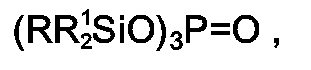
worin R und R² die oben dafür angegebene Bedeutung haben, oder deren Teilhydrolysaten mit Orthophosphorsäure, Phosphoriger Säure oder Phosphorpentoxyd oder deren Gemischen ist z.B. aus US 3 767 432 (ausgegeben 23. Oktober 1973, I.M. Thomas, Owens-Illinois, Inc.) bekannt. - Als Organosiliciumverbindung der Formel

ist Tris-(trimethylsiloxy)-phosphat besonders bevorzugt. - Als Umsetzungsprodukte von Silanen der Formel
RSi(OR²)₃
mit Orthophosphorsäure sind Umsetzungsprodukte von Phenyltriethoxysilan mit Orthophosphorsäure besonders bevorzugt. - Einzelne Beispiele für von Phosphor freie organische Siliciumverbindungen, die zusätzlich zu Phosphor enthaltender Organosiliciumverbindung in den erfindungsgemäß verwendeten Lösungen vorliegen können, sind Methyltrimethoxysilan, Phenyltriethoxysilan, Tetramethoxysilan, Tetraethoxysilan und 3-Methacryloxypropyltrimethoxysilan.
- Als organische aprotische Lösungsmittel sind polare organische, aprotische Lösungsmittel bevorzugt. Unter diesen polaren Lösungsmitteln sind wiederum Essigsäureester von 1 bis 4 Kohlenstoffatome je Molekül aufweisenden Alkanolen, insbesondere Essigsäureethylester, besonders bevorzugt. Weitere Beispiele für im Rahmen des erfindungsgemäßen Verfahrens verwendbare polare, organische, aprotische Lösungsmittel sind Chlorkohlenwasserstoffe, wie Methylenchlorid, 1,2-Dichlorethan, 1,1,1-Trichlorethan, 1,2-Dichlorethan, 1,1,2-Trichlorethylen, Perchlorethylen und Chlorbenzol; Ketone, wie Methylethylketon und Cyclohexanon; sowie Ether, wie Di-sec.-butylether.
- Es kann eine Art von organischem Lösungsmittel verwendet werden. Es können aber auch Gemische aus mindestens zwei verschiedenen Arten derartiger Lösungsmittel verwendet werden.
- Vorzugsweise enthalten die erfindungsgemäß verwendeten Lösungen 0,001 bis 0,15, bevorzugter 0,003 bis 0,05, insbesondere 0,005 bis 0,03 Grammatom Phosphor, der in den erfindungsgemäß verwendeten, Phosphor enthaltenden Organosiliciumverbindungen vorliegt, je 100 g ihres Gesamtgewichts.
- Vorzugsweise sind die Carbonat enthaltenden Oberflächen vor dem Auftragen der erfindungsgemäß verwendeten Lösungen frei von fettartigen Stoffen und anderen Verunreinigungen, wie Staub. Vor dem Auftragen der erfindungsgemäß verwendeten Lösungen können die Carbonat enthaltenden Oberflächen trocken oder, weil auf ihnen Wasser oder Lösungsmittel adsorbiert ist, feucht sein. Vorzugsweise sind sie etwas feucht, weil auf ihnen Wasser adsorbiert ist.
- Das Auftragen der erfindungsgemäß verwendeten Lösungen auf die damit zu behandelnden Carbonat enthaltenden Oberflächen kann in beliebiger für das Auftragen von Lösungen in aprotischem organischem Lösungsmittel auf Oberflächen von normalerweise festen Stoffen geeigneter Weise, z.B. durch Aufsprühen, Gießen, Streichen, Walzen oder Tauchen bzw. durch Vermischen mit Carbonat enthaltendem Pulver oder Mehl, erfolgen.
- Die Entfernung von Lösungsmittel von mit erfindungsgemäß verwendeter Lösung behandelter Carbonat enthaltender Oberfläche, bevor diese mit polymerem oder zu Polymer vernetzbarem Stoff, dessen Haften auf dieser Oberfläche verstärkt werden soll, in Berührung gebracht wird, kann durch Verdunsten lassen oder Verdampfen des Lösungsmittels erfolgen.
- Bei den polymeren Stoffen, die organische Gruppen enthalten oder aus solchen Gruppen aufgebaut sind und mit den mit erfindungsgemäßer Lösung vorbehandelten Carbonat enthaltende Oberflächen nach dem Entfernen des Lösungsmittels von diesen Oberflächen in Berührung gebracht werden, kann es sich um beliebige polymere Stoffe handeln, die organische Gruppen enthalten oder aus solchen Gruppen bestehen, mit denen auch bisher Carbonat enthaltende Oberflächen überzogen oder imprägniert würden oder in deren auch bisher Carbonate als Füllstoffe oder Verstärkungsmittel vorliegen konnten. Dabei können sich die polymeren Stoffe auch aus niedermolekularen Stoffen, wie Methyltriethoxysilan, erst nach der Berührung mit der Carbonat enthaltende Oberfläche bilden.
- Bevorzugte Beispiele für polymere Stoffe, die organische Gruppen enthalten oder aus solchen Gruppen aufgebaut sind und mit den mit erfindungsgemäß verwendeter Lösung vorbehandelten Carbonat enthaltende Oberflächen nach dem Entfernen des Lösungsmittels von diesen Oberflächen in Berührung gebracht werden können, sind solche, die zumindest teilweise aus sich von Alkylester oder Amiden der Acrylsäure oder Meth-acrylsäure ableitenden Einheiten und gegebenenfalls sich von Acryloxyalkylsilanen, insbesondere 3-Acryloxypropylsilanen, wie 3-Acryloxypropyltrimethoxysilan, und/oder Methacryloxyalkylsilanen, insbesondere 3-Methacryloxypropylsilanen, wie 3-Methacryloxypropyltrimethoxysilan, ableitenden Einheiten aufgebaut sind.
- Weitere Beispiele für polymere Stoffe, die aus organischen Gruppen aufgebaut sind und mit den mit erfindungsgemäß verwendeter Lösung vorbehandelten Carbonat enthaltenden Oberflächen nach dem Entfernen des Lösungsmittels von diesen Oberflächen in Berührung gebracht werden können bzw. für niedermolekulare Stoffe, aus denen sich derartige Polymere auf diesen Oberflächen bilden können, sind Organoalkoxysilane, außer dem bereits genannten Methyltriethoxysilan z.B. Phenyltriethoxysilan, oder deren Teilhydrolysate oder thermoplastische oder duroplastische Organopolysiloxane, einschließlich Organopolysiloxanelastomeren, Epoxyharze, Polyester und Polyamide.
- Auf die erfindungsgemäß vorbehandelten Carbonat enthaltenden Oberflächen kann eine Schicht von polymerem Stoff aufgetragen bzw. auf diesen Oberflächen erzeugt werden. Auf die erfindungsgemäß vorbehandelten Carbonat enthaltende Oberflächen könnnen aber auch mindestens zwei Schichten aus gleichem oder verschiedenem polymerem Stoff aufgetragen bzw. auf diesen Oberflächen erzeugt werden.
- Die polymeren Stoffe, die aus organischen Gruppen aufgebaut sind oder solche Gruppen enthalten bzw. die zu Polymeren vernetzbar sind, können auf die mit erfindungsgemäß verwendeter Lösung vorbehandelten Carbonat enthaltender Oberflächen nach dem Entfernen des Lösungsmittels von diesen Oberflächen in beliebiger Weise in Berührung gebracht werden, in der polymere Stoffe der vorstehend definierten Art auch bisher in Berührung mit Oberflächen gebracht werden konnten, z.B. durch Vermischen von aus Carbonat bestehenden oder Carbonat enthaltenden, erfindungsgemäß vorbehandelten Füllstoffen mit derartigen polymeren Stoffen oder durch Auftragen derartiger polymerer Stoffe auf die zu überziehenden Oberflächen, z.B. durch Streichen, Sprühen, Gießen, Walzen oder Tauchen. Dabei können die polymeren Stoffe in unverdünnter Form, soweit ihre Viskositat dies zuläßt, oder in Form von Lösungen oder Dispersionen angewandt werden.
- Das erfindungsgemäße Verfahren eignet sich hervorragend zur Verstärkung des Haftens von Bautenschutzmitteln, beispielsweise Steinfestigern, vorzugsweise solchen auf der Basis von Kieselsäureestern, insbesondere Tetramethylsilicat, Tetraethylsilicat (Tetraethoxysilan) und deren Teilhydrolysaten auf Carbonat enthaltendem Kunst- oder Naturstein. Es eignet sich auch zur Verstärkung des Haftens des Bindemittels bei der Herstellung von anorganisches Carbonat enthaltendem Kunststein. Bei diesen Anwendungen ist es oft vorteilhaft, auf die erfindungsgemäß vorbehandelten Oberflächen ein Gemische von Kieselsäureestern und/oder deren Teilhydrolysaten mit Siliconharzen aufzubringen. Die erwähnten Bautenschutzmittel bzw. Bindemittel auf der Basis von Kieselsäureester werden vorzugsweise in Lösungsmitteln, insbesondere in organischen Lösungsmitteln gelöst bzw. dispergiert, auf die vorbehandelten Oberflächen aufgebracht. Als solche Lösungsmittel sind Alkohole, insbesondere Methanol, Ethanol, n-Propanol, i-Propanol, n-Butanol, sec.-Butanol, tert.-Butanol, Pentanole, Hexanole; Aromaten, insbesondere Toluol, m-, o- und p-Xylol; Ketone, insbesondere Aceton, Methylethylketon, Methylisobutylketon, Methyl-n- oder -i-propylketon; Ester, insbesondere Methylacetat, Ethylacetat, n-Propylacetat, i-Propylacetat, n-, sec.- und tert.-Butylacetat; sowie Gemische der vorgenannten Lösungsmittel. Für weitere Details bezüglich der verwendbaren Bautenschutzmittel und deren Anwendung sei auf US-PS 3 955 988 und CA-PS 1 128 685 (jeweils M. Roth et al., Wacker-Chemie GmbH) verwiesen.
- Selbstverständlich kann das erfindungsgemäße Verfahren auch auf nicht Carbonat enthaltenden Kunst- oder Natursteinoberflächen durchgeführt werden.
- In den folgenden Beispielen beziehen sich alle Angaben von Teilen und Prozentsätzen auf das Gewicht, soweit nichts anderes angegeben ist.
- Bei jedem der in der folgenden Tabelle I bezifferten Beispiele wird jeweils 1g einer Lösung aus
5% Tris-(trimethylsiloxy)-phosphat, 5% Phenyltriethoxysilan und 90% Essigsäureethylester (Beispiele 1 und 5)
2,5% Tris-(trimethylsiloxy)-phosphat, 5% Phenyltriethoxysilan und 92,5% Essigsäureethylester (Beispiel 2)
10% Tris-(trimethylsiloxy)-phosphat, 5% Phenyltriethoxysilan und 85% Essigsäureethylester (Beispiel 3)
5% Tris-(trimethylsiloxy)-phosphat, 10% Phenyltriethoxysilan und 85% Essigsäureethylester (Beispiel 4)
auf 100 cm² große Oberflächen von polierten Platten der in Tabelle I angegebenen Gesteinsart aufgetragen, die vorher mit von Fremdionen befreitem Wasser gespült und eine Stunde bei Raumtemperatur stehen gelassen wurden, sodaß sie beim Auftragen der Lösung noch feucht sind. - Dann werden die Platten 4 Stunden bei Raumtemperatur stehengelassen, um das Lösungsmittel durch Verdunsten zu entfernen. Danach wird auf die so vorbehandelten Erdalkalicarbonat enthaltende Oberflächen ein handelsüblicher Lack auf Grundlage eines Mischpolymerisats von Methacrylsäuremethylester und Methacrylsäureethylester ("Paraloid B 72", wobei die Bezeichnung "Paraloid" ein Registriertes Warenzeichen ist, der Fa. Rohm & Haas Co., Philadelphia, PA., USA) aufgetragen. Die Bewertung der Stärke des Haftens der Beschichtung auf der Calciumcarbonat-oberfläche erfolgt durch Gitterschnittprüfung nach DIN (Deutsche Industrie Norm) 53 151 vom Mai 1981. Dabei ist die Stärke des Haftens der Beschichtung bei einem Gitterschnitt-Kennwert von 0 am höchsten. Je höher der Gitterschnitt-Kennwert ist, desto schwächer ist das Haften der Beschichtung auf der Unterlage.

- Bei jedem der in der folgenden Tabelle II bezifferten Beispiele wird jeweils 1 g einer Lösung aus
5% Tris-(trimethylsiloxy)-phosphat, 5% Phenyltriethoxysilan
und 90% Essigsäureethylester (Beispiel 6, 8 und 9) bzw. - 10% eines Umsetzungsprodukts von Phenyltriethoxysilan mit Orthophosphorsäure und 90% Essigsäureethylester (Beispiel 7),wobei dieses Umsetzungsprodukt von Phenyltriethoxysilan mit Orthophosphorsäure durch Erwärmen eines Gemisches aus 88 Teilen Phenyltriethoxysilan, 12 Teilen wasserfreier Orthophosphorsäure und 500 Teilen Toluol zum Sieden unter Rückfluß, bis in einer Dean-Stark-Falle die Ethanolmenge gleich blieb, was etwa 8 Stunden erforderte, Abdestillieren des Toluols und Lösen des Rückstands in Essigsäureethylester hergestellt wurde,
auf 100 cm² große Oberflächen von polierten Platten der in Tabelle II angegebenen Gesteinsart aufgetragen, die vorher mit von Fremdionen befreitem Wasser gespült und eine Stunde bei Raumtemperatur stehen gelassen wurden, sodaß sie beim Auftragen der Lösung noch feucht sind. - Dann werden die Platten 4 Stunden bei Raumtemperatur stehen gelassen, um das Lösungsmittel durch Verdunsten zu entfernen. Dann wird auf die so vorbehandelten Erdalkalicarbonat enthaltende Oberfläche n ein handelsüblicher Lack auf Grundlage eines Mischpolymerisats aus 86% Methacrylsäuremethylester, 12% Acrylsäure-2-hydroxyethylester und 2% 3-Methacryloxypropyltrimethoxysilan aufgetragen. Die Bewertung der Stärke des Haftens der Beschichtung auf der Calciumcarbonatoberfläche erfolgt wie in Beispiel 1 beschrieben.

- In den folgenden Beispielen wurden erfindungsgemäß beschichtete pulverförmige Kreide (Beispiele 10 bis 13) bzw. käufliche unbehandelte oder mit Stearat behandelte Kreide (Vergleichsbeispiele f, g und h) als Füllstoffe in Kunststoffen eingesetzt.
-
- 1)Vergleichsbeispiele g und h: Unbehandelte Kreide (Omyalite 90;mittlere Teilchengröße 1µm;Omya GmbH,5000 Köln)
- 2)Vergleichsbeispiel f: Mit Stearat beschichtete Kreide. (Omyalite 95T;mittlere Teilchengröße 1µm;Omya GmbH,5000 Köln)
- 3)Beispiele 10 und 12: Kreide (Omyalite 90) beschichtet mit OP(OSi(CH₃)₃)₃
- 4)Beispiele 11: Kreide (Omyalite 90) beschichtet mit OP(OSi(CH₃)₃)₃ und Phenyltrimethoxysilan.
- Beispiele 10 und 11, Vergleichsbeispiele f und g:
- 100
- Gewichtsteile Ethylen-Vinylacetat-Copolymer (Levapren 450 der Bayer AG, D-5090 Leverkusen)
- 40
- Gewichtsteile Füllstoff wie oben angegeben
- 2
- Gewichtsteile Triallylcyanurat
- 4
- Gewichtsteile einer 40 Gew.%igen Lösung von Bis(t-butylperoxyisopropyl)benzol (Perkadox 14/40 der Akzo-Chemie, D-5160 Düren)
- 1
- Gewichtsteil Stearinsäure
- Beispiel 12, Vergleichsbeispiel h:
- 45
- Gewichtsteile eines endständige Hydroxylgruppen aufweisenden Polydimethylsiloxans einer Viskosität von 80 mm²/s bei 25° (FD 80 der Wacker-Chemie GmbH, D-8000 München)
- 60
- Gewichtsteile Füllstoff wie oben angegeben
- 7
- Gewichtsteile hochdisperse Kieselsäure einer BET-Oberfläche von 150 m²/g
- 30
- Gewichtsteile Siliconöl (AK 100 der Wacker-Chemie GmbH, D-8000 München
- 7,5
- Gewichtsteile Vernetzer auf Oximbasis (Vernetzer BO 30 der Wacker-Chemie GmbH)
- 0,15
- Gewichtsteile Katalysator (Katalysator 41 der Wacker-Chemie GmbH, D-8000 München)
- Herstellung von Kunststein:
- Mischung A:
Mischung bestehend aus 2 Gewichtsteilen Dibutylzinndilaurat und 100 Gewichtsteilen einer Mischung eines Teilhydrolysats von Tetraethoxysilan mit einem SiO₂-Gehalt von 34 Gew.%. - Mischung B:
Eine 2 Gew.%ige Lösung einer Mischung aus 9 Gewichtsteilen Phenyltriethoxysilan und 1 Gewichtsteil Trimethylsilylphosphat in Aceton. - Mischung C:
Eine 2 Gew.%ige Lösung von Vinyltriethoxysilan in Aceton. - Herstellung der Formkörper:
Hundert Gewichtsteile eines gegebenenfalls wie nachstehend geschildert vorbehandelten Calcits einer Korngrößenverteilung von 0,1 bis 0,5 mm wurden mit 20 Gewichtsteilen Mischung A vermischt und in eine Ringform mit einem Durchmesser von 75 mm und einer Höhe von 10 mm gefüllt. Nach 4 Tagen wurde der so hergestellte Formkörper nochmals mit 10 Gewichtsteilen Mischung A und nach weiteren 14 Tagen schließlich mit 5 Gewichtsteilen Mischung A getränkt.
Vergleichsbeispiel i: Nicht vorbehandelter Calcit. - Beispiel 13: Der Calcit wurde 24 h bei 70 °C getrocknet, anschließend in Mischung B suspendiert, von der überschüssigen Mischung B dekantiert und bei Raumtemperatur getrocknet.
- Vergleichsbeispiel j: Beispiel 13 wurde wiederholt mit der Abänderung, daß statt Mischung B Mischung C eingesetzt wurde.
- Für jeweils acht gleichbehandelte Formkörper wurden die Haftzugfestigkeiten an einem Herion FluidtronikR Meßgerät (Hersteller: Herion Werke KG, D-7012 Fellbach) mit Stempeln von 50 mm Durchmesser gemessen und die Durchschnittswerte dieser Messungen ermittelt. Folgende Resultate wurden erzielt:


Claims (10)
- Verfahren zur Verstärkung des Haftens von polymeren Stoffen, die organische Gruppen enthalten oder aus solchen Gruppen aufgebaut sind oder von organische Gruppen enthaltenden Stoffen, die zu Polymeren vernetzbar sind, auf anorganisches Carbonat, vorzugsweise Erdalkalicarbonat, enthaltenden Oberflächen, wobei bevor polymerer bzw. zu Polymer vernetzbarer Stoff der vorstehend definierten Art in Berührung mit der anorganisches Carbonat enthaltenden Oberfläche, auf der er stärker haften soll, gebracht wird, auf diese anorganisches Carbonat enthaltenden Oberfläche eine Lösung einer Phosphorverbindung aufgetragen und dann das Lösungsmittel entfernt wird, dadurch gekennzeichnet, daß die Phosphorverbindung eine Phosphorsäure oder eine Phosphor enthaltende Organosiliciumverbindung mit mindestens einer Gruppe der Formel
RSiOP=O ,
worin R einen SiC-gebundenen, einwertigen, gegebenenfalls substituierten Kohlenwasserstoffrest bedeutet, aufweist und daß das Lösungsmittel organisch und aprotisch ist. - Verfahren nach Anspruch 1, dadurch gekennzeichnet, daß die Phosphor enthaltende Organosiliciumverbindung solche der Formel

R₃SiO1/2,
worin R die in Anspruch 1 dafür angegebene Bedeutung hat, oder aus 2 bis 10 Siloxaneinheiten der Formel
RSiO3/2, R₂SiO oder SiO4/2,
worin R ebenfalls die in Anspruch 1 dafür angegebene Bedeutung hat, oder einem Gemisch aus mindestens 2 derartiger Siloxaneinheiten und gegebenenfalls Einheiten der Formel
R₃SiO1/2,
wobei R ebenfalls die in Anspruch 1 dafür angegebene Bedeutung hat, aufgebaute Reste bedeutet. - Verfahren nach Anspruch 1, dadurch gekennzeichnet, daß die Phosphor enthaltende Organosiliciumverbindung ein 0,005 bis 0,33 Phosphoratome je Siliciumatom in dieser Organosiliciumverbindung enthaltendes Umsetzungsprodukt von Silan der Formel
RSi(OR²)₃,
worin R die in Anspruch 1 dafür angegebene Bedeutung hat und R² gleiche oder verschiedene Alkyl- oder Alkoxyalkylenreste mit jeweils höchstens 4 Kohlenstoffatomen je Rest bedeutet, oder dessen höchstens 15 Siliciumatome je Molekül enthaltenden Teilhydrolysaten mit Orthophosphorsäure ist. - Verfahren nach Anspruch 2, dadurch gekennzeichnet, daß die Phosphor enthaltende Organosiliciumverbindung Tris-(trimethylsiloxy)-phosphat ist.
- Verfahren nach mindestens einem der Ansprüche 1 bis 4, dadurch gekennzeichnet, daß die Lösung zusätzlich zu Phosphor enthaltender Organosiliciumverbindung mindestens eine von Phosphor freie organische Siliciumverbindung enthält.
- Verfahren nach Anspruch 5, dadurch gekennzeichnet, daß die von Phosphor freie organische Siliciumverbindung Phenyltriethoxysilan ist.
- Verfahren nach mindestens einem der Ansprüche 1 bis 6, dadurch gekennzeichnet, daß die anorganisches Carbonat enthaltende Oberfläche diejenige von carbonatischen oder calcitischen Natursteinen, Kunststeinen, Sanden und Kiesen oder diejenige von pulver- oder faserförmigem anorganischem Carbonat, wie Füllstoffen oder Pigmenten, ist.
- Verfahren nach mindestens einem der Ansprüche 1 bis 7, wobei die anorganisches Carbonat enthaltende Oberfläche die Oberfläche eines Stoffes ist, der zu mindestens zu 50 Gewichtsprozent aus Erdalkalicarbonat besteht.
- Verfahren nach mindestens einem der Ansprüche 1 bis 8 wobei Natur- und/oder Kunststein gefestigt wird.
- Verfahren nach mindestens einem der Ansprüche 1 bis 9, wobei die polymeren Stoffe, die organische Gruppen enthalten oder aus solchen aufgebaut sind beziehungsweise die organische Gruppen enthaltenden Stoffe, die zu Polymeren vernetzbar sind, Tetramethylsilikat, Tetraethylsilikat, deren Teilhydrolysate oder zu Polymeren vernetzbare Organosilane oder Polyorganosiloxane sind.
Applications Claiming Priority (2)
| Application Number | Priority Date | Filing Date | Title |
|---|---|---|---|
| DE3914874 | 1989-05-05 | ||
| DE3914874A DE3914874A1 (de) | 1989-05-05 | 1989-05-05 | Verfahren zur verstaerkung des haftens von polymeren stoffen an carbonatoberflaechen |
Publications (2)
| Publication Number | Publication Date |
|---|---|
| EP0405095A1 EP0405095A1 (de) | 1991-01-02 |
| EP0405095B1 true EP0405095B1 (de) | 1993-11-03 |
Family
ID=6380174
Family Applications (1)
| Application Number | Title | Priority Date | Filing Date |
|---|---|---|---|
| EP90108355A Expired - Lifetime EP0405095B1 (de) | 1989-05-05 | 1990-05-03 | Verfahren zur Verstärkung des Haftens von polymeren Stoffen an inorganischen Carbonatoberflächen |
Country Status (3)
| Country | Link |
|---|---|
| US (1) | US5063087A (de) |
| EP (1) | EP0405095B1 (de) |
| DE (2) | DE3914874A1 (de) |
Families Citing this family (9)
| Publication number | Priority date | Publication date | Assignee | Title |
|---|---|---|---|---|
| DE19507416C1 (de) * | 1995-03-03 | 1996-09-19 | Bayer Ag | Kondensationsvernetzende Polysiloxanmassen, ein Verfahren zu deren Herstellung sowie deren Verwendung |
| US5795620A (en) * | 1995-10-12 | 1998-08-18 | Kennecott Greens Creek Mining Company | Retarding the leaching of metal values from waste rock |
| JP3500257B2 (ja) | 1996-10-30 | 2004-02-23 | ジーイー東芝シリコーン株式会社 | 難燃性シリコーンゴム組成物およびそれを用いたシリコーンゴム碍子 |
| DE19751857A1 (de) * | 1997-11-22 | 1999-05-27 | Kronos Titan Gmbh | Phosphonatosiloxanbehandelte anorganische Partikel |
| WO2008137167A1 (en) * | 2007-05-07 | 2008-11-13 | Questech Corporation | Method for sealing natural stone |
| US7875674B2 (en) * | 2008-05-01 | 2011-01-25 | Wacker Chemical Corporation | Building materials incorporated with hydrophobic silicone resin(s) |
| US20090301027A1 (en) * | 2008-06-06 | 2009-12-10 | David Pelletier | Compositions and methods for sealing natural stone tiles and natural stone articles |
| EP2418241B1 (de) * | 2010-08-12 | 2016-02-17 | Bene_fit Systems GmbH & Co. KG | Magnesiumcarbonathaltiges füllmaterial für verbundmaterialien, dessen herstellung und verwendung |
| US9809497B2 (en) * | 2015-12-01 | 2017-11-07 | Wacker Chemical Corporation | Omniphobic grout additive |
Family Cites Families (10)
| Publication number | Priority date | Publication date | Assignee | Title |
|---|---|---|---|---|
| US3382083A (en) * | 1964-03-05 | 1968-05-07 | Union Carbide Corp | Filled inorganic structural compositions having improved strength |
| US3767432A (en) * | 1971-04-08 | 1973-10-23 | Owens Illinois Inc | PRODUCTION OF P{11 O{11 -SiO{11 {11 PRODUCTS |
| BE790735A (fr) * | 1971-11-03 | 1973-02-15 | Dynamit Nobel Ag | Application de phosphoro-organosilanes comme promoteurs d'adhesion |
| AU504536B2 (en) * | 1975-10-02 | 1979-10-18 | Sws Silicones Corporation | Bonding rtv silicone rubbers |
| DE2653499C3 (de) * | 1976-11-25 | 1980-05-08 | Wacker-Chemie Gmbh, 8000 Muenchen | Unter Ausschluß von Wasser lagerfähige bei Zutritt desselben bei Raumtemperatur zu Elastomeren vernetzende Organopolysiloxanformmassen |
| US4177200A (en) * | 1977-11-25 | 1979-12-04 | General Electric Company | Silyl phosphates as neutralizing agents for alkali metal hydroxides |
| IT1205310B (it) * | 1983-12-27 | 1989-03-15 | Anic Spa | Composizioni organo-silossaniche per rivestimenti protettivi resistenti all'abrasione e promotori di adesione |
| DE3406266A1 (de) * | 1984-02-21 | 1985-08-29 | Wacker-Chemie GmbH, 8000 München | Verfahren zur herstellung von schutzueberzuegen auf beschichtungen aus asphaltbeton und ueberzogene beschichtungen |
| JPH0639567B2 (ja) * | 1986-05-22 | 1994-05-25 | 東レ・ダウコ−ニング・シリコ−ン株式会社 | 硬化性オルガノポリシロキサン組成物 |
| DE3711225A1 (de) * | 1987-04-03 | 1988-10-13 | Wacker Chemie Gmbh | Verfahren zur verstaerkung des haftens von polymeren stoffen |
-
1989
- 1989-05-05 DE DE3914874A patent/DE3914874A1/de not_active Withdrawn
-
1990
- 1990-03-29 US US07/501,109 patent/US5063087A/en not_active Expired - Fee Related
- 1990-05-03 EP EP90108355A patent/EP0405095B1/de not_active Expired - Lifetime
- 1990-05-03 DE DE90108355T patent/DE59003298D1/de not_active Expired - Fee Related
Also Published As
| Publication number | Publication date |
|---|---|
| US5063087A (en) | 1991-11-05 |
| DE3914874A1 (de) | 1990-11-08 |
| DE59003298D1 (de) | 1993-12-09 |
| EP0405095A1 (de) | 1991-01-02 |
Similar Documents
| Publication | Publication Date | Title |
|---|---|---|
| DE2422846C3 (de) | Verfahren zur Herstellung von Organopolysiloxanmassen | |
| DE2523224C3 (de) | Verfahren zum Verstärken des Haftens von Organopolysiloxanelastomeren | |
| EP0242798B1 (de) | Wässerige Emulsionen von Organopolysiloxan und Verwendung solcher Emulsionen | |
| EP0000929B1 (de) | Zu Elastomeren vernetzende Massen auf Basis von Polysiloxanen | |
| DE2738026C2 (de) | ||
| DE3447636A1 (de) | Bei verduennen mit wasser durchsichtige gemische ergebende, polysiloxan enthaltende zusammensetzungen | |
| DE3524452A1 (de) | Rtv-siliconpasten mit verkuerzter aushaertungszeit | |
| DE102017107591A1 (de) | Verfahren zum Herstellen von Kunststein | |
| DE2259802A1 (de) | Verfahren zum herstellen von plastischen, rueckprallelastizitaet aufweisenden massen aus organopolysiloxanen | |
| DE2244644C2 (de) | ||
| DE2507362A1 (de) | Acetoxysiloxanzubereitung | |
| EP3433321A1 (de) | Vernetzbare massen auf der basis von organosiliciumverbindungen | |
| EP0618242A2 (de) | Selbsthärtende Systeme | |
| EP0603747B1 (de) | Zusammensetzungen zur Imprägnierung von mineralischen Baustoffen | |
| EP1000121A1 (de) | Unter abspaltung von alkoholen zu elastomeren vernetzbare organopolysiloxanmassen | |
| EP0405095A1 (de) | Verfahren zur Verstärkung des Haftens von polymeren Stoffen an inorganischen Carbonatoberflächen | |
| DE2631889A1 (de) | Hitzehaertbare organopolysiloxanzubereitungen | |
| EP0018634A1 (de) | Zu Elastomeren vernetzbare Massen | |
| EP0772643A1 (de) | Katalysator zur herstellung und verarbeitung von polyorganosiloxanen | |
| EP0073446B1 (de) | Silikonkautschuk mit verzögerter Hautbildung | |
| DE1745498B2 (de) | Nach zutritt von feuchtigkeit bei raumtemperatur zu elastomeren haertende gemische von linearen organopolysiloxaminen und organosiliciumverbindungen | |
| DE1260140B (de) | Unter Ausschluss von Wasser lagerfaehige, bei Raumtemperatur zu Elastomeren haertende Organopolysiloxanformmassen | |
| DE2911301C2 (de) | Bei Raumtemperatur zu Elastomeren vernetzbare Formmassen | |
| DE2044684A1 (de) | Organopolysiloxane im Gemisch mit einem thixotrop machenden Zusatz | |
| EP0285092B1 (de) | Verfahren zur Verstärkung des Haftens von polymeren Stoffen |
Legal Events
| Date | Code | Title | Description |
|---|---|---|---|
| PUAI | Public reference made under article 153(3) epc to a published international application that has entered the european phase |
Free format text: ORIGINAL CODE: 0009012 |
|
| 17P | Request for examination filed |
Effective date: 19900503 |
|
| AK | Designated contracting states |
Kind code of ref document: A1 Designated state(s): CH DE FR GB IT LI |
|
| RAP1 | Party data changed (applicant data changed or rights of an application transferred) |
Owner name: WACKER-CHEMIE GMBH |
|
| 17Q | First examination report despatched |
Effective date: 19920819 |
|
| ITF | It: translation for a ep patent filed | ||
| GRAA | (expected) grant |
Free format text: ORIGINAL CODE: 0009210 |
|
| AK | Designated contracting states |
Kind code of ref document: B1 Designated state(s): CH DE FR GB IT LI |
|
| REF | Corresponds to: |
Ref document number: 59003298 Country of ref document: DE Date of ref document: 19931209 |
|
| GBT | Gb: translation of ep patent filed (gb section 77(6)(a)/1977) |
Effective date: 19931207 |
|
| ET | Fr: translation filed | ||
| PLBE | No opposition filed within time limit |
Free format text: ORIGINAL CODE: 0009261 |
|
| STAA | Information on the status of an ep patent application or granted ep patent |
Free format text: STATUS: NO OPPOSITION FILED WITHIN TIME LIMIT |
|
| 26N | No opposition filed | ||
| PGFP | Annual fee paid to national office [announced via postgrant information from national office to epo] |
Ref country code: FR Payment date: 19980420 Year of fee payment: 9 |
|
| PGFP | Annual fee paid to national office [announced via postgrant information from national office to epo] |
Ref country code: GB Payment date: 19980427 Year of fee payment: 9 |
|
| PGFP | Annual fee paid to national office [announced via postgrant information from national office to epo] |
Ref country code: CH Payment date: 19980505 Year of fee payment: 9 |
|
| PG25 | Lapsed in a contracting state [announced via postgrant information from national office to epo] |
Ref country code: GB Free format text: LAPSE BECAUSE OF NON-PAYMENT OF DUE FEES Effective date: 19990503 |
|
| PG25 | Lapsed in a contracting state [announced via postgrant information from national office to epo] |
Ref country code: LI Free format text: LAPSE BECAUSE OF NON-PAYMENT OF DUE FEES Effective date: 19990531 Ref country code: CH Free format text: LAPSE BECAUSE OF NON-PAYMENT OF DUE FEES Effective date: 19990531 |
|
| GBPC | Gb: european patent ceased through non-payment of renewal fee |
Effective date: 19990503 |
|
| REG | Reference to a national code |
Ref country code: CH Ref legal event code: PL |
|
| PG25 | Lapsed in a contracting state [announced via postgrant information from national office to epo] |
Ref country code: FR Free format text: LAPSE BECAUSE OF NON-PAYMENT OF DUE FEES Effective date: 20000131 |
|
| REG | Reference to a national code |
Ref country code: FR Ref legal event code: ST |
|
| PGFP | Annual fee paid to national office [announced via postgrant information from national office to epo] |
Ref country code: DE Payment date: 20001227 Year of fee payment: 11 |
|
| PG25 | Lapsed in a contracting state [announced via postgrant information from national office to epo] |
Ref country code: DE Free format text: LAPSE BECAUSE OF NON-PAYMENT OF DUE FEES Effective date: 20020301 |
|
| PG25 | Lapsed in a contracting state [announced via postgrant information from national office to epo] |
Ref country code: IT Free format text: LAPSE BECAUSE OF NON-PAYMENT OF DUE FEES Effective date: 20050503 |