EP0404077B1 - Verfahren zur Herstellung von Propargylcarbinolen - Google Patents
Verfahren zur Herstellung von Propargylcarbinolen Download PDFInfo
- Publication number
- EP0404077B1 EP0404077B1 EP90111592A EP90111592A EP0404077B1 EP 0404077 B1 EP0404077 B1 EP 0404077B1 EP 90111592 A EP90111592 A EP 90111592A EP 90111592 A EP90111592 A EP 90111592A EP 0404077 B1 EP0404077 B1 EP 0404077B1
- Authority
- EP
- European Patent Office
- Prior art keywords
- group
- substituted
- phenyl
- phenoxy
- halogen atoms
- Prior art date
- Legal status (The legal status is an assumption and is not a legal conclusion. Google has not performed a legal analysis and makes no representation as to the accuracy of the status listed.)
- Expired - Lifetime
Links
Classifications
-
- C—CHEMISTRY; METALLURGY
- C07—ORGANIC CHEMISTRY
- C07C—ACYCLIC OR CARBOCYCLIC COMPOUNDS
- C07C29/00—Preparation of compounds having hydroxy or O-metal groups bound to a carbon atom not belonging to a six-membered aromatic ring
- C07C29/36—Preparation of compounds having hydroxy or O-metal groups bound to a carbon atom not belonging to a six-membered aromatic ring increasing the number of carbon atoms by reactions with formation of hydroxy groups, which may occur via intermediates being derivatives of hydroxy, e.g. O-metal
- C07C29/38—Preparation of compounds having hydroxy or O-metal groups bound to a carbon atom not belonging to a six-membered aromatic ring increasing the number of carbon atoms by reactions with formation of hydroxy groups, which may occur via intermediates being derivatives of hydroxy, e.g. O-metal by reaction with aldehydes or ketones
-
- C—CHEMISTRY; METALLURGY
- C07—ORGANIC CHEMISTRY
- C07C—ACYCLIC OR CARBOCYCLIC COMPOUNDS
- C07C29/00—Preparation of compounds having hydroxy or O-metal groups bound to a carbon atom not belonging to a six-membered aromatic ring
- C07C29/58—Preparation of compounds having hydroxy or O-metal groups bound to a carbon atom not belonging to a six-membered aromatic ring by elimination of halogen, e.g. by hydrogenolysis, splitting-off
-
- C—CHEMISTRY; METALLURGY
- C07—ORGANIC CHEMISTRY
- C07C—ACYCLIC OR CARBOCYCLIC COMPOUNDS
- C07C33/00—Unsaturated compounds having hydroxy or O-metal groups bound to acyclic carbon atoms
- C07C33/04—Acyclic alcohols with carbon-to-carbon triple bonds
- C07C33/042—Acyclic alcohols with carbon-to-carbon triple bonds with only one triple bond
-
- C—CHEMISTRY; METALLURGY
- C07—ORGANIC CHEMISTRY
- C07C—ACYCLIC OR CARBOCYCLIC COMPOUNDS
- C07C2601/00—Systems containing only non-condensed rings
- C07C2601/12—Systems containing only non-condensed rings with a six-membered ring
- C07C2601/14—The ring being saturated
Definitions
- the present invention relates to a process for producing propargylcarbinols useful as intermediates for agrochemicals, pharmaceuticals, perfumes, resin monomers, and the like.
- Propargylcarbinols have been heretofore produced by a Grignard reaction of propargyl bromide or propargyl chloride and a ketone or aldehyde compound.
- EP-A-0 247 589 relates to a method for producing a furfuryl alcohol represented by the general formula, wherein R1 represents a hydrogen atom or a methyl group, and R2 represents an allyl or propargyl group.
- a furfuryl alcohol represented by the above general formula is a useful intermediate for producing agricultural chemicals, medicines, perfumes, etc.
- the present inventors have found a process for producing a propargylcarbinol by dehalogenation with a base through a haloallylcarbinol, derived from a ketone compound or an aldehyde compound and 2,3-dihalo-1-propene, without using propargyl bromide or propargyl chloride.
- the present invention relates to a haloallylcarbinol-producing reaction (step 1) for producing a haloallylcarbinol compound of the formula (II) (sometimes referred to as haloallylcarbinol Compound II hereinafter) where R1 and R2 independently represent a hydrogen atom; a C1-C15 alkyl group which may be substituted with at least one member selected from the group consisting of halogen atoms, a hydroxyl group, a phenyl group, a phenoxy group, a phenyl or phenoxy group substituted with at least one member selected from the group consisting of halogen atoms and hydroxyl, alkoxy, phenoxy, dialkylamino and methylenedioxy groups, an aralkyloxy group, a dialkylamino group, an alkylthio group, a phenylthio group, a biphenyl group and a phenylalkyl group; a C2-C
- step 2 for producing a propargylcarbinol compound (referred to as propargylcarbinol Compound (I) hereinafter) of the formula (I): where R1 and R2 are as defined above, which comprises reacting haloallylcarbinol Compound (II) obtained in the above step 1 with a base in the presence of a solvent.
- a process for producing a propargylcarbinol compound referred to as propargylcarbinol Compound (I) hereinafter
- step 2 for producing a propargylcarbinol Compound (I) hereinafter) of the formula (I): where R1 and R2 are as defined above, which comprises reacting haloallylcarbinol Compound (II) obtained in the above step 1 with a base in the presence of a solvent.
- An object of the present invention is to provide a process, with safety and industrial advantage, for producing a propargylcarbinol compound useful as an intermediate for an agrochemical, pharmaceutical, perfume and resin monomer without using propargyl bromide or propargyl chloride involving the above problem.
- each of R1 and R2 independently of the other represents a hydrogen atom, a C1-C15 alkyl group which may be substituted with at least one member selected from the group consisting of halogen atoms and hydroxyl, phenyl, phenoxy, aralkyloxy, dialkylamino, alkylthio, phenylthio, biphenyl and phenylalkyl groups; a C3-C9 cycloalkyl or cycloalkenyl group; a C2-C9 alkenyl group which may be substituted with a phenyl group; a C2-C6 alkynyl group; or a phenyl, naphthyl, furyl or thienyl group which may be substituted with at least one member selected from the group consisting of halogen atoms and hydroxyl, alkyl, alkyloxy, phenoxy, dialkylamino and methylened
- each of R1 and R2 independently of the other represents a C1-C15 alkyl group which may be substituted with a phenyl a C2-C9 alkenyl group which may be substituted with a phenyl group; a C5-C7 cycloalkyl or cycloalkenyl group; a phenyl, naphthyl or thienyl group which may be substituted with at least one member selected from the group consisting of halogen atoms, C1-C3 alkyl, C1-C3 alkoxy, phenoxy and methylenedioxy groups; or a hydrogen atom.
- Examples of Compound (III) used at the step 1 include C1-C15 linear aliphatic aldehydes such as formaldehyde, acetaldehyde, propionaldehyde, propenal, butanal, pentanal, hexanal, heptanal, 6-heptynal, decanal, dodecanal, tetradecanal, hexadecanal, etc.; branched or cyclic aliphatic aldehydes such as 2-methylpropionaldehyde, 4-methyl-1-pentanal, 2-methyl-2-pentenal, citral, cyclohexanecarbaldehyde, etc.; halogen-substituted aliphatic aldehydes such as 2-chlorohexanal, 3-bromoheptanal, etc.; hydroxyl-substituted aliphatic aldehydes such as 3-hydroxybutanal, 6-hydroxyhexanal, etc.; aryl
- aldehydes are referred to as aldehyde Compound (III-1) and the ketones as ketone Compound (III-2) hereinafter.
- Examples of Compound (IV) include 2,3-dichloro-1-propene, 2,3-dibromo-1-propene, 2,3-diiodo-1-propene, 2-chloro-3-bromo-1-propene, 2-chloro-3-iodo-1-propene, 2-bromo-3-chloro-1-propene, 2-bromo-3-iodo-1-propene, 2-iodo-3-chloro-1-propene, and 2-iodo-3-bromo-1-propene.
- zinc in a variety of form may be used as zinc for the present reaction, and zinc in a powder or granular form is preferred. In particular, zinc in a powder form is more preferred.
- the amount of the zinc to be used is 1 to 4 parts by mole, preferably 1.2 to 2 parts by mole, based on the aldehyde Compound (III-1) and 1 to 10 parts by mole, preferably 2 to 6 parts by mole, based on the ketone Compound (III-2).
- the amount of water to be used is 1 to 24 parts by weight, preferably 2 to 9 parts by weight, based on Compound (III).
- the amount of Compound (IV) to be used is usually 1 to 10 parts by mole based on the ketone Compound (III-2) and 1 to 4 parts by mole based on the aldehyde Compound (III-1).
- the reaction of dehalogenation in the step 1 may be carried out in an organic solvent as required.
- organic solvent examples include diethyl ether, tetrahydrofuran, dioxane, toluene, benzene, monochlorobenzene, ethylene dichloride, chloroform, ethyl acetate, methanol, etc.
- the used amount of the organic solvent is not specially limited, and yet, it is preferably not more than 5 parts by weight, more preferably not more than 3 parts by weight based on the water.
- the reaction temperature is in a range of 0 to 100°C, preferably 20 to 60°C.
- the reaction time is usually 1 to 24 hours.
- reaction time can be shortened by adding a small amount of an acid, e.g. acetic acid, hydrochloric acid, hydrobromic acid, sulfuric acid, phosphoric acid, or the like.
- an acid e.g. acetic acid, hydrochloric acid, hydrobromic acid, sulfuric acid, phosphoric acid, or the like.
- the aldehyde Compound (III-1) when used, the use of not more than 5% by weight of acetic acid or not more than 0.1% by weight of hydrochloric acid, hydrobromic acid, sulfuric acid or phosphoric acid is preferred.
- the ketone Compound (III-2) when used, the use of not more than 20% by weight of acetic acid or not more than 1% by weight of hydrochloric acid, hydrobromic acid, sulfuric acid or phosphoric acid is preferred.
- the resultant mixture is treated in an ordinary manner, e.g. filtered, separated, concentrated or distilled, whereby the haloallylcarbinol Compound (II) can be obtained.
- step 2 for the production of the propargylcarbinol Compound (I) by dehydrohalogenation of the haloallylcarbinol Compound (II) a suitable combination of a base and a solvent is required.
- alkali metal hydroxide used in the reaction at the step 2 are sodium hydroxide, potassium hydroxide, etc.
- alkali metal alkoxide sodium methoxide, sodium ethoxide, potassium t-butoxide, etc.
- Examples of the polar aprotic solvent used in the above combination (1) are acetonitrile, N,N-dimethylacetamide, N,N-dimethylformamide, N-methyl-2-pyrrolidone, dimethylsulfoxide, and hexamethylphosphoric acid triamide, etc.
- hydrophobic hydrocarbon and the hydrophobic halogenated hydrocarbon used in the above combination (2) are pentane, hexane, benzene, toluene, xylene, methylene chloride, chloroform, ethylene dichloride, and monochlorobenzene, etc.
- phase transfer catalyst examples include organic quaternary ammonium salts such as tetra-n-butylammonium bromide, tetra-n-butylammonium chloride, tetra-n-pentylammonium bromide, tetra-n-pentylammonium iodide and benzyltriethylammonium chloride, and polyethylene glycols having a molecular weight of 200, 300, 600 or the like.
- organic quaternary ammonium salts such as tetra-n-butylammonium bromide, tetra-n-butylammonium chloride, tetra-n-pentylammonium bromide, tetra-n-pentylammonium iodide and benzyltriethylammonium chloride, and polyethylene glycols having a molecular weight of 200, 300, 600 or the like.
- organic solvent used in the above combination (3) examples include ethyl ether, tetrahydrofuran, dioxane, diglyme, triglyme, triethylamine, pyridine and such solvents as are specified concerning the combinations (1) and (2).
- diamine examples include ethylenediamine, N,N,N′,N′-tetramethylethylenediamine, 1,2-diaminopropane, 1,3-diaminopropane, 1,4-diaminobutane, 1,6-diaminohexane, 1,8-diazabicyclo[5,4,0]undec-7-ene, 1,5-diazabicyclo[4,3,0]non-5-ene, and 1,4-diazabicyclo[2,2,2]octane.
- the solvent is not necessarily required.
- the amount of the base is usually 1 to 10 parts by mole, preferably 1 to 4 parts by mole, based on the haloallylcarbinol Compound (II).
- the amount of the solvent other than water is not specially limited, and yet, it is usually 0.1 to 20 parts by weight based on the haloallylcarbinol Compound (II).
- the amount of the phase transfer catalyst in the combination (2) is 0.5 to 10 parts by mole, preferably 0.5 to 5 parts by mole, based on the haloallylcarbinol Compound (II).
- the amount of the diamine in the combination (3) is usually 1 to 20 parts by mole, preferably 1 to 15 parts by mole based on the haloallylcarbinol Compound (II).
- the reaction temperature at the above step 2 is usually in a range of -20 to 100°C, preferably 0 to 60°C.
- reaction time is not specially limited, and the reaction can be quenched when the haloallylcarbinol Compound (II), a starting material, is not detected any longer.
- the resultant mixture is treated, i.e. by filtering, addition of water, extraction, separation, concentration or distillation, whereby the propargylcarbinol Compound (I) can be obtained.
- the formation of a by-product, an allen compound of the formula (V) which is an isomer of the propargylcarbinol Compound (I) is low, and the propargylcarbinol Compound (I) can be obtained highly selectively.
- the propargylcarbinol Compound (I) obtained according to the above-detailed process is useful as a compound shown below or as an intermediate therefor. The present invention is explained further in detail hereinbelow by reference to Examples.
- Propargylcarbinol compounds (I) were produced from haloallylcarbinol compounds (II) shown in Table 1 according to conditions described in Example 11. The results are shown in Table 1.
- Haloallylcarbinol compounds (II) were produced from aldehyde compounds (III-1) shown in Table 2 according to conditions described in Example 7. The results are shown in Table 2.
- Haloallylcarbinol compounds (II) were produced from ketone compounds (III-2) shown in Table 3 according to the conditions described in Example 53. The results are shown in Table 3.
Landscapes
- Chemical & Material Sciences (AREA)
- Organic Chemistry (AREA)
- Chemical Kinetics & Catalysis (AREA)
- Organic Low-Molecular-Weight Compounds And Preparation Thereof (AREA)
- Heterocyclic Compounds Containing Sulfur Atoms (AREA)
- Low-Molecular Organic Synthesis Reactions Using Catalysts (AREA)
Claims (20)
- Verfahren zur Herstellung einer Propargylcarbinolverbindung der Formel (I):
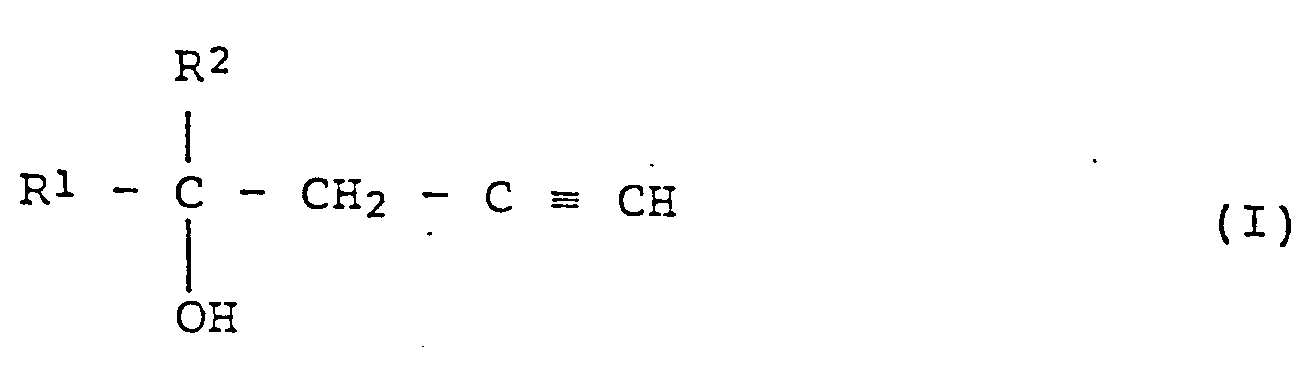
R¹ und R² unabhängig voneinander ein Wasserstoffatom; eine C₁-C₁₅ Alkylgruppe, die durch mindestens einen Substituenten, ausgewählt aus der Gruppe Halogenatome, eine Hydroxylgruppe, eine Phenylgruppe, eine Phenoxygruppe, eine Phenyl- oder Phenoxygruppe, die durch mindestens einen Substituenten, ausgewählt aus der Gruppe Halogenatome und Hydroxyl-, Alkoxy-, Phenoxy-, Dialkylamino- und Methylendioxygruppen, substituiert ist, eine Aralkoxygruppe, eine Dialkylaminogruppe, eine Alkylthiogruppe, eine Phenylthiogruppe, eine Biphenylgruppe und eine Phenylalkylgruppe, substituiert sein kann; eine C₂-C₁₅ Alkenylgruppe, die durch mindestens einen Substituenten, ausgewählt aus der Gruppe Halogenatome, eine Hydroxylgruppe, eine Phenylgruppe, eine Phenoxygruppe, eine Phenyl- oder Phenoxygruppe, die durch mindestens einen Substituenten, ausgewählt aus der Gruppe Halogenatome und Hydroxyl-, Alkoxy-, Phenoxy, Dialkylamino- und Methylendioxygruppen, substituiert ist, eine Dialkylaminogruppe, eine Alkylthiogruppe, eine Phenylthiogruppe, eine Biphenylgruppe und eine Phenylalkylgruppe, substituiert sein kann; eine C₂-C₁₅ Alkinylgruppe, die durch mindestens einen Substituenten, ausgewählt aus der Gruppe Halogenatome, eine Hydroxylgruppe, eine Phenylgruppe, eine Phenoxygruppe, eine Phenyl- oder Phenoxygruppe, die durch mindestens einen Substituenten, ausgewählt aus der Gruppe Halogenatome und Hydroxyl-, Alkoxy-, Phenoxy-, Dialkylamino- und Methylendioxygruppen, substituiert ist, eine Di-lkylaminogruppe, eine Alkylthiogruppe, eine Phenylthiogruppe, eine Biphenylgruppe und eine Phenylalkylgruppe, substituiert sein kann; eine C₃-C₁₅ Cycloalkylgruppe; eine C₄-C₁₅ Cycloalkenylgruppe oder eine Phenyl-, Naphthyl-, Furyl oder Thienylgruppe, die durch mindestens einen Substituenten, ausgewählt aus der Gruppe Halogenatome und Hydroxyl-, Alkyl-, Alkoxy-, Phenoxy, Dialkylamino- und Methylendioxygruppen, substituiert sein kann; oder
R¹ und R² zusammen eine C₂-C₁₅ Alkylen- oder Alkenylenkette, wobei gilt, daß die Kohlenstoffatome in den 1-Stellungen von R¹ und R² nicht zusammen tert.-Kohlenstoffatome sind und daß im Falle, daß einer der Reste R¹ und R² für die Furylgruppe steht, der andere nicht ein Wasserstoffatom bedeuten kann,
durch Umsetzen einer Halogenallylcarbinolverbindung der Formel (II):
- Verfahren nach Anspruch 1, wobei die Base aus einem Alkalimetallhydroxid und das Lösungsmittel aus einem polaren aprotischen Lösungsmittel bestehen.
- Verfahren nach Anspruch 1, wobei die Halogenallylcarbinolverbindung mit einem Alkalimetallhydroxid in Gegenwart eines Diamins umgesetzt wird.
- Verfahren nach Anspruch 1, wobei die Halogenallylcarbinolverbindung mit einem Alkalimetallalkoxid in Gegenwart eines Diamins umgesetzt wird.
- Verfahren nach Anspruch 3 oder 4, wobei das Diamin aus der Gruppe Ethylendiamin, N,N,N',N'-Tetramethylethylendiamin, 1,2-Diaminopropan, 1,3-Diaminopropan, 1,8-Diazabicyclo[5,4,0]undec-7-en, 1,5-Diazabicyclo[4,3,0]-non-5-en und 1,4-Diazabicyclo[2,2,2]octan ausgewählt ist.
- Verfahren nach Anspruch 1, wobei die Halogenallylcarbinolverbindung mit einem Alkalimetallhydroxid in Gegenwart eines Phasentransferkatalysators in einem Lösungsmittel, ausgewählt aus einem Lösungsmittelgemisch aus einem hydrophoben Kohlenwasserstoff mit Wasser, einem Lösungsmittelgemisch aus einem hydrophoben Kohlenwasserstoffhalogenid mit Wasser sowie Wasser umgesetzt wird.
- Verfahren nach Anspruch 1, wobei die Halogenallylcarbinolverbindung mit einem Alkalimetallalkoxid in Gegenwart eines polaren aprotischen Lösungsmittels umgesetzt wird.
- Verfahren nach Anspruch 2 oder 7, wobei das polare aprotische Lösungsmittel aus der Gruppe Acetonitril, N,N-Dimethylacetamid, N,N-Dimethylformamid, N-Methyl-2-pyrrolidon oder Dimethylsulfoxid ausgewählt ist.
- Verfahren nach Anspruch 1, wobei die Halogenallylcarbinolverbindung der Formel (II) durch Umsetzen einer Carbonylverbindung der Formel (III)


- Verfahren zur Herstellung einer Halogenallylcarbinolverbindung der Formel (II):

R¹ und R² unabhängig voneinander ein Wasserstoffatom; eine C₁-C₁₅ Alkylgruppe, die durch mindestens einen eine Hydroxylgruppe, eine Phenylgruppe, eine Phenoxygruppe, eine Phenyl- oder Phenoxygruppe, die durch mindestens einen Substituenten, ausgewählt aus der Gruppe Halogenatome und Hydroxyl-, Alkoxy-, Phenoxy-, Dialkylamino- und Methylendioxygruppen, substituiert ist, eine Aralkoxygruppe, eine Dialkylaminogruppe, eine Alkylthiogruppe, eine Phenylthiogruppe, eine Biphenylgruppe und eine Phenylalkylgruppe, substituiert sein kann; eine C₂-C₁₅ Alkenylgruppe, die durch mindestens einen Substituenten, ausgewählt aus der Gruppe Halogenatome, eine Hydroxylgruppe, eine Phenylgruppe, eine Phenoxygruppe, eine Phenyl- oder Phenoxygruppe, die durch mindestens einen Substituenten, ausgewählt aus der Gruppe Halogenatome und Hydroxyl-, Alkoxy-, Phenoxy, Dialkylamino- und Methylendioxygruppen, substituiert ist, eine Dialkylaminogruppe, eine Alkylthiogruppe, eine Phenylthiogruppe, eine Biphenylgruppe und eine Phenylalkylgruppe, substituiert sein kann; eine C₂-C₁₅ Alkinylgruppe, die durch mindestens einen Substituenten, ausgewählt aus der Gruppe Halogenatome, eine Hydroxylgruppe, eine Phenylgruppe, eine Phenoxygruppe, eine Phenyl- oder Phenoxygruppe, die durch mindestens einen Substituenten, ausgewählt aus der Gruppe Halogenatome und Hydroxyl-, Alkoxy-, Phenoxy-, Dialkylamino- und Methylendioxygruppen, substituiert ist, eine Dialkylaminogruppe, eine Alkylthiogruppe, eine Phenylthiogruppe, eine Biphenylgruppe und eine Phenylalkylgruppe, substituiert sein kann; eine C₃-C₁₅ Cycloalkylgruppe; eine C₄-C₁₅ Cycloalkylgruppe oder eine Phenyl-, Naphthyl-, Furyl oder Thienylgruppe, die durch mindestens einen Substituenten, ausgewählt aus der Gruppe Halogenatome und Hydroxyl-, Alkyl-, Alkoxy-, Phenoxy, Dialkylamino- und Methylendioxygruppen, substituiert sein kann; oder
R¹ und R² zusammen eine C₂-C₁₅ Alkylen- oder Alkenylenkette, wobei gilt, daß die Kohlenstoffatome in den 1-Stellungen von R¹ und R² nicht zusammen tert.-Kohlenstoffatome sind und daß im Falle, daß einer der Reste R¹ und R² für die Furylgruppe steht, der andere nicht ein Wasserstoffatom bedeuten kann,
durch Umsetzen einer Carbonylverbindung der Formel (III):

- Verfahren nach Anspruch 9 oder 10, wobei die Dihalogenpropenverbindung aus einer Dichlorpropenverbindung besteht.
- Verfahren nach einem der Ansprüche 1 bis 4, 6, 7, 9 und 10, wobei jeder Rest R¹ und R² unabhängig vom anderen für ein Wasserstoffatom, eine C₁-C₁₅ Alkylgruppe, die durch mindestens einen Substituenten, ausgewählt aus der Gruppe Halogenatome und Hydroxyl-, Phenyl-, Phenoxy-, Aralkyloxy-, Dialkylamino-, Alkylthio-, Phenylthio-, Biphenyl- und Phenylalkylgruppen, substituiert sein kann; eine C₃-C₉ Cycloalkyl- oder Cycloalkenylgruppe; eine C₂-C₉ Alkenylgruppe, die durch eine Phenylgruppe substituiert sein kann; eine C₂-C₆ Alkinylgruppe oder eine Phenyl-, Naphthyl-, Furyl- oder Thienylgruppe, die durch mindestens einen Substituenten, ausgewählt aus der Gruppe Halogenatome und Hydroxyl-, Alkyl-, Alkoxy-, Phenoxy-, Dialkylamino- und Methylendioxygruppen, substituiert sein kann, steht.
- Verfahren nach Anspruch 5, wobei jeder der Reste R¹ und R² unabhängig vom anderen für ein Wasserstoffatom, eine C₁-C₁₅ Alkylgruppe, die durch mindestens einen Substituenten, ausgewählt aus der Gruppe Halogenatome und Hydroxyl-, Phenyl-, Phenoxy-, Aralkyloxy-, Dialkylamino-, Alkylthio-, Phenylthio-, Biphenyl- und Phenylalkylgruppen substituiert sein kann; eine C₃-C₉ Cycloalkyl- oder Cycloalkenylgruppe; eine C₂-C₉ Alkenylgruppe, die durch eine Phenylgruppe substituiert sein kann, eine C₂-C₆ Alkinylgruppe oder eine Phenyl-, Naphthyl-, Furyl- oder Thienylgruppe, die durch mindestens einen Substituenten, ausgewählt aus der Gruppe Halogenatome und Hydroxyl-, Alkyl-, Alkoxy-, Phenoxy-, Dialkylamino- und Methylendioxygruppen, substituiert sein kann, steht.
- Verfahren nach Anspruch 8, wobei jeder der Reste R¹ und R² unabhängig vom anderen für ein Wasserstoffatom, eine C₁-C₁₅ Alkylgruppe, die durch mindestens einen Substituenten, ausgewählt aus der Gruppe Halogenatome und Hydroxyl-, Phenyl-, Phenoxy-, Aralkyloxy-, Dialkylamino-, Alkylthio-, Phenylthio-, Biphenyl- und Phenylalkylgruppen, substituiert sein kann; eine C₃-C₉ Cycloalkyl- oder Cycloalkenylgruppe; eine C₂-C₉ Alkenylgruppe, die durch eine Phenylgruppe substituiert sein kann; eine C₂-C₆ Alkinylgruppe oder eine Phenyl-, Naphthyl-, Furyl- oder Thienylgruppe, die durch mindestens einen Substituenten, ausgewählt aus der Gruppe Halogenatome und Hydroxyl-, Alkyl-, Alkoxy-, Phenoxy-, Dialkylamino- und Methylendioxygruppen, substituiert sein kann, steht.
- Verfahren nach Anspruch 11, wobei jeder der Reste R¹ und R² unabhängig vom anderen für ein Wasserstoffatom, eine C₁-C₁₅ Alkylgruppe, die durch mindestens einen Substituenten, ausgewählt aus der Gruppe Halogenatome und Hydroxyl-, Phenyl-, Phenoxy-, Aralkyloxy-, Dialkylamino-, Alkylthio-, Phenylthio-, Biphenyl- und Phenylalkylgruppen, substituiert sein kann; eine C₃-C₉ Cycloalkyl- oder Cycloalkenylgruppe; eine C₂-C₉ Alkenylgruppe, die durch eine Phenylgruppe substituiert sein kann; eine C₂-C₆ Alkinylgruppe oder eine Phenyl-, Naphthyl-, Furyl- oder Thienylgruppe, die durch mindestens einen Substituenten, ausgewählt aus der Gruppe Halogenatome und Hydroxyl-, Alkyl-, Alkoxy-, Phenoxy-, Dialkylamino- und Methylendioxygruppen, substituiert sein kann, steht.
- Verfahren nach einem der Ansprüche 1 bis 4, 6, 7, 9 und 10, wobei jeder Rest R¹ und R² unabhängig vom anderen für eine C₁-C₁₅ Alkylgruppe, die durch eine Phenylgruppe substituiert sein kann; eine C₂-C₉ Alkenylgruppe, die durch eine Phenylgruppe substituiert sein kann; eine C₅-C₇ Cycloalkyl- oder Cycloalkenylgruppe; eine Phenyl-, Naphthyl- oder Thienylgruppe, die durch mindestens einen Substituenten, ausgewählt aus der Gruppe Halogenatome, C₁-C₃ Alkylgruppen, C₁-C₃ Alkoxygruppen, einer Phenoxygruppe und einer Methylendioxygruppe, substituiert sein kann, oder ein Wasserstoffatom steht.
- Verfahren nach Anspruch 5, wobei jeder Rest R¹ und R² unabhängig vom anderen für eine C₁-C₁₅ Alkylgruppe, die durch eine Phenylgruppe substituiert sein kann; eine C₂-C₉ Alkenylgruppe, die durhc eine Phenylgruppe substituiert sein kann, eine C₅-C₇ Cycloalkyl- oder Cycloalkenylgruppe; eine Phenyl-, Naphthyl- oder Thienylgruppe, die durch mindestens einen Substituenten, ausgewählt aus der Gruppe Halogenatome, C₁-C₃ Alkylgruppen, C₁-C₃ Alkoxygruppen, einer Phenoxygruppe und einer Methylendioxygruppe,substituiert sein kann, oder ein Wasserstoffatom steht.
- Verfahren nach Anspruch 8, wobei jeder Rest R¹ und R² unabhängig vom anderen für eine C₁-C₁₅ Alkylgruppe, die durch eine Phenylgruppe substituiert sein kann; eine C₂-C₉ Alkenylgruppe, die durch eine Phenylgruppe substituiert sein kann, eine C₅-C₇ Cycloalkyl- oder Cycloalkenylgruppe; eine Phenyl-, Naphthyl- oder Thienylgruppe, die durch mindestens einen Substituenten, ausgewählt aus der Gruppe Halogenatome, C₁-C₃ Alkylgruppen, C₁-C₃ Alkoxygruppen, einer Phenoxygruppe und einer Methylendioxygruppe, substituiert sein kann, oder ein Wasserstoffatom steht.
- Verfahren nach Anspruch 11, wobei jeder Rest R¹ und R² unabhängig vom anderen für eine C₁-C₁₅ Alkylgruppe, die durch eine Phenylgruppe substituiert sein kann; eine C₂-C₉ Alkenylgruppe, die durch eine Phenylgruppe substituiert sein kann, eine C₅-C₇ Cycloalkyl- oder Cycloalkenylgruppe; eine Phenyl-, Naphthyl- oder Thienylgruppe, die durch mindestens einen Substituenten, ausgewählt aus der Gruppe Halogenatome, C₁-C₃ Alkylgruppen, C₁-C₃ Alkoxygruppen, einer Phenoxygruppe und einer Methylendioxygruppe, substituiert sein kann, oder ein Wasserstoffatom steht.
- Verbindung der folgenden allgemeinen Formel:
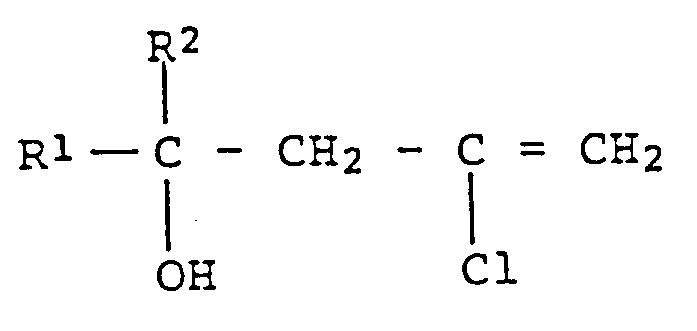
R¹ und R² unabhängig voneinander ein Wasserstoffatom; eine C₁-C₁₅ Alkylgruppe, die durch mindestens einen Substituenten, ausgewählt aus der Gruppe Halogenatome, eine Hydroxylgruppe, eine Phenylgruppe, eine Phenoxygruppe, eine Phenyl- oder Phenoxygruppe, die durch mindestens einen Substituenten, ausgewählt aus der Gruppe Halogenatome und Hydroxyl-, Alkoxy-, Phenoxy-, Dialkylamino- und Methylendioxygruppen, substituiert ist, eine Aralkoxygruppe, eine Dialkylaminogruppe, eine Alkylthiogruppe, eine Phenylthiogruppe, eine Biphenylgruppe und eine Phenylalkylgruppe, substituiert sein kann;
eine C₂-C₁₅ Alkenylgruppe, die durch mindestens einen Substituenten, ausgewählt aus der Gruppe Halogenatome, eine Hydroxylgruppe, eine Phenylgruppe, eine Phenoxygruppe, eine Phenyl- oder Phenoxygruppe, die durch mindestens einen Substituenten, ausgewählt aus der Gruppe Halogenatome und Hydroxyl-, Alkoxy-, Phenoxy, Dialkylamino- und Methylendioxygruppen, substituiert ist, eine Dialkylaminogruppe, eine Alkylthiogruppe, eine Phenylthiogruppe, eine Biphenylgruppe und eine Phenylalkylgruppe, substituiert sein kann; eine C₂-C₁₅ Alkinylgruppe, die durch mindestens einen Substituenten, ausgewählt aus der Gruppe Halogenatome, eine Hydroxylgruppe, eine Phenylgruppe, eine Phenoxygruppe, eine Phenyl- oder Phenoxygruppe, die durch mindestens einen Substituenten, ausgewählt aus der Gruppe Halogenatome und Hydroxyl-, Alkoxy-, Phenoxy-, Dialkylamino- und Methylendioxygruppen, substituiert ist, eine Dialkylaminogruppe, eine Alkylthiogruppe, eine Phenylthiogruppe, eine Biphenylgruppe und eine Phenylalkylgruppe, substituiert sein kann; eine C₃-C₁₅ Cycloalkylgruppe; eine C₄-C₁₅ Cycloalkenylgruppe oder eine Phenyl-, Naphthyl-, Furyl oder Thienylgruppe, die durch mindestens einen Substituenten, ausgewählt aus der Gruppe Halogenatome und Hydroxyl-, Alkyl-, Alkoxy-, Phenoxy, Dialkylamino- und Methylendioxygruppen,substituiert sein kann; oder
R¹ und R² zusammen eine C₂-C₁₅ Alkylen- oder Alkenylenkette, wobei gilt, daß die Kohlenstoffatome in den 1-Stellungen von R¹ und R² nicht zusammen tert.-Kohlenstoffatome sind und daß im Falle, daß einer der Reste R¹ und R² für die Furylgruppe steht, der andere nicht ein Wasserstoffatom bedeuten kann.
Applications Claiming Priority (6)
| Application Number | Priority Date | Filing Date | Title |
|---|---|---|---|
| JP16209889 | 1989-06-22 | ||
| JP162098/89 | 1989-06-22 | ||
| JP17499789 | 1989-07-05 | ||
| JP174997/89 | 1989-07-05 | ||
| JP28557089 | 1989-10-31 | ||
| JP285570/89 | 1989-10-31 |
Publications (2)
| Publication Number | Publication Date |
|---|---|
| EP0404077A1 EP0404077A1 (de) | 1990-12-27 |
| EP0404077B1 true EP0404077B1 (de) | 1994-06-01 |
Family
ID=27321952
Family Applications (1)
| Application Number | Title | Priority Date | Filing Date |
|---|---|---|---|
| EP90111592A Expired - Lifetime EP0404077B1 (de) | 1989-06-22 | 1990-06-19 | Verfahren zur Herstellung von Propargylcarbinolen |
Country Status (4)
| Country | Link |
|---|---|
| US (2) | US5258529A (de) |
| EP (1) | EP0404077B1 (de) |
| JP (1) | JP2946654B2 (de) |
| DE (1) | DE69009301T2 (de) |
Families Citing this family (5)
| Publication number | Priority date | Publication date | Assignee | Title |
|---|---|---|---|---|
| JP2781774B2 (ja) * | 1996-02-27 | 1998-07-30 | トライオン株式会社 | 野球用グローブ |
| US7842727B2 (en) * | 2001-03-27 | 2010-11-30 | Errant Gene Therapeutics, Llc | Histone deacetylase inhibitors |
| EP1511477A4 (de) * | 2002-05-22 | 2008-04-09 | Errant Gene Therapeutics Llc | Histondeacetylase-hemmer auf basis von alpha-ketoepoxid-verbindungen |
| WO2003099789A1 (en) * | 2002-05-22 | 2003-12-04 | Errant Gene Therapeutics, Llc. | Histone deacetylase inhibitors based on alphachalcogenmethylcarbonyl compounds |
| CN107614998A (zh) * | 2015-05-29 | 2018-01-19 | 三菱电机株式会社 | 换热器 |
Family Cites Families (15)
| Publication number | Priority date | Publication date | Assignee | Title |
|---|---|---|---|---|
| DE223592C (de) * | ||||
| CA557340A (en) * | 1958-05-13 | Isler Otto | Process for the manufacture of propynyl-carbinols | |
| GB582764A (en) * | 1942-11-23 | 1946-11-27 | Shell Dev | Production of acetylenic alcohols |
| FR1159181A (fr) * | 1953-06-12 | 1958-06-24 | Hoffmann La Roche | Procédé pour la préparation de propynyl-carbinols |
| AT223592B (de) * | 1960-04-02 | 1962-09-25 | Bayer Ag | Verfahren zur Herstellung von 6-[2',6',6'-Trimethylcyclohexen-(1')-yl]-4-hydroxy-4-methylhexen-(5)-in-(1) |
| US3383427A (en) * | 1962-12-17 | 1968-05-14 | Dow Chemical Co | Procedure for synthesis of propargyl alcohol |
| JPS59118780A (ja) * | 1982-12-24 | 1984-07-09 | Sumitomo Chem Co Ltd | フルフリルアルコ−ル類の製造方法 |
| AU597042B2 (en) * | 1986-04-07 | 1990-05-24 | Ici Australia Limited | Enantioselective process for the preparation of a homallyl alcohol |
| DE3724950A1 (de) * | 1987-05-13 | 1988-11-24 | Bayer Ag | Verfahren zur herstellung von zwischenprodukten fuer prostaglandine |
| FR2625499B1 (fr) * | 1987-12-30 | 1990-06-15 | Elf Aquitaine | Perfectionnement a la production d'alcools tertiaires et secondaires par l'action d'un compose organique halogene et du manganese sur un compose porteur d'un groupe carbonyle |
| US5189186A (en) * | 1988-06-16 | 1993-02-23 | Sumitomo Chemical Company, Limited | Process for producing furylpropargylcarbinol and a derivative thereof |
| US5239092A (en) * | 1988-06-16 | 1993-08-24 | Sumitomo Chemical Company, Limited | Process for producing furylpropargylcarbinol and derivative thereof |
| US4990697A (en) * | 1988-10-26 | 1991-02-05 | Kuraray Co., Ltd. | Process for producing homoallyl alcohols |
| JPH03222123A (ja) * | 1990-01-26 | 1991-10-01 | Canon Inc | クリーニングカートリッジ |
| FI924881L (fi) * | 1991-11-15 | 1993-05-16 | Lonza Ag | Foerfarande foer framstaellning av (2R, 3E)-4-halo-3-buten-2-oler |
-
1990
- 1990-06-15 US US07/538,555 patent/US5258529A/en not_active Expired - Lifetime
- 1990-06-19 EP EP90111592A patent/EP0404077B1/de not_active Expired - Lifetime
- 1990-06-19 DE DE69009301T patent/DE69009301T2/de not_active Expired - Lifetime
- 1990-06-21 JP JP16444690A patent/JP2946654B2/ja not_active Expired - Lifetime
-
1995
- 1995-02-13 US US08/387,367 patent/US5523495A/en not_active Expired - Lifetime
Also Published As
| Publication number | Publication date |
|---|---|
| JPH03204828A (ja) | 1991-09-06 |
| DE69009301T2 (de) | 1994-10-06 |
| US5258529A (en) | 1993-11-02 |
| US5523495A (en) | 1996-06-04 |
| JP2946654B2 (ja) | 1999-09-06 |
| EP0404077A1 (de) | 1990-12-27 |
| DE69009301D1 (de) | 1994-07-07 |
Similar Documents
| Publication | Publication Date | Title |
|---|---|---|
| EP0775684B1 (de) | Verfahren zur Oxidation primärer oder sekundärer Alkohole | |
| Tiffany et al. | Antiviral compounds. I. Aliphatic glyoxals, α-hydroxyaldehydes and related compounds | |
| US3950427A (en) | Araliphatic ketones and carbinols | |
| EP0404077B1 (de) | Verfahren zur Herstellung von Propargylcarbinolen | |
| US3736319A (en) | Novel cyclopentanone-2-carboxylates | |
| EP0113107B1 (de) | Verfahren zur Herstellung von Alkoholen | |
| JP3795970B2 (ja) | α,β−不飽和アルデヒドの製造方法 | |
| EP2152656B1 (de) | Verfahren zur herstellung von 1,4-dialkyl-2,3-diol-1,4-butandion | |
| JP4687464B2 (ja) | テトラヒドロピラン−4−オン及びピラン−4−オンの製法 | |
| EP1758875B1 (de) | Chirale heptinderivate zur herstellung von epothilonen und verfahren zu deren herstellung | |
| US7084281B2 (en) | Synthesis of dihalohydrins and tri- and tetra-substituted olefins | |
| JP3805392B2 (ja) | 1,1−シクロプロパンジメタノールの製造方法 | |
| US4356326A (en) | Process for producing 3-oxocyclopentenes | |
| JPS5854139B2 (ja) | シンキナプロスタンサンルイエンカゴウブツノ セイホウ | |
| PL105365B1 (pl) | Sposob wytwarzania nowych pochodnych cykloheksanu | |
| JP2952872B2 (ja) | β−γ不飽和ケトン類の製造方法 | |
| EP0170517A2 (de) | Verfahren zur Herstellung von 1,2-Aminoalkoholen | |
| JPS6148815B2 (de) | ||
| JPH05255295A (ja) | γ−アルキリデン−γ−ブチロラクトン誘導体の製造方法 | |
| JP4294130B2 (ja) | α,β−不飽和ケトン化合物の製造方法 | |
| EP0053842A1 (de) | Verfahren zur Herstellung von Cyclopentenolonen | |
| JPS5855480A (ja) | 4−アルコキシ−1,3−ジオキサン−5−カルボニトリル類 | |
| Derdziński et al. | Insect growth regulators. XIII. Juvenoids with Cyclopentene Ring. Synthesis of alkyl ω‐(2, 2, 3‐trimethyl‐cyclopent‐3‐en‐1‐yl)‐2‐alkenoates and ω‐(2, 2, 3‐trimethyl‐cyclopent‐3‐en‐1‐yl) alkyl phenyl ethers | |
| JPH07309798A (ja) | 1,5−ケトアルデヒドの製造法 | |
| JPH0434531B2 (de) |
Legal Events
| Date | Code | Title | Description |
|---|---|---|---|
| PUAI | Public reference made under article 153(3) epc to a published international application that has entered the european phase |
Free format text: ORIGINAL CODE: 0009012 |
|
| AK | Designated contracting states |
Kind code of ref document: A1 Designated state(s): CH DE FR GB IT LI |
|
| 17P | Request for examination filed |
Effective date: 19901228 |
|
| 17Q | First examination report despatched |
Effective date: 19920723 |
|
| GRAA | (expected) grant |
Free format text: ORIGINAL CODE: 0009210 |
|
| ITF | It: translation for a ep patent filed | ||
| AK | Designated contracting states |
Kind code of ref document: B1 Designated state(s): CH DE FR GB IT LI |
|
| REF | Corresponds to: |
Ref document number: 69009301 Country of ref document: DE Date of ref document: 19940707 |
|
| ET | Fr: translation filed | ||
| PLBE | No opposition filed within time limit |
Free format text: ORIGINAL CODE: 0009261 |
|
| STAA | Information on the status of an ep patent application or granted ep patent |
Free format text: STATUS: NO OPPOSITION FILED WITHIN TIME LIMIT |
|
| 26N | No opposition filed | ||
| ITTA | It: last paid annual fee | ||
| REG | Reference to a national code |
Ref country code: GB Ref legal event code: IF02 |
|
| REG | Reference to a national code |
Ref country code: CH Ref legal event code: PFA Owner name: SUMITOMO CHEMICAL COMPANY, LIMITED Free format text: SUMITOMO CHEMICAL COMPANY, LIMITED#5-33 KITAHAMA 4-CHOME#CHUO-KU/OSAKA (JP) -TRANSFER TO- SUMITOMO CHEMICAL COMPANY, LIMITED#5-33 KITAHAMA 4-CHOME#CHUO-KU/OSAKA (JP) |
|
| PGFP | Annual fee paid to national office [announced via postgrant information from national office to epo] |
Ref country code: IT Payment date: 20090610 Year of fee payment: 20 |
|
| PGFP | Annual fee paid to national office [announced via postgrant information from national office to epo] |
Ref country code: CH Payment date: 20090629 Year of fee payment: 20 Ref country code: FR Payment date: 20090630 Year of fee payment: 20 |
|
| PGFP | Annual fee paid to national office [announced via postgrant information from national office to epo] |
Ref country code: DE Payment date: 20090828 Year of fee payment: 20 Ref country code: GB Payment date: 20090520 Year of fee payment: 20 |
|
| REG | Reference to a national code |
Ref country code: CH Ref legal event code: PL |
|
| REG | Reference to a national code |
Ref country code: GB Ref legal event code: PE20 Expiry date: 20100618 |
|
| PG25 | Lapsed in a contracting state [announced via postgrant information from national office to epo] |
Ref country code: GB Free format text: LAPSE BECAUSE OF EXPIRATION OF PROTECTION Effective date: 20100618 |
|
| PG25 | Lapsed in a contracting state [announced via postgrant information from national office to epo] |
Ref country code: DE Free format text: LAPSE BECAUSE OF EXPIRATION OF PROTECTION Effective date: 20100619 |