EP0401098B1 - Tôle d'acier magnétique laminée à chaud - Google Patents
Tôle d'acier magnétique laminée à chaud Download PDFInfo
- Publication number
- EP0401098B1 EP0401098B1 EP90401402A EP90401402A EP0401098B1 EP 0401098 B1 EP0401098 B1 EP 0401098B1 EP 90401402 A EP90401402 A EP 90401402A EP 90401402 A EP90401402 A EP 90401402A EP 0401098 B1 EP0401098 B1 EP 0401098B1
- Authority
- EP
- European Patent Office
- Prior art keywords
- silicon
- final
- annealing
- texture
- rolling
- Prior art date
- Legal status (The legal status is an assumption and is not a legal conclusion. Google has not performed a legal analysis and makes no representation as to the accuracy of the status listed.)
- Expired - Lifetime
Links
Images

Classifications
-
- C—CHEMISTRY; METALLURGY
- C22—METALLURGY; FERROUS OR NON-FERROUS ALLOYS; TREATMENT OF ALLOYS OR NON-FERROUS METALS
- C22C—ALLOYS
- C22C38/00—Ferrous alloys, e.g. steel alloys
- C22C38/02—Ferrous alloys, e.g. steel alloys containing silicon
-
- C—CHEMISTRY; METALLURGY
- C21—METALLURGY OF IRON
- C21D—MODIFYING THE PHYSICAL STRUCTURE OF FERROUS METALS; GENERAL DEVICES FOR HEAT TREATMENT OF FERROUS OR NON-FERROUS METALS OR ALLOYS; MAKING METAL MALLEABLE, e.g. BY DECARBURISATION OR TEMPERING
- C21D8/00—Modifying the physical properties of ferrous metals or ferrous alloys by deformation combined with, or followed by, heat treatment
- C21D8/12—Modifying the physical properties of ferrous metals or ferrous alloys by deformation combined with, or followed by, heat treatment during manufacturing of articles with special electromagnetic properties
- C21D8/1216—Modifying the physical properties of ferrous metals or ferrous alloys by deformation combined with, or followed by, heat treatment during manufacturing of articles with special electromagnetic properties characterised by the working steps
- C21D8/1233—Cold rolling
-
- C—CHEMISTRY; METALLURGY
- C22—METALLURGY; FERROUS OR NON-FERROUS ALLOYS; TREATMENT OF ALLOYS OR NON-FERROUS METALS
- C22C—ALLOYS
- C22C38/00—Ferrous alloys, e.g. steel alloys
- C22C38/06—Ferrous alloys, e.g. steel alloys containing aluminium
Definitions
- the subject of the present invention is a sheet metal containing in particular iron, silicon and aluminum, and forming part of a family of oriented grain sheets having a texture of cubic type, that is to say a sheet having two directions. of easy magnetization, one confused with the rolling direction, the other perpendicular to the rolling direction, in the plane of the sheet, called transverse direction.
- non-oriented magnetic sheets are more particularly intended for the construction of circuits supplied with alternating current, including in particular those of rotating machines of high power. For the construction of these machines, it is important to have very efficient magnetic circuits.
- the stator is made up of assembled sheets and these have a degree of efficiency which is evaluated according to two parameters which are the level of induction on the one hand, and the volume losses on the other hand.
- the induction is limited by the saturation magnetization of the material, and the losses include losses by hysteresis and by eddy currents. Also, it is necessary to find a compromise between materials with strong saturation magnetization and low losses.
- Non-oriented silicon steel sheets currently give the best results, since the particularly strong magnetization of iron is only slightly reduced by the addition of alloying elements, going from 2.16 Tesla for pure iron to 2.0 Tesla for the 3.2% silicon alloy.
- GOSS texture sheets are not used by manufacturers of rotating machines who prefer so-called non-oriented sheets, in principle without texture, or with little rolling texture. marked.
- Non-oriented grain sheets called N.O.
- N.O. have a low anisotropy in the rolling plane, because the grains are distributed substantially randomly, which results in a statistically isotropic behavior.
- the ternary alloy constituted by Iron, Silicon and Aluminum for example, has an important magnetocrystalline anisotropy energy which tends to maintain, inside each grain, the atomic magnetic moments parallel to the quaternary axes of the crystal. This results in a distribution in domains oriented along the directions of easy magnetization of the type [100].
- BLOCH walls the easiest magnetization mechanisms involve the displacement of walls, called BLOCH walls, between neighboring domains. It is therefore advantageous in N.O. sheets to preferentially orient these areas in the direction of flow flow.
- the highest quality sheet steel listed in JIS (Japanese industry standard) C2552 (1986) is grade 35.A.230 (thickness 0.35 mm, W 15/50 ⁇ 2.30 W / Kg and B5000 ⁇ 1.60 T).
- This process applies to hot-rolled silicon steel sheets containing at most 0.020% carbon, 2.5 to 3.5% silicon, 0.1 to 1.0% manganese and 0.3 to 1.5% Aluminum, the rest being iron and accidental impurities.
- the method After a cold rolling in at least two stages, with an intermediate annealing and a continuous final annealing to obtain the final thickness, the method provides that the sulfur and oxygen contents are limited respectively to at most 0.0025% and 0.005 % and that the final cold rolling has a reduction rate of between 40 and 70%.
- the percentages given are expressed in weight concentrations.
- a comparative test was carried out with a sample having the same composition, with identical decarburization and final annealing, but with an intermediate annealing temperature of 1050 ° C.
- the losses in the iron W 15/50 and the magnetic induction B5000 obtained are substantially the same, but in this case, the elongation relative to the break measured in the direction of rolling is 3% and the elongation relative to the break measured in the cross direction is 10%.
- FR-A-2 186 714 also discloses a process for manufacturing magnetic sheets with isotropic magnetic properties by hot and cold rolling of a steel.
- the process consists in giving a steel with 0.1% maximum of carbon, 0.15 to 0.35% of manganese, 0.3 to 2.4% of aluminum, 0.25% maximum of copper, 0 , 05% maximum of sulfur and 0.02% maximum of phosphorus, by rolling at 820-1080 ° C, a structure of which at least 5% have an orientation (100) ⁇ hkl ⁇ , to be cold rolled with a reduction in cross-section from 50 to 85% and subjecting it to recrystallization annealing at 820 to 950 ° C.
- the steel according to FR-A-2 186 714 contains copper in a proportion at most equal to 0.25% and does not contain silicon.
- the present invention therefore aims to avoid the drawbacks mentioned above while increasing the percentage of aluminum and decreasing the percentage of silicon, and to provide a magnetic sheet containing in particular iron, silicon and aluminum having a so-called cubic texture, that is to say having two directions of easy magnetization in the plane of the sheet, one confused with the direction of rolling, the other with the direction transverse, and whose magnetic properties are improved by compared to existing non-oriented iron-silicon sheets, in particular, the permeability in large amplitude excitation fields and the specific losses at industrial frequency for a peak value of the induction of 1.5 Tesla or more, all with mechanical properties comparable to those of non-oriented iron-silicon sheets in common use.
- the magnetic sheet according to the invention is further characterized in that the directions of easy magnetization are the rolling direction and the direction perpendicular to the rolling in the plane of the sheet.
- the various stages of the manufacturing cycle have more or less marked influences on the characteristics of the sheet obtained, in particular the texture, the losses, the induction, as will be described with the aid of several examples.
- Tests were carried out to verify the influence of the initial solidification texture of the ingot of the base steel on the final texture of the sheet.
- the anisotropy torque is measured by means of a torsion balance.
- the principle of measurement is as follows: After identifying the rolling direction, a disc with a diameter of approximately 15 mm is punched out of the sheet. This disc is then placed on a horizontal support, mobile around a vertical axis, and an external magnetic field saturates the sample in a variable direction of the horizontal plane identified by the angle made by the magnetization with the direction of rolling. In the presence of a volumetric anisotropy energy, the sample disc is subjected to a torque, which tends to align the magnetization of the disc in one of the preferred directions known as easy magnetization.
- the measurement consists in varying the angle made by the magnetization with the rolling direction and in recording the mechanical torque which must be exerted on the disc to keep it fixed.
- the module of the torque as a function of the angle made by the magnetization with the rolling direction has substantially a sinusoidal shape having two successive different maxima M1 and m2 where M1 is the large maximum and m2 the small maximum, the anisotropy being characterized by report which tends towards 1 in the case of an ideal anisotropy, while the quality of the cubic texture is all the better as M1 and m2 are higher.
- the treatment cycle of the hot rolled steel strip includes two cold rolls and the determination of the influence of the reduction rates during these rollings is important to characterize the evolution of the texture.
- the measurement of the anisotropy torque is a parameter that allows us to appreciate this evolution.
- the hot rolled steel strip is reduced after a first cold rolling to an intermediate thickness varying from 0.7 mm to 2 mm.
- Table 1 presents the results of the measurements of anisotropy couples obtained on the strip reduced to the indicated thickness, of a steel according to the invention of composition Si, 1.92%, Al 1.86%.
- the final texture can be influenced by the intermediate annealing of the manufacturing cycle according to the invention in particular by the atmosphere during this heat treatment.
- the intermediate annealing to a thickness of 1 mm is carried out in a dry atmosphere of purified hydrogen, then by varying the oxygen level.
- Table II summarizes the results obtained at the intermediate stage 1 mm and at the final stage 0.35 mm, for small and large maxima, as well as the corresponding anisotropy coefficients, the composition of the steel being Si 1.92%, Al 1.86%.
- the role of the final annealing is important since the annealing must repair the defects introduced by the second cold rolling and, moreover, the sheet resulting from this final annealing is directly used. The characteristics after the final annealing are therefore the final characteristics.
- the anisotropy torque measurements are indicated in Table III for the thickness of 0.35 mm, depending on the temperature of the final annealing.
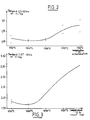
- the heat treatment temperature has no significant influence on the anisotropy curves, on the other hand the study of the magnetic losses measured respectively at two induction values of 1 Tesla and 1.5 Tesla as shown in the figures 2 and 3 shows a harmful increase in said magnetic losses, above a final annealing temperature of 1050 ° C. and below 950 ° C.
- the magnetization values as a function of the final annealing temperatures (for an annealing duration equal to 1 hour) shown in FIG. 4 show a reduction in the magnetization when the temperature of the final annealing increases.
- the duration of the final annealing does not affect the value of the anisotropy beyond a certain stage, since the grains reach a size such that they pass through the sheet and their growth stops. From this state, the texture no longer changes.
- Intermediate annealing can be carried out continuously at a temperature above 950 ° C for 1 to 5 minutes, and final annealing at a temperature between 950 ° and 1100 ° C also for 1 to 5 minutes.
- Example 1 the composition of the steel is given in Table V. TABLE V % in weight in ppm 10 ⁇ 4% Yes Al VS S O NOT Mn Cu Co Or 1.88 1.80 50 3 19 17 20 50 50 50 50
- the samples are produced from a hot-rolled sheet reduced to an intermediate thickness of 1 mm, then annealed under H2 for 2 min at a temperature of 1020 ° C.
- Example 2 the composition of the steel is given by the following Table VI: TABLE VI % in weight 10 ⁇ 4% Yes Al VS S O NOT Mn Cu Co Or Cr 1.86 1.81 40 2 11 1 50 50 60 30 20
- the present invention provides an improvement in magnetic properties compared to existing non-oriented iron-silicon sheets, while having mechanical properties comparable to those of non-oriented iron-silicon sheets in common use.
Landscapes
- Chemical & Material Sciences (AREA)
- Engineering & Computer Science (AREA)
- Mechanical Engineering (AREA)
- Organic Chemistry (AREA)
- Metallurgy (AREA)
- Materials Engineering (AREA)
- Physics & Mathematics (AREA)
- Thermal Sciences (AREA)
- Crystallography & Structural Chemistry (AREA)
- Manufacturing & Machinery (AREA)
- Electromagnetism (AREA)
- Manufacturing Of Steel Electrode Plates (AREA)
- Soft Magnetic Materials (AREA)
- Heat Treatment Of Strip Materials And Filament Materials (AREA)
- Manufacturing Cores, Coils, And Magnets (AREA)
- Heat Treatment Of Sheet Steel (AREA)
Applications Claiming Priority (2)
| Application Number | Priority Date | Filing Date | Title |
|---|---|---|---|
| FR8907263A FR2647813B1 (fr) | 1989-06-01 | 1989-06-01 | Tole magnetique obtenue a partir d'une bande d'acier laminee a chaud contenant notamment du fer, du silicium et de l'aluminium |
| FR8907263 | 1989-06-01 |
Publications (2)
| Publication Number | Publication Date |
|---|---|
| EP0401098A1 EP0401098A1 (fr) | 1990-12-05 |
| EP0401098B1 true EP0401098B1 (fr) | 1995-11-29 |
Family
ID=9382272
Family Applications (1)
| Application Number | Title | Priority Date | Filing Date |
|---|---|---|---|
| EP90401402A Expired - Lifetime EP0401098B1 (fr) | 1989-06-01 | 1990-05-25 | Tôle d'acier magnétique laminée à chaud |
Country Status (9)
| Country | Link |
|---|---|
| US (1) | US5306356A (da) |
| EP (1) | EP0401098B1 (da) |
| JP (1) | JPH0324251A (da) |
| AT (1) | ATE130874T1 (da) |
| DE (1) | DE69023814T2 (da) |
| DK (1) | DK0401098T3 (da) |
| ES (1) | ES2082841T3 (da) |
| FR (1) | FR2647813B1 (da) |
| GR (1) | GR3018689T3 (da) |
Families Citing this family (10)
| Publication number | Priority date | Publication date | Assignee | Title |
|---|---|---|---|---|
| JPH06238118A (ja) * | 1993-02-18 | 1994-08-30 | Electric Power Dev Co Ltd | 燃焼排ガス用除塵装置の運転方法 |
| JP3470475B2 (ja) * | 1995-11-27 | 2003-11-25 | Jfeスチール株式会社 | 極めて鉄損の低い方向性電磁鋼板とその製造方法 |
| DE19634524A1 (de) * | 1996-08-27 | 1998-04-09 | Krupp Ag Hoesch Krupp | Leichtbaustahl und seine Verwendung für Fahrzeugteile und Fassadenverkleidungen |
| JP3316854B2 (ja) * | 1996-11-01 | 2002-08-19 | 住友金属工業株式会社 | 二方向性電磁鋼板およびその製造方法 |
| CN1102670C (zh) * | 1999-06-16 | 2003-03-05 | 住友金属工业株式会社 | 无方向性电磁钢片及其制造方法 |
| JP4507316B2 (ja) * | 1999-11-26 | 2010-07-21 | Jfeスチール株式会社 | Dcブラシレスモーター |
| US20080097300A1 (en) * | 2006-08-07 | 2008-04-24 | Sherif Eskaros | Catheter balloon with multiple micropleats |
| DE102012002642B4 (de) * | 2012-02-08 | 2013-08-14 | Salzgitter Flachstahl Gmbh | Warmband zur Herstellung eines Elektroblechs und Verfahren hierzu |
| JP6984763B2 (ja) * | 2019-04-22 | 2021-12-22 | Jfeスチール株式会社 | 圧延鋼板の金属組織評価装置、圧延鋼板の金属組織評価方法、鋼材の製造設備、鋼材の製造方法、及び鋼材の品質管理方法 |
| CN114521546A (zh) * | 2022-03-01 | 2022-05-24 | 刘伟 | 一种林业用便于快速移动的高效打药机及其使用方法 |
Family Cites Families (7)
| Publication number | Priority date | Publication date | Assignee | Title |
|---|---|---|---|---|
| DE1159979B (de) * | 1957-02-16 | 1963-12-27 | Ver Deutsche Metallwerke Ag | Verfahren zur Herstellung kornorientierter Bleche oder Baender aus silizium- und/oder aluminiumhaltigen Eisenlegierungen |
| US3971678A (en) * | 1972-05-31 | 1976-07-27 | Stahlwerke Peine-Salzgitter Aktiengesellschaft | Method of making cold-rolled sheet for electrical purposes |
| DE2226379B2 (de) * | 1972-05-31 | 1976-06-24 | Stahlwerke Peine-Salzgitter AG, 315OPeine | Verfahren zum herstellen von kaltgewalztem elektroblech |
| JPS5366816A (en) * | 1976-11-26 | 1978-06-14 | Kawasaki Steel Co | Method of making nondirectional silicon steel shee having high magnetic flux and low iron loss |
| JPS5850295B2 (ja) * | 1980-06-04 | 1983-11-09 | 新日本製鐵株式会社 | 磁束密度の高い一方向性珪素鋼板の製造法 |
| JPS58157917A (ja) * | 1982-03-15 | 1983-09-20 | Kawasaki Steel Corp | 磁気特性の優れた一方向性珪素鋼板の製造方法 |
| JPH0674460B2 (ja) * | 1985-06-26 | 1994-09-21 | 日新製鋼株式会社 | 電磁鋼板の製造法 |
-
1989
- 1989-06-01 FR FR8907263A patent/FR2647813B1/fr not_active Expired - Lifetime
-
1990
- 1990-05-25 DE DE69023814T patent/DE69023814T2/de not_active Expired - Fee Related
- 1990-05-25 DK DK90401402.4T patent/DK0401098T3/da active
- 1990-05-25 ES ES90401402T patent/ES2082841T3/es not_active Expired - Lifetime
- 1990-05-25 AT AT90401402T patent/ATE130874T1/de not_active IP Right Cessation
- 1990-05-25 EP EP90401402A patent/EP0401098B1/fr not_active Expired - Lifetime
- 1990-06-01 JP JP2144236A patent/JPH0324251A/ja active Pending
-
1991
- 1991-12-13 US US07/807,627 patent/US5306356A/en not_active Expired - Fee Related
-
1996
- 1996-01-17 GR GR960400090T patent/GR3018689T3/el unknown
Also Published As
| Publication number | Publication date |
|---|---|
| DE69023814T2 (de) | 1996-04-11 |
| GR3018689T3 (en) | 1996-04-30 |
| US5306356A (en) | 1994-04-26 |
| FR2647813A1 (fr) | 1990-12-07 |
| ES2082841T3 (es) | 1996-04-01 |
| ATE130874T1 (de) | 1995-12-15 |
| DE69023814D1 (de) | 1996-01-11 |
| DK0401098T3 (da) | 1996-02-26 |
| JPH0324251A (ja) | 1991-02-01 |
| EP0401098A1 (fr) | 1990-12-05 |
| FR2647813B1 (fr) | 1991-09-20 |
Similar Documents
| Publication | Publication Date | Title |
|---|---|---|
| US6531001B2 (en) | Non-oriented magnetic steel sheet having low iron loss and high magnetic flux density and manufacturing method therefor | |
| EP3329027B1 (fr) | Tôle ou bande en alliage feco ou fesi ou en fe et son procédé de fabrication, noyau magnétique de transformateur réalisé à partir d'elle et transformateur le comportant | |
| EP0401098B1 (fr) | Tôle d'acier magnétique laminée à chaud | |
| FR2763960A1 (fr) | Procede de fabrication de bandes minces d'acier inoxydable ferritique, et bandes minces ainsi obtenues | |
| CN103429388A (zh) | Co-Si系铜合金板 | |
| WO2023190621A1 (ja) | 無方向性電磁鋼板及びモータコア | |
| EP0896069B1 (fr) | Procédé d'élaboration d'une tôle mince en acier à ultra bas carbone pour la réalisation de produits emboutis pour emballage et tôle mince obtenue | |
| EP0469980B1 (fr) | Procédé de fabrication de tÔle d'acier magnétique à grains non orientés et tÔle obtenue par ce procédé | |
| EP1065286B1 (fr) | Tole d'acier à basse teneur en aluminium pour emballage | |
| FR2664907A1 (fr) | Procede de fabrication d'une tole ou feuillard en zircaloy de bonne formabilite et feuillards obtenus. | |
| CA2435938C (fr) | Acier isotrope a haute resistance, procede de fabrication de toles et toles obtenues | |
| EP1065284B1 (fr) | Tole d'acier à bas carbone calmé à l'aluminium pour emballage | |
| EP1065283B1 (fr) | Tôle d'acier à moyen carbone calmé à l'aluminium pour emballage | |
| US5913987A (en) | Finish treatment method and silicon steel sheet manufactured by direct casting method | |
| FR2502179A1 (fr) | Procede pour produire de l'acier au silicium a grain oriente | |
| EP3327151A1 (fr) | Résonateur pour piece d'horlogerie | |
| EP1065285B1 (fr) | Tôle d'acier à bas carbone calmé à l'aluminium pour emballage. | |
| FR2795743A1 (fr) | Tole d'acier a basse teneur en aluminium pour emballage | |
| EP0754770B1 (fr) | Procédé de fabrication d'une bande de tôle mince à emboutissabilité améliorée | |
| EP0905263A1 (fr) | Procédé de fabrication d'une bande en alliage du type fer-nickel à partir d'une bande mince coulée en continu | |
| WO2006051188A2 (fr) | Bande d’alliage fer-nickel pour la fabrication de grilles support de circuits integres | |
| WO2025181781A1 (fr) | Procédé de préparation d'un feuillard en alliage fe-ni austénitique, feuillard ainsi préparé et produits réalisés à partir de ce feuillard | |
| BE823868A (fr) | Alliages a saturation magnetique elevee | |
| FR2669349A1 (fr) | Procede de fabrication de toles en acier a usage electrique, et tole obtenue par ce procede. | |
| FR2835001A1 (fr) | Procede de fabrication d'une tole d'acier magnetique, toles et pieces obtenues |
Legal Events
| Date | Code | Title | Description |
|---|---|---|---|
| PUAI | Public reference made under article 153(3) epc to a published international application that has entered the european phase |
Free format text: ORIGINAL CODE: 0009012 |
|
| AK | Designated contracting states |
Kind code of ref document: A1 Designated state(s): AT BE CH DE DK ES FR GB GR IT LI LU NL SE |
|
| 17P | Request for examination filed |
Effective date: 19901031 |
|
| 17Q | First examination report despatched |
Effective date: 19930921 |
|
| GRAA | (expected) grant |
Free format text: ORIGINAL CODE: 0009210 |
|
| RAP1 | Party data changed (applicant data changed or rights of an application transferred) |
Owner name: UGINE S.A. |
|
| AK | Designated contracting states |
Kind code of ref document: B1 Designated state(s): AT BE CH DE DK ES FR GB GR IT LI LU NL SE |
|
| REF | Corresponds to: |
Ref document number: 130874 Country of ref document: AT Date of ref document: 19951215 Kind code of ref document: T |
|
| ITF | It: translation for a ep patent filed | ||
| GBT | Gb: translation of ep patent filed (gb section 77(6)(a)/1977) |
Effective date: 19951130 |
|
| REF | Corresponds to: |
Ref document number: 69023814 Country of ref document: DE Date of ref document: 19960111 |
|
| REG | Reference to a national code |
Ref country code: DK Ref legal event code: T3 |
|
| REG | Reference to a national code |
Ref country code: GR Ref legal event code: FG4A Free format text: 3018689 |
|
| REG | Reference to a national code |
Ref country code: ES Ref legal event code: FG2A Ref document number: 2082841 Country of ref document: ES Kind code of ref document: T3 |
|
| PLBE | No opposition filed within time limit |
Free format text: ORIGINAL CODE: 0009261 |
|
| 26N | No opposition filed | ||
| REG | Reference to a national code |
Ref country code: FR Ref legal event code: TP Ref country code: FR Ref legal event code: CD Ref country code: FR Ref legal event code: CA |
|
| REG | Reference to a national code |
Ref country code: CH Ref legal event code: PUE Owner name: USINOR TRANSFER- SOLLAC Ref country code: CH Ref legal event code: PFA Free format text: UGINE S.A. TRANSFER- USINOR SACILOR SOCIETE ANONYME * USINOR SACILOR SOCIETE ANONYME TRANSFER- USINOR |
|
| REG | Reference to a national code |
Ref country code: FR Ref legal event code: TP |
|
| BECH | Be: change of holder |
Free format text: 19991005 S.A. *SOLLAC |
|
| BECN | Be: change of holder's name |
Effective date: 19991005 |
|
| NLS | Nl: assignments of ep-patents |
Owner name: SOLLAC;USINOR SACILOR SOCIETE ANONYME |
|
| NLT1 | Nl: modifications of names registered in virtue of documents presented to the patent office pursuant to art. 16 a, paragraph 1 |
Owner name: USINOR |
|
| REG | Reference to a national code |
Ref country code: ES Ref legal event code: PC2A |
|
| REG | Reference to a national code |
Ref country code: GB Ref legal event code: IF02 |
|
| PGFP | Annual fee paid to national office [announced via postgrant information from national office to epo] |
Ref country code: CH Payment date: 20030415 Year of fee payment: 14 Ref country code: AT Payment date: 20030415 Year of fee payment: 14 |
|
| PGFP | Annual fee paid to national office [announced via postgrant information from national office to epo] |
Ref country code: NL Payment date: 20030416 Year of fee payment: 14 Ref country code: LU Payment date: 20030416 Year of fee payment: 14 |
|
| PGFP | Annual fee paid to national office [announced via postgrant information from national office to epo] |
Ref country code: SE Payment date: 20030417 Year of fee payment: 14 |
|
| PGFP | Annual fee paid to national office [announced via postgrant information from national office to epo] |
Ref country code: GR Payment date: 20030422 Year of fee payment: 14 Ref country code: DK Payment date: 20030422 Year of fee payment: 14 |
|
| PGFP | Annual fee paid to national office [announced via postgrant information from national office to epo] |
Ref country code: DE Payment date: 20030512 Year of fee payment: 14 |
|
| PGFP | Annual fee paid to national office [announced via postgrant information from national office to epo] |
Ref country code: ES Payment date: 20030514 Year of fee payment: 14 |
|
| PGFP | Annual fee paid to national office [announced via postgrant information from national office to epo] |
Ref country code: FR Payment date: 20030516 Year of fee payment: 14 |
|
| PGFP | Annual fee paid to national office [announced via postgrant information from national office to epo] |
Ref country code: GB Payment date: 20030520 Year of fee payment: 14 |
|
| PGFP | Annual fee paid to national office [announced via postgrant information from national office to epo] |
Ref country code: BE Payment date: 20030603 Year of fee payment: 14 |
|
| PG25 | Lapsed in a contracting state [announced via postgrant information from national office to epo] |
Ref country code: LU Free format text: LAPSE BECAUSE OF NON-PAYMENT OF DUE FEES Effective date: 20040525 Ref country code: GB Free format text: LAPSE BECAUSE OF NON-PAYMENT OF DUE FEES Effective date: 20040525 Ref country code: AT Free format text: LAPSE BECAUSE OF NON-PAYMENT OF DUE FEES Effective date: 20040525 |
|
| PG25 | Lapsed in a contracting state [announced via postgrant information from national office to epo] |
Ref country code: SE Free format text: LAPSE BECAUSE OF NON-PAYMENT OF DUE FEES Effective date: 20040526 Ref country code: ES Free format text: LAPSE BECAUSE OF NON-PAYMENT OF DUE FEES Effective date: 20040526 |
|
| PG25 | Lapsed in a contracting state [announced via postgrant information from national office to epo] |
Ref country code: LI Free format text: LAPSE BECAUSE OF NON-PAYMENT OF DUE FEES Effective date: 20040531 Ref country code: CH Free format text: LAPSE BECAUSE OF NON-PAYMENT OF DUE FEES Effective date: 20040531 Ref country code: BE Free format text: LAPSE BECAUSE OF NON-PAYMENT OF DUE FEES Effective date: 20040531 |
|
| PG25 | Lapsed in a contracting state [announced via postgrant information from national office to epo] |
Ref country code: DK Free format text: LAPSE BECAUSE OF NON-PAYMENT OF DUE FEES Effective date: 20040601 |
|
| BERE | Be: lapsed |
Owner name: S.A. *SOLLAC Effective date: 20040531 |
|
| PG25 | Lapsed in a contracting state [announced via postgrant information from national office to epo] |
Ref country code: NL Free format text: LAPSE BECAUSE OF NON-PAYMENT OF DUE FEES Effective date: 20041201 Ref country code: DE Free format text: LAPSE BECAUSE OF NON-PAYMENT OF DUE FEES Effective date: 20041201 |
|
| PG25 | Lapsed in a contracting state [announced via postgrant information from national office to epo] |
Ref country code: GR Free format text: LAPSE BECAUSE OF NON-PAYMENT OF DUE FEES Effective date: 20041203 |
|
| EUG | Se: european patent has lapsed | ||
| REG | Reference to a national code |
Ref country code: DK Ref legal event code: EBP |
|
| GBPC | Gb: european patent ceased through non-payment of renewal fee |
Effective date: 20040525 |
|
| REG | Reference to a national code |
Ref country code: CH Ref legal event code: PL |
|
| PG25 | Lapsed in a contracting state [announced via postgrant information from national office to epo] |
Ref country code: FR Free format text: LAPSE BECAUSE OF NON-PAYMENT OF DUE FEES Effective date: 20050131 |
|
| NLV4 | Nl: lapsed or anulled due to non-payment of the annual fee |
Effective date: 20041201 |
|
| REG | Reference to a national code |
Ref country code: FR Ref legal event code: ST |
|
| PG25 | Lapsed in a contracting state [announced via postgrant information from national office to epo] |
Ref country code: IT Free format text: LAPSE BECAUSE OF NON-PAYMENT OF DUE FEES;WARNING: LAPSES OF ITALIAN PATENTS WITH EFFECTIVE DATE BEFORE 2007 MAY HAVE OCCURRED AT ANY TIME BEFORE 2007. THE CORRECT EFFECTIVE DATE MAY BE DIFFERENT FROM THE ONE RECORDED. Effective date: 20050525 |
|
| REG | Reference to a national code |
Ref country code: ES Ref legal event code: FD2A Effective date: 20040526 |