EP0385223B1 - Verfahren zur Herstellung von Polyaryletherketonen durch elektrophile Polykondensation - Google Patents
Verfahren zur Herstellung von Polyaryletherketonen durch elektrophile Polykondensation Download PDFInfo
- Publication number
- EP0385223B1 EP0385223B1 EP90103174A EP90103174A EP0385223B1 EP 0385223 B1 EP0385223 B1 EP 0385223B1 EP 90103174 A EP90103174 A EP 90103174A EP 90103174 A EP90103174 A EP 90103174A EP 0385223 B1 EP0385223 B1 EP 0385223B1
- Authority
- EP
- European Patent Office
- Prior art keywords
- mol
- polycondensation
- lewis
- added
- carbonyl halides
- Prior art date
- Legal status (The legal status is an assumption and is not a legal conclusion. Google has not performed a legal analysis and makes no representation as to the accuracy of the status listed.)
- Expired - Lifetime
Links
- 238000006068 polycondensation reaction Methods 0.000 title claims description 16
- 238000004519 manufacturing process Methods 0.000 title claims description 5
- 238000000034 method Methods 0.000 claims description 20
- -1 carbonyl halides Chemical class 0.000 claims description 17
- VSCWAEJMTAWNJL-UHFFFAOYSA-K aluminium trichloride Chemical compound Cl[Al](Cl)Cl VSCWAEJMTAWNJL-UHFFFAOYSA-K 0.000 claims description 15
- XHXFXVLFKHQFAL-UHFFFAOYSA-N phosphoryl trichloride Chemical compound ClP(Cl)(Cl)=O XHXFXVLFKHQFAL-UHFFFAOYSA-N 0.000 claims description 15
- 229920006260 polyaryletherketone Polymers 0.000 claims description 15
- 239000002841 Lewis acid Substances 0.000 claims description 14
- 150000007517 lewis acids Chemical class 0.000 claims description 14
- 239000002879 Lewis base Substances 0.000 claims description 12
- 150000007527 lewis bases Chemical class 0.000 claims description 12
- 239000000178 monomer Substances 0.000 claims description 11
- 239000002253 acid Substances 0.000 claims description 6
- 150000004820 halides Chemical group 0.000 claims description 6
- 150000002366 halogen compounds Chemical class 0.000 claims description 6
- 239000011541 reaction mixture Substances 0.000 claims description 5
- 229910015900 BF3 Inorganic materials 0.000 claims description 4
- OAICVXFJPJFONN-UHFFFAOYSA-N Phosphorus Chemical compound [P] OAICVXFJPJFONN-UHFFFAOYSA-N 0.000 claims description 4
- NINIDFKCEFEMDL-UHFFFAOYSA-N Sulfur Chemical compound [S] NINIDFKCEFEMDL-UHFFFAOYSA-N 0.000 claims description 4
- WTEOIRVLGSZEPR-UHFFFAOYSA-N boron trifluoride Chemical compound FB(F)F WTEOIRVLGSZEPR-UHFFFAOYSA-N 0.000 claims description 4
- PSCMQHVBLHHWTO-UHFFFAOYSA-K indium(iii) chloride Chemical compound Cl[In](Cl)Cl PSCMQHVBLHHWTO-UHFFFAOYSA-K 0.000 claims description 4
- 239000012442 inert solvent Substances 0.000 claims description 4
- 229910052698 phosphorus Inorganic materials 0.000 claims description 4
- 239000011574 phosphorus Substances 0.000 claims description 4
- 229910052717 sulfur Inorganic materials 0.000 claims description 4
- 239000011593 sulfur Substances 0.000 claims description 4
- FYSNRJHAOHDILO-UHFFFAOYSA-N thionyl chloride Chemical compound ClS(Cl)=O FYSNRJHAOHDILO-UHFFFAOYSA-N 0.000 claims description 4
- 125000002915 carbonyl group Chemical group [*:2]C([*:1])=O 0.000 claims description 3
- UHZYTMXLRWXGPK-UHFFFAOYSA-N phosphorus pentachloride Chemical compound ClP(Cl)(Cl)(Cl)Cl UHZYTMXLRWXGPK-UHFFFAOYSA-N 0.000 claims description 3
- 229910021630 Antimony pentafluoride Inorganic materials 0.000 claims description 2
- 229910015844 BCl3 Inorganic materials 0.000 claims description 2
- 229910005267 GaCl3 Inorganic materials 0.000 claims description 2
- 229910021578 Iron(III) chloride Inorganic materials 0.000 claims description 2
- 229910015221 MoCl5 Inorganic materials 0.000 claims description 2
- 229910019213 POCl3 Inorganic materials 0.000 claims description 2
- 229910006124 SOCl2 Inorganic materials 0.000 claims description 2
- 229910003074 TiCl4 Inorganic materials 0.000 claims description 2
- 229910021627 Tin(IV) chloride Inorganic materials 0.000 claims description 2
- PQLAYKMGZDUDLQ-UHFFFAOYSA-K aluminium bromide Chemical compound Br[Al](Br)Br PQLAYKMGZDUDLQ-UHFFFAOYSA-K 0.000 claims description 2
- VBVBHWZYQGJZLR-UHFFFAOYSA-I antimony pentafluoride Chemical compound F[Sb](F)(F)(F)F VBVBHWZYQGJZLR-UHFFFAOYSA-I 0.000 claims description 2
- VMPVEPPRYRXYNP-UHFFFAOYSA-I antimony(5+);pentachloride Chemical compound Cl[Sb](Cl)(Cl)(Cl)Cl VMPVEPPRYRXYNP-UHFFFAOYSA-I 0.000 claims description 2
- UPWPDUACHOATKO-UHFFFAOYSA-K gallium trichloride Chemical compound Cl[Ga](Cl)Cl UPWPDUACHOATKO-UHFFFAOYSA-K 0.000 claims description 2
- RBTARNINKXHZNM-UHFFFAOYSA-K iron trichloride Chemical compound Cl[Fe](Cl)Cl RBTARNINKXHZNM-UHFFFAOYSA-K 0.000 claims description 2
- GICWIDZXWJGTCI-UHFFFAOYSA-I molybdenum pentachloride Chemical compound Cl[Mo](Cl)(Cl)(Cl)Cl GICWIDZXWJGTCI-UHFFFAOYSA-I 0.000 claims description 2
- FAIAAWCVCHQXDN-UHFFFAOYSA-N phosphorus trichloride Chemical compound ClP(Cl)Cl FAIAAWCVCHQXDN-UHFFFAOYSA-N 0.000 claims description 2
- HPGGPRDJHPYFRM-UHFFFAOYSA-J tin(iv) chloride Chemical compound Cl[Sn](Cl)(Cl)Cl HPGGPRDJHPYFRM-UHFFFAOYSA-J 0.000 claims description 2
- XJDNKRIXUMDJCW-UHFFFAOYSA-J titanium tetrachloride Chemical compound Cl[Ti](Cl)(Cl)Cl XJDNKRIXUMDJCW-UHFFFAOYSA-J 0.000 claims description 2
- FAQYAMRNWDIXMY-UHFFFAOYSA-N trichloroborane Chemical compound ClB(Cl)Cl FAQYAMRNWDIXMY-UHFFFAOYSA-N 0.000 claims description 2
- 239000011592 zinc chloride Substances 0.000 claims description 2
- 235000005074 zinc chloride Nutrition 0.000 claims description 2
- JIAARYAFYJHUJI-UHFFFAOYSA-L zinc dichloride Chemical compound [Cl-].[Cl-].[Zn+2] JIAARYAFYJHUJI-UHFFFAOYSA-L 0.000 claims description 2
- 239000000470 constituent Substances 0.000 claims 1
- 229920000642 polymer Polymers 0.000 description 14
- 238000006243 chemical reaction Methods 0.000 description 11
- YMWUJEATGCHHMB-UHFFFAOYSA-N Dichloromethane Chemical compound ClCCl YMWUJEATGCHHMB-UHFFFAOYSA-N 0.000 description 9
- HHVIBTZHLRERCL-UHFFFAOYSA-N sulfonyldimethane Chemical compound CS(C)(=O)=O HHVIBTZHLRERCL-UHFFFAOYSA-N 0.000 description 8
- 239000002904 solvent Substances 0.000 description 7
- LXEJRKJRKIFVNY-UHFFFAOYSA-N terephthaloyl chloride Chemical compound ClC(=O)C1=CC=C(C(Cl)=O)C=C1 LXEJRKJRKIFVNY-UHFFFAOYSA-N 0.000 description 7
- 229910052801 chlorine Inorganic materials 0.000 description 6
- 239000000460 chlorine Substances 0.000 description 6
- 150000001875 compounds Chemical class 0.000 description 6
- 125000003118 aryl group Chemical group 0.000 description 5
- 125000004169 (C1-C6) alkyl group Chemical class 0.000 description 4
- IJGRMHOSHXDMSA-UHFFFAOYSA-N Atomic nitrogen Chemical compound N#N IJGRMHOSHXDMSA-UHFFFAOYSA-N 0.000 description 4
- ZAMOUSCENKQFHK-UHFFFAOYSA-N Chlorine atom Chemical compound [Cl] ZAMOUSCENKQFHK-UHFFFAOYSA-N 0.000 description 4
- 239000003054 catalyst Substances 0.000 description 4
- USIUVYZYUHIAEV-UHFFFAOYSA-N diphenyl ether Chemical compound C=1C=CC=CC=1OC1=CC=CC=C1 USIUVYZYUHIAEV-UHFFFAOYSA-N 0.000 description 4
- 125000001153 fluoro group Chemical class F* 0.000 description 4
- XLYOFNOQVPJJNP-UHFFFAOYSA-N water Substances O XLYOFNOQVPJJNP-UHFFFAOYSA-N 0.000 description 4
- 125000004191 (C1-C6) alkoxy group Chemical group 0.000 description 3
- WSLDOOZREJYCGB-UHFFFAOYSA-N 1,2-Dichloroethane Chemical compound ClCCCl WSLDOOZREJYCGB-UHFFFAOYSA-N 0.000 description 3
- RFFLAFLAYFXFSW-UHFFFAOYSA-N 1,2-dichlorobenzene Chemical compound ClC1=CC=CC=C1Cl RFFLAFLAYFXFSW-UHFFFAOYSA-N 0.000 description 3
- OKKJLVBELUTLKV-UHFFFAOYSA-N Methanol Chemical compound OC OKKJLVBELUTLKV-UHFFFAOYSA-N 0.000 description 3
- ZMXDDKWLCZADIW-UHFFFAOYSA-N N,N-Dimethylformamide Chemical compound CN(C)C=O ZMXDDKWLCZADIW-UHFFFAOYSA-N 0.000 description 3
- YGYAWVDWMABLBF-UHFFFAOYSA-N Phosgene Chemical compound ClC(Cl)=O YGYAWVDWMABLBF-UHFFFAOYSA-N 0.000 description 3
- 125000004957 naphthylene group Chemical group 0.000 description 3
- 238000002360 preparation method Methods 0.000 description 3
- QLNZDMTUYPQUCX-UHFFFAOYSA-N (2,3-diphenoxyphenyl)-phenylmethanone Chemical compound C=1C=CC(OC=2C=CC=CC=2)=C(OC=2C=CC=CC=2)C=1C(=O)C1=CC=CC=C1 QLNZDMTUYPQUCX-UHFFFAOYSA-N 0.000 description 2
- QPFMBZIOSGYJDE-UHFFFAOYSA-N 1,1,2,2-tetrachloroethane Chemical compound ClC(Cl)C(Cl)Cl QPFMBZIOSGYJDE-UHFFFAOYSA-N 0.000 description 2
- CSCPPACGZOOCGX-UHFFFAOYSA-N Acetone Chemical compound CC(C)=O CSCPPACGZOOCGX-UHFFFAOYSA-N 0.000 description 2
- ATHHXGZTWNVVOU-UHFFFAOYSA-N N-methylformamide Chemical compound CNC=O ATHHXGZTWNVVOU-UHFFFAOYSA-N 0.000 description 2
- PASDCCFISLVPSO-UHFFFAOYSA-N benzoyl chloride Chemical compound ClC(=O)C1=CC=CC=C1 PASDCCFISLVPSO-UHFFFAOYSA-N 0.000 description 2
- BSILAEQTGTZMIW-UHFFFAOYSA-N bis(4-phenoxyphenyl)methanone Chemical compound C=1C=C(OC=2C=CC=CC=2)C=CC=1C(=O)C(C=C1)=CC=C1OC1=CC=CC=C1 BSILAEQTGTZMIW-UHFFFAOYSA-N 0.000 description 2
- 238000009835 boiling Methods 0.000 description 2
- 238000005520 cutting process Methods 0.000 description 2
- 125000004435 hydrogen atom Chemical group [H]* 0.000 description 2
- 230000007062 hydrolysis Effects 0.000 description 2
- 238000006460 hydrolysis reaction Methods 0.000 description 2
- KWGKDLIKAYFUFQ-UHFFFAOYSA-M lithium chloride Chemical compound [Li+].[Cl-] KWGKDLIKAYFUFQ-UHFFFAOYSA-M 0.000 description 2
- 239000000203 mixture Substances 0.000 description 2
- 229910052757 nitrogen Inorganic materials 0.000 description 2
- 238000003860 storage Methods 0.000 description 2
- 125000001989 1,3-phenylene group Chemical group [H]C1=C([H])C([*:1])=C([H])C([*:2])=C1[H] 0.000 description 1
- UVGPELGZPWDPFP-UHFFFAOYSA-N 1,4-diphenoxybenzene Chemical compound C=1C=C(OC=2C=CC=CC=2)C=CC=1OC1=CC=CC=C1 UVGPELGZPWDPFP-UHFFFAOYSA-N 0.000 description 1
- AOOZVQGGMFGGEE-UHFFFAOYSA-N 4-phenoxybenzoyl chloride Chemical compound C1=CC(C(=O)Cl)=CC=C1OC1=CC=CC=C1 AOOZVQGGMFGGEE-UHFFFAOYSA-N 0.000 description 1
- FXHOOIRPVKKKFG-UHFFFAOYSA-N N,N-Dimethylacetamide Chemical compound CN(C)C(C)=O FXHOOIRPVKKKFG-UHFFFAOYSA-N 0.000 description 1
- SECXISVLQFMRJM-UHFFFAOYSA-N N-Methylpyrrolidone Chemical compound CN1CCCC1=O SECXISVLQFMRJM-UHFFFAOYSA-N 0.000 description 1
- 229910001514 alkali metal chloride Inorganic materials 0.000 description 1
- 230000002152 alkylating effect Effects 0.000 description 1
- 150000001408 amides Chemical class 0.000 description 1
- 150000001412 amines Chemical class 0.000 description 1
- 150000001491 aromatic compounds Chemical class 0.000 description 1
- 125000004104 aryloxy group Chemical class 0.000 description 1
- RWCCWEUUXYIKHB-UHFFFAOYSA-N benzophenone Chemical compound C=1C=CC=CC=1C(=O)C1=CC=CC=C1 RWCCWEUUXYIKHB-UHFFFAOYSA-N 0.000 description 1
- 239000012965 benzophenone Substances 0.000 description 1
- IFVTZJHWGZSXFD-UHFFFAOYSA-N biphenylene Chemical group C1=CC=C2C3=CC=CC=C3C2=C1 IFVTZJHWGZSXFD-UHFFFAOYSA-N 0.000 description 1
- 125000002529 biphenylenyl group Chemical group C1(=CC=CC=2C3=CC=CC=C3C12)* 0.000 description 1
- 229910052794 bromium Inorganic materials 0.000 description 1
- QGJOPFRUJISHPQ-NJFSPNSNSA-N carbon disulfide-14c Chemical compound S=[14C]=S QGJOPFRUJISHPQ-NJFSPNSNSA-N 0.000 description 1
- 125000002843 carboxylic acid group Chemical group 0.000 description 1
- 150000001735 carboxylic acids Chemical class 0.000 description 1
- 150000001805 chlorine compounds Chemical class 0.000 description 1
- 238000004140 cleaning Methods 0.000 description 1
- 238000009833 condensation Methods 0.000 description 1
- 230000005494 condensation Effects 0.000 description 1
- 238000006114 decarboxylation reaction Methods 0.000 description 1
- 230000001419 dependent effect Effects 0.000 description 1
- 238000004821 distillation Methods 0.000 description 1
- 239000012153 distilled water Substances 0.000 description 1
- 230000000694 effects Effects 0.000 description 1
- 238000007336 electrophilic substitution reaction Methods 0.000 description 1
- 150000002148 esters Chemical class 0.000 description 1
- 150000002170 ethers Chemical class 0.000 description 1
- 229910052731 fluorine Inorganic materials 0.000 description 1
- 238000005187 foaming Methods 0.000 description 1
- 150000008282 halocarbons Chemical class 0.000 description 1
- 239000005457 ice water Substances 0.000 description 1
- 239000012535 impurity Substances 0.000 description 1
- 229910052740 iodine Inorganic materials 0.000 description 1
- 150000002576 ketones Chemical class 0.000 description 1
- 239000000463 material Substances 0.000 description 1
- 239000000155 melt Substances 0.000 description 1
- 150000002825 nitriles Chemical class 0.000 description 1
- 150000002828 nitro derivatives Chemical class 0.000 description 1
- MPQXHAGKBWFSNV-UHFFFAOYSA-N oxidophosphanium Chemical class [PH3]=O MPQXHAGKBWFSNV-UHFFFAOYSA-N 0.000 description 1
- 150000003003 phosphines Chemical class 0.000 description 1
- 239000002798 polar solvent Substances 0.000 description 1
- 239000000843 powder Substances 0.000 description 1
- 238000001953 recrystallisation Methods 0.000 description 1
- 238000007086 side reaction Methods 0.000 description 1
- 239000007858 starting material Substances 0.000 description 1
- 125000001424 substituent group Chemical group 0.000 description 1
- 238000006467 substitution reaction Methods 0.000 description 1
- 229940124530 sulfonamide Drugs 0.000 description 1
- 150000003456 sulfonamides Chemical class 0.000 description 1
- 125000001174 sulfone group Chemical group 0.000 description 1
- 150000003457 sulfones Chemical class 0.000 description 1
- 150000003462 sulfoxides Chemical class 0.000 description 1
- QAOWNCQODCNURD-UHFFFAOYSA-N sulfuric acid Substances OS(O)(=O)=O QAOWNCQODCNURD-UHFFFAOYSA-N 0.000 description 1
- 229920001169 thermoplastic Polymers 0.000 description 1
- 239000004416 thermosoftening plastic Substances 0.000 description 1
- 150000003568 thioethers Chemical class 0.000 description 1
- 238000005303 weighing Methods 0.000 description 1
Classifications
-
- C—CHEMISTRY; METALLURGY
- C08—ORGANIC MACROMOLECULAR COMPOUNDS; THEIR PREPARATION OR CHEMICAL WORKING-UP; COMPOSITIONS BASED THEREON
- C08G—MACROMOLECULAR COMPOUNDS OBTAINED OTHERWISE THAN BY REACTIONS ONLY INVOLVING UNSATURATED CARBON-TO-CARBON BONDS
- C08G61/00—Macromolecular compounds obtained by reactions forming a carbon-to-carbon link in the main chain of the macromolecule
- C08G61/12—Macromolecular compounds containing atoms other than carbon in the main chain of the macromolecule
- C08G61/127—Macromolecular compounds containing atoms other than carbon in the main chain of the macromolecule derived from carbon dioxide, carbonyl halide, carboxylic acids or their derivatives
Definitions
- the present invention relates to a process for the preparation of polyaryl ether ketones by electrophilic polycondensation using carboxylic acid halides as a monomer component in the presence of a Lewis acid and optionally a Lewis base in an inert solvent.
- Polyaryl ether ketones belong to the class of high-temperature resistant thermoplastics and, apart from their good temperature resistance, are characterized above all by good mechanical properties and excellent resistance to solvents.
- polyaryl ether ketones can be prepared nucleophilically or electrophilically, and corresponding processes are described in the literature.
- electrophilic procedure generally aromatic dicarboxylic acid halides or phosgene are reacted with suitable aromatic compounds which contain two hydrogen atoms which can be exchanged by electrophilic substitution, or an aromatic carboxylic acid halide which contains both an acid halide group and a substitutable hydrogen atom is polycondensed with itself.
- Lewis acids are generally used as catalysts.
- halogenated hydrocarbons can also be used as solvents and other Lewis acids, e.g. AlCl3 can be used as a catalyst.
- Aromatic carboxylic acid halides are not stable in storage since they react with traces of moisture with hydrolysis to give the corresponding carboxylic acids; Even in the absence of moisture, carboxylic acid chlorides are not stable in storage for an unlimited period. The products formed in the hydrolysis lead to one in the polycondensation incomplete sales and thus to products with low molecular weight.
- the regulation of the molecular weight is also only unsatisfactorily possible when using contaminated carboxylic acid halides, since the molecular weight is then essentially determined by the impurities.
- the object of the present invention was therefore to provide a process for the preparation of polyaryl ether ketones by electrophilic polycondensation, in which the problems described above do not occur and, even when monomers which have not been purified immediately before the polycondensation, use polymers having good melt stability and high molecular weight will.
- the regulation of the molecular weight should be easy to control.
- This object is achieved according to the invention by a process for the preparation of polyaryl ether ketones by electrophilic polycondensation using carboxylic acid halides as a monomer component in the presence of a Lewis acid as catalyst and, if appropriate, a Lewis base in an inert solvent, the amount of the reaction mixture being from 0.1 to 10 mol%, based on the amount of carboxylic acid halides used, of halogen compounds of phosphorus or sulfur according to claim 1 is added.
- Preferred embodiments of the method according to the invention can be found in the subclaims and the detailed description below.
- the claimed process is suitable for the production of polyaryl ether ketones with any recurring units, ie in principle all polymers, in the main chain of which aromatic structural units are essentially linked to one another by -CO- or -O-bridges. Besides these Links may also have other linking units in smaller proportions.
- the polyaryl ether ketones preferably have recurring units of the general formulas I and / or II or their nucleus-substituted C1-C6-alkyl, C1-C6-alkoxy-aryl, chlorine or fluorine derivatives.
- Units of the general formula I have the structure where s and t each have the value 0.1, 2 or 3 and Q and T can each be -O-or -CO-.
- Units of the general formula II have the structure where Ar1, Ar2, Ar3, Ar4 and Ar5 are each independently an m-phenylene, p-phenylene, biphenylene or naphthylene group or a C1-C6-alkyl, C1-C6-alkoxy, aryl, chlorine or fluorine derivative thereof represent, Q 'and T' can each be -O- or -CO- and s 'and t' each have the value 0.1, 2 or 3, with the proviso that at least one of the groups Ar1, Ar2, Ar3, Ar4 or Ar5 is an m-phenylene, biphenylene or naphthylene group or a C1-C6 alkyl, C1-C6 alkoxy, aryl, chlorine or fluorine derivative of such a group.
- the diphenylene units contained in the formulas (II1) - (II6) can be replaced by naphthylene units.
- X represents Cl, Br, F or I, preferably Cl
- Ar 1 represents divalent aromatic radicals which are selected in accordance with the repeating units of the desired polyaryl ether ketone.
- the polyaryl ether ketone with recurring units of the formula I3 can be obtained by reacting phosgene with diphenyl ether according to the general equation b) and a polyaryl ether ketone with recurring units of the formula I6 can be obtained by reacting terephthaloyl dichloride with 4,4'-diphenoxybenzophenone.
- carboxylic acid halides May be mentioned compounds in which Ar1 and Ar3 have the following meaning the three first-mentioned compounds being particularly preferred. Further suitable acid halides are described, for example, in US-A 3956240.
- Diphenyl ether, 4,4'-diphenoxybenzophenone, 1,4-diphenoxybenzene and 4-phenoxydiphenyl may be mentioned here as preferred compounds HAr 2 H according to the reaction equations given above.
- Other suitable connections are e.g. the already mentioned US-A-3956240 and US-A-4239884, to which reference is made here for further details.
- monofunctional compounds can also be added which bring about end group closure in the products formed.
- Corresponding compounds are known to the person skilled in the art and are described in the literature.
- the electrophilic polycondensation of the monomers described above is carried out in the presence of a Lewis acid in a solvent which is inert under the reaction conditions.
- the Lewis acid is used in a molar excess, based on the molar amount of carbonyl groups or acid halides used, the molar excess having to be sufficient to catalyze the reaction. In general, an excess of 2 to 80, preferably 5 to 30 mol% Lewis acid, based on the amount of active, i.e. participating carbonyl groups for this purpose.
- Lewis acid here AlCl3, AlBr3, SbCl5, SbF5, InCl3 GaCl3, BCl3, BF3, ZnCl2, FeCl3, SnCl4, TiCl4 and MoCl5 are meant, of which in particular anhydrous AlCl3 is preferred.
- the polycondensation is carried out in the presence of 0.01 to 4 mol, preferably 0.05 to 2 mol, of a Lewis base, based on the molar amount of acid halide groups.
- a Lewis base based on the molar amount of acid halide groups.
- this controls the reaction and, among other things, suppresses undesired side reactions (for example the ortho substitution of activated aryloxy groups).
- Suitable Lewis bases for these purposes are described in detail in WO-A-84/03891, which are described in more detail here Details are referred to.
- Amides, amines, esters, ethers, ketones, nitriles, nitro compounds, phosphines, phosphine oxides, sulfides, sulfones, sulfonamides and sulfoxides may only be mentioned by way of example, care being taken that the Lewis base on the one hand has a non-acylating, alkylating or arylating effect , on the other hand, is not itself acylated.
- Preferred Lewis bases are N-methylformamide, N, N-dimethylformamide, N, N-dimethylacetamide, 1-methyl-2-pyrrolidone, acetone, benzophenone and alkali metal chlorides, to name just a few.
- Polar solvents whose dielectric constant is at least 2.5, preferably 4.0 to 25 (at 25 ° C.) are preferably used as inert solvents.
- examples include methylene chloride, carbon disulfide, 1,2-dichloroethane, 1,1,2,2-tetrachloroethane and 1,2-dichlorobenzene and mixtures thereof.
- the temperature at which the reaction is carried out is generally in the range from -50 to + 150 ° C., preferably in the range from -20 to + 50 ° C.
- reaction mixture is 0.1 to 10 mol%, preferably 0.2 to 8 mol%, based on the amount of carboxylic acid halide used, of halogen compounds of phosphorus and sulfur, selected from the group PCl3, POCl3, PCl5 and SOCl2, are added, of which phosphorus oxytrichloride is preferred.
- the compound is advantageously added to the reaction mixture before the start of the polycondensation, in particular before the addition of the acid halide, but in principle it can also be added during the condensation, as long as no undesired reactions have yet occurred.
- the reaction mass is worked up according to methods known per se and described in the literature.
- a Lewis base is added, which degrades the Lewis acid / polymer complex and also any amounts of the halogen compound added.
- Examples of such Lewis bases can be found in WO-A-84/03891 already mentioned. Water and methanol or mixtures thereof are preferred. After this decomplexing and optionally comminuting the product, it can be extracted with a suitable solvent for cleaning.
- the process according to the invention allows the production of high-molecular and melt-stable polyaryl ether ketones in a simple way, the molecular weight being simple and precisely controllable.
- the reproducibility of the process is not dependent on the fact that freshly purified monomers are always used.
- the temperature was raised to 25 ° C. within 20 minutes and the solidifying reaction mass was kept at this temperature for 4 hours. Then the rubber-like mass was removed from the flask, pre-crushed by cutting with a knife and decomplexed in a household mixer with 2 liters of ice-water and further crushed. The polymer flakes obtained were extracted 5 times 30 minutes with 5 liters of boiling water and dried in vacuo at 150 ° C.
- the polymer obtained had the structure and had an inherent viscosity of 1.121 (measured in concentrated sulfuric acid, 0.5 g / 100 ml at 25 ° C).
- Example 1 was reproduced. However, no freshly distilled terephthalic acid dichloride, but terephthalic acid dichloride from DuPont was used, which was stored for about 9 months in an airtight sealed film bag.
- Example 2 was repeated, except that after adding dimethyl sulfone and before adding benzoyl chloride, 1.533 g (0.010 mol) of phosphorus oxychloride was added.
- Example 3 was repeated, but 2.082 g (0.010 mol) of phosphorus pentachloride were added instead of the phosphorus oxychloride.
- Example 2 Aluminum chloride (144.007 g, 1.080 mol) Dimethyl sulfone (28.239 g, 0.300 mol) Terephthaloyl chloride (40.605 g, 0.200 mol) Diphenoxybenzophenone (73.283 g, 0.200 mol)
- the terephthaloyl chloride used was the same as in Example 2.
- Example 5 was repeated, but after the addition of dimethyl sulfone and before the addition of terephthaloyl chloride, 1.533 g (0.01 mol) of phosphorus oxychloride was added.
- the stirrer was then switched off and the reaction mixture was post-condensed at 0 ° C. for 24 hours.
- the rubbery mass was mechanically removed from the flask, pre-crushed by cutting with a knife, and decomplexed in a household mixer with 2 liters of distilled water and further crushed.
- the crude polymer thus obtained was extracted 5 times 30 minutes with 5 liters of boiling water and dried in vacuo at 150 ° C.
- the polymer thus produced had the structure and had an inherent viscosity of 3.674.
Landscapes
- Chemical & Material Sciences (AREA)
- Health & Medical Sciences (AREA)
- Chemical Kinetics & Catalysis (AREA)
- Medicinal Chemistry (AREA)
- Polymers & Plastics (AREA)
- Organic Chemistry (AREA)
- Polyethers (AREA)
- Polymers With Sulfur, Phosphorus Or Metals In The Main Chain (AREA)
Description
- Die vorliegende Erfindung betrifft ein Verfahren zur Herstellung von Polyaryletherketonen durch elektrophile Polykondensation unter Verwendung von Carbonsäurehalogeniden als Monomerbestandteil in Gegenwart einer Lewis-Säure und gegebenenfalls einer Lewis-Base in einem inerten Lösungsmittel.
- Polyaryletherketone gehören zur Klasse der hochtemperaturbeständigen Thermoplaste und zeichnen sich neben ihrer guten Temperaturbeständigkeit vor allem durch gute mechanische Eigenschaften und eine ausgezeichnete Lösungsmittelbeständigkeit aus.
- Prinzipiell lassen sich Polyaryletherketone auf nukleophilem oder auf elektrophilem Weg herstellen, und entsprechende Verfahren sind in der Literatur beschrieben. Bei der elektrophilen Verfahrensweise werden allgemein aromatische Dicarbonsäurehalogenide oder Phosgen mit geeigneten aromatischen Verbindungen, welche zwei durch elektrophile Substitution austauschbare Wasserstoffatome enthalten, umgesetzt oder ein aromatisches Carbonsäurehalogenid, welches sowohl eine Säurehalogenidgruppe als auch ein substituierbares Wasserstoffatom enthält, mit sich selbst polykondensiert. Als Katalysatoren werden in der Regel Lewis-Säuren eingesetzt. In den US-A-3441538, US-A-3442857, US-A-3953400, DE-A-3241444, DE-A-3416445 und DE-A-3416446 werden elektrophile Polykondensationsreaktionen beschrieben, in denen HF als Lösungsmittel und BF₃ als Katalysator verwendet wird.
- Gemäß einer Variante können auch halogenierte Kohlenwasserstoffe als Lösungsmittel und andere Lewis-Säuren, z.B. AlCl₃ als Katalysator verwendet werden.
- Schließlich ist es nach der Lehre der WO-A-84/03891 und WO-A-84/03892 vorteilhaft, die Reaktion in Gegenwart einer Lewis-Base durchzuführen.
- Allen elektrophilen Polykondensationsverfahren gemein ist die Verwendung von aromatischen Carbonsäurehalogeniden, insbesondere Chloriden oder Phosgen als Monomeren. Aromatische Carbonsäurehalogenide sind jedoch nicht lagerstabil, da sie mit Spuren von Feuchtigkeit unter Hydrolyse zu den entsprechenden Carbonsäuren reagieren; selbst unter Ausschluß von Feuchtigkeit sind Carbonsäurechloride nicht unbegrenzt lagerstabil. Die bei der Hydrolyse entstehenden Produkte führen bei der Polykondensation zu einem unvollständigen Umsatz und damit zu Produkten mit niedrigem Molekulargewicht.
- Hinzu kommt, daß die nicht abreagierten Carbonsäuregruppen wegen ihrer mangelnden thermischen Stabilität zu Problemen bei der Verarbeitung führen, da die Schmelzestabilität des Polymeren verschlechtert wird und durch Decarboxylierung abgespaltenes CO₂ zum Aufschäumen der Polymerschmelze führt.
- Auch die Regelung des Molekulargewichts ist bei der Verwendung verunreinigter Carbonsäurehalogenide nur unbefriedigend möglich, da das Molekulargewicht dann im wesentlichen durch die Verunreinigungen bestimmt wird.
- Um alle diese Probleme zu vermeiden, war es bislang erforderlich, die eingesetzten Carbonsäurehalogenide unmittelbar vor der Verwendung durch aufwendige Maßnahmen (z.B. Umkristallisation oder Destillation) zu reinigen. Es ist leicht einzusehen, daß dieser Aufwand für ein großtechnisch anwendbares Verfahren nicht akzeptabel ist.
- Aufgabe der vorliegenden Erfindung war es daher, ein Verfahren zur Herstellung von Polyaryletherketonen durch elektrophile Polykondensation zur Verfügung zu stellen, in dem die vorstehend beschriebenen Probleme nicht auftreten und auch bei Verwendung von nicht unmittelbar vor der Polykondensation gereinigten Monomeren Polymere mit guter Schmelzestabilität und hohem Molekulargewicht erhalten werden. Darüber hinaus sollte die Regelung des Molekulargewichts gut kontrollierbar sein.
- Diese Aufgabe wird erfindungsgemäß gelöst durch ein Verfahren zur Herstellung von Polyaryletherketonen durch elektrophile Polykondensation unter Verwendung von Carbonsäurehalogeniden als Monomerbestandteil in Gegenwart einer Lewis-Säure als Katalysator und gegebenenfalls einer Lewis-Base in einem inerten Lösungsmittel, wobei der Reaktionsmischung eine Menge von 0,1 bis 10 mol%, bezogen auf die Menge an eingesetzten Carbonsäurehalogeniden, an Halogenverbindungen des Phosphors oder Schwefels gemäß Anspruch 1 zugesetzt wird. Bevorzugte Ausführungsformen des erfindungsgemäßen Verfahrens sind den Unteransprüchen und der nachfolgenden detaillierten Beschreibung zu entnehmen.
- Das beanspruchte Verfahren eignet sich zur Herstellung von Polyaryletherketonen mit beliebigen wiederkehrenden Einheiten, d.h. prinzipiell allen Polymeren, in deren Hauptkette aromatische Struktureinheiten im wesentlichen durch -CO- oder -O-Brücken miteinander verknüpft sind. Neben diesen Verknüpfungen können in kleineren Anteilen auch andere verknüpfende Einheiten vorhanden sein.
- Bevorzugt weisen die Polyaryletherketone wiederkehrende Einheiten der allgemeinen Formeln I und/oder II bzw. deren kernsubstituierte C₁-C₆-Alkyl-, C₁-C₆-Alkoxy-Aryl-, Chlor- oder Fluorderivate auf.
- Einheiten der allgemeinen Formel I haben die Struktur

wobei s und t jeweils den Wert 0,1, 2 oder 3 haben und Q und T jeweils -O-oder -CO- sein können. - Einheiten der allgemeinen Formel II haben die Struktur

wobei Ar¹, Ar², Ar³, Ar⁴ und Ar⁵ unabhängig voneinander jeweils eine m-Phenylen, p-Phenylen-, Biphenylen- oder Naphthylengruppe oder ein C₁-C₆-Alkyl, C₁-C₆-Alkoxy-, Aryl-, Chlor- oder Fluorderivat derselben darstellen, Q' und T' jeweils -O- oder -CO- sein können und s' und t' jeweils den Wert 0,1, 2 oder 3 haben, mit der Maßgabe, daß mindestens einer der Gruppen Ar¹, Ar², Ar³, Ar⁴ oder Ar⁵ eine m-Phenylen-, Biphenylen- oder Naphthylengruppe oder ein C₁-C₆-Alkyl-, C₁-C₆-Alkoxy-, Aryl-, Chlor- oder Fluorderivat einer solchen Gruppe ist. - Stellvertretend für wiederkehrende Einheiten, die unter die allgemeine Formel I fallen, seien die nachstehenden genannt:

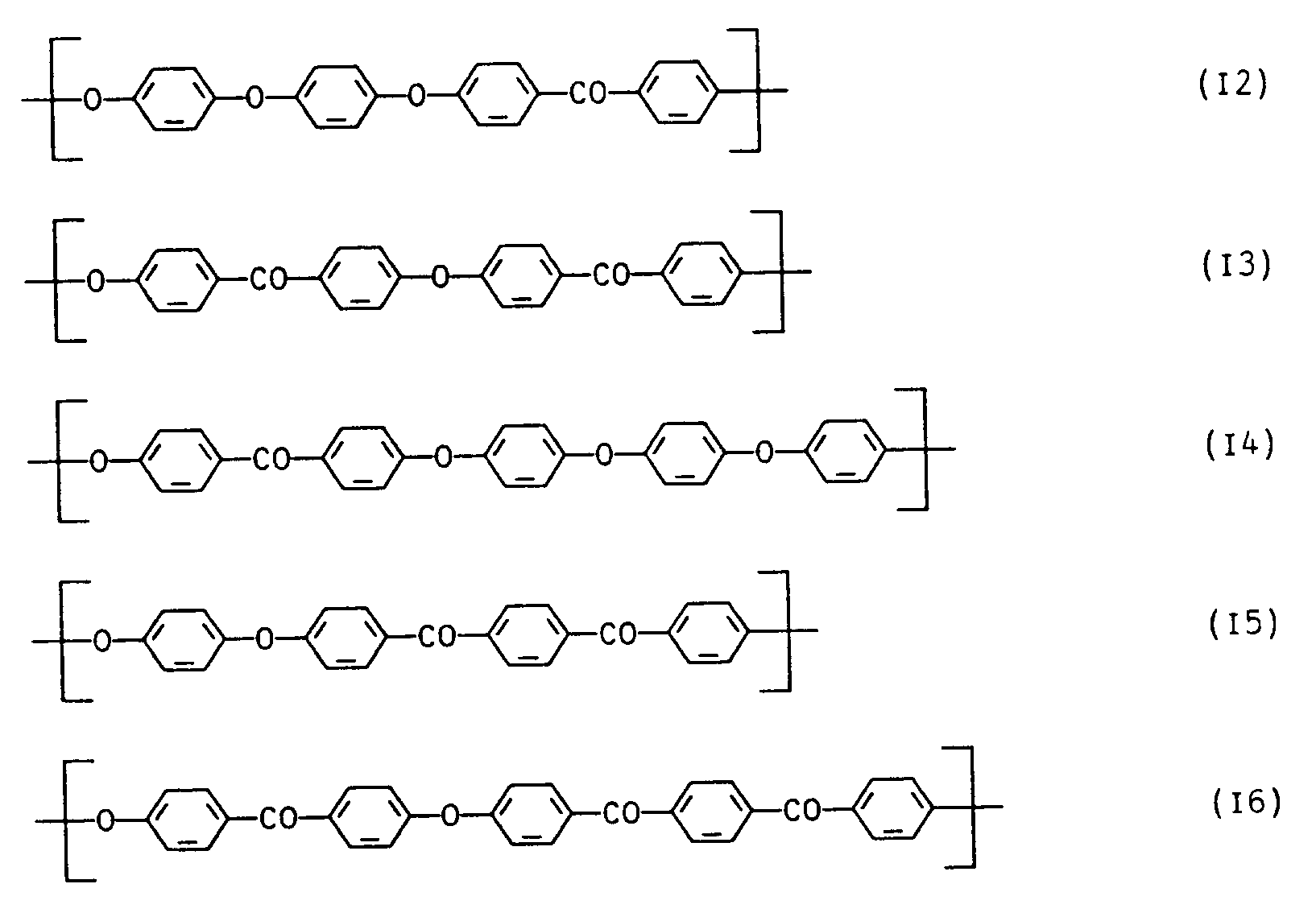
Im Falle der Polyaryletherketone mit wiederkehrenden Einheiten der allgemeinen Formel II werden solche, in denen beide Substituenten Q' und T' jeweils eine -CO-Gruppe darstellen, sowie solche, in denen die wiederkehrenden Einheiten der allgemeinen Formel II folgenden Aufbau haben
wobei die aromatischen Ringe durch C₁-C₆-Alkyl, C₁-C₆-Alkoxy-, Aryl-, Chlor- oder Fluorgruppen substituiert sein können und Q', T', s' und t', die vorstehend angegebene Bedeutung haben, bevorzugt. - Als Beispiele für wiederkehrende Einheiten der allgemeinen Formel II seien stellvertretend die nachstehenden genannt:

Die in den Formeln (II1)-(II6) enthaltenen Diphenyleneinheiten können durch Naphthyleneinheiten ersetzt werden. - Die Herstellung von Polyaryletherketonen des vorstehend beschriebenen Aufbaus durch elektrophile Polykondensation läßt sich prinzipiell durch drei allgemeine Gleichungen darstellen:
- a)

- b)

- c)

- Dabei steht X in diesen allgemeinen Gleichungen für Cl, Br, F oder I, vorzugsweise Cl, und Ar¹, Ar² und Ar³ stellen zweiwertige aromatische Reste dar, die entsprechend den wiederkehrenden Einheiten des gewünschten Polyaryletherketons gewählt werden.
- So kann z.B. das Polyaryletherketon mit wiederkehrenden Einheiten der Formel I3 durch Umsetzung von Phosgen mit Diphenylether nach der allgemeinen Gleichung b) und ein Polyaryletherketon mit wiederkehrenden Einheiten der Formel I6 durch Umsetzung von Terephthaloyldichlorid mit 4,4'-Diphenoxybenzophenon erhalten werden.
- Die Reaktionsgleichungen lauten in diesen Fällen

Die Polyaryletherketone mit den anderen vorstehend wiedergegebenen wiederkehrenden Einheiten werden durch entsprechende Wahl der Ausgangsverbindungen erhalten. - Als bevorzugte Carbonsäurehalogenide

seien Verbindungen genannt, in denen Ar¹ bzw. Ar³ die folgende Bedeutung haben
wobei die drei erstgenannten Verbindungen besonders bevorzugt werden. Weitere geeignete Säurehalogenide sind z.B. in der US-A 3956240 beschrieben. - Als bevorzugte Verbindungen HAr²H gemäß den vorstehend angegebenen Reaktionsgleichungen seien hier stellvertretend Diphenylether, 4,4'-Diphenoxybenzophenon, 1,4-Diphenoxybenzol und 4-Phenoxydiphenyl genannt. Weitere geeignete Verbindungen sind z.B. der bereits erwähnten US-A-3956240 und der US-A-4239884 zu entnehmen, auf die hier wegen näherer Einzelheiten verwiesen sei.
- Gegebenenfalls können auch monofunktionelle Verbindungen zugesetzt werden, die einen Endgruppenverschluß in den gebildeten Produkten bewirken. Entsprechende Verbindungen sind dem Fachmann bekannt und in der Literatur beschrieben.
- Die elektrophile Polykondensation der vorstehend beschriebenen Monomeren wird in Gegenwart einer Lewis-Säure in einem unter den Reaktionsbedingungen inerten Lösungsmittel durchgeführt. Die Lewis-Säure wird dabei in einem molaren Überschuß, bezogen auf die molare Menge an eingesetzten Carbonylgruppen bzw. Säurehalogeniden verwendet, wobei der molare Überschuß ausreichend sein muß, um die Reaktion zu katalysieren. Im allgemeinen reicht ein Überschuß von 2 bis 80, vorzugsweise von 5 bis 30 mol% Lewis-Säure, bezogen auf die eingesetzte Menge an aktiven, d.h. an der Reaktion teilnehmenden Carbonylgruppen, für diesen Zweck aus.
- Der notwendige Überschuß hängt natürlich auch von der Art der eingesetzten Monomeren ab; falls in Comonomeren basische Gruppen (z.B. Sulfongruppen) vorhanden sind, kann es erforderlich sein, einen höheren Überschuß an Lewis-Säure einzusetzen.
- Mit dem Begriff Lewis-Säure sind hier AlCl₃, AlBr₃, SbCl₅, SbF₅, InCl₃ GaCl₃, BCl₃, BF₃, ZnCl₂, FeCl₃, SnCl₄, TiCl₄ und MoCl₅ gemeint, wovon insbesondere wasserfreies AlCl₃ bevorzugt wird.
- Gemäß einer bevorzugten Ausführungsform des Verfahrens wird die Polykondensation in Gegenwart von 0,01 bis 4 mol, vorzugsweise 0,05 bis 2 mol, einer Lewis-Base, bezogen auf die molare Menge an Säurehalogenidgruppen durchgeführt. Diese steuert in gewissem Maße die Reaktion und unterdrückt unter anderem unerwünschte Nebenreaktionen (z.B. die ortho-Substitution aktivierter Aryloxygruppen). Geeignete Lewis-Basen für diese Zwecke werden detailliert in der WO-A-84/03891 beschrieben, auf die hier wegen näherer Einzelheiten verwiesen sei. Nur beispielhaft seien Amide, Amine, Ester, Ether, Ketone, Nitrile, Nitroverbindungen, Phosphine, Phosphinoxide, Sulfide, Sulfone, Sulfonamide und Sulfoxide genannt, wobei darauf geachtet werden sollte, daß die Lewis-Base zum einen nicht acylierend, alkylierend oder arylierend wirkt, zum anderen selbst nicht acyliert wird.
- Bevorzugte Lewis-Basen sind N-Methylformamid, N,N-Dimethylformamid, N,N-Dimethylacetamid, 1-Methyl-2-Pyrrolidon, Aceton, Benzophenon und Alkalimetallchloride, um nur einige zu nennen.
- Als inerte Lösungsmittel werden vorzugsweise polare Lösungsmittel eingesetzt, deren Dielektrizitätskonstante mindestens 2,5, vorzugsweise 4,0 bis 25 (bei 25°C) beträgt. Beispielhaft seien hier Methylenchlorid, Schwefelkohlenstoff, 1,2-Dichlorethan, 1,1,2,2-Tetrachlorethan und 1,2-Dichlorbenzol sowie deren Mischungen genannt.
- Bei Verwendung von BF₃ als Lewis-Säure hat sich HF als Lösungsmittel bewährt.
- Die Temperatur, bei der die Reaktion durchgeführt wird, liegt im allgemeinen im Bereich von -50 bis +150°C, vorzugsweise im Bereich von -20 bis +50°C.
- Es versteht sich, daß alle Lösungsmittel und Monomere möglichst wasserfrei eingesetzt werden sollten.
- Wesentlicher Schritt des erfindungsgemäßen Verfahrens ist, daß man der Reaktionsmischung 0,1 bis 10 mol%, vorzugsweise 0,2 bis 8 mol%, bezogen auf die Menge an eingesetztem Carbonsäurehalogenid, an Halogenverbindungen des Phosphors und des Schwefels, ausgewählt aus der Gruppe PCl₃, POCl₃, PCl₅ und SOCl₂, zusetzt, wovon Phosphoroxytrichlorid bevorzugt wird.
- Vorteilhaft wird die Verbindung vor Beginn der Polykondensation insbesondere vor der Zugabe des Säurehalogenids, zur Reaktionsmischung, zugesetzt, sie kann jedoch prinzipiell auch noch während der Kondensation zugegeben werden, solange noch keine unerwünschten Reaktionen aufgetreten sind.
- Nach erfolgter Polykondensation arbeitet man die Reaktionsmasse nach an sich bekannter und in der Literatur beschriebenen Verfahren auf. Vorzugsweise wird hierzu eine Lewis-Base zugegeben, die den Lewis-Säure/Polymer-Komplex und auch evtl. noch vorhandene Mengen der zugesetzten Halogenverbindung abbaut. Beispiele für solche Lewis-Basen finden sich in der bereits erwähnt WO-A-84/03891. Bevorzugt werden Wasser und Methanol oder deren Mischungen. Nach dieser Dekomplexierung und gegebenenfalls Zerkleinerung des Produkts kann dieses zur Reinigung noch mit einem geeigneten Lösungsmittel extrahiert werden.
- Das erfindungsgemäße Verfahren erlaubt auf einfachem Weg die Herstellung hochmolekularer und schmelzestabiler Polyaryletherketone, wobei das Molekulargewicht einfach und genau kontrolliert werden kann. Die Reproduzierbarkeit des Verfahrens ist nicht davon abhängig, daß stets frisch gereinigte Monomere eingesetzt werden.
- In einem 1 L-Dreihalskolben mit Rührer und Stickstoffeinleitung wurden 200 ml getrocknetes Methylenchlorid vorgelegt. Bei -20°C wurden 147,335 g (1,105 Mol) wasserfreies Aluminiumtrichlorid suspendiert. Dazu wurden langsam 28,239 g (0,300 Mol) Dimethylsulfon gegeben. Bei -15°C wurden nacheinander 1,012 g (0,007 Mol) Benzoylchlorid, 40,605 g (0,200 Mol) Terephthalsäuredichlorid (frisch destilliert, Kp 266 °C) und 74,603 g (0,204 Mol) Diphenoxybenzophenon gegeben. Die zum Einwiegen und Dosieren der Einsatzstoffe verwendeten Gefäße und Pulvertrichter wurden mit 20 ml trockenem Methylenchlorid nachgespült.
- Die Temperatur wurde innerhalb von 20 Minuten auf 25°C erhöht und die erstarrende Reaktionsmasse 4 Stunden bei dieser Temperatur gehalten. Dann wurde die gummiartige Masse aus dem Kolben entfernt, durch Zerschneiden mit einem Messer vorzerkleinert und in einem Haushaltsmixer mit 2 Liter Eis-Wasser dekomplexiert und weiter zerkleinert. Die erhaltenen Polymerflocken wurden 5 mal 30 Minuten mit 5 Liter kochendem Wasser extrahiert und im Vakuum bei 150°C getrocknet.
- Das erhaltene Polymer hatte die Struktur

und wies eine inhärente Viskosität von 1,121 auf (gemessen in konz. Schwefelsäure, 0,5 g/100 ml bei 25°C). - Beispiel 1 wurde reproduziert. Es wurde jedoch kein frisch destilliertes Terephthalsäuredichlorid, sondern Terephthalsäuredichlorid der Fa. DuPont verwendet, das ca. 9 Monate in einem luftdicht verschlossenen Foliensack gelagert wurde.
- Es wurde ein Polymer mit einer inhärenten Viskosität von 0,837 erhalten.
- Beispiel 2 wurde wiederholt, jedoch wurden nach Zugabe von Dimethylsulfon und vor der Zugabe von Benzoylchlorid 1,533 g (0,010 Mol) Phosphoroxychlorid zugesetzt.
- Es wurde ein Polymer mit einer inhärenten Viskosität von 1,115 erhalten.
- Beispiel 3 wurde wiederholt, jedoch wurden anstelle des Phosphoroxychlorids 2,082 g (0,010 Mol) Phosphorpentachlorid zugesetzt.
- Es wurde ein Polymer mit einer inhärenten Viskosität von 1,119 erhalten.
- Unter den in Beispiel 1 beschriebenen Reaktionsbedingungen wurden umgesetzt:
Aluminiumchlorid (144,007 g, 1,080 Mol)
Dimethylsulfon (28,239 g, 0,300 Mol)
Terephthaloylchlorid (40,605 g, 0,200 Mol)
Diphenoxybenzophenon (73,283 g, 0,200 Mol)
Das verwendete Terephthaloylchlorid war dasselbe wie in Beispiel 2. - Es wurde ein Polymer mit einer inhärenten Viskosität von 1,073 erhalten.
- Beispiel 5 wurde wiederholt, jedoch wurden nach der Zugabe von Dimethylsulfon und vor der Zugabe von Terephthaloylchlorid 1,533 g (0,01 Mol) Phosphoroxychlorid zugegeben.
- Es wurde ein Polymer mit einer inhärenten Viskosität von 2,667 erhalten.
- In einem mit Rührer und Stickstoff-Einleitung versehenen 500 ml-Dreihalskolben wurden 200 ml getrocknetes 1,2-Dichlorethan vorgelegt, auf -20°C gekühlt und 160,008 g (1,200 Mol) Aluminiumchlorid suspendiert. Dazu wurden bei -20°C 25,434 g (0,600 Mol) Lithiumchlorid undn 1,533 g (0,01 Mol) Phosphoroxychlorid gegeben. Bei -20°C wurden 89,467 g (0,400 Mol) p-Phenoxybenzoylchlorid zugetropft. Es wurde mit 20 ml 1,2-Dichlorethan nachgespült und die Temperatur wurde innerhalb einer Stunde langsam auf 0°C erhöht. Dann wurde der Rührer abgeschaltet und das Reaktionsgemisch bei 0°C 24 Stunden nachkondensiert. Die gummiartige Masse wurde mechanisch aus dem Kolben entfernt, durch Zerschneiden mit einem Messer vorzerkleinert und in einem Haushaltsmixer mit 2 Litern destilliertem Wasser dekomplexiert und weiter zerkleinert. Das so erhaltene Rohpolymer wurde 5 mal 30 Minuten mit 5 Liter kochendem Wasser extrahiert und im Vakuum bei 150°C getrocknet.
- Das so hergestellte Polymer hatte die Struktur

und wies eine inhärente Viskosität von 3,674 auf. - Die in den Beispielen 3, 4, 6 und 7 erhaltenen Produkte wiesen eine gute Schmelzestabilität bei der Verarbeitung auf, die den Produkten der Beispiele 1, 2 und 5 überlegen war.
Claims (7)
- Verfahren zur Herstellung von Polyaryletherketonen durch elektrophile Polykondensation unter Verwendung von Carbonsäurehalogeniden als Monomerbestandteil in Gegenwart eines molaren Überschußes, bezogen auf die eingesetzte molare Menge an Carbonsäurehalogenide einer Lewis-Säure, ausgewählt aus der Gruppe AlCl₃, AlBr₃, SbCl₅, SbF₅, InCl₃, GaCl₃, BCl₃, BF₃, ZnCl₂, FeCl₃, SnCl₄, TiCl₄, und MoCl₅, und gegebenenfalls einer Lewis-Base, die nicht acylierend, alkylierend oder arylierend wirkt und selbst nicht acyliert wird, in einem inerten Lösungsmittel, dadurch gekennzeichnet, daß man der Reaktionsmischung 0,1 bis 10 mol%, bezogen auf die eingesetzte Menge an Carbonsäurehalogeniden, an Halogenverbindungen des Phosphors oder Schwefels, ausgewählt aus der Gruppe PCl₃, POCl₃, PCl₅ und SOCl₂, zusetzt.
- Verfahren nach Anspruch 1, dadurch gekennzeichnet, daß man die Halogenverbindungen des Phosphors oder Schwefels, vor oder zusammen mit den Carbonsäurehalogeniden zugibt.
- Verfahren nach mindestens einem der Ansprüche 1 und 2, dadurch gekennzeichnet, daß man als molaren Überschuß an Lewis-Säure 2 bis 80 mol%, bezogen auf die an der Polykondensationsreaktion teilnehmenden Carbonylgruppen verwendet.
- Verfahren nach mindestens einem der Ansprüche 1 bis 3, dadurch gekennzeichnet, daß man die Polykondensation in Gegenwart einer Lewis-Base durchführt.
- Verfahren nach mindestens einem der Ansprüche 1 bis 4, dadurch gekennzeichnet, daß man 0,01 bis 4 mol an Lewis-Base, bezogen auf die molare Menge an Säurehalogenidgruppen, verwendet.
- Verfahren nach einem der Ansprüche 1 bis 5, dadurch gekennzeichnet, daß man als Lewis-Säure Aluminiumtrichlorid verwendet.
- Verfahren nach einem der Ansprüche 1 bis 6, dadurch gekennzeichnet, daß man als Halogenverbindung Phosphoroxytrichlorid verwendet.
Applications Claiming Priority (2)
| Application Number | Priority Date | Filing Date | Title |
|---|---|---|---|
| DE3906178A DE3906178A1 (de) | 1989-02-28 | 1989-02-28 | Verfahren zur herstellung von polyaryletherketonen durch elektrophile polykondensation |
| DE3906178 | 1989-02-28 |
Publications (2)
| Publication Number | Publication Date |
|---|---|
| EP0385223A1 EP0385223A1 (de) | 1990-09-05 |
| EP0385223B1 true EP0385223B1 (de) | 1994-11-17 |
Family
ID=6375083
Family Applications (1)
| Application Number | Title | Priority Date | Filing Date |
|---|---|---|---|
| EP90103174A Expired - Lifetime EP0385223B1 (de) | 1989-02-28 | 1990-02-20 | Verfahren zur Herstellung von Polyaryletherketonen durch elektrophile Polykondensation |
Country Status (4)
| Country | Link |
|---|---|
| US (1) | US5081216A (de) |
| EP (1) | EP0385223B1 (de) |
| JP (1) | JPH02248429A (de) |
| DE (2) | DE3906178A1 (de) |
Families Citing this family (4)
| Publication number | Priority date | Publication date | Assignee | Title |
|---|---|---|---|---|
| GB8726884D0 (en) * | 1987-11-17 | 1987-12-23 | Raychem Ltd | Poly(arylene ether ketones) |
| DE4424042A1 (de) | 1994-07-11 | 1996-01-18 | Basf Ag | Schwefeloxide und deren Halogenderivate als elektrophiles Endgruppenverschlußreagens bei der elektrophilen Synthese von Polyaryletherketonen |
| FR2993567B1 (fr) * | 2012-07-20 | 2015-09-25 | Arkema France | Procede de synthese de poly-aryl-ether-cetones |
| CN120025539B (zh) * | 2025-04-21 | 2025-07-18 | 江苏苏博特新材料股份有限公司 | 一种高韧性聚醚酮酮聚合物及其制备方法 |
Family Cites Families (13)
| Publication number | Priority date | Publication date | Assignee | Title |
|---|---|---|---|---|
| NL6611019A (de) * | 1965-08-04 | 1967-02-06 | ||
| US3442857A (en) * | 1965-11-10 | 1969-05-06 | Du Pont | Boron trifluoride-hydrogen fluoride catalyzed synthesis of poly(aromatic sulfone) and poly(aromatic ketone) polymers |
| US3953400A (en) * | 1972-01-17 | 1976-04-27 | Raychem Corporation | Polyketones and methods therefor |
| US4186262A (en) * | 1976-02-10 | 1980-01-29 | Imperial Chemical Industries Limited | Aromatic polymers having phenylene groups linked by oxygen atoms, keto groups and sulphone groups |
| US4396755A (en) * | 1981-11-12 | 1983-08-02 | Imperial Chemical Industries Plc | Production of aromatic polyketones |
| DE3241444A1 (de) * | 1981-11-14 | 1983-05-26 | Basf Ag, 6700 Ludwigshafen | Aromatische copolyetherketone |
| GB8408082D0 (en) * | 1983-03-31 | 1984-05-10 | Raychem Corp | Preparing poly-(arylene ketones) |
| DE3342433A1 (de) * | 1983-11-24 | 1985-06-05 | Hoechst Ag, 6230 Frankfurt | Verfahren zur herstellung von aromatischen polyaethern |
| DE3416446A1 (de) * | 1984-05-04 | 1985-11-07 | Basf Ag, 6700 Ludwigshafen | Verfahren zur herstellung aromatischer polyetherketone |
| DE3416445A1 (de) * | 1984-05-04 | 1985-11-07 | Basf Ag, 6700 Ludwigshafen | Unvernetzte, thermoplastisch verarbeitbare polyetherketone und verfahren zu ihrer herstellung |
| US4820790A (en) * | 1987-03-13 | 1989-04-11 | Amoco Corporation | Chain-extended poly(aryl ether ketones) |
| US4826947A (en) * | 1987-07-09 | 1989-05-02 | Raychem Corporation | Preparation of poly(arylene ether ketones) |
| US4870153A (en) * | 1987-10-22 | 1989-09-26 | Amoco Corporation | Novel poly(aryl ether) polymers |
-
1989
- 1989-02-28 DE DE3906178A patent/DE3906178A1/de not_active Withdrawn
-
1990
- 1990-02-01 US US07/473,408 patent/US5081216A/en not_active Expired - Fee Related
- 1990-02-20 DE DE59007708T patent/DE59007708D1/de not_active Expired - Lifetime
- 1990-02-20 EP EP90103174A patent/EP0385223B1/de not_active Expired - Lifetime
- 1990-02-26 JP JP2042739A patent/JPH02248429A/ja active Pending
Non-Patent Citations (1)
| Title |
|---|
| J. March, Advanced Organic Chemistry, John Wiley & Sons, 3rd Ed. (1985), p. 388. * |
Also Published As
| Publication number | Publication date |
|---|---|
| DE3906178A1 (de) | 1990-08-30 |
| US5081216A (en) | 1992-01-14 |
| EP0385223A1 (de) | 1990-09-05 |
| JPH02248429A (ja) | 1990-10-04 |
| DE59007708D1 (de) | 1994-12-22 |
Similar Documents
| Publication | Publication Date | Title |
|---|---|---|
| DE3485955T2 (de) | Herstellung von polyarylenetherketonen. | |
| DE2635895C2 (de) | ||
| DE2549529C2 (de) | Aromatische Polyäthersulfone und ein Verfahren zu ihrer Herstellung | |
| DE2517142C2 (de) | ||
| EP0327984A2 (de) | Polyaryletherketone mit verbesserter Verarbeitbarkeit | |
| DE2433278C2 (de) | ||
| DE2206836A1 (de) | Polyketone und Verfahren zu ihrer Herstellung | |
| DE2712542C2 (de) | Phosphazen-Copolymere | |
| DE3614753A1 (de) | Hochtemperaturbestaendige copolykondensat-formmassen | |
| EP0385223A1 (de) | Verfahren zur Herstellung von Polyaryletherketonen durch elektrophile Polykondensation | |
| DE1909441B2 (de) | Verfahren zur Herstellung von linearen aromatischen Copolymeren | |
| EP0327980A2 (de) | Hochtemperaturbeständige Polyarylether mit verbesserter Verarbeitbarkeit | |
| EP0386582A2 (de) | Verfahren zur Herstellung von Polyaryletherketonen durch elektrophile Polykondensation | |
| EP0044411A1 (de) | Verfahren zur Herstellung von elektrisch leitfähigen polymeren Systemen und deren Verwendung in der Elektrotechnik und zur antistatischen Ausrüstung von Kunststoffen | |
| DE3700810A1 (de) | Hochtemperaturbestaendige polyaryletherketone | |
| EP0451556A2 (de) | Stabilisierte Polyaryletherketon-Formmassen | |
| DE3785284T2 (de) | Verfahren zur Herstellung von Arylen-Oligomeren. | |
| DE602004012912T2 (de) | Verfahren zur Herstellung von Fluorhalogenethern | |
| DE1645153A1 (de) | Verfahren zur Herstellung von Polymerisaten | |
| DE3309075A1 (de) | Verfahren zur herstellung von aromatischen polyketonen | |
| DE2705587C2 (de) | Aromatische Ätherketon/Sulfon-Copolymere und Verfahren zur Herstellung derselben | |
| Rose | Synthesis of polyaryletherketones | |
| DE3040295A1 (de) | Verfahren zur herstellung von aromatischen carbonsaeurechloriden | |
| EP0692508A1 (de) | Amphotere Metalloxide als Cokatalysator bei der elektrophilen Synthese von Polyaryletherketonen | |
| EP0330962A2 (de) | Verfahren zur Herstellung von halogenhaltigen aromatischen Verbindungen |
Legal Events
| Date | Code | Title | Description |
|---|---|---|---|
| PUAI | Public reference made under article 153(3) epc to a published international application that has entered the european phase |
Free format text: ORIGINAL CODE: 0009012 |
|
| 17P | Request for examination filed |
Effective date: 19900705 |
|
| AK | Designated contracting states |
Kind code of ref document: A1 Designated state(s): BE DE FR GB NL |
|
| 17Q | First examination report despatched |
Effective date: 19921203 |
|
| GRAA | (expected) grant |
Free format text: ORIGINAL CODE: 0009210 |
|
| AK | Designated contracting states |
Kind code of ref document: B1 Designated state(s): BE DE FR GB NL |
|
| REF | Corresponds to: |
Ref document number: 59007708 Country of ref document: DE Date of ref document: 19941222 |
|
| GBT | Gb: translation of ep patent filed (gb section 77(6)(a)/1977) |
Effective date: 19941201 |
|
| PGFP | Annual fee paid to national office [announced via postgrant information from national office to epo] |
Ref country code: FR Payment date: 19950126 Year of fee payment: 6 |
|
| PGFP | Annual fee paid to national office [announced via postgrant information from national office to epo] |
Ref country code: GB Payment date: 19950215 Year of fee payment: 6 |
|
| PGFP | Annual fee paid to national office [announced via postgrant information from national office to epo] |
Ref country code: NL Payment date: 19950228 Year of fee payment: 6 Ref country code: DE Payment date: 19950228 Year of fee payment: 6 |
|
| PGFP | Annual fee paid to national office [announced via postgrant information from national office to epo] |
Ref country code: BE Payment date: 19950306 Year of fee payment: 6 |
|
| ET | Fr: translation filed | ||
| PLBE | No opposition filed within time limit |
Free format text: ORIGINAL CODE: 0009261 |
|
| STAA | Information on the status of an ep patent application or granted ep patent |
Free format text: STATUS: NO OPPOSITION FILED WITHIN TIME LIMIT |
|
| 26N | No opposition filed | ||
| PG25 | Lapsed in a contracting state [announced via postgrant information from national office to epo] |
Ref country code: GB Effective date: 19960220 |
|
| PG25 | Lapsed in a contracting state [announced via postgrant information from national office to epo] |
Ref country code: DE Effective date: 19960223 |
|
| PG25 | Lapsed in a contracting state [announced via postgrant information from national office to epo] |
Ref country code: BE Effective date: 19960228 |
|
| BERE | Be: lapsed |
Owner name: BASF A.G. Effective date: 19960228 |
|
| PG25 | Lapsed in a contracting state [announced via postgrant information from national office to epo] |
Ref country code: NL Effective date: 19960901 |
|
| GBPC | Gb: european patent ceased through non-payment of renewal fee |
Effective date: 19960220 |
|
| PG25 | Lapsed in a contracting state [announced via postgrant information from national office to epo] |
Ref country code: FR Effective date: 19961031 |
|
| NLV4 | Nl: lapsed or anulled due to non-payment of the annual fee |
Effective date: 19960901 |
|
| REG | Reference to a national code |
Ref country code: FR Ref legal event code: ST |