EP0381206B2 - Manufacturing process for fibers, rovings and mats from lyotropic liquid crystalline polymers - Google Patents
Manufacturing process for fibers, rovings and mats from lyotropic liquid crystalline polymers Download PDFInfo
- Publication number
- EP0381206B2 EP0381206B2 EP90101976A EP90101976A EP0381206B2 EP 0381206 B2 EP0381206 B2 EP 0381206B2 EP 90101976 A EP90101976 A EP 90101976A EP 90101976 A EP90101976 A EP 90101976A EP 0381206 B2 EP0381206 B2 EP 0381206B2
- Authority
- EP
- European Patent Office
- Prior art keywords
- stream
- polymer
- solution
- process according
- fibers
- Prior art date
- Legal status (The legal status is an assumption and is not a legal conclusion. Google has not performed a legal analysis and makes no representation as to the accuracy of the status listed.)
- Expired - Lifetime
Links
- 239000000835 fiber Substances 0.000 title claims description 62
- 229920000106 Liquid crystal polymer Polymers 0.000 title claims description 5
- 230000002535 lyotropic effect Effects 0.000 title claims description 5
- 238000004519 manufacturing process Methods 0.000 title claims description 5
- 229920000642 polymer Polymers 0.000 claims description 39
- 239000012530 fluid Substances 0.000 claims description 28
- 238000000034 method Methods 0.000 claims description 24
- 230000001112 coagulating effect Effects 0.000 claims description 18
- XLYOFNOQVPJJNP-UHFFFAOYSA-N water Substances O XLYOFNOQVPJJNP-UHFFFAOYSA-N 0.000 claims description 16
- 239000000203 mixture Substances 0.000 claims description 14
- 239000012634 fragment Substances 0.000 claims description 11
- -1 poly(p-phenylene-terephthalamide) Polymers 0.000 claims description 11
- QAOWNCQODCNURD-UHFFFAOYSA-N sulfuric acid Substances OS(O)(=O)=O QAOWNCQODCNURD-UHFFFAOYSA-N 0.000 claims description 11
- 229920003366 poly(p-phenylene terephthalamide) Polymers 0.000 claims description 8
- 238000009987 spinning Methods 0.000 claims description 7
- NAQMVNRVTILPCV-UHFFFAOYSA-N hexane-1,6-diamine Chemical compound NCCCCCCN NAQMVNRVTILPCV-UHFFFAOYSA-N 0.000 claims description 6
- 229920002284 Cellulose triacetate Polymers 0.000 claims description 5
- NNLVGZFZQQXQNW-ADJNRHBOSA-N [(2r,3r,4s,5r,6s)-4,5-diacetyloxy-3-[(2s,3r,4s,5r,6r)-3,4,5-triacetyloxy-6-(acetyloxymethyl)oxan-2-yl]oxy-6-[(2r,3r,4s,5r,6s)-4,5,6-triacetyloxy-2-(acetyloxymethyl)oxan-3-yl]oxyoxan-2-yl]methyl acetate Chemical compound O([C@@H]1O[C@@H]([C@H]([C@H](OC(C)=O)[C@H]1OC(C)=O)O[C@H]1[C@@H]([C@@H](OC(C)=O)[C@H](OC(C)=O)[C@@H](COC(C)=O)O1)OC(C)=O)COC(=O)C)[C@@H]1[C@@H](COC(C)=O)O[C@@H](OC(C)=O)[C@H](OC(C)=O)[C@H]1OC(C)=O NNLVGZFZQQXQNW-ADJNRHBOSA-N 0.000 claims description 5
- 230000002238 attenuated effect Effects 0.000 claims description 5
- ZBMISJGHVWNWTE-UHFFFAOYSA-N 3-(4-aminophenoxy)aniline Chemical compound C1=CC(N)=CC=C1OC1=CC=CC(N)=C1 ZBMISJGHVWNWTE-UHFFFAOYSA-N 0.000 claims description 3
- DZIHTWJGPDVSGE-UHFFFAOYSA-N 4-[(4-aminocyclohexyl)methyl]cyclohexan-1-amine Chemical compound C1CC(N)CCC1CC1CCC(N)CC1 DZIHTWJGPDVSGE-UHFFFAOYSA-N 0.000 claims description 3
- XQMKYNYUUFUXLP-UHFFFAOYSA-N 7-[3-(7-oxoazepane-2-carbonyl)benzoyl]azepan-2-one Chemical compound C=1C=CC(C(=O)C2NC(=O)CCCC2)=CC=1C(=O)C1CCCCC(=O)N1 XQMKYNYUUFUXLP-UHFFFAOYSA-N 0.000 claims description 3
- 229920002292 Nylon 6 Polymers 0.000 claims description 3
- 229920001577 copolymer Polymers 0.000 claims description 3
- QTBSBXVTEAMEQO-UHFFFAOYSA-M Acetate Chemical compound CC([O-])=O QTBSBXVTEAMEQO-UHFFFAOYSA-M 0.000 claims description 2
- 229920001661 Chitosan Polymers 0.000 claims description 2
- 229920006020 amorphous polyamide Polymers 0.000 claims description 2
- 150000002531 isophthalic acids Chemical class 0.000 claims description 2
- 150000003504 terephthalic acids Chemical class 0.000 claims description 2
- HEMHJVSKTPXQMS-UHFFFAOYSA-M Sodium hydroxide Chemical compound [OH-].[Na+] HEMHJVSKTPXQMS-UHFFFAOYSA-M 0.000 description 6
- 238000005259 measurement Methods 0.000 description 5
- 239000007921 spray Substances 0.000 description 5
- 230000015271 coagulation Effects 0.000 description 4
- 238000005345 coagulation Methods 0.000 description 4
- YMWUJEATGCHHMB-UHFFFAOYSA-N Dichloromethane Chemical compound ClCCl YMWUJEATGCHHMB-UHFFFAOYSA-N 0.000 description 3
- OKKJLVBELUTLKV-UHFFFAOYSA-N Methanol Chemical compound OC OKKJLVBELUTLKV-UHFFFAOYSA-N 0.000 description 3
- DTQVDTLACAAQTR-UHFFFAOYSA-N Trifluoroacetic acid Chemical compound OC(=O)C(F)(F)F DTQVDTLACAAQTR-UHFFFAOYSA-N 0.000 description 3
- 239000002253 acid Substances 0.000 description 3
- 238000010791 quenching Methods 0.000 description 3
- 239000002904 solvent Substances 0.000 description 3
- 239000004952 Polyamide Substances 0.000 description 2
- KKEYFWRCBNTPAC-UHFFFAOYSA-N Terephthalic acid Chemical compound OC(=O)C1=CC=C(C(O)=O)C=C1 KKEYFWRCBNTPAC-UHFFFAOYSA-N 0.000 description 2
- 230000015572 biosynthetic process Effects 0.000 description 2
- QQVIHTHCMHWDBS-UHFFFAOYSA-N isophthalic acid Chemical compound OC(=O)C1=CC=CC(C(O)=O)=C1 QQVIHTHCMHWDBS-UHFFFAOYSA-N 0.000 description 2
- 229920002647 polyamide Polymers 0.000 description 2
- 239000007787 solid Substances 0.000 description 2
- 238000005507 spraying Methods 0.000 description 2
- 238000003892 spreading Methods 0.000 description 2
- 229910001220 stainless steel Inorganic materials 0.000 description 2
- 239000010935 stainless steel Substances 0.000 description 2
- 239000004677 Nylon Substances 0.000 description 1
- 239000000853 adhesive Substances 0.000 description 1
- 230000001070 adhesive effect Effects 0.000 description 1
- 239000000701 coagulant Substances 0.000 description 1
- 239000002131 composite material Substances 0.000 description 1
- 238000010924 continuous production Methods 0.000 description 1
- 238000005520 cutting process Methods 0.000 description 1
- 230000008021 deposition Effects 0.000 description 1
- 239000003085 diluting agent Substances 0.000 description 1
- 238000002474 experimental method Methods 0.000 description 1
- 238000001125 extrusion Methods 0.000 description 1
- 210000000416 exudates and transudate Anatomy 0.000 description 1
- 238000010438 heat treatment Methods 0.000 description 1
- 230000001788 irregular Effects 0.000 description 1
- 239000007788 liquid Substances 0.000 description 1
- 239000000463 material Substances 0.000 description 1
- 238000012986 modification Methods 0.000 description 1
- 230000004048 modification Effects 0.000 description 1
- 229920001778 nylon Polymers 0.000 description 1
- 230000003287 optical effect Effects 0.000 description 1
- 239000002245 particle Substances 0.000 description 1
- 229920001084 poly(chloroprene) Polymers 0.000 description 1
- 229920002959 polymer blend Polymers 0.000 description 1
- 239000000843 powder Substances 0.000 description 1
- 230000000171 quenching effect Effects 0.000 description 1
- 238000007711 solidification Methods 0.000 description 1
- 230000008023 solidification Effects 0.000 description 1
- 239000000126 substance Substances 0.000 description 1
- HIFJUMGIHIZEPX-UHFFFAOYSA-N sulfuric acid;sulfur trioxide Chemical compound O=S(=O)=O.OS(O)(=O)=O HIFJUMGIHIZEPX-UHFFFAOYSA-N 0.000 description 1
- 238000012956 testing procedure Methods 0.000 description 1
- WROMPOXWARCANT-UHFFFAOYSA-N tfa trifluoroacetic acid Chemical compound OC(=O)C(F)(F)F.OC(=O)C(F)(F)F WROMPOXWARCANT-UHFFFAOYSA-N 0.000 description 1
- 229920001169 thermoplastic Polymers 0.000 description 1
- 239000004416 thermosoftening plastic Substances 0.000 description 1
- YNJBWRMUSHSURL-UHFFFAOYSA-N trichloroacetic acid Chemical compound OC(=O)C(Cl)(Cl)Cl YNJBWRMUSHSURL-UHFFFAOYSA-N 0.000 description 1
- 229960004319 trichloroacetic acid Drugs 0.000 description 1
- 230000008016 vaporization Effects 0.000 description 1
- 238000009834 vaporization Methods 0.000 description 1
Images

Classifications
-
- D—TEXTILES; PAPER
- D01—NATURAL OR MAN-MADE THREADS OR FIBRES; SPINNING
- D01F—CHEMICAL FEATURES IN THE MANUFACTURE OF ARTIFICIAL FILAMENTS, THREADS, FIBRES, BRISTLES OR RIBBONS; APPARATUS SPECIALLY ADAPTED FOR THE MANUFACTURE OF CARBON FILAMENTS
- D01F6/00—Monocomponent artificial filaments or the like of synthetic polymers; Manufacture thereof
- D01F6/58—Monocomponent artificial filaments or the like of synthetic polymers; Manufacture thereof from homopolycondensation products
- D01F6/60—Monocomponent artificial filaments or the like of synthetic polymers; Manufacture thereof from homopolycondensation products from polyamides
- D01F6/605—Monocomponent artificial filaments or the like of synthetic polymers; Manufacture thereof from homopolycondensation products from polyamides from aromatic polyamides
-
- D—TEXTILES; PAPER
- D01—NATURAL OR MAN-MADE THREADS OR FIBRES; SPINNING
- D01D—MECHANICAL METHODS OR APPARATUS IN THE MANUFACTURE OF ARTIFICIAL FILAMENTS, THREADS, FIBRES, BRISTLES OR RIBBONS
- D01D5/00—Formation of filaments, threads, or the like
- D01D5/08—Melt spinning methods
- D01D5/098—Melt spinning methods with simultaneous stretching
- D01D5/0985—Melt spinning methods with simultaneous stretching by means of a flowing gas (e.g. melt-blowing)
-
- D—TEXTILES; PAPER
- D01—NATURAL OR MAN-MADE THREADS OR FIBRES; SPINNING
- D01D—MECHANICAL METHODS OR APPARATUS IN THE MANUFACTURE OF ARTIFICIAL FILAMENTS, THREADS, FIBRES, BRISTLES OR RIBBONS
- D01D5/00—Formation of filaments, threads, or the like
- D01D5/11—Flash-spinning
-
- D—TEXTILES; PAPER
- D01—NATURAL OR MAN-MADE THREADS OR FIBRES; SPINNING
- D01F—CHEMICAL FEATURES IN THE MANUFACTURE OF ARTIFICIAL FILAMENTS, THREADS, FIBRES, BRISTLES OR RIBBONS; APPARATUS SPECIALLY ADAPTED FOR THE MANUFACTURE OF CARBON FILAMENTS
- D01F2/00—Monocomponent artificial filaments or the like of cellulose or cellulose derivatives; Manufacture thereof
- D01F2/24—Monocomponent artificial filaments or the like of cellulose or cellulose derivatives; Manufacture thereof from cellulose derivatives
- D01F2/28—Monocomponent artificial filaments or the like of cellulose or cellulose derivatives; Manufacture thereof from cellulose derivatives from organic cellulose esters or ethers, e.g. cellulose acetate
-
- D—TEXTILES; PAPER
- D04—BRAIDING; LACE-MAKING; KNITTING; TRIMMINGS; NON-WOVEN FABRICS
- D04H—MAKING TEXTILE FABRICS, e.g. FROM FIBRES OR FILAMENTARY MATERIAL; FABRICS MADE BY SUCH PROCESSES OR APPARATUS, e.g. FELTS, NON-WOVEN FABRICS; COTTON-WOOL; WADDING ; NON-WOVEN FABRICS FROM STAPLE FIBRES, FILAMENTS OR YARNS, BONDED WITH AT LEAST ONE WEB-LIKE MATERIAL DURING THEIR CONSOLIDATION
- D04H1/00—Non-woven fabrics formed wholly or mainly of staple fibres or like relatively short fibres
- D04H1/40—Non-woven fabrics formed wholly or mainly of staple fibres or like relatively short fibres from fleeces or layers composed of fibres without existing or potential cohesive properties
- D04H1/54—Non-woven fabrics formed wholly or mainly of staple fibres or like relatively short fibres from fleeces or layers composed of fibres without existing or potential cohesive properties by welding together the fibres, e.g. by partially melting or dissolving
- D04H1/56—Non-woven fabrics formed wholly or mainly of staple fibres or like relatively short fibres from fleeces or layers composed of fibres without existing or potential cohesive properties by welding together the fibres, e.g. by partially melting or dissolving in association with fibre formation, e.g. immediately following extrusion of staple fibres
Definitions
- U.S. 3,767,756 discloses a process for dry-jet spinning continuous polyamide fibers.
- the gas layer provides a gap in which the fiber is attenuated.
- a coagulant bath is required in order to coagulate the polymer and remove the solvent. Since the purpose of this process is to obtain continuous filaments, it would be contrary to this purpose for the gas layer to interact with the polymer and stream in such a way as to provide fragmented fibers.
- U.S. 4,025,593 discloses a process for flash spinning of a pressurized two-phase mixture via an abrupt pressure release which causes solidification of the polymer and complete vaporization of the solvent.
- the abrupt pressure release occurs by passing the two-phase mixture through a die.
- a diluent fluid (make-up fluid) is introduced into the two-phase liquid mixture so that the abrupt pressure released results in discontinuous fibrils.
- the make-up fluid seems to be directed into the two-phase stream rather that in surrounding contact with the stream as is required for the invention.
- the present invention provides novel processes for preparing pulp-like fibers, rovings or non-woven mats from lyotropic liquid crystalline polymers. It also contemplates and includes novel structures of subdenier fibers having different cross-sections and lengths which are produced thereby.
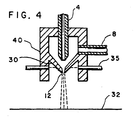
- Figs. 1-4 are cross-sectional schematic views of apparatus, primarily spin-cells, for practicing the invention.
- This invention provides a process for preparing subdenier fibers from lyotropic liquid crystalline polymer
- the invention provides in particular a process for preparing attenuated and fragmented subdenier fiber from polymers by extruding polymer spinning dope into a chamber, introducing pressurized gas into the chamber and passing the polymer stream through an aperture into a zone of lower pressure, characterized in that the polymers are lyotropic liquid crystalline polymers and the process comprises the steps of 1) extruding the stream of the optically anisotropic solution of the polymer through spinneret orifice (3) into chamber (9) having an aperture (11) of generally convergent walls in the vicinity of the orifice (3), 2) introducing the pressurized gas into said chamber (9), 3) directing the gas before it contacts the stream in the flow direction of the stream and then in surrounding contact with the stream within chamber (9) at a velocity sufficient to attenuate and fragment the stream into fibers as both the gas and stream pass through the aperture (11) into the zone of lower pressure, and 4)
- the fragmented stream of subdenier fibers may be collected in the form of pulp-like short fibers, rovings or mats and such products are contemplated as part of the present invention.
- Optically anisotropic solutions are useful in the present invention and are well known in the art. Such solutions include poly(p-phenylene terephthalamide) (PPD-T) in concentrated sulfuric acid as disclosed in U.S. Patent Nos. 3,767,756 and 3,869,429 and cellulose triacetate in trifluoroacetic acid as disclosed in U.S. Patent No. 4,464,326. If desired, polymers that do not form anisotropic solutions on their own, may be incorporated in the aforementioned anisotropic solutions before extrusion to form polymer blends or molecular composites of the polymers.
- PPD-T poly(p-phenylene terephthalamide)
- cellulose triacetate in trifluoroacetic acid
- polymers that do not form anisotropic solutions on their own may be incorporated in the aforementioned anisotropic solutions before extrusion to form polymer blends or molecular composites of the polymers.
- Such added polymers include nylon 6/6, the amorphous polyamides prepared from a mixture of terephthalic acid, isophthalic acid, bis(p-aminocyclohexyl)methane and hexamethylene diamine and copolymers prepared from 3,4'-diaminodiphenyl ether, and isophthaloyl bis-(caprolactam).
- the solutions can be prepared by techniques understood by those skilled in the art.
- the solution is extruded through a spinneret orifice into a chamber in the vicinity of an aperture, generally convergent-walled through which it will exit the chamber.
- a pressurized gas which is inert to the anisotropic solution, is introduced into the chamber also in the vicinity of the aperture and in surrounding contact with the solution stream.
- the gas preferably air, is conveniently at a pressure between 2.94 bar and 4.91 bar (3.0 kg/sq.cm. and 5.0 kg/sq.cm.) and is at a temperature of from 20° to 120°C. as it is fed into the chamber.
- the velocity of the gas is such as to attenuate and fragment the stream as it exits the chamber through the aperture.
- the gas and stream upon leaving the chamber enter a zone of lower pressure, preferably air at atmospheric pressure. It is in this zone that the fragmented stream is contacted either before or after collection, with a jet of coagulating fluid.
- the fragmented stream is contacted with a jet of coagulating fluid, for example, water, at some distance such as 15 to 30 centimeters from the aperture.
- a jet of coagulating fluid for example, water
- the water jet will coagulate and disperse the stream which may then be collected as a mat on a screen belt moving transversely to the dispersed stream.
- the stream comprises a sulfuric acid solution of PPD-T
- contact with water dilutes the acid and causes the polymer to come out of solution.
- the collected material may be washed further or neutralized with dilute base, as is known in the art while on the screen belt.
- the resulting mat is formed by the random laydown of jet attenuated spun, oriented, subdenier, discontinuous fibers having widely varying morphology. It may be tacked at fiber cross-over points to form a dimensionally stable sheet structure.
- the pulp-like product consists of short oriented, subdenier fibers with varying cross-sectional morphology and lengths up to 15.0 mm.
- a jet of coagulating fluid is directed against the fragmented stream at a distance from the aperture of between about 1.0 and 10.0 cms. and the coagulated product is collected on a screen; however, in this case the jet employed is one that lacks sufficient force to disperse the coagulated product before it is collected.
- This structure is an essentially unidirectional lay down of oriented subdenier, discontinuous fibers having widely varying morphology with essentially no tacking or bonding between fibers.
- Fig. 1 shows, in schematic cross-section, a spin-cell having a tubular 1-hole spinneret (4) with an outlet (3) extending into chamber (9) of cylindrical manifold (6).
- the manifold has an inlet (8) and a nozzle (10) with a convergent-walled aperture (11) serving as an exit from the cell.
- an anisotropic solution of polymer is metered through spinneret (4) and into chamber (9) where it is contacted by a pressurized gas introduced from inlet (8).
- the gas attenuates and fractures the polymer solution into elongated fragments as it passes out of the chamber through aperture (11), whose walls converge into a narrower opening.
- As the stream of elongated fragments exit aperture (11) they are contacted with a coagulating fluid.
- a variety of products may be obtained depending upon how the contact is made.
- Fig. 2 shows a process wherein the elongated fragments or fibers exiting spin-cell (6) are contacted at a distance below aperture (11) with a fluid (26) from spray jet nozzles (20) which acts to coagulate and spread the fragments of stream (30) which are then deposited as a nonwoven sheet onto moving screen (32) If desired, a sequence of such jets may be employed.
- These fragments are subdenier fibers with widely different cross sections. They have lengths of up to 10 cm., diameters of up to 10 ⁇ m, and length to diameter ratios of at least 1000.
- the fibers on the screen can be washed, dried and wound onto a bobbin (not shown) all in a continuous process.
- Fig. 3 shows an alternate method for contacting the stream leaving aperture (11) with coagulating fluid to produce roving or sliver.
- an atomized jet of coagulating fluid (28) from spray jet nozzle(s) (24) impinges on the stream exiting aperture (11) at a distance up to 10 cm below the aperture.
- the fibers in the stream have a momentum greater than the atomized jet of coagulating fluid and consequently deflection of the stream and dispersal of the fibers is low. Under these conditions the subsequent fiber deposition on the moving screen (32) is essentially unidirectional and the product is suitable for sliver or roving.
- the stream exiting aperture (11) may be prevented from spreading by surrounding the stream with a curtain of coagulating fluid flowing in the same direction. The curtain of the coagulating fluid initiates fiber coagulation and prevents spreading.
- the stream containing coagulated fibers is intercepted by a moving screen conveyor belt causing the fibers to lay down essentially unidirectionally over the screen.
- the sliver or roving which forms can be wrapped on a bobbin (not shown).
- the fibers are similar to those of the previously described nonwoven mat.
- Fig. 4 shows a method for producing pulp-like short fibers.
- Fig. 4 shows spin-cell (40) which is similar to that of Fig. 1, except for having a conical nozzle (30) and a jet (35) which is built into the spin cell housing. Coagulating fluid from jet (35) is impinged on the outer surface of nozzle (30) and trickles down the slope of nozzle (30) to aperture (12) and contacts the exiting stream. This results in formation of a pulp-like short length coagulated fragments which can be spread over a screen conveyor belt or recovered in a receptacle (not shown) located below the spin-cell.
- the fibers have very fine structure and irregular and varied cross-sections.
- Techniques for measuring the denier of non-round and varying diameter fibers include Specific Surface Area Measurement, Scanning Electron Microscope Measurement and direct measurement of a sample group of fibers under the optical microscope.
- Each end of a filament sample was taped to opposite ends of a rectangular tab with a rectangular cut-out (opening) of the specified length 2.54 cm or 0.64 cm (1 inch or 0.25 inch)). Taping was at a distance away from the opening and some slack in the fiber was allowed. A drop of adhesive was placed close to the edges of the tab opening to bond the designated length of filament to correspond to length of the tab opening.
- the tab was mounted in the top clamp of the Instron after cutting one side of the tab. The opposite end of the tab was then mounted in the lower clamp and-the other side of the tab was cut leaving the filament extended across the gap between the clamps.
- the Instron is turned on and the stress-strain relationship of the filament is directly fed into the computer which calculates the tensile properties.
- a 19.5% by weight solution of poly(p-phenyleneterephthalamide) (PPD-T) having an inherent viscosity of 6.15 dl/g in sulfuric acid was prepared by adding 19.5 parts by weight of the polymer in powder form into 80.5 parts by weight fuming sulfuric acid (conc. 100.3%) which had been pre-cooled to -20°C. During the addition of the polymer to the acid the temperature was allowed to rise to 70°C. and held at the same temperature for one hour, followed by heating to 80°C under vacuum for one hour to degas the solution. The solution (at 80°C.) was then pushed hydraulically into a spin-cell similar to that shown in Fig. 1 through a single-hole spinneret (dia.
- the spin-cell had an air-gap of 0.125 in. (3.175 mm) as measured from the outlet (3) of the spinneret to the narrowest diameter of the aperture (11) of nozzle (10) of the spin-cell.
- the convergent wall of aperture (11) was at an angle of 45° Heated (80°C.) and pressurized (3.91 bar (3.25 kg/sq.cm.)) air was supplied to the spin-cell to attenuate and fragment the freshly extruded polymer.
- the short fibers leaving the spin-cell were then contacted with a stream of water (25°C., 3.785 l (1 gallon) per minute) having a 110° spread angle as supplied from a spray nozzle (Spraying Systems Co.. Wheaton. III. Model H 1/4VV 11010) to quench, coagulate and spread the fibers
- the fibers were then collected in the form of a sheet onto a moving 60-mesh stainless steel screen, neutralized with a spray of aqueous NaOH (0 6% solution), and washed with water while on the moving screen.
- the mat or sheet (average basis weight of 6 5 g/m 2 ) was subsequently wound on a bobbin Properties of the fibers are shown in Table II.
- air was supplied in this example at a temperature about equal to the polymer stream temperature, it may be preferable to lower the air temperature at the exit of-the spin-cell in order to accelerate fiber quenching and enhance fiber strength.
- a 38% by weight solution of cellulose triacetate in aqueous trifluoroacetic acid (TFA) 100 parts by weight TFA/8 parts by weight H 2 O was prepared by adding 38 parts by weight cellulose triacetate (Kodak Chemicals, Rochester, NY) into 62 parts by weight solvent pre-cooled to -20°C.
- the spin-cell had an air gap of 0.125 in. (3.175 mm) as measured from the outlet (3) of the spinneret (4) to the narrowest diameter of aperture (11) of nozzle (10) of the spin-cell and a convergent angle of 45° for the aperture.
- Air 25°C., 5.15 bar (5.25 kg/sq.cm.) was supplied to the spin cell to attenuate and fragment the freshly extruded polymer.
- the fibers leaving the spin-cell were then contacted with a stream of water (15°C, 1.0 gpm) supplied by a spray nozzle (Spraying System Co., Model #1/4 P5010) to quench and spread the fibers.
- the fibers were then collected in the form of a mat or sheet onto a moving 60-mesh stainless steel screen.
- the fibrous mat was neutralized with aqueous NaOH (0.6% solution), washed with water, and subsequently wound up.
- the average basis weight of the sheet was 21.7 g/m 2 .
- a 19.0% solids solution of poly(p-phenyleneterephthalamide) in concentrated sulfuric acid (100.3%) was fed at a rate of 5.3 gms/min. through a long capillary leading to a 0.004 inch (0.1015 mm) spinneret located along the center line of a spin-cell similar to Fig. 4.
- Hot air (80°C) flowing at a rate of 44.0 standard liters per minute entered the spin cell at location (8) in Fig. 4 and exited a 0.062 inch (1.574 mm) throat diameter sonic air jet nozzle (12) at the bottom of the spin-cell after flowing around the spinneret.
- a 19.0% solids solution in concentrated sulfuric acid of a 70/30 wt. % mixture of poly(p-phenyleneterephthalamide) and an amorphous nylon comprising a polyamide prepared from a 30/70 mol % mixture of terephthalic and isophthalic acids and a 4/96 mol% mixture of bis(p-aminocyclohexyl)methane and hexamethylene diamine was spun at a solution flow rate of 1.0 gms/min. using a spin-cell similar to that shown in Fig. 1.
- the fibers had varied cross-sections ranging from substantially cylindrical to multilateral ribbons. Fiber length varied between 1.0 and 15.0 mm with an average length of 6.3 mm. The specific surface area of the fibers was 14.856 m 2 /g.
- a 19.0% solution of a 70/30 wt. % mixture of PPD-T and nylon 6/6 in concentrated sulluric acid was spun using a spin-cell similar to that shown in Figure 4. having a bullet shaped spinneret with a single 0.004 inch (0.1016 cm) diameter hole and a sonic air-jet nozzle with 0.06 inch (1.57 mm) diameter at the throat. Air at a temperature between 80 and 85°C. and a pressure of 3.77 bar (54.7 psia 3.85 kg/sq.cm.) was used as attenuating fluid and water at room temperature (15°C.) as coagulating fluid. The coagulation was initiated at the tip of the air-jet nozzle. The same experiment was also conducted with a 0.010 inch (0.254 mm) diameter spinneret with similar air flow conditions.
- the fibrous particles produced had widely different cross-sections ranging from nearly cylindrical to multilateral ribbon-like shapes.
- the average diameter of the fibers, calculated from specific surface area measurements was 4.5 ⁇ m and the fiber length varied between 1.0 and 5.0 tm for an average of 3.0 mm.
- the specific surface area of the fibers was 0.614m 2 /g.
- the best fibers were obtained at 2.39 bar (34.7 psia 2.44 kg/sq.cm) with a polymer solution pressure of 42.64 bar (614.7 psia 43.22 kg/sq.cm.)
- the fibers were initially coagulated at the outer side of the air-jet nozzle throat and allowed to fall in a tray of cold water. They were taken out of the cold water and soaked in methanol overnight.
- the discontinuous fibers ranged between 1.0 cm to about 30 cm. Fiber diameters as measured under a microscope They varied between 0.9 and 1.8 ⁇ m. The specific surface area of the fiber was 0.394 m 2 /g.
Landscapes
- Engineering & Computer Science (AREA)
- Textile Engineering (AREA)
- Mechanical Engineering (AREA)
- Chemical & Material Sciences (AREA)
- Chemical Kinetics & Catalysis (AREA)
- General Chemical & Material Sciences (AREA)
- Artificial Filaments (AREA)
- Spinning Methods And Devices For Manufacturing Artificial Fibers (AREA)
- Nonwoven Fabrics (AREA)
- Polyamides (AREA)
- Liquid Crystal Substances (AREA)
- Polyesters Or Polycarbonates (AREA)
Applications Claiming Priority (2)
| Application Number | Priority Date | Filing Date | Title |
|---|---|---|---|
| US07/304,461 US4963298A (en) | 1989-02-01 | 1989-02-01 | Process for preparing fiber, rovings and mats from lyotropic liquid crystalline polymers |
| US304461 | 1994-09-12 |
Publications (4)
| Publication Number | Publication Date |
|---|---|
| EP0381206A2 EP0381206A2 (en) | 1990-08-08 |
| EP0381206A3 EP0381206A3 (en) | 1991-08-07 |
| EP0381206B1 EP0381206B1 (en) | 1997-04-02 |
| EP0381206B2 true EP0381206B2 (en) | 2003-04-16 |
Family
ID=23176619
Family Applications (1)
| Application Number | Title | Priority Date | Filing Date |
|---|---|---|---|
| EP90101976A Expired - Lifetime EP0381206B2 (en) | 1989-02-01 | 1990-02-01 | Manufacturing process for fibers, rovings and mats from lyotropic liquid crystalline polymers |
Country Status (6)
| Country | Link |
|---|---|
| US (1) | US4963298A (enExample) |
| EP (1) | EP0381206B2 (enExample) |
| JP (1) | JP2897136B2 (enExample) |
| CA (1) | CA2008421C (enExample) |
| DE (1) | DE69030338T3 (enExample) |
| ES (1) | ES2101679T5 (enExample) |
Cited By (2)
| Publication number | Priority date | Publication date | Assignee | Title |
|---|---|---|---|---|
| US8088696B2 (en) | 1998-09-14 | 2012-01-03 | The Procter & Gamble Company | Nonwoven fabrics with advantageous properties |
| CN108754639A (zh) * | 2018-05-28 | 2018-11-06 | 泽塔纳米科技(苏州)有限公司 | 一种纳米纤维的制备方法 |
Families Citing this family (33)
| Publication number | Priority date | Publication date | Assignee | Title |
|---|---|---|---|---|
| US5296286A (en) * | 1989-02-01 | 1994-03-22 | E. I. Du Pont De Nemours And Company | Process for preparing subdenier fibers, pulp-like short fibers, fibrids, rovings and mats from isotropic polymer solutions |
| US5366781A (en) * | 1989-04-13 | 1994-11-22 | E. I. Du Pont De Nemours And Company | Oriented, shape articles of lyotropic/thermally-consolidatable polymer blends |
| KR0178360B1 (ko) * | 1990-07-20 | 1999-02-01 | 미리암 디. 메코너헤이 | 등방성 폴리머 용액으로부터 서브데니어 섬유, 펄프상 단섬유, 피브리드, 로빙 및 매트의 제조 방법 |
| US5279776A (en) * | 1991-09-17 | 1994-01-18 | E. I. Du Pont De Nemours And Company | Method for making strong discrete fibers |
| US5196207A (en) * | 1992-01-27 | 1993-03-23 | Kimberly-Clark Corporation | Meltblown die head |
| US5346747A (en) * | 1992-12-24 | 1994-09-13 | Granmont, Inc. | Composite printed circuit board substrate and process for its manufacture |
| AU6696694A (en) * | 1993-04-20 | 1994-11-08 | E.I. Du Pont De Nemours And Company | Water-soluble fibers and nets as agricultural formulations |
| WO1995006765A1 (fr) * | 1993-09-03 | 1995-03-09 | Polymer Processing Research Inst., Ltd. | Procede de fabrication de filament et d'un assemblage de filaments d'un polymere de cristal liquide thermotrope |
| US5429864A (en) * | 1993-10-06 | 1995-07-04 | E. I. Du Pont De Nemours And Company | High efficiency filter fabric for hot gas filtration |
| US5585052A (en) * | 1994-08-10 | 1996-12-17 | The Dow Chemical Company | Process for the preparation of polybenzazole staple fiber |
| BR9710713A (pt) | 1996-03-06 | 1999-08-17 | Mitsubishi Rayon Co | Fibra com sistema de fibrila e seu m-todo de fabrica-Æo um bico de fia-Æo usado no m-todo e um produto moldado obtido dessa forma |
| DE10023391A1 (de) * | 2000-05-12 | 2001-03-15 | Lurgi Zimmer Ag | Verfahren und Vorrichtung zur zugspannungsfreien Förderung von Endlosformkörpern |
| KR20020073476A (ko) | 2000-09-15 | 2002-09-26 | 퍼스트 퀄러티 파이버스 인코퍼레이티드 | 반결정성 중합체로 제조된 광학섬유의 제조장치 |
| WO2003016606A1 (en) * | 2001-08-17 | 2003-02-27 | Cerex Advanced Fabrics, Inc. | Nonwoven fabrics with two or more filament cross sections |
| MY138441A (en) * | 2003-12-09 | 2009-06-30 | Teijin Aramid Bv | Aramid fibrils |
| US7311050B2 (en) * | 2005-04-19 | 2007-12-25 | Kamterter Ii, L.L.C. | Systems for the control and use of fluids and particles |
| TWI330209B (en) * | 2005-12-28 | 2010-09-11 | Taiwan Textile Res Inst | A method and an apparatus for producing ultra thin fiber of chitosan non-wover clothes |
| US8753672B2 (en) * | 2006-04-24 | 2014-06-17 | Coloplast A/S | Gelatin non-woven structures produced by a non-toxic dry solvent spinning process |
| US7665149B2 (en) * | 2008-05-14 | 2010-02-23 | E.I. Du Pont De Nemours And Company | Ballistic resistant body armor articles |
| JP2011241510A (ja) | 2010-05-19 | 2011-12-01 | Toyota Boshoku Corp | 溶融紡糸方法及び溶融紡糸装置 |
| JP5482440B2 (ja) | 2010-05-19 | 2014-05-07 | トヨタ紡織株式会社 | 溶融紡糸方法及び溶融紡糸装置 |
| CN103147138B (zh) * | 2013-03-08 | 2015-11-04 | 厦门大学 | 一种借助双层气体加强聚焦功能的电纺直写喷印装置 |
| WO2016106068A1 (en) | 2014-12-22 | 2016-06-30 | E. I. Du Pont De Nemours And Company | Polymeric blend containing poly alpha-1,3-glucan |
| BR112017012481B1 (pt) | 2015-02-06 | 2021-10-19 | Nutrition & Biosciences USA 4, Inc. | Dispersão coloidal, produto de cuidados pessoais, produto alimentício e processo de fabricação de uma dispersão coloidal |
| WO2016196021A1 (en) | 2015-06-01 | 2016-12-08 | E I Du Pont De Nemours And Company | Structured liquid compositions comprising colloidal dispersions of poly alpha-1,3-glucan |
| JP2018123434A (ja) * | 2015-06-07 | 2018-08-09 | 株式会社大木工藝 | 繊維集合体製造方法 |
| WO2017074859A1 (en) | 2015-10-26 | 2017-05-04 | E. I. Du Pont De Nemours And Company | Polysaccharide coatings for paper |
| KR102746152B1 (ko) | 2015-10-26 | 2024-12-26 | 뉴트리션 앤드 바이오사이언시스 유에스에이 4, 인크. | 수불용성 알파-(1,3-글루칸) 조성물 |
| JP7045313B2 (ja) | 2015-11-13 | 2022-03-31 | ニュートリション・アンド・バイオサイエンシーズ・ユーエスエー・フォー,インコーポレイテッド | 洗濯ケアおよび織物ケアにおいて使用するためのグルカン繊維組成物 |
| JP2019504932A (ja) | 2015-11-13 | 2019-02-21 | イー・アイ・デュポン・ドウ・ヌムール・アンド・カンパニーE.I.Du Pont De Nemours And Company | 洗濯ケアおよび織物ケアにおいて使用するためのグルカン繊維組成物 |
| EP3374488B1 (en) | 2015-11-13 | 2020-10-14 | DuPont Industrial Biosciences USA, LLC | Glucan fiber compositions for use in laundry care and fabric care |
| WO2022259753A1 (ja) * | 2021-06-07 | 2022-12-15 | 株式会社村田製作所 | 液晶ポリマーウェブの製造方法 |
| CN113789608A (zh) * | 2021-09-27 | 2021-12-14 | 威海联桥新材料科技股份有限公司 | 一种海藻酸钙非织造布的制备方法及生产设备 |
Family Cites Families (9)
| Publication number | Priority date | Publication date | Assignee | Title |
|---|---|---|---|---|
| US3342921A (en) * | 1966-03-16 | 1967-09-19 | West Virginia Pulp & Paper Co | Process for producing fibrous filler having high wet end retention |
| US3849241A (en) * | 1968-12-23 | 1974-11-19 | Exxon Research Engineering Co | Non-woven mats by melt blowing |
| BE787033A (enExample) * | 1971-08-06 | 1973-02-01 | Solvay | |
| US4025593A (en) * | 1971-08-06 | 1977-05-24 | Solvay & Cie | Fabrication of discontinuous fibrils |
| BE795724A (fr) * | 1972-02-25 | 1973-08-21 | Basf Ag | Procede et dispositif de fabrication de fibres courtes en matieres synthetiques thermoplastiques |
| US3767756A (en) * | 1972-06-30 | 1973-10-23 | Du Pont | Dry jet wet spinning process |
| US4210615A (en) * | 1973-05-23 | 1980-07-01 | Basf Aktiengesellschaft | Manufacture of thermoplastics fibrids |
| US4192838A (en) * | 1976-10-06 | 1980-03-11 | Celanese Corporation | Process for producing filter material |
| EP0166830B1 (en) * | 1984-07-04 | 1989-10-04 | Celanese Corporation | Non-woven articles comprised of thermotropic liquid crystal polymer fibers and method of production thereof |
-
1989
- 1989-02-01 US US07/304,461 patent/US4963298A/en not_active Expired - Lifetime
-
1990
- 1990-01-24 CA CA002008421A patent/CA2008421C/en not_active Expired - Lifetime
- 1990-01-29 JP JP2016302A patent/JP2897136B2/ja not_active Expired - Fee Related
- 1990-02-01 DE DE69030338T patent/DE69030338T3/de not_active Expired - Fee Related
- 1990-02-01 ES ES90101976T patent/ES2101679T5/es not_active Expired - Lifetime
- 1990-02-01 EP EP90101976A patent/EP0381206B2/en not_active Expired - Lifetime
Cited By (2)
| Publication number | Priority date | Publication date | Assignee | Title |
|---|---|---|---|---|
| US8088696B2 (en) | 1998-09-14 | 2012-01-03 | The Procter & Gamble Company | Nonwoven fabrics with advantageous properties |
| CN108754639A (zh) * | 2018-05-28 | 2018-11-06 | 泽塔纳米科技(苏州)有限公司 | 一种纳米纤维的制备方法 |
Also Published As
| Publication number | Publication date |
|---|---|
| CA2008421A1 (en) | 1990-08-01 |
| US4963298A (en) | 1990-10-16 |
| JP2897136B2 (ja) | 1999-05-31 |
| EP0381206B1 (en) | 1997-04-02 |
| JPH02234909A (ja) | 1990-09-18 |
| ES2101679T3 (es) | 1997-07-16 |
| DE69030338T2 (de) | 1997-10-30 |
| EP0381206A3 (en) | 1991-08-07 |
| DE69030338D1 (de) | 1997-05-07 |
| EP0381206A2 (en) | 1990-08-08 |
| ES2101679T5 (es) | 2003-11-01 |
| CA2008421C (en) | 2000-09-26 |
| DE69030338T3 (de) | 2004-02-12 |
Similar Documents
| Publication | Publication Date | Title |
|---|---|---|
| EP0381206B1 (en) | Manufacturing process for fibers, rovings and mats from lyotropic liquid crystalline polymers | |
| US5252284A (en) | Method of producing shaped cellulosic articles | |
| US5296286A (en) | Process for preparing subdenier fibers, pulp-like short fibers, fibrids, rovings and mats from isotropic polymer solutions | |
| US3528129A (en) | Apparatus for producing nonwoven fleeces | |
| CN1492952A (zh) | 制造基本连续不断的细丝的方法和装置 | |
| CA1254358A (en) | Spinning process for aromatic polyamide filaments | |
| CA2257037A1 (en) | Spinneret for flash-spinning | |
| KR19980701273A (ko) | 압출물 제조방법(manufacture of extruded atricles) | |
| CN1111912A (zh) | 制备纤维素纤维的方法及实施该方法的设备 | |
| CN1076405C (zh) | 制造高强度芳族聚酰胺纤维的方法 | |
| SK104496A3 (en) | Spinning device | |
| JPH0359161B2 (enExample) | ||
| AU1185797A (en) | Method for the production of cellulose fibres and device for carrying out the method | |
| JP2817812B2 (ja) | 高強度、高モジユラス芳香族ポリアミドの紡糸方法 | |
| EP0540608B1 (en) | A process for preparing subdenier fibers, pulp-like short fibers, fibrids, rovings and mats from isotropic polymer solutions | |
| EP0581909B1 (en) | Non-woven Fabric | |
| JPH11513757A (ja) | 光学的に異方性の紡糸液からフィラメントを作る方法 | |
| JP2003531313A (ja) | 機械的細化を用いたメルトブロー法 | |
| EP0900288A1 (en) | Flash-spinning apparatus and process | |
| JP2581201B2 (ja) | 長繊維不織布およびその製造方法 | |
| CN1033596C (zh) | 成型的纤维制品的制造方法 | |
| KR920008971B1 (ko) | 전방향족 폴리아미드 중공섬유의 제조방법 | |
| Goswami | Spunbonding and melt-blowing processes | |
| JPS63182411A (ja) | ポリ−パラフエニレンテレフタルアミド系繊維の製造方法 | |
| EP0804639A1 (en) | Process for preparing polybenzazole filaments and fiber |
Legal Events
| Date | Code | Title | Description |
|---|---|---|---|
| PUAI | Public reference made under article 153(3) epc to a published international application that has entered the european phase |
Free format text: ORIGINAL CODE: 0009012 |
|
| AK | Designated contracting states |
Kind code of ref document: A2 Designated state(s): DE ES FR GB IT NL |
|
| 17P | Request for examination filed |
Effective date: 19901227 |
|
| PUAL | Search report despatched |
Free format text: ORIGINAL CODE: 0009013 |
|
| AK | Designated contracting states |
Kind code of ref document: A3 Designated state(s): DE ES FR GB IT NL |
|
| 17Q | First examination report despatched |
Effective date: 19930927 |
|
| GRAG | Despatch of communication of intention to grant |
Free format text: ORIGINAL CODE: EPIDOS AGRA |
|
| GRAH | Despatch of communication of intention to grant a patent |
Free format text: ORIGINAL CODE: EPIDOS IGRA |
|
| GRAH | Despatch of communication of intention to grant a patent |
Free format text: ORIGINAL CODE: EPIDOS IGRA |
|
| GRAA | (expected) grant |
Free format text: ORIGINAL CODE: 0009210 |
|
| AK | Designated contracting states |
Kind code of ref document: B1 Designated state(s): DE ES FR GB IT NL |
|
| REF | Corresponds to: |
Ref document number: 69030338 Country of ref document: DE Date of ref document: 19970507 |
|
| ITF | It: translation for a ep patent filed | ||
| ET | Fr: translation filed | ||
| REG | Reference to a national code |
Ref country code: ES Ref legal event code: FG2A Ref document number: 2101679 Country of ref document: ES Kind code of ref document: T3 |
|
| PLBQ | Unpublished change to opponent data |
Free format text: ORIGINAL CODE: EPIDOS OPPO |
|
| PLBI | Opposition filed |
Free format text: ORIGINAL CODE: 0009260 |
|
| PLBF | Reply of patent proprietor to notice(s) of opposition |
Free format text: ORIGINAL CODE: EPIDOS OBSO |
|
| 26 | Opposition filed |
Opponent name: AKZO NOBEL N.V. Effective date: 19971219 |
|
| NLR1 | Nl: opposition has been filed with the epo |
Opponent name: AKZO NOBEL N.V. |
|
| PLBF | Reply of patent proprietor to notice(s) of opposition |
Free format text: ORIGINAL CODE: EPIDOS OBSO |
|
| PLBO | Opposition rejected |
Free format text: ORIGINAL CODE: EPIDOS REJO |
|
| APAC | Appeal dossier modified |
Free format text: ORIGINAL CODE: EPIDOS NOAPO |
|
| APAC | Appeal dossier modified |
Free format text: ORIGINAL CODE: EPIDOS NOAPO |
|
| APAE | Appeal reference modified |
Free format text: ORIGINAL CODE: EPIDOS REFNO |
|
| APAC | Appeal dossier modified |
Free format text: ORIGINAL CODE: EPIDOS NOAPO |
|
| REG | Reference to a national code |
Ref country code: GB Ref legal event code: IF02 |
|
| APAC | Appeal dossier modified |
Free format text: ORIGINAL CODE: EPIDOS NOAPO |
|
| PLAW | Interlocutory decision in opposition |
Free format text: ORIGINAL CODE: EPIDOS IDOP |
|
| PUAH | Patent maintained in amended form |
Free format text: ORIGINAL CODE: 0009272 |
|
| STAA | Information on the status of an ep patent application or granted ep patent |
Free format text: STATUS: PATENT MAINTAINED AS AMENDED |
|
| 27A | Patent maintained in amended form |
Effective date: 20030416 |
|
| AK | Designated contracting states |
Designated state(s): DE ES FR GB IT NL |
|
| NLR3 | Nl: receipt of modified translations in the netherlands language after an opposition procedure | ||
| ET3 | Fr: translation filed ** decision concerning opposition | ||
| REG | Reference to a national code |
Ref country code: ES Ref legal event code: DC2A Date of ref document: 20030521 Kind code of ref document: T5 |
|
| APAH | Appeal reference modified |
Free format text: ORIGINAL CODE: EPIDOSCREFNO |
|
| PGFP | Annual fee paid to national office [announced via postgrant information from national office to epo] |
Ref country code: ES Payment date: 20080324 Year of fee payment: 19 |
|
| PGFP | Annual fee paid to national office [announced via postgrant information from national office to epo] |
Ref country code: IT Payment date: 20080226 Year of fee payment: 19 Ref country code: GB Payment date: 20080130 Year of fee payment: 19 Ref country code: DE Payment date: 20080124 Year of fee payment: 19 |
|
| PGFP | Annual fee paid to national office [announced via postgrant information from national office to epo] |
Ref country code: FR Payment date: 20080208 Year of fee payment: 19 |
|
| PGFP | Annual fee paid to national office [announced via postgrant information from national office to epo] |
Ref country code: NL Payment date: 20090203 Year of fee payment: 20 |
|
| GBPC | Gb: european patent ceased through non-payment of renewal fee |
Effective date: 20090201 |
|
| REG | Reference to a national code |
Ref country code: FR Ref legal event code: ST Effective date: 20091030 |
|
| PG25 | Lapsed in a contracting state [announced via postgrant information from national office to epo] |
Ref country code: DE Free format text: LAPSE BECAUSE OF NON-PAYMENT OF DUE FEES Effective date: 20090901 |
|
| NLV7 | Nl: ceased due to reaching the maximum lifetime of a patent |
Effective date: 20100201 |
|
| REG | Reference to a national code |
Ref country code: ES Ref legal event code: FD2A Effective date: 20090202 |
|
| PG25 | Lapsed in a contracting state [announced via postgrant information from national office to epo] |
Ref country code: GB Free format text: LAPSE BECAUSE OF NON-PAYMENT OF DUE FEES Effective date: 20090201 Ref country code: FR Free format text: LAPSE BECAUSE OF NON-PAYMENT OF DUE FEES Effective date: 20090302 |
|
| PG25 | Lapsed in a contracting state [announced via postgrant information from national office to epo] |
Ref country code: ES Free format text: LAPSE BECAUSE OF NON-PAYMENT OF DUE FEES Effective date: 20090202 |
|
| PG25 | Lapsed in a contracting state [announced via postgrant information from national office to epo] |
Ref country code: IT Free format text: LAPSE BECAUSE OF NON-PAYMENT OF DUE FEES Effective date: 20090201 |