EP0364463B1 - Trennung und gewinnung von nickel und kobalt in ammoniakalen systemen - Google Patents
Trennung und gewinnung von nickel und kobalt in ammoniakalen systemen Download PDFInfo
- Publication number
- EP0364463B1 EP0364463B1 EP88904193A EP88904193A EP0364463B1 EP 0364463 B1 EP0364463 B1 EP 0364463B1 EP 88904193 A EP88904193 A EP 88904193A EP 88904193 A EP88904193 A EP 88904193A EP 0364463 B1 EP0364463 B1 EP 0364463B1
- Authority
- EP
- European Patent Office
- Prior art keywords
- nickel
- cobalt
- liquor
- organic
- ammoniacal
- Prior art date
- Legal status (The legal status is an assumption and is not a legal conclusion. Google has not performed a legal analysis and makes no representation as to the accuracy of the status listed.)
- Expired - Lifetime
Links
- PXHVJJICTQNCMI-UHFFFAOYSA-N Nickel Chemical compound [Ni] PXHVJJICTQNCMI-UHFFFAOYSA-N 0.000 title claims abstract description 358
- 229910052759 nickel Inorganic materials 0.000 title claims abstract description 163
- 229910017052 cobalt Inorganic materials 0.000 title claims abstract description 99
- 239000010941 cobalt Substances 0.000 title claims abstract description 99
- GUTLYIVDDKVIGB-UHFFFAOYSA-N cobalt atom Chemical compound [Co] GUTLYIVDDKVIGB-UHFFFAOYSA-N 0.000 title claims abstract description 98
- 238000011084 recovery Methods 0.000 title claims abstract description 21
- 238000000926 separation method Methods 0.000 title claims abstract description 16
- 238000000034 method Methods 0.000 claims abstract description 87
- 239000003153 chemical reaction reagent Substances 0.000 claims abstract description 66
- 230000008569 process Effects 0.000 claims abstract description 65
- 239000012074 organic phase Substances 0.000 claims abstract description 52
- 239000001099 ammonium carbonate Substances 0.000 claims abstract description 40
- 235000012501 ammonium carbonate Nutrition 0.000 claims abstract description 40
- ATRRKUHOCOJYRX-UHFFFAOYSA-N Ammonium bicarbonate Chemical compound [NH4+].OC([O-])=O ATRRKUHOCOJYRX-UHFFFAOYSA-N 0.000 claims abstract description 39
- 238000000638 solvent extraction Methods 0.000 claims abstract description 30
- 239000008346 aqueous phase Substances 0.000 claims abstract description 29
- 239000012071 phase Substances 0.000 claims abstract description 21
- 235000011114 ammonium hydroxide Nutrition 0.000 claims abstract description 11
- 239000007788 liquid Substances 0.000 claims abstract description 10
- 238000000622 liquid--liquid extraction Methods 0.000 claims abstract description 9
- 150000002500 ions Chemical class 0.000 claims abstract description 7
- QGZKDVFQNNGYKY-UHFFFAOYSA-N Ammonia Chemical compound N QGZKDVFQNNGYKY-UHFFFAOYSA-N 0.000 claims description 74
- 239000000243 solution Substances 0.000 claims description 71
- CURLTUGMZLYLDI-UHFFFAOYSA-N Carbon dioxide Chemical compound O=C=O CURLTUGMZLYLDI-UHFFFAOYSA-N 0.000 claims description 68
- 238000000605 extraction Methods 0.000 claims description 35
- 229910002092 carbon dioxide Inorganic materials 0.000 claims description 34
- 229910000008 nickel(II) carbonate Inorganic materials 0.000 claims description 28
- ZULUUIKRFGGGTL-UHFFFAOYSA-L nickel(ii) carbonate Chemical compound [Ni+2].[O-]C([O-])=O ZULUUIKRFGGGTL-UHFFFAOYSA-L 0.000 claims description 28
- 229910021529 ammonia Inorganic materials 0.000 claims description 20
- 239000001569 carbon dioxide Substances 0.000 claims description 18
- 125000003118 aryl group Chemical group 0.000 claims description 16
- 230000003647 oxidation Effects 0.000 claims description 15
- 238000007254 oxidation reaction Methods 0.000 claims description 15
- 238000004821 distillation Methods 0.000 claims description 13
- 239000003350 kerosene Substances 0.000 claims description 9
- XUJLWPFSUCHPQL-UHFFFAOYSA-N 11-methyldodecan-1-ol Chemical compound CC(C)CCCCCCCCCCO XUJLWPFSUCHPQL-UHFFFAOYSA-N 0.000 claims description 8
- MHAJPDPJQMAIIY-UHFFFAOYSA-N Hydrogen peroxide Chemical compound OO MHAJPDPJQMAIIY-UHFFFAOYSA-N 0.000 claims description 8
- 125000001931 aliphatic group Chemical group 0.000 claims description 6
- 239000002904 solvent Substances 0.000 claims description 6
- QGZKDVFQNNGYKY-UHFFFAOYSA-O Ammonium Chemical compound [NH4+] QGZKDVFQNNGYKY-UHFFFAOYSA-O 0.000 claims description 5
- 125000000217 alkyl group Chemical group 0.000 claims description 5
- 238000010438 heat treatment Methods 0.000 claims description 5
- 239000004215 Carbon black (E152) Substances 0.000 claims description 4
- 229930195733 hydrocarbon Natural products 0.000 claims description 4
- 150000002430 hydrocarbons Chemical class 0.000 claims description 4
- 239000003960 organic solvent Substances 0.000 claims description 4
- 238000004064 recycling Methods 0.000 claims description 4
- BXTSXFDFZMHCFO-UHFFFAOYSA-N OC1(C(C=NO)C=C(C=C1)CCCCCCCCC)O Chemical compound OC1(C(C=NO)C=C(C=C1)CCCCCCCCC)O BXTSXFDFZMHCFO-UHFFFAOYSA-N 0.000 claims description 3
- 239000007864 aqueous solution Substances 0.000 claims description 3
- 238000005342 ion exchange Methods 0.000 claims description 3
- NQDZCRSUOVPTII-UHFFFAOYSA-N 10-methylundecan-1-ol Chemical compound CC(C)CCCCCCCCCO NQDZCRSUOVPTII-UHFFFAOYSA-N 0.000 claims description 2
- JTKHUJNVHQWSAY-UHFFFAOYSA-N 9-methyldecan-1-ol Chemical compound CC(C)CCCCCCCCO JTKHUJNVHQWSAY-UHFFFAOYSA-N 0.000 claims description 2
- 125000005594 diketone group Chemical group 0.000 claims description 2
- LFQSCWFLJHTTHZ-UHFFFAOYSA-N Ethanol Chemical compound CCO LFQSCWFLJHTTHZ-UHFFFAOYSA-N 0.000 claims 3
- 125000003158 alcohol group Chemical group 0.000 claims 1
- 230000001590 oxidative effect Effects 0.000 abstract description 2
- 239000000203 mixture Substances 0.000 description 38
- 229910052751 metal Inorganic materials 0.000 description 26
- 239000002184 metal Substances 0.000 description 26
- 238000012360 testing method Methods 0.000 description 20
- 239000007787 solid Substances 0.000 description 18
- 229910000069 nitrogen hydride Inorganic materials 0.000 description 16
- 239000010949 copper Substances 0.000 description 13
- 239000012535 impurity Substances 0.000 description 13
- RYGMFSIKBFXOCR-UHFFFAOYSA-N Copper Chemical compound [Cu] RYGMFSIKBFXOCR-UHFFFAOYSA-N 0.000 description 12
- 229910052802 copper Inorganic materials 0.000 description 12
- 239000005864 Sulphur Substances 0.000 description 11
- GNRSAWUEBMWBQH-UHFFFAOYSA-N oxonickel Chemical compound [Ni]=O GNRSAWUEBMWBQH-UHFFFAOYSA-N 0.000 description 11
- -1 sulphur anions Chemical class 0.000 description 11
- 150000001875 compounds Chemical class 0.000 description 10
- 229910000480 nickel oxide Inorganic materials 0.000 description 9
- 230000009467 reduction Effects 0.000 description 9
- XEEYBQQBJWHFJM-UHFFFAOYSA-N Iron Chemical compound [Fe] XEEYBQQBJWHFJM-UHFFFAOYSA-N 0.000 description 8
- NINIDFKCEFEMDL-UHFFFAOYSA-N Sulfur Chemical class [S] NINIDFKCEFEMDL-UHFFFAOYSA-N 0.000 description 8
- UFHFLCQGNIYNRP-UHFFFAOYSA-N Hydrogen Chemical compound [H][H] UFHFLCQGNIYNRP-UHFFFAOYSA-N 0.000 description 7
- HIVLDXAAFGCOFU-UHFFFAOYSA-N ammonium hydrosulfide Chemical compound [NH4+].[SH-] HIVLDXAAFGCOFU-UHFFFAOYSA-N 0.000 description 7
- 238000001556 precipitation Methods 0.000 description 7
- 238000012545 processing Methods 0.000 description 7
- 239000002002 slurry Substances 0.000 description 7
- 239000002562 thickening agent Substances 0.000 description 7
- 239000003795 chemical substances by application Substances 0.000 description 6
- 239000007789 gas Substances 0.000 description 6
- 238000011068 loading method Methods 0.000 description 6
- 150000002739 metals Chemical class 0.000 description 6
- 238000002156 mixing Methods 0.000 description 6
- 229910017709 Ni Co Inorganic materials 0.000 description 5
- 238000006243 chemical reaction Methods 0.000 description 5
- FWABRVJYGBOLEM-UHFFFAOYSA-N diazanium;azane;carbonate Chemical compound N.[NH4+].[NH4+].[O-]C([O-])=O FWABRVJYGBOLEM-UHFFFAOYSA-N 0.000 description 5
- 239000001257 hydrogen Substances 0.000 description 5
- 229910052739 hydrogen Inorganic materials 0.000 description 5
- 238000002347 injection Methods 0.000 description 5
- 239000007924 injection Substances 0.000 description 5
- 230000002378 acidificating effect Effects 0.000 description 4
- 238000005273 aeration Methods 0.000 description 4
- KAEHZLZKAKBMJB-UHFFFAOYSA-N cobalt;sulfanylidenenickel Chemical compound [Ni].[Co]=S KAEHZLZKAKBMJB-UHFFFAOYSA-N 0.000 description 4
- 229910052742 iron Inorganic materials 0.000 description 4
- 238000004519 manufacturing process Methods 0.000 description 4
- 238000002360 preparation method Methods 0.000 description 4
- 229910052720 vanadium Inorganic materials 0.000 description 4
- FYYHWMGAXLPEAU-UHFFFAOYSA-N Magnesium Chemical compound [Mg] FYYHWMGAXLPEAU-UHFFFAOYSA-N 0.000 description 3
- VYPSYNLAJGMNEJ-UHFFFAOYSA-N Silicium dioxide Chemical compound O=[Si]=O VYPSYNLAJGMNEJ-UHFFFAOYSA-N 0.000 description 3
- UCKMPCXJQFINFW-UHFFFAOYSA-N Sulphide Chemical compound [S-2] UCKMPCXJQFINFW-UHFFFAOYSA-N 0.000 description 3
- XKMRRTOUMJRJIA-UHFFFAOYSA-N ammonia nh3 Chemical compound N.N XKMRRTOUMJRJIA-UHFFFAOYSA-N 0.000 description 3
- 239000012298 atmosphere Substances 0.000 description 3
- 238000001354 calcination Methods 0.000 description 3
- 238000001816 cooling Methods 0.000 description 3
- 239000008394 flocculating agent Substances 0.000 description 3
- 238000002386 leaching Methods 0.000 description 3
- 229910052749 magnesium Inorganic materials 0.000 description 3
- 239000011777 magnesium Substances 0.000 description 3
- 239000003607 modifier Substances 0.000 description 3
- 150000004763 sulfides Chemical class 0.000 description 3
- 238000012546 transfer Methods 0.000 description 3
- 238000005406 washing Methods 0.000 description 3
- XLYOFNOQVPJJNP-UHFFFAOYSA-N water Substances O XLYOFNOQVPJJNP-UHFFFAOYSA-N 0.000 description 3
- 229910001868 water Inorganic materials 0.000 description 3
- 239000011701 zinc Substances 0.000 description 3
- UGFAIRIUMAVXCW-UHFFFAOYSA-N Carbon monoxide Chemical compound [O+]#[C-] UGFAIRIUMAVXCW-UHFFFAOYSA-N 0.000 description 2
- PWHULOQIROXLJO-UHFFFAOYSA-N Manganese Chemical compound [Mn] PWHULOQIROXLJO-UHFFFAOYSA-N 0.000 description 2
- QAOWNCQODCNURD-UHFFFAOYSA-L Sulfate Chemical compound [O-]S([O-])(=O)=O QAOWNCQODCNURD-UHFFFAOYSA-L 0.000 description 2
- QAOWNCQODCNURD-UHFFFAOYSA-N Sulfuric acid Chemical compound OS(O)(=O)=O QAOWNCQODCNURD-UHFFFAOYSA-N 0.000 description 2
- HCHKCACWOHOZIP-UHFFFAOYSA-N Zinc Chemical compound [Zn] HCHKCACWOHOZIP-UHFFFAOYSA-N 0.000 description 2
- QXZUUHYBWMWJHK-UHFFFAOYSA-N [Co].[Ni] Chemical compound [Co].[Ni] QXZUUHYBWMWJHK-UHFFFAOYSA-N 0.000 description 2
- 150000001298 alcohols Chemical class 0.000 description 2
- 239000001166 ammonium sulphate Substances 0.000 description 2
- 235000011130 ammonium sulphate Nutrition 0.000 description 2
- 150000001450 anions Chemical class 0.000 description 2
- QVGXLLKOCUKJST-UHFFFAOYSA-N atomic oxygen Chemical compound [O] QVGXLLKOCUKJST-UHFFFAOYSA-N 0.000 description 2
- 230000008901 benefit Effects 0.000 description 2
- 230000015572 biosynthetic process Effects 0.000 description 2
- 229910002091 carbon monoxide Inorganic materials 0.000 description 2
- 239000000969 carrier Substances 0.000 description 2
- 238000011109 contamination Methods 0.000 description 2
- 238000013461 design Methods 0.000 description 2
- 230000000694 effects Effects 0.000 description 2
- 238000001914 filtration Methods 0.000 description 2
- 238000005189 flocculation Methods 0.000 description 2
- 239000000446 fuel Substances 0.000 description 2
- 229910052748 manganese Inorganic materials 0.000 description 2
- 239000011572 manganese Substances 0.000 description 2
- WPBNNNQJVZRUHP-UHFFFAOYSA-L manganese(2+);methyl n-[[2-(methoxycarbonylcarbamothioylamino)phenyl]carbamothioyl]carbamate;n-[2-(sulfidocarbothioylamino)ethyl]carbamodithioate Chemical compound [Mn+2].[S-]C(=S)NCCNC([S-])=S.COC(=O)NC(=S)NC1=CC=CC=C1NC(=S)NC(=O)OC WPBNNNQJVZRUHP-UHFFFAOYSA-L 0.000 description 2
- 239000000463 material Substances 0.000 description 2
- YFLLTMUVNFGTIW-UHFFFAOYSA-N nickel;sulfanylidenecopper Chemical compound [Ni].[Cu]=S YFLLTMUVNFGTIW-UHFFFAOYSA-N 0.000 description 2
- 239000012044 organic layer Substances 0.000 description 2
- 229920000620 organic polymer Polymers 0.000 description 2
- 125000002524 organometallic group Chemical group 0.000 description 2
- 150000002923 oximes Chemical class 0.000 description 2
- 239000001301 oxygen Substances 0.000 description 2
- 229910052760 oxygen Inorganic materials 0.000 description 2
- 230000001376 precipitating effect Effects 0.000 description 2
- 238000000746 purification Methods 0.000 description 2
- 239000012266 salt solution Substances 0.000 description 2
- 238000003860 storage Methods 0.000 description 2
- WWNBZGLDODTKEM-UHFFFAOYSA-N sulfanylidenenickel Chemical compound [Ni]=S WWNBZGLDODTKEM-UHFFFAOYSA-N 0.000 description 2
- 229910021653 sulphate ion Inorganic materials 0.000 description 2
- 239000001117 sulphuric acid Substances 0.000 description 2
- 235000011149 sulphuric acid Nutrition 0.000 description 2
- 229910052721 tungsten Inorganic materials 0.000 description 2
- 229910052725 zinc Inorganic materials 0.000 description 2
- HZXQKZWVTDAZAE-UHFFFAOYSA-N 2-(N-hydroxy-C-phenylcarbonimidoyl)phenol Chemical compound C=1C=CC=C(O)C=1C(=NO)C1=CC=CC=C1 HZXQKZWVTDAZAE-UHFFFAOYSA-N 0.000 description 1
- ZDFBXXSHBTVQMB-UHFFFAOYSA-N 2-ethylhexoxy(2-ethylhexyl)phosphinic acid Chemical compound CCCCC(CC)COP(O)(=O)CC(CC)CCCC ZDFBXXSHBTVQMB-UHFFFAOYSA-N 0.000 description 1
- CILYKUDMVIRMGY-UHFFFAOYSA-N 4-dodecyl-2-(N-hydroxy-C-phenylcarbonimidoyl)phenol Chemical compound CCCCCCCCCCCCC1=CC=C(O)C(C(=NO)C=2C=CC=CC=2)=C1 CILYKUDMVIRMGY-UHFFFAOYSA-N 0.000 description 1
- YKGBNAGNNUEZQC-UHFFFAOYSA-N 6-methyl-n,n-bis(6-methylheptyl)heptan-1-amine Chemical compound CC(C)CCCCCN(CCCCCC(C)C)CCCCCC(C)C YKGBNAGNNUEZQC-UHFFFAOYSA-N 0.000 description 1
- BVKZGUZCCUSVTD-UHFFFAOYSA-L Carbonate Chemical compound [O-]C([O-])=O BVKZGUZCCUSVTD-UHFFFAOYSA-L 0.000 description 1
- VEXZGXHMUGYJMC-UHFFFAOYSA-M Chloride anion Chemical compound [Cl-] VEXZGXHMUGYJMC-UHFFFAOYSA-M 0.000 description 1
- RWSOTUBLDIXVET-UHFFFAOYSA-N Dihydrogen sulfide Chemical compound S RWSOTUBLDIXVET-UHFFFAOYSA-N 0.000 description 1
- 239000005909 Kieselgur Substances 0.000 description 1
- 239000006096 absorbing agent Substances 0.000 description 1
- 238000009825 accumulation Methods 0.000 description 1
- 239000002253 acid Substances 0.000 description 1
- 230000006978 adaptation Effects 0.000 description 1
- BFNBIHQBYMNNAN-UHFFFAOYSA-N ammonium sulfate Chemical compound N.N.OS(O)(=O)=O BFNBIHQBYMNNAN-UHFFFAOYSA-N 0.000 description 1
- 229910052921 ammonium sulfate Inorganic materials 0.000 description 1
- 239000011260 aqueous acid Substances 0.000 description 1
- 229910052785 arsenic Inorganic materials 0.000 description 1
- RQNWIZPPADIBDY-UHFFFAOYSA-N arsenic atom Chemical compound [As] RQNWIZPPADIBDY-UHFFFAOYSA-N 0.000 description 1
- QUXFOKCUIZCKGS-UHFFFAOYSA-N bis(2,4,4-trimethylpentyl)phosphinic acid Chemical compound CC(C)(C)CC(C)CP(O)(=O)CC(C)CC(C)(C)C QUXFOKCUIZCKGS-UHFFFAOYSA-N 0.000 description 1
- 230000015556 catabolic process Effects 0.000 description 1
- 230000008859 change Effects 0.000 description 1
- 239000003638 chemical reducing agent Substances 0.000 description 1
- 238000005345 coagulation Methods 0.000 description 1
- 230000015271 coagulation Effects 0.000 description 1
- 150000001868 cobalt Chemical class 0.000 description 1
- 239000012141 concentrate Substances 0.000 description 1
- BWFPGXWASODCHM-UHFFFAOYSA-N copper monosulfide Chemical compound [Cu]=S BWFPGXWASODCHM-UHFFFAOYSA-N 0.000 description 1
- 238000000354 decomposition reaction Methods 0.000 description 1
- 238000006731 degradation reaction Methods 0.000 description 1
- 230000029087 digestion Effects 0.000 description 1
- 238000004090 dissolution Methods 0.000 description 1
- 230000009977 dual effect Effects 0.000 description 1
- 238000005363 electrowinning Methods 0.000 description 1
- 230000002349 favourable effect Effects 0.000 description 1
- 239000012527 feed solution Substances 0.000 description 1
- 230000016615 flocculation Effects 0.000 description 1
- 238000000227 grinding Methods 0.000 description 1
- 125000005843 halogen group Chemical group 0.000 description 1
- 230000006872 improvement Effects 0.000 description 1
- 230000014759 maintenance of location Effects 0.000 description 1
- 229910052976 metal sulfide Inorganic materials 0.000 description 1
- 230000004048 modification Effects 0.000 description 1
- 238000012986 modification Methods 0.000 description 1
- DNYZBFWKVMKMRM-UHFFFAOYSA-N n-benzhydrylidenehydroxylamine Chemical class C=1C=CC=CC=1C(=NO)C1=CC=CC=C1 DNYZBFWKVMKMRM-UHFFFAOYSA-N 0.000 description 1
- 230000007935 neutral effect Effects 0.000 description 1
- 150000002815 nickel Chemical class 0.000 description 1
- LGQLOGILCSXPEA-UHFFFAOYSA-L nickel sulfate Chemical compound [Ni+2].[O-]S([O-])(=O)=O LGQLOGILCSXPEA-UHFFFAOYSA-L 0.000 description 1
- 239000007800 oxidant agent Substances 0.000 description 1
- 238000005191 phase separation Methods 0.000 description 1
- 239000000843 powder Substances 0.000 description 1
- 238000005086 pumping Methods 0.000 description 1
- MCJGNVYPOGVAJF-UHFFFAOYSA-N quinolin-8-ol Chemical compound C1=CN=C2C(O)=CC=CC2=C1 MCJGNVYPOGVAJF-UHFFFAOYSA-N 0.000 description 1
- 238000010405 reoxidation reaction Methods 0.000 description 1
- 230000000630 rising effect Effects 0.000 description 1
- 150000003839 salts Chemical class 0.000 description 1
- 239000000377 silicon dioxide Substances 0.000 description 1
- 239000007921 spray Substances 0.000 description 1
- 229910001220 stainless steel Inorganic materials 0.000 description 1
- 239000010935 stainless steel Substances 0.000 description 1
- 238000001256 steam distillation Methods 0.000 description 1
- 238000004326 stimulated echo acquisition mode for imaging Methods 0.000 description 1
- 239000000126 substance Substances 0.000 description 1
- 239000000725 suspension Substances 0.000 description 1
- 230000008719 thickening Effects 0.000 description 1
Images
Classifications
-
- C—CHEMISTRY; METALLURGY
- C01—INORGANIC CHEMISTRY
- C01G—COMPOUNDS CONTAINING METALS NOT COVERED BY SUBCLASSES C01D OR C01F
- C01G53/00—Compounds of nickel
- C01G53/01—Preparation or separation involving a liquid-liquid extraction, an adsorption or an ion-exchange
-
- C—CHEMISTRY; METALLURGY
- C01—INORGANIC CHEMISTRY
- C01G—COMPOUNDS CONTAINING METALS NOT COVERED BY SUBCLASSES C01D OR C01F
- C01G51/00—Compounds of cobalt
- C01G51/20—Complexes with ammonia
-
- C—CHEMISTRY; METALLURGY
- C22—METALLURGY; FERROUS OR NON-FERROUS ALLOYS; TREATMENT OF ALLOYS OR NON-FERROUS METALS
- C22B—PRODUCTION AND REFINING OF METALS; PRETREATMENT OF RAW MATERIALS
- C22B3/00—Extraction of metal compounds from ores or concentrates by wet processes
- C22B3/20—Treatment or purification of solutions, e.g. obtained by leaching
- C22B3/26—Treatment or purification of solutions, e.g. obtained by leaching by liquid-liquid extraction using organic compounds
- C22B3/30—Oximes
-
- C—CHEMISTRY; METALLURGY
- C22—METALLURGY; FERROUS OR NON-FERROUS ALLOYS; TREATMENT OF ALLOYS OR NON-FERROUS METALS
- C22B—PRODUCTION AND REFINING OF METALS; PRETREATMENT OF RAW MATERIALS
- C22B3/00—Extraction of metal compounds from ores or concentrates by wet processes
- C22B3/20—Treatment or purification of solutions, e.g. obtained by leaching
- C22B3/26—Treatment or purification of solutions, e.g. obtained by leaching by liquid-liquid extraction using organic compounds
- C22B3/306—Ketones or aldehydes
-
- Y—GENERAL TAGGING OF NEW TECHNOLOGICAL DEVELOPMENTS; GENERAL TAGGING OF CROSS-SECTIONAL TECHNOLOGIES SPANNING OVER SEVERAL SECTIONS OF THE IPC; TECHNICAL SUBJECTS COVERED BY FORMER USPC CROSS-REFERENCE ART COLLECTIONS [XRACs] AND DIGESTS
- Y02—TECHNOLOGIES OR APPLICATIONS FOR MITIGATION OR ADAPTATION AGAINST CLIMATE CHANGE
- Y02P—CLIMATE CHANGE MITIGATION TECHNOLOGIES IN THE PRODUCTION OR PROCESSING OF GOODS
- Y02P10/00—Technologies related to metal processing
- Y02P10/20—Recycling
Definitions
- the invention relates to the separation and recovery of nickel and cobalt. More specifically, it relates to the separation and recovery of nickel and cobalt values when present in aqueous ammoniacal solution by solvent extraction and the recovery of the isolated nickel by aqueous ammonium carbonate stripping of the nickel-organic reagent complex.
- Nickel and cobalt are valuable metals and their recovery from ores containing these metals is the basis of widespread Industrial Processes of considerable importance.
- a common process for the recovery of nickel and cobalt from ores and concentrates is to use a reduction roast followed by an ammonia-ammonium carbonate leach process.
- the mixed nickel-cobalt sulphide formed, and other metal impurities that are concurrently precipitated have to be subjected to a complex series of digestion, separation and recovery processes before metallic cobalt and metallic nickel, or suitable salts thereof, can be obtained.
- the sulphiding process also introduces sulphur anions into the essentially cobalt-free nickel-rich process stream.
- the sulphur anions are difficult to remove and contaminate the basic nickel carbonate when it is precipitated.
- the presence of sulphur compounds in the basic nickel carbonate requires high calcination temperatures to produce a suitable low sulphur content nickel oxide product.
- Liquid-liquid extraction processes are now well established in processing a wide range of metallic and non-metallic compounds.
- the application of such a process to the present problem avoids the use of a sulphiding compound, but it is often difficult to achieve the desired result.
- nickel-cobalt separation by liquid-liquid extraction is relatively difficult but can be effected under certain conditions, for example, a suitable extraction can be achieved by contacting the organic reagent tri-iso-octylamine with a strongly acidic chloride solution of nickel and cobalt in oxidation state II.
- a suitable extraction is achieved by contacting the organic reagent tri-iso-octylamine with a strongly acidic chloride solution of nickel and cobalt in oxidation state II.
- Another example of the extraction is the application of di-2-ethylhexyl phosphoric acid or similar reagents, such as bis-(2,4,4-trimethylpentyl) phosphinic acid and 2-ethylhexyl phosphonic acid mono-2-ethylhexyl ester to acidic sulphate solutions containing nickel and cobalt in oxidation state II.
- oxime type reagents such as 2-hydroxy -5-t-nonyl acetophenone oxime and 2-hydroxy-5-dodecyl benzophenoneoxime to ammoniacal ammonium sulphate or carbonate solutions of nickel and cobalt, the latter in oxidation state III.
- oxime type reagents such as 2-hydroxy -5-t-nonyl acetophenone oxime and 2-hydroxy-5-dodecyl benzophenoneoxime
- An additional example of another type of reagent is the contacting of substituted beta-diketone reagents with ammoniacal ammonium carbonate or sulphate solutions of nickel and cobalt in oxidation state III.
- the aqueous phase that separates from the organic phase is usually termed the raffinate and contains the majority of the cobalt, while the organic phase contains the majority of the nickel.
- the nickel-rich organic phase is reacted (stripped) with a suitable aqueous acid, for example sulphuric acid, to return the nickel to an aqueous phase, the resulting aqueous solutions are fed to conventional metal winning circuits, e.g. electrowinning, to recover the nickel and the cobalt.
- Acid stripping of the nickel-containing organic layer should be avoided if a basic nickel carbonate product is required.
- a suitable non-acidic stripping medium capable of stripping nickel from commonly used organic reagents such as 2-hydroxy-5-t-nonyl acetophenoneoxime, 2-hydroxy-5-nonyl salicylaldoxime and alkyl, aryl, halide substituted beta-diketone type reagents, had not been developed.
- United States Patent US-A-3 907 966 describes a process centred around the use of benzophenoneoximes as an organic reagent, and sets values of between 80-200 g/l of NH3 and 50-100 g/l CO2 to strip the nickel from the organic phase.
- United States Patent US-A-3,981,968 describes a method of extracting nickel from an ammoniacal solution using an organic reagent containing an oxime or an oxine. This extractant (organic phase) is then stripped with a solution capable of withdrawing the nickel. The improvement is said to consist of stripping the extractant with sulphuric acid at an elevated temperature to remove any trace of cobalt and permit recycling of the extractant.
- GB-A-1 411 545 describes a process for separating Ni(II) from Co(III) in an aqueous ammoniacal phase by liquid-liquid extraction by contacting the aqueous phase with an organic solvent and a specific 2-hydroxybenzophenone oxime and/or with an aliphatic alpha hydroxy ketone oxime and/or with an 2-hydroxy-phenyl aliphatic ketone oxime as an extracting agent.
- the present invention provides a process for the separation and recovery of nickel from an ammoniacal ammonium carbonate liquor containing nickel II ions and cobalt III ions by liquid-liquid extraction including the successive steps of:
- the process of the present invention helps to alleviate the above-mentioned disadvantages of the prior art.
- the stripping agent for the organic layer used in accordance with the invention is non-acidic, eliminates contamination of the nickel by sulphur anions, and can be readily incorporated into an ammoniacal process stream containing nickel and cobalt.
- the ammoniacal ammonium carbonate liquor containing the nickel and cobalt may be heated prior to the oxidising step so as to precipitate unwanted elements and to reduce the ammonium content. It is preferred that the ammoniacal ammonium carbonate liquor be heated to a temperature of about 100°C at atmospheric pressure and the ammonium content reduced to between 22 and 32 gl ⁇ 1. It is particularly preferred that the liquor comprise ammonia and carbon dioxide and that the ammonia content be reduced to 25 gl ⁇ 1 and that the carbon dioxide content be 18 gl ⁇ 1.
- the oxidation is preferably carried out with air, either alone or combined with hydrogen peroxide.
- the ammoniacal liquor contains less than 1 ppm cobalt II after oxidation at 50°C and atmospheric pressure.
- the process of the present invention involves a novel stripping agent to strip a nickel-loaded organic phase, obtained after a liquid-liquid extraction of the nickel and cobalt.
- the defined organic reagents, together with suitable modifiers, if required, may be dissolved in a liquid organic solvent, preferably a hydrocarbon solvent of either an aromatic or aliphatic nature.
- the modifiers that may be used include alcohols (e.g. isotridecanol, isoundecanol and isododecanol and the corresponding linear types) and aliphatic or aromatic carriers of the kerosene type, or mixtures of such alcohols and kerosene-type carriers. Isotridecanol is preferred.
- a particularly preferred organic solution may comprise about 32.5% v/v 2-hydroxy-5-t-nonylacetophenoneoxime, 18.4% v/v iso-tridecanol and 49.1% v/v hydrocarbon solvent of less than 25% aromatic content.
- the process is preferably applied to solutions in which the concentration of nickel is within the range of 8-10 gl ⁇ 1.
- a nickel concentration of about 9 gl ⁇ 1 appears to give optimum results; however, adjustments to the circuit flow rates will compensate for both higher and lower nickel concentrations.
- the concentration of cobalt may vary widely in the solutions requiring separation without appearing to affect the efficiency of the separation.
- nickel II The majority of the nickel will usually separate into the organic phase, in which it will form a neutral nickel II organo-metallic complex with an organic:nickel molar ratio of 2:1.
- Cobalt III does not react with the organic reagents but cobalt II forms similar organo-metallic complexes to nickel II.
- ammoniacal liquor be contacted with the liquid organic solution containing the organic reagent for a period of 30 seconds to 60 minutes, particularly about 3 minutes.
- the cobalt in the raffinate may be recovered in any appropriate manner, for example by sulphiding.
- Any nickel remaining in the raffinate can be recovered by appropriate procedures if such recovery is considered economically viable or is otherwise necessary.
- the organic phase from the extraction step is then treated in order to recover the nickel.
- the process of this invention involved contacting the nickel-containing organic phase with an aqueous ammoniacal ammonium carbonate solution, so as to recover the nickel by bringing it back into the aqueous strip liquor.
- the ammoniacal ammonium carbonate solution may contain excess of ammonia and is preferably stronger than the ammoniacal ammonium carbonate solution used to leach the ore.
- the concentration of the solution used to recover the nickel from the loaded organic phase is preferably in the ranges of NH3:150-300 gl ⁇ 1, CO2:100-250 gl ⁇ 1; especially NH3:270 gl ⁇ 1, CO2:230 gl ⁇ 1.
- the contact between the nickel-loaded organic phase and the ammoniacal ammonium carbonate solution may be carried out at any appropriate temperature and pressure.
- this step is conducted in a stripping cell at atmospheric pressure and at a temperature in the range of 20°C to 50°C, especially at about 40°C.
- nickel-loaded organic phase be contacted with the ammoniacal ammonium carbonate solution for a period of between 30 seconds and 60 minutes, particularly about 3 minutes.
- Both the separation and stripping process can be carried out by a conventional batch extraction technique or by a continuous mixer settler technique.
- three extraction and three strip stages are carried out with recycling of the aqueous solution to maintain an aqueous to organic ratio of 1:1 in the mixer boxes.
- the latter technique is generally preferred as it recycles the stripped organic phase in a continuous manner, thus allowing the one volume of organic reagent to be repeatedly used for nickel recovery.
- the organic/aqueous ratio in the stripping cells is preferably in the range of 6.0-10.0:1. This contrasts with the preferred organic/aqueous range in the extraction cells (where comparable organic agents may be used) of 1.0-1.2:1.
- the nickel that separates into the aqueous phase can be recovered as a nickel carbonate by any conventional manner.
- basic nickel carbonate can readily be recovered by distillation of the nickel-loaded aqueous strip liquor.
- Nickel can also be recovered effectively from aqueous ammonium carbonate solution by hydrogen reduction under pressure.
- the recovery technique preferably allows for the NH3 and CO2 components of the strip liquor to be recycled to the nickel loaded organic stripping stage.
- Cobalt may be recovered from the ammoniacal ammonium carbonate phase by means of steam-heating, sulphide-addition or ion-exchange procedures.
- this liquor Prior to liquid-liquid extraction, this liquor was treated to lower the total ammonium content to a suitable strength of approximately 30 gl ⁇ 1.
- the organic extractant system consisted of 25 volumes of a (2-hydroxy-5-t-nonyl acetophenoneoxime) reagent dissolved in 75 volumes of kerosene of approximately 17% aromatic content. Test work was carried out in the temperature range of 23°C to 43°C. The mixer settlers used were sealed units to prevent loss of NH3 and CO2 to the atmosphere.
- the batch extraction tests were conducted in the approximate ratio range of organic phase to aqueous phase of 10:1 to 1:10 in seven ratio increments.
- the organic to aqueous ratio of 1.64 was used.
- the batch stripping tests were conducted in the range of organic to aqueous of approximately 10:1 to 1:10 in seven ratio increments.
- the stripping solution was an ammoniacal ammonium carbonate solution containing between 100 and 250gl ⁇ 1 NH3 and 100 and 250 gl ⁇ 1 CO2. Typical results for the batch stripping tests are given in Table No. 3.
- the organic extraction system in this case consisted of 25 volumes of a 2-hydroxyl-5-salicylaldoxime reagent dissolved in 75 volumes of kerosene of approximately 17% aromatic content. Apparatus and conditions employed were similar to those described above in Example No. 1. Typical results for the batchwise extraction tests are given in Table No. 5 and the continuous mixer settler extraction test results are given in Table No. 6. TABLE NO.
- Feed liquor composition Ni 13.0 gl ⁇ 1, Co 0-.42 gl ⁇ 1 (Approx.) ORGANIC/AQUEOUS PHASE RATIO AQUEOUS PHASE ORGANIC PHASE Ni gl ⁇ 1 Co gl ⁇ 1 Ni gl ⁇ 1 Co gl ⁇ 1 10:1 0.004 0.42 1.3 0.001 5:1 0.016 0.42 2.5 0.001 2:1 0.008 0.42 6.08 0.001 1:1 0.071 0.42 11.36 0.001 1:2 6.04 0.42 11.92 0.001 1:5 10.28 0.42 12.18 0.001 1:10 11.52 0.42 12.18 0.001 TABLE NO.
- Feed liquor composition Ni 12.36 gl ⁇ 1, Co 0.62 gl ⁇ 1 EXT CELL 1 EXT CELL 2 (Raffinate) EXT CELL 3 NICKEL LOADED ORGANIC 195 ppm Ni 1.5 ppm Ni 1.0 ppm Ni 10.76 gl ⁇ 1 Ni
- the batch stripping tests were conducted in approximate ratios ranging from 10:1 to 1:10 organic to aqueous in seven ratio increments. The results are in Table No.7.
- the stripping solution was an ammoniacal ammonium carbonate solution containing between 100 and 250gl ⁇ 1 NH3 and 100 and 250 gl ⁇ 1 CO2.
- the organic extraction system in this case consisted of 25 volumes of an alkyl, aryl substituted beta-diketone reagent, dissolved in 75 volumes of kerosene with greater than 50% aromatic content. Apparatus and conditions employed were similar to those reported above in Example No. 1. Typical examples for the batchwise extraction tests are given in Table No. 9 and the continuous mixer settler test results are given in Table No. 10. TABLE NO.
- Feed liquor composition Ni 12.36 gl ⁇ 1, Co 0.57 gl ⁇ 1 EXT CELL 1 EXT CELL 2 EXT CELL 3 (Raffinate) EXT CELL 4 NICKEL LOADED ORGANIC 5.64 1.46 0.27 0.069 6.34
- the batch stripping tests were conducted in approximate ratios ranging from 10:1 to 1:10 organic to aqueous in seven ratio increments.
- the stripping solution was an ammoniacal ammonium carbonate solution containing between 100 and 250gl ⁇ 1 NH3 and 100 and 250 gl ⁇ 1 CO2. Typical results for the batch stripping tests are given in Table No. 11.
- the separation and recovery of nickel and cobalt in oxidation state III in completely ammoniacal systems is not restricted to ammoniacal ammonium carbonate leachates of reduced laterites.
- Other ammonia-ammonium salt solutions in which cobalt is in oxidation state III can be successfully treated by the present invention.
- Aeration or oxidation of the ammonia-ammonium salt solution by other oxidants is a preferred method of bringing the dissolved cobalt into oxidation state III.
- the method is applicable to solutions resulting from the oxidation under pressure of nickel cobalt sulphides producing nickel ammines and cobaltic (Co III) ammines in ammoniacal solutions.
- the solution of nickel and cobalt wad prepared by autoclaving a plant produced nickel cobalt sulphide solid sample slurried at 15% solids W/V in ammonium carbonate solutions (NH3 160, CO2 100 gl ⁇ 1) at 70°C for three hours at oxygen pressure 45 psig (411.2 kPa).
- the resultant solution has the following composition. Ni 32.4 gl ⁇ 1 Co 14.0 gl ⁇ 1 NH3 80 gl ⁇ 1 CO2 64 gl ⁇ 1
- the organic extractant system used in this case in a bench shake-out test was a 2-hydroxyl-5-t-nonyl acetophenoneoxime reagent (47% v/v) in kerosene.
- the apparatus and conditions used in the bench shake-out tests were similar to those reported above for Example No. 1.
- the results for the batchwise tests are given in Table No. 13. TABLE NO.
- a counter current liquid ion exchange circuit consisting of three extraction cells, three stripping cells and one loaded organic wash cell is fed with an ammonium carbonate solution (25 gl ⁇ 1 NH3, 14 gl ⁇ 1 CO2) with 9 gl ⁇ 1 Ni and variable cobalt, 0.1 to 1.0 gl ⁇ 1 together with trace amounts of iron, manganese, copper and zinc.
- the organic extractant used is a 42.5% V/V solution of an alkyl, aryl, beta-diketone dissolved in the high aromatic content solvent Pegasol R150 sold by Mobil.
- aqueous raffinate (cobalt III rich solutions) analysed 0.34 gl ⁇ 1 cobalt, 0.005 gl ⁇ 1 nickel, averaged over a 24 hour continuous period.
- the strip liquor feed solution contained 240 gl ⁇ 1 NH3 and 215 gl ⁇ 1 CO2 and contacted the nickel loaded organic reagent exiting extractant cell No. 1 in an organic to aqueous ratio of 7.5:1.
- the ratio of the organic to aqueous phases in the mixer box was maintained at 1:1 or thereabouts as necessary, by the use of aqueous recycle from the settler back to the mixer in each individual cell.
- the loaded strip solution analysed 68.6 gl ⁇ 1 nickel and 0.013 gl ⁇ 1 cobalt averaged over a 24 hour period.
- the stripped organic solution after exiting the final strip cell (S3) and before entering the final extraction cell (E3) analyzed 0.10 gl ⁇ 1 nickel and 0.006 gl ⁇ 1 cobalt.
- the system was operated continuously for 96 hours at 30-40°C with the stripped organic recycled from the stripping to the extraction cells via a small volume intermediate vessel. The results reported above were typical of those achieved during the operating period.
- An alternative organic extractant for use in the above process is a 27.5% V/V solution of a modified hydroxy oxime reagent.
- An alternative high aromatic content solvent is Solvesso 150 sold by Exxon.
- the organic to aqueous ratio in the extraction stages may be increased to 1.2:1 and the continuity of the phases may be either aqueous continuous or organic continuous depending on which system produces the least organic reagent entrainment losses.
- pilot Plant was designed to process forty five (45) litres per minute of plant liquor it must be emphasized that by extrapolating the results found for the Pilot Plant one skilled in the art can design a commercial Plant for processing large volumes of solution.
- Ores containing cobalt and nickel values are prepared by forming an appropriate slurry. This preparation includes reducing the metal ores in size by crushing and grinding and chemically reducing by subjecting the ores to suitable reductants while also heating.
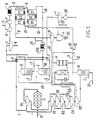
- the resultant slurry (21) is passed through aeration tanks (D) oxidising the majority of any cobalt II to cobalt III.
- the slurry is then subjected to washing and thickening in tanks 1a to 7a.
- Tailings (23) are removed after washing through tailings still (M) wherein steam (2) is added and vapours (22) are condensed in Gas Cooler condenser (H). Any non condensed vapours are passed to absorber (N) for dissolution in plant liquor and the resultant liquid recycled back to wash thickener 7(a).
- the Plant Product Liquor solution stream (1) of normal composition (9 gl ⁇ 1 Ni, 0.4 gl ⁇ 1 Co, 85 gl ⁇ 1 NH3 and 60 gl ⁇ 1 CO2) is pumped through a heat exchanger (A) to a multiple tray distillation column (B).
- Steam from a 10 psi (68.9kPa) line (2) is injected into the bottom of the Still thereby stripping some ammonia and carbon dioxide from the Plant Product Liquor.
- the amount of steam applied is carefully controlled to produce a liquor containing approximately 25 gl ⁇ 1 ammonia. (NH3) 18 gl ⁇ 1 carbon dioxide CO2 with essentially the same concentration of nickel and cobalt as the incoming Product Liquor.
- This quantity of steam is of the order of 0.12 kg steam per litre of Product Liquor feed.
- This liquor exiting the distillation column is termed special product liquor and is identified as stream (3) and has the following approximate composition.
- TABLE NO. 14 Nickel 7.3 g/l Ammonia 28 g/l Cobalt 0.35 g/l Carbon Dioxide 18 g/l Iron 1 ppm Zinc 7 ppm Manganese 1 ppm Copper 15 ppm Magnesium 22 ppm
- the distillation procedure described above produces two essential benefits to the process stream prior to solvent extraction; (i) the reduced ammonia concentration significantly enhances the solvent extraction kinetics thereby reducing both the size of the solvent extraction cells and their number; (ii) the effect of heat on the Product Liquor stream causes coagulation and precipitation of important impurity elements such as iron, manganese, silica and arsenic together with the removal of other impurities such as organic polymer flocculants.
- the removal of these impurity solids is effected by passing the special product liquor stream (3) to a Thickener, vessel (C).
- the underflow slurry (4) from this vessel contains the impurity elements listed above together with some nickel and this is returned to the plant stockpile to enable the nickel to be recovered.
- the solvent extraction nickel cobalt separation efficiency depends largely on the presence of cobalt III compounds and absence of cobalt II compounds in the special product liquor stream (3).
- the presence of cobalt II compounds in the special product liquor stream can be caused by factors such as insufficient aeration of the ore/liquor slurry during leaching of the reduced ore in the Aeration and Leaching Tanks (D) and or post leaching conversion of Co III compounds to Co II compounds by reducing substances in either the product liquor or special product liquor.
- cobalt II is extracted together with nickel II by the organic reagent and subsequent stripping of the organic reagent with ammonia-ammonium carbonate solution to recover nickel may also remove the cobalt II thereby contaminating the essentially pure nickel solution and resulting in a loss of some cobalt;
- cobalt II organic reagent complex can undergo oxidation within the solvent extraction cells in which case the cobalt cannot be stripped from the organic reagent by normal procedures.
- the accumulation of cobalt II and III on the organic phase results eventually in the nickel extracting power of the reagent being reduced.
- the reagent has not been permanently lost as special techniques have been developed by the inventor to treat the reagent and remove the cobalt thus restoring the reagent to its full nickel loading capacity, but this entails additional costs.
- the exiting liquor will contain less than five parts per million cobalt II.
- the object is to use an organic reagent mixture in hydrocarbon solvent to separate nickel and cobalt and recover the nickel in an ammonium carbonate strip liquor thereby allowing the organic reagent mixture to be continually recycled for further nickel loading duties.
- the special product liquor stream (6) is pumped at the rate of 35 litres/minute into the mixer box of extraction cell E1 where it contacts the partially nickel loaded organic reagent exiting extraction cell E2 and also flowing at a rate of 35 litres/minute.
- the mixed phases overflow the mixer box and separate in the settler section of the solvent extraction Cell, the organic phase rising to the top of the aqueous, heavy phase underneath.
- the phases flow cocurrently in the cells but countercurrently between the cells.
- the process of mixing and separation is repeated in each cell with the aqueous phase (7) exiting extraction cell E3 being essentially free of nickel while the organic phase (8) exiting extraction cell E1 being free of cobalt and loaded with nickel.
- the composition of the ammonia-ammonium carbonate stripping solution is a vital factor in controlling the efficiency of the solvent extraction overall process.
- the condensate (9) from the Gas Cooler Condensers (H) can be modified by the injection of anhydrous ammonia gas (10) or by injection of carbon dioxide gas (11) to achieve the desired result.
- the resulting strip liquor of suitable composition (12) is pumped at approximately, 4 litres per minute into the mixing box of strip cell S3 where it contacts both the partially scrapped organic reagent mixture exiting strip cell S2 at 35 litres per minute and an amount of recycle aqueous phase from strip cell S3 equal to approximately 31 litres per minute.
- This combination of solution streams gives an organic to aqueous ratio in the mixer box of cell S3 of approximately 1:1, which is desirable for both mixing and metal transfer reasons.
- the mixed phases overflow the S3 mixer box and separate in the settler section of the cell.
- the partially nickel loaded strip liquor moves forward to the mixer box of strip cell S2 where it contacts the partially stripped organic reagent mixture exiting strip cell S1.
- the stripped organic reagent mixture (13) exiting strip cell S3, now referred to as stripped organic gravitates to an intermediate reagent storage tank from which it is pumped to extraction cell E3 to recommence separating nickel from the incoming special product liquor stream (6).
- the strip liquor exiting strip cell S2 enters the mixer box of strip cell S1 where it contacts both the incoming nickel loaded organic reagent exiting extraction cell E1 and a metered flow of recycle aqueous phase from the settler section of strip cell S1 to enable an organic to aqueous ratio of approximately 1:1 to be achieved.
- the aqueous phase exiting the strip cell S1 is referred to as the loaded strip liquor (14) and may contain 80 gl ⁇ 1 nickel, 270 gl ⁇ 1 NH3 and 230 gl ⁇ 1 CO2 together with some impurity elements such as copper, cobalt and magnesium.
- the total nickel loading capacity of the organic reagent mixture will govern the organic to aqueous ratio flow rates.
- the nickel loading capacity must exceed the concentration of nickel in the special product liquor in order to remove all the nickel from this stream at an organic to aqueous flow ratio of 1:1.
- the composition of the organic reagent mixture must be controlled so that it will rapidly release the complexed nickel to the strip liquor when so contacted.
- the composition of the strip liquor is also extremely important as it must have suitable stripping power to remove nickel from the nickel organic reagent complex to a sufficiently low residual nickel value such that the stripped organic reagent nickel loading capacity is in excess of the nickel in the incoming special product liquor stream.
- a suitable strip liquor will have an ammonia content of 250-280 grams per litre and a carbon dioxide content of 220-250 grams per litre.
- composition of the aqueous phase exiting Cell 1 of the stripping circuit illustrates the excellent ratio of nickel to cobalt achieved. From a Ni/Co of 20.9 in the Special Product Liquor the invention has enabled this to be upgraded to a Ni/Co ratio in excess of 14,000. A nickel product containing 99% nickel produced from this liquor would contain less than 0.007% cobalt as an impurity.
- a feature of the invention is that it allows the Concentration of the Loaded strip liquor stream (14) and the composition of the Raffinate stream (7) to be optimized.
- the following example will illustrate how the nickel content of the Raffinate stream (7) can be reduced while maintaining the purity of the loaded strip liquor stream (14).
- the loaded strip liquor (14) exiting strip cell S1 can now be treated if required to enhance the ratio of nickel to impurity elements.
- the impurity elements such as manganese and iron are reduced to levels of the order of one part per million or less in the special product liquor by means of the ammonia distillation procedure described above.
- Metals such as copper that form stable ammines in ammonium carbonate solution will remain in solution during the distillation procedure and will, if present as cupric ions, extract into the organic reagent in a similar manner to nickel II and cobalt II.
- the copper may be depending on the composition of the organic reagent mixture, that the copper distributes its concentration between the strip liquor and the organic reagent in a favourable fashion during stripping so that the nickel to copper ratio in the loaded strip liquor is satisfactory for specification purposes.
- the copper may be stripped by the ammonia-ammonium carbonate strip liquor from its organic complex with similar facility to nickel and if present initially in the special product liquor at an unfavourable nickel to copper ratio the copper will have to be removed from the loaded strip liquor before a satisfactory nickel product can be produced.
- Ammonium hydrosulphide is an effective sulphiding agent, particularly in ammoniacal solutions and there are many examples where it is used to precipitate metals from solution as insoluble sulphides. It is not a specific precipitating reagent but can nevertheless be used to sulphide one metal more favourably than another.
- the precipitated sulphides can be readily removed from solution by flocculation with organic polymers followed by filtration through a conventional industrial filter, such as copper sulphide filter 15(a) to produce a purified loaded strip liquor (16).
- the purified loaded strip liquor stream (16) is pumped into a multiple plate distillation column (I) into the base of which is injected low pressure steam (2).
- the amount of steam necessary to effect complete precipitation of the nickel as basic nickel carbonate will vary with the nature of the purified loaded strip liquor stream, however a value of 0.6 kg steam per litre of feed liquor has been determined in trails.
- vapours from the distillation column (17) consisting essentially of water, ammonia and carbon dioxide are condensed in a Gas Cooler Condenser (H) and the condensate after concentration adjustment by the addition of either ammonia gas (10) or carbon dioxide gas (11) is termed strip liquor (12) and is recycled to strip cell S3 in the solvent extraction area.
- H Gas Cooler Condenser
- product magma The product stream from the distillation column consisting of a mixture of basic nickel carbonate and water of approximately 25% W/V solids is termed product magma (18) and is pumped to a Thickener (J) to increase the solids content of the slurry to approximately 50% W/V before further processing.
- Thickener organic flocculants may be added to the dilute slurry stream (18) to promote the production of a dense Thickener underflow product while at the same time producing an overflow stream almost free of suspended solids.
- the clean aqueous overflow stream (19) may contain traces of ammonia of the order of 100 parts per million, soluble nickel of the order of 3 parts per million together with suspended basic nickel carbonate solids, that have not been collected by the flocculation process, of the order of 5 parts per million.
- This stream could be recycled directly to the plant as a source of good quality water, however as its temperature is above 50°C it is first diverted to a cooling pond.
- the cooling pond serves a dual purpose in that while the aqueous phase is cooling below 50°C it also allows any valuable suspended basic nickel carbonate solids to settle out for later recovery and recycle to the processing plant.
- the nickel may be recovered as a basic nickel carbonate from stream (24) by any conventional manner.
- the basic nickel carbonate solids produced are very pure, free of the anions of sulphur and have the general formula NiCO3.4Ni(OH)2.
- the basic nickel carbonate may be processed to produce nickel products. Those experienced in metal production techniques will be aware that the basic nickel carbonate can be redissolved in ammonia-ammonium salt liquors and then subjected to high pressure hydrogen reduction to produce nickel metal of high purity. Alternatively the basic nickel carbonate can be calcined to produce both black and green nickel oxides which are also saleable products. The nickel oxides can be converted to nickel metal by reduction with hydrogen at moderate temperatures.
- Basic nickel carbonate solids recovered from process streams containing sulphur anions at the time of distillation precipitation are always contaminated with sulphur compounds.
- the solids obtained from such a distillation precipitation are in fact a mixture of basic nickel carbonate and basic nickel sulphate. Processing these solids via the calcination-reduction route to produce a low sulphur nickel product requires temperatures in the oxidative calcination stage of the order of 1200°C.
- a significant benefit of the present invention is that it eliminates sulphur anions prior to the distillation-precipitation recovery of basic nickel carbonate solids.
- Basic nickel carbonate solids recovered free of contaminating sulphur compounds can be converted to nickel oxide powder at temperatures in the range of 450-550°C. A substantial savings in energy accrues by processing at lower temperature.
- This low temperature calcination facilitates the hydrogen reduction step which proceeds more rapidly with nickel oxide produced at a low temperature, consequently more energy savings are made or the same energy inputs will result in significantly higher productivity.
- the route to nickel metal may proceed by initially heating the basic nickel carbonate in a Calciner at a suitably low temperature to produce black nickel oxide followed by reduction of the black nickel oxide in a heated hydrogen furnace to produce nickel metal.
- the conversion of the basic nickel carbonate to nickel oxide followed by reduction of the oxide metal may be achieved in one operation by careful control of the atmosphere and temperature of the reaction vessel.
- the offgas from the reaction vessel should have a carbon monoxide (CO) content of approximately 1.5% to achieve the required in-furnace reduction efficiency.
- CO carbon monoxide
- the choice of fuel to produce both the heat and reducing atmosphere necessary is very important.
- the known ability of nickel oxide to react quickly with oxides of sulphur precludes the use of fuels containing sulphur if a low sulphur nickel metal is the desired end result.
- a third process is to commit the basic nickel carbonate directly to an electrically heated furnace through which a stream of hydrogen gas is passed.
- the decomposition of the basic nickel carbonate to nickel oxide is followed by reduction of the nickel oxide to nickel metal without any contamination of the metal by sulphur.
- the aqueous stream exiting the E3 extraction cell is called the Raffinate (7) and contains a mixture of cobalt ammines with cobalt in oxidation state (III).
- the present invention utilizes the efficiency of the hydrosulphide ion in precipitating insoluble metal sulphides from dilute solution. This procedure separates nickel and cobalt from elements such as magnesium that do not under these conditions form insoluble sulphides, releases the solution which contains approximately 25 grams per litre ammonia and 15 grams per litre carbon dioxide for recycling back to the process and serves to isolate the metals in a concentrated form.
- the raffinate stream (7) is injected with ammonium hydrosulphide (15) at a ratio of approximately one part ammonium hydrosulphide liquor to 170 parts of raffinate.
- the reaction is carried out in a tube reactor in which the solutions are in a turbulent state. It is desirable to add sufficient ammonium hydrosulphide liquor to remove all of the cobalt from solution and at the same time allowing as much nickel as possible to remain in solution. Realization of this aim will result in extremely low levels of excess hydrosulphide ion in the sulphided raffinate.
Landscapes
- Chemical & Material Sciences (AREA)
- Organic Chemistry (AREA)
- Engineering & Computer Science (AREA)
- Materials Engineering (AREA)
- Metallurgy (AREA)
- General Life Sciences & Earth Sciences (AREA)
- Geochemistry & Mineralogy (AREA)
- Geology (AREA)
- Life Sciences & Earth Sciences (AREA)
- Manufacturing & Machinery (AREA)
- Inorganic Chemistry (AREA)
- Mechanical Engineering (AREA)
- Environmental & Geological Engineering (AREA)
- Manufacture And Refinement Of Metals (AREA)
- Inorganic Compounds Of Heavy Metals (AREA)
- Extraction Or Liquid Replacement (AREA)
- External Artificial Organs (AREA)
- Disintegrating Or Milling (AREA)
- Separation Using Semi-Permeable Membranes (AREA)
- Gas Separation By Absorption (AREA)
- Organic Low-Molecular-Weight Compounds And Preparation Thereof (AREA)
Claims (24)
- Verfahren zur Trennung und Gewinnung von Nickel aus einer ammoniakalischen Ammoniumcarbonatflüssigkeit, welche Nickel(II)-Ionen und Cobalt(III)-Ionen enthält, durch Flüssig-Flüssig-Extraktion, das die aufeinanderfolgenden Schritte umfaßt:(a) Oxidieren des Großteils jeglicher Cobalt(II)ammoniakate in der ammoniakalischen Flüssigkeit zu Cobalt(III);(b) Extrahieren von Nickel aus der ammoniakalischen Flüssigkeit mit einem organischen Reagenz, um eine mit Nickel angereicherte organische Phase und eine ammoniakalische Ammoniumcarbonatphase, die Cobalt enthält, zu bilden; und(c) Abstreifen der mit Nickel angereicherten organischen Phase, dadurch gekennzeichnet, daß
das organische Reagenz 2-Hydroxy-5-t-nonylacetophenonoxim, 2-Hydroxy-5-nonylsalicylaldoxim oder ein alkyl-, aryl- oder halogensubstituiertes β-Diketon ist, und auch dadurch, daß die mit Nickel angereicherte organische Phase durch Inkontaktbringen der organischen Phase mit einer ammoniakalischen Ammoniumcarbonatlösung abgestreift wird, um eine mit Nickel angereicherte, wäßrige Abstreifflüssigkeit zu bilden, und dadurch, daß ammoniakalische Ammoniumcarbonatlösungen die einzigen in dem Verfahren beinhalteten wäßrigen Phasen sind. - Verfahren nach Anspruch 1, dadurch gekennzeichnet, daß die ammoniakalische Ammoniumcarbonatflüssigkeit, welche Nickel und Cobalt enthält, vor dem Schritt (a) erhitzt wird, um unerwünschte Elemente auszufällen und den Ammoniumgehalt zu verringern.
- Verfahren nach Anspruch 2, dadurch gekennzeichnet, daß die ammoniakalische Ammoniumcarbonatflüssigkeit auf eine Temperatur von etwa 100°C bei Atmosphärendruck erhitzt wird und der Ammoniumgehalt auf zwischen 22 bis 32 g/l vermindert wird.
- Verfahren nach Anspruch 3, dadurch gekennzeichnet, daß die ammoniakalische Ammoniumcarbonatflüssigkeit Ammoniak und Kohlenstoffdioxid enthält, der Ammoniakgehalt auf 25 g/l vermindert wird und der Kohlenstoffdioxidgehalt 18 g/l beträgt.
- Verfahren nach Anspruch 1, dadurch gekennzeichnet, daß die Cobalt(II)ammoniakate zu Cobalt(III) durch Oxidieren mit Luft oder Luft in Verbindung mit Wasserstoffperoxid oxidiert werden.
- Verfahren nach Anspruch 5, dadurch gekennzeichnet, daß die ammoniakalische Flüssigkeit weniger als 1 ppm Cobalt(II) nach einer Oxidation bei 50°C und Atmosphärendruck enthält.
- Verfahren nach Anspruch 1, dadurch gekennzeichnet, daß die ammoniakalische Flüssigkeit nach Anspruch 1 (b) mit einer Lösung in Kontakt gebracht wird, welche das organische Reagenz in einem flüssigen organischen Lösungsmittel enthält.
- Verfahren nach Anspruch 7, dadurch gekennzeichnet, daß die flüssige organische Lösung auch ein modifiziertes Reagenz, wie einen Alkohol, einen aliphatischen oder aromatischen, kerosinartigen Träger oder eine Kombination eines Alkohols mit einem aliphatischen oder aromatischen, kerosinartigen Träger enthält.
- Verfahren nach Anspruch 8, dadurch gekennzeichnet, daß das modifizierende Reagenz ein Alkohol ist, der aus i-Tridecanol, i-Undecanol, i-Dodecanol und den entsprechenden geradkettigen Arten ausgewählt ist.
- Verfahren nach Anspruch 9, dadurch gekennzeichnet, daß der Alkohol i-Tridecanol ist.
- Verfahren anch Anspruch 10, dadurch gekennzeichnet, daß die organische Lösung 32,5 Vol% 2-Hydroxy-5-t-nonylacetophenonoxim, 18,4 Vol% i-Tridecanol mit 49,1 Vol% Kohlenwasserstofflösungsmittel mit weniger als 25% Aromatengehalt umfaßt.
- Verfahren nach Anspruch 7, dadurch gekennzeichnet, daß die ammoniakalische Flüssigkeit mit der flüssigen organischen Lösung, welche das organische Reagenz enthält, für eine Zeitdauer von zwischen 30 Sekunden und 60 Minuten in Kontakt gebracht wird.
- Verfahren nach Anspruch 12, dadurch gekennzeichnet, daß die ammoniakalische Lösung mit der flüssigen organischen Lösung, welche das organische Reagenz enthält, für eine Zeitdauer von 3 Minuten in Kontakt gebracht wird.
- Verfahren nach Anspruch 1, dadurch gekennzeichnet, daR die Nickel enthaltende organische Phase durch Kontakt mit einer wäßrigen ammoniakalischen Ammoniumcarbonatlösung für eine Zeitdauer abgestreift wird, die ausreicht, dem Nickel zu ermöglichen, aus der organischen Phase in die wäßrige Abstreifphase überzugehen.
- Verfahren nach Anspruch 14, dadurch gekennzeichnet, daß die Kontaktzeitdauer 30 Sekunden bis 60 Minuten beträgt.
- Verfahren nach Anspruch 15, dadurch gekennzeichnet, daß die ammoniakalische Ammoniumcarbonat-Abstreiflösung mit der mit Nickel angereicherten organischen Phase für eine Zeitdauer von 3 Minuten in Kontakt gebracht wird.
- Verfahren nach Anspruch 1, dadurch gekennzeichnet, daß die mit Nickel angereicherte organische Phase in einer Abstreifzelle bei Atmosphärendruck und bei einer Temperatur von 20 bis 50°C abgestreift wird.
- Verfahren nach Anspruch 17, dadurch gekennzeichnet, daß die Temperatur etwa 40°C beträgt.
- Verfahren nach Anspruch 14, dadurch gekennzeichnet, daß die ammoniakalische Ammoniumcarbonatlösung eine Gesamtammoniakkonzentration von 100 bis 300 g/l und eine Gesamtkohlendioxidkonzentration von 50 bis 300 g/l enthält.
- Verfahren nach Anspruch 19, dadurch gekennzeichnet, daß die mit Nickel angereicherte wäßrige Abstreifflüssigkeitsphase eine Ammoniakkonzentration von 270 g/l und und eine Kohlendioxidkonzentration von 230 g/l enthält.
- Verfahren nach Anspruch 1, dadurch gekennzeichnet, daß die mit Nickel angereicherte organische Phase von der ammoniakalischen Ammoniumcarbonatphase, welche das Cobalt enthält, abgetrennt wird, und das Nickel-Abstreifverfahren mittels einer herkömmlichen Chargenextraktion oder kontinuierlichen Mischer-Abscheider-Techniken durchgeführt wird.
- Verfahren nach Anspruch 1, dadurch gekennzeichnet, daß drei Extraktions- und drei Abstreifstufen unter Rückführung der wäßrigen Lösung durchgeführt werden, um in den Mischerkammern ein Verhältnis von wäßriger zu organischer Lösung von 1:1 aufrechtzuerhalten.
- Verfahren nach Anspruch 1, dadurch gekennzeichnet, daß das Nickel aus der mit Nickel angereicherten, wäßrigen Abstreifflüssigkeitsphase als basisches Nickelcarbonat mittels Destillation der Flüssigkeit gewonnen wird.
- Verfahren nach Anspruch 1, dadurch gekennzeichnet, daß das Cobalt aus der ammoniakalischen Ammoniumcarbonatlösung mittels Dampferhitzungs-, Sulfidzugabe- oder Ionenaustauschverfahren gewonnen wird.
Applications Claiming Priority (3)
| Application Number | Priority Date | Filing Date | Title |
|---|---|---|---|
| AU2018/87 | 1987-05-20 | ||
| AUPI201887 | 1987-05-20 | ||
| PCT/AU1988/000144 WO1988009389A1 (en) | 1987-05-20 | 1988-05-19 | Separation and recovery of nickel and cobalt in ammoniacal systems |
Publications (3)
| Publication Number | Publication Date |
|---|---|
| EP0364463A1 EP0364463A1 (de) | 1990-04-25 |
| EP0364463A4 EP0364463A4 (en) | 1990-09-26 |
| EP0364463B1 true EP0364463B1 (de) | 1995-09-20 |
Family
ID=3772180
Family Applications (1)
| Application Number | Title | Priority Date | Filing Date |
|---|---|---|---|
| EP88904193A Expired - Lifetime EP0364463B1 (de) | 1987-05-20 | 1988-05-19 | Trennung und gewinnung von nickel und kobalt in ammoniakalen systemen |
Country Status (11)
| Country | Link |
|---|---|
| US (1) | US5174812A (de) |
| EP (1) | EP0364463B1 (de) |
| JP (1) | JPH089741B2 (de) |
| AT (1) | ATE128190T1 (de) |
| BR (1) | BR8807511A (de) |
| CA (1) | CA1335332C (de) |
| DE (1) | DE3854499T2 (de) |
| GR (1) | GR1000388B (de) |
| ID (1) | ID827B (de) |
| PH (1) | PH25719A (de) |
| WO (1) | WO1988009389A1 (de) |
Families Citing this family (18)
| Publication number | Priority date | Publication date | Assignee | Title |
|---|---|---|---|---|
| CA1338345C (en) * | 1988-06-14 | 1996-05-28 | Gary A. Kordosky | Nickel extraction with oxime extractants |
| CA2068982C (en) * | 1992-05-19 | 2000-10-03 | Derek G.E. Kerfoot | Process for the separation of cobalt from nickel |
| JP2500352B2 (ja) * | 1993-03-25 | 1996-05-29 | 工業技術院長 | リチウムの分離、回収方法 |
| US6048506A (en) * | 1993-10-29 | 2000-04-11 | Queensland Nickel Pty. Ltd. | Process for the removal of cationic impurities from a cobalt sulphate solution |
| US5605668A (en) * | 1993-10-29 | 1997-02-25 | Queensland Nickel Pyt. Ltd. | Solvent extraction of cobalt from cobalt sulfate solution |
| US5788844A (en) * | 1995-06-08 | 1998-08-04 | Henkel Corporation | Process for removing and recovering ammonia from organic metal extractant solutions in a liquid-liquid metal extraction process |
| CN1101475C (zh) * | 1996-01-16 | 2003-02-12 | 中国科学院化工冶金研究所 | 一种反萃钴的方法 |
| US6210647B1 (en) * | 1996-12-23 | 2001-04-03 | Henkel Corporation | Process of recovery of metals from aqueous ammoniacal solutions employing an ammonia antagonist having only hydrogen bond acceptor properties |
| AUPQ578200A0 (en) * | 2000-02-22 | 2000-03-16 | Anaconda Nickel Limited | Method for the recovery of nickel and/or cobalt |
| US6231823B1 (en) | 2000-03-27 | 2001-05-15 | Dynatec Corporation | Solvent extraction process for the separation of cobalt from nickel in aqueous sulphate-containing solutions |
| AU2001281597B2 (en) * | 2001-08-24 | 2007-06-21 | Qni Technology Pty Ltd | Organic reagent cleaning |
| AUPR917701A0 (en) * | 2001-11-29 | 2001-12-20 | QNI Technology Limited | Integrated ammoniacal solvent extraction and hydrogen reduction of nickel |
| AU2003900387A0 (en) * | 2003-01-30 | 2003-02-27 | Qni Technology Pty Ltd | Process for nickel and cobalt extraction from laterite ores |
| AU2004207148B2 (en) * | 2003-01-30 | 2009-09-10 | Bhp Billiton Ssm Technology Pty Ltd | Process for nickel and cobalt extraction from laterite ores |
| RU2359048C1 (ru) * | 2007-10-29 | 2009-06-20 | ООО "Институт Гипроникель" | Способ коллективного извлечения никеля и кобальта из сульфатных растворов, содержащих кальций, магний и марганец |
| JP5151760B2 (ja) * | 2008-07-22 | 2013-02-27 | 住友金属鉱山株式会社 | 向流式直接加熱型熱交換器 |
| RU2540257C1 (ru) * | 2013-10-18 | 2015-02-10 | Федеральное Государственное Бюджетное Учреждение Науки Институт Химии И Химической Технологии Сибирского Отделения Российской Академии Наук (Иххт Со Ран) | Способ разделения кобальта и никеля |
| JP6020971B2 (ja) * | 2015-03-23 | 2016-11-02 | 住友金属鉱山株式会社 | コバルト粉の製造方法 |
Family Cites Families (14)
| Publication number | Priority date | Publication date | Assignee | Title |
|---|---|---|---|---|
| US2848322A (en) * | 1955-07-13 | 1958-08-19 | Merck & Co Inc | Separation of cobalt from nickel |
| US2913355A (en) * | 1955-12-27 | 1959-11-17 | Johnson & Johnson | Adhesive tape with low adhesion backsize coating |
| US3276863A (en) * | 1964-01-21 | 1966-10-04 | Gen Mills Inc | Separation of nickel and cobalt values using alpha-hydroxy oximes |
| US3438768A (en) * | 1965-06-21 | 1969-04-15 | Eldorado Mining & Refining Ltd | Separation of cobalt from nickel by extraction from ammonical solution |
| GB1411545A (en) * | 1971-12-31 | 1975-10-29 | Shell Int Research | Separation of metal values by liquid-liquid extraction |
| US3907966A (en) * | 1972-06-28 | 1975-09-23 | Kennecott Copper Corp | Nickel extraction and stripping using oximes and ammoniacal carbonate solutions |
| US3988151A (en) * | 1973-07-19 | 1976-10-26 | Kennecott Copper Corporation | Liquid ion exchange process for the recovery of copper and nickel |
| US3981968A (en) * | 1973-10-19 | 1976-09-21 | Freeport Minerals Company | Solvent extraction of nickel from ammoniacal solutions |
| US4005173A (en) * | 1975-03-03 | 1977-01-25 | Kennecott Copper Corporation | Steam stripping of ammoniacal solutions and simultaneous loading of metal values by organic acids |
| US3981969A (en) * | 1975-10-15 | 1976-09-21 | Uop Inc. | Pressurized column solvent extraction of nickel from ammoniacal solutions |
| US4083915A (en) * | 1975-11-20 | 1978-04-11 | Kennecott Copper Corporation | Cobalt stripping process |
| US4278463A (en) * | 1980-03-28 | 1981-07-14 | Gte Products Corporation | Process for recovering cobalt |
| US4432953A (en) * | 1982-09-24 | 1984-02-21 | Chevron Research Company | Leaching cobalt from spent hydroprocessing catalysts with sulfur dioxide |
| US4619816A (en) * | 1985-11-21 | 1986-10-28 | American Cyanamid Company | Recovery of cobalt from ammoniacal solutions containing cobalt and nickel |
-
1987
- 1987-05-19 ID IDP302787A patent/ID827B/id unknown
-
1988
- 1988-05-17 CA CA000567026A patent/CA1335332C/en not_active Expired - Fee Related
- 1988-05-19 JP JP63504066A patent/JPH089741B2/ja not_active Expired - Lifetime
- 1988-05-19 WO PCT/AU1988/000144 patent/WO1988009389A1/en not_active Ceased
- 1988-05-19 BR BR888807511A patent/BR8807511A/pt not_active IP Right Cessation
- 1988-05-19 AT AT88904193T patent/ATE128190T1/de active
- 1988-05-19 US US07/439,377 patent/US5174812A/en not_active Expired - Lifetime
- 1988-05-19 DE DE3854499T patent/DE3854499T2/de not_active Expired - Lifetime
- 1988-05-19 EP EP88904193A patent/EP0364463B1/de not_active Expired - Lifetime
- 1988-05-20 GR GR880100334A patent/GR1000388B/el not_active IP Right Cessation
- 1988-05-20 PH PH36958A patent/PH25719A/en unknown
Also Published As
| Publication number | Publication date |
|---|---|
| BR8807511A (pt) | 1990-05-22 |
| CA1335332C (en) | 1995-04-25 |
| WO1988009389A1 (en) | 1988-12-01 |
| JPH089741B2 (ja) | 1996-01-31 |
| GR1000388B (el) | 1992-06-30 |
| DE3854499D1 (de) | 1995-10-26 |
| PH25719A (en) | 1991-09-18 |
| ATE128190T1 (de) | 1995-10-15 |
| JPH02503575A (ja) | 1990-10-25 |
| EP0364463A4 (en) | 1990-09-26 |
| EP0364463A1 (de) | 1990-04-25 |
| US5174812A (en) | 1992-12-29 |
| ID827B (id) | 1996-07-25 |
| GR880100334A (en) | 1989-02-23 |
| DE3854499T2 (de) | 1996-03-07 |
Similar Documents
| Publication | Publication Date | Title |
|---|---|---|
| EP0364463B1 (de) | Trennung und gewinnung von nickel und kobalt in ammoniakalen systemen | |
| US4008076A (en) | Method for processing manganese nodules and recovering the values contained therein | |
| EP1159461B1 (de) | Gewinnung von nickel und kobalt aus erzmaterialien | |
| US3816098A (en) | Production of nickel powder from impure nickel compounds | |
| CN101254948B (zh) | 由低品位辉钼矿浓缩物生产纯氧化钼 | |
| US3276863A (en) | Separation of nickel and cobalt values using alpha-hydroxy oximes | |
| US4150976A (en) | Method for the recovery of metallic copper | |
| US3888748A (en) | Recovery of metal values from ore concentrates | |
| US4233063A (en) | Process for producing cobalt powder | |
| US3981966A (en) | Zinc recovery from acidic aqueous streams | |
| US3458277A (en) | Process for the recovery of molybdenum values as high purity ammonium paramolybdate from impure molybdenum-bearing solution,with optional recovery of rhenium values if present | |
| CA1057507A (en) | Process for recovering cobalt values from an aqueous ammonical solution containing dissolved cobalt and other metals as ammine sulphates | |
| EP0641392B1 (de) | Verfahren zur Abtrennung von Kobalt von Nickel | |
| US4214895A (en) | Method for producing cobalt metal powder | |
| CA2252592C (en) | Process for the recovery of nickel | |
| EP2604712B1 (de) | Verfahren zur behandlung von flüssigkeitsausflüssen und zur rückgewinnung von metallen | |
| US4545816A (en) | Processes relating to the extraction of metals from laterites and ocean manganese nodules | |
| EP0651062B1 (de) | Verfahren zur Herstellung von hoch-reinen Cobalt-Zwischenprodukten | |
| US4563213A (en) | Extraction and stripping cobalt values | |
| US4030917A (en) | Hydrometallurgical processing of metal sulfides | |
| AU670398B2 (en) | Process for the preparation of a high purity cobalt intermediate | |
| US6048506A (en) | Process for the removal of cationic impurities from a cobalt sulphate solution | |
| AU677559B2 (en) | Process for the removal of cationic impurities from a cobaltsulphate solution |
Legal Events
| Date | Code | Title | Description |
|---|---|---|---|
| PUAI | Public reference made under article 153(3) epc to a published international application that has entered the european phase |
Free format text: ORIGINAL CODE: 0009012 |
|
| 17P | Request for examination filed |
Effective date: 19891101 |
|
| AK | Designated contracting states |
Kind code of ref document: A1 Designated state(s): AT BE CH DE FR GB IT LI LU NL SE |
|
| A4 | Supplementary search report drawn up and despatched |
Effective date: 19900807 |
|
| AK | Designated contracting states |
Kind code of ref document: A4 Designated state(s): AT BE CH DE FR GB IT LI LU NL SE |
|
| 17Q | First examination report despatched |
Effective date: 19920609 |
|
| RAP1 | Party data changed (applicant data changed or rights of an application transferred) |
Owner name: QUEENSLAND NICKEL PTY LTD |
|
| GRAA | (expected) grant |
Free format text: ORIGINAL CODE: 0009210 |
|
| AK | Designated contracting states |
Kind code of ref document: B1 Designated state(s): AT BE CH DE FR GB IT LI LU NL SE |
|
| PG25 | Lapsed in a contracting state [announced via postgrant information from national office to epo] |
Ref country code: LI Effective date: 19950920 Ref country code: CH Effective date: 19950920 Ref country code: AT Effective date: 19950920 Ref country code: IT Free format text: LAPSE BECAUSE OF FAILURE TO SUBMIT A TRANSLATION OF THE DESCRIPTION OR TO PAY THE FEE WITHIN THE PRE;WARNING: LAPSES OF ITALIAN PATENTS WITH EFFECTIVE DATE BEFORE 2007 MAY HAVE OCCURRED AT ANY TIME BEFORE 2007. THE CORRECT EFFECTIVE DATE MAY BE DIFFERENT FROM THE ONE RECORDED.SCRIBED TIME-LIMIT Effective date: 19950920 |
|
| REF | Corresponds to: |
Ref document number: 128190 Country of ref document: AT Date of ref document: 19951015 Kind code of ref document: T |
|
| REF | Corresponds to: |
Ref document number: 3854499 Country of ref document: DE Date of ref document: 19951026 |
|
| ET | Fr: translation filed | ||
| REG | Reference to a national code |
Ref country code: CH Ref legal event code: PL |
|
| PG25 | Lapsed in a contracting state [announced via postgrant information from national office to epo] |
Ref country code: LU Free format text: LAPSE BECAUSE OF NON-PAYMENT OF DUE FEES Effective date: 19960531 |
|
| PLBE | No opposition filed within time limit |
Free format text: ORIGINAL CODE: 0009261 |
|
| STAA | Information on the status of an ep patent application or granted ep patent |
Free format text: STATUS: NO OPPOSITION FILED WITHIN TIME LIMIT |
|
| 26N | No opposition filed | ||
| REG | Reference to a national code |
Ref country code: GB Ref legal event code: IF02 |
|
| PGFP | Annual fee paid to national office [announced via postgrant information from national office to epo] |
Ref country code: NL Payment date: 20040226 Year of fee payment: 17 |
|
| PGFP | Annual fee paid to national office [announced via postgrant information from national office to epo] |
Ref country code: SE Payment date: 20040517 Year of fee payment: 17 |
|
| PG25 | Lapsed in a contracting state [announced via postgrant information from national office to epo] |
Ref country code: SE Free format text: LAPSE BECAUSE OF NON-PAYMENT OF DUE FEES Effective date: 20050520 |
|
| PG25 | Lapsed in a contracting state [announced via postgrant information from national office to epo] |
Ref country code: NL Free format text: LAPSE BECAUSE OF NON-PAYMENT OF DUE FEES Effective date: 20051201 |
|
| EUG | Se: european patent has lapsed | ||
| NLV4 | Nl: lapsed or anulled due to non-payment of the annual fee |
Effective date: 20051201 |
|
| PGFP | Annual fee paid to national office [announced via postgrant information from national office to epo] |
Ref country code: BE Payment date: 20070508 Year of fee payment: 20 |
|
| PGFP | Annual fee paid to national office [announced via postgrant information from national office to epo] |
Ref country code: DE Payment date: 20070517 Year of fee payment: 20 |
|
| PGFP | Annual fee paid to national office [announced via postgrant information from national office to epo] |
Ref country code: GB Payment date: 20070417 Year of fee payment: 20 |
|
| PGFP | Annual fee paid to national office [announced via postgrant information from national office to epo] |
Ref country code: FR Payment date: 20070510 Year of fee payment: 20 |
|
| BE20 | Be: patent expired |
Owner name: *QUEENSLAND NICKEL PTY LTD Effective date: 20080519 |
|
| REG | Reference to a national code |
Ref country code: GB Ref legal event code: PE20 Expiry date: 20080518 |
|
| PG25 | Lapsed in a contracting state [announced via postgrant information from national office to epo] |
Ref country code: GB Free format text: LAPSE BECAUSE OF EXPIRATION OF PROTECTION Effective date: 20080518 |