EP0352567A2 - Schuh für den Skilanglauf - Google Patents
Schuh für den Skilanglauf Download PDFInfo
- Publication number
- EP0352567A2 EP0352567A2 EP89112925A EP89112925A EP0352567A2 EP 0352567 A2 EP0352567 A2 EP 0352567A2 EP 89112925 A EP89112925 A EP 89112925A EP 89112925 A EP89112925 A EP 89112925A EP 0352567 A2 EP0352567 A2 EP 0352567A2
- Authority
- EP
- European Patent Office
- Prior art keywords
- shoe
- ski
- sole
- binding
- spring element
- Prior art date
- Legal status (The legal status is an assumption and is not a legal conclusion. Google has not performed a legal analysis and makes no representation as to the accuracy of the status listed.)
- Granted
Links
Images
Classifications
-
- A—HUMAN NECESSITIES
- A43—FOOTWEAR
- A43B—CHARACTERISTIC FEATURES OF FOOTWEAR; PARTS OF FOOTWEAR
- A43B5/00—Footwear for sporting purposes
- A43B5/04—Ski or like boots
- A43B5/0411—Ski or like boots for cross-country
Definitions
- the invention relates to a shoe for cross-country skiing, which carries on its front a spring element which, when in contact with a fixed part of a ski and / or binding, counteracts the upward rotation of the shoe around its front edge, the sole of the shoe having a horizontal transverse axis carries or is suitably designed to accommodate such, which mediates a detachable connection of the boot with the ski and / or with the binding.
- Such a shoe is known from EP-0169429.
- the sole of the shoe is designed to be flexible, in particular its end region which is extended towards the front acts as a spring element.
- the design of the front shoe sole extension as a spring element has been known for a long time and is especially common with the traditional Nordic standard cross-country shoes.
- this version has some serious disadvantages.
- the front sole extension is subject to rapid wear due to repeated bending. First, the restoring force decreases, eventually cracks can occur in the material.
- the sole extension is designed as a spring, it is difficult to achieve exactly the desired spring characteristic, since other criteria must also be taken into account when selecting the sole material and the dimensioning.
- the invention therefore has as its object to avoid the disadvantages mentioned in a ski boot of the type outlined at the outset and to design a spring element on the front of a cross-country ski shoe independently of the sole material in such a way that the spring characteristic can optionally be designed according to the respective requirements.
- the spring element is a clip made of spring wire. It is also possible to constructively connect the transverse axis and the spring wire, for example by the spring wire running horizontally inside the sole, and obliquely upwards outside the same, abutting the transverse axis.
- the elasticity of the spring wire is used to the maximum if the bracket is supported essentially by means of its crossbar on the ski-fixed part of the ski or the binding.
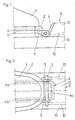
- the spring element is designed as a bracket 4 made of spring wire, which is anchored in the sole 2 of the shoe 1 by means of its two legs 4a, 4b.
- the horizontal transverse axis 3, about which the shoe 1 can be pivoted about the ski binding 11 against the resistance of the spring 4, is mounted on the sole 2 by means of retaining plates 5, which are anchored in the sole 2 and comprise the transverse axis 3.
- the illustrated shoe 1 can be fastened on a ski 10 in various ways, which is why the ski binding 11 used is only indicated schematically. It is essential that it comprises an abutment 12 for the bracket 4, and that 3 holding parts 13 are provided for the pivotable mounting of the transverse axis.
- the shoe 1 could also carry a bearing for a transverse axis belonging to the ski binding instead of a transverse axis 3, as is shown, for example, in US Pat. No. 3,003,777.
- the shoe 1 is supported on the abutment 12 of the ski binding 11 essentially via its transverse web 4c.
- the latter Depending on the direction of the course of the two end sections of the legs 4a, 4b of the bracket 4, the latter then lies either exclusively by means of its transverse web 4c or else by means of the thus created End sections of the two legs 4a, 4b and the crossbar 4c on the abutment 12 of the ski binding 11.
Landscapes
- Health & Medical Sciences (AREA)
- General Health & Medical Sciences (AREA)
- Physical Education & Sports Medicine (AREA)
- Footwear And Its Accessory, Manufacturing Method And Apparatuses (AREA)
Abstract
Description
- Die Erfindung bezieht sich auf einen Schuh für den Skilanglauf, welcher an seiner Vorderseite ein Federelement trägt, das bei Anlage an einem festen Teil eines Skis und/oder einer Bindung der Aufwärtsdrehung des Schuhs um dessen Vorderkante entgegenwirkt, wobei die Sohle des Schuhs eine horizontale Querachse trägt oder zur Aufnahme einer solchen geeignet ausgebildet ist, welche eine lösbare Verbindung des Schuhs mit dem Ski und/oder mit der Bindung vermittelt.
- Ein derartiger Schuh ist aus der EP-0169429 bekannt. Bei diesem Schuh ist die Schuhsohle biegsam ausgebildet, wobei insbesondere ihr nach vorne verlängerter Endbereich als Federelement wirkt. Die Ausgestaltung der vorderen Schuhsohlenverlängerung als Federelement ist zwar seit langem bekannt und ist vor allem auch bei den traditionellen Nordic-Norm Langlaufschuhen üblich. Dennoch hat diese Ausführung einige gravierende Nachteile. So ist die vordere Sohlenverlängerung durch das wiederholte Abbiegen einer raschen Abnützung unterworfen. Dabei läßt zunächst die Rückstellkraft nach, schließlich können auch Risse im Material auftreten. Weiters ist es bei einer Ausgestaltung der Sohlenverlängerung als Feder schwierig, genau die gewünschte Federcharakeristik zu erreichen, da ja bei der Auswahl des Sohlenmateriales und der Dimensionierung gleichzeitig auch andere Kriterien berücksichtigt werden müssen.
- Schuhe, welche im Sohlenbereich eine horizontale Querachse als Angriffsstelle für eine Skibindung tragen, sind verschiedentlich bereits bekannt geworden. Im Falle der Einrichtung nach DE-PS 222 828 liegt damit die Schwenkachse geringfügig vor der Schuhsohle, ebenso auch bei der Einrichtung nach US-PS 3,003.777. Beispielsweise aus DE-AS 2,622.966 ist es aber auch bereits bekannt geworden, die Schwenkachse in den vorderen Sohlenrand zu integrieren, wobei die zuletzt genannte Ausbildung den Vorteil hat, daß die horizontale Querachse seitlich nicht über die Schuhsohle vorragt.
- Falls ein Schuh in der vorgeschlagenen Weise mit einer horizontalen Querachse versehen ist, bestehen verschiedene Möglichkeiten, ihn lösbar mit dem Ski zu verbinden. Die Erfindung ist auf die Verwendung einer speziellen Bindung nicht eingeschränkt. Als Beispiel für mögliche Ausführungen können jene Bindungen dienen, welche in den drei zuletzt genannten Druckschriften dargestellt sind.
- Die Erfindung stellt sich also die Aufgabe, bei einem Skischuh der eingangs skizzierten Art, die genannten Nachteile zu vermeiden und ein Federelement an der Vorderseite eines Skilanglaufschuhes unabhängig vom Sohlenmaterial so zu gestalten, daß die Federcharakteristik den jeweiligen Anforderungen entsprechend wahlweise gestaltet werden kann.
- Erfindungsgemäß ist in diesem Sinne vorgesehen, daß das Federelement ein Bügel aus Federdraht ist. Es ist auch möglich, Querachse und Federdraht konstruktiv zu verbinden, etwa indem der innerhalb der Sohle horizontal, außerhalb derselben schräg nach oben verlaufende Federdraht an der Querachse, diese untergreifend, anliegt. Die Elastizität des Federdrahtes wird maximal ausgenützt, wenn der Bügel im wesentlichen mittels seines Quersteges am skifesten Teil des Skis bzw. der Bindung abgestützt ist.
- Weitere Einzelheiten der Erfindung werden anschließend anhand der Zeichnung erläutert.
- Fig.1 ist eine Seitenansicht des Vorderteiles eines erfindungsgemäßen Schuhs mit einer angedeuteten Bindung und
- Fig.2 die zugehörige Draufsicht.
- Wesentlich am dargestellten Schuh 1 ist es, daß er sowohl ein Federelement 4 trägt, welches einer Aufwärtsbewegung der Ferse entgegenwirkt, wie auch eine Querachse 3, an welcher eine Skibindung 11 angreifen kann. Beim dargestellten Ausführungsbeispiel ist das Federelement als Bügel 4 aus Federdraht ausgebildet, welcher mittels seiner beiden Schenkel 4a,4b in der Sohle 2 des Schuhs 1 verankert ist.
- Die horizontale Querachse 3, um welche der Schuh 1 gegen den Widerstand der Feder 4 um die Skibindung 11 schwenkbar ist, ist an der Sohle 2 mittels die Querachse 3 umfassender, in der Sohle 2 verankerter Haltebleche 5 gelagert.
- Der dargestellte Schuh 1 kann auf einem Ski 10 in verschiedener Weise befestigt werden, weshalb die verwendete Skibindung 11 auch nur schematisch angedeutet ist. Wesentlich ist, daß sie ein Widerlager 12 für den Bügel 4 umfaßt, und daß zur schwenkbaren Halterung der Querachse 3 Halteteile 13 vorgesehen sind.
- Wie bereits einleitend erwähnt, könnte der Schuh 1 statt einer Querachse 3 auch ein Lager für eine zur Skibindung gehörende Querachse tragen, wie dies beispielsweise in US-PS 3,003.777 dargestellt ist. Im dargestellten Ausführungsbeispiel ist der Schuh 1 am Widerlager 12 der Skibindung 11 im wesentlichen über seinen Quersteg 4c abgestützt. Es ist aber auch denkbar, in den schräg nach oben verlaufenden Abschnitten der beiden Schenkel 4a,4b des Bügels 4 je einen Knick einzubauen. In Abhängigkeit von der Richtung des Verlaufes der beiden Endabschnitte der Schenkel 4a,4b des Bügels 4 liegt dann letzterer entweder ausschließlich mittels seines Quersteges 4c oder aber mittels der so erstellten Endabschnitte der beiden Schenkel 4a,4b und des Quersteges 4c am Widerlager 12 der Skibindung 11 an.
- Die konstruktive Ausgestaltung des sehr allgemeinen Erfindugnsgedankens ist somit auf vielfache Weise möglich.
Claims (3)
Applications Claiming Priority (2)
| Application Number | Priority Date | Filing Date | Title |
|---|---|---|---|
| AT1916/88 | 1988-07-28 | ||
| AT191688A AT393777B (de) | 1988-07-28 | 1988-07-28 | Schuh fuer den skilanglauf |
Publications (3)
| Publication Number | Publication Date |
|---|---|
| EP0352567A2 true EP0352567A2 (de) | 1990-01-31 |
| EP0352567A3 EP0352567A3 (de) | 1991-04-03 |
| EP0352567B1 EP0352567B1 (de) | 1993-12-22 |
Family
ID=3523793
Family Applications (1)
| Application Number | Title | Priority Date | Filing Date |
|---|---|---|---|
| EP19890112925 Expired - Lifetime EP0352567B1 (de) | 1988-07-28 | 1989-07-14 | Schuh für den Skilanglauf |
Country Status (3)
| Country | Link |
|---|---|
| EP (1) | EP0352567B1 (de) |
| AT (1) | AT393777B (de) |
| DE (1) | DE58906479D1 (de) |
Family Cites Families (1)
| Publication number | Priority date | Publication date | Assignee | Title |
|---|---|---|---|---|
| IT8422574U1 (it) * | 1984-07-13 | 1986-01-13 | Callegari Mario | Puntale di scarpa da sci particolarmente per sci da fondo. |
-
1988
- 1988-07-28 AT AT191688A patent/AT393777B/de not_active IP Right Cessation
-
1989
- 1989-07-14 DE DE89112925T patent/DE58906479D1/de not_active Expired - Fee Related
- 1989-07-14 EP EP19890112925 patent/EP0352567B1/de not_active Expired - Lifetime
Also Published As
| Publication number | Publication date |
|---|---|
| ATA191688A (de) | 1991-06-15 |
| EP0352567B1 (de) | 1993-12-22 |
| AT393777B (de) | 1991-12-10 |
| DE58906479D1 (de) | 1994-02-03 |
| EP0352567A3 (de) | 1991-04-03 |
Similar Documents
| Publication | Publication Date | Title |
|---|---|---|
| DE69610147T2 (de) | Snowboard mit Tragplatte zum Erhöhen der Skibindung | |
| DE2134810C3 (de) | Skibindung | |
| EP0551899B1 (de) | Langlauf- oder Tourenskibindung für Langlaufskischuhe | |
| DE69606577T2 (de) | Gleitbrett mit Vorrichtung zur Montage einer Skibindung | |
| EP0230989A2 (de) | Federbrett für einen Ski | |
| EP0437172A1 (de) | Skibindungsträger | |
| DE2554110A1 (de) | Skibremse | |
| DE2051758B2 (de) | Sicherheitsskibindung | |
| DE69604350T2 (de) | Gleitbrett mit Plattform zur Aufnahme und Erhöhung der Skibindung | |
| DE2737637A1 (de) | Schibindung | |
| EP0352567B1 (de) | Schuh für den Skilanglauf | |
| EP0272317B1 (de) | Sicherheitsskibindung | |
| DE4020212A1 (de) | Ski, insbesondere alpinski | |
| EP0985433A1 (de) | Skibindungsträger | |
| EP1615706B1 (de) | Snowboard | |
| AT393629B (de) | Schibremse | |
| AT286842B (de) | Ski | |
| EP0665035B1 (de) | Skibindungs-Einrichtung | |
| DE3015052A1 (de) | Langlauf-skischuh | |
| AT349952B (de) | Skibindung | |
| EP0220329A1 (de) | Skibindung | |
| DE2436117A1 (de) | Vorrichtung zum abbremsen des skis nach dem loesen vom skischuh (skibremse) | |
| DE2707887A1 (de) | Skibindung | |
| AT343524B (de) | Skibremse | |
| DE3935202A1 (de) | Skibindung fuer langlaufskis |
Legal Events
| Date | Code | Title | Description |
|---|---|---|---|
| PUAI | Public reference made under article 153(3) epc to a published international application that has entered the european phase |
Free format text: ORIGINAL CODE: 0009012 |
|
| AK | Designated contracting states |
Kind code of ref document: A2 Designated state(s): CH DE FR LI |
|
| PUAL | Search report despatched |
Free format text: ORIGINAL CODE: 0009013 |
|
| AK | Designated contracting states |
Kind code of ref document: A3 Designated state(s): CH DE FR LI |
|
| 17P | Request for examination filed |
Effective date: 19910803 |
|
| RAP1 | Party data changed (applicant data changed or rights of an application transferred) |
Owner name: TMC CORPORATION |
|
| RAP1 | Party data changed (applicant data changed or rights of an application transferred) |
Owner name: HTM SPORT- UND FREIZEITGERAETE GESELLSCHAFT M.B.H. |
|
| 17Q | First examination report despatched |
Effective date: 19930210 |
|
| GRAA | (expected) grant |
Free format text: ORIGINAL CODE: 0009210 |
|
| AK | Designated contracting states |
Kind code of ref document: B1 Designated state(s): CH DE FR LI |
|
| RAP2 | Party data changed (patent owner data changed or rights of a patent transferred) |
Owner name: HTM SPORT- UND FREIZEITGERAETE AKTIENGESELLSCHAFT |
|
| REF | Corresponds to: |
Ref document number: 58906479 Country of ref document: DE Date of ref document: 19940203 |
|
| ET | Fr: translation filed | ||
| PGFP | Annual fee paid to national office [announced via postgrant information from national office to epo] |
Ref country code: DE Payment date: 19940704 Year of fee payment: 6 |
|
| PGFP | Annual fee paid to national office [announced via postgrant information from national office to epo] |
Ref country code: FR Payment date: 19940706 Year of fee payment: 6 |
|
| PGFP | Annual fee paid to national office [announced via postgrant information from national office to epo] |
Ref country code: CH Payment date: 19940719 Year of fee payment: 6 |
|
| REG | Reference to a national code |
Ref country code: FR Ref legal event code: CJ |
|
| PLBE | No opposition filed within time limit |
Free format text: ORIGINAL CODE: 0009261 |
|
| STAA | Information on the status of an ep patent application or granted ep patent |
Free format text: STATUS: NO OPPOSITION FILED WITHIN TIME LIMIT |
|
| 26N | No opposition filed | ||
| PG25 | Lapsed in a contracting state [announced via postgrant information from national office to epo] |
Ref country code: LI Effective date: 19950731 Ref country code: CH Effective date: 19950731 |
|
| REG | Reference to a national code |
Ref country code: CH Ref legal event code: PL |
|
| PG25 | Lapsed in a contracting state [announced via postgrant information from national office to epo] |
Ref country code: DE Effective date: 19960402 |
|
| PG25 | Lapsed in a contracting state [announced via postgrant information from national office to epo] |
Ref country code: FR Effective date: 19960430 |
|
| REG | Reference to a national code |
Ref country code: FR Ref legal event code: ST |
|
| REG | Reference to a national code |
Ref country code: FR Ref legal event code: ST |
|
| REG | Reference to a national code |
Ref country code: FR Ref legal event code: ST |