EP0348744A2 - Trialkylsilyloxy-1,1-diphenyl-ethylene und damit hergestellte Polymere - Google Patents
Trialkylsilyloxy-1,1-diphenyl-ethylene und damit hergestellte Polymere Download PDFInfo
- Publication number
- EP0348744A2 EP0348744A2 EP89110850A EP89110850A EP0348744A2 EP 0348744 A2 EP0348744 A2 EP 0348744A2 EP 89110850 A EP89110850 A EP 89110850A EP 89110850 A EP89110850 A EP 89110850A EP 0348744 A2 EP0348744 A2 EP 0348744A2
- Authority
- EP
- European Patent Office
- Prior art keywords
- alkyl
- end groups
- polymer
- formula
- ether
- Prior art date
- Legal status (The legal status is an assumption and is not a legal conclusion. Google has not performed a legal analysis and makes no representation as to the accuracy of the status listed.)
- Withdrawn
Links
Classifications
-
- C—CHEMISTRY; METALLURGY
- C08—ORGANIC MACROMOLECULAR COMPOUNDS; THEIR PREPARATION OR CHEMICAL WORKING-UP; COMPOSITIONS BASED THEREON
- C08F—MACROMOLECULAR COMPOUNDS OBTAINED BY REACTIONS ONLY INVOLVING CARBON-TO-CARBON UNSATURATED BONDS
- C08F8/00—Chemical modification by after-treatment
-
- C—CHEMISTRY; METALLURGY
- C07—ORGANIC CHEMISTRY
- C07F—ACYCLIC, CARBOCYCLIC OR HETEROCYCLIC COMPOUNDS CONTAINING ELEMENTS OTHER THAN CARBON, HYDROGEN, HALOGEN, OXYGEN, NITROGEN, SULFUR, SELENIUM OR TELLURIUM
- C07F7/00—Compounds containing elements of Groups 4 or 14 of the Periodic Table
- C07F7/02—Silicon compounds
- C07F7/08—Compounds having one or more C—Si linkages
- C07F7/18—Compounds having one or more C—Si linkages as well as one or more C—O—Si linkages
- C07F7/1804—Compounds having Si-O-C linkages
-
- C—CHEMISTRY; METALLURGY
- C08—ORGANIC MACROMOLECULAR COMPOUNDS; THEIR PREPARATION OR CHEMICAL WORKING-UP; COMPOSITIONS BASED THEREON
- C08F—MACROMOLECULAR COMPOUNDS OBTAINED BY REACTIONS ONLY INVOLVING CARBON-TO-CARBON UNSATURATED BONDS
- C08F30/00—Homopolymers or copolymers of compounds having one or more unsaturated aliphatic radicals, each having only one carbon-to-carbon double bond, and containing phosphorus, selenium, tellurium or a metal
- C08F30/04—Homopolymers or copolymers of compounds having one or more unsaturated aliphatic radicals, each having only one carbon-to-carbon double bond, and containing phosphorus, selenium, tellurium or a metal containing a metal
- C08F30/08—Homopolymers or copolymers of compounds having one or more unsaturated aliphatic radicals, each having only one carbon-to-carbon double bond, and containing phosphorus, selenium, tellurium or a metal containing a metal containing silicon
-
- C—CHEMISTRY; METALLURGY
- C08—ORGANIC MACROMOLECULAR COMPOUNDS; THEIR PREPARATION OR CHEMICAL WORKING-UP; COMPOSITIONS BASED THEREON
- C08F—MACROMOLECULAR COMPOUNDS OBTAINED BY REACTIONS ONLY INVOLVING CARBON-TO-CARBON UNSATURATED BONDS
- C08F8/00—Chemical modification by after-treatment
- C08F8/42—Introducing metal atoms or metal-containing groups
Definitions
- the invention relates to trialkylsilyloxy-1,1-diphenylethylenes of the general formula I and to novel polymers produced therewith with aryl trialkylsilyl ether or phenolic hydroxyl end groups and a process for the preparation of these polymers by anionic polymerization.
- R1, R2 H, C1-C4-alkyl, OCH3
- R3 H, C1-C4-alkyl, O-C1-C4-alkyl
- R4 H, C1-C4 alkyl
- R5 C1-C4 alkyl
- R6 C1-C4 alkyl.
- DE-OS P 37 25 848 describes the preparation of polymeric dihydroxy compounds by anionic polymerization of suitable compounds, optionally reducing the reactivity of the polyanion by 1,1-diphenylethylene, reaction with 2,5-dimethoxybenzyl bromide and removal of the protective group by subsequent ether cleavage with trimethyliodosilane, Trimethylchlorosilane and sodium iodide or acids.
- the compounds are suitable as stabilizers for polymers, in particular those with unsaturated bonds in the polymer chain, against thermal, radiation-induced and oxidative degradation.
- the invention relates to trialkylsilyloxy-1,1-diphenylethylenes of the formula (I), polymers prepared therefrom with aryl trialkylsilyl ether end groups or phenolic hydroxyl end groups of the formulas (II) and (III) and corresponding preparation processes.
- A polymer of anionically polymerizable vinyl compounds
- R1, R2 H, C1-C4-alkyl, OCH3,
- R3 H, C1-C4-alkyl, O-C1-C4-alkyl
- R4 H, C1-C4 alkyl
- R5 C1-C4 alkyl
- R6 H, C1-C4 alkyl
- R7 H, Si (R5) 3.
- the trialkylsilyloxy-1,1-diphenylethylenes of the formula I according to the invention can be prepared by processes known per se. Alkali-catalyzed thermal cleavage of 1-alkyl-1-phenyl-bis (hydroxyphenyl) methane of the formula (IV) gives hydroxy-1,1-diphenylethylenes of the formula (V) (DE-AS 1 235 894): where in formula IV and V R1, R2, R3, R4, R6 have the meaning given above.
- the starting product for the preparation of the compounds of the formula (I) according to the invention are 1-alkyl-1-phenyl-bis (hydroxyphenyl) methanes of the formula (IV), in which the substituents R1 to R6 have the meaning given above.
- Examples of compounds of the formula IV are: 1-methyl-1-phenyl-bis (4-hydroxyphenyl) methane, 1-ethyl-1-phenyl-bis (4-hydroxyphenyl) methane, 1-propyl-1-phenyl-bis (4-hydroxyphenyl) methane, 1-pentyl-1-phenyl-bis (4-hydroxyphenyl) methane, 1-methyl-1- (4-methylphenyl) bis (4-hydroxyphenyl) methane, 1-methyl-1- (4-methoxyphenyl) bis (4-hydroxyphenyl) methane, 1-methyl-1- (3,5-dimethylphenyl) bis (4-hydroxyphenyl) methane, 1-methyl-1-phenyl-bis (2-hydroxy-phenyl) methane, 1-methyl-1-phenyl - [(4-hydroxyphenyl) - (2′-hydroxyphenyl)] methane, 1-methyl-1-phenyl-bis (3-methyl-4-hydroxyphenyl) methane, 1-methyl-1-phen
- R1, R2, R3, R4, R6 is particularly preferably hydrogen.
- the compounds of formula (IV) can be cleaved under the conditions specified in DE-AS 1 235 894.
- Suitable halosilanes for the reaction of the compounds of the formula (V) to the trialkylsilyloxy-1,1-diphenylethylenes of the formula (I) according to the invention correspond to the formula (VI).
- halosilanes of the formula VI are: Trimethylchlorosilane, triethylbromosilane, tripropylchlorosilane, diethylmethylchlorosilane. Trimethylchlorosilane and triethylchlorosilane are preferred, and trimethylchlorosilane is particularly preferred.
- Compounds of the formula (V) and compounds of the formula (VI) can generally be used in a molar ratio of 1: 1 (or with a slight excess of (VI)) in inert solvents, such as hydrocarbons (petrol, ligroin, heptane, pentane, cyclohexane, benzene, Toluene, xylene), halogenated hydrocarbons (chloroform, methylene chloride, dichloroethane, chlorobenzene) or ethers (diethyl ether, diisopropyl ether, dibutyl ether); hydrocarbons and the presence of a base such as ammonia, triethylamine, tributylamine, pyridine, N-methylimidazole, quinoline are preferred.
- the compound of the formula (V) can also be converted into a salt and reacted with the halosilane in dry form.
- suitable salts such as sodium amine salts mentioned
- the reaction temperature is 0 to 120 ° C, preferably 10 to 100 ° C.
- the base must advantageously be used in a slight excess in at least a stoichiometric amount based on (V).
- the compounds of the formula (I) can be used directly. Additional purification is possible by distillation.
- Suitable compounds of the formula I for the preparation of the new polymers are, for example: 4-methyl-4'-trimethylsilyloxy-1,1-diphenylethylene, 4-ethyl-4'-triethylsilyloxy-1,1-diphenylethylene, 3-methoxy-4'-trimethylsilyloxy-1,1-diphenylethylene, 4-isopropyl-4'-triethylsilyloxy-1,1-diphenylethylene, 4-methyl-2'-trimethylsilyloxy-5'-methyl-1,1-diphenylethylene, 3-methyl-4'-trimethylsilyloxy-1,1-diphenylethylene, 4-methoxy-2′-trimethylsilyloxy-3 ′, 5′-dimethyl-1,1-diphenylethylene, 3-methoxy-4-trimethylsilyloxy-1,1-diphenylethylene, 4-trimethylsilyloxy- ⁇ -methyl-1,1-diphenylethylene, 4-trimethylsilyloxy- ⁇ -propyl
- anionically polymerizable vinyl compounds are polymerized in aromatic or aliphatic hydrocarbons or an ether with an alkylalkali metal, arylalkali metal compound or an oligomeric ⁇ -methylstyrene-alkali metal compound to form a "living" polyanion or polydianion until the monomer is completely converted.
- this is reacted with compounds of the formula (I), a new polyanion or dianion being formed.
- the polyanion or dianion is neutralized in step 3 after steps 1 and 2, the product is isolated if necessary and the silyl ether is cleaved.
- Suitable anionically polymerizable compounds in the sense of the invention are e.g. Styrene, p-methylstyrene, vinylpyridine, vinylnaphthalene, isopropenylnaphthalene, 1,3-butadiene, isoprene or mixtures thereof. Styrene, 1,3-butadiene, isoprene or mixtures of styrene / 1,3-butadiene and styrene / isoprene are preferred.
- Suitable aromatic and aliphatic hydrocarbons for the purposes of the invention are, for example, toluene, benzene, xylene, pentane, hexane, cyclohexane.
- Ether in the sense of Er invention are, for example, tetrahydrofuran and dioxane.
- a mixture of aromatic or aliphatic hydrocarbons and ethers can also be used to set certain reaction rates.
- Alkyl alkali metal compounds in particular n-butyl or sec-butyllithium, are preferably used as initiators for the preparation of the polymers of the formula (II).
- Arylalkali metal compounds in particular naphthalene sodium, naphthalene potassium, oligo- ⁇ -methylstyryl sodium or oligo- ⁇ -methylstyryl potassium or 1,3-phenylene-bis (3-methyl-1-phenyl-pentylidene) bis are preferably used to prepare the polymer of the formula (III) (lithium) used as initiators.
- the anionically polymerizable compounds can be polymerized at -100 ° C to + 80 ° C, preferably -78 ° C to + 50 ° C.
- the "living" polymer anions can be reacted with the compound (I) at -78 ° C to + 100 ° C, preferably at 0 ° C to + 50 ° C.
- Compound (I) is preferably used in excess, based on the initiator.
- Suitable neutralizing agents for the "living" polymer anions are, for example, weak inorganic or organic acids, in particular methanol or acetic acid.
- inorganic acids for example hydrochloric acid
- organic acids for example p-toluenesulfonic acid
- the polymers according to formulas (II) and (III) according to the invention have (particularly controllable via the ratio of monomer concentration to initiator concentration) molecular weights of 500 g / mol to 500,000 g / mol, preferably 1,000 g / mol to 250,000 g / mol 1,000 g / mol to 100,000 g / mol.
- HCl gas is passed into a mixture of 240 g (2 mol) acetophenone, 940 g (10 mol) phenol and 30 g mercaptopropionic acid until saturation is reached, slowly warming to 50.degree.
- the mixture is left under these conditions for 5 hours, left to stand overnight and first HCl and water are distilled in a water jet vacuum and then the excess phenol is removed to a bottom temperature of 120.degree.
- the remaining residue of 510 g is redissolved from 1250 ml of toluene under reflux, suction filtered after drying and dried: 412 g mp 185-7 ° C d.s. 72% of theory (MG 580).
Landscapes
- Chemical & Material Sciences (AREA)
- Organic Chemistry (AREA)
- Health & Medical Sciences (AREA)
- Chemical Kinetics & Catalysis (AREA)
- Medicinal Chemistry (AREA)
- Polymers & Plastics (AREA)
- General Chemical & Material Sciences (AREA)
- Addition Polymer Or Copolymer, Post-Treatments, Or Chemical Modifications (AREA)
Abstract
Description
- Die Erfindung betrifft Trialkylsilyloxy-1,1-diphenylethylene der allgemeinen Formel I und damit hergestellte neue Polymere mit Aryl-trialkyl-silyl-ether- oder phenolischen Hydroxyl-Endgruppen und ein Verfahren zur Herstellung dieser Polymeren durch anionische Polymerisation.

R¹, R² = H, C₁-C₄-Alkyl, OCH₃
R³ = H, C₁-C₄-Alkyl, O-C₁-C₄-Alkyl,
R⁴ = H, C₁-C₄-Alkyl,
R⁵ = C₁-C₄-Alkyl,
R⁶ = C₁-C₄-Alkyl. - Die DE-OS P 37 25 848 beschreibt die Herstellung von polymeren Dihydroxyverbindungen durch anionische Polymerisation geeigneter Verbindungen, gegebenenfalls Verminderung der Reaktivität des Polyanions durch 1,1-Diphenylethylen, Umsetzung mit 2,5-Dimethoxybenzylbromid und Entfernung der Schutzgruppe durch anschließende Etherspaltung mit Trimethyliodsilan, Trimethylchlorsilan und Natriumiodid oder Säuren.
- Die Verbindungen eignen sich als Stabilisatoren für Polymere, insbesondere solchen mit ungesättigten Bindungen in der Polymerkette, gegen thermischen, strahleninduzierten und oxidativen Abbau.
- Die Umsetzung von sogenannten "lebenden" Polymeren (wie Polystyryllithium) mit weitere funktionelle Gruppen enthaltenden Halogenverbindungen, liefert funktionelle Polymere, ist aber begleitet von einer Anzahl an Nebenreaktionen (vgl. J. Polym. Sci. A 3, 4131 (1965); Polymer 17, 1020 (1976); J. Polym. Sci. B 14, 471 (1976; Adv. Polym. Sci. 56, 72 (1984)). Die Ausbeute an funktionellem Polymer ist daher oftmals nicht befriedigend. Für technische Zwecke ist diese Reaktion daher nicht geeignet.
- Gegenstand der Erfindung sind Trialkylsilyloxy-1,1-diphenylethylene der Formel (I), daraus hergestellte Polymere mit Aryl-trialkylsilylether-Endgruppen oder phenolischen Hydroxyl-Endgruppen der Formeln (II) und (III) sowie entsprechende Herstellungsverfahren.

A = Polymerisat von anionisch polymerisierbaren Vinylverbindungen,
R¹, R² = H, C₁-C₄-Alkyl, OCH₃,
R³ = H, C₁-C₄-Alkyl, O-C₁-C₄-Alkyl,
R⁴ = H, C₁-C₄-Alkyl,
R⁵ = C₁-C₄-Alkyl,
R⁶ = H, C₁-C₄-Alkyl
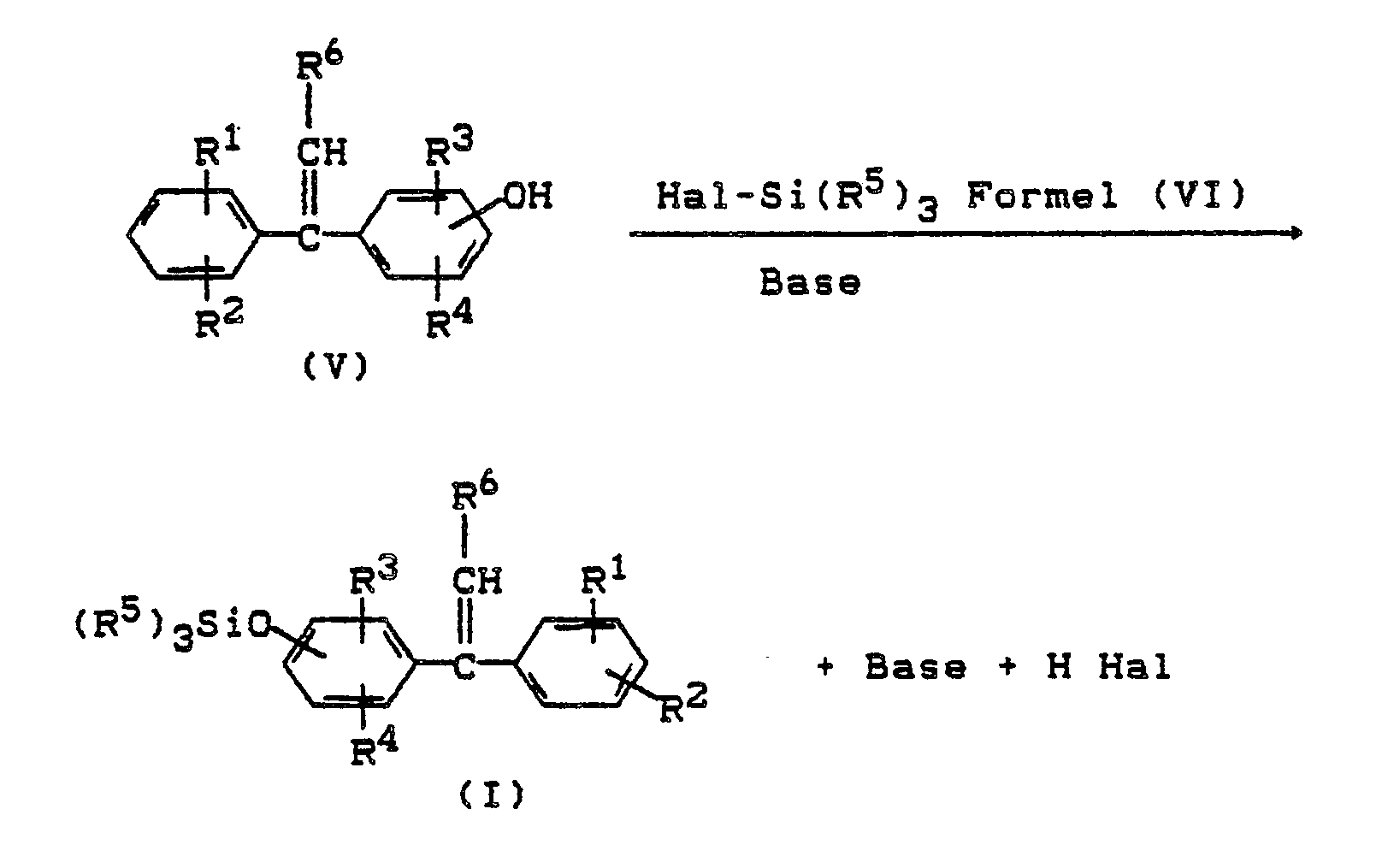
R⁷ = H, Si(R⁵)₃. - Die erfindungsgemäßen Trialkylsilyloxy-1,1-diphenylethylene der Formel I können nach an sich bekannten Verfahren hergestellt werden. Durch alkalikatalysierte thermische Spaltung von 1-Alkyl-1-Phenyl-bis(hydroxyphenyl)-methan der Formel (IV) sind Hydroxy-1,1- diphenylethylene der Formel (V) zugänglich (DE-AS 1 235 894):

R¹, R², R³, R⁴, R⁶ die oben angegebene Bedeutung haben. - Durch Umsetzung der Hydroxydiphenylethylene der Formel (V) mit Halogensilanen der Formel (VI) in Gegenwart von Säurefängern bilden sich die erfindungsgemäßen Trialkylsilyloxy-1,1-diphenylethylene (I).
- Ausgangsprodukt zur Herstellung der erfindungsgemäßen Verbindungen der Formel (I) sind also 1-Alkyl-1-phenyl-bis(hydroxy-phenyl)methane der Formel (IV), worin die Substituenten R¹ bis R⁶ die oben angegebene Bedeutung haben.
- Beispiele für Verbindungen der Formel IV sind:
1-Methyl-1-phenyl-bis(4-hydroxyphenyl)methan,
1-Ethyl-1-phenyl-bis(4-hydroxyphenyl)methan,
1-Propyl-1-phenyl-bis(4-hydroxyphenyl)methan,
1-Pentyl-1-phenyl-bis(4-hydroxyphenyl)methan,
1-Methyl-1-(4-methyl-phenyl)-bis(4-hydroxyphenyl)-methan,
1-Methyl-1-(4-methoxyphenyl)-bis-(4-hydroxyphenyl)-methan,
1-Methyl-1-(3,5-dimethylphenyl)-bis-(4-hydroxyphenyl)-methan,
1-Methyl-1-phenyl-bis(2-hydroxy-phenyl)methan,
1-Methyl-1-phenyl-[(4-hydroxyphenyl)-(2′-hydroxyphenyl)]methan,
1-Methyl-1-phenyl-bis(3-methyl-4-hydroxyphenyl)methan,
1-Methyl-1-phenyl-bis(3-methoxy-4-hydroxyphenyl)methan,
1-Methyl-1-phenyl-bis(3,5-dimethyl-4-hydroxyphenyl)methan,
1-Methyl-1-phenyl-bis(3,5-dimethyl-2-hydroxyphenyl)methan. - Bevorzugte Verbindungen der Formel (IV) sind solche mit den Substituenten
R¹ = H, R² = H, CH₃, OCH₃,
R³ = H, CH₃, OCH₃,
R⁴ = H, CH₃,
R⁶ = H, CH₃.
Besonders bevorzugt ist R¹, R², R³, R⁴, R⁶ Wasserstoff. - Die Verbindungen der Formel (IV) können unter den in DE-AS 1 235 894 angegebenen Bedingungen gespalten werden. Geeignete Halogensilane für die Umsetzung der Verbindungen gemäß Formel (V) zu den erfindungsgemäßen Trialkylsilyloxy-1,1-diphenylethylenen der Formel (I) entsprechen der Formel (VI).
- Beispiele für Halogensilane der Formel VI sind:
Trimethylchlorsilan, Triethylbromsilan, Tripropylchlorsilan, Diethylmethylchlorsilan. Bevorzugt sind Trimethylchlorsilan und Triethylchlorsilan, besonders bevorzugt Trimethylchlorsilan. - Verbindungen der Formel (V) und Verbindungen der Formel (VI) können im allgemeinen im Molverhältnis 1:1 (oder mit geringem Überschuß an (VI)) in inerten Lösungsmitteln, wie Kohlenwasserstoffen (Benzin, Ligroin, Heptan, Pentan, Cyclohexan, Benzol, Toluol, Xylol), Halogenkohlenwasserstoffen (Chloroform, Methylenchlorid, Dichlorethan, Chlorbenzol) oder Ethern (Diethylether, Diisopropylether, Dibutylether) umgesetzt werden; bevorzugt sind Kohlenwasserstoffe und die Gegenwart einer Base wie Ammoniak, Triethylamin, Tributylamin, Pyridin, N-Methylimidazol, Chinolin. Man kann aber auch die Verbindung der Formel (V) in ein Salz überführen und dieses in trockener Form mit dem Halogensilan umsetzen. Geeignete Salze sind außer den obengenannten Aminsalzen auch solche des Lithiums, Natriums und Kaliums.
- Die Reaktionstemperatur liegt bei 0 bis 120°C, bevorzugt 10 bis 100°C.
- Die Base muß in mindestens stöchiometrischer Menge bezogen auf (V) zweckmäßig in einem geringen Überschuß eingesetzt werden.
- Nach Abtrennung der bei der Umsetzung entstandenen Salze, beispielsweise durch Filtration, können die Verbindungen der Formel (I) direkt weiter verwendet werden. Zusätzliche Reinigung ist durch Destillation möglich.
- Geeignete Verbindungen der Formel I zur Herstellung der neuen Polymeren sind beispielsweise:
4-Methyl-4′-trimethylsilyloxy-1,1-diphenylethylen,
4-Ethyl-4′-triethylsilyloxy-1,1-diphenylethylen,
3-Methoxy-4′-trimethylsilyloxy-1,1-diphenylethylen,
4-Isopropyl-4′-triethylsilyloxy-1,1-diphenylethylen,
4-Methyl-2′-trimethylsilyloxy-5′-methyl-1,1-diphenylethylen,
3-Methyl-4′-trimethylsilyloxy-1,1-diphenylethylen,
4-Methoxy-2′-trimethylsilyloxy-3′,5′-dimethyl-1,1-diphenylethylen,
3-Methoxy-4-trimethylsilyloxy-1,1-diphenylethylen,
4-Trimethylsilyloxy-β-methyl-1,1-diphenylethylen,
4-Trimethylsilyloxy-β-propyl-1,1-diphenylethylen,
besonders bevorzugt
4-Trimethylsilyloxy-1,1-diphenylethylen. - Das erfindungsgemäße Verfahren zur Herstellung der polymeren Verbindungen mit Aryl-trimethylsilyl-ether-Endgruppen oder der polymeren Verbindungen mit phenolischen Hydroxyl-Endgruppen gemäß Formeln (II) und (III) erfordert folgende Schritte:
- 1. Herstellung eines Polyanions durch anionische Polymerisation einer geeigneten Vinylverbindung.
- 2. Umsetzung des Polyanions mit einer Verbindung der Formel (I)

- 3. Neutralisation der Umsetzungsprodukte (die selbst Polyanionen sind) mit protischen Verbindungen unter Bildung der polymeren Verbindungen mit Aryltrisilyloxy-ether-Endgruppen gemäß Formeln (II) und (III) mit R⁷ = Si (R⁵)₃ und gegebenenfalls
- 4. Silyletherspaltung zur Herstellung der polymeren Verbindungen mit phenolischen Hydroxyl-Endgruppen gemäß Formel (II) und (III) mit R⁷ = H.
- In Schritt 1 polymerisiert man anionisch polymerisierbare Vinylverbindungen in aromatischen oder aliphatischen Kohlenwasserstoffen oder einem Ether mit einer Alkylalkalimetall-, Arylalkalimetallverbindung oder einer oligomeren α-Methylstyrol-Alkalimetall-Verbindung unter Ausbildung eines "lebenden" Polyanions oder Polydianions bis zum vollständigen Umsatz des Monomeren. In Schritt 2 setzt man dieses mit Verbindungen der Formel (I) um, wobei sich ein neues Polyanion bzw. -dianion bildet. In Schritt 3 neutralisiert man das Polyanion bzw. -dianion mit protischen Verbindungen und isoliert das Polymere (II) oder (III) mit Aryltrisilyloxy-ether-Endgruppen (R⁷ = Si(R⁵)₃).
- Zur Herstellung der Polymeren (II) oder (III) mit phenolischen Hydroxyl-Endgruppen (R⁷ = H) neutralisiert man nach den Schritten 1 und 2 das Polyanion bzw. Dianion im Schritt 3, isoliert gegebenenfalls das Produkt und spaltet den Silylether.
- Geeignete anionisch polymerisierbare Verbindungen im Sinne der Erfindung sind z.B. Styrol, p-Methylstyrol, Vinylpyridin, Vinylnaphthalin, Isopropenylnaphthalin, 1,3-Butadien, Isopren oder Mischungen daraus. Bevorzugt sind Styrol, 1,3-Butadien, Isopren oder Mischungen aus Styrol/1,3-Butadien und Styrol/Isopren.
- Geeignete aromatische und aliphatische Kohlenwasserstoffe im Sinne der Erfindung sind z.B. Toluol, Benzol, Xylol, Pentan, Hexan, Cyclohexan. Ether im Sinne der Er findung sind z.B. Tetrahydrofuran und Dioxan. Zur Einstellung bestimmter Reaktionsgeschwindigkeiten kann auch ein Gemisch aus aromatischen oder aliphatischen Kohlenwasserstoffen und Ethern verwendet werden.
- Zur Herstellung der Polymeren gemäß Formel (II) werden bevorzugt Alkylalkalimetallverbindungen, insbesondere n-Butyl- oder sec.-Butyllithium als Initiatoren eingesetzt.
- Zur Herstellung des Polymeren gemäß Formel (III) werden bevorzugt Arylalkalimetallverbindungen, insbesondere Naphthalinnatrium, Naphthalinkalium, oligo-α-Methylstyrylnatrium bzw. oligo-α-Methylstyrylkalium oder 1,3-Phenylen-bis(3-methyl-1-phenyl-pentyliden)bis(lithium) als Initiatoren verwendet.
- Die anionisch polymerisierbaren Verbindungen können bei -100°C bis +80°C, vorzugsweise -78°C bis +50°C polymerisiert werden.
- Die "lebenden" Polymeranionen können mit der Verbindung (I) bei -78°C bis +100°C, vorzugsweise bei 0°C bis +50°C umgesetzt werden. Verbindung (I) wird vorzugsweise in Überschuß bezogen auf Initiator eingesetzt.
- Geeignete Neutralisationsmittel für die "lebenden" Polymeranionen sind z.B. schwache anorganische oder organische Säuren, insbesondere Methanol oder Essigsäure.
- Da das erfindungsgemäße Verfahren mit "lebenden" Carbanionen arbeitet, sind natürlich Bedingungen einzuhalten, unter denen "lebende" Carbanionen beständig sind, z.B. inerte Atmosphäre, Ausschluß von Luftsauerstoff und -feuchtigkeit.
- Die Silylether der Formeln (II) und (III) (R⁷ = Si(R⁵)₃ können vorzugsweise durch Ansäuern ihrer Lösungen mit anorganischen Säuren (z.B. Salzsäure) oder organischen Säuren (z.B. p-Toluolsulfonsäure) gespalten werden. Die Spaltung führt man im Temperaturbereich von Zimmertemperatur bis zur Siedetemperatur des Lösungsmittels durch.
- Die erfindungsgemäßen Polymeren der Formeln (II) und (III) (R⁷ = H) können durch Ausfällen des Polymeren aus der Lösung, vorzugsweise unter Verwendung von Methanol, oder durch Ausdampfen der Polymerlösung in bekannten Ausdampfaggregaten isoliert werden.
- Die erfindungsgemäßen Polymeren gemäß Formeln (II) und (III) besitzen (über das Verhältnis Monomerkonzentration zu Initiatorkonzentration steuerbare) Molekulargewichte von 500 g/mol bis 500 000 g/mol, vorzugsweise 1 000 g/mol bis 250 000 g/mol, besonders bevorzugt 1 000 g/mol bis 100 000 g/mol.
- Die erfindungsgemäßen Polymeren der Formeln (II) und (III) eignen sich als Stabilisatoren und/oder Gleitmittel für synthetische Polymere. Weiterhin können sie (R⁷ = H) zum Aufbau von Polykondensaten verwendet werden.
- In ein Gemisch von 240 g (2 Mol) Acetophenon, 940 g (10 Mol) Phenol und 30 g Mercaptopropionsäure leitet man bis zur Sättigung HCl-Gas ein, wobei langsam auf 50°C erwärmt wird. Man hält 5 h bei diesen Bedingungen, läßt über Nacht stehen und destilliert zunächst im Wasserstrahlvakuum HCl und Wasser und dann das überschüssige Phenol bis zu einer Sumpftemperatur von 120°C ab. Der verbleibende Rückstand von 510 g wird aus 1250 ml Toluol unter Rückfluß umgelöst, nach Abkühlen abgesaugt und getrocknet: 412 g Fp. 185-7°C d.s. 72 % d.Th. (MG 580).
- 400 g des nach obigen Verfahren erhaltenen Triphenylmethanderivates werden mit 4 g NaOH auf 180 - 220°C gebracht. Bei 130 - 160°C und etwa 15 mbar gehen die Spaltprodukte über. Man erhält insgesamt 340 g Destillat und ca. 56 g braunen harzigen Rückstand.
- Durch Redestillation wird aus diesem Destillat eine Fraktion von 120 g isoliert, die der Titelverbindung entspricht (45 % d.Th.; MG 196).
- 100 g (0,51 M) des durch Spaltung gewonnenen 4-Hydroxy-1,1-diphenyl-ethylens werden in 200 ml Cyclohexan gelöst, mit 56 g (0,56 M) Triethylamin versetzt und dazu bei RT bis 50°C 56 g (0,56 M) Trimethylchlorsilan in ca. 1 h zugetropft. Nach weiteren 2 h bei 50°C wird von ausgefallenem Salz abgedrückt, der Filterkuchen gut mit Cyclohexan gewaschen und das gesamte Filtrat destilliert. Man erhält nach Redestillation der Hauptfraktion Kp1,5 143-8°C 110 g farblose Flüssigkeit (n

- Zu einem Gemisch aus 800 ml Toluol und 100,2 g Styrol wurden unter N₂-Atmosphäre 6,5 ml einer 2,5 molaren n-Butyllithium-Lösung (in Hexan) mittels einer Spritze unter schnellem Rühren bei Raumtemperatur gegeben, wobei sich die Lösung orangerot färbte. Die Temperatur wurde anschließend auf 40°C erhöht. Nach einer Polymerisationszeit von 3 h wurde die Lösung auf Zimmertemperatur gebracht und 45 ml einer Lösung aus 10 g 4-Trimethylsilyloxy-1,1-diphenyl-ethylen und 60 g Toluol mittels einer Spritze zugegeben, wobei sich die Farbe der Lösung nach Dunkelrot veränderte. Die Reaktionszeit betrug 1 h bei Zimmertemperatur. Anschließend wurde das Polymer mit 2 ml Methanol (N₂-gesättigt) neutralisiert und durch Fällung in Methanol isoliert.
- Zu einer Lösung von 100 g des im obengenannten Beispiel beschriebenen Polymeren in 800 ml Tetrahydrofuran wurden bei 40°C 20 ml einer 10 %igen wäßrigen Salzsäure gegeben. Die Reaktionszeit betrug 1 h. Anschließend wurde das Polymere in Methanol gefällt, neutral gewaschen und getrocknet.
- GPC-Analyse (Polystyrol-Eichung): Mn = 6 500 g/mol,
Mw = 7.900 g/mol. - Zu 0,55 g (0,024 mol) Natrium in 250 ml Tetrahydrofuran werden 4 g (0,031 mol) Naphthalin unter N₂-Atmosphäre gegeben, wobei sich die Lösung intensiv grün färbte. Nach ca. 2 h bei Zimmertemperatur hatte sich das Natrium vollständig zu Naphthalin-Natrium umgesetzt. Anschließend wurden 50 g Styrol mit einer Spritze während 2 h zugetropft, wobei die Farbe nach rot umschlug. Nach weiteren 30 min wurde eine Lösung aus 8 g (0,03 mol) 4-Trimethylsilyloxy-1,1-diphenylethylen und 15 ml Toluol mit einer Spritze zugegeben. Nach einer Reaktionszeit von 2 h bei Zimmertemperatur wurde das Polymere mit Methanol (N₂ gesättigt) neutralisiert und durch Fällung in Methanol isoliert.
- Zu einer Lösung von 45 g des im obengenannten Beispiel beschriebenen Polymeren in 350 ml Tetrahydrofuran wurden bei 40°C 35 ml 10 %igen wäßrige Salzsäure gegeben. Nach einer Reaktionszeit von einer Stunde wurde das Polymere in Methanol gefällt, isoliert, neutral gewaschen und getrocknet.
Claims (7)

R¹, R² = H, C₁-C₄-Alkyl, OCH₃,
R³ = H, C₁-C₄-Alkyl, O-C₁-C₄-Alkyl,
R⁴ = H, C₁-C₄-Alkyl,
R⁵ = C₁-C₄-Alkyl,
R⁶ = H, C₁-C₄-Alkyl bedeuten.

A ein Polymerisat von anionisch polymerisierbaren Vinylverbindungen ist und
R¹, R², R³, R⁴, R⁵, R⁶ die in Anspruch 1 angegebene Bedeutung haben und R⁷ Wasserstoff oder -Si(R⁵)₃ bedeutet.
R¹ = H; R² = H, CH₃, OCH₃;
R⁴ = H, CH₃; R⁵ = C₁-C₄-Alkyl und
R⁶ = H, CH₃ bedeuten.
R¹, R², R³, R⁴ und R⁶ = Wasserstoff und R⁵ = CH₃ bedeuten.
Applications Claiming Priority (2)
| Application Number | Priority Date | Filing Date | Title |
|---|---|---|---|
| DE3821745 | 1988-06-28 | ||
| DE3821745A DE3821745A1 (de) | 1988-06-28 | 1988-06-28 | Trialkylsilyloxy-diphenylethylene und damit hergestellte polymere |
Publications (2)
| Publication Number | Publication Date |
|---|---|
| EP0348744A2 true EP0348744A2 (de) | 1990-01-03 |
| EP0348744A3 EP0348744A3 (de) | 1991-03-06 |
Family
ID=6357407
Family Applications (1)
| Application Number | Title | Priority Date | Filing Date |
|---|---|---|---|
| EP19890110850 Withdrawn EP0348744A3 (de) | 1988-06-28 | 1989-06-15 | Trialkylsilyloxy-1,1-diphenyl-ethylene und damit hergestellte Polymere |
Country Status (4)
| Country | Link |
|---|---|
| US (1) | US4956485A (de) |
| EP (1) | EP0348744A3 (de) |
| JP (1) | JPH0248584A (de) |
| DE (1) | DE3821745A1 (de) |
Cited By (6)
| Publication number | Priority date | Publication date | Assignee | Title |
|---|---|---|---|---|
| EP0402729A3 (de) * | 1989-06-15 | 1992-01-22 | Bayer Ag | Polycarbonate mit vinylaromatischen Endgruppen |
| EP0442068A3 (en) * | 1990-02-02 | 1992-02-19 | Bayer Ag | Benzophenone derivatives and polymers containing phenolic hydroxyl groups |
| EP0467167A3 (en) * | 1990-07-18 | 1992-05-27 | Bayer Ag | Carbonates, their manufacture and use as dispersing agents |
| WO1995010544A1 (en) * | 1993-10-15 | 1995-04-20 | University Of Massachusetts At Lowell | Capping of living polymers |
| EP0722959A3 (de) * | 1995-01-20 | 1996-10-23 | Menicon Co Ltd | Hohen Sauerstoff durchlässiges temperaturbeständiges Material |
| EP0705870A3 (de) * | 1994-09-22 | 1996-10-23 | Ciba Geigy Ag | Stabilisatoren für organische Materialien |
Families Citing this family (7)
| Publication number | Priority date | Publication date | Assignee | Title |
|---|---|---|---|---|
| KR101657603B1 (ko) * | 2007-12-28 | 2016-09-19 | 가부시키가이샤 브리지스톤 | 히드록시아릴 관능화 중합체 |
| US8765888B2 (en) * | 2009-06-30 | 2014-07-01 | Bridgestone Corporation | Polymers functionalized with hydroxyl group-containing diphenylethylene |
| EP2452981A1 (de) * | 2010-11-16 | 2012-05-16 | LANXESS Deutschland GmbH | Trialkylsilyloxy-terminierte Polymere |
| JP7070799B2 (ja) * | 2019-06-20 | 2022-05-18 | Dic株式会社 | ブロック共重合体用中間体、ブロック共重合体及びそれらの製造方法 |
| WO2021024811A1 (ja) | 2019-08-06 | 2021-02-11 | 旭化成株式会社 | 共役ジエン系重合体、分岐化剤、共役ジエン系重合体の製造方法、油展共役ジエン系重合体、ゴム組成物、及びタイヤ |
| JP7356881B2 (ja) * | 2019-11-26 | 2023-10-05 | 旭化成株式会社 | 共役ジエン系重合体組成物、及びタイヤ |
| EP3845568A3 (de) | 2019-12-12 | 2021-10-27 | Asahi Kasei Kabushiki Kaisha | Verfahren zur herstellung eines modifizierten konjugierten dienbasierten polymers, modifiziertes konjugiertes dienbasiertes polymer, kautschukzusammensetzung, herstellungsverfahren für kautschukzusammensetzung und herstellungsverfahren für reifen |
Family Cites Families (2)
| Publication number | Priority date | Publication date | Assignee | Title |
|---|---|---|---|---|
| DE1235894B (de) * | 1959-08-18 | 1967-03-09 | Bayer Ag | Verfahren zur Herstellung von Alkenylphenolen aus Dihydroxydiarylalkanen |
| DE2823820A1 (de) * | 1978-05-31 | 1979-12-06 | Siemens Ag | Verfahren zur vernetzung und stabilisierung von radikalisch vernetzbaren polymeren |
-
1988
- 1988-06-28 DE DE3821745A patent/DE3821745A1/de not_active Withdrawn
-
1989
- 1989-06-15 EP EP19890110850 patent/EP0348744A3/de not_active Withdrawn
- 1989-06-16 US US07/367,002 patent/US4956485A/en not_active Expired - Fee Related
- 1989-06-22 JP JP1158471A patent/JPH0248584A/ja active Pending
Non-Patent Citations (3)
| Title |
|---|
| DIE MAKROMOLEKULARE CHEMIE, Band 186, 1985, Seiten 1157-1166, Basel, CH; A. HIRAO et al.: "Polymerization of monomers containing functional groups protected by trialkylsilyl groups, 4" * |
| DIE MAKROMOLEKULARE CHEMIE, Band 190, Nr. 3, M{rz 1989, Seiten 487-493, Basel, CH; R.P. QUIRK et al.: "Anionic synthesis of chain-end functionalized polymers using 1,1-diphenylethylene derivatives. Preparation of 4-hydroxyphenyl-terminated polystyrenes" * |
| MACROMOLECULES, Band 10, Nr. 6, November-Dezember 1977, Seiten 1320-1326, Washington, DC; R. BUSSON et al.: "Hammett relations in anionic polymerization. Reaction of polystyrylalkali salts with disubstituted 1,1-diphenylethylenes" * |
Cited By (7)
| Publication number | Priority date | Publication date | Assignee | Title |
|---|---|---|---|---|
| EP0402729A3 (de) * | 1989-06-15 | 1992-01-22 | Bayer Ag | Polycarbonate mit vinylaromatischen Endgruppen |
| EP0442068A3 (en) * | 1990-02-02 | 1992-02-19 | Bayer Ag | Benzophenone derivatives and polymers containing phenolic hydroxyl groups |
| EP0467167A3 (en) * | 1990-07-18 | 1992-05-27 | Bayer Ag | Carbonates, their manufacture and use as dispersing agents |
| WO1995010544A1 (en) * | 1993-10-15 | 1995-04-20 | University Of Massachusetts At Lowell | Capping of living polymers |
| EP0705870A3 (de) * | 1994-09-22 | 1996-10-23 | Ciba Geigy Ag | Stabilisatoren für organische Materialien |
| US5672574A (en) * | 1994-09-22 | 1997-09-30 | Ciba-Geigy Corporation | Stabilizers for organic materials |
| EP0722959A3 (de) * | 1995-01-20 | 1996-10-23 | Menicon Co Ltd | Hohen Sauerstoff durchlässiges temperaturbeständiges Material |
Also Published As
| Publication number | Publication date |
|---|---|
| DE3821745A1 (de) | 1990-02-08 |
| JPH0248584A (ja) | 1990-02-19 |
| US4956485A (en) | 1990-09-11 |
| EP0348744A3 (de) | 1991-03-06 |
Similar Documents
| Publication | Publication Date | Title |
|---|---|---|
| DE69133119T2 (de) | Polymerisation für olefinische monomere unter verwendung von anionischen initiatoren | |
| EP0274021B1 (de) | Am Kettenende funktionalisierte Polymere und Verfahren zu ihrer Herstellung | |
| DE3821745A1 (de) | Trialkylsilyloxy-diphenylethylene und damit hergestellte polymere | |
| EP0211395A1 (de) | Polymerisate mit Aminogruppen, deren Herstellung und Verwendung | |
| JPH07268012A (ja) | 末端官能化ポリマー製造用保護官能開始剤 | |
| DE69601704T2 (de) | Kupplung von anionischen polymeren mit trialkoxysilanen, die silizium-wasserstoff-bindungen enthalten | |
| DE2917819C2 (de) | ||
| DE3889103T2 (de) | Verfahren zur herstellung von organopolysiloxanen mit einer alkenyl-endgruppe. | |
| EP0115641A2 (de) | Verfahren zur Herstellung von bifunktionellen Polyphenylenethern | |
| DE4219376A1 (de) | Sulfoniumsalze und Verfahren zu deren Herstellung | |
| US5153291A (en) | Trialkylsilyloxy-1,1-diphenyl ethylenes and polymers produced therewith | |
| US4311818A (en) | Bi- and Trifunctional organolithium initiators and applications thereof | |
| EP0442068B1 (de) | Benzophenoderivate und Polymere mit phenolischen Hydroxylgruppen | |
| US4161494A (en) | Bi-and trifunctional organolithium initiators | |
| DE2164469A1 (de) | Transparente Polydimethylsiloxan-Polyalkylmethacrylat- Verbindungen | |
| DE1954255C3 (de) | Polymere mit einem System von konjugierten Doppelbindungen in der Hauptkette und Verfahren zu deren Herstellung | |
| EP0402729B1 (de) | Polycarbonate mit vinylaromatischen Endgruppen | |
| DE3842217A1 (de) | Verfahren zur herstellung von polymeren mit phenolischen hydroxylendgruppen | |
| DE69223298T2 (de) | 3-(Vinylphenyloxy)propylsilan Verbindungen | |
| EP0283764B1 (de) | Alkenylphenol- und Alkenylphenolether-Copolymere | |
| DE69300358T2 (de) | Organische Peroxide und ihre Verwendung. | |
| EP0130439A1 (de) | Verfahren zur Herstellung von Derivaten der Vinylphosphon-, oder Vinylpyrophosphonsäure | |
| DE3725848A1 (de) | Polymere dihydroxyverbindungen und ihre verwendung als stabilisatoren fuer polymere | |
| EP0184764B1 (de) | Copolymere aus einer Hauptkette und Nebenketten | |
| US4939211A (en) | Phosphonate-capped polymers |
Legal Events
| Date | Code | Title | Description |
|---|---|---|---|
| PUAI | Public reference made under article 153(3) epc to a published international application that has entered the european phase |
Free format text: ORIGINAL CODE: 0009012 |
|
| 17P | Request for examination filed |
Effective date: 19890615 |
|
| AK | Designated contracting states |
Kind code of ref document: A2 Designated state(s): DE FR GB IT NL |
|
| PUAL | Search report despatched |
Free format text: ORIGINAL CODE: 0009013 |
|
| AK | Designated contracting states |
Kind code of ref document: A3 Designated state(s): DE FR GB IT NL |
|
| 17Q | First examination report despatched |
Effective date: 19930728 |
|
| STAA | Information on the status of an ep patent application or granted ep patent |
Free format text: STATUS: THE APPLICATION HAS BEEN WITHDRAWN |
|
| 18W | Application withdrawn |
Withdrawal date: 19940124 |