EP0348166B1 - Thiokarbonsäure oder ihre Derivate enthaltende Klebzusammensetzung - Google Patents
Thiokarbonsäure oder ihre Derivate enthaltende Klebzusammensetzung Download PDFInfo
- Publication number
- EP0348166B1 EP0348166B1 EP89306251A EP89306251A EP0348166B1 EP 0348166 B1 EP0348166 B1 EP 0348166B1 EP 89306251 A EP89306251 A EP 89306251A EP 89306251 A EP89306251 A EP 89306251A EP 0348166 B1 EP0348166 B1 EP 0348166B1
- Authority
- EP
- European Patent Office
- Prior art keywords
- adhesive
- adhesive composition
- organic group
- general formula
- group
- Prior art date
- Legal status (The legal status is an assumption and is not a legal conclusion. Google has not performed a legal analysis and makes no representation as to the accuracy of the status listed.)
- Expired - Lifetime
Links
Classifications
-
- C—CHEMISTRY; METALLURGY
- C09—DYES; PAINTS; POLISHES; NATURAL RESINS; ADHESIVES; COMPOSITIONS NOT OTHERWISE PROVIDED FOR; APPLICATIONS OF MATERIALS NOT OTHERWISE PROVIDED FOR
- C09J—ADHESIVES; NON-MECHANICAL ASPECTS OF ADHESIVE PROCESSES IN GENERAL; ADHESIVE PROCESSES NOT PROVIDED FOR ELSEWHERE; USE OF MATERIALS AS ADHESIVES
- C09J4/00—Adhesives based on organic non-macromolecular compounds having at least one polymerisable carbon-to-carbon unsaturated bond ; adhesives, based on monomers of macromolecular compounds of groups C09J183/00 - C09J183/16
Definitions
- This invention relates to adhesive compositions which provides a high strength bond to metals and particularly to noble metals. More particularly, this invention relates to adhesive compositions which provides a high strength bond to various metals used in the dental field.
- Adhesives based on monomers such as acrylic compounds and epoxy compounds can be allowed to cure at atmospheric temperature and pressure in short periods of time, offering good workability, and as such have been in prevalent use for the bonding of metal.
- these adhesives may prove to have serious drawbacks.
- the bond strength suffers a sharp decline, so that these adhesives can hardly be used in applications demanding water resistance.
- a dental adhesive composition containing a phosphoric acid ester compound as disclosed in Japanese laid-open Patent Application KOKAI No. 21607/1983 exhibits an excellent water-resistant bond strength to base metals, such as iron, nickel, chromium, cobalt, tin, aluminum, copper, titanium, etc., and base metal alloys containing such elements as major ingredients, and has actually been in use clinically as a dental cement.
- the adhesive composition according to said prior art is inferior in water resistance of a bond to noble metal alloys containing gold, platinum, palladium or silver, e.g. inlays, crowns and bridges, to that to base metal alloys.
- EP-A-277413 which was published on 10th August 1980 and has a priority date of 6th October 1986 (see Art. 54(3) EPC) describes an adhesive comprising a compound having at least one mercapto group joined to a saturated carbon atom and having at least one olefinic double bond.
- an English-language Abstract of JP-A-60231746 describes a rubber composition which can be firmly bonded to brass and which contains an imidazole dithiocarboxylic acid compound.
- Japanese laid-open Patent Application KOKAI No. 110523/1976 states that a varnish based on a methacrylic acid ester was improved in its bond strength to a glass or an aluminum plate by addition of 3-(isopropenylthiocarbonylthio) propyltrimethoxysilane to the varnish.
- an aim of this invention to provide an improved primer for use in the surface conditioning of metals, particularly noble metals, prior to adhesion of the metal to a metal or other material. It is another aim of this invention to provide an improved adhesive for metal-to-metal bonding or metal-to- other material bonding.
- both the primer and the adhesive are collectively referred to as "adhesive" or “adhesive composition”.
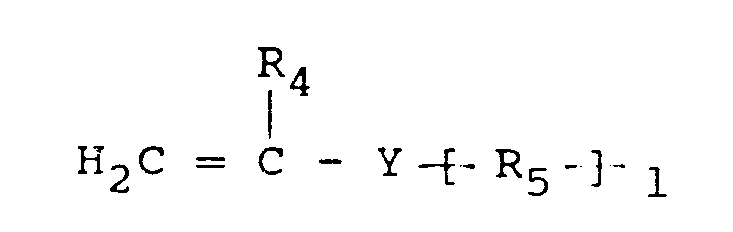
- This invention is directed to an adhesive composition containing a polymerizable thiocarboxylic acid, or a derivative thereof, of the general formula wherein X1 is an oxygen atom; R1 is an organic group of the general formula wherein R4 is a hydrogen atom or a methyl group; R5 is an organic group of 1 to 40 carbon atoms; Y is -COO-, -OOC-, -CONH-, -COS-, -SOC-, -S- or l is 0 or 1, and R2 is a mercapto group; or wherein X1 is a sulfur atom; R1 is an organic group of the general formula wherein R4 is a hydrogen atom or a methyl group; R5 is an organic group of 1 to 40 carbon atoms; Y is -COO-, -OOC-, -CONH-, -COS-, -SOC-, -S- or l is 0 or 1; and R2 is a mer
- the compound of general formula [I] is characterized by the moiety As specific examples of the group, these may be mentioned In this specification, compounds having any of these groups are called a thiocarboxylic acid or a derivative thereof.
- 'olefinic double bond' as used in this specification means a carbon-to-carbon double bond which takes part in radical, cationic or anionic addition polymerization to give a high polymer.
- 'organic group' is used in this specification to mean any and all groups that contain 1 to 40 carbon atoms, may contain hydrogen, oxygen, nitrogen, sulfur, phosphorus, and/or halogen in addition to carbon, and meet the following requirements (a) and/or (b).
- X1 is an oxygen atom
- R1 is an organic group of the general formula wherein R4 is a hydrogen atom or a methyl group
- R5 is an organic group of 1 to 40 carbon atoms
- Y is -COO-, -OOC-, -CONH-, -COS-, -SOC-, -S- or and l is 0 or 1
- R2 is a mercapto group.
- the structural formula of these compounds is as follows.
- the moiety containing the olefinic double bond is any of acryloyloxy, methacryloyloxy, vinyloxycarbonyl, isopropenyloxycarbonyl, acryloylamino, methacryloylamino, acryloylthio, methacryloylthio, vinylthiocarbonyl, isopropenylthiocarbonyl, vinylthio, isopropenylthio, vinylphenyl or isopropenylphenyl, and R1 is an organic group containing at least one such olefinic double bond.
- the second group of compounds of general formula [I] comprises the following carbodithioic acids or halides thereof.
- X1 is a sulfur atom
- R1 is an organic group of the general formula wherein R4 is a hydrogen atom or a methyl group
- R5 is an organic group of 1 to 40 carbon atoms
- Y is -COO-, -OOC-, -CONH-, -COS-, -SOC-, -S- or and l is 0 or 1
- R2 is a mercapto group or a halogen atom.
- R1 and Z are the same as that defined for the above-mentioned first group of compounds.
- the third group of compounds of general formula [I] comprises the following thiocarboxylic acid derivatives.
- X1 is a sulfur atom
- R1 is an organic group of the general formula wherein R4 is a hydrogen atom or a methyl group
- R6 is an organic group of 1 to 40 carbon atoms
- Y is -COO-, -OOC-, -CONH-, -COS-, -SOC-, -S- or m and n each is 0 or 1 and m+n ⁇ 1
- R2 is -OR3 or -SR3
- R3 is an organic group of the general formula wherein R4 ⁇ is the same as R4; R6 ⁇ is the same as R6; Y′ is the same as Y; and m′ and n′ each is 0 or 1 and n′+m′ ⁇ 1 ; m+m′ ⁇ 1 .
- the moiety containing the olefinic double bond is any of acryloyloxy, methacryloyloxy, vinyloxycarbonyl, isopropenyloxycarbonyl, acryloylamino, methacryloylamino, acryloylthio, methacryloylthio, vinylthiocarbonyl, isopropenylthiocarbonyl, vinylthio, isopropenylthio, vinylphenyl or isopropenylphenyl, and at least one of R1 and R3 is an organic group having the above-mentioned olefinic double bond.
- the thiocarboxylic acid derivatives which can be used in accordance with this invention include the corresponding esters, acid anhydrides and those containing disulfide bonds as mentioned below in the following list of exemplary compounds.
- the adhesive composition of this invention is prepared by the following procedure (1) or (2), using the compound or compounds described hereinbefore.
- the solvent those which are either copolymerizable or non-copolymerizable with said polymerizable compounds can be employed.
- the adhesive composition of this invention can be used not only as an adhesive in the usual manner but also as a primer for other adhesives.
- the adhesive composition of this invention is, for example, applied to the surface of a metal and then the ordinary adhesive or composite resin is applied for bonding the metal to the other material.
- the adhesive composition of this invention is preferably used as a primer, and as mentioned above, the adherend surface coated with this primer accepts a conventional adhesive, preferably an acrylic monomer-containing adhesive, to provide a firm bond.
- the adhesive of the present invention shows excellent water resistance and when the bonded specimen is kept in water at room temperature, no prominent decrease occurs in bond strength over several months.
- the copolymerizable monomer to be used as the solvent for the present compound is preferably a (meth)acrylic acid ester [the term '(meth)acrylic acid ester' means whichever or both of methacrylate and acrylate], such as methyl methacrylate, 2-hydroxyethyl methacrylate, ethylene glycol dimethacrylate, triethylene glycol dimethacrylate, neopentyl glycol dimethacrylate, 2,2-bis[4-(3-methacryloyloxy-2-hydroxypropoxy)phenyl]propane (Bis-GMA), 2,2-bis(methacryloyloxyethoxyphenyl)propane, trimethylolethane triacrylate, pentaerythritol tetraacrylate, 4-(2-methacryloyloxyethyl) trimellitate, 4-methacryloyloxyethyl trimellitate anhydride, bis(2-methacryloyloxyethyl
- a polymerization initiator is usually incorporated in the adhesive composition of this invention.
- polymerization initiator there may be mentioned benzoyl peroxide-aromatic tertiary amine systems, peroxides such as cumene hydroperoxide, tributylborane, and aromatic sulfinic acid or its salt -aromatic secondary or tertiary amine-acyl peroxide systems.
- photopolymerization initiators such as camphorquinone and camphorquinone-tertiary amine, camphorquinone-aldehyde, camphorquinone-mercaptan and other systems.
- the adhesive composition When the adhesive composition is to be used as a primer and a different adhesive agent is applied on the primer, it is not essential to incorporate such an initiator in the composition of this invention, for the polymerization initiator contained in the other adhesive agent will migrate to induce polymerization.
- the adhesive composition of this invention may further contain inorganic fillers such as quartz, glass, hydroxyapatite, calcium carbonate, barium sulfate, titanium dioxide, zirconium oxide, etc., and powders of polymers such as polymethyl methacrylate, polystyrene, polyvinyl chloride and so on.
- inorganic fillers such as quartz, glass, hydroxyapatite, calcium carbonate, barium sulfate, titanium dioxide, zirconium oxide, etc.
- powders of polymers such as polymethyl methacrylate, polystyrene, polyvinyl chloride and so on.
- adherend metals to which the adhesive comopsition of this invention is applicable are noble metals such as gold, platinum, palladium, silver, ruthenium, rhodium, osmium, iridium, etc. and a broad range of base metals such as iron, nickel, cobalt, copper, zinc, tin, aluminum, titanium, vanadium, chromium, manganese, zirconium, molybdenum, cadmium, indium, antimony and so on.
- the adhesive of this invention is also applicable to metal oxides such as aluminum oxide, titanium oxide, zirconium oxide, and further to ceramic materials containing such metal oxides.
- the preferred adhesive composition of this invention finds application with great advantage in the dental field.
- it is very useful as an adhesive for bonding a noble metal casting such as the inlay, crown, bridge or the like to the tooth, an adhesive for preparing a prosthetic appliance simulating the natural tooth by bonding a resin or ceramic veneer layer to the surface of a noble metal frame, or an adhesive for bonding cast parts of noble metal into a single complete assembly.
- the adhesive composition of this invention is not only useful in the dental field but finds application in any other industrial area where bonding of metals or metal oxides is practiced.
- This ether layer was washed with water and dried over anhydrous sodium sulfate and the ether was distilled off under reduced pressure to recover 18 g of 11-bromoundecanethioic acid.
- a mixture of 9.5 g of silver methacrylate, 50 ml of ether and 15 g of the above 11-bromoundecanethioic acid was refluxed for 72 hours and after cooling, the insoluble matter was filtered off. The solvent was then distilled off under reduced pressure and the residue was purified by chromatography. 7.2 g of a solid compound were obtained. By elemental analysis and NMR, the above compound was identified to be 11-methacryloyloxyundecanethioic acid.
- a three-necked flask fitted with a dropping funnel, stirrer and reflux condenser was charged with 5 g of magnesium and 100 ml of ether. Then, a solution of 45 g of 10-bromo-1-decene in 200 ml of ether was added via the dropping funnel to prepare a Grignard reagent. With cooling on an ice bath, 15 g of carbon disulfide was added dropwise with stirring. After completion of the dropwise addition, the mixture was stirred on an ice bath for 24 hours, and then ice-water was added to the mixture. The aqueous layer was acidified with diluted hydrochloric acid and the liberated organic matter was extracted with ether.
- This ether layer was washed with water and dried over anhydrous sodium sulfate and the ether was distilled off under reduced pressure to recover 26 g of 10-undecenedithioic acid.
- 100 ml of n-hexane were dissolved 22 g of 10-undecenedithioic acid and 0.2 g of benzoyl peroxide and then, 14 g of dry hydrogen bromide gas was bubbled into the solution at 0°C for 2 hours. Thereafter, the temperature of the mixture was allowed to return to room temperature and the mixture was allowed to stand for 12 hours. The n-hexane was then distilled off to recover 18 g of 11-bromoundecanedithioic acid.
- a mixture of 9.5 g of silver methacrylate, which was prepared from methacrylic acid, sodium hydroxide and silver nitrate, 60 ml of ether and 15 g of 11-bromoundecanedithioic acid thus obtained was refluxed for 72 hours under heating and the insoluble matter was filtered off after cooling. The solvent was then distilled off from the solution under reduced pressure and the residue was purified by chromatography. 9.2 g of a solid compound were obtained. By elemental analysis and NMR, this compound was identified to be 11-methacryloyloxyundecaneditioic acid.
- a 50 cc round-bottomed flask was charged with 5 g of 11-methacryloyloxyundecanedithioic acid, 6 g of thionyl chloride, 0.1 g of pyridine and a trace amount of cuprous chloride and the mixture was refluxed at 80°C until the evolution of gases subsided. Then, this flask was connected to a vacuum distillation apparatus and the low-boiling fraction was distilled off. The residue was then purified by chromatography to recover 3.2 g of a liquid compound. By elemental analysis and NMR , this liquid compound was identified as 11 methacryloyloxyundecanethioic acid chloride.
- the coated surface was washed with pure toluene so as to leave a monomolecular layer adsorbed on the metal surface. Then, an adhesive tape with an aperture 5 mm in diameter was applied to the above surface to prepare an adherend surface. Also, a round bar of SUS 304, 7 mm in diameter and 25 mm long, was provided and the end face of the bar was sand-blasted with alumina abrasive having a particle diameter of 50 ⁇ m.
- Example 2 In the same manner as Example 1, a Castwell® adherend was coated with a 1% toluene solution of the compound used in Example 2 and after a lapse of 1 minute, the coated surface was washed with pure toluene. Then, a stainless steel bar was adhered using Panavia EX® (Kuraray.Co., Ltd.) to prepare a testpiece (Example 26). Similarly, a testpiece (Example 27) was prepared with the compound used in Example 5. On the other hand, as a control, a testpiece (Comparative Example 4) was prepared by bonding a stainless steel bar directly to a Castwell® adherend with Panavia EX® instead of the adhesive composition of this invention.
- Example 26 was 283 kg/cm2 and that of Example 27 was 340 kg/cm2, in contrast to the mean bond strength of 31 kg/cm2 for Comparative Example 4.
- a two-package adhesive consisting of the following pastes A and B was prepared.
- Paste A Bis-GMA 12.5 Weight parts Triethylene glycol dimethacrylate 12.5 Adhesive component of Example 2 0.1 N,N-Diethanol-p-toluidine 0.5 Silanated quartz powder 74.5
- Paste B Bis-GMA 12.5 Weight parts Triethylene glycol dimethacrylate 12.5 Benzoyl peroxide 0.5 Silanated quartz powder 74.5
- Example 29 A similar experiment was performed with the adhesive component of Example 5 in lieu of that of Example 2. In this case (Example 29), the mean bond strength was 286 kg/cm2.
- a paste A′ was prepared by omitting the adhesive component of Example 2 from the composition of paste A, and in the same manner as Examples 28 and 29, a bonding experiment was carried out with the combination of A′ + B (Comparative Example 5). As a result, an adhesive failure occurred between the gold alloy and the adhesive and the mean bond strength was 106 kg/cm2.
- a powder-liquid mixture adhesive of the following components C and D was prepared.
- Powder C Silanated silica powder 100 Weight parts Sodium benzenesulfinate 0.4 N,N-Diethanol-p-toluidine 0.5 Liquid D
- Bis-GMA 50 Weight parts 1,6-Hexanediol dimethacrylate 39
- Adhesive component of Example 5 1 Benzoyl peroxide 1
- a sandblasted stainless steel bar was bonded to a dental alloy [Herador H] adherend polished with silicon carbide abrasive paper (1000 grit) by the same procedure as Example 1 (except, however, that a primer was not applied).
- a disk (4 mm in diameter, 3 mm thick) was cast from Degudent Universal®, a dental alloy, and the surface of the disk was polished with silicon carbide abrasive paper (1000 grit) to prepare an adherend (A). Meanwhile, the labial surface enamel of a human maxillary central incisor was polished with the same abrasive paper as above to prepare a flat surface and this surface was further subjected to acid etching with a 40% aqueous solution of phosphoric acid, rinsed and dried to provide an adherend (B).
- the adherend (A) was coated with the primer of Example 2 and after evaporation of the toluene, it was bonded to the adherend (B) using Panavia EX®, and the specimens were obtained. After immersion of the specimens in water at 37°C for a half year, a mean value of tensile bond strength of the 8 specimens was 181 Kg/cm2 and the adhesive failure occured at the interface between enamel and Panavia EX.
Landscapes
- Chemical & Material Sciences (AREA)
- Organic Chemistry (AREA)
- Adhesives Or Adhesive Processes (AREA)
- Dental Preparations (AREA)
- Addition Polymer Or Copolymer, Post-Treatments, Or Chemical Modifications (AREA)
Claims (4)
- Klebstoffzusammensetzung, umfassend eine polymerisierbare Thiocarbonsäure oder ein Derivat davon mit der allgemeinen Formel


worin X₁ ein Schwefelatom bedeutet; R₁ eine organische Gruppe der allgemeinen Formel

worin X₁ ein Schwefelatom bedeutet; R₁ eine organische Gruppe der allgemeinen Formel


- Klebstoffzusammensetzung nach Anspruch 1, die die polymerisierbare Thiocarbonsäure oder ein Derivat davon und ein Lösungsmittel, das entweder mit der polymerisierbaren Zusammensetzung copolymerisierbar ist oder nicht damit copolymerisierbar ist, umfaßt.
- Verwendung der Klebstoffzusammensetzung nach Anspruch 1 oder 2 beim Verbinden von Metallen.
- Verwendung nach Anspruch 3, wobei die Klebstoffzusammensetzung als Primärschicht für eine andere Klebstoffzusammensetzung verwendet wird.
Applications Claiming Priority (4)
| Application Number | Priority Date | Filing Date | Title |
|---|---|---|---|
| JP152491/88 | 1988-06-20 | ||
| JP15249188 | 1988-06-20 | ||
| JP198623/88 | 1988-08-08 | ||
| JP63198623A JPH0753846B2 (ja) | 1988-06-20 | 1988-08-08 | 含イオウ接着剤 |
Publications (3)
| Publication Number | Publication Date |
|---|---|
| EP0348166A2 EP0348166A2 (de) | 1989-12-27 |
| EP0348166A3 EP0348166A3 (de) | 1991-05-08 |
| EP0348166B1 true EP0348166B1 (de) | 1994-04-20 |
Family
ID=26481396
Family Applications (1)
| Application Number | Title | Priority Date | Filing Date |
|---|---|---|---|
| EP89306251A Expired - Lifetime EP0348166B1 (de) | 1988-06-20 | 1989-06-20 | Thiokarbonsäure oder ihre Derivate enthaltende Klebzusammensetzung |
Country Status (4)
| Country | Link |
|---|---|
| EP (1) | EP0348166B1 (de) |
| JP (1) | JPH0753846B2 (de) |
| CA (1) | CA1340226C (de) |
| DE (1) | DE68914726T2 (de) |
Families Citing this family (14)
| Publication number | Priority date | Publication date | Assignee | Title |
|---|---|---|---|---|
| DE4137076A1 (de) * | 1991-11-12 | 1993-05-13 | Ivoclar Ag | Dentalklebstoff |
| JPH107992A (ja) * | 1996-06-26 | 1998-01-13 | Elf Atochem Japan Kk | 高分子樹脂の金属への接着方法 |
| AU728717B2 (en) * | 1996-07-10 | 2001-01-18 | Commonwealth Scientific And Industrial Research Organisation | Polymerization with living characteristics |
| EP0910587B1 (de) | 1996-07-10 | 2001-12-12 | E.I. Du Pont De Nemours And Company | Polymerisation mit "living" kennzeichen |
| JP3527033B2 (ja) * | 1996-10-11 | 2004-05-17 | サンメディカル株式会社 | 歯科用または外科用接着性組成物 |
| FR2764892B1 (fr) * | 1997-06-23 | 2000-03-03 | Rhodia Chimie Sa | Procede de synthese de polymeres a blocs |
| US6812291B1 (en) | 1997-12-31 | 2004-11-02 | Rhodia Chimie | Method for block polymer synthesis by controlled radical polymerization from dithiocarbamate compounds |
| FR2773161B1 (fr) * | 1997-12-31 | 2000-01-21 | Rhodia Chimie Sa | Procede de synthese de polymeres a blocs |
| FR2814168B1 (fr) * | 2000-09-18 | 2006-11-17 | Rhodia Chimie Sa | Procede de synthese de polymeres a blocs par polymerisation radicalaire controlee en presence d'un compose disulfure |
| JP4889867B2 (ja) * | 2001-03-13 | 2012-03-07 | 株式会社カネカ | 末端にアルケニル基を有するビニル系重合体の製造方法、ビニル系重合体および硬化性組成物 |
| JP5962347B2 (ja) * | 2012-05-08 | 2016-08-03 | Jsr株式会社 | 新規(メタ)アクリル酸エステルおよびその重合体 |
| EP2925719A4 (de) * | 2012-11-28 | 2016-07-13 | Yansong Lu | Neuartige synthetische antioxidantien und deren verwendungen |
| KR20250082845A (ko) | 2023-11-30 | 2025-06-09 | (주)경인양행 | Raft 제제로 인한 탈보호 현상 억제를 위한 raft 중합 고분자의 회분 방식 후처리 공정 |
| KR20250082289A (ko) | 2023-11-30 | 2025-06-09 | (주)경인양행 | Raft 제제로 인한 탈보호 현상 억제를 위한 raft 중합방법 또는 raft 중합 고분자의 후처리 공정 |
Citations (1)
| Publication number | Priority date | Publication date | Assignee | Title |
|---|---|---|---|---|
| EP0277413A2 (de) * | 1986-10-06 | 1988-08-10 | Kuraray Co., Ltd. | Klebemittel insbesondere für Dentalzwecke |
Family Cites Families (3)
| Publication number | Priority date | Publication date | Assignee | Title |
|---|---|---|---|---|
| JPS5726311B2 (de) * | 1974-05-23 | 1982-06-03 | ||
| JPS57105472A (en) * | 1980-12-19 | 1982-06-30 | Matsushita Electric Ind Co Ltd | Adhesive for optical device |
| US4756774A (en) * | 1984-09-04 | 1988-07-12 | Fox Steel Treating Co. | Shallow case hardening and corrosion inhibition process |
-
1988
- 1988-08-08 JP JP63198623A patent/JPH0753846B2/ja not_active Expired - Fee Related
-
1989
- 1989-06-14 CA CA000602812A patent/CA1340226C/en not_active Expired - Fee Related
- 1989-06-20 EP EP89306251A patent/EP0348166B1/de not_active Expired - Lifetime
- 1989-06-20 DE DE68914726T patent/DE68914726T2/de not_active Expired - Fee Related
Patent Citations (1)
| Publication number | Priority date | Publication date | Assignee | Title |
|---|---|---|---|---|
| EP0277413A2 (de) * | 1986-10-06 | 1988-08-10 | Kuraray Co., Ltd. | Klebemittel insbesondere für Dentalzwecke |
Also Published As
| Publication number | Publication date |
|---|---|
| EP0348166A3 (de) | 1991-05-08 |
| CA1340226C (en) | 1998-12-15 |
| DE68914726T2 (de) | 1994-08-04 |
| JPH0753846B2 (ja) | 1995-06-07 |
| EP0348166A2 (de) | 1989-12-27 |
| DE68914726D1 (de) | 1994-05-26 |
| JPH0277478A (ja) | 1990-03-16 |
Similar Documents
| Publication | Publication Date | Title |
|---|---|---|
| US5085726A (en) | Method of adhesion with a sulfide group containing adhesive | |
| US5254198A (en) | Method of bonding a metal or alloy utilizing a polymerizable thiocarboxylic acid or a derivative thereof | |
| CA1340226C (en) | Adhesive composition containing a thiocarboxylic acid or a derivatives thereof | |
| US4918136A (en) | Adhesive composition | |
| US5670657A (en) | (Meth) arcylic ester derivatives | |
| US5186783A (en) | Method of bonding with adhesive composition containing a thiocarboxylic acid compound | |
| EP0115410A2 (de) | Klebemischungen | |
| US4425471A (en) | Novel cyanoacrylate adhesive compositions and methods of bonding | |
| JPS5812918B2 (ja) | ケンキセイカンアツセツチヤクザイストツク | |
| US5556897A (en) | Primer solution compositions and method of forming adhesive layer on tooth surface | |
| CA1128695A (en) | Adhesive composition and method | |
| EP0034046B1 (de) | Hitzebeständige, zähgemachte Klebezusammensetzung | |
| US5374664A (en) | Dental adhesives and restoration compositions | |
| US5795497A (en) | Thiouracil derivatives and metal surface-treating agent comprising thereof | |
| JP5417849B2 (ja) | 金属接合用接着剤組成物 | |
| WO2001051576A1 (en) | Acrylic adhesive compositions containing ketonyl (meth)acrylate | |
| JP2731785B2 (ja) | 接着剤 | |
| JP3296476B2 (ja) | 金属表面処理剤 | |
| JP2642105B2 (ja) | 接着剤 | |
| EP0802194B1 (de) | Thioürazil-Derivate und diese enthaltende Metall-Oberflächebehandlungsmittel | |
| JPH0567146B2 (de) | ||
| EP0718386B1 (de) | Luftaktivierbare polymerisierbare Zusammensetzungen, die Tetrazole enthalten | |
| JP2008056649A (ja) | 金属用プライマー | |
| JPS63246360A (ja) | ω−メルカプトアルキル(メタ)アクリレ−ト | |
| JP3517041B2 (ja) | 金属用接着性組成物 |
Legal Events
| Date | Code | Title | Description |
|---|---|---|---|
| PUAI | Public reference made under article 153(3) epc to a published international application that has entered the european phase |
Free format text: ORIGINAL CODE: 0009012 |
|
| AK | Designated contracting states |
Kind code of ref document: A2 Designated state(s): DE FR GB IT NL |
|
| PUAL | Search report despatched |
Free format text: ORIGINAL CODE: 0009013 |
|
| AK | Designated contracting states |
Kind code of ref document: A3 Designated state(s): DE FR GB IT NL |
|
| 17P | Request for examination filed |
Effective date: 19911019 |
|
| 17Q | First examination report despatched |
Effective date: 19920828 |
|
| GRAA | (expected) grant |
Free format text: ORIGINAL CODE: 0009210 |
|
| AK | Designated contracting states |
Kind code of ref document: B1 Designated state(s): DE FR GB IT NL |
|
| REF | Corresponds to: |
Ref document number: 68914726 Country of ref document: DE Date of ref document: 19940526 |
|
| ITF | It: translation for a ep patent filed | ||
| ET | Fr: translation filed | ||
| PLBE | No opposition filed within time limit |
Free format text: ORIGINAL CODE: 0009261 |
|
| STAA | Information on the status of an ep patent application or granted ep patent |
Free format text: STATUS: NO OPPOSITION FILED WITHIN TIME LIMIT |
|
| 26N | No opposition filed | ||
| REG | Reference to a national code |
Ref country code: GB Ref legal event code: IF02 |
|
| PGFP | Annual fee paid to national office [announced via postgrant information from national office to epo] |
Ref country code: NL Payment date: 20050605 Year of fee payment: 17 |
|
| PGFP | Annual fee paid to national office [announced via postgrant information from national office to epo] |
Ref country code: FR Payment date: 20050608 Year of fee payment: 17 |
|
| PGFP | Annual fee paid to national office [announced via postgrant information from national office to epo] |
Ref country code: GB Payment date: 20050615 Year of fee payment: 17 |
|
| PGFP | Annual fee paid to national office [announced via postgrant information from national office to epo] |
Ref country code: DE Payment date: 20050616 Year of fee payment: 17 |
|
| PG25 | Lapsed in a contracting state [announced via postgrant information from national office to epo] |
Ref country code: GB Free format text: LAPSE BECAUSE OF NON-PAYMENT OF DUE FEES Effective date: 20060620 |
|
| PGFP | Annual fee paid to national office [announced via postgrant information from national office to epo] |
Ref country code: IT Payment date: 20060630 Year of fee payment: 18 |
|
| PG25 | Lapsed in a contracting state [announced via postgrant information from national office to epo] |
Ref country code: NL Free format text: LAPSE BECAUSE OF NON-PAYMENT OF DUE FEES Effective date: 20070101 |
|
| PG25 | Lapsed in a contracting state [announced via postgrant information from national office to epo] |
Ref country code: DE Free format text: LAPSE BECAUSE OF NON-PAYMENT OF DUE FEES Effective date: 20070103 |
|
| GBPC | Gb: european patent ceased through non-payment of renewal fee |
Effective date: 20060620 |
|
| NLV4 | Nl: lapsed or anulled due to non-payment of the annual fee |
Effective date: 20070101 |
|
| REG | Reference to a national code |
Ref country code: FR Ref legal event code: ST Effective date: 20070228 |
|
| PG25 | Lapsed in a contracting state [announced via postgrant information from national office to epo] |
Ref country code: FR Free format text: LAPSE BECAUSE OF NON-PAYMENT OF DUE FEES Effective date: 20060630 |
|
| PG25 | Lapsed in a contracting state [announced via postgrant information from national office to epo] |
Ref country code: IT Free format text: LAPSE BECAUSE OF NON-PAYMENT OF DUE FEES Effective date: 20070620 |