EP0346429B1 - Peptid-analoge vom insulinähnlichen wachstums-faktor 1 (igf-1) oder faktor 2 (igf-2) - Google Patents
Peptid-analoge vom insulinähnlichen wachstums-faktor 1 (igf-1) oder faktor 2 (igf-2) Download PDFInfo
- Publication number
- EP0346429B1 EP0346429B1 EP89900786A EP89900786A EP0346429B1 EP 0346429 B1 EP0346429 B1 EP 0346429B1 EP 89900786 A EP89900786 A EP 89900786A EP 89900786 A EP89900786 A EP 89900786A EP 0346429 B1 EP0346429 B1 EP 0346429B1
- Authority
- EP
- European Patent Office
- Prior art keywords
- igf
- peptide analogue
- acid residue
- terminal
- cys
- Prior art date
- Legal status (The legal status is an assumption and is not a legal conclusion. Google has not performed a legal analysis and makes no representation as to the accuracy of the status listed.)
- Expired - Lifetime
Links
Classifications
-
- C—CHEMISTRY; METALLURGY
- C07—ORGANIC CHEMISTRY
- C07K—PEPTIDES
- C07K14/00—Peptides having more than 20 amino acids; Gastrins; Somatostatins; Melanotropins; Derivatives thereof
- C07K14/435—Peptides having more than 20 amino acids; Gastrins; Somatostatins; Melanotropins; Derivatives thereof from animals; from humans
- C07K14/575—Hormones
- C07K14/65—Insulin-like growth factors, i.e. somatomedins, e.g. IGF-1, IGF-2
-
- A—HUMAN NECESSITIES
- A61—MEDICAL OR VETERINARY SCIENCE; HYGIENE
- A61P—SPECIFIC THERAPEUTIC ACTIVITY OF CHEMICAL COMPOUNDS OR MEDICINAL PREPARATIONS
- A61P15/00—Drugs for genital or sexual disorders; Contraceptives
-
- A—HUMAN NECESSITIES
- A61—MEDICAL OR VETERINARY SCIENCE; HYGIENE
- A61P—SPECIFIC THERAPEUTIC ACTIVITY OF CHEMICAL COMPOUNDS OR MEDICINAL PREPARATIONS
- A61P17/00—Drugs for dermatological disorders
-
- A—HUMAN NECESSITIES
- A61—MEDICAL OR VETERINARY SCIENCE; HYGIENE
- A61P—SPECIFIC THERAPEUTIC ACTIVITY OF CHEMICAL COMPOUNDS OR MEDICINAL PREPARATIONS
- A61P43/00—Drugs for specific purposes, not provided for in groups A61P1/00-A61P41/00
-
- A—HUMAN NECESSITIES
- A61—MEDICAL OR VETERINARY SCIENCE; HYGIENE
- A61K—PREPARATIONS FOR MEDICAL, DENTAL OR TOILETRY PURPOSES
- A61K38/00—Medicinal preparations containing peptides
-
- Y—GENERAL TAGGING OF NEW TECHNOLOGICAL DEVELOPMENTS; GENERAL TAGGING OF CROSS-SECTIONAL TECHNOLOGIES SPANNING OVER SEVERAL SECTIONS OF THE IPC; TECHNICAL SUBJECTS COVERED BY FORMER USPC CROSS-REFERENCE ART COLLECTIONS [XRACs] AND DIGESTS
- Y10—TECHNICAL SUBJECTS COVERED BY FORMER USPC
- Y10S—TECHNICAL SUBJECTS COVERED BY FORMER USPC CROSS-REFERENCE ART COLLECTIONS [XRACs] AND DIGESTS
- Y10S930/00—Peptide or protein sequence
- Y10S930/01—Peptide or protein sequence
- Y10S930/12—Growth hormone, growth factor other than t-cell or b-cell growth factor, and growth hormone releasing factor; related peptides
Definitions
- This invention relates to growth factors, related compounds and their use.
- Insulin-like growth factor-1 a somatomedin
- Human IGF-1 hIGF-1
- the serum mediator of growth hormone action somatomedin C
- Bovine IGF-1 and porcine IGF-1 have identical sequences.
- ovine and chicken IGF-1 differ from human IGF-1 only as follows:
- IGF-2 Insulin-like growth factor-2
- IGF-1 Insulin-like growth factor-2
- hIGF-2 human IGF-2
- the amino acid sequence established for human IGF-2 (hIGF-2) beginning with the N-terminal alanine is shown below. Upper case letters have been used to indicate the amino acids equivalent to the N-terminal 5 amino acids of hIGF-1: Using the conventional numbering system of the N-terminal alanine being residue #1 and the C-terminal glutamic acid being residue #67, bovine, ovine, porcine and chicken IGF-2 differ from human IGF-2 only as follows:
- the compound destripeptide bIGF-1 but lacking the amino acid residues gly, pro and glu from the N-terminal, is effective in inhibiting protein breakdown and stimulating both protein synthesis and DNA synthesis in cellular systems at concentrations between 4 and 50 fold lower than required for entire bIGF-1.
- IGF-1 peptides having N-terminal amino acid sequences in common with that of human/bovine/porcine IGF-1 the elimination of between 1 and 5 amino acid residues from the N-terminal also results in enchanced biological potencies.
- the said N-terminal amino acid sequence is also a feature of the IGF-1 of rat, ovine, and chicken species.
- a peptide analogue of insulin-like growth factor-1 (IGF-1) or factor-2 (IGF-2) exhibiting growth factor activity wherein at least the glutamic acid residue is absent at position 3 from the N-terminal of IGF-1 or at position 5 or 6 from the N-terminal of IGF-2, and wherein the glutamic acid residue of IGF-1 is optionally replaced by a different amino acid residue other than glutamine with the proviso that the (IGF-1) peptide analogue does not have a N-terminal sequence Cys-Gly, Leu-Cys-Gly, or Thr-Leu-Cys-Gly.
- the peptide analogue is a human, bovine, ovine, porcine or chicken insulin-like growth factor analogue. More preferably the peptide analogue is a human, bovine or porcine insulin-like growth factor-1 analogue.
- the peptide analogue according to the present invention may be in a biologically pure form.
- the peptide analogue is an insulin like growth factor-1 analogue in addition at least one of the Gly-, Pro-, or Thr- residues may be absent from the N-terminal in addition to the absence of the glutamic acid residue.
- the glutamic acid residue may be replaced by a different amino acid residue.
- Suitable amino acid residues to replace glutamic acid include glycine, leucine, arginine, or lysine.
- the replacement residue for glutamic acid will be a positively charged amino acid residue such as arginine or lysine.
- glutamic acid residue may be replaced by glycine and the threonine residue normally adjacent to the glutamic acid may be replaced by a different amino acid residue, preferably arginine or glycine, most preferably arginine.
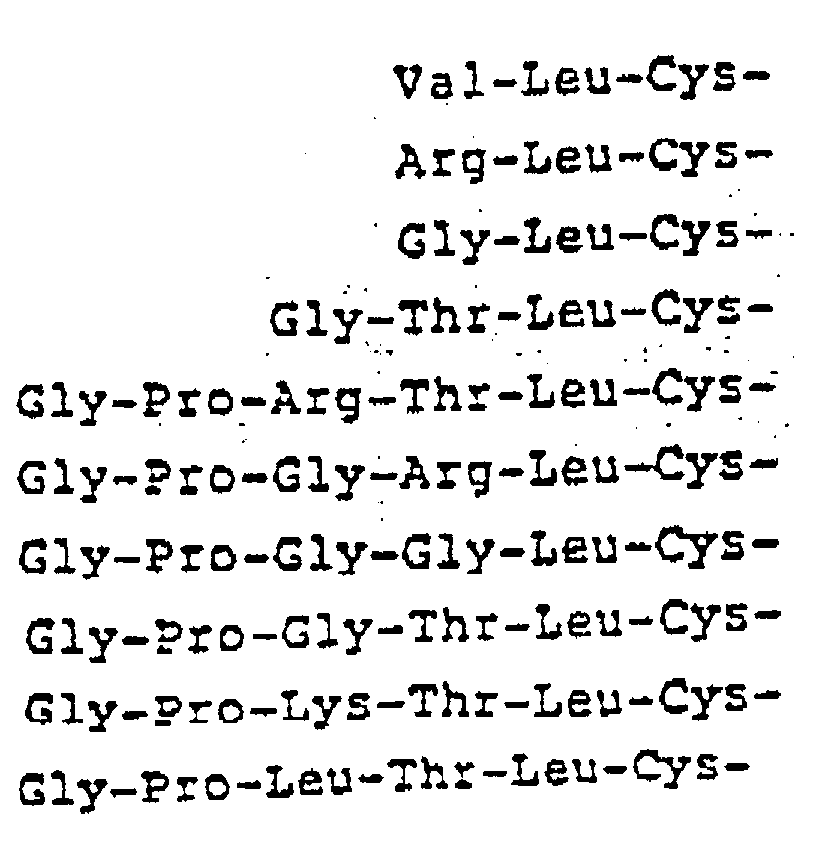
- the N-terminal sequence is selected from with the Cys residue shown being that normally at position 6 from the N-terminal.
- the peptide analogue is an insulin-like growth factor-2 analogue.
- at least one of the Ala-, Tyr-, Arg-, Pro-, Ser- or Thr- residues is absent from the N-terminal in addition to the absence of the glutamic acid residue.
- glutamic acid residue is replaced by a different amino acid residue.
- Suitable amino acid residues to replace glutamic acid include glycine, leucine, arginine, or lysine.
- Suitable amino acid residues to replace the threonine residue include arginine or glycine.
- the replacement residue for glutamic acid will be a positively charged amino acid residue such as arginine or lysine.
- glutamic acid residue may be replaced by glycine and the threonine residue normally adjacent to the glutamic acid may be replaced by a different amino acid residue, preferably arginine or glycine, most preferably arginine.
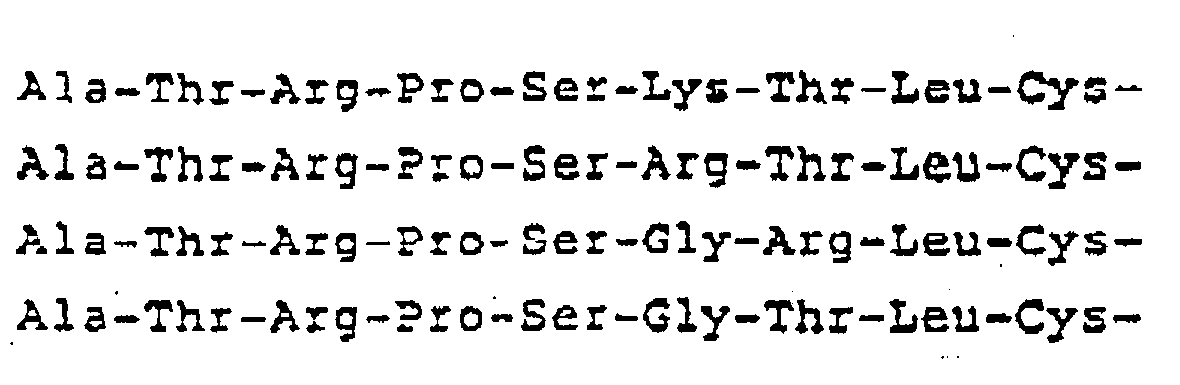
- the N-terminal sequence is selected from with the Cys residue shown being that normally at position 9 from the N-terminal.
- the peptides lacking the glutamic acid residue bind poorly to the binding proteins produced by many cell types. This binding may be further reduced by the substitution of an arginine or lysine residue for the glutamic acid residue and optionally the substitution of the adjacent threonine residue by arginine or a lysine residue. Should a binding protein be present those other IGF-1 peptides that do bind have reduced potencies.
- this invention provides peptide analogues that are suitable for cleavage of an engineered upstream asparagine.
- the peptide analogues have higher potencies than IGF-1 in cultured cells.
- the peptide analogues according to the present invention may form suitable replacements for IGF-1 and -2 in the following applications: (1) in humans to treat growth hormone deficiencies; (2) in farm animals to increase growth rates, increase the relative proportion of muscle or improve food conversion efficiency; (3) in humans to suppress the loss of body protein in severe catabolic states such as following burns, infection or other trauma; (4) in humans and animals to improve wound healing, and (5) to support the growth of cells in culture.
- the present invention provides a pharmaceutical or veterinary composition for the treatment of protein accumulation deficiencies or protein loss in animals including
- the peptide analogue may be present in amounts sufficient to provide a dose rate of approximately 0.01 to 10, preferably 0.1 to 1 milligrams/kg body weight/day.
- the peptide analogue may be present in amounts of from approximately 0.02 to 2000 milligrams.
- the peptide analogue may be present in concentrations from approximately 0.1 to 100 milligrams per litre.
- a peptide analgoue of insulin-like growth factor-1 (IGF-1) or factor-2 (IGF-2) exhibiting growth factor activity wherein at least the glutamic acid residue is absent at position 3 from the N-terminal of IGF-1 or at position 5 or 6 from the N-terminal of IGF-2, and wherein the glutamic acid residue of IGF-1 is optionally replaced by a different amino acid residue other than glutamine with the proviso that the (IGF-1) peptide analogue does not have a N-terminal sequence Cys-Gly, Leu-Cys-Gly, or Thr-Leu-Cys-Gly, for the preparation of a medicament for the treatment of protein accumulation deficiences or protein loss in human and animal subjects.
- IGF-1 insulin-like growth factor-1
- IGF-2 factor-2
- the peptide analogues may be administered to human subjects as a treatment for disorders associated with tissue wasting including, but not limited to, burns, skeletal trauma, infection, cancer, cystic fibrosis, Duchenne muscular dystrophy, Becker dystrophy, autosomal recessive dystrophy, polymyositis as well as other myopathies and acquired immune deficiency syndrome (AIDS).
- the peptide analogues may be administered parenterally or by injection.
- IGF-1 insulin-like growth factor-1
- IGF-2 factor-2
- the peptide analogue may be applied externally to the wound or it may be administered by injection.
- IGF-1 insulin-like growth factor-1
- IGF-2 factor-2
- An implant preferably a slow release pellet, is the preferred method of administration to farm animals as applied in conventional practice. Otherwise the peptide analogue may be administered by injection.
- the peptide analogues of the present invention may be administered to premature or other human infants to promote growth, improve nitrogen status and to treat catabolic disorders.
- the peptides may be administered as outlined above for tissue wasting conditions.
- a method for improving the growth of cells in culture which method includes providing a culture medium and an effective amount of a peptide analogue of insulin-like growth factor-1 (IGF-1) or factor-2 (IGF-2) exhibiting growth factor activity wherein at least the glutamic acid residue is absent at position 3 from the N-terminal or IGF-1 or at position 5 ot 6 from the N-terminal of IGF-2, and wherein the glutamic cid residue of IGF-1 is optionally replaced by a different amino acid residue other than glutamine with the proviso that the (IGF-1) peptide analogue does not have a N-terminal sequence Cys-Gly, Leu-Cys-Gly, or Thr-Leu-Cys-Gly; and adding the peptide analogue to the culture medium.
- IGF-1 insulin-like growth factor-1
- IGF-2 factor-2
- any standard culture medium may be used in accordance with this aspect of the present invention.
- the culture medium may include Eagle's Minimal Essential Medium.
- a method for the preparation of a peptide analogue of IGF-1 exhibiting growth factor activity wherein at least the glutamic acid residue is absent at position 3 from the N-terminal which method includes providing a source of amino acids, and coupling the amino acids in sequence to form a peptide analogue having an N-terminal sequence selected from, with the Cys residue being that normally at position 6 from the N-terminal.
- the peptide analogues may be produced by appropriate modifications to methods existing for the production of the full IGF-1 peptide. these modifications would be familiar to those familiar with the art.
- the peptides related to human/bovine/porcine IGF-1 may be synthesisted chemically using procedures developed for human IGF-1 (for example: Li et al., Proc. Natl. Acad. Sci, USA 80: 2216-2220, 1983) but with the final cycles of amino acid ligation modified.
- Synthetic ovine or chicken IGF-1 as well as related IGF-1 and IGF-2 peptides may be produced by techniques similar to those used for human IGF-1 using amino acid sequence information for these peptides.
- the peptides may also be produced following transformation of susceptible bacterial, yeast or tissue culture cell hosts with recombinant plasmids that include DNA sequences capable of directing the expression of the peptides.
- the DNA sequence may be synthetic, chromosomal, cDNA or combination thereof.
- the inserted coding sequences may incorporate deletion or omissions to account for differences between the sequence of peptide analogues and the full IGF-1 peptide.
- the starting material was Boc-ala-phenylacetamido methyl resin. Coupling was effected in an Applied Biosystems Inc model 430A peptide synthesiser with preformed symmetric anhydrides of the Boc-aminoacids in dichloromethane except for the derivatives of arginine, asparagine and glutamine which were coupled in dimethyl formamide (DMF). In all cases a second coupling was performed in DMF. Samples of resin were removed after each cycle of synthesis and subjected to quantitive ninhydrin analysis (Sarin, V.K., Kent, S.B.H., Tam, J.P., Merifield, R.B.; Anal. Biochem. 17, 147-157 (1981). Preview sequence analysis of the side-chain protected, resin-bound peptide was also carried out and together, these indicated an average repetitive yield of 99%.
- Peptides were redissolved in 6M guanidine hydrochloride pH 8.5 with Tris containing 10 mM dithioerythritol and desalted by reverse phase HPLC and dried. Oxidation of the reduced peptide was effected by dissolving in 8M urea, 0.1M Tris (pH8.0 with HCl) containing 13mM oxidized gluthathione and incubated at 25 o for 15 hours. The sample was purified by reverse phase HPLC using a gradient of acetonitrile in 0.1% trifluoroacetic acid to elute the peptides and separate the biologically active form of the peptide from those forms lacking the correct disulphide bonds and hence lacking full biological activity. The samples were dried prior to resuspension.
- Bioassays of purified synthetic peptides have been compared with pure humna/bovine/porcine IGF-1.
- the assays involve the incorporation of 3H-labelled leucine into the total cell protein of L6 myoblasts as described by Francis et al. (Biochem. J. 233:207-213, 1986).
- the higher potencies produced by the deletion or modification of the glutamic acid residue normally at position 3 of IGF-1 are not associated with a markedly increased competition of the peptide for binding to receptors on the L6 myoblasts, provided that binding is carried out at 4 o C otherwise using the method of Ballard et al (Biochem. J. 233; 223-230, 1986) with human/bovine/porcine IGF-1 as radioligand.
- This apparent discrepancy is caused by the myoblasts producing a binding protein in addition to the receptor.
- This binding protein selectively binds those IGF-1 peptides that have a glutamic acid residue at position 3 from the N-terminal, thus preventing the peptide binding to the cell receptor.
Landscapes
- Health & Medical Sciences (AREA)
- Chemical & Material Sciences (AREA)
- Life Sciences & Earth Sciences (AREA)
- Organic Chemistry (AREA)
- Medicinal Chemistry (AREA)
- General Health & Medical Sciences (AREA)
- Veterinary Medicine (AREA)
- Endocrinology (AREA)
- General Chemical & Material Sciences (AREA)
- Pharmacology & Pharmacy (AREA)
- Chemical Kinetics & Catalysis (AREA)
- Animal Behavior & Ethology (AREA)
- Bioinformatics & Cheminformatics (AREA)
- Public Health (AREA)
- Engineering & Computer Science (AREA)
- Nuclear Medicine, Radiotherapy & Molecular Imaging (AREA)
- Toxicology (AREA)
- Molecular Biology (AREA)
- Zoology (AREA)
- Gastroenterology & Hepatology (AREA)
- Biochemistry (AREA)
- Biophysics (AREA)
- Genetics & Genomics (AREA)
- Diabetes (AREA)
- Proteomics, Peptides & Aminoacids (AREA)
- Dermatology (AREA)
- Reproductive Health (AREA)
- Peptides Or Proteins (AREA)
- Medicines That Contain Protein Lipid Enzymes And Other Medicines (AREA)
- Preparation Of Compounds By Using Micro-Organisms (AREA)
Claims (33)
- Ein Wachstumsfaktoraktivität aufweisendes Peptid-Analoges zu dem insulin-ähnlichen Wachstumsfaktor-1 (IGF-1) oder Faktor-2 (IGF-2), worin wenigstens der Glutaminsäurerest in der Position 3 zum N-Terminus von IGF-1 oder in den Positionen 5 oder 6 zum N-Terminus von IGF-2 fehlt, und worin der Glutaminsäurerest von IGF-1 wahlweise durch einen von Glutamin verschiedenen Aminosäurerest ersetzt ist, mit der Maßgabe, daß das zu dem (IGF-1) analoge Peptid keine N-terminale Sequenz Cys-Gly, Leu-Cys-Gly oder Thr-Leu-Cys-Gly aufweist.
- Peptid-Analoges nach Anspruch 1, das analog ist zu dem insulin-ähnlichen Wachstumsfaktor vom Menschen, Rind, Schaf, Schwein oder Huhn.
- Peptid-Analoges nach Anspruch 2, das analog ist zu dem insulin-ähnlichen Wachstumsfaktor-1 vom Menschen, Rind oder Schwein.
- Peptid-Analoges nach Anspruch 3, worin zusätzlich wenigstens einer der Gly-Pro- oder Thr-Reste am N-Terminus fehlt.
- Peptid-Analoges nach Anspruch 3, worin der Glutaminsäurerest durch einen anderen Aminosäurerest ersetzt ist.
- Peptid Analoges nach Anspruch 5, worin der Glutaminsäurerest durch einen positiv geladenen Aminosäurerest ersetzt ist.
- Peptid-Analoges nach Anspruch 6, worin der normalerweise neben dem Glutaminsäurerest stehende Threoninrest durch einen anderen Aminosäurerest ersetzt ist.
- Peptid-Analoges nach Anspruch 1 mit einer N-terminalen Sequenz, ausgewählt auswobei der angegebene Cys-Rest normalerweise in der Position 6 zum N-Terminus steht.
- Peptid-Analoges nach Anspruch 1, das zur Spaltung eines gentechnisch erzeugten, stromaufwärts gelegenen Asparaginrestes geeignet ist, zur Bereitsstellng eines endständigen Glycinrestes.
- Peptid-Analoges nach Anspruch 1 in reiner Form.
- Peptid-Analoges nach Anspruch 1, das analog ist zu dem insulin-ähnlichen Wachstumsfaktor-2 (IGF-2) vom Menschen, Rind, Schaf, Schwein oder Huhn.
- Peptid-Analoges nach Anspruch 11, worin zusätzlich wenigstens einer der Ala-, Tyr-, Arg-, Pro, Ser- oder Thr- Reste am N-Terminus fehlt.
- Peptid-Analoges nach Anspruch 11, worin der Glutaminrest durch einen anderen Aminosäurerest ersetzt ist.
- Peptid-Analoges nach Anspruch 13, worin der Glutaminsäurerest durch einen positiv geladenen Aminosäurerest ersetzt ist.
- Peptid-Analoges nach Anspruch 14, worin der normalerweise neben dem Glutminsäurerest stehende Threoninrest durch einen anderen Aminosäurerest ersetzt ist.
- Peptid-Analoges nach Anspruch 13 mit einer N-terminalen Sequenz, ausgewählt auswobei der Cys-Rest normalerweise in der Position 9 zum N-Terminus steht.
- Peptid-Analoges nach Anspruch 11, das zur Spaltung eines gentechnisch erzeugten, stromaufwärts gelegenen Asparaginrestes geeignet ist, zur Bereitstellung eines endständigen Glycinrestes.
- Eine pharmazeutische oder veterinär-medizinische Zusammensetzung zur Behandlung von Proteinaufbaumängeln oder Proteinverlusten bei Lebewesen, enthaltend (a) eine wirksame Menge eines Wachstumsfaktoraktivität aufweisenden Peptid-Analogen zu dem insulin-ähnlichen Wachstumsfaktor-1 (IGF-1) oder Faktor-2 (IGF-2), worin wenigstens der Glutaminsäurerest in der Position 3 zum N-Terminus von IGF-1 oder in den Positionen 5 oder 6 zum N-Terminus von IGF-2 fehlt, und worin der Glutaminsäurerest von IGF-1 wahlweise durch einen von Glutamin verschiedenen Aminosäurerest ersetzt ist, mit der Maßgabe, daß das zu dem (IGF-1) analoge Peptid keine N-terminale Sequenz Cys-Gly, Leu-Cys-Gly oder Thr-Leu-Cys-Gly aufweist, sowie (b) einen pharmazeutisch oder veterinär-medizinisch akzeptablen Verdünnungsmittelträger oder Arzneistoffträger dafür.
- Eine pharmazeutische oder veterinär-medizinische Zusammensetzung nach Anspruch 18, worin der Glutaminsäurerest in dem Peptid-Analogen durch einen anderen Aminosäurerest ersetzt ist.
- Eine pharmazeutische oder veterinär-medizinische Zusammensetzung nach Anspruch 19, worin das Peptid-Analoge in Mengen von ungefähr 0,02 bis 2000 mg vorhanden ist.
- Verwendung eines Wachstumsfaktoraktivität aufweisenden Peptid-Analogen zu dem insulin-ähnlichen Wachstumsfaktor-1 (IGF-1) oder Faktor-2 (IGF-2), worin wenigstens der Glutaminsäurerest in der Position 3 zum N-Terminus von IGF-1 oder in den Positionen 5 oder 6 zum N-Terminus von IGF-2 fehlt, und worin der Glutaminsäurerest von IGF-1 wahlweise durch einen von Glutamin verschiedenen Aminosäurerest ersetzt ist, mit der Maßgabe, daß das zu dem (IGF-1) analoge Peptid keine N-terminale Sequenz Cys Gly, Leu-Cys-Gly oder Thr-Leu-Cys-Gly aufweist, zur Herstellung eines Medikaments für die Behandlung von Proteinaufbaumängeln oder Proteinverlusten bei Menschen und Tieren.
- Verwendung eines Peptid-Analogen nach Anspruch 21, worin der Glutaminsäurerest im Peptid-Analogen durch einen anderen Aminosäurerest ersetzt ist.
- Verwendung eines Peptid-Analogen nach Anspruch 22, worin die Proteinaufbaumängel in verbindung gebracht werden mit Frühreife bei Kindern, Mangel an Wachstumshormonen, Verbrennungen, Infektionen, sonstigen Traumata, Krebs, zystischer Fibrose, Duchenne'schem Muskelschwund, Becker'scher Dystrophie, autosomaler rezessiver Dystrophie, Polymyositis sowie anderen Muskelerkrankungen.
- Verwendung eines Peptid-Analogen nach Anspruch 23, worin das Peptid-Analoge in einer Dosis von etwa 0,01 bis 10 mg pro Kilogramm Körpergewicht pro Tag verabreicht wird.
- Verwendung eines Wachtstumsfaktoraktivität aufweisenden Peptid-Analogen zu dem inculin-ähnlichen Wachstumsfaktor-1 (IGF-1) oder Faktor-2 (IGF-2), worin wenigstens der Glutaminsäurerest in der Position 3 zum N-Terminus von IGF-1 oder in den Positionen 5 oder 6 zum N-Terminus von IGF-2 fehlt, und worin der Glutaminsäurerest von IGF-1 wahlweise durch einen von Glutamin verschiedenen Aminosäurerest ersetzt ist, mit der Maßgabe, daß das zu dem (IGF-1) analoge Peptid keine N-terminale Sequenz Cys-Gly, Leu-Cys-Gly oder Thr-Leu-Cys-Gly aufweist, zur Herstellung eines Medikaments für die Behandlung von Wunden bei Menschen und Tieren.
- Verwendung eines Peptid-Analogen nach Anspruch 25, worin der Glutaminsäurerest im Peptid-Analogen durch einen anderen Aminosäurerest ersetzt ist.
- Verwendung eines Peptid-Analogen nach Anspruch 26, worin das Peptid-Analoge durch Injektion verabreicht wird bzw. äußerlich in Mengen von ungefähr 0,02 bis 2000 mg angewandt wird.
- Verwendung eines Wachtstumsfaktoraktivität aufweisenden Peptid-Analogen zu dem insulin-ähnlichen Wachstumsfaktor-1 (IGF-1) oder Faktor-2 (IGF-2), worin wenigstens der Glutaminsäurerest in der Position 3 zum N-Terminus von IGF-1 oder in den Positionen 5 oder 6 zum N-Terminus von IGF-2 fehlt, und worin der Glutaminsäurerest von IGF-1 wahlweise durch einen von Glutamin verschiedenen Aminosäurerest ersetzt ist, mit der Maßgabe, daß das zu dem (IGF-1) analoge Peptid keine N-terminale Sequenz Cys-Gly, Leu-Cys-Gly oder Thr-Leu-Cys-Gly aufweist, zur Herstellung eines Medikaments zur Verbesserung des Wachstums bei Menschen und Tieren.
- Verwendung eines Peptid-Analogen nach Anspruch 28, worin die verbesserte Wachstumsfunktion in Verbindung gebracht wird mit erhöhter Wachstumsrate, selektiver Muskelablagerung, reduzierten Fettmengen oder erhöhtem Metabolismus.
- Verwendung eines Peptid-Analogen nach Anspruch 29, worin das Peptid-Analoge in einer Dosis von etwa 0,01 bis 10 mg pro Kilogramm Körpergewicht pro Tag verabreicht wird.
- Verfahren zur Verbesserung des Wachstums von Zellkulturen, umfassend
die Bereitstellung eines Kulturmediums sowie einer effektiven Menge eines Wachstumsfaktoraktivität aufweisenden Peptid-Analogen zu dem insulin-ähnlichen Wachstumsfaktor-1 (IGF-1) oder Faktor-2 (IGF-2), worin wenigstens der Glutaminsäurerest in der Position 3 zum N-Terminus von IGF-1 oder in den Positionen 5 oder 6 zum N-Terminus von IGF-2 fehlt, und worin der Glutaminsäurerest von IGF-1 wahlweise durch einen von Glutamin verschiedenen Aminosäurerest ersetzt ist, mit der Maßgabe, daß das zu dem (IGF-1) analoge Peptid keine N-terminale Sequenz Cys-Gly, Leu-Cys-Gly oder Thr-Leu-Cys-Gly aufweist, sowie die Zugabe des Peptid-Analogen zu dem Kulturmedium. - Verfahren nach Anspruch 31, worin das Peptid-Analoge in einer Menge von ungefähr 0,1 bis 100 mg pro Liter Kulturmedium zugegeben wird.
- Verfahren zur Herstellung eines Wachstumsfaktoraktivität aufweisenden Peptid-Analogen zu dem insulin-ähnlichen Wachstumsfaktor-1 (IGF-1), worin wenigstens der Glutaminsäurerest in der Position 3 zum N-Terminus fehlt, umfassend die Bereitsstellung einer Aminosäurequelle; Verbinden der Aminosäuren in Sequenz zur Bildung eines Peptid-Analogen mit einer endständigen N-terminalen Sequenz, ausgewählt auswobei der Cys-Rest normalerweise in der Position 6 zum N-Terminus steht.

Applications Claiming Priority (3)
| Application Number | Priority Date | Filing Date | Title |
|---|---|---|---|
| AUPI606887 | 1987-12-24 | ||
| AU6068/87 | 1987-12-24 | ||
| PCT/AU1988/000485 WO1989005822A1 (en) | 1987-12-24 | 1988-12-20 | Peptide analogues of insulin-like growth factor 1 (igf-1) or factor 2 (igf-2) |
Publications (3)
| Publication Number | Publication Date |
|---|---|
| EP0346429A1 EP0346429A1 (de) | 1989-12-20 |
| EP0346429A4 EP0346429A4 (en) | 1990-10-10 |
| EP0346429B1 true EP0346429B1 (de) | 1994-12-28 |
Family
ID=3772677
Family Applications (1)
| Application Number | Title | Priority Date | Filing Date |
|---|---|---|---|
| EP89900786A Expired - Lifetime EP0346429B1 (de) | 1987-12-24 | 1988-12-20 | Peptid-analoge vom insulinähnlichen wachstums-faktor 1 (igf-1) oder faktor 2 (igf-2) |
Country Status (7)
| Country | Link |
|---|---|
| US (1) | US5164370A (de) |
| EP (1) | EP0346429B1 (de) |
| JP (1) | JP2507106B2 (de) |
| AT (1) | ATE116335T1 (de) |
| CA (1) | CA1341204C (de) |
| DE (1) | DE3852636T2 (de) |
| WO (1) | WO1989005822A1 (de) |
Families Citing this family (54)
| Publication number | Priority date | Publication date | Assignee | Title |
|---|---|---|---|---|
| US5470828A (en) * | 1987-12-24 | 1995-11-28 | Gropep Pty. Ltd. | Peptide analogs of insulin-like growth factor II |
| US6723699B1 (en) | 1989-06-05 | 2004-04-20 | Cephalon, Inc. | Treating disorders by application of insulin-like growth factors and analogs |
| US6693076B1 (en) | 1989-06-05 | 2004-02-17 | Cephalon, Inc. | Treating disorders by application of insulin-like growth factors and analogs |
| US5652214A (en) * | 1989-06-05 | 1997-07-29 | Cephalon, Inc. | Treating disorders by application of insulin-like growth factors and analogs |
| CA2033176C (en) * | 1989-06-09 | 1999-12-14 | Julian Richard Este Wells | Growth hormone fusion proteins |
| US5045531A (en) * | 1989-12-18 | 1991-09-03 | Magainin Sciences Inc. | Wound treatment employing biologically active ion channel forming peptides and proteins |
| US5679771A (en) * | 1990-02-13 | 1997-10-21 | Gropep Pty. Ltd. | Method for treating intestinal diseases |
| ATE165008T1 (de) * | 1990-02-13 | 1998-05-15 | Gropep Pty Ltd | Methode zur behandlung intestinaler krankheiten |
| US5681814A (en) * | 1990-06-07 | 1997-10-28 | Genentech, Inc. | Formulated IGF-I Composition |
| SE9002731D0 (sv) * | 1990-08-24 | 1990-08-24 | Kabivitrum Ab | Product comprising growth factor |
| SE9002732D0 (sv) * | 1990-08-24 | 1990-08-24 | Kabivitrum Ab | Product containing growth factor |
| US5202119A (en) * | 1991-06-28 | 1993-04-13 | Genentech, Inc. | Method of stimulating immune response |
| US5744139A (en) * | 1991-06-28 | 1998-04-28 | University Of Tennessee Research Corporation | Insulin-like growth factor I (IGF-1) induced improvement of depressed T4/T8 ratios |
| US5736363A (en) * | 1991-07-29 | 1998-04-07 | British Bio-Technology Limited | IGF-II analogues |
| EP0607278B1 (de) * | 1991-10-07 | 2002-04-17 | The Brigham And Women's Hospital, Inc. | Verfahren zur erhöhung der darmabsorption |
| US6310040B1 (en) | 1991-11-08 | 2001-10-30 | Cephalon, Inc. | Treating retinal neuronal disorders by the application of insulin-like growth factors and analogs |
| EP0639981A4 (de) * | 1992-05-08 | 1995-06-28 | Univ Jefferson | Analoge des igf-faktors(18.01.94). |
| JPH06510065A (ja) * | 1992-06-08 | 1994-11-10 | カイロン コーポレーション | 成長因子igf−iおよび/またはigf−iiの用法 |
| NZ260309A (en) * | 1992-06-08 | 1997-07-27 | Pharmacia Ab Substituted For K | Use of 1gf-2 for prevention or treatment of nutritional or gastrointestinal disorders and promoting neonatal growth |
| US5420112A (en) * | 1992-06-12 | 1995-05-30 | Lewis; Michael E. | Prevention and treatment of peripheral neuropathy |
| EP0659083B1 (de) * | 1992-06-12 | 1999-12-22 | Cephalon, Inc. | Vorbeugung und behandlung der peripheren neuropathie |
| US5444045A (en) * | 1992-09-17 | 1995-08-22 | Gropep, Pty. Ltd. | Method of administering IGF-1, IGF-2, and analogs thereof to birds |
| GB9310049D0 (en) * | 1993-05-12 | 1993-06-30 | Cancer Res Campaign Tech | Growth factor effects |
| ATE226958T1 (de) * | 1993-09-20 | 2002-11-15 | Celtrix Pharma | Behandlung von hematologischen störungen mit einem igf-1/igfbp-3 komplex |
| EP0956041A1 (de) * | 1996-09-16 | 1999-11-17 | Dalhousie University | Verwendung von igf-1 zur behandlung von polyzystischer nierenkrankheit und damit verbundene indikationen |
| US6156728A (en) * | 1996-11-01 | 2000-12-05 | Genentech, Inc. | Treatment of inner ear hair cells |
| US6420518B1 (en) | 1997-04-04 | 2002-07-16 | Genetech, Inc. | Insulin-like growth factor agonist molecules |
| US6121416A (en) * | 1997-04-04 | 2000-09-19 | Genentech, Inc. | Insulin-like growth factor agonist molecules |
| US7700353B2 (en) | 1998-07-22 | 2010-04-20 | E-P Therapeutics, Inc. | Compositions and methods for inducing apoptosis in tumor cells |
| US7118752B2 (en) | 1998-07-22 | 2006-10-10 | University Of Connecticut | Compositions and methods for inhibiting the proliferation and invasiveness of malignant cells comprising E-domain peptides of IGF-I |
| US6358916B1 (en) | 1998-07-22 | 2002-03-19 | Thomas T. Chen | Biological activity of IGF-I E domain peptide |
| AU762351B2 (en) * | 1999-01-06 | 2003-06-26 | Genentech Inc. | Insulin-like growth factor (IGF) I mutant variants |
| EP1506972A1 (de) * | 1999-01-06 | 2005-02-16 | Genentech Inc. | Mutierte Varianten des Insulin-ähnlichen Wachstumsfaktor-I (IGF-I) |
| ES2329220T3 (es) * | 1999-01-06 | 2009-11-24 | Genentech, Inc. | Variantes mutantes del factor de crecimiento similar a insulina (igf) i. |
| ES2208305T3 (es) * | 1999-04-08 | 2004-06-16 | Genentech, Inc. | Composicion basada en polipeptidos de carga opuesta.. |
| AU2001263215A1 (en) | 2000-05-16 | 2001-11-26 | Genentech Inc. | Method for treating cartilage disorders |
| DE60217066T4 (de) * | 2001-02-09 | 2010-07-01 | Genentech, Inc., South San Francisco | Kristallisierung von igf-1 |
| CA2439735A1 (en) * | 2001-03-14 | 2002-09-19 | Genentech, Inc. | Igf antagonist peptides |
| EP1401808B1 (de) | 2001-05-24 | 2009-07-08 | Neuren Pharmaceuticals Limited | Gpe-analoga und peptidomimetika |
| US7714020B2 (en) | 2001-05-24 | 2010-05-11 | Neuren Pharmaceuticals Limited | Treatment of non-convulsive seizures in brain injury using G-2-methyl-prolyl glutamate |
| US7605177B2 (en) | 2001-05-24 | 2009-10-20 | Neuren Pharmaceuticals Limited | Effects of glycyl-2 methyl prolyl glutamate on neurodegeneration |
| AU2002363322A1 (en) * | 2001-10-26 | 2003-05-19 | Large Scale Biology Corporation | Endothelial cell derived hemotopoietic growth factor |
| JP2005534650A (ja) * | 2002-06-11 | 2005-11-17 | ザ バーナム インスティテュート | エリスロポイエチンおよびインスリン様増殖因子の神経保護的相乗作用 |
| DK2274978T3 (en) | 2003-09-12 | 2015-06-15 | Ipsen Biopharmaceuticals Inc | Methods of treating an insulin-like growth factor-I (IGF-I) deficiency |
| US7355018B2 (en) * | 2003-09-30 | 2008-04-08 | Regeneron Pharmaceuticals, Inc. | Modified IGF1 polypeptides with increased stability and potency |
| AU2004278311A1 (en) * | 2003-10-03 | 2005-04-14 | Genentech, Inc. | IGF binding proteins |
| EP1674113A1 (de) * | 2004-12-22 | 2006-06-28 | F. Hoffmann-La Roche Ag | Konjugate von insulinähnlichem Wachstumfaktor-1 und Poly(Ethylenglykol) |
| US20080103457A1 (en) * | 2005-01-11 | 2008-05-01 | Heart Failure Technologies, Inc. University Enterprise Laboratories (Uel) | Method and System for Treating Heart Failure |
| TWI406870B (zh) | 2005-02-21 | 2013-09-01 | Chugai Pharmaceutical Co Ltd | A method of making a protein using hamster IGF-1 |
| CL2007001614A1 (es) | 2006-06-09 | 2008-08-08 | Novartis Ag | Polipeptido que comprende una proteina del precursor del factor de crecimiento tipo insulina, igf-1 humana, en la cual la escision del peptido e mediante una proteasa se reduce a traves de la modificacion de la proteina del precursor; y su uso para t |
| AU2010227419A1 (en) | 2009-03-27 | 2011-10-20 | Proyecto De Biomedicina Cima, S.L. | Methods and compositions for the treatment of cirrhosis and liver fibrosis |
| PT3344758T (pt) | 2015-09-01 | 2021-10-28 | Ncardia B V | Um método in vitro para diferenciação de uma população de células estaminais pluripotentes humanas numa população de células de cardiomiócitos |
| US20210008172A1 (en) | 2019-07-11 | 2021-01-14 | Opko Biologics Ltd. | Long-acting igf-1 or igf-1 variants and methods of producing same |
| US20250179430A1 (en) * | 2022-07-05 | 2025-06-05 | Terasaki Institute For Biomedical Innovation | Cell growth supplements using dairy-based materials |
Citations (1)
| Publication number | Priority date | Publication date | Assignee | Title |
|---|---|---|---|---|
| US4876242A (en) * | 1987-09-21 | 1989-10-24 | Merck & Co., Inc. | Human insulin-like growth factor analoges with reduced binding to serum carrier proteins and their production in yeast |
Family Cites Families (8)
| Publication number | Priority date | Publication date | Assignee | Title |
|---|---|---|---|---|
| US408518A (en) * | 1889-08-06 | Stilt | ||
| US4196167A (en) * | 1978-12-26 | 1980-04-01 | California Medical Developments, Inc. | Drug detection device |
| WO1985000831A1 (en) * | 1983-08-10 | 1985-02-28 | Amgen | Microbial expression of insulin-like growth factor |
| US4745179A (en) * | 1984-04-02 | 1988-05-17 | Fujisawa Pharmaceutical Co., Ltd. | 59 Valine insulin-like growth factor I and process for production thereof |
| SE8403479L (sv) * | 1984-06-29 | 1986-01-29 | Ssab Svenskt Stal Ab | Sett att framstella profilerade stenger |
| AU598205B2 (en) * | 1985-08-22 | 1990-06-21 | Gropep Pty Ltd | Peptide analogues of mammalian insulin-like growth factor-1 |
| SE8505920D0 (sv) * | 1985-12-13 | 1985-12-13 | Kabigen Ab | New protein and its use |
| EP0379338A3 (de) * | 1989-01-17 | 1991-07-24 | Merck & Co. Inc. | Menschlicher insulinähnlicher Wachstumsfaktor und seine Herstellung in Hefe |
-
1988
- 1988-12-20 EP EP89900786A patent/EP0346429B1/de not_active Expired - Lifetime
- 1988-12-20 JP JP1500684A patent/JP2507106B2/ja not_active Expired - Lifetime
- 1988-12-20 DE DE3852636T patent/DE3852636T2/de not_active Expired - Lifetime
- 1988-12-20 US US07/408,518 patent/US5164370A/en not_active Expired - Lifetime
- 1988-12-20 AT AT89900786T patent/ATE116335T1/de not_active IP Right Cessation
- 1988-12-20 WO PCT/AU1988/000485 patent/WO1989005822A1/en not_active Ceased
- 1988-12-21 CA CA000586713A patent/CA1341204C/en not_active Expired - Lifetime
Patent Citations (1)
| Publication number | Priority date | Publication date | Assignee | Title |
|---|---|---|---|---|
| US4876242A (en) * | 1987-09-21 | 1989-10-24 | Merck & Co., Inc. | Human insulin-like growth factor analoges with reduced binding to serum carrier proteins and their production in yeast |
Non-Patent Citations (9)
| Title |
|---|
| Chemical Abstracts, vol 105, No.5, issued 1986, August 4, (Columbus,Ohio USA), Carlsson-Skwirut, Cristine et al.Page 147, abstract no. 36363w, FEBS Lett. 1986, 201, 46-50 * |
| Chemical Abstracts, vol 108, no.23, issued 1988, June 6, (Columbus, Ohio, USA) Dawe S R et al. Page 421, abstract no. 202006r, J ENDOCRINOL. 1988 117(2), 173-81 (Eng) * |
| Chemical Abstracts, vol. 104, No.23, issued 1986, June 9, (Columbus, Ohio, USA) Blumberg, Shmaryahu, et al. Page 410, abstract no. 203501c * |
| Chemical Abstracts, vol. 105, no.9, issued 1986, September 1 (Columbus, Ohio, USA), Sara, Vicki R., et al. Page 142, abstract no. 73328j, Proc Natl Acad Sci USA 1986, 83(134), 4904-7(Eng) * |
| Chemical Abstracts, vol. 106, no.13 issued 1987, March 30, (Columbus, Ohio USA), Carlsson-Skwirut, C et al. Page 156, abstract no. 96902b, ACTA ENDOCRINOL; (Copenhagen) 1987, 114(1), 37-40 (Eng) * |
| Chemical Abstracts, vol. 108, No.23, issued 1988, June 6, (Columbus, Ohio, USA), Francis, Geoffrey L. et al. Page 82, abstract no. 1988502e, BIOCHEM. J., 1988, 251(1), 95-103 (Eng) * |
| Chemical Abstracts, Vol. 109, No.11, issued 1988, September 12, (Columbus, Ohio, USA), Cascieri, Margaret A et al. Page 146, abstract no. 86924h, ENDOCRINOLOGY, (Baltimore) 1988, 123(1), 373-81 (Eng) * |
| Chemical Abstracts, Vol. 109, no.3, issued 1988, July 18, (Columbus, Ohio, USA), Bayne Marvin L., et al. Page 68 abstract no. 17150r, J .BIOL.CHEM. 1988, 263(13), 6233-9(Eng9) * |
| Francis at al.,Biochem.J.,Vol.251,pp.:95-103(1988) * |
Also Published As
| Publication number | Publication date |
|---|---|
| EP0346429A4 (en) | 1990-10-10 |
| WO1989005822A1 (en) | 1989-06-29 |
| EP0346429A1 (de) | 1989-12-20 |
| AU612776B2 (en) | 1991-07-18 |
| DE3852636D1 (de) | 1995-02-09 |
| CA1341204C (en) | 2001-03-13 |
| DE3852636T2 (de) | 1995-05-04 |
| JPH02504279A (ja) | 1990-12-06 |
| JP2507106B2 (ja) | 1996-06-12 |
| ATE116335T1 (de) | 1995-01-15 |
| US5164370A (en) | 1992-11-17 |
| AU2900989A (en) | 1989-07-19 |
Similar Documents
| Publication | Publication Date | Title |
|---|---|---|
| US5164370A (en) | Peptide analogues of insulin-like growth factor 1 (igf-1) or factor 2 (igf-2) | |
| EP0235205B1 (de) | Peptidanalogedes insulinähnlichen wachstumsfaktors-1 bei säugetieren | |
| US5470828A (en) | Peptide analogs of insulin-like growth factor II | |
| EP0309050B1 (de) | Menschliche, Insulin ähnliche Wachstumfaktoren mit reduzierter Bindung zu Serumträgerproteinen und ihre Herstellung in Hefe | |
| CA1341638C (en) | Fibroblast growth factor | |
| EP0828758B1 (de) | Chimäre lipidkörper-pro-grf analoge mit erhöheter biologischer potenz | |
| CN101970476A (zh) | 具有超延迟时效特征的新型胰岛素衍生物 | |
| JPH08301899A (ja) | Igf−1スーパーアゴニスト | |
| US4734399A (en) | Growth hormone releasing factor analogs | |
| JPH0367589A (ja) | 28k igf 結合タンパク質に対して低結合性のヒトインシユリン様成長因子アナログ及びそれらの酵母内産生 | |
| JPH0786120B2 (ja) | ポリペプチド | |
| US4223017A (en) | Biologically active amides | |
| JP2677795B2 (ja) | 二つのイオン形式から成るソマトメジンcの精製および単離方法 | |
| US4175122A (en) | Biologically active amides | |
| EP0282318A2 (de) | Analog des Rinderwachstumshormons | |
| AU612776C (en) | Peptide analogues of insulin-like growth factor 1 (IGF-1) or factor 2 (IGF-2) | |
| US4732972A (en) | Polypeptides having growth hormone releasing activity | |
| IE914484A1 (en) | Oxidation resistant variants of parathyroid hormone | |
| EP0282319A2 (de) | Analoge des Porcin-Wachstumshormones | |
| RU2119800C1 (ru) | Аналог пептида фактора гормона роста (фгр), способ стимулирования секреции гормона роста и композиция для стимулирования секреции | |
| CS121192A3 (en) | Super-active analog of a growth-hormone releasing factor, process forpreparing thereof and a pharmaceutical composition which contains said analog | |
| HU201566B (en) | Process for producing new analoguse of activatin factor of human growth hormon and pharmaceutical and veterinair compositions containing them | |
| HU205953B (en) | Process for producing new analogues of growth hormon secretion stimulating hormon and pharmaceutical and veterinaryc compositions containing them as active components |
Legal Events
| Date | Code | Title | Description |
|---|---|---|---|
| PUAI | Public reference made under article 153(3) epc to a published international application that has entered the european phase |
Free format text: ORIGINAL CODE: 0009012 |
|
| 17P | Request for examination filed |
Effective date: 19890830 |
|
| AK | Designated contracting states |
Kind code of ref document: A1 Designated state(s): AT BE CH DE FR GB IT LI LU NL SE |
|
| RIN1 | Information on inventor provided before grant (corrected) |
Inventor name: BALLARD, FRANCIS, JOHN Inventor name: WALLACE, JOHN, CAMPBELL Inventor name: WELLS, JULIAN RICHARD ESTE |
|
| A4 | Supplementary search report drawn up and despatched |
Effective date: 19900820 |
|
| AK | Designated contracting states |
Kind code of ref document: A4 Designated state(s): AT BE CH DE FR GB IT LI LU NL SE |
|
| 17Q | First examination report despatched |
Effective date: 19920511 |
|
| GRAA | (expected) grant |
Free format text: ORIGINAL CODE: 0009210 |
|
| AK | Designated contracting states |
Kind code of ref document: B1 Designated state(s): AT BE CH DE FR GB IT LI LU NL SE |
|
| REF | Corresponds to: |
Ref document number: 116335 Country of ref document: AT Date of ref document: 19950115 Kind code of ref document: T |
|
| BECA | Be: change of holder's address |
Free format text: 941228 *GROPEP PTY. LTD:GATE 11 VICTORIA DRIVE, ADELAIDE SOUTH AUSTRALIA 5000 |
|
| EAL | Se: european patent in force in sweden |
Ref document number: 89900786.8 |
|
| REF | Corresponds to: |
Ref document number: 3852636 Country of ref document: DE Date of ref document: 19950209 |
|
| RAP4 | Party data changed (patent owner data changed or rights of a patent transferred) |
Owner name: GROPEP PTY. LTD. |
|
| ET | Fr: translation filed | ||
| ITF | It: translation for a ep patent filed | ||
| REG | Reference to a national code |
Ref country code: FR Ref legal event code: CA |
|
| PLBE | No opposition filed within time limit |
Free format text: ORIGINAL CODE: 0009261 |
|
| STAA | Information on the status of an ep patent application or granted ep patent |
Free format text: STATUS: NO OPPOSITION FILED WITHIN TIME LIMIT |
|
| 26N | No opposition filed | ||
| PGFP | Annual fee paid to national office [announced via postgrant information from national office to epo] |
Ref country code: AT Payment date: 19971117 Year of fee payment: 10 |
|
| PGFP | Annual fee paid to national office [announced via postgrant information from national office to epo] |
Ref country code: SE Payment date: 19971210 Year of fee payment: 10 |
|
| PGFP | Annual fee paid to national office [announced via postgrant information from national office to epo] |
Ref country code: BE Payment date: 19971212 Year of fee payment: 10 |
|
| PGFP | Annual fee paid to national office [announced via postgrant information from national office to epo] |
Ref country code: CH Payment date: 19971215 Year of fee payment: 10 |
|
| PGFP | Annual fee paid to national office [announced via postgrant information from national office to epo] |
Ref country code: LU Payment date: 19971216 Year of fee payment: 10 |
|
| PGFP | Annual fee paid to national office [announced via postgrant information from national office to epo] |
Ref country code: NL Payment date: 19971218 Year of fee payment: 10 |
|
| PG25 | Lapsed in a contracting state [announced via postgrant information from national office to epo] |
Ref country code: LU Free format text: LAPSE BECAUSE OF NON-PAYMENT OF DUE FEES Effective date: 19981220 Ref country code: AT Free format text: LAPSE BECAUSE OF NON-PAYMENT OF DUE FEES Effective date: 19981220 |
|
| PG25 | Lapsed in a contracting state [announced via postgrant information from national office to epo] |
Ref country code: SE Free format text: LAPSE BECAUSE OF NON-PAYMENT OF DUE FEES Effective date: 19981221 |
|
| PG25 | Lapsed in a contracting state [announced via postgrant information from national office to epo] |
Ref country code: BE Free format text: LAPSE BECAUSE OF NON-PAYMENT OF DUE FEES Effective date: 19981231 Ref country code: LI Free format text: LAPSE BECAUSE OF NON-PAYMENT OF DUE FEES Effective date: 19981231 Ref country code: CH Free format text: LAPSE BECAUSE OF NON-PAYMENT OF DUE FEES Effective date: 19981231 |
|
| BERE | Be: lapsed |
Owner name: GROPEP PTY. LTD Effective date: 19981231 |
|
| PG25 | Lapsed in a contracting state [announced via postgrant information from national office to epo] |
Ref country code: NL Free format text: LAPSE BECAUSE OF NON-PAYMENT OF DUE FEES Effective date: 19990701 |
|
| REG | Reference to a national code |
Ref country code: CH Ref legal event code: PL |
|
| NLV4 | Nl: lapsed or anulled due to non-payment of the annual fee |
Effective date: 19990701 |
|
| REG | Reference to a national code |
Ref country code: GB Ref legal event code: IF02 |
|
| PGFP | Annual fee paid to national office [announced via postgrant information from national office to epo] |
Ref country code: FR Payment date: 20071205 Year of fee payment: 20 Ref country code: GB Payment date: 20071219 Year of fee payment: 20 |
|
| PGFP | Annual fee paid to national office [announced via postgrant information from national office to epo] |
Ref country code: IT Payment date: 20071229 Year of fee payment: 20 Ref country code: DE Payment date: 20071204 Year of fee payment: 20 |
|
| REG | Reference to a national code |
Ref country code: GB Ref legal event code: PE20 Expiry date: 20081219 |
|
| PG25 | Lapsed in a contracting state [announced via postgrant information from national office to epo] |
Ref country code: GB Free format text: LAPSE BECAUSE OF EXPIRATION OF PROTECTION Effective date: 20081219 |