EP0338786A2 - Durch Wasser entwickelbares negativ arbeitendes Farbprüfsystem, mittels Überhängen oder Überlagern - Google Patents
Durch Wasser entwickelbares negativ arbeitendes Farbprüfsystem, mittels Überhängen oder Überlagern Download PDFInfo
- Publication number
- EP0338786A2 EP0338786A2 EP89303851A EP89303851A EP0338786A2 EP 0338786 A2 EP0338786 A2 EP 0338786A2 EP 89303851 A EP89303851 A EP 89303851A EP 89303851 A EP89303851 A EP 89303851A EP 0338786 A2 EP0338786 A2 EP 0338786A2
- Authority
- EP
- European Patent Office
- Prior art keywords
- layer
- photosensitive layer
- film
- photosensitive
- substrate
- Prior art date
- Legal status (The legal status is an assumption and is not a legal conclusion. Google has not performed a legal analysis and makes no representation as to the accuracy of the status listed.)
- Ceased
Links
Images

Classifications
-
- G—PHYSICS
- G03—PHOTOGRAPHY; CINEMATOGRAPHY; ANALOGOUS TECHNIQUES USING WAVES OTHER THAN OPTICAL WAVES; ELECTROGRAPHY; HOLOGRAPHY
- G03F—PHOTOMECHANICAL PRODUCTION OF TEXTURED OR PATTERNED SURFACES, e.g. FOR PRINTING, FOR PROCESSING OF SEMICONDUCTOR DEVICES; MATERIALS THEREFOR; ORIGINALS THEREFOR; APPARATUS SPECIALLY ADAPTED THEREFOR
- G03F3/00—Colour separation; Correction of tonal value
- G03F3/10—Checking the colour or tonal value of separation negatives or positives
-
- G—PHYSICS
- G03—PHOTOGRAPHY; CINEMATOGRAPHY; ANALOGOUS TECHNIQUES USING WAVES OTHER THAN OPTICAL WAVES; ELECTROGRAPHY; HOLOGRAPHY
- G03F—PHOTOMECHANICAL PRODUCTION OF TEXTURED OR PATTERNED SURFACES, e.g. FOR PRINTING, FOR PROCESSING OF SEMICONDUCTOR DEVICES; MATERIALS THEREFOR; ORIGINALS THEREFOR; APPARATUS SPECIALLY ADAPTED THEREFOR
- G03F7/00—Photomechanical, e.g. photolithographic, production of textured or patterned surfaces, e.g. printing surfaces; Materials therefor, e.g. comprising photoresists; Apparatus specially adapted therefor
- G03F7/004—Photosensitive materials
- G03F7/016—Diazonium salts or compounds
Definitions
- the present invention relates to an improved overlay or transfer type of negative working color proofing system which is developable with water alone. It has long been desired in the art to produce color proofing systems which are water developable. Water developability renders developer effluent more ecologically acceptable and provides a less hazardous working environment. Water developable color proofing systems are known in the art. These typically employ a combination of certain water soluble diazonium salts in conjunction with water soluble binder resins. While such materials are truly water developable, they are disadvantageous because fingerprint resistance is low. This invention improves upon such prior systems such as taught in U. S. patent 4,469,772 which specifies a combination of the methane sulfonate and mesitylene sulfonate salts and a water soluble resin binder.
- a color proof In the field of reprographics, it is desirable to produce a color proof to assist a printer in correcting a set of photomasks which will be used in exposing printing plates.
- the proof should reproduce the color quality that will be obtained during the printing process.
- the proof must be a consistent duplicate of the desired half tone or line image, and should neither gain nor lose color.
- Visual examination of a color proof should reveal any defects on the photomask; the best color rendition to be expected from press printing of the material; the correct gradation of all colors and whether grays are neutral; and the need, if any, for subduing any of the colors and/or giving directions for altering the film photomask before making the printing plates.
- Color proofing sheets for multicolored printing have heretofore been made by using a printing press proof which requires taking all the steps necessary for actual multicolor printing. Such a conventional method of color proofing has been costly and time consuming. Alternate color proofing methods have therefore been developed to simulate the quality of press proofs.
- photographic color proofing methods namely, the surprint type, the overlay type and the transfer type.
- an independent transparent plastic support is used for producing an image of each color separation film.
- a number of such supports carrying colored images are then superimposed upon each other and placed on a white sheet to produce a color proof.
- Advantages are that it is quick and can serve as a progressive proof by combining any two or more colors in register.
- a color proofing sheet is prepared by successfully producing images of different colors from different color separation films onto a single receptor sheet. This is done by utilizing a single opaque support and by applying toners, photosensitive solutions or coatings of photosensitive materials of corresponding colors on the opaque support in succession.
- An example of this approach is described in U. S. Patent No. 3,671,236.
- An advantage of the surprint type of color proof is that the color saturation is not influenced by superimposed plastic supports. This method more closely resembles actual printing and eliminates the color distortion inherent in overlay systems.
- U. S. Patent No, 3,574,049 provides a transfer process for printing a design on a final support which comprises (a) printing a design onto a temporary support, (b) superimposing the temporary support and the final support, (c) applying heat and/or pressure to the superimposed structure formed in (b), and (d) separating the temporary support from the final support which retains the printed design.
- the affinity of the design for the temporary support is lower than its affinity for the final support.
- This invention employs a polycondensation product of 3-methoxy-4-diazodiphenylamine sulfate and 4,4′-bis-methoxymethyl diphenylether precipitated as the chloride salt formulated with various water soluble and certain water insoluble but swellable resins to prepare a completely water developable overlay or, when overcoated with adhesive and transferred by lamination, a one piece proofing film. Additionally, since the preferred formulation utilizes water insoluble resin binders, the films have the advantage of excellent fingerprint resistance.
- the invention provides a color proofing film and method for forming a colored image which comprises:
- the invention also provides a color proofing film and a method for forming a colored image which comprises:
- a photographic element which broadly comprises a transparent substrate and a colored photosensitive layer on it.
- a photographic element which broadly comprises a substrate having a release surface, a colored photosensitive layer on the release surface and an adhesive layer on the photosensitive layer.
- a photographic element which broadly comprises a substrate having a release surface, a colored photosensitive layer on the release surface and an adhesive layer on the photosensitive layer.
- Optional additional layers containing anti-halation materials, adhesion promoters or release agents may also be used.
- the substrate is composed of a dimensionally and chemically stable base material which does not significantly change its size, shape or chemical properties as the result of the heating, coating or other treatments which it must undergo.
- a dimensionally and chemically stable base material which does not significantly change its size, shape or chemical properties as the result of the heating, coating or other treatments which it must undergo.
- One preferred material is polyethylene terephthalate. In the usual case it has a thickness of from about 1 to about 10 mils, a more preferred thickness is from about 2-5 mils and most preferably from about 2-3 mils.
- Suitable films include Hostaphan 3000, available from Hoechst Celanese Corporation, Mylar D, available from DuPont and Melinex grades 0; 052; 442; 516 and S, available from ICI.
- the surface of the substrate may be smooth or may be provided with a matte texture by various methods known in the art.
- Matte films include Melinex 377 and 470 from ICI. These materials have the unique property of giving the final image of the transfer version a desired matte finish without any extra steps. One can control the gloss of the final image by properly selecting the matte finish of the temporary support. This effect works because the top layer of the final image is originally in contact with this matte surface. This does not occur with a separate release layer between the temporary support and photosensitive layer. An additional advantage of coating on a matte surface is that subsequent transferred layers generally adhere better to a rough surface than to a smooth surface.
- a similar matte finish of the final image can be obtained by embossing the shiny, top surface of the image with a matte material, such as described above. This is done by laminating together the final image and matte material under pressure and temperature. The matte material is then generally removed after lamination.
- the advantage of this method is that the finish of the final proof can be varied. Furthermore, the matting material can be used repeatedly.
- a third method for producing a matte finish uses a heat transferable layer such as Butvar 90 available from Monsanto, coated onto a film with a rough surface such as Melinex 329, available from ICI.
- the adhesive layer is laminated to the final image under pressure and temperature. Then the film with the rough surface is peeled off. The rough surface imparts a matte finish to the final image.
- the advantage is that all layers appear matte and that the extra adhesive layer protects the image.
- U. S. Patents 4,294,909 and 4,376,159 also suggest various methods for making a matte surface.
- the substrate In the transfer case, the substrate must have a release surface, that is, it must be capable of releasably holding the photosensitive layer thereto. This may be accomplished either by the substrate surface being inherently releasable, being rendered releasable by a suitable treatment or being provided with a release layer over the substrate surface.
- a release layer may comprise polyvinyl alcohol.
- the photosensitive layer broadly comprises a photosensitizer, a colorant, a binding resin, and other optional ingredients such as plasticizers, acid stabilizers, surfactants, anti-static compositions, uv absorbers and residual coating solvents.
- the photosensitizer is a light sensitive, polymeric diazonium salt which is the polycondensation product of 3-methoxy-4-diazo-diphenyl amine sulfate and 4,4′-bis-methoxy methyl-diphenyl ether, precipitated as the chloride salt as taught in U. S. 3,849,392.
- Suitable binding resins are water insoluble and water swellable.
- Water insoluble resins include those which are less than about 2% by weight soluble in water.
- An important resin selection criterion is that it must be a good film former.
- the most preferred resins are polyvinyl acetate polymers such as Mowilith 30 which is available from Hoechst AG and has an average molecular weight of about 30,000; a polyvinyl alcohol/polyvinyl acetate copolymer available as Gelvatol 20/30 from Monsanto; and a polyvinyl acetate/crotonic acid (95:5) copolymer having an average molecular weight of about 100,000, available as Mowilith CT-5 from Hoechst AG.
- Carboset (acrylic) resins from B. F. Goodrich are also useful.
- the colorants useful for the present invention include various classes of dyes and pigments. In the most preferred embodiment, pigments having an average particle size of about 1 micrometer or less are used.
- Optional plasticizers which may be incorporated into the photosensitive layer include those of the phthalate and phosphate types.
- Preferred plasticizers include dibutyl phthalate and dimethyl phthalate.
- Acid stabilizers include phosphoric acid and p-toluene sulfonic acid.
- the photosensitive layer has a coating weight between approximately 0.1 and 5.0g/m. The most preferred weight is from about 0.5 to 2.0g/m.
- the photosensitizer is present in the photosensitive layer in an amount of from about 10 to about 70 percent by weight; or more preferably from about 20 to about 60 percent by weight.
- the colorant is present in the photosensitive layer in an amount of from about 5 to about 30 percent by weight; or more preferably from about 10 to about 20 percent by weight.
- the binding resin is present in the photosensitive layer in an amount of from about 5 to about 50 percent by weight; or more preferably from about 15 to about 35 percent by weight.
- the plasticizer when one is used, is present in the photosensitive layer in an amount of up to about 10 percent by weight or more preferably at about 5 percent by weight.
- the acid stabilizer when one is used, is present in the photosensitive layer in an amount of up to about 10 percent of the photosensitizer.
- the adhesive layer comprises a polymeric material which is preferably polyvinyl acetate and may optionally contain such other desired components as uv absorbers, anti-static compositions and plasticizers.
- Useful polyvinyl acetates non-exclusively include Mowilith DM-6, 20, DM-22, 25, 30 and mixtures thereof, available from Hoechst AG.
- Other suitable polymers non-exclusively include polyvinyl acetates, MOWILITH CT-5, as before described, polyvinyl acetals such as Formvar, available from Monsanto and the vinyl acetate/vinyl alcohol/vinyl acetal terpolymers described in U. S. 4,670,507 which is incorporated herein by reference.
- the layer may optionally contain a uv absorber such as Uvinul D-50 from GAF. It may also contain a plasticizer such as Resoflex R-296, available from Cambridge Industries. It may also contain antistats, such as Gafac and Gafstat from GAF. It may also contain other resins, such as Nitrocellulose RS 1 ⁇ 2 available from Hercules.
- the adhesive layer should not be tacky to the touch, during storage or during development of the photosensitive element.
- the layer should have a softening point in the range of from about 60°C to about 180°C, preferably 60°C to 120°C, more preferably 60°C to 100°C.
- the polyvinyl acetate is present in the adhesive layer in an amount of greater than about 50 percent by weight.
- the plasticizer may be present in an amount of up to about 30 percent by weight, the uv absorber up to about 20 percent by weight, and other resins up to about 50 percent by weight.
- Typical adhesive formulations include: I. Water 50.00 Mowilith DM-22 50.00 II. n-butyl acetate 78.00 Resoflex R-296 1.00 Mowilith 25 21.00 III. n-butyl acetate 68.70 Uvinul D-50 1.30 Mowilith 20 30.00
- the photosensitive element is laminated to a receptor sheet via the adhesive layer.
- the receiver sheet should be resistant to any adverse effects which may be caused by the developer of choice.
- the receiver sheet should be water resistant if aqueous developers are used. Plastic or plastic coated receiver sheets are useful for this purpose.
- Useful receiver sheets include Melinex 329, 339, 994 and 3020 from ICI. Other white and non-white receiver sheets may also be used. Rough textured and/or adhesion promoted surfaces are preferred for the receiver, which must be able to withstand the laminating and development processes.
- Lamination may be conducted by putting the receiver sheet in contact with the adhesive side of the colored composite and then introducing the two materials into the nip of a pair of heated laminating rollers under suitable pressure. Suitable laminating temperatures usually range from about 60°C to about 90°C, preferably about 75°C to about 85°C. After lamination, the substrate is peeled away, usually merely employing manual peeling forces. The adhesive and photosensitive layers thus remain on the receiver sheet.
- the photosensitive layer is imagewise exposed by means well known in the art either before or after lamination. Such exposure may be conducted by exposure to a uv light source through a photomask under vacuum frame conditions. Exposure may be performed with actinic light through a conventional negative flat. Exposures after lamination and peel apart are preferred for emulsion-to-emulsion contact. Mercury vapor discharge lamps are preferred over metal halide lamps. Filters may be used to reduce light scattering in the material.
- the photosensitive layer After lamination, peel apart and exposure, the photosensitive layer is developed by dissolving the non-exposed area in a water developer and dried. The adhesive layer is not removed by this development.
- the process can then be repeated whereby another photosensitive element having a different color is laminated to the same receiver sheet over the previously formed image.
- another photosensitive element having a different color is laminated to the same receiver sheet over the previously formed image.
- four colored layers are employed to produce a full color reproduction of a desired image. These are cyan, magenta, yellow and black.
- the photosensitive layer on the substrate is exposed as above and developed with water.
- a colored image appears on the transparent substrate.
- four such films, each bearing a different colored image, are produced. They are held over one another in register over an opaque background sheet. A full color image may thereby be examined.
- the substrate is preferably adhesion promoted by means well known in the art, such as that method taught in U. S. Patent 4,157,918 which is incorporated herein by reference.
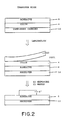
- FIG. 1 A transparent substrate 2 is coated with photosensitive layer 4. This composite is exposed to actinic radiation through color separation negative 6. This produces exposed area 4′ of layer 4. Upon development with water, the unexposed portion of layer 4 is removed and only image portion 4′ remains on substrate 2.
- Temporary substrate 10 is coated with colored photosensitive layer 4 and adhesive layer 8. This construction is then laminated to a receiver sheet 12 via the adhesive 8 and the temporary substrate 10 is peeled away. After exposure and development of the photosensitive layer with water, exposed image 4′ is positioned on the adhesive/substrate composite.
- a resin binder stock solution is prepared by dissolving 30 g. of Gelvatol 20/30 (Polyvinyl alcohol/polyvinyl acetate copolymer) in 800 ml. of H2O and adding 200 ml. of ethanol and 0.2 ml. Triton X-100. To 20 g. of this stock solution, 20 g. of methanol, 0.45 g. Calcozine yellow and 1.1 g. of the polycondensation product of 3-methoxy-4-diazo diphenyl amine sulfate and 4,4′-bis-methoxymethyl diphenyl ether precipitated as the chloride salt, are added and stirred until dissolved.
- Gelvatol 20/30 Polyvinyl alcohol/polyvinyl acetate copolymer
- Triton X-100 Triton X-100
- An aliquot is coated by Meir rod drawdown onto a Melinex 516 polyester sheet. After oven drying at 100°C for one minute, the coated sheet is exposed in a Berkey-Ascor exposure light source through a negative mask. The sample could be spray developed with water giving excellent resolution including 6 micron lines of an UGRA target.
- Mowilith CT-5 resin polyvinyl acetate/crotonic acid: 95/5) followed by Victoria Cyan at 0.023 g. and Victoria Pure Blue at 0.35 g.
- Mowilith CT-5 resin polyvinyl acetate/crotonic acid: 95/5
- Victoria Cyan at 0.023 g.
- Victoria Pure Blue at 0.35 g.
- 1.0 g. of the diazo of example 1 are dissolved and the solution is coated onto Melinex 516 with a Meir rod. After colordrying for one minute at 100°C, the color coat is overcoated with Mowilith 30 (polyvinylacetate) to a coating weight of 10-12 g/m2.
- the coatings can be transferred by lamination at 165°F to an adhesion promoted (acrylate) white receiver sheet (Melinex 3020). Exposure in a Berkey Ascor light source through a negative mask followed by water development gives excellent image contrast with good fingerprint resistance.
- Example 1 The coating solution of Example 1 is diluted 1:1 with a 50:50 mixture of methyl Cellosolve and methanol. An aliquot is coated with a Meir rod onto a polyester sheet. After air drying at 100°C. for one minute, the coated sheet is exposed in a Berkey-Ascor exposure light source. The sample could be spray developed with water, giving excellent resolution including 8 microns of a UCRA test target.
- Example 3 The composition of Example 3 is 1:1 diluted with a 50:50 mixture of methyl Cellosolve and methanol and the steps are repeated. The sample is still imageable with a resolution of at least 12 microns with a UCRA test target.
Landscapes
- Physics & Mathematics (AREA)
- General Physics & Mathematics (AREA)
- Photosensitive Polymer And Photoresist Processing (AREA)
- Non-Silver Salt Photosensitive Materials And Non-Silver Salt Photography (AREA)
- Silver Salt Photography Or Processing Solution Therefor (AREA)
Applications Claiming Priority (2)
| Application Number | Priority Date | Filing Date | Title |
|---|---|---|---|
| US183841 | 1988-04-20 | ||
| US07/183,841 US4914039A (en) | 1988-04-20 | 1988-04-20 | Water developable, negative working overlay or transfer type diazo color proofing system |
Publications (2)
| Publication Number | Publication Date |
|---|---|
| EP0338786A2 true EP0338786A2 (de) | 1989-10-25 |
| EP0338786A3 EP0338786A3 (de) | 1991-04-24 |
Family
ID=22674520
Family Applications (1)
| Application Number | Title | Priority Date | Filing Date |
|---|---|---|---|
| EP19890303851 Ceased EP0338786A3 (de) | 1988-04-20 | 1989-04-19 | Durch Wasser entwickelbares negativ arbeitendes Farbprüfsystem, mittels Überhängen oder Überlagern |
Country Status (4)
| Country | Link |
|---|---|
| US (3) | US4914039A (de) |
| EP (1) | EP0338786A3 (de) |
| JP (1) | JP2626048B2 (de) |
| CA (1) | CA1335480C (de) |
Cited By (6)
| Publication number | Priority date | Publication date | Assignee | Title |
|---|---|---|---|---|
| EP0463239A1 (de) * | 1986-05-29 | 1992-01-02 | Edward L. Weller, Jr. | Photographisches Bildaufzeichungsverfahren mit wasserentwickelbaren Schichten |
| EP0546360A1 (de) * | 1991-11-19 | 1993-06-16 | Toyo Gosei Kogyo Co., Ltd. | Lichtempfindliche Zusammensetzung |
| WO2002006898A3 (en) * | 2000-06-26 | 2002-05-02 | Agfa Gevaert | Material and method for making an electroconductive pattern |
| EP1321575A1 (de) * | 2001-12-21 | 2003-06-25 | Papierfabrik Schoeller & Hoesch Gmbh & Co. Kg | Lichtbeständiges Overlaypapier |
| US6638680B2 (en) | 2000-06-26 | 2003-10-28 | Agfa-Gevaert | Material and method for making an electroconductive pattern |
| US6746751B2 (en) | 2001-06-22 | 2004-06-08 | Agfa-Gevaert | Material having a conductive pattern and a material and method for making a conductive pattern |
Families Citing this family (6)
| Publication number | Priority date | Publication date | Assignee | Title |
|---|---|---|---|---|
| US5080996A (en) * | 1988-10-21 | 1992-01-14 | Hoechst Celanese Corporation | Color proofing system having a graduated layer of resins with different solubilities |
| JP2849622B2 (ja) * | 1988-12-26 | 1999-01-20 | コニカ株式会社 | 画像形成方法 |
| US5176973A (en) * | 1989-09-28 | 1993-01-05 | Minnesota Mining And Manufacturing Company | Low optical dot gain pre-press proofs wherein the first down adhesive layer thickness is at least twice that of any additional thin adhesive layer |
| US5270147A (en) * | 1991-07-12 | 1993-12-14 | Agfa-Gevaert N.V. | Stripping film material |
| US5232814A (en) * | 1991-12-30 | 1993-08-03 | Minnesota Mining And Manufacturing Company | Presensitized color-proofing sheet |
| US6010821A (en) * | 1997-05-23 | 2000-01-04 | Minnesota Mining And Manufacturing Company | Aqueous developable color proofing elements |
Family Cites Families (16)
| Publication number | Priority date | Publication date | Assignee | Title |
|---|---|---|---|---|
| US3849392A (en) * | 1969-05-20 | 1974-11-19 | Kalle Ag | Process for the production of polycondensation products of aromatic diazonium compounds |
| NL7009571A (de) * | 1969-07-09 | 1971-01-12 | ||
| DE2637768C2 (de) * | 1976-08-21 | 1984-11-22 | Hoechst Ag, 6230 Frankfurt | Lichtempfindliches Aufzeichnungsmaterial und Verfahren zur Herstellung von farbigen Reliefbildern |
| DE2834059A1 (de) * | 1978-08-03 | 1980-02-14 | Hoechst Ag | Lichtempfindliches kopiermaterial und verfahren zu seiner herstellung |
| DE3071134D1 (en) * | 1979-06-01 | 1985-11-07 | Hoechst Co American | Colour testing foil |
| JPS5738431A (en) * | 1980-08-12 | 1982-03-03 | Polychrome Corp | Image system for selective positive or negative |
| US4436804A (en) * | 1981-03-20 | 1984-03-13 | American Hoechst Corporation | Light-sensitive polymeric diazonium condensates and reproduction compositions and materials therewith |
| JPS5849940A (ja) * | 1981-06-30 | 1983-03-24 | Konishiroku Photo Ind Co Ltd | 感光性組成物 |
| JPS582834A (ja) * | 1981-06-30 | 1983-01-08 | Konishiroku Photo Ind Co Ltd | 平版印刷版 |
| JPS5997140A (ja) * | 1982-11-26 | 1984-06-04 | Fuji Photo Film Co Ltd | カラ−プル−フイングシ−トの製法 |
| JPS6151311A (ja) * | 1984-08-20 | 1986-03-13 | Kanegafuchi Chem Ind Co Ltd | 複合導電性樹脂ペレツトの製造方法 |
| US4650738A (en) * | 1984-10-22 | 1987-03-17 | American Hoechst Corporation | Negative working diazo color proofing method |
| US4748101A (en) * | 1985-01-14 | 1988-05-31 | Hoechst Celanese Corporation | Overlay proofing film |
| US4634652A (en) * | 1985-07-25 | 1987-01-06 | American Hoechst Corporation | Overlay light-sensitive proofing film with transparent aluminum oxide and transparent magnesium fluoride layers therein |
| JPS6227735A (ja) * | 1985-07-27 | 1987-02-05 | Konishiroku Photo Ind Co Ltd | 転写画像形成方法 |
| US4808508A (en) * | 1986-07-01 | 1989-02-28 | Hoechst Celanese Corporation | Negative working color proofing process comprising diazo compound and polyvinyl acetal/polyvinyl alcohol/polyvinyl acetate resin |
-
1988
- 1988-04-20 US US07/183,841 patent/US4914039A/en not_active Expired - Fee Related
-
1989
- 1989-03-17 CA CA000594151A patent/CA1335480C/en not_active Expired - Fee Related
- 1989-04-19 EP EP19890303851 patent/EP0338786A3/de not_active Ceased
- 1989-04-20 JP JP1101537A patent/JP2626048B2/ja not_active Expired - Lifetime
-
1993
- 1993-02-02 US US08/012,198 patent/US5348834A/en not_active Expired - Fee Related
-
1994
- 1994-06-17 US US08/261,621 patent/US5429903A/en not_active Expired - Fee Related
Cited By (10)
| Publication number | Priority date | Publication date | Assignee | Title |
|---|---|---|---|---|
| EP0463239A1 (de) * | 1986-05-29 | 1992-01-02 | Edward L. Weller, Jr. | Photographisches Bildaufzeichungsverfahren mit wasserentwickelbaren Schichten |
| EP0546360A1 (de) * | 1991-11-19 | 1993-06-16 | Toyo Gosei Kogyo Co., Ltd. | Lichtempfindliche Zusammensetzung |
| US5459011A (en) * | 1991-11-19 | 1995-10-17 | Toyo Gosei Kogyo Co., Ltd. | Liquid or paste photosensitive composition containg aromatic diazo compound and lactic acid, hydroxyacetic acid or mixture thereof |
| WO2002006898A3 (en) * | 2000-06-26 | 2002-05-02 | Agfa Gevaert | Material and method for making an electroconductive pattern |
| US6638680B2 (en) | 2000-06-26 | 2003-10-28 | Agfa-Gevaert | Material and method for making an electroconductive pattern |
| US6746751B2 (en) | 2001-06-22 | 2004-06-08 | Agfa-Gevaert | Material having a conductive pattern and a material and method for making a conductive pattern |
| US6759083B2 (en) | 2001-06-22 | 2004-07-06 | Agfa-Gevaert | Material having a conductive pattern; and a material and method for making a conductive pattern |
| US6863955B2 (en) | 2001-06-22 | 2005-03-08 | Agfa-Gevaert | Material having a conductive pattern; and a material and method for making a conductive pattern |
| EP1321575A1 (de) * | 2001-12-21 | 2003-06-25 | Papierfabrik Schoeller & Hoesch Gmbh & Co. Kg | Lichtbeständiges Overlaypapier |
| US7377998B2 (en) | 2001-12-21 | 2008-05-27 | Papierfabrik Schoeller & Hoesch Gmbh & Co. Kg | Light-fast overlay paper |
Also Published As
| Publication number | Publication date |
|---|---|
| EP0338786A3 (de) | 1991-04-24 |
| JP2626048B2 (ja) | 1997-07-02 |
| JPH0212250A (ja) | 1990-01-17 |
| US4914039A (en) | 1990-04-03 |
| US5429903A (en) | 1995-07-04 |
| US5348834A (en) | 1994-09-20 |
| CA1335480C (en) | 1995-05-09 |
Similar Documents
| Publication | Publication Date | Title |
|---|---|---|
| US4650738A (en) | Negative working diazo color proofing method | |
| US4659642A (en) | Positive working naphthoquinone diazide color proofing transfer process | |
| US4808508A (en) | Negative working color proofing process comprising diazo compound and polyvinyl acetal/polyvinyl alcohol/polyvinyl acetate resin | |
| US4914039A (en) | Water developable, negative working overlay or transfer type diazo color proofing system | |
| US4937168A (en) | Solid transfer negative- or positive-working color proofing method on diverse paper stocks | |
| US4948693A (en) | Positive working color proofing system comprising polyvinyl acetal/polyvinyl alcohol/polyvinyl acetate resin | |
| US5725988A (en) | Solid transfer negative- or positive-working color proofing element | |
| US5100757A (en) | Method for forming a colored image on a degradable sheet material | |
| US4751166A (en) | Negative working diazo color proofing method | |
| EP0357324A2 (de) | Optisches Bleichmittel enthaltendes, positiv arbeitendes Farbprüfsystem | |
| US5053310A (en) | Negative working diazo resin color proofing material comprising polyvinyl acetal/polyvinyl, alcohol/polyvinyl acetate resin | |
| US5008174A (en) | Color proofing system having a graduated layer of resins with different solubilities | |
| US4929532A (en) | Diazo negative color proofing process utilizing acrylic/acrylate polymers | |
| US5108868A (en) | Negative working, peel developable, single sheet color proofing method | |
| GB2195782A (en) | Photosensitive elements | |
| US5609945A (en) | Partially translucent white film having metallized surface | |
| US4772533A (en) | Positive working naphthoquinone diazide color proofing element with polyvinyl acetate adhesive layer | |
| EP0778494B1 (de) | Negativ arbeitende Diazoniumsalz-Farbprüffolie mit einer Haftvermittlerschicht von verminderter Klebrigkeit | |
| CA1335633C (en) | Single coating positive or negative working color proofing system | |
| US5212041A (en) | Water developable, negative working overlay color proofing system utilizing water soluble polymeric diazonium compound and water insoluble, water swellable, binder resin | |
| US5039590A (en) | Coating positive or negative working color proofing system | |
| US5183723A (en) | Colored image on a degradable sheet material and method of formation | |
| EP0404522A2 (de) | Mehrschicht-Abbildungsartikel für ein Farbprüfsystem mittels Übertragung | |
| WO1995032454A1 (en) | Single coating transfer color proofing system | |
| US5080996A (en) | Color proofing system having a graduated layer of resins with different solubilities |
Legal Events
| Date | Code | Title | Description |
|---|---|---|---|
| PUAI | Public reference made under article 153(3) epc to a published international application that has entered the european phase |
Free format text: ORIGINAL CODE: 0009012 |
|
| AK | Designated contracting states |
Kind code of ref document: A2 Designated state(s): DE FR GB |
|
| 17P | Request for examination filed |
Effective date: 19901219 |
|
| PUAL | Search report despatched |
Free format text: ORIGINAL CODE: 0009013 |
|
| AK | Designated contracting states |
Kind code of ref document: A3 Designated state(s): DE FR GB |
|
| 17Q | First examination report despatched |
Effective date: 19920124 |
|
| STAA | Information on the status of an ep patent application or granted ep patent |
Free format text: STATUS: THE APPLICATION HAS BEEN REFUSED |
|
| 18R | Application refused |
Effective date: 19960215 |