EP0334097B1 - Verfahren zur Herstellung von 4,4'-Dihalogeno-biphenylen - Google Patents
Verfahren zur Herstellung von 4,4'-Dihalogeno-biphenylen Download PDFInfo
- Publication number
- EP0334097B1 EP0334097B1 EP89103980A EP89103980A EP0334097B1 EP 0334097 B1 EP0334097 B1 EP 0334097B1 EP 89103980 A EP89103980 A EP 89103980A EP 89103980 A EP89103980 A EP 89103980A EP 0334097 B1 EP0334097 B1 EP 0334097B1
- Authority
- EP
- European Patent Office
- Prior art keywords
- zsm
- process according
- zeolite
- zeolites
- weight
- Prior art date
- Legal status (The legal status is an assumption and is not a legal conclusion. Google has not performed a legal analysis and makes no representation as to the accuracy of the status listed.)
- Expired - Lifetime
Links
- 238000000034 method Methods 0.000 title claims description 32
- 238000002360 preparation method Methods 0.000 title claims description 5
- 239000010457 zeolite Substances 0.000 claims description 61
- 229910021536 Zeolite Inorganic materials 0.000 claims description 35
- HNPSIPDUKPIQMN-UHFFFAOYSA-N dioxosilane;oxo(oxoalumanyloxy)alumane Chemical compound O=[Si]=O.O=[Al]O[Al]=O HNPSIPDUKPIQMN-UHFFFAOYSA-N 0.000 claims description 35
- ZUOUZKKEUPVFJK-UHFFFAOYSA-N diphenyl Chemical compound C1=CC=CC=C1C1=CC=CC=C1 ZUOUZKKEUPVFJK-UHFFFAOYSA-N 0.000 claims description 34
- 235000010290 biphenyl Nutrition 0.000 claims description 30
- 239000004305 biphenyl Substances 0.000 claims description 17
- 239000003054 catalyst Substances 0.000 claims description 15
- ZAMOUSCENKQFHK-UHFFFAOYSA-N Chlorine atom Chemical compound [Cl] ZAMOUSCENKQFHK-UHFFFAOYSA-N 0.000 claims description 14
- 229910052739 hydrogen Inorganic materials 0.000 claims description 14
- UFHFLCQGNIYNRP-UHFFFAOYSA-N Hydrogen Chemical compound [H][H] UFHFLCQGNIYNRP-UHFFFAOYSA-N 0.000 claims description 13
- 150000004074 biphenyls Chemical class 0.000 claims description 13
- 239000001257 hydrogen Substances 0.000 claims description 13
- GDTBXPJZTBHREO-UHFFFAOYSA-N bromine Substances BrBr GDTBXPJZTBHREO-UHFFFAOYSA-N 0.000 claims description 12
- 239000000460 chlorine Substances 0.000 claims description 11
- 229910052801 chlorine Inorganic materials 0.000 claims description 11
- 239000000203 mixture Substances 0.000 claims description 11
- 150000001768 cations Chemical class 0.000 claims description 10
- 239000011734 sodium Substances 0.000 claims description 10
- WKBOTKDWSSQWDR-UHFFFAOYSA-N Bromine atom Chemical compound [Br] WKBOTKDWSSQWDR-UHFFFAOYSA-N 0.000 claims description 9
- 238000006243 chemical reaction Methods 0.000 claims description 9
- 239000000155 melt Substances 0.000 claims description 7
- 229910052680 mordenite Inorganic materials 0.000 claims description 7
- KZBUYRJDOAKODT-UHFFFAOYSA-N Chlorine Chemical compound ClCl KZBUYRJDOAKODT-UHFFFAOYSA-N 0.000 claims description 6
- 229910052794 bromium Inorganic materials 0.000 claims description 6
- 239000003795 chemical substances by application Substances 0.000 claims description 6
- 230000002140 halogenating effect Effects 0.000 claims description 6
- 229910052700 potassium Inorganic materials 0.000 claims description 6
- XLYOFNOQVPJJNP-UHFFFAOYSA-N water Substances O XLYOFNOQVPJJNP-UHFFFAOYSA-N 0.000 claims description 6
- 229910052782 aluminium Inorganic materials 0.000 claims description 5
- 229910052796 boron Inorganic materials 0.000 claims description 5
- 239000003426 co-catalyst Substances 0.000 claims description 5
- 229910001657 ferrierite group Inorganic materials 0.000 claims description 5
- 150000002431 hydrogen Chemical group 0.000 claims description 5
- 150000003839 salts Chemical class 0.000 claims description 5
- 239000002904 solvent Substances 0.000 claims description 5
- YBBRCQOCSYXUOC-UHFFFAOYSA-N sulfuryl dichloride Chemical compound ClS(Cl)(=O)=O YBBRCQOCSYXUOC-UHFFFAOYSA-N 0.000 claims description 5
- 229910006024 SO2Cl2 Inorganic materials 0.000 claims description 4
- 229910052733 gallium Inorganic materials 0.000 claims description 4
- 229910052738 indium Inorganic materials 0.000 claims description 4
- 125000002496 methyl group Chemical group [H]C([H])([H])* 0.000 claims description 4
- 239000011148 porous material Substances 0.000 claims description 4
- 229910052708 sodium Inorganic materials 0.000 claims description 4
- 125000004178 (C1-C4) alkyl group Chemical group 0.000 claims description 3
- 125000000229 (C1-C4)alkoxy group Chemical group 0.000 claims description 3
- 150000001412 amines Chemical class 0.000 claims description 3
- 150000001735 carboxylic acids Chemical class 0.000 claims description 3
- 229910052675 erionite Inorganic materials 0.000 claims description 3
- 239000012013 faujasite Substances 0.000 claims description 3
- 230000026030 halogenation Effects 0.000 claims description 3
- 238000005658 halogenation reaction Methods 0.000 claims description 3
- 125000000956 methoxy group Chemical group [H]C([H])([H])O* 0.000 claims description 3
- 229910052720 vanadium Inorganic materials 0.000 claims description 3
- ZCYVEMRRCGMTRW-UHFFFAOYSA-N 7553-56-2 Chemical compound [I] ZCYVEMRRCGMTRW-UHFFFAOYSA-N 0.000 claims description 2
- RWSOTUBLDIXVET-UHFFFAOYSA-N Dihydrogen sulfide Chemical class S RWSOTUBLDIXVET-UHFFFAOYSA-N 0.000 claims description 2
- NINIDFKCEFEMDL-UHFFFAOYSA-N Sulfur Chemical compound [S] NINIDFKCEFEMDL-UHFFFAOYSA-N 0.000 claims description 2
- 150000001298 alcohols Chemical class 0.000 claims description 2
- 150000001299 aldehydes Chemical class 0.000 claims description 2
- 229910052783 alkali metal Inorganic materials 0.000 claims description 2
- 150000001340 alkali metals Chemical class 0.000 claims description 2
- 150000001408 amides Chemical class 0.000 claims description 2
- 229910052663 cancrinite Inorganic materials 0.000 claims description 2
- 150000002148 esters Chemical class 0.000 claims description 2
- 229910052731 fluorine Inorganic materials 0.000 claims description 2
- 239000011737 fluorine Substances 0.000 claims description 2
- 229910001683 gmelinite Inorganic materials 0.000 claims description 2
- 150000004820 halides Chemical class 0.000 claims description 2
- 229910052677 heulandite Inorganic materials 0.000 claims description 2
- 125000002887 hydroxy group Chemical group [H]O* 0.000 claims description 2
- 229910052740 iodine Inorganic materials 0.000 claims description 2
- 239000011630 iodine Substances 0.000 claims description 2
- 150000002576 ketones Chemical class 0.000 claims description 2
- 150000002825 nitriles Chemical class 0.000 claims description 2
- -1 sulphur halides Chemical class 0.000 claims description 2
- 150000003566 thiocarboxylic acids Chemical class 0.000 claims description 2
- 150000003568 thioethers Chemical class 0.000 claims description 2
- ZLMJMSJWJFRBEC-UHFFFAOYSA-N Potassium Chemical compound [K] ZLMJMSJWJFRBEC-UHFFFAOYSA-N 0.000 claims 3
- 239000011591 potassium Substances 0.000 claims 3
- DGAQECJNVWCQMB-PUAWFVPOSA-M Ilexoside XXIX Chemical compound C[C@@H]1CC[C@@]2(CC[C@@]3(C(=CC[C@H]4[C@]3(CC[C@@H]5[C@@]4(CC[C@@H](C5(C)C)OS(=O)(=O)[O-])C)C)[C@@H]2[C@]1(C)O)C)C(=O)O[C@H]6[C@@H]([C@H]([C@@H]([C@H](O6)CO)O)O)O.[Na+] DGAQECJNVWCQMB-PUAWFVPOSA-M 0.000 claims 2
- 239000005864 Sulphur Substances 0.000 claims 2
- ZOXJGFHDIHLPTG-UHFFFAOYSA-N Boron Chemical compound [B] ZOXJGFHDIHLPTG-UHFFFAOYSA-N 0.000 claims 1
- PXGOKWXKJXAPGV-UHFFFAOYSA-N Fluorine Chemical compound FF PXGOKWXKJXAPGV-UHFFFAOYSA-N 0.000 claims 1
- BPQQTUXANYXVAA-UHFFFAOYSA-N Orthosilicate Chemical compound [O-][Si]([O-])([O-])[O-] BPQQTUXANYXVAA-UHFFFAOYSA-N 0.000 claims 1
- 125000002777 acetyl group Chemical class [H]C([H])([H])C(*)=O 0.000 claims 1
- 239000004411 aluminium Substances 0.000 claims 1
- XAGFODPZIPBFFR-UHFFFAOYSA-N aluminium Chemical compound [Al] XAGFODPZIPBFFR-UHFFFAOYSA-N 0.000 claims 1
- 150000003863 ammonium salts Chemical class 0.000 claims 1
- 150000002500 ions Chemical class 0.000 claims 1
- IJGRMHOSHXDMSA-UHFFFAOYSA-N Atomic nitrogen Chemical compound N#N IJGRMHOSHXDMSA-UHFFFAOYSA-N 0.000 description 10
- 238000005660 chlorination reaction Methods 0.000 description 9
- QTBSBXVTEAMEQO-UHFFFAOYSA-N Acetic acid Chemical compound CC(O)=O QTBSBXVTEAMEQO-UHFFFAOYSA-N 0.000 description 7
- FUZZWVXGSFPDMH-UHFFFAOYSA-N hexanoic acid Chemical compound CCCCCC(O)=O FUZZWVXGSFPDMH-UHFFFAOYSA-N 0.000 description 6
- 229910021578 Iron(III) chloride Inorganic materials 0.000 description 5
- RBTARNINKXHZNM-UHFFFAOYSA-K iron trichloride Chemical compound Cl[Fe](Cl)Cl RBTARNINKXHZNM-UHFFFAOYSA-K 0.000 description 5
- 229910052757 nitrogen Inorganic materials 0.000 description 5
- VYPSYNLAJGMNEJ-UHFFFAOYSA-N Silicium dioxide Chemical compound O=[Si]=O VYPSYNLAJGMNEJ-UHFFFAOYSA-N 0.000 description 4
- YTPLMLYBLZKORZ-UHFFFAOYSA-N Thiophene Chemical compound C=1C=CSC=1 YTPLMLYBLZKORZ-UHFFFAOYSA-N 0.000 description 4
- 230000000052 comparative effect Effects 0.000 description 4
- 238000006467 substitution reaction Methods 0.000 description 4
- ZWEHNKRNPOVVGH-UHFFFAOYSA-N 2-Butanone Chemical compound CCC(C)=O ZWEHNKRNPOVVGH-UHFFFAOYSA-N 0.000 description 3
- CSCPPACGZOOCGX-UHFFFAOYSA-N Acetone Chemical compound CC(C)=O CSCPPACGZOOCGX-UHFFFAOYSA-N 0.000 description 3
- WEVYAHXRMPXWCK-UHFFFAOYSA-N Acetonitrile Chemical compound CC#N WEVYAHXRMPXWCK-UHFFFAOYSA-N 0.000 description 3
- YMWUJEATGCHHMB-UHFFFAOYSA-N Dichloromethane Chemical compound ClCCl YMWUJEATGCHHMB-UHFFFAOYSA-N 0.000 description 3
- QMMFVYPAHWMCMS-UHFFFAOYSA-N Dimethyl sulfide Chemical compound CSC QMMFVYPAHWMCMS-UHFFFAOYSA-N 0.000 description 3
- LFQSCWFLJHTTHZ-UHFFFAOYSA-N Ethanol Chemical compound CCO LFQSCWFLJHTTHZ-UHFFFAOYSA-N 0.000 description 3
- OKKJLVBELUTLKV-UHFFFAOYSA-N Methanol Chemical compound OC OKKJLVBELUTLKV-UHFFFAOYSA-N 0.000 description 3
- 229960000583 acetic acid Drugs 0.000 description 3
- 150000001555 benzenes Chemical class 0.000 description 3
- JFDZBHWFFUWGJE-UHFFFAOYSA-N benzonitrile Chemical compound N#CC1=CC=CC=C1 JFDZBHWFFUWGJE-UHFFFAOYSA-N 0.000 description 3
- 239000007789 gas Substances 0.000 description 3
- 238000004817 gas chromatography Methods 0.000 description 3
- 239000007791 liquid phase Substances 0.000 description 3
- 238000003756 stirring Methods 0.000 description 3
- RMVRSNDYEFQCLF-UHFFFAOYSA-N thiophenol Chemical compound SC1=CC=CC=C1 RMVRSNDYEFQCLF-UHFFFAOYSA-N 0.000 description 3
- SPEUIVXLLWOEMJ-UHFFFAOYSA-N 1,1-dimethoxyethane Chemical compound COC(C)OC SPEUIVXLLWOEMJ-UHFFFAOYSA-N 0.000 description 2
- PKJBWOWQJHHAHG-UHFFFAOYSA-N 1-bromo-4-phenylbenzene Chemical group C1=CC(Br)=CC=C1C1=CC=CC=C1 PKJBWOWQJHHAHG-UHFFFAOYSA-N 0.000 description 2
- ZTQSAGDEMFDKMZ-UHFFFAOYSA-N Butyraldehyde Chemical compound CCCC=O ZTQSAGDEMFDKMZ-UHFFFAOYSA-N 0.000 description 2
- HEDRZPFGACZZDS-UHFFFAOYSA-N Chloroform Chemical compound ClC(Cl)Cl HEDRZPFGACZZDS-UHFFFAOYSA-N 0.000 description 2
- HTIRHQRTDBPHNZ-UHFFFAOYSA-N Dibutyl sulfide Chemical compound CCCCSCCCC HTIRHQRTDBPHNZ-UHFFFAOYSA-N 0.000 description 2
- ROSDSFDQCJNGOL-UHFFFAOYSA-N Dimethylamine Chemical compound CNC ROSDSFDQCJNGOL-UHFFFAOYSA-N 0.000 description 2
- QUSNBJAOOMFDIB-UHFFFAOYSA-N Ethylamine Chemical compound CCN QUSNBJAOOMFDIB-UHFFFAOYSA-N 0.000 description 2
- 239000002841 Lewis acid Substances 0.000 description 2
- LRHPLDYGYMQRHN-UHFFFAOYSA-N N-Butanol Chemical compound CCCCO LRHPLDYGYMQRHN-UHFFFAOYSA-N 0.000 description 2
- JUJWROOIHBZHMG-UHFFFAOYSA-N Pyridine Chemical compound C1=CC=NC=C1 JUJWROOIHBZHMG-UHFFFAOYSA-N 0.000 description 2
- SMWDFEZZVXVKRB-UHFFFAOYSA-N Quinoline Chemical compound N1=CC=CC2=CC=CC=C21 SMWDFEZZVXVKRB-UHFFFAOYSA-N 0.000 description 2
- HUMNYLRZRPPJDN-UHFFFAOYSA-N benzaldehyde Chemical compound O=CC1=CC=CC=C1 HUMNYLRZRPPJDN-UHFFFAOYSA-N 0.000 description 2
- HQABUPZFAYXKJW-UHFFFAOYSA-N butan-1-amine Chemical compound CCCCN HQABUPZFAYXKJW-UHFFFAOYSA-N 0.000 description 2
- WQAQPCDUOCURKW-UHFFFAOYSA-N butanethiol Chemical compound CCCCS WQAQPCDUOCURKW-UHFFFAOYSA-N 0.000 description 2
- FOCAUTSVDIKZOP-UHFFFAOYSA-N chloroacetic acid Chemical compound OC(=O)CCl FOCAUTSVDIKZOP-UHFFFAOYSA-N 0.000 description 2
- 229940106681 chloroacetic acid Drugs 0.000 description 2
- 229910052681 coesite Inorganic materials 0.000 description 2
- 229910052906 cristobalite Inorganic materials 0.000 description 2
- JXTHNDFMNIQAHM-UHFFFAOYSA-N dichloroacetic acid Chemical compound OC(=O)C(Cl)Cl JXTHNDFMNIQAHM-UHFFFAOYSA-N 0.000 description 2
- XBDQKXXYIPTUBI-UHFFFAOYSA-N dimethylselenoniopropionate Natural products CCC(O)=O XBDQKXXYIPTUBI-UHFFFAOYSA-N 0.000 description 2
- 238000004821 distillation Methods 0.000 description 2
- 150000007517 lewis acids Chemical class 0.000 description 2
- 238000004519 manufacturing process Methods 0.000 description 2
- 150000003071 polychlorinated biphenyls Chemical class 0.000 description 2
- SCVFZCLFOSHCOH-UHFFFAOYSA-M potassium acetate Chemical compound [K+].CC([O-])=O SCVFZCLFOSHCOH-UHFFFAOYSA-M 0.000 description 2
- 239000000377 silicon dioxide Substances 0.000 description 2
- 235000012239 silicon dioxide Nutrition 0.000 description 2
- 229910052682 stishovite Inorganic materials 0.000 description 2
- 239000000126 substance Substances 0.000 description 2
- 229910052717 sulfur Inorganic materials 0.000 description 2
- 239000011593 sulfur Substances 0.000 description 2
- VZGDMQKNWNREIO-UHFFFAOYSA-N tetrachloromethane Chemical compound ClC(Cl)(Cl)Cl VZGDMQKNWNREIO-UHFFFAOYSA-N 0.000 description 2
- 229930192474 thiophene Natural products 0.000 description 2
- 229910052905 tridymite Inorganic materials 0.000 description 2
- UOCLXMDMGBRAIB-UHFFFAOYSA-N 1,1,1-trichloroethane Chemical compound CC(Cl)(Cl)Cl UOCLXMDMGBRAIB-UHFFFAOYSA-N 0.000 description 1
- WSLDOOZREJYCGB-UHFFFAOYSA-N 1,2-Dichloroethane Chemical compound ClCCCl WSLDOOZREJYCGB-UHFFFAOYSA-N 0.000 description 1
- HQJQYILBCQPYBI-UHFFFAOYSA-N 1-bromo-4-(4-bromophenyl)benzene Chemical group C1=CC(Br)=CC=C1C1=CC=C(Br)C=C1 HQJQYILBCQPYBI-UHFFFAOYSA-N 0.000 description 1
- WMXVUHANYJZYHO-UHFFFAOYSA-N 1-bromo-4-(4-chlorophenyl)benzene Chemical group C1=CC(Cl)=CC=C1C1=CC=C(Br)C=C1 WMXVUHANYJZYHO-UHFFFAOYSA-N 0.000 description 1
- GWGSGYOPKPVAPW-UHFFFAOYSA-N 1-chloro-4-(4-fluorophenyl)benzene Chemical group C1=CC(F)=CC=C1C1=CC=C(Cl)C=C1 GWGSGYOPKPVAPW-UHFFFAOYSA-N 0.000 description 1
- HCHAMYGZDLHKMD-UHFFFAOYSA-N 1-chloro-4-(4-iodophenyl)benzene Chemical group C1=CC(Cl)=CC=C1C1=CC=C(I)C=C1 HCHAMYGZDLHKMD-UHFFFAOYSA-N 0.000 description 1
- NXYICUMSYKIABQ-UHFFFAOYSA-N 1-iodo-4-phenylbenzene Chemical group C1=CC(I)=CC=C1C1=CC=CC=C1 NXYICUMSYKIABQ-UHFFFAOYSA-N 0.000 description 1
- NLWCWEGVNJVLAX-UHFFFAOYSA-N 1-methoxy-2-phenylbenzene Chemical group COC1=CC=CC=C1C1=CC=CC=C1 NLWCWEGVNJVLAX-UHFFFAOYSA-N 0.000 description 1
- IUYHQGMDSZOPDZ-UHFFFAOYSA-N 2,3,4-trichlorobiphenyl Chemical group ClC1=C(Cl)C(Cl)=CC=C1C1=CC=CC=C1 IUYHQGMDSZOPDZ-UHFFFAOYSA-N 0.000 description 1
- HIXDQWDOVZUNNA-UHFFFAOYSA-N 2-(3,4-dimethoxyphenyl)-5-hydroxy-7-methoxychromen-4-one Chemical compound C=1C(OC)=CC(O)=C(C(C=2)=O)C=1OC=2C1=CC=C(OC)C(OC)=C1 HIXDQWDOVZUNNA-UHFFFAOYSA-N 0.000 description 1
- IQHSSYROJYPFDV-UHFFFAOYSA-N 2-bromo-1,3-dichloro-5-(trifluoromethyl)benzene Chemical group FC(F)(F)C1=CC(Cl)=C(Br)C(Cl)=C1 IQHSSYROJYPFDV-UHFFFAOYSA-N 0.000 description 1
- SZIFAVKTNFCBPC-UHFFFAOYSA-N 2-chloroethanol Chemical compound OCCCl SZIFAVKTNFCBPC-UHFFFAOYSA-N 0.000 description 1
- BSKHPKMHTQYZBB-UHFFFAOYSA-N 2-methylpyridine Chemical compound CC1=CC=CC=N1 BSKHPKMHTQYZBB-UHFFFAOYSA-N 0.000 description 1
- YTBRNEUEFCNVHC-UHFFFAOYSA-N 4,4'-dichlorobiphenyl Chemical group C1=CC(Cl)=CC=C1C1=CC=C(Cl)C=C1 YTBRNEUEFCNVHC-UHFFFAOYSA-N 0.000 description 1
- GFJMOZYIDADKLJ-UHFFFAOYSA-N 5-bromo-2-chloro-3-methoxypyridine Chemical compound COC1=CC(Br)=CN=C1Cl GFJMOZYIDADKLJ-UHFFFAOYSA-N 0.000 description 1
- ZBEUVXGUMNEWDR-UHFFFAOYSA-M C(C)(=O)OCC.ClCC(=O)[O-].[K+] Chemical compound C(C)(=O)OCC.ClCC(=O)[O-].[K+] ZBEUVXGUMNEWDR-UHFFFAOYSA-M 0.000 description 1
- BCZXFFBUYPCTSJ-UHFFFAOYSA-L Calcium propionate Chemical compound [Ca+2].CCC([O-])=O.CCC([O-])=O BCZXFFBUYPCTSJ-UHFFFAOYSA-L 0.000 description 1
- VGCXGMAHQTYDJK-UHFFFAOYSA-N Chloroacetyl chloride Chemical compound ClCC(Cl)=O VGCXGMAHQTYDJK-UHFFFAOYSA-N 0.000 description 1
- JGFBQFKZKSSODQ-UHFFFAOYSA-N Isothiocyanatocyclopropane Chemical compound S=C=NC1CC1 JGFBQFKZKSSODQ-UHFFFAOYSA-N 0.000 description 1
- OKIZCWYLBDKLSU-UHFFFAOYSA-M N,N,N-Trimethylmethanaminium chloride Chemical compound [Cl-].C[N+](C)(C)C OKIZCWYLBDKLSU-UHFFFAOYSA-M 0.000 description 1
- FXHOOIRPVKKKFG-UHFFFAOYSA-N N,N-Dimethylacetamide Chemical compound CN(C)C(C)=O FXHOOIRPVKKKFG-UHFFFAOYSA-N 0.000 description 1
- FAPVBPRVMURJKM-UHFFFAOYSA-N O[Cl]F Chemical compound O[Cl]F FAPVBPRVMURJKM-UHFFFAOYSA-N 0.000 description 1
- CYTYCFOTNPOANT-UHFFFAOYSA-N Perchloroethylene Chemical group ClC(Cl)=C(Cl)Cl CYTYCFOTNPOANT-UHFFFAOYSA-N 0.000 description 1
- 239000004734 Polyphenylene sulfide Substances 0.000 description 1
- VMHLLURERBWHNL-UHFFFAOYSA-M Sodium acetate Chemical compound [Na+].CC([O-])=O VMHLLURERBWHNL-UHFFFAOYSA-M 0.000 description 1
- IKHGUXGNUITLKF-XPULMUKRSA-N acetaldehyde Chemical compound [14CH]([14CH3])=O IKHGUXGNUITLKF-XPULMUKRSA-N 0.000 description 1
- 150000001241 acetals Chemical class 0.000 description 1
- 229940022682 acetone Drugs 0.000 description 1
- 230000004913 activation Effects 0.000 description 1
- 239000000654 additive Substances 0.000 description 1
- 229910001413 alkali metal ion Inorganic materials 0.000 description 1
- 125000003545 alkoxy group Chemical group 0.000 description 1
- 125000000217 alkyl group Chemical group 0.000 description 1
- PNEYBMLMFCGWSK-UHFFFAOYSA-N aluminium oxide Inorganic materials [O-2].[O-2].[O-2].[Al+3].[Al+3] PNEYBMLMFCGWSK-UHFFFAOYSA-N 0.000 description 1
- 229910000323 aluminium silicate Inorganic materials 0.000 description 1
- RWCCWEUUXYIKHB-UHFFFAOYSA-N benzophenone Chemical compound C=1C=CC=CC=1C(=O)C1=CC=CC=C1 RWCCWEUUXYIKHB-UHFFFAOYSA-N 0.000 description 1
- 239000012965 benzophenone Substances 0.000 description 1
- 229940024874 benzophenone Drugs 0.000 description 1
- 230000015572 biosynthetic process Effects 0.000 description 1
- PWLNAUNEAKQYLH-UHFFFAOYSA-N butyric acid octyl ester Natural products CCCCCCCCOC(=O)CCC PWLNAUNEAKQYLH-UHFFFAOYSA-N 0.000 description 1
- 238000001354 calcination Methods 0.000 description 1
- 239000004330 calcium propionate Substances 0.000 description 1
- 235000010331 calcium propionate Nutrition 0.000 description 1
- 239000007795 chemical reaction product Substances 0.000 description 1
- 125000001309 chloro group Chemical group Cl* 0.000 description 1
- VXIVSQZSERGHQP-UHFFFAOYSA-N chloroacetamide Chemical compound NC(=O)CCl VXIVSQZSERGHQP-UHFFFAOYSA-N 0.000 description 1
- 150000001875 compounds Chemical class 0.000 description 1
- 230000007797 corrosion Effects 0.000 description 1
- 238000005260 corrosion Methods 0.000 description 1
- 229910052593 corundum Inorganic materials 0.000 description 1
- 229960005215 dichloroacetic acid Drugs 0.000 description 1
- 238000006251 dihalogenation reaction Methods 0.000 description 1
- 125000000118 dimethyl group Chemical group [H]C([H])([H])* 0.000 description 1
- LTYMSROWYAPPGB-UHFFFAOYSA-N diphenyl sulfide Chemical compound C=1C=CC=CC=1SC1=CC=CC=C1 LTYMSROWYAPPGB-UHFFFAOYSA-N 0.000 description 1
- 230000000694 effects Effects 0.000 description 1
- 238000003912 environmental pollution Methods 0.000 description 1
- RTZKZFJDLAIYFH-UHFFFAOYSA-N ether Substances CCOCC RTZKZFJDLAIYFH-UHFFFAOYSA-N 0.000 description 1
- 125000001495 ethyl group Chemical group [H]C([H])([H])C([H])([H])* 0.000 description 1
- 238000000605 extraction Methods 0.000 description 1
- 150000008282 halocarbons Chemical class 0.000 description 1
- 229910052736 halogen Inorganic materials 0.000 description 1
- 150000002367 halogens Chemical class 0.000 description 1
- VHHHONWQHHHLTI-UHFFFAOYSA-N hexachloroethane Chemical compound ClC(Cl)(Cl)C(Cl)(Cl)Cl VHHHONWQHHHLTI-UHFFFAOYSA-N 0.000 description 1
- AILKHAQXUAOOFU-UHFFFAOYSA-N hexanenitrile Chemical compound CCCCCC#N AILKHAQXUAOOFU-UHFFFAOYSA-N 0.000 description 1
- 229930195733 hydrocarbon Natural products 0.000 description 1
- 150000002430 hydrocarbons Chemical class 0.000 description 1
- AQYSYJUIMQTRMV-UHFFFAOYSA-N hypofluorous acid Chemical compound FO AQYSYJUIMQTRMV-UHFFFAOYSA-N 0.000 description 1
- 229910001387 inorganic aluminate Inorganic materials 0.000 description 1
- 229910052909 inorganic silicate Inorganic materials 0.000 description 1
- 238000005342 ion exchange Methods 0.000 description 1
- 238000002955 isolation Methods 0.000 description 1
- 125000001449 isopropyl group Chemical group [H]C([H])([H])C([H])(*)C([H])([H])[H] 0.000 description 1
- 238000002844 melting Methods 0.000 description 1
- 230000008018 melting Effects 0.000 description 1
- 229910052751 metal Inorganic materials 0.000 description 1
- 239000002184 metal Substances 0.000 description 1
- WSFSSNUMVMOOMR-NJFSPNSNSA-N methanone Chemical compound O=[14CH2] WSFSSNUMVMOOMR-NJFSPNSNSA-N 0.000 description 1
- RMIODHQZRUFFFF-UHFFFAOYSA-N methoxyacetic acid Chemical compound COCC(O)=O RMIODHQZRUFFFF-UHFFFAOYSA-N 0.000 description 1
- 229940032007 methylethyl ketone Drugs 0.000 description 1
- 239000002808 molecular sieve Substances 0.000 description 1
- UUIQMZJEGPQKFD-UHFFFAOYSA-N n-butyric acid methyl ester Natural products CCCC(=O)OC UUIQMZJEGPQKFD-UHFFFAOYSA-N 0.000 description 1
- 229910052760 oxygen Inorganic materials 0.000 description 1
- 239000001301 oxygen Substances 0.000 description 1
- QNGNSVIICDLXHT-UHFFFAOYSA-N para-ethylbenzaldehyde Natural products CCC1=CC=C(C=O)C=C1 QNGNSVIICDLXHT-UHFFFAOYSA-N 0.000 description 1
- 239000003208 petroleum Substances 0.000 description 1
- 239000012071 phase Substances 0.000 description 1
- 239000004033 plastic Substances 0.000 description 1
- 229920003023 plastic Polymers 0.000 description 1
- 229920000069 polyphenylene sulfide Polymers 0.000 description 1
- 235000011056 potassium acetate Nutrition 0.000 description 1
- WFIZEGIEIOHZCP-UHFFFAOYSA-M potassium formate Chemical compound [K+].[O-]C=O WFIZEGIEIOHZCP-UHFFFAOYSA-M 0.000 description 1
- 239000000843 powder Substances 0.000 description 1
- BDERNNFJNOPAEC-UHFFFAOYSA-N propan-1-ol Chemical compound CCCO BDERNNFJNOPAEC-UHFFFAOYSA-N 0.000 description 1
- RZWZRACFZGVKFM-UHFFFAOYSA-N propanoyl chloride Chemical compound CCC(Cl)=O RZWZRACFZGVKFM-UHFFFAOYSA-N 0.000 description 1
- 235000019260 propionic acid Nutrition 0.000 description 1
- FVSKHRXBFJPNKK-UHFFFAOYSA-N propionitrile Chemical compound CCC#N FVSKHRXBFJPNKK-UHFFFAOYSA-N 0.000 description 1
- 238000000746 purification Methods 0.000 description 1
- KOUKXHPPRFNWPP-UHFFFAOYSA-N pyrazine-2,5-dicarboxylic acid;hydrate Chemical compound O.OC(=O)C1=CN=C(C(O)=O)C=N1 KOUKXHPPRFNWPP-UHFFFAOYSA-N 0.000 description 1
- UMJSCPRVCHMLSP-UHFFFAOYSA-N pyridine Natural products COC1=CC=CN=C1 UMJSCPRVCHMLSP-UHFFFAOYSA-N 0.000 description 1
- 150000003242 quaternary ammonium salts Chemical class 0.000 description 1
- IUVKMZGDUIUOCP-BTNSXGMBSA-N quinbolone Chemical compound O([C@H]1CC[C@H]2[C@H]3[C@@H]([C@]4(C=CC(=O)C=C4CC3)C)CC[C@@]21C)C1=CCCC1 IUVKMZGDUIUOCP-BTNSXGMBSA-N 0.000 description 1
- 239000011541 reaction mixture Substances 0.000 description 1
- 238000001953 recrystallisation Methods 0.000 description 1
- 239000001632 sodium acetate Substances 0.000 description 1
- 235000017281 sodium acetate Nutrition 0.000 description 1
- URGAHOPLAPQHLN-UHFFFAOYSA-N sodium aluminosilicate Chemical compound [Na+].[Al+3].[O-][Si]([O-])=O.[O-][Si]([O-])=O URGAHOPLAPQHLN-UHFFFAOYSA-N 0.000 description 1
- 239000007858 starting material Substances 0.000 description 1
- 150000003464 sulfur compounds Chemical class 0.000 description 1
- FWMUJAIKEJWSSY-UHFFFAOYSA-N sulfur dichloride Chemical compound ClSCl FWMUJAIKEJWSSY-UHFFFAOYSA-N 0.000 description 1
- 238000003786 synthesis reaction Methods 0.000 description 1
- 229950011008 tetrachloroethylene Drugs 0.000 description 1
- YMBCJWGVCUEGHA-UHFFFAOYSA-M tetraethylammonium chloride Chemical compound [Cl-].CC[N+](CC)(CC)CC YMBCJWGVCUEGHA-UHFFFAOYSA-M 0.000 description 1
- 231100000167 toxic agent Toxicity 0.000 description 1
- 239000003440 toxic substance Substances 0.000 description 1
- 231100000419 toxicity Toxicity 0.000 description 1
- 230000001988 toxicity Effects 0.000 description 1
- LSZKGNJKKQYFLR-UHFFFAOYSA-J tri(butanoyloxy)stannyl butanoate Chemical compound [Sn+4].CCCC([O-])=O.CCCC([O-])=O.CCCC([O-])=O.CCCC([O-])=O LSZKGNJKKQYFLR-UHFFFAOYSA-J 0.000 description 1
- 238000005292 vacuum distillation Methods 0.000 description 1
- HGBOYTHUEUWSSQ-UHFFFAOYSA-N valeric aldehyde Natural products CCCCC=O HGBOYTHUEUWSSQ-UHFFFAOYSA-N 0.000 description 1
- 239000000052 vinegar Substances 0.000 description 1
- 235000021419 vinegar Nutrition 0.000 description 1
- 238000010626 work up procedure Methods 0.000 description 1
- 229910001845 yogo sapphire Inorganic materials 0.000 description 1
Classifications
-
- C—CHEMISTRY; METALLURGY
- C07—ORGANIC CHEMISTRY
- C07C—ACYCLIC OR CARBOCYCLIC COMPOUNDS
- C07C17/00—Preparation of halogenated hydrocarbons
- C07C17/093—Preparation of halogenated hydrocarbons by replacement by halogens
- C07C17/10—Preparation of halogenated hydrocarbons by replacement by halogens of hydrogen atoms
- C07C17/12—Preparation of halogenated hydrocarbons by replacement by halogens of hydrogen atoms in the ring of aromatic compounds
Definitions
- the invention relates to a process for the preparation of 4,4'-dihalobiphenyls by selective halogenation of biphenyls in the presence of zeolites as catalysts which have pore sizes of at least 5 ⁇ .
- 4,4'-dichloro- or -dibromobiphenyl claim strong interest, for example as an intermediate for the production of highly heat-resistant plastics, such as modified polyphenylene sulfides (cf. JP patent application 61/231 030 or US 3,396,110 [CA 69 P 60 564 w]).
- the process according to the invention accordingly allows the use of the biphenyls mentioned, it being possible for one of the para positions to already be occupied by halogen; this last-mentioned variant even allows the production of differently halogenated biphenyls in the 4,4'-position.
- the unsubstituted biphenyl is reacted in a particularly preferred manner.
- the reaction according to the invention can be illustrated on unsubstituted biphenyl using the following formula:
- methyl, dimethyl, ethyl, isopropyl, hydroxy and methoxy-biphenyl may be mentioned as starting material for the process according to the invention.
- asymmetric 4,4'-dihalobiphenyls such as 4-bromo-4'-chlorobiphenyl, 4-chloro-4'-fluorobiphenyl, 4-chloro-4'-iodobiphenyl, 4-chloro, 4- Fluorine, 4-bromo or 4-iodo-biphenyl as a feed.
- Suitable halogenating agents are Cl2, Br2, SO2Cl2 and SO2Br2. Cl2 or Br2 are preferably used.
- the halogenating agent is in generally used in a stoichiometric ratio to biphenyl, i.e. in a molar ratio of 2: 1 for non-halogenated biphenyls, in a molar ratio of 1: 1 for already monohalogenated biphenyls. Up to 35 mol%, preferably up to 20 mol%, can be deviated from this stoichiometric ratio upwards or downwards.
- Zeolites are crystalline aluminosilicates that are made up of a network of SiO4 or AlO4 tetrahedra.
- the individual tetrahedra are linked with each other by oxygen bridges across the corners and form a spatial network that is traversed by channels and cavities. Interchangeable cations are stored to compensate for the negative charge of the lattice.
- Al in the zeolites can be at least partially replaced by other elements, so that the abovementioned formula (III) can be used to represent them.
- Me1 means a trivalent element from the group Al, Ga, In, B and V.
- Me1 Al is alone
- Zeolites of the structure type faujasite, L, offretite, gmelinite, cancrinite, H, ZSM 12, ZSM 25, zeolite ⁇ , ferrierite, ZSM 5, ZSM 11, Heulandite, ZSM 22, ZSM 23, ZSM 48, ZSM 43, are particularly suitable.
- the types of zeolites mentioned can be formed with exchangeable cations from their synthesis or can be provided with any number of other cations in the sense of ion exchange. This exchange is state of the art and well known to the person skilled in the art. Suitable according to the invention are both zeolites in their H form and zeolites in which all or part of the hydrogen has been replaced by alkali metal ions, preferably Na+ or K+. Forms in which the hydrogen is partially suitable are also often suitable or is completely exchanged for two different metal cations, for example for the combination Na / K.
- the particularly preferred structure type L can contain, for example, cations of H, Na, K or mixtures thereof, preferably Na, K or mixtures of them, particularly preferably K, as cations.
- the zeolite catalyst is used in an amount of 1-100% by weight, preferably 5-50% by weight, particularly preferably 10-30% by weight, based on the weight of the biphenyl to be reacted.
- Co-catalysts are polar substances that presumably can interact with active centers of the zeolite catalysts.
- Co-catalysts belong, for example, to the following group: water, alcohols, aldehydes or their acetals, ketones, carboxylic acids or their salts, their halides, their amides or their esters, nitriles, sulfur, sulfur halides, mercaptans, thioethers, thiocarboxylic acids, amines or their Salts, quaternary ammonium salts, iodine.
- Examples of individual compounds which may be mentioned are: water, methanol, ethanol, (iso) propanol, butanol, chloroethanol, formaldehyde, acetaldehyde, butyraldehyde, benzaldehyde, acetaldehyde-dimethylacetal, acetone, methyl ethyl ketone, benzophenone, acetic acid, chloroacetic acid, dichloroacetic acid, methoxyacetic acid, propionic acid, caproic acid, caproic acid, caproic acid, Vinegar or Propionic acid chloride, acet dimethylamide, Chloroacetamide, potassium chloroacetate ethyl acetate, methyl butyrate, acetonitrile, propionitrile, capronitrile, benzonitrile, potassium formate, sodium acetate, calcium propionate, tin butyrate, sulfur dichloride, butyl mercaptan, thiophenol,
- Such cocatalysts are added in an amount of 0.01 to 50% by weight, preferably 0.02-20% by weight, based on the weight of the zeolite catalyst used.
- the amount of the cocatalyst depends in part on the polarity of the chosen substance is generally very variable, but is advantageously used in the lower range, for example in amounts of 0.02-2% by weight.
- the process according to the invention can be carried out with or without additional solvent.
- solvents must be resistant to the halogenating agents used; Examples include: hydrocarbons or halogenated hydrocarbons, such as petroleum ether, methylene chloride, chloroform, carbon tetrachloride, 1,1,1-trichloroethane, 1,2-dichloroethane, perchloroethane, perchlorethylene, lower carboxylic acids, such as acetic acid and others which are known to those skilled in the art as inert are.
- hydrocarbons or halogenated hydrocarbons such as petroleum ether, methylene chloride, chloroform, carbon tetrachloride, 1,1,1-trichloroethane, 1,2-dichloroethane, perchloroethane, perchlorethylene, lower carboxylic acids, such as acetic acid and others which are known to those skilled in the art as inert are.
- work can be carried out continuously or batchwise, at atmospheric pressure, reduced or elevated pressure; the pressure is not critical to the course of the process according to the invention and is only of importance, for example, when working with a volatile solvent at elevated temperature.
- the intrinsic pressure of the system is advantageously used.
- the process according to the invention can be carried out in a wide temperature range, for example at 0 to 300 ° C., preferably 30 to 180 ° C., particularly preferably at 50 to 150 ° C.
- the process according to the invention is carried out, for example, in such a way that, in a batch operation, biphenyl is melted with stirring or dissolved in one of the solvents mentioned.
- the zeolite catalyst is then added in powdered form and then 2 mol of the halogenating agent is passed into the liquid phase at the reaction temperature in the amount consumed.
- Column apparatuses, for example, in which the zeolite catalyst is arranged in lumpy form are suitable for continuous operation.
- the cocatalyst used is generally in the liquid phase of the melt or solution.
- processes such as distillation, vacuum distillation, recrystallization or chromatographic Process used.
- the desired 4,4'-isomer shows a significantly higher melting point and a significantly lower solubility, compared to the halogenated biphenyls that are formed with other substitution patterns.
- Triple or even more halogenated biphenyls occur only in minor amounts, for example in an amount of at most 2% by weight, but often in an even smaller amount. Because of the toxicity of such higher halogenated biphenyls, this is of great advantage with regard to occupational safety and environmental pollution and furthermore promotes the economy of the process according to the invention. In the 4- or 4'-position monosubstituted biphenyls can be recycled back into the process according to the invention, it also being possible to increase the economy.
- the zeolite catalyst remaining either as a distillation residue or as an extraction residue can generally be used again according to the invention without further activation.
- the zeolite catalyst can be reactivated by a customary method, for example by calcining at elevated temperature (for example 400-600 ° C.).
- Comparative Examples I to V the following catalysts were used instead of the zeolites using the same procedure as in Example 1: Comparative example catalyst I. without II 2 g FeCl3 III 2 g FeCl3 + 2 g thiophene IV 7 g of 4,4'-dichloro-diphenylthioether V 2.5 g FeCl3 + 2.5 g 4,4'-dichloro-diphenylthioether
- Example 16 2 g chloroacetic acid
- Example 17 2 g chloroacetic acid chloride
- Example 18 1 g water
- Example 19 2 g of chloroacetic acid sodium salt
- Example 20 2 g potassium acetate
- Example 21 70 ° C
- Example 2 100 ° C
- Example 22 120 ° C
- Example 23 150 ° C
- Example 24 With the same procedure as in Example 24, further zeolites were used. The conversion, based on the biphenyl used, was 100% in each case. The zeolites used and the selectivities achieved can be seen from the following list: example catalyst [S] 4,4′-dibromo [S] 4-monobromobiphenyl 25th KL 78.9 11.0 26 K- ⁇ 81.5 8.8 27th H-ZSM 5 66.8 16.5 28 H-ZSM 11 69.5 13.9
Landscapes
- Chemical & Material Sciences (AREA)
- Organic Chemistry (AREA)
- Catalysts (AREA)
- Organic Low-Molecular-Weight Compounds And Preparation Thereof (AREA)
- Low-Molecular Organic Synthesis Reactions Using Catalysts (AREA)
Description
- Die Erfindung betrifft ein Verfahren zur Herstellung von 4,4′-Dihalogeno-biphenylen durch selektive Halogenierung von Biphenylen in Gegenwart von Zeolithen als Katalysatoren, die Porenweiten von mindestens 5 Å haben.
- 4,4′-Dichlor- bzw. -Dibrom-biphenyl beanspruchen starkes Interesse, beispielsweise als Zwischenprodukt für die Herstellung von hochwärmestandfesten Kunststoffen, wie modifizierte Polyphenylensulfide (vgl. JP-Patentanmeldung 61/231 030 bzw. US 3.396.110 [C.A. 69 P 60 564 w]).
- Die konventionelle Chlorierung von Biphenyl in Gegenwart von Lewis-Säuren führt zu einer unselektiven statistischen Substitution, wobei das 4,4′-Derivat nicht das bevorzugte ist. So liefert die Chlorierung bei 100°C in Gegenwart von 2,5 % FeCl₃ eine Selektivität von nur 8 % an dem 4,4′-Dichlorisomeren; der Anteil an Trichlor-biphenyl ist mit 15 % bemerkenswert hoch, wobei bekanntlich polychlorierte Biphenyle zu den hochtoxischen Substanzklassen zählen. Nach den Angaben von US 1 946 040, US 3 226 447 und GB 1 153 746 soll der Zusatz einer Schwefelverbindung bei der Chlorierung von Benzolen die Selektivität zugunsten der para-Substitution erhöhen. Wie das Vergleichsbeispiel III weiter unten zeigt, wird aber bei der Chlorierung von Biphenyl durch Zugabe von 2,5 Gew.-% Thiophen neben 2,5 Gew.-% FeCl₃ die Selektivität zugunsten des 4,4′-Dichlorbiphenyls nur unwesentlich gesteigert, während polychlorierte Biphenyle mit mehr als 9 Gew.-% des Reaktionsproduktes immer noch einen beträchtlichen Anteil einnehmen.
- Die Verwendung von Lewis-Säuren führt in der Praxis weiterhin bekanntlich zu erhöhten Korrosionsproblemen sowie zu einer erschwerten Aufarbeitung und Entsorgung.
- Es wurde nun ein Verfahren zur Herstellung von 4,4′-Dihalogeno-biphenylen der Formel

durch katalysierte Halogenierung von Biphenylen der Formel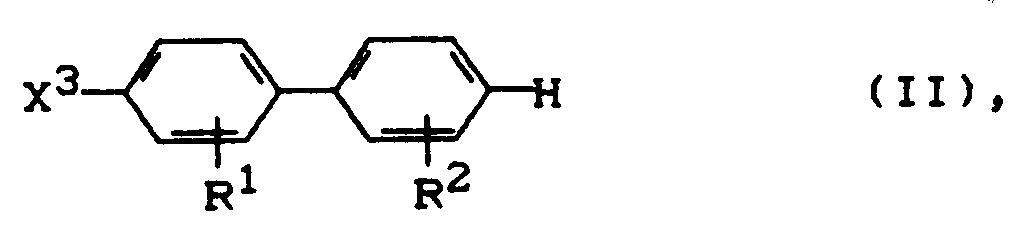
wobei in den Formeln - X¹ und X²
- unabhängig voneinander für Chlor oder Brom, bevorzugt für Chlor stehen,
- X³
- für Wasserstoff, Chlor oder Brom, bevorzugt für Wasserstoff oder Chlor, besonders bevorzugt für Wasserstoff steht und
- R¹ und R²
- unabhängig voneinander Wasserstoff, C₁-C₄-Alkyl (bevorzugt C₁-C₂-Alkyl, besonders bevorzugt Methyl), C₁-C₄-Alkoxy (bevorzugt C₁-C₂-Alkoxy, besonders bevorzugt Methoxy), Hydroxy, Fluor, Chlor oder Brom bedeuten,
- M
- ein austauschbares Kation aus der Gruppe von Wasserstoff und den Alkalimetallen bedeutet,
- Me¹
- ein dreiwertiges Element aus der Gruppe von Al, Ga, In, B und V darstellt,
- n/m
- das Verhältnis der Elemente bedeutet und Werte von 1 - 3000 annimmt und
- q
- die Menge des sorbierten Wassers bedeutet,
- Das erfindungsgemäße Verfahren erlaubt demnach den Einsatz der genannten Biphenyle, wobei eine der para-Positionen bereits durch Halogen besetzt sein kann; diese zuletzt genannte Variante erlaubt sogar die Herstellung von in 4,4′-Stellung verschieden halogenierten Biphenylen. In ganz besonders bevorzugter Weise wird das nicht-substituierte Biphenyl umgesetzt. Am nicht-substituierten Biphenyl läßt sich die erfindungsgemäße Reaktion durch folgendes Formelschema veranschaulichen:

- Eine hohe Selektivität der 4,4′-Dihalogenierung war nach dem Stand der Technik nicht zu erwarten. Zwar ist bereits die para-Monochlorierung von Benzolen, die ausschließlich mit Chlor, Niederalkyl oder niederem Alkoxy substituiert sind, in Gegenwart von Faujasit bzw. Zeolith L beschrieben worden (EP 112 722, EP 118 851, Stud. Surf. Sci. Catal. (Amsterdam) 28 (1986) 747-754), wobei etwas höhere Selektivitäten für die para-Chlorierung angegeben worden waren. Eine Bishalogenierung von 2-Kern-Aromaten in Gegenwart von Zeolithen ist jedoch bisher nicht beschrieben worden, weil offenbar ein Vorurteil überwunden werden mußte. Die genannte Monochlorierung an Benzolen mit Zeolithen verschiebt nämlich das ortho-para-Verhältnis von 1,1 bei der konventionellen Chlorierung nur bis zu 0,68 bei der Chlorierung mit Zeolithen, wie durch eine Nacharbeitung gefunden wurde. Diese Ergebnisse mußten im Hinblick auf die vergrößerte Anzahl von möglichen Substitutionsmustern beim Biphenyl als völlig unzureichend erscheinen und sind jedenfalls in keiner Weise geeignet, die starke Verbesserung der 4,4'-Selektivität von 8 % (konventionelle Chlorierung) auf bis zu über 80 % (erfindungsgemäße Chlorierung) zu erklären. Diese Leistung des erfindungsgemäßen Verfahrens ist daher völlig überraschend.
- Beispielsweise seien neben dem nicht substituierten Biphenyl das Methyl-, Dimethyl-, Ethyl-, Isopropyl-, Hydroxy- und Methoxy-biphenyl als Einsatzmaterial für das erfindungsgemäße Verfahren genannt. Für die Herstellung asymmetrischer 4,4'-Dihalogen-biphenyle, wie beispielsweise 4-Brom-4'-chlorbiphenyl, 4-Chlor-4'-fluorbiphenyl, 4-Chlor-4'-jodbiphenyl, kommen 4-Chlor-, 4-Fluor-, 4-Brom- oder 4-Jod-biphenyl als Einsatzmaterial in Frage.
- Als Halogenierungsmittel eignen sich Cl₂, Br₂, SO₂Cl₂ und SO₂Br₂. In bevorzugter Weise werden Cl₂ bzw. Br₂ eingesetzt. Das Halogenierungsmittel wird in der Regel im stöchiometrischen Verhältnis zum Biphenyl eingesetzt, also bei noch nicht halogenierten Biphenylen im Molverhältnis 2:1, bei bereits monohalogenierten Biphenylen im Molverhältnis 1:1. Von diesem stöchiometrischen Verhältnis kann bis zu 35 Mol-%, bevorzugt bis zu 20 Mol-%, nach oben oder nach unten abgewichen werden.
- Das erfindungsgemäße Verfahren wird in Gegenwart von Zeolithen als Katalysatoren durchgeführt. Zeolithe sind kristalline Alumosilikate, die aus einem Netzwerk von SiO₄- bzw. AlO₄-Tetraedern aufgebaut sind. Die einzelnen Tetraeder sind mit Sauerstoffbrücken über die Ecken untereinander verknüpft und bilden ein räumliches Netzwerk, das von Kanälen und Hohlräumen durchzogen ist. Als Ausgleich für die negative Ladung des Gitters sind austauschbare Kationen eingelagert.
- Al in den Zeolithen kann zumindest teilweise durch andere Elemente ersetzt sein, so daß die obengenannte Formel (III) zu ihrer Darstellung in Frage kommt.
- Eine ausführliche Darstellung von Zeolithen ist beispielsweise in der Monographie von D. W. Breck "Zeolite Molecular Sieves, Structure, Chemistry, and Use", J. Wiley and Sons, New York, 1974 gegeben. Zeolithe, die für das erfindungsgemäße Verfahren geeignet sind, weisen Porenweiten von mindestens 5 Å, beispielsweise im Bereich von 5-9 Å, bevorzugt 5-7 Å, auf und haben ein Verhältnis n/m = 1-3000, bevorzugt 1-2000. In der Formel (III) bedeutet Me¹ ein dreiwertiges Element aus der Gruppe Al, Ga, In, B und V.
- In bevorzugter Weise ist Me¹ Al allein
- In Frage kommen besonders Zeolithe des Strukturtyps Faujasit, L, Offretit, Gmelinit, Cancrinit, H, ZSM 12, ZSM 25, Zeolith β, Ferrierit, ZSM 5, ZSM 11, Heulandit, ZSM 22, ZSM 23, ZSM 48, ZSM 43, ZSM 35, PSH-3, Zeolith ρ, ZSM 38, CSZ-1, ZSM 3, ZSM 20, Mordenit, Zeolith Ω, Erionit, Borsilikat, besonders bevorzugt Zeolithe des Strukturtyps Mordenit, Ferrierit, H, L, Ω, ZSM 11 oder ZSM 5, ganz besonders bevorzugt vom Strukturtyp Ω oder L.
- Die genannten Zeolithtypen können mit austauschbaren Kationen aus ihren Synthese formen oder irgendeiner Vielzahl anderer Kationen im Sinne eines Ionenaustauschs versehen seien. Dieser Austausch ist Stand der Technik und dem Fachmann wohl bekannt. Erfindungsgemäß geeignet sind sowohl Zeolithe in ihrer H-Form als auch Zeolithe, in denen der Wasserstoff ganz oder teilweise gegen Alkalimetallionen, bevorzugt Na⁺ oder K⁺ ausgetauscht sind. Vielfach eignen sich auch Formen, bei denen der Wasserstoff teilweise oder ganz gegen zwei verschiedene Metallkationen, beispielsweise gegen die Kombination Na/K ausgetauscht ist. Der besonders bevorzugte Strukturtyp L kann beispielsweise als Kationen solche von H, Na, K oder Gemische von ihnen, bevorzugt von Na, K oder Gemische von ihnen, besonders bevorzugt von K enthalten.
- Der Zeolith-Katalysator wird in einer Menge von 1-100 Gew.-%, bevorzugt 5-50 Gew.-%, besonders bevorzugt 10-30 Gew.-%, bezogen auf das Gewicht des umzusetzenden Biphenyls, eingesetzt.
- Es wurde weiterhin gefunden, daß die Selektivität der Zeolith-Katalysatoren durch Co-Katalysatoren erhöht werden kann. Co-Katalysatoren sind polare Substanzen, die vermutlich mit aktiven Zentren der Zeolith-Katalysatoren in Wechselwirkung treten können. Co-Katalysatoren gehören beispielsweise der folgenden Gruppe an: Wasser, Alkohole, Aldehyde oder deren Acetale, Ketone, Carbonsäuren oder deren Salze, deren Halogenide, deren Amide oder deren Ester, Nitrile, Schwefel, Schwefelhalogenide, Mercaptane, Thioether, Thiocarbonsäuren, Amine oder deren Salze, quartäre Ammoniumsalze, Jod. Als Einzelverbindungen seien beispielsweise genannt: Wasser, Methanol, Ethanol, (Iso)propanol, Butanol Chlorethanol, Formaldehyd, Acetaldehyd, Butyraldehyd, Benzaldehyd, Acetaldehyd-dimethylacetal, Aceton, Methylethylketon, Benzophenon, Essigsäure, Chloressigsäure, Dichloressigsäure, Methoxyessigsäure, Propionsäure, Capronsäure, Essig-bzw. Propionsäurechlorid, Acet-dimethylamid, Chloracetamid, Essigsäureethylester, Buttersäuremethylester, Acetonitril, Propionitril, Capronitril, Benzonitril, Kaliumformiat, Natriumacetat, Kalium-chloracetat, Calciumpropionat, Zinnbutyrat, Schwefeldichlorid, Butylmercaptan, Thiophenol, Dimethylsulfid, Dibutylsulfid, Dibutyldisulfid, Diphenylsulfid, Thioessigsäure, Dimethylamin, Ethylamin, Butylamin, Pyridin, Picolin, Chinolin, die Salze der genannten Amine, Tetramethylammoniumchlorid, Tetraethylammoniumchlorid, J₂.
- Solche Co-Katalysatoren werden in einer Menge von 0,01 bis 50 Gew.-%, bevorzugt 0,02-20 Gew.-%, bezogen auf das Gewicht des eingesetzten Zeolith-Katalysators, zugesetzt Die Menge des Co-Katalysators hängt teilweise von der Polarität der gewählten Substanz ab, ist im allgemeinen sehr variabel, wird aber mit Vorteil im unteren Bereich, beispielswiese in Mengen von 0,02-2 Gew.-% verwendet.
- Das erfindungsgemäße Verfahren kann mit oder ohne zusätzliches Lösungsmittel durchgeführt werden. Solche Lösungsmittel müssen gegenüber den verwendeten Halogenierungsmitteln resistent sein; in Frage kommen beispielsweise: Kohlenwasserstoffe oder Halogenkohlenwasserstoffe, wie Petrolether, Methylenchlorid, Chloroform, Tetrachlorkohlenstoff, 1,1,1-Trichlorethan, 1,2-Dichlorethan, Perchlorethan, Perchlorethylen, niedere Carbonsäuren, wie Essigsäure und andere, die dem Fachmann als inert bekannt sind. In bevorzugter Weise wird jedoch in der Schmelze des umzusetzenden Biphenyls gearbeitet, wodurch die Aufarbeitung des Reaktionsansatzes vereinfacht wird. Das erfindungsgemäße Verfahren kann weiterhin in der Gasphase durchgeführt werden. Die Durchführung in der Flüssigphase ist jedoch bevorzugt.
- Weiterhin kann kontinuierlich oder diskontinuierlich, bei Normaldruck, vermindertem oder erhöhtem Druck gearbeitet werden; der Druck ist für den Ablauf des erfindungsgemäßen Verfahrens nicht kritisch und hat beispielsweise nur Bedeutung, wenn bei erhöhter Temperatur mit einem leicht flüchtigen Lösungsmittel gearbeitet werden soll. Hierbei wird vorteilhaft der Eigendruck des Systems angewandt.
- Das erfindungsgemäße Verfahren läßt sich in einem weiten Temperaturbereich durchführen, beispielsweise bei 0 bis 300°C, bevorzugt 30 bis 180°C, besonders bevorzugt bei 50 bis 150°C.
- Das erfindungsgemäße Verfahren wird beispielsweise so durchgeführt, daß einer diskontinuierlichen Arbeitsweise Biphenyl unter Rühren aufgeschmolzen oder in einem der genannten Lösungsmittel gelöst wird. Sodann wird der Zeolith-Katalysator in gepulverter Form zugefügt und danach 2 Mol des Halogenierungsmittels in dem Maße, wie es verbrauch wird, bei Reaktionstemperatur in die flüssige Phase eingeleitet. Für die kontinuierliche Durchführung eignen sich beispielsweise Säulenapparaturen, in denen der Zeolith-Katalysator in stückiger Form angeordnet wird. Der eingesetzte Co-Katalysator befindet sich im allgemeinen in der flüssigen Phase der Schmelze oder Lösung. Für Isolierung der Reinigung der erfindungsgemäß erhältlichen 4,4′-Dihalogeno-biphenyle werden allgemein bekannte Verfahren, wie Destillation, Vakuumdestillation, Umkristallisation oder chromatographische Verfahren eingesetzt. Vielfach zeigt das gewünschte 4,4′-Isomere einen deutlich höheren Schmelzpunkt und eine deutlich geringere Löslichkeit, verglichen mit etwa mitentstehenden halogenierten Biphenylen anderer Substitutionsmuster. Dreifach oder noch höher halogenierte Biphenyle treten nur in untergeordneten Mengen, beispielsweise in einer Menge von höchstens 2 Gew.-%, vielfach jedoch in noch geringerer Menge, auf. Dies ist wegen der Giftigkeit solcher höher halogenierter Biphenyle von großem Vorteil bezüglich der Arbeitssicherheit und Umweltbelastung und fördert weiterhin die Wirtschaftlichkeit des erfindungsgemäßen Verfahrens. In 4- oder 4′-Stellung monosubstituierte Biphenyle können wieder in das erfindungsgemäße Verfahren zurückgeführt werden, wobei sich ebenfalls die Wirtschaftlichkeit steigern läßt.
- Der entweder als Destillationsrückstand oder als Extraktionsrückstand hinterbleibende Zeolith-Katalysator kann im allgemeinen ohne weitere Aktivierung erneut erfindungsgemäß eingesetzt werden. Für den Fall, daß nach mehrmaliger Wiederverwendung eine Aktivitätsminderung beobachtet wird, kann der Zeolith-Katalysator nach einem üblichen Verfahren, beispielsweise durch Calcinierung bei erhöhter Temperatur (beispielsweise 400-600°C) reaktiviert werden.
- In den Beispielen 1 bis 15 und 24-28 wurden folgende Zeolithe eingesetzt:
Beispiel Typ/Kation SiO₂/Al₂O₃ 1 K-Zeolith L 6 2 Na, K-Zeolith L 6,4 3 H-Zeolith L 7,5 4 H-Mordenit 25 5 H-Mordenit 16 6 H-Mordenit 18 7 K-Zeolith Ω 6,2 8 H-Ferrierit 17 9 H-ZSM 11 65 10 H-Offretit/H-Erionit 6 11 Borsilikat SiO₂/B₂O₃ = 40 12 Na-Zeolith X 2,5 13 K-Zeolith H 4 14 Na/K-Zeolith L 6 15 K-Zeolith Ω 6,2 24 Na, K-Zeolith L 6,4 25 K-Zeolith L 6 26 K-Zeolith Ω 6,2 27 H-ZSM 5 90 28 H-ZSM 11 65 - In den Vergleichsbeispielen I bis V wurden bei sonst gleicher Verfahrensweise wie in Beispiel 1 an Stelle der Zeolithe folgende Katalysatoren eingesetzt:
Vergleichsbeispiel Katalysator I ohne II 2 g FeCl₃ III 2 g FeCl₃ + 2 g Thiophen IV 7 g 4,4′-Dichlor-diphenylthioether V 2,5 g FeCl₃ + 2,5 g 4,4′-Dichlor-diphenylthioether - Man brachte 77,1 g (0,5 Mol) Biphenyl in einer Rührapparatur unter Rühren und Durchleiten von Stickstoff zum Schmelzen, fügte 15 g aktives (3 Std. bei 400°C aktiviertes) Zeolithpulver zu und leitete bei 100°C innerhalb von 5 h 71 g (1 Mol) Cl₂-Gas ein. Man hielt noch 30 Minuten bei 100°C, entgaste die Schmelze mit Stickstoff und bestimmte deren Zusammensetzung gaschromatographisch.
- Die Ergebnisse werden zusammen mit denen der Beispiele 14 und 15 sowie der Vergleichsbeispiele I bis V in der Tabelle 1 dargestellt.
- 77,1 g (0,5 Mol) Biphenyl wurden unter Zusatz von 15 g K/Na-L-Zeolith unter Stickstoff aufgeschmolzen, dan bei 100°C 135 g (1 Mol) Sulfurylchlorid unter Rühren in die Schmelze innerhalb von 3 h eingetropft. Nach Beendigung der Gasentwicklung spülte man mit Stickstoff und bestimmte die Zusammensetzung der Schmelze gaschromatographisch.
- Man verfuhr analog Beispiel 14, wobei anstelle des K/Na-Zeoliths L 15 g K-Ω-Zeolith eingesetzt wurden.

- Bei gleicher Verfahrensweise wie in Beispiel 1 wurden zusammen mit 15 g des Katalysators Zeolith K-L folgende Zusätze mitverwendet.
Beispiel 16 2 g Chloressigsäure Beispiel 17 2 g Chloressigsäurechlorid Beispiel 18 1 g Wasser Beispiel 19 2 g Chloressigsäure-Natriumsalz Beispiel 20 2 g Kaliumacetat - Die Ergebnisse sind in Tabelle 2 zusammengestellt.
- Man verfuhr analog Beispiel 1 unter Verwendung von 15 g K/Na-Zeolithe L(nach Beispiel 2), jedoch bei unterschiedlichen Reaktionstemperaturen:
Beispiel 21 70°C Beispiel 2 100°C Beispiel 22 120°C Beispiel 23 150°C - Die Ergebnisse gehen aus Tabelle 3 hervor.


- 77,1 g (0,5 Mol) Biphenyl wurden analog Beispiel 1 in Gegenwart von 15 g Zeolith Na/K-L aufgeschmolzen; dann wurden 159,8 g (1 Mol) Br₂ im Verlauf von 8 h bei 100°C in die Schmelze eingetropft. Man rührte noch 30 Minuten nach, spülte 30 Minuten durch Hindurchleiten von Stickstoff und bestimmte die Zusammensetzung gaschromatographisch: der Umsatz betrug 100 %, die Selektivität für 4,4′-Dibrombiphenyl 75 %, die für 4-Monobrombiphenyl 16,5 %.
- Bei gleicher Verfahrensweise wie in Beispiel 24 wurden weitere Zeolithe eingesetzt. Der Umsatz, bezogen auf das eingesetzte Biphenyl, betrug jeweils 100 %. Die verwendeten Zeolithe sowie die erreichten Selektivitäten gehen aus folgender Aufstellung hervor:
Beispiel Katalysator [S] 4,4′-Dibrom- [S] 4-Monobrombiphenyl 25 K-L 78,9 11,0 26 K-Ω 81,5 8,8 27 H-ZSM 5 66,8 16,5 28 H-ZSM 11 69,5 13,9
Mm [mMe ¹O₂ · nSiO₂] · q H₂O (III),
worin
umsetzt.
Claims (9)
- Verfahren zur Herstellung von 4,4'-Dihalogeno-biphenylen der Formel

 X¹ und X² unabhängig voneinander für Chlor oder Brom, bevorzugt für Chlor stehen,X³ für Wasserstoff, Chlor oder Brom, bevorzugt für Wasserstoff oder Chlor, besonders bevorzugt für Wasserstoff steht undR¹ und R² unabhängig voneinander Wasserstoff, C₁-C₄-Alkyl (bevorzugt C₁-C₂-Alkyl, besonders bevorzugt Methyl), C₁-C₄-Alkoxy (bevorzugt C₁-C₂-Alkoxy, besonders bevorzugt Methoxy), Hydroxy, Fluor, Chlor oder Brom bedeuten,dadurch gekennzeichnet, daß man die Biphenyle mit Halogenierungsmitteln aus der Gruppe von Cl₂, Br₂, SO₂Cl₂ und SO₂Br₂ in Gegenwart von Zeolithen der Formel
Mm [mMe¹O₂ · nSiO₂] · q H₂O
,
worinM ein austauschbares Kation aus der Gruppe von Wasserstoff und den Alkalimetallen bedeutet,Me¹ ein dreiwertiges Element aus der Gruppe von Al, Ga, In, B und V darstellt,n/m das Verhältnis der Elemente bedeutet und Werte von 1 - 3000 annimmt undq die Menge des sorbierten Wassers bedeutet,wobei die Zeolithe Porenweiten von mindestens 5 Å haben,
umsetzt. - Verfahren nach Anspruch 1, dadurch gekennzeichnet, daß Me¹ Aluminium ist.
- Verfahren nach Anspruch 1, dadurch gekennzeichnet, daß Zeolithe des Strukturtyps Faujasit, L, Offretit, Gmelinit, Cancrinit, H, ZSM 12, ZSM 25, Zeolith ß, Ferrierit, ZSM 5, ZSM 11, Heulandit, ZSM 22, ZSM 23, ZSM 48, ZSM 43, ZSM 35, PSH-3, Zeolith ρ, ZSM 38, CSZ-1, ZSM 3, ZSM 20, Mordenit, Zeolith Ω, Erionit, Borsilikat, bevorzugt Zeolithe des Strukturtyps, Mordenit, Ferrierit, H, L, Ω, ZSM 5 oder ZSM 11, besonders bevorzugt vom Strukturtyp Ω oder L, eingesetzt werden.
- Verfahren nach Anspruch 3, dadurch gekennzeichnet, daß Zeolith des Strukturtyps Ω oder L eingesetzt werden, bei denen die austauschbaren Kationen Ionen von Wasserstoff, Natrium, Kalium oder Gemische von ihnen, bevorzugt von Natrium, Kalium oder Gemische von ihnen, besonders bevorzugt von Kalium sind.
- Verfahren nach Anspruch 1, dadurch gekennzeichnet, daß in Gegenwart von 1-100 Gew.-%, bevorzugt 5-50 Gew.-%, besonders bevorzugt 10-30 Gew.-% Zeolith, bezogen auf das Gewicht des umzusetzenden Biphenyls, gearbeitet wird.
- Verfahren nach Anspruch 1, dadurch gekennzeichnet, daß in Gegenwart von Co-Katalysatoren aus der Gruppe: Wasser, Alkohole, Aldehyde oder deren Acetale, Ketone, Carbonsäuren oder deren Salze, deren Halogenide, deren Amide oder deren Ester, Nitrile, Schwefel, Schwefelhalogenide, Mercaptane, Thioether, Thiocarbonsäuren, Amine oder deren Salze, quartäre Ammoniumsalze oder Iod gearbeitet wird.
- Verfahren nach Anspruch 6, dadurch gekennzeichnet, daß in Gegenwart von 0,01-50 Gew.-%, bevorzugt 0,02 bis 20 Gew.-% an Co-Katalysator, bezogen auf das Gewicht des eingesetzten Zeolith-Katalysators, gearbeitet wird.
- Verfahren nach Anspruch 1, dadurch gekennzeichnet, daß in der Schmelze des Biphenyls ohne weiteres Lösungsmittel gearbeitet wird.
- Verfahren nach Anspruch 1, dadurch gekennzeichnet, daß unsubstituiertes Biphenyl oder sein 4-Monohalogenderivat eingesetzt wird.
Applications Claiming Priority (4)
| Application Number | Priority Date | Filing Date | Title |
|---|---|---|---|
| DE3809258 | 1988-03-19 | ||
| DE3809258A DE3809258A1 (de) | 1988-03-19 | 1988-03-19 | Verfahren zur herstellung von 4,4'-dihalogeno-biphenylen |
| DE3820192A DE3820192A1 (de) | 1988-06-14 | 1988-06-14 | Verfahren zur herstellung von 4,4'-dihalogeno-biphenylen |
| DE3820192 | 1988-06-14 |
Publications (3)
| Publication Number | Publication Date |
|---|---|
| EP0334097A2 EP0334097A2 (de) | 1989-09-27 |
| EP0334097A3 EP0334097A3 (en) | 1990-07-11 |
| EP0334097B1 true EP0334097B1 (de) | 1993-04-28 |
Family
ID=25866145
Family Applications (1)
| Application Number | Title | Priority Date | Filing Date |
|---|---|---|---|
| EP89103980A Expired - Lifetime EP0334097B1 (de) | 1988-03-19 | 1989-03-07 | Verfahren zur Herstellung von 4,4'-Dihalogeno-biphenylen |
Country Status (4)
| Country | Link |
|---|---|
| US (1) | US4950817A (de) |
| EP (1) | EP0334097B1 (de) |
| JP (1) | JP2561726B2 (de) |
| DE (1) | DE58904175D1 (de) |
Families Citing this family (7)
| Publication number | Priority date | Publication date | Assignee | Title |
|---|---|---|---|---|
| JPH02200647A (ja) * | 1989-01-27 | 1990-08-08 | Mitsui Toatsu Chem Inc | 4―クロロ―4’―ハロゲノジフェニル類の製造方法 |
| DE3930848A1 (de) * | 1989-09-15 | 1991-03-28 | Bayer Ag | Verfahren zur herstellung von in 4,4'-stellung dihalogenierten oligophenylen |
| DE69129843T2 (de) * | 1991-03-21 | 1999-03-11 | Solutia Europe N.V./S.A., Bruessel/Bruxelles | Verbessertes katalytisches Verfahren zur selektiven Alkylierung von aromatischen Kohlenwasserstoffen |
| DE69129496T2 (de) * | 1991-08-21 | 1998-11-19 | Solutia Europ Nv Sa | Katalytischer Prozess zur selektiven Alkylierung polyzyklischer, aromatischer Verbindungen |
| ES2133606T3 (es) * | 1994-03-23 | 1999-09-16 | Hoechst Ag | Procedimiento para la preparacion de un 2,2'-bis(halogenometil)-1,1'-binaftilo. |
| DE19922402A1 (de) * | 1999-05-14 | 2000-11-16 | Bayer Ag | Verfahren zur Herstellung von 4-Chlorbiphenyl und 4-Chlorbiphenyl bestimmter Spezifikationen |
| CN101851148A (zh) * | 2010-05-24 | 2010-10-06 | 苏州安正科技有限公司 | 4,4’-二溴联苯的制备方法 |
Family Cites Families (4)
| Publication number | Priority date | Publication date | Assignee | Title |
|---|---|---|---|---|
| US4240987A (en) * | 1979-10-29 | 1980-12-23 | Xerox Corporation | Chemical process |
| JPS59163329A (ja) * | 1983-03-07 | 1984-09-14 | Ihara Chem Ind Co Ltd | ジハロゲン化ベンゼンの製造方法 |
| GB2155009B (en) * | 1983-09-15 | 1988-01-20 | British Petroleum Co Plc | Compositions suitable for use as electrophilic halogenating agents and their use in the electro-philic halogenation of organic substrates |
| JPS61172837A (ja) * | 1985-01-28 | 1986-08-04 | Ihara Chem Ind Co Ltd | 核ハロゲン化置換ベンゼン類の製造方法 |
-
1989
- 1989-03-02 US US07/318,087 patent/US4950817A/en not_active Expired - Fee Related
- 1989-03-07 EP EP89103980A patent/EP0334097B1/de not_active Expired - Lifetime
- 1989-03-07 DE DE8989103980T patent/DE58904175D1/de not_active Expired - Fee Related
- 1989-03-15 JP JP1061066A patent/JP2561726B2/ja not_active Expired - Lifetime
Also Published As
| Publication number | Publication date |
|---|---|
| EP0334097A2 (de) | 1989-09-27 |
| US4950817A (en) | 1990-08-21 |
| JP2561726B2 (ja) | 1996-12-11 |
| DE58904175D1 (de) | 1993-06-03 |
| JPH01299238A (ja) | 1989-12-04 |
| EP0334097A3 (en) | 1990-07-11 |
Similar Documents
| Publication | Publication Date | Title |
|---|---|---|
| EP0334096A2 (de) | Verfahren zur Herstellung von in 4-Stellung veretherten Phenylketonen | |
| DE2649112C3 (de) | Verfahren zur Herstellung von p-Chlorxylenolen durch Chlorierung von Xylenolen | |
| EP0334097A2 (de) | Verfahren zur Herstellung von 4,4'-Dihalogeno-biphenylen | |
| DE2546532C2 (de) | Verfahren zur Herstellung von Trichlormethyl-trifluormethylbenzolen | |
| EP0144668B1 (de) | Verfahren zur Herstellung von 3,4,6-trisubstituierten 3-Alkylthio-1,2,4-triazin-5-on-Derivaten | |
| DE2523104C3 (de) | Verfahren zur Herstellung von 2,5-Dichlortoluol | |
| EP0505874B1 (de) | Verfahren zur Herstellung von p-Dichlorbenzol | |
| EP0773210A1 (de) | Verfahren zur Herstellung von fluorierten Aromaten | |
| DE3809258A1 (de) | Verfahren zur herstellung von 4,4'-dihalogeno-biphenylen | |
| EP0623573B1 (de) | Verfahren zur Herstellung von m-Chloraromaten | |
| DE3820192A1 (de) | Verfahren zur herstellung von 4,4'-dihalogeno-biphenylen | |
| EP0234503B1 (de) | Verfahren zur Herstellung von 1,1,3-Trichloraceton | |
| EP0173201B1 (de) | Verfahren zur Herstellung aromatischer Bromverbindungen | |
| DE2644641C2 (de) | Verfahren zur Herstellung von bestimmten kernchlorierten Benzotrichloriden | |
| DE2548970A1 (de) | Trichlormethyl-trifluormethyl-benzole | |
| DE2609461C2 (de) | α-4-(Trifluormethylphenoxy)-phenoxy-propionsäuren und ihre Derivate, Verfahren zu ihrer Herstellung und sie enthaltende herbizide Mittel | |
| DE10039717A1 (de) | Verfahren zur Kernchlorierung von meta-Xylol | |
| DE69837852T2 (de) | Derivate von o-(perfluor)dibenzofuranium-salzen, zwischenprodukte zu ihrer herstellung, verfahren zur herstellung der zwischenprodukte, perfluoralkylierungsmittel und perfluoralkylierungsverfahren | |
| EP0423479B1 (de) | Verfahren zur Herstellung von in 4,4'-Stellung dihalogenierten Oligophenylen | |
| DE3720391A1 (de) | Verfahren zur herstellung von halogenierten benzolderivaten | |
| DE4309365C2 (de) | Verfahren zum Herstellen von Halogenphenoxyfettsäurederivaten durch selektive Halogenierung und Halogenphenoxyfettsäurederivate | |
| DE3345490C2 (de) | ||
| EP0069754B1 (de) | Verfahren zur herstellung von imidazolylvinylethern | |
| DE3047376C2 (de) | ||
| DE69612122T2 (de) | Herstellung von 6-brom-2-methoxynaphthalin und derivaten |
Legal Events
| Date | Code | Title | Description |
|---|---|---|---|
| PUAI | Public reference made under article 153(3) epc to a published international application that has entered the european phase |
Free format text: ORIGINAL CODE: 0009012 |
|
| 17P | Request for examination filed |
Effective date: 19890307 |
|
| AK | Designated contracting states |
Kind code of ref document: A2 Designated state(s): BE DE FR GB IT NL |
|
| PUAL | Search report despatched |
Free format text: ORIGINAL CODE: 0009013 |
|
| AK | Designated contracting states |
Kind code of ref document: A3 Designated state(s): BE DE FR GB IT NL |
|
| 17Q | First examination report despatched |
Effective date: 19911213 |
|
| GRAA | (expected) grant |
Free format text: ORIGINAL CODE: 0009210 |
|
| AK | Designated contracting states |
Kind code of ref document: B1 Designated state(s): BE DE FR GB IT NL |
|
| ITF | It: translation for a ep patent filed | ||
| GBT | Gb: translation of ep patent filed (gb section 77(6)(a)/1977) |
Effective date: 19930504 |
|
| REF | Corresponds to: |
Ref document number: 58904175 Country of ref document: DE Date of ref document: 19930603 |
|
| ET | Fr: translation filed | ||
| PLBE | No opposition filed within time limit |
Free format text: ORIGINAL CODE: 0009261 |
|
| STAA | Information on the status of an ep patent application or granted ep patent |
Free format text: STATUS: NO OPPOSITION FILED WITHIN TIME LIMIT |
|
| 26N | No opposition filed | ||
| PGFP | Annual fee paid to national office [announced via postgrant information from national office to epo] |
Ref country code: DE Payment date: 19980216 Year of fee payment: 10 |
|
| PGFP | Annual fee paid to national office [announced via postgrant information from national office to epo] |
Ref country code: GB Payment date: 19980226 Year of fee payment: 10 Ref country code: FR Payment date: 19980226 Year of fee payment: 10 |
|
| PGFP | Annual fee paid to national office [announced via postgrant information from national office to epo] |
Ref country code: BE Payment date: 19980325 Year of fee payment: 10 |
|
| PGFP | Annual fee paid to national office [announced via postgrant information from national office to epo] |
Ref country code: NL Payment date: 19980331 Year of fee payment: 10 |
|
| PG25 | Lapsed in a contracting state [announced via postgrant information from national office to epo] |
Ref country code: GB Free format text: LAPSE BECAUSE OF NON-PAYMENT OF DUE FEES Effective date: 19990307 |
|
| PG25 | Lapsed in a contracting state [announced via postgrant information from national office to epo] |
Ref country code: BE Free format text: LAPSE BECAUSE OF NON-PAYMENT OF DUE FEES Effective date: 19990331 |
|
| BERE | Be: lapsed |
Owner name: BAYER A.G. Effective date: 19990331 |
|
| PG25 | Lapsed in a contracting state [announced via postgrant information from national office to epo] |
Ref country code: NL Free format text: LAPSE BECAUSE OF NON-PAYMENT OF DUE FEES Effective date: 19991001 |
|
| GBPC | Gb: european patent ceased through non-payment of renewal fee |
Effective date: 19990307 |
|
| PG25 | Lapsed in a contracting state [announced via postgrant information from national office to epo] |
Ref country code: FR Free format text: LAPSE BECAUSE OF NON-PAYMENT OF DUE FEES Effective date: 19991130 |
|
| NLV4 | Nl: lapsed or anulled due to non-payment of the annual fee |
Effective date: 19991001 |
|
| REG | Reference to a national code |
Ref country code: FR Ref legal event code: ST |
|
| PG25 | Lapsed in a contracting state [announced via postgrant information from national office to epo] |
Ref country code: DE Free format text: LAPSE BECAUSE OF NON-PAYMENT OF DUE FEES Effective date: 20000101 |
|
| PG25 | Lapsed in a contracting state [announced via postgrant information from national office to epo] |
Ref country code: IT Free format text: LAPSE BECAUSE OF NON-PAYMENT OF DUE FEES Effective date: 20050307 |