EP0333773B1 - Schweisseinlage - Google Patents
Schweisseinlage Download PDFInfo
- Publication number
- EP0333773B1 EP0333773B1 EP88900947A EP88900947A EP0333773B1 EP 0333773 B1 EP0333773 B1 EP 0333773B1 EP 88900947 A EP88900947 A EP 88900947A EP 88900947 A EP88900947 A EP 88900947A EP 0333773 B1 EP0333773 B1 EP 0333773B1
- Authority
- EP
- European Patent Office
- Prior art keywords
- perspiration
- microcapsules
- pad according
- absorbent layer
- perspiration pad
- Prior art date
- Legal status (The legal status is an assumption and is not a legal conclusion. Google has not performed a legal analysis and makes no representation as to the accuracy of the status listed.)
- Expired - Lifetime
Links
- 230000002745 absorbent Effects 0.000 claims abstract description 28
- 239000002250 absorbent Substances 0.000 claims abstract description 28
- 239000003094 microcapsule Substances 0.000 claims abstract description 22
- 239000000463 material Substances 0.000 claims abstract description 14
- 229920002678 cellulose Polymers 0.000 claims abstract description 7
- 239000001913 cellulose Substances 0.000 claims abstract description 7
- 239000000835 fiber Substances 0.000 claims abstract description 6
- 239000010410 layer Substances 0.000 claims description 32
- 239000013543 active substance Substances 0.000 claims description 11
- 239000000126 substance Substances 0.000 claims description 7
- 239000012790 adhesive layer Substances 0.000 claims description 5
- 239000011248 coating agent Substances 0.000 claims description 5
- 238000000576 coating method Methods 0.000 claims description 5
- 239000004744 fabric Substances 0.000 claims description 5
- 230000002401 inhibitory effect Effects 0.000 claims description 4
- 229920000742 Cotton Polymers 0.000 claims description 3
- 230000003110 anti-inflammatory effect Effects 0.000 claims description 3
- 239000000203 mixture Substances 0.000 claims description 3
- 210000002268 wool Anatomy 0.000 claims description 3
- 239000011230 binding agent Substances 0.000 claims description 2
- 238000010521 absorption reaction Methods 0.000 claims 1
- 239000002775 capsule Substances 0.000 claims 1
- XLYOFNOQVPJJNP-UHFFFAOYSA-N water Substances O XLYOFNOQVPJJNP-UHFFFAOYSA-N 0.000 claims 1
- 210000004243 sweat Anatomy 0.000 abstract description 29
- 206010061218 Inflammation Diseases 0.000 abstract description 2
- 230000004054 inflammatory process Effects 0.000 abstract description 2
- 239000002304 perfume Substances 0.000 abstract description 2
- 239000002390 adhesive tape Substances 0.000 abstract 1
- 239000003112 inhibitor Substances 0.000 abstract 1
- 239000003205 fragrance Substances 0.000 description 25
- 238000003466 welding Methods 0.000 description 24
- 239000004005 microsphere Substances 0.000 description 18
- 239000004480 active ingredient Substances 0.000 description 17
- 238000011161 development Methods 0.000 description 10
- 230000018109 developmental process Effects 0.000 description 10
- 239000002781 deodorant agent Substances 0.000 description 5
- 230000000694 effects Effects 0.000 description 5
- 230000015572 biosynthetic process Effects 0.000 description 4
- 230000006978 adaptation Effects 0.000 description 3
- 239000000853 adhesive Substances 0.000 description 3
- 239000007788 liquid Substances 0.000 description 3
- 239000002985 plastic film Substances 0.000 description 3
- 229920006255 plastic film Polymers 0.000 description 3
- 239000007921 spray Substances 0.000 description 3
- 230000001070 adhesive effect Effects 0.000 description 2
- 239000002260 anti-inflammatory agent Substances 0.000 description 2
- 229940121363 anti-inflammatory agent Drugs 0.000 description 2
- 239000002131 composite material Substances 0.000 description 2
- 235000019645 odor Nutrition 0.000 description 2
- 238000004080 punching Methods 0.000 description 2
- 230000035943 smell Effects 0.000 description 2
- 241001295925 Gegenes Species 0.000 description 1
- 108010010803 Gelatin Proteins 0.000 description 1
- 238000009825 accumulation Methods 0.000 description 1
- 238000004026 adhesive bonding Methods 0.000 description 1
- 230000001166 anti-perspirative effect Effects 0.000 description 1
- 239000003213 antiperspirant Substances 0.000 description 1
- 238000004090 dissolution Methods 0.000 description 1
- 239000003814 drug Substances 0.000 description 1
- 230000005489 elastic deformation Effects 0.000 description 1
- 239000013013 elastic material Substances 0.000 description 1
- 239000007789 gas Substances 0.000 description 1
- 229920000159 gelatin Polymers 0.000 description 1
- 239000008273 gelatin Substances 0.000 description 1
- 235000019322 gelatine Nutrition 0.000 description 1
- 235000011852 gelatine desserts Nutrition 0.000 description 1
- 239000003292 glue Substances 0.000 description 1
- 239000000976 ink Substances 0.000 description 1
- 230000007774 longterm Effects 0.000 description 1
- 238000004519 manufacturing process Methods 0.000 description 1
- 230000009965 odorless effect Effects 0.000 description 1
- 230000000149 penetrating effect Effects 0.000 description 1
- 239000003380 propellant Substances 0.000 description 1
- 230000000717 retained effect Effects 0.000 description 1
- 238000007789 sealing Methods 0.000 description 1
- 238000007493 shaping process Methods 0.000 description 1
- 239000002356 single layer Substances 0.000 description 1
- 239000002904 solvent Substances 0.000 description 1
- 230000035900 sweating Effects 0.000 description 1
- 238000007725 thermal activation Methods 0.000 description 1
- 238000009827 uniform distribution Methods 0.000 description 1
- 230000036642 wellbeing Effects 0.000 description 1
Images

Classifications
-
- A—HUMAN NECESSITIES
- A61—MEDICAL OR VETERINARY SCIENCE; HYGIENE
- A61L—METHODS OR APPARATUS FOR STERILISING MATERIALS OR OBJECTS IN GENERAL; DISINFECTION, STERILISATION OR DEODORISATION OF AIR; CHEMICAL ASPECTS OF BANDAGES, DRESSINGS, ABSORBENT PADS OR SURGICAL ARTICLES; MATERIALS FOR BANDAGES, DRESSINGS, ABSORBENT PADS OR SURGICAL ARTICLES
- A61L15/00—Chemical aspects of, or use of materials for, bandages, dressings or absorbent pads
- A61L15/16—Bandages, dressings or absorbent pads for physiological fluids such as urine or blood, e.g. sanitary towels, tampons
- A61L15/42—Use of materials characterised by their function or physical properties
- A61L15/46—Deodorants or malodour counteractants, e.g. to inhibit the formation of ammonia or bacteria
-
- A—HUMAN NECESSITIES
- A41—WEARING APPAREL
- A41D—OUTERWEAR; PROTECTIVE GARMENTS; ACCESSORIES
- A41D27/00—Details of garments or of their making
- A41D27/12—Shields or protectors
-
- A—HUMAN NECESSITIES
- A41—WEARING APPAREL
- A41D—OUTERWEAR; PROTECTIVE GARMENTS; ACCESSORIES
- A41D27/00—Details of garments or of their making
- A41D27/12—Shields or protectors
- A41D27/13—Under-arm shields
-
- A—HUMAN NECESSITIES
- A61—MEDICAL OR VETERINARY SCIENCE; HYGIENE
- A61L—METHODS OR APPARATUS FOR STERILISING MATERIALS OR OBJECTS IN GENERAL; DISINFECTION, STERILISATION OR DEODORISATION OF AIR; CHEMICAL ASPECTS OF BANDAGES, DRESSINGS, ABSORBENT PADS OR SURGICAL ARTICLES; MATERIALS FOR BANDAGES, DRESSINGS, ABSORBENT PADS OR SURGICAL ARTICLES
- A61L9/00—Disinfection, sterilisation or deodorisation of air
- A61L9/015—Disinfection, sterilisation or deodorisation of air using gaseous or vaporous substances, e.g. ozone
- A61L9/04—Disinfection, sterilisation or deodorisation of air using gaseous or vaporous substances, e.g. ozone using substances evaporated in the air without heating
- A61L9/12—Apparatus, e.g. holders, therefor
-
- A—HUMAN NECESSITIES
- A61—MEDICAL OR VETERINARY SCIENCE; HYGIENE
- A61L—METHODS OR APPARATUS FOR STERILISING MATERIALS OR OBJECTS IN GENERAL; DISINFECTION, STERILISATION OR DEODORISATION OF AIR; CHEMICAL ASPECTS OF BANDAGES, DRESSINGS, ABSORBENT PADS OR SURGICAL ARTICLES; MATERIALS FOR BANDAGES, DRESSINGS, ABSORBENT PADS OR SURGICAL ARTICLES
- A61L2300/00—Biologically active materials used in bandages, wound dressings, absorbent pads or medical devices
- A61L2300/40—Biologically active materials used in bandages, wound dressings, absorbent pads or medical devices characterised by a specific therapeutic activity or mode of action
- A61L2300/41—Anti-inflammatory agents, e.g. NSAIDs
-
- A—HUMAN NECESSITIES
- A61—MEDICAL OR VETERINARY SCIENCE; HYGIENE
- A61L—METHODS OR APPARATUS FOR STERILISING MATERIALS OR OBJECTS IN GENERAL; DISINFECTION, STERILISATION OR DEODORISATION OF AIR; CHEMICAL ASPECTS OF BANDAGES, DRESSINGS, ABSORBENT PADS OR SURGICAL ARTICLES; MATERIALS FOR BANDAGES, DRESSINGS, ABSORBENT PADS OR SURGICAL ARTICLES
- A61L2300/00—Biologically active materials used in bandages, wound dressings, absorbent pads or medical devices
- A61L2300/60—Biologically active materials used in bandages, wound dressings, absorbent pads or medical devices characterised by a special physical form
- A61L2300/62—Encapsulated active agents, e.g. emulsified droplets
- A61L2300/622—Microcapsules
Definitions
- the invention relates to a replaceable welding insert for laundry or clothing with a skin-friendly absorbent layer, which e.g. Paper fleece, fiber fleece, felt, cellulose, cellulose fleece or a fabric made of wool or cotton, and with a thin water-impermeable outer layer, which is provided with means for detachable attachment to a piece of laundry or clothing, in particular a self-adhesive coating.
- a skin-friendly absorbent layer which e.g. Paper fleece, fiber fleece, felt, cellulose, cellulose fleece or a fabric made of wool or cotton
- a thin water-impermeable outer layer which is provided with means for detachable attachment to a piece of laundry or clothing, in particular a self-adhesive coating.
- Such welding deposits can e.g. can be found in German Offenlegungsschriften 31 04 047, 33 04 749, 26 17 545, 28 41 365, 33 39 474, 32 36 941 and 32 47 859. They are generally used to absorb sweat.
- Deodorant sprays that cover bad smells are also widely used, but only for a limited time.
- deodorant sprays like deodorant sticks, cannot prevent sweat stains on clothing.
- Deodorant sprays are also partly environmentally harmful due to their propellant gases.
- suction layer which forms a sweat reservoir and prevents sweat from penetrating into or through the laundry or clothing, also has further disadvantages: the suction layer must be relatively thick and is therefore not particularly comfortable to wear, and the moisture stored in the absorbent layer often leads to inflammation.
- the present invention is intended to provide an interchangeable welding insert for laundry or clothing which combats the formation of sweat and odors for a long time.
- an exchangeable welding insert which is characterized in that the absorbent layer is pliable and contains microencapsulated fragrances and / or microencapsulated sweat-decomposing and / or sweat-inhibiting and / or anti-inflammatory active substances.
- the microencapsulation means that the fragrances and active ingredients are only released when the sweat insert has been attached to a piece of laundry or clothing and this is worn.
- the sweat insert can therefore be stored for a long time without sealing without falling in love with its effectiveness. Even if the laundry or clothing item provided with it is not worn for a long time, the sweat insert is not used up.
- Microencapsulated fragrances and microencapsulated anti-inflammatory agents are known per se, but they have so far been used in the field of medicine and advertising (fragrance-releasing rubbing printing inks). Corresponding microencapsulated substances are marketed by EURAND in Milan and NCR Dayton in Ohio / USA. DE-A-2004872 and DE-A-2914386 have microencapsulated substances which, however, are used for sanitary napkins or the like. The problem of the silence of the deposits is not addressed.
- the absorbent layer needs not to be dimensioned so abundantly that it prevents odors even under unfavorable conditions by simply absorbing sweat. Rather, it can relinquish part of this task to the fragrances and / or active ingredients and therefore only needs to have a small thickness, so that it is pliable and can easily adapt to differently curved surfaces. It is also not very bulky and can also be worn under thin fabrics without affecting the appearance of the laundry or garment.
- Welding inserts according to the invention can be quickly and effortlessly attached to items of clothing and clothing and removed therefrom. They leave no ugly glue spots on the laundry and clothing and keep their pleasant fragrance and / or their antiperspirant or sweat-reducing effect for days. They can be used equally as a collar insert, as an insert in underwear, in sports clothing or in the bodice area, but also on outer clothing such as jackets or women's clothing or in stockings or shoes.
- the fragrances and / or active ingredients are only released to a greater extent by the microcapsules when a predetermined temperature is reached or a predetermined amount of sweat reaches the microcapsules.
- the fragrance and active ingredient delivery is thus switched off automatically when the item of laundry or clothing is not worn.
- an additional coating made of a different material than the wall can be used for those of the microcapsules which are intended to withstand the effects of temperature or sweat for a long time - Provide basic material.
- the development of the invention according to claim 7 also serves to increase the release of fragrance and active ingredient in a targeted manner with increased physical exertion.
- the insert is particularly suitable for attachment to the collar of shirts, laundry items and for thin clothes. Such deposits are not visually noticeable, but are an aid to well-being and serve to protect laundry or clothing.
- the insoles also adapt to slightly differently shaped surfaces, and since they are provided with a self-adhesive layer in practice, they can easily be replaced in hot weather or with great effort, if necessary, more often in one day.
- the development of the invention according to claim 9 is advantageous with regard to a predetermined basic release of fragrances for times when there is no increased sweat release.
- the development of the invention according to claim 11 is advantageous with regard to the loss-free delivery of the sweat-decomposing and / or anti-inflammatory agents to the skin.
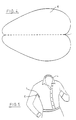
- a welding insert is designated 5 overall. It is cut out of an endless material using a punching tool which defines its edge contour and has a prepared fold or crease line 1. serve for attachment in undershirts, long and short underpants and briefs, as indicated in Figures 6, 8 and 9. For these applications, fold line 1 can be used (FIGS. 6 and 8) or not (FIG. 9).
- the welding insert shown in Figure 1 consists of a composite material, the structure of which is shown in more detail in Figure 2.
- a thin, absolutely but still thin absorbent layer 3 is firmly attached to a thin plastic film 2, e.g. by gluing or welding.
- the absorbent layer 3 consists for example of a paper fleece, fiber fleece, felt, cellulose, cellulose fleece or fabric made of wool or cotton, that is to say absorbent and skin-friendly material.
- the absorbent layer 3 is shown in FIG. 2 as a single-layer layer, but in practice it can also consist of several layers lying one above the other.
- Microcapsules 10 indicated by small dots are embedded in the absorbent layer 3 in FIG. 2, specifically in the exemplary embodiment distributed uniformly according to FIG.
- the microcapsules which in practice have a diameter of 5 to 10 ⁇ m, have a wall 12 which encloses a volume of liquid 14.
- the liquid volume can serve as a solvent for fragrances and / or sweat-decomposing and / or sweat-inhibiting active substances.
- the material from which the wall 12 is made is selected so that it changes in contact with the skin due to the elevated temperature and / or due to the action of moisture so that the fragrances and / or active ingredients can penetrate the wall 12. Such a change in material can e.g. be the complete dissolution of the wall 12, whereby the liquid volume 14 is released.
- the wall 12 can e.g. consist of gelatin.
- a mixture of microcapsules can be used, in which mixture the material for the wall 12 is selected with regard to different resistance to the effects of temperature and / or sweat.
- the wall thickness of the different types of microsphere can be the same.
- part of the microspheres can be produced with an increased thickness of the wall 12, the wall material then being chosen to be the same for all microspheres. This also results in an increased resistance of a subset of the microspheres to the effects of temperature and / or sweat.
- FIG. 11 c) shows a third possibility of increasing the resistance for a subset of the microspheres by applying an outer coating 16 made of a material that differs from that of the wall 12.
- the uniform distribution of the microspheres in the absorbent layer 3 shown in FIG. 2 is advantageous for microspheres including fragrances, and also for microspheres containing sweat-decomposing active substances.
- microspheres which already contain substances that counteract the formation of sweat, it is advantageous if they are arranged as close as possible to the free surface of the insert, as shown schematically in FIG. Circles there represent such microspheres 18 which contain fragrances and / or sweat-decomposing active substances.
- the microspheres 18 are uniformly distributed over the absorbent layer 3.
- Black spheres represent microspheres 20 which contain active substances which inhibit perspiration.
- the microspheres 20 are arranged in the immediate vicinity of the skin-side surface of the absorbent layer 3. The active ingredients released by them thus get well to the surface of the sweat insert 3 and thus to the skin.
- the introduction of the microspheres 10 into the absorbent layer 3 can take place in a dry way or a wet way.
- a binder can be added to the microspheres, which ensures good adhesion of the microspheres to the fibers of the absorbent layer 3.
- the free surface of the absorbent layer 3 can be closed by a thin line, e.g. then can immediately contain the microspheres 20 to be provided only on the surface.
- an adhesive layer 7 is applied to the underside of the water-impermeable plastic film 2, by means of which the welding insert can be attached to a fabric.
- the adhesive layer 7 need not be continuous; it can also include a variety of adhesive spots.
- FIG. 4 shows a welding insert 6 for the sleeves of a shirt, which is again provided with a crease and fold line 1 which facilitates the attachment.
- An example of use of the welding insert 6 is shown in FIG. 5.
- the absorbent layer 3 is thin and pliable overall, as well as the thin plastic film 2, so that the entire insert can be shaped slightly differently. If this shaping is to be carried out absolutely wrinkle-free, the absorbent layer can also be made of elastic material, the adhesive force of the adhesive layer 7 then being chosen so high that the elastic deformation necessary for shape adaptation can be absorbed in the long term. Conversely, the absorbent layer 3 can also be constructed in such a way that the fibers in it can move against one another when the absorbent layer is deformed. In this way, too, a wrinkle-free adaptation to differently curved surfaces is possible.
- the welding pads described above can be provided with different fragrance notes for the users, which match the fragrance notes of perfumes and aftershaves.
- the welding pads can be offered in larger packs of 10 to 100 pieces, whereby these packs can also be stored open for long periods without the effectiveness of the welding pads suffering.
Landscapes
- Health & Medical Sciences (AREA)
- Engineering & Computer Science (AREA)
- General Health & Medical Sciences (AREA)
- Textile Engineering (AREA)
- Veterinary Medicine (AREA)
- Public Health (AREA)
- Epidemiology (AREA)
- Life Sciences & Earth Sciences (AREA)
- Animal Behavior & Ethology (AREA)
- Chemical & Material Sciences (AREA)
- Materials Engineering (AREA)
- Hematology (AREA)
- Undergarments, Swaddling Clothes, Handkerchiefs Or Underwear Materials (AREA)
- Chemical Or Physical Treatment Of Fibers (AREA)
- Details Of Garments (AREA)
- Absorbent Articles And Supports Therefor (AREA)
- Cosmetics (AREA)
Description
- Die Erfindung betrifft eine auswechselbare Schweißeinlage für Wäsche- oder Kleidungsstücke mit einer hautfreundlichen Saugschicht, welche z.B. Papiervlies, Faservlies, Filz, Zellstoff, Cellulosevlies oder eine Gewebe aus Wolle oder Baumwolle aufweisen kann, und mit einer dünnen wasserundurchlässigen Außenschicht, die mit Mitteln zum lösbaren Anbringen an einem Wäsche- oder Bekleidungsstück versehen ist, insbesondere einer selbstklebende Beschichtung.
- Derartige Schweißeinlagen können z.B. den Deutschen Offenlegungsschriften 31 04 047, 33 04 749, 26 17 545, 28 41 365, 33 39 474, 32 36 941 und 32 47 859 entnommen werden. Sie dienen allgemein dazu, entstandenen Schweiß aufzusaugen.
- Es sind ferner auch chemische Wirkstoffe bekannt, die gebildeten Schweiß so zersetzen, daß er geruchsneutral wird. Diese Wirkstoffe werden bisher direkt auf die Haut aufgebracht, wobei sich jedoch durch dieses direkte Aufbringen Grenzen für den Einsatz aus der Hautverträglichkeit ergeben.
- Ferner finden in großem Umfange Deo-Sprays Verwendung, die schlechte Gerüche überdecken, allerdings nur für begrenzte Zeit. Darüber hinaus können Deo-Sprays ebenso wenig wie Deodorant-Stifte Schweißflecken an den Kleidungsstücken verhindern. Deo-Sprays sind darüber hinaus wegen ihrer Treibgase zum Teil umweltschädlich.
- Das mechanische Angehen des Problems über eine Saugschicht, die ein Schweißreservoir bildet und ein Durchdringen des Schweißes in das Wäsche- oder Kleidungsstück oder durch dieses hindurch verhindert, hat auch weitere Nachteile: Die Saugschicht muß verhältnismäßig dick sein und ist daher im Tragen nicht besonders angenehm, und die in der Saugschicht gespeicherte Feuchtigkeit führt oft zu Entzündungen.
- Versieht man derartige Schweißeinlagen zusätzlich mit einem Deodorant. so verdunstet dies in kurzer Zeit. Danach tritt der Schweißgeruch, bedingt durch die Ansammlung des Schweißes sogar noch vermehrt hervor.
- Durch die vorliegende Erfindung soll eine auswechselbare Schweißeinlage für Wäsche- oder Kleidungsstücke geschaffen werden, welche über lange Zeit hinweg die Schweiß- und Geruchsbildung bekämpft.
- Diese Aufgabe ist erfindungsgemäß gelöst durch eine auswechselbare Schweißeinlage, die dadurch gekennzeichnet ist, daß die Saugschicht schmiegsam ist und mikroverkapselte Duftstoffe und/oder mikroverkapselte schweißzersetzende und/oder die Schweißbildung hemmende und/oder entzündungshemmende Wirkstoffe enthält.
- Durch die Mikroverkapselung wird erreicht, daß die Duftstoffe und Wirkstoffe erst dann freigegeben werden, wenn die Schweißeinlage an einem Wäsche- oder Kleidungsstück angebracht worden ist und dieses getragen wird. Die Schweißeinlage kann also ohne Einsiegelung für lange Zeit aufbewahrt werden, ohne daß sie ihre Wirksamkeit verliebt. Auch wenn das mit ihr versehene Wäsche- oder Kleidungsstück längere Zeit nicht getragen wird, verbraucht sich die Schweißeinlage nicht.
- Mikroverkapselte Duftstoffe und mikroverkapselte entzündungshemmende Wirkstoffe sind zwar an sich bekannt, sie wurden bisher aber im Gebiet der Medizin und der Werbung (Duftstoffe freisetzende Rubbel-Druckfarben) verwendet. Entsprechende mikroverkapselte Stoffe werden von den Firmen EURAND in Mailand und NCR Dayton in Ohio/USA in den Handel gebracht. DE-A-2004872 und DE-A-2914386 weisen mikroverkapselte Stoffe auf, die aber für Damenbinden oder das gleichen benitat werden. Dabei wird das Problem der Schweigsamkeit der Einlagen nicht berüht.
- Dadurch, daß die erfindungsgemäße Einlage mikroverkapselte Duft- und/oder Wirkstoffe enthält, braucht die Saugschicht nicht so reichlich dimensioniert zu werden, daß sie auch unter ungünstigen Bedingungen rein durch Aufsaugen von Schweiß eine Geruchsbildung verhindert. Sie kann vielmehr einen Teil dieser Aufgabe an die Duft- und/oder Wirkstoffe abgeben und braucht daher nur geringe Dicke zu haben, sodaß sie schmiegsam ist und sich unterschiedlich gewölbten Flächen leicht anpassen kann. Sie trägt auch nur wenig auf und kann auch unter dünnen Stoffen ohne Beeinträchtigung des Aussehens des Wäsche- oder Kleidungsstückes getragen werden.
- Erfindungsgemäße Schweißeinlagen lassen sich schnell und mühelos an Wäsche- und Kleidungsstücken anbringen und von diesen wieder abnehmen. Sie hinterlassen an den Wäsche- und Kleidungsstücken keine häßlichen Klebestellen und behalten über Tage hinweg ihren angenehmen Duft und/oder ihre schweißhemmende oder schweißzersetzende Wirkung. Sie lassen sich gleichermaßen als Krageneinlage, als Einlage in der Unterwäsche, in der Sportbekleidung oder im Miederbereich, aber auch an Oberbekleidung wie Jackets oder Damenkleidern oder in Strümpfen oder Schuhen einsetzen.
- Vorteilhafte Weiterbildungen der Erfindung sind in Unteransprüchen angegeben.
- Mit der Weiterbildung der Erfindung gemäß Anspruch 2 wird erreicht, daß die Duftstoffe und/oder Wirkstoffe erst dann in größerem Ausmaße von den Mikrokapseln freigegeben werden, wenn eine vorgegebene Temperatur erreicht wird bzw. eine vorgegebene Menge Schweiß an die Mikrokapseln gelangt. Die Duft- und Wirkstoffabgabe wird somit automatisch abgeschaltet, wenn das Wäsche- oder Kleidungsstück nicht getragen wird.
- Mit der Weiterbildung der Erfindung gemäß Anspruch 3 wird erreicht, daß die Freigabe der Duft- oder Wirkstoffe auch bei langer Temperatur- und Schweißeinwirkung noch anhält, da eine Teilmenge der Mikrokapseln erst nach langer Temperatur- oder Schweißeinwirkung die Duft- bzw. Wirkstoffe freigibt.
- Die Weiterbildung der Erfindung gemäß Anspruch 4 läßt sich von der Herstellung her besonders einfach realisieren, auch sprechen Mikrokapseln unterschiedlicher Wandstärke im Prinzip in gleicher Weise auf Temperatur bzw. Schweiß an, so daß sich die Freigabecharakteristik über die Wandstärke in gut vorhersehbarer Weise vorgeben läßt.
- In Fällen, in denen man zur Erzielung langer Resistenz der Mikrokapseln eine zu große Wandstärke vorsehen müßte, kann man gemäß Anspruch 5 für diejenigen der Mikrokapseln, die der Temperatur- oder Schweißeinwirkung längere Zeit standhalten sollen, eine zusätzliche Beschichtung aus einem anderen Material als dem Wand-Grundmaterial vorsehen.
- Mit der Weiterbildung der Erfindung gemäß Anspruch 6 wird erreicht, daß beim normalen Tragen des Wäsche- oder Kleidungsstückes ohne nennenswerte Schweißbildung eine Grundmenge an Duftstoffen bzw. Wirkstoffen freigesetzt wird, wie sie sich aus der rein thermischen Aktivierung der Mikrokapseln ergibt. Bei erhöhter Schweißabsonderung wird aber rasch eine zusätzliche Duftstoffmenge bzw. Wirkstoffmenge bereitgestellt.
- Auch die Weiterbildung der Erfindung gemäß Anspruch 7 dient der gezielten Erhöhung der Duftstoff- und Wirkstofffreigabe bei erhöhter körperlicher Anstrengung.
- Wählt man die Saugschicht, die den weitaus überwiegenden Teil der Dicke der Einlage ausmacht, gemäß Anspruch 8 sehr dünn und die Konzentration mikroverkapselter Duft- und/oder Wirkstoffe groß, so eignet sich die Einlage insbesondere zur Anbringung an den Kragen von Hemden, an Wäschestücken und für dünne Kleider. Derartige Einlagen fallen optisch nicht auf, sind aber eine Hilfe für das Wohlbefinden und dienen der Schonung der Wäsche- oder Kleidungsstücke. Die Einlagen passen sich auch leicht unterschiedlich geformten Flächen an, und da sie in der Praxis mit eine Selbstklebeschicht versehen sind, können sie bei heißem Wetter oder großen Anstrengungen leicht ggf. auch öfters an einem Tag ausgewechselt werden.
- Die Weiterbildung der Erfindung gemäß Anspruch 9 ist im Hinblick auf eine vorgegebene Grundabgabe an Duftstoffen für solche Zeiten von Vorteil, in denen keine erhöhte Schweißabgabe erfolgt.
- Mit der Weiterbildung der Erfindung gemäß Anspruch 10 wird erreicht, daß ein Teil der schweißzersetzenden und/oder entzündungshemmenden Wirkstoffe solange zurückgehalten wird, bis eine größere Schweißbildung auftritt.
- Die Weiterbildung der Erfindung gemäß Anspruch 11 ist im Hinblick auf eine möglichst verlustfreie Abgabe der schweißzersetzenden und/oder entzündungshemmenden Wirkstoffe an die Haut von Vorteil.
- Die Weiterbildungen der Erfindung gemäß den Ansprüchen 12 und 13 sind im Hinblick auf gute faltenlose Anpassung auch an stark gekrümmte Flächen von Vorteil.
- Nachstehend wird die Erfindung anhand von Ausführungsbeispielen unter Bezugnahme auf die Zeichnung näher erläutert. In dieser zeigen:
- Figur 1: eine Aufsicht auf eine Schweißeinlage;
- Figur 2: einen Schnitt durch eine Schweißeinlage;
- Figuren 3 und 4: Aufsichten auf abgewandelte Schweißeinlagen;
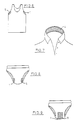
- Figuren 5 bis 9: Anwendungsbeispiele für die Schweißeinlagen nach den Figuren 1, 3 und 4;
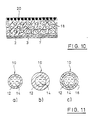
- Figur 10: einen stark vergrößerten Schnitt durch eine abgewandelte Schweißeinlage; und
- Figur 11: Schnitte durch Mikrokugeln, welche Duft- oder Wirkstoffe enthalten und gegen Temperatur- und/oder Schweißeinwirkung unterschiedliche Resistenz aufweisen.
- In Figur 1 ist eine Schweißeinlage insgesamt mit 5 bezeichnet. Sie ist aus einem Endlosmaterial unter Verwendung eines ihre Randkontur vorgebenden Stanzwerkzeuges ausgeschnitten und hat eine vorbereitete Falt- oder Knicklinie 1. Derartige Schweißeinlagen können z.B. zur Anbringung in Unterhemden, langen und kurzen Unterhosen und Slips dienen, wie in den Figuren 6, 8 und 9 angedeutet. Für diese Anwendungsfälle kann von der Faltlinie 1 Gebrauch gemacht werden (Figuren 6 und 8) oder nicht (Figur 9).
- Die in Figur 1 gezeigte Schweißeinlage besteht aus einem Verbundmaterial, dessen Aufbau in Figur 2 näher gezeigt ist.
- Auf einer dünnen Kunststoffolie 2 ist eine demgegenüber dicke, absolut aber immer noch dünne Saugschicht 3 fest angebracht, z.B. durch Verkleben oder Verschweißen. Die Saugschicht 3 besteht beispielsweise aus einem Papiervlies, Faservlies, Filz, Zellstoff, Cellulosevlies oder Gewebe aus Wolle oder Baumwolle, also saugfähigem und hautfreundlichem Material. Die Saugschicht 3 ist in Figur 2 als einlagige Schicht wiedergegeben, sie kann in der Praxis aber auch aus mehreren übereinander liegenden Lagen bestehen.
- In die Saugschicht 3 sind in Figur 2 durch kleine Punkte angedeutete Mikrokapseln 10 eingebettet, und zwar beim Ausführungsbeispiel nach Figur 2 gleichförmig verteilt.
- Wie in Figur 11 bei a) gezeigt, haben die in der Praxis einen Durchmesser von 5 bis 10 µ aufweisenden Mikrokapseln eine Wand 12, welche ein Flüssigkeitsvolumen 14 umschließt. Das Flüssigkeitsvolumen kann als Lösungsmittel für Duftstoffe und/oder schweißzersetzende und/oder die Schweißbildung hemmende Wirkstoffe dienen. Das Material, aus welchem die Wand 12 besteht, ist so ausgewählt, daß es sich bei Hautkontakt aufgrund der erhöhten Temperatur und/ oder durch Feuchtigkeitseinwirkung so verändert, daß die Duftstoffe und/ oder Wirkstoffe die Wand 12 durchsetzen können. Eine derartige Materialveränderung kann z.B. das völlige Auflösen der Wand 12 sein, wodurch das Flüssigkeitsvolumen 14 freigegeben wird. Die Wand 12 kann z.B. aus Gelatine bestehen.
- Um zu verhindern, daß sich nicht alle der Mikrokapseln 10 gleichzeitig auflösen, kann man ein Gemisch von Mikrokapseln verwenden, wobei in diesem Gemisch das Material für die Wand 12 im Hinblick auf unterschiedliche Resistenz gegen Temperatur- und/oder Schweißeinwirkung gewählt ist. In diesem Falle kann dann die Wandstärke der verschiedenen Mikrokugel-Typen gleich groß sein.
- Alternativ kann man gemäß Figur 11 b) einen Teil der Mikrokugeln mit vergrößerter Dicke der Wand 12 herstellen, wobei dann das Wandmaterial für alle Mikrokugeln gleich gewählt wird. Auch so erzielt man eine erhöhte Resistenz einer Teilmenge der Mikrokugeln gegen Temperatur- und/oder Schweißeinwirkung.
- Figur 11 c) zeigt eine dritte Möglichkeit der Erhöhung der Resistenz für eine Teilmenge der Mikrokugeln durch Aufbringen einer Außenbeschichtung 16 aus einem Material, welches sich von demjenigen der Wand 12 unterscheidet.
- Die in Figur 2 dargestellte Gleichverteilung der Mikrokugeln in der Saugschicht 3 ist für Duftstoffe einschließende Mikrokugeln vorteilhaft, ebenso für schweißzersetzende Wirkstoffe enthaltende Mikrokugeln. Für solche Mikrokugeln, die schon der Schweißentstehung entgegenwirkende Stoffe enthalten, ist es dagegen vorteilhaft, wenn sie möglichst nahe bei der freien Oberfläche der Einlage angeordnet werden, wie in Figur 10 schematisch wiedergegeben. Dort stellen Kreise solche Mikrokugeln 18 dar, die Duftstoffe und/ oder schweißzersetzende Wirkstoffe enthalten. Die Mikrokugeln 18 sind gleichförmig über die Saugschicht 3 verteilt. Schwarz ausgefüllte Kreisflächen stellen dagegen Mikrokugeln 20 dar, welche die Schweißbildung hemmende Wirkstoffe enthalten. Die Mikrokugeln 20 sind in der unmittelbaren Nachbarschaft der hautseitigen Oberfläche der Saugschicht 3 angeordnet. Die von ihnen abgegebenen Wirkstoffe gelangen somit gut zur Oberfläche der Schweißeinlage 3 und damit zur Haut.
- Das Einbringen der Mikrokugeln 10 in die Saugschicht 3 kann auf trockenem Wege oder feuchtem Wege erfolgen. Im letztgenannten Falle kann man den Mikrokugeln noch ein Bindemittel zusetzen, welches ein gutes Haften der Mikrokugeln an den Fasern der Saugschicht 3 gewährleistet. Im erstgenannten Falle kann man die freie Oberfläche der Saugschicht 3 durch einen dünnen Strich verschließen, der z.B. dann gleich die nur an der Oberfläche vorzusehenden Mikrokugeln 20 enthalten kann.
- Wie aus Figur 2 ersichtlich, ist auf die Unterseite der wasserundurchlässigen Kunststoffolie 2 eine Klebstoffschicht 7 aufgebracht, über welche die Schweißeinlage an einem Gewebe angebracht werden kann. Die Klebstoffschicht 7 braucht nicht durchgehend zu sein; sie kann auch eine Vielzahl von Klebstoffpunkten umfassen.
- Figur 3 zeigt eine Schweißeinlage 4, wie sie in Verbindung mit Hemdenkragen verwendet werden kann. Auch diese Schweißeinlage ist mit einem geeigneten Stanzwerkzeug wieder aus einem Verbundmaterial ausgestanzt, wie es obenstehend unter Bezugnahme auf Figur 2 erläutert wurde. Einsatzmöglichkeiten dieser Schweißeinlage sind in den Figuren 5 und 7 gezeigt.
- Figur 4 zeigt eine Schweißeinlage 6 für den Ärmelansatz eines Hemdes, die wieder mit einer die Anbringung erleichternden Knick- und Faltlinie 1 versehen ist. Ein Einsatzbeispiel der Schweißeinlage 6 ist in Figur 5 wiedergegeben.
- Aus der obigen Beschreibung von Schweißeinlagen ist ersichtlich, daß diese sehr leicht an den unterschiedlichsten Wäsche- und Kleidungsstücken angebracht werden können, da die Saugschicht 3 insgesamt dünn und schmiegsam ist, ebenso die dünne Kunststoffolie 2, sodaß die gesamte Einlage leicht unterschiedlich geformt werden kann. Soll diese Formung absolut faltenfrei erfolgen, kann man die Saugschicht auch aus elastischem Material herstellen, wobei dann die Klebekraft der Klebstoffschicht 7 so hoch gewählt wird, daß die zur Formanpassung notwendige elastische Verformung auf Dauer aufgenommen werden kann. Umgekehrt kann man die Saugschicht 3 auch so aufbauen, daß sich die in ihr befindlichen Fasern bei Verformung der Saugschicht gegeneinander verschieben können. Auch auf diese Weise wird eine faltenfreie Anpassung an unterschiedlich gewölbte Flächen möglich.
- Da nahezu jeder Duftstoff mikroverkapselt werden kann, kann man die oben beschriebenen Schweißeinlagen mit unterschiedlichen Duftnoten für die Benutzer bereitstellen, welche mit den Duftnoten von Parfums und Rasierwässern übereinstimmen.
- Da, wie dargelegt, die Duftstoffabgabe und Wirkstoffabgabe erst mit dem Tragen eines mit der Schweißeinlage versehenen Wäsche- oder Kleidungsstückes einsetzt, kann man die Schweißeinlagen in größeren Packungen von 10 bis 100 Stück anbieten, wobei diese Packungen auch offen über lange Zeiträume gelagert werden können, ohne daß die Wirksamkeit der Schweißeinlagen leidet.
Claims (13)
Priority Applications (1)
| Application Number | Priority Date | Filing Date | Title |
|---|---|---|---|
| AT88900947T ATE78136T1 (de) | 1986-11-26 | 1987-11-24 | Schweisseinlage. |
Applications Claiming Priority (2)
| Application Number | Priority Date | Filing Date | Title |
|---|---|---|---|
| DE19863640374 DE3640374A1 (de) | 1986-11-26 | 1986-11-26 | Schweiss - einlagen |
| DE3640374 | 1986-11-26 |
Publications (2)
| Publication Number | Publication Date |
|---|---|
| EP0333773A1 EP0333773A1 (de) | 1989-09-27 |
| EP0333773B1 true EP0333773B1 (de) | 1992-07-15 |
Family
ID=6314799
Family Applications (1)
| Application Number | Title | Priority Date | Filing Date |
|---|---|---|---|
| EP88900947A Expired - Lifetime EP0333773B1 (de) | 1986-11-26 | 1987-11-24 | Schweisseinlage |
Country Status (5)
| Country | Link |
|---|---|
| EP (1) | EP0333773B1 (de) |
| JP (1) | JP2590375B2 (de) |
| AT (1) | ATE78136T1 (de) |
| DE (2) | DE3640374A1 (de) |
| WO (1) | WO1988003765A2 (de) |
Cited By (1)
| Publication number | Priority date | Publication date | Assignee | Title |
|---|---|---|---|---|
| IT202100031385A1 (it) * | 2021-12-15 | 2023-06-15 | Matteo Racheli | Cerotto assorbente per attivita’ sportiva |
Families Citing this family (22)
| Publication number | Priority date | Publication date | Assignee | Title |
|---|---|---|---|---|
| US4904524A (en) * | 1988-10-18 | 1990-02-27 | Scott Paper Company | Wet wipes |
| FR2645717A1 (fr) * | 1989-04-18 | 1990-10-19 | Vadsaria Vafi | Procede pour la conception et la realisation d'accessoires en ouate de cellulose autocollant pour chemises |
| DE4007275C2 (de) * | 1990-03-08 | 1999-12-09 | Deotexis Inc | Wirkstoff-imprägnierter Schal als Wegwerfartikel |
| WO1992006604A1 (de) * | 1990-10-18 | 1992-04-30 | Demetrio Leone | Formatiertes, elastisches armblatt |
| NZ263688A (en) * | 1993-03-31 | 1998-05-27 | Procter & Gamble | Composition comprising moisture-activated encapsulated perfume, odour-absorbing material and fluid-absorbing material |
| DE4318141B4 (de) * | 1993-06-01 | 2005-09-29 | Deotexis Inc. | Wirkstofftuch |
| US5465424A (en) * | 1993-09-21 | 1995-11-14 | Tipperary Sport Products, Inc. | Body protector |
| US5669080A (en) * | 1994-09-20 | 1997-09-23 | Culton; Dale M. | Protective apparatus against baseball pitching injury |
| DE19616224C1 (de) * | 1996-04-12 | 1997-11-20 | Daramic Inc | Verwendung von mikroporösem Polyolefin zur Absorption von Schweiß und anderen Körperausdünstungen |
| DE29613302U1 (de) * | 1996-08-01 | 1996-10-31 | Blank Jutta | Arbeitsschutzhandschuh mit Schwitzkissen |
| DE69617960T2 (de) | 1996-10-29 | 2002-07-18 | THE PROCTER & GAMBLE COMPANY, CINCINNATI | Atmungsfähige Schweisseinlage mit Geruchsbeherrschung |
| GB2323282B (en) * | 1997-03-17 | 2001-03-07 | Bristol Myers Squibb Co | Improvements relating to hygiene and medical products |
| DE19711277C2 (de) * | 1997-03-18 | 2000-07-20 | Christoph Fritz | Hygienische Vorlage |
| US6417156B1 (en) * | 1997-04-09 | 2002-07-09 | R. J. Reynolds Tobacco Company | Anti-static article |
| DE19800006A1 (de) * | 1998-01-02 | 1999-07-08 | Banda Fruehbauer Brigitte | Taschentuch und Verfahren zu seiner Herstellung |
| DE19936154C2 (de) * | 1999-07-31 | 2003-08-07 | Deotexis Inc | Flächiger biegsamer Schicht-Verbundstoff |
| DE10149198A1 (de) * | 2001-10-05 | 2003-04-24 | Schaedel Daniela | Schweißundurchlässige Achseleinlage zum einmaligen Gebrauch |
| DE20204988U1 (de) | 2002-03-28 | 2002-06-13 | W. Pelz GmbH & Co., 23812 Wahlstedt | Wattescheibe aus natürlichen und/oder synthetischen Fasern |
| DE20311634U1 (de) | 2003-07-29 | 2003-10-02 | Köhler, Sabine, 29308 Winsen | Auswechselbarer Schutz für Kleidung und Schuhe gegen Schweiß |
| GB2446448A (en) * | 2007-02-07 | 2008-08-13 | Darren Jon Chant | Underarm perspiration control device |
| JP5450943B2 (ja) * | 2007-08-29 | 2014-03-26 | 株式会社アロマスペース | 衣服の汚れ防止シート |
| DE102007046374B4 (de) | 2007-09-27 | 2014-02-27 | Stephanie Keller E.K. | Auswechselbares Armblatt |
Family Cites Families (6)
| Publication number | Priority date | Publication date | Assignee | Title |
|---|---|---|---|---|
| US3490454A (en) * | 1966-10-21 | 1970-01-20 | United Merchants & Mfg | Catamenial products having a coating of rupturable microcapsules containing medicants |
| LU57907A1 (de) | 1969-02-04 | 1970-08-04 | ||
| US3623659A (en) * | 1969-12-29 | 1971-11-30 | Ncr Co | Articles of manufacture containing encapsulated, vaporizable core material |
| DE2914386A1 (de) * | 1978-04-13 | 1979-10-25 | Andersson A E Bror | Desodorierendes und desinfizierendes, fluessigkeitsaufsaugendes erzeugnis und verfahren zu seiner herstellung |
| DE3339474A1 (de) * | 1983-10-31 | 1985-05-09 | Sandor Dipl.-Ing. 8750 Aschaffenburg Potak | Einweg-aermelblaetter |
| IT1183575B (it) * | 1985-05-08 | 1987-10-22 | Eurand Spa | Formulazione deodorando ad effetto modulante sulla trfaspirazione |
-
1986
- 1986-11-26 DE DE19863640374 patent/DE3640374A1/de not_active Withdrawn
-
1987
- 1987-11-24 DE DE8888900947T patent/DE3780470D1/de not_active Expired - Lifetime
- 1987-11-24 AT AT88900947T patent/ATE78136T1/de not_active IP Right Cessation
- 1987-11-24 JP JP63501129A patent/JP2590375B2/ja not_active Expired - Fee Related
- 1987-11-24 EP EP88900947A patent/EP0333773B1/de not_active Expired - Lifetime
- 1987-11-24 WO PCT/EP1987/000724 patent/WO1988003765A2/de not_active Ceased
Cited By (1)
| Publication number | Priority date | Publication date | Assignee | Title |
|---|---|---|---|---|
| IT202100031385A1 (it) * | 2021-12-15 | 2023-06-15 | Matteo Racheli | Cerotto assorbente per attivita’ sportiva |
Also Published As
| Publication number | Publication date |
|---|---|
| WO1988003765A3 (en) | 1988-06-16 |
| ATE78136T1 (de) | 1992-08-15 |
| JPH02502552A (ja) | 1990-08-16 |
| JP2590375B2 (ja) | 1997-03-12 |
| EP0333773A1 (de) | 1989-09-27 |
| DE3780470D1 (de) | 1992-08-20 |
| DE3640374A1 (de) | 1988-06-01 |
| WO1988003765A2 (en) | 1988-06-02 |
Similar Documents
| Publication | Publication Date | Title |
|---|---|---|
| EP0333773A1 (de) | Schweisseinlage. | |
| DE69721572T2 (de) | Damenbinde mit parfümmikrokapseln enthaltenden klebstoff | |
| DE69919957T2 (de) | Pflaster, Anordnung bestehend aus einem Pflaster und einem Behälter, und Verfahren | |
| DE2853243A1 (de) | Hygienevorlage | |
| DE2721816A1 (de) | Vorlage | |
| DE69617960T2 (de) | Atmungsfähige Schweisseinlage mit Geruchsbeherrschung | |
| EP2051599A1 (de) | Antitranspirationseinlage | |
| DE60317754T2 (de) | Absorbierende Artikel mit flockigen Fasern | |
| DE4007275C2 (de) | Wirkstoff-imprägnierter Schal als Wegwerfartikel | |
| DE3215526A1 (de) | Hygienische schuheinlegesohle | |
| DE69835035T2 (de) | Vorrichtung und Verfahren zum Verabreichen flüchtiger Substanzen in einen Inhalationsströmungsweg | |
| DE3339474A1 (de) | Einweg-aermelblaetter | |
| DE19936154C2 (de) | Flächiger biegsamer Schicht-Verbundstoff | |
| EP3923913B1 (de) | Naturstoffpad | |
| EP0511224B1 (de) | Wirkstoff-imprägniertes tuch | |
| EP0030342A2 (de) | Verfahren zur Herstellung einer Hygienevorlage | |
| DE1079794B (de) | Koerperdecke oder -unterlage mit einer Traegerschicht fuer verdunstende Heilmittel | |
| WO1991000719A1 (de) | Hygieneartikel und verfahren zur herstellung desselben | |
| DE10146531B4 (de) | Verfahren zur Herstellung von Kompressen zur therapeutischen und/oder kosmetischen Behandlung | |
| DE102005032359A1 (de) | Einlage für Kleidungsstücke | |
| WO1992006604A1 (de) | Formatiertes, elastisches armblatt | |
| EP4017305B1 (de) | Hygienepflaster zum absorbieren von schweiss | |
| EP1241294A2 (de) | Fasermaterial sowie Verfahren und Behandlungsflüssigkeit zu seiner Herstellung | |
| DE20213051U1 (de) | Schutzvorrichtung gegen Achselschweiß | |
| DE2137684A1 (de) | Nach ihrer Verwendung wegwerfbare Einlage zum Aufsaugen der Schweißabsonderung |
Legal Events
| Date | Code | Title | Description |
|---|---|---|---|
| PUAI | Public reference made under article 153(3) epc to a published international application that has entered the european phase |
Free format text: ORIGINAL CODE: 0009012 |
|
| 17P | Request for examination filed |
Effective date: 19890524 |
|
| AK | Designated contracting states |
Kind code of ref document: A1 Designated state(s): AT BE CH DE FR GB IT LI LU NL SE |
|
| DIN1 | Information on inventor provided before grant (deleted) | ||
| RAP1 | Party data changed (applicant data changed or rights of an application transferred) |
Owner name: DEOTEXIS AG |
|
| 17Q | First examination report despatched |
Effective date: 19910826 |
|
| GRAA | (expected) grant |
Free format text: ORIGINAL CODE: 0009210 |
|
| AK | Designated contracting states |
Kind code of ref document: B1 Designated state(s): AT BE CH DE FR GB IT LI LU NL SE |
|
| REF | Corresponds to: |
Ref document number: 78136 Country of ref document: AT Date of ref document: 19920815 Kind code of ref document: T |
|
| REF | Corresponds to: |
Ref document number: 3780470 Country of ref document: DE Date of ref document: 19920820 |
|
| ET | Fr: translation filed | ||
| GBT | Gb: translation of ep patent filed (gb section 77(6)(a)/1977) | ||
| ITF | It: translation for a ep patent filed | ||
| PG25 | Lapsed in a contracting state [announced via postgrant information from national office to epo] |
Ref country code: LU Free format text: LAPSE BECAUSE OF NON-PAYMENT OF DUE FEES Effective date: 19921130 |
|
| PLBI | Opposition filed |
Free format text: ORIGINAL CODE: 0009260 |
|
| 26 | Opposition filed |
Opponent name: THE PROCTER & GAMBLE COMPANY Effective date: 19930415 |
|
| NLR1 | Nl: opposition has been filed with the epo |
Opponent name: THE PROCTER & GAMBLE COMPANY. |
|
| EAL | Se: european patent in force in sweden |
Ref document number: 88900947.8 |
|
| PLBQ | Unpublished change to opponent data |
Free format text: ORIGINAL CODE: EPIDOS OPPO |
|
| PLAB | Opposition data, opponent's data or that of the opponent's representative modified |
Free format text: ORIGINAL CODE: 0009299OPPO |
|
| R26 | Opposition filed (corrected) |
Opponent name: THE PROCTER & GAMBLE COMPANY Effective date: 19930415 |
|
| NLR1 | Nl: opposition has been filed with the epo |
Opponent name: THE PROCTER & GAMBLE COMPANY |
|
| APAC | Appeal dossier modified |
Free format text: ORIGINAL CODE: EPIDOS NOAPO |
|
| PLBN | Opposition rejected |
Free format text: ORIGINAL CODE: 0009273 |
|
| STAA | Information on the status of an ep patent application or granted ep patent |
Free format text: STATUS: OPPOSITION REJECTED |
|
| 27O | Opposition rejected |
Effective date: 19961001 |
|
| NLR2 | Nl: decision of opposition | ||
| REG | Reference to a national code |
Ref country code: CH Ref legal event code: PUE Owner name: DEOTEXIS AG TRANSFER- DEOTEXIS INC. |
|
| NLS | Nl: assignments of ep-patents |
Owner name: DEOTEXIS INC. |
|
| REG | Reference to a national code |
Ref country code: FR Ref legal event code: TP |
|
| REG | Reference to a national code |
Ref country code: GB Ref legal event code: 732E |
|
| REG | Reference to a national code |
Ref country code: GB Ref legal event code: IF02 |
|
| PGFP | Annual fee paid to national office [announced via postgrant information from national office to epo] |
Ref country code: SE Payment date: 20031126 Year of fee payment: 17 Ref country code: GB Payment date: 20031126 Year of fee payment: 17 Ref country code: FR Payment date: 20031126 Year of fee payment: 17 Ref country code: CH Payment date: 20031126 Year of fee payment: 17 Ref country code: AT Payment date: 20031126 Year of fee payment: 17 |
|
| PGFP | Annual fee paid to national office [announced via postgrant information from national office to epo] |
Ref country code: NL Payment date: 20031130 Year of fee payment: 17 |
|
| PGFP | Annual fee paid to national office [announced via postgrant information from national office to epo] |
Ref country code: BE Payment date: 20031218 Year of fee payment: 17 |
|
| PG25 | Lapsed in a contracting state [announced via postgrant information from national office to epo] |
Ref country code: GB Free format text: LAPSE BECAUSE OF NON-PAYMENT OF DUE FEES Effective date: 20041124 Ref country code: AT Free format text: LAPSE BECAUSE OF NON-PAYMENT OF DUE FEES Effective date: 20041124 |
|
| PG25 | Lapsed in a contracting state [announced via postgrant information from national office to epo] |
Ref country code: SE Free format text: LAPSE BECAUSE OF NON-PAYMENT OF DUE FEES Effective date: 20041125 |
|
| PG25 | Lapsed in a contracting state [announced via postgrant information from national office to epo] |
Ref country code: LI Free format text: LAPSE BECAUSE OF NON-PAYMENT OF DUE FEES Effective date: 20041130 Ref country code: CH Free format text: LAPSE BECAUSE OF NON-PAYMENT OF DUE FEES Effective date: 20041130 Ref country code: BE Free format text: LAPSE BECAUSE OF NON-PAYMENT OF DUE FEES Effective date: 20041130 |
|
| PGFP | Annual fee paid to national office [announced via postgrant information from national office to epo] |
Ref country code: DE Payment date: 20050528 Year of fee payment: 18 |
|
| BERE | Be: lapsed |
Owner name: *DEOTEXIS INC. Effective date: 20041130 |
|
| PG25 | Lapsed in a contracting state [announced via postgrant information from national office to epo] |
Ref country code: NL Free format text: LAPSE BECAUSE OF NON-PAYMENT OF DUE FEES Effective date: 20050601 |
|
| EUG | Se: european patent has lapsed | ||
| GBPC | Gb: european patent ceased through non-payment of renewal fee |
Effective date: 20041124 |
|
| REG | Reference to a national code |
Ref country code: CH Ref legal event code: PL |
|
| PG25 | Lapsed in a contracting state [announced via postgrant information from national office to epo] |
Ref country code: FR Free format text: LAPSE BECAUSE OF NON-PAYMENT OF DUE FEES Effective date: 20050729 |
|
| NLV4 | Nl: lapsed or anulled due to non-payment of the annual fee |
Effective date: 20050601 |
|
| REG | Reference to a national code |
Ref country code: FR Ref legal event code: ST |
|
| APAH | Appeal reference modified |
Free format text: ORIGINAL CODE: EPIDOSCREFNO |
|
| PG25 | Lapsed in a contracting state [announced via postgrant information from national office to epo] |
Ref country code: IT Free format text: LAPSE BECAUSE OF NON-PAYMENT OF DUE FEES Effective date: 20051124 |
|
| PG25 | Lapsed in a contracting state [announced via postgrant information from national office to epo] |
Ref country code: DE Free format text: LAPSE BECAUSE OF NON-PAYMENT OF DUE FEES Effective date: 20060601 |
|
| BERE | Be: lapsed |
Owner name: *DEOTEXIS INC. Effective date: 20041130 |