EP0333407A2 - Resistmaterial und Verfahren zur Herstellung von Resistbildern - Google Patents
Resistmaterial und Verfahren zur Herstellung von Resistbildern Download PDFInfo
- Publication number
- EP0333407A2 EP0333407A2 EP89302448A EP89302448A EP0333407A2 EP 0333407 A2 EP0333407 A2 EP 0333407A2 EP 89302448 A EP89302448 A EP 89302448A EP 89302448 A EP89302448 A EP 89302448A EP 0333407 A2 EP0333407 A2 EP 0333407A2
- Authority
- EP
- European Patent Office
- Prior art keywords
- resist
- polymeric material
- water
- photo
- acid
- Prior art date
- Legal status (The legal status is an assumption and is not a legal conclusion. Google has not performed a legal analysis and makes no representation as to the accuracy of the status listed.)
- Ceased
Links
Images
Classifications
-
- G—PHYSICS
- G03—PHOTOGRAPHY; CINEMATOGRAPHY; ANALOGOUS TECHNIQUES USING WAVES OTHER THAN OPTICAL WAVES; ELECTROGRAPHY; HOLOGRAPHY
- G03F—PHOTOMECHANICAL PRODUCTION OF TEXTURED OR PATTERNED SURFACES, e.g. FOR PRINTING, FOR PROCESSING OF SEMICONDUCTOR DEVICES; MATERIALS THEREFOR; ORIGINALS THEREFOR; APPARATUS SPECIALLY ADAPTED THEREFOR
- G03F7/00—Photomechanical, e.g. photolithographic, production of textured or patterned surfaces, e.g. printing surfaces; Materials therefor, e.g. comprising photoresists; Apparatus specially adapted therefor
-
- G—PHYSICS
- G03—PHOTOGRAPHY; CINEMATOGRAPHY; ANALOGOUS TECHNIQUES USING WAVES OTHER THAN OPTICAL WAVES; ELECTROGRAPHY; HOLOGRAPHY
- G03F—PHOTOMECHANICAL PRODUCTION OF TEXTURED OR PATTERNED SURFACES, e.g. FOR PRINTING, FOR PROCESSING OF SEMICONDUCTOR DEVICES; MATERIALS THEREFOR; ORIGINALS THEREFOR; APPARATUS SPECIALLY ADAPTED THEREFOR
- G03F7/00—Photomechanical, e.g. photolithographic, production of textured or patterned surfaces, e.g. printing surfaces; Materials therefor, e.g. comprising photoresists; Apparatus specially adapted therefor
- G03F7/004—Photosensitive materials
- G03F7/0045—Photosensitive materials with organic non-macromolecular light-sensitive compounds not otherwise provided for, e.g. dissolution inhibitors
-
- G—PHYSICS
- G03—PHOTOGRAPHY; CINEMATOGRAPHY; ANALOGOUS TECHNIQUES USING WAVES OTHER THAN OPTICAL WAVES; ELECTROGRAPHY; HOLOGRAPHY
- G03F—PHOTOMECHANICAL PRODUCTION OF TEXTURED OR PATTERNED SURFACES, e.g. FOR PRINTING, FOR PROCESSING OF SEMICONDUCTOR DEVICES; MATERIALS THEREFOR; ORIGINALS THEREFOR; APPARATUS SPECIALLY ADAPTED THEREFOR
- G03F7/00—Photomechanical, e.g. photolithographic, production of textured or patterned surfaces, e.g. printing surfaces; Materials therefor, e.g. comprising photoresists; Apparatus specially adapted therefor
- G03F7/004—Photosensitive materials
- G03F7/038—Macromolecular compounds which are rendered insoluble or differentially wettable
Definitions
- the present invention relates to a resist technology, and more particularly, to a pattern-forming resist material suitable for forming negative resist patterns using deep ultraviolet (UV) radiation as an exposure radiation.
- the resist patterns are usually formed on a substrate or base material, i.e., a semiconductor material, during the production of semiconductor devices such as large-scale integrated (LSI) circuits, very-large-scale integrated (VLSI) circuits, and bubble memory devices.
- LSI large-scale integrated
- VLSI very-large-scale integrated
- bubble memory devices i.e., a semiconductor material
- a plurality of pattern-forming resist materials such as rubber-like resists, photocomposable polymeric resists and novolac resin resists, as well as different exposure radiations such as ultraviolet (UV) rays, electron beams, X-rays, and ion beams, are widely used.
- UV radiation has replaced the usual UV radiation, as the deep UV radiation has a wavelength of about 200 to 300 nm, which is shorter than that of the usual UV radiation, and can satisfy the requirements for a greater a degree of fine fabrication in the resulting resist patterns.
- cross-linking resists wherein a cross-linkable polymer such as polyvinyl alcohol is combined with a cross-linking agent such as diazonium salts, but these resists have an unsatisfactory pattern resolution due to swelling of the resulting resist patterns.
- the reason for the swelling of the resist patterns is as follows:
- n denotes a polymerization degree
- a diazonium salt of the formula: as a cross-linking agent is used as a resist material, and the resist material is selectively exposed to deep UV radiation
- PVA in the exposed areas becomes insoluble in water as a result of the cross-linking thereof.
- the water-insoluble resist pattern thus formed is represented by the following formula: in which n is as defined above.
- This cross-linking reaction occurs at a small portion of hydroxyl groups in PVA, because the concentration of the cross-linker is low. And thus, since the most of hydroxyl groups in PVA remains unchanged, the polymer remains hydrophilic even after the cross-linking reaction. Therefore, during development, water diffuses into the polymer and results in swelling.
- An object of the present invention is to provide a novel pattern-forming resist material particularly suitable for deep UV exposure and formation of fine negative resist patterns having a high sensitivity, a resistance to dry etching, and a good resolution.
- Another object of the present invention is to provide a novel process for the formation of resist patterns, in which the problem of swelling of the patterns due to absorption of water used during development is eliminated.
- a pattern-forming resist material comprising a mixture of a water-soluble polymeric material having at least one hydroxyl group in the molecular structure thereof and a photo-acid generator which, during exposure to radiation, does not cause cross-linking of said polymeric material, but releases an acid upon reaction with said polymeric material, the product of reacting the thus reacted polymeric material with said acid on heating in the presence of said acid as catalyst providing a water-insoluble polymeric material as a result of removal of water from said reacted polymeric material, which dewatered polymeric material, when present as a substrate, if said exposure has been to patterning radiation, then provides resist patterns when developed with water.
- a process for the formation of a resist pattern comprising coating a solution of a resist material according to the invention onto a substrate to form a resist layer, exposing said resist layer to patterning radiation to cause reaction of said polymeric material and said photo-acid generator and release of said acid, heating the exposed resist layer in the presence of said acid as a catalyst to remove water from the thus reacted polymeric material in said resist layer, thereby insolubilizing said reaction product in water, and developing said resist layer with water to remove said water-soluble polymeric material in unexposed areas of said layer to form resist patterns on said substrate.
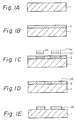
- the resist patterns are formed as follows, for example:
- a semiconductor substrate 1 for example, a silicon substrate or wafer, is prepared and washed to obtain clean surfaces.
- the substrate 1 may carry any circuit parts or other elements, if desired; for example, an insulating layer such as SiO2 layer, circuits such as Al circuits, and the like.
- a resist material to be coated on the cleaned surface of the substrate 1 is prepared by mixing a water-soluble, hydroxyl group-containing polymeric material with a photo-acid generator, i.e., a compound capable of photographically producing and releasing an acid as a result of radiation exposure of the resist material.
- a photo-acid generator i.e., a compound capable of photographically producing and releasing an acid as a result of radiation exposure of the resist material.
- PVA of the formula: wherein n denotes a polymerization degree is used as the polymeric material
- a diazonium salt of the formula: wherein X1 represents a halogen atom such as C1 is used as the photo-acid generator.
- the resist material is coated on the substrate 1 to form a resist layer 2. Since this polymeric material has a good solubility in water, coating is generally carried out by conventional coating methods such as spin coating using an aqueous solution of the resist material, and the coated resist material is then dried.
- the resulting resist layer 2 is then selectively exposed to patterning radiation (deep UV used herein) h ⁇ through a mask (not shown), as illustrated in Fig. 1C.
- the wavelength of the deep UV may be a commonly used one, i.e., 240 to 250 nm.
- the following reaction proceeds in the exposed area of the resist layer 2: wherein 1 and m are intergers whose total combined with the number of phenoxy groups present is equal to n.
- the exposed resist layer is then heated to a temperature of, for example, about 100°C, and during this heating, the following reaction proceeds in the exposed area of the resist layer 2. Namely, an elimination reaction of the hydroxyl group occurs in the presence of the acid HX1 as a catalyst generated in the exposure step. Since water has been removed from the reaction product, the product 22 in the exposed area of the resist layer 2 now shows an insolubility in water (see, Fig. 1D). Namely, the exposed area is insolubilized in water, but the unexposed area remains water-soluble.
- the resist layer is developed with water to wash the unexposed area therefrom, and as shown in Fig. 1E, water-insoluble negative resist patterns 22 are thus formed on the substrate 1.
- the resulting resist patterns do not suffer from swelling thereof, with the result that these resist patterns are very fine or have an increased resolution.
- the precursor thereof i.e., the photo-acid generator
- the photo-acid generator gives satisfactory effects, even if used in a small amount of 10% by weight or less.
- a resist material having a small amount of the photo-acid generator incorporated therein has a good transparency to deep UV. The loss of resolution caused by excessively high light absorption such as in the prior art novolac resists is eliminated.
- the pattern-forming resist material according to the present invention comprises a water-soluble polymeric material, as a basic polymer, and a photo-acid generator.
- the polymeric material does not have an aromatic ring such as benzene ring in the molecular structure thereof, as an aromatic ring-free polymeric material ensures the formation of fine resist patterns, because it does not suffer from the reduced resolution caused by specific absorption characteristics of the aromatic ring.
- the polymeric material has a structure in which a carbon atom adjacent to another carbon atom to which the hydroxyl group is bonded in the polymeric material contains at least one hydrogen atom which can be combined with the split-off hydroxyl group during the heating step to form water, which is then removed from the polymeric material.
- the polymeric material used in the present invention may have a wide range of molecular weights, and a suitable range of the molecular weights thereof is generally from 1,000 to 100,000, although molecular weights over or under that range also may be applied to the polymeric material, insofar as they do not have an adverse affect on the resulting resist patterns.
- the hydroxyl-containing polymeric material used in the present invention may be optionally selected from a plurality of well-known hydroxyl polymers which satisfy the requirements described herein.
- These polymeric materials include, for example, polyvinyl alcohol (PVA) or derivatives thereof such as poly(1-methyl) thereof such as cellulose esters (for example, cellulose acetate and nitrocellulose) and cellulose ethers (for example, methyl cellulose and ethyl cellulose).
- These polymeric materials may be used alone or in combinations thereof.
- the photo-acid generator used together with the polymeric material is a compound capable of releasing an acid upon exposure to patterning radiation, but this compound does not cause a cross-linking of the polymeric material used at the same time during the exposure step.
- Any photo-acid generator may be used in the practice of the present invention, insofar as it satisfies the requirements described herein.
- photo-acid generators include, for example, an onium salt or compound or derivatives thereof such as ammonium compounds, phosphonium compounds, oxonium compounds, sulfonium compounds and iodonium compounds (for example, p-(N-phenylamino)phenyldiazonium sulfate, 2-(N-phenylamino)phenyldiazonium sulfate, diphenyliodonium trifluoromethane sulfonate and triphenylsulfonium hexafluoroarsenate).
- an onium salt or compound or derivatives thereof such as ammonium compounds, phosphonium compounds, oxonium compounds, sulfonium compounds and iodonium compounds (for example, p-(N-phenylamino)phenyldiazonium sulfate, 2-(N-phenylamino)phenyldia
- Preferred photo-acid generators include those represented by the formula: in which Ar may be the same or different and represents a substituted or unsubstituted aromatic group such as a phenyl group, and X ⁇ represents BF4 ⁇ SbF6 ⁇ , PF6 ⁇ or AsF6 ⁇ ; and the compounds of formula: in which X ⁇ is as defined above.
- the amount used of the photo-acid generator is such that the water-insoluble polymeric material is obtained thereby.
- the present inventor found that a relatively small amount of the photo-acid generator will provide the desired effects, when used in the present invention, and is usually within the range of about 2 to 10% by weight based on a combined weight of the polymeric material and photo-acid generator.
- the patterning radiation is preferably a deep UV radiation pattern having a wavelength of about 200 to 300 nm.
- the deep UV radiation may be generated from radiation sources such as a Xe-Hg (xenon-mercury vapor) lamp and an excimer laser (wavelength of 248 nm).
- other radiations such as electron beams, X-rays and ion beams may be used if desired and if not adversely affecting the patterning process and results thereof.
- the resist material and pattern formation process of the present invention may be widely used to form negative resist patterns with excellent properties, and the thus formed resist patterns may be advantageously utilized in the production of semiconductor devices such as LSI and VLSI, and further may be utilized in the production of photoprinting plates and other articles, if desired.
- Polyvinyl alcohol (PVA) having a molecular weight of 27,000 was mixed with 5% by weight, based on a total weight of the mixture, of p-(N-phenylamino)phenyldiazonium sulfate as the photo-acid generator and water.
- the thus obtained aqueous solution of the resist was spun-coated on a silicon wafer, and then dried at 60 °C for 60 minutes, and a resist layer having a layer thickness of 1.0 ⁇ m was obtained.
- the resist layer was exposed to a deep UV radiation pattern (4 mW/cm2) for about 15 seconds, after a wavelength of the radiation from an Xe-Hg lamp was adjusted to below 330 nm by a cold mirror.
- the exposed resist layer was heated at 100°C for 45 minutes on a hot plate, to insolubilize the exposed area thereof, and after the heating was completed, the resist layer was developed with water to wash the unexposed area therefrom, whereby fine negative resist patterns having a resolution of 1.0 ⁇ m l&s (line & space) were obtained.
- the sensitivity was 90 mJ. It was observed that the resist patterns had a good resistance to oxygen plasma etching.
- Example 2 The procedure of Example 1 was repeated except that the photo-acid generator was replaced by the same amount of diphenyliodonium trifluoromethane sulfonate. Fine negative resist patterns having a resolution of 0.8 ⁇ m l&s and a sensitivity 120 mJ were obtained. It was observed that the resist patterns had a good resistance to oxygen plasma etching.
- Example 2 The procedure of Example 1 was repeated except that the photo-acid generator was replaced by the same amount of triphenylsulfonium hexafluoroarsenate. Fine negative resist patterns having a resolution of 0.8 ⁇ m l&s and a sensitivity of 100 mJ were obtained. It was observed that the resist patterns had a good resistance to oxygen plasma etching.
- Example 2 The procedure of Example 1 was repeated except that PVA was replaced by methyl cellulose (MC) having a molecular weight of 10,000, and the photo-acid generator was replaced by the same amount of 2-(N-phenylamino)phenyldiazonium sulfate. Fine negative resist patterns having a resolution of 1.5 ⁇ m l&s and a sensitivity of 90 mJ were obtained. It was observed that the resist patterns had a good resistance to oxygen plasma etching.
- MC methyl cellulose
- Example 2 The procedure of Example 1 was repeated except that PVA was replaced by poly(1-methyl) vinyl alcohol having a molecular weight of 20,000, and the photo-acid generator was replaced by the same amount of 2-(N-phenylamino)phenyldiazonium sulfate. Fine negative resist patterns having a resolution of 1.0 ⁇ m l&s and a sensitivity of 90 mJ were obtained. It was observed that the resist patterns had a good resistance to oxygen plasma etching.
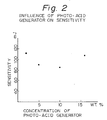
- This example is intended to ascertain the effect of the concentration of the added photo-acid generator on the sensitivity of the resulting resist patterns.
- Example 2 The procedure of Example 1 was repeated except that the photo-acid generator was replaced by different amounts of 2-(N-phenylamino)phenyldiazonium sulfate.
- the amount of the photo-acid generator added was varied from 2% by weight to 16% by weight.
- the results plotted in Fig. 2 show that all of the resist samples have a good sensitivity of 85 to 110 mJ, but it was observed that the amount of the photo-acid generator should not be less than 2% by weight, as otherwise there is a lowering of the resist retention percentage in the exposed area as a result of insufficient photo-acid generator being present for insolubilizing the resist with respect to water.
- the amount of the photo-acid generator should not be more than 10% by weight, as otherwise foaming will occur in the exposed area of the resist as a result of an incorporation of nitrogen (N2) gas generated therein upon exposure to pattering radiation
- Example 1 The procedure of Example 1 was repeated except that the resist material was replaced by a commercially available novolac resin resist: OFPR-800 (product of Tokyo Oka Kogyo KK), and an excimer laser was used as an exposure source, whereby negative resist patterns having a resolution of 2.0 ⁇ m l&s or more are obtained.
- OFPR-800 product of Tokyo Oka Kogyo KK
Landscapes
- Physics & Mathematics (AREA)
- General Physics & Mathematics (AREA)
- Spectroscopy & Molecular Physics (AREA)
- Exposure And Positioning Against Photoresist Photosensitive Materials (AREA)
- Photosensitive Polymer And Photoresist Processing (AREA)
- Addition Polymer Or Copolymer, Post-Treatments, Or Chemical Modifications (AREA)
- Materials For Photolithography (AREA)
Applications Claiming Priority (2)
| Application Number | Priority Date | Filing Date | Title |
|---|---|---|---|
| JP63059328A JPH01233443A (ja) | 1988-03-15 | 1988-03-15 | パターン形成方法 |
| JP59328/88 | 1988-03-15 |
Publications (2)
| Publication Number | Publication Date |
|---|---|
| EP0333407A2 true EP0333407A2 (de) | 1989-09-20 |
| EP0333407A3 EP0333407A3 (de) | 1992-07-01 |
Family
ID=13110167
Family Applications (1)
| Application Number | Title | Priority Date | Filing Date |
|---|---|---|---|
| EP19890302448 Ceased EP0333407A3 (de) | 1988-03-15 | 1989-03-13 | Resistmaterial und Verfahren zur Herstellung von Resistbildern |
Country Status (4)
| Country | Link |
|---|---|
| US (1) | US5017461A (de) |
| EP (1) | EP0333407A3 (de) |
| JP (1) | JPH01233443A (de) |
| KR (1) | KR910005884B1 (de) |
Cited By (6)
| Publication number | Priority date | Publication date | Assignee | Title |
|---|---|---|---|---|
| US5550008A (en) * | 1993-05-31 | 1996-08-27 | Sony Corporation | Method for making a dry etching resistant positive and negative photoresist |
| WO2003069382A1 (en) * | 2002-02-12 | 2003-08-21 | 3M Innovative Properties Company | Process for preparing a k-type polarizer |
| US6814899B2 (en) | 2002-02-12 | 2004-11-09 | 3M Innovative Properties Company | Enhanced K-type polarizer |
| US6949207B2 (en) | 2002-04-04 | 2005-09-27 | 3M Innovative Properties Company | K-type polarizer and preparation thereof |
| US7087194B2 (en) | 2002-04-04 | 2006-08-08 | 3M Innovative Properties Company | K-type polarizer and preparation thereof |
| WO2006113492A3 (en) * | 2005-04-14 | 2006-12-07 | Harvard College | Adjustable solubility in sacrificial layers for microfabrication |
Families Citing this family (53)
| Publication number | Priority date | Publication date | Assignee | Title |
|---|---|---|---|---|
| US5252435A (en) * | 1990-01-30 | 1993-10-12 | Matsushita Electric Industrial Co., Ltd. | Method for forming pattern |
| US5691101A (en) * | 1994-03-15 | 1997-11-25 | Kabushiki Kaisha Toshiba | Photosensitive composition |
| US6905621B2 (en) * | 2002-10-10 | 2005-06-14 | Taiwan Semiconductor Manufacturing Co., Ltd. | Method for preventing the etch transfer of sidelobes in contact hole patterns |
| US7235348B2 (en) * | 2003-05-22 | 2007-06-26 | Taiwan Semiconductor Manufacturing Co., Ltd. | Water soluble negative tone photoresist |
| US7033735B2 (en) * | 2003-11-17 | 2006-04-25 | Taiwan Semiconductor Manufacturing Co., Ltd. | Water soluble negative tone photoresist |
| JP4196822B2 (ja) * | 2003-12-22 | 2008-12-17 | パナソニック株式会社 | 水溶性材料及びそれを用いたパターン形成方法 |
| US7651830B2 (en) * | 2007-06-01 | 2010-01-26 | 3M Innovative Properties Company | Patterned photoacid etching and articles therefrom |
| EP2956823B2 (de) | 2013-02-12 | 2019-07-03 | CARBON3D, Inc. | Kontinuierliches drucken mit einer flüssigen zwischenschicht |
| BR112015018105A2 (pt) | 2013-02-12 | 2017-07-18 | Carbon3D Inc | método e aparelho para fabricação tridimensional |
| WO2015142546A1 (en) | 2014-03-21 | 2015-09-24 | Carbon3D, Inc. | Method and apparatus for three-dimensional fabrication with gas injection through carrier |
| EP3656559A1 (de) | 2014-04-25 | 2020-05-27 | Carbon, Inc. | Kontinuierliche dreidimensionale herstellung aus nicht mischbaren flüssigkeiten |
| MX2016017099A (es) | 2014-06-20 | 2017-08-07 | Carbon Inc | Impresion tridimensional con alimentacion reciproca de liquido polimerizable. |
| WO2015195909A1 (en) | 2014-06-20 | 2015-12-23 | Carbon3D, Inc. | Three-dimensional printing using tiled light engines |
| US10661501B2 (en) | 2014-06-20 | 2020-05-26 | Carbon, Inc. | Three-dimensional printing method using increased light intensity and apparatus therefor |
| MX2016016627A (es) | 2014-06-23 | 2017-06-06 | Carbon Inc | Metodos de produccion de objetos tridimensionales a partir de materiales que tienen multiples mecanismos de endurecimiento. |
| US11390062B2 (en) | 2014-08-12 | 2022-07-19 | Carbon, Inc. | Three-dimensional printing with supported build plates |
| US20170355132A1 (en) | 2014-12-31 | 2017-12-14 | Carbon, Inc. | Three-dimensional printing of objects with breathing orifices |
| WO2016112084A1 (en) | 2015-01-06 | 2016-07-14 | Carbon3D, Inc. | Build plate for three dimensional printing having a rough or patterned surface |
| WO2016112090A1 (en) | 2015-01-07 | 2016-07-14 | Carbon3D, Inc. | Microfluidic devices and methods of making the same |
| WO2016115236A1 (en) | 2015-01-13 | 2016-07-21 | Carbon3D, Inc. | Three-dimensional printing with build plates having surface topologies for increasing permeability and related methods |
| EP3250368A1 (de) | 2015-01-30 | 2017-12-06 | Carbon, Inc. | Bauplatten für clip-druckverfahren mit durchlässigen folien und zugehörige verfahren, systeme und vorrichtungen |
| US11020898B2 (en) | 2015-01-30 | 2021-06-01 | Carbon, Inc. | Build plates for continuous liquid interface printing having permeable base and adhesive for increasing permeability and related methods, systems and devices |
| WO2016126779A1 (en) | 2015-02-05 | 2016-08-11 | Carbon3D, Inc. | Method of additive manufacturing by fabrication through multiple zones |
| US11000992B2 (en) | 2015-02-20 | 2021-05-11 | Carbon, Inc. | Methods and apparatus for continuous liquid interface printing with electrochemically supported dead zone |
| US20180029292A1 (en) | 2015-03-05 | 2018-02-01 | Carbon, Inc. | Continuous liquid interface production with sequential patterned exposure |
| US10391711B2 (en) | 2015-03-05 | 2019-08-27 | Carbon, Inc. | Fabrication of three dimensional objects with multiple operating modes |
| US20180015662A1 (en) | 2015-03-05 | 2018-01-18 | Carbon, Inc. | Fabrication of three dimensional objects with variable slice thickness |
| WO2016145050A1 (en) | 2015-03-10 | 2016-09-15 | Carbon3D, Inc. | Microfluidic devices having flexible features and methods of making the same |
| WO2016145182A1 (en) | 2015-03-12 | 2016-09-15 | Carbon3D, Inc. | Additive manufacturing using polymerization initiators or inhibitors having controlled migration |
| WO2016149097A1 (en) | 2015-03-13 | 2016-09-22 | Carbon3D, Inc. | Three-dimensional printing with reduced pressure build plate unit |
| US10792856B2 (en) | 2015-03-13 | 2020-10-06 | Carbon, Inc. | Three-dimensional printing with flexible build plates |
| WO2016149151A1 (en) | 2015-03-13 | 2016-09-22 | Carbon3D, Inc. | Three-dimensional printing with concurrent delivery of different polymerizable liquids |
| WO2017048710A1 (en) | 2015-09-14 | 2017-03-23 | Carbon, Inc. | Light-curable article of manufacture with portions of differing solubility |
| KR20180081489A (ko) | 2015-09-25 | 2018-07-16 | 카본, 인크. | 조명 패널을 갖는 연속적인 액체 상간 프린팅을 위한 빌드 플레이트 조립체 및 이와 관련된 방법, 시스템 및 장치 |
| US20180243976A1 (en) | 2015-09-30 | 2018-08-30 | Carbon, Inc. | Method and Apparatus for Producing Three- Dimensional Objects |
| US12010287B2 (en) | 2015-10-09 | 2024-06-11 | Southern Methodist University | System and method for a three-dimensional optical switch display device |
| US12558845B2 (en) | 2015-10-09 | 2026-02-24 | Southern Methodist University | System and method for a three-dimensional optical switch display device |
| US10647873B2 (en) | 2015-10-30 | 2020-05-12 | Carbon, Inc. | Dual cure article of manufacture with portions of differing solubility |
| WO2017112483A2 (en) | 2015-12-22 | 2017-06-29 | Carbon, Inc. | Accelerants for additive manufacturing with dual cure resins |
| WO2017112521A1 (en) | 2015-12-22 | 2017-06-29 | Carbon, Inc. | Production of flexible products by additive manufacturing with dual cure resins |
| CN108475008B (zh) | 2015-12-22 | 2020-11-06 | 卡本有限公司 | 一种形成三维物体的方法 |
| WO2017112653A1 (en) | 2015-12-22 | 2017-06-29 | Carbon, Inc. | Dual precursor resin systems for additive manufacturing with dual cure resins |
| WO2017112571A1 (en) | 2015-12-22 | 2017-06-29 | Carbon, Inc. | Dual cure additive manufacturing of rigid intermediates that generate semi-rigid, flexible, or elastic final products |
| CN109414874B (zh) | 2016-05-31 | 2025-02-21 | 西北大学 | 用于制造三维物体的方法和设备 |
| CN109153173B (zh) | 2016-07-01 | 2021-08-24 | 卡本有限公司 | 用于通过建造板脱气来减少气泡的三维打印方法和设备 |
| WO2018094131A1 (en) | 2016-11-21 | 2018-05-24 | Carbon, Inc. | Method of making three-dimensional object by delivering reactive component for subsequent cure |
| US10239255B2 (en) | 2017-04-11 | 2019-03-26 | Molecule Corp | Fabrication of solid materials or films from a polymerizable liquid |
| KR20230153510A (ko) * | 2017-04-18 | 2023-11-06 | 더 유니버서티 오브 시카고 | 광활성인 무기 리간드-캐핑된 무기 나노결정 |
| NL2022372B1 (en) | 2018-12-17 | 2020-07-03 | What The Future Venture Capital Wtfvc B V | Process for producing a cured 3d product |
| CA3128721A1 (en) | 2019-03-07 | 2020-09-17 | David A. Walker | Rapid, large volume, dead layer-free 3d printing |
| US11534966B2 (en) | 2019-04-09 | 2022-12-27 | Azul 3D, Inc. | Methodologies to rapidly cure and coat parts produced by additive manufacturing |
| CN113745439B (zh) * | 2020-05-27 | 2023-04-18 | 京东方科技集团股份有限公司 | 量子点发光结构及其制作方法和显示装置 |
| CN114784151A (zh) * | 2022-03-22 | 2022-07-22 | 清华大学 | 纳米颗粒打印的方法以及发光元件 |
Family Cites Families (8)
| Publication number | Priority date | Publication date | Assignee | Title |
|---|---|---|---|---|
| US2199865A (en) * | 1937-06-18 | 1940-05-07 | Harris Seybold Potter Co | Production of plates for printing in lithographic manner |
| US4341859A (en) * | 1980-09-23 | 1982-07-27 | General Electric Company | Emulsion for making dry film resists |
| US4414059A (en) * | 1982-12-09 | 1983-11-08 | International Business Machines Corporation | Far UV patterning of resist materials |
| US4657844A (en) * | 1983-06-27 | 1987-04-14 | Texas Instruments Incorporated | Plasma developable negative resist compositions for electron beam, X-ray and optical lithography |
| US4537854A (en) * | 1983-09-14 | 1985-08-27 | General Electric Company | Photoresist compositions and method |
| US4610952A (en) * | 1983-09-14 | 1986-09-09 | General Electric Company | Photoresist compositions and method |
| EP0195106B1 (de) * | 1985-03-22 | 1989-06-21 | Ibm Deutschland Gmbh | Herstellung einer Abhebemaske und ihre Anwendung |
| DE3721741A1 (de) * | 1987-07-01 | 1989-01-12 | Basf Ag | Strahlungsempfindliches gemisch fuer lichtempfindliche beschichtungsmaterialien |
-
1988
- 1988-03-15 JP JP63059328A patent/JPH01233443A/ja active Pending
-
1989
- 1989-03-13 EP EP19890302448 patent/EP0333407A3/de not_active Ceased
- 1989-03-13 US US07/322,037 patent/US5017461A/en not_active Expired - Fee Related
- 1989-03-15 KR KR1019890003188A patent/KR910005884B1/ko not_active Expired
Cited By (10)
| Publication number | Priority date | Publication date | Assignee | Title |
|---|---|---|---|---|
| US5550008A (en) * | 1993-05-31 | 1996-08-27 | Sony Corporation | Method for making a dry etching resistant positive and negative photoresist |
| WO2003069382A1 (en) * | 2002-02-12 | 2003-08-21 | 3M Innovative Properties Company | Process for preparing a k-type polarizer |
| US6808657B2 (en) | 2002-02-12 | 2004-10-26 | 3M Innovative Properties Company | Process for preparing a K-type polarizer |
| US6814899B2 (en) | 2002-02-12 | 2004-11-09 | 3M Innovative Properties Company | Enhanced K-type polarizer |
| US6998179B2 (en) | 2002-02-12 | 2006-02-14 | 3M Innovative Properties Company | Process for preparing a K-type polarizer |
| CN1311256C (zh) * | 2002-02-12 | 2007-04-18 | 3M创新有限公司 | 制备k型偏振器的方法 |
| US6949207B2 (en) | 2002-04-04 | 2005-09-27 | 3M Innovative Properties Company | K-type polarizer and preparation thereof |
| US7087194B2 (en) | 2002-04-04 | 2006-08-08 | 3M Innovative Properties Company | K-type polarizer and preparation thereof |
| WO2006113492A3 (en) * | 2005-04-14 | 2006-12-07 | Harvard College | Adjustable solubility in sacrificial layers for microfabrication |
| US8357616B2 (en) | 2005-04-14 | 2013-01-22 | President And Fellows Of Harvard College | Adjustable solubility in sacrificial layers for microfabrication |
Also Published As
| Publication number | Publication date |
|---|---|
| JPH01233443A (ja) | 1989-09-19 |
| KR890015077A (ko) | 1989-10-28 |
| EP0333407A3 (de) | 1992-07-01 |
| US5017461A (en) | 1991-05-21 |
| KR910005884B1 (ko) | 1991-08-06 |
Similar Documents
| Publication | Publication Date | Title |
|---|---|---|
| EP0333407A2 (de) | Resistmaterial und Verfahren zur Herstellung von Resistbildern | |
| JP4216705B2 (ja) | フォトレジストパターン形成方法 | |
| US5118585A (en) | Positive and negative working radiation sensitive mixtures and production of relief patterns | |
| EP1311908B1 (de) | Zur bilderzeugung mit tiefer uv-strahlung geeignete photoresistzusammensetzung und diese verwendendes bilderzeugungsverfahren | |
| JP3408415B2 (ja) | 光酸発生剤をしてなる反射防止コーティング組成物 | |
| KR100387319B1 (ko) | 방사선민감성혼합물 | |
| US6365322B1 (en) | Photoresist composition for deep UV radiation | |
| JP2501292B2 (ja) | 酸感応ポリマおよびホトレジスト構造の作成方法 | |
| JP4299670B2 (ja) | ネガ型深紫外線フォトレジスト | |
| KR100520670B1 (ko) | 포토레지스트 패턴의 형성방법 | |
| JPH07261393A (ja) | ネガ型レジスト組成物 | |
| JP3228193B2 (ja) | ネガ型フォトレジスト組成物及びそれを用いたパターン形成方法 | |
| JP3509988B2 (ja) | 放射感応性混合物 | |
| JP4136934B2 (ja) | ネガ型水性フォトレジスト組成物 | |
| KR100570206B1 (ko) | 유기 반사방지막용 광 흡수제 중합체 및 이의 제조 방법과상기 중합체를 포함하는 유기 반사 방지막 조성물 | |
| US5814432A (en) | Method of forming patterns for use in manufacturing electronic devices | |
| CA2020378A1 (en) | Maleimide containing, negative working deep uv photoresist | |
| EP1295177B1 (de) | Photoresistzusammensetzung mit einer wasslöslichen fotosäure erzeugenden substanz | |
| JPS6037548A (ja) | 照射線反応ネガレジストの形成方法 | |
| JPH04358155A (ja) | 酸硬化フォトレジスト | |
| US6989227B2 (en) | E-beam curable resist and process for e-beam curing the resist | |
| KR100570207B1 (ko) | 유기 반사방지막용 광 흡수제 중합체 및 이의 제조 방법과상기 중합체를 포함하는 유기 반사 방지막 조성물 | |
| JPH1195436A (ja) | パターン形成方法 | |
| Reichmanis | Polymers for Electronic and Photonic Applications | |
| JPH11282165A (ja) | レジスト材料及びシリル化レジストパターンの形成方法 |
Legal Events
| Date | Code | Title | Description |
|---|---|---|---|
| PUAI | Public reference made under article 153(3) epc to a published international application that has entered the european phase |
Free format text: ORIGINAL CODE: 0009012 |
|
| AK | Designated contracting states |
Kind code of ref document: A2 Designated state(s): DE FR GB |
|
| PUAL | Search report despatched |
Free format text: ORIGINAL CODE: 0009013 |
|
| AK | Designated contracting states |
Kind code of ref document: A3 Designated state(s): DE FR GB |
|
| 17P | Request for examination filed |
Effective date: 19921013 |
|
| 17Q | First examination report despatched |
Effective date: 19950125 |
|
| GRAG | Despatch of communication of intention to grant |
Free format text: ORIGINAL CODE: EPIDOS AGRA |
|
| STAA | Information on the status of an ep patent application or granted ep patent |
Free format text: STATUS: THE APPLICATION HAS BEEN REFUSED |
|
| 18R | Application refused |
Effective date: 19970306 |