EP0331765B2 - Verfahren zum Verlegen und Abdichten von Bitumen-Abdichtungsbahnen und Abdichtungsbahn zur Durchführung dieses Verfahrens - Google Patents
Verfahren zum Verlegen und Abdichten von Bitumen-Abdichtungsbahnen und Abdichtungsbahn zur Durchführung dieses Verfahrens Download PDFInfo
- Publication number
- EP0331765B2 EP0331765B2 EP88103482A EP88103482A EP0331765B2 EP 0331765 B2 EP0331765 B2 EP 0331765B2 EP 88103482 A EP88103482 A EP 88103482A EP 88103482 A EP88103482 A EP 88103482A EP 0331765 B2 EP0331765 B2 EP 0331765B2
- Authority
- EP
- European Patent Office
- Prior art keywords
- bitumen
- sealing
- particles
- embedded
- heated
- Prior art date
- Legal status (The legal status is an assumption and is not a legal conclusion. Google has not performed a legal analysis and makes no representation as to the accuracy of the status listed.)
- Expired - Lifetime
Links
- 238000007789 sealing Methods 0.000 title claims abstract description 31
- 238000000034 method Methods 0.000 title claims abstract description 21
- 239000012528 membrane Substances 0.000 title abstract description 46
- 239000010426 asphalt Substances 0.000 claims abstract description 70
- 239000002245 particle Substances 0.000 claims abstract description 35
- 230000005855 radiation Effects 0.000 claims abstract description 10
- OKTJSMMVPCPJKN-UHFFFAOYSA-N Carbon Chemical compound [C] OKTJSMMVPCPJKN-UHFFFAOYSA-N 0.000 claims description 21
- 229910052799 carbon Inorganic materials 0.000 claims description 18
- 229920000049 Carbon (fiber) Polymers 0.000 claims description 7
- 239000004917 carbon fiber Substances 0.000 claims description 7
- 239000010439 graphite Substances 0.000 claims description 3
- 229910002804 graphite Inorganic materials 0.000 claims description 3
- 239000000428 dust Substances 0.000 claims description 2
- 239000006229 carbon black Substances 0.000 claims 1
- 238000004078 waterproofing Methods 0.000 description 25
- 239000010410 layer Substances 0.000 description 18
- 238000010438 heat treatment Methods 0.000 description 12
- 239000000853 adhesive Substances 0.000 description 8
- 230000001070 adhesive effect Effects 0.000 description 5
- 239000012790 adhesive layer Substances 0.000 description 5
- 238000004026 adhesive bonding Methods 0.000 description 4
- 235000013312 flour Nutrition 0.000 description 4
- 230000001681 protective effect Effects 0.000 description 4
- 239000004071 soot Substances 0.000 description 4
- KGRVJHAUYBGFFP-UHFFFAOYSA-N 2,2'-Methylenebis(4-methyl-6-tert-butylphenol) Chemical compound CC(C)(C)C1=CC(C)=CC(CC=2C(=C(C=C(C)C=2)C(C)(C)C)O)=C1O KGRVJHAUYBGFFP-UHFFFAOYSA-N 0.000 description 3
- 239000013032 Hydrocarbon resin Substances 0.000 description 3
- 235000019738 Limestone Nutrition 0.000 description 3
- 238000004821 distillation Methods 0.000 description 3
- 229920006270 hydrocarbon resin Polymers 0.000 description 3
- 239000006028 limestone Substances 0.000 description 3
- 238000003466 welding Methods 0.000 description 3
- 239000003245 coal Substances 0.000 description 2
- 239000002817 coal dust Substances 0.000 description 2
- 230000005284 excitation Effects 0.000 description 2
- 239000004576 sand Substances 0.000 description 2
- 239000004831 Hot glue Substances 0.000 description 1
- 230000000052 comparative effect Effects 0.000 description 1
- 238000007796 conventional method Methods 0.000 description 1
- 230000001419 dependent effect Effects 0.000 description 1
- 239000003292 glue Substances 0.000 description 1
- 231100001261 hazardous Toxicity 0.000 description 1
- 229910052500 inorganic mineral Inorganic materials 0.000 description 1
- 210000001503 joint Anatomy 0.000 description 1
- 239000007788 liquid Substances 0.000 description 1
- 239000000463 material Substances 0.000 description 1
- 239000011707 mineral Substances 0.000 description 1
- 230000003647 oxidation Effects 0.000 description 1
- 238000007254 oxidation reaction Methods 0.000 description 1
- 230000035515 penetration Effects 0.000 description 1
- 230000003014 reinforcing effect Effects 0.000 description 1
- 239000010454 slate Substances 0.000 description 1
- 239000000126 substance Substances 0.000 description 1
- 239000000758 substrate Substances 0.000 description 1
- 230000008093 supporting effect Effects 0.000 description 1
- 239000000454 talc Substances 0.000 description 1
- 229910052623 talc Inorganic materials 0.000 description 1
Images
Classifications
-
- B—PERFORMING OPERATIONS; TRANSPORTING
- B29—WORKING OF PLASTICS; WORKING OF SUBSTANCES IN A PLASTIC STATE IN GENERAL
- B29C—SHAPING OR JOINING OF PLASTICS; SHAPING OF MATERIAL IN A PLASTIC STATE, NOT OTHERWISE PROVIDED FOR; AFTER-TREATMENT OF THE SHAPED PRODUCTS, e.g. REPAIRING
- B29C66/00—General aspects of processes or apparatus for joining preformed parts
- B29C66/40—General aspects of joining substantially flat articles, e.g. plates, sheets or web-like materials; Making flat seams in tubular or hollow articles; Joining single elements to substantially flat surfaces
- B29C66/41—Joining substantially flat articles ; Making flat seams in tubular or hollow articles
- B29C66/45—Joining of substantially the whole surface of the articles
-
- B—PERFORMING OPERATIONS; TRANSPORTING
- B29—WORKING OF PLASTICS; WORKING OF SUBSTANCES IN A PLASTIC STATE IN GENERAL
- B29C—SHAPING OR JOINING OF PLASTICS; SHAPING OF MATERIAL IN A PLASTIC STATE, NOT OTHERWISE PROVIDED FOR; AFTER-TREATMENT OF THE SHAPED PRODUCTS, e.g. REPAIRING
- B29C65/00—Joining or sealing of preformed parts, e.g. welding of plastics materials; Apparatus therefor
- B29C65/02—Joining or sealing of preformed parts, e.g. welding of plastics materials; Apparatus therefor by heating, with or without pressure
- B29C65/14—Joining or sealing of preformed parts, e.g. welding of plastics materials; Apparatus therefor by heating, with or without pressure using wave energy, i.e. electromagnetic radiation, or particle radiation
- B29C65/1403—Joining or sealing of preformed parts, e.g. welding of plastics materials; Apparatus therefor by heating, with or without pressure using wave energy, i.e. electromagnetic radiation, or particle radiation characterised by the type of electromagnetic or particle radiation
- B29C65/1425—Microwave radiation
-
- B—PERFORMING OPERATIONS; TRANSPORTING
- B29—WORKING OF PLASTICS; WORKING OF SUBSTANCES IN A PLASTIC STATE IN GENERAL
- B29C—SHAPING OR JOINING OF PLASTICS; SHAPING OF MATERIAL IN A PLASTIC STATE, NOT OTHERWISE PROVIDED FOR; AFTER-TREATMENT OF THE SHAPED PRODUCTS, e.g. REPAIRING
- B29C65/00—Joining or sealing of preformed parts, e.g. welding of plastics materials; Apparatus therefor
- B29C65/02—Joining or sealing of preformed parts, e.g. welding of plastics materials; Apparatus therefor by heating, with or without pressure
- B29C65/14—Joining or sealing of preformed parts, e.g. welding of plastics materials; Apparatus therefor by heating, with or without pressure using wave energy, i.e. electromagnetic radiation, or particle radiation
- B29C65/1477—Joining or sealing of preformed parts, e.g. welding of plastics materials; Apparatus therefor by heating, with or without pressure using wave energy, i.e. electromagnetic radiation, or particle radiation making use of an absorber or impact modifier
- B29C65/1483—Joining or sealing of preformed parts, e.g. welding of plastics materials; Apparatus therefor by heating, with or without pressure using wave energy, i.e. electromagnetic radiation, or particle radiation making use of an absorber or impact modifier coated on the article
-
- B—PERFORMING OPERATIONS; TRANSPORTING
- B29—WORKING OF PLASTICS; WORKING OF SUBSTANCES IN A PLASTIC STATE IN GENERAL
- B29C—SHAPING OR JOINING OF PLASTICS; SHAPING OF MATERIAL IN A PLASTIC STATE, NOT OTHERWISE PROVIDED FOR; AFTER-TREATMENT OF THE SHAPED PRODUCTS, e.g. REPAIRING
- B29C66/00—General aspects of processes or apparatus for joining preformed parts
- B29C66/01—General aspects dealing with the joint area or with the area to be joined
- B29C66/05—Particular design of joint configurations
- B29C66/10—Particular design of joint configurations particular design of the joint cross-sections
- B29C66/11—Joint cross-sections comprising a single joint-segment, i.e. one of the parts to be joined comprising a single joint-segment in the joint cross-section
- B29C66/112—Single lapped joints
- B29C66/1122—Single lap to lap joints, i.e. overlap joints
-
- B—PERFORMING OPERATIONS; TRANSPORTING
- B29—WORKING OF PLASTICS; WORKING OF SUBSTANCES IN A PLASTIC STATE IN GENERAL
- B29C—SHAPING OR JOINING OF PLASTICS; SHAPING OF MATERIAL IN A PLASTIC STATE, NOT OTHERWISE PROVIDED FOR; AFTER-TREATMENT OF THE SHAPED PRODUCTS, e.g. REPAIRING
- B29C66/00—General aspects of processes or apparatus for joining preformed parts
- B29C66/70—General aspects of processes or apparatus for joining preformed parts characterised by the composition, physical properties or the structure of the material of the parts to be joined; Joining with non-plastics material
- B29C66/71—General aspects of processes or apparatus for joining preformed parts characterised by the composition, physical properties or the structure of the material of the parts to be joined; Joining with non-plastics material characterised by the composition of the plastics material of the parts to be joined
-
- C—CHEMISTRY; METALLURGY
- C09—DYES; PAINTS; POLISHES; NATURAL RESINS; ADHESIVES; COMPOSITIONS NOT OTHERWISE PROVIDED FOR; APPLICATIONS OF MATERIALS NOT OTHERWISE PROVIDED FOR
- C09J—ADHESIVES; NON-MECHANICAL ASPECTS OF ADHESIVE PROCESSES IN GENERAL; ADHESIVE PROCESSES NOT PROVIDED FOR ELSEWHERE; USE OF MATERIALS AS ADHESIVES
- C09J5/00—Adhesive processes in general; Adhesive processes not provided for elsewhere, e.g. relating to primers
- C09J5/06—Adhesive processes in general; Adhesive processes not provided for elsewhere, e.g. relating to primers involving heating of the applied adhesive
-
- D—TEXTILES; PAPER
- D06—TREATMENT OF TEXTILES OR THE LIKE; LAUNDERING; FLEXIBLE MATERIALS NOT OTHERWISE PROVIDED FOR
- D06N—WALL, FLOOR, OR LIKE COVERING MATERIALS, e.g. LINOLEUM, OILCLOTH, ARTIFICIAL LEATHER, ROOFING FELT, CONSISTING OF A FIBROUS WEB COATED WITH A LAYER OF MACROMOLECULAR MATERIAL; FLEXIBLE SHEET MATERIAL NOT OTHERWISE PROVIDED FOR
- D06N5/00—Roofing materials comprising a fibrous web coated with bitumen or another polymer, e.g. pitch
-
- E—FIXED CONSTRUCTIONS
- E04—BUILDING
- E04D—ROOF COVERINGS; SKY-LIGHTS; GUTTERS; ROOF-WORKING TOOLS
- E04D5/00—Roof covering by making use of flexible material, e.g. supplied in roll form
- E04D5/02—Roof covering by making use of flexible material, e.g. supplied in roll form of materials impregnated with sealing substances, e.g. roofing felt
-
- E—FIXED CONSTRUCTIONS
- E04—BUILDING
- E04D—ROOF COVERINGS; SKY-LIGHTS; GUTTERS; ROOF-WORKING TOOLS
- E04D5/00—Roof covering by making use of flexible material, e.g. supplied in roll form
- E04D5/10—Roof covering by making use of flexible material, e.g. supplied in roll form by making use of compounded or laminated materials, e.g. metal foils or plastic films coated with bitumen
-
- E—FIXED CONSTRUCTIONS
- E04—BUILDING
- E04D—ROOF COVERINGS; SKY-LIGHTS; GUTTERS; ROOF-WORKING TOOLS
- E04D5/00—Roof covering by making use of flexible material, e.g. supplied in roll form
- E04D5/12—Roof covering by making use of flexible material, e.g. supplied in roll form specially modified, e.g. perforated, with granulated surface, with attached pads
-
- B—PERFORMING OPERATIONS; TRANSPORTING
- B29—WORKING OF PLASTICS; WORKING OF SUBSTANCES IN A PLASTIC STATE IN GENERAL
- B29C—SHAPING OR JOINING OF PLASTICS; SHAPING OF MATERIAL IN A PLASTIC STATE, NOT OTHERWISE PROVIDED FOR; AFTER-TREATMENT OF THE SHAPED PRODUCTS, e.g. REPAIRING
- B29C66/00—General aspects of processes or apparatus for joining preformed parts
- B29C66/70—General aspects of processes or apparatus for joining preformed parts characterised by the composition, physical properties or the structure of the material of the parts to be joined; Joining with non-plastics material
- B29C66/72—General aspects of processes or apparatus for joining preformed parts characterised by the composition, physical properties or the structure of the material of the parts to be joined; Joining with non-plastics material characterised by the structure of the material of the parts to be joined
- B29C66/729—Textile or other fibrous material made from plastics
-
- B—PERFORMING OPERATIONS; TRANSPORTING
- B29—WORKING OF PLASTICS; WORKING OF SUBSTANCES IN A PLASTIC STATE IN GENERAL
- B29K—INDEXING SCHEME ASSOCIATED WITH SUBCLASSES B29B, B29C OR B29D, RELATING TO MOULDING MATERIALS OR TO MATERIALS FOR MOULDS, REINFORCEMENTS, FILLERS OR PREFORMED PARTS, e.g. INSERTS
- B29K2095/00—Use of bituminous materials as moulding material
-
- B—PERFORMING OPERATIONS; TRANSPORTING
- B29—WORKING OF PLASTICS; WORKING OF SUBSTANCES IN A PLASTIC STATE IN GENERAL
- B29L—INDEXING SCHEME ASSOCIATED WITH SUBCLASS B29C, RELATING TO PARTICULAR ARTICLES
- B29L2031/00—Other particular articles
- B29L2031/10—Building elements, e.g. bricks, blocks, tiles, panels, posts, beams
- B29L2031/108—Roofs
Definitions
- the invention relates to a method for laying and sealing bitumen waterproofing membranes on roofs or the like, in which the bitumen of the waterproofing membrane is heated and the waterproofing membrane is pressed onto the base and thereby glued or welded.
- bitumen waterproofing membranes it is known to glue bitumen waterproofing membranes to one another with the aid of hot liquid bitumen adhesive or by direct heating with an open flame (flame treatment). Handling bitumen at around 200 ° C and an open flame can be dangerous.
- Bitumen waterproofing membranes have recently been developed which are designed to be self-adhesive on the underside.
- these so-called cold self-adhesive webs have the disadvantage that their self-adhesive strength is very strongly dependent on the ambient temperature during processing, the absence of dust on the surface and any moisture present on the surface.
- This object is achieved according to the invention in a method of the type described at the outset by embedding particles which can be heated by microwave radiation in the bitumen of the sealing membrane and selectively heating the sealing membrane by exposure to microwave radiation in the region in which the particles are embedded, so that the bitumen undergoes the softening necessary for sealing in the heated area.
- DE-PS 33 07 502 already describes a method for gluing carpets and other floor coverings, in which an adhesive which is dry at room temperature is applied to the underside of these floor coverings and can be heated by means of microwave excitation and thereby made adhesive.
- this is a separately applied adhesive layer on the floor covering, and the method described is also expressly intended only for the bonding of carpets, linoleum etc., that is to say of floor coverings to the floor. It is surprising that such a method can also be used with bitumen waterproofing membranes which have a completely different composition, in contrast to the known method not a separate adhesive being made sticky, but rather the bitumen composition itself forming the waterproofing membrane.
- a particular advantage of this method is that the sealing sheet can already be placed in the final position on the base before gluing, without any gluing or welding taking place.
- the application is considerably easier compared to the conventional method, in which gluing or welding must also be carried out immediately during application, since the connection to the layer underneath in the new method only takes place when the sealing membrane has already been laid out.
- carbon particles are embedded in the bitumen, in a proportion of 0.01 to about 30 percent by weight. It is extremely surprising that the embedding of carbon particles in bitumen enables heating by microwave radiation. This is probably due to the fact that polar groups are attached to the surface of the non-polar carbon particles, which are excited in the microwave field and thus heat the carbon particles and their surroundings.
- the embedding of the carbon particles has the additional advantage that the carbon particles in the embedding area result in a significantly improved heat conduction compared to the bitumen, so that the heating in the embedding area is distributed evenly over the bitumen mass.
- the carbon particles can be used in the form of soot, graphite or coal dust.
- the use of carbon fibers has proven to be particularly suitable, which are probably particularly suitable for attaching polar groups. These carbon fibers also have a supporting and reinforcing effect and thereby improve the dimensional stability of the bitumen waterproofing membrane during the laying process, in which the heated bitumen mass is soft and dimensionally stable.
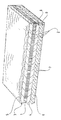
- the drawing shows a section of a bitumen waterproofing membrane with an embedding area for microwavable particles.
- the bitumen waterproofing membrane shown in the drawing comprises a fleece or fabric-like support insert 1, which is embedded on both sides in bitumen 2, so that an upper bitumen layer 3 is formed above the insert 1 and a lower bitumen layer 4 is formed below the insert 1.
- the upper bitumen layer 3 can be provided on the upper side with a scatter 5 made of sand or the like, while the lower bitumen layer 4 usually carries a removable protective film 6.
- the lower bitumen layer 4 is thicker than the upper bitumen layer 3.
- Particles 7 are embedded in the part of the lower bitumen layer 4 adjoining the underside according to the invention, in particular carbon particles which are in the form of soot, graphite or coal dust or preferably in Form of carbon fibers.
- the particle size of the carbon particles is in the order of 10 nanometers to 800 micrometers.
- carbon fibers In the case of carbon fibers, it has proven to be advantageous to use carbon fibers whose length is between 0.2 millimeters and 6 millimeters, while the diameter can be of the order of 1 to 50 micrometers.
- the embedding is carried out in an amount between 0.01 and 30 percent by weight based on the bitumen.
- the carbon particles can be embedded homogeneously in the entire lower bitumen layer 4, but it is also possible, as indicated in the drawing, to subdivide the lower bitumen layer 4 into an upper part 8 and a lower part 9, with carbon particles only in the lower part Part 9 will be embedded.
- Carbon particles can also be embedded in the upper bitumen layer 3; this is particularly advantageous if the bitumen waterproofing membrane is used to produce multi-layer waterproofing, i.e. if another bitumen waterproofing membrane is to be glued to the bitumen waterproofing membrane. In other cases, it is sufficient if carbon particles are embedded in the lower bitumen layer 4.
- the embedding can take place homogeneously in the embedding area, but it is also possible to have the concentration of the embedded particles decrease continuously or in steps from the outside of the bitumen waterproofing membrane into the interior of the membrane.
- Such a bitumen waterproofing membrane is after removing the protective film 6 on the surface to be sealed applied, it being particularly advantageous if a provisional fixation is achieved by an additional cold self-adhesive layer on the underside of the sealing membrane.
- microwave energy is applied, for example by a mobile microwave device combined with rollers, which is moved over the top of the membrane.
- the microwave radiation penetrates the roofing membrane and is only absorbed in the area of the sealing sheet in which carbon particles are located, so that heating only occurs in the area.
- This heating can be metered in such a way that, for example, temperatures between 40 ° C. and 80 ° C. are reached, that is to say relatively low temperatures compared to bonding with bitumen hot-melt adhesive or with the known flame treatment method. However, these temperatures are sufficient to achieve perfect adhesion to the underlay.
- the sealing membrane is provided on the underside with a removable protective film 6. It is not absolutely necessary for the sealing sheet to carry such a protective film 6.
- the sealing membrane is covered on the underside with a mineral scattering, for example from sand or talc.
- a mineral scattering for example from sand or talc.
- the heating occurs in the volume of the waterproofing membrane itself, so that an intimate connection of the underlay with the bituminous membrane itself can be achieved without an adhesive layer imparting adhesion being arranged in between.
- This is particularly advantageous if several such bitumen waterproofing membranes are glued together or in the seam and butt joint area of adjacent membranes, since the bitumen mass of both membranes can then flow into one another and produce a practically one-piece connection.
- bitumen materials which can be heated and softened by microwave radiation and can therefore be used in bitumen waterproofing membranes in the specified manner:
- Oxidation bitumen 100/40 85% Slate flour 10% soot 5%
- a quantity of this mass in the order of approximately 150 g is heated from a temperature of 20 ° C. to a temperature of 100 ° C. in 2 minutes at a microwave power of 600 watts.
- An amount of about 150 g of this composition is heated at a microwave power of 600 watts in two minutes from a temperature of 20 ° C to a temperature of about 100 ° C.
- An amount of about 150 g of this composition is heated at a microwave power of 600 watts in two minutes from a temperature of 20 ° C to a temperature of about 100 ° C.
- An amount of about 150 g of this composition is heated at a microwave power of 600 watts in two minutes from a temperature of 20 ° C to a temperature of about 27 ° C.
Landscapes
- Engineering & Computer Science (AREA)
- Mechanical Engineering (AREA)
- Architecture (AREA)
- Physics & Mathematics (AREA)
- Electromagnetism (AREA)
- Structural Engineering (AREA)
- Civil Engineering (AREA)
- Health & Medical Sciences (AREA)
- Toxicology (AREA)
- Textile Engineering (AREA)
- Chemical & Material Sciences (AREA)
- Organic Chemistry (AREA)
- Adhesives Or Adhesive Processes (AREA)
- Lining Or Joining Of Plastics Or The Like (AREA)
Description
- Die Erfindung betrifft ein Verfahren zum Verlegen und Abdichten von Bitumen-Abdichtungsbahnen auf Dächern oder dergleichen, bei dem man das Bitumen der Abdichtungsbahn erwärmt und die Abdichtungsbahn an die Unterlage andrückt und dabei anklebt oder verschweißt.
- Es ist bekannt, Bitumen-Abdichtungsbahnen mit Hilfe von heißflüssiger Bitumen-Klebemasse oder durch direktes Erwärmen mit offener Flamme (Flämmverfahren) miteinander zu verkleben. Der Umgang mit etwa 200°C heißem Bitumen sowie mit offener Flamme kann dabei gefährlich sein.
- Es sind in letzter Zeit Bitumen-Abdichtungsbahnen entwikkelt worden, die an der Unterseite selbstklebend ausgebildet sind. Diese sogenannten Kalt-Selbstklebebahnen haben jedoch den Nachteil, daß ihre Selbstklebekraft sehr stark abhängig ist von der Umgebungstemperatur bei der Verarbeitung, von der Staubfreiheit des Untergrundes sowie von eventuell anwesender Feuchtigkeit auf dem Untergrund.
- Es ist Aufgabe der Erfindung, ein Verfahren der gattungsgemäßen Art derart zu verbessern, daß die für die Verklebung notwendige Erweichung der Bitumen-Abdichtungsbahn in ungefährlicher Weise erreicht werden kann, wobei trotzdem die Sicherheit der Verklebung gegenüber Kaltselbstklebeschichten verbessert wird.
- Diese Aufgabe wird bei einem Verfahren der eingangs beschriebenen Art erfindungsgemäß dadurch gelöst, daß man in das Bitumen der Abdichtungsbahn durch Mikrowellenstrahlung erwärmbare Partikel einbettet und die Abdichtungsbahn durch Beaufschlagung mit Mikrowellenstrahlung in dem Bereich selektiv erwärmt, in den die Partikel eingebettet sind, so daß das Bitumen in dem erwärmten Bereich die für die Abdichtung notwendige Erweichung erfährt.
- Es ist dabei außerordentlich vorteilhaft, daß eine Erwärmung nur in dem Bereich erfolgt, in dem die durch die Mikrowellen erwärmbaren Partikel eingebettet sind, so daß es möglich ist, durch gezielte Verteilung der eingebetteten Partikel auch zu bestimmen, in welchem Bereich die Bitumen-Abdichtungsbahn erwärmt wird bzw. kalt bleibt. So ist es beispielsweise möglich, daß Bitumen im Bereich des normalerweise eingebetteten Stützgerüstes unerwärmt zu lassen, so daß in diesem Bereich keine Stabilitätseinbußen auftreten, während in dem Bereich, in dem die Verklebung erfolgt, also vorzugsweise an der Unterseite oder bei Mehrlagigkeit auch an der Oberseite der Bitumen-Abdichtungsbahn, eine selektive Erwärmung und damit eine Erzielung der notwendigen Klebrigkeit nur in den gewünschten Bereichen möglich werden.
- Die DE-PS 33 07 502 beschreibt zwar bereits ein Verfahren zum Verkleben von Teppichböden und anderen Bodenbelägen, bei dem an der Unterseite dieser Bodenbeläge ein bei Raumtemperatur trockener Klebstoff aufgebracht wird, der mittels Mikrowellenanregung erwärmt und dadurch klebefähig gemacht werden kann. Es handelt sich dabei aber um eine separat auf den Bodenbelag aufgebrachte Kleberschicht, und das beschriebene Verfahren ist auch ausdrücklich nur für das Verkleben von Teppichböden, Linoleum etc., also von Bodenbelägen mit dem Bodem bestimmt. Es ist überraschend, daß ein solches Verfahren auch bei Bitumen-Abdichtungsbahnen, die eine vollständig andere Zusammensetzung haben, verwendbar ist, wobei im Unterschied zu dem bekannten Verfahren nicht ein separater Klebstoff klebrig gemacht wird sondern die die Abdichtungsbahn selbst bildende Bitumenmasse. Nicht durch das schichtweise Auftragen einer durch Mikrowellen erwärmbaren Substanz sondern durch das Einbetten partikelförmiger Teilchen in die Bitumenmasse wird es möglich, eine gleichmäßige Erwärmung der Bitumenmasse nicht nur unmittelbar an der Oberfläche sondern auch über eine bestimmte Tiefe der Bitumen-Abdichtungsbahn zu erreichen, wobei durch die Einbettung zusätzlich die Möglichkeit gegeben wird,die Eindringtiefe der Erwärmung und auch die Verteilung der Temperatur im Innern der Bitumenbahn durch unterschiedliche Konzentration der Einbettung zu steuern. Daführ fehlen in der DE-PS 33 07 502 alle Anregungen.
- Ein besonderer Vorteil dieses Verfahrens liegt darin, daß man die Abdichtungsbahn vor dem Verkleben bereits in die endgültige Position auf die Unterlage auflegen kann, ohne daß dabei eine Verklebung oder Verschweißung erfolgt, d. h. das Auflegen wird gegenüber dem herkömmlichen Verfahren, bei dem unmittelbar während des Auflegens auch noch verklebt bzw. verschweißt werden muß, wesentlich erleichtert, da die Verbindung mit der darunterliegenden Schicht bei dem neuen Verfahren erst erfolgt, wenn die Abdichtungsbahn bereits ausgelegt ist.
- Bei einem besonders vorteilhaften Ausführungsbeispiel der Erfindung ist vorgesehen, daß man in das Bitumen Kohlenstoffpartikel einbettet, und zwar in einem Anteil von 0,01 bis etwa 30 Gewichtsprozent. Es ist dabei außerordentlich überraschend, daß durch die Einbettung von Kohlenstoffpartikeln in Bitumen eine Erwärmbarkeit durch Mikrowellenstrahlung ermöglicht wird. Wahrscheinlich liegt dies daran, daß an der Oberfläche der an sich nicht polaren Kohlenstoffpartikel polare Gruppen angelagert werden, die im Mikrowellenfeld eine Anregung erfahren und somit die Kohlenstoffpartikel und ihre Umgebung erwärmen. Die Einbettung der Kohlenstoffpartikel hat zusätzlich den Vorteil, daß in dem Einbettungsbereich durch die Kohlenstoffpartikel eine gegenüber dem Bitumen wesentlich verbesserte Wärmeleitung auftritt, so daß die Erwärmung in dem Einbettungsbereich gleichmäßig auf die Bitumenmasse verteilt wird. Wenn die Kohlenstoffpartikel nur in einer dünnen Schicht in die Bitumen-Abdichtbahn eingebettet werden, führt dies dazu, daß innerhalb der Schicht eine gute Wärmeleitfähigkeit gegeben ist, während senkrecht dazu die Wärmeleitfähigkeit durch die relativ schlechte Wärmeleitfähigkeit des Bitumens bestimmt wird. Durch die Mikrowellenanregung erzeugte Wärme wird daher innerhalb der Einbettungsschicht gleichmäßig verteilt, während die angrenzende Bitumenschicht nur sehr geringfügig erwärmt wird, also ihre Stabilität in vollem Umfange beibehält.
- Die Kohlenstoffpartikel können in Form von Ruß, Graphit oder Kohlestaub verwendet werden. Als besonders geeignet hat sich die Verwendung von Kohlenstoffasern herausgestellt, die wahrscheinlich in besonderer Weise geeignet sind, polare Gruppen anzulagern. Diese Kohlefasern haben zusätzlich einen stützenden und verstärkenden Effekt und verbessern dadurch die Formstabilität der Bitumen-Abdichtungsbahn während des Verlegungsvorganges, bei dem die erwärmte Bitumenmasse weich und formstabil ist.
- Die nachstehende Beschreibung bevorzugter Ausführungsformen der Erfindung dient im Zusammenhang mit der Zeichnung der näheren Erläuterung. Die Zeichnung zeigt einen Ausschnitt aus einer Bitumen-Abdichtungsbahn mit einem Einbettungsbereich für mikrowellenaktivierbare Partikel.
- Die in der Zeichnung ausschnittsweise dargestellte Bitumen-Abdichtungsbahn umfaßt eine vlies- oder gewebeartige Stützeinlage 1, die beidseitig in Bitumen 2 eingebettet ist, so daß sich oberhalb der Einlage 1 eine obere Bitumenschicht 3 und unterhalb der Einlage 1 eine untere Bitumenschicht 4 ausbilden. Die obere Bitumenschicht 3 kann an der Oberseite mit einer Abstreuung 5 aus Sand oder dergleichen versehen sein, während die untere Bitumenschicht 4 üblicherweise eine abziehbare Schutzfolie 6 trägt.
- In dem dargestellten Ausführungsbeispiel ist die untere Bitumenschicht 4 dicker ausgebildet als die obere Bitumenschicht 3. In den an die Unterseite anschließenden Teil der unteren Bitumenschicht 4 sind erfindungsgemäß Partikel 7 eingebettet, insbesondere Kohlenstoffpartikel, die in Form von Ruß, Graphit oder Kohlenstaub vorliegen oder vorzugsweise in Form von Kohlefasern. Die Teilchengröße der Kohlenstoffpartikel liegt in der Größenordnung von 10 Nanometern bis 800 Mikrometern.
- Bei den Kohlefasern hat es sich als günstig herausgestellt, Kohlefasern zu verwenden, deren Länge zwischen 0,2 Millimetern und 6 Millimetern liegt, während der Durchmesser eine Größenordnung von 1 bis 50 Mikrometer haben kann. Die Einbettung erfolgt dabei in einer Menge zwischen 0,01 und 30 Gewichtsprozent bezogen auf das Bitumen. Die Kohlenstoffpartikel können in der gesamten unteren Bitumenschicht 4 homogen eingebettet sein, es ist aber auch möglich, wie dies in der Zeichnung angedeutet ist, die untere Bitumenschicht 4 in einen oberen Teil 8 und einen unteren Teil 9 zu unterteilen, wobei Kohlepartikel nur in den unteren Teil 9 eingebettet werden.
- Kohlepartikel können auch in die obere Bitumenschicht 3 eingebettet sein; dies ist insbesondere dann von Vorteil, wenn die Bitumen-Abdichtungsbahn zur Herstellung mehrlagiger Abdichtungen verwendet wird, d.h. wenn auf die Bitumen-Abdichtungsbahn eine weitere Bitumen-Abdichtungsbahn aufgeklebt werden soll. In anderen Fällen genügt es, wenn eine Einbettung von Kohlenstoffpartikeln in die untere Bitumenschicht 4 erfolgt.
- Die Einbettung kann im Einbettungsbereich homogen erfolgen, es ist aber auch möglich, die Konzentration der eingebetteten Partikel von der Außenseite der Bitumen-Abdichtungsbahn in das Innere der Bahn hinein kontinuierlich oder stufenförmig abnehmen zu lassen.
- Eine derartige Bitumen-Abdichtungsbahn wird nach dem Abziehen der Schutzfolie 6 auf die abzudichtende Unterlage aufgelegt, wobei es besonders vorteilhaft ist, wenn durch eine zusätzliche Kaltselbstklebeschicht an der Unterseite der Abdichtungsbahn eine vorläufige Fixierung erreicht wird.
- Nach dem Auflegen wird die Abdichtungsbahn mit Mikrowellenenergie beaufschlagt, beispielsweise durch ein fahrbares, mit Walzen kombiniertes Mikrowellengerät, das über die Oberseite der Abdichtungsbahn gefahren wird. Die Mikrowellenstrahlung durchdringt die Dachbahn und wird nur in dem Bereich der Abdichtungsbahn absorbiert, in dem sich Kohlenstoffpartikel befinden, so daß auch nur in dem Bereich eine Erwärmung auftritt. Diese Erwärmung kann so dosiert werden, daß beispielsweise Temperaturen zwischen 40° C und 80° C erreicht werden, also gegenüber der Verklebung mit Bitumen-Heißklebemasse oder mit dem bekannten Flämmverfahren relativ niedrige Temperaturen. Diese Temperaturen reichen aber aus, um eine einwandfreie Verklebung mit der Unterlage zu erreichen.
- Bei dem dargestellten Ausführungsbeispiel ist die Abdichtungsbahn an der Unterseite mit einer abziehbaren Schutzfolie 6 versehen. Es ist nicht unbedingt notwendig, daß die Abdichtungsbahn eine solche Schutzfolie 6 trägt. Bei anderen Ausführungsformen ist die Abdichtungsbahn an der Unterseite mit einer mineralischen Abstreuung bedeckt, beispielsweise aus Sand oder Talkum. Bei der Erwärmung der Bitumenmasse mittels Mikrowellenstrahlung wird die Bitumenmasse so stark erweicht, daß sie im Bereich der Abdeckung fließt und die Abstreuungspartikel allseits umschließt und einbettet und außerdem eine innige Verbindung mit der darunterliegenden Unterlage eingeht, die ihrerseits eine weitere Bitumen-Abdichtungsbahn, mit Betondach oder dergleichen sein kann. Die Abstreuungspartikel werden dabei im Verbindungsbereich in die Bitumenmasse eingeschlossen.
- Es ist dabei äußerst vorteilhaft, daß die Erwärmung im Volumen der Abdichtungsbahn selbst auftritt, so daß eine innige Verbindung der Unterlage mit der Bitumenbahn selbst erreicht werden kann, ohne daß eine die Haftung vermittelnde Klebeschicht dazwischen angeordnet ist. Dies ist besonders vorteilhaft, wenn mehrere derartige Bitumen-Abdichtungsbahnen miteinander verklebt werden oder im Naht- und Stoßbereich benachbarter Bahnen, da dann die Bitumenmasse beider Bahnen ineinanderfließen kann und eine praktisch einstückige Verbindung herstellt.
- Durch die aufgrund der eingebetteten Partikel erhöhte Flächenwärmeleitfähigkeit wird nicht nur der Verlegevorgang beschleunigt, sondern es wird auch sichergestellt, daß alle Bereiche an der Klebefläche gleichmäßig erwärmt werden, so daß insgesamt eine wesentliche Erhöhung der Verklebeschicht erreicht werden kann.
- Nachstehend werden einige Beispiele für die Zusammensetzung von Bitumenmassen angegeben, die durch Mikrowellenstrahlung erwärmbar und erweichbar sind und daher in der angegebenen Weise in Bitumen-Abdichtungsbahnen Verwendung finden können:
-
Gewichtsprozent Oxidationsbitumen 100/40 85 % Schiefermehl 10 % Ruß 5 % - Eine Menge dieser Masse in der Größenordnung von ca. 150 g wird bei einer Mikrowellenleistung von 600 Watt in 2 Minuten von einer Temperatur von 20° C auf eine Temperatur von 100° C erwärmt.
-
Gewichtsprozent Destillationsbitumen B 200 63,5 % SBS Kautschuk 10,5 % Kohlenwasserstoffharz 4,9 % Kalksteinmehl 20 % Antioxidans 1 % Kohlefasern 0,1 % - Eine Menge von ca. 150 g dieser Zusammensetzung wird bei einer Mikrowellenleistung von 600 Watt in zwei Minuten von einer Temperatur von 20° C auf eine Temperatur von etwa 100° C erwärmt.
-
Gewichtsprozent Destillationsbitumen B 200 58,6 % SBS Kautschuk 10,5 % Kohlenwasserstoffharz 4,9 % Kalksteinmehl 20 % Antioxidans 1 % Ruß 5 % - Eine Menge von ca. 150 g dieser Zusammensetzung wird bei einer Mikrowellenleistung von 600 Watt in zwei Minuten von einer Temperatur von 20° C auf eine Temperatur von etwa 100° C erwärmt.
-
Gewichtsprozent Destillationsbitumen B 200 63,6 % SBS Kautschuk 10,5 % Kohlenwasserstoffharz 4,9 % Kalksteinmehl 20 % Antioxidans 1 % - Eine Menge von ca. 150 g dieser Zusammensetzung wird bei einer Mikrowellenleistung von 600 Watt in zwei Minuten von einer Temperatur von 20° C auf eine Temperatur von etwa 27° C erwärmt.
- Dieses Beispiel zeigt deutlich, daß ohne den Kohlezusatz nur eine unbedeutende Erwärmung der Bitumenmasse eintritt, die in keiner Weise ausreichend wäre, um eine Verklebung oder gar Verschweißung zu erreichen. Erst durch den Kohlezusatz wird die starke Erwärmung der Bitumenmasse ermöglicht.
Claims (5)
- Verfahren zum Verlegen und Abdichten von Bitumen-Abdichtungsbahnen auf Dächern oder dergleichen, bei dem man das Bitumen der Abdichtungsbahn erwärmt und die Abdichtungsbahn an die Unterlage andrückt und dabei anklebt oder verschweißt, dadurch gekennzeichnet, daß man in das Bitumen der Abdichtungsbahn durch Mikrowellenstrahlung erwärmbare Partikel einbettet und die Abdichtungsbahn durch Beaufschlagung mit Mikrowellenstrahlung in dem Bereich selektiv erwärmt, in den die Partikel eingebettet sind, so daß das Bitumen in dem erwärmten Bereich die für die Abdichtung notwendige Erweichung erfährt.
- Verfahren nach Anspruch 1, dadurch gekennzeichnet, daß man die Partikel in eine an die Unterseite der Abdichtungsbahn angrenzende Schicht einbettet.
- Verfahren nach Anspruch 1 oder 2, dadurch gekennzeichnet, daß man die Partikel in eine an die Oberseite der Abdichtungsbahn angrenzende Schicht einbettet.
- Verfahren nach einem der voranstehenden Ansprüche, dadurch gekennzeichnet, daß man in das Bitumen 0,01 bis 30 Gewichtsprozent Kohlenstoffpartikel einbettet.
- Verfahren nach Anspruch 4, dadurch gekennzeichnet, daß man die Kohlenstoffpartikel in Form von Ruß, Graphit, Kohlestaub oder Kohlefasern einbettet.
Priority Applications (3)
| Application Number | Priority Date | Filing Date | Title |
|---|---|---|---|
| DE8888103482T DE3871368D1 (de) | 1988-03-05 | 1988-03-05 | Verfahren zum verlegen und abdichten von bitumen-abdichtungsbahnen und abdichtungsbahn zur durchfuehrung dieses verfahrens. |
| AT88103482T ATE76467T1 (de) | 1988-03-05 | 1988-03-05 | Verfahren zum verlegen und abdichten von bitumen- abdichtungsbahnen und abdichtungsbahn zur durchfuehrung dieses verfahrens. |
| EP88103482A EP0331765B2 (de) | 1988-03-05 | 1988-03-05 | Verfahren zum Verlegen und Abdichten von Bitumen-Abdichtungsbahnen und Abdichtungsbahn zur Durchführung dieses Verfahrens |
Applications Claiming Priority (1)
| Application Number | Priority Date | Filing Date | Title |
|---|---|---|---|
| EP88103482A EP0331765B2 (de) | 1988-03-05 | 1988-03-05 | Verfahren zum Verlegen und Abdichten von Bitumen-Abdichtungsbahnen und Abdichtungsbahn zur Durchführung dieses Verfahrens |
Publications (3)
| Publication Number | Publication Date |
|---|---|
| EP0331765A1 EP0331765A1 (de) | 1989-09-13 |
| EP0331765B1 EP0331765B1 (de) | 1992-05-20 |
| EP0331765B2 true EP0331765B2 (de) | 1995-10-11 |
Family
ID=8198777
Family Applications (1)
| Application Number | Title | Priority Date | Filing Date |
|---|---|---|---|
| EP88103482A Expired - Lifetime EP0331765B2 (de) | 1988-03-05 | 1988-03-05 | Verfahren zum Verlegen und Abdichten von Bitumen-Abdichtungsbahnen und Abdichtungsbahn zur Durchführung dieses Verfahrens |
Country Status (3)
| Country | Link |
|---|---|
| EP (1) | EP0331765B2 (de) |
| AT (1) | ATE76467T1 (de) |
| DE (1) | DE3871368D1 (de) |
Families Citing this family (4)
| Publication number | Priority date | Publication date | Assignee | Title |
|---|---|---|---|---|
| DE3907144A1 (de) * | 1989-03-06 | 1990-09-13 | Michael Gerhardt | Verfahren zum reversiblen befestigen grossflaechiger bahnen auf unterlagen |
| TW386056B (en) * | 1996-08-05 | 2000-04-01 | Senco Products | Method of adhering roll goods to a work surface and article of roll goods including an adhesive device |
| WO2018186297A1 (ja) * | 2017-04-03 | 2018-10-11 | リンテック株式会社 | 高周波誘電加熱接着シート、及び高周波誘電加熱接着シートを用いてなる接着方法 |
| CN116752770A (zh) * | 2023-06-13 | 2023-09-15 | 北京东方雨虹防水技术股份有限公司 | 吸波发热卷材铺设施工工艺及施工设备 |
Family Cites Families (3)
| Publication number | Priority date | Publication date | Assignee | Title |
|---|---|---|---|---|
| AU3945478A (en) * | 1977-09-02 | 1980-03-06 | Pickermann O | Asphalt production |
| US4253898A (en) * | 1979-12-17 | 1981-03-03 | The B. F. Goodrich Company | Bonding composition and microwave process for bonding together plastic components |
| DE3307502C2 (de) * | 1983-03-03 | 1985-04-18 | Helmut 8900 Augsburg Piller | Verfahren und Vorrichtung zum Verkleben von Bodenbelägen, sowie Bodenbelag zur Durchführung des Verfahrens |
-
1988
- 1988-03-05 AT AT88103482T patent/ATE76467T1/de not_active IP Right Cessation
- 1988-03-05 EP EP88103482A patent/EP0331765B2/de not_active Expired - Lifetime
- 1988-03-05 DE DE8888103482T patent/DE3871368D1/de not_active Expired - Fee Related
Also Published As
| Publication number | Publication date |
|---|---|
| EP0331765B1 (de) | 1992-05-20 |
| EP0331765A1 (de) | 1989-09-13 |
| DE3871368D1 (de) | 1992-06-25 |
| ATE76467T1 (de) | 1992-06-15 |
Similar Documents
| Publication | Publication Date | Title |
|---|---|---|
| DE2611177A1 (de) | Verfahren zum aufbringen eines bituminoesen oder eines wasserdichten und waermedaemmenden dachbelags | |
| DE69004262T2 (de) | Bituminöses beschichtungsmaterial und verfahren zur herstellung einer bituminösen beschichtung auf einem substrat. | |
| EP0350541A1 (de) | Bituminöses Dachdeckungsmaterial | |
| EP0331765B2 (de) | Verfahren zum Verlegen und Abdichten von Bitumen-Abdichtungsbahnen und Abdichtungsbahn zur Durchführung dieses Verfahrens | |
| DE3307502C2 (de) | Verfahren und Vorrichtung zum Verkleben von Bodenbelägen, sowie Bodenbelag zur Durchführung des Verfahrens | |
| DE102010019688A1 (de) | Verfahren und Vorrichtung zum Verschweißen oder Verkleben flächiger Bauwerksabdichtungen | |
| EP0262317A1 (de) | Bituminöse Dichtungsbahn für Brückenabdichtungen | |
| DE4036876A1 (de) | Mikrowellenaktivierung von thermoplasten, sowie verfahren zur sicheren anwendung offener und halboffener mikrowellenstrahlung | |
| DE8804605U1 (de) | Belagbahn | |
| WO1990010679A2 (de) | Verfahren zum reversiblen befestigen von grossflächigen bahnen auf unterlagen | |
| DE8623017U1 (de) | Bitumenbahn mit Abdeckschicht | |
| DE19937111C1 (de) | Verfahren zum Verlegen kaltselbstklebender Bitumenabdichtungsbahnen und Bitumenabdichtungsbahn | |
| DE4128896C2 (de) | Dichtungsbahn mit wenigstens einer thermoplastischen Deckschicht für Dach- und Bauwerksabdichtung und mit einer Ausgleichschicht und Verfahren zu deren Herstellung | |
| DE4447022C2 (de) | Thermoaktive Selbstklebebahn | |
| DE4220770C2 (de) | Verfahren zum Verlegen von Fliesen | |
| DE2439574C2 (de) | Bauwerksabdichtung, insbesondere Brückenabdichtung | |
| EP1130186A2 (de) | Verfahren zum Verlegen von Dachdichtungsbahnen | |
| DE2221237C3 (de) | Äthylencopolymerhaltige, bituminöse, zur Herstellung von wasserdichten und säurebeständigen Abdeckungen dienende Dichtungsbahn | |
| DE60111410T2 (de) | Verfahren zur herstellung einer folie mit einer bituminösen schicht und derart hergestellte folie | |
| DE29510084U1 (de) | Unterdachbahn | |
| DE8901224U1 (de) | Verlegbare Bahn zum Abdichten von Dächern o.dgl. | |
| DE60027222T2 (de) | Verfahren zum Verlegen einer plattenförmigen Beschichtung auf einem Träger | |
| DE2433089A1 (de) | Feuerhemmender flachdach-oberflaechenschutz | |
| AT303805B (de) | Isolierung und Verfahren zu deren Herstellung | |
| DE3611939A1 (de) | Thermoplastische abdichtungsbahn |
Legal Events
| Date | Code | Title | Description |
|---|---|---|---|
| PUAI | Public reference made under article 153(3) epc to a published international application that has entered the european phase |
Free format text: ORIGINAL CODE: 0009012 |
|
| 17P | Request for examination filed |
Effective date: 19881203 |
|
| AK | Designated contracting states |
Kind code of ref document: A1 Designated state(s): AT BE CH DE ES FR GB IT LI NL SE |
|
| 17Q | First examination report despatched |
Effective date: 19910423 |
|
| GRAA | (expected) grant |
Free format text: ORIGINAL CODE: 0009210 |
|
| AK | Designated contracting states |
Kind code of ref document: B1 Designated state(s): AT BE CH DE ES FR GB IT LI NL SE |
|
| PG25 | Lapsed in a contracting state [announced via postgrant information from national office to epo] |
Ref country code: IT Free format text: LAPSE BECAUSE OF FAILURE TO SUBMIT A TRANSLATION OF THE DESCRIPTION OR TO PAY THE FEE WITHIN THE PRE;WARNING: LAPSES OF ITALIAN PATENTS WITH EFFECTIVE DATE BEFORE 2007 MAY HAVE OCCURRED AT ANY TIME BEFORE 2007. THE CORRECT EFFECTIVE DATE MAY BE DIFFERENT FROM THE ONE RECORDED.SCRIBED TIME-LIMIT Effective date: 19920520 Ref country code: BE Effective date: 19920520 Ref country code: NL Effective date: 19920520 Ref country code: ES Free format text: THE PATENT HAS BEEN ANNULLED BY A DECISION OF A NATIONAL AUTHORITY Effective date: 19920520 Ref country code: SE Effective date: 19920520 Ref country code: GB Effective date: 19920520 Ref country code: FR Effective date: 19920520 |
|
| REF | Corresponds to: |
Ref document number: 76467 Country of ref document: AT Date of ref document: 19920615 Kind code of ref document: T |
|
| REF | Corresponds to: |
Ref document number: 3871368 Country of ref document: DE Date of ref document: 19920625 |
|
| EN | Fr: translation not filed | ||
| NLV1 | Nl: lapsed or annulled due to failure to fulfill the requirements of art. 29p and 29m of the patents act | ||
| GBV | Gb: ep patent (uk) treated as always having been void in accordance with gb section 77(7)/1977 [no translation filed] | ||
| PLBI | Opposition filed |
Free format text: ORIGINAL CODE: 0009260 |
|
| PG25 | Lapsed in a contracting state [announced via postgrant information from national office to epo] |
Ref country code: AT Effective date: 19930305 |
|
| PG25 | Lapsed in a contracting state [announced via postgrant information from national office to epo] |
Ref country code: LI Effective date: 19930331 Ref country code: CH Effective date: 19930331 |
|
| 26 | Opposition filed |
Opponent name: OESTERREICHISCHE HERAKLITH AG Effective date: 19930219 |
|
| REG | Reference to a national code |
Ref country code: CH Ref legal event code: PL |
|
| PUAH | Patent maintained in amended form |
Free format text: ORIGINAL CODE: 0009272 |
|
| STAA | Information on the status of an ep patent application or granted ep patent |
Free format text: STATUS: PATENT MAINTAINED AS AMENDED |
|
| 27A | Patent maintained in amended form |
Effective date: 19951011 |
|
| AK | Designated contracting states |
Kind code of ref document: B2 Designated state(s): AT BE CH DE ES FR GB IT LI NL SE |
|
| REG | Reference to a national code |
Ref country code: CH Ref legal event code: AEN Free format text: AUFRECHTERHALTUNG DES PATENTES IN GEAENDERTER FORM |
|
| EN | Fr: translation not filed | ||
| PGFP | Annual fee paid to national office [announced via postgrant information from national office to epo] |
Ref country code: DE Payment date: 20000427 Year of fee payment: 13 |
|
| PG25 | Lapsed in a contracting state [announced via postgrant information from national office to epo] |
Ref country code: DE Free format text: LAPSE BECAUSE OF NON-PAYMENT OF DUE FEES Effective date: 20020101 |