EP0331498B1 - Verfahren zum Vermindern der Eisenverluste in Elektroblechen durch Schaffung hitzebeständiger, verfeinerter Bereichsstrukturen - Google Patents
Verfahren zum Vermindern der Eisenverluste in Elektroblechen durch Schaffung hitzebeständiger, verfeinerter Bereichsstrukturen Download PDFInfo
- Publication number
- EP0331498B1 EP0331498B1 EP89302104A EP89302104A EP0331498B1 EP 0331498 B1 EP0331498 B1 EP 0331498B1 EP 89302104 A EP89302104 A EP 89302104A EP 89302104 A EP89302104 A EP 89302104A EP 0331498 B1 EP0331498 B1 EP 0331498B1
- Authority
- EP
- European Patent Office
- Prior art keywords
- electron beam
- sheet
- strip
- core loss
- heat resistant
- Prior art date
- Legal status (The legal status is an assumption and is not a legal conclusion. Google has not performed a legal analysis and makes no representation as to the accuracy of the status listed.)
- Expired - Lifetime
Links
- 238000000034 method Methods 0.000 title claims abstract description 32
- 239000010959 steel Substances 0.000 title abstract description 61
- 229910000831 Steel Inorganic materials 0.000 title abstract description 60
- 238000010894 electron beam technology Methods 0.000 claims abstract description 79
- 229910000976 Electrical steel Inorganic materials 0.000 claims abstract description 26
- 230000000694 effects Effects 0.000 claims abstract description 17
- 230000007547 defect Effects 0.000 claims abstract description 13
- 238000004519 manufacturing process Methods 0.000 claims abstract description 12
- 239000011248 coating agent Substances 0.000 claims description 42
- 238000000576 coating method Methods 0.000 claims description 42
- 238000000137 annealing Methods 0.000 claims description 23
- 230000035699 permeability Effects 0.000 claims description 19
- 230000005291 magnetic effect Effects 0.000 claims description 15
- 229910052751 metal Inorganic materials 0.000 claims description 11
- 239000002184 metal Substances 0.000 claims description 11
- 238000005096 rolling process Methods 0.000 claims description 9
- 230000005381 magnetic domain Effects 0.000 claims description 6
- 238000002844 melting Methods 0.000 claims 1
- 230000008018 melting Effects 0.000 claims 1
- 238000009413 insulation Methods 0.000 abstract description 2
- 239000000696 magnetic material Substances 0.000 abstract description 2
- XUIMIQQOPSSXEZ-UHFFFAOYSA-N Silicon Chemical compound [Si] XUIMIQQOPSSXEZ-UHFFFAOYSA-N 0.000 description 12
- 229910052710 silicon Inorganic materials 0.000 description 12
- 239000010703 silicon Substances 0.000 description 12
- 239000000463 material Substances 0.000 description 9
- 239000000047 product Substances 0.000 description 9
- 239000000203 mixture Substances 0.000 description 8
- 230000009467 reduction Effects 0.000 description 7
- 229910052839 forsterite Inorganic materials 0.000 description 6
- HCWCAKKEBCNQJP-UHFFFAOYSA-N magnesium orthosilicate Chemical compound [Mg+2].[Mg+2].[O-][Si]([O-])([O-])[O-] HCWCAKKEBCNQJP-UHFFFAOYSA-N 0.000 description 6
- 238000001953 recrystallisation Methods 0.000 description 6
- 238000005097 cold rolling Methods 0.000 description 4
- 238000011161 development Methods 0.000 description 4
- 230000006872 improvement Effects 0.000 description 4
- CPLXHLVBOLITMK-UHFFFAOYSA-N magnesium oxide Inorganic materials [Mg]=O CPLXHLVBOLITMK-UHFFFAOYSA-N 0.000 description 4
- 239000000395 magnesium oxide Substances 0.000 description 4
- 239000000155 melt Substances 0.000 description 4
- 230000008569 process Effects 0.000 description 4
- 238000012545 processing Methods 0.000 description 4
- 238000007670 refining Methods 0.000 description 4
- 238000012360 testing method Methods 0.000 description 4
- 238000005266 casting Methods 0.000 description 3
- 230000001419 dependent effect Effects 0.000 description 3
- 238000009826 distribution Methods 0.000 description 3
- 230000003993 interaction Effects 0.000 description 3
- 230000007246 mechanism Effects 0.000 description 3
- 230000001681 protective effect Effects 0.000 description 3
- IJGRMHOSHXDMSA-UHFFFAOYSA-N Atomic nitrogen Chemical compound N#N IJGRMHOSHXDMSA-UHFFFAOYSA-N 0.000 description 2
- 230000006866 deterioration Effects 0.000 description 2
- 238000005530 etching Methods 0.000 description 2
- 239000011521 glass Substances 0.000 description 2
- 238000005098 hot rolling Methods 0.000 description 2
- AXZKOIWUVFPNLO-UHFFFAOYSA-N magnesium;oxygen(2-) Chemical compound [O-2].[Mg+2] AXZKOIWUVFPNLO-UHFFFAOYSA-N 0.000 description 2
- 229910052757 nitrogen Inorganic materials 0.000 description 2
- 238000010899 nucleation Methods 0.000 description 2
- 230000006911 nucleation Effects 0.000 description 2
- 239000011148 porous material Substances 0.000 description 2
- 239000000161 steel melt Substances 0.000 description 2
- 229910052717 sulfur Inorganic materials 0.000 description 2
- NINIDFKCEFEMDL-UHFFFAOYSA-N Sulfur Chemical compound [S] NINIDFKCEFEMDL-UHFFFAOYSA-N 0.000 description 1
- 238000004458 analytical method Methods 0.000 description 1
- 238000005452 bending Methods 0.000 description 1
- 230000009286 beneficial effect Effects 0.000 description 1
- 230000008901 benefit Effects 0.000 description 1
- 229910052799 carbon Inorganic materials 0.000 description 1
- 229910052802 copper Inorganic materials 0.000 description 1
- 239000010949 copper Substances 0.000 description 1
- 239000013078 crystal Substances 0.000 description 1
- 238000005520 cutting process Methods 0.000 description 1
- 125000004122 cyclic group Chemical group 0.000 description 1
- 230000007423 decrease Effects 0.000 description 1
- 238000013461 design Methods 0.000 description 1
- 230000002349 favourable effect Effects 0.000 description 1
- 239000012467 final product Substances 0.000 description 1
- 238000010438 heat treatment Methods 0.000 description 1
- 238000003384 imaging method Methods 0.000 description 1
- 239000012535 impurity Substances 0.000 description 1
- 230000006698 induction Effects 0.000 description 1
- 230000005764 inhibitory process Effects 0.000 description 1
- 230000000977 initiatory effect Effects 0.000 description 1
- SZVJSHCCFOBDDC-UHFFFAOYSA-N iron(II,III) oxide Inorganic materials O=[Fe]O[Fe]O[Fe]=O SZVJSHCCFOBDDC-UHFFFAOYSA-N 0.000 description 1
- 150000002739 metals Chemical class 0.000 description 1
- 230000004048 modification Effects 0.000 description 1
- 238000012986 modification Methods 0.000 description 1
- 150000004767 nitrides Chemical class 0.000 description 1
- 238000005457 optimization Methods 0.000 description 1
- 239000002244 precipitate Substances 0.000 description 1
- 238000000746 purification Methods 0.000 description 1
- 238000007493 shaping process Methods 0.000 description 1
- 239000011593 sulfur Substances 0.000 description 1
- 239000000725 suspension Substances 0.000 description 1
- 150000003568 thioethers Chemical class 0.000 description 1
- 238000003466 welding Methods 0.000 description 1
Images

Classifications
-
- C—CHEMISTRY; METALLURGY
- C21—METALLURGY OF IRON
- C21D—MODIFYING THE PHYSICAL STRUCTURE OF FERROUS METALS; GENERAL DEVICES FOR HEAT TREATMENT OF FERROUS OR NON-FERROUS METALS OR ALLOYS; MAKING METAL MALLEABLE, e.g. BY DECARBURISATION OR TEMPERING
- C21D1/00—General methods or devices for heat treatment, e.g. annealing, hardening, quenching or tempering
- C21D1/34—Methods of heating
-
- H—ELECTRICITY
- H01—ELECTRIC ELEMENTS
- H01F—MAGNETS; INDUCTANCES; TRANSFORMERS; SELECTION OF MATERIALS FOR THEIR MAGNETIC PROPERTIES
- H01F1/00—Magnets or magnetic bodies characterised by the magnetic materials therefor; Selection of materials for their magnetic properties
- H01F1/01—Magnets or magnetic bodies characterised by the magnetic materials therefor; Selection of materials for their magnetic properties of inorganic materials
- H01F1/03—Magnets or magnetic bodies characterised by the magnetic materials therefor; Selection of materials for their magnetic properties of inorganic materials characterised by their coercivity
- H01F1/12—Magnets or magnetic bodies characterised by the magnetic materials therefor; Selection of materials for their magnetic properties of inorganic materials characterised by their coercivity of soft-magnetic materials
- H01F1/14—Magnets or magnetic bodies characterised by the magnetic materials therefor; Selection of materials for their magnetic properties of inorganic materials characterised by their coercivity of soft-magnetic materials metals or alloys
- H01F1/16—Magnets or magnetic bodies characterised by the magnetic materials therefor; Selection of materials for their magnetic properties of inorganic materials characterised by their coercivity of soft-magnetic materials metals or alloys in the form of sheets
-
- C—CHEMISTRY; METALLURGY
- C21—METALLURGY OF IRON
- C21D—MODIFYING THE PHYSICAL STRUCTURE OF FERROUS METALS; GENERAL DEVICES FOR HEAT TREATMENT OF FERROUS OR NON-FERROUS METALS OR ALLOYS; MAKING METAL MALLEABLE, e.g. BY DECARBURISATION OR TEMPERING
- C21D8/00—Modifying the physical properties by deformation combined with, or followed by, heat treatment
- C21D8/12—Modifying the physical properties by deformation combined with, or followed by, heat treatment during manufacturing of articles with special electromagnetic properties
- C21D8/1294—Modifying the physical properties by deformation combined with, or followed by, heat treatment during manufacturing of articles with special electromagnetic properties involving a localized treatment
-
- H—ELECTRICITY
- H01—ELECTRIC ELEMENTS
- H01F—MAGNETS; INDUCTANCES; TRANSFORMERS; SELECTION OF MATERIALS FOR THEIR MAGNETIC PROPERTIES
- H01F1/00—Magnets or magnetic bodies characterised by the magnetic materials therefor; Selection of materials for their magnetic properties
- H01F1/01—Magnets or magnetic bodies characterised by the magnetic materials therefor; Selection of materials for their magnetic properties of inorganic materials
- H01F1/03—Magnets or magnetic bodies characterised by the magnetic materials therefor; Selection of materials for their magnetic properties of inorganic materials characterised by their coercivity
- H01F1/12—Magnets or magnetic bodies characterised by the magnetic materials therefor; Selection of materials for their magnetic properties of inorganic materials characterised by their coercivity of soft-magnetic materials
- H01F1/14—Magnets or magnetic bodies characterised by the magnetic materials therefor; Selection of materials for their magnetic properties of inorganic materials characterised by their coercivity of soft-magnetic materials metals or alloys
- H01F1/147—Alloys characterised by their composition
- H01F1/153—Amorphous metallic alloys, e.g. glassy metals
- H01F1/15341—Preparation processes therefor
Definitions
- This invention relates to a method for working the surface of electrical sheet or strip products to affect the domain size so as to reduce the core loss properties. More particularly, this invention relates to providing localized strains in the surface of electrical steels to provide heat resistant domain refinement.
- the Goss secondary recrystallization texture (110) [001] in terms of Miller's indices, results in improved magnetic properties, particularly permeability and core loss over nonoriented silicon steels.
- the Goss texture refers to the body-centered cubic lattice comprising the grain or crystal being oriented in the cube-on-edge position.
- the texture or grain orientation of this type has a cube edge parallel to the rolling direction and in the plane of rolling. with the (110) plane being in the sheet plane.
- steels having this orientation are characterized by a relatively high permeability in the rolling direction and a relatively low permeability in a direction at right angles thereto.
- typical steps include providing a melt having of the order of 2-4.5% silicon, casting the melt, hot rolling, cold rolling the steel to final gauge; e.g., of up to about 14 mils (0.3556mm) and typically 7 to 9 mils (0.1778 to 0.2286mm) with an intermediate annealing when two or more cold rollings are used, decarburizing the steel, applying a refractory oxide base coating, such as a magnesium oxide coating, to the steel, and final texture annealing the steel at elevated temperatures in order to produce the desired secondary recrystallization and purification treatment to remove impurities such as nitrogen and sulfur.
- the development of the cube-on-edge orientation is dependent upon the mechanism of secondary recrystallization wherein during recrystallization, secondary cube-on-edge oriented grains are preferentially grown at the expense of primary grains having a different and undesirable orientation.
- Grain-oriented silicon steel is conventionally used in electrical applications, such as power transformers, distribution transformers, generators, and the like.
- the domain structure and resistivity of the steel in electrical applications permits cyclic variation of the applied magnetic field with limited energy loss, which is termed "core loss". It is desirable, therefore, in steels used for such applications, that such steels have reduced core loss values.
- sheet and “strip” are used interchangeably and mean the same unless otherwise specified.
- first, regular or conventional grain oriented silicon steel and second, high permeability grain oriented silicon steel are generally characterized by permeabilities of less than 1850 at 10 Oersteds (795.77A/m) with a core loss of greater than 0.400 watts per pound (WPP) (0.882 watts per kilogram) at 1.5 Tesla at 60 Hertz for nominally 8 mil (0.2286mm) material.
- WPP watts per pound
- High permeability grain oriented silicon steels are characterized by higher permeabilities and lower core losses. Such higher permeability steels may be the result of compositional changes alone or together with process changes.
- high permeability silicon steels may contain nitrides, sulfides and/or borides which contribute to the precipitates and inclusions of the inhibition system which contribute to the properties of the final steel product.
- high permeability silicon steels generally undergo cold reduction operations to final gauge wherein a final heavy cold reduction of the order of greater than 80% is made in order to facilitate the grain orientation.
- domain size and thereby core loss values of electrical steels may be reduced if the steel is subjected to any of various practices to induce localized strains in the surface of the steel.
- Such practices may be generally referred to as “scribing” or “domain refining” and are performed after the final high temperature annealing operation. If the steel is scribed after the final texture annealing, then there is induced a localized stress state in the texture annealed sheet so that the domain wall spacing is reduced.
- These disturbances typically are relatively narrow, straight lines, or scribes generally spaced at regular intervals. The scribe lines are substantially transverse to the rolling direction and typically are applied to only one side of the steel.
- the particular end use and the fabrication techniques may require that the scribed steel product survive a stress relief anneal (SRA), while other products do not undergo such an SRA.
- SRA stress relief anneal
- a flat, domain refined silicon steel which is not subjected to stress relief annealing.
- the scribed steel does not have to provide heat resistant domain refinement.
- What is needed is a method and apparatus for treating electrical sheet products to effect domain refinement which is heat resistant and can withstand a stress relief anneal (SRA) typically used in the fabrication of transformers. Still further, the method and apparatus should be suitable for treating grain-oriented silicon steels of both the high permeability and conventional types as well as amorphous type electrical materials.
- SRA stress relief anneal
- a method for improving the core loss of an electrical sheet or strip having final annealed magnetic domain structures as set-out in the appended claims and which in its principal features includes subjecting at least one surface of the sheet to an electron beam treatment Lo produce narrow substantially parallel bands of treated regions separated by untreated regions substantially transverse to the direction of sheet manufacture.
- the electron beam treatment includes providing an energy density sufficient to produce a permanent defect in each treated region to effect a refinement of magnetic domain wall spacing which is heat resistant.
- the treated sheet or strip may be subsequently processed by annealing, applying a tension coating, or some combination to reduce the core loss.
- a method for improving the magnetic properties of regular and high permeability grain-oriented silicon steels and amorphous materials.
- the method is useful for treating such steels to effect a permanent refinement of the magnetic domain wall spacing for improving core loss of the steel strip.
- the width of the scribed lines and the spacing of the treated regions or lines substantially transverse to the rolling direction of the silicon strip and the casting direction of amorphous material is conventional. What is not conventional, however, is the method of the present invention for effecting such magnetic domain wall spacing in a controlled manner such that the steel so treated has improved magnetic properties which are heat resistant to survive a stress relief anneal (SRA).
- SRA stress relief anneal
- Typical electron beam generating equipment used in welding and cutting requires that the electron beam be generated in and used in at least a partial vacuum in order to provide control of the beam and spot size or width focused on the workpiece.
- Such typical equipment was modified and used in the development of the present invention.
- a particular modification included high frequency electron beam deflection coils to generate selected patterns to scan the electrical sheet.
- the speed at which the electron beam traversed the steel sheets was controlled in the laboratory development work by setting the scan frequency with a wave form generator (sold by Wavetek) which drove the electron beam deflection coils.
- the electron beam useful in the present invention could have a direct current (DC) for providing continuous beam energy or a modulated current for providing pulsed or discontinuous beam energy.
- DC direct current
- the DC electron beam was used in the examples.
- a single electron beam was used, a plurality of beams may be used to create a single treated region or to create a plurality of regions at the same time.
- the current of the electron beam may range from 0.5 to 100 milliamperes (ma); however, narrower preferred ranges may be selected for specific equipment and conditions as described herein.
- the voltage of the electron beam generated may range from 20 to 200 kilovolts (kV), preferably 60 to 150 kV. For these ranges of currents and voltages, the speed at which the electron beam traverses the steel strip must be properly selected in order to effect the domain refinement and create a permanent defect which will improve core loss values which survive subsequent annealing. It has been found that the scanning speed may range up to 10,000 ips (254m per second).
- the parameters of current, voltage, scan speed, and strip speed are interdependent for a desired scribing effect; selected and preferred ranges of the parameters are dependent upon machine design and production requirements.
- the electron beam current is adjusted to compensate for the speed of the strip and the electron beam scan speed.
- the scan speed for a given width of strip would be determined and from that the desired and suitable electrical parameters would be set to satisfactorily treat the strip in accordance with the present invention.
- the size of the electron beam focused on and imparting energy to the strip is also an important factor in determining the effect of domain refinement.
- Conventional electron beam generating equipment can produce electron beam diameters of the order of 4 to 16 mils (0.102 to 0.406mm) in a hard vacuum, usually less than 10 ⁇ 4 Torr (1,333 ⁇ 10 ⁇ Pa).
- the electron beam generally produced focuses an elliptical or circular spot size. It is expected that other shapes may be suitable.
- the focussed beam spot size effectively determines the width of the narrow irradiated or treated regions.
- the size across the focussed spot, in terms of diameter or width, of the electron beam used in the laboratory development work herein was of the order of 5 mils (0.127mm), unless otherwise specified.
- a key parameter for the electron beam treatment in accordance with the present invention is the energy being transferred to the electrical material. Particularly, it was found that it is not the beam power, but the energy density which is determinative of the extent of treatment to the sheet material.
- the energy density is a function of the electron current, voltage, scanning speed, spot size, and the number of teams used on the treated region.
- the energy density may be defined as the energy per area in units of Joules per square inch (J/in).
- the areal energy density should be about 150 J/in (23.25 J/cm) or more and may range from 150 to 4000 J/in (23.25 to 620 J/cm).
- the electron beam spot size of 5 mils (0.127mm) was constant.
- the linear energy density can be simply calculated by dividing the beam power (in J/sec. units) by the beam scanning speed (in ips units). With low beam currents of 0.5 to 10 ma, the linear energy density, expressed in such units should be about 0.75 J/in. (0.3 J/cm) or more and may range from 0.75 to 20 J/in. (0.3 to 7.9 J/cm). Broadly, the upper limit of energy density is that value at which the sheet is severely damaged or cut through.
- the specific parameters within the ranges identified depend upon the type and end use of the domain refined electrical steel. When the end use is in distribution or wound core transformers, for example, where heat resistant domain refining is needed, then the parameters will need to be selected so that the controlled working and damage to the steel will survive a subsequent stress relief anneal which is used to relieve the mechanical stresses induced in making fabricated steel articles.
- the electron beam treatment for the present invention will vary somewhat between grain-oriented silicon steels of the regular or conventional type and a high permeability steel as well as with amorphous metals. Any of these magnetic materials may have an insulative coating thereon, such as a mill glass, applied coating, for combination thereof.
- Another factor to consider in establishing the parameters for electron beam treatment is whether or not the coating on the final annealed electrical steel is damaged as a result of the treatment. Generally, it would be advantageous and desirable that the coating would not be damaged or removed in the areas of the induced stress so as to avoid any subsequent recoating process.
- An acceptable trade-off, however, to subsequent recoating steps is an electron beam treatment which provides a permanent and heat resistant domain refinement.
- the present invention described in detail hereafter has utility with grain-oriented silicon steel generally, the following typical compositions are two examples of silicon steel compositions adapted for use with the present invention and which were used in developing the present invention.
- the steel melts of the two steels initially contained the nominal compositions of: Steel C N Mn S Si Cu B Fe 1 .030 50 PPM .07 .022 3.15 .22 -- Bal. 2 .030 Less than 50PPM .038 .017 3.15 .30 10 PPM Bal.
- composition ranges are in weight percent.
- Steel 1 is a conventional grain-oriented silicon steel and Steel 2 is a high permeability grain-oriented silicon steel. Both Steels 1 and 2 were produced by casting, hot rolling, normalizing, cold rolling to final gauge with an intermediate annealing when two or more cold rolling stages were used, decarburizing, coating with MgO and final texture annealing to achieve the desired secondary recrystallization of cube-on-edge orientation. After decarburizing the steel, a refractory oxide base coating containing primarily magnesium oxide was applied before final texture annealing at elevated temperature, such annealing caused a reaction at the steel surface to create a forsterite base coating. Although the steel melts of Steels 1 and 2 initially contained the nominal compositions recited above, after final texture annealing, the C, N and S were reduced to trace levels of less than about 0.001% by weight.
- the strips were about 1.2 inches (30.5mm) wide and were passed under a stationary or fixed electron beam at 3.3 ips (83.82mm/second) and subsequently stress relied annealed, tension coated, and again stress relief annealed as indicated.
- the electron beam was generated by a machine manufactured by Leybold Heraeus.
- the machine generated a beam having a spot size of about 5 mils (0.127mm) for treating the steels in a vacuum of about 10 ⁇ 4 Torr (1.333 ⁇ 10 ⁇ 2 Pa) or better.
- the parallel bands of treated regions were about 6 millimeters apart.
- Pack 40-33A was annealed at 1475°F (800°C) to flatten the strips and exhibited watt losses which were lower than the Control values.
- the strips of Pack 40-33A were then coated with a known tension coating. The watt losses were slightly lower after tension coating than the Control Pack in the as-received condition.
- Domain imaging was conducted in a known manner with magnetite suspension and flexible permanent magnets to determine the effect on domain refinement.
- Figure 2 is a 7.5X photomicrograph which shows that the domain refinement survived the SRA and tension coating.
- the pack was reannealed twice more and watt loss properties measured each time as shown with overall improvement of 4% at 1.5T and 5% at 1.7T as compared to the Control Pack. The stability of the domain refinement and its heat resistance are demonstrated by such data.
- Figure 1 is a Scanning Electron Microscope (SEM) photomicrograph in partial cross-section of a treated zone of a strip of Pack 40-33A shown by a nital-etching.
- SEM Scanning Electron Microscope
- High energy electron beam treatment produces a cavity in the metal strip which is back filled by the melted metal strip as the electron beam moves relative to the strip.
- an interface between the metal strip and the treated zone results as shown in Figure 1. Defects such as pores or "cold-shuts" (voids due to poor adhesion of the resolidified metal to the metal strip) may be created in the subsurface.
- the metal strip has a coating thereon, such as a forsterite base-coating, mill glass, or an insulation coating for example, some of the coating material may be deposited into the cavity and melted into the zone. If the resolidified metal adheres well to the cavity wall, then the interface between the strip and the resolidified zone may disappear all, or in part, due to a subsequent high temperature anneal; however, the pores and cold-shut defects remain for the nucleation of domain wall.
- a preferred mechanism for generating heat resistant domain refinement is the interaction of tension or stress with the electron beam induced defects. Such defects and any residual stresses not relieved by annealing can be sufficient for nucleation of domain walls when tension is applied. Applying a stress coating which does not degrade upon annealing will provide "heat resistant" localized stresses introduced by the tension/defect interaction.
- Epstein Packs 40-37A, 40-34A, and 40-35A contained final texture annealed strips having a forsterite base coating thereon in the Control Pack.
- the other Epstein packs contained final texture annealed strips having a forsterite base coating and a stress or tension coating thereon in the Control Pack.
- Table II demonstrates that some samples have improved magnetic core loss properties after SRA.
- Epstein Packs 40-8 and 40-37A were subjected to electron beam treatment using the same parameters as for Pack 40-33-A of Example I. The packs seemed to respond similarly. The strips treated with 150kV were bent more severely than strips scribed with 60kV even though the linear energy densities were lower. Domain images showed that the stressed zones tended to be more localized in strips scribed with 150kV. Generally, the packs exhibited a deterioration in magnetic properties in the as-treated condition; however, they also exhibited an overall 2 to 7% watt loss reduction after one SRA.
- the data demonstrate that after electron beam treatment and SRA, the watt los properties were reduced in 18 of the 21 single strips as compared to the as-received condition up to 19% improvement at 1.5T. The watt losses were lower in 20 of 21 strips up to 15% at 1.5T in the subsequent tension coated condition.
- the second SRA demonstrated the permanence of the domain refinement induced by the electron beam and tension coating since all 21 strips exhibited lower watt losses at 1.5T when compared with the as-received condition.
- the data demonstrate that the tension/defect interaction results in heat resistant domain refinement.
- the electron beam treatment of base coated strips yielded the best watt loss reductions at 4 ma and 8.6 J/in (3.44 J/cm) linear energy density.
- the permeabilities at 10 Oersteds were reduced by about 55-94 G/o e after the second SRA when compared to the as-received condition.
- Metallographic analysis of the electron beam treated zones in cross-sections etched with nital showed that the melt zone depth and width increased with either beam current or linear energy density.
- the strips treated at 4 ma and 8.6 J/in (3.44 J/cm) exhibit the deepest and widest melt zone.
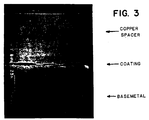
- Figure 3 is an SEM photomicrograph at 600X of Steel 2 in cross-section shown by nital etching (with copper spacer) illustrating minimal coating damage and a shallow resolidified melt zone in the treated region of about 12 microns.
- the sample of Figure 3 was subjected to electron beam treatment of 2.25 J/in. (0.9 J/cm) at 150 kV, 0.75 ma, and 50 ips (12.7 cm/sec) to affect heat resistant domain refinement just above the threshold for coating damage.
- Example IV show that the electron beam treatment was more effective on base-coated strip. Packs 2 and 3, which were stress coated prior to the electron beam treatment, did not result in reduced core loss properties under the parameters used.
- the data of Table VI show that modulated electron beam treatment produces a permanent defect to effect heat resistant domain refinement in sheet suitable to provide reduced core loss.
- Packs A and C show that base-coated material may be stress coated after electron beam treatment and thereafter subjected to an SRA and still provide reduced core loss properties in the sheet product.
- a subsequent heat treating or annealing up to 1800°F (982°C) is a critical step to achieve reductions in core loss properties. Electron beam treatment alone does not yield lower core loss properties.
- the invention includes embodiments of subsequent processing by tension coating and stress relief annealing in that order or in reversed sequence.
- a method has been developed using electron beam treatment for effecting domain refinement of electrical steels, particularly, exemplified by grain-oriented silicon steel to improve core loss values.
- a further advantage of the method of the present invention is that such improvements in core loss are heat resistant such that they survive a stress relief anneal and would be suitable for a wide variety of electrical applications.
Landscapes
- Chemical & Material Sciences (AREA)
- Engineering & Computer Science (AREA)
- Physics & Mathematics (AREA)
- Dispersion Chemistry (AREA)
- Electromagnetism (AREA)
- Power Engineering (AREA)
- Thermal Sciences (AREA)
- Mechanical Engineering (AREA)
- Materials Engineering (AREA)
- Metallurgy (AREA)
- Organic Chemistry (AREA)
- Crystallography & Structural Chemistry (AREA)
- Manufacturing & Machinery (AREA)
- Manufacturing Of Steel Electrode Plates (AREA)
- Soft Magnetic Materials (AREA)
- Heat Treatment Of Sheet Steel (AREA)
- Manufacture Of Macromolecular Shaped Articles (AREA)
- Insulating Bodies (AREA)
Claims (13)
- Verfahren zum Verbessern der Eisenverlusteigenschaften von Elektro(stahl)blech- oder -banderzeugnissen, gekennzeichnet durch (folgende Schritte):Glühen eines Elektrometallblechs zwecks Erzielung seiner magnetischen Eigenschaften, anschließende Elektronenstrahlbehandlung mindestens einer Oberfläche des Blechs oder Bands zwecks Bildung schmaler, im wesentlichen paralleler Bänder bzw. Streifen behandelter Bereiche, die durch unbehandelte Bereiche (voneinander) getrennt sind, praktisch quer zur Richtung der Blechherstellung,wobei die behandelten Bereiche von einem Schmelzen und Wiedererstarren von Metall in diesen Bereichen herrühren,wobei die Elektronenstrahlbehandlung umfaßt:Generieren eines 0,1 bis 0,41 mm (4 bis 16 mils) breiten Elektronenstrahls mit einer Spannung von 20 bis 200 kV und Ablenken des Elektronenstrahls transversal bzw. quer zur (Blech-) Auswalzrichtung mit einer Geschwindigkeit von 0,08 bis 254 m/s (3,3 bis 10 000 Zoll/s) unter Gewährleistung einer Energiedichte von 23,25 bis 620 J/cm (150 bis 4000 J/Quadratzoll), die für die Erzeugung eines permanenten Defekts in jedem behandelten Bereich ausreichend ist, um eine bis zu 982°C (1800°F) wärmebeständige Verfeinerung des Abstands magnetischer Bereich zu Wand des Blechs oder Bands zu bewirken, welche für die Gewährleistung verringerter Eisenverluste zweckmäßig ist, und wobei das Verfahren ferner umfaßt:Glühen (oder Anlassen) des Blechs oder Bands bei Temperaturen von bis zu 982°C (1800°F) zwecks Bereitstellung eines Blech- oder Banderzeugnisses mit verringerten Eisenverlusten.
- Verfahren nach Anspruch 1, wobei die lineare Energiedichte für eine Elektronenstrahl-Fleck(quer)-größe von etwa 0,127 mm (4 mils) im Bereich von 0,3 J/cm (0,75 J/Zoll) oder mehr liegt.
- Verfahren nach Anspruch 1, wobei die lineare Energiedichte bei einem (einer) Strom(stärke) von 0,5 bis 10 mA im Bereich von 0,3 bis 7,9 J/cm (0,75 bis 20 J/Zoll) liegt.
- Verfahren nach Anspruch 1 oder 2, wobei der Elektronenstrahl mit einem Strom von 0,5 bis 100 mA generiert wird.
- Verfahren nach einem der vorangehenden Ansprüche, umfassend ein Wiederbeschichten des Blech- oder Banderzeugnisses auf mindestens einer Seite nach der Elektronenstrahlbehandlung.
- Verfahren nach Anspruch 5, wobei das Wiederbeschichten das Auftragen eines Zug(spannungs)überzugs (tension coating) auf mindestens eine Oberfläche des behandelten Blechs oder Bands zum Verringern der Eisenverluste umfaßt.
- Verfahren nach einem der vorangehenden Ansprüche, wobei das elektronenstrahlbehandelte Blech oder Band anschließend durch Auftragen eines Zug-(spannungs)überzugs zum Verringern der Eisenverluste bearbeitet wird.
- Verfahren nach einem der vorangehenden Ansprüche, bei welchem eine kontinuierliche Elektronenstrahlenergie zur Herbeiführung der wärmebeständigen Bereichsverfeinerung bereitgestellt wird.
- Verfahren nach einem der Ansprüche 1 bis 7, bei welchem eine diskontinuierliche Elektronenstrahlenergie zur Herbeiführung der wärmebeständigen Bereichsverfeinerung bereitgestellt wird.
- Verfahren nach einem der vorangehenden Ansprüche, wobei das Blech oder Band aus herkömmlichem Würfel-auf-Kante kornorientiertem Siliciumstahl, hochpermeablem Würfel-auf-Kante kornorientiertem Siliciumstahl oder amorphem magnetischen Metall besteht.
- Verfahren nach einem der vorangehenden Ansprüche, wobei die Enddicke des Blechs oder Bands im Bereich von bis zu etwa 0,3556 mm (14 mils) liegt.
- Verfahren nach einem der vorangehenden Ansprüche, umfassend den Schritt des Vorsehens zumindest eines teilweisen Vakuums im Bereich des der Elektronenstrahlbehandlung unterworfenen Blechs oder Bands.
- Verfahren nach einem der vorangehenden Ansprüche, mit Ausnahme von Anspruch 4, wobei der Elektronenstrahl mit einer Spannung von 150 kV und einem (einer) Strom(stärke) von 4,5 oder 6 mA generiert und der Elektronenstrahl quer zur Auswalzrichtung mit einer Geschwindigkeit von 52,8 m/s (2080 Zoll/s) abgelenkt wird.
Applications Claiming Priority (2)
| Application Number | Priority Date | Filing Date | Title |
|---|---|---|---|
| US07/163,670 US4915750A (en) | 1988-03-03 | 1988-03-03 | Method for providing heat resistant domain refinement of electrical steels to reduce core loss |
| US163670 | 1988-03-03 |
Publications (3)
| Publication Number | Publication Date |
|---|---|
| EP0331498A2 EP0331498A2 (de) | 1989-09-06 |
| EP0331498A3 EP0331498A3 (de) | 1991-09-18 |
| EP0331498B1 true EP0331498B1 (de) | 1996-05-15 |
Family
ID=22591059
Family Applications (1)
| Application Number | Title | Priority Date | Filing Date |
|---|---|---|---|
| EP89302104A Expired - Lifetime EP0331498B1 (de) | 1988-03-03 | 1989-03-02 | Verfahren zum Vermindern der Eisenverluste in Elektroblechen durch Schaffung hitzebeständiger, verfeinerter Bereichsstrukturen |
Country Status (7)
| Country | Link |
|---|---|
| US (1) | US4915750A (de) |
| EP (1) | EP0331498B1 (de) |
| JP (1) | JPH01281709A (de) |
| KR (1) | KR960014945B1 (de) |
| AT (1) | ATE138109T1 (de) |
| BR (1) | BR8900960A (de) |
| DE (1) | DE68926470T2 (de) |
Families Citing this family (13)
| Publication number | Priority date | Publication date | Assignee | Title |
|---|---|---|---|---|
| JP3023242B2 (ja) * | 1992-05-29 | 2000-03-21 | 川崎製鉄株式会社 | 騒音特性の優れた低鉄損一方向性珪素鋼板の製造方法 |
| US5296051A (en) * | 1993-02-11 | 1994-03-22 | Kawasaki Steel Corporation | Method of producing low iron loss grain-oriented silicon steel sheet having low-noise and superior shape characteristics |
| DE19625851A1 (de) * | 1996-06-27 | 1998-01-02 | Ebetech Electron Beam Technolo | Verfahren und Vorrichtung zum Kristallisieren einer amorphen Schicht |
| JP4398666B2 (ja) | 2002-05-31 | 2010-01-13 | 新日本製鐵株式会社 | 磁気特性の優れた一方向性電磁鋼板およびその製造方法 |
| US8314357B2 (en) * | 2009-05-08 | 2012-11-20 | Children's Hospital And Research Center At Oakland | Joule heated nanowire biosensors |
| WO2012017669A1 (ja) * | 2010-08-06 | 2012-02-09 | Jfeスチール株式会社 | 方向性電磁鋼板およびその製造方法 |
| JP5870580B2 (ja) * | 2011-09-26 | 2016-03-01 | Jfeスチール株式会社 | 方向性電磁鋼板の製造方法 |
| CN107012303B (zh) * | 2011-12-28 | 2020-01-24 | 杰富意钢铁株式会社 | 方向性电磁钢板及其制造方法 |
| RU2611457C2 (ru) * | 2012-10-31 | 2017-02-22 | ДжФЕ СТИЛ КОРПОРЕЙШН | Текстурированный лист электротехнической стали и способ его изготовления |
| WO2017201418A1 (en) | 2016-05-20 | 2017-11-23 | Arcanum Alloys, Inc. | Methods and systems for coating a steel substrate |
| WO2021155280A1 (en) * | 2020-01-31 | 2021-08-05 | Arcanum Alloys, Inc. | Modified steel compositions and methods related thereto |
| JP7331800B2 (ja) * | 2020-07-31 | 2023-08-23 | Jfeスチール株式会社 | 方向性電磁鋼板 |
| US12030115B2 (en) | 2020-09-25 | 2024-07-09 | Metglas, Inc. | Process for in-line mechanically scribing of amorphous foil for magnetic domain alignment and core loss reduction |
Citations (1)
| Publication number | Priority date | Publication date | Assignee | Title |
|---|---|---|---|---|
| EP0108573A2 (de) * | 1982-11-08 | 1984-05-16 | Armco Inc. | Örtliche Wärmebehandlung von Elektrostahl |
Family Cites Families (12)
| Publication number | Priority date | Publication date | Assignee | Title |
|---|---|---|---|---|
| DE2408878C3 (de) * | 1974-02-23 | 1979-08-16 | Kloeckner-Werke Ag, 4100 Duisburg | Vorrichtung für den Spritzguß von Formungen aus ungebrannten keramischen Massen |
| JPS5423647B2 (de) * | 1974-04-25 | 1979-08-15 | ||
| GB2062972B (en) * | 1979-10-19 | 1983-08-10 | Nippon Steel Corp | Iron core for electrical machinery and apparatus and well as method for producing the iron core |
| US4645547A (en) * | 1982-10-20 | 1987-02-24 | Westinghouse Electric Corp. | Loss ferromagnetic materials and methods of improvement |
| GB8324643D0 (en) * | 1983-09-14 | 1983-10-19 | British Steel Corp | Production of grain orientated steel |
| US4655854A (en) * | 1983-10-27 | 1987-04-07 | Kawasaki Steel Corporation | Grain-oriented silicon steel sheet having a low iron loss free from deterioration due to stress-relief annealing and a method of producing the same |
| JPS60213005A (ja) * | 1984-04-06 | 1985-10-25 | Mitsubishi Electric Corp | アモルフアス磁心の製造方法 |
| US4724015A (en) * | 1984-05-04 | 1988-02-09 | Nippon Steel Corporation | Method for improving the magnetic properties of Fe-based amorphous-alloy thin strip |
| DE3539731C2 (de) * | 1984-11-10 | 1994-08-04 | Nippon Steel Corp | Kornorientiertes Elektrostahlblech mit stabilen, gegen das Spannungsfreiglühen beständigen magnetischen Eigenschaften und Verfahren und Vorrichtung zu seiner Herstellung |
| US4909864A (en) * | 1986-09-16 | 1990-03-20 | Kawasaki Steel Corp. | Method of producing extra-low iron loss grain oriented silicon steel sheets |
| JPH0672266B2 (ja) * | 1987-01-28 | 1994-09-14 | 川崎製鉄株式会社 | 超低鉄損一方向性珪素鋼板の製造方法 |
| ATE199027T1 (de) * | 1997-04-30 | 2001-02-15 | Corus Uk Ltd | Eisenerzsinterprozess mit verringerten emissionen schädlicher gase |
-
1988
- 1988-03-03 US US07/163,670 patent/US4915750A/en not_active Expired - Fee Related
-
1989
- 1989-03-02 KR KR1019890002564A patent/KR960014945B1/ko not_active Expired - Fee Related
- 1989-03-02 DE DE68926470T patent/DE68926470T2/de not_active Expired - Fee Related
- 1989-03-02 AT AT89302104T patent/ATE138109T1/de not_active IP Right Cessation
- 1989-03-02 BR BR898900960A patent/BR8900960A/pt unknown
- 1989-03-02 EP EP89302104A patent/EP0331498B1/de not_active Expired - Lifetime
- 1989-03-03 JP JP1051830A patent/JPH01281709A/ja active Pending
Patent Citations (1)
| Publication number | Priority date | Publication date | Assignee | Title |
|---|---|---|---|---|
| EP0108573A2 (de) * | 1982-11-08 | 1984-05-16 | Armco Inc. | Örtliche Wärmebehandlung von Elektrostahl |
Also Published As
| Publication number | Publication date |
|---|---|
| US4915750A (en) | 1990-04-10 |
| DE68926470D1 (de) | 1996-06-20 |
| BR8900960A (pt) | 1989-10-24 |
| EP0331498A3 (de) | 1991-09-18 |
| EP0331498A2 (de) | 1989-09-06 |
| DE68926470T2 (de) | 1996-10-02 |
| JPH01281709A (ja) | 1989-11-13 |
| ATE138109T1 (de) | 1996-06-15 |
| KR960014945B1 (ko) | 1996-10-21 |
| KR890014756A (ko) | 1989-10-25 |
Similar Documents
| Publication | Publication Date | Title |
|---|---|---|
| EP0334223B1 (de) | Verfahren zum Herstellen kornorientierter Elektrobleche durch Schnellerwärmung | |
| EP0331497B1 (de) | Verfahren zum Verbessern der Ummagnetisierungseigenschaften von Elektroblechen | |
| JP3023242B2 (ja) | 騒音特性の優れた低鉄損一方向性珪素鋼板の製造方法 | |
| EP0331498B1 (de) | Verfahren zum Vermindern der Eisenverluste in Elektroblechen durch Schaffung hitzebeständiger, verfeinerter Bereichsstrukturen | |
| KR102133909B1 (ko) | 방향성 전기강판 및 그의 제조 방법 | |
| JP3726289B2 (ja) | 鉄損の低い方向性電磁鋼板 | |
| US4545828A (en) | Local annealing treatment for cube-on-edge grain oriented silicon steel | |
| KR102428854B1 (ko) | 방향성 전기강판 및 그 자구미세화 방법 | |
| KR100345723B1 (ko) | 저자왜 방향성 전기강판의 제조방법과 이에 사용되는제조장치 | |
| EP0367467B1 (de) | Kornorientierte Siliziumstahlbleche mit niedrigen Wattverlusten und Verfahren zur Herstellung derselben | |
| KR102149826B1 (ko) | 방향성 전기강판 및 그의 제조 방법 | |
| EP3901969B1 (de) | Orientiertes elektrostahlblech und verfahren zur herstellung davon | |
| EP0345936B1 (de) | Verfahren zur Veredelung der magnetischen Bereiche von elektrischen Stählen | |
| JPH0432517A (ja) | 低鉄損一方向性けい素鋼板の製造方法 | |
| US4911766A (en) | Method of refining magnetic domains of electrical steels using phosphorus | |
| JPH05311241A (ja) | 低鉄損一方向性珪素鋼板の製造方法および電子ビーム照射装置 | |
| US5114501A (en) | Method employing skin-pass rolling to enhance the quality of phosphorous-striped silicon steel | |
| US5041170A (en) | Method employing skin-pass rolling to enhance the quality of phosphorus-striped silicon steel | |
| JPH04231415A (ja) | 低鉄損一方向性けい素鋼板の製造方法 | |
| JPS6175506A (ja) | 磁区制御処理を施した方向性電磁鋼板およびその製造方法 | |
| KR840000179B1 (ko) | 방향성 전자강판의 철손 특성 개선방법 | |
| JPS61248507A (ja) | 非晶質合金積み鉄心の磁性改善方法 | |
| JPH04202627A (ja) | 電子ビーム照射方法 | |
| JPH01127621A (ja) | 少量の添加ボロンを有する結晶粒配向性シリコン鋼を製造する方法 | |
| JPS6139395B2 (de) |
Legal Events
| Date | Code | Title | Description |
|---|---|---|---|
| PUAI | Public reference made under article 153(3) epc to a published international application that has entered the european phase |
Free format text: ORIGINAL CODE: 0009012 |
|
| AK | Designated contracting states |
Kind code of ref document: A2 Designated state(s): AT BE CH DE FR GB IT LI LU NL SE |
|
| PUAL | Search report despatched |
Free format text: ORIGINAL CODE: 0009013 |
|
| AK | Designated contracting states |
Kind code of ref document: A3 Designated state(s): AT BE CH DE FR GB IT LI LU NL SE |
|
| 17P | Request for examination filed |
Effective date: 19920203 |
|
| 17Q | First examination report despatched |
Effective date: 19921204 |
|
| GRAA | (expected) grant |
Free format text: ORIGINAL CODE: 0009210 |
|
| AK | Designated contracting states |
Kind code of ref document: B1 Designated state(s): AT BE CH DE FR GB IT LI LU NL SE |
|
| PG25 | Lapsed in a contracting state [announced via postgrant information from national office to epo] |
Ref country code: NL Free format text: LAPSE BECAUSE OF FAILURE TO SUBMIT A TRANSLATION OF THE DESCRIPTION OR TO PAY THE FEE WITHIN THE PRESCRIBED TIME-LIMIT Effective date: 19960515 Ref country code: LI Effective date: 19960515 Ref country code: CH Effective date: 19960515 Ref country code: AT Effective date: 19960515 |
|
| REF | Corresponds to: |
Ref document number: 138109 Country of ref document: AT Date of ref document: 19960615 Kind code of ref document: T |
|
| ITF | It: translation for a ep patent filed | ||
| REF | Corresponds to: |
Ref document number: 68926470 Country of ref document: DE Date of ref document: 19960620 |
|
| ET | Fr: translation filed | ||
| NLV1 | Nl: lapsed or annulled due to failure to fulfill the requirements of art. 29p and 29m of the patents act | ||
| REG | Reference to a national code |
Ref country code: CH Ref legal event code: PL |
|
| PGFP | Annual fee paid to national office [announced via postgrant information from national office to epo] |
Ref country code: SE Payment date: 19970213 Year of fee payment: 9 Ref country code: FR Payment date: 19970213 Year of fee payment: 9 |
|
| PGFP | Annual fee paid to national office [announced via postgrant information from national office to epo] |
Ref country code: DE Payment date: 19970225 Year of fee payment: 9 |
|
| PGFP | Annual fee paid to national office [announced via postgrant information from national office to epo] |
Ref country code: GB Payment date: 19970226 Year of fee payment: 9 |
|
| PGFP | Annual fee paid to national office [announced via postgrant information from national office to epo] |
Ref country code: BE Payment date: 19970317 Year of fee payment: 9 |
|
| PLBE | No opposition filed within time limit |
Free format text: ORIGINAL CODE: 0009261 |
|
| STAA | Information on the status of an ep patent application or granted ep patent |
Free format text: STATUS: NO OPPOSITION FILED WITHIN TIME LIMIT |
|
| PG25 | Lapsed in a contracting state [announced via postgrant information from national office to epo] |
Ref country code: LU Free format text: LAPSE BECAUSE OF NON-PAYMENT OF DUE FEES Effective date: 19970331 |
|
| 26N | No opposition filed | ||
| PG25 | Lapsed in a contracting state [announced via postgrant information from national office to epo] |
Ref country code: GB Free format text: LAPSE BECAUSE OF NON-PAYMENT OF DUE FEES Effective date: 19980302 |
|
| PG25 | Lapsed in a contracting state [announced via postgrant information from national office to epo] |
Ref country code: SE Free format text: LAPSE BECAUSE OF NON-PAYMENT OF DUE FEES Effective date: 19980303 |
|
| PG25 | Lapsed in a contracting state [announced via postgrant information from national office to epo] |
Ref country code: FR Free format text: THE PATENT HAS BEEN ANNULLED BY A DECISION OF A NATIONAL AUTHORITY Effective date: 19980331 Ref country code: BE Free format text: LAPSE BECAUSE OF NON-PAYMENT OF DUE FEES Effective date: 19980331 |
|
| BERE | Be: lapsed |
Owner name: ALLEGHENY LUDLUM CORP. Effective date: 19980331 |
|
| GBPC | Gb: european patent ceased through non-payment of renewal fee |
Effective date: 19980302 |
|
| PG25 | Lapsed in a contracting state [announced via postgrant information from national office to epo] |
Ref country code: DE Free format text: LAPSE BECAUSE OF NON-PAYMENT OF DUE FEES Effective date: 19981201 |
|
| EUG | Se: european patent has lapsed |
Ref document number: 89302104.8 |
|
| REG | Reference to a national code |
Ref country code: FR Ref legal event code: ST |
|
| PG25 | Lapsed in a contracting state [announced via postgrant information from national office to epo] |
Ref country code: IT Free format text: LAPSE BECAUSE OF NON-PAYMENT OF DUE FEES;WARNING: LAPSES OF ITALIAN PATENTS WITH EFFECTIVE DATE BEFORE 2007 MAY HAVE OCCURRED AT ANY TIME BEFORE 2007. THE CORRECT EFFECTIVE DATE MAY BE DIFFERENT FROM THE ONE RECORDED. Effective date: 20050302 |