EP0321918B2 - Verfahren zur enzymatischen Racematspaltung von racemischen Alkoholen mit/in vinylestern durch Umesterung - Google Patents
Verfahren zur enzymatischen Racematspaltung von racemischen Alkoholen mit/in vinylestern durch Umesterung Download PDFInfo
- Publication number
- EP0321918B2 EP0321918B2 EP88121274A EP88121274A EP0321918B2 EP 0321918 B2 EP0321918 B2 EP 0321918B2 EP 88121274 A EP88121274 A EP 88121274A EP 88121274 A EP88121274 A EP 88121274A EP 0321918 B2 EP0321918 B2 EP 0321918B2
- Authority
- EP
- European Patent Office
- Prior art keywords
- alcohol
- alkyl
- transesterification
- vinyl
- alcohols
- Prior art date
- Legal status (The legal status is an assumption and is not a legal conclusion. Google has not performed a legal analysis and makes no representation as to the accuracy of the status listed.)
- Expired - Lifetime
Links
- 238000000034 method Methods 0.000 title claims description 19
- 229920001567 vinyl ester resin Polymers 0.000 title claims description 16
- 150000001298 alcohols Chemical class 0.000 title claims description 13
- 230000002255 enzymatic effect Effects 0.000 title claims description 5
- 230000008569 process Effects 0.000 title description 13
- 125000000391 vinyl group Chemical group [H]C([*])=C([H])[H] 0.000 title description 7
- 238000005809 transesterification reaction Methods 0.000 title description 4
- 238000003776 cleavage reaction Methods 0.000 title description 3
- 230000007017 scission Effects 0.000 title description 3
- LFQSCWFLJHTTHZ-UHFFFAOYSA-N Ethanol Chemical compound CCO LFQSCWFLJHTTHZ-UHFFFAOYSA-N 0.000 claims description 23
- 150000002148 esters Chemical class 0.000 claims description 10
- 108090001060 Lipase Proteins 0.000 claims description 9
- 102000004882 Lipase Human genes 0.000 claims description 9
- 239000004367 Lipase Substances 0.000 claims description 9
- 235000019421 lipase Nutrition 0.000 claims description 9
- 241000589516 Pseudomonas Species 0.000 claims description 5
- UFHFLCQGNIYNRP-UHFFFAOYSA-N Hydrogen Chemical compound [H][H] UFHFLCQGNIYNRP-UHFFFAOYSA-N 0.000 claims description 4
- 229910052739 hydrogen Inorganic materials 0.000 claims description 4
- 239000001257 hydrogen Substances 0.000 claims description 4
- 125000002496 methyl group Chemical group [H]C([H])([H])* 0.000 claims description 4
- 125000004178 (C1-C4) alkyl group Chemical group 0.000 claims description 3
- 241000222120 Candida <Saccharomycetales> Species 0.000 claims description 3
- 241000235395 Mucor Species 0.000 claims description 3
- 241000228143 Penicillium Species 0.000 claims description 3
- 241000235527 Rhizopus Species 0.000 claims description 3
- 210000004185 liver Anatomy 0.000 claims description 3
- 244000005700 microbiome Species 0.000 claims description 3
- 210000000496 pancreas Anatomy 0.000 claims description 3
- 125000001997 phenyl group Chemical group [H]C1=C([H])C([H])=C(*)C([H])=C1[H] 0.000 claims description 3
- 125000006702 (C1-C18) alkyl group Chemical group 0.000 claims description 2
- 241000228212 Aspergillus Species 0.000 claims description 2
- 150000002431 hydrogen Chemical class 0.000 claims description 2
- 125000004218 chloromethyl group Chemical group [H]C([H])(Cl)* 0.000 claims 1
- 102000004190 Enzymes Human genes 0.000 description 15
- 108090000790 Enzymes Proteins 0.000 description 15
- 229940088598 enzyme Drugs 0.000 description 15
- 238000006243 chemical reaction Methods 0.000 description 8
- 150000002576 ketones Chemical class 0.000 description 6
- 101000968491 Pseudomonas sp. (strain 109) Triacylglycerol lipase Proteins 0.000 description 4
- 238000004821 distillation Methods 0.000 description 4
- 238000000926 separation method Methods 0.000 description 4
- UHOVQNZJYSORNB-UHFFFAOYSA-N Benzene Chemical compound C1=CC=CC=C1 UHOVQNZJYSORNB-UHFFFAOYSA-N 0.000 description 3
- YXFVVABEGXRONW-UHFFFAOYSA-N Toluene Chemical compound CC1=CC=CC=C1 YXFVVABEGXRONW-UHFFFAOYSA-N 0.000 description 3
- XTXRWKRVRITETP-UHFFFAOYSA-N Vinyl acetate Chemical compound CC(=O)OC=C XTXRWKRVRITETP-UHFFFAOYSA-N 0.000 description 3
- 239000002253 acid Substances 0.000 description 3
- 150000001299 aldehydes Chemical class 0.000 description 3
- -1 allethrins Chemical compound 0.000 description 3
- 229910052736 halogen Inorganic materials 0.000 description 3
- 150000002367 halogens Chemical class 0.000 description 3
- 229940040461 lipase Drugs 0.000 description 3
- VLKZOEOYAKHREP-UHFFFAOYSA-N n-Hexane Chemical compound CCCCCC VLKZOEOYAKHREP-UHFFFAOYSA-N 0.000 description 3
- 230000035484 reaction time Effects 0.000 description 3
- 239000002904 solvent Substances 0.000 description 3
- IKHGUXGNUITLKF-UHFFFAOYSA-N Acetaldehyde Chemical compound CC=O IKHGUXGNUITLKF-UHFFFAOYSA-N 0.000 description 2
- CSCPPACGZOOCGX-UHFFFAOYSA-N Acetone Chemical compound CC(C)=O CSCPPACGZOOCGX-UHFFFAOYSA-N 0.000 description 2
- WKBOTKDWSSQWDR-UHFFFAOYSA-N Bromine atom Chemical compound [Br] WKBOTKDWSSQWDR-UHFFFAOYSA-N 0.000 description 2
- ZAMOUSCENKQFHK-UHFFFAOYSA-N Chlorine atom Chemical compound [Cl] ZAMOUSCENKQFHK-UHFFFAOYSA-N 0.000 description 2
- HEDRZPFGACZZDS-UHFFFAOYSA-N Chloroform Chemical compound ClC(Cl)Cl HEDRZPFGACZZDS-UHFFFAOYSA-N 0.000 description 2
- IAZDPXIOMUYVGZ-UHFFFAOYSA-N Dimethylsulphoxide Chemical compound CS(C)=O IAZDPXIOMUYVGZ-UHFFFAOYSA-N 0.000 description 2
- IMROMDMJAWUWLK-UHFFFAOYSA-N Ethenol Chemical compound OC=C IMROMDMJAWUWLK-UHFFFAOYSA-N 0.000 description 2
- IMNFDUFMRHMDMM-UHFFFAOYSA-N N-Heptane Chemical compound CCCCCCC IMNFDUFMRHMDMM-UHFFFAOYSA-N 0.000 description 2
- 101001134452 Sus scrofa Pancreatic triacylglycerol lipase Proteins 0.000 description 2
- WYURNTSHIVDZCO-UHFFFAOYSA-N Tetrahydrofuran Chemical compound C1CCOC1 WYURNTSHIVDZCO-UHFFFAOYSA-N 0.000 description 2
- 125000000217 alkyl group Chemical group 0.000 description 2
- GDTBXPJZTBHREO-UHFFFAOYSA-N bromine Substances BrBr GDTBXPJZTBHREO-UHFFFAOYSA-N 0.000 description 2
- 229910052794 bromium Inorganic materials 0.000 description 2
- 229910052801 chlorine Inorganic materials 0.000 description 2
- 239000000460 chlorine Substances 0.000 description 2
- 238000002425 crystallisation Methods 0.000 description 2
- 230000008025 crystallization Effects 0.000 description 2
- 239000003814 drug Substances 0.000 description 2
- XJELOQYISYPGDX-UHFFFAOYSA-N ethenyl 2-chloroacetate Chemical compound ClCC(=O)OC=C XJELOQYISYPGDX-UHFFFAOYSA-N 0.000 description 2
- 238000000605 extraction Methods 0.000 description 2
- 125000002887 hydroxy group Chemical group [H]O* 0.000 description 2
- 229940021182 non-steroidal anti-inflammatory drug Drugs 0.000 description 2
- 230000009467 reduction Effects 0.000 description 2
- BYJAVTDNIXVSPW-UHFFFAOYSA-N tetryzoline Chemical compound N1CCN=C1C1C2=CC=CC=C2CCC1 BYJAVTDNIXVSPW-UHFFFAOYSA-N 0.000 description 2
- 229920002554 vinyl polymer Polymers 0.000 description 2
- ZCVAOQKBXKSDMS-AQYZNVCMSA-N (+)-trans-allethrin Chemical class CC1(C)[C@H](C=C(C)C)[C@H]1C(=O)OC1C(C)=C(CC=C)C(=O)C1 ZCVAOQKBXKSDMS-AQYZNVCMSA-N 0.000 description 1
- QXHHHPZILQDDPS-UHFFFAOYSA-N 1-{2-[(2-chloro-3-thienyl)methoxy]-2-(2,4-dichlorophenyl)ethyl}imidazole Chemical compound S1C=CC(COC(CN2C=NC=C2)C=2C(=CC(Cl)=CC=2)Cl)=C1Cl QXHHHPZILQDDPS-UHFFFAOYSA-N 0.000 description 1
- XDTMQSROBMDMFD-UHFFFAOYSA-N Cyclohexane Chemical compound C1CCCCC1 XDTMQSROBMDMFD-UHFFFAOYSA-N 0.000 description 1
- PXGOKWXKJXAPGV-UHFFFAOYSA-N Fluorine Chemical compound FF PXGOKWXKJXAPGV-UHFFFAOYSA-N 0.000 description 1
- 102000004157 Hydrolases Human genes 0.000 description 1
- 108090000604 Hydrolases Proteins 0.000 description 1
- HEFNNWSXXWATRW-UHFFFAOYSA-N Ibuprofen Chemical compound CC(C)CC1=CC=C(C(C)C(O)=O)C=C1 HEFNNWSXXWATRW-UHFFFAOYSA-N 0.000 description 1
- 108010093096 Immobilized Enzymes Proteins 0.000 description 1
- HLFSDGLLUJUHTE-SNVBAGLBSA-N Levamisole Chemical compound C1([C@H]2CN3CCSC3=N2)=CC=CC=C1 HLFSDGLLUJUHTE-SNVBAGLBSA-N 0.000 description 1
- 108010013563 Lipoprotein Lipase Proteins 0.000 description 1
- 102000043296 Lipoprotein lipases Human genes 0.000 description 1
- CMWTZPSULFXXJA-UHFFFAOYSA-N Naproxen Natural products C1=C(C(C)C(O)=O)C=CC2=CC(OC)=CC=C21 CMWTZPSULFXXJA-UHFFFAOYSA-N 0.000 description 1
- VYPSYNLAJGMNEJ-UHFFFAOYSA-N Silicium dioxide Chemical compound O=[Si]=O VYPSYNLAJGMNEJ-UHFFFAOYSA-N 0.000 description 1
- 239000004480 active ingredient Substances 0.000 description 1
- 239000013543 active substance Substances 0.000 description 1
- 238000007259 addition reaction Methods 0.000 description 1
- 125000003158 alcohol group Chemical group 0.000 description 1
- 150000003978 alpha-halocarboxylic acids Chemical class 0.000 description 1
- 230000001857 anti-mycotic effect Effects 0.000 description 1
- 239000002543 antimycotic Substances 0.000 description 1
- 229960002430 atomoxetine Drugs 0.000 description 1
- 239000002876 beta blocker Substances 0.000 description 1
- 229940097320 beta blocking agent Drugs 0.000 description 1
- VEMKTZHHVJILDY-UXHICEINSA-N bioresmethrin Chemical compound CC1(C)[C@H](C=C(C)C)[C@H]1C(=O)OCC1=COC(CC=2C=CC=CC=2)=C1 VEMKTZHHVJILDY-UXHICEINSA-N 0.000 description 1
- FZGVEKPRDOIXJY-UHFFFAOYSA-N bitolterol Chemical compound C1=CC(C)=CC=C1C(=O)OC1=CC=C(C(O)CNC(C)(C)C)C=C1OC(=O)C1=CC=C(C)C=C1 FZGVEKPRDOIXJY-UHFFFAOYSA-N 0.000 description 1
- 229960004620 bitolterol Drugs 0.000 description 1
- 238000009835 boiling Methods 0.000 description 1
- 238000005893 bromination reaction Methods 0.000 description 1
- 230000000572 bronchospasmolytic effect Effects 0.000 description 1
- 229940077731 carbohydrate nutrients Drugs 0.000 description 1
- 150000001720 carbohydrates Chemical class 0.000 description 1
- 235000014633 carbohydrates Nutrition 0.000 description 1
- 125000004432 carbon atom Chemical group C* 0.000 description 1
- 150000001728 carbonyl compounds Chemical class 0.000 description 1
- 150000001732 carboxylic acid derivatives Chemical class 0.000 description 1
- 150000001733 carboxylic acid esters Chemical class 0.000 description 1
- 150000001735 carboxylic acids Chemical class 0.000 description 1
- 239000000969 carrier Substances 0.000 description 1
- 230000003197 catalytic effect Effects 0.000 description 1
- 238000006555 catalytic reaction Methods 0.000 description 1
- 238000004440 column chromatography Methods 0.000 description 1
- 150000001875 compounds Chemical class 0.000 description 1
- 150000002009 diols Chemical class 0.000 description 1
- 230000032050 esterification Effects 0.000 description 1
- 238000005886 esterification reaction Methods 0.000 description 1
- 238000001914 filtration Methods 0.000 description 1
- 229910052731 fluorine Inorganic materials 0.000 description 1
- 239000011737 fluorine Substances 0.000 description 1
- 229960001680 ibuprofen Drugs 0.000 description 1
- PNDPGZBMCMUPRI-UHFFFAOYSA-N iodine Chemical compound II PNDPGZBMCMUPRI-UHFFFAOYSA-N 0.000 description 1
- 238000007273 lactonization reaction Methods 0.000 description 1
- 229960001614 levamisole Drugs 0.000 description 1
- 238000004519 manufacturing process Methods 0.000 description 1
- 239000000203 mixture Substances 0.000 description 1
- 229960002009 naproxen Drugs 0.000 description 1
- CMWTZPSULFXXJA-VIFPVBQESA-M naproxen(1-) Chemical compound C1=C([C@H](C)C([O-])=O)C=CC2=CC(OC)=CC=C21 CMWTZPSULFXXJA-VIFPVBQESA-M 0.000 description 1
- 229930014626 natural product Natural products 0.000 description 1
- UAORFCGRZIGNCI-UHFFFAOYSA-N nifenalol Chemical compound CC(C)NCC(O)C1=CC=C([N+]([O-])=O)C=C1 UAORFCGRZIGNCI-UHFFFAOYSA-N 0.000 description 1
- 229950000096 nifenalol Drugs 0.000 description 1
- 239000003960 organic solvent Substances 0.000 description 1
- 229940094443 oxytocics prostaglandins Drugs 0.000 description 1
- 229960002035 penbutolol Drugs 0.000 description 1
- KQXKVJAGOJTNJS-HNNXBMFYSA-N penbutolol Chemical compound CC(C)(C)NC[C@H](O)COC1=CC=CC=C1C1CCCC1 KQXKVJAGOJTNJS-HNNXBMFYSA-N 0.000 description 1
- 239000000575 pesticide Substances 0.000 description 1
- 230000000144 pharmacologic effect Effects 0.000 description 1
- 239000002243 precursor Substances 0.000 description 1
- 150000003180 prostaglandins Chemical class 0.000 description 1
- 239000011541 reaction mixture Substances 0.000 description 1
- 230000009257 reactivity Effects 0.000 description 1
- 239000000741 silica gel Substances 0.000 description 1
- 229910002027 silica gel Inorganic materials 0.000 description 1
- 238000003756 stirring Methods 0.000 description 1
- 239000000126 substance Substances 0.000 description 1
- YLQBMQCUIZJEEH-UHFFFAOYSA-N tetrahydrofuran Natural products C=1C=COC=1 YLQBMQCUIZJEEH-UHFFFAOYSA-N 0.000 description 1
- 229960000337 tetryzoline Drugs 0.000 description 1
- 229960004214 tioconazole Drugs 0.000 description 1
- 230000007306 turnover Effects 0.000 description 1
Classifications
-
- C—CHEMISTRY; METALLURGY
- C12—BIOCHEMISTRY; BEER; SPIRITS; WINE; VINEGAR; MICROBIOLOGY; ENZYMOLOGY; MUTATION OR GENETIC ENGINEERING
- C12P—FERMENTATION OR ENZYME-USING PROCESSES TO SYNTHESISE A DESIRED CHEMICAL COMPOUND OR COMPOSITION OR TO SEPARATE OPTICAL ISOMERS FROM A RACEMIC MIXTURE
- C12P7/00—Preparation of oxygen-containing organic compounds
- C12P7/62—Carboxylic acid esters
-
- C—CHEMISTRY; METALLURGY
- C12—BIOCHEMISTRY; BEER; SPIRITS; WINE; VINEGAR; MICROBIOLOGY; ENZYMOLOGY; MUTATION OR GENETIC ENGINEERING
- C12P—FERMENTATION OR ENZYME-USING PROCESSES TO SYNTHESISE A DESIRED CHEMICAL COMPOUND OR COMPOSITION OR TO SEPARATE OPTICAL ISOMERS FROM A RACEMIC MIXTURE
- C12P41/00—Processes using enzymes or microorganisms to separate optical isomers from a racemic mixture
- C12P41/003—Processes using enzymes or microorganisms to separate optical isomers from a racemic mixture by ester formation, lactone formation or the inverse reactions
- C12P41/004—Processes using enzymes or microorganisms to separate optical isomers from a racemic mixture by ester formation, lactone formation or the inverse reactions by esterification of alcohol- or thiol groups in the enantiomers or the inverse reaction
Definitions
- the invention relates to a process for the enzymatic resolution of racemic alcohols with or in vinyl esters by transesterification, the vinyl ester in a ketone or an aldehyde and one "Acid residue" is cleaved and the remaining acid residue with an added racemic Alcohol forms an ester enantioselectively and only one enantiomer of the alcohol remains unchanged. Esters and unreacted alcohol and thus both enantiomeric alcohols can be easily separated from one another be separated. The second enantiomer of the alcohol can optionally be cleaved by the ester be won.
- NSAIDs non-steroidal anti-inflammatory drugs
- beta blockers such as nifenalol and penbutolol
- bronchospasmolytics such as tolubuterol and bitolterol
- Antimycotics such as tioconazole
- pyrethroids such as allethrins, in addition tetramisole, tetrahydrozoline, (R) - (-) - Tomoxetine and (S) - (+) - Fluoxetine as well as prostaglandins and carbohydrates.
- German patent application P 36 24 703.0 it was proposed to use prochiral diols Reaction with vinyl acetate in the presence of hydrolases to represent chiral compounds optically pure. This is achieved by selective esterification of only one of the two enantiotopic primary OH groups.
- racemic alcohols can be separated enzymatically, by subjecting them to a selective enzyme-catalyzed transesterification reaction with vinyl esters, where there is no need for solvents.
- Lipases from pig liver and pig pancreas can be used as enzymes and from microorganisms such as Candida, Mucor, Rhizopus, Penicillium and in particular from Pseudomonas spec., Such as Lipase P and Lipase FP (Amano, Japan) are used.
- Halogens are fluorine, chlorine, bromine and iodine, in particular chlorine and bromine.
- the optionally substituted radical R 1 is preferably monosubstituted.
- Alkyl residues with 3 and more carbon atoms can be straight or branched.
- the vinyl ester of the formula I is converted into carboxylic acid and appropriate vinyl alcohol split.
- the vinyl alcohol immediately changes into a ketone or a Aldehyde. A back reaction is therefore completely prevented.
- the lipases mentioned become selectively an enantiomer quickly and in high yields esterified to the racemic alcohol, the other enantiomer remains unchanged in the reaction mixture.
- the process according to the invention is particularly well suited for the cleavage of those alcohols which ⁇ position to the OH group have a C-C double bond.
- the best procedure is to use the vinyl ester of Formula I, preferably vinyl acetate or vinyl chloroacetate, and both to this solution Enzyme as well as the alcohol to be split.
- a lipoprotein lipase is preferred as the enzyme from Pseudomonas spec., in particular Lipase P or Lipase FP, which are commercially available (Amano Pharmaceuticals, Nagoya, Japan).
- the enzyme can also be in immobilized form are used, all common immobilization methods and carriers being suitable for this. Immobilized enzyme and free enzyme can also be used in the column process.
- the amount of enzyme will depend on the size of the batch, the reactivity of the alcohol, the desired reaction time and of the type of enzyme (free or fixed) freely chosen and is in the Easy to determine in individual cases by simple preliminary tests.
- the alcohol to be split is in concentrations from 1% to 200%, preferably from 10% to 40% - based on the volume of the vinyl or. Methyl vinyl ester - used. In some cases it is even possible to use vinyl esters only in stoichiometric Quantities - based on an enantiomer - to be submitted.
- the reaction temperature is -10 ° C to 100 ° C, preferably 15 ° C to 50 ° C. It is appropriate that Stir solution during the reaction.
- the reaction times vary depending on the racemic used Alcohol and depending on the amount of enzyme between a few hours and up to 4 Weeks; however, the majority of cases are between 3 hours and 3 days.
- the vinyl or methyl vinyl esters of the formula I can be prepared in a simple manner, for example by transesterification of vinyl acetate with the corresponding carboxylic acids.
- racemic alcohols are obtained, unless they are commercially available, e.g. through reduction from the corresponding ketones, which are usually commercially available, or by ⁇ -bromination of corresponding ketones with subsequent reduction to alcohol.
- Other non-commercially available alcohols or ketones can be used easily produce processes known from the literature, for example using Grignard or other common addition reactions.
- the products formed in the process according to the invention are acetaldehyde or acetone, carboxylic acid esters and alcohol can be separated in a known manner. Ideally you don't get it converted alcohol by separation by distillation. If a separation by distillation is not possible, this is done Separation chromatographically or by extraction or crystallization.
- One way the boiling point difference between the enzymatically formed lower ester and the unreacted alcohol consists of using the corresponding ⁇ -halocarboxylic acid vinyl ester instead of vinyl ester (e.g. B. ⁇ -chloroacetic acid vinyl ester).
- the ester If the other enantiomer is also to be shown in pure form, the ester and is first isolated splits it into acid and alcohol in a known manner.
- the enzyme used for the reactions can easily be recovered by filtration.
- the racemic alcohol is dissolved or suspended in vinyl ester.
- Lipase P or Lipase FP
- the enzyme is filtered (both the free and the fixed enzyme are reusable), the remaining solution is evaporated to dryness in a vacuum and separated as Residue remaining alcohol / ester mixture by column chromatography on silica gel, or by Extraction, crystallization or distillation.
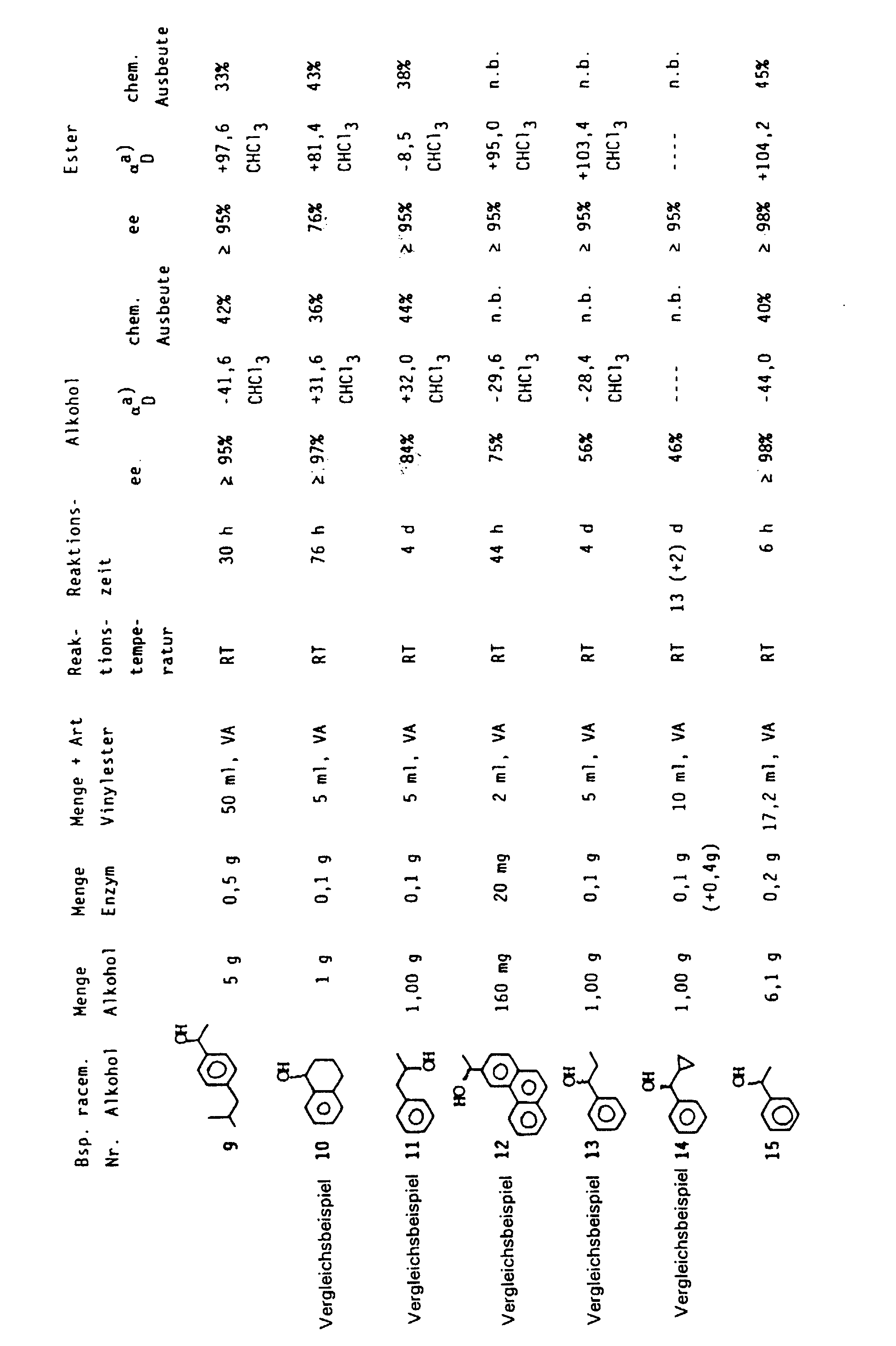
- Table 1 shows the products obtained, the variable process parameters (amount of enzyme, amount of alcohol, amounts of vinyl ester, reaction temperature, reaction time) as well as product characteristics and chemical yield.
Landscapes
- Chemical & Material Sciences (AREA)
- Organic Chemistry (AREA)
- Engineering & Computer Science (AREA)
- Life Sciences & Earth Sciences (AREA)
- Zoology (AREA)
- Wood Science & Technology (AREA)
- Health & Medical Sciences (AREA)
- General Engineering & Computer Science (AREA)
- General Chemical & Material Sciences (AREA)
- Chemical Kinetics & Catalysis (AREA)
- Biotechnology (AREA)
- Biochemistry (AREA)
- Bioinformatics & Cheminformatics (AREA)
- Microbiology (AREA)
- General Health & Medical Sciences (AREA)
- Genetics & Genomics (AREA)
- Analytical Chemistry (AREA)
- Preparation Of Compounds By Using Micro-Organisms (AREA)
- Organic Low-Molecular-Weight Compounds And Preparation Thereof (AREA)
- Acyclic And Carbocyclic Compounds In Medicinal Compositions (AREA)
Description
Ein Verfahren zur enzymatischen Racematspaltung von racemischen Alkoholen, wobei man einen Vinylester der Formel I,

- R1
- Wasserstoff, C1-C18-Alkyl, welches gegebenenfalls mit Halogen substituiert ist, Phenyl oder (C1-C3)-Alkoxy-(C1-C4)-Alkyl
und - R2
- Wasserstoff oder Methyl bedeutet,
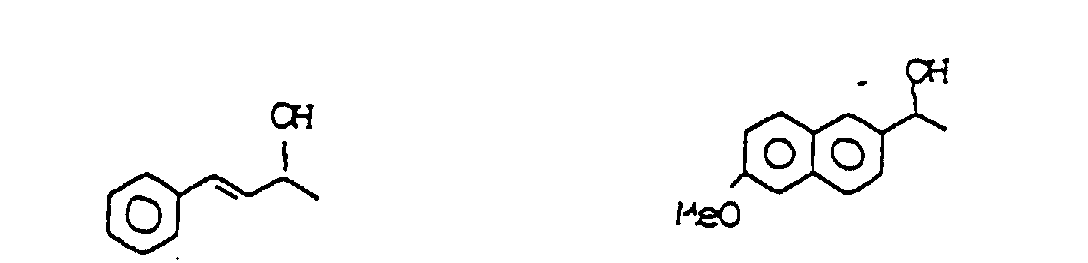
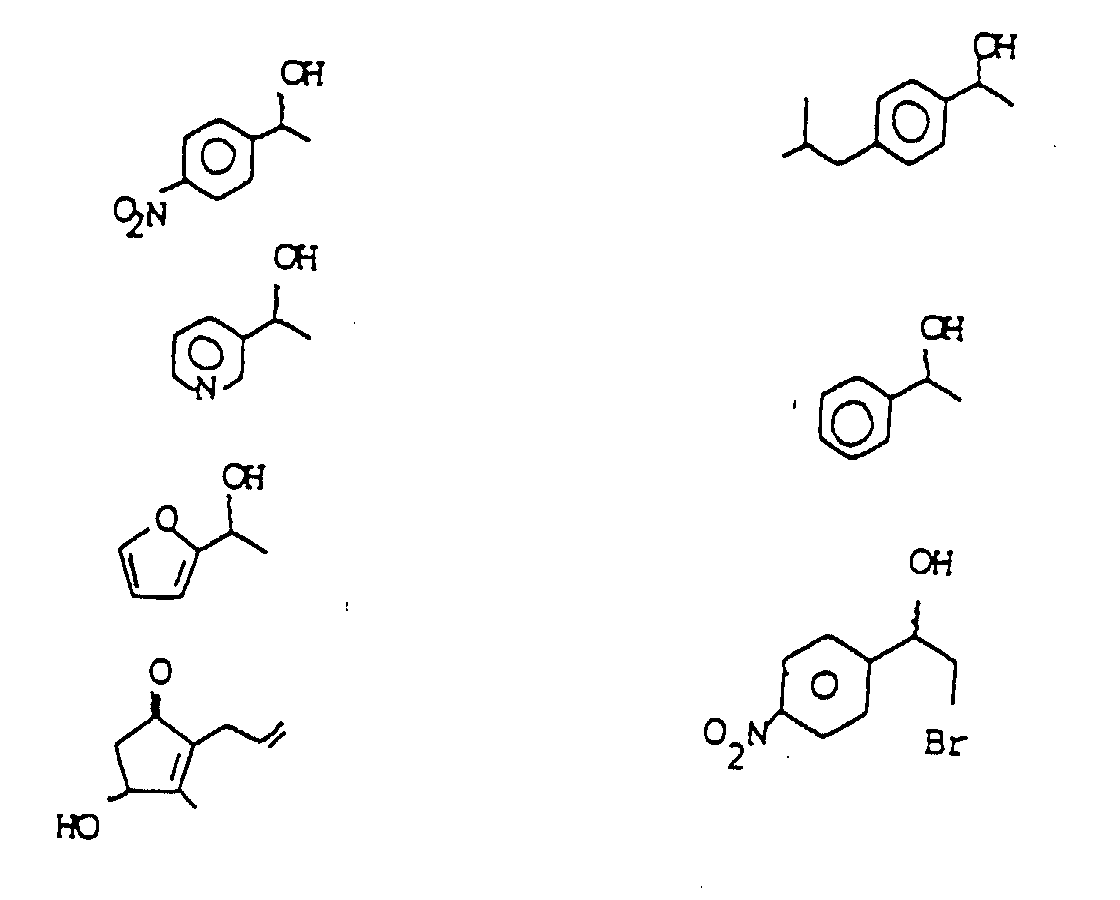



Claims (4)
- Verfahren zur enzymatischen Racematspaltung von racemischen Alkoholen, dadurch gekennzeichnet, daß man einen Vinylester der Formel I,in der

- R1
- Wasserstoff, C1-C18-Alkyl, welches gegebenenfalls mit Halogen substituiert ist, Phenyl oder
C1-C3-Alkoxy-C1-C4-Alkyl
und - R2
- Wasserstoff oder Methyl bedeutet,
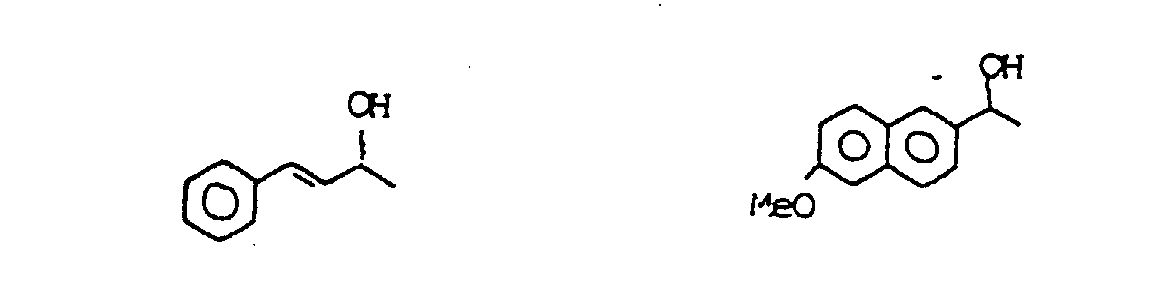 und anschließend den entstandenen optisch reinen Alkohol isoliert und gegebenenfalls das andere Enantiomere aus dem verbliebenen Ester gewinnt.
- Verfahren nach Anspruch 1, dadurch gekennzeichnet, daß
- R1
- bedeutet C1-C4-Alkyl, welches gegebenenfalls chlorsubstituiert ist.
- Verfahren nach Anspruch 1 oder 2, dadurch gekennzeichnet, daß
- R1
- bedeutet Methyl oder Chlormethyl
- Verfahren nach einem oder mehreren der Ansprüche 1 bis 3, dadurch gekennzeichnet, daß Lipase von Pseudomonas eingesetzt wird.
Applications Claiming Priority (2)
| Application Number | Priority Date | Filing Date | Title |
|---|---|---|---|
| DE3743824A DE3743824C2 (de) | 1987-12-23 | 1987-12-23 | Verfahren zur enzymatischen Racematspaltung von racemischen Alkoholen mit/in Vinylestern durch Umesterung |
| DE3743824 | 1987-12-23 |
Publications (4)
| Publication Number | Publication Date |
|---|---|
| EP0321918A2 EP0321918A2 (de) | 1989-06-28 |
| EP0321918A3 EP0321918A3 (en) | 1990-10-03 |
| EP0321918B1 EP0321918B1 (de) | 1994-03-23 |
| EP0321918B2 true EP0321918B2 (de) | 1999-04-14 |
Family
ID=6343443
Family Applications (1)
| Application Number | Title | Priority Date | Filing Date |
|---|---|---|---|
| EP88121274A Expired - Lifetime EP0321918B2 (de) | 1987-12-23 | 1988-12-20 | Verfahren zur enzymatischen Racematspaltung von racemischen Alkoholen mit/in vinylestern durch Umesterung |
Country Status (4)
| Country | Link |
|---|---|
| US (1) | US4963492A (de) |
| EP (1) | EP0321918B2 (de) |
| JP (1) | JPH072118B2 (de) |
| DE (2) | DE3743824C2 (de) |
Families Citing this family (59)
| Publication number | Priority date | Publication date | Assignee | Title |
|---|---|---|---|---|
| JP2578658B2 (ja) * | 1989-02-21 | 1997-02-05 | チッソ株式会社 | 光学活性化合物及びその製造法 |
| DE3919029A1 (de) * | 1989-06-10 | 1990-12-13 | Hoechst Ag | Verfahren zur enzymatischen spaltung von 2-arylpropionsaeure-vinylester |
| PT95142B (pt) * | 1989-08-30 | 1997-05-28 | Sankyo Co | Processo para a preparacao de derivados indolobenzoquinolinicos com accao anti-arritmica |
| JPH03191796A (ja) * | 1989-12-20 | 1991-08-21 | Daicel Chem Ind Ltd | 光学活性1―パライソブチルフェニルエタノール及びそのカルボン酸エステルの製造法 |
| US5342780A (en) * | 1990-01-26 | 1994-08-30 | University Of New Mexico | Methods of enzymatically separating stereoisomers of a racemic mixture of a reactive ester |
| JP2542941B2 (ja) * | 1990-02-02 | 1996-10-09 | チッソ株式会社 | 光学活性ヒドロキシラクトン類の製造方法 |
| DE4005150A1 (de) * | 1990-02-17 | 1991-08-22 | Hoechst Ag | Verfahren zur enzymatischen racematspaltung von pantolacton |
| DE69127219T2 (de) * | 1990-04-12 | 1998-01-15 | Chisso Corp | Verfahren zur Herstellung von optisch aktiven Alkyl-3-aryl-3-hydroxypropionaten |
| US5202457A (en) * | 1990-04-12 | 1993-04-13 | Chisso Corporation | Optically active alkyl 3-aryl-3-hydroxypropionates and a method for producing thereof |
| JP3010497B2 (ja) * | 1990-05-31 | 2000-02-21 | チッソ株式会社 | 光学活性α―ヒドロキシエステル類の製造方法 |
| EP0471531B1 (de) * | 1990-08-13 | 1996-12-04 | Suntory Limited | Verfahren zur Herstellung optisch aktiver Alpha-Hydroxyalkenderivate |
| US5315007A (en) * | 1990-12-20 | 1994-05-24 | North Carolina State University | Process for making DE ring intermediates for the synthesis of camptothecin and camptothecin analogs |
| US5212317A (en) * | 1990-12-20 | 1993-05-18 | North Carolina State University | Methods and intermediates for the assymmetric synthesis of camptothecin and camptothecin analogs |
| US5258516A (en) * | 1990-12-20 | 1993-11-02 | Nc State University | Optically pure D,E ring intermediates useful for the synthesis of camptothecin and camptothecin analogs |
| US5264579A (en) * | 1990-12-20 | 1993-11-23 | North Carolina State University | D ring intermediates for the synthesis of camptothecin and camptothecin analogs |
| DE59108123D1 (de) * | 1990-12-24 | 1996-10-02 | Hoechst Ag | Verfahren zur Acylierung von Alkoholen mit einem immobilisierten Pseudomonas-Lipase |
| EP0529085B1 (de) * | 1991-02-19 | 1997-08-20 | Daicel Chemical Industries, Ltd. | Verfahren zur herstellung von optisch aktivem 3-chlor-1-phenyl-propan-1-ol und dessen derivat |
| JPH05192145A (ja) * | 1991-04-02 | 1993-08-03 | Hoechst Ag | 固定化生体触媒、その製造およびカラムリアクター中でのエステル合成におけるその使用 |
| GB9108376D0 (en) * | 1991-04-19 | 1991-06-05 | Enzymatix Ltd | Cyclopentenes |
| EP0514694B1 (de) * | 1991-05-18 | 1997-07-23 | Mitsubishi Rayon Co., Ltd | Verfahren zur Herstellung von Ascorbinsäure-Estern oder Erythorbinsäure-Estern |
| AT398310B (de) * | 1991-08-30 | 1994-11-25 | Chemie Linz Gmbh | Immobilisierte lipase, verfahren zu ihrer herstellung sowie verfahren zur erhöhung der enantioselektivität einer candida lipase bei der veresterung chiraler alkohole |
| EP0536671B1 (de) * | 1991-10-07 | 1996-03-06 | Hoechst Aktiengesellschaft | Carbonsäureester-Schutzgruppen, ein Verfahren zu ihrer Herstellung, ihre Kopplung an eine funktionelle Gruppe sowie ihre Verwendung |
| US5262571A (en) * | 1992-03-20 | 1993-11-16 | North Carolina State University | Cycloalkyl-based chiral auxiliaries and method making the same |
| EP0577446A3 (de) * | 1992-05-28 | 1995-04-05 | Showa Shell Sekiyu | Verfahren zur Herstellung von optisch-aktiven Halogen-enthaltenden Alkoholen. |
| AT398579B (de) * | 1992-07-06 | 1994-12-27 | Chemie Linz Gmbh | Enzymatisches verfahren zur trennung racemischer gemische von delta-valerolactonen |
| AT399723B (de) * | 1993-02-19 | 1995-07-25 | Chemie Linz Gmbh | Enzymatische racematspaltung asymmetrischer alkinole |
| US5639662A (en) * | 1993-02-19 | 1997-06-17 | Dsm Chemie Linz Gmbh | Increased enantioselectivity of lipase catalyzed transesterification of alkynols with vinyl esters |
| DE4329293A1 (de) * | 1993-08-31 | 1995-03-02 | Basf Ag | Lipase katalysierte Acylierung von Alkoholen mit Diketenen |
| AT401385B (de) * | 1994-03-30 | 1996-08-26 | Chemie Linz Gmbh | Enzymatische racematspaltung asymmetrischer alkohole mittels vinylestern mehrbasiger carbonsäuren |
| DE4414273A1 (de) * | 1994-04-23 | 1995-10-26 | Chemie Linz Deutschland | Enzymatische Racematspaltung asymmetrischer Alkohole mittels Vinylestern mehrbasiger Carbonsäuren |
| US5600027A (en) * | 1994-11-29 | 1997-02-04 | The Nisshin Oil Mills, Ltd. | Process for producing optically active alcohol containing phenyl group |
| DE19505672A1 (de) * | 1995-02-20 | 1996-08-22 | Hoechst Ag | Verfahren zur enzymatischen Acylierung von Alkoholen mit Alkoxyvinylacetaten durch Umesterung |
| FR2742147B1 (fr) * | 1995-12-06 | 1998-02-27 | Esteve Labor Dr | Procede de separation de carbinols |
| GB9611041D0 (en) * | 1996-05-25 | 1996-07-31 | Salford Ultrafine Chem & Res | Process for the preparation of optically active methadones in high enantiomeric purity |
| US6103517A (en) * | 1996-09-11 | 2000-08-15 | Mitsubishi Gas Chemical Company | Process for the production of an optically active alcohol and a novel optically active alcohol |
| DE19706337A1 (de) | 1997-02-19 | 1998-08-20 | Basf Ag | Verfahren zur Herstellung von enantiomerenreinen Estern |
| EP0893422A1 (de) * | 1997-07-18 | 1999-01-27 | Mitsubishi Gas Chemical Company, Inc. | Optisch reiner Alkohol und Verfahren zu seiner Herstellung |
| DE19809649A1 (de) * | 1998-03-06 | 1999-09-09 | Hoechst Marion Roussel De Gmbh | Verfahren zur enzymatischen Enantiomeren-Trennung von 3(R)- und 3(S)-Hydroxy-1-methyl-4-(2,4,6-trimethoxyphenyl)-1,2,3,6-tetrahydro-pyridin bzw. der Carbonsäureester |
| CA2362070A1 (en) | 1999-02-16 | 2000-08-24 | Masaru Mitsuda | Substituted acetylpyridine derivatives and process for the preparation of intermediates for optically active .beta.3 agonist by the use of the same |
| DE19908074A1 (de) * | 1999-02-25 | 2000-08-31 | Basf Ag | Verfahren zur Herstellung von stereoisomeren Carbonsäureestern |
| ES2159231B1 (es) * | 1999-04-09 | 2002-05-16 | Smithkline Beecham Sa | Procedimiento de resolucion de mezclas enantiomericas de alcoholes catalizada por lipasas. |
| KR100359028B1 (ko) * | 1999-12-02 | 2002-10-30 | 학교법인 포항공과대학교 | 키랄 알릴 에스테르의 제조방법 |
| NL1015313C2 (nl) * | 2000-05-26 | 2001-11-27 | Dsm Nv | Werkwijze voor de bereiding van enantiomeer verrijkte esters en alcoholen. |
| ITMI20010047A1 (it) * | 2001-01-12 | 2002-07-12 | Consiglio Nazionale Ricerche | Procedimento di preparazione degli enantiomeri di 1-(3-trifluo-rometilfenil)-propan-2-olo |
| KR100437873B1 (ko) * | 2001-05-08 | 2004-06-26 | 연성정밀화학(주) | 프로스타글란딘 유도체의 제조방법 및 그의 입체특이적출발물질 |
| AU2002365968A1 (en) * | 2001-11-19 | 2003-06-10 | Merck And Co., Inc. | Process for the synthesis of (r)-1-(3,5-bis(trifluoromethyl)-phenyl)ethan-1-ol and esters thereof by dynamic kinetic resolution |
| KR100423875B1 (ko) * | 2001-12-06 | 2004-03-22 | 주식회사 포스코 | 키랄 아민의 제조 방법 |
| WO2003060094A2 (en) * | 2002-01-10 | 2003-07-24 | Teva Pharmaceutical Industries Ltd. | Selective enzymatic esterification and solvolysis of epimeric vitamin d analog and separation of the epimers |
| WO2004080963A1 (en) * | 2003-03-13 | 2004-09-23 | Ciba Specialty Chemicals Holding Inc. | Process for the preparation of indole derivatives by enzymatic acylation |
| DE10336270B3 (de) * | 2003-08-07 | 2005-04-14 | Consortium für elektrochemische Industrie GmbH | Verfahren zur enantioselektiven Herstellung von sekundären Alkoholen durch lipasenkatalysierte Solvolyse der korrespondierenden Acetessigester |
| AT500556A1 (de) * | 2004-03-18 | 2006-01-15 | Dsm Fine Chem Austria Gmbh | Verfahren zur herstellung von chiralen, sekundären alkoholen |
| US7374926B2 (en) * | 2004-12-23 | 2008-05-20 | Council Of Scientific And Industrial Research | Enantioconvergent chemoenzymatic synthesis of (R)-γ-amino-β-hydroxybutyric acid ((R)-GABOB) |
| AU2016252609B2 (en) | 2015-04-20 | 2022-06-30 | Sumitomo Pharma Oncology, Inc. | Predicting response to alvocidib by mitochondrial profiling |
| HUE045585T2 (hu) | 2015-05-18 | 2020-01-28 | Tolero Pharmaceuticals Inc | Megnövelt biológiai hozzáférhetõséggel rendelkezõ Alvocidib gyógyszer-elõanyagok |
| AU2016301315C1 (en) | 2015-08-03 | 2022-07-07 | Sumitomo Pharma Oncology, Inc. | Combination therapies for treatment of cancer |
| WO2018094275A1 (en) | 2016-11-18 | 2018-05-24 | Tolero Pharmaceuticals, Inc. | Alvocidib prodrugs and their use as protein kinase inhibitors |
| JP7196160B2 (ja) | 2017-09-12 | 2022-12-26 | スミトモ ファーマ オンコロジー, インコーポレイテッド | Mcl-1阻害剤アルボシジブを用いた、bcl-2阻害剤に対して非感受性である癌の治療レジメン |
| US11034710B2 (en) | 2018-12-04 | 2021-06-15 | Sumitomo Dainippon Pharma Oncology, Inc. | CDK9 inhibitors and polymorphs thereof for use as agents for treatment of cancer |
| JP2022525149A (ja) | 2019-03-20 | 2022-05-11 | スミトモ ダイニッポン ファーマ オンコロジー, インコーポレイテッド | ベネトクラクスが失敗した急性骨髄性白血病(aml)の処置 |
Family Cites Families (4)
| Publication number | Priority date | Publication date | Assignee | Title |
|---|---|---|---|---|
| US4732853A (en) * | 1984-11-21 | 1988-03-22 | President And Fellows Of Harvard College | Method of making chiral epoxy alcohols |
| JPS61181390A (ja) * | 1985-02-06 | 1986-08-14 | Amano Pharmaceut Co Ltd | 酵素によるグリセライドの製造法 |
| DE3624703A1 (de) * | 1986-07-22 | 1988-01-28 | Hoechst Ag | Chirale synthesebausteine aus prochiralem glycerin |
| US4916074A (en) * | 1986-10-30 | 1990-04-10 | Chisso Corporation | Process for producing optically active compounds |
-
1987
- 1987-12-23 DE DE3743824A patent/DE3743824C2/de not_active Expired - Lifetime
-
1988
- 1988-12-20 DE DE88121274T patent/DE3888650D1/de not_active Expired - Lifetime
- 1988-12-20 EP EP88121274A patent/EP0321918B2/de not_active Expired - Lifetime
- 1988-12-21 US US07/287,371 patent/US4963492A/en not_active Expired - Lifetime
- 1988-12-22 JP JP63322246A patent/JPH072118B2/ja not_active Expired - Lifetime
Also Published As
| Publication number | Publication date |
|---|---|
| JPH01202296A (ja) | 1989-08-15 |
| EP0321918B1 (de) | 1994-03-23 |
| EP0321918A3 (en) | 1990-10-03 |
| US4963492A (en) | 1990-10-16 |
| DE3743824A1 (de) | 1989-07-06 |
| EP0321918A2 (de) | 1989-06-28 |
| JPH072118B2 (ja) | 1995-01-18 |
| DE3888650D1 (de) | 1994-04-28 |
| DE3743824C2 (de) | 1997-03-06 |
Similar Documents
| Publication | Publication Date | Title |
|---|---|---|
| EP0321918B1 (de) | Verfahren zur enzymatischen Racematspaltung von racemischen Alkoholen mit/in vinylestern durch Umesterung | |
| DE3783327T2 (de) | Verfahren zur herstellung von optisch aktiven verbindungen. | |
| DE3424440C2 (de) | ||
| CH619982A5 (de) | ||
| EP0492497B1 (de) | Verfahren zur Acylierung von Alkoholen mit einem immobilisierten Pseudomonas-Lipase | |
| EP0539767B1 (de) | Enzymatisches Verfahren zur enantioselektiven Herstellung optisch aktiver Cyanhydrine | |
| DE4005150A1 (de) | Verfahren zur enzymatischen racematspaltung von pantolacton | |
| DE69221685T2 (de) | Verfahren zur herstellung von optisch aktivem 3-chlor-1-phenyl-propan-1-ol und dessen derivat | |
| DE69005121T2 (de) | Verfahren zur herstellung von aryl-alkandiolen mit hoher optischer reinheit. | |
| EP0632130B1 (de) | Enzymatisches Verfahren zur Herstellung aliphatischer S-Cyanhydrine | |
| DE10032254B4 (de) | Nukleotidsequenz kodierend für eine Benzaldehyd-Lyase und Verfahren zur stereoselektiven Synthese von (R)-2-Hydroxyketonen | |
| EP0716712B1 (de) | Lipase katalysierte acylierung von alkoholen mit diketenen | |
| AT398579B (de) | Enzymatisches verfahren zur trennung racemischer gemische von delta-valerolactonen | |
| EP0727494B1 (de) | Verfahren zu enzymatischen Acylierung von Alkoholen mit Alkoxyvinylacetaten durch Umesterung | |
| EP0675205B1 (de) | Enzymatische Racematspaltung asymmetrischer Alkohole mittels Vinylestern mehrbasiger Carbonsäuren | |
| DE3724721A1 (de) | Verfahren zur enzymatischen racematspaltung von 1-acyloxy-2-cyclopenten-4-on(2,2- dimethylpropandiol)-ketal | |
| DE69006801T2 (de) | Optisch aktive Cyclopentenole und Verfahren zu deren Herstellung. | |
| DE3878264T2 (de) | Monoacetylierung von diolen mit einem biokatalysator aus corynebakteriumoxidans. | |
| DE69103998T2 (de) | Alkohol-estertrennung durch reaktion mit acetat. | |
| DE69103850T2 (de) | Alkohol-estertrennung durch kristallisierung. | |
| EP1805314B1 (de) | Verfahren zur enantioselektiven öffnung von 3-substituierten oxetan-2-onen unter verwendung der lipasen von candida antarctica oder von burkholderia plantarii | |
| JPH0584094A (ja) | 光学活性アルコールの製造法 | |
| EP1242613A2 (de) | Verfahren zur kinetischen racematspaltung von alkoholen oder carbonsäureestern | |
| EP0303947A2 (de) | Verfahren zur enzymatischen Herstellung optisch aktiver phosphorhaltiger funktioneller Essigsäurederivate | |
| EP0419988A1 (de) | Enantioselektive enzymatische Synthese von S(-)- und R(+)-Estern des 4-Hydroxy-cyclopenten-1-ons und seines 2',2'-Dimethylpropan-1',3'-diol-ketals |
Legal Events
| Date | Code | Title | Description |
|---|---|---|---|
| PUAI | Public reference made under article 153(3) epc to a published international application that has entered the european phase |
Free format text: ORIGINAL CODE: 0009012 |
|
| AK | Designated contracting states |
Kind code of ref document: A2 Designated state(s): BE CH DE FR GB IT LI NL |
|
| PUAL | Search report despatched |
Free format text: ORIGINAL CODE: 0009013 |
|
| AK | Designated contracting states |
Kind code of ref document: A3 Designated state(s): BE CH DE FR GB IT LI NL |
|
| 17P | Request for examination filed |
Effective date: 19901221 |
|
| 17Q | First examination report despatched |
Effective date: 19920527 |
|
| RIN1 | Information on inventor provided before grant (corrected) |
Inventor name: PROF. DR. MANFRED SCHNEIDER Inventor name: FUELLING, GERD, DR. Inventor name: HOLLA, WOLFGANG, DR. Inventor name: KELLER, REINHOLD, DR. |
|
| GRAA | (expected) grant |
Free format text: ORIGINAL CODE: 0009210 |
|
| AK | Designated contracting states |
Kind code of ref document: B1 Designated state(s): BE CH DE FR GB IT LI NL |
|
| REF | Corresponds to: |
Ref document number: 3888650 Country of ref document: DE Date of ref document: 19940428 |
|
| ET | Fr: translation filed | ||
| ITF | It: translation for a ep patent filed | ||
| GBT | Gb: translation of ep patent filed (gb section 77(6)(a)/1977) |
Effective date: 19940531 |
|
| PLBI | Opposition filed |
Free format text: ORIGINAL CODE: 0009260 |
|
| 26 | Opposition filed |
Opponent name: BASF AKTIENGESELLSCHAFT, LUDWIGSHAFEN Effective date: 19941223 |
|
| NLR1 | Nl: opposition has been filed with the epo |
Opponent name: BASF AKTIENGESELLSCHAFT, LUDWIGSHAFEN |
|
| RAP2 | Party data changed (patent owner data changed or rights of a patent transferred) |
Owner name: CLARIANT GMBH |
|
| NLT2 | Nl: modifications (of names), taken from the european patent patent bulletin |
Owner name: CLARIANT GMBH |
|
| PLAW | Interlocutory decision in opposition |
Free format text: ORIGINAL CODE: EPIDOS IDOP |
|
| PLAW | Interlocutory decision in opposition |
Free format text: ORIGINAL CODE: EPIDOS IDOP |
|
| PUAH | Patent maintained in amended form |
Free format text: ORIGINAL CODE: 0009272 |
|
| STAA | Information on the status of an ep patent application or granted ep patent |
Free format text: STATUS: PATENT MAINTAINED AS AMENDED |
|
| 27A | Patent maintained in amended form |
Effective date: 19990414 |
|
| AK | Designated contracting states |
Kind code of ref document: B2 Designated state(s): BE CH DE FR GB IT LI NL |
|
| RIN2 | Information on inventor provided after grant (corrected) |
Free format text: KELLER, REINHOLD, DR. * HOLLA, WOLFGANG, DR. * FUELLING, GERD, DR. * PROF. DR. MANFRED SCHNEIDER |
|
| REG | Reference to a national code |
Ref country code: CH Ref legal event code: AEN Free format text: AUFRECHTERHALTUNG DES PATENTES IN GEAENDERTER FORM |
|
| NLR2 | Nl: decision of opposition | ||
| GBTA | Gb: translation of amended ep patent filed (gb section 77(6)(b)/1977) | ||
| ET3 | Fr: translation filed ** decision concerning opposition | ||
| REG | Reference to a national code |
Ref country code: CH Ref legal event code: PUE Owner name: HOECHST AKTIENGESELLSCHAFT TRANSFER- CLARIANT GMBH |
|
| NLR3 | Nl: receipt of modified translations in the netherlands language after an opposition procedure | ||
| REG | Reference to a national code |
Ref country code: GB Ref legal event code: IF02 |
|
| REG | Reference to a national code |
Ref country code: CH Ref legal event code: PFA Owner name: CLARIANT PRODUKTE (DEUTSCHLAND) GMBH Free format text: CLARIANT GMBH#BRUENINGSTRASSE 50#65929 FRANKFURT AM MAIN (DE) -TRANSFER TO- CLARIANT PRODUKTE (DEUTSCHLAND) GMBH#BRUENINGSTRASSE 50#65929 FRANKFURT AM MAIN (DE) |
|
| REG | Reference to a national code |
Ref country code: FR Ref legal event code: CD |
|
| PGFP | Annual fee paid to national office [announced via postgrant information from national office to epo] |
Ref country code: IT Payment date: 20061231 Year of fee payment: 19 |
|
| PGFP | Annual fee paid to national office [announced via postgrant information from national office to epo] |
Ref country code: NL Payment date: 20071213 Year of fee payment: 20 |
|
| PGFP | Annual fee paid to national office [announced via postgrant information from national office to epo] |
Ref country code: CH Payment date: 20071219 Year of fee payment: 20 |
|
| PGFP | Annual fee paid to national office [announced via postgrant information from national office to epo] |
Ref country code: BE Payment date: 20071219 Year of fee payment: 20 |
|
| PGFP | Annual fee paid to national office [announced via postgrant information from national office to epo] |
Ref country code: GB Payment date: 20071220 Year of fee payment: 20 |
|
| PGFP | Annual fee paid to national office [announced via postgrant information from national office to epo] |
Ref country code: DE Payment date: 20080221 Year of fee payment: 20 |
|
| PGFP | Annual fee paid to national office [announced via postgrant information from national office to epo] |
Ref country code: FR Payment date: 20071214 Year of fee payment: 20 |
|
| BE20 | Be: patent expired |
Owner name: *CLARIANT PRODUKTE DEUTSCHLAND G.M.B.H. Effective date: 20081220 |
|
| REG | Reference to a national code |
Ref country code: CH Ref legal event code: PL |
|
| REG | Reference to a national code |
Ref country code: GB Ref legal event code: PE20 Expiry date: 20081219 |
|
| PG25 | Lapsed in a contracting state [announced via postgrant information from national office to epo] |
Ref country code: NL Free format text: LAPSE BECAUSE OF EXPIRATION OF PROTECTION Effective date: 20081220 |
|
| PG25 | Lapsed in a contracting state [announced via postgrant information from national office to epo] |
Ref country code: GB Free format text: LAPSE BECAUSE OF EXPIRATION OF PROTECTION Effective date: 20081219 |
|
| PG25 | Lapsed in a contracting state [announced via postgrant information from national office to epo] |
Ref country code: IT Free format text: LAPSE BECAUSE OF NON-PAYMENT OF DUE FEES Effective date: 20071220 |