EP0321871A2 - Substrate für die alpha-Amylasebestimmung - Google Patents
Substrate für die alpha-Amylasebestimmung Download PDFInfo
- Publication number
- EP0321871A2 EP0321871A2 EP88121068A EP88121068A EP0321871A2 EP 0321871 A2 EP0321871 A2 EP 0321871A2 EP 88121068 A EP88121068 A EP 88121068A EP 88121068 A EP88121068 A EP 88121068A EP 0321871 A2 EP0321871 A2 EP 0321871A2
- Authority
- EP
- European Patent Office
- Prior art keywords
- group
- substituted
- general formula
- acid
- carbon atoms
- Prior art date
- Legal status (The legal status is an assumption and is not a legal conclusion. Google has not performed a legal analysis and makes no representation as to the accuracy of the status listed.)
- Granted
Links
- 0 CCCC(*(*)N=O)OC(C*(CC)CO)CO Chemical compound CCCC(*(*)N=O)OC(C*(CC)CO)CO 0.000 description 1
Classifications
-
- C—CHEMISTRY; METALLURGY
- C07—ORGANIC CHEMISTRY
- C07H—SUGARS; DERIVATIVES THEREOF; NUCLEOSIDES; NUCLEOTIDES; NUCLEIC ACIDS
- C07H15/00—Compounds containing hydrocarbon or substituted hydrocarbon radicals directly attached to hetero atoms of saccharide radicals
- C07H15/20—Carbocyclic rings
- C07H15/203—Monocyclic carbocyclic rings other than cyclohexane rings; Bicyclic carbocyclic ring systems
-
- C—CHEMISTRY; METALLURGY
- C07—ORGANIC CHEMISTRY
- C07H—SUGARS; DERIVATIVES THEREOF; NUCLEOSIDES; NUCLEOTIDES; NUCLEIC ACIDS
- C07H17/00—Compounds containing heterocyclic radicals directly attached to hetero atoms of saccharide radicals
Definitions
- the invention relates to new oligoglucoside derivatives, their preparation and their use as substrates for the determination of ⁇ -amylase.
- a-amylase in serum and urine is an important clinical parameter for checking pancreatic function.
- the substrates used are oligoglucosides which consist of three to eight 1,4-a-linked glucose units, in the 1-position at the reducing end with a determinable group and at the other end in 6- and possibly 4-position are derivatized with a protective group.
- EP 135 758 describes such substrates, derivatized with a determinable residue such as, for example, the nitrophenyl group in the 1-position at the reducing end and a protective group in the 4- and 6-position at the other end.
- Suitable protective groups are, for example, straight-chain or branched alkyl or alkoyl groups, a phenyl radical or an ethylidene bridge.
- auxiliary enzymes that are used to release the determinable residue such as. B. a-glucosidase or ⁇ -glucosidase, attack only the substrate already cleaved by a-amylase, but not the non-cleaved substrate.
- the shelf life of the reagent mixture is improved compared to the unprotected substrates.
- Sensitivity means the ratio of a-amylase activity to the increase in extinction per unit of time ( ⁇ E / min). An increase in sensitivity therefore means that a larger AE / min is found with the same a-amylase activity of the sample.
- the object of the present invention is therefore to provide ⁇ -amylase substrates which are storable and show improved sensitivity.
- R 1 is a hydrogen atom, a methyl, ethyl, propyl, isopropyl, butyl, tert. Butyl, 1-alkoxyalkyl or an optionally hydrophilically substituted cyclopropyl, cyclobutyl, cyclopentyl, cyclohexyl, phenyl, tetrahydropyranyl, piperidinyl, optionally N-methyl or ethyl substituted, pyridinyl, thiophenyl or 1.1.
- R 2 represents an oligoglucoside residue with 2 , 3 or 4 glucose units and X represents a hydrogen atom or an optically determinable residue.
- the substrates according to the invention with the above-mentioned protective groups for the terminal C6-hydroxy group are significantly more sensitive than the known substrates and that the precision of the a-amylase determination can thus be significantly improved.
- R 1 a methyl, isopropyl or an optionally hydrophilically substituted cyclopropyl group is preferred.
- the isopropyl and cyclopropyl group is particularly preferred.
- An oligoglucoside residue with 4 glucose units is preferred as R 2 .
- Suitable hydrophilic substituents are, for example, carboxy, hydroxy, sulfonic acid, dimethylamino, phosphate, halogen and / or nitro groups.
- optically determinable residue in the 1 position at the reducing end of the substrate can be bound either in an ⁇ -linkage or in a ⁇ -linkage.
- X is an optically determinable residue, it can be a residue that has a coloration even in the visible or UV range, or a residue that can only be determined optically after reaction with another compound, for example by transferring it to a compound Dye or by coupling with a dye.
- optically determinable residues are familiar to the person skilled in the art and do not require any further explanation here.
- Preferred are nitro group-containing and optionally chlorinated phenyl radicals, such as the nitrophenyl, the 3,4-di-nitrophenyl or the 2-chloro-4-nitrophenyl group, as well as the resorufin group and its derivatives.
- the compounds according to the invention and the comparison compounds are prepared, for example, analogously to the processes described in EP 135 758. It can also in the unprotected substrate, the desired protective group via activated carboxylic acid groups such. B. on the corresponding orthoesters, acid chlorides, anhydrides, from activated esters enzymatically (JACS 110 (1988) 584-589), from acetals or directly from the carboxylic acid via dehydrating agents such as. B. by the Mitsunobu reaction (poster by S. Czernecki at the XIVth International Carbohydrate Symposium (1988), Sweden; Synthesis 1981, pp. 1 - 28). Production via the corresponding orthoesters as intermediates and production via the Mitsunobu reaction is particularly preferred.
- the orthoesters are preferably made from the corresponding nitriles (cf., for example, HoubenWeyl, Volume VI / 3 (1965) 300-313).
- the nitriles can be produced, for example, from the corresponding carboxylic acids.
- the protected substrates can be cleaned, for example, by chromatography, such as using an ion exchanger or MPLC.
- Another object of the invention is a process for the preparation of the compounds of general formula I, which is characterized in that compounds of general formula II in which R represents an oligoglucoside residue with 2, 3 or 4 glucose units and Y represents a hydrogen atom or an optically determinable residue, with carboxylic acids, their esters, which may optionally be additionally activated, or orthoesters of the general formula III in which R 3 is a hydrogen atom, a methyl, ethyl, propyl, isopropyl, butyl, tert.
- 4,6-ethylidene-resorufinyl- ⁇ -D- or 4,6-ethylidene-p-nitrophenyl- ⁇ -D-maltepentaoside can also be obtained with the corresponding amount of an acetal and compounds of the general formula III.
- p-toluenesulfonic acid other organic acids and mineral acids and / or Lewis acids can also be used for acid catalysis.
- R 3 is a methyl, an isopropyl or a hydrophilically substituted cyclopropyl group
- R4 is a hydroxyl or an alkoxy group
- R 5 and R 6 together are an oxygen atom represent, and compounds of general formula II, which are reacted with the exclusion of moisture and in the presence of one or more dehydrating agents.
- Triphenylphosphine and / or diethyl azodicarboxylate and / or compounds which can be used analogously can be used, for example, as dehydrating agents.
- Alkoxyalkyl in the definition of R 1 and R 3 is to be understood as an alkoxy group bonded to an alkyl group, each having 1 to 6, preferably 1 to 4, carbon atoms.
- alkoxy group in the definition of R4 contains 1 to 10, preferably 1 to 6 carbon atoms and optionally one or more heteroatoms, preferably nitrogen or chlorine, and can be straight-chain, branched or as a ring.
- the preparation can also be carried out by peracetylation of the respective glucoside (maltotrioside, maltotetraoside, maltopentaoside) with acetic anhydride or acetyl chloride (Chem. Ber. 13 (1880) 267) and by hydrolysis of the 1-position acetoxy group (Chem. Ber. 86 (1953) 604) to the hydroxide or bromide. Then The free dye is added to the glucoside using the chloroacetimidate method (Synthesis (1981) 885-887) or the Königs-Knorr method (J. Am. Chem. Soc. 51 (1929) 1830, Angew. Chemie 94 (1982 ) 184) coupled.
- the coupling can also be carried out directly by reacting the respective peracetylated compound with a phenolic chromogen under Lewis acid catalysis (JP-OS 62/289595).
- JP-OS 62/289595 phenolic chromogen under Lewis acid catalysis
- the protective group is coupled to the terminal 6-position via the corresponding orthoesters, enzymatically or via activated carboxylic acid derivatives such as active esters, acid chlorides or anhydrides (Tetrahedron Letters 28 (1987) 3809-3812, J. Am. Chem. Soc 108 (1986) 5638).
- the comparison compounds can be prepared analogously.
- Another object of the invention is a method for determining the ⁇ -amylase in a sample by reaction with an oligosaccharide substrate, ⁇ -glucosidase and / or ⁇ -glucosidase and determination of the cleavage products, characterized in that a compound of the general formula I is used as the oligoglucoside substrate is used.
- the determination of the cleavage products can be carried out in a manner familiar to the person skilled in the art, such as, for. B. described in De 27 41 192 take place.
- the determination of the cleavage products in the event that X is an optically determinable residue is also familiar to the person skilled in the art and is described, for example, in EP 135 758.
- glucoamylase is additionally added.
- the determination is usually carried out in buffer, preferably GOOD buffer, pH 6-8, preferably pH 6.5-7.5 and a concentration of 20-200 mmol / l, preferably 50-150 mmol / l. If necessary, 5 - 20 U / ml glucoamylase can be added. The determination is preferably carried out in the presence of 5-20 mmol / l MgCl 2 .
- peracetyl- ⁇ -D-maltooligosaccharides were synthesized as described above, using the same amounts of maltose, maltotriose, maltotetraose, maltohexaose and maltoheptaose instead of maltopentaose.
- fractions containing the resorufinyl maltopentaoside are combined, concentrated to about 20 ml in vacuo and chromatographed on an RP-18 MPLC column in 10 ml portions with 15% isopropanol as the eluent.
- the fractions containing the product are combined, concentrated in vacuo and then lyophilized.
- the filtrate is evaporated to dryness in vacuo, the residue in 1 l abs. Dissolved ethanol and stirred with 5 g NaOCHa with exclusion of moisture at RT for 18 h.
- the suspension is evaporated to dryness in vacuo, the residue is dissolved in 200 ml of H 2 O, adjusted to pH 7 and applied to a column filled with 500 ml of Diaion-HP-20. It is washed with 15 IH 2 0 and eluted with 10 I of a 15% isopropanol solution.
- the eluate is concentrated to 100 ml in vacuo and, according to the imidate method, chromatographed on an MPLC column (RP-18) with isopropanol solution and lyophilized.
Landscapes
- Chemical & Material Sciences (AREA)
- Organic Chemistry (AREA)
- Engineering & Computer Science (AREA)
- Health & Medical Sciences (AREA)
- Biochemistry (AREA)
- Biotechnology (AREA)
- General Health & Medical Sciences (AREA)
- Genetics & Genomics (AREA)
- Molecular Biology (AREA)
- Life Sciences & Earth Sciences (AREA)
- Measuring Or Testing Involving Enzymes Or Micro-Organisms (AREA)
- Saccharide Compounds (AREA)
- Polysaccharides And Polysaccharide Derivatives (AREA)
Abstract
Description
- Die Erfindung betrifft neue Oligoglucosidderivate, ihre Herstellung sowie ihre Verwendung als Substrate für die Bestimmung der a-Amylase.
- Die Bestimmung von a-Amylase in Serum und Urin ist ein wichtiger klinischer Parameter zur Überprüfung der Bauchspeicheldrüsenfunktion. Bei den gängigsten Verfahren zur a-Amylasebestimmung werden als Substrate Oligoglucoside verwendet, welche aus drei bis acht 1,4-a-verknüpften Glucoseeinheiten bestehen, in 1-Position am reduzierenden Ende mit einer bestimmbaren Gruppe und am anderen Ende in 6- und ggf. 4-Position mit einer Schutzgruppe derivatisiert sind.
- EP 135 758 beschreibt derartige Substrate, derivatisiert mit einem bestimmbaren Rest wie beispielsweise der Nitrophenylgruppe in 1-Position am reduzierenden Ende und einer Schutzgruppe in der 4- und 6-Position am anderen Ende. Als Schutzgruppe geeignet sind beispielsweise geradkettige oder verzweigte Alkyl- oder Alkoylgruppen, ein Phenylrest oder eine Ethylidenbrücke.
- Die Durchführung einer a-Amylasebestimmung mit derartigen Substraten als enzymatischer Farbtest ist für das Substrat 4,6-Ethyliden-p-nitrophenyl-α-D-maltoheptaosid (Et-G7-PNP) in Fresenius Z. Anal. Chem. 324 (1986) 304-305 beschrieben. Dabei erfolgt die Bestimmung nach folgendem Testprinzip (vereinfacht):
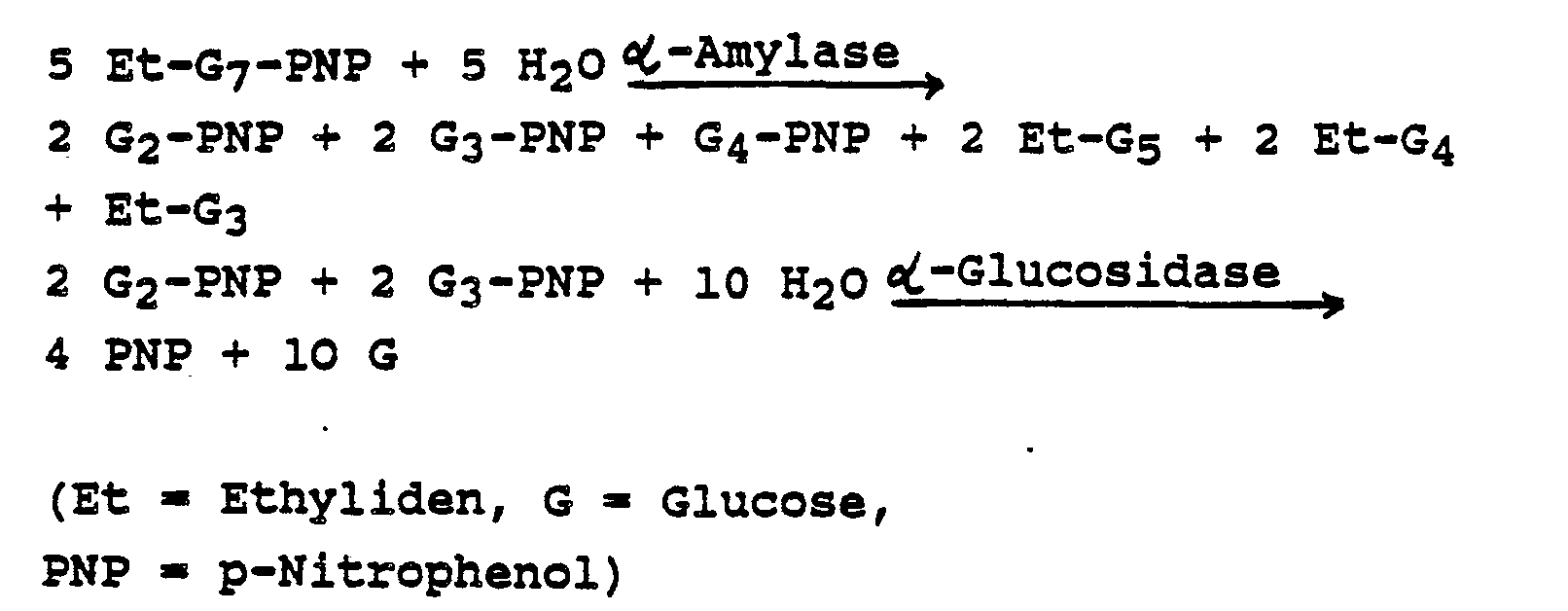
- Der Vorteil dieser Substrate liegt insbesondere darin, daß die Hilfsenzyme, die zur Freisetzung des bestimmbaren Rests verwendet werden, wie z. B. a-Glucosidase oder ß-Glucosidase, nur das bereits durch a-Amylase gespaltene Substrat, nicht jedoch das nichtgespaltene Substrat angreifen.
- Damit wird mit den geschützten Substraten im Vergleich zu den ungeschützten Substraten eine verbesserte Lagerfähigkeit der Reagenzienmischung erreicht.
- Zur Erhöhung der Präzision ist es jedoch, insbesondere bei der Bestimmung von geringen a-Amylase-Aktivitäten, wünschenswert, a-Amylase-Substrate mit einer noch höheren Empfindlichkeit im photometrischen Test als dies mit den bekannten Substraten erreicht werden kann, zu erhalten. Unter Empfindlichkeit wird hier das Verhältnis a-Amylase-Aktivität zur Extinktionszunahme pro Zeiteinheit (ΔE/min) verstanden. Eine Steigerung der Empfindlichkeit bedeutet also, daß bei gleicher a-Amylaseaktivität der Probe ein größeres AE/min gefunden wird.
- Aufgabe der vorliegenden Erfindung ist es daher, a-Amylase-Substrate bereitzustellen, die lagerfähig sind und eine verbesserte Empfindlichkeit zeigen.
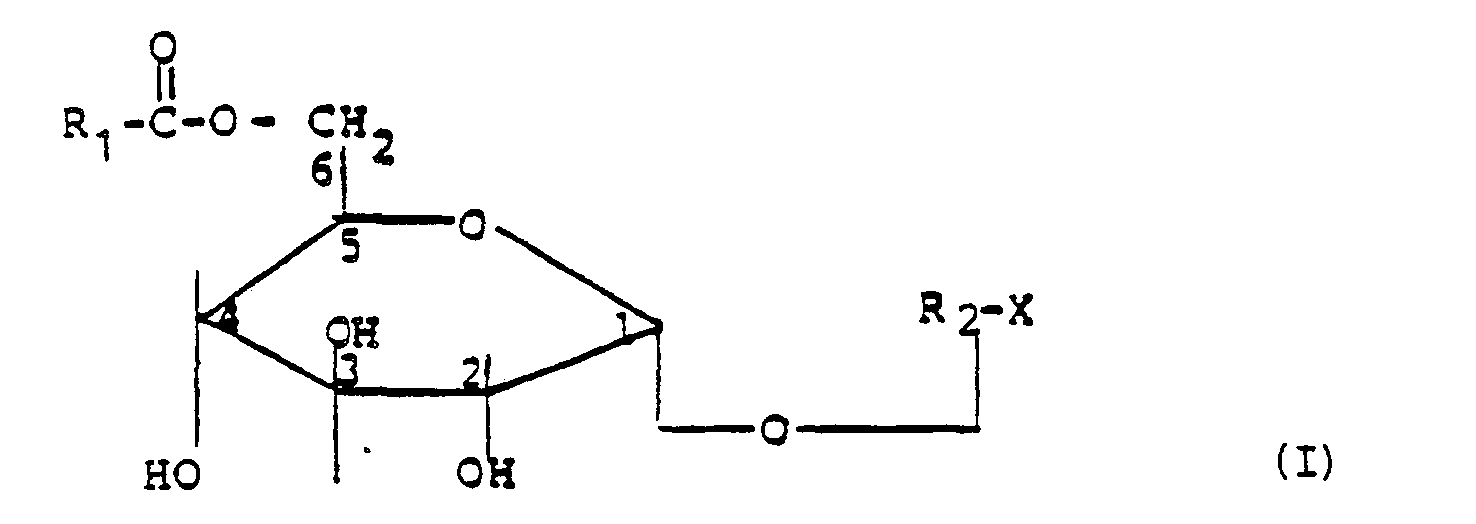
- Gelöst wird diese Aufgabe erfindungsgemäß durch Verbindungen der allgemeinen Formel I

- Überraschenderweise hat sich gezeigt, daß die erfindungsgemäßen Substrate mit den oben genannten Schutzgruppen für die terminale C6-Hydroxygruppe deutlich empfindlicher als die bekannten Substrate sind und damit die Präzision der a-Amylase-Bestimmung wesentlich verbessert werden kann.
- Als R1 ist eine Methyl-, Isopropyl- oder eine gegebenenfalls hydrophil substituierte Cyclopropylgruppe bevorzugt. Die Iso propyl- und Cyclopropylgruppe ist besonders bevorzugt. Als R2 ist ein Oligoglucosidrest - mit 4 Glucoseeinheiten bevorzugt.
- Als hydrophile Substituenten sind beispielsweise geeignet Carboxy-, Hydroxy-, Sulfonsäure-, Dimethylamino-, Phosphat-, Halogen- und/oder Nitrogruppen.
- Der optisch bestimmbare Rest in 1-Position am reduzierenden Ende des Substrats kann sowohl in α-Verknüpfung oder in ß-Verknüpfung gebunden sein.
- Falls X ein optisch bestimmbarer Rest ist, kann es sich um einen Rest handeln, der selbst im sichtbaren- oder UV-Bereich eine Färbung aufweist, oder um einen Rest der erst nach Umsetzung mit einer weiteren Verbindung optisch bestimmbar wird, beispielsweise durch Überführen in einen Farbstoff oder durch Kopplung mit einem Farbstoff. Derartige optisch bestimmbare Reste sind dem Fachmann geläufig und bedürfen hier keiner näheren Erläuterung. Bevorzugt sind Nitrogruppenhaltige und ggf. chlorierte Phenylreste, wie die Nitrophenyl-, die 3,4-Di-nitrophenyl- oder die 2-Chloro-4-nitrophenylgruppe sowie die Resorufingruppe und deren Derivate.
- Die Herstellung der erfindungsgemäßen Verbindungen und der Vergleichsverbindungen erfolgt beispielsweise analog zu den in EP 135 758 beschriebenen Verfahren. Es kann auch in das ungeschützte Substrat die gewünschte Schutzgruppe über aktivierte Carbonsäuregruppen wie z. B. über die entsprechenden Orthoester, Säurechloride, Anhydride, aus aktivierten Estern enzymatisch (JACS 110 (1988) 584 - 589), aus Acetalen oder direkt aus der Carbonsäure über wasserentziehende Mittel wie z. B. durch die Mitsunobu-Reaktion (Poster von S. Czernecki auf dem XIVth International Carbohydrate Symposium (1988), Stockholm; Synthesis 1981, S. 1 - 28) eingeführt werden. Besonders bevorzugt ist die Herstellung über die entsprechenden Orthoester als Zwischenprodukte und die Herstellung über die Mitsunobu-Reaktion. Die Orthoester werden bevorzugt aus den entsprechenden Nitrilen hergestellt (vgl. z. B. HoubenWeyl, Band VI/3 (1965) 300 - 313). Die Nitrile können beispielsweise aus den entsprechenden Carbonsäuren hergestellt werden. Die Reinigung der geschützte Substrate kann zum Beispiel chromatographisch wie über lonentauscher oder MPLC erfolgen.
- Ein weiterer Gegenstand der Erfindung ist ein Verfahren zur Herstellung der Verbindungen der allgemeinen Formel I, welches dadurch gekennzeichnet ist, daß man Verbindungen der allgemeinen Formel II


- Auf diese Weise können beispielsweise Verbindungen der allgemeinen Formel I, in der R, eine Methyl-, eine Isopropyl- oder eine hydrophil substituierte Cyclopropylgruppe, R2 ein Oligoglucosid mit 4 Glucoseeinheiten und X ein Resorufin-oder p-Nitrophenylrest bedeuten, erhalten werden, wenn man Verbindungen der allgemeinen Formel II, in der R und Y die zu R2 und X analoge Bedeutung haben, mit der mindestens 4fach äquimolaren Menge eines Orthoesters der allgemeinen Formel 111, in der R3 eine Methyl-, Isopropyl- oder eine hydrophil substituierte Cyclopropylgruppe, R4 eine Methoxy- oder Ethoxygruppe und Rs und R6 entweder beide eine Methoxy-, oder beide eine Ethoxygruppe bedeuten, in absolutem Lösungsmittel löst und 1 Mol p-Toluolsulfonsäure unter Feuchtigkeitsausschluß einrührt.
- Analog können auch mit der entsprechenden Menge eines Acetals und Verbindungen der allgemeinen Formel III beispielsweise 4,6-Ethyliden-Resorufinyl-ß-D- bzw. 4,6-Ethyliden-p-Nitrophenyl-α-D-maltepentaoside erhalten werden. Anstatt p-Toluolsulfonsäure können auch andere organische Säuren sowie Mineralsäuren und/oder Lewis-Säuren zur Säurekatalyse eingesetzt werden.
- Ebenso bevorzugt ist die Herstpllung der erfindungsgemäßen Verbindungen aus Carbonsäuren gemäß der allgemeinen Formel 111, in der beispielsweise R3 eine Methyl-, eine Isopropyl- oder eine hydrophil substituierte Cyclopropylgruppe, R4 eine Hydroxy- oder eine Alkoxygruppe und R5 und R6 zusammen ein Sauerstoffatom darstellen, und Verbindungen der allgemeinen Formel II, die unter Feuchtigkeitsausschluß und in Gegenwart eines oder mehrerer wasserentziehender Mittel zur Reaktion gebracht werden. Als wasserentziehendes Mittel können beispielsweise Triphenylphosphin und/oder Diethylazodicarboxylat und/oder analog verwendbare Verbindungen verwendet werden.
- Unter "Alkoxyalkyl" in der Definition von R1 und R3 ist eine an eine Alkylgruppe gebundene Alkoxygruppe zu verstehen, wobei jede 1 bis 6, vorzugsweise 1 bis 4 Kohlenstoffatome aufweist.
- Die "Alkoxygruppe" in der Definition von R4 enthält 1 bis 10, bevorzugt 1 bis 6 Kohlenstoffatome und ggf. ein oder mehrere Heteroatome, bevorzugt Stickstoff oder Chlor und kann geradkettig, verzweigt oder als Ring vorliegen.
- Die Herstellung kann auch durch Peracetylierung des jeweiligen Glucosides (Maltotriosid, Maltotetraosid, Maltopentaosid) mit Acetanhydrid oder Acetylchlorid (Chem. Ber. 13 (1880) 267) und durch Hydrolyse der 1-ständigen Acetoxygruppe (Chem. Ber. 86 (1953) 604) zum Hydroxid oder Bromid erfolgen. Anschließend wird der freie Farbstoff an das Glucosid über die Chloracetimidat-Methode (Synthesis (1981) 885 - 887) oder die Königs-Knorr-Methode (J. Am. Chem. Soc. 51 (1929) 1830, Angew. Chemie 94 (1982) 184) gekuppelt. Die Kupplung kann auch direkt durch Umsetzung der jeweiligen peracetylierten Verbindung mit einen phenolischen Chromogen unter Lewis-Säure-Katalyse erfolgen (JP-OS 62/289595). Nach Kupplung des Farbstoffs wird deacetyliert und die Schutzgruppe an die endständige 6-Position über die entsprechenden Orthoester, enzymatisch oder über aktivierte Carbonsäurederivate wie Aktivester, Säurechloride oder Anhydride gekuppelt (Tetrahedron Letters 28 (1987) 3809 - 3812, J. Am. Chem. Soc. 108 (1986) 5638). Die Vergleichsverbindungen können analog hergestellt werden.
- Ein weiterer Gegenstand der Erfindung ist ein Verfahren zur Bestimmung der a-Amylase in einer Probe durch Umsetzung mit einem Oligosaccharidsubstrat, a-Glucosidase und/oder β-Glucosidase und Bestimmung der Spaltprodukte, dadurch gekennzeichnet, daß als Oligoglucosidsubstrat eine Verbindung der allgemeinen Formel I

- Sofern X = H ist, kann die Bestimmung der Spaltprodukte auf die dem Fachmann geläufige Weise, wie z. B. in De 27 41 192 beschrieben, erfolgen. Die Bestimmung der Spaltprodukte für den Fall, daß X ein optisch bestimmbarer Rest ist, ist dem Fachmann ebenfalls geläufig und beispielsweise in EP 135 758 beschrieben. In einer weiteren Ausführungsform wird Glucoamylase zusätzlich zugesetzt.
- Ein weiterer Gegenstand der Erfindung ist ein Reagenz zur Bestimmung von a-Amylase, bestehend aus (Endkonzentrationen im Test):
- 0,5 - 2 mmol/I erfindungsgemäßes Substrat
- 30 - 100 mmol/I NaCl
- 20 - 5- U/I a-Glucosidase und/oder
- 0,5 - 2 U/ml β-Glucosidase
- Die Bestimmung wird üblicherweise in Puffer, vorzugsweise GOOD-Puffer, pH 6 - 8, vorzugsweise pH 6,5 - 7,5 und einer Konzentration von 20 - 200 mmol/I, bevorzugt von 50 - 150 mmol/l durchgeführt. Gegebenenfalls können 5 - 20 U/ml Glucoamylase zugesetzt werden. Vorzugsweise wird die Bestimmung in Gegenwart von 5-20 mmol/I MgCl2 durchgeführt.
- Die folgenden Beispiele und Zeichnungen erläutern die Erfindung weiter:
- 100 g (0.12 mol) Maltopentaose und 81,8 g (1.0 mol) wasserfreies Natriumacetat werden in 1.1 I (11.7 mol) Acetanhydrid suspendiert und langsam unter Feuchtigkeitsausschluß bis zum Reaktionsbeginn (ca. 110°C) aufgeheizt. Dann wird mit Eiswasser gekühlt, bis die Reaktion abgeklungen ist und anschließend zur vollständigen Umsetzung noch I h am Rückfluß gekocht. Das Reaktionsgemisch wird auf ca. 70°C abgekühlt und auf 4 I Eiswasser gegossen. Nach 60 min Rühren wird der Überstand abgegossen und der Rückstand in 500 ml CH2Cl2 gelöst. Die CH2Cl2-Phase wird sukzessiv mit H20, gesättigter NaHCO3-Lösung und H2O ausgeschüttelt und über Na2S04 getrocknet. Nach Abdestillieren des Lösungsmittels im Vakuum wird der Rückstand au 1.5 I Ethanol-Isopropanol (1 : 1) unter Aktivkohlezusatz umkristallisiert.
- Ausbeute: 166.2 g (89.8 % d. Th.) farblose Kristalle
Fp: 120-125°C;
- DC: Kieselgel 60-Platten F254 (Merck)
Toluol/Aceton (7/4)
rf = 0.52
1H-NMR (DMSO-d6): 1.8 - 2.2 (s, 51 H, CH3CO); 3.8 - 5.5 (m, 35H, H-1 - H-6) - Folgende Peracetyl-ß-D-Maltooligosaccharide wurden wie oben beschrieben synthetisiert, wobei anstelle von Maltopentaose gleiche Mengen von Maltose, Maltotriose, Maltotetraose, Maltohexaose und Maltoheptaose eingesetzt wurden.

- 150 g (0.096 mol) Peracetyl-β-D-maltopentaosid werden in 200 ml abs. Tetrahydrofuran gelöst. Dazu gibt man unter Rühren 33 ml (0.3 mol) Benzylamin und läßt 2 h bei Raumtemperatur unter Feuchtigkeitsausschluß rühren. Anschließend wird bis zur Trockene im Vakuum eingeengt, der Rückstand in 400 ml CH2Cl2 gelöst und die CH2C12-Phase nacheinander mit je 400 ml 5 mol/1 HCL, H20, gesättigter NaHCO3-Lösung und H20 gewaschen. Die organische Phase wird dann über Na2S04 getrocknet und mit Aktivkohle unter Rückfluß zum Sieden erhitzt. Nach dem Abfiltrieren der Aktivkohle wird das Filtrat im Vakuum bis zur Trockne eingeengt. Das Produkt kann ohne weitere Reinigung für die nächste Stufe eingesetzt werden.
- Ausbeute: 140 g (97 % d. Th.)
- DC: Kieselgel 60 F254 (Merck)
Toiuoi/Aceton (7/4)
rf = 0.42 - 'H-NMR (DMSO-d6): 1.8 - 2.2 (s, 48H CH3CO) 3.8 - 5.5 (m, 35H, H-1 - H-6) 5.7 (s, 1 H, OH)
- Helferich, B.; Portz, W.; Chem. Ber. 86, (1953), 604.
- Folgende Maltooligosaccharide wurden analog dieser Vorschrift synthetisiert:

- 75 g (0.05 mol) Hydroxy-α-D-paracetyl-maltopentaosid und 25 ml (0.25 ml) Trichloracetonitril werden in 150 ml abs. CH2CI2 gelöst. Die Lösung wird auf 0°C abgekühlt, unter Rühren portionsweise 1.5 g (0.055 mol) Natriumhydrid zugegeben und anschließend 2 h bei RT unter Feuchtigkeitsausschluß gerührt. Überschüssiges Natriumhydrid wird über einer Glasfritte abgetrennt, das Filtrat über einer Kieselgelsäule (60 Merck, ca. 200 ml, Ø 6 cm) filtriert und mit 2 I Essigester nachgewaschen. Das Filtrat wird mit Aktivkohle unter Rückfluß zum Sieden erhitzt, von der Aktivkohle abfiltriert und das Filtrat im Vakuum zur Trockne eingeengt.
- Ausbeute: 72 g (87.5 % d. Th.) farbloses, schaumiges Produkt
- DC: Keiselgel 60 F254 (Merck)
Toluol/Aceton (7/4)
rf = 0.58 - 1H-NMR (DMSO-d6): 1.8 - 2.2 (s, 48H, CH3CO) 3.8 - 5.5 (m, 35H, H-1 - H-6); 6.3 (s, 1 H, NH)
- Schmidt, R., Stumpp, M., Liebigs. Ann. Chem. 1983, 1249 -1256
- Analog dieser Vorschrift wurde noch Peracetyl-maltotriosetrichloracetimidat hergestellt.

- 72 g (0,044 mol) Peracetylmaltopentaosyl-α-D-trichlor-acetimidat und 4.4 g (0.02 mol) Resorufin werden in 1 1 abs. DMF suspendiert. Unter BF3.OEt-Katalyse wird unter Feuchtig keitsausschluß 8 h bei 60° C gerührt. Nach Abkühlen auf Raumtemperatur (RT) wird über Al2O3 (ca. 500 ml) filtriert und mit 5 I Essigester nachgewaschen. Das Filtrat wird im Vakuum bis zur Trockne eingeengt, der Rückstand in 100 ml abs. MeOH gelöst und mit 2 g NaOCH3 3 h bei RT unter Feuchtigkeitsausschluß deacetyliert. Die Suspension wird im Vakuum bis zur Trockne eingeengt, der Rückstand in 100 ml H20 aufgenommen, mit 2 mol/I CHI auf pH = 6 gestellt und auf eine Diaion-Säule (ca. 500 ml/Ø 8 cm) aufgezogen. Es wird zuerst mit 4 I H20, dann mit 3 I 20 %iger Isopropanol-Lösung eluiert. Das Eluat wird auf ca. 40 ml eingeengt und über eine RP-18-Flash-Säule (Ø = 4 cm, h = 39 cm) mit 15 % Isopropanol als Elutionsmittel in 50 ml-Portionen chromatographiert. Die Fraktion, die das Resorufinyl-maltopentaosid enthalten, werden vereinigt, auf ca. 20 ml in Vakuum eingeengt und über einer RP-18-MPLC-Säule in 10 ml-Portionen mit 15 % Isopropanol als Elutionsmittel chromatographiert. Die Fraktionen, die das Produkt enthalten, werden vereinigt, im Vakuum eingeengt und anschließend lyophilisiert.
- Ausbeute: 2,8 g (14 % d. Th.) oranges Lyophilisat
- HPLC: RP-18-Säule, 1 ml/min, 17 % Isopropanol, rt = 2.95 min, Gehalt Resorufin-Gs: 97 %
- 1H-NMR (DMSO-d6): 3.0 - 6.0 (m, 51 H, OH, H-1 - H-6); 6.2 - 8.0 (m, 6H, ArH)
- Schmidt, R.; Grundler, G.; Synthesis 1981, 885 - 887
- 25 mmol des peracetylierten Zuckers werden in 50 ml Eisessig gelöst. Dazu läßt man 50 ml HBr (30 %ig) in Eisessig hinzutropfen und rührt bei RT unter Feuchtigkeitsausschluß. Anschließend werden 300 ml CH2C12 hinzugefügt und auf 1 I Eiswasser gegossen. Die organsiche Phase wird abgetrennt und nacheinander mit H20, gesättigter NaHCO3-Lösung und H20 ausgeschüttelt. Die organsiche Phase wird über Na2SO4. getrocknet und dann im Vakuum zur Trockne eingeengt. Das Produkt kann ohne weitere Aufreinigung in die Folgereaktion eingesetzt werden.

- Brauns, J. Am. Chem. Soc. 51, (1929), 1830
- 50 mmol Resorufin und 25 mmol Ag20 werden in 800 ml abs. CH3CN mit Molekularsieb (3 Å) suspendiert und 4 h unter Feuchtigkeitsausschluß am Rückfluß gekocht. Man gibt 62. 5 mmol des Acetobrom-a-D-maltooligosaccharides in 200 ml abs. CHaCN hinzu und läßt 6 h am Rückfluß kochen. Man läßt weitere 18 h bei RT rühren, setzt 10 g Aktivkohle hinzu und kocht kurz am Rückfluß. Das Gemisch wird über 100 g Al2O3 (Aktivitätsstufe III/N) filtriert und mit 5 I Essigester nachgewaschen. Das Filtrat wird im Vakuum bis zur Trockne eingeengt, der Rückstand in 1 I abs. Ethanol gelöst und mit 5 g NaOCHa unter Feuchtigkeitsausschluß bei RT 18 h gerührt. Die Suspension wird zur Trockne im Vakuum eingeengt, der Rückstand in 200 ml H20 gelöst, auf pH 7 eingestellt und auf eine Säule, gefüllt mit 500 ml Diaion-HP-20, aufgetragen. Es wird mit 15 I H20 gewaschen und mit 10 I einer 15 %igen Isopropanol-Lösung eluiert. Das Eluat wird auf 100 ml im Vakuum eingeengt und entsprechend der Imidat-Methode auf einer MPLC-Säule (RP-18) mit Isopropanol-Lösung chromatographiert und lyophilisiert.

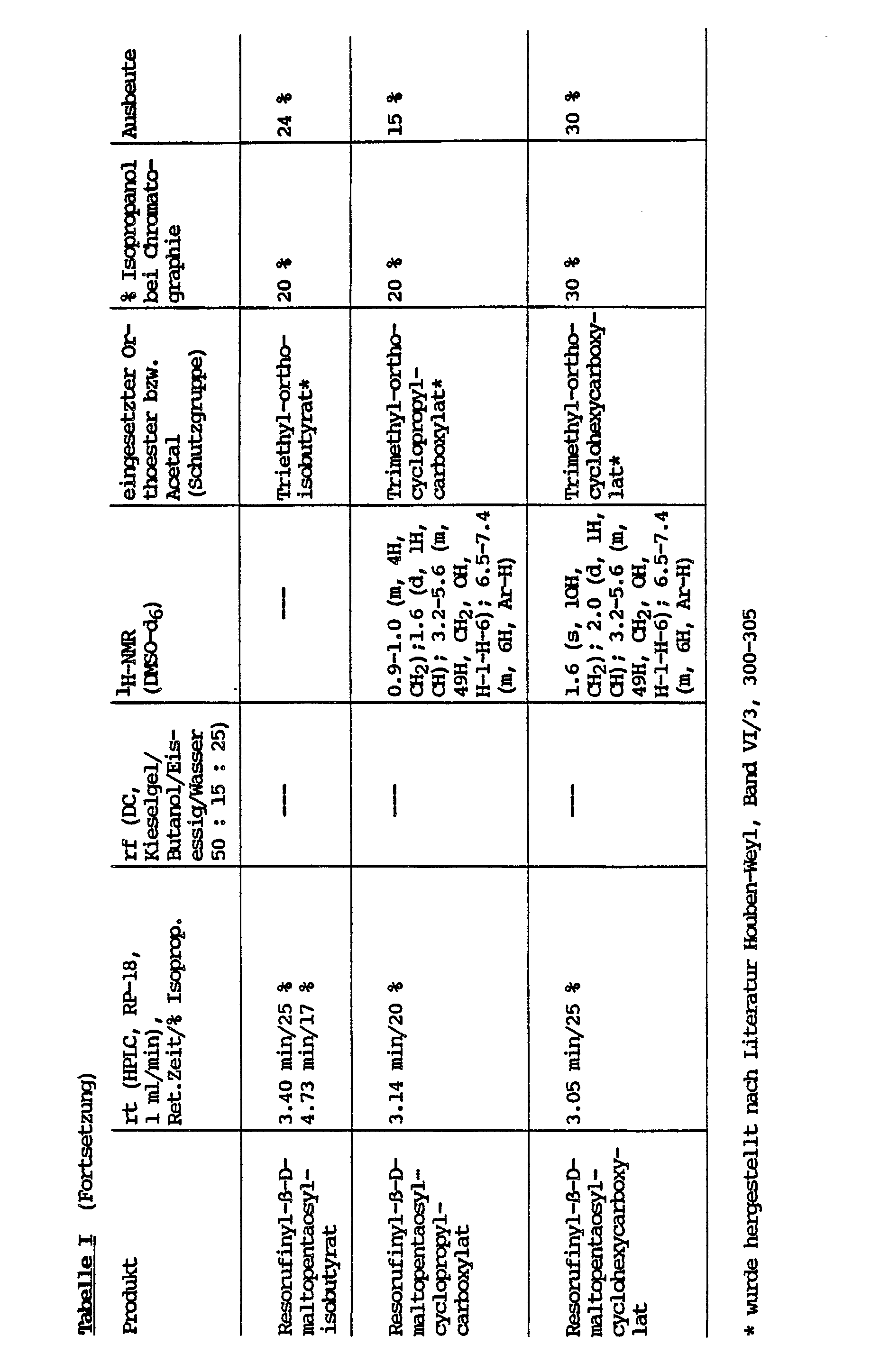
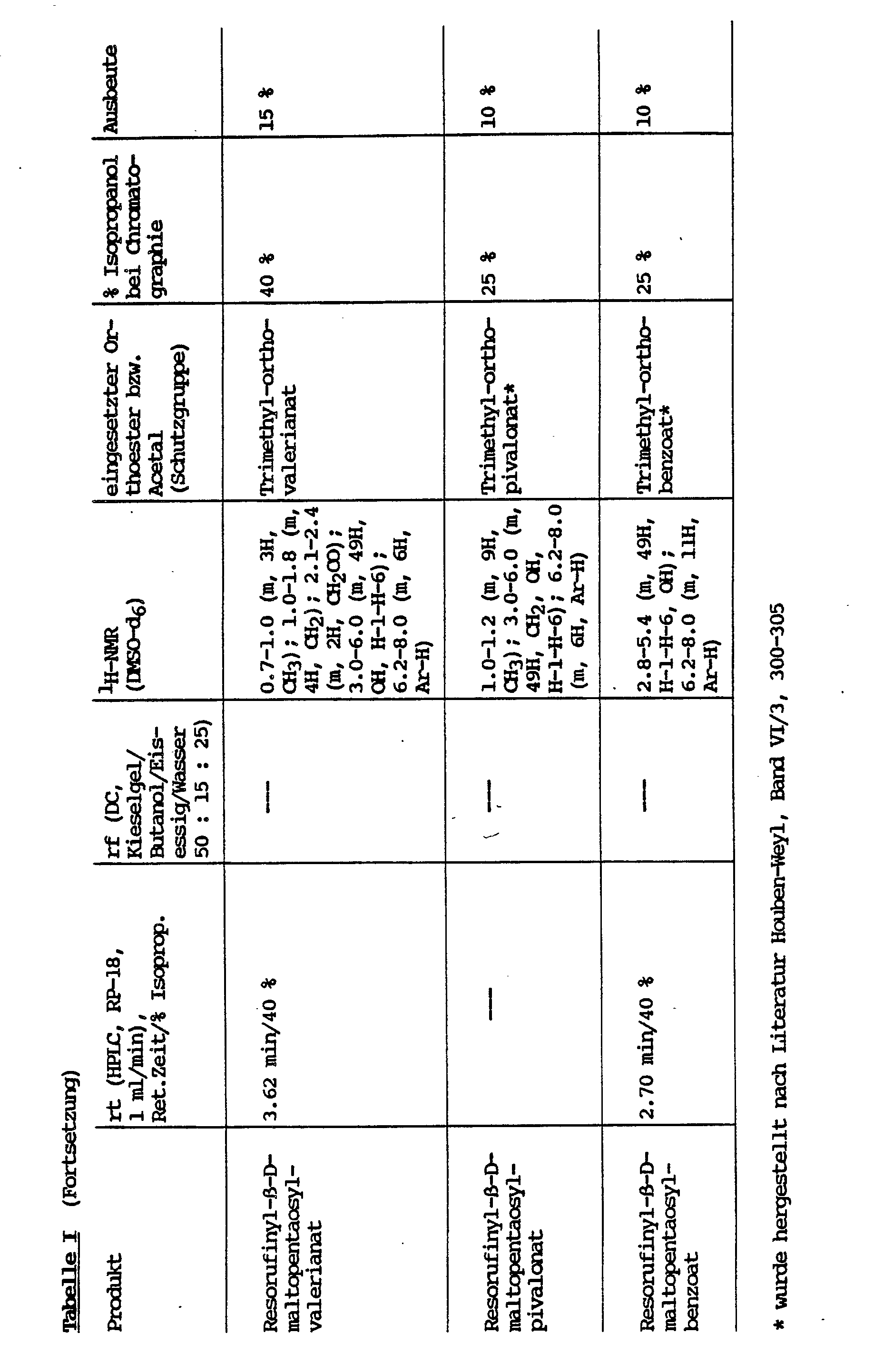
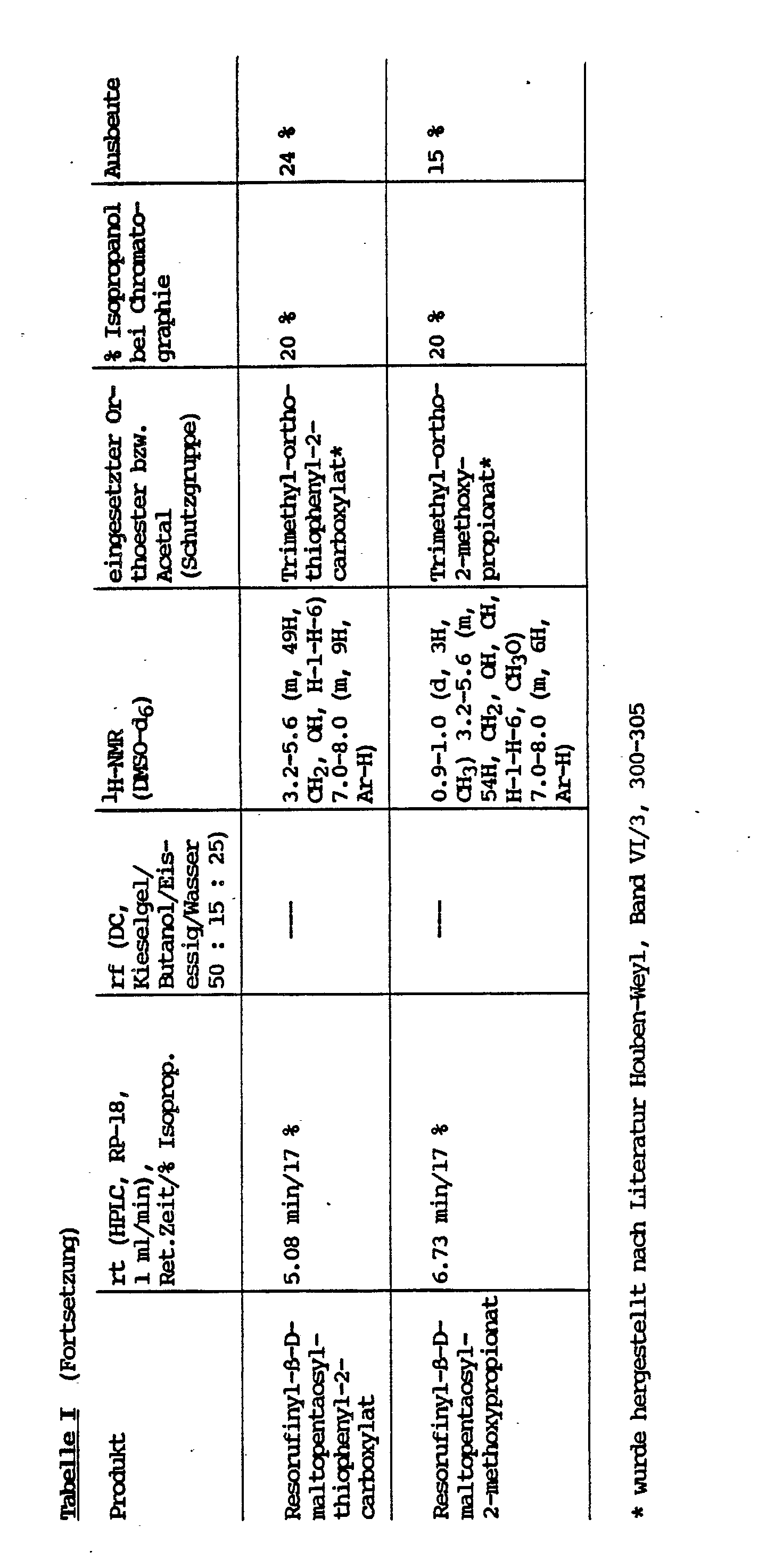
- 1 mmol Resorufinyl- bzw. p-Nitrophenyl-maltooligosaccharid und 4 mmol Orthoester bzw. Acetal werden in 10 ml abs. DMF mit Molekularsieb (3 Ä, frisch, aktiviert) unter Feuchtigkeitsausschluß gelöst. Dazu gibt man unter Rühren 1 mmol p-Toluolsulfonsäure und läßt 4 h bei RT rühren. Anschließend setzt . man 20 ml H20 zu, läßt 10 min rühren und filtriert über DEAE-Sephacel (C03 2-). Man wäscht mit 20 %igem Isopropanol nach, engt das Filtrat auf 20 ml im Vakuum ein und chromatographiert fraktioniert über eine RP-18-MPLC-Säule mit 18 - 60 %igem Isopropanol. Die Produktfraktionen werden vereinigt, im Vakuum eingeengt und lyophilisiert. Im Falle der geschützten Verbindungen von Resorufinyl-β-D-maltosid fällt man aus DMF/H20. Die jeweils eingesetzten Verbindungen und die physikalischen Daten der Produkte ergeben sich aus Tabelle I.
- 1 mmol Resorufinyl-maltopentaosid werden in abs. DMF mit 2 mmol der jeweiligen Carbonsäure, Triphenylphosphin und Diethylazodicarboxylat versetzt und 16 h bei RT unter Feuchtigkeitsausschlußgerührt. Darauf wird 20 ml H20 zugegeben und der entstandene Niederschlag über einen Seitz-Filter abfiltriert. Das Filtrat wird im Vakuum auf ca. 8 ml eingeengt und über eine RP-18-MPLC-Säule mit 18 % Isopropanol chromatographiert. Die Produktfraktionen werden vereinigt, im Vakuum eingeengt und lyophilisiert. Die jeweiligen Produkte sind mit den über die Orthoester-Methode (Beispiel 6) hergestellten Produkten identisch und zeigen die gleichen physikalischen Daten (Tabelle I).
-



-


Claims (10)


Priority Applications (1)
| Application Number | Priority Date | Filing Date | Title |
|---|---|---|---|
| AT88121068T ATE91284T1 (de) | 1987-12-23 | 1988-12-16 | Substrate fuer die alpha-amylasebestimmung. |
Applications Claiming Priority (2)
| Application Number | Priority Date | Filing Date | Title |
|---|---|---|---|
| DE19873743908 DE3743908A1 (de) | 1987-12-23 | 1987-12-23 | Neue oligoglucoside |
| DE3743908 | 1987-12-23 |
Publications (3)
| Publication Number | Publication Date |
|---|---|
| EP0321871A2 true EP0321871A2 (de) | 1989-06-28 |
| EP0321871A3 EP0321871A3 (de) | 1991-06-12 |
| EP0321871B1 EP0321871B1 (de) | 1993-07-07 |
Family
ID=6343487
Family Applications (1)
| Application Number | Title | Priority Date | Filing Date |
|---|---|---|---|
| EP88121068A Expired - Lifetime EP0321871B1 (de) | 1987-12-23 | 1988-12-16 | Substrate für die alpha-Amylasebestimmung |
Country Status (9)
| Country | Link |
|---|---|
| US (1) | US5068182A (de) |
| EP (1) | EP0321871B1 (de) |
| JP (1) | JPH0655753B2 (de) |
| AT (1) | ATE91284T1 (de) |
| AU (1) | AU603941B2 (de) |
| DE (2) | DE3743908A1 (de) |
| ES (1) | ES2058225T3 (de) |
| NZ (1) | NZ227396A (de) |
| ZA (1) | ZA889431B (de) |
Cited By (2)
| Publication number | Priority date | Publication date | Assignee | Title |
|---|---|---|---|---|
| WO2002053766A1 (fr) * | 2000-12-28 | 2002-07-11 | Japan Science And Technology Corporation | Procede permettant de determiner l'activite enzymatique des hydrolases du sucre |
| US10396517B1 (en) | 2018-02-19 | 2019-08-27 | PSZ electronic GmbH | Tapping apparatus for transmitting electrical energy |
Families Citing this family (5)
| Publication number | Priority date | Publication date | Assignee | Title |
|---|---|---|---|---|
| DE3929355A1 (de) * | 1989-09-04 | 1991-03-07 | Boehringer Mannheim Gmbh | Verfahren zur spezifischen bestimmung von pankreas-(alpha)-amylase |
| US5470715A (en) * | 1990-07-23 | 1995-11-28 | Toyo Boseki Kabushiki Kaisha | Composition for determination of chloride ion |
| JPH04346994A (ja) * | 1991-05-23 | 1992-12-02 | Kikkoman Corp | 非還元末端カルバモイルマルトオリゴシド誘導体、これを有効成分とするα‐アミラーゼ活性測定用試薬及びこれを用いたα‐アミラーゼ活性の測定方法 |
| JP3075377B2 (ja) * | 1991-11-06 | 2000-08-14 | 東洋紡績株式会社 | α−アミラーゼ活性の測定法およびα−アミラーゼ活性測定用試薬 |
| JP3023239U (ja) * | 1995-06-01 | 1996-04-16 | 俊彦 岡田 | 風呂またはトイレの掃除用具と芳香剤の組合せ |
Family Cites Families (16)
| Publication number | Priority date | Publication date | Assignee | Title |
|---|---|---|---|---|
| US4147860A (en) * | 1976-07-13 | 1979-04-03 | E. I. Du Pont De Nemours And Company | Process for preparing nitroaromatic glycosides |
| US4145527A (en) * | 1976-07-13 | 1979-03-20 | E. I. Du Pont De Nemours And Company | Nitro aromatic glycosides |
| US4102747A (en) * | 1977-07-28 | 1978-07-25 | American Hospital Supply Corporation | Amylase determination |
| AT362526B (de) * | 1977-09-13 | 1981-05-25 | Boehringer Mannheim Gmbh | Verfahren und reagens zur bestimmung von alpha- -amylase |
| US4233403A (en) * | 1978-02-27 | 1980-11-11 | E. I. Du Pont De Nemours And Company | Amylase assay |
| DE3001878A1 (de) * | 1980-01-19 | 1981-07-23 | Behringwerke Ag, 3550 Marburg | Polysaccharid-derivate, verfahren zu ihrer herstellung, ihre verwendung sowie diese enthaltende mittel |
| US4550077A (en) * | 1980-05-07 | 1985-10-29 | Electro-Nucleonics, Inc. | β-Amylase determination |
| US4451563A (en) * | 1981-08-28 | 1984-05-29 | Kaufman Richard A | Method for increasing the sensitivity of assays |
| US4521592A (en) * | 1981-10-23 | 1985-06-04 | Svenska Sockerfabriks Ab | Compounds for therapeutic or diagnostic use, a process and intermediates for their preparation |
| US4472499A (en) * | 1982-01-22 | 1984-09-18 | American Hoechst Corporation | Reagents for the determination of enzymes |
| DE3372774D1 (en) * | 1982-09-16 | 1987-09-03 | Wako Pure Chem Ind Ltd | Modified oligosaccharides used as substrate for measuring alpha-amylase activity |
| DE3328616A1 (de) * | 1983-08-08 | 1985-02-28 | Boehringer Mannheim Gmbh, 6800 Mannheim | Oligoglucosidderivate |
| JPS6087297A (ja) * | 1983-10-19 | 1985-05-16 | Toyobo Co Ltd | α,β−核置換フエニルマルトオリゴサイドの環状アセタ−ル誘導体,その製造方法並びに該基質を用いるアミラ−ゼ活性の測定方法 |
| JPS60237998A (ja) * | 1983-12-22 | 1985-11-26 | Toyobo Co Ltd | α−アミラ−ゼ活性測定法 |
| DE3411574A1 (de) * | 1984-03-29 | 1985-10-10 | Boehringer Mannheim Gmbh, 6800 Mannheim | Glycoside von resorufin-derivaten, verfahren zu deren herstellung sowie deren verwendung zur bestimmung der aktivitaet von glycosidasen |
| US4649108A (en) * | 1984-07-26 | 1987-03-10 | Genzyme Corporation | Alpha amylase assay |
-
1987
- 1987-12-23 DE DE19873743908 patent/DE3743908A1/de not_active Withdrawn
-
1988
- 1988-12-16 AT AT88121068T patent/ATE91284T1/de active
- 1988-12-16 ES ES88121068T patent/ES2058225T3/es not_active Expired - Lifetime
- 1988-12-16 DE DE8888121068T patent/DE3882215D1/de not_active Expired - Fee Related
- 1988-12-16 EP EP88121068A patent/EP0321871B1/de not_active Expired - Lifetime
- 1988-12-19 ZA ZA889431A patent/ZA889431B/xx unknown
- 1988-12-20 NZ NZ227396A patent/NZ227396A/xx unknown
- 1988-12-22 US US07/288,471 patent/US5068182A/en not_active Expired - Fee Related
- 1988-12-23 AU AU27576/88A patent/AU603941B2/en not_active Ceased
- 1988-12-23 JP JP63323815A patent/JPH0655753B2/ja not_active Expired - Lifetime
Cited By (3)
| Publication number | Priority date | Publication date | Assignee | Title |
|---|---|---|---|---|
| WO2002053766A1 (fr) * | 2000-12-28 | 2002-07-11 | Japan Science And Technology Corporation | Procede permettant de determiner l'activite enzymatique des hydrolases du sucre |
| US10396517B1 (en) | 2018-02-19 | 2019-08-27 | PSZ electronic GmbH | Tapping apparatus for transmitting electrical energy |
| US10673193B2 (en) | 2018-02-19 | 2020-06-02 | PSZ electronic GmbH | Tapping apparatus for transmitting electrical energy |
Also Published As
| Publication number | Publication date |
|---|---|
| DE3882215D1 (de) | 1993-08-12 |
| ZA889431B (en) | 1989-09-27 |
| ATE91284T1 (de) | 1993-07-15 |
| AU2757688A (en) | 1989-06-29 |
| NZ227396A (en) | 1990-09-26 |
| JPH02138291A (ja) | 1990-05-28 |
| US5068182A (en) | 1991-11-26 |
| ES2058225T3 (es) | 1994-11-01 |
| AU603941B2 (en) | 1990-11-29 |
| EP0321871B1 (de) | 1993-07-07 |
| EP0321871A3 (de) | 1991-06-12 |
| DE3743908A1 (de) | 1989-07-06 |
| JPH0655753B2 (ja) | 1994-07-27 |
Similar Documents
| Publication | Publication Date | Title |
|---|---|---|
| EP0135758B1 (de) | Oliglucosidderivate | |
| EP0157384B1 (de) | Substrate für Hydrolasen, Verfahren zu ihrer Herstellung und ihre Verwendung | |
| DE3751253T2 (de) | Mit Aromaten substituiertes Glykosid. | |
| EP0207252B1 (de) | Aromatische Hydroxy- oder Thiol-Derivate von Carbonsäureestern als Lipasesubstrate | |
| EP0321871B1 (de) | Substrate für die alpha-Amylasebestimmung | |
| DE2920890C2 (de) | Esterastin-Derivate und Verfahren zu deren Herstellung | |
| EP0416514B1 (de) | Verfahren zur spezifischen Bestimmung von Pankreas-alpha-Amylase | |
| DE1917874B2 (de) | 14-Halogendaunomycine, Verfahren zu ihrer Herstellung und deren Verwendung zur Herstellung von Adriamycin | |
| DE4338375C2 (de) | Verwendung eines Maltooligosaccharidderivats zur Bestimmung der alpha-Amylaseaktivität | |
| JPH01157996A (ja) | マルトオリゴ糖誘導体およびアミラーゼ活性測定用試薬 | |
| EP0064635B1 (de) | Aminocyclitderivate, ihre Herstellung und sie enthaltende Arzneimittel | |
| DE3738477A1 (de) | Substrat zur messung der (alpha)-amylaseaktivitaet | |
| DE69315721T2 (de) | Oligosaccharidderivate für die Alpha-Amylasebestimmung | |
| EP0536371B1 (de) | INDOPHENOL-SUBSTITUIERTE MALTOOLIGOSIDE ALS alpha-AMYLASE-SUBSTRATE | |
| DE68928496T2 (de) | Zuckerester-Derivate, Reagenzien zur Messung der Hydrolase-Aktivität und Verfahren zur Messung der Hydrolase-Aktivität | |
| DE2132883A1 (de) | Cephemverbindungen | |
| DE4220984A1 (de) | Maltooligosidderivat, dieses als wirksamen bestandteil enthaltendes reagens zur bestimmung der alpha-amylase-aktivitaet und verfahren unter verwendung dieses derivats zur bestimmung der alpha-amylase-aktivitaet | |
| DE69314947T2 (de) | 2-aminozuckermakrolid-derivate | |
| DE2755803C2 (de) | ||
| DE3425357A1 (de) | 1-hydroxy-cytorhodine, ein mikrobiologisches verfahren zu ihrer herstellung und ihre verwendung als cytostatika | |
| JP4115066B2 (ja) | 糖質アミジン誘導体 | |
| JP3070709B2 (ja) | マルトオリゴ糖誘導体の製造法 | |
| DE2760138C2 (de) | Verfahren zur Herstellung von Maltoheptaosederivaten | |
| DE3132691A1 (de) | Aminocyclitderivate, ihre herstellung und sie enthaltende arzneimittel | |
| DE4436313A1 (de) | Differenzierendes Bestimmungsverfahren von alpha-Amylase-Isoenzym-Aktivitäten |
Legal Events
| Date | Code | Title | Description |
|---|---|---|---|
| PUAI | Public reference made under article 153(3) epc to a published international application that has entered the european phase |
Free format text: ORIGINAL CODE: 0009012 |
|
| 17P | Request for examination filed |
Effective date: 19881216 |
|
| AK | Designated contracting states |
Kind code of ref document: A2 Designated state(s): AT BE CH DE ES FR GB GR IT LI LU NL SE |
|
| PUAL | Search report despatched |
Free format text: ORIGINAL CODE: 0009013 |
|
| AK | Designated contracting states |
Kind code of ref document: A3 Designated state(s): AT BE CH DE ES FR GB GR IT LI LU NL SE |
|
| 17Q | First examination report despatched |
Effective date: 19920911 |
|
| GRAA | (expected) grant |
Free format text: ORIGINAL CODE: 0009210 |
|
| AK | Designated contracting states |
Kind code of ref document: B1 Designated state(s): AT BE CH DE ES FR GB GR IT LI LU NL SE |
|
| REF | Corresponds to: |
Ref document number: 91284 Country of ref document: AT Date of ref document: 19930715 Kind code of ref document: T |
|
| REF | Corresponds to: |
Ref document number: 3882215 Country of ref document: DE Date of ref document: 19930812 |
|
| ET | Fr: translation filed | ||
| ITF | It: translation for a ep patent filed | ||
| REG | Reference to a national code |
Ref country code: GR Ref legal event code: FG4A Free format text: 3008670 |
|
| GBT | Gb: translation of ep patent filed (gb section 77(6)(a)/1977) |
Effective date: 19931013 |
|
| EPTA | Lu: last paid annual fee | ||
| PLBE | No opposition filed within time limit |
Free format text: ORIGINAL CODE: 0009261 |
|
| STAA | Information on the status of an ep patent application or granted ep patent |
Free format text: STATUS: NO OPPOSITION FILED WITHIN TIME LIMIT |
|
| 26N | No opposition filed | ||
| REG | Reference to a national code |
Ref country code: ES Ref legal event code: FG2A Ref document number: 2058225 Country of ref document: ES Kind code of ref document: T3 |
|
| EAL | Se: european patent in force in sweden |
Ref document number: 88121068.6 |
|
| PGFP | Annual fee paid to national office [announced via postgrant information from national office to epo] |
Ref country code: SE Payment date: 19981207 Year of fee payment: 11 |
|
| PGFP | Annual fee paid to national office [announced via postgrant information from national office to epo] |
Ref country code: AT Payment date: 19981214 Year of fee payment: 11 |
|
| PGFP | Annual fee paid to national office [announced via postgrant information from national office to epo] |
Ref country code: LU Payment date: 19981221 Year of fee payment: 11 |
|
| PGFP | Annual fee paid to national office [announced via postgrant information from national office to epo] |
Ref country code: GR Payment date: 19981223 Year of fee payment: 11 |
|
| PGFP | Annual fee paid to national office [announced via postgrant information from national office to epo] |
Ref country code: NL Payment date: 19981229 Year of fee payment: 11 |
|
| PGFP | Annual fee paid to national office [announced via postgrant information from national office to epo] |
Ref country code: BE Payment date: 19990215 Year of fee payment: 11 |
|
| PG25 | Lapsed in a contracting state [announced via postgrant information from national office to epo] |
Ref country code: LU Free format text: LAPSE BECAUSE OF NON-PAYMENT OF DUE FEES Effective date: 19991216 Ref country code: AT Free format text: LAPSE BECAUSE OF NON-PAYMENT OF DUE FEES Effective date: 19991216 |
|
| PG25 | Lapsed in a contracting state [announced via postgrant information from national office to epo] |
Ref country code: SE Free format text: LAPSE BECAUSE OF NON-PAYMENT OF DUE FEES Effective date: 19991217 |
|
| PG25 | Lapsed in a contracting state [announced via postgrant information from national office to epo] |
Ref country code: GR Free format text: LAPSE BECAUSE OF NON-PAYMENT OF DUE FEES Effective date: 19991231 Ref country code: BE Free format text: LAPSE BECAUSE OF NON-PAYMENT OF DUE FEES Effective date: 19991231 |
|
| BERE | Be: lapsed |
Owner name: BOEHRINGER MANNHEIM G.M.B.H. Effective date: 19991231 |
|
| PG25 | Lapsed in a contracting state [announced via postgrant information from national office to epo] |
Ref country code: NL Free format text: LAPSE BECAUSE OF NON-PAYMENT OF DUE FEES Effective date: 20000701 |
|
| EUG | Se: european patent has lapsed |
Ref document number: 88121068.6 |
|
| NLV4 | Nl: lapsed or anulled due to non-payment of the annual fee |
Effective date: 20000701 |
|
| PGFP | Annual fee paid to national office [announced via postgrant information from national office to epo] |
Ref country code: DE Payment date: 20001211 Year of fee payment: 13 |
|
| PGFP | Annual fee paid to national office [announced via postgrant information from national office to epo] |
Ref country code: FR Payment date: 20001212 Year of fee payment: 13 |
|
| PGFP | Annual fee paid to national office [announced via postgrant information from national office to epo] |
Ref country code: GB Payment date: 20001213 Year of fee payment: 13 |
|
| PGFP | Annual fee paid to national office [announced via postgrant information from national office to epo] |
Ref country code: CH Payment date: 20001215 Year of fee payment: 13 |
|
| PGFP | Annual fee paid to national office [announced via postgrant information from national office to epo] |
Ref country code: ES Payment date: 20001220 Year of fee payment: 13 |
|
| PG25 | Lapsed in a contracting state [announced via postgrant information from national office to epo] |
Ref country code: GB Free format text: LAPSE BECAUSE OF NON-PAYMENT OF DUE FEES Effective date: 20011216 |
|
| PG25 | Lapsed in a contracting state [announced via postgrant information from national office to epo] |
Ref country code: LI Free format text: LAPSE BECAUSE OF NON-PAYMENT OF DUE FEES Effective date: 20011231 Ref country code: CH Free format text: LAPSE BECAUSE OF NON-PAYMENT OF DUE FEES Effective date: 20011231 |
|
| REG | Reference to a national code |
Ref country code: GB Ref legal event code: IF02 |
|
| PG25 | Lapsed in a contracting state [announced via postgrant information from national office to epo] |
Ref country code: DE Free format text: LAPSE BECAUSE OF NON-PAYMENT OF DUE FEES Effective date: 20020702 |
|
| GBPC | Gb: european patent ceased through non-payment of renewal fee |
Effective date: 20011216 |
|
| REG | Reference to a national code |
Ref country code: CH Ref legal event code: PL |
|
| PG25 | Lapsed in a contracting state [announced via postgrant information from national office to epo] |
Ref country code: FR Free format text: LAPSE BECAUSE OF NON-PAYMENT OF DUE FEES Effective date: 20020830 |
|
| REG | Reference to a national code |
Ref country code: FR Ref legal event code: ST |
|
| PG25 | Lapsed in a contracting state [announced via postgrant information from national office to epo] |
Ref country code: ES Free format text: LAPSE BECAUSE OF NON-PAYMENT OF DUE FEES Effective date: 20021217 |
|
| REG | Reference to a national code |
Ref country code: ES Ref legal event code: FD2A Effective date: 20030113 |
|
| PG25 | Lapsed in a contracting state [announced via postgrant information from national office to epo] |
Ref country code: IT Free format text: LAPSE BECAUSE OF NON-PAYMENT OF DUE FEES;WARNING: LAPSES OF ITALIAN PATENTS WITH EFFECTIVE DATE BEFORE 2007 MAY HAVE OCCURRED AT ANY TIME BEFORE 2007. THE CORRECT EFFECTIVE DATE MAY BE DIFFERENT FROM THE ONE RECORDED. Effective date: 20051216 |