EP0306599B1 - Verfahren zur Herstellung von magnetisch anisotropem Magnetmaterial aus Nd-Fe-B - Google Patents
Verfahren zur Herstellung von magnetisch anisotropem Magnetmaterial aus Nd-Fe-B Download PDFInfo
- Publication number
- EP0306599B1 EP0306599B1 EP88103646A EP88103646A EP0306599B1 EP 0306599 B1 EP0306599 B1 EP 0306599B1 EP 88103646 A EP88103646 A EP 88103646A EP 88103646 A EP88103646 A EP 88103646A EP 0306599 B1 EP0306599 B1 EP 0306599B1
- Authority
- EP
- European Patent Office
- Prior art keywords
- die
- upsetting
- temperature
- plunger
- pressing
- Prior art date
- Legal status (The legal status is an assumption and is not a legal conclusion. Google has not performed a legal analysis and makes no representation as to the accuracy of the status listed.)
- Expired - Lifetime
Links
- 239000000463 material Substances 0.000 title claims description 15
- 238000000034 method Methods 0.000 title claims description 15
- 229910001172 neodymium magnet Inorganic materials 0.000 title claims description 13
- 229910045601 alloy Inorganic materials 0.000 claims description 15
- 239000000956 alloy Substances 0.000 claims description 15
- 239000013078 crystal Substances 0.000 claims description 8
- 238000010438 heat treatment Methods 0.000 claims description 8
- 238000003825 pressing Methods 0.000 claims description 8
- 230000003028 elevating effect Effects 0.000 claims description 7
- 229910052779 Neodymium Inorganic materials 0.000 claims description 4
- 229910052771 Terbium Inorganic materials 0.000 claims description 3
- 229910052796 boron Inorganic materials 0.000 claims description 3
- 229910052782 aluminium Inorganic materials 0.000 claims description 2
- 229910052733 gallium Inorganic materials 0.000 claims description 2
- 229910052735 hafnium Inorganic materials 0.000 claims description 2
- 229910052758 niobium Inorganic materials 0.000 claims description 2
- 229910052710 silicon Inorganic materials 0.000 claims description 2
- 229910052715 tantalum Inorganic materials 0.000 claims description 2
- 229910052719 titanium Inorganic materials 0.000 claims description 2
- 229910052725 zinc Inorganic materials 0.000 claims description 2
- 229910052726 zirconium Inorganic materials 0.000 claims description 2
- 229910000808 amorphous metal alloy Inorganic materials 0.000 claims 1
- 230000006835 compression Effects 0.000 description 12
- 238000007906 compression Methods 0.000 description 12
- 230000007423 decrease Effects 0.000 description 8
- 239000000843 powder Substances 0.000 description 7
- 239000000203 mixture Substances 0.000 description 6
- 230000004907 flux Effects 0.000 description 4
- 238000002844 melting Methods 0.000 description 4
- 230000008018 melting Effects 0.000 description 4
- 238000010791 quenching Methods 0.000 description 4
- 230000000171 quenching effect Effects 0.000 description 4
- 238000010298 pulverizing process Methods 0.000 description 3
- 238000005096 rolling process Methods 0.000 description 3
- 229910052692 Dysprosium Inorganic materials 0.000 description 2
- 229910052777 Praseodymium Inorganic materials 0.000 description 2
- 230000005347 demagnetization Effects 0.000 description 2
- 230000000694 effects Effects 0.000 description 2
- 229910052742 iron Inorganic materials 0.000 description 2
- 230000005415 magnetization Effects 0.000 description 2
- XLYOFNOQVPJJNP-UHFFFAOYSA-N water Substances O XLYOFNOQVPJJNP-UHFFFAOYSA-N 0.000 description 2
- 238000002441 X-ray diffraction Methods 0.000 description 1
- 238000007796 conventional method Methods 0.000 description 1
- 238000001816 cooling Methods 0.000 description 1
- 229910052802 copper Inorganic materials 0.000 description 1
- 230000006866 deterioration Effects 0.000 description 1
- 238000007723 die pressing method Methods 0.000 description 1
- 235000012489 doughnuts Nutrition 0.000 description 1
- 238000007731 hot pressing Methods 0.000 description 1
- 239000011261 inert gas Substances 0.000 description 1
- 230000001788 irregular Effects 0.000 description 1
- 230000002427 irreversible effect Effects 0.000 description 1
- 238000004519 manufacturing process Methods 0.000 description 1
- 230000003647 oxidation Effects 0.000 description 1
- 238000007254 oxidation reaction Methods 0.000 description 1
- 230000002093 peripheral effect Effects 0.000 description 1
- 238000005245 sintering Methods 0.000 description 1
- 239000007858 starting material Substances 0.000 description 1
- 238000006467 substitution reaction Methods 0.000 description 1
Images


Classifications
-
- B—PERFORMING OPERATIONS; TRANSPORTING
- B22—CASTING; POWDER METALLURGY
- B22F—WORKING METALLIC POWDER; MANUFACTURE OF ARTICLES FROM METALLIC POWDER; MAKING METALLIC POWDER; APPARATUS OR DEVICES SPECIALLY ADAPTED FOR METALLIC POWDER
- B22F3/00—Manufacture of workpieces or articles from metallic powder characterised by the manner of compacting or sintering; Apparatus specially adapted therefor ; Presses and furnaces
- B22F3/12—Both compacting and sintering
- B22F3/14—Both compacting and sintering simultaneously
-
- B—PERFORMING OPERATIONS; TRANSPORTING
- B22—CASTING; POWDER METALLURGY
- B22F—WORKING METALLIC POWDER; MANUFACTURE OF ARTICLES FROM METALLIC POWDER; MAKING METALLIC POWDER; APPARATUS OR DEVICES SPECIALLY ADAPTED FOR METALLIC POWDER
- B22F9/00—Making metallic powder or suspensions thereof
- B22F9/002—Making metallic powder or suspensions thereof amorphous or microcrystalline
- B22F9/008—Rapid solidification processing
-
- H—ELECTRICITY
- H01—ELECTRIC ELEMENTS
- H01F—MAGNETS; INDUCTANCES; TRANSFORMERS; SELECTION OF MATERIALS FOR THEIR MAGNETIC PROPERTIES
- H01F1/00—Magnets or magnetic bodies characterised by the magnetic materials therefor; Selection of materials for their magnetic properties
- H01F1/01—Magnets or magnetic bodies characterised by the magnetic materials therefor; Selection of materials for their magnetic properties of inorganic materials
- H01F1/03—Magnets or magnetic bodies characterised by the magnetic materials therefor; Selection of materials for their magnetic properties of inorganic materials characterised by their coercivity
- H01F1/032—Magnets or magnetic bodies characterised by the magnetic materials therefor; Selection of materials for their magnetic properties of inorganic materials characterised by their coercivity of hard-magnetic materials
- H01F1/04—Magnets or magnetic bodies characterised by the magnetic materials therefor; Selection of materials for their magnetic properties of inorganic materials characterised by their coercivity of hard-magnetic materials metals or alloys
- H01F1/047—Alloys characterised by their composition
- H01F1/053—Alloys characterised by their composition containing rare earth metals
- H01F1/055—Alloys characterised by their composition containing rare earth metals and magnetic transition metals, e.g. SmCo5
- H01F1/057—Alloys characterised by their composition containing rare earth metals and magnetic transition metals, e.g. SmCo5 and IIIa elements, e.g. Nd2Fe14B
- H01F1/0571—Alloys characterised by their composition containing rare earth metals and magnetic transition metals, e.g. SmCo5 and IIIa elements, e.g. Nd2Fe14B in the form of particles, e.g. rapid quenched powders or ribbon flakes
- H01F1/0575—Alloys characterised by their composition containing rare earth metals and magnetic transition metals, e.g. SmCo5 and IIIa elements, e.g. Nd2Fe14B in the form of particles, e.g. rapid quenched powders or ribbon flakes pressed, sintered or bonded together
- H01F1/0576—Alloys characterised by their composition containing rare earth metals and magnetic transition metals, e.g. SmCo5 and IIIa elements, e.g. Nd2Fe14B in the form of particles, e.g. rapid quenched powders or ribbon flakes pressed, sintered or bonded together pressed, e.g. hot working
-
- H—ELECTRICITY
- H01—ELECTRIC ELEMENTS
- H01F—MAGNETS; INDUCTANCES; TRANSFORMERS; SELECTION OF MATERIALS FOR THEIR MAGNETIC PROPERTIES
- H01F41/00—Apparatus or processes specially adapted for manufacturing or assembling magnets, inductances or transformers; Apparatus or processes specially adapted for manufacturing materials characterised by their magnetic properties
- H01F41/02—Apparatus or processes specially adapted for manufacturing or assembling magnets, inductances or transformers; Apparatus or processes specially adapted for manufacturing materials characterised by their magnetic properties for manufacturing cores, coils, or magnets
- H01F41/0253—Apparatus or processes specially adapted for manufacturing or assembling magnets, inductances or transformers; Apparatus or processes specially adapted for manufacturing materials characterised by their magnetic properties for manufacturing cores, coils, or magnets for manufacturing permanent magnets
Definitions
- the present invention relates to a method and an apparatus for producing a magnetically anisotropic Nd-Fe-B magnet material having large coercive force and magnetic energy product by compressing a green body and treating it to have magnetic anisotropy, the green body being obtained by cold forming of flakes or powders obtained by pulverizing an Nd-Fe-B magnetic ribbon formed by a rapid quenching method.
- Nd-Fe-B sintered magnet It is conventionally known as disclosed in JP-C-61-34242 to produce an Nd-Fe-B sintered magnet by preparing an ingot by melting a mixture of Nd, Fe, B and if necessary additional elements, pulverizing it to form powder, sintering and heat-treating it. Further, it is known that an Nd-Fe-B magnet can be provided with a high coercive force by making the crystal grains of the magnet finer, for instance, to an average grain size of about 0.01-0.5»m. This fine crystal-type Nd-Fe-B magnet is disclosed, for instance, in EP-A-0 133 758.
- die upsetting can provide the magnet with magnetic anisotropy, but it is not disclosed how a pressed powder body having fine crystal grains can be efficiently formed into a compressed body with magnetic anisotropy, and what deformation by upsetting can increase the magnetic properties of the compressed body.
- the present invention is aimed at providing a method of efficiently producing a magnetically anisotropic Nd-Fe-B magnet of a substantially fine crystal type. More specifically, it is aimed at providing a magnetically anisotropic Nd-Fe-B magnet material with high coercive force and magnetic energy product by carrying out the compression of a pressed powder body and giving magnetic anisotropy thereto more efficiently than conventional methods.
- Another object of the present invention is to provide an apparatus for producing a magnetically anisotropic Nd-Fe-B magnet by upsetting in such a manner as to form such a final shape as a field magnet for voice coils (mostly fan shape), a field magnet for generators (mostly arc segment shape), a magnet for speakers (mostly doughnut shape) or a field magnet for flat motors (mostly circular shape).
- the present invention provides the method defined in claim 1.
- Pr and Nd have substantially the same effects, so that part or all of Nd may be replaced by Pr.
- a substitution of part of Nd with Dy or Tb provides a fine crystal-type magnet with particularly high coercive force and excellent thermal stability.
- x is 0-0.3 when A is Dy or Tb.
- the Curie temperature of the alloy can be enhanced, reducing the temperature variation of residual magnetic flux density thereof.
- M is one or more elements other than Nd, Dy, Pr, Fe, Tb, Co and B, and it is preferably Ga, Zr, Hf, Nb, Ta, Si, Zn, Al or Ti.
- the alloy of the present invention may contain Nb coming from ferroboron.
- the average size of fine crystal grains in the alloy exceeds 0.5»m, the iHc of the alloy decreases and the irreversible loss of flux thereof at 160°C becomes 10% or more, extremely lowering thermal stability thereof.
- the average size is less than 0.01»m, the iHc is also low, unable to provide the desired permanent magnet. Therefore, the average size of the fine crystal grains in the alloy is limited to 0.01-0.5»m.
- flaky or powdery starting material may be prepared by the following procedures.
- an alloy of a predetermined composition is prepared by high-frequency melting or arc melting, etc., and the alloy is rapidly quenched to form flakes.
- the rapid quenching can be carried out by either of a single roll method or a double roll method, and materials for the roll may be Fe, Cu, etc.
- Cu is used for the roll, it is preferably plated with Cr.
- the rapid quenching is conducted in an inert gas atmosphere such as Ar, He, etc. to prevent the oxidation of the alloy.
- the resulting flakes are pulverized to 100-200»m or so.
- the coarse powder thus formed is pressed at room temperature to provide a green body.
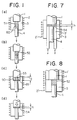
- the green body is placed in a cavity of a die 3 for compression as shown in Fig. 1, and it is kept at temperatures between 600°C and 850°C by high-frequency heating. It is compressed by elevating a lower plunger 4, and elevated to an upsetting position by elevating the lower plunger 4 while heating with a high-frequency heater 2, and then upset at temperatures of 600-850°C by lowering an upper plunger 1 while keeping the lower plunger 4 stationary. If the compression of the green body is insufficient, magnetic anisotropy cannot be fully obtained by die upsetting. Thus, it is important to carry out compression at 600-850°C to produce a pressed body having a relatively small crystal grain size.
- Fig. 2 shows how the coercive force varies depending upon the compression temperature in the pressed powder body of Nd14Fe80B6.
- the compression and the die upsetting are preferably conducted at 700-760°C.
- the upsetting of the pressed body at 600-850°C, particularly 700-760°C can provide an anisotropic flat plate. In this case, a lowering speed of the upper plunger, namely how fast strain is given to the pressed body greatly affects the magnetic properties of the resulting magnet alloy.
- a strain rate is defined herein as h/h0, wherein h is a distance of the upper plunger lowered a second, and h0 is a height of the pressed body.
- the magnetic properties depend upon the strain rate as shown in Fig. 3.
- the strain rate is preferably about 1x10 ⁇ 5/sec or more.
- extreme decrease in residual magnetic flux density Br(4 ⁇ Ir) ensues.
- it is preferably about 1x10 ⁇ 1/sec or less. More preferably, with the strain rate between about 4x10 ⁇ 4/sec. and about 4x10 ⁇ 2/sec., magnetically anisotropic magnet material with large magnetic energy product can be obtained by the upsetting.
- the resulting flat plate may be subjected to a heat treatment of rapid quenching after heating at 600-800°C to increase the iHc thereof.
- the magnetically anisotropic upset magnet in the shape of disc, doughnut or fan can be produced.
- the flat plate may be pulverized to form powder for anisotropic resin-bonded magnets.
- Nd14Fe80B6 alloy was prepared by arc melting, and formed into flakes by a single roll method in an Ar atmosphere.
- the flakes obtained at a roll peripheral speed of 30 m/sec. were in an irregular shape having a thickness of about 30»m. It was found by X-ray diffraction that they were composed of a mixture of an amorphous phase and a finely crystalline phase phase.
- These flakes were pulverized to 32 mesh or less, and formed into a green body by die pressing.
- the pressing pressure was 0.6 kbar , and no magnetic field was applied.
- the green body had a diameter of about 15mm and a height of about 30mm, and the density of the green body was 8.5g/cm3.
- This green body 51 was placed in a cavity 80 as shown in Fig. 1, and compressed at 700°C under pressure (about 0.2 kbar) by the lower plunger 4 to provide a pressed body 52 of about 15mm in diameter and about 20mm in height.
- This pressed body 52 had a density of 7.4g/cm3which was sufficiently high as compared to the theoretical density of 7.5g/cm3.
- the upper plunger 1 was lowered to compress this pressed body 53 at 700°C to conduct the upsetting thereof to provide a disc-shaped, magnetically anisotropic magnet material 54 having a diameter of about 40mm.
- the compression ratio h0/h was set at 3.5 or more.
- Example 1 With the alloy composition of Nd14Fe77B8M1, Example 1 was repeated to prepare an upset magnet with magnetic properties as shown in the following Table.
- the magnet containing Ga was further investigated with respect to composition, working conditions and heat treatment conditions.
- the Nd14Fe 79.25 B6Ga 0.75 magnet having the magnetization curve "a”, which was prepared by hot pressing at 620°C, upsetting at 675°C and heat treating at 650°C for 1 hour and then water cooling is shown in Fig. 6.
- the curve "b” shows the magnet prepared by pulverizing the magnet "a” by a disc mill to 105-250»m and compressing it.
- the upset magnet 54 can be easily withdrawn by elevating the lower plunger 4 and an inner die 1 simultaneously. And with a concentrically dividable upper plunger 1 ⁇ shown in Fig. 8, the formed magnet can be withdrawn laterally after elevating the upper plunger.
- the die may have a plurality of steps on the upper side to carry out multi-step upsetting.
- the present invention can provide a magnetically anisotropic Nd-Fe-B magnet material with high coercive force and high magnetic energy product. And the following effects are attained:
Landscapes
- Engineering & Computer Science (AREA)
- Power Engineering (AREA)
- Chemical & Material Sciences (AREA)
- Crystallography & Structural Chemistry (AREA)
- Manufacturing & Machinery (AREA)
- Mechanical Engineering (AREA)
- Inorganic Chemistry (AREA)
- Manufacturing Cores, Coils, And Magnets (AREA)
- Hard Magnetic Materials (AREA)
- Powder Metallurgy (AREA)
Claims (10)
- Verfahren zur Herstellung von magnetisch anisotropem Nd-Fe-B-Magnetmaterial mit einer mittleren Kristallkorngröße von 0,01 bis 0,5 »m, mit den folgenden Schritten:
Erzeugen eines Rohlings durch Pressen eines flockigen bzw. eines schuppigen oder pulverigen Materials, das aus einer amorphen Legierung und/oder einer feinkristallisierten Legierung besteht, die dargestellt ist durch die Formel
(Nd1-xAx)₁₁₋₁₈(Fe1-yCo)balB₄₋₁₁Mz,
wobei 0 ≦ x ≦ 1; y ≦ 0,3; z ≦ 3; M mindestens ein Element mit Ausnahme von Nd, Dy, Pr, Fe, Tb, Co und B darstellt; und A mindestens eines der Elemente Dy, Pr und Tb darstellt,
Pressen des Rohlings bei einer Temperatur von 600 bis 850°C unter Benutzung eines Gesenks (3), das eine Durchgangsbohrung aufweist, einen unteren Stößel (4), der in die Bohrung eingeführt ist, und einen oberen Stößel (1), und
Stauchen des gepreßten Körpers bei einer Temperatur von 600 bis 850°C, um ihn mit magnetischer Anisotropie zu versehen,
dadurch gekennzeichnet,
daß ein Gesenk (3) benutzt wird, bei welchem der obere Stößel (1) einen größeren Durchmesser hat als die Bohrung im Gesenk;
daß der Schritt des Pressens durch Anheben des unteren Stößels (4) durchgeführt wird,
daß der gepreßte Körper nach dem Schritt des Pressens durch weiteres Anheben des unteren Stößels (4) angehoben wird, und
daß die Schritte des Pressens und Stauchens durchgeführt werden, während die Temperatur des Körpers ständig bei der genannten Temperatur von 600 bis 850°C gehalten bleibt. - Verfahren nach Anspruch 1, worin M eines oder mehrere Elemente darstellt, die ausgewählt sind aus Ga, Zr, Hf, Nb, Ta, Si, Zn, Aℓ und Ti.
- Verfahren nach Anspruch 1 oder 2, worin die Preßtemperatur und die Stauchtemperatur jeweils im Bereich von 700 bis 760°C liegen.
- Verfahren nach irgendeinem der Ansprüche 1 bis 3, worin beim Schritt des Stauchens das genannte Magnetmaterial mit einer Spannungsgeschwindigkeit von etwa 1x10⁻⁵/s bis etwa 1x10⁻¹/s, bevorzugt etwa 4x10⁻⁴/s bis etwa 4x10⁻²/s, plastisch verformt wird.
- Verfahren nach irgendeinem der Ansprüche 1 bis 4, worin sowohl der Schritt des Pressens als auch der Schritt des Stauchens unter verringertem Druck von 13 Pa oder weniger ausgeführt werden.
- Verfahren nach irgendeinem der Ansprüche 1 bis 5, worin der Schritte des Stauchens mit einem geeigneten Gesenk mit einer solchen Form durchgeführt wird, daß ein fächerförmiges, bogensegmentförmiges oder kringelförmiges Magnetmaterial gebildet wird.
- Verfahren nach irgendeinem der Ansprüche 1 bis 6, worin der genannte gepreßte Körper eine Dichte aufweist, die 95% oder mehr seiner theoretischen Dichte beträgt.
- Vorrichtung zur Herstellung eines magnetisch anisotropen Nd-Fe-B-Magnetmaterials, mit
einem Gesenk (3) mit einer sich durch dieses erstreckenden Bohrung,
einem oberen Stößel (1) und einem unteren Stößel (4), die innerhalb der Bohrung des genannten Gesenks (3) axial beweglich sind,
einem vom Gesenk (3) sowie vom oberen und unteren Stößel (1, 4) festgelegten Hohlraum (80),
einer Einrichtung (2) zum Beheizen eines gepreßten Körpers aus Nd-Fe-B bei einer Temperatur von 600 bis 850°C, und
einer luftdichten Einrichtung, um den gepreßten Körper unter verringertem Druck zu halten,
dadurch gekennzeichnet, daß der obere Stößel (1) einen größeren Durchmesser hat als die Bohrung des genannten Gesenks (3) und bis in eine Lage beweglich ist, in welcher er die genannte Bohrung verschließt. - Vorrichtung nach Anspruch 8, worin das Gesenk und/oder der obere Stößel aus gesonderten, koaxialen, zylindrischen Teilen (3, 3'; 1, 1') hergestellt ist bzw. sind.
- Vorrichtung nach Anspruch 8 oder 9, worin das Gesenk an seiner Oberseite eine Anzahl konzentrischer Abstufungen aufweist, und eine Anzahl oberer Stößel mit unterschiedlichen Durchmessern vorgesehen ist.
Applications Claiming Priority (2)
| Application Number | Priority Date | Filing Date | Title |
|---|---|---|---|
| JP227387/87 | 1987-09-10 | ||
| JP62227387A JPH07105301B2 (ja) | 1987-09-10 | 1987-09-10 | 磁気異方性Nd―Fe―B磁石材の製法 |
Publications (3)
| Publication Number | Publication Date |
|---|---|
| EP0306599A2 EP0306599A2 (de) | 1989-03-15 |
| EP0306599A3 EP0306599A3 (en) | 1990-07-25 |
| EP0306599B1 true EP0306599B1 (de) | 1994-06-08 |
Family
ID=16860022
Family Applications (1)
| Application Number | Title | Priority Date | Filing Date |
|---|---|---|---|
| EP88103646A Expired - Lifetime EP0306599B1 (de) | 1987-09-10 | 1988-03-08 | Verfahren zur Herstellung von magnetisch anisotropem Magnetmaterial aus Nd-Fe-B |
Country Status (4)
| Country | Link |
|---|---|
| US (1) | US4985086A (de) |
| EP (1) | EP0306599B1 (de) |
| JP (1) | JPH07105301B2 (de) |
| DE (1) | DE3850011T2 (de) |
Cited By (3)
| Publication number | Priority date | Publication date | Assignee | Title |
|---|---|---|---|---|
| EP0513891A1 (de) * | 1991-05-15 | 1992-11-19 | General Motors Corporation | Heissgepresster Magnet in offener Luft arbeitende Pressen |
| US5211766A (en) * | 1992-01-21 | 1993-05-18 | General Motors Corporation | Anisotropic neodymium-iron-boron permanent magnets formed at reduced hot working temperatures |
| EP0522177B1 (de) * | 1991-01-28 | 1995-07-12 | Mitsubishi Materials Corporation | Anisotroper Seltenerd-Magnet |
Families Citing this family (6)
| Publication number | Priority date | Publication date | Assignee | Title |
|---|---|---|---|---|
| US5201963A (en) * | 1989-10-26 | 1993-04-13 | Nippon Steel Corporation | Rare earth magnets and method of producing same |
| US5516371A (en) * | 1994-09-22 | 1996-05-14 | Korea Research Institute Of Standard And Science | Method of manufacturing magnets |
| JP2013098486A (ja) * | 2011-11-04 | 2013-05-20 | Toyota Motor Corp | 希土類磁石の製造方法 |
| JP2013098485A (ja) * | 2011-11-04 | 2013-05-20 | Toyota Motor Corp | 希土類磁石の製造装置と製造方法 |
| JP6221978B2 (ja) * | 2014-07-25 | 2017-11-01 | トヨタ自動車株式会社 | 希土類磁石の製造方法 |
| CN111636035B (zh) * | 2020-06-11 | 2022-03-01 | 福建省长汀金龙稀土有限公司 | 重稀土合金、钕铁硼永磁材料、原料和制备方法 |
Family Cites Families (6)
| Publication number | Priority date | Publication date | Assignee | Title |
|---|---|---|---|---|
| CA1316375C (en) * | 1982-08-21 | 1993-04-20 | Masato Sagawa | Magnetic materials and permanent magnets |
| JPS5946008A (ja) * | 1982-08-21 | 1984-03-15 | Sumitomo Special Metals Co Ltd | 永久磁石 |
| CA1236381A (en) * | 1983-08-04 | 1988-05-10 | Robert W. Lee | Iron-rare earth-boron permanent magnets by hot working |
| JPS6134242A (ja) * | 1984-07-23 | 1986-02-18 | 帝人株式会社 | 無撚無糊織物の製織方法 |
| CA1244322A (en) * | 1984-09-14 | 1988-11-08 | Robert W. Lee | Hot pressed permanent magnet having high and low coercivity regions |
| JPH01139738A (ja) * | 1987-11-27 | 1989-06-01 | Hitachi Metals Ltd | 磁気異方性磁石材料の製造方法及びその装置 |
-
1987
- 1987-09-10 JP JP62227387A patent/JPH07105301B2/ja not_active Expired - Lifetime
-
1988
- 1988-03-08 EP EP88103646A patent/EP0306599B1/de not_active Expired - Lifetime
- 1988-03-08 DE DE3850011T patent/DE3850011T2/de not_active Expired - Fee Related
-
1989
- 1989-06-02 US US07/361,685 patent/US4985086A/en not_active Expired - Fee Related
Cited By (3)
| Publication number | Priority date | Publication date | Assignee | Title |
|---|---|---|---|---|
| EP0522177B1 (de) * | 1991-01-28 | 1995-07-12 | Mitsubishi Materials Corporation | Anisotroper Seltenerd-Magnet |
| EP0513891A1 (de) * | 1991-05-15 | 1992-11-19 | General Motors Corporation | Heissgepresster Magnet in offener Luft arbeitende Pressen |
| US5211766A (en) * | 1992-01-21 | 1993-05-18 | General Motors Corporation | Anisotropic neodymium-iron-boron permanent magnets formed at reduced hot working temperatures |
Also Published As
| Publication number | Publication date |
|---|---|
| DE3850011T2 (de) | 1994-10-06 |
| EP0306599A3 (en) | 1990-07-25 |
| US4985086A (en) | 1991-01-15 |
| JPS6469006A (en) | 1989-03-15 |
| EP0306599A2 (de) | 1989-03-15 |
| DE3850011D1 (de) | 1994-07-14 |
| JPH07105301B2 (ja) | 1995-11-13 |
Similar Documents
| Publication | Publication Date | Title |
|---|---|---|
| EP0304054B1 (de) | Magnetisches Seltenerd-Eisen-Bor-Puder und sein Herstellungsverfahren | |
| US4960469A (en) | Method of manufacturing magnetically anisotropic magnet materials and device for same | |
| US4601875A (en) | Process for producing magnetic materials | |
| EP0187538B1 (de) | Dauermagnet und Verfahren zu seiner Herstellung | |
| CN1033623C (zh) | 生产稀土合金磁粉的方法 | |
| US11335484B2 (en) | Permanent magnet | |
| KR102605565B1 (ko) | 이방성 희토류 벌크자석의 제조방법 및 이로부터 제조된 이방성 희토류 벌크자석 | |
| EP0306599B1 (de) | Verfahren zur Herstellung von magnetisch anisotropem Magnetmaterial aus Nd-Fe-B | |
| JPH04245403A (ja) | 希土類−Fe−Co−B系異方性磁石 | |
| EP0348038B1 (de) | Herstellungsverfahren eines Dauermagnetes | |
| EP1770177B1 (de) | Verfahren zur Herstellung eines magnetostriktiven Materials | |
| US6001193A (en) | Hard magnetic alloy compact and method of producing the same | |
| JP3368295B2 (ja) | 永久磁石用異方性希土類合金粉末の製造方法 | |
| JPH024901A (ja) | 希土類−Fe−B系合金磁石粉末の製造法 | |
| JP3423965B2 (ja) | 永久磁石用異方性希土類合金粉末の製造方法 | |
| JP2586199B2 (ja) | 磁気的異方性および耐食性に優れた希土類―Fe―Co―B系永久磁石粉末およびボンド磁石 | |
| JP2623731B2 (ja) | 希土類―Fe―B系異方性永久磁石の製造法 | |
| CA2034632C (en) | Hot worked rare earth-iron-carbon magnets | |
| KR102828878B1 (ko) | 이방성 벌크자석 및 이의 제조방법 | |
| JPH04246803A (ja) | 希土類−Fe−B系異方性磁石 | |
| JPH08288113A (ja) | 希土類磁石材料粉末および希土類磁石の製造方法 | |
| JP2794704B2 (ja) | 異方性永久磁石の製造方法 | |
| JP2004339527A (ja) | 熱間成形型ナノコンポジット磁石の製造方法 | |
| JPH07335468A (ja) | 希土類磁石の製造方法 | |
| JPH09320825A (ja) | 希土類磁石の製造方法 |
Legal Events
| Date | Code | Title | Description |
|---|---|---|---|
| PUAI | Public reference made under article 153(3) epc to a published international application that has entered the european phase |
Free format text: ORIGINAL CODE: 0009012 |
|
| AK | Designated contracting states |
Kind code of ref document: A2 Designated state(s): DE FR GB |
|
| PUAL | Search report despatched |
Free format text: ORIGINAL CODE: 0009013 |
|
| AK | Designated contracting states |
Kind code of ref document: A3 Designated state(s): DE FR GB |
|
| 17P | Request for examination filed |
Effective date: 19900927 |
|
| 17Q | First examination report despatched |
Effective date: 19921026 |
|
| GRAA | (expected) grant |
Free format text: ORIGINAL CODE: 0009210 |
|
| AK | Designated contracting states |
Kind code of ref document: B1 Designated state(s): DE FR GB |
|
| PG25 | Lapsed in a contracting state [announced via postgrant information from national office to epo] |
Ref country code: FR Free format text: THE PATENT HAS BEEN ANNULLED BY A DECISION OF A NATIONAL AUTHORITY Effective date: 19940608 |
|
| REF | Corresponds to: |
Ref document number: 3850011 Country of ref document: DE Date of ref document: 19940714 |
|
| ET | Fr: translation filed | ||
| PG25 | Lapsed in a contracting state [announced via postgrant information from national office to epo] |
Ref country code: GB Effective date: 19950308 |
|
| PLBE | No opposition filed within time limit |
Free format text: ORIGINAL CODE: 0009261 |
|
| STAA | Information on the status of an ep patent application or granted ep patent |
Free format text: STATUS: NO OPPOSITION FILED WITHIN TIME LIMIT |
|
| 26N | No opposition filed | ||
| GBPC | Gb: european patent ceased through non-payment of renewal fee |
Effective date: 19950308 |
|
| PG25 | Lapsed in a contracting state [announced via postgrant information from national office to epo] |
Ref country code: DE Effective date: 19951201 |
|
| REG | Reference to a national code |
Ref country code: FR Ref legal event code: ST |