EP0293595A2 - Ionomerharz und seine Herstellung - Google Patents
Ionomerharz und seine Herstellung Download PDFInfo
- Publication number
- EP0293595A2 EP0293595A2 EP88106635A EP88106635A EP0293595A2 EP 0293595 A2 EP0293595 A2 EP 0293595A2 EP 88106635 A EP88106635 A EP 88106635A EP 88106635 A EP88106635 A EP 88106635A EP 0293595 A2 EP0293595 A2 EP 0293595A2
- Authority
- EP
- European Patent Office
- Prior art keywords
- unit
- carbon atoms
- acrylate
- methacrylate
- chloroacrylate
- Prior art date
- Legal status (The legal status is an assumption and is not a legal conclusion. Google has not performed a legal analysis and makes no representation as to the accuracy of the status listed.)
- Granted
Links
Images


Classifications
-
- C—CHEMISTRY; METALLURGY
- C08—ORGANIC MACROMOLECULAR COMPOUNDS; THEIR PREPARATION OR CHEMICAL WORKING-UP; COMPOSITIONS BASED THEREON
- C08F—MACROMOLECULAR COMPOUNDS OBTAINED BY REACTIONS ONLY INVOLVING CARBON-TO-CARBON UNSATURATED BONDS
- C08F8/00—Chemical modification by after-treatment
- C08F8/44—Preparation of metal salts or ammonium salts
-
- C—CHEMISTRY; METALLURGY
- C08—ORGANIC MACROMOLECULAR COMPOUNDS; THEIR PREPARATION OR CHEMICAL WORKING-UP; COMPOSITIONS BASED THEREON
- C08F—MACROMOLECULAR COMPOUNDS OBTAINED BY REACTIONS ONLY INVOLVING CARBON-TO-CARBON UNSATURATED BONDS
- C08F210/00—Copolymers of unsaturated aliphatic hydrocarbons having only one carbon-to-carbon double bond
- C08F210/02—Ethene
-
- C—CHEMISTRY; METALLURGY
- C08—ORGANIC MACROMOLECULAR COMPOUNDS; THEIR PREPARATION OR CHEMICAL WORKING-UP; COMPOSITIONS BASED THEREON
- C08F—MACROMOLECULAR COMPOUNDS OBTAINED BY REACTIONS ONLY INVOLVING CARBON-TO-CARBON UNSATURATED BONDS
- C08F220/00—Copolymers of compounds having one or more unsaturated aliphatic radicals, each having only one carbon-to-carbon double bond, and only one being terminated by only one carboxyl radical or a salt, anhydride ester, amide, imide or nitrile thereof
- C08F220/02—Monocarboxylic acids having less than ten carbon atoms; Derivatives thereof
- C08F220/04—Acids; Metal salts or ammonium salts thereof
- C08F220/06—Acrylic acid; Methacrylic acid; Metal salts or ammonium salts thereof
-
- C—CHEMISTRY; METALLURGY
- C08—ORGANIC MACROMOLECULAR COMPOUNDS; THEIR PREPARATION OR CHEMICAL WORKING-UP; COMPOSITIONS BASED THEREON
- C08F—MACROMOLECULAR COMPOUNDS OBTAINED BY REACTIONS ONLY INVOLVING CARBON-TO-CARBON UNSATURATED BONDS
- C08F220/00—Copolymers of compounds having one or more unsaturated aliphatic radicals, each having only one carbon-to-carbon double bond, and only one being terminated by only one carboxyl radical or a salt, anhydride ester, amide, imide or nitrile thereof
- C08F220/02—Monocarboxylic acids having less than ten carbon atoms; Derivatives thereof
- C08F220/10—Esters
- C08F220/12—Esters of monohydric alcohols or phenols
- C08F220/14—Methyl esters, e.g. methyl (meth)acrylate
-
- C—CHEMISTRY; METALLURGY
- C08—ORGANIC MACROMOLECULAR COMPOUNDS; THEIR PREPARATION OR CHEMICAL WORKING-UP; COMPOSITIONS BASED THEREON
- C08F—MACROMOLECULAR COMPOUNDS OBTAINED BY REACTIONS ONLY INVOLVING CARBON-TO-CARBON UNSATURATED BONDS
- C08F8/00—Chemical modification by after-treatment
- C08F8/12—Hydrolysis
-
- C—CHEMISTRY; METALLURGY
- C08—ORGANIC MACROMOLECULAR COMPOUNDS; THEIR PREPARATION OR CHEMICAL WORKING-UP; COMPOSITIONS BASED THEREON
- C08L—COMPOSITIONS OF MACROMOLECULAR COMPOUNDS
- C08L23/00—Compositions of homopolymers or copolymers of unsaturated aliphatic hydrocarbons having only one carbon-to-carbon double bond; Compositions of derivatives of such polymers
- C08L23/02—Compositions of homopolymers or copolymers of unsaturated aliphatic hydrocarbons having only one carbon-to-carbon double bond; Compositions of derivatives of such polymers not modified by chemical after-treatment
- C08L23/04—Homopolymers or copolymers of ethene
- C08L23/08—Copolymers of ethene
-
- C—CHEMISTRY; METALLURGY
- C08—ORGANIC MACROMOLECULAR COMPOUNDS; THEIR PREPARATION OR CHEMICAL WORKING-UP; COMPOSITIONS BASED THEREON
- C08F—MACROMOLECULAR COMPOUNDS OBTAINED BY REACTIONS ONLY INVOLVING CARBON-TO-CARBON UNSATURATED BONDS
- C08F2800/00—Copolymer characterised by the proportions of the comonomers expressed
- C08F2800/10—Copolymer characterised by the proportions of the comonomers expressed as molar percentages
-
- C—CHEMISTRY; METALLURGY
- C08—ORGANIC MACROMOLECULAR COMPOUNDS; THEIR PREPARATION OR CHEMICAL WORKING-UP; COMPOSITIONS BASED THEREON
- C08F—MACROMOLECULAR COMPOUNDS OBTAINED BY REACTIONS ONLY INVOLVING CARBON-TO-CARBON UNSATURATED BONDS
- C08F2810/00—Chemical modification of a polymer
- C08F2810/10—Chemical modification of a polymer including a reactive processing step which leads, inter alia, to morphological and/or rheological modifications, e.g. visbreaking
-
- C—CHEMISTRY; METALLURGY
- C08—ORGANIC MACROMOLECULAR COMPOUNDS; THEIR PREPARATION OR CHEMICAL WORKING-UP; COMPOSITIONS BASED THEREON
- C08F—MACROMOLECULAR COMPOUNDS OBTAINED BY REACTIONS ONLY INVOLVING CARBON-TO-CARBON UNSATURATED BONDS
- C08F2810/00—Chemical modification of a polymer
- C08F2810/50—Chemical modification of a polymer wherein the polymer is a copolymer and the modification is taking place only on one or more of the monomers present in minority
Definitions
- the present invention relates to an ionomer resin and a method for the preparation thereof and, more particularly, to an ionomer resin which is of a novel chemical structure and excels in mechanical strength, oxygen gas barrierring ability and an efficient method for the preparation thereof.
- polyolefin resins have found use in wide applications due to a number of excellent properties, but have offered problems in connection with printability and dyeing properties because of chemical inertness.
- olefins are copolymerized with polar vinyl monomers.
- olefins are copolymerized with polar vinyl monomers, followed by crosslinking with metal ions (Japanese Patent Publication No. 39(1964)-6810).
- the resins obtained by the latter method in particular have been named the ionomer resins by R. W. Rees, et al and, since then, inomer resins of various structures have been proposed in the art.
- ionomer resins are typically represented by ethylene-methacrylic acid copolymers obtained by the high-pressure process and crosslinked with Na or Zn . However, they are still found to be unsatisfactory in terms of heat resistance, mechanical strength, oxygen gas barrierring ability and so on.
- a primary object of the present invention is to provide a novel ionomer resin in which, unlike the prior art ionomer resins as mentioned above, two specific repeating units are randomly arranged in basic repeating units of linearly polymerized ethylene.
- an ionomer resin having a weight-average molecular weight of at least 5,000 and containing as the primary components:
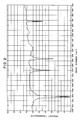
- Figures 1 to 3 show the infrared absorption spectra of the copolymer obtained at respective stages in Example 1.
- the ionomer resins of the present invention consist essentially of, or contain as the main components, the first repeating unit (A) expressed by Formula I (i.e., the unit of ethylene), the second repeating unit (B) expressed by Formula II (i.e., the unit of acrylic acid or its derivative) and the third repeating unit (C) expressed by Formula III (i.e., the unit of a metal salt of acrylic acid or its derivative), said three repeating units being arranged randomly and linearly.
- the ionomer resins of the present invention are free from such a branched long chain as found in the ethylene-unsaturated carboxylic acid copolymers obtained by the high-pressure radical process.
- the repeating units (B) or (C) are polymerized in the block form found.
- a small amount of a fourth repeating unit (D) having a short-chain alkyl branch may be introduced in the reaction of ethylene with the unsaturated carboxylic acid or its ester.
- R 3 stands for an alkyl group, such as a methyl or ethyl group
- Such a short-chain alkyl branch is formed depending upon the reaction conditions selected, and may occur easily, for instance, if the total proportion of the repeating units (B) and (C) contained exceeds about 2 mol% or the reaction takes place at a temperature exceeding 30 C.
- Such an alkyl branch may also be formed by the incorporation of alphaolefins such as propylene, 1-butene, 1-pentene and 4-methylpentene-1.
- the ionomer resins of the present invention have a total proportion of the repeating units (B) and (C) ranging from 0.001 to 45 mol%, preferably 0.1 to 20 mol% and a weight-average molecular weight of no lower than 5,000, usually 10,000 to 2,000,000.
- the repeating unit (B) expressed by Formula II may be a acrylic acid, methacrylic acid, alpha-chloroacrylic acid or alpha-phenylacrylic acid unit, by way of example.
- the repeating unit (C) expressed by Formula III may be, by way of example, sodium acrylate, potassium acrylate lithium acrylate, calcium acrylate, magnesium acrylate, zinc acrylate, tin acrylate, aluminium acrylate, iron acrylate, sodium methacrylate, lithium methacrylate, calcium methacrylate, zinc methacrylate, tin methacrylate, copper methacrylate, aluminium methacrylate, iron methacrylate, sodium a-chloroacrylate, calcium a-chloroacrylate, lead a-chloroacrylate, tin a-chloroacrylate, copper a-chloroacrylate, aluminium a-chloroacrylate, iron a-chloroacrylate, sodium a-phenyl acrylate, calcium a-phenyl acrylate, zinc a-phenyl acrylate, tin a-phenyl acrylate, copper a-phenyl
- the ionomer resins of the present invention may be prepared by various methods. Practically, however, they are prepared by the methods as mentioned in the foregoing. That is, ethylene is copolymerized with the unsaturated carboxylic acid or ester in the presence of a Lewis acid, using as a catalyst a chromium compound and a compound of a metal of Groups I to V of the periodic table, thereby obtaining copolymers of ethylene with the unsaturated carboxylic acid or ester.
- the chromium compounds used may be one or more compounds selected from the group consisting of chromium carboxylates such as chromium acetate, chromium stearate, chromium-2-ethylhexoate, chromium benzoate and chromium naphthanoate or their anhydrides, esters, ethers and ketone adducts; chromium alkoxides such as tetramethoxychromium, tetraethoxychromium, tetra-n-butoxychromium, triethoxych- romium monochloride and diethoxychromium dichloride; chromium xylate compounds such as chromium trisacetylacetonate, chromium tris(2-methyl-1,3-butanedionate), chromium tris(trifluoroacetylacetonate) and
- organic metallic compounds use may be made of organic compounds of metals of Groups I to V of the periodic table, which, by way of example, include methyllithium, ethyllithium, butyllithium, diethylmagnesium, ethylbutylmagnesium, dimethylzinc, diethylzinc, dibutylzinc, trimethylgal- lium, triethylgallium, tributylgallium, triethylboron, tetraethyltin, trimethylaluminium, triethylaluminium, tri- isopropylaluminium, tri-isobutylaluminium, dimethylaluminium monochloride, diethylaluminium monochloride, diethylaluminium monoboromide, di-isopropylaluminium monochloride, diisobutylaluminium monochloride, methylaluminium sesquichloride, eth
- carboxylates organic phosphates, halides and alkoxides of other metals may optionally be added.
- Lewis acids include aluminium chloride, aluminium boromide, ethylaluminium dichloride and diethyl aluminium chloride, by way of example.
- unsaturated carboxylic acids or esters for reaction with ethylene include acrylic acid, methacrylic acid, a-chloroacrylic acid, a-phenylacrylic acid, methyl acrylate, ethyl acrylate, propyl acrylate, butyl acrylate, n-octyl acrylate, 2-ethylhexyl acrylate, benzyl acrylate, methyl methacrylate, ethyl methacrylate, butyl methacrylate, 2-ethylhexyl methacrylate, phenyl methacrylate, methyl a-chloroacrylate and ethyl a-chloromethacrylate.
- Aliphatic, aromatic, alicyclic and halogenated hydrocarbons may be used as the solvents for copolymerization, and include pentane, hexane, heptane, octane, decane, dodecane, kerosine, xylene, toluene, benzene, cyclohexane, ethylbenzene, chlorobenzene and ethylene dichloride.
- Copolymers of ethylene with the unsaturated carboxylic acids or esters are obtained by copolymerization.
- the latter copolymers are converted to the copolymers of ethylene with the unsaturated carboxylic acids by hydrolysis or thermal decomposition, while a part of the ester groups may or may not be allowed to remain.
- a specific metallic compound is then permitted to react with the copolymers of ethylene with the unsaturated carboxylic acids to effect ionization crosslinking where the carboxyl groups of the copolymers are replaced by metal ions, thereby obtaining the desired ionomer resins.
- the "metallic compounds” refer to compounds of metals belonging to Groups I, II, III, IVA and VIII in the periodic table and, by way of example, include preferably water-soluble organic acid salts e.g., formates and acetates, hydroxides, alkoxides e.g., methoxides and ethoxides, nitrates, carbonates and bicarbonates of sodium, potassium, lithium, cesium, silver, copper, mercury, beryllium, magnesium, strontium, barium, cadmium, zinc, scandium, aluminium, titanium, zirconium, osmium, iron, cobalt and nickel.
- water-soluble organic acid salts e.g., formates and acetates, hydroxides, alkoxides e.g., methoxides and ethoxides, nitrates, carbonates and bicarbonates of sodium, potassium, lithium, cesium, silver, copper, mercury, beryllium, magnesium, strontium
- the crosslinking reaction of the ethylene-unsaturated carboxylic acid copolymers with the metallic compounds may be effected by hot mixing or solution reaction.
- This reaction gives the ionomer resins of the present invention, wherein a part, preferably 10 to 50%, of the carboxyl group of the repeating unit (B) in said copolymers, expressed by Formula II, is replaced by the metal ion.
- Novel ionomer resins of the present invention are improved in regard of heat resistance, mechanical strength and 0 2 barrier ability over the ionomer resins obtained by the ionization of conventional copolymers of ethylene with unsaturated carboxylic acids prepared by the high-pressure radical process, and can thus be effectively used as the materials for general goods and industrial products required to possess printability and dye properties.
- the thus obtained copolymer had a weight-average molecular weight of 51,000 and showed infrared absorption spectra as shown in Figure 1.
- Analysis of the infrared absorption spectra have indicated that at 1730 cm- 1 , 1160 cm-', 730 cm- 1 and 720 cm- 1 there are respectively absorptions based on the stretching vibration of the carbonyl group of ethyl acrylate, the ether bond, the methylene chain in the crystal region and the methylene chain in the amorphous region.
- the content of the ethyl methacrylate residue was found to be 3.0 mol% by these absorption intensities.
- Further, from the analysis of ' 3 C-NMR spectra it has turned out that the polymer chain is in the linear form, and has the ethyl acrylate residues introduced randomly therein.
- this copolymer was heat-treated at 180° C for 3 minutes in a nitrogen gas, cooled down to 50° C in 5 minutes, and heated at a heating rate of 10° C/min. As a result, the copolymer was found to have a melting point of 129 C. This copolymer was also found to have a melt index of 5.4 g/10 min., as measured at 190° C under a load of 2.16 kg.
- Example 1 was substantially repeated, except that the amount of sodium hydroxide added was 4 ml in Examples 1 (4).
- the results of measurement of various properties of the obtained ionized copolymer are set out in Table 1.
- Example 1 was substantially repeated, except that the amount of a 0.1 N aqueous solution of sodium hydroxide was 8 ml in Example 1 (4).
- the results of measurement of various properties of the obtained ionized copolymer are set out in Table 1.
- Example 1 was substantially repeated, except that 4 ml of an aqueous solution of zinc acetate were used in a concentration of 1 mol/I in place of the aqueous solution of sodium hydroxide in Example 1 (4).
- the results of measurement of various properties of the obtained ionized copolymer are set out in Table 1.
- Example 1 was substantially repeated, except that 4 ml of an aqueous solution of lithium hydroxide were used in a concentration of 1 mol/l in place of the aqueous solution of sodium hydroxide in Example 1 (4).
- the results of measurement of various properties of the obtained ionized copolymer are set out in Table 1.
- Example 1 Similar operations as in Example 1 (3) were carried out, except that the reaction was permitted to take place for 3 hours under reflux with the addition of 2 ml of an 1 N aqueous solution of sodium hydroxide and 30 ml of water, thereby obtaining a copolymer having a degree of hydrolysis of 32%.
- the obtained copolymer was treated in a similar manner as in Example 1 (4).
- the results of measurement of various properties of the obtained ionized copolymer are set out in Table 1.
- Example 1 (2) Similar operations as in Example 1 (2) were carried out, except that methyl acrylate was used for ethyl methacrylate, and the partial pressures of hydrogen and ethylene were 3 kg/cm 2 G and 7 kgicm 2 G, respectively, thereby obtaining a copolymer which was found to have a methyl acrylate residue content of 4.7 mol% and a weight-average molecular weight of 32,600.
- Example 2 For hydrolysis, similar operations as in Example 1 (3) were carried out, except that the copolymer obtained as above was substituted for the ethylene-ethyl acrylate copolymer.
- the obtained ethylene-acrylic acid copolymer was found to have a melting point of 126" C and a melt index of 3.9 g/10 min.
- Example 1 With the ethylene-acrylic acid copolymer obtained as above, Example 1 (4) was substantially repeated, except for dropwise addition of 4 ml of an 1 N aqueous solution of sodium hydroxide. The obtained ionized copolymer was found to have a degree of ionization of 16.4% with various properties given in Table 1.
- Example 2 For hydrolysis, similar operations as in Example 1 (3) were carried out, except that 70 g of the ethylene-methyl acrylate copolymer obtained in Ex. 7 were charged in 1 liter of methanol with subsequent addition of 100 ml of an 1 N aqueous solution of sodium hydroxide and 100 ml of water, thereby obtaining an ethylene-acrylic acid copolymer which was found to have a melting point of 126 C and a melt index of 7.3 g/10 min.
- Example 2 Similar operations as in Example 1 (2) were carried out, provided however that in place of the equimolar mixture of ethyl acrylate with aluminium trichloride, use was made of a 106.8 mmol, calculated as acrylic acid, of a mixture of acrylic acid and aluminium trichloride in a molar ratio of 1:3, thereby obtaining 37.4 g of a copolymer which was found to have a weight-average molecular weight of 58,600 and an acrylic acid residue content of 1.7 mol% as a result of the infrared-absorption-spectral analysis. This copolymer was also found to have a melting point of 131 °C and a melt index of 1.5 g/10 min.
- Example 1 Similar operations as in Example 1 (4) were carried out, provided however that the ethylene-acrylic acid copolymer obtained as above was used with dropwise addition of 20 ml of a 0.1 N aqueous solution of sodium hydroxide.
- the thus obtained ionized copolymer was found to have a degree of ionization of 12.5% with various properties shown in Table 1.
- Example 9 For the preparation of a copolymer, Example 9 was substantially repeated, except that methyl methacrylate was substituted for acrylic acid, thereby obtaining 16.7 g of the copolymer.
- the obtained copolymer was found to have a weight-average molecular weight of 44,400 and a methyl methacrylate residue content of 2.4 mol% as a result of the infrared-absorption-spectral analysis.
- This copolymer was also found to have a melting point of 128" C and a melt index of 1.7 g / 10 min.
- Example 2 For hydrolysis, similar operations as in Example 1 (3) were then carried out, except that use was made of the ethylene-methyl methacrylate copolymer obtained as above, thereby obtaining an ethylene-methacrylic acid copolymer.
- Example 1 Similar operations as in Example 1 (4) were performed, provided however that the ethylene-methacrylic acid copolymer obtained as above was employed as the copolymer, thereby obtaining an ionized copolymer having a degree of ionization of 14.6%. Various properties of that copolymer, as measured, are shown in Table 1.
- Example 1 (2) was repeated, except that the pressure of hydrogen was 4 kg/cm 2 G, and 76.2 g of an ethylene-acrylic acid copolymer having an acrylic acid residue content of 2.6 mol% were obtained.
- test piece 100x 100 mm was prepared from the sheet having a thickness of 100 ⁇ m, and oxygen gas permeability index of the test piece was measured with M-C3 (manufactured by Toyo Seiki Seisakusho, Co., Ltd.). As the result, the oxygen gas permeability index of the test piece was 0.53x10 -10 cm 3- .cm/cm 2 ⁇ second'cmHg.
Landscapes
- Chemical & Material Sciences (AREA)
- Health & Medical Sciences (AREA)
- Chemical Kinetics & Catalysis (AREA)
- Medicinal Chemistry (AREA)
- Polymers & Plastics (AREA)
- Organic Chemistry (AREA)
- General Chemical & Material Sciences (AREA)
- Addition Polymer Or Copolymer, Post-Treatments, Or Chemical Modifications (AREA)
- Transition And Organic Metals Composition Catalysts For Addition Polymerization (AREA)
Applications Claiming Priority (2)
| Application Number | Priority Date | Filing Date | Title |
|---|---|---|---|
| JP104530/87 | 1987-04-30 | ||
| JP62104530A JPH0678384B2 (ja) | 1987-04-30 | 1987-04-30 | アイオノマ−樹脂およびその製造法 |
Publications (3)
| Publication Number | Publication Date |
|---|---|
| EP0293595A2 true EP0293595A2 (de) | 1988-12-07 |
| EP0293595A3 EP0293595A3 (en) | 1990-05-30 |
| EP0293595B1 EP0293595B1 (de) | 1994-01-05 |
Family
ID=14383048
Family Applications (1)
| Application Number | Title | Priority Date | Filing Date |
|---|---|---|---|
| EP88106635A Expired - Lifetime EP0293595B1 (de) | 1987-04-30 | 1988-04-26 | Ionomerharz und seine Herstellung |
Country Status (6)
| Country | Link |
|---|---|
| US (1) | US4956418A (de) |
| EP (1) | EP0293595B1 (de) |
| JP (1) | JPH0678384B2 (de) |
| KR (1) | KR910005671B1 (de) |
| CA (1) | CA1331822C (de) |
| DE (1) | DE3886820T2 (de) |
Families Citing this family (22)
| Publication number | Priority date | Publication date | Assignee | Title |
|---|---|---|---|---|
| JP2521820B2 (ja) * | 1989-09-21 | 1996-08-07 | 三井・デュポンポリケミカル株式会社 | アイオノマ―組成物 |
| US5206614A (en) * | 1991-03-28 | 1993-04-27 | Westinghouse Electric Corp. | Line conductor gasket |
| US5571878A (en) * | 1991-09-24 | 1996-11-05 | Chevron Chemical Company | Ethylene-alkyl acrylate copolymers and derivatives having improved melt-point temperatures and adhesive strength and processes for preparing same |
| US6906146B2 (en) | 1993-07-13 | 2005-06-14 | Phillips Petroleum Company | Compositions having ethylenic backbone and benzylic, allylic, or ether-containing side-chains, oxygen scavenging compositions containing same, and process for making these compositions by esterification or transesterification of a polymer melt |
| WO2001009199A1 (en) * | 1999-07-28 | 2001-02-08 | E.I. Du Pont De Nemours And Company | High melt swell polymer |
| US20100247939A1 (en) * | 2007-12-07 | 2010-09-30 | Du Pont-Mitsui Polychemicals Co., Ltd. | Ionomer, resin composition containing the ionomer, unstretched film, sheet or molded body each made of the composition, and laminate comprising layer of the unstretched film |
| WO2016060218A1 (ja) * | 2014-10-15 | 2016-04-21 | 日本ポリエチレン株式会社 | エチレン系アイオノマーの製造方法及びエチレン系アイオノマー |
| CN113366028A (zh) * | 2019-01-28 | 2021-09-07 | 日本聚乙烯株式会社 | 含极性基团的烯烃共聚物 |
| JP7392515B2 (ja) * | 2019-03-04 | 2023-12-06 | 日本ポリエチレン株式会社 | 多元アイオノマー |
| US20220251268A1 (en) * | 2019-06-24 | 2022-08-11 | Japan Polyethylene Corporation | Resin composition for injection molding or compression molding |
| JP2021001332A (ja) * | 2019-06-24 | 2021-01-07 | 日本ポリエチレン株式会社 | 軟質系シート用エチレン系アイオノマー及びその成形体 |
| WO2020262482A1 (ja) * | 2019-06-24 | 2020-12-30 | 日本ポリエチレン株式会社 | フィルム状成形体用樹脂及びそれからなる成形品 |
| JP7694008B2 (ja) * | 2019-06-24 | 2025-06-18 | 日本ポリエチレン株式会社 | フィルム用樹脂組成物及びそれを用いたエチレン系フィルム |
| JP7484495B2 (ja) * | 2019-07-01 | 2024-05-16 | 日本ポリエチレン株式会社 | 三次元網状構造体用エチレン系アイオノマー及びその成形体 |
| JP7547811B2 (ja) * | 2019-07-01 | 2024-09-10 | 日本ポリエチレン株式会社 | ゴルフボール用樹脂 |
| JP7642987B2 (ja) * | 2019-07-01 | 2025-03-11 | 日本ポリエチレン株式会社 | ガスケット用エチレン系アイオノマー及びその成形体 |
| JP7501157B2 (ja) * | 2019-07-02 | 2024-06-18 | 日本ポリエチレン株式会社 | ダイシングテープ基材用樹脂、それを含む樹脂組成物、ダイシングテープ基材及びダイシングテープ |
| JP7552100B2 (ja) * | 2019-07-02 | 2024-09-18 | 日本ポリエチレン株式会社 | ガラス積層体用樹脂 |
| US12252565B2 (en) | 2019-12-19 | 2025-03-18 | Kuraray Europe Gmbh | Method for producing ionomer resin |
| CN115768803B (zh) * | 2020-11-27 | 2023-05-12 | 株式会社可乐丽 | 离聚物树脂 |
| JP2023018968A (ja) * | 2021-07-28 | 2023-02-09 | 日本ポリエチレン株式会社 | 帯電防止用樹脂組成物 |
| JPWO2023008485A1 (de) | 2021-07-28 | 2023-02-02 |
Family Cites Families (8)
| Publication number | Priority date | Publication date | Assignee | Title |
|---|---|---|---|---|
| US2626945A (en) * | 1949-07-11 | 1953-01-27 | Us Rubber Co | Interpolymerization of polyolefinic esters of 2-alkenyl alcohols with certain monoolefinic hydrocarbons |
| BE621846A (de) * | 1961-08-31 | 1900-01-01 | ||
| NL6511920A (de) * | 1965-09-14 | 1967-03-15 | ||
| DE2265659C2 (de) * | 1971-10-11 | 1985-03-07 | Asahi Kasei Kogyo K.K., Osaka | Verfahren zur Herstellung von metallhaltigen Copolymeren |
| DE3374319D1 (en) * | 1982-08-04 | 1987-12-10 | Allied Corp | Preparation of salts of low molecular weight copolymers using metal oxides |
| US4638034A (en) * | 1985-06-24 | 1987-01-20 | National Distillers And Chemical Corporation | Preparation of ethylene-acrylic acid copolymer or salt thereof |
| JPS6143613A (ja) * | 1985-07-26 | 1986-03-03 | Showa Highpolymer Co Ltd | 硬化性樹脂組成物 |
| US4833224A (en) * | 1985-10-11 | 1989-05-23 | Idemitsu Kosan Company Limited | Ethylene copolymers and process for production |
-
1987
- 1987-04-30 JP JP62104530A patent/JPH0678384B2/ja not_active Expired - Lifetime
-
1988
- 1988-04-06 US US07/178,235 patent/US4956418A/en not_active Expired - Lifetime
- 1988-04-07 CA CA000563508A patent/CA1331822C/en not_active Expired - Fee Related
- 1988-04-26 DE DE88106635T patent/DE3886820T2/de not_active Expired - Fee Related
- 1988-04-26 EP EP88106635A patent/EP0293595B1/de not_active Expired - Lifetime
- 1988-04-27 KR KR1019880004746A patent/KR910005671B1/ko not_active Expired
Also Published As
| Publication number | Publication date |
|---|---|
| JPH0678384B2 (ja) | 1994-10-05 |
| EP0293595B1 (de) | 1994-01-05 |
| KR910005671B1 (ko) | 1991-08-01 |
| EP0293595A3 (en) | 1990-05-30 |
| KR880012659A (ko) | 1988-11-28 |
| JPS63270709A (ja) | 1988-11-08 |
| DE3886820T2 (de) | 1994-05-11 |
| US4956418A (en) | 1990-09-11 |
| CA1331822C (en) | 1994-08-30 |
| DE3886820D1 (de) | 1994-02-17 |
Similar Documents
| Publication | Publication Date | Title |
|---|---|---|
| EP0293595A2 (de) | Ionomerharz und seine Herstellung | |
| EP0017229B1 (de) | Geordnete Copolymere von Äthylen und einer alpha, beta-ungesättigten Carbonsäure, Verfahren zu ihrer Herstellung und mit diesen geordneten Copolymeren hergestellte Ionomere | |
| EP0243083B1 (de) | Isopropanolamine als Katalysatordeaktivierungsmittel in einem alpha-Olefin-Lösungspolymerisationsverfahren | |
| EP2035467A2 (de) | Verfahren zur deaktivierung eines polymerisierungskatalysators mittels phosphor-oder phosphonsäuresalzen und katalysatordeaktivator | |
| CA2234188C (en) | Heat treatment of ziegler-natta catalysts to increase activity in solution polymerization process | |
| EP1321479B1 (de) | Ziegler Natta Lösungskatalysatoren zur Anwendung bei hohen Temperaturen | |
| EP0218254B1 (de) | Ethylencopolymere und Verfahren zur Herstellung derselben | |
| EP0356692B1 (de) | Verfahren zur Herstellung von Streckformteilen | |
| CA2232099C (en) | Low aluminum and magnesium z-n solution catalysts | |
| JP2531585B2 (ja) | 酸素バリヤ−性成形材料 | |
| US5270420A (en) | Stretched molding | |
| CA1268297A (en) | DEACTIVATION OF CATALYST IN SOLUTION PROCESS FOR POLYMERIZATION OF .alpha.-OLEFINS | |
| JPH01103640A (ja) | 樹脂組成物 | |
| CA2234189C (en) | Heat treatment of ziegler-natta catalysts to increase polymer molecular weight in solution polymerization | |
| WO2008043388A1 (en) | Surface-modified polymerization catalysts for the preparation of low-gel polyolefin films | |
| JPH01282204A (ja) | エチレン系共重合体の製造方法 | |
| JPH0660220B2 (ja) | エチレン系共重合体の製造法 | |
| RU2234517C1 (ru) | Способ полимеризации этилена | |
| JPS61278508A (ja) | エチレン系共重合体の製造方法 | |
| JPH0241306A (ja) | 超高分子量エチレン系共重合体の製造方法 | |
| EP0148302A1 (de) | Neutralisierung von Katalysatorrückständen in Polyäthylen | |
| JPH01313512A (ja) | エチレン系共重合体の製造方法 | |
| JPH0262565B2 (de) | ||
| JPS60262808A (ja) | エチレン共重合体の製法 |
Legal Events
| Date | Code | Title | Description |
|---|---|---|---|
| PUAI | Public reference made under article 153(3) epc to a published international application that has entered the european phase |
Free format text: ORIGINAL CODE: 0009012 |
|
| AK | Designated contracting states |
Kind code of ref document: A2 Designated state(s): BE CH DE FR GB IT LI NL SE |
|
| PUAL | Search report despatched |
Free format text: ORIGINAL CODE: 0009013 |
|
| AK | Designated contracting states |
Kind code of ref document: A3 Designated state(s): BE CH DE FR GB IT LI NL SE |
|
| 17P | Request for examination filed |
Effective date: 19901123 |
|
| 17Q | First examination report despatched |
Effective date: 19920305 |
|
| GRAA | (expected) grant |
Free format text: ORIGINAL CODE: 0009210 |
|
| AK | Designated contracting states |
Kind code of ref document: B1 Designated state(s): BE CH DE FR GB IT LI NL SE |
|
| PG25 | Lapsed in a contracting state [announced via postgrant information from national office to epo] |
Ref country code: IT Free format text: LAPSE BECAUSE OF FAILURE TO SUBMIT A TRANSLATION OF THE DESCRIPTION OR TO PAY THE FEE WITHIN THE PRE;WARNING: LAPSES OF ITALIAN PATENTS WITH EFFECTIVE DATE BEFORE 2007 MAY HAVE OCCURRED AT ANY TIME BEFORE 2007. THE CORRECT EFFECTIVE DATE MAY BE DIFFERENT FROM THE ONE RECORDED.SCRIBED TIME-LIMIT Effective date: 19940105 Ref country code: CH Effective date: 19940105 Ref country code: BE Effective date: 19940105 Ref country code: SE Effective date: 19940105 Ref country code: LI Effective date: 19940105 |
|
| REF | Corresponds to: |
Ref document number: 3886820 Country of ref document: DE Date of ref document: 19940217 |
|
| ET | Fr: translation filed | ||
| REG | Reference to a national code |
Ref country code: CH Ref legal event code: PL |
|
| PLBE | No opposition filed within time limit |
Free format text: ORIGINAL CODE: 0009261 |
|
| STAA | Information on the status of an ep patent application or granted ep patent |
Free format text: STATUS: NO OPPOSITION FILED WITHIN TIME LIMIT |
|
| 26N | No opposition filed | ||
| REG | Reference to a national code |
Ref country code: GB Ref legal event code: IF02 |
|
| PGFP | Annual fee paid to national office [announced via postgrant information from national office to epo] |
Ref country code: NL Payment date: 20040406 Year of fee payment: 17 |
|
| PGFP | Annual fee paid to national office [announced via postgrant information from national office to epo] |
Ref country code: FR Payment date: 20040408 Year of fee payment: 17 |
|
| PGFP | Annual fee paid to national office [announced via postgrant information from national office to epo] |
Ref country code: GB Payment date: 20040421 Year of fee payment: 17 |
|
| PGFP | Annual fee paid to national office [announced via postgrant information from national office to epo] |
Ref country code: DE Payment date: 20040506 Year of fee payment: 17 |
|
| PG25 | Lapsed in a contracting state [announced via postgrant information from national office to epo] |
Ref country code: GB Free format text: LAPSE BECAUSE OF NON-PAYMENT OF DUE FEES Effective date: 20050426 |
|
| PG25 | Lapsed in a contracting state [announced via postgrant information from national office to epo] |
Ref country code: DE Free format text: LAPSE BECAUSE OF NON-PAYMENT OF DUE FEES Effective date: 20051101 Ref country code: NL Free format text: LAPSE BECAUSE OF NON-PAYMENT OF DUE FEES Effective date: 20051101 |
|
| GBPC | Gb: european patent ceased through non-payment of renewal fee |
Effective date: 20050426 |
|
| PG25 | Lapsed in a contracting state [announced via postgrant information from national office to epo] |
Ref country code: FR Free format text: LAPSE BECAUSE OF NON-PAYMENT OF DUE FEES Effective date: 20051230 |
|
| NLV4 | Nl: lapsed or anulled due to non-payment of the annual fee |
Effective date: 20051101 |
|
| REG | Reference to a national code |
Ref country code: FR Ref legal event code: ST Effective date: 20051230 |