EP0288493B1 - 3-halogensuccinimide - Google Patents
3-halogensuccinimide Download PDFInfo
- Publication number
- EP0288493B1 EP0288493B1 EP87906419A EP87906419A EP0288493B1 EP 0288493 B1 EP0288493 B1 EP 0288493B1 EP 87906419 A EP87906419 A EP 87906419A EP 87906419 A EP87906419 A EP 87906419A EP 0288493 B1 EP0288493 B1 EP 0288493B1
- Authority
- EP
- European Patent Office
- Prior art keywords
- formula
- radicals
- compounds
- atom
- hydrogen atom
- Prior art date
- Legal status (The legal status is an assumption and is not a legal conclusion. Google has not performed a legal analysis and makes no representation as to the accuracy of the status listed.)
- Expired - Lifetime
Links
- 229910052736 halogen Inorganic materials 0.000 title 1
- 150000001875 compounds Chemical class 0.000 claims abstract description 30
- 239000000460 chlorine Substances 0.000 claims abstract description 10
- 229910052801 chlorine Inorganic materials 0.000 claims abstract description 9
- 230000000855 fungicidal effect Effects 0.000 claims abstract description 9
- ZCYVEMRRCGMTRW-UHFFFAOYSA-N 7553-56-2 Chemical group [I] ZCYVEMRRCGMTRW-UHFFFAOYSA-N 0.000 claims abstract description 7
- GDTBXPJZTBHREO-UHFFFAOYSA-N bromine Chemical group BrBr GDTBXPJZTBHREO-UHFFFAOYSA-N 0.000 claims abstract description 6
- 229910052740 iodine Chemical group 0.000 claims abstract description 5
- 125000001309 chloro group Chemical group Cl* 0.000 claims abstract description 4
- 229910052794 bromium Inorganic materials 0.000 claims abstract description 3
- 125000004435 hydrogen atom Chemical group [H]* 0.000 claims description 12
- 239000013543 active substance Substances 0.000 claims description 11
- 125000002496 methyl group Chemical group [H]C([H])([H])* 0.000 claims description 11
- 238000002360 preparation method Methods 0.000 claims description 9
- WKBOTKDWSSQWDR-UHFFFAOYSA-N Bromine atom Chemical group [Br] WKBOTKDWSSQWDR-UHFFFAOYSA-N 0.000 claims description 5
- 125000001153 fluoro group Chemical group F* 0.000 claims description 4
- 239000001257 hydrogen Substances 0.000 claims description 4
- 229910052739 hydrogen Inorganic materials 0.000 claims description 4
- 238000000034 method Methods 0.000 claims description 4
- PXGOKWXKJXAPGV-UHFFFAOYSA-N Fluorine Chemical compound FF PXGOKWXKJXAPGV-UHFFFAOYSA-N 0.000 claims description 3
- UFHFLCQGNIYNRP-UHFFFAOYSA-N Hydrogen Chemical compound [H][H] UFHFLCQGNIYNRP-UHFFFAOYSA-N 0.000 claims description 3
- 239000011737 fluorine Substances 0.000 claims description 3
- 229910052731 fluorine Inorganic materials 0.000 claims description 3
- KZBUYRJDOAKODT-UHFFFAOYSA-N Chlorine Chemical compound ClCl KZBUYRJDOAKODT-UHFFFAOYSA-N 0.000 claims description 2
- 229910001516 alkali metal iodide Inorganic materials 0.000 claims description 2
- 239000004480 active ingredient Substances 0.000 description 23
- YXFVVABEGXRONW-UHFFFAOYSA-N Toluene Chemical compound CC1=CC=CC=C1 YXFVVABEGXRONW-UHFFFAOYSA-N 0.000 description 17
- 239000000203 mixture Substances 0.000 description 11
- 241000196324 Embryophyta Species 0.000 description 9
- 239000000047 product Substances 0.000 description 9
- 239000000243 solution Substances 0.000 description 9
- -1 3,5-dichlorophenyl Chemical group 0.000 description 8
- 241001465180 Botrytis Species 0.000 description 8
- CSCPPACGZOOCGX-UHFFFAOYSA-N Acetone Chemical compound CC(C)=O CSCPPACGZOOCGX-UHFFFAOYSA-N 0.000 description 7
- 239000003795 chemical substances by application Substances 0.000 description 7
- 230000000052 comparative effect Effects 0.000 description 7
- FVAUCKIRQBBSSJ-UHFFFAOYSA-M sodium iodide Chemical compound [Na+].[I-] FVAUCKIRQBBSSJ-UHFFFAOYSA-M 0.000 description 7
- 239000000126 substance Substances 0.000 description 7
- LFQSCWFLJHTTHZ-UHFFFAOYSA-N Ethanol Chemical compound CCO LFQSCWFLJHTTHZ-UHFFFAOYSA-N 0.000 description 6
- XEKOWRVHYACXOJ-UHFFFAOYSA-N Ethyl acetate Chemical compound CCOC(C)=O XEKOWRVHYACXOJ-UHFFFAOYSA-N 0.000 description 6
- 241000233866 Fungi Species 0.000 description 6
- OKKJLVBELUTLKV-UHFFFAOYSA-N Methanol Chemical compound OC OKKJLVBELUTLKV-UHFFFAOYSA-N 0.000 description 6
- VYPSYNLAJGMNEJ-UHFFFAOYSA-N Silicium dioxide Chemical compound O=[Si]=O VYPSYNLAJGMNEJ-UHFFFAOYSA-N 0.000 description 6
- 239000002904 solvent Substances 0.000 description 6
- 239000000725 suspension Substances 0.000 description 6
- 238000012360 testing method Methods 0.000 description 6
- CSNNHWWHGAXBCP-UHFFFAOYSA-L Magnesium sulfate Chemical compound [Mg+2].[O-][S+2]([O-])([O-])[O-] CSNNHWWHGAXBCP-UHFFFAOYSA-L 0.000 description 5
- 230000000694 effects Effects 0.000 description 5
- 230000002538 fungal effect Effects 0.000 description 5
- XLYOFNOQVPJJNP-UHFFFAOYSA-N water Substances O XLYOFNOQVPJJNP-UHFFFAOYSA-N 0.000 description 5
- 241000123650 Botrytis cinerea Species 0.000 description 4
- 240000004160 Capsicum annuum Species 0.000 description 4
- IAZDPXIOMUYVGZ-UHFFFAOYSA-N Dimethylsulphoxide Chemical compound CS(C)=O IAZDPXIOMUYVGZ-UHFFFAOYSA-N 0.000 description 4
- ZMXDDKWLCZADIW-UHFFFAOYSA-N N,N-Dimethylformamide Chemical compound CN(C)C=O ZMXDDKWLCZADIW-UHFFFAOYSA-N 0.000 description 4
- 241000918584 Pythium ultimum Species 0.000 description 4
- 238000006243 chemical reaction Methods 0.000 description 4
- NLYAJNPCOHFWQQ-UHFFFAOYSA-N kaolin Chemical compound O.O.O=[Al]O[Si](=O)O[Si](=O)O[Al]=O NLYAJNPCOHFWQQ-UHFFFAOYSA-N 0.000 description 4
- FPYJFEHAWHCUMM-UHFFFAOYSA-N maleic anhydride Chemical compound O=C1OC(=O)C=C1 FPYJFEHAWHCUMM-UHFFFAOYSA-N 0.000 description 4
- 238000002844 melting Methods 0.000 description 4
- 230000008018 melting Effects 0.000 description 4
- 239000002244 precipitate Substances 0.000 description 4
- 239000002689 soil Substances 0.000 description 4
- 238000005507 spraying Methods 0.000 description 4
- 238000003756 stirring Methods 0.000 description 4
- 239000005909 Kieselgur Substances 0.000 description 3
- 241000209140 Triticum Species 0.000 description 3
- 150000001412 amines Chemical class 0.000 description 3
- 239000000470 constituent Substances 0.000 description 3
- 235000019674 grape juice Nutrition 0.000 description 3
- 150000003949 imides Chemical class 0.000 description 3
- 235000015097 nutrients Nutrition 0.000 description 3
- 238000010992 reflux Methods 0.000 description 3
- 238000005406 washing Methods 0.000 description 3
- CZZZABOKJQXEBO-UHFFFAOYSA-N 2,4-dimethylaniline Chemical compound CC1=CC=C(N)C(C)=C1 CZZZABOKJQXEBO-UHFFFAOYSA-N 0.000 description 2
- FSCWZHGZWWDELK-UHFFFAOYSA-N 3-(3,5-dichlorophenyl)-5-ethenyl-5-methyl-2,4-oxazolidinedione Chemical compound O=C1C(C)(C=C)OC(=O)N1C1=CC(Cl)=CC(Cl)=C1 FSCWZHGZWWDELK-UHFFFAOYSA-N 0.000 description 2
- UBJGUVJZFOISJO-UHFFFAOYSA-N 3-(chloromethyl)-1-(2,4,6-trimethylphenyl)pyrrolidine-2,5-dione Chemical compound CC1=CC(C)=CC(C)=C1N1C(=O)C(CCl)CC1=O UBJGUVJZFOISJO-UHFFFAOYSA-N 0.000 description 2
- UVDPCRCHGLROLQ-UHFFFAOYSA-N 3-bromo-1-(3,5-dichlorophenyl)pyrrolidine-2,5-dione Chemical compound ClC1=CC(Cl)=CC(N2C(C(Br)CC2=O)=O)=C1 UVDPCRCHGLROLQ-UHFFFAOYSA-N 0.000 description 2
- PADIZQCMJCZQAW-UHFFFAOYSA-N 3-bromo-1-(4-fluorophenyl)pyrrolidine-2,5-dione Chemical compound C1=CC(F)=CC=C1N1C(=O)C(Br)CC1=O PADIZQCMJCZQAW-UHFFFAOYSA-N 0.000 description 2
- OPWMCWSGKAIANZ-UHFFFAOYSA-N 3-chloro-1-(2,4,6-trimethylphenyl)pyrrole-2,5-dione Chemical compound CC1=CC(C)=CC(C)=C1N1C(=O)C(Cl)=CC1=O OPWMCWSGKAIANZ-UHFFFAOYSA-N 0.000 description 2
- HRADVHZVMOMEPU-UHFFFAOYSA-N 3-iodopyrrolidine-2,5-dione Chemical class IC1CC(=O)NC1=O HRADVHZVMOMEPU-UHFFFAOYSA-N 0.000 description 2
- HBAQYPYDRFILMT-UHFFFAOYSA-N 8-[3-(1-cyclopropylpyrazol-4-yl)-1H-pyrazolo[4,3-d]pyrimidin-5-yl]-3-methyl-3,8-diazabicyclo[3.2.1]octan-2-one Chemical class C1(CC1)N1N=CC(=C1)C1=NNC2=C1N=C(N=C2)N1C2C(N(CC1CC2)C)=O HBAQYPYDRFILMT-UHFFFAOYSA-N 0.000 description 2
- 229920001817 Agar Polymers 0.000 description 2
- 239000005995 Aluminium silicate Substances 0.000 description 2
- IJGRMHOSHXDMSA-UHFFFAOYSA-N Atomic nitrogen Chemical compound N#N IJGRMHOSHXDMSA-UHFFFAOYSA-N 0.000 description 2
- VTYYLEPIZMXCLO-UHFFFAOYSA-L Calcium carbonate Chemical compound [Ca+2].[O-]C([O-])=O VTYYLEPIZMXCLO-UHFFFAOYSA-L 0.000 description 2
- HEDRZPFGACZZDS-UHFFFAOYSA-N Chloroform Chemical compound ClC(Cl)Cl HEDRZPFGACZZDS-UHFFFAOYSA-N 0.000 description 2
- 229920000858 Cyclodextrin Polymers 0.000 description 2
- LYCAIKOWRPUZTN-UHFFFAOYSA-N Ethylene glycol Chemical compound OCCO LYCAIKOWRPUZTN-UHFFFAOYSA-N 0.000 description 2
- SECXISVLQFMRJM-UHFFFAOYSA-N N-Methylpyrrolidone Chemical compound CN1CCCC1=O SECXISVLQFMRJM-UHFFFAOYSA-N 0.000 description 2
- QAOWNCQODCNURD-UHFFFAOYSA-N Sulfuric acid Chemical compound OS(O)(=O)=O QAOWNCQODCNURD-UHFFFAOYSA-N 0.000 description 2
- HEDRZPFGACZZDS-MICDWDOJSA-N Trichloro(2H)methane Chemical compound [2H]C(Cl)(Cl)Cl HEDRZPFGACZZDS-MICDWDOJSA-N 0.000 description 2
- 235000021307 Triticum Nutrition 0.000 description 2
- 241000221577 Uromyces appendiculatus Species 0.000 description 2
- FXXACINHVKSMDR-UHFFFAOYSA-N acetyl bromide Chemical compound CC(Br)=O FXXACINHVKSMDR-UHFFFAOYSA-N 0.000 description 2
- WETWJCDKMRHUPV-UHFFFAOYSA-N acetyl chloride Chemical compound CC(Cl)=O WETWJCDKMRHUPV-UHFFFAOYSA-N 0.000 description 2
- 239000008272 agar Substances 0.000 description 2
- 235000012211 aluminium silicate Nutrition 0.000 description 2
- 150000003931 anilides Chemical class 0.000 description 2
- 125000005228 aryl sulfonate group Chemical group 0.000 description 2
- 239000012141 concentrate Substances 0.000 description 2
- 229960001760 dimethyl sulfoxide Drugs 0.000 description 2
- 239000012153 distilled water Substances 0.000 description 2
- 239000003814 drug Substances 0.000 description 2
- 229940079593 drug Drugs 0.000 description 2
- 239000000839 emulsion Substances 0.000 description 2
- 239000000417 fungicide Substances 0.000 description 2
- 239000008187 granular material Substances 0.000 description 2
- 238000011534 incubation Methods 0.000 description 2
- JEIPFZHSYJVQDO-UHFFFAOYSA-N iron(III) oxide Inorganic materials O=[Fe]O[Fe]=O JEIPFZHSYJVQDO-UHFFFAOYSA-N 0.000 description 2
- 239000007788 liquid Substances 0.000 description 2
- 229910052943 magnesium sulfate Inorganic materials 0.000 description 2
- 235000019341 magnesium sulphate Nutrition 0.000 description 2
- 239000003094 microcapsule Substances 0.000 description 2
- 239000003960 organic solvent Substances 0.000 description 2
- 229920002451 polyvinyl alcohol Polymers 0.000 description 2
- 239000000843 powder Substances 0.000 description 2
- 239000000377 silicon dioxide Substances 0.000 description 2
- JHJLBTNAGRQEKS-UHFFFAOYSA-M sodium bromide Chemical compound [Na+].[Br-] JHJLBTNAGRQEKS-UHFFFAOYSA-M 0.000 description 2
- 235000009518 sodium iodide Nutrition 0.000 description 2
- LPXPTNMVRIOKMN-UHFFFAOYSA-M sodium nitrite Chemical compound [Na+].[O-]N=O LPXPTNMVRIOKMN-UHFFFAOYSA-M 0.000 description 2
- 239000007787 solid Substances 0.000 description 2
- 239000007858 starting material Substances 0.000 description 2
- LNAZSHAWQACDHT-XIYTZBAFSA-N (2r,3r,4s,5r,6s)-4,5-dimethoxy-2-(methoxymethyl)-3-[(2s,3r,4s,5r,6r)-3,4,5-trimethoxy-6-(methoxymethyl)oxan-2-yl]oxy-6-[(2r,3r,4s,5r,6r)-4,5,6-trimethoxy-2-(methoxymethyl)oxan-3-yl]oxyoxane Chemical compound CO[C@@H]1[C@@H](OC)[C@H](OC)[C@@H](COC)O[C@H]1O[C@H]1[C@H](OC)[C@@H](OC)[C@H](O[C@H]2[C@@H]([C@@H](OC)[C@H](OC)O[C@@H]2COC)OC)O[C@@H]1COC LNAZSHAWQACDHT-XIYTZBAFSA-N 0.000 description 1
- 0 *C(CC(N1*)=O)C1=O Chemical compound *C(CC(N1*)=O)C1=O 0.000 description 1
- FNLORJAUKLTBGN-UHFFFAOYSA-N 1-(4-fluorophenyl)-3-iodopyrrolidine-2,5-dione Chemical compound C1=CC(F)=CC=C1N1C(=O)C(I)CC1=O FNLORJAUKLTBGN-UHFFFAOYSA-N 0.000 description 1
- 238000005160 1H NMR spectroscopy Methods 0.000 description 1
- SRXFXCKTIGELTI-UHFFFAOYSA-N 2-(4-chlorophenyl)ethanamine Chemical compound NCCC1=CC=C(Cl)C=C1 SRXFXCKTIGELTI-UHFFFAOYSA-N 0.000 description 1
- FALRKNHUBBKYCC-UHFFFAOYSA-N 2-(chloromethyl)pyridine-3-carbonitrile Chemical compound ClCC1=NC=CC=C1C#N FALRKNHUBBKYCC-UHFFFAOYSA-N 0.000 description 1
- WXXDZCDRRBAWDG-UHFFFAOYSA-N 3-bromo-1-(5-fluoro-2,4-dimethylphenyl)pyrrolidine-2,5-dione Chemical compound C1=C(F)C(C)=CC(C)=C1N1C(=O)C(Br)CC1=O WXXDZCDRRBAWDG-UHFFFAOYSA-N 0.000 description 1
- ALVUWNZSGKSBCP-UHFFFAOYSA-N 3-bromo-1-[1-(4-chlorophenyl)ethyl]pyrrolidine-2,5-dione Chemical compound C=1C=C(Cl)C=CC=1C(C)N1C(=O)CC(Br)C1=O ALVUWNZSGKSBCP-UHFFFAOYSA-N 0.000 description 1
- NITPIKUGPTUBJE-UHFFFAOYSA-N 3-chloro-1-phenylpyrrolidine-2,5-dione Chemical compound O=C1C(Cl)CC(=O)N1C1=CC=CC=C1 NITPIKUGPTUBJE-UHFFFAOYSA-N 0.000 description 1
- KRZCOLNOCZKSDF-UHFFFAOYSA-N 4-fluoroaniline Chemical compound NC1=CC=C(F)C=C1 KRZCOLNOCZKSDF-UHFFFAOYSA-N 0.000 description 1
- JYXUZCBLTOASMC-UHFFFAOYSA-N 5-fluoro-2,4-dimethylaniline Chemical compound CC1=CC(C)=C(F)C=C1N JYXUZCBLTOASMC-UHFFFAOYSA-N 0.000 description 1
- 244000215068 Acacia senegal Species 0.000 description 1
- 235000001674 Agaricus brunnescens Nutrition 0.000 description 1
- 241000223600 Alternaria Species 0.000 description 1
- 241000213004 Alternaria solani Species 0.000 description 1
- 240000002791 Brassica napus Species 0.000 description 1
- 235000004977 Brassica sinapistrum Nutrition 0.000 description 1
- 235000002567 Capsicum annuum Nutrition 0.000 description 1
- 235000008534 Capsicum annuum var annuum Nutrition 0.000 description 1
- 229920002134 Carboxymethyl cellulose Polymers 0.000 description 1
- 241000222199 Colletotrichum Species 0.000 description 1
- 241000612152 Cyclamen hederifolium Species 0.000 description 1
- 235000016623 Fragaria vesca Nutrition 0.000 description 1
- 240000009088 Fragaria x ananassa Species 0.000 description 1
- 235000011363 Fragaria x ananassa Nutrition 0.000 description 1
- 241000223218 Fusarium Species 0.000 description 1
- 241000208150 Geraniaceae Species 0.000 description 1
- 229920000084 Gum arabic Polymers 0.000 description 1
- 229910004039 HBF4 Inorganic materials 0.000 description 1
- 206010061217 Infestation Diseases 0.000 description 1
- 239000007836 KH2PO4 Substances 0.000 description 1
- 240000008415 Lactuca sativa Species 0.000 description 1
- 235000003228 Lactuca sativa Nutrition 0.000 description 1
- 241001363490 Monilia Species 0.000 description 1
- 208000031888 Mycoses Diseases 0.000 description 1
- LRHPLDYGYMQRHN-UHFFFAOYSA-N N-Butanol Chemical class CCCCO LRHPLDYGYMQRHN-UHFFFAOYSA-N 0.000 description 1
- 238000005481 NMR spectroscopy Methods 0.000 description 1
- GRYLNZFGIOXLOG-UHFFFAOYSA-N Nitric acid Chemical compound O[N+]([O-])=O GRYLNZFGIOXLOG-UHFFFAOYSA-N 0.000 description 1
- CTQNGGLPUBDAKN-UHFFFAOYSA-N O-Xylene Chemical compound CC1=CC=CC=C1C CTQNGGLPUBDAKN-UHFFFAOYSA-N 0.000 description 1
- 241000233654 Oomycetes Species 0.000 description 1
- 241000228143 Penicillium Species 0.000 description 1
- 241001123663 Penicillium expansum Species 0.000 description 1
- 239000004372 Polyvinyl alcohol Substances 0.000 description 1
- OFOBLEOULBTSOW-UHFFFAOYSA-N Propanedioic acid Natural products OC(=O)CC(O)=O OFOBLEOULBTSOW-UHFFFAOYSA-N 0.000 description 1
- 229910019020 PtO2 Inorganic materials 0.000 description 1
- 241001246061 Puccinia triticina Species 0.000 description 1
- 241001533598 Septoria Species 0.000 description 1
- 229920002472 Starch Polymers 0.000 description 1
- 241001409553 Uredo Species 0.000 description 1
- 241001123668 Verticillium dahliae Species 0.000 description 1
- 240000008042 Zea mays Species 0.000 description 1
- 235000016383 Zea mays subsp huehuetenangensis Nutrition 0.000 description 1
- 235000002017 Zea mays subsp mays Nutrition 0.000 description 1
- 239000000205 acacia gum Substances 0.000 description 1
- 235000010489 acacia gum Nutrition 0.000 description 1
- 239000012346 acetyl chloride Substances 0.000 description 1
- YKIOKAURTKXMSB-UHFFFAOYSA-N adams's catalyst Chemical compound O=[Pt]=O YKIOKAURTKXMSB-UHFFFAOYSA-N 0.000 description 1
- 150000001298 alcohols Chemical class 0.000 description 1
- 125000000217 alkyl group Chemical group 0.000 description 1
- 150000001408 amides Chemical class 0.000 description 1
- 150000001448 anilines Chemical class 0.000 description 1
- 239000007864 aqueous solution Substances 0.000 description 1
- 125000003118 aryl group Chemical group 0.000 description 1
- 239000011230 binding agent Substances 0.000 description 1
- 239000011449 brick Substances 0.000 description 1
- 230000001680 brushing effect Effects 0.000 description 1
- 229910000019 calcium carbonate Inorganic materials 0.000 description 1
- 239000001511 capsicum annuum Substances 0.000 description 1
- 229910052799 carbon Inorganic materials 0.000 description 1
- 125000004432 carbon atom Chemical group C* 0.000 description 1
- 239000001768 carboxy methyl cellulose Substances 0.000 description 1
- 235000010948 carboxy methyl cellulose Nutrition 0.000 description 1
- 239000008112 carboxymethyl-cellulose Substances 0.000 description 1
- 239000003054 catalyst Substances 0.000 description 1
- 229960001701 chloroform Drugs 0.000 description 1
- 239000011248 coating agent Substances 0.000 description 1
- 238000000576 coating method Methods 0.000 description 1
- 230000005494 condensation Effects 0.000 description 1
- 239000013068 control sample Substances 0.000 description 1
- 238000002425 crystallisation Methods 0.000 description 1
- 230000008025 crystallization Effects 0.000 description 1
- 229930186364 cyclamen Natural products 0.000 description 1
- 229940097362 cyclodextrins Drugs 0.000 description 1
- 238000006704 dehydrohalogenation reaction Methods 0.000 description 1
- 238000011161 development Methods 0.000 description 1
- 150000008056 dicarboxyimides Chemical class 0.000 description 1
- 235000014113 dietary fatty acids Nutrition 0.000 description 1
- 239000003085 diluting agent Substances 0.000 description 1
- 239000002270 dispersing agent Substances 0.000 description 1
- 238000001035 drying Methods 0.000 description 1
- 235000013399 edible fruits Nutrition 0.000 description 1
- 238000002474 experimental method Methods 0.000 description 1
- 239000004744 fabric Substances 0.000 description 1
- 239000000194 fatty acid Substances 0.000 description 1
- 229930195729 fatty acid Natural products 0.000 description 1
- 239000000706 filtrate Substances 0.000 description 1
- 238000001914 filtration Methods 0.000 description 1
- 238000009472 formulation Methods 0.000 description 1
- 230000002464 fungitoxic effect Effects 0.000 description 1
- 239000000499 gel Substances 0.000 description 1
- 239000010440 gypsum Substances 0.000 description 1
- 229910052602 gypsum Inorganic materials 0.000 description 1
- 238000010438 heat treatment Methods 0.000 description 1
- 125000000623 heterocyclic group Chemical group 0.000 description 1
- 238000003898 horticulture Methods 0.000 description 1
- WGCNASOHLSPBMP-UHFFFAOYSA-N hydroxyacetaldehyde Natural products OCC=O WGCNASOHLSPBMP-UHFFFAOYSA-N 0.000 description 1
- 208000015181 infectious disease Diseases 0.000 description 1
- 238000011081 inoculation Methods 0.000 description 1
- 235000009973 maize Nutrition 0.000 description 1
- VZCYOOQTPOCHFL-UPHRSURJSA-N maleic acid Chemical compound OC(=O)\C=C/C(O)=O VZCYOOQTPOCHFL-UPHRSURJSA-N 0.000 description 1
- 239000011976 maleic acid Substances 0.000 description 1
- 238000004519 manufacturing process Methods 0.000 description 1
- 235000012054 meals Nutrition 0.000 description 1
- 239000000155 melt Substances 0.000 description 1
- 229920000609 methyl cellulose Polymers 0.000 description 1
- 239000001923 methylcellulose Substances 0.000 description 1
- 235000010981 methylcellulose Nutrition 0.000 description 1
- 238000012986 modification Methods 0.000 description 1
- 230000004048 modification Effects 0.000 description 1
- 229910000402 monopotassium phosphate Inorganic materials 0.000 description 1
- 235000019796 monopotassium phosphate Nutrition 0.000 description 1
- 229910017604 nitric acid Inorganic materials 0.000 description 1
- 150000002828 nitro derivatives Chemical class 0.000 description 1
- 229910052757 nitrogen Inorganic materials 0.000 description 1
- 230000003647 oxidation Effects 0.000 description 1
- 238000007254 oxidation reaction Methods 0.000 description 1
- 239000000575 pesticide Substances 0.000 description 1
- 229920003023 plastic Polymers 0.000 description 1
- 239000004033 plastic Substances 0.000 description 1
- GNSKLFRGEWLPPA-UHFFFAOYSA-M potassium dihydrogen phosphate Chemical compound [K+].OP(O)([O-])=O GNSKLFRGEWLPPA-UHFFFAOYSA-M 0.000 description 1
- 230000000069 prophylactic effect Effects 0.000 description 1
- 239000008262 pumice Substances 0.000 description 1
- 238000006798 ring closing metathesis reaction Methods 0.000 description 1
- 150000003839 salts Chemical class 0.000 description 1
- HFHDHCJBZVLPGP-UHFFFAOYSA-N schardinger α-dextrin Chemical compound O1C(C(C2O)O)C(CO)OC2OC(C(C2O)O)C(CO)OC2OC(C(C2O)O)C(CO)OC2OC(C(O)C2O)C(CO)OC2OC(C(C2O)O)C(CO)OC2OC2C(O)C(O)C1OC2CO HFHDHCJBZVLPGP-UHFFFAOYSA-N 0.000 description 1
- 230000035945 sensitivity Effects 0.000 description 1
- 235000010288 sodium nitrite Nutrition 0.000 description 1
- 241000894007 species Species 0.000 description 1
- 239000007921 spray Substances 0.000 description 1
- 239000008107 starch Substances 0.000 description 1
- 235000019698 starch Nutrition 0.000 description 1
- JDVPQXZIJDEHAN-UHFFFAOYSA-N succinamic acid Chemical class NC(=O)CCC(O)=O JDVPQXZIJDEHAN-UHFFFAOYSA-N 0.000 description 1
- 229940014800 succinic anhydride Drugs 0.000 description 1
- 150000005846 sugar alcohols Polymers 0.000 description 1
- 150000003460 sulfonic acids Chemical class 0.000 description 1
- 239000000454 talc Substances 0.000 description 1
- 229910052623 talc Inorganic materials 0.000 description 1
- CZDYPVPMEAXLPK-UHFFFAOYSA-N tetramethylsilane Chemical compound C[Si](C)(C)C CZDYPVPMEAXLPK-UHFFFAOYSA-N 0.000 description 1
- 239000002562 thickening agent Substances 0.000 description 1
- VZCYOOQTPOCHFL-UHFFFAOYSA-N trans-butenedioic acid Natural products OC(=O)C=CC(O)=O VZCYOOQTPOCHFL-UHFFFAOYSA-N 0.000 description 1
- 238000009369 viticulture Methods 0.000 description 1
- 239000008096 xylene Substances 0.000 description 1
- 150000003738 xylenes Chemical class 0.000 description 1
Classifications
-
- C—CHEMISTRY; METALLURGY
- C07—ORGANIC CHEMISTRY
- C07D—HETEROCYCLIC COMPOUNDS
- C07D207/00—Heterocyclic compounds containing five-membered rings not condensed with other rings, with one nitrogen atom as the only ring hetero atom
- C07D207/02—Heterocyclic compounds containing five-membered rings not condensed with other rings, with one nitrogen atom as the only ring hetero atom with only hydrogen or carbon atoms directly attached to the ring nitrogen atom
- C07D207/30—Heterocyclic compounds containing five-membered rings not condensed with other rings, with one nitrogen atom as the only ring hetero atom with only hydrogen or carbon atoms directly attached to the ring nitrogen atom having two double bonds between ring members or between ring members and non-ring members
- C07D207/34—Heterocyclic compounds containing five-membered rings not condensed with other rings, with one nitrogen atom as the only ring hetero atom with only hydrogen or carbon atoms directly attached to the ring nitrogen atom having two double bonds between ring members or between ring members and non-ring members with hetero atoms or with carbon atoms having three bonds to hetero atoms with at the most one bond to halogen, e.g. ester or nitrile radicals, directly attached to ring carbon atoms
- C07D207/36—Oxygen or sulfur atoms
- C07D207/40—2,5-Pyrrolidine-diones
- C07D207/416—2,5-Pyrrolidine-diones with hetero atoms or with carbon atoms having three bonds to hetero atoms with at the most one bond to halogen, e.g. ester or nitrile radicals, directly attached to other ring carbon atoms
Definitions
- the invention relates to certain N-substituted 3-halosuccinimides, a process for their preparation and the use of these compounds from fungicidal active ingredients.
- the object of the invention was to produce new substances with high fungicidal activity.
- Another object of the present invention was to provide fungicidally active substances with a broad spectrum of activity.
- Particularly preferred due to their fungicidal activity are those compounds of the formulas (II) and (III) for which R is a bromine atom, in particular those of the formula wherein n, X and Y have the meanings given for formula (I), the radicals X being the same radicals.
- radicals X preferably each represent two hydrogen atoms or two methyl groups.
- the compound of the formula is in particular prefers.
- the 3-halosuccinimides of the formula (I) according to the invention are optically active owing to an asymmetry center on the carbon atom in the 3-position on the heterocycle. It is quite possible that one of the respective enantiomers (3-R or 3-S enantiomer) contributes more than the other to the desired effect.
- the term “compounds of the formula” in any case includes the optically pure 3-R or 3-S enantiomers and any mixtures of at least one 3-R with at least one 3-S isomer, for example the corresponding racemates, to understand
- the succinic acid amides of the formula (IX) can be obtained by the reaction of compounds of the formula (VII) with succinic anhydride.
- the amines of the formula (VII) required as starting materials are commercially available or can be prepared in a known manner.
- the compounds according to the invention have fungitoxic properties. They are used against fungal attack on plants or on plant products.
- Botrytis cinerea and their accompanying fungi, such as Alternaria solani and Penicillium glaucum.
- active compounds according to the invention are also active against those botrytis strains which already show signs of resistance to known dicarboxanilides, the common characteristic of which is a 3S-dichlorophenyl radical located on an imide nitrogen.
- fungi such as Alternaria species, Septoria species, Verticillium dahliae, Colletotrichum species, Monilia species, Fusarium species and Oomycetes, such as e.g. Pythium ultimum.
- the active compounds according to the invention are distinguished by a broad spectrum of action. For example, not only the botrytis is fought, but also the typical accompanying mushrooms.
- the active compounds according to the invention can thus be used to treat the entire complex of the fungal disease and thus prevent the increased growth of accompanying fungi, which is often observed in the case of unilateral treatment.
- the active substances are suitable without their field of application being restricted thereto, e.g. for use in viticulture, in horticulture, especially in lettuce or ornamental plants (cyclamen, geraniums), in ornamental turf, in rapeseed cultivation, in hop cultivation, in strawberry plantations and in pome fruit growing.
- the active ingredients are applied in a manner known per se to the fungus habitat, for example by watering, spraying, spraying, atomizing or brushing. Both prophylactic and curative effects can be achieved.
- the active compounds according to the invention can be applied on their own or in a mixture with other pesticides, in particular fungicidal agents. In general, they are used as mixtures with solid or liquid diluents or as solutions in solid or liquid solvents, with active ingredient contents of 0.005 to 95% by weight.
- the mixtures or solutions are generally prepared as emulsion concentrates, pastes, wettable powders, granules or microcapsules.
- Emulsion concentrates and pastes generally contain 10 to 90% by weight, preferably 15 to 50% by weight of active ingredient, 2 to 25% by weight of dispersing auxiliaries and organic solvents and / or water.
- Spray powders usually contain 10 to 80% by weight, preferably 15 to 70% by weight of active ingredient, 1 to 30% by weight of dispersing auxiliaries and 10 to 89% by weight of inert constituents.
- Granules and microcapsules contain, in addition to inert constituents and / or outer fabrics, 1 to 10% by weight, preferably 5 to 10% by weight, of active ingredient.
- the active compounds according to the invention for use as fungicides are formulated as follows:
- 50 ⁇ l of a solution or suspension of an active substance with a content of 250 or 16 ppm of active substance were prepared together with 50 ⁇ l of a spore suspension, by washing off the spores from an agar culture with a nutrient solution containing 10 g of sugar, 1 g of glycol, 1 per liter g KH2PO4 and 0.5 g MgSO4 contained, introduced into the hollow section of hollow section slides.
- the slides were kept at 20 ° C for 48 hours in a petri dish, the bottom of which was covered with dampened filter paper.
- the ratio of the germinated and the non-germinated spores was then compared against an untreated control sample.
- the efficiency is given in% according to the following formula: 100 - Number of germinated spores treated Number of sprouts sprouted, untreated ⁇ 100
- the efficiency was calculated in% using the following formula: 100 - Fungal growth, treated Fungal growth, untreated ⁇ 100
- Particularly active agents according to the invention e.g. Active ingredient 16 shows 80% effectiveness even at 2 ppm after 20 days.
- Example 6 The procedure according to Example 6 was repeated with the modification that botrytis spores were inoculated into a botrytis strain which shows resistance to N- (1,5-dichlorophenyl) -substituted imides.
- the drug concentration was 8 ppm. While a 65% effectiveness was achieved with active ingredient 7 against this strain, only 20% effectiveness was found with comparison A with the same active ingredient concentration.
- “Ronilan” 3- (3,5-dichlorophenyl) -5-ethenyl-5-methyl-2,4-oxazolidinedione; registered trademark of BASF AG) was used, which achieved only 26% effectiveness against the same strain even at 62 ppm active ingredient concentration.
- Botrytis cinerea on bell pepper Capsicum annuum
- Young bell pepper plants that have developed the first real pair of leaves are sprayed to runoff with an aqueous solution of the active ingredient formulation. After the spray coating has dried on, the plants are artificially infected with a suspension of botrytis spores and then stored in a climatic chamber at 95-98% humidity and 20 ° C. The test is rated 6 days after the inoculation. The degree of infestation is determined by comparison to untreated control plants and a comparative preparation.
- Young wheat plants in the 2-leaf stage were sprayed to runoff point with an aqueous active ingredient suspension. After the active ingredient coating had dried on, the plants were infected by spraying with an aqueous Uredo spore suspension. After standing in a dark moist chamber for 24 hours, the plants were in the greenhouse at 20 to 22 ° C and 65 to 70% rel. Humidity set up. After an incubation period of 10 to 14 days, the percentages of the degree of infection were determined by comparing the infected leaf areas with untreated, infected control plants.
- Control values against bean rust are usually very similar to those against wheat brown rust.
- the active ingredient was evenly mixed in a concentration of 500 ppm in soil artificially infected with Pythium ultimum.
- the soil treated in this way was filled into plastic pots (4 repetitions per test substance) and sown with 10 pea seeds each. These pots were kept at 24 to 26 ° C and a humidity of 75 to 90% for 10 days. The number of healthy, emerged plants was then determined. The efficiency was calculated by comparison with infected but untreated soil samples. The results are summarized in the table below.
Landscapes
- Chemical & Material Sciences (AREA)
- Organic Chemistry (AREA)
- Agricultural Chemicals And Associated Chemicals (AREA)
Description
- Die Erfindung betrifft gewisse N-substituierte 3-Halogensuccinimide, ein Verfahren zu ihrer Herstellung sowie die Verwendung dieser Verbindungen aus fungizide Wirkstoffe.
- In DE-AS 20 12 656 und in der JP Kokai 75 129 743 sind einige N-substituierte 3-Halogensuccinimide als fungizide Wirkstoffe beschrieben. In J. Org. Chem. Vol. 37, Nr. 25, (1972) wird die Herstellung von α-Chlor-N-phenylsuccinimid beschrieben.
- Aufgabe der Erfindung war es, neue Substanzen mit hoher fungizider Wirksamkeit herzustellen. Eine weitere Aufgabe der vorliegenden Erfindung war es, fungizid wirksame Substanzen mit breitem Wirksamkeitsspektrum bereitzustellen. Insbesondere war es Aufgabe der vorliegenden Erfindung, Substanzen herzustellen, die auch gegen Pilzstämme, bei denen eine weitgehende Resistenz gegenüber N-(3.5-Dichlorphenyl)substituierten Dicarboximiden vorliegt, noch zufriedenstellende Wirksamkeiten zeigen. Des weiteren war es insbesondere die Aufgabe der vorliegenden Erfindung, fungizide Substanzen bereitzustellen, die sowohl gegen Botrytis cinerea, als auch gegen die diesen Pilz häufig begleitenden Pilzarten, wie beispielsweise Altenaria-Arten oder Penicillium-Arten, gute Wirksamkeiten zeigen.
- Diese Aufgaben wurden im Rahmen der vorliegenden Erfindung dadurch gelöst, daß Verbindungen der Formel

synthetisiert wurden, worin - R ein Chlor-, Brom- oder Jodatom,
- n 0, 1, 2 oder 3,
- X, X′ und Z jeweils gleiche oder verschiedene Reste, nämlich Wasserstoffatome, Fluoratome oder Methylgruppen, und
- Y ein Wasserstoff-, Fluor-, Chlor- oder Bromatom oder eine Methylgruppe bedeuten, mit der Maßgabe, daß für n = 0 und gleichzeitig R = Cl, mindestens einer der Reste X, X′, Y und Z kein Wasserstoffatom ist und daß, wenn Z kein Wasserstoffatom bedeutet, mindestens einer der Reste X, X′ und Y ebenfalls kein Wasserstoffatom bedeutet.
- Bevorzugt sind Verbindungen der Formeln

und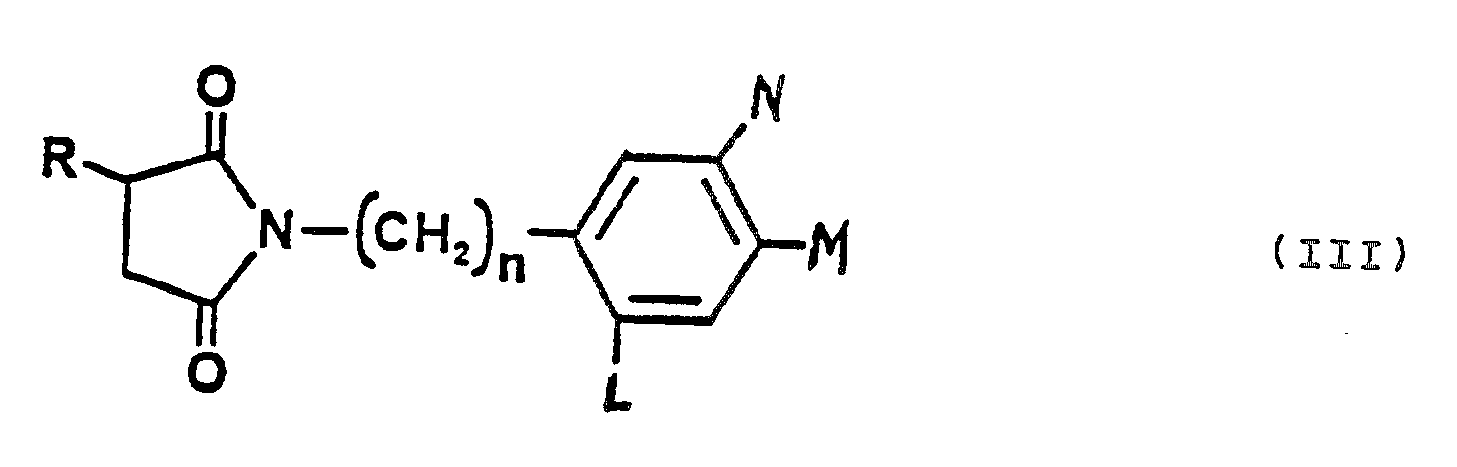
worin R, n, X, Y die gleichen Bedeutungen wie für die Formel (I) haben, wobei die Reste X jeweils gleiche Reste sind, und - L und N gleiche oder verschiedene Reste, nämlich Methylgruppen oder Fluoratome, und
- M ein Wasserstoffatom oder eine Methylgruppe bedeuten.
- Besonders bevorzugt aufgrund ihrer fungiziden Wirksamkeit sind diejenigen Verbindungen der Formeln (II) und (III), für die R ein Bromatom bedeutet, insbesondere solche der Formel

worin n, X und Y die für Formel (I) angegebenen Bedeutungen haben, wobei die Reste X jeweils gleiche Reste sind. - Vorzugsweise bedeuten in Formel (IV) die Reste X jeweils zwei Wasserstoffatome oder zwei Methylgruppen.
- Wegen ihrer besonders hohen fungiziden Wirksamkeit ist insbesondere-die Verbindung der Formel

bevorzugt. - Die erfindungsgemäßen 3-Halogensuccinimide der Formel (I) sind aufgrund eines Asymmetriezentrums am Kohlenstoffatom in 3-Stellung am Heterozyklus optisch aktiv. Es ist durchaus möglich, daß eines der jeweiligen Enantiomeren (3-R- oder 3-S-Enantiomer) stärker als das andere zur gewünschten Wirkung beiträgt. Unter dem Begriff "Verbindungen der Formel" sind auf jeden Fall die optisch reinen 3-R- bzw. 3-S-Enantiomeren sowie jegliche Mischungen von mindestens einem 3-R- mit mindestens einem 3-S-Isomer, beispielsweise die entsprechenden Racemate, zu verstehen
- Die erfindungsgemäßen Verbindungen sind beispielsweise wie folgt herstellbar:
- 1. Durch Umsetzung von Verbindungen der Formel


- 2. Durch Umsetzung von Verbindungen der Formel

- 3. Besonders vorteilhaft ist es, wenn zur Herstellung der erfindungsgemäßen Verbindungen der Formel (I) Verbindungen der Formel
- Es ist aufgrund der Empfindlichkeit von 3-Jodsuccinimiden gegen Oxidation und Dehydrohalogenierung grundsätzlich von Vorteil, die erfindungsgemäßen 3-Jodsuccinimide in oben geschilderter Weise aus den entsprechenden 3-Chlor- bzw. 3-Bromderivaten herzustellen.
- Die Bensteinsäureamide der Formel (IX) sind durch die Reaktion von Verbindungen der Formel (VII) mit Bensteinsäureanhydrid zugänglich, Die als Ausgangsstoffe benötigten Amine der Formel (VII) sind käuflich oder lassen sich in bekannter Weise darstellen.
- Nach den vorstehend beschriebenen Methoden wurden die in der folgenden Tab. 1 aufgeführten Verbindungen hergestellt.

- Die erfindungsgemäßen Verbindungen weisen fungitoxische Eigenschaften auf. Sie werden gegen Pilzbefall an Pflanzen bzw. an pflanzlichen Produkten eingesetzt.
- Sie erweisen sich beispielsweise hochwirksam gegen alle Lebensformen von Botrytis cinerea und gegen deren Begleitpilze, wie Alternaria solani und Penicillium glaucum. Es ist insbesondere hervorzuheben, daß die erfindungsgemäßen Wirkstoffe auch gegen solche Botrytis-Stämme wirksam sind, die bereits gegen bekannte Dicarboxanilide, deren gemeinsames Kennzeichen ein an einem Imid-Stickstoff befindlicher 3.S-Dichlorphenyl-Rest ist, Resistenzerscheinungen zeigen.
- Ferner werden solche Pilze bekämpft wie Alternaria-Arten, Septoria-Arten, Verticillium dahliae, Colletotrichum-Arten, Monilia-Arten, Fusarium-Arten und Oomyceten, wie z.B. Pythium ultimum.
- Die erfindungsgemäßen Wirkstoffe zeichnen sich durch ein breites Wirkungsspektrum aus. So wird beispielsweise nicht nur die Botrytis bekämpft, sondern ebenso die typischen Begleitpilze. Mit den erfindungsgemäßen Wirkstoffen kann mithin der Gesamtkomplex der Pilzkrankheit behandelt werden und damit das bei einseitiger Behandlung oftmals beobachtete vermehrte Aufwachsen von Begleitpilzen verhindert werden.
- Die Wirkstoffe eignen sich, ohne daß ihr Anwendungsgebiet darauf beschränkt wäre, z.B. zum Einsatz im Weinbau, im Gartenbau, insbesondere in Salatpflanzungen oder bei Zierpflanzen (Alpenveilchen, Geranien), in Zierrasen, beim Rapsanbau, beim Hopfenanbau, in Erdbeerpflanzungen und im Kernobstbau.
- Die Applikation der Wirkstoffe erfolgt in an sich bekannter Weise auf den Lebensraum der Pilze durch beispielsweise Gießen, Verspritzen, Versprühen, Zerstäuben, Bestreichen. Es kann dabei sowohl eine prophylaktische als auch eine kurative Wirkung erzielt werden.
- Die erfindungsgemäßen Wirkstoffe können allein oder im Gemisch mit sonstigen Pestiziden, insbesondere fungiziden Mitteln ausgebracht werden. Im allgemeinen werden sie als Mischungen mit festen oder flüssigen Verdünnungsmitteln oder als Lösungen in festen oder flüssigen Lösungsmitteln verwendet, mit Wirkstoffgehalten von 0,005 bis 95 Gew.-%.
- Die Mischungen bzw. Lösungen werden im allgemeinen als Emulsionskonzentrate, Pasten, Spritzpulver, Granulate oder Mikrokapseln hergestellt.
- Emulsionskonzentrate und Pasten enthalten im allgemeinen 10 bis 90 Gew.-%, vorzugsweise 15 bis 50 Gew.-% Wirkstoff, 2 bis 25 Gew.-% Dispergierhilfsstoffe und organische Lösungsmittel und/oder Wasser.
- Spritzpulver enhalten meistens 10 bis 80 Gew.-%, vorzugsweise 15-bis 70 Gew.-% Wirkstoff, 1 bis 30 Gew.-% Dispergierhilfsstoffe und 10 bis 89 Gew.-% inerte Bestandteile.
- Granulate und Mikrokapseln enthalten neben inerten Bestandteilen und/oder Oberzugsstoffen 1 bis 10 Gew.-%, vorzugsweise 5 bis 10 Gew.-% Wirkstoff.
- Erfindungsgemäß angewandt werden
- als Dispergierhilfsstoffe, z.B. Alkyl- und Arylsulfonate, Methylzellulose, polymere Sulfonsäuren und deren Salze, Polyalkohole, Fettsäureester, Fettalkoholether, Fettamine;
- als organische Lösungsmittel, z.B. Alkohole wie Ethanol, Butanole, Dimethylformamid, Dimethylsulfoxid, N-Methyl-Pyrrolidon, Aromaten wie Toluol und Xylole;
- als inerte Bestandteile, z.B. Kaolin, China-Clay, Talkum, Calciumkarbonat, hochdisperse Kieselsäure, Kieselgele, Kieselgur, Diatomeenerde, Bims, Ziegelsplitt, Maisschrot, Verdickungsmittel wie Stärke und Carboxymethylzellulose, Cyclodextrine;
- als Bindemittel, z.B. Magnesiumsulfat, Gips, Gummiarabikum, Polyvinylalkohol.
- Beispielsweise werden die erfindungsgemäßen Wirkstoffe zur Verwendung als Fungizide wie folgt formuliert:


- Die folgenden Beispiele dienen zur Erläuterung der Erfindung. Die erfindungsgemäßen Produkte wurden jeweils durch ¹H-NMR identifiziert
- 29,4 g (0.3 Mol) Maleinsäureanhydrid wurden in 300 ml Toluol gelöst und dazu bei 30°C eine lösung von 33,3 g (0.3 Mol) 4-Fluoranilin in 100 ml Toluol zugegeben. Das Halbanilid fiel rasch aus. Zur Vervollständigung der Reaktion wurde das Gemisch 2 Stunden auf 100°C erwärmt, dann abgekühl;, das ausfallende Produkt abfiltriert, gewaschen und getrocknet. Die Ausbeute an Halbanilid war quantitativ. Das Halbanilid wurde in Essigsäureethylester suspendiert und dazu 43 g (0.35 Mol) Acetylbromid zugegeben. Durch Rühren bei 30°C (2 Std.) und durch nachfolgendes 2-stündiges Erhitzen auf Rückfluß wurde die Reaktion durchgeführt, danach das Lösungsmittel abdestilliert und der Rest kristallisiert. Die Ausbeute betrug 69,2 g (entsprechend 85,5% d.Th.) Das Produkt wies einen Schmelzpunkt von 154°C auf. NMR (in CDCl₃ als Lösungsmittel, Tetramethylsilan als innerer Standard): 2,9-3,8 ppm (4 Dubletts, J = 3 bzw. 9 Hz; Ring-CH₂), 4,8 bzw. 4,95 (2 Dubletts, J = 3 Hz; Ring-CH) 7,0-7,45 (Multiplett, 4 aromat. Protonen) im Verhältnis 2: 1: 4.
- 27,2 g (0.1 Mol) des nach Beispiel 1 hergestellten 3-Brom-1-(4-fluorphenyl)-2.5-pyrrolidindions wurden in 140 ml Aceton gelöst und dazu eine lösung von 15,75 (0.105 Mol) Natriumjodid in Aceton zugegeben. Das Gemisch wurde 2 Stunden bei Zimmertemperatur gerührt und dann 1 Stunde auf Rückfluß erhitzt. Anschließend wurde abgekühlt, vom entstandenen Natriumbromid abfiltriert und das Filtrat eingeengt. Der Rückstand wurde aus Methanol/Wasser (3: 1) umkristallisiert und ergab das gesuchte Produkt mit 70,5% d.Th. Der Schmelzpunkt des Derivats liegt bei 118°C.
- 13,9 g (0.1 Mol) 2.4-Dimethyl-5-fluoranilin und 9,8 g (0.1 Mol) Maleinsäureanhydrid wurden, wie in Beispiel 1 beschrieben, miteinander umgesetzt. Die Ausbeute betrug 70,2% d.Th; der Schmelzpunkt des Produkts liegt bei 115°C.
- Herstellung des Ausgangsmaterials (nach B.C. Becker und R. Adams, J. Am. chem. Soc. 54, 2980 (1932)): 60,5 g käufliches 2.4-Dimethylanilin wurden langsam bei 0-10°C zu 340 ml konz. Schwefelsäure gegeben und dazu, ebenfalls bei 0-10°C 72,5 ml konz. Salpetersäure (D = 1,4) im Verlauf einer Stunde unter Rühren zugetropft. Anschließend wurde noch 30 min. weitergerührt, dann das Gemisch auf Eis gegossen und der Niederschlag mit 35 g Natriumnitrit bei 0-10°C in etwa 2,5 Std. diazotiert. Nach weiteren 30 min Rühren wurden bei 0°C 88 ml 50% wässr. HBF₄ zugetropft, wieder 30 min. gerührt und dann der ausgefallene Niederschlag abfiltriert (52,5 g nach Waschen und Trocknen). Dieses Produkt wurde nun portionsweise im Verlauf von 5 Std. bei 130°C zersetzt und destilliert (Kp₁₂ 103°C). Die Ausbeute betrug 14,8 g (entspricht 17,4% d.Th.).
- Diese Nitroverbindung wurde nun in 125 ml Methanol gelöst und mit PtO₂ als Katalysator mit Wasserstoff bei 35-45°C (exotherme Reaktion) im Verlauf von 3 Std. hydriert. Durch Filtrieren, Einengen und Kristallisieren wurden 11 g (entsprechend 93% d.Th.) des gesuchten Anilinderivats erhalten. Schmelzpunkt des Amins 58-60°C.
- 9,8 g (0.1 Mol) Maleinsäureanhydrid wurden in 100 ml Toluol gelöst und dazu bei 30°C eine lösung von 15,6 g (0.1 Mol) käuflichem 2-(4-Chlorphenyl)ethylamin in Toluol zugegeben. Das Maleinsäurehalbamid fällt rasch aus. Nach weiteren zwei Stunden wurde das Halbamid abfiltriert (Fp 136-138°C). Anschließend wurde es in Essigsäureethylester suspendiert, 12,9 g (0.105 Mol) Acetylbromid zugefügt und das Gemisch unter Rühren 2 h auf 30-40°C enwärmt, wobei der Niederschlag allmählich aufgelöst wurde. Danach wurde weitere 2 Stunden auf Rückfluß erhitzt, dann das Lösungsmittel abgezogen und der Rückstand kristallisiert. Das Produkt kann aus Ethanol umkristallisiert werden und schmilzt dann bei 96°C. Die Ausbeute beträgt 78,0% d.Th.
- Für die folgenden Wirkungsbeispiele wurden aus dem bekannten Stand der Technik drei besonders nahe liegende Substanzen als Vergleichsmittel ausgewählt. Es sind dies:
- 1. 3-Brom-1-(3.5-dichlorphenyl)-2.5-pyrrolidindion, bekannt aus DE 2.012.656, im folgenden als "Vergleich A" bezeichnet,
- 2. 3-Chlor-1-(2.4.6-trimethylphenyl)-1H-pyrrol-2.5-dion, bekannt aus FR 2.226.396, im folgenden als "Vergleich B" bezeichnet,
- 3. 3-Chlormethyl-1-(2.4.6-trimethylphenyl)-2.5-pyrrolidindion, bekannt aus EPA 0.173.284, im folgenden als "Vergleich C" bezeichnet.
- 50 µl einer Lösung oder Suspension eines Wirkstoffs mit einem Gehalt von 250 bzw. 16 ppm Aktivsubstanz wurden zusammen mit 50 µl einer Sporensuspension, hergestellt durch Abschwemmen der Sporen von einer Agarkultur mit einer Nährlösung, die pro Liter 10 g Zucker, 1 g Glykol, 1 g KH₂PO₄ und 0,5 g MgSO₄ enthielt, in den Hohlschliff von Hohlschliffobjektträgern eingebracht. Die Objektträger wurden bei 20°C 48 Stunden in einer Petrischale, deren Boden mit angefeuchtetem Filterpapier bedeckt war, aufbewahrt.
- Danach wurde das Verhältnis der gekeimten und der nicht gekeimten Sporen gegen eine unbehandelte Kontrollprobe verglichen.
- Der Wirkungsgrad wird in % nach der folgenden Formel angegeben:

- Die Ergebnisse sind in den folgenden Tab. 2 und 3 zusammengestellt.


- 20 ml eine Nährlösung aus Traubensaft und destilliertem Wasser im Verhältnis 1: 1 wurden in Petrischalen eingefüllt und mit den in der Folgenden Tabelle angeführten Wirstoffen versetzt. Die Wirkstoffkonzentration betrug 31 ppm. Anschließend wurden die Versuchsansätze mit jeweils 50 µl einer Botrytis-Sporensuspension, hergestellt durch Abschwemmen der Botrytis-Sporen von einer Agarkultur mit destilliertem Wasser, beimpft.
- Nach einer Bebrütungsdauer von 10 bzw. 20 Tagen bei 20°C wurde das Ausmaß der Pilzentwicklung auf der Nährlösungsoberfläche beurteilt.
- Der Wirkungsgrad wurde in % nach der folgenden Formel errechnet:

- Wirksamkeit von erfindungsgemäßen Stoffen und von Vergleichsmitteln in %-Graden bei 31 ppm Wirkstoffkonzentration nach 10 bzw. 20 Tagen Einwirkungs- dauer


- Besonders aktive erfindungsgemäße Wirkstoffe, wie z.B. Wirkstoff 16, zeigen selbst bei 2 ppm noch 80% Wirksamkeit nach 20 Tagen.
- Die Arbeitsweise nach Beispiel 6 wurde mit der Abänderung wiederholt, daß mit Botrytissporen eines Botrytisstammes beimpft wurde, der gegen N-(1.5-Dichlorphenyl)-substituierte Imide Resistenz zeigt. Die Wirkstoffkonzentration betrug 8 ppm. Während mit Wirkstoff 7 gegen diesen Stamm eine 65%ige Wirksamkeit erreicht wurde, war mit Vergleich A bei gleicher Wirkstoffkonzentration nur 20% Wirksamkeit festzustellen. Als zusätzlicher Vergleich wurde "Ronilan" (= 3-(3.5-Dichlorphenyl)-5-ethenyl-5-methyl-2.4-oxazolidindion; eingetragener Markenname der BASF AG) verwendet, das gegen den gleichen Stamm selbst bei 62 ppm Wirkstoffkonzentration nur 26% Wirksamkeit erzielte.
- Junge Paprikapflanzen, die das erste echte Blattpaar entwickelt haben, werden mit einer wässrigen Lösung der Wirkstofformulierung tropfnaß gespritzt. Nach dem Antrocknen des Spritzbelags werden die Pflanzen mit einer Suspension von Botrytissporen künstlich infiziert und danach bei 95-98% Luftfeuchtigkeit und 20°C in einer Klimakammer aufbewahrt. 6 Tage nach der Inokulation wird der Versuch bonitiert. Die Befallsgrade werden durch Vergleich zu unbehandelten Kontrollpflanzen sowie einem Vergleichspräparat ermittelt.
- Wirksamkeit von erfindungsgemäßen Wirkstoffen und von Vergleichsmitteln in %-Graden bei 500 ppm Wirkstoffkonzentration an Paprikapflanzen.

- Führt man den gleichen Versuch mit Botrytis-Sporen durch, die wie in Beispiel 7 gegen N-(3.5-Dichlorphenyl)substituierte Imide Resistenzerscheinungen zeigen, so sinkt der Wirksamkeitsgrad beispielsweise mit Vergleichssubstanz A auf etwa die Hälfte des Wertes mit sensiblen Stämmen ab, während beispielsweise mit Wirkstoff 7 praktisch die gleiche Wirksamkeit gegen sensible wie auch gegen resistente Stämme erhalten wurde.
- Junge Weizenpflanzen im 2-Blatt-Stadium wurden mit einer wässrigen Wirkstoffsuspension tropfnaß gespritzt. Nach dem Antrocknen des Wirkstoffbelags wurden die Pflanzen durch Besprühen mit einer wässrigen Uredo-Sporen-Suspension infiziert. Nach 24-stündigem Stehen in einer dunklen Feuchtkammer wurden die Pflanzen im Gewächshaus bei 20 bis 22°C und 65 bis 70% rel. Luftfeuchte aufgestellt. Nach 10 bis 14 Tagen Inkubationszeit wurden die Prozentzahlen der Befallsgrade durch Vergleich der befallenen Blattflächen mit unbehandelten, infizierten Kontrollpflanzen ermittelt.
- Wirksamkeit von erfindungsgemäßen Verbindungen und von Vergleichsmitteln in %-Graden bei 500 ppm Wirkstoffkonzentration

- Gegen Bohnenrost (Uromyces phaseoli) werden meist ganz ähnliche Bekämpfungswerte erzielt wie gegen Weizenbraunrost.
- Der Wirkstoff wurde in einer Konzentration von 500 ppm gleichmäßig in Erde gemischt, die mit Pythium ultimum künstlich infiziert war. Die so behandelte Erde wurde in Plastiktöpfe gefüllt (je 4 Wiederholungen pro Testsubstanz) und mit je 10 Erbsensamen besät. Diese Töpfe wurden 10 Tage bei 24 bis 26°C und einer Luftfeuchte von 75 bis 90% aufbewahrt. Danach wurde die Anzahl der gesunden, aufgelaufenen Pflanzen bestimmt. Der Wirkungsgrad wurde durch Vergleich mit infizierten, aber unbehandelten Erdproben errechnet. Die Ergebnisse sind in der nachfolgenden Tabelle zusammengestellt.
- Wirksamkeit von erfindungsgemäßen Wirkstoffen und von Vergleichsmitteln in % Graden bei 500 ppm Wirkstoffkonzentration gegen Pythium ultimum.


mit solchen der Formel
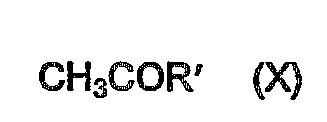
umgesetzt werden, wobei R, n, X, X′, Y und Z die in Anspruch 1 angegebenen Bedeutungen haben und R′ ein Chlor- oder Bromatom bedeutet, und,
falls R ein Jodatom bedeutet, das so erhaltene Produkt der Formel

anschließend in an sich bekannter Weise mit Alkalimetalljodid, vorzugsweise Natriumjodid, vorzugsweise in einem geeigneten Lösungsmittel, wie Aceton, umgesetzt wird.
Claims (7)


worin R, n, X, Y die gleichen Bedeutungen wie für die Formel (I) haben, wobei die Reste X jeweils gleiche Reste sind, und

worin n, X und Y die für Formel (I) angegebenen Bedeutungen haben, wobei die Reste X jeweils gleiche Reste sind, aufweisen.


umgesetzt werden, wobei R, n, X, X′, Y und Z die in Anspruch 1 angegebenen Bedeutungen haben und R′ ein Chlor- oder Bromatom bedeuten, wobei dann, wenn n gleich 0 und R gleich Cl ist, mindestens einer der Rest X, X′, Y und Z kein Wasserstoffatom ist, und falls R in der Formel (I) ein Jodatom bedeutet, das so erhaltene Produkt der Formel

Priority Applications (1)
| Application Number | Priority Date | Filing Date | Title |
|---|---|---|---|
| AT87906419T ATE63902T1 (de) | 1986-10-16 | 1987-10-01 | 3-halogensuccinimide. |
Applications Claiming Priority (2)
| Application Number | Priority Date | Filing Date | Title |
|---|---|---|---|
| DE3635282 | 1986-10-16 | ||
| DE19863635282 DE3635282A1 (de) | 1986-10-16 | 1986-10-16 | 3 halogensuccinimide |
Publications (2)
| Publication Number | Publication Date |
|---|---|
| EP0288493A1 EP0288493A1 (de) | 1988-11-02 |
| EP0288493B1 true EP0288493B1 (de) | 1991-05-29 |
Family
ID=6311867
Family Applications (1)
| Application Number | Title | Priority Date | Filing Date |
|---|---|---|---|
| EP87906419A Expired - Lifetime EP0288493B1 (de) | 1986-10-16 | 1987-10-01 | 3-halogensuccinimide |
Country Status (4)
| Country | Link |
|---|---|
| US (1) | US4900840A (de) |
| EP (1) | EP0288493B1 (de) |
| DE (2) | DE3635282A1 (de) |
| WO (1) | WO1988002747A1 (de) |
Families Citing this family (4)
| Publication number | Priority date | Publication date | Assignee | Title |
|---|---|---|---|---|
| US4977183A (en) * | 1986-10-16 | 1990-12-11 | The Dow Chemical Company | 3-halosuccinimides and plant fungicidal use thereof |
| JP2788490B2 (ja) * | 1988-06-30 | 1998-08-20 | 三井化学株式会社 | N‐置換モノクロロコハク酸イミドの製造方法 |
| JP4500096B2 (ja) | 2004-04-27 | 2010-07-14 | オリンパス株式会社 | 内視鏡及び内視鏡システム |
| CN117865812A (zh) * | 2023-12-18 | 2024-04-12 | 上海凌凯医药科技有限公司 | 一种合成2,4-二甲基-5-硝基氟苯的方法 |
Family Cites Families (6)
| Publication number | Priority date | Publication date | Assignee | Title |
|---|---|---|---|---|
| CH330820A (de) * | 1953-04-29 | 1958-06-30 | Pittsburgh Coke & Chemical Co | Verfahren zur Herstellung von Dichlorbernsteinsäureimiden |
| US3745170A (en) * | 1969-03-19 | 1973-07-10 | Sumitomo Chemical Co | Novel n-(3,5-dihalophenyl)-imide compounds |
| FR2371432A1 (fr) * | 1976-11-22 | 1978-06-16 | Philagro Sa | Procede de preparation de n-imides a partir d'acides amiques |
| US4276090A (en) * | 1977-10-19 | 1981-06-30 | Abbott Laboratories | Method for protecting industrial substrates from fungal or bacterial attack |
| DE2758818A1 (de) * | 1977-12-30 | 1979-07-12 | Hoechst Ag | Neue kristallmodifikation des 5-(2'-hydroxy-3'-naphthoyl-amino)-benzimidazolon- (2), verfahren zu ihrer herstellung und ihre verwendung |
| DE3636552A1 (de) * | 1986-10-28 | 1988-05-05 | Dow Chemical Co | Neue herbizide |
-
1986
- 1986-10-16 DE DE19863635282 patent/DE3635282A1/de not_active Withdrawn
-
1987
- 1987-10-01 WO PCT/EP1987/000563 patent/WO1988002747A1/de not_active Ceased
- 1987-10-01 US US07/240,763 patent/US4900840A/en not_active Expired - Fee Related
- 1987-10-01 DE DE8787906419T patent/DE3770459D1/de not_active Expired - Lifetime
- 1987-10-01 EP EP87906419A patent/EP0288493B1/de not_active Expired - Lifetime
Also Published As
| Publication number | Publication date |
|---|---|
| DE3635282A1 (de) | 1988-04-28 |
| US4900840A (en) | 1990-02-13 |
| EP0288493A1 (de) | 1988-11-02 |
| DE3770459D1 (de) | 1991-07-04 |
| WO1988002747A1 (fr) | 1988-04-21 |
Similar Documents
| Publication | Publication Date | Title |
|---|---|---|
| DE2513732C2 (de) | ||
| DE2212268C3 (de) | N-Halogenacetylanilinoessigsäureester, Verfahren zu deren Herstellung und diese enthaltende herbicide Massen | |
| DE3881478T2 (de) | Substituierte carbonsaeure-derivate, verfahren zu ihrer herstellung und diese enthaltende fungizide fuer acker- und gartenbau. | |
| DE2905650C2 (de) | ||
| DE1955750A1 (de) | Ureidophenylguanidine,Verfahren zu ihrer Herstellung und ihre fungizide Verwendung | |
| DE69018847T2 (de) | Maleimidverbindungen und diese enthaltende Fungizide. | |
| DE69312776T2 (de) | Fungizide 3,4-Diaryl-(5H)-Furan-2-Onederivate | |
| DE2600799A1 (de) | Acylierte triazolyl-0,n-acetale, verfahren zu ihrer herstellung und ihre verwendung als fungizide | |
| DE2409011B2 (de) | 2,4-Dimethyl-3-carboxanttido-furanverbindungen, Verfahren zur Herstellung derselben und Pflanzenschutzmittel mit einem Gehalt dieser Verbindungen | |
| DE2136923A1 (de) | Substituierte benzthiazole, verfahren zu ihrer herstellung und ihre verwendung als fungizide und bakterizide | |
| EP0046274B1 (de) | Substituierte Bernsteinsäureimide und ihre Verwendung als fungizide Mittel | |
| DE1960029A1 (de) | Ureidophenylthioharnstoffe,Verfahren zu ihrer Herstellung und ihre fungizide Verwendung | |
| DE2643403A1 (de) | Mikrobizide mittel | |
| WO1988002747A1 (fr) | Succinimides de 3-halogene | |
| EP0392286B1 (de) | 3-Cyano-4-phenyl-pyrrol-Derivate | |
| EP0007089A1 (de) | Acylanilide mit herbicider und fungicider Wirkung, Verfahren zu ihrer Herstellung und ihre Verwendung | |
| DE68912083T2 (de) | Substituierte Karbonsäuren, ihre Herstellung und Verwendung. | |
| DE3144526C2 (de) | ||
| DE2128700C2 (de) | Fungitoxische Mittel | |
| EP0173284A1 (de) | Substituierte 1-Phenyl-3-methyl-pyrrolidindione, ihre Herstellung und Verwendung als Fungizide | |
| DE1936130A1 (de) | Benzimidazol-Derivate,Verfahren zu ihrer Herstellung und ihre fungizide Verwendung | |
| EP0339422B1 (de) | 3-Cyano-4-phenyl-pyrrol-Derivate | |
| DE2815290A1 (de) | Neue diarylamine, verfahren zu ihrer herstellung und ihre verwendung | |
| DE68924160T2 (de) | Maleimidderivat, Verfahren zu seiner Herstellung und dieses Maleimidderivat als Wirkstoff enthaltende Fungizid für den Acker- und Gartenbau. | |
| DE68905202T2 (de) | Imidazolderivate, verfahren zu ihrer herstellung und sie enthaltende fungizide zusammensetzungen zu landwirtschaftlichen und gartenbau-verwendungen. |
Legal Events
| Date | Code | Title | Description |
|---|---|---|---|
| PUAI | Public reference made under article 153(3) epc to a published international application that has entered the european phase |
Free format text: ORIGINAL CODE: 0009012 |
|
| 17P | Request for examination filed |
Effective date: 19880429 |
|
| AK | Designated contracting states |
Kind code of ref document: A1 Designated state(s): AT BE CH DE FR GB IT LI LU NL SE |
|
| 17Q | First examination report despatched |
Effective date: 19900213 |
|
| GRAA | (expected) grant |
Free format text: ORIGINAL CODE: 0009210 |
|
| RAP1 | Party data changed (applicant data changed or rights of an application transferred) |
Owner name: DOWELANCO |
|
| AK | Designated contracting states |
Kind code of ref document: B1 Designated state(s): AT BE CH DE FR GB IT LI LU NL SE |
|
| REF | Corresponds to: |
Ref document number: 63902 Country of ref document: AT Date of ref document: 19910615 Kind code of ref document: T |
|
| GBT | Gb: translation of ep patent filed (gb section 77(6)(a)/1977) | ||
| ITF | It: translation for a ep patent filed | ||
| REF | Corresponds to: |
Ref document number: 3770459 Country of ref document: DE Date of ref document: 19910704 |
|
| ET | Fr: translation filed | ||
| PLBE | No opposition filed within time limit |
Free format text: ORIGINAL CODE: 0009261 |
|
| STAA | Information on the status of an ep patent application or granted ep patent |
Free format text: STATUS: NO OPPOSITION FILED WITHIN TIME LIMIT |
|
| 26N | No opposition filed | ||
| EPTA | Lu: last paid annual fee | ||
| PGFP | Annual fee paid to national office [announced via postgrant information from national office to epo] |
Ref country code: SE Payment date: 19940826 Year of fee payment: 8 |
|
| PGFP | Annual fee paid to national office [announced via postgrant information from national office to epo] |
Ref country code: CH Payment date: 19940830 Year of fee payment: 8 |
|
| PGFP | Annual fee paid to national office [announced via postgrant information from national office to epo] |
Ref country code: LU Payment date: 19940901 Year of fee payment: 8 |
|
| PGFP | Annual fee paid to national office [announced via postgrant information from national office to epo] |
Ref country code: AT Payment date: 19940907 Year of fee payment: 8 |
|
| PGFP | Annual fee paid to national office [announced via postgrant information from national office to epo] |
Ref country code: BE Payment date: 19940909 Year of fee payment: 8 |
|
| PGFP | Annual fee paid to national office [announced via postgrant information from national office to epo] |
Ref country code: FR Payment date: 19940915 Year of fee payment: 8 |
|
| PGFP | Annual fee paid to national office [announced via postgrant information from national office to epo] |
Ref country code: GB Payment date: 19940930 Year of fee payment: 8 |
|
| PGFP | Annual fee paid to national office [announced via postgrant information from national office to epo] |
Ref country code: NL Payment date: 19941031 Year of fee payment: 8 Ref country code: DE Payment date: 19941031 Year of fee payment: 8 |
|
| EAL | Se: european patent in force in sweden |
Ref document number: 87906419.4 |
|
| PG25 | Lapsed in a contracting state [announced via postgrant information from national office to epo] |
Ref country code: LU Free format text: LAPSE BECAUSE OF NON-PAYMENT OF DUE FEES Effective date: 19951001 Ref country code: GB Effective date: 19951001 Ref country code: AT Effective date: 19951001 |
|
| PG25 | Lapsed in a contracting state [announced via postgrant information from national office to epo] |
Ref country code: SE Effective date: 19951002 |
|
| PG25 | Lapsed in a contracting state [announced via postgrant information from national office to epo] |
Ref country code: LI Effective date: 19951031 Ref country code: CH Effective date: 19951031 Ref country code: BE Effective date: 19951031 |
|
| BERE | Be: lapsed |
Owner name: DOWELANCO Effective date: 19951031 |
|
| PG25 | Lapsed in a contracting state [announced via postgrant information from national office to epo] |
Ref country code: NL Effective date: 19960501 |
|
| GBPC | Gb: european patent ceased through non-payment of renewal fee |
Effective date: 19951001 |
|
| REG | Reference to a national code |
Ref country code: CH Ref legal event code: PL |
|
| PG25 | Lapsed in a contracting state [announced via postgrant information from national office to epo] |
Ref country code: FR Effective date: 19960628 |
|
| EUG | Se: european patent has lapsed |
Ref document number: 87906419.4 |
|
| PG25 | Lapsed in a contracting state [announced via postgrant information from national office to epo] |
Ref country code: DE Effective date: 19960702 |
|
| NLV4 | Nl: lapsed or anulled due to non-payment of the annual fee |
Effective date: 19960501 |
|
| REG | Reference to a national code |
Ref country code: FR Ref legal event code: ST |
|
| PG25 | Lapsed in a contracting state [announced via postgrant information from national office to epo] |
Ref country code: IT Free format text: LAPSE BECAUSE OF NON-PAYMENT OF DUE FEES;WARNING: LAPSES OF ITALIAN PATENTS WITH EFFECTIVE DATE BEFORE 2007 MAY HAVE OCCURRED AT ANY TIME BEFORE 2007. THE CORRECT EFFECTIVE DATE MAY BE DIFFERENT FROM THE ONE RECORDED. Effective date: 20051001 |