EP0339422B1 - 3-Cyano-4-phenyl-pyrrol-Derivate - Google Patents
3-Cyano-4-phenyl-pyrrol-Derivate Download PDFInfo
- Publication number
- EP0339422B1 EP0339422B1 EP89106825A EP89106825A EP0339422B1 EP 0339422 B1 EP0339422 B1 EP 0339422B1 EP 89106825 A EP89106825 A EP 89106825A EP 89106825 A EP89106825 A EP 89106825A EP 0339422 B1 EP0339422 B1 EP 0339422B1
- Authority
- EP
- European Patent Office
- Prior art keywords
- cyano
- formula
- phenyl
- pyrrole
- pyrrole derivatives
- Prior art date
- Legal status (The legal status is an assumption and is not a legal conclusion. Google has not performed a legal analysis and makes no representation as to the accuracy of the status listed.)
- Expired - Lifetime
Links
- 0 C*C=CC(C1C(*)=CNC1)=C(CCl)F Chemical compound C*C=CC(C1C(*)=CNC1)=C(CCl)F 0.000 description 6
Classifications
-
- C—CHEMISTRY; METALLURGY
- C07—ORGANIC CHEMISTRY
- C07D—HETEROCYCLIC COMPOUNDS
- C07D207/00—Heterocyclic compounds containing five-membered rings not condensed with other rings, with one nitrogen atom as the only ring hetero atom
- C07D207/02—Heterocyclic compounds containing five-membered rings not condensed with other rings, with one nitrogen atom as the only ring hetero atom with only hydrogen or carbon atoms directly attached to the ring nitrogen atom
- C07D207/30—Heterocyclic compounds containing five-membered rings not condensed with other rings, with one nitrogen atom as the only ring hetero atom with only hydrogen or carbon atoms directly attached to the ring nitrogen atom having two double bonds between ring members or between ring members and non-ring members
- C07D207/32—Heterocyclic compounds containing five-membered rings not condensed with other rings, with one nitrogen atom as the only ring hetero atom with only hydrogen or carbon atoms directly attached to the ring nitrogen atom having two double bonds between ring members or between ring members and non-ring members with only hydrogen atoms, hydrocarbon or substituted hydrocarbon radicals, directly attached to ring carbon atoms
- C07D207/33—Heterocyclic compounds containing five-membered rings not condensed with other rings, with one nitrogen atom as the only ring hetero atom with only hydrogen or carbon atoms directly attached to the ring nitrogen atom having two double bonds between ring members or between ring members and non-ring members with only hydrogen atoms, hydrocarbon or substituted hydrocarbon radicals, directly attached to ring carbon atoms with substituted hydrocarbon radicals, directly attached to ring carbon atoms
- C07D207/337—Radicals substituted by carbon atoms having three bonds to hetero atoms with at the most one bond to halogen, e.g. ester or nitrile radicals
-
- C—CHEMISTRY; METALLURGY
- C07—ORGANIC CHEMISTRY
- C07D—HETEROCYCLIC COMPOUNDS
- C07D207/00—Heterocyclic compounds containing five-membered rings not condensed with other rings, with one nitrogen atom as the only ring hetero atom
- C07D207/02—Heterocyclic compounds containing five-membered rings not condensed with other rings, with one nitrogen atom as the only ring hetero atom with only hydrogen or carbon atoms directly attached to the ring nitrogen atom
- C07D207/30—Heterocyclic compounds containing five-membered rings not condensed with other rings, with one nitrogen atom as the only ring hetero atom with only hydrogen or carbon atoms directly attached to the ring nitrogen atom having two double bonds between ring members or between ring members and non-ring members
- C07D207/34—Heterocyclic compounds containing five-membered rings not condensed with other rings, with one nitrogen atom as the only ring hetero atom with only hydrogen or carbon atoms directly attached to the ring nitrogen atom having two double bonds between ring members or between ring members and non-ring members with hetero atoms or with carbon atoms having three bonds to hetero atoms with at the most one bond to halogen, e.g. ester or nitrile radicals, directly attached to ring carbon atoms
-
- A—HUMAN NECESSITIES
- A01—AGRICULTURE; FORESTRY; ANIMAL HUSBANDRY; HUNTING; TRAPPING; FISHING
- A01N—PRESERVATION OF BODIES OF HUMANS OR ANIMALS OR PLANTS OR PARTS THEREOF; BIOCIDES, e.g. AS DISINFECTANTS, AS PESTICIDES OR AS HERBICIDES; PEST REPELLANTS OR ATTRACTANTS; PLANT GROWTH REGULATORS
- A01N43/00—Biocides, pest repellants or attractants, or plant growth regulators containing heterocyclic compounds
- A01N43/34—Biocides, pest repellants or attractants, or plant growth regulators containing heterocyclic compounds having rings with one nitrogen atom as the only ring hetero atom
- A01N43/36—Biocides, pest repellants or attractants, or plant growth regulators containing heterocyclic compounds having rings with one nitrogen atom as the only ring hetero atom five-membered rings
-
- A—HUMAN NECESSITIES
- A01—AGRICULTURE; FORESTRY; ANIMAL HUSBANDRY; HUNTING; TRAPPING; FISHING
- A01N—PRESERVATION OF BODIES OF HUMANS OR ANIMALS OR PLANTS OR PARTS THEREOF; BIOCIDES, e.g. AS DISINFECTANTS, AS PESTICIDES OR AS HERBICIDES; PEST REPELLANTS OR ATTRACTANTS; PLANT GROWTH REGULATORS
- A01N47/00—Biocides, pest repellants or attractants, or plant growth regulators containing organic compounds containing a carbon atom not being member of a ring and having no bond to a carbon or hydrogen atom, e.g. derivatives of carbonic acid
- A01N47/08—Biocides, pest repellants or attractants, or plant growth regulators containing organic compounds containing a carbon atom not being member of a ring and having no bond to a carbon or hydrogen atom, e.g. derivatives of carbonic acid the carbon atom having one or more single bonds to nitrogen atoms
- A01N47/10—Carbamic acid derivatives, i.e. containing the group —O—CO—N<; Thio analogues thereof
- A01N47/16—Carbamic acid derivatives, i.e. containing the group —O—CO—N<; Thio analogues thereof the nitrogen atom being part of a heterocyclic ring
Definitions
- the invention relates to new 3-cyano-4-phenyl-pyrrole derivatives, a process for their preparation and their use in pesticides.
- 3-cyano-4-phenyl-pyrroles such as, for example, the compound 3-cyano-4- (2,3-dichlorophenyl) pyrrole, have fungicidal activity (cf. e.g. EP 236272).
- 3-cyano-4-phenyl-pyrrole derivatives such as 1-methoxymethylcarbonyl-3-cyano-4- (2,3-dichlorophenyl) pyrrole, are known which have a fungicidal activity (cf. Chem. Abstracts 95 , No. 21, 187.069f).
- the 3-cyano-4-phenyl-pyrrole derivatives according to the invention of the general formula (I) e.g. a considerably better fungicidal activity than the 3-cyano-4-phenyl-pyrroles known from the prior art, such as, for example, the compound 3-cyano-4- (2,3-dichlorophenyl) pyrrole, which are chemically and effectively obvious compounds .
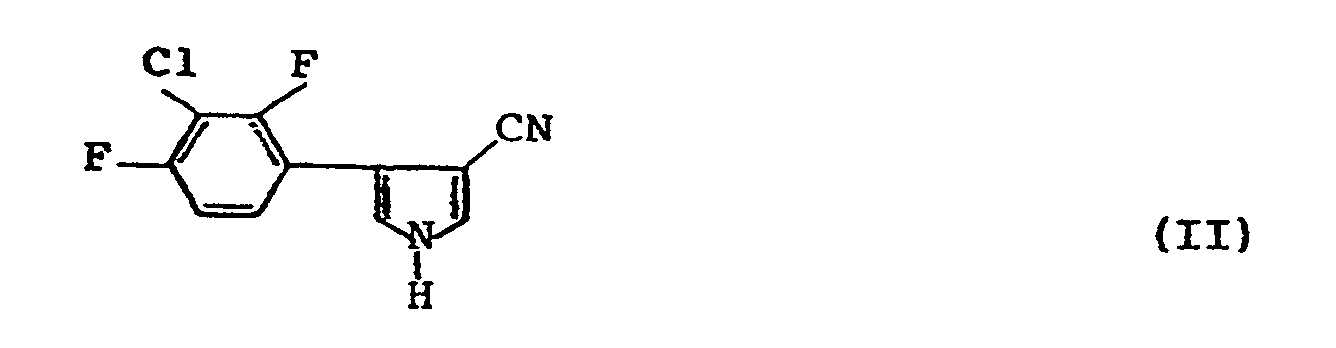
- Formula (II) defines the 1H-3-cyano-4- (2,4-difluoro-3-chloro) phenylpyrrole required as starting material for carrying out the process according to the invention.
- the sulfonylmethyl isocyanides of the formula (IX) which are also required as precursors for the preparation of the new starting materials of the formula (II) are also known (cf., for example, Synthesis 1985 , 400-402; Org. Syntheses 57 , 102-106 [1977]; J. org. Chem. 42 , 1153-1159 [1977]; Tetrahedron Lett. 1972 , 2367-2368).
- the acylating agents of the formula (III) are generally known compounds of organic chemistry.
- 1H-3-cyano-4-phenyl-pyrroles of the formula (II) are also obtained when using ⁇ -cyanocinnamic acid esters in the presence of bases and in the presence of copper (II) salts with p-toluenesulfonylmethyl isocyanide (cf. JP 61/030571 or JP 61/200984) or if one cyclizes ⁇ -substituted cinnamic acid nitriles in the presence of sodium hydride with isocyanoacetic acid esters, so available pyrrole-2-carboxylic acid esters are saponified with bases and then thermally decarboxylated (cf.
- Inert organic solvents are suitable as diluents for carrying out the process according to the invention.
- These include in particular aliphastic, alicyclic or aromatic, optionally halogenated hydrocarbons, such as, for example, gasoline, benzene, toluene, xylene, chlorobenzene, petroleum ether, hexane, cyclohexane, dichloromethane, chloroform, carbon tetrachloride, ethers, such as diethyl ether, dioxane, tetrahydrofuran or ethylene glycol dimethyl or diethyl ether, ketones, such as Acetone or butanone, nitriles, such as acetonitrile or propionitrile, amides, such as dimethylformamide, dimethylacetamide, N-methylformanilide, N-methylpyrrolidone or hexamethylphosphoric triamide, esters, such as ethyl acetate or
- the process according to the invention is preferably carried out in the presence of a suitable reaction auxiliary.
- All conventional inorganic or organic bases are suitable as such. These include, for example, alkali metal hydroxides, such as sodium hydroxide or potassium hydroxide, alkali metal carbonates, such as sodium carbonate, potassium carbonate or sodium hydrogen carbonate, and also tertiary amines, such as triethylamine, N, N-dimethylaniline, pyridine, N, N-dimethylaminopyridine, diazabicyclooctane (DABCO) or diazabicyclone (DABCO), diazabicyclone Diazabicycloundecene (DBU).
- alkali metal hydroxides such as sodium hydroxide or potassium hydroxide
- alkali metal carbonates such as sodium carbonate, potassium carbonate or sodium hydrogen carbonate
- tertiary amines such as triethylamine, N, N-dimethylaniline, pyridine,
- reaction temperatures can be varied within a substantial range when carrying out the process according to the invention. In general, temperatures between -20 ° C and 150 ° C, preferably at temperatures between 0 ° C and 80 ° C.
- 1.0 to 5.0 mol, preferably 1.0 to 1.5 mol, of acylating agent of the formula (III) and, if appropriate, 1.0 to 5.0, are generally employed per mol of 1H-3-cyano-4-phenylpyrrole of the formula (II) Mol, preferably 1.0 to 1.5 mol of reaction aids.
- reaction products are worked up, worked up and isolated using generally customary methods (cf. also the preparation examples).
- the active compounds according to the invention have a strong action against pests and can be used practically to control unwanted harmful organisms.
- the active ingredients include suitable for use as pesticides, especially as fungicides.
- Fungicidal agents in crop protection are used to control Plasmodiophoromycetes, Oomycetes, Chytridiomycetes, Zygomycetes, Ascomycetes, Basidiomycetes, Deuteromycetes.
- Pythium species such as, for example, Pythium ultimum
- Phytophthora species such as, for example, Phytophthora infestans
- Pseudoperonospora species such as, for example, Pseudoperonospora humuli or Pseudoperonospora cubensis
- Plasmopara species such as, for example, Plasmopara viticola
- Peronospora species such as, for example, Peronospora pisi or P.
- Erysiphe species such as, for example, Erysiphe graminis
- Sphaerotheca species such as, for example, Sphaerotheca fuliginea
- Podosphaera species such as, for example, Podosphaera leucotricha
- Venturia species such as, for example, Venturia inaequalis
- Pyrenophora species such as, for example, Pyrenophora teres or P.
- Drechslera graminea
- Cochliobolus species ie for example Cochliobolus sativus
- Uromyces species such as, for example, Uromyces appendiculatus
- Puccinia species such as, for example, Puccinia recondita
- Tilletia species such as, for example, Tilletia caries
- Ustilago species such as, for example, Ustilago nuda or Ustilago avenae
- Pellicularia species such as, for example, Pellicularia sasakii
- Pyricularia species such as, for example, Pyricularia oryzae
- Fusarium species such as, for example, Fusarium culmorum
- Botrytis species such as, for example, Botrytis cinerea
- Septoria species such as,
- the active compounds according to the invention can be used with particularly good success for combating diseases in fruit and vegetable cultivation, such as, for example, against the pathogen of gray bean mold (Botrytis cinerea), or for combating rice diseases, for example against the pathogen of rice stain disease (Pyricularia oryzae) or to combat cereal diseases, such as against the pathogen causing brown furs in wheat (Leptosphaeria nodorum) or against the pathogen causing net spot disease in barley (Pyrenophora teres) or against the pathogen causing cereal snow mold (Fusarium nivale).
- the active compounds according to the invention have good fungicidal activity in vitro.
- the active compounds can be converted into customary formulations, such as solutions, emulsions, suspensions, powders, foams, pastes, Granules, aerosols, very fine encapsulations in polymeric substances and in coating compositions for seeds, as well as ULV cold and warm mist formulations.
- formulations are prepared in a known manner, for example by mixing the active ingredients with extenders, that is to say liquid solvents, pressurized liquefied gases and / or solid carriers, optionally using surface-active agents, that is to say emulsifiers and / or dispersants and / or foam-generating agents. If water is used as an extender, organic solvents can, for example, also be used as auxiliary solvents.
- extenders that is to say liquid solvents, pressurized liquefied gases and / or solid carriers, optionally using surface-active agents, that is to say emulsifiers and / or dispersants and / or foam-generating agents.
- surface-active agents that is to say emulsifiers and / or dispersants and / or foam-generating agents.
- organic solvents can, for example, also be used as auxiliary solvents.
- liquid solvents aromatics, such as xylene, toluene, or alkylnaphthalenes, chlorinated aromatics or chlorinated aliphatic hydrocarbons, such as chlorobenzenes, chlorethylenes or methylene chloride, aliphatic hydrocarbons, such as cyclohexane or paraffins, for example petroleum fractions, alcohols, such as butanol or glycol as well as their ethers and esters, ketones such as acetone, methyl ethyl ketone, methyl isobutyl ketone or cyclohexanone, strongly polar solvents such as dimethylformamide and dimethyl sulfoxide, and water;
- Liquefied gaseous extenders or carriers mean those liquids which are gaseous at normal temperature and under normal pressure, for example aerosol propellants, such as halogenated hydrocarbons and butane, propane, nitrogen and carbon dioxide;
- Solid carrier materials are suitable: for example natural rock flours
- Adhesives such as carboxymethyl cellulose, natural and synthetic polymers in the form of powders, granules or latices, such as gum arabic, polyvinyl alcohol, polyvinyl acetate, and also natural phospholipids, such as cephalins and lecithins, and synthetic phospholipids can be used in the formulations.
- Other additives can be mineral and vegetable oils.
- Dyes such as inorganic pigments, for example iron oxide, titanium oxide, ferrocyan blue and organic dyes such as alizarin, azo and metal phthalocyanine dyes and trace nutrients such as salts of iron, manganese, boron, copper, cobalt, molybdenum and zinc can be used.
- the formulations generally contain between 0.1 and 95 percent by weight of active compound, preferably between 0.5 and 90%.
- the active compounds according to the invention can be present in the formulations in a mixture with other known active compounds, such as fungicides, insecticides, acaricides and herbicides, and in mixtures with fertilizers and growth regulators.
- the active ingredients can be used as such, in the form of their formulations or the use forms prepared therefrom, such as ready-to-use solutions, suspensions, wettable powders, pastes, soluble powders, dusts and granules. They are used in the usual way, e.g. by pouring, spraying, atomizing, scattering, dusting, foaming, brushing, etc. It is also possible to apply the active ingredients by the ultra-low-volume process or to inject the active ingredient preparation or the active ingredient into the soil itself. The seeds of the plants can also be treated.
- the drug concentration in the use forms can be varied over a wide range. They are generally between 1 and 0.0001% by weight, preferably between 0.5 and 0.001%.
- active compound 0.001 to 50 g per kilogram of seed, preferably 0.01 to 10 g, are generally required.
- active ingredient concentrations of 0.00001 to 0.1% by weight, preferably 0.0001 to 0.02%, are required at the site of action.
- reaction mixture is allowed to come to room temperature, water is added, the mixture is extracted several times with ethyl acetate, the combined ethyl acetate phases are washed with water, dried over sodium sulfate and concentrated in vacuo. The residue is purified by chromatography on silica gel (mobile phase: cyclohexane / ethyl acetate 5: 1).
- Botrytis test (bean) / protective
- the compounds according to the manufacturing examples: 1 and 3 show a clear superiority in effectiveness compared to the prior art.
- active compound 1 part by weight of active compound is mixed with the stated amounts of solvent and emulsifier and the concentrate is diluted with water to the desired concentration.
- the plants are placed in a greenhouse at a temperature of approx. 15 ° C and a relative humidity of approx. 80%.
- Evaluation is carried out 10 days after the inoculation.
Landscapes
- Life Sciences & Earth Sciences (AREA)
- Chemical & Material Sciences (AREA)
- Organic Chemistry (AREA)
- Dentistry (AREA)
- Wood Science & Technology (AREA)
- Plant Pathology (AREA)
- Health & Medical Sciences (AREA)
- Engineering & Computer Science (AREA)
- Agronomy & Crop Science (AREA)
- General Health & Medical Sciences (AREA)
- Pest Control & Pesticides (AREA)
- Zoology (AREA)
- Environmental Sciences (AREA)
- Pyrrole Compounds (AREA)
- Organic Low-Molecular-Weight Compounds And Preparation Thereof (AREA)
- Agricultural Chemicals And Associated Chemicals (AREA)
- Furan Compounds (AREA)
Description
- Die Erfindung betrifft neue 3-Cyano-4-phenyl-pyrrol-Derivate, ein Verfahren zu ihrer Herstellung und ihre Verwendung in Schädlingsbekämpfungsmitteln.
- Es ist bekannt, daß bestimmte 3-Cyano-4-phenyl-pyrrole, wie beispielsweise die Verbindung 3-Cyano-4-(2,3-dichlorphenyl)-pyrrol, Fungizide Wirksamkeit besitzen (vgl. z.B. EP 236272).
- Außerdem sind 3-Cyano-4-phenyl-pyrrol-Derivate, wie beispielsweise das 1-Methoxymethylcarbonyl-3-cyano-4-(2,3-dichlorphenyl)-pyrrol bekannt, die eine fungizide Wirksamkeit aufweisen (vgl. Chem. Abstracts 95, Nr. 21, 187.069f).
- Die Wirksamkeit dieser vorbekannten Verbindungen ist jedoch insbesondere beiniedrigen Aufwandmengen und Konzentrationen nicht in allen Anwendungsgebieten völlig zufriedenstellend.
- Es wurden neue 3-Cyano-4-phenyl-pyrrol-Derivate der allgemeinen Formel (I),

- R
- für jeweils geradkettiges oder verzweigtes Alkyl, Alkoxy oder Alkoxyalkyl mit jeweils 1 bis 6 Kohlenstoffatomen in den einzelnen Alkylteilen steht, gefunden.
- Weiterhin wurde gefunden, daß die neuen 3-Cyano-4-phenyl-pyrrol-Derivate der allgemeinen Formel (I),

- R
- für jeweils geradkettiges oder verzweigtes Alkyl, Alkoxy oder Alkoxyalkyl mit jeweils 1 bis 6 Kohlenstoffatomen in den einzelnen Alkylteilen steht,
- R
- die oben angegebene Bedeutung hat und
- E
- für eine elektronenanziehende Abgangsgruppe steht,
- Schließlich wurde gefunden, daß die neuen 3-Cyano-4-phenyl-pyrrol-Derivate der allgemeinen Formel (I) eine gute Wirkung gegen Schädlinge besitzen.
- Überraschenderweise zeigen die erfindungsgemäßen 3-Cyano-4-phenyl-pyrrol-Derivate der allgemeinen Formel (I) z.B. eine erheblich bessere fungizide Wirksamkeit als die aus dem Stand der Technik bekannten 3-Cyano-4-phenyl-pyrrole, wie beispielsweise die Verbindung 3-Cyano-4-(2,3-dichlorphenyl)-pyrrol, welches chemisch und wirkungsmäßig naheliegende Verbindungen sind.
- Die erfindungsgemäßen 3-Cyano-4-phenyl-pyrrol-Derivate sind durch die Formel (I) allgemein definiert. Bevorzugt sind Verbindungen der Formel (I), bei welchen
- R
- für jeweils geradkettiges oder verzweigtes Alkyl, Alkoxy oder Alkoxyalkyl mit jeweils 1 bis 4 Kohlenstoffatomen in den einzelnen Alkylteilen steht.
- Ganz besonders bevorzugt sind Yerbindungen der Formel (I), bei welchen
- R
- für Methyl, Ethyl, Methoxy, Ethoxy, Methoxymethyl oder Ethoxymethyl steht.
- Im einzelnen seien außer den bei den Herstellungsbeispielen genannten Verbindungen die folgenden 3-Cyano-4-phenyl-pyrrol-Derivate der allgemeinen Formel (I) genannt:

- Verwendet man beispielsweise 3-Cyano-4-(2,4-difluor-3-chlorphenyl)-pyrrol und Chlorameisensäureethylester als Ausgangsstoffe, so läßt sich der Reaktionsablauf des erfindungsgemäßen Verfahrens durch das folgende Formelschema darstellen:

- Das zur Durchführung des erfindungsgemäßen Verfahrens als Ausgangsstoff benötigte 1H-3-Cyano-4-(2,4-difluor-3-chlor)-phenylpyrrol ist durch die Formel (II) definiert.
- Das 1H-3-Cyano-4-(2,4-difluor-3-chlor)-phenylpyrrol der Formel (II) ist noch nicht bekannt. Es ist jedoch u.a. Gegenstand der eigenen vorgängigen, noch nicht publizierten deutschen Patentanmeldung P 3737983 vom 09.11.1987 und erhältlich in Analogie zu bekannten Verfahren (vgl. z.B. EP 236272, DE-OS 2927480), beispielsweise wenn man
- a) 2.4-Difluor-3-chlorsubstituiertes Anilin der Formel (IV),


- b) 2,4-Difluor-3-chlorsubstituiertes Benzaldehyd der Formel (VI)


in üblicher Art und Weise in Gegenwart einer Base, wie beispielsweise Piperidin oder Pyridin, und gegebenenfalls in Gegenwart eines geeigneten Verdünnungsmittels, wie beispielsweise Pyridin, bei Temperaturen zwischen 50°C und 120°C kondensiert und gleichzeitig decarboxyliert (vgl. z.B. "Organikum" S. 571/572; 15. Auflage; VEB Deutscher Verlag der Wissenschaften Berlin 1981 sowie die Herstellungsbeispiele), und das so [nach Verfahren (a) oder (b)] erhältliche 2,4-Difluor-3-chlorsubstituierte Zimtsäurenitril der Formel (VIII),

in welcher
- R¹
- für Alkyl oder für gegebenenfalls substituiertes Aryl, insbesondere für Methyl, für 4-Methylphenyl, 4-Chlorphenyl oder für Phenyl steht,
- Substituierte Aniline der Formel (IV) sind teilweise bekannt (vgl. z.B. J. org. Chem. 39, 1758-1761 [1974]; J. med. Chem. 12, 195-196 [1969] oder US-PS 3900519).
- Die weiterhin als Vorprodukte zur Herstellung der neuen Ausgangsprodukte der Formel (II) nach Variante b) benötigten Fluorbenzaldehyde der Formel (VI) sind größtenteils bekannt (vgl. z.B. Jap, pat. 58-222045 bzw. C.A. 100: 209 288K) und ebenso ist die Cyanessigsäure der Formel (VII) allgemein bekannt (vgl. Organikum "Organisch-chemisches Grundpraktikum", Berlin 1977, VEB Deutscher Verlag der Wissenschaften, Seite 573).
- Die weiterhin als Vorprodukte zur Herstellung der neuen Ausgangsprodukte der Formel (II) benötigten Sulfonylmethylisocyanide der Formel (IX) sind ebenfalls bekannt (vgl. z.B., Synthesis 1985, 400-402; Org. Syntheses 57, 102-106 [1977]; J. org. Chem. 42, 1153-1159 [1977]; Tetrahedron Lett. 1972, 2367-2368).
- Die zur Durchführung des erfindungsgemäßen Verfahrens weiterhin als Ausgangsstoffe benötigten Acylierungsmittel sind durch die Formel (III) allgemein definiert. In dieser Formel (III) steht R vorzugsweise für diejenigen Reste, die bereits im Zusammenhang mit der Beschreibung der erfindungsgemäßen Stoffe der Formel (I) als bevorzugt für diesen Substituenten genannt wurden.
- E
- steht vorzugsweise für Halogen, insbesondere für Chlor oder Brom, oder für einen Anhydridrest der Formel
- Die Acylierungsmittel der Formel (III) sind allgemein bekannte Verbindungen der organischen Chemie.
- Alternativ zur Herstellung der Vorprodukte der Formel (II) mit Hilfe der im vorangegangenen beschriebenen Herstellungsverfahren sind verschiedene weitere Herstellungsverfahren zur Herstellung der Vorprodukte der Formel (II) denkbar.
- So erhält man 1H-3-Cyano-4-phenyl-pyrrole der Formel (II) beispielsweise auch, wenn man α-Cyanozimtsäureester in Gegenwart von Basen und in Gegenwart von Kupfer-(II)-Salzen mit p-Toluolsulfonylmethylisocyanid umsetzt (vgl. JP 61/030571 oder JP 61/200984) oder wenn man α-substituierte Zimtsäurenitrile in Gegenwart von Natriumhydrid mit Isocyanoessigsäureestern cyclisiert, die so erhältlichen Pyrrol-2-carbonsäureester mit Basen verseift und anschließend thermisch decarboxyliert (vgl. JP 59/212468) oder wenn man Phenacylaminderivate mit geeignet substituierten Acrylnitril-Derivaten umsetzt (vgl. EP 174910) oder wenn man 3-Cyano-4-phenyl-Δ²-pyrroline in Gegenwart von Kupfer-II-Salzen oder Eisen-III-salzen oxidiert (vgl. EP 183217) oder wenn man α-Cyanoacrylsäurederivate mit Isocyanoessigsäureestern in Gegenwart einer Base umsetzt und die so erhältlichen Δ²-Pyrrolin-2-carbonsäurederivate in einer 2. Stufe in Gegenwart einer Base und in Gegenwart eines Metallsalzkatalysators oxidativ decarboxyliert (vgl. Deutsche Patentanmeldung P 3718375 vom 02.06.1987).
- Als Verdünnungsmittel zur Durchführung des erfindungsgemäßen Verfahrens kommen inerte organische Lösungsmittel infrage. Hierzu gehören insbesondere aliphastische, alicyclische oder aromatische, gegebenenfalls halogenierte Kohlenwasserstoffe, wie beispielsweise Benzin, Benzol, Toluol, Xylol, Chlorbenzol, Petrolether, Hexan, Cyclohexan, Dichlormethan, Chloroform, Tetrachlorkohlenstoff, Ether, wie Diethylether, Dioxan, Tetrahydrofuran oder Ethylenglykoldimethyl- oder -diethylether, Ketone, wie Aceton oder Butanon, Nitrile, wie Acetonitril oder Propionitril, Amide, wie Dimethylformamid, Dimethylacetamid, N-Methylformanilid, N-Methylpyrrolidon oder Hexamethylphosphorsäuretriamid, Ester, wie Essigsäureethylester oder Sulfoxide, wie Dimethylsulfoxid.
- Das erfindungsgemäße Verfahren wird vorzugsweise in Gegenwart eines geeigneten Reaktionshilfsmittels durchgeführt. Als solche kommen alle üblichen anorganischen oder organischen Basen in Frage. Hierzu gehören beispielsweise Alkalimetallhydroxide, wie Natriumhydroxid oder Kaliumhydroxid, Alkalimetallcarbonate, wie Natriumcarbonat, Kaliumcarbonat oder Natriumhydrogencarbonat, sowie tertiäre Amine, wie Triethylamin, N,N-Dimethylanilin, Pyridin, N,N-Dimethylaminopyridin, Diazabicyclooctan (DABCO), Diazabicyclononen (DBN) oder Diazabicycloundecen (DBU).
- Die Reaktionstemperaturen können bei der Durchführung des erfindungsgemäßen Verfahrens in einem größeren Bereich variiert werden. Im allgemeinen arbeitet man bei Temperaturen zwischen -20°C und 150°C, vorzugsweise bei Temperaturen zwischen 0°C und 80°C.
- Zur Durecführung des erfindungsgemäßen Verfahrens setzt man pro Mol an 1H-3-Cyano-4-phenyl-pyrrol der Formel (II) im allgemeinen 1.0 bis 5.0 Mol, vorzugsweise 1.0 bis 1.5 Mol an Acylierungsmittel der Formel (III) und gegebenenfalls 1.0 bis 5.0 Mol, vorzugsweise 1.0 bis 1.5 Mol an Reaktionshilfsmittel ein.
- Die Reaktionsdurchführung, Aufarbeitung und Isolierung der Reaktionsprodukte erfolgt nach allgemein üblichen Methoden (vgl. auch die Herstellungsbeispiele).
- Die erfindungsgemäßen Wirkstoffe weisen eine starke Wirkung gegen Schädlinge auf und können zur Bekämpfung von unerwünschten Schadorganismen praktisch eingesetzt werden. Die Wirkstoffe sind u.a. für den Gebrauch als Pflanzenschutzmittel insbesondere als Fungizide geeignet.
- Fungizide Mittel im Pflanzenschutz werden eingesetzt zur Bekämpfung von Plasmodiophoromycetes, Oomycetes, Chytridiomycetes, Zygomycetes, Ascomycetes, Basidiomycetes, Deuteromycetes.
- Beispielhaft aber nicht begrenzend seien einige Erreger von pilzlichen Erkrankungen, die unter die oben aufgezählten Oberbegriffe fallen, genannt:
Pythium-Arten, wie beispielsweise Pythium ultimum; Phytophthora-Arten, wie beispielsweise Phytophthora infestans;
Pseudoperonospora-Arten, wie beispielsweise Pseudoperonospora humuli oder Pseudoperonospora cubensis;
Plasmopara-Arten, wie beispielsweise Plasmopara viticola;
Peronospora-Arten, wie beispielsweise Peronospora pisi oder P. brassicae;
Erysiphe-Arten, wie beispielsweise Erysiphe graminis;
Sphaerotheca-Arten, wie beispielsweise Sphaerotheca fuliginea;
Podosphaera-Arten, wie beispielsweise Podosphaera leucotricha;
Venturia-Arten, wie beispielsweise Venturia inaequalis;
Pyrenophora-Arten, wie beispielsweise Pyrenophora teres oder P. graminea
(Konidienform: Drechslera, Syn: Helminthosporium);
Cochliobolus-Arten, ie beispielsweise Cochliobolus sativus
(Konidienform: Drechslera, Syn: Helminthosporium);
Uromyces-Arten, wie beispielsweise Uromyces appendiculatus;
Puccinia-Arten, wie beispielsweise Puccinia recondita;
Tilletia-Arten, wie beispielsweise Tilletia caries;
Ustilago-Arten, wie beispielsweise Ustilago nuda oder Ustilago avenae;
Pellicularia-Arten, wie beispielsweise Pellicularia sasakii;
Pyricularia-Arten, wie beispielsweise Pyricularia oryzae;
Fusarium-Arten, wie beispielsweise Fusarium culmorum;
Botrytis-Arten, wie beispielsweise Botrytis cinerea;
Septoria-Arten, wie beispielsweise Septoria nodorum;
Leptosphaeria-Arten, wie beispielsweise Leptosphaeria nodorum;
Cercospora-Arten, wie beispielsweise Cercospora canescens;
Alternaria-Arten, wie beispielsweise Altenaria brassicae;
Pseudocercosporella-Arten, wie beispielsweise Pseudocercosporella herpotrichoides. - Die gute Pflanzenverträglichkeit der Wirkstoffe in den zur Bekämpfung von Pflanzenkrankheiten notwendigen Konzentrationen erlaubt eine Behandlung von oberirdischen Pflanzenteilen, von Pflanz- und Saatgut, und des Bodens.
- Dabei lassen sich die erfindungsgemäßen Wirkstoffe mit besonders gutem Erfolg zur Bekämpfung von krankheiten im Obst- und Gemüseanbau, wie beispielsweise gegen den Erreger des Bohnengrauschimmels (Botrytis cinerea), oder zur Bekämpfung von Reiskrankheiten, wie beispielsweise gegen den Erreger der Reisfleckenkrankheit (Pyricularia oryzae) oder zur Bekämpfung von Getreidekrankheiten, wie beispielsweise gegen den Erreger der Braunspelzigkeit des Weizens (Leptosphaeria nodorum) oder gegen den Erreger der Netzfleckenkrankheit der Gerste (Pyrenophora teres) oder gegen den Erreger des Getreideschneeschimmels (Fusarium nivale) einsetzen. Darüberhinaus besitzen die erfindungsgemäßen Wirkstoffe eine gute fungizide in vitro-Wirksamkeit.
- Die Wirkstoffe können in Abhängigkeit von ihren jeweiligen physikalischen und/oder chemischen Eigenschaften in übliche Formulierungen übergeführt werden, wie Lösungen, Emulsionen, Suspensionen, Pulver, Schäume, Pasten, Granulate, Aerosole, Feinstverkapselungen in polymeren Stoffen und in Hüllmassen für Saatgut, sowie ULV-Kalt- und Warmnebel-Formulierungen.
- Diese Formulierungen werden in bekannter Weise hergestellt, z.B. durch Vermischen der Wirkstoffe mit Streckmitteln, also flüssigen Lösungsmitteln, unter Druck stehenden verflüssigten Gasen und/oder festen Trägerstoffen, gegebenenfalls unter Verwendung von oberflächenaktiven Mitteln, also Emulgiermitteln und/oder Dispergiermitteln und/oder schaumerzeugenden Mitteln. Im falle der Benutzung von Wasser als Streckmittel können z.B. auch organische Lösungsmittel als Hilfslösungsmittel verwendet werden. Als flüssige Lösungsmittel kommen im wesentlichen in frage: Aromaten, wie Xylol, Toluol, oder Alkylnaphthaline, chlorierte Aromaten oder chlorierte aliphatische Kohlenwasserstoffe, wie Chlorbenzole, Chlorethylene oder Methylenchlorid, aliphatische Kohlenwasserstoffe, wie Cyclohexan oder Paraffine, z.B. Erdölfraktionen, Alkohole, wie Butanol oder Glycol sowie deren Ether und Ester, Ketone, wie Aceton, Methylethylketon, Methylisobutylketon oder Cyclohexanon, stark polare Lösungsmittel, wie Dimethylformamid und Dimethylsulfoxid, sowie Wasser; mit verflüssigten gasförmigen Streckmitteln oder Trägerstoffen sind solche flüssigkeiten gemeint, welche bei normaler Temperatur und unter Normaldruck gasförmig sind, z.B. Aerosol-Treibgase, wie Halogenkohlenwasserstoffe sowie Butan, Propan, Stickstoff und Kohlendioxid; als feste Trägerstoffe kommen in Frage: z.B. natürliche Gesteinsmehle, wie Kaoline, Tonerden, Talkum, Kreide, Quarz, Attapulgit, Montmorillonit oder Diatomeenerde und synthetische Gesteinsmehle, wie hochdisperse Kieselsäure, Aluminiumoxid und Silikate; als feste Trägerstoffe für Granulate kommen in Frage: z.B. gebrochene und fraktionierte natürliche Gesteine wie Calcit, Marmor, Bims, Sepiolith, Dolomit sowie synthetische Granulate aus anorganischen und organischen Mehlen sowie Granulate aus organischem Material wie Sägemehl, Kokosnußschalen, Maiskolben und Tabakstengel; als Emulgier- und/oder schaumerzeugende Mittel kommen in Frage: z.B. nichtionogene und anionische Emulgatoren, wie Polyoxyethylen-Fettsäure-Ester, Polyoxyethylen-Fettalkohol-Ether, z.B. Alkylarylpolyglykol-Ether, Alkylsulfonate, Alkylsulfate, Arylsulfonate sowie Eiweißhydrolysate; als Dispergiermittel kommen in Frage: z.B. Lignin-Sulfitablaugen und Methylcellulose.
- Es können in den Formulierungen Haftmittel wie Carboxymethylcellulose, natürliche und synthetische pulverige, körnige oder latexförmige Polymere verwendet werden, wie Gummiarabicum, Polyvinylalkohol, Polyvinylacetat, sowie natürliche Phospholipide, wie Kephaline und Lecithine, und synthetische Phospholipide. Weitere Additive können mineralische und vegetabile Öle sein.
- Es können Farbstoffe wie anorganische Pigmente, z.B. Eisenoxid, Titanoxid, Ferrocyanblau und organische Farbstoffe, wie Alizarin-, Azo- und Metallphthalocyaninfarbstoffe und Spurennährstoffe wie Salze von Eisen, Mangan, Bor, Kupfer, Kobalt, Molybdän und Zink verwendet werden.
- Die Formulierungen enthalten im allgemeinen zwischen 0,1 und 95 Gewichtsprozent Wirkstoff, vorzugsweise zwischen 0,5 und 90%.
- Die erfindungsgemäßen Wirkstoffe können in den Formulierungen in Mischung mit anderen bekannten Wirkstoffen vorliegen wie Fungizide, Insektizide, Akarizide und Herbizide sowie in Mischungen mit Düngemitteln und Wachstumsregulatoren.
- Die Wirkstoffe konnen als solche, in Form ihrer Formulierungen oder den daraus bereiteten Anwendungsformen wie gebrauchsfertige Lösungen, Suspensionen, Spritzpulver, Pasten, lösliche Pulver, Stäubemittel und Granulate angewendet werden. Die Anwendung geschieht in üblicher Weise, z.B. durch Gießen, Verspritzen, Versprühen, Verstreuen, Verstäuben, Verschäumen, Bestreichen usw.. Es ist ferner möglich, die Wirkstoffe nach dem Ultra-Low-Volume-Verfahren auszubringen oder die Wirkstoffzubereitung oder den Wirkstoff selbst in den Boden zu injizieren. Es kann auch das Saatgut der Pflanzen behandelt werden.
- Bei der Behandlung von Pflanzenteilen können die Wirkstoffkanzentrationen in den Anwendungsformen in einem größeren Bereich variiert werden. Sie liegen im allgemeinen zwischen 1 und 0,0001 Gew.-%, vorzugsweise zwischen 0,5 und 0,001%.
- Bei der Saatgutbehandlung werden im allgemeinen Wirkstoffmengen von 0,001 bis 50 g je Kilogramm Saatgut, vorzugsweise 0,01 bis 10 g benötigt.
- Bei Behandlung des Bodens sind Wirkstoffkonzentrationen von 0,00001 bis 0,1 Gew.-%, vorzugsweise von 0,0001 bis 0,02% am Wirkungsort erforderlich.
-

- Zu 1,4 g (0.006 Mol) 3-Cyano-4-(2,4-difluor-3-chlorphenyl)-pyrrol in einer Mischung aus 50 ml Dichlormethan/Tetrahydrofuran (4: 1) gibt man 0.63 g (0.0062 Mol) Acetanhydrid, 0,62 g (0.0062 Mol) Triethylamin und 0.1 g 4-Dimethylaminopyridin, rührt 16 Stunden bei Raumtemperatur, wäscht zweimal mit Wasser, trocknet über Natriumsulfat und engt im Vakuum ein.
- Man erhält 1,5 g (90% der Theorie) an 1-Acetyl-3-cyano-4-(2,4-difluor-3-chlorphenyl)-pyrrol vom Schmelzpunkt 182°C-183°C.
-

- Zu 0,65 g (0.022 Mol) Natriumhydrid (80prozentig in Paraffinöl) in 20 ml Dimethoxyethan gibt man bei Raumtemperatur tropfenweise unter Rühren 4,3 g (0.018 Mol) 3-Cyano-4-(2,4-difluor-3-chlorphenyl)-pyrrol in 60 ml Dimethoxyethan und rührt anschließend zwei weitere Stunden bei Raumtemperatur. Danach gibt man ebenfalls bei Raumtemperatur tropfenweise unter Rühren 3,4 g (0.032 Mol) Chlorameisensäureethylester in 20 ml Dimethoxyethan gelöst zu, rührt weitere 3 Stunden bei Raumtemperatur, hydrolysiert mit Wasser, extrahiert mit Essigester, wäscht zweimal mit Wasser, trocknet über Natriumsulfat und entfernt das Lösungsmittel im Vakkuum.
- Man erhält 5,3 g (94% der Theorie) an 1-Ethoxycarbonyl-3-cyano-4-(2,4-difluor-3-chlorphenyl)-pyrrol vom Schmelzpunkt 132°C.
-

- Zu 1,3 g (0.0431 Mol) Natriumhydrid (80%ig in Mineralöl) in 16 ml Tetrahydrofuran unter einor Argonschutzgasatmosphäre gibt man bei -10°C bis -20°C tropfenweise unter Rühren eine Lösung von 6,0 g (0.03 Mol) 3-(2,4-Difluor-3-chlorphenyl)-acrylnitril und 7,8 g (0.0431 Mol) p-Toluolsulfonylmethylisocyanid in 20 ml einer Mischung aus Tetrahydrofuran/Dimethylsulfoxid (5: 1). Nach beendeter Zugabe läßt man die Reaktionsmischung auf Raumtemperatur kommen, gibt Wasser zu, extrahiert mehrfach mit Essigester, wäscht die vereinigten Essigesterphasen mit Wasser, trocknet über Natriumsulfat und engt im Vakuum ein. Der Rückstand wird durch Chromatographie an Kieselgel (Laufmittel: Cyclohexan/ Essigester 5: 1) gereinigt.
- Man erhält 4,8 g (67% der Theorie) an 3-Cyano-4-(2,4-Difluor-3-chlorphenyl)-pyrrol vom Schmelzpunkt 218°C-219°C.
-

- Zu 25,5 g (0.11 Mol) 2-Chlor-3-(2,4-difluor-3-chlorphenyl)-propionitril in 100 ml Tetrahydrofuran tropft man bei Raumtemperatur unter Rühren 18,2 g (0,12 Mol) Diazabicycloundecen in 150 ml Tetrahydrofuran, rührt nach beendeter Zugabe 15 Stunden bei Raumtemperatur, filtriert, engt das Filtrat im Vakuum ein, nimmt den Rückstand in Essigester auf, wäscht nacheinander mit 1 normaler Salzsäure und Wasser, trocknet über Natriumsulfat und entfernt das Lösungsmittel im Vakuum.
- Man erhält 20,6 g (94% der Theorie) an 3-(2,4-Difluor-3-chlorphenyl)-acrylnitril vom Schmelzpunkt 76°C-77°C.
-

- Zu 20,0 g (0.12 Mol) 2,4-Difluor-3-chlor-anilin (vgl. z.B. J. Fluorine Chem. 2, 19-26 [1972]) in 40 ml Aceton gibt man 40 ml 25prozentige Salzsäure und 28,8 ml (0.37 Mol) Acrylsäurenitril, tropft dann bei 0°C bis 10°C unter Rühren innerhalb einer Stunde 8,7 g (0,13 Mol) Natriumnitrit in 17 ml Wasser zu, rührt eine weitere Stunde bei 0°C bis 10°C und gibt dann mehrere Portionen Kupfer-II-oxid-Pulver zu, wobei eine heftige Stickstoffgasentwicklung zu beobachten ist. Nach beendeter Gasentwicklung rührt man weitere 15 Stunden bei Raumtemperatur, gibt dann Dichlormethan zu, wäscht mit Wasser, trocknet über Natriumsulfat, engt im Vakuum ein und reinigt den Rückstand durch Destillation im Hochvakuum.
- Man erhält 25,5 g (90% der Theorie) an 2-Chlor-3-(2,4-difluor-3-chlorphenyl)-propionitril vom Siedepunkt 75-77°C bei 0.15 mbar.
- In entsprechender Weise und gemäß den allgemeinen Angaben zur Herstellung eihält man die folgenden 3-Cyano-4-phenyl-pyrrol-Derivate der allgemeinen Formel (I):

- In den folgenden Anwendungsbeispielen wurden die nachstehend aufgeführten Verbindungen als Vergleichsubstanzen eingesetzt:


-
- Lösungsmittel:
- 4,7 Gewichtsteile Aceton
- Emulgator:
- 0,3 Gewichtsteile Alkylarylpolyglykolether
- Zur Herstellung ainer zweckmäßigen Wirkstoffzubereitung vermischt man 1 Gewichtsteil Wirkstoff mit den angegebenen Mengen Lösungsmittel und Emulgator und verdünnt das Konzentrat mit Wasser auf die gewünschte Konzentration.
- Zur Prüfung auf protektive Wirksamkeit bespritzt man junge Pflanzen mit der Wirkstoffzubereitung bis zur Tropfnässe. Nach Antrocknen des Spritzbelages werden auf jedes Blatt 2 kleine mit Botrytis cinerea bewachsene Agarstückchen aufgelegt. Die inokulierten Pflanzen werden in einer abgedunkelten, feuchten Kammer bei 20°C aufgestellt. 3 Tage nach der Inokulation wird die Größe der Befallsflecken auf den Blättern ausgewertet.
- Eine deutliche Überlegenheit in der Wirksamkeit gegenüber dem Stand der Technik zeigen in diesem Test z.B. die Verbindungen gemäß den Herstallungsbeispielen: 1 und 3.
-
- Lösungsmittel:
- 100 Gewichtsteile Dimethylformamid
- Emulgator:
- 0,25 Gewichtsteile Alkylarylpolyglykolether
- Zur Herstellung einer zweckmäßigen Wirkstoffzubereitung vermischt man 1 Gewichtsteil Wirkstoff mit den angegebenen Mengen Lösungsmittel und Emulgator und verdünnt das Konzentrat mit Wasser auf die gewünschte Konzentration.
- Zur Prüfung auf protektive Wirksamkeit besprüht man junge Pflanzen mit der Wirkstoffzubereitung taufeucht. Nach Antrocknen des Spritzbelages werden die Pflanzen mit einer Konidiensuspension von Leptosphaeria nodorum besprüht. Die Pflanzen verbleiben 48 Stunden bei 20°C und 100%. relativer Luftfeuchtigkeit in einer Inkubationskabine.
- Die Pflanzen werden in einem Gewächshaus bei einer Temperatur von ca. 15°C und einer relativen Luftfeuchtigkeit von ca. 80% aufgestellt.
- 10 Tage nach der Inokulation erfolgt die Auswertung.
- Eine deutliche Überlegenheit in der Wirksamkeit gegenüber dem Stand der Technik zeigen bei diesem Test z.B. die Verbindungen gemäß den Herstellungsbeispielen: 1 und 3.
erhält, wenn man 1H-3-Cyano-4-phenyl-pyrrol der Formel (II),


gegebenenfalls in Gegenwart eines Verdünnungsmittels und gegebenenfalls in Gegenwart eines Reaktionshilfsmittels umsetzt.
in Gegenwart einer Base, wie beispielsweise Natriumhydrid und gegebenenfalls in Gegenwart eines Verdünnungsmittels, wie beispielsweise Tetrahydrofuran bei Temperaturen zwischen -20°C und +50°C umsetzt.

Claims (8)


gegebenenfalls in Gegenwart eines Verdünnungsmittels und gegebenenfalls in Gegenwart eines Reaktionshilfsmittels umsetzt.
Applications Claiming Priority (2)
| Application Number | Priority Date | Filing Date | Title |
|---|---|---|---|
| DE3814479 | 1988-04-29 | ||
| DE3814479A DE3814479A1 (de) | 1988-04-29 | 1988-04-29 | 3-cyano-4-phenyl-pyrrol-derivate, verfahren zu ihrer herstellung und ihre verwendung in schaedlingsbekaempfungsmitteln |
Publications (2)
| Publication Number | Publication Date |
|---|---|
| EP0339422A1 EP0339422A1 (de) | 1989-11-02 |
| EP0339422B1 true EP0339422B1 (de) | 1991-10-16 |
Family
ID=6353163
Family Applications (1)
| Application Number | Title | Priority Date | Filing Date |
|---|---|---|---|
| EP89106825A Expired - Lifetime EP0339422B1 (de) | 1988-04-29 | 1989-04-17 | 3-Cyano-4-phenyl-pyrrol-Derivate |
Country Status (10)
| Country | Link |
|---|---|
| US (1) | US4963181A (de) |
| EP (1) | EP0339422B1 (de) |
| JP (1) | JPH01316354A (de) |
| KR (1) | KR900016127A (de) |
| AU (1) | AU609973B2 (de) |
| BR (1) | BR8902024A (de) |
| DE (2) | DE3814479A1 (de) |
| DK (1) | DK208689A (de) |
| ES (1) | ES2038799T3 (de) |
| ZA (1) | ZA893169B (de) |
Families Citing this family (3)
| Publication number | Priority date | Publication date | Assignee | Title |
|---|---|---|---|---|
| US5328928A (en) * | 1990-05-11 | 1994-07-12 | American Cyanamid Company | N-acylated arylpyrroles useful as insecticidal, agents |
| US5932520A (en) * | 1995-05-23 | 1999-08-03 | American Cyanamid Company | Use of pyrrole compounds as antifouling agents |
| US6011155A (en) * | 1996-11-07 | 2000-01-04 | Novartis Ag | N-(substituted glycyl)-2-cyanopyrrolidines, pharmaceutical compositions containing them and their use in inhibiting dipeptidyl peptidase-IV |
Family Cites Families (7)
| Publication number | Priority date | Publication date | Assignee | Title |
|---|---|---|---|---|
| US3590051A (en) * | 1967-07-27 | 1971-06-29 | Lilly Co Eli | Modified pyrrolnitrins |
| JPS5511524A (en) * | 1978-07-10 | 1980-01-26 | Nippon Soda Co Ltd | Cyanopyrrole derivative, its preparation and agricultural and horticultural fungicide |
| US4303667A (en) * | 1979-05-25 | 1981-12-01 | Nippon Soda Company Limited | Phenylprrole derivatives |
| EP0174910B1 (de) * | 1984-09-12 | 1990-04-04 | Ciba-Geigy Ag | Verfahren zur Herstellung von 4-Phenyl-pyrrol-derivaten |
| US4705801A (en) * | 1984-10-16 | 1987-11-10 | Ciba-Geigy Corporation | Production for producing 3-cyano-4-phenyl indoles and intermediates |
| US4705800A (en) * | 1985-06-21 | 1987-11-10 | Ciba-Geigy Corporation | Difluorbenzodioxyl cyanopyrrole microbicidal compositions |
| EP0236272B1 (de) * | 1986-03-04 | 1991-06-12 | Ciba-Geigy Ag | Fungizide Verwendung eines Cyanopyrrol-Derivates |
-
1988
- 1988-04-29 DE DE3814479A patent/DE3814479A1/de not_active Withdrawn
-
1989
- 1989-04-12 US US07/337,195 patent/US4963181A/en not_active Expired - Fee Related
- 1989-04-17 ES ES198989106825T patent/ES2038799T3/es not_active Expired - Lifetime
- 1989-04-17 DE DE8989106825T patent/DE58900371D1/de not_active Expired - Lifetime
- 1989-04-17 EP EP89106825A patent/EP0339422B1/de not_active Expired - Lifetime
- 1989-04-27 JP JP1106076A patent/JPH01316354A/ja active Pending
- 1989-04-28 KR KR1019890005592A patent/KR900016127A/ko not_active Ceased
- 1989-04-28 DK DK208689A patent/DK208689A/da not_active Application Discontinuation
- 1989-04-28 AU AU33826/89A patent/AU609973B2/en not_active Ceased
- 1989-04-28 ZA ZA893169A patent/ZA893169B/xx unknown
- 1989-04-28 BR BR898902024A patent/BR8902024A/pt not_active Application Discontinuation
Non-Patent Citations (1)
| Title |
|---|
| CHEMICAL ABSTRACTS, Vol. 95, Nr. 21, Seite 637, Zusammenfassung-Nr. 187 069f * |
Also Published As
| Publication number | Publication date |
|---|---|
| DK208689A (da) | 1989-10-30 |
| AU3382689A (en) | 1989-11-02 |
| JPH01316354A (ja) | 1989-12-21 |
| ES2038799T3 (es) | 1993-08-01 |
| EP0339422A1 (de) | 1989-11-02 |
| US4963181A (en) | 1990-10-16 |
| DE58900371D1 (de) | 1991-11-21 |
| ZA893169B (en) | 1989-12-27 |
| AU609973B2 (en) | 1991-05-09 |
| DK208689D0 (da) | 1989-04-28 |
| KR900016127A (ko) | 1990-11-12 |
| BR8902024A (pt) | 1989-12-05 |
| DE3814479A1 (de) | 1989-11-09 |
Similar Documents
| Publication | Publication Date | Title |
|---|---|---|
| EP0464381B1 (de) | 2-Methoximinocarbonsäureester | |
| EP0318704B1 (de) | 3-Cyano-4-phenyl-pyrrole | |
| EP0281731A2 (de) | 1-Aminomethyl-3-aryl-4-cyano-pyrrole | |
| EP0554729B1 (de) | Substituierte Aminosäureamide | |
| EP0392286B1 (de) | 3-Cyano-4-phenyl-pyrrol-Derivate | |
| EP0284952A2 (de) | Substituierte Propylamine | |
| EP0590458B1 (de) | Substituierte Thiophencarbonsäureamide | |
| EP0531821A2 (de) | 1-Alkoxyhexatrien-2-carbonsäureester | |
| EP0315869A2 (de) | 3-Cyano-4-(2,4-difluor-3-phenyl)-pyrrol | |
| EP0277537B1 (de) | 1-Aminomethyl-3-aryl-4-cyano-pyrrole | |
| EP0339417B1 (de) | 3-Cyano-4-phenyl-pyrrole | |
| EP0278311A1 (de) | 2-Aminomethyltetrahydrofurane | |
| EP0329011A1 (de) | Heterocyclisch substituierte Acrylsäureester | |
| US4963181A (en) | Fungicidal 3-cyano-4-phenyl-pyrrole derivatives | |
| EP0300312A2 (de) | Substituierte 3-Arylpyrrole | |
| EP0387499B1 (de) | Substituierte Oximether sowie deren Verwendung als Schädlingsbekämpfungsmittel | |
| EP0327987A1 (de) | 1-Aminomethyl-3-(2-fluor-3-chlorphenyl)-4-cyano-pyrrol-Derivate | |
| EP0270971A2 (de) | Substituierte Benzamide | |
| EP0557860A1 (de) | Substituierte Pyridylpyrimidine und ihre Verwendung als Schädlingsbekämpfungsmittel | |
| EP0433805A1 (de) | N-Substituierte 3-Cyano-4-phenyl-pyrrole | |
| EP0327977A1 (de) | 1-Aminomethyl-3-(2,4-difluor-3-chlorphenyl)-4-cyanopyrrole | |
| EP0303934A1 (de) | 2-Cyano-2-oximino-acetamide | |
| EP0610651A1 (de) | N-substituierte alpha-Fluoralkyl-Lactame | |
| DE3719225A1 (de) | (2-cyan-2-methoximinoacetyl)-aminosaeure- derivate | |
| EP0267435A1 (de) | Substituierte Aminoketale |
Legal Events
| Date | Code | Title | Description |
|---|---|---|---|
| PUAI | Public reference made under article 153(3) epc to a published international application that has entered the european phase |
Free format text: ORIGINAL CODE: 0009012 |
|
| 17P | Request for examination filed |
Effective date: 19890417 |
|
| AK | Designated contracting states |
Kind code of ref document: A1 Designated state(s): BE CH DE ES FR GB IT LI NL |
|
| 17Q | First examination report despatched |
Effective date: 19900716 |
|
| GRAA | (expected) grant |
Free format text: ORIGINAL CODE: 0009210 |
|
| AK | Designated contracting states |
Kind code of ref document: B1 Designated state(s): BE CH DE ES FR GB IT LI NL |
|
| ITF | It: translation for a ep patent filed | ||
| GBT | Gb: translation of ep patent filed (gb section 77(6)(a)/1977) | ||
| REF | Corresponds to: |
Ref document number: 58900371 Country of ref document: DE Date of ref document: 19911121 |
|
| ET | Fr: translation filed | ||
| PLBE | No opposition filed within time limit |
Free format text: ORIGINAL CODE: 0009261 |
|
| STAA | Information on the status of an ep patent application or granted ep patent |
Free format text: STATUS: NO OPPOSITION FILED WITHIN TIME LIMIT |
|
| 26N | No opposition filed | ||
| REG | Reference to a national code |
Ref country code: ES Ref legal event code: FG2A Ref document number: 2038799 Country of ref document: ES Kind code of ref document: T3 |
|
| PGFP | Annual fee paid to national office [announced via postgrant information from national office to epo] |
Ref country code: DE Payment date: 19950313 Year of fee payment: 7 |
|
| PGFP | Annual fee paid to national office [announced via postgrant information from national office to epo] |
Ref country code: CH Payment date: 19950317 Year of fee payment: 7 |
|
| PGFP | Annual fee paid to national office [announced via postgrant information from national office to epo] |
Ref country code: FR Payment date: 19950330 Year of fee payment: 7 |
|
| PGFP | Annual fee paid to national office [announced via postgrant information from national office to epo] |
Ref country code: GB Payment date: 19950407 Year of fee payment: 7 |
|
| PGFP | Annual fee paid to national office [announced via postgrant information from national office to epo] |
Ref country code: BE Payment date: 19950419 Year of fee payment: 7 |
|
| PGFP | Annual fee paid to national office [announced via postgrant information from national office to epo] |
Ref country code: ES Payment date: 19950427 Year of fee payment: 7 |
|
| PGFP | Annual fee paid to national office [announced via postgrant information from national office to epo] |
Ref country code: NL Payment date: 19950430 Year of fee payment: 7 |
|
| PG25 | Lapsed in a contracting state [announced via postgrant information from national office to epo] |
Ref country code: GB Effective date: 19960417 |
|
| PG25 | Lapsed in a contracting state [announced via postgrant information from national office to epo] |
Ref country code: ES Free format text: LAPSE BECAUSE OF NON-PAYMENT OF DUE FEES Effective date: 19960418 |
|
| PG25 | Lapsed in a contracting state [announced via postgrant information from national office to epo] |
Ref country code: LI Effective date: 19960430 Ref country code: CH Effective date: 19960430 Ref country code: BE Effective date: 19960430 |
|
| BERE | Be: lapsed |
Owner name: BAYER A.G. Effective date: 19960430 |
|
| PG25 | Lapsed in a contracting state [announced via postgrant information from national office to epo] |
Ref country code: NL Effective date: 19961101 |
|
| GBPC | Gb: european patent ceased through non-payment of renewal fee |
Effective date: 19960417 |
|
| REG | Reference to a national code |
Ref country code: CH Ref legal event code: PL |
|
| PG25 | Lapsed in a contracting state [announced via postgrant information from national office to epo] |
Ref country code: FR Effective date: 19961227 |
|
| PG25 | Lapsed in a contracting state [announced via postgrant information from national office to epo] |
Ref country code: DE Effective date: 19970101 |
|
| NLV4 | Nl: lapsed or anulled due to non-payment of the annual fee |
Effective date: 19961101 |
|
| REG | Reference to a national code |
Ref country code: FR Ref legal event code: ST |
|
| REG | Reference to a national code |
Ref country code: ES Ref legal event code: FD2A Effective date: 19990405 |
|
| PG25 | Lapsed in a contracting state [announced via postgrant information from national office to epo] |
Ref country code: IT Free format text: LAPSE BECAUSE OF NON-PAYMENT OF DUE FEES Effective date: 20050417 |