EP0285782B1 - Methinfanalpigmente enthaltende Trockentoner - Google Patents
Methinfanalpigmente enthaltende Trockentoner Download PDFInfo
- Publication number
- EP0285782B1 EP0285782B1 EP88102604A EP88102604A EP0285782B1 EP 0285782 B1 EP0285782 B1 EP 0285782B1 EP 88102604 A EP88102604 A EP 88102604A EP 88102604 A EP88102604 A EP 88102604A EP 0285782 B1 EP0285782 B1 EP 0285782B1
- Authority
- EP
- European Patent Office
- Prior art keywords
- alkyl
- methyl
- alkoxy
- radical
- pigment
- Prior art date
- Legal status (The legal status is an assumption and is not a legal conclusion. Google has not performed a legal analysis and makes no representation as to the accuracy of the status listed.)
- Expired - Lifetime
Links
- 239000000049 pigment Substances 0.000 title claims description 49
- 125000001434 methanylylidene group Chemical group [H]C#[*] 0.000 title claims description 3
- 125000002496 methyl group Chemical group [H]C([H])([H])* 0.000 claims description 60
- 239000000975 dye Substances 0.000 claims description 44
- ZAMOUSCENKQFHK-UHFFFAOYSA-N Chlorine atom Chemical group [Cl] ZAMOUSCENKQFHK-UHFFFAOYSA-N 0.000 claims description 34
- 125000000217 alkyl group Chemical group 0.000 claims description 32
- -1 cationic radical Chemical class 0.000 claims description 32
- 239000000460 chlorine Substances 0.000 claims description 31
- 229910052801 chlorine Inorganic materials 0.000 claims description 31
- 229910052739 hydrogen Inorganic materials 0.000 claims description 30
- 239000001257 hydrogen Substances 0.000 claims description 30
- 150000002431 hydrogen Chemical class 0.000 claims description 27
- 125000001495 ethyl group Chemical group [H]C([H])([H])C([H])([H])* 0.000 claims description 22
- UFHFLCQGNIYNRP-UHFFFAOYSA-N Hydrogen Chemical compound [H][H] UFHFLCQGNIYNRP-UHFFFAOYSA-N 0.000 claims description 21
- 125000003710 aryl alkyl group Chemical group 0.000 claims description 18
- 238000000034 method Methods 0.000 claims description 17
- 125000003118 aryl group Chemical group 0.000 claims description 13
- 239000000126 substance Substances 0.000 claims description 12
- 125000004093 cyano group Chemical group *C#N 0.000 claims description 10
- 125000001997 phenyl group Chemical group [H]C1=C([H])C([H])=C(*)C([H])=C1[H] 0.000 claims description 10
- 125000001424 substituent group Chemical group 0.000 claims description 10
- LBUJPTNKIBCYBY-UHFFFAOYSA-N 1,2,3,4-tetrahydroquinoline Chemical compound C1=CC=C2CCCNC2=C1 LBUJPTNKIBCYBY-UHFFFAOYSA-N 0.000 claims description 9
- 125000001797 benzyl group Chemical group [H]C1=C([H])C([H])=C(C([H])=C1[H])C([H])([H])* 0.000 claims description 9
- OAICVXFJPJFONN-UHFFFAOYSA-N Phosphorus Chemical compound [P] OAICVXFJPJFONN-UHFFFAOYSA-N 0.000 claims description 8
- 125000000738 acetamido group Chemical group [H]C([H])([H])C(=O)N([H])[*] 0.000 claims description 8
- 239000011347 resin Substances 0.000 claims description 8
- 229920005989 resin Polymers 0.000 claims description 8
- 150000001450 anions Chemical class 0.000 claims description 7
- 125000001309 chloro group Chemical group Cl* 0.000 claims description 7
- RAXXELZNTBOGNW-UHFFFAOYSA-N imidazole Natural products C1=CNC=N1 RAXXELZNTBOGNW-UHFFFAOYSA-N 0.000 claims description 7
- ZOKXTWBITQBERF-UHFFFAOYSA-N Molybdenum Chemical compound [Mo] ZOKXTWBITQBERF-UHFFFAOYSA-N 0.000 claims description 6
- PXHVJJICTQNCMI-UHFFFAOYSA-N Nickel Chemical compound [Ni] PXHVJJICTQNCMI-UHFFFAOYSA-N 0.000 claims description 6
- XUIMIQQOPSSXEZ-UHFFFAOYSA-N Silicon Chemical compound [Si] XUIMIQQOPSSXEZ-UHFFFAOYSA-N 0.000 claims description 6
- CIUQDSCDWFSTQR-UHFFFAOYSA-N [C]1=CC=CC=C1 Chemical group [C]1=CC=CC=C1 CIUQDSCDWFSTQR-UHFFFAOYSA-N 0.000 claims description 6
- 229910052698 phosphorus Inorganic materials 0.000 claims description 6
- 239000011574 phosphorus Substances 0.000 claims description 6
- 150000003254 radicals Chemical class 0.000 claims description 6
- IOJUPLGTWVMSFF-UHFFFAOYSA-N benzothiazole Chemical compound C1=CC=C2SC=NC2=C1 IOJUPLGTWVMSFF-UHFFFAOYSA-N 0.000 claims description 5
- 229910052710 silicon Inorganic materials 0.000 claims description 5
- 239000010703 silicon Substances 0.000 claims description 5
- WFKWXMTUELFFGS-UHFFFAOYSA-N tungsten Chemical compound [W] WFKWXMTUELFFGS-UHFFFAOYSA-N 0.000 claims description 5
- BGDOLELXXPTPFX-UHFFFAOYSA-N 3,4-dihydro-2h-1,2-benzoxazine Chemical group C1=CC=C2ONCCC2=C1 BGDOLELXXPTPFX-UHFFFAOYSA-N 0.000 claims description 4
- JUJWROOIHBZHMG-UHFFFAOYSA-N Pyridine Chemical compound C1=CC=NC=C1 JUJWROOIHBZHMG-UHFFFAOYSA-N 0.000 claims description 4
- VYPSYNLAJGMNEJ-UHFFFAOYSA-N Silicium dioxide Chemical compound O=[Si]=O VYPSYNLAJGMNEJ-UHFFFAOYSA-N 0.000 claims description 4
- 239000011964 heteropoly acid Substances 0.000 claims description 4
- 229910052750 molybdenum Inorganic materials 0.000 claims description 4
- 239000011733 molybdenum Substances 0.000 claims description 4
- 229910052721 tungsten Inorganic materials 0.000 claims description 4
- 239000010937 tungsten Substances 0.000 claims description 4
- HYZJCKYKOHLVJF-UHFFFAOYSA-N 1H-benzimidazole Chemical compound C1=CC=C2NC=NC2=C1 HYZJCKYKOHLVJF-UHFFFAOYSA-N 0.000 claims description 3
- BAXOFTOLAUCFNW-UHFFFAOYSA-N 1H-indazole Chemical compound C1=CC=C2C=NNC2=C1 BAXOFTOLAUCFNW-UHFFFAOYSA-N 0.000 claims description 3
- VYZAMTAEIAYCRO-UHFFFAOYSA-N Chromium Chemical compound [Cr] VYZAMTAEIAYCRO-UHFFFAOYSA-N 0.000 claims description 3
- WTKZEGDFNFYCGP-UHFFFAOYSA-N Pyrazole Chemical compound C=1C=NNC=1 WTKZEGDFNFYCGP-UHFFFAOYSA-N 0.000 claims description 3
- FZWLAAWBMGSTSO-UHFFFAOYSA-N Thiazole Chemical compound C1=CSC=N1 FZWLAAWBMGSTSO-UHFFFAOYSA-N 0.000 claims description 3
- 229910052782 aluminium Inorganic materials 0.000 claims description 3
- XAGFODPZIPBFFR-UHFFFAOYSA-N aluminium Chemical compound [Al] XAGFODPZIPBFFR-UHFFFAOYSA-N 0.000 claims description 3
- 150000005840 aryl radicals Chemical class 0.000 claims description 3
- 239000011230 binding agent Substances 0.000 claims description 3
- GUTLYIVDDKVIGB-UHFFFAOYSA-N cobalt atom Chemical compound [Co] GUTLYIVDDKVIGB-UHFFFAOYSA-N 0.000 claims description 3
- 229910052759 nickel Inorganic materials 0.000 claims description 3
- 229910052720 vanadium Inorganic materials 0.000 claims description 3
- SLRMQYXOBQWXCR-UHFFFAOYSA-N 2154-56-5 Chemical compound [CH2]C1=CC=CC=C1 SLRMQYXOBQWXCR-UHFFFAOYSA-N 0.000 claims description 2
- SIKJAQJRHWYJAI-UHFFFAOYSA-N Indole Chemical compound C1=CC=C2NC=CC2=C1 SIKJAQJRHWYJAI-UHFFFAOYSA-N 0.000 claims description 2
- 239000004411 aluminium Substances 0.000 claims description 2
- 229910052804 chromium Inorganic materials 0.000 claims description 2
- 239000011651 chromium Substances 0.000 claims description 2
- 229910017052 cobalt Inorganic materials 0.000 claims description 2
- 239000010941 cobalt Substances 0.000 claims description 2
- WPBNNNQJVZRUHP-UHFFFAOYSA-L manganese(2+);methyl n-[[2-(methoxycarbonylcarbamothioylamino)phenyl]carbamothioyl]carbamate;n-[2-(sulfidocarbothioylamino)ethyl]carbamodithioate Chemical compound [Mn+2].[S-]C(=S)NCCNC([S-])=S.COC(=O)NC(=S)NC1=CC=CC=C1NC(=S)NC(=O)OC WPBNNNQJVZRUHP-UHFFFAOYSA-L 0.000 claims description 2
- UMJSCPRVCHMLSP-UHFFFAOYSA-N pyridine Natural products COC1=CC=CN=C1 UMJSCPRVCHMLSP-UHFFFAOYSA-N 0.000 claims description 2
- 125000002943 quinolinyl group Chemical group N1=C(C=CC2=CC=CC=C12)* 0.000 claims description 2
- 238000006798 ring closing metathesis reaction Methods 0.000 claims description 2
- 239000000377 silicon dioxide Substances 0.000 claims description 2
- 150000003852 triazoles Chemical class 0.000 claims description 2
- 125000004169 (C1-C6) alkyl group Chemical group 0.000 claims 1
- LEONUFNNVUYDNQ-UHFFFAOYSA-N vanadium atom Chemical compound [V] LEONUFNNVUYDNQ-UHFFFAOYSA-N 0.000 claims 1
- 125000002091 cationic group Chemical group 0.000 description 25
- 239000000843 powder Substances 0.000 description 22
- XLYOFNOQVPJJNP-UHFFFAOYSA-N water Substances O XLYOFNOQVPJJNP-UHFFFAOYSA-N 0.000 description 21
- MEFBJEMVZONFCJ-UHFFFAOYSA-N molybdate Chemical compound [O-][Mo]([O-])(=O)=O MEFBJEMVZONFCJ-UHFFFAOYSA-N 0.000 description 14
- 239000000203 mixture Substances 0.000 description 13
- 238000002360 preparation method Methods 0.000 description 12
- 125000000956 methoxy group Chemical group [H]C([H])([H])O* 0.000 description 11
- IJGRMHOSHXDMSA-UHFFFAOYSA-N Atomic nitrogen Chemical compound N#N IJGRMHOSHXDMSA-UHFFFAOYSA-N 0.000 description 10
- 0 **c1ccc2N(*)[C@@](N=NC3C=CC(N(*)*I)=CC3*)Sc2c1 Chemical compound **c1ccc2N(*)[C@@](N=NC3C=CC(N(*)*I)=CC3*)Sc2c1 0.000 description 9
- RKJUIXBNRJVNHR-UHFFFAOYSA-N indolenine Natural products C1=CC=C2CC=NC2=C1 RKJUIXBNRJVNHR-UHFFFAOYSA-N 0.000 description 9
- 238000003756 stirring Methods 0.000 description 9
- 125000003545 alkoxy group Chemical group 0.000 description 8
- PPBRXRYQALVLMV-UHFFFAOYSA-N Styrene Chemical compound C=CC1=CC=CC=C1 PPBRXRYQALVLMV-UHFFFAOYSA-N 0.000 description 7
- 125000004453 alkoxycarbonyl group Chemical group 0.000 description 7
- 238000004519 manufacturing process Methods 0.000 description 7
- 239000000725 suspension Substances 0.000 description 7
- 229910052757 nitrogen Inorganic materials 0.000 description 6
- DGAQECJNVWCQMB-PUAWFVPOSA-M Ilexoside XXIX Chemical compound C[C@@H]1CC[C@@]2(CC[C@@]3(C(=CC[C@H]4[C@]3(CC[C@@H]5[C@@]4(CC[C@@H](C5(C)C)OS(=O)(=O)[O-])C)C)[C@@H]2[C@]1(C)O)C)C(=O)O[C@H]6[C@@H]([C@H]([C@@H]([C@H](O6)CO)O)O)O.[Na+] DGAQECJNVWCQMB-PUAWFVPOSA-M 0.000 description 5
- 229910052736 halogen Inorganic materials 0.000 description 5
- 150000002367 halogens Chemical class 0.000 description 5
- 239000011734 sodium Substances 0.000 description 5
- 229910052708 sodium Inorganic materials 0.000 description 5
- VEXZGXHMUGYJMC-UHFFFAOYSA-N Hydrochloric acid Chemical compound Cl VEXZGXHMUGYJMC-UHFFFAOYSA-N 0.000 description 4
- 125000000484 butyl group Chemical group [H]C([*])([H])C([H])([H])C([H])([H])C([H])([H])[H] 0.000 description 4
- 150000001875 compounds Chemical class 0.000 description 4
- 238000001816 cooling Methods 0.000 description 4
- 125000001731 2-cyanoethyl group Chemical group [H]C([H])(*)C([H])([H])C#N 0.000 description 3
- WKBOTKDWSSQWDR-UHFFFAOYSA-N Bromine atom Chemical compound [Br] WKBOTKDWSSQWDR-UHFFFAOYSA-N 0.000 description 3
- XEEYBQQBJWHFJM-UHFFFAOYSA-N Iron Chemical compound [Fe] XEEYBQQBJWHFJM-UHFFFAOYSA-N 0.000 description 3
- HEMHJVSKTPXQMS-UHFFFAOYSA-M Sodium hydroxide Chemical compound [OH-].[Na+] HEMHJVSKTPXQMS-UHFFFAOYSA-M 0.000 description 3
- XTKKMRABCNQYNZ-UHFFFAOYSA-N [P].[Na].[W] Chemical compound [P].[Na].[W] XTKKMRABCNQYNZ-UHFFFAOYSA-N 0.000 description 3
- 125000004390 alkyl sulfonyl group Chemical group 0.000 description 3
- GDTBXPJZTBHREO-UHFFFAOYSA-N bromine Substances BrBr GDTBXPJZTBHREO-UHFFFAOYSA-N 0.000 description 3
- 229910052794 bromium Inorganic materials 0.000 description 3
- 239000003086 colorant Substances 0.000 description 3
- 125000001301 ethoxy group Chemical group [H]C([H])([H])C([H])([H])O* 0.000 description 3
- 125000004356 hydroxy functional group Chemical group O* 0.000 description 3
- UYDPQDSKEDUNKV-UHFFFAOYSA-N phosphanylidynetungsten Chemical compound [W]#P UYDPQDSKEDUNKV-UHFFFAOYSA-N 0.000 description 3
- VZCYOOQTPOCHFL-UHFFFAOYSA-N trans-butenedioic acid Natural products OC(=O)C=CC(O)=O VZCYOOQTPOCHFL-UHFFFAOYSA-N 0.000 description 3
- 239000001052 yellow pigment Substances 0.000 description 3
- 125000004178 (C1-C4) alkyl group Chemical group 0.000 description 2
- IVWSGOOPQGMALJ-UHFFFAOYSA-N 2,3,3-trimethyl-1,2-dihydroindole Chemical compound C1=CC=C2C(C)(C)C(C)NC2=C1 IVWSGOOPQGMALJ-UHFFFAOYSA-N 0.000 description 2
- QRWRJDVVXAXGBT-UHFFFAOYSA-N 2-Methylindoline Chemical compound C1=CC=C2NC(C)CC2=C1 QRWRJDVVXAXGBT-UHFFFAOYSA-N 0.000 description 2
- 125000004172 4-methoxyphenyl group Chemical group [H]C1=C([H])C(OC([H])([H])[H])=C([H])C([H])=C1* 0.000 description 2
- QTBSBXVTEAMEQO-UHFFFAOYSA-N Acetic acid Chemical compound CC(O)=O QTBSBXVTEAMEQO-UHFFFAOYSA-N 0.000 description 2
- IAYPIBMASNFSPL-UHFFFAOYSA-N Ethylene oxide Chemical compound C1CO1 IAYPIBMASNFSPL-UHFFFAOYSA-N 0.000 description 2
- PXGOKWXKJXAPGV-UHFFFAOYSA-N Fluorine Chemical compound FF PXGOKWXKJXAPGV-UHFFFAOYSA-N 0.000 description 2
- VZCYOOQTPOCHFL-OWOJBTEDSA-N Fumaric acid Chemical compound OC(=O)\C=C\C(O)=O VZCYOOQTPOCHFL-OWOJBTEDSA-N 0.000 description 2
- IGFHQQFPSIBGKE-UHFFFAOYSA-N Nonylphenol Natural products CCCCCCCCCC1=CC=C(O)C=C1 IGFHQQFPSIBGKE-UHFFFAOYSA-N 0.000 description 2
- MZUSCVCCMHDHDF-UHFFFAOYSA-N P(=O)(=O)[W] Chemical compound P(=O)(=O)[W] MZUSCVCCMHDHDF-UHFFFAOYSA-N 0.000 description 2
- UMDRMROWMVLIJP-UHFFFAOYSA-N P(=O)(=O)[W].[Na] Chemical compound P(=O)(=O)[W].[Na] UMDRMROWMVLIJP-UHFFFAOYSA-N 0.000 description 2
- GLUUGHFHXGJENI-UHFFFAOYSA-N Piperazine Chemical compound C1CNCCN1 GLUUGHFHXGJENI-UHFFFAOYSA-N 0.000 description 2
- NQRYJNQNLNOLGT-UHFFFAOYSA-N Piperidine Chemical compound C1CCNCC1 NQRYJNQNLNOLGT-UHFFFAOYSA-N 0.000 description 2
- OFOBLEOULBTSOW-UHFFFAOYSA-N Propanedioic acid Natural products OC(=O)CC(O)=O OFOBLEOULBTSOW-UHFFFAOYSA-N 0.000 description 2
- KKEYFWRCBNTPAC-UHFFFAOYSA-N Terephthalic acid Chemical compound OC(=O)C1=CC=C(C(O)=O)C=C1 KKEYFWRCBNTPAC-UHFFFAOYSA-N 0.000 description 2
- XLOMVQKBTHCTTD-UHFFFAOYSA-N Zinc monoxide Chemical compound [Zn]=O XLOMVQKBTHCTTD-UHFFFAOYSA-N 0.000 description 2
- 125000003342 alkenyl group Chemical group 0.000 description 2
- 125000004414 alkyl thio group Chemical group 0.000 description 2
- 125000003917 carbamoyl group Chemical group [H]N([H])C(*)=O 0.000 description 2
- HRYZWHHZPQKTII-UHFFFAOYSA-N chloroethane Chemical group CCCl HRYZWHHZPQKTII-UHFFFAOYSA-N 0.000 description 2
- 125000002603 chloroethyl group Chemical group [H]C([*])([H])C([H])([H])Cl 0.000 description 2
- 239000011248 coating agent Substances 0.000 description 2
- 238000000576 coating method Methods 0.000 description 2
- 229920001577 copolymer Polymers 0.000 description 2
- 125000000753 cycloalkyl group Chemical group 0.000 description 2
- 125000003754 ethoxycarbonyl group Chemical group C(=O)(OCC)* 0.000 description 2
- 229910052731 fluorine Inorganic materials 0.000 description 2
- 239000011737 fluorine Substances 0.000 description 2
- VZCYOOQTPOCHFL-UPHRSURJSA-N maleic acid Chemical compound OC(=O)\C=C/C(O)=O VZCYOOQTPOCHFL-UPHRSURJSA-N 0.000 description 2
- 239000011976 maleic acid Substances 0.000 description 2
- 125000004170 methylsulfonyl group Chemical group [H]C([H])([H])S(*)(=O)=O 0.000 description 2
- 125000000449 nitro group Chemical group [O-][N+](*)=O 0.000 description 2
- 239000012875 nonionic emulsifier Substances 0.000 description 2
- SNQQPOLDUKLAAF-UHFFFAOYSA-N nonylphenol Chemical compound CCCCCCCCCC1=CC=CC=C1O SNQQPOLDUKLAAF-UHFFFAOYSA-N 0.000 description 2
- 125000003170 phenylsulfonyl group Chemical group C1(=CC=CC=C1)S(=O)(=O)* 0.000 description 2
- 239000001054 red pigment Substances 0.000 description 2
- ARCGXLSVLAOJQL-UHFFFAOYSA-N trimellitic acid Chemical compound OC(=O)C1=CC=C(C(O)=O)C(C(O)=O)=C1 ARCGXLSVLAOJQL-UHFFFAOYSA-N 0.000 description 2
- GPPXJZIENCGNKB-UHFFFAOYSA-N vanadium Chemical compound [V]#[V] GPPXJZIENCGNKB-UHFFFAOYSA-N 0.000 description 2
- UGUHFDPGDQDVGX-UHFFFAOYSA-N 1,2,3-thiadiazole Chemical compound C1=CSN=N1 UGUHFDPGDQDVGX-UHFFFAOYSA-N 0.000 description 1
- RPQOZSKWYNULKS-UHFFFAOYSA-N 1,2-dicarbamoylperylene-3,4-dicarboxylic acid Chemical compound C1=C(C(O)=O)C2=C(C(O)=O)C(C(=N)O)=C(C(O)=N)C(C=3C4=C5C=CC=C4C=CC=3)=C2C5=C1 RPQOZSKWYNULKS-UHFFFAOYSA-N 0.000 description 1
- OSNILPMOSNGHLC-UHFFFAOYSA-N 1-[4-methoxy-3-(piperidin-1-ylmethyl)phenyl]ethanone Chemical compound COC1=CC=C(C(C)=O)C=C1CN1CCCCC1 OSNILPMOSNGHLC-UHFFFAOYSA-N 0.000 description 1
- QWENRTYMTSOGBR-UHFFFAOYSA-N 1H-1,2,3-Triazole Chemical compound C=1C=NNN=1 QWENRTYMTSOGBR-UHFFFAOYSA-N 0.000 description 1
- JJGJIUISUWQMPZ-UHFFFAOYSA-N 2,4,4-trimethyl-2,3,4a,5-tetrahydro-1h-quinoline Chemical compound C1C=CC=C2NC(C)CC(C)(C)C21 JJGJIUISUWQMPZ-UHFFFAOYSA-N 0.000 description 1
- KEZYHIPQRGTUDU-UHFFFAOYSA-N 2-[dithiocarboxy(methyl)amino]acetic acid Chemical compound SC(=S)N(C)CC(O)=O KEZYHIPQRGTUDU-UHFFFAOYSA-N 0.000 description 1
- SBYMUDUGTIKLCR-UHFFFAOYSA-N 2-chloroethenylbenzene Chemical compound ClC=CC1=CC=CC=C1 SBYMUDUGTIKLCR-UHFFFAOYSA-N 0.000 description 1
- JHWIEAWILPSRMU-UHFFFAOYSA-N 2-methyl-3-pyrimidin-4-ylpropanoic acid Chemical compound OC(=O)C(C)CC1=CC=NC=N1 JHWIEAWILPSRMU-UHFFFAOYSA-N 0.000 description 1
- 125000003903 2-propenyl group Chemical group [H]C([*])([H])C([H])=C([H])[H] 0.000 description 1
- 125000006539 C12 alkyl group Chemical group [H]C([H])([H])C([H])([H])C([H])([H])C([H])([H])C([H])([H])C([H])([H])C([H])([H])C([H])([H])C([H])([H])C([H])([H])C([H])([H])C([H])([H])* 0.000 description 1
- MEMBJMDZWKVOTB-UHFFFAOYSA-N CCc1ccc(C)cc1C Chemical compound CCc1ccc(C)cc1C MEMBJMDZWKVOTB-UHFFFAOYSA-N 0.000 description 1
- 239000004593 Epoxy Substances 0.000 description 1
- PWHULOQIROXLJO-UHFFFAOYSA-N Manganese Chemical compound [Mn] PWHULOQIROXLJO-UHFFFAOYSA-N 0.000 description 1
- YNAVUWVOSKDBBP-UHFFFAOYSA-N Morpholine Chemical group C1COCCN1 YNAVUWVOSKDBBP-UHFFFAOYSA-N 0.000 description 1
- NRCMAYZCPIVABH-UHFFFAOYSA-N Quinacridone Chemical compound N1C2=CC=CC=C2C(=O)C2=C1C=C1C(=O)C3=CC=CC=C3NC1=C2 NRCMAYZCPIVABH-UHFFFAOYSA-N 0.000 description 1
- DWAQJAXMDSEUJJ-UHFFFAOYSA-M Sodium bisulfite Chemical compound [Na+].OS([O-])=O DWAQJAXMDSEUJJ-UHFFFAOYSA-M 0.000 description 1
- XTXRWKRVRITETP-UHFFFAOYSA-N Vinyl acetate Chemical compound CC(=O)OC=C XTXRWKRVRITETP-UHFFFAOYSA-N 0.000 description 1
- BZHJMEDXRYGGRV-UHFFFAOYSA-N Vinyl chloride Chemical compound ClC=C BZHJMEDXRYGGRV-UHFFFAOYSA-N 0.000 description 1
- 229960000583 acetic acid Drugs 0.000 description 1
- 239000002253 acid Substances 0.000 description 1
- 150000007513 acids Chemical class 0.000 description 1
- 125000005396 acrylic acid ester group Chemical group 0.000 description 1
- 125000002252 acyl group Chemical group 0.000 description 1
- 125000004442 acylamino group Chemical group 0.000 description 1
- 125000005236 alkanoylamino group Chemical group 0.000 description 1
- 125000003302 alkenyloxy group Chemical group 0.000 description 1
- 125000005036 alkoxyphenyl group Chemical group 0.000 description 1
- 125000003282 alkyl amino group Chemical group 0.000 description 1
- 125000004448 alkyl carbonyl group Chemical group 0.000 description 1
- 125000005196 alkyl carbonyloxy group Chemical group 0.000 description 1
- XYLMUPLGERFSHI-UHFFFAOYSA-N alpha-Methylstyrene Chemical compound CC(=C)C1=CC=CC=C1 XYLMUPLGERFSHI-UHFFFAOYSA-N 0.000 description 1
- 125000003277 amino group Chemical group 0.000 description 1
- 125000004397 aminosulfonyl group Chemical group NS(=O)(=O)* 0.000 description 1
- 125000005199 aryl carbonyloxy group Chemical group 0.000 description 1
- 125000004391 aryl sulfonyl group Chemical group 0.000 description 1
- 125000003609 aryl vinyl group Chemical group 0.000 description 1
- 125000004104 aryloxy group Chemical group 0.000 description 1
- 239000011324 bead Substances 0.000 description 1
- IISBACLAFKSPIT-UHFFFAOYSA-N bisphenol A Chemical compound C=1C=C(O)C=CC=1C(C)(C)C1=CC=C(O)C=C1 IISBACLAFKSPIT-UHFFFAOYSA-N 0.000 description 1
- 125000004432 carbon atom Chemical group C* 0.000 description 1
- 239000006229 carbon black Substances 0.000 description 1
- 239000012876 carrier material Substances 0.000 description 1
- 150000001768 cations Chemical class 0.000 description 1
- 239000000470 constituent Substances 0.000 description 1
- 125000000000 cycloalkoxy group Chemical group 0.000 description 1
- 125000000113 cyclohexyl group Chemical group [H]C1([H])C([H])([H])C([H])([H])C([H])(*)C([H])([H])C1([H])[H] 0.000 description 1
- 125000001511 cyclopentyl group Chemical group [H]C1([H])C([H])([H])C([H])([H])C([H])(*)C1([H])[H] 0.000 description 1
- BNIILDVGGAEEIG-UHFFFAOYSA-L disodium hydrogen phosphate Chemical compound [Na+].[Na+].OP([O-])([O-])=O BNIILDVGGAEEIG-UHFFFAOYSA-L 0.000 description 1
- 239000006185 dispersion Substances 0.000 description 1
- 239000001530 fumaric acid Substances 0.000 description 1
- 239000012362 glacial acetic acid Substances 0.000 description 1
- 239000011521 glass Substances 0.000 description 1
- 229920001519 homopolymer Polymers 0.000 description 1
- 125000002883 imidazolyl group Chemical group 0.000 description 1
- LPAGFVYQRIESJQ-UHFFFAOYSA-N indoline Chemical compound C1=CC=C2NCCC2=C1 LPAGFVYQRIESJQ-UHFFFAOYSA-N 0.000 description 1
- 125000003387 indolinyl group Chemical group N1(CCC2=CC=CC=C12)* 0.000 description 1
- 125000001041 indolyl group Chemical group 0.000 description 1
- 229910052742 iron Inorganic materials 0.000 description 1
- 235000021190 leftovers Nutrition 0.000 description 1
- 239000007788 liquid Substances 0.000 description 1
- 230000007774 longterm Effects 0.000 description 1
- 239000000463 material Substances 0.000 description 1
- 125000005397 methacrylic acid ester group Chemical group 0.000 description 1
- 125000001160 methoxycarbonyl group Chemical group [H]C([H])([H])OC(*)=O 0.000 description 1
- 238000002156 mixing Methods 0.000 description 1
- 125000001624 naphthyl group Chemical group 0.000 description 1
- 125000004433 nitrogen atom Chemical group N* 0.000 description 1
- 239000001053 orange pigment Substances 0.000 description 1
- 125000002971 oxazolyl group Chemical group 0.000 description 1
- ISWSIDIOOBJBQZ-UHFFFAOYSA-N phenol group Chemical group C1(=CC=CC=C1)O ISWSIDIOOBJBQZ-UHFFFAOYSA-N 0.000 description 1
- IEQIEDJGQAUEQZ-UHFFFAOYSA-N phthalocyanine Chemical compound N1C(N=C2C3=CC=CC=C3C(N=C3C4=CC=CC=C4C(=N4)N3)=N2)=C(C=CC=C2)C2=C1N=C1C2=CC=CC=C2C4=N1 IEQIEDJGQAUEQZ-UHFFFAOYSA-N 0.000 description 1
- 229920006122 polyamide resin Polymers 0.000 description 1
- 238000006068 polycondensation reaction Methods 0.000 description 1
- 229920000642 polymer Polymers 0.000 description 1
- 125000002924 primary amino group Chemical group [H]N([H])* 0.000 description 1
- 238000010298 pulverizing process Methods 0.000 description 1
- 125000003373 pyrazinyl group Chemical group 0.000 description 1
- 125000004076 pyridyl group Chemical group 0.000 description 1
- 125000000714 pyrimidinyl group Chemical group 0.000 description 1
- 238000010992 reflux Methods 0.000 description 1
- 235000010267 sodium hydrogen sulphite Nutrition 0.000 description 1
- XMVONEAAOPAGAO-UHFFFAOYSA-N sodium tungstate Chemical compound [Na+].[Na+].[O-][W]([O-])(=O)=O XMVONEAAOPAGAO-UHFFFAOYSA-N 0.000 description 1
- RWVGQQGBQSJDQV-UHFFFAOYSA-M sodium;3-[[4-[(e)-[4-(4-ethoxyanilino)phenyl]-[4-[ethyl-[(3-sulfonatophenyl)methyl]azaniumylidene]-2-methylcyclohexa-2,5-dien-1-ylidene]methyl]-n-ethyl-3-methylanilino]methyl]benzenesulfonate Chemical compound [Na+].C1=CC(OCC)=CC=C1NC1=CC=C(C(=C2C(=CC(C=C2)=[N+](CC)CC=2C=C(C=CC=2)S([O-])(=O)=O)C)C=2C(=CC(=CC=2)N(CC)CC=2C=C(C=CC=2)S([O-])(=O)=O)C)C=C1 RWVGQQGBQSJDQV-UHFFFAOYSA-M 0.000 description 1
- 239000013589 supplement Substances 0.000 description 1
- 125000003831 tetrazolyl group Chemical group 0.000 description 1
- VLLMWSRANPNYQX-UHFFFAOYSA-N thiadiazole Chemical compound C1=CSN=N1.C1=CSN=N1 VLLMWSRANPNYQX-UHFFFAOYSA-N 0.000 description 1
- 125000001113 thiadiazolyl group Chemical group 0.000 description 1
- 125000000335 thiazolyl group Chemical group 0.000 description 1
- 125000004306 triazinyl group Chemical group 0.000 description 1
- 125000001425 triazolyl group Chemical group 0.000 description 1
- PBYZMCDFOULPGH-UHFFFAOYSA-N tungstate Chemical compound [O-][W]([O-])(=O)=O PBYZMCDFOULPGH-UHFFFAOYSA-N 0.000 description 1
- 125000000391 vinyl group Chemical group [H]C([*])=C([H])[H] 0.000 description 1
- 229920002554 vinyl polymer Polymers 0.000 description 1
- 239000011787 zinc oxide Substances 0.000 description 1
Classifications
-
- G—PHYSICS
- G03—PHOTOGRAPHY; CINEMATOGRAPHY; ANALOGOUS TECHNIQUES USING WAVES OTHER THAN OPTICAL WAVES; ELECTROGRAPHY; HOLOGRAPHY
- G03G—ELECTROGRAPHY; ELECTROPHOTOGRAPHY; MAGNETOGRAPHY
- G03G9/00—Developers
- G03G9/08—Developers with toner particles
- G03G9/09—Colouring agents for toner particles
- G03G9/0906—Organic dyes
- G03G9/0916—Quinoline; Polymethine dyes
-
- G—PHYSICS
- G03—PHOTOGRAPHY; CINEMATOGRAPHY; ANALOGOUS TECHNIQUES USING WAVES OTHER THAN OPTICAL WAVES; ELECTROGRAPHY; HOLOGRAPHY
- G03G—ELECTROGRAPHY; ELECTROPHOTOGRAPHY; MAGNETOGRAPHY
- G03G9/00—Developers
- G03G9/08—Developers with toner particles
- G03G9/09—Colouring agents for toner particles
- G03G9/0906—Organic dyes
- G03G9/0922—Formazane dyes; Nitro and Nitroso dyes; Quinone imides; Azomethine dyes
Definitions
- nonionic groups are halogen, hydroxy, alkoxy, alkenyloxy, aryloxy, aralkoxy, cycloalkyloxy, heteryloxy, aryl, heteryl, alkylmercapto, arylmercapto, aralkylmercapto, alkylsulfonyl, arylsulfonyl, cyan, carbamoyl, alkoxycarbonyl, amino, that can be substituted by 1 or 2 alkyl, cycloalkyl, aryl or aralkyl groups, acylamino, alkylcarbonyloxy and arylcarbonyloxy and, as substituents for the rings, also alkyl, aryl, aralkyl, nitro, alkenyl or arylvinyl.
- Alkyl is C1 to C30 alkyl, especially C1 to C12 alkyl.
- alkyl radicals and the alkyl radicals in alkoxy, alkylthio, alkylamino, alkanoylamino, alkylsulfonyl and alkoxycarbonyl groups can be branched and substituted, for example, by fluorine, chlorine, C1- to C4alkoxy, cyano or C1- to C4alkoxycarbonyl.
- Aralkyl is especially phenyl-C1 to C4-alkyl, which can be substituted in the phenyl nucleus by halogen, C1- to C4-alkyl and / or C1- to C4-alkoxy, preferably benzyl.
- Cycloalkyl is in particular cyclopentyl or cyclohexyl optionally substituted by methyl.
- Alkenyl is in particular C2- to C5-alkenyl, which can be monosubstituted by hydroxy, C1- to C4-alkoxy, cyano, C1- to C4-alkoxycarbonyl, chlorine or bromine. Vinyl and allyl are preferred.
- Halogen is especially fluorine, chlorine and bromine, preferably chlorine.
- Aryl is in particular optionally substituted by 1 to 3 C1 to C4 alkyl, chlorine, bromine, cyano, C1 to C4 alkoxycarbonyl or C1 to C4 alkoxy phenyl or naphthyl.
- Alkoxy is in particular optionally substituted by chlorine or C1 to C4 alkoxy, C1 to C12 alkoxy.
- Acyl is especially C1 to C4 alkylcarbonyl and C1 to C4 alkoxycarbonyl, optionally by C1 to C4 alkyl, phenyl, benzyl, mono- or disubstituted aminocarbonyl or aminosulfonyl.
- Alkoxycarbonyl is in particular optionally substituted by hydroxy, halogen or cyano-substituted C1 to C4 alkoxycarbonyl.
- Heteryl is in particular pyridyl, pyrimidyl, pyrazinyl, triazinyl, indolyl, imidazolyl, oxazolyl, thiazolyl, triazolyl, thiadiazolyl or tetrazolyl, which can be benzanellated, and their partially hydrogenated or fully hydrogenated derivatives.
- Preferred nonionic substituents of the rings are C1 to C4 alkyl, C1 to C4 alkoxy, cyano, nitro and halogen.
- the substituents R1 and R2 together with the nitrogen atom to which they are attached can form, for example, a piperidine, piperazine or morpholine ring optionally substituted by 1 to 4 C1-C--alkyl groups.
- An ⁇ are particularly preferred phosphorus molybdate, phosphorus tungstate, phosphorus tungsten molybdate and silicomolybdate.
- Dry toners used to develop latent electrostatic images in electrostatic recording and printing processes generally contain binder resins, charge control substances, and colorants such as pigments or soluble dyes.
- Suitable binder resins are e.g. Styrene, epoxy, phenolic, maleic acid and polyamide resins.
- the styrene resins are e.g. Styrene homopolymers or styrene copolymers with methacrylic acid esters, acrylic acid esters, chlorostyrene, ⁇ -methylstyrene, vinyl chloride or vinyl acetate.
- Polycondensation resins are obtained from di- or polycarboxylic acids, such as terephthalic acid, trimellitic acid, maleic acid, fumaric acid, and polyhydroxy compounds, such as 2,2-bis (hydroxyphenyl) propane.
- di- or polycarboxylic acids such as terephthalic acid, trimellitic acid, maleic acid, fumaric acid, and polyhydroxy compounds, such as 2,2-bis (hydroxyphenyl) propane.
- the preferred weight ratio of pigment of formula (I) to resin is 0.1 to 15, in particular 0.1 to 5, to 100 parts.
- Suitable colorants are benzidine yellow, phthalocyanine, quinacridone and perylene tetracarboxylic acid diimide pigments.
- the preferred weight ratio of colorant to resin is 1 to 20 to 100 parts.
- the dry toners according to the invention can be produced, for example, by mixing the constituents in a kneader and then pulverizing them.
- the toner obtained is used to produce a dry developer with a carrier, e.g. Iron powder, which can also carry a coating, or mixed with glass beads, shows a strong positive chargeability compared to the carrier.
- a carrier e.g. Iron powder, which can also carry a coating, or mixed with glass beads, shows a strong positive chargeability compared to the carrier.
- Pigments of the formula (I) have hitherto been used for the production of liquid electrophoretic toner dispersions which are used for charge development on papers coated with zinc oxide. This method cannot be used in modern duplicating devices.
- Color bases have hitherto been used as charge control substances in dry toners.
- Nigrosine color bases have the disadvantage that their charge properties fluctuate between the individual production batches.
- Other color bases give an unstable charge when the temperature and humidity conditions fluctuate.
- the charge control pigments according to the invention do not have these disadvantages and result in stable charging, which also leads to a more satisfactory generation in the long-term test Enables copies. They show a wide variety of shades, so that they are particularly suitable for the production of colored toners.
- the charge control substances are also suitable for producing black toners when used in combination with carbon black.
- 16 g of the dye of the formula are dissolved in 2400 ml of water at 85 ° C. and 0.6 g of nonylphenol, oxyethylated with 10 mol of ethylene oxide, are added. The mixture is then heated to 90 ° C. and 150 ml of phosphotungsten molybdate solution are added at 90 to 95 ° C. within 10 minutes. After stirring for several hours, the precipitated pigment is filtered off and dried. Yield: 26 g.
- Example 1 50 g of the cationic dye of the formula are dissolved in 1 l of water at 90 ° C., 0.8 g of nonylphenol, oxyethylated with 10 mol of ethylene oxide, and 700 g of sodium phosphotungsten molybdate solution are added dropwise, the Preparation was described in Example 1. After stirring for several hours, the precipitated pigment is suctioned off and dried. According to the instructions in Example 1, a yellow toner powder is produced and the triboelectric charge is determined using the blow-off method. It is 3.9 ⁇ C / g.
- Example 1 50 g of the cationic dye of the formula are dissolved in 1 l of water at 90 ° C., 0.8 g of a nonionic emulsifier is added, and 600 g of sodium phosphotungstammolybadate solution, which had been prepared as described in Example 1, are added dropwise. The mixture is stirred for a further 1 h at 90 ° C., the pigment is suctioned off hot and it is dried in vacuo. Yield: 90.7 g. According to the information in Example 1, an orange-colored toner powder is produced and the triboelectric charge is determined by the blow-off method. It is 3.2 ⁇ C / g.
- pigments are prepared from cationic dyes of the above formula in which, instead of the methoxy group in the p-position on the phenyl radical, there is hydrogen, methyl, ethoxy, an acetylamino or a phenylazo group.
- the toner powders produced with these pigments also show good triboelectric charging.
- Example 1 According to the instructions in Example 1, a toner powder is produced and the triboelectric charge is measured using the blow-off method. It is 9.6 ⁇ C / g.
- a toner powder of similarly strong triboelectric charge can be obtained by using the cationic dye of the formula according to the information in this example falls as phosphorus tungsten molybdate.
- the yellow pigment is processed into a toner powder according to the instructions in Example 1 and the triboelectric charge is determined. According to the blow-off method, it is 4.1 ⁇ C / g.
- a toner with equally good triboelectric properties is obtained if a cationic dye of the above formula, which bears a second methoxy group in the o-position to the amino group, is precipitated in the same way as a pigment and processed into the toner.
- Toner powder with equally good triboelectric charging is obtained if pigments are used which are produced from cationic dyes of the above formula and which are substituted by methyl, methoxy or chlorine in the p-position to the nitrogen of the indolenine radical.
- the pigment is processed into a toner powder according to the instructions in Example 1 and the triboelectric charge is determined by the blow-off method. It is 4.4 ⁇ C / g.
- toner materials are obtained if pigments are used which have been prepared from cationic dyes of the above formula, in which the indolenine residue in the p-position to the nitrogen is substituted by methyl, chlorine or methoxy.
- the dye of the formula is dissolved in 1 liter of water at 50 ° C. and 750 ml of the silicomolybdate solution, the preparation of which was described in Example 8, are added dropwise.
- the suspension is left to stir at 50 ° C. for a further hour, cooled, the yellow pigment is filtered off with suction, washed with water and dried in vacuo at 50 ° C. Yield: 61.3 g.
- the yellow pigment is processed into a toner powder according to the instructions in Example 1 and the triboelectric charge is measured using the blow-off method. It is 3.1 ⁇ C / g.
- Toner powder with a similarly good triboelectric charge is obtained with pigments which have been prepared from cationic dyes of the above formula, in which the indolenine residue in the p-position to the nitrogen is substituted by a methoxy or a methoxycarbonyl group.
- the cationic dyes of the formulas are also suitable for producing yellow toner powder:
- a toner powder with an equally good triboelectric charge is obtained if a pigment is used which is made from the cationic dye of the formula was produced, or if one uses dyes of this formula in which the indolenine ring in the p-position to the nitrogen is substituted by methyl, methoxy or chlorine.
- a blue toner powder is produced from the pigment and the triboelectric charge is determined by the blow-off method. It is 8.8 ⁇ C / g.
Landscapes
- Physics & Mathematics (AREA)
- General Physics & Mathematics (AREA)
- Developing Agents For Electrophotography (AREA)
Description
- Gegenstand der Erfindung ist ein Trockentoner zum Entwickeln von latenten elektrostatischen Bildern in elektrostatischen Aufzeichnungs- und Druckverfahren, der als Ladungskontrollsubstanz ein Pigment der Formel
F⁺ A⁻ (I)
enthält, in der - F
- für den kationischen Rest eines Methinfarbstoffes und
- A⁻
- für ein Anion einer Heteropolysäure auf der Basis Wolfram und/oder Molybdän mit Phosphor, Silicium, Vanadium, Kobalt, Aluminium, Mangan, Chrom und/oder Nickel oder ein Kupfer-I-hexacyanoferrat-Anion stehen.
- Eine bevorzugte Gruppe dieser kationischen Methinfarbstoffe entspricht der Formel

in der - A⁻
- die oben angegebene bedeutung hat, und
- R
- für Alkyl oder Aralkyl,
- X
- für CH oder N und
- B
- für die Reste der Formeln

- R¹
- Alkyl oder Aralkyl,
- R²
- Alkyl, Aralkyl oder Aryl oder
- R¹ und R²
- unabhängig voneinander durch Verknüpfung mit der o-Stellung des Phenylenrestes die Glieder eines teilhydrierten fünf- oder sechsgliedrigen Ringes, oder
- R¹ und R²
- gemeinsam die Glieder eines fünf- oder sechsgliedrigen Ringes,
- R³
- Wasserstoff, Alkyl oder Aryl,
- R⁴
- Wasserstoff, Alkyl oder Aralkyl und
- R⁵
- Wasserstoff oder Alkyl oder durch Verknüpfung mit der o-Stellung des Phenylrestes die Glieder eines teilhydrierten 5- oder 6-gliedrigen Ringes
- Beispiele für nichtionische Gruppen sind Halogen, Hydroxy, Alkoxy, Alkenyloxy, Aryloxy, Aralkoxy, Cycloalkyloxy, Heteryloxy, Aryl, Heteryl, Alkylmercapto, Arylmercapto, Aralkylmercapto, Alkylsulfonyl, Arylsulfonyl, Cyan, Carbamoyl, Alkoxycarbonyl, Amino, das durch 1 oder 2 Alkyl-, Cycloalkyl-, Aryl- oder Aralkylgruppen substituiert sein kann, Acylamino, Alkylcarbonyloxy und Arylcarbonyloxy und als Substituenten der Ringe außerdem Alkyl, Aryl, Aralkyl, Nitro, Alkenyl oder Arylvinyl.
- Alkyl steht für C₁- bis C₃₀-Alkyl, insbesondere für C₁-bis C₁₂-Alkyl.
- Die Alkylreste und die Alkylreste in Alkoxy-, Alkylthio-, Alkylamino-, Alkanoylamino-, Alkylsulfonyl- und Alkoxycarbonylgruppen können verzweigt und beispielsweise durch Fluor, Chlor, C₁- bis C₄-Alkoxy, Cyano oder C₁- bis C₄-Alkoxycarbonyl substituiert sein.
- Aralkyl ist insbesondere Phenyl-C₁- bis C₄-alkyl, das im Phenylkern durch Halogen, C₁- bis C₄-Alkyl und/oder C₁- bis C₄-Alkoxy substituiert sein kann, vorzugsweise Benzyl.
- Cycloalkyl ist insbesondere gegebenenfalls durch Methyl substituiertes Cyclopentyl oder Cyclohexyl.
- Alkenyl ist insbesondere C₂- bis C₅-Alkenyl, das durch Hydroxy, C₁- bis C₄-Alkoxy, Cyan, C₁- bis C₄-Alkoxycarbonyl, Chlor oder Brom monosubstituiert sein kann. Bevorzugt sind Vinyl und Allyl.
- Halogen ist insbesondere Fluor, Chlor und Brom, vorzugsweise Chlor.
- Aryl ist insbesondere gegebenenfalls durch 1 bis 3 C₁-bis C₄-Alkyl, Chlor, Brom, Cyan, C₁- bis C₄-Alkoxycarbonyl oder C₁- bis C₄-Alkoxy substituiertes Phenyl oder Naphthyl.
- Alkoxy ist insbesondere gegebenenfalls durch Chlor oder C₁- bis C₄-Alkoxy substituiertes C₁- bis C₁₂-Alkoxy.
- Acyl ist insbesondere C₁- bis C₄-Alkylcarbonyl und C₁-bis C₄-Alkoxycarbonyl, gegebenenfalls durch C₁- bis C₄-Alkyl, Phenyl, Benzyl, mono- oder disubstituiertes Aminocarbonyl oder Aminosulfonyl.
- Alkoxycarbonyl ist insbesondere gegebenenfalls durch Hydroxy, Halogen oder Cyan substituiertes C₁- bis C₄-Alkoxycarbonyl.
- Heteryl ist insbesondere Pyridyl, Pyrimidyl, Pyrazinyl, Triazinyl, Indolyl, Imidazolyl, Oxazolyl, Thiazolyl, Triazolyl, Thiadiazolyl oder Tetrazolyl, die benzanelliert sein können, sowie ihre teilhydrierten oder ganzhydrierten Derivate.
- Bevorzugte nichtionische Substituenten der Ringe sind C₁- bis C₄-Alkyl, C₁- bis C₄-Alkoxy, Cyan, Nitro und Halogen.
- Die Substituenten R¹ und R² können gemeinsam mit dem Stickstoffatom, an das sie gebunden sind, z.B. einen gegebenenfalls durch 1 bis 4 C₁-C₄-Alkylgruppen substituierten Piperidin-, Piperazin- oder Morpholinring bilden.
- Durch Verknüpfung der Substituenten R¹ bzw. R² mit der o-Stellung des Phenylenrestes bzw. des Substituenten R⁵ mit der o-Stellung des Phenylrestes entstehen beispielsweise der Dihydrobenzoxazin-, Tetrahydrochinolin- oder der Indolin-Ring, die durch 1 bis 4 C₁-C₄-Alkylgruppen substituiert sein können.
- Eine unter den oben angegebenen Verbindungen bevorzugte Gruppe entspricht der allgemeinen Formel

in welcher - Rʹ
- für Methyl und Ethyl,
- R1ʹ
- für einen gegebenenfalls durch Chlor, Cyan oder C₁-bis C₄-Alkoxy substituierten C₁- bis C₄-Alkyl-oder Benzylrest,
- R2ʹ
- für die bei R1ʹ genannten Substituenten oder einen gegebenenfalls durch Methyl, Chlor oder C₁- bis C₄-Alkoxy substituierten Phenylrest,
- R⁶
- für Wasserstoff, Methyl, Chlor oder C₁- bis C₄-Alkoxy,
- R⁷
- für Wasserstoff, Methyl, Chlor, C₁- bis C₄-Alkoxy, Cyan, Nitro, Acetylamino, C₁- bis C₄-Alkylsulfonyl, Phenylsulfonyl oder C₁- bis C₄-Alkoxycarbonyl und
- An⁻
- für das Anion einer Heteropolysäure auf Basis Phosphor, Molybdän, Wolfram und/oder Kieselsäure stehen.
- Eine weitere bevorzugte Gruppe von Pigmenten der Formel (II) entspricht der Formel

in welcher - R3ʹ
- für Wasserstoff, Methyl oder Phenyl,
- R4ʹ
- für Wasserstoff, gegebenenfalls durch Chlor, Cyan oder C₁- bis C₄-Alkoxy substituiertes C₁- bis C₄-Alkyl und
- R⁸
- für Wasserstoff, Methyl, Chlor oder C₁- bis C₄-Alkoxy stehen, und
- Eine weitere bevorzugte Gruppe von Verbindungen der allgemeinen Formel (II) entspricht der Formel

in welcher
Rʹ, R⁷ und An⁻ die oben angegebene Bedeutung haben. - Eine weitere bevorzugte Gruppe von Verbindungen der Formel (II) entspricht der allgemeinen Formel

in der - R5ʹ
- für Wasserstoff, einen gegebenenfalls durch Chlor, Cyan oder C₁- bis C₄-Alkoxy substituierten C₁- bis C₄-Alkylrest steht oder durch Ringschluß in o-Stellung zum Phenylenrest mit diesem einen Indolin-, Tetrahydrochinolin- oder Dihydrobenzoxazinring bildet, die durch C₁-C₄-Alkyl substituiert sein können,
- R⁹
- für Wasserstoff, Chlor, Methyl, C₁- bis C₄-Alkoxy, Benzyl, Benzyloxy, Amino und Acetylamino steht, und die Reste
- Eine weitere bevorzugte Farbstoffklasse der Formel (I) entspricht der allgemeinen Formel

in der - R und A⁻
- die oben angegebene Bedeutung haben,
- Z
- für die restlichen Glieder eines Triazol-, Thiazol-, Benzthiazol-, Thiadiazol-, Imidazol-, Benzimidazol-, Pyrazol-, Indazol-, Pyridin-oder Chinolinringes und
- D
- für die Reste

- Unter den Farbstoffen der allgemeinen Formel (VII) sind wiederum bevorzugt Farbstoffe der allgemeinen Formel

in der
Rʹ, R1', R2', R⁶ und An die oben angegebene Bedeutung haben;
Farbstoffe der Formel
in der
Rʹ, R3ʹ, R4ʹ, R⁸ und An⁻ die oben angegebene Bedeutung haben;
Farbstoffe der Formel
in der
Rʹ, R1ʹ, R2ʹ, R⁶ und An⁻ die oben angegebene Bedeutung haben;
Farbstoffe der Formel
in der - R¹⁰
- für Wasserstoff, Methyl, Chlor, C₁- bis C₄-Alkoxy oder C₁- bis C₄-Alkylcarbonylamino steht, und
- R¹¹ und R¹²
- für Alkylreste mit 1 bis 6 C-Atomen stehen, und
- Unter den in den Formeln (III) bis (VI) und (VIII) bis (XII) aufgeführten Substituenten sind die folgenden von besonderer Bedeutung:
- Rʹ
- Methyl,
- R1ʹ
- Methyl, Ethyl, Butyl, Chlorethyl, Cyanethyl und Benzyl,
- R2ʹ
- Methyl, Ethyl, Butyl, Chlorethyl, Cyanethyl, Benzyl, Phenyl, 4-Methoxy-phenyl und 4-Ethoxyphenyl,
- R3ʹ
- Wasserstoff, Methyl und Phenyl,
- R4ʹ
- Wasserstoff, Methyl, Ethyl und Cyanethyl,
- R5ʹ
- Wasserstoff, Methyl, Ethyl sowie die restlichen Glieder zur Ergänzung eines 2-Methyl-indolin-, 2,3,3-Trimethyl-indolin-, Tetrahydrochinolin-, 2,4,4-Trimethyl-tetrahydrochinolin- und eines Dihydrobenzoxazinringes,
- R⁶
- Wasserstoff, Methyl und Chlor,
- R⁷
- Wasserstoff, Methyl, Chlor, Cyan, Methylsulfonyl, Methoxy, Ethoxy, Methoxycarbonyl, Ethoxycarbonyl und Acetylamino,
- R⁸
- Wasserstoff, Methyl, Chlor, Methoxy und Ethoxy,
- R⁹
- Wasserstoff, Methyl, Methoxy, Ethoxy, Amino und Acetylamino.
- Unter den Anionen An⁻ sind besonders bevorzugt Phosphormolybdat, Phosphorwolframat, Phosphorwolframmolybdat und Silicomolybdat.
- Zum Entwickeln von latenten elektrostatischen Bildern in elektrostatischen Aufzeichnungs- und Druckverfahren verwendete Trockentoner enthalten im allgemeinen Bindemittelharze, Ladungskontrollsubstanzen und Färbemittel wie Pigmente oder lösliche Farbstoffe. Als Bindemittelharze eignen sich z.B. Styrol-, Epoxy-, Phenol-, Maleinsäure- und Polyamidharze.
- Die Styrolharze sind z.B. Styrolhomopolymere oder Styrolcopolymere mit Methacrylsäureestern, Acrylsäureestern, Chlorstyrol, α-Methylstyrol, Vinylchlorid oder Vinylacetat.
- Polykondensationsharze erhält man aus Di- oder Polycarbonsäuren, wie Terephthalsäure, Trimellitsäure, Maleinsäure, Fumarsäure und Polyhydroxyverbindungen, wie 2,2-Bis-(hydroxyphenyl)-propan.
- Das bevorzugte Gewichtsverhältnis von Pigment der Formel (I) zu Harz beträgt 0,1 bis 15, insbesondere 0,1 bis 5, zu 100 Teile.
- Als Färbemittel eignen sich beispielsweise Benzidingelb, Phthalocyanin-, Chinacridon- und Perylentetracarbonsäurediimid-Pigmente.
- Das bevorzugte Gewichtsverhältnis von Färbemittel zu Harz liegt bei 1 bis 20 zu 100 Teilen.
- Die erfindungsgemäßen Trockentoner können beispielsweise durch Vermischen der Bestandteile in einem Kneter und anschließendes Pulverisieren hergestellt werden.
- Der erhaltene Toner wird zur Herstellung eines Trockenentwicklers mit einem Träger, z.B. Eisenpulver, das auch eine Umhüllung tragen kann, oder mit Glasperlen, vermischt und zeigt hierbei eine stark positive Aufladbarkeit gegenüber dem Träger.
- Pigmente der Formel (I) werden bisher zur Herstellung flüssiger elektrophoretischer Tonerdispersionen eingesetzt, die zur Ladungsentwicklung auf mit Zinkoxid beschichteten Papieren verwendet werden. Dieses Verfahren ist in modernen Vervielfältigungsgeräten nicht anwendbar.
- Als Ladungskontrollsubstanzen in Trockentonern wurden bisher Farbbasen eingesetzt. Nigrosinfarbbasen zeigen den Nachteil, daß ihre Ladungseigenschaften zwischen den einzelnen Produktionschargen schwanken. Andere Farbbasen geben eine instabile Aufladung, wenn die Temperatur- und Feuchtigkeitsbedingungen schwanken.
- Die erfindungsgemäßen Ladungskontrollpigmente weisen diese Nachteile nicht auf und ergeben eine stabile Aufladung, die auch im Dauertest die Erzeugung einwandfreier Kopien ermöglicht. Sie zeigen eine breite Vielfalt von Farbtönen, so daß sie sich insbesondere zur Herstellung farbiger Toner eignen.
- Die Ladungskontrollsubstanzen eignen sich auch zur Herstellung schwarzer Toner, wenn sie in Kombination mit Ruß eingesetzt werden.
- In 2500 ml Wasser werden 15 g Natriumhydroxid gelöst, die Lösung auf 90°C erhitzt und mit 527,5 g Natriumwolframat + 2 H₂O, 50 g Molbydän-VI-oxid und 63 g Dinatriumhydrogenphosphat versetzt. Zu der so entstandenen Lösung tropft man 49 g konzentrierte Salzsäure und anschließend 94,5 g 38 %ige Natriumbisulfitlösung. Durch 30 min siedenden Rückfluß wird SO₂ ausgetrieben und die so erhaltene Lösung zur Fällung der Farbstoffe eingesetzt.
- 16 g des Farbstoffes der Formel

werden bei 85°C in 2400 ml Wasser gelöst und 0,6 g Nonylphenol, oxethyliert mit 10 mol Ethylenoxid, zugesetzt. Man erwärmt nun auf 90°C und gibt 150 ml Phosphorwolframmolybdatlösung innerhalb von 10 min bei 90 bis 95°C zu. Nach mehrstündigem Rühren wird das ausgefallene Pigment abgesaugt und getrocknet.
Ausbeute: 26 g. - 100 g Styrol-n-butylmethacrylat-Copolymer (Mol 50 000) und 5 g des Phosphorwolframmolybdatpigmentes, dessen Herstellung oben beschrieben wurde, werden in einem Kneter gleichmäßig vermischt. Nach dem Abkühlen pulverisiert man das Harz in einer Strahlmühle auf eine mittlere Kornfeinheit von 12 µ. 5 g dieses Tonerpulvers werden mit 95 g eines Carriermaterials aus Eisen mit Polymerbeschichtung durch Rotation aufgeladen und die Ladung nach der Blow-off-Methode bestimmt. Sie beträgt 9,6 µC/g und ist nach 10 000 Kopien noch unverändert hoch.
- 50 g des kationischen Farbstoffes der Formel

werden in 1 l Wasser von 90°C gelöst, 0,8 g Nonylphenol, oxethyliert mit 10 mol Ethylenoxid, zugesetzt und 700 g Natriumphosphorwolframmolybdatlösung zugetropft, deren Herstellung in Beispiel 1 beschrieben wurde. Nach mehrstündigem Nachrühren wird das gefällte Pigment abgesaugt und getrocknet. Nach den Angaben des Beispiels 1 wird ein gelbes Tonerpulver hergestellt und nach der Blow-off-Methode die triboelektrische Aufladung bestimmt. Sie beträgt 3,9 µC/g. - 50 g des kationischen Farbstoffes der Formel

werden in 1 l Wasser von 90°C gelöst, 0,8 g eines nichtionischen Emulgators zugesetzt und 600 g Natriumphosphorwolframmolybadatlösung zugetropft, die nach den Angaben des Beispiels 1 hergestellt worden war. Man läßt noch 1 h bei 90°C rühren, saugt das Pigment heiß ab und trocknet es im Vakuum.
Ausbeute: 90,7 g.
Nach den Angaben des Beispiels 1 wird ein orangefarbenes Tonerpulver hergestellt und die triboelektrische Aufladung nach der Blow-off-Methode bestimmt. Sie beträgt 3,2 µC/g. - In gleicher Weise stellt man Pigmente aus kationischen Farbstoffen der obigen Formel her, in denen anstelle der Methoxygruppe in p-Stellung am Phenylrest Wasserstoff, Methyl, Ethoxy, eine Acetylamino- oder eine Phenylazogruppe steht. Die mit diesen Pigmenten hergestellten Tonerpulver zeigen gleichfalls eine gute triboelektrische Aufladung.
- 30 g des kationischen Farbstoffs der Formel

werden in 1200 ml Wasser gelöst, 0,8 g eines nichtionischen Emulgators zugesetzt und 600 g der nach Beispiel 1 hergestellten Natriumphosphorwolframmolybdatlösung eingetropft. Man läßt noch 10 min bei 90°C nachrühren und saugt nach Abkühlen das gebildete orangefarbige Pigment ab. Der Preßkuchen wird im Vakuum getrocknet. Ausbeute: 55,9 g. - Nach den Angaben des Beispiels 1 wird ein Tonerpulver hergestellt und die triboelektrische Aufladung nach der Blow-off-Methode gemessen. Sie beträgt 9,6 µC/g.
- Ein Tonerpulver ähnlich starker triboelektrischer Aufladung erhält man, wenn man den kationischen Farbstoff der Formel

nach den Angaben dieses Beispiels als Phosphorwolframmolybdat fällt. - 30 g des kationischen Farbstoffs der Formel

werden in 1 l Wasser bei 90°C gelöst und 600 g der Natriumphosphorwolframmolybadatlösung, hergestellt nach Angaben des Beispiels 1, zugetropft. Man läßt 10 min bei 90°C nachrühren, saugt nach Abkühlen ab und trocknet im Vakuum. Ausbeute: 38,0 g. - Das gelbe Pigment wird nach den Angaben des Beispiels 1 zu einem Tonerpulver verarbeitet und die triboelektrische Aufladung bestimmt. Sie beträgt nach der Blow-off-Methode 4,1 µC/g.
- Einen Toner mit gleichguten triboelektrischen Eigenschaften erhält man, wenn man einen kationischen Farbstoff obiger Formel, der in o-Stellung zur Aminogruppe eine zweite Methoxygruppe trägt, in gleicher Weise als Pigment fällt und zum Toner verarbeitet.
- 36 g des kationischen Farbstoffes der Formel

werden in 1,2 l Wasser bei 85°C gelöst und bei 90°C tropfenweise mit 500 g der nach Beispiel 1 hergestellten Natriumphosphorwolframmolybdatlösung versetzt. Man läßt noch 10 min bei 90°C nachrühren, kühlt auf Raumtemperatur ab, saugt ab und trocknet das Pigment im Vakuum bei 50°C.
Ausbeute: 55,0 g
Das rote Pigment wird nach den Angaben des Beispiels 1 zu einem Tonerpulver verarbeitet und die triboelektrische Aufladung nach der Blow-off-Methode bestimmt. Sie beträgt 5,3 µC/g. - Tonerpulver mit gleichguter triboelektrischer Aufladung erhält man, wenn man Pigmente einsetzt, die aus kationischen Farbstoffen obiger Formel hergestellt werden, die in p-Stellung zum Stickstoff des Indoleninrestes durch Methyl, Methoxy oder Chlor substituiert sind.
- Mit gleichgutem Ergebnis wurden auch die folgenden kationischen Farbstoffe eingesetzt:

mit R = H, R¹ = R² = C₂H₅,
mit R = H, R¹ = C₂H₄CN, R² = CH₃ und
mit R = CH₃, R¹ = C₂H₄CN, R² = C₂H₅ - 16 g des kationischen Farbstoffes der Formel
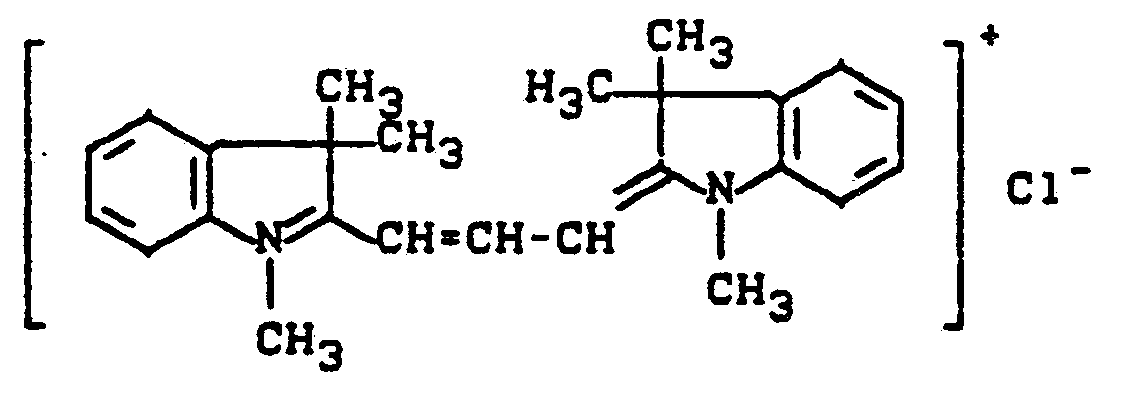
werden in 2,5 l Wasser bei 85° C gelöst und 132 g der Lösung des Natriumphosphorwolframmolybdats zugesetzt, deren Herstellung in Beispiel 1 angegeben ist. Man läßt 6 h bei Raumtemperatur nachrühren, saugt das Pigment ab und trocknet es bei 50°C im Vakuum. Ausbeute: 24,5 g. Nach den Angaben des Beispiels 1 wird ein Tonerpulver hergestellt und die triboelektrische Aufladung nach der Blow-off-Methode gemessen. Sie beträgt 6,1 µC/g. - Ähnlich gute Toner erhält man aus Farbstoffen der obigen Formel, bei denen die Indoleninringe in p-Stellung zum Stickstoff durch Methyl, Methoxy oder Chlor substituiert sind.
- 900 ml Wasser werden auf 30°C erwärmt, 82,5 g Natriummolybdat-dihydrat und 9,9 g Natriummetasilikat-pentahydrat zugesetzt und die Lösung 10 min bei 30°C gerührt. Dann werden 0,9 g Natriumdichromat zugegeben und der pH-Wert durch Eintropfen von 64 ml 32 %iger Salzsäure auf 2,5 bis 2,6 eingestellt. Man rührt weitere 15 min bei 30°C und verdünnt mit Wasser auf 1575 ml. Die Lösung wird auf 50°C erwärmt und 10 min bei 50°C gerührt.
- 30 g des kationischen Farbstoffes der Formel

werden bei 50°C in 1 l Wasser gelöst und 750 ml Silicomolybdatlösung bei 50°C zugetropft, deren Herstellung oben beschrieben wurde. Man läßt noch 10 min bei 50°C nachrühren, kühlt die Suspension ab, saugt das Pigment ab, wäscht es mit Wasser und trocknet es im Vakuum bei 50°C. Ausbeute: 49,9 g. - Das Pigment wird nach den Angaben des Beispiels 1 zu einem Tonerpulver verarbeitet und die triboelektrische Aufladung nach der Blow-off-Methode bestimmt. Sie beträgt 4,4 µC/g.
- Gleichgute Tonermaterialien erhält man, wenn man Pigmente einsetzt, die aus kationischen Farbstoffen der obigen Formel hergestellt wurden, in denen der Indoleninrest in p-Stellung zum Stickstoff durch Methyl, Chlor oder Methoxy substituiert ist.
- Ebenfalls gute Ergebnisse erhält man, wenn man zur Pigmentherstellung die nachfolgenden drei Farbstoffe einsetzt:

- a) R = H, R¹ = R² = C₂H₅
- b) R = H, R¹ = C₂H₄CN, R² = CH₃
- c) R = CH₃, R¹ = C₂H₄CN, R² = C₂H₅
- 30 g des kation

ischen Farbstoffes der Formel werden bei 50°C in 1 l Wasser gelöst und 750 ml der Silicomolybdatlösung zugetropft, deren Herstellung in Beispiel 8 beschrieben wurde. Man läßt die Suspension noch 1 h bei 50°C nachrühren, kühlt sie ab, saugt das gelbe Pigment ab, wäscht es mit Wasser und trocknet es im Vakuum bei 50°C.
Ausbeute: 61,3 g.
Das gelbe Pigment wird nach den Angaben des Beispiels 1 zu einem Tonerpulver verarbeitet und nach der Blow-off-Methode die triboelektrische Aufladung gemessen. Sie beträgt 3,1 µC/g. - Tonerpulver ähnlich guter triboelektrischer Aufladung erhält man mit Pigmenten, die aus kationischen Farbstoffen obiger Formel hergestellt wurden, in denen der Indoleninrest in p-Stellung zum Stickstoff durch eine Methoxy- oder eine Methoxycarbonylgruppe substituiert ist.
- Zur Herstellung gelber Tonerpulver eignen sich auch die kationischen Farbstoffe der Formeln:

- 30 g des kationischen Farbstoffes der Formel

werden bei 90°C in 1,3 l Wasser gelöst. Man tropft bei dieser Temperatur 590 ml Silicomolybdatlösung zu, deren Herstellung in Beispiel 8 beschrieben wurde. Dann rührt man noch 10 min bei 90°C, kühlt die Suspension ab, saugt das orangefarbige Pigment ab, wäscht es mit Wasser und trocknet es im Vakuum bei 50°C. Ausbeute: 59,7 g. Aus dem Pigment wird ein orangefarbiges Tonerpulver hergestellt, dessen triboelektrische Aufladung nach der Blow-off-Methode gemessen wird. Die Ladung beträgt 7,7 µC/g. - Ein Tonerpulver mit gleichguter triboelektrischer Aufladung erhält man, wenn man ein Pigment einsetzt, das aus dem kationischen Farbstoff der Formel

hergestellt wurde, oder wenn man Farbstoffe dieser Formel einsetzt, in denen der Indoleninring in p-Stellung zum Stickstoff durch Methyl, Methoxy oder Chlor substituiert ist. - 30 g des kationischen Farbstoffes der Formel

werden in 1,5 l Wasser und 50 ml Eisessig bei 90°C gelöst und mit 500 ml Silicomolybdatlösung gefällt, deren Herstellung in Beispiel 8 beschrieben wurde. Man läßt 10 min bei 90°C nachrühren, kühlt die Suspension ab, saugt das rote Pigment ab, wäscht es mit Wasser und trocknet es im Vakuum bei 50°C. Ausbeute: 51,9 g. Nach den Angaben des Beispiels 1 wird aus diesem Pigment ein Tonerpulver hergestellt und nach der Blow-off-Methode die triboelektrische Aufladung untersucht. Sie beträgt 6,2 µC/g. - 100 g des kationischen Farbstoffes der Formel

werden in 1,5 l Wasser bei 85°C gelöst. Bei 90°C werden 700 g Natriumphosphorwolframmolybdatlösung eingetropft, deren Herstellung in Beispiel 1 beschrieben ist. Man rührt noch 10 min bei 90°C nach, kühlt die Farbstoffsuspension auf Raumtemperatur ab, filtriert das Pigment ab und trocknet es im Vakuum bei 50°C. Ausbeute: 44,6 g.
Nach den Angaben des Beispiels 1 wird aus diesem Pigment ein rotes Tonerpulver hergestellt und nach der Blow-off-Methode die triboelektrische Aufladung bestimmt. Sie beträgt 9,1 µC/g. - Toner mit gleichguter triboelektrischer Aufladung erhält man unter Verwendung von Pigmenten, die aus kationischen Farbstoffen der Formel

R¹ = R² = CH₃
R¹ = R² = C₂H₅
R¹ = R² = C₄H₉
hergestellt wurden. - 20 g des kationischen Farbstoffes der Formel

werden bei 85°C in 1,5 l Wasser gelöst. Bei 90°C werden 600 g einer Lösung von Natriumphosphorwolframmolybdat zugesetzt, deren Herstellung in Beispiel 1 beschrieben wurde, und 10 min bei 90°C nachgerührt. Nach Abkühlen auf Raumtemperatur saugt man die Pigmentsuspension ab und trocknet das Pigment im Vakuum bei 50°C. Ausbeute: 17,7 g. - Nach den Angaben des Beispiels 1 wird aus dem Pigment ein blaues Tonerpulver hergestellt und die triboelektrische Aufladung nach der Blow-off-Methode bestimmt. Sie beträgt 8,8 µC/g.
- Tonerpulver mit ähnlich guter triboelektrischer Aufladung erhält man unter Verwendung von Pigmenten, die aus kationischen Farbstoffen der folgenden Formel hergestellt wurden:

R = OCH₃, R¹ = R² = CH₃
R = OC₂H₅, R¹ = R² = C₂H₅
R = OCH₃, R¹ = C₂H₄CN, R² = C₄H₉
R = H, R¹ = R² = CH₃
R = OCH₃, R¹ = CH₃, R² = C₆H₅ - 20 g des kationischen Farbstoffes der Formel

werden in 0,5 l Wasser bei 85°C gelöst. Bei 90°C tropft man innerhalb von 15 min 250 g einer Lösung von Natriumphosphorwolframmolybdat zu, deren Herstellung in Beispiel 1 beschrieben wurde. Man läßt 10 min bei 90°C nachrühren, kühlt die Pigmentsuspension auf Raumtemperatur ab, saugt das Pigment ab und trocknet es im Vakuum bei 50°C. Ausbeute: 17,6 g.
Nach den Angaben des Beispiels 1 wird aus diesem Pigment ein blaues Tonerpulver hergestellt und die triboelektrische Aufladung geprüft. Sie beträgt 8,9 µC/g. - Tonerpulver mit gleichfalls guter triboelektrischer Aufladung erhält man unter Verwendung von Pigmenten, die aus kationischen Farbstoffen der folgenden Formel hergestellt wurden:

R¹ = R² = C₃H₇, R³ = R⁴ = C₂H₅
R¹ = C₂H₄OH, R² = C₂H₅, R³ = R⁴ = C₂H₅
R¹ = R² = C₂H₄OH, R³ = C₂H₄CN, R⁴ = CH₃
bedeuten, und in der die Alkyl-, Aralkyl- und Arylreste und die aromatischen Ringe durch in der Farbstoffchemie übliche nichtionische Gruppen substituiert sein können.
Rʹ, R⁷ und An⁻ die oben angegebene Bedeutung haben.
Rʹ, R⁷, X und An⁻ die oben angegebene Bedeutung haben.
R¹, R², R³ und R⁴ die oben angegebene Bedeutung haben, und die Alkyl-, Aralkyl- und Arylreste, die aromatischen Ringe und der Z enthaltende Ring durch in der Farbstoffchemie übliche nichtionische Gruppen substituiert sein können.
Rʹ, R1ʹ, R2ʹ, R⁶ und An⁻ die oben angegebene Bedeutung haben,
und die Farbstoffe der Formel

in der
Claims (10)
- Positiv aufladbarer Trockentoner für elektrostatische Aufzeichnungs- und Druckverfahren, der als Ladungskontrollsubstanz ein Pigment der allgemeinen Formel
F⁺ A⁻
enthält, in derF für den kationischen Rest eines Methinfarbstoffes undA⁻ für ein Anion einer Heteropolysäure auf der Basis Wolfram und/oder Molybdän mit Phosphor, Silicium, Vanadium, Kobalt, Aluminium, Mangan, Chrom und/oder Nickel oder ein Kupfer-I-hexacyanoferrat-Anion stehen. - Positiv aufladbarer Trockentoner gemäß Anspruch 1, der als Ladungsregler ein Pigment der allgemeinen Formel
 A⁻ die oben angegebene Bedeutung hat, undR für Alkyl oder Aralkyl,X für CH oder N undB für die Reste der Formeln
 R¹ Alkyl oder Aralkyl,R² Alkyl, Aralkyl oder Aryl oderR¹ und R² unabhängig voneinander durch Verknüpfung mit der o-Stellung des Phenylenrestes die Glieder eines teilhydrierten fünf- oder sechsgliedrigen Ringes, oderR¹ und R² gemeinsam die Glieder eines fünf-oder sechsgliedrigen Ringes,R³ Wasserstoff, Alkyl oder Aryl,R⁴ Wasserstoff, Alkyl oder Aralkyl undR⁵ Wasserstoff oder Alkyl oder durch Verknüpfung mit der o-Stellung des Phenylrestes die Glieder eines teilhydrierten 5- oder 6-gliedrigen Ringesbedeuten, und in der die Alkyl-, Aralkyl- und Arylreste und die aromatischen Ringe durch in der Farbstoffchemie übliche nichtionische Gruppen substituiert sein können.
 - Positiv aufladbarer Trockentoner gemäß Anspruch 1 der als Ladungskontrollsubstanz ein Pigment der allgemeinen Formel
 E für die Reste
 Rʹ für Methyl und Ethyl,R1ʹ für einen gegebenenfalls durch Chlor, Cyan oder C₁-bis C₄-Alkoxy substituierten C₁- bis C₄-Alkyl- oder Benzylrest,R2ʹ für die bei R1ʹ genannten Substituenten oder einen gegebenenfalls durch Methyl, Chlor oder C₁- bis C₄-Alkoxy substituierten Phenylrest,R3ʹ für Wasserstoff, Methyl oder Phenyl,R4ʹ für Wasserstoff, gegebenenfalls durch Chlor, Cyan oder C₁- bis C₄-Alkoxy substituiertes C₁-bis C₄-Alkyl,R⁶ für Wasserstoff, Methyl, Chlor oder C₁- bis C₄-Alkoxy,R⁷ für Wasserstoff, Methyl, Chlor, C₁- bis C₄-Alkoxy, Cyan, Nitro, Acetylamino, C₁- bis C₄-Alkylsulfonyl, Phenylsulfonyl oder C₁- bis C₄-Alkoxycarbonyl,R⁸ für Wasserstoff, Methyl, Chlor oder C₁- bis C₄-Alkoxy undAn⁻ für das Anion einer Heteropolysäure auf Basis Phosphor, Molybdän, Wolfram und/oder Kieselsäure stehen.
 - Positiv aufladbarer Trockentoner gemäß Anspruch 1, der als Ladungskontrollsubstanz ein Pigment der allgemeinen Formel

Rʹ, R⁷ und An⁻ die oben angegebene Bedeutung haben. - Positiv aufladbarer Trockentoner gemäß Anspruch 1, der als Ladungskontrollsubstanz ein Pigment der allgemeinen Formel
 R5ʹ für Wasserstoff, einen gegebenenfalls durch Chlor, Cyan oder C₁- bis C₄-Alkoxy substituierten C₁- bis C₄-Alkylrest steht oder durch Ringschluß in o-Stellung zum Phenylenrest mit diesem einen Indolin-, Tetrahydrochinolin-oder Dihydrobenzoxazinring bildet, die durch C₁-C₄-Alkyl substituiert sein können,R⁹ für Wasserstoff, Chlor, Methyl, C₁- bis C₄-Alkoxy, Benzyl, Benzyloxy, Amino und Acetylamino steht, und die Reste
Rʹ, R⁷, X und An⁻ die oben angegebene Bedeutung haben. - Positiv aufladbarer Trockentoner gemäß Anspruch 1, der als Ladungskontrollsubstanz ein Pigment der allgemeinen Formel
 Z für die restlichen Glieder eines Triazol-, Thiazol-, Benzthiazol-, Thiadiazol-, Imidazol-, Benzimidazol-, Pyrazol-, Indazol-, Pyridin-oder Chinolinringes undD für die Restestehen, in denen die Substituenten
R¹, R², R³, R⁴ und A die Bedeutung von Anspruch 2 haben. - Positiv aufladbarer Trockentoner gemäß Anspruch 1, der als Ladungskontrollsubstanz ein Pigment der allgemeinen Formel
 G für die Reste
Rʹ, R1ʹ, R2ʹ, R3ʹ, R4ʹ, R⁶, R⁸ und An⁻ die in Anspruch 3 angegebene Bedeutung haben. - Positiv aufladbarer Trockentoner gemäß Anspruch 1, der als Ladungskontrollsubstanz ein Pigment der allgemeinen Formel
 L für die Reste
 R¹⁰ für Wasserstoff, Methyl, Chlor, C₁- bis C₄-Alkoxy oder C₁- bis C₄-Alkylcarbonylamino undR¹¹ und R¹² für C₁-C₆-Alkyl stehen und
Rʹ, R1' R2' R⁶ und An⁻ die in Anspruch 3 angegebene Bedeutung haben. - Positiv aufladbarer Trockentoner nach Anspruch 1, der ein Bindemittelharz enthält.
- Verwendung von Pigmenten der Formel des Anspruchs 1 als Ladungskontrollsubstanzen in Trockentonern.
Applications Claiming Priority (2)
| Application Number | Priority Date | Filing Date | Title |
|---|---|---|---|
| DE19873707262 DE3707262A1 (de) | 1987-03-06 | 1987-03-06 | Methinfanalpigmente enthaltende trockentoner |
| DE3707262 | 1987-03-06 |
Publications (2)
| Publication Number | Publication Date |
|---|---|
| EP0285782A1 EP0285782A1 (de) | 1988-10-12 |
| EP0285782B1 true EP0285782B1 (de) | 1991-09-25 |
Family
ID=6322449
Family Applications (1)
| Application Number | Title | Priority Date | Filing Date |
|---|---|---|---|
| EP88102604A Expired - Lifetime EP0285782B1 (de) | 1987-03-06 | 1988-02-23 | Methinfanalpigmente enthaltende Trockentoner |
Country Status (4)
| Country | Link |
|---|---|
| US (1) | US4849306A (de) |
| EP (1) | EP0285782B1 (de) |
| JP (1) | JPS63231359A (de) |
| DE (2) | DE3707262A1 (de) |
Cited By (1)
| Publication number | Priority date | Publication date | Assignee | Title |
|---|---|---|---|---|
| CN110724395A (zh) * | 2019-10-30 | 2020-01-24 | 河南省化工研究所有限责任公司 | 一种阳离子蓝染料的制备方法 |
Families Citing this family (5)
| Publication number | Priority date | Publication date | Assignee | Title |
|---|---|---|---|---|
| US5604069A (en) * | 1994-12-07 | 1997-02-18 | Eastman Kodak Company | Toners and developers containing ammonium trihalozincates as charge-control agents |
| JP6268823B2 (ja) * | 2013-09-03 | 2018-01-31 | 大日本印刷株式会社 | 色材、色材分散液、及び樹脂組成物 |
| JP6268822B2 (ja) * | 2013-09-03 | 2018-01-31 | 大日本印刷株式会社 | 色材、色材分散液、及び樹脂組成物 |
| JP6895294B2 (ja) * | 2017-03-31 | 2021-06-30 | 株式会社Dnpファインケミカル | 色材分散液、色材、着色樹脂組成物、カラーフィルタ、及び表示装置 |
| JP6914455B2 (ja) * | 2019-07-25 | 2021-08-04 | Dic株式会社 | 化合物 |
Family Cites Families (5)
| Publication number | Priority date | Publication date | Assignee | Title |
|---|---|---|---|---|
| JPS5312187B2 (de) * | 1973-03-29 | 1978-04-27 | ||
| DE2357584A1 (de) * | 1972-11-17 | 1974-05-22 | Sumitomo Chemical Co | Fluessige elektrophoretische tonerdispersion und ihre verwendung zum entwickeln latenter ladungsbilder von elektrophotographischem aufzeichnungsmaterial |
| JPS59172655A (ja) * | 1983-03-23 | 1984-09-29 | Sumitomo Chem Co Ltd | 静電荷像現像用トナ− |
| DE3413833A1 (de) * | 1983-04-12 | 1984-10-18 | Canon K.K., Tokio/Tokyo | Entwicklungsverfahren und entwickler dafuer |
| US4734350A (en) * | 1986-12-29 | 1988-03-29 | Xerox Corporation | Positively charged developer compositions with modified charge enhancing additives containing amino alcohols |
-
1987
- 1987-03-06 DE DE19873707262 patent/DE3707262A1/de not_active Withdrawn
-
1988
- 1988-02-22 US US07/158,520 patent/US4849306A/en not_active Expired - Fee Related
- 1988-02-23 EP EP88102604A patent/EP0285782B1/de not_active Expired - Lifetime
- 1988-02-23 DE DE8888102604T patent/DE3865060D1/de not_active Expired - Lifetime
- 1988-02-29 JP JP63044656A patent/JPS63231359A/ja active Pending
Cited By (2)
| Publication number | Priority date | Publication date | Assignee | Title |
|---|---|---|---|---|
| CN110724395A (zh) * | 2019-10-30 | 2020-01-24 | 河南省化工研究所有限责任公司 | 一种阳离子蓝染料的制备方法 |
| CN110724395B (zh) * | 2019-10-30 | 2021-12-21 | 河南省化工研究所有限责任公司 | 一种阳离子蓝染料的制备方法 |
Also Published As
| Publication number | Publication date |
|---|---|
| JPS63231359A (ja) | 1988-09-27 |
| DE3865060D1 (de) | 1991-10-31 |
| US4849306A (en) | 1989-07-18 |
| DE3707262A1 (de) | 1988-09-15 |
| EP0285782A1 (de) | 1988-10-12 |
Similar Documents
| Publication | Publication Date | Title |
|---|---|---|
| DE3218758C2 (de) | ||
| EP0233544B1 (de) | Elektrophotographische Toner | |
| US3830647A (en) | Recording process and element employing as photoconductive material fluorene ring system fused 1,2,-dihydro-2,2,4-trialkyl-quinolines | |
| DE69828267T2 (de) | Zirkoniumverbindung und diese enthaltender elektrophotographischer toner | |
| US4869989A (en) | Dry toners containing fanal pigments based on cationic dyes | |
| EP0501249A1 (de) | Neue Naphthalimide, diese enthaltende Toner und die Verwendung der neuen Naphtalimide als Additive für Toner | |
| EP0285782A1 (de) | Methinfanalpigmente enthaltende Trockentoner | |
| US4301227A (en) | Electrophotographic liquid developer | |
| EP0619346A1 (de) | Verlackte tris- oder tetrakationische Polymethinfarbstoffe | |
| DE3714289A1 (de) | Fanalpigmente ringgeschlossener indamin- und diphenylmethanfarbstoffe enthaltende trockentoner | |
| EP0303942A2 (de) | Triarylmethan-Farbbildner | |
| EP0355006B1 (de) | Elektrophotographischer Toner | |
| DE3887565T2 (de) | Farbstoffe, geeignet für die Sensibilisierung photoleitfähiger Systeme. | |
| US4051052A (en) | Liquid developer | |
| EP0371360B1 (de) | Elektrophotographische Toner | |
| US5478948A (en) | Benzimidazoles and their use as charger stabilizers | |
| US3152905A (en) | Sensitizing methine dyes and intermediates, process for preparing same and photographic element containing these dyes | |
| EP0392356B1 (de) | Xanthenfarbstoffe für elektrophotographische Aufzeichungsverfahren | |
| DE3124394A1 (de) | Neue methinverbindungen und ihre verwendung im rahmen elektrophoretischer bildherstellungsverfahren | |
| US3600165A (en) | Optical sensitisation of inorganic photoconductors | |
| DE2020812A1 (de) | Fluessigentwickler fuer Elektrophotographie | |
| DE2136996C3 (de) | Verfahren zur Herstellung eines Pigments für einen elektrophotographischen Entwickler | |
| EP0023652B1 (de) | Verfahren zur Herstellung kationischer Farbstoffe | |
| US5478940A (en) | Double benzimidazoles | |
| US5501932A (en) | Charge control agent and toner for developing electrostatic images |
Legal Events
| Date | Code | Title | Description |
|---|---|---|---|
| PUAI | Public reference made under article 153(3) epc to a published international application that has entered the european phase |
Free format text: ORIGINAL CODE: 0009012 |
|
| 17P | Request for examination filed |
Effective date: 19880223 |
|
| AK | Designated contracting states |
Kind code of ref document: A1 Designated state(s): CH DE FR GB LI |
|
| 17Q | First examination report despatched |
Effective date: 19910304 |
|
| GRAA | (expected) grant |
Free format text: ORIGINAL CODE: 0009210 |
|
| AK | Designated contracting states |
Kind code of ref document: B1 Designated state(s): CH DE FR GB LI |
|
| REF | Corresponds to: |
Ref document number: 3865060 Country of ref document: DE Date of ref document: 19911031 |
|
| GBT | Gb: translation of ep patent filed (gb section 77(6)(a)/1977) | ||
| ET | Fr: translation filed | ||
| PGFP | Annual fee paid to national office [announced via postgrant information from national office to epo] |
Ref country code: DE Payment date: 19920122 Year of fee payment: 5 |
|
| PGFP | Annual fee paid to national office [announced via postgrant information from national office to epo] |
Ref country code: CH Payment date: 19920124 Year of fee payment: 5 |
|
| PGFP | Annual fee paid to national office [announced via postgrant information from national office to epo] |
Ref country code: GB Payment date: 19920211 Year of fee payment: 5 |
|
| PGFP | Annual fee paid to national office [announced via postgrant information from national office to epo] |
Ref country code: FR Payment date: 19920221 Year of fee payment: 5 |
|
| PLBE | No opposition filed within time limit |
Free format text: ORIGINAL CODE: 0009261 |
|
| STAA | Information on the status of an ep patent application or granted ep patent |
Free format text: STATUS: NO OPPOSITION FILED WITHIN TIME LIMIT |
|
| 26N | No opposition filed | ||
| PG25 | Lapsed in a contracting state [announced via postgrant information from national office to epo] |
Ref country code: GB Effective date: 19930223 |
|
| PG25 | Lapsed in a contracting state [announced via postgrant information from national office to epo] |
Ref country code: LI Effective date: 19930228 Ref country code: CH Effective date: 19930228 |
|
| GBPC | Gb: european patent ceased through non-payment of renewal fee |
Effective date: 19930223 |
|
| PG25 | Lapsed in a contracting state [announced via postgrant information from national office to epo] |
Ref country code: FR Effective date: 19931029 |
|
| REG | Reference to a national code |
Ref country code: CH Ref legal event code: PL |
|
| PG25 | Lapsed in a contracting state [announced via postgrant information from national office to epo] |
Ref country code: DE Effective date: 19931103 |
|
| REG | Reference to a national code |
Ref country code: FR Ref legal event code: ST |