EP0260587A2 - Lösungen von Fluorpolymeren und deren Verwendung - Google Patents
Lösungen von Fluorpolymeren und deren Verwendung Download PDFInfo
- Publication number
- EP0260587A2 EP0260587A2 EP87113157A EP87113157A EP0260587A2 EP 0260587 A2 EP0260587 A2 EP 0260587A2 EP 87113157 A EP87113157 A EP 87113157A EP 87113157 A EP87113157 A EP 87113157A EP 0260587 A2 EP0260587 A2 EP 0260587A2
- Authority
- EP
- European Patent Office
- Prior art keywords
- solution according
- hydrogen
- solvent
- fluoropolymer
- solution
- Prior art date
- Legal status (The legal status is an assumption and is not a legal conclusion. Google has not performed a legal analysis and makes no representation as to the accuracy of the status listed.)
- Granted
Links
Classifications
-
- C—CHEMISTRY; METALLURGY
- C08—ORGANIC MACROMOLECULAR COMPOUNDS; THEIR PREPARATION OR CHEMICAL WORKING-UP; COMPOSITIONS BASED THEREON
- C08J—WORKING-UP; GENERAL PROCESSES OF COMPOUNDING; AFTER-TREATMENT NOT COVERED BY SUBCLASSES C08B, C08C, C08F, C08G or C08H
- C08J5/00—Manufacture of articles or shaped materials containing macromolecular substances
- C08J5/20—Manufacture of shaped structures of ion-exchange resins
- C08J5/22—Films, membranes or diaphragms
- C08J5/2206—Films, membranes or diaphragms based on organic and/or inorganic macromolecular compounds
- C08J5/2218—Synthetic macromolecular compounds
- C08J5/2231—Synthetic macromolecular compounds based on macromolecular compounds obtained by reactions involving unsaturated carbon-to-carbon bonds
- C08J5/2237—Synthetic macromolecular compounds based on macromolecular compounds obtained by reactions involving unsaturated carbon-to-carbon bonds containing fluorine
-
- B—PERFORMING OPERATIONS; TRANSPORTING
- B01—PHYSICAL OR CHEMICAL PROCESSES OR APPARATUS IN GENERAL
- B01D—SEPARATION
- B01D65/00—Accessories or auxiliary operations, in general, for separation processes or apparatus using semi-permeable membranes
- B01D65/10—Testing of membranes or membrane apparatus; Detecting or repairing leaks
- B01D65/106—Repairing membrane apparatus or modules
- B01D65/108—Repairing membranes
-
- B—PERFORMING OPERATIONS; TRANSPORTING
- B01—PHYSICAL OR CHEMICAL PROCESSES OR APPARATUS IN GENERAL
- B01D—SEPARATION
- B01D67/00—Processes specially adapted for manufacturing semi-permeable membranes for separation processes or apparatus
- B01D67/0002—Organic membrane manufacture
- B01D67/0009—Organic membrane manufacture by phase separation, sol-gel transition, evaporation or solvent quenching
- B01D67/0011—Casting solutions therefor
- B01D67/00111—Polymer pretreatment in the casting solutions
-
- B—PERFORMING OPERATIONS; TRANSPORTING
- B01—PHYSICAL OR CHEMICAL PROCESSES OR APPARATUS IN GENERAL
- B01D—SEPARATION
- B01D71/00—Semi-permeable membranes for separation processes or apparatus characterised by the material; Manufacturing processes specially adapted therefor
- B01D71/06—Organic material
- B01D71/30—Polyalkenyl halides
- B01D71/32—Polyalkenyl halides containing fluorine atoms
-
- C—CHEMISTRY; METALLURGY
- C08—ORGANIC MACROMOLECULAR COMPOUNDS; THEIR PREPARATION OR CHEMICAL WORKING-UP; COMPOSITIONS BASED THEREON
- C08J—WORKING-UP; GENERAL PROCESSES OF COMPOUNDING; AFTER-TREATMENT NOT COVERED BY SUBCLASSES C08B, C08C, C08F, C08G or C08H
- C08J3/00—Processes of treating or compounding macromolecular substances
- C08J3/02—Making solutions, dispersions, lattices or gels by other methods than by solution, emulsion or suspension polymerisation techniques
- C08J3/09—Making solutions, dispersions, lattices or gels by other methods than by solution, emulsion or suspension polymerisation techniques in organic liquids
- C08J3/091—Making solutions, dispersions, lattices or gels by other methods than by solution, emulsion or suspension polymerisation techniques in organic liquids characterised by the chemical constitution of the organic liquid
- C08J3/095—Oxygen containing compounds
-
- B—PERFORMING OPERATIONS; TRANSPORTING
- B01—PHYSICAL OR CHEMICAL PROCESSES OR APPARATUS IN GENERAL
- B01D—SEPARATION
- B01D2323/00—Details relating to membrane preparation
- B01D2323/12—Specific ratios of components used
-
- C—CHEMISTRY; METALLURGY
- C08—ORGANIC MACROMOLECULAR COMPOUNDS; THEIR PREPARATION OR CHEMICAL WORKING-UP; COMPOSITIONS BASED THEREON
- C08J—WORKING-UP; GENERAL PROCESSES OF COMPOUNDING; AFTER-TREATMENT NOT COVERED BY SUBCLASSES C08B, C08C, C08F, C08G or C08H
- C08J2327/00—Characterised by the use of homopolymers or copolymers of compounds having one or more unsaturated aliphatic radicals, each having only one carbon-to-carbon double bond, and at least one being terminated by a halogen; Derivatives of such polymers
- C08J2327/02—Characterised by the use of homopolymers or copolymers of compounds having one or more unsaturated aliphatic radicals, each having only one carbon-to-carbon double bond, and at least one being terminated by a halogen; Derivatives of such polymers not modified by chemical after-treatment
- C08J2327/12—Characterised by the use of homopolymers or copolymers of compounds having one or more unsaturated aliphatic radicals, each having only one carbon-to-carbon double bond, and at least one being terminated by a halogen; Derivatives of such polymers not modified by chemical after-treatment containing fluorine atoms
Definitions
- fluoropolymers with functional groups such as carboxylic ester or sulfonic acid groups
- halocarbon oils perhalogenated alkyl polymers with low molecular weight, for example from chlorotrifluoroethylene, manufacturer: Halocarbon Products Corp., Ralphensack NJ, USA
- perfluoroethers solve cf. WO-81/01158.
- solvents however, have quite high boiling points of more than 200 ° C., which means that the polymer is subjected to high thermal stress when it is evaporated.
- a number of fluoropolymers with ester groups dissolve only poorly in halocarbon oils.
- DE-OS 3.036.410 also describes perfluoroethers with carboxylic esters or sulfonyl fluoride groups as solvents for fluoropolymers which contain sulfonyl fluoride or carboxylic ester groups. Disadvantages of these solvents are that their reactive groups are not acid and base stable, transesterifications can occur, and corrosion phenomena on apparatus, for example due to the occurrence of hydrogen fluoride (hydrolysis of SO 2 F groups etc.) are to be feared.
- the object of the present invention was therefore to provide a solvent for fluoropolymers or corresponding solutions which do not have the above disadvantages and fluoropolymers such as those e.g. in EP-A-0 088 285, which either contain non-polar or polar groups, solve equally well.
- the boiling point of the solvents used according to the invention is preferably at most 180 ° C. and is in particular between 50 ° C. and 180 ° C., both data relating to normal pressure.
- They preferably contain the groups -SO 2 F (A) and / or
- groups (B) are preferred.
- the group (B) is preferably -COOR.
- these recurring units may be in a mixture.
- Examples of monomers leading to the repeating units (C) are:
- tetraftuoroethylene trifluorochloroethylene, hexafluoropropene, perfluoro (propyl vinyl ether) and perfluoropropoxy (propyl vinyl ether) can be mentioned as examples.
- the number average molecular weight of the fluoropolymers according to the invention is generally between 50,000 and 1,000,000, preferably between 100,000 and 500,000.
- the equivalent weight (in the presence of groups (A) and / or (B)) is 400 to 1800, preferably 450 to 1500.
- solutions according to the invention are notable in particular for their stability owing to the lack of functional groups in the solvent, the ability of the solvent to dissolve polymers with or without polar groups equally well. their high solids content due to the good dissolving properties of the solvents and the fact that molded bodies (membranes) can be produced therefrom without major thermal stress on the fluoropolymer.
- solutions according to the invention can be used in a wide variety of fields, as described, for example, in DE-OS 2,905,467 and DE-OS 3,036,410 and in EP-A-0 066 369. They are preferably used for the manufacture or repair of membranes, in particular for liquid penetration processes such as those of Lei Ultra or. Hyperfiltration, dialysis (reverse osmosis) electrolysis, especially of aqueous saline solutions, and in fuel cells. Further areas of application are membranes for ion exchange processes, for mass transport and for catalytic purposes.
- the solution is poured or a porous substrate such as nets, fabrics, porous plates, etc. is impregnated with the solution.
- the groups (A) and / or (B) are then converted into the acid or salt form in a known manner, if necessary.
- solutions according to the invention can also effectively serve to repair membrane defects, such as pinholes. If appropriate, the solvent according to the invention itself is sufficient for this, after the functional groups which may have been converted into a derivative which is suitable for dissolution.
- solutions according to the invention can also be used to make non-wettable surfaces wettable (in the case of the presence of groups (A) and / or (B), if appropriate after their hydrolysis) or around the fluoropolymer, after adding non-solvents to the solution, available in finely divided form.
- the fluoropolymer according to Example 1 was converted into the methyl ester form by the process described in Example 1 of EP-0 088 285. 10 g of such a fluoropolymer were then stirred for 5 hours at 150 ° C. in 80 g of the solvent used in Example 1. A completely clear solution with a solids content of 11.1% by weight was obtained. Films of this type were produced which, after hydrolysis with NaOH, are used, for example, as ion exchange membranes in chlor-alkali electrolysis.
- halocarbon oil 11-21 100 g of halocarbon oil 11-21 (manufacturer: Halocarbon Products Corp., Hackensack N.J. USA) were added to 5 g of the copolymer from Example 2.
- the polymer did not dissolve under the conditions given in Example 5; it could only be brought into solution at temperatures above 165 ° C. after stirring for several hours.
- Example 4 50 g of the solvent according to Example 1 were added to 10 g of the terpolymer from Example 4. The mixture was stirred at 15 ° C. for 5 hours and a clear solution of the polymer was obtained.
Landscapes
- Chemical & Material Sciences (AREA)
- Chemical Kinetics & Catalysis (AREA)
- Engineering & Computer Science (AREA)
- Manufacturing & Machinery (AREA)
- Medicinal Chemistry (AREA)
- Health & Medical Sciences (AREA)
- Dispersion Chemistry (AREA)
- Polymers & Plastics (AREA)
- Organic Chemistry (AREA)
- Inorganic Chemistry (AREA)
- Materials Engineering (AREA)
- General Chemical & Material Sciences (AREA)
- Addition Polymer Or Copolymer, Post-Treatments, Or Chemical Modifications (AREA)
- Organic Low-Molecular-Weight Compounds And Preparation Thereof (AREA)
- Manufacture Of Macromolecular Shaped Articles (AREA)
- Compositions Of Macromolecular Compounds (AREA)
Abstract
Description
- Es ist bekannt, daß sich Fluorpolymere mit funktionellen Gruppen, wie Carbonester-oder Sulfonsäuregruppen, in Perfluorkerosin, "Halocarbonölen" (perhalogenierte Alkylpolymere mit niedrigem Mole- kulargewicht, z.B. von Chlortrifluorethylen, Hersteller: Halocarbon Products Corp., Hackensack N.J., USA) oder Perfluorethern lösen (vgl. WO-81/01158). Derartige Lösungsmittel besitzen jedoch recht hohe Siedepunkte von mehr als 200°C, was beim Abdampfen eine hohe thermische Belastung des Polymeren bedingt. Außerdem lösen sich eine Reihe von Fluorpolymeren.mit Estergruppen, beispielsweise die in der EP-A-0 088 285 und der EP-A-0 171 696 beschriebenen, nur schlecht in Halocarbonölen.
- In der DE-OS 3.036.410 werden weiterhin Perfluorether mit Carbonester oder Sulfonylfluorid-Gruppen als Lösungsmittel für Fluorpolymere beschrieben, die Sulfonylfluorid-oder Carbonestergruppen enthalten. Nachteile dieser Lösungsmittel sind, daß ihre reaktiven Gruppen nicht säure-und basenstabil sind, Umesterungen auftreten können, sowie Korrosionserscheinungen an Apparaten z.B. durch Auftreten von Fluorwasserstoff (Hydrolyse von S02F-Gruppen u.a.) zu befürchten sind.
- Die Aufgabe vorliegender Erfindung bestand daher darin, ein Lösungsmittel für Fluorpolymere bzw. entsprechende Lösungen bereitzustellen, welche obige Nachteile nicht besitzen und Fluorpolymere, wie sie z.B. in der EP-A-0 088 285 beschrieben sind, die entweder unpolare oder polare Gruppen enthalten, gleichermaßen gut lösen.
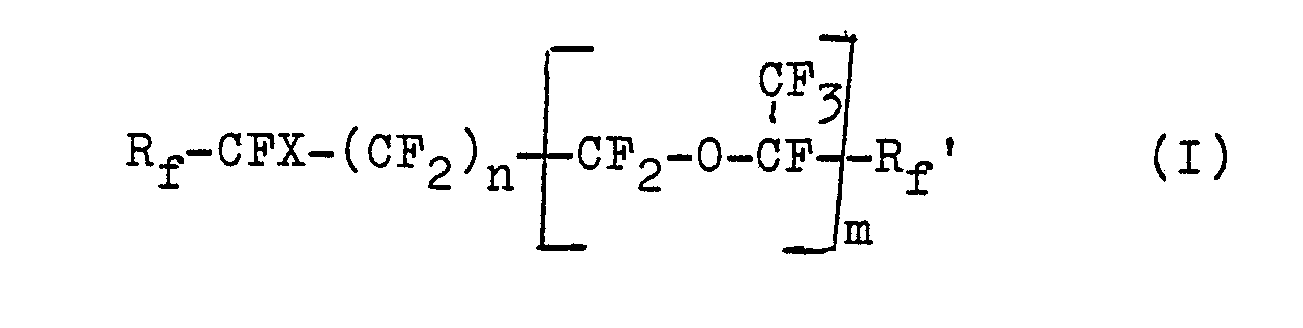
- Die Erfindung betrifft eine Lösung eines Fluorpolymeren in einem halogenhaltigen Lösungsmittel, dadurch gekennzeichnet, daß das Lösungsmittel die allgemeine Formel (I)

- Rf F oder Perfluoralkyl mit 1 - 3 C-Atomen,
- X Wasserstoff oder Halogen, vorzugsweise Wasserstoff, F, CI und Br ,
- n eine ganze Zahl von 0 - 10, vorzugsweise von 0 - 6, insbesondere 1 - 5,
- m eine Zahl von 0 - 5, vorzugsweise 0-3, insbesondere 0 - 2 und

- Weiterhin betrifft die Erfindung die Verwendung einer derartigen Lösung zur Herstellung oder Reparatur von Membranen, die insbesondere für Flüssigkeitsdurchdringungsprozesse eingesetzt werden.
- Der Siedepunkt der erfindungsgemäß eingesetzten Lösungsmittel beträgt vorzugsweise höchstens 180°C und liegt insbesondere zwischen 50°C und 180°C, wobei sich beide Angaben auf Normaldruck beziehen.
- Als Beispiele für Lösungsmittel der obigen Formel (I) seien hier genannt:





- Selbstverständlich liegt es auch im Rahmen der Erfindung, Gemische von Lösungsmitteln gemäß Formel (I) einzusetzen.
- Die Herstellung dieser Lösungsmittel erfolgt analog bekannten Syntheseverfahren. Lösungsmittel der allgemeinen Formel (I), in denen Rf' für CF2-O-CFY-CF2Y oder CFY-CF2Y steht, können beispielsweise erhalten werden durch Addition von Chlor oder Brom an ungesättigte Verbindungen der allgemeinen Formel (II)

- Die Vinylether dieser allgemeinen Formel II (Rf"'= -CF2-O-CF=CF2) sind z.B. durch die nachstehende Reaktionsfolge leicht herstellbar:
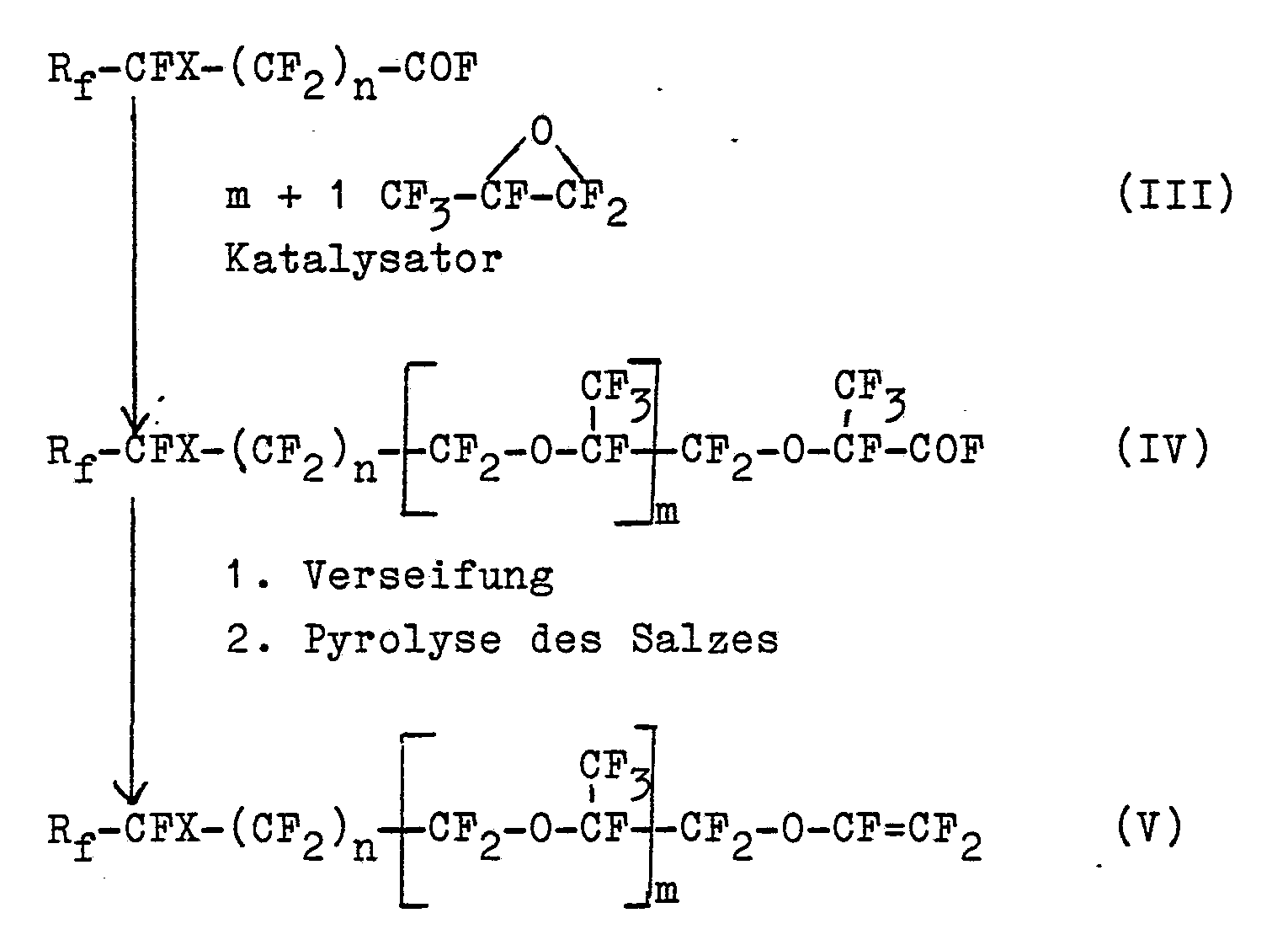
- Bezüglich näherer Einzelheiten sei auf Angew. Chem. 97, 164 (1985) sowie auf R.E. Banks, Preparation, Properties, and Ind. Appl. of Organofluorine Compounds Ellis Horwood Ltd. 1982, Seite 257 sowie auf die gleichzeitig eingereichte DE-Patentanmeldung P 36 31 560.5 verwiesen.
- Olefine der allgemeinen Formel II (Rf'"= -CF=CF2) mit m gleich 0, sind z.B. durch Pyrolyse von Na-Salzen erhältlich:

- Lösungsmittel der allgemeinen Formel (I) in der Rf= F, X = H, n = 1, 3, 5, 7 usw., m = 0 und Rf'=
- CF2Y sind, werden hergestellt für Y= C1 durch Pyrolyse von Difluorchlormethan, wobei sie als Nebenprodukte anfallen (Ind. Eng. Chem. 39, 354 (1947);
- für Y= CI oder Br durch Belichtung von entsprechenden fluorierten Carbonsäurehalogeniden (J. Org. Chem. 30 2182 (1965));
- für Y= Wasserstoff durch Hydrierung von entsprechenden fluorierten Olefinen, vgl. z.B. "Organic Fluorine Chemistry" (M. Hudlicky; Plenum Press), 1971, S. 89 ff.
- Durch Kolbe-Elektrolyse können Verbindungen den allgemeinen Formel (I) mit


- Bei den Fluorpolymeren der erfindungsgemäßen Lösungen handelt es sich um bekannte Produkte, wie sie beispielsweise in der DE-OS 2 905 457 und der DE-OS 3 036 410, in der E-A-0 066 369 und der EP-A-0 088 285 sowie in der WO-81/01158 beschrieben sind.
- Bevorzugt enthalten sie die Gruppen -SO2F (A) und/oder
- -CG (G = Stickstoff, -OOR oder -ON(R)2, wobei R C1-C10-Alkyl, Aryl, Aralkyl, vorzugsweise C1-C8-Alkyl darstellt) (B)
- wobei die Gruppen (B) bevorzugt sind. Vorzugsweise bedeutet die Gruppe (B) -COOR.
- Besonders bevorzugt sind erfindungsgemäß Fluorpolymere, welche die wiederkehrenden Einheiten mit der allgemeinen Formel (C) entweder allein oder zusammen mit anderen wiederkehrenden Einheiten enthalten:

- worin u = 0, 1 oder 2, vorzugsweise 0 oder 1,
- v = 0 oder 1, vorzugsweise 1,
- w = 1 - 7, vorzugsweise 2 - 5,
- A' und B'= unabhängig voneinander F oder CF3, vorzugweise A'= CF3 und B'= F und
- D = Wasserstoff, CI, Br, CG (G die gleiche Bedeutung wie oben) und weniger bevorzugt S02F bedeuten.
- Diese wiederkehrenden Einheiten (C) können ggf. in Mischung untereinander das Fluorpolymere aufbauen. Vorzugsweise finden sich in diesem jedoch zusätzlich noch wiederkehrende Einheiten der allgemeinen Formel (D)
- -CF2-CFE- (D)
- worin E für Cl, F, R f oder ORf (Rf= CF3 oder ggf. durch O-Atome unterbrochnener C2-C8-Perfluoralkylrest)
- steht. Bevorzugt bedeutet E = F, CF3, -O-CF-2-CF2-CF3 oder -O-CF2-

- Auch hier können diese wiederkehrenden Einheiten ggf. in Mischung vorliegen. Bevorzugt im Rahmen dieser Fluorpolymeren sind solche, welche aus der wiederkehrenden Einheit (C)

- Beispiele für zu den wiederkehrenden Einheiten (C) führender Monomerer sind:





- Im Zusammenhang mit der wiederkehrenden Einheit (D) sind als Beispiele Tetraftuorethyien, Trifluorchlorethylen, Hexafluorpropen, Perfluor(propylvinylether) und Perfluorpropoxy(propylvinylether) zu nennen.
- Die Herstellung derartiger aus (C) und ggf. (D) bestehender, erfindungsgemäß besonders bevorzugter Fluorpolymerer ist beispielsweise in der EP-A-0 088 285 und der EP-A-0 171 696 beschrieben.
- Das Molekulargewicht (Zahlenmittel) der erfindungsgemäßen Fluorpolymeren liegt im allgemeinen zwischen 50000 und 1000000, vorzugsweise zwischen 100000 und 500000. Das Äquivalentgewicht (bei Vorhandensein der Gruppen (A) und/oder (B)) beträgt 400 bis 1800, vorzugsweise 450 bis 1500.
- Die Herstellung der erfindungsgemäßen Lösungen der Fluorpolymere kann bei Temperaturen von 20°C . bis zum Siedepunkt des entsprechenden Lösungsmittels, vorzugsweise bei Temperaturen von 50°C bis 10°C unterhalb des Siedepunktes erfolgen. Gegebenenfalls kann dabei auch unter überatmosphärischem Druck gearbeitet werden, um höhere Temperaturen zu erzielen. Im allgemeinen ist jedoch Normaldruck bevorzugt. Es ist von Vorteil, den Lösevorgang durch Rühren udgl. der Lösug zu unterstützen und das Fluorpolymere in möglichst feinverteilter Form einzusetzen. Die Konzentration (der Feststoffgehalt) der erfindungsgemäßen Lösungen liegt üblicherweise zwischen 0,5 und 30 Gew.-%, vorzugsweise zwischen 1 und 25 Gew.-%.
- Die erfindungsgemäßen Lösungen zeichnen sich vor allem durch ihre Stabilität aufgrund des Fehlens von funktionellen Gruppen im Lösungsmittel, der Fähigkeit des Lösungsmittels, Polymere mit oder ohne polare Gruppen gleichermaßen gut zu lösen,. ihrem hohen Feststoffgehalt wegen der guten Löse-Eigenschaften der Lösungsmittel und des Umstandes aus, daß daraus Formkörper (Membranen) ohne größere thermische Belastung des Fluorpolymeren hergestellt werden können.
- Die erfindungsgemäßen Lösungen können auf den verschiedensten Gebieten eingesetzt werden, wie sie beispielsweise in der DE-OS 2.905.467 und der DE-OS 3.036.410 sowie der EP-A-0 066 369 beschrieben sind. Bevorzugt werden sie zur Herstellung oder Reparatur von Membranen insbesondere für Flüssigkeitsdurchdringungsprozesse benutzt, wie sie Lei der Ultra-bzw. Hyperfiltration, Dialyse (umgekehrte Osmose) Elektrolyse, insbesondere von wäßrigen Kochsalzlösungen, sowie in Brennstoffzellen auftreten. Als weitere Einsatzgebiete kommen Membranen für lonenaustauschprozesse, für Massentransporte sowie für katalytische Zwecke in Betracht.
- Zur Herstellung dieser Membranen wird die Lösung gegossen oder ein poröses Substrat, wie Netze, Gewebe, poröse Platten etc. wird mit der Lösung imprägniert. Anschließend erfolgt dann Umwandlung der Gruppen (A) und/oder (B) in die Säure oder Salzform in bekannter Weise, falls erforderlich.
- Die erfindungsgemäßen Lösungen können in wirksamer Weise auch zur Reparatur von Membrandefekten, wie Nadellöchern, dienen. Gegebenenfalls reicht dazu auch schon das erfindungsgemäße Lösungsmittel selbst aus, nachdem die evtl. vorhandenen funktionellen Gruppen in ein zur Lösung geeignetes Derivat umgewandelt wurden.
- Weiterhin können die erfindungsgemäßen Lösungen auch dazu verwendet werden, um nichtbenetzbare Oberflächen benetzbar zu machen (im Falle des Vorhandenseins von Gruppen (A) und/oder (B) ggf. nach deren Hydrolyse) oder um das Fluorpolymere, nach Zusatz von Nichtlösungsmitteln zur Lösung, in feinverteilter Form zu erhalten.
- 1. Rf'= CF2-O-CFBr(Cl)-CF2Br(Cl) oder CFBr(Cl)-CF2Br(Cl).
- a) In einem Glaskolben, der mit einem Magnetrührer, Rückflußkühler und Tropftrichter ausgestattet war, wurden der Vinylether oder das Olefin vorgelegt. Unter Belichtung mit einer Tageslichtlampe tropfte man so lange Brom zu, bis keine Entfärbung mehr auftrat. Die Innentemperatur wurde durch Kühlung mit Eis zwischen 20 und 100°C gehalten. Die Aufarbeitung des Ansatzes erfolgte entweder durch Waschen mit Natronlauge und Wasser und anschließende Trocknung über P2O5 mit nachfolgender Destillation oder durch direkte Destillation des Reaktionsgemisches.
- b) In der vorstehend beschriebenen Apparatur, in der der Rückflußkühler durch einen Kältekühler und der Tropftrichter durch ein Gaseinleitungsrohr ersetzt war, wurde die Chlorierung von Vinylethern und Olefinen vorgenommen. Es wurde so lange Chlor bei 0 - 40°C eingeleitet, bis eine bleibende gelbe Färbung auftritt. Die Aufarbeitung erfolgte wie bei der Bromierung beschrieben.
- In der nachfolgenden Tabelle ist eine Reihe von "Dibromiden" und "Dichloriden" zusammengestellt, die auf diesem Weg erhalten wurden:


- Die fluorieren Kohlenwasserstoffe und Ether 1,8-Dihydrohexadekafluoroctan (2), 2,5-Dihydrododekafluorhexan (4) und 1,10-Dihydro-5,6-bistrifluormethyl-4,7-oxatetradekafluordekan (6) sowie das Hexadecan (8) wurden aus den entsprechenden Carbonsäuren (1), (3), (5) und (7) durch Kolbe-Elektrolyse hergestellt:
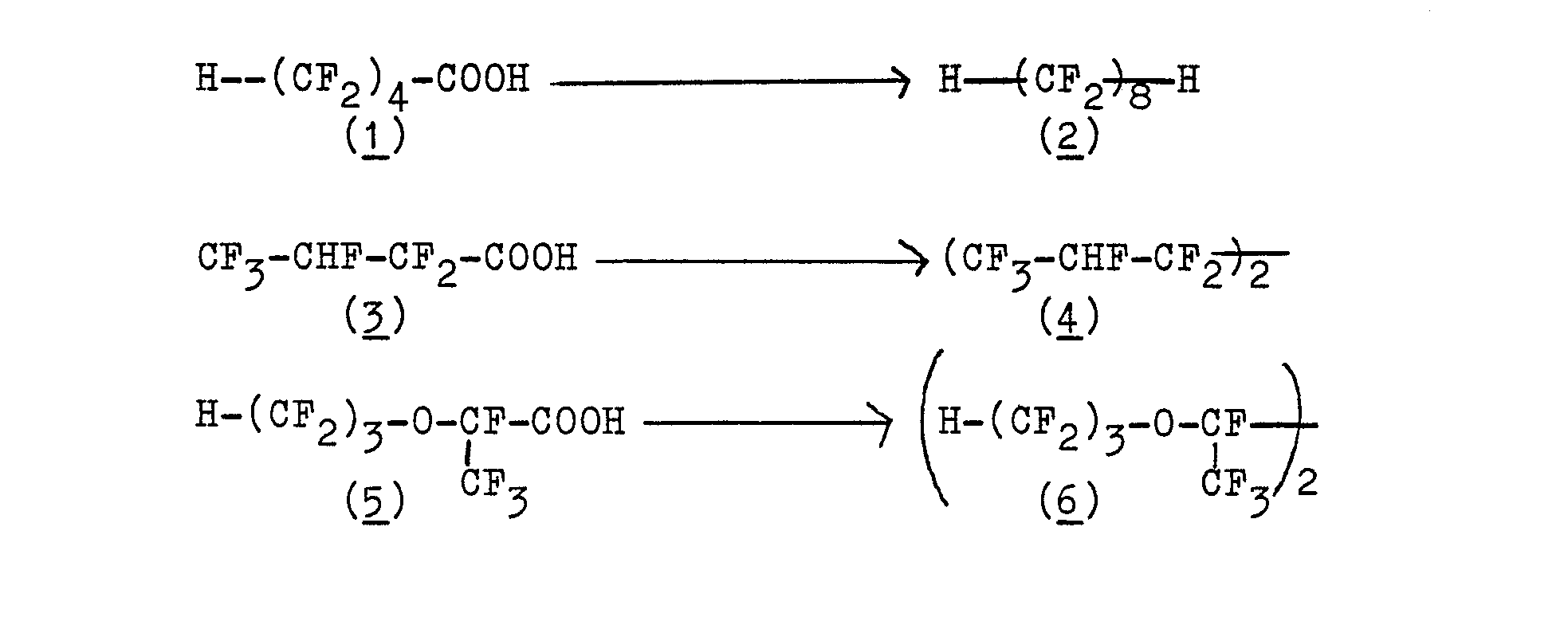

- In einer Glastopfelelektrolysezelle mit Platinnetzelektroden (Anode 59 cm2) wurden in einem Elektrolyt, der aus 330 ml H20, 165 ml CH3OH und 2,5 g NaOH bestand, 200 g (0,8 Mol) H-(CF2)4-COOH bei 14 bis 8 A Stromstärke elektrolysiert (5 F/Mol). Danach wurde der Elektrolyt mit 500 ml 1 N NaOH versetzt und die Produktphase abgetrennt; diese wurde mit Wasser gewaschen, über Na2S04 getrocknet und destilliert. Ausbeute an (2) 82,7 %; Sdp. 134°C (Lit.: A.I. Levin, O.N. Chechina, S.V. Sokolov Zh. Obsh. Khim. 35 [10] 1778 - 81 (1965).
- Die Verbindungen (4), (6) und (8) wurden auf analoge Weise in derselben Apparatur mit den nachfolgenden Ausbeuten hergestellt:
- (4) in 72 % Ausbeute (Kp. 80 - 82°C)
- (6) in 67 % Ausbeute (Kp. 103 - 104°C/233 mbar) (8 ) in 80 % Ausbeute (Kp. 110°C/26 mbar).
- 10 g eines Fluorpolymeren aus Tetrafluorethylen (TFE) und ω-Hydroperfluor-(propylvinylether) (HPPVE), das gemäß Beispiel 1 der EP-A-0 171 696 hergestellt worden war und 21,5 Mol-% HPPVE enthielt, wurden in 90 g des Lösungsmittels mit der Formel

- Das Fluorpolymere gemäß Beispiel 1 wurde nach dem in Beispiel 1 der EP-0 088 285 beschriebenen Verfahren in die Methylesterform überführt. 10 g eines solchen Fluorpolymeren wurden danach 5 Stunden bei 150°C in 80 g des in Beispiel 1 verwendeten Lösungsmittels gerührt. Man erhielt eine völlig klare Lösung mit einem Feststoffgehalt von 11,1 Gew.-%. Aus einer solchen Lösung wurden Filme hergestellt, die nach der Hydrolyse mit NaOH z.B. als lonenaustauschermembranen bei der Chloralkali-Elektrolyse Verwendung finden. Wurde eine solche Membran in eine Elektrolyse-Zelle, die mit einer Titan-Streckmetallanode und einer V4A-Kathode ersehen war, eingebaut, so erhielt man bei einer Stromdichte von 3000 A/m2 einer Anolytkonzentration von 205 g NaCl/lH2O und einer Laugenkonzentration von 36 % NaOH eine Stromausbeute von 94 % und eine Zellspannung von 3,45 V.
- Zu 5 g des Copolymeren aus Beispiel 2 wurden 60 g des Lösungsmittels der Formel H-(CF2)s-H (Kp. 134°C) gegeben. Es wurde 2 Stunden bei 95°C gerührt und eine klare Lösung des Polymeren erhalten. Gegossene Filme zeigten bei der Chloralkali-Elektrolyse dieselben elektrochemischen Werte wie in vorstehendem Beispiel 2.
- 5 g eines Terpolymeren aus TFE/PPVE/HPPVE (76/8/16 Mol-%), das entsprechend dem Verfahren im Beispiel 1 der EP-A-0 088 285 in die Methylesterform überführt worden war (Äquivalentgewicht 912), wurde mit 30 ml des Lösungsmittels gemäß Beispiel 3 versetzt. Nach 2 Stunden Rühren bei 110°C erhielt man eine klare Lösung. (PPVE = CF3-CF2-CF2-O-CF = CF2).
- Zu 5 g des Copolymeren aus Beispiel 2 wurden 50 g des Lösungsmittels der Formel [HCF2-CF2-CF2-O-

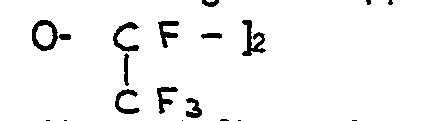
- Zu 5 a des Coppolvmeren aus Beispiel 2 wurden 150 a des Lösunasmittels der Formel [CF3-CF2-CF2-
- Zu 5 g des Copolymeren aus Beispiel 2 wurden 100 g Halocarbonöl 11-21 (Hersteller: Halocarbon Products Corp., Hackensack N.J. USA) gegeben. Das Polymere löste sich unter den in Beispiel 5 angegebenen Bedingungen nicht; es ließ sich erst bei Temperaturen von über 165°C nach mehrstündigem Rühren in Lösung bringen.
- Zu 5 g des Copolymeren aus Beispiel 5 wurden 90 g des Lösungsmittels H(-CF2)4-CF2Cl (Kp.: 77°C) gegeben. Es wurde 3 Stunden bei 68°C gerührt und eine klare Lösung des Polymeren erhalten. Aus dieser Lösung ließen sich Filme/Folien herstellen, die nach der Hydrolyse mit 25 %. NaOH z.B. als lonenaustauschermembranen bei der Chloralkali-Elektrolyse Verwendung finden können.
- Zu 5 g des Copolymeren aus Beispiel 5 wurden 80 g des Lösungsmittels HCF2-CFz-CFBr-CF2Br (Kp.: 119°C) gegeben. Das Polymere löste sich unter Rühren nach 2 Stunden bei 90°C unter Bildung einer klaren Lösung.
- Zu 10 g des Terpolymeren aus Beispiel 4 wurden 50 g des Lösungsmittels gemäß Beispiel 1 gegeben. Es wurde 5 Stunden bei 15°C gerührt und eine klare Lösung des Polymeren erhalten.
Claims (15)



Applications Claiming Priority (2)
| Application Number | Priority Date | Filing Date | Title |
|---|---|---|---|
| DE19863631561 DE3631561A1 (de) | 1986-09-17 | 1986-09-17 | Loesungen von fluorpolymeren und deren verwendung |
| DE3631561 | 1986-09-17 |
Publications (3)
| Publication Number | Publication Date |
|---|---|
| EP0260587A2 true EP0260587A2 (de) | 1988-03-23 |
| EP0260587A3 EP0260587A3 (en) | 1989-10-25 |
| EP0260587B1 EP0260587B1 (de) | 1993-07-07 |
Family
ID=6309736
Family Applications (1)
| Application Number | Title | Priority Date | Filing Date |
|---|---|---|---|
| EP87113157A Expired - Lifetime EP0260587B1 (de) | 1986-09-17 | 1987-09-09 | Lösungen von Fluorpolymeren und deren Verwendung |
Country Status (5)
| Country | Link |
|---|---|
| US (1) | US4808651A (de) |
| EP (1) | EP0260587B1 (de) |
| JP (1) | JPS6377961A (de) |
| CA (1) | CA1323127C (de) |
| DE (2) | DE3631561A1 (de) |
Cited By (7)
| Publication number | Priority date | Publication date | Assignee | Title |
|---|---|---|---|---|
| EP0431458A1 (de) * | 1989-12-07 | 1991-06-12 | Daikin Industries, Limited | Reinigungszusammensetzung |
| EP0261501B1 (de) * | 1986-09-17 | 1993-03-31 | Hoechst Aktiengesellschaft | Halogenhaltige Ether |
| WO1994015998A1 (en) * | 1993-01-13 | 1994-07-21 | E.I. Du Pont De Nemours And Company | Dissolution of tetrafluoroethylene polymers at superautogenous pressure |
| EP0615779A1 (de) * | 1993-03-16 | 1994-09-21 | W.L. GORE & ASSOCIATES GmbH | Oleophob modifizierte mikroporöse polymere |
| WO1998058418A1 (en) * | 1997-06-17 | 1998-12-23 | Aer Energy Resources, Inc. | Membrane for selective transport of oxygen over water vapor and metal-air electrochemical cell including said membrane |
| WO2003006537A1 (en) * | 2001-07-13 | 2003-01-23 | E.I. Du Pont De Nemours And Company | Process for dissolution of highly fluorinated ion-exchange polymers |
| US20210079180A1 (en) * | 2017-08-28 | 2021-03-18 | Dsm Ip Assets B.V. | Synthetic membrane composition comprising a fluorinated polyurethane |
Families Citing this family (21)
| Publication number | Priority date | Publication date | Assignee | Title |
|---|---|---|---|---|
| IT1213536B (it) * | 1986-11-14 | 1989-12-20 | Ausimont Spa | 2-bromo,1',2',-dicloro-perfluoro dietil-etere e procedimento per lasua preparazione. |
| DE3923128A1 (de) * | 1989-07-13 | 1991-01-24 | Akzo Gmbh | Flach- oder kapillarmembran auf der basis eines homogenen gemisches aus polyvinylidenfluorid und eines zweiten, durch chemische umsetzung hydrophilierbaren polymeren |
| US5225561A (en) * | 1990-07-06 | 1993-07-06 | Advanced Technology Materials, Inc. | Source reagent compounds for MOCVD of refractory films containing group IIA elements |
| US7323581B1 (en) | 1990-07-06 | 2008-01-29 | Advanced Technology Materials, Inc. | Source reagent compositions and method for forming metal films on a substrate by chemical vapor deposition |
| US5403575A (en) * | 1991-12-12 | 1995-04-04 | Hemagen/Pfc | Highly fluorinated, chloro-substituted organic compound-containing emulsions and methods of using them |
| US5290846A (en) * | 1992-08-28 | 1994-03-01 | E. I. Du Pont De Nemours And Company | Solvents for fluorinated polymers |
| US5273694A (en) * | 1992-08-28 | 1993-12-28 | E. I. Du Pont De Nemours And Company | Process for making ion exchange membranes and films |
| US5336801A (en) * | 1992-09-15 | 1994-08-09 | E. I. Du Pont De Nemours And Company | Processes for the preparation of 2,2,3,3-tetrafluoropropionate salts and derivatives thereof |
| US5420359A (en) * | 1992-12-11 | 1995-05-30 | Minnesota Mining And Manufacturing Company | Chlorofluoroether compositions and preparation thereof |
| US5399307A (en) * | 1993-06-18 | 1995-03-21 | Dalton; Robert E. | Methods of compression molding two or more polytetrafluoroethylene resin layers |
| EP1000602B1 (de) * | 1997-06-04 | 2010-04-07 | Daikin Industries, Limited | Copolymere für kosmetik |
| US6416698B1 (en) | 1999-02-18 | 2002-07-09 | E. I. Du Pont De Nemours And Company | Fluoropolymer finishing process |
| JP3453366B2 (ja) * | 2001-01-25 | 2003-10-06 | 株式会社半導体先端テクノロジーズ | 基板の洗浄装置および洗浄方法 |
| US20050131116A1 (en) * | 2002-07-12 | 2005-06-16 | Qun Sun | Process for dissolution of highly fluorinated ion-exchange polymers |
| JP2003246906A (ja) * | 2002-02-25 | 2003-09-05 | Asahi Kasei Corp | フッ素系共重合体含有組成物 |
| US8193397B2 (en) * | 2006-12-06 | 2012-06-05 | 3M Innovative Properties Company | Hydrofluoroether compounds and processes for their preparation and use |
| WO2010044425A1 (ja) * | 2008-10-16 | 2010-04-22 | 旭硝子株式会社 | エチレン/テトラフルオロエチレン共重合体多孔体の製造方法およびエチレン/テトラフルオロエチレン共重合体多孔体 |
| US20130045399A1 (en) * | 2011-08-16 | 2013-02-21 | Primus Power Corporation | Flow Battery with Reactant Separation |
| CN104277163B (zh) * | 2013-07-01 | 2017-08-25 | 山东东岳高分子材料有限公司 | 一种含氟羧酸乳化剂及含氟聚合物的制备方法 |
| US10227288B2 (en) | 2015-02-03 | 2019-03-12 | Blue Current, Inc. | Functionalized fluoropolymers and electrolyte compositions |
| WO2017127569A1 (en) | 2016-01-21 | 2017-07-27 | 3M Innovative Properties Company | Additive processing of fluoroelastomers |
Family Cites Families (5)
| Publication number | Priority date | Publication date | Assignee | Title |
|---|---|---|---|---|
| US2542070A (en) * | 1949-11-25 | 1951-02-20 | Gen Electric | Solutions of polymeric chlorotrifluoroethylene |
| US3740369A (en) * | 1971-06-25 | 1973-06-19 | Du Pont | Low viscosity solution of fluoropolymer due to the use of polar organic compounds |
| US4266036A (en) * | 1979-10-23 | 1981-05-05 | Diamond Shamrock Corporation | Recovery of polymeric cation exchange materials for reuse by converting by reaction to the precursor form |
| US4414280A (en) * | 1980-08-08 | 1983-11-08 | E. I. Du Pont De Nemours And Company | Membranes and composites from fluoropolymer solutions |
| US4610762A (en) * | 1985-05-31 | 1986-09-09 | The Dow Chemical Company | Method for forming polymer films having bubble release surfaces |
-
1986
- 1986-09-17 DE DE19863631561 patent/DE3631561A1/de not_active Withdrawn
-
1987
- 1987-09-09 DE DE8787113157T patent/DE3786435D1/de not_active Expired - Fee Related
- 1987-09-09 EP EP87113157A patent/EP0260587B1/de not_active Expired - Lifetime
- 1987-09-15 US US07/096,653 patent/US4808651A/en not_active Expired - Fee Related
- 1987-09-16 CA CA000547010A patent/CA1323127C/en not_active Expired - Fee Related
- 1987-09-16 JP JP62229959A patent/JPS6377961A/ja active Pending
Cited By (8)
| Publication number | Priority date | Publication date | Assignee | Title |
|---|---|---|---|---|
| EP0261501B1 (de) * | 1986-09-17 | 1993-03-31 | Hoechst Aktiengesellschaft | Halogenhaltige Ether |
| EP0431458A1 (de) * | 1989-12-07 | 1991-06-12 | Daikin Industries, Limited | Reinigungszusammensetzung |
| WO1994015998A1 (en) * | 1993-01-13 | 1994-07-21 | E.I. Du Pont De Nemours And Company | Dissolution of tetrafluoroethylene polymers at superautogenous pressure |
| EP0615779A1 (de) * | 1993-03-16 | 1994-09-21 | W.L. GORE & ASSOCIATES GmbH | Oleophob modifizierte mikroporöse polymere |
| WO1998058418A1 (en) * | 1997-06-17 | 1998-12-23 | Aer Energy Resources, Inc. | Membrane for selective transport of oxygen over water vapor and metal-air electrochemical cell including said membrane |
| WO2003006537A1 (en) * | 2001-07-13 | 2003-01-23 | E.I. Du Pont De Nemours And Company | Process for dissolution of highly fluorinated ion-exchange polymers |
| US20210079180A1 (en) * | 2017-08-28 | 2021-03-18 | Dsm Ip Assets B.V. | Synthetic membrane composition comprising a fluorinated polyurethane |
| US11649353B2 (en) * | 2017-08-28 | 2023-05-16 | Dsm Ip Assets B.V. | Synthetic membrane composition comprising a fluorinated polyurethane |
Also Published As
| Publication number | Publication date |
|---|---|
| EP0260587A3 (en) | 1989-10-25 |
| US4808651A (en) | 1989-02-28 |
| JPS6377961A (ja) | 1988-04-08 |
| EP0260587B1 (de) | 1993-07-07 |
| DE3786435D1 (de) | 1993-08-12 |
| DE3631561A1 (de) | 1988-03-31 |
| CA1323127C (en) | 1993-10-12 |
Similar Documents
| Publication | Publication Date | Title |
|---|---|---|
| EP0260587B1 (de) | Lösungen von Fluorpolymeren und deren Verwendung | |
| DE3046501C2 (de) | Fluorierte Vinyletherverbindungen und Verfahren zu ihrer Herstellung | |
| DE3047438C2 (de) | Fluorierte Copolymerisate, ihre Herstellung und Verwendung | |
| DE2437395C3 (de) | Folie aus fluorhaltigen Polymeren mit Sulfonylgruppen enthaltenden Seitenketten | |
| DE2560151B1 (de) | Fluorkohlenstoffpolymerisate und funktionelle Gruppen enthaltende,dichte Kationenaustauschermembran fuer die Elektrolyse einer waessrigen Natriumchloridloesung | |
| DE2638791A1 (de) | Fluorierte kationenaustauschermembran und verwendung derselben zur elektrolyse von alkalimetallhalogeniden | |
| DE2650979A1 (de) | Verfahren zur herstellung eines fluorierten copolymeren | |
| DE2746416A1 (de) | Verfahren zur herstellung von fluorierten copolymeren mit ionenaustauschgruppen | |
| DE2747576A1 (de) | Verfahren zur herrstellung von jodwasserstoff | |
| DE2265306A1 (de) | Verfahren zur reparatur von beschaedigten kationenaktiven permselektiven membranen | |
| DE2817344A1 (de) | Fluorhaltige ionenaustauscherpolymere mit carboxylgruppen | |
| AU615262B2 (en) | Organic polymeric material and ion-exchange membrane produced therefrom | |
| EP0088285B1 (de) | Verfahren zur Herstellung von Carboxylgruppen enthaltenden Fluorkohlenstoffpolymerisaten sowie einige Ausgangsstoffe hierfür und die bei dem Verfahren als Zwischenprodukte auftretenden Fluorsulfatoverbindungen | |
| EP0308838B1 (de) | Verfahren zur Herstellung von fluorierten Acrylsäuren und ihren Derivaten | |
| EP0334796A1 (de) | Verfahren zur Herstellung von ungesättigten halogenierten Kohlenwasserstoffen | |
| EP0355726B1 (de) | Verfahren zur elektrolytischen Decarboxylierung einer Perfluorcarbonsäure oder deren löslichen Salzen und anschliessende Dimerisierung der dabei entstehenden Radikale | |
| DE2659581A1 (de) | Fluorierte kationenaustauschermembran und deren verwendung | |
| EP0261501B1 (de) | Halogenhaltige Ether | |
| DE60205292T2 (de) | Verfahren zur Rückgewinnung von Fluoropolymeren | |
| DE3036410A1 (de) | Loesungen von fluorpolymeren in halogenierten loesungsmitteln und deren verwendung zur herstellung von me mbranen und zum reparieren dieser membranen | |
| DE3248945T1 (de) | Verfahren zur herstellung eines kationenaustauschharzes | |
| EP0047945B1 (de) | Verfahren zur Herstellung von Perfluorcarbonylsulfonsäurefluoriden sowie die dabei als Zwischenprodukte auftretenden Fluorsulfatoperfluoralkansulfonsäurehalogenide | |
| DE2613103C2 (de) | Wasserbenetzbare und wasserunlösliche Copolymerisate, Verfahren zu deren Herstellung und deren Verwendung | |
| DE60312515T2 (de) | Verfahren zur herstellung fluorierter fluorsulfonylalkyl-vinyl-ether | |
| DE2654965A1 (de) | Verfahren zur reversiblen ueberfuehrung unloeslicher polymerer in loesliche oder leicht dispergierbare form |
Legal Events
| Date | Code | Title | Description |
|---|---|---|---|
| PUAI | Public reference made under article 153(3) epc to a published international application that has entered the european phase |
Free format text: ORIGINAL CODE: 0009012 |
|
| AK | Designated contracting states |
Kind code of ref document: A2 Designated state(s): BE DE FR GB IT NL |
|
| PUAL | Search report despatched |
Free format text: ORIGINAL CODE: 0009013 |
|
| AK | Designated contracting states |
Kind code of ref document: A3 Designated state(s): BE DE FR GB IT NL |
|
| 17P | Request for examination filed |
Effective date: 19900424 |
|
| 17Q | First examination report despatched |
Effective date: 19910626 |
|
| GRAA | (expected) grant |
Free format text: ORIGINAL CODE: 0009210 |
|
| AK | Designated contracting states |
Kind code of ref document: B1 Designated state(s): BE DE FR GB IT NL |
|
| ITF | It: translation for a ep patent filed | ||
| REF | Corresponds to: |
Ref document number: 3786435 Country of ref document: DE Date of ref document: 19930812 |
|
| ET | Fr: translation filed | ||
| GBT | Gb: translation of ep patent filed (gb section 77(6)(a)/1977) |
Effective date: 19930914 |
|
| PGFP | Annual fee paid to national office [announced via postgrant information from national office to epo] |
Ref country code: DE Payment date: 19931118 Year of fee payment: 7 |
|
| PLBE | No opposition filed within time limit |
Free format text: ORIGINAL CODE: 0009261 |
|
| STAA | Information on the status of an ep patent application or granted ep patent |
Free format text: STATUS: NO OPPOSITION FILED WITHIN TIME LIMIT |
|
| 26N | No opposition filed | ||
| PGFP | Annual fee paid to national office [announced via postgrant information from national office to epo] |
Ref country code: FR Payment date: 19940812 Year of fee payment: 8 |
|
| PGFP | Annual fee paid to national office [announced via postgrant information from national office to epo] |
Ref country code: GB Payment date: 19940819 Year of fee payment: 8 |
|
| PGFP | Annual fee paid to national office [announced via postgrant information from national office to epo] |
Ref country code: BE Payment date: 19940902 Year of fee payment: 8 |
|
| PGFP | Annual fee paid to national office [announced via postgrant information from national office to epo] |
Ref country code: NL Payment date: 19940930 Year of fee payment: 8 |
|
| PG25 | Lapsed in a contracting state [announced via postgrant information from national office to epo] |
Ref country code: DE Effective date: 19950601 |
|
| PG25 | Lapsed in a contracting state [announced via postgrant information from national office to epo] |
Ref country code: GB Effective date: 19950909 |
|
| PG25 | Lapsed in a contracting state [announced via postgrant information from national office to epo] |
Ref country code: BE Effective date: 19950930 |
|
| BERE | Be: lapsed |
Owner name: HOECHST A.G. Effective date: 19950930 |
|
| PG25 | Lapsed in a contracting state [announced via postgrant information from national office to epo] |
Ref country code: NL Effective date: 19960401 |
|
| GBPC | Gb: european patent ceased through non-payment of renewal fee |
Effective date: 19950909 |
|
| PG25 | Lapsed in a contracting state [announced via postgrant information from national office to epo] |
Ref country code: FR Effective date: 19960531 |
|
| NLV4 | Nl: lapsed or anulled due to non-payment of the annual fee |
Effective date: 19960401 |
|
| REG | Reference to a national code |
Ref country code: FR Ref legal event code: ST |
|
| PG25 | Lapsed in a contracting state [announced via postgrant information from national office to epo] |
Ref country code: IT Free format text: LAPSE BECAUSE OF NON-PAYMENT OF DUE FEES;WARNING: LAPSES OF ITALIAN PATENTS WITH EFFECTIVE DATE BEFORE 2007 MAY HAVE OCCURRED AT ANY TIME BEFORE 2007. THE CORRECT EFFECTIVE DATE MAY BE DIFFERENT FROM THE ONE RECORDED. Effective date: 20050909 |