EP0258729A2 - Dihydropyridinverbindungen, Verfahren zu ihrer Herstellung und ihre Verwendung - Google Patents
Dihydropyridinverbindungen, Verfahren zu ihrer Herstellung und ihre Verwendung Download PDFInfo
- Publication number
- EP0258729A2 EP0258729A2 EP87111924A EP87111924A EP0258729A2 EP 0258729 A2 EP0258729 A2 EP 0258729A2 EP 87111924 A EP87111924 A EP 87111924A EP 87111924 A EP87111924 A EP 87111924A EP 0258729 A2 EP0258729 A2 EP 0258729A2
- Authority
- EP
- European Patent Office
- Prior art keywords
- carbon atoms
- alkyl
- chain
- general formula
- compounds
- Prior art date
- Legal status (The legal status is an assumption and is not a legal conclusion. Google has not performed a legal analysis and makes no representation as to the accuracy of the status listed.)
- Granted
Links
- 0 C*C(C(C=C(C(*)=C1N)N*)=C(C*)C1O)=O Chemical compound C*C(C(C=C(C(*)=C1N)N*)=C(C*)C1O)=O 0.000 description 4
Classifications
-
- C—CHEMISTRY; METALLURGY
- C07—ORGANIC CHEMISTRY
- C07D—HETEROCYCLIC COMPOUNDS
- C07D491/00—Heterocyclic compounds containing in the condensed ring system both one or more rings having oxygen atoms as the only ring hetero atoms and one or more rings having nitrogen atoms as the only ring hetero atoms, not provided for by groups C07D451/00 - C07D459/00, C07D463/00, C07D477/00 or C07D489/00
- C07D491/02—Heterocyclic compounds containing in the condensed ring system both one or more rings having oxygen atoms as the only ring hetero atoms and one or more rings having nitrogen atoms as the only ring hetero atoms, not provided for by groups C07D451/00 - C07D459/00, C07D463/00, C07D477/00 or C07D489/00 in which the condensed system contains two hetero rings
- C07D491/04—Ortho-condensed systems
-
- A—HUMAN NECESSITIES
- A61—MEDICAL OR VETERINARY SCIENCE; HYGIENE
- A61P—SPECIFIC THERAPEUTIC ACTIVITY OF CHEMICAL COMPOUNDS OR MEDICINAL PREPARATIONS
- A61P3/00—Drugs for disorders of the metabolism
- A61P3/08—Drugs for disorders of the metabolism for glucose homeostasis
-
- C—CHEMISTRY; METALLURGY
- C07—ORGANIC CHEMISTRY
- C07D—HETEROCYCLIC COMPOUNDS
- C07D211/00—Heterocyclic compounds containing hydrogenated pyridine rings, not condensed with other rings
- C07D211/04—Heterocyclic compounds containing hydrogenated pyridine rings, not condensed with other rings with only hydrogen or carbon atoms directly attached to the ring nitrogen atom
- C07D211/80—Heterocyclic compounds containing hydrogenated pyridine rings, not condensed with other rings with only hydrogen or carbon atoms directly attached to the ring nitrogen atom having two double bonds between ring members or between ring members and non-ring members
- C07D211/84—Heterocyclic compounds containing hydrogenated pyridine rings, not condensed with other rings with only hydrogen or carbon atoms directly attached to the ring nitrogen atom having two double bonds between ring members or between ring members and non-ring members with hetero atoms or with carbon atoms having three bonds to hetero atoms, with at the most one bond to halogen directly attached to ring carbon atoms
- C07D211/90—Carbon atoms having three bonds to hetero atoms with at the most one bond to halogen
-
- C—CHEMISTRY; METALLURGY
- C07—ORGANIC CHEMISTRY
- C07D—HETEROCYCLIC COMPOUNDS
- C07D491/00—Heterocyclic compounds containing in the condensed ring system both one or more rings having oxygen atoms as the only ring hetero atoms and one or more rings having nitrogen atoms as the only ring hetero atoms, not provided for by groups C07D451/00 - C07D459/00, C07D463/00, C07D477/00 or C07D489/00
- C07D491/02—Heterocyclic compounds containing in the condensed ring system both one or more rings having oxygen atoms as the only ring hetero atoms and one or more rings having nitrogen atoms as the only ring hetero atoms, not provided for by groups C07D451/00 - C07D459/00, C07D463/00, C07D477/00 or C07D489/00 in which the condensed system contains two hetero rings
- C07D491/04—Ortho-condensed systems
- C07D491/044—Ortho-condensed systems with only one oxygen atom as ring hetero atom in the oxygen-containing ring
- C07D491/048—Ortho-condensed systems with only one oxygen atom as ring hetero atom in the oxygen-containing ring the oxygen-containing ring being five-membered
Definitions
- the invention relates to dihydropyridine compounds, processes for their preparation and their use in medicaments, in particular medicaments which influence blood sugar.
- the present invention relates to dihydropyridine compounds of the general formula (I) in which R1 - represents phenyl, naphthyl, thienyl, pyridyl, chromenyl or thiochromenyl, where the radicals mentioned each have up to 2 identical or different substituents from the series halogen, alkyl, alkoxy, alkylthio each having up to 6 carbon atoms, Can carry fluoroalkyl, fluoroalkoxy, each with up to 3 carbon atoms and 3 fluorine atoms, nitro or cyano, R2 - represents straight-chain, branched or cyclic alkyl having up to 8 carbon atoms, which can be interrupted in the alkyl chain by an oxygen or a sulfur atom and which can be substituted by halogen, phenyl, cyano, hydroxy, amino, alkylamino, dialkylamino in each case up to 3 carbon atoms per alkyl group or through N-benzy
- R1 - represents phenyl or thienyl, where the radicals mentioned can carry up to 2 identical or different substituents from the series, fluorine, chlorine, alkyl, alkoxy each having up to 3 carbon atoms, trifluoromethyl, nitro or cyano
- R2 - represents straight-chain or branched alkyl having up to 6 carbon atoms, which can be interrupted by an oxygen atom in the alkyl chain and which can be substituted by fluorine, chlorine or phenyl
- R3 - represents straight-chain or branched alkyl having up to 6 carbon atoms, which can be substituted by hydroxy or alkoxycarbonyl having up to 2 carbon atoms
- R4 and R5 - each represent hydroxy or R4 and R5 together represent -O-, in the form of their isomers, isomer mixtures, optical antipodes or racemates and their physiologically acceptable salts.
- R1 - stands for phenyl, which can be substituted up to 2 times in the same or different manner by chlorine, alkyl having up to 3 carbon atoms, trifluoromethyl or nitro
- R2 - represents straight-chain or branched alkyl having up to 4 carbon atoms, which can be interrupted in the alkyl chain by an oxygen atom
- R3 - represents straight-chain or branched alkyl having up to 4 carbon atoms
- R4 and R5 - each represent hydroxy, or R4 and R5 together represent -O-, in the form of their isomers, isomer mixtures, optical antipodes or racemates and their physiologically acceptable salts.
- the compounds according to the invention exist in stereoisomeric forms which are either like image and mirror image (enantiomers) or which are not like image and Mirror image (diastereomers) behave.
- the invention relates to both the antipodes and the racemic forms as well as the diastereomer mixtures.
- the racemic forms can be separated into the stereoisomerically uniform constituents in a known manner (cf. EL Eliel, Stereochemistry of Carbon Compounds, McGraW Hill, 1962).
- dihydropyridinedicarboxylic acid anhydrides in the context of the general formula (I) correspond to the formula (Ia)
- dihydropyridinedicarboxylic acids in the context of the general formula (I) correspond to the formula (Ib)
- the compounds according to the invention can be in the form of their salts.
- Physiologically acceptable salts of the dihydropyridine dicarboxylic acid anhydrides are generally salts of the substances (Ia) according to the invention with inorganic or organic acids. Examples are ge named: hydrohalides, hydrogen sulfates, sulfates, hydrogen phosphates, acetates, maleates, citrates, fumarates, tartrates, lactates or benzoates.
- Physiologically acceptable salts of the dihydropyridinedicarboxylic acids (Ib) can be metal or ammonium salts of the substances according to the invention.
- ammonium salts which are derived from ammonia or organic amines, such as, for example, ethylamine, di- or triethylamine, di- or. Triethanolamine, dicyclohexylamine, dimethylaminoethanol, arginine or ethylenediamine.
- the dihydropyridine dicarboxylic acid anhydrides of the general formula (Ia) can be prepared by: Dihydropyridine lactols of the general formula (II) in which R1, R2 and R3 have the meaning given, oxidized in inert solvents.
- the oxidation is generally carried out using dimethyl sulfoxide as the oxidizing agent in the presence of an activating agent in suitable solvents.
- Activating agents which can be used are carboxylic anhydrides, preferably acetic anhydride or trifluoroacetic anhydride, carboxylic acid halides, preferably oxalyl chloride, or else dicyclohexylcarbodiimide / phosphoric acid, pyridine-sulfur trioxide complex, phosphorus pentoxide or chlorosulfonyl isocyanate.
- the usual solvents which do not change under the reaction conditions are suitable as solvents.
- hydrocarbons such as benzene, toluene, xylene or hexane, or ethers such as diethyl ether, dioxane or tetrahydrofuran, or halogenated hydrocarbons such as methylene chloride, chloroform, carbon tetrachloride, 1,2-dichloroethane or 1,2-dichlorethylene, or mixtures of the solvents mentioned.
- the oxidation with dimethyl sulfoxide as the oxidizing agent is particularly preferably carried out in the presence of trifluoroacetic anhydride. It has proven to be advantageous to use dimethyl sulfoxide in large excess at the same time as a solvent.
- the oxidation can also be carried out with oxidizing agents such as chromium (VI) compounds, preferably with chromium (VI) oxide in dilute sulfuric acid / acetone, acetic acid or pyridine, and sodium or potassium dichromate, manganese dioxide or potassium permanganate, as is done in Houben -Weyl's "Methods of Organic Chemistry" Volume IV / 1a, 1b is described.
- oxidizing agents such as chromium (VI) compounds, preferably with chromium (VI) oxide in dilute sulfuric acid / acetone, acetic acid or pyridine, and sodium or potassium dichromate, manganese dioxide or potassium permanganate, as is done in Houben -Weyl's "Methods of Organic Chemistry" Volume IV / 1a, 1b is described.
- the process according to the invention is generally carried out in a temperature range from -30 ° C. to + 60 ° C., preferably from -10 ° C. to + 30 ° C.
- the process according to the invention is generally carried out under normal pressure, but it is also possible to carry out the process under negative pressure or under positive pressure.
- the method according to the invention can be carried out, for example, as follows:
- the dihydropyridine lactol is dissolved in an excess of dimethyl sulfoxide and mixed with trifluoroacetic anhydride while cooling. After the reaction has ended, the mixture is worked up in the customary manner by extraction, chromatography and / or crystallization.
- the compounds of the general formula (Ib) according to the invention can be made by Dihydropyridine dicarboxylic acid anhydrides of the general formula (Ia) in which R1, R2 and R3 have the meaning given hydrolyzed and optionally converted the free acids into their salts.
- the hydrolysis is generally carried out using bases in suitable solvents.
- the usual basic compounds are suitable as bases. These preferably include alkali or alkaline earth metal hydroxides such as sodium hydroxide, potassium hydroxide or barium hydroxide, or alkali metal carbonates such as sodium carbonate, sodium hydrogen carbonate or potassium carbonate, or alkali metal alcoholates such as sodium methoxide, potassium methoxide, sodium ethanolate, potassium ethanolate or potassium tert-butylate, or ammonia or diamine amine or triethylamine or organic amines such as triethylamine or organic amines such as triethylamine or diamine .
- alkali or alkaline earth metal hydroxides such as sodium hydroxide, potassium hydroxide or barium hydroxide
- alkali metal carbonates such as sodium carbonate, sodium hydrogen carbonate or potassium carbonate
- alkali metal alcoholates such as sodium methoxide, potassium methoxide, sodium ethanolate, potassium ethanolate or potassium tert-butylate
- solvents which do not change under the reaction conditions are suitable as solvents.
- solvents preferably include water or alcohols such as methanol, ethanol, propanol, isopropanol or butanol, or ethers such as diethyl ether, dioxane or tetrahydrofuran, or dimethylformamide, hexamethylphosphoric triamide, acetone or acetonitrile. It is also possible to use mixtures of the solvents mentioned.
- aqueous alkali hydroxide solutions such as e.g. Potassium hydroxide solution or sodium hydroxide solution in alcohols, such as methanol, ethanol, propanol, isopropanol or butanol, as the solvent.
- the hydrolysis is carried out in a temperature range from 0 ° C. to + 100 ° C., preferably from + 20 ° C. to + 60 ° C.
- the hydrolysis can be carried out under normal pressure, under positive pressure or under negative pressure. Generally one works at normal pressure.
- the base is used in an amount of 2 to 6 mol, preferably 2 to 4 mol, based on 1 mol of the dihydropyridinedicarboxylic anhydride.
- the method can be carried out, for example, as follows: The dihydropyridine dicarboxylic acid anhydride is dissolved in a suitable solvent and crosslinked with the appropriate base. The processing is carried out in the usual way.
- the dihydropyridine lactols of the general formula (II) used as starting materials can be prepared by [A] formyl compounds of the general formula (III) in which R1, R2 and R3 have the meaning given and R6 - represents straight-chain or branched alkyl having up to 8 carbon atoms, in suitable solvents, first reacted with base and then with acid, or by [B] Dihydropyridine lactones of the general formula (IV) in which R1, R2 and R3 have the meaning given, in suitable solvents, optionally brominated in the presence of a base and then hydrolyzed, or directly hydroxylated.
- Suitable solvents are water and all organic solvents which do not change under the reaction conditions. These preferably include alcohols such as methanol, ethanol, propanol, isopropanol or butanol, or ethers such as diethyl ether, dioxane, tetrahydrofuran, glycol mono- or dimethyl ether, or acetonitrile, pyridine, dimethylformamide, dimethyl sulfoxide or hexamethylphosphoric acid triamide. It is also possible to use mixtures of the solvents mentioned.
- bases are suitable as bases. These preferably include alkali hydroxides such as sodium hydroxide or potassium hydroxide, or alkali metal alcoholates such as sodium methylate, sodium ethylate, potassium methylate or potassium ethylate or potassium tert-butoxide, or alkali metals such as sodium, or alkali metal hydrides such as sodium hydride or potassium hydride, or alkali amides such as sodium amide or lithium diisopropylamide.
- alkali hydroxides such as sodium hydroxide or potassium hydroxide
- alkali metal alcoholates such as sodium methylate, sodium ethylate, potassium methylate or potassium ethylate or potassium tert-butoxide
- alkali metals such as sodium
- alkali metal hydrides such as sodium hydride or potassium hydride
- alkali amides such as sodium amide or lithium diisopropylamide.
- organic or inorganic acids are suitable as acids. These preferably include mineral acids such as hydrochloric acid, hydrobromic acid, sulfuric acid, phosphoric acid, or organic carboxylic acids such as acetic acid.
- the process is carried out by first reacting the formyl compounds of the formula (III) in suitable solvents with 100 to 5 mol, preferably with 50 to 10 mol, of base, based on 1 mol of formyl compound, and then treating the reaction mixture with acids.
- the processing takes place in the usual way.
- the reaction is generally carried out at temperatures from 0 ° C. to + 150 ° C., preferably from + 20 ° C. to + 100 ° C.
- the reaction can be carried out under normal pressure, but also under elevated or reduced pressure. Generally one works at normal pressure.
- the formyl compounds of the general formula (III) used as starting compounds are known or can be prepared by known methods [DOS 26 29 892].
- the bromination is carried out with the usual bromination agents such as N-bromosuccinimide or bromine, preferably with bromine.
- the usual basic compounds are suitable as bases. These preferably include alkali metals such as sodium or potassium, alkali metal hydrides such as sodium hydride or potassium hydride, alkali amides such as sodium amide or lithium diisopropylamide, or organometallic compounds such as phenyllithium, n-butyllithium, sec-butyllithium or tert-butyllithium, or alcoholates such as sodium methoxide, sodium ethanolate, potassium methanolate Potassium tert-butoxide.
- alkali metals such as sodium or potassium
- alkali metal hydrides such as sodium hydride or potassium hydride
- alkali amides such as sodium amide or lithium diisopropylamide
- organometallic compounds such as phenyllithium, n-butyllithium, sec-butyllithium or tert-butyllithium, or alcoholates such as sodium methoxide, sodium ethanolate, potassium m
- solvents which do not change under the reaction conditions are suitable as solvents.
- solvents preferably include ethers such as diethyl ether, dioxane or tetrahydrofuran, or hydrocarbons such as benzene, toluene, xylene, hexane, cyclohexane or petroleum fractions. It is also possible to use mixtures of the solvents mentioned.
- the bromination is carried out in a temperature range from -120 ° C to + 100 ° C, preferably from -18 ° C to +50 ° C.
- the bromination can be carried out, for example, in such a way that initially 5 to 1 mol, preferably 2 to 1 mol, particularly preferably with 1 mol of base, based on 1 mol of the starting compound (IV), an anion is generated and this is converted into the bromide by means of bromine.
- the subsequent conversion of the bromine compound into the corresponding hydroxy compound of the general formula (II) is advantageously carried out without isolating the bromine compound.
- This hydrolysis is carried out in a manner known per se using water, if appropriate in the presence of traces of an acid such as hydrochloric acid or sulfuric acid.
- Process B can be carried out under normal as well as under elevated or reduced pressure. Generally one works at normal pressure.
- the hydroxylation can also be carried out with 2-sulfonyloxaziridine, with molybdenum peroxide / pyridine / phosphite or with oxygen / phosphite in the presence of bases in inert organic solvents, as described, for example, by E. Vedejs in J. Am. Chem. Soc. 96 , 5944 (1974) or J. Org. Chem. 43 , 188 (1978) or by JM Billmers, J. Finn in J. Org. Chem. 49 , 3243 (1984) or by HH Wassermann, BH Lipschutz in Tetrahedron Letters 1975 , 1731.
- lactones of the general formula (IV) used as starting compounds are known or can be prepared by known methods [DOS 34 10 645].
- the compounds of general formula (I) according to the invention show a valuable pharmacological spectrum of action.
- the blood glucose lowering effect of the substances to be examined was tested on male Wistar rats weighing between 140 and 190 g. For this purpose, the rats were fasted 18 h before application of the substances.
- the substances to be examined were dissolved in pure DMSO immediately before application. Pure DMSO (control animals) or the substances dissolved in DMSO were administered intravenously into the tail vein of the rats.
- Blood was drawn from each rat 30, 60 and 120 min after application from the retroorbital venous plexus. In each case 30 ⁇ l of blood were removed with an automatic dilutor and de-proteinized with 0.3 ml of uranyl acetate (0.16%). After centrifugation, the glucose in the supernatant was determined photometrically on a Gemsaec Fastanalyzer using the glucose oxidase method using 4-aminophenazone as a color reagent. The results were evaluated using the Student's t-test, p ⁇ 0.05 was chosen as the limit of significance.
- Table 1 below contains the changes in blood glucose concentrations found as a percentage of the control.
- the present invention includes pharmaceutical preparations which, in addition to non-toxic, inert pharmaceutically suitable excipients, contain one or more compounds according to the invention or which consist of one or more active compounds according to the invention, and processes for the preparation of these preparations.
- the present invention also includes pharmaceutical preparations in dosage units.
- the preparations in the form of individual parts e.g. Tablets, dragees, capsules, pills, suppositories and ampoules are available, the active ingredient content of which corresponds to a fraction or a multiple of a single dose.
- the dosage units can e.g. B. 1, 2, 3 or 4 single doses or 1/2, 1/3 or 1/4 of a single dose.
- a single dose preferably contains the amount of active ingredient which is administered in one application and which usually corresponds to a whole, a half or a third or a quarter of a daily dose.
- Non-toxic, inert pharmaceutically suitable carriers are to be understood as solid, semi-solid or liquid diluents, fillers or formulation auxiliaries of all kinds.
- Tablets, dragees, capsules, pills, granules, suppositories, solutions, suspensions and emulsions, pastes, ointments, gels, creams, lotions, powders and sprays may be mentioned as preferred pharmaceutical preparations.
- Tablets, dragees, capsules, pills and granules can contain the active ingredient (s) in addition to the usual carriers, such as (a) fillers and extenders, e.g. Starch, milk sugar, cane sugar, glucose, mannitol and silica, (b) binders, e.g. Carboxymethyl cellulose, alginates, gelatin, polyvinyl pyrrolidone, (c) humectants, e.g. Glycerin, (d) disintegrant, e.g. Agar, calcium carbonate and sodium carbonate, (e) solution retarders, e.g. Paraffin and (f) absorption accelerators, e.g.
- fillers and extenders e.g. Starch, milk sugar, cane sugar, glucose, mannitol and silica
- binders e.g. Carboxymethyl cellulose, alginates, gelatin, polyvinyl pyrrolidone
- humectants
- quaternary ammonium compounds (g) wetting agents, e.g. Cetyl alcohol, glycerol monostearate, (h) adsorbent e.g. Kaolin and bentonite and (i) lubricants, e.g. Talc, calcium and magnesium stearate and solid polyethylene glycols or mixtures of the substances listed under (a) to (i).
- wetting agents e.g. Cetyl alcohol, glycerol monostearate
- adsorbent e.g. Kaolin and bentonite
- lubricants e.g. Talc, calcium and magnesium stearate and solid polyethylene glycols or mixtures of the substances listed under (a) to (i).
- the active ingredient (s) can optionally also be in microencapsulated form with one or more of the above-mentioned excipients.
- suppositories can contain the usual water-soluble or water-insoluble excipients, e.g. Polyethylene glycols, fats, e.g. Cocoa fat and higher esters (e.g. C14 alcohol with C16 fatty acid) or mixtures of these substances.
- water-soluble or water-insoluble excipients e.g. Polyethylene glycols, fats, e.g. Cocoa fat and higher esters (e.g. C14 alcohol with C16 fatty acid) or mixtures of these substances.
- solutions and emulsions can contain the usual carriers such as solvents, solubilizers and emulsifiers, for example water, ethyl alcohol, isopropyl alcohol, ethyl carbonate, ethyl acetate, benzyl alcohol, dimethylformamide, oils, in particular tree woolen oil, peanut oil, corn oil, olive oil, castor oil and sesame oil, glycerin, glycerin formal, tetrahydrofurfuryl alcohol, polyethylene glycols and fatty acid esters of sorbitan or mixtures of these substances.
- solvents such as solvents, solubilizers and emulsifiers, for example water, ethyl alcohol, isopropyl alcohol, ethyl carbonate, ethyl acetate, benzyl alcohol, dimethylformamide, oils, in particular tree woolen oil, peanut oil, corn oil, olive oil, castor oil and sesame oil, glycerin, g
- solutions and emulsions can also be in sterile and blood isotonic form.
- suspensions can contain the usual carriers such as liquid diluents, e.g. Water, ethyl alcohol, propylene glycol, suspending agents e.g. ethoxylated isostearyl alcohols, polyoxyethylene sorbitol and sorbitan esters, microcrystalline cellulose, aluminum metahydroxide, bentonite, agar and tragacanth or mixtures of these substances.
- liquid diluents e.g. Water, ethyl alcohol, propylene glycol
- suspending agents e.g. ethoxylated isostearyl alcohols, polyoxyethylene sorbitol and sorbitan esters, microcrystalline cellulose, aluminum metahydroxide, bentonite, agar and tragacanth or mixtures of these substances.
- the formulation forms mentioned can also contain colorants, preservatives and additives which improve the smell and taste, e.g. Peppermint oil and eucalyptus oil and sweeteners, e.g. Saccharin.
- the therapeutically active compounds should be present in the pharmaceutical preparations listed above preferably in a concentration of about 0.1 to 99.5, preferably of about 0.5 to 95 percent by weight of the total mixture.
- the pharmaceutical preparations listed above can also contain further active pharmaceutical ingredients.
- the pharmaceutical preparations listed above are prepared in a conventional manner by known methods, e.g. by mixing the active substance or substances with the carrier substance or substances.
- the present invention also includes the use of the compounds of the general formula (I) and / or their salts, and their pharmaceutical preparations which contain the compounds of the formula (I) and / or their salts, in human and veterinary medicine for prevention , Improvement and / or healing of diseases of carbohydrate metabolism.
- the active compound (s) according to the invention in total amounts of about 0.5 to 500, preferably 50 to 100 mg / kg of body weight per 24 hours, optionally in the form of several Single doses to achieve the desired results.
- a single dose contains the active ingredient (s) according to the invention, preferably in amounts of about 1 to about 80, in particular 3 to 30 mg / kg of body weight.
Landscapes
- Chemical & Material Sciences (AREA)
- Organic Chemistry (AREA)
- Health & Medical Sciences (AREA)
- Diabetes (AREA)
- Nuclear Medicine, Radiotherapy & Molecular Imaging (AREA)
- Life Sciences & Earth Sciences (AREA)
- Hematology (AREA)
- Obesity (AREA)
- Engineering & Computer Science (AREA)
- Chemical Kinetics & Catalysis (AREA)
- General Chemical & Material Sciences (AREA)
- Medicinal Chemistry (AREA)
- Endocrinology (AREA)
- Emergency Medicine (AREA)
- Pharmacology & Pharmacy (AREA)
- Bioinformatics & Cheminformatics (AREA)
- Animal Behavior & Ethology (AREA)
- General Health & Medical Sciences (AREA)
- Public Health (AREA)
- Veterinary Medicine (AREA)
- Pharmaceuticals Containing Other Organic And Inorganic Compounds (AREA)
- Hydrogenated Pyridines (AREA)
- Nitrogen Condensed Heterocyclic Rings (AREA)
- Investigating Or Analysing Biological Materials (AREA)
- Polysaccharides And Polysaccharide Derivatives (AREA)
- Plural Heterocyclic Compounds (AREA)
- Organic Low-Molecular-Weight Compounds And Preparation Thereof (AREA)
Abstract
Description
- Die Erfindung betrifft Dihydropyridinverbindungen, Verfahen zu ihrer Herstellung sowie ihre Verwendung in Arzneimittelm, insbesondere von blutzuckerbeeinflussenden Arzneimitteln.
- Die vorliegende Erfindung betrifft Dihydropyridinverbindungen der allgemeinen Formel (I)

R¹ - für Phenyl, Naphthyl, Thienyl, Pyridyl, Chromenyl oder Thiochromenyl steht, wobei die genannten Reste jeweils bis zu 2 gleiche oder verschiedene Substituenten aus der Reihe Halogen, Alkyl, Alkoxy, Alkylthio mit jeweils bis zu 6 Kohlenstoffatomen, Fluoralkyl, Fluoralkoxy mit jeweils bis zu 3 Kohlenstoffatomen und 3 Fluoratomen, Nitro oder Cyano tragen können,
R² - für geradkettiges, verzweigtes oder cyclisches Alkyl mit bis zu 8 Kohlenstoffatomen steht, das in der Alkylkette durch ein Sauerstoff- oder ein Schwefelatom unterbrochen sein kann und das substituiert sein kann durch Halogen, Phenyl, Cyano, Hydroxy, Amino, Alkylamino, Dialkylamino mit jeweils bis zu 3 Kohlenstoffatomen je Alkylgruppe oder durch N-Benzyl-N-methylamino,
R³ - für geradkettiges, verzweigtes oder cyclisches Alkyl mit bis zu 6 Kohlenstoffatomen steht, das in der Alkylkette durch ein Sauerstoffatom unterbrochen sein kann und das substituiert sein kann durch Halogen, Hydroxy, Amino, Phenyl, Morpholino, Carboxy oder Alkoxycarbonyl mit bis zu 4 Kohlenstoffatomen
und
R⁴ und R⁵ - jeweils für Hydroxy stehen,
oder
R⁴ und R⁵ zusammen für -O- stehen,
in Form ihrer Isomeren, Isomerengemische, optischen Antipoden oder Racemate sowie ihrer physiologisch unbedenklichen Salze. - Bevorzugt seien solche Verbindungen der allgemeinen Formel (I) genannt,
in denen
R¹ - für Phenyl oder Thienyl steht, wobei die genannten Reste bis zu 2 gleiche oder verschiedene Substituenten der Reihe, Fluor, Chlor, Alkyl, Alkoxy mit jeweils bis zu 3 Kohlenstoffatomen, Trifluormethyl, Nitro oder Cyano tragen können,
R² - für geradkettiges oder verzweigtes Alkyl mit bis zu 6 Kohlenstoffatomen steht, das durch ein Sauerstoffatom in der Alkylkette unterbrochen sein kann und das substituiert sein kann durch Fluor, Chlor oder Phenyl,
R³ - für geradkettiges oder verzweigtes Alkyl mit bis zu 6 Kohlenstoffatomen steht, das durch Hydroxy oder Alkoxycarbonyl mit bis zu 2 Kohlenstoffatomen substituiert sein kann
und
R⁴ und R⁵ - jeweils für Hydroxy stehen
oder
R⁴ und R⁵ zusammen für -O- stehen,
in Form ihrer Isomeren, Isomerengemische, optischen Antipoden oder Racemate sowie ihrer physiologisch unbedenklichen Salze. - Besonders bevorzugt seien solche Verbindungen der allgemeinen Formel (I) genannt,
in denen
R¹ - für Phenyl steht, das bis zu 2-fach gleich oder verschieden substituiert sein kann durch Chlor, Alkyl mit bis zu 3 Kohlenstoffatomen, Trifluormethyl oder Nitro,
R² - für geradkettiges oder verzweigtes Alkyl mit bis zu 4 Kohlenstoffatomen steht, das in der Alkylkette durch ein Sauerstoffatom unterbrochen sein kann,
R³ - für geradkettiges oder verzweigtes Alkyl mit bis zu 4 Kohlenstoffatomen steht
und
R⁴ und R⁵ - jeweils für Hydroxy stehen,
oder
R⁴ und R⁵ zusammen für -O- stehen,
in Form ihrer Isomeren, Isomerengemische, optischen Antipoden oder Racemate sowie ihrer physiologisch unbedenklichen Salze. - Die erfindungsgemäßen Verbindungen existieren in stereoisomeren Formen, die sich entweder wie Bild und Spiegelbild (Enantiomere) oder die sich nicht wie Bild und Spiegelbild (Diastereomere) verhalten. Die Erfindung betrifft sowohl die Antipoden als auch die Racemformen sowie die Diastereomerengemische. Die Racemformen lassen sich ebenso wie die Diastereomeren in bekannter Weise in die stereoisomer einheitlichen Bestandteile trennen (vgl. E.L. Eliel, Stereochemistry of Carbon Compounds, McGraW Hill, 1962).
- Die Dihydropyridindicarbonsäureanhydride im Rahmen der allgemeinen Formel (I) entsprechen der Formel (Ia)


- Die erfindungsgemäßen Verbindungen können in Form ihrer Salze vorliegen. Physiologisch unbedenkliche Salze der Dihydropyridindicarbonsäureanhydride sind im allgemeinen Salze der erfindungsgemäßen Stoffe (Ia) mit anorganischen oder organischen Säuren. Als Beispiele seien ge nannt: Hydrohalogenide, Hydrogensulfate, Sulfate, Hydrogenphosphate, Acetate, Maleate, Citrate, Fumarate, Tartrate, Lactate oder Benzoate.
Physiologisch unbedenkliche Salze der Dihydropyridindicarbonsäuren (Ib) können Metall- oder Ammoniumsalze der erfindungsgemäßen Stoffe sein. Besonders bevorzugt sind z.B. Natrium-, Kalium-, Magnesium- oder Calciumsalze, sowie Ammoniumsalze, die abgeleitet sind von Ammoniak oder organischen Aminen, wie beispielsweise Ethylamin, Di- bzw. Triethylamin, Di-bzw. Triethanolamin, Dicyclohexylamin, Dimethylaminoethanol, Arginin oder Ethylendiamin. - Die erfindungsgemäßen Dihydropyridindicarbonsäureanhydride der allgemeinen Formel (Ia) können hergestellt werden, indem man
Dihydropyridinlactole der allgemeinen Formel (II)
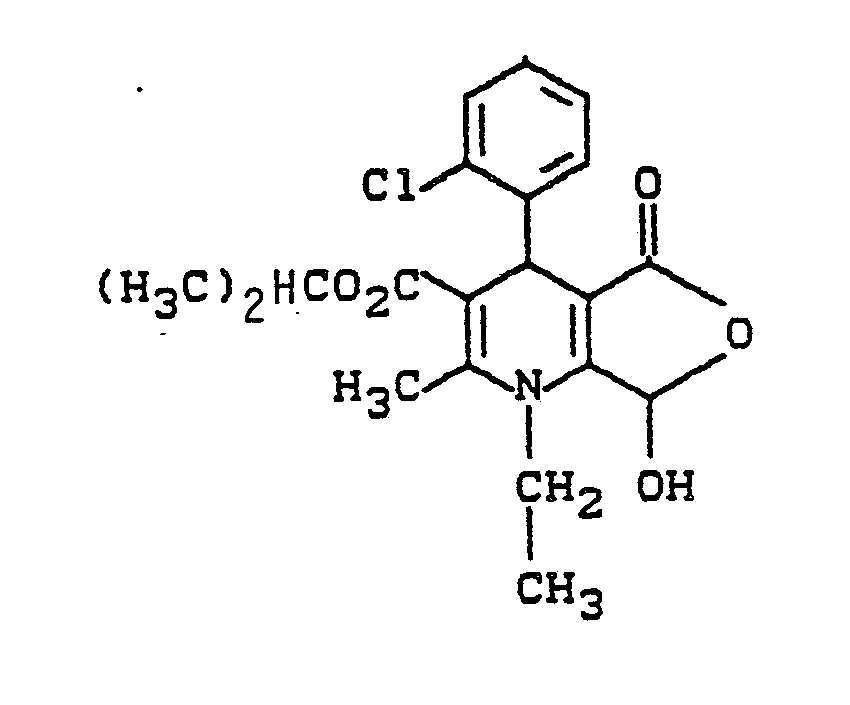
R¹, R² und R³ die angegebene Bedeutung haben, in inerten Lösemitteln oxidiert. - Verwendet man als Ausgangsstoff 4-(2-Chlorpheny)-1-ethyl-7-hydroxy-2-methyl-5-oxo-1,4,5,7-tetrahydrofuro[3,4-b]pyridin-3-carbonsäureethylester läßt sich die Reaktion durch folgendes Schema verdeutlichen:

- Die Oxidation erfolgt im allgemeinen mit Dimethylsulfoxid als Oxidationsmittel in Anwesenheit eines Aktivierungsmittels in geeigneten Lösemitteln.
Als Aktivierungsmittel können Carbonsäureanhydride, bevorzugt Acetanhydrid oder Trifluoracetanhydrid, Carbonsäurehalogenide, bevorzugt Oxalylchlorid, oder aber Dicyclohexylcarbodiimid/Phosphorsäure, Pyridin-Schwefeltrioxid-Komplex, Phosphorpentoxid oder Chlorsulfonylisocyanat eingesetzt werden.
Als Lösemittel eignen sich die üblichen Lösemittel, die sich unter den Reaktionsbedingungen nicht verändern. Hierzu gehören bevorzugt Kohlenwasserstoffe wie Benzol, Toluol, Xylol oder Hexan, oder Ether wie Diethylether, Dioxan oder Tetrahydrofuran, oder Halogenkohlenwasserstoffe wie Methylenchlorid, Chloroform, Tetrachlorkohlenstoff, 1,2-Dichlorethan oder 1,2-Dichlorethylen, oder Gemische der genannten Lösemittel. - Besonders bevorzugt wird die Oxidation mit Dimethylsulfoxid als Oxidationsmittel in Anwesenheit von Trifluoracetanhydrid durchgeführt. Es hat sich hierbei als günstig erwiesen,Dimethylsulfoxid in großem Überschuß gleichzeitig als Lösemittel einzusetzten.
- Darüberhinaus kann die Oxidation ebenso mit Oxidationsmitteln wie Chrom(VI)-Verbindungen, bevorzugt mit Chrom-(VI)-oxid in verdünnter Schwefelsäure/Aceton, Essigsäure oder Pyridin, sowie Natrium- oder Kaliumdichromat, Mangandioxid oder Kaliumpermanganat durchgeführt werden, wie es in Houben-Weyl's "Methoden der organischen Chemie" Band IV/1a, 1b beschrieben wird.
- Das erfindungsgemäße Verfahren wird im allgemeinen in einem Temperaturbereich von -30° C bis +60° C, bevorzugt von -10° C bis +30° C durchgeführt.
- Das erfindungsgemäße Verfahren wird im allgemeinen bei Normaldruck durchgeführt, es ist aber auch möglich, das Verfahren bei Unterdruck oder bei Überdruck durchzuführen.
- Das erfindungsgemäße Verfahren kann beispielweise wie folgt durchgeführt werden:
Das Dihydropyridinlactol wird in einem Überschuß Dimethylsulfoxid gelöst und unter Kühlung mit Trifluoressigsäureanhydrid versetzt. Nach Beendigung der Reaktion wird wie üblich durch Extraktion, Chromatographie und/oder Kristallisation aufgearbeitet. - Die erfindungsgemäßen Verbindungen der allgemeinen Formel (Ib)

Dihydropyridindicarbonsäureanhydride der allgemeinen Formel (Ia)
in welcher
R¹, R² und R³ die angegebenen Bedeutung haben hydrolysiert und gegebenenfalls die freien Säuren in ihre Salze überführt. - Verwendet man als Ausgangsstoff 4-(2-Chlorphenyl)-5,7-dioxo-1-ethyl-2-methyl-1,4,5,7-tetrahydrofuro[3,4-b]-pyridin-3-carbonsäureethylester, so läßt sich das Verfahren durch folgendes Schema verdeutlichen:

- Die Hydrolyse erfolgt im allgemeinen mit Hilfe von Basen in geeigneten Lösemitteln.
- Als Basen eignen sich die üblichen basischen Verbindungen. Hierzu gehören bevorzugt Alkali- oder Erdalkalihydroxide wie Natriumhydroxid, Kaliumhydroxid oder Bariumhydroxid , oder Alkalicarbonate wie Natriumcarbonat, Natriumhydrogencarbonat oder Kaliumcarbonat, oder Alkalialkoholate wie Natriummethanolat, Kaliummethanolat, Natriumethanolat, Kaliumethanolat oder Kalium-tert-butylat, oder Ammoniak, oder organische Amine wie Triethylamin oder Diisopropylamin.
- Als Lösemittel eignen sich die üblichen Lösemittel, die sich unter den Reaktionsbedingungen nicht verändern. Hierzu gehören bevorzugt Wasser oder Alkohole wie Methanol, Ethanol, Propanol, Isopropanol oder Butanol, oder Ether wie Diethylether, Dioxan oder Tetrahydrofuran, oder Dimethylformamid, Hexamethylphophorsäuretriamid, Aceton oder Acetonitril. Ebenso ist es möglich, Gemische der genannten Lösemittel zu verwenden.
- Besonders bevorzugt wird die Hydrolyse mit wässrigen Alkalihydroxidlösungen wie z.B. Kalilauge oder Natronlauge in Alkoholen, wie beispielsweise Methanol, Ethanol, Propanol, Isopropanol oder Butanol als Lösemittel durchgeführt.
- Die Hydrolyse wird in einem Temperaturbereich von 0° C bis +100° C, bevorzugt von +20° C bis +60° C durchgeführt.
- Die Hydrolyse kann bei normalem Druck, bei Überdruck oder auch bei Unterdruck durchgeführt werden. Im allgemeinen arbeitet man bei Normaldruck.
- Im allgemeinen wird die Base in eine Menge von 2 bis 6 Mol, bevorzugt von 2 bis 4 Mol, bezogen auf 1 Mol des Dihydropyridindicarbonsäureanhydrids eingesetzt.
- Es hat sich hierbei als günstig erwiesen, die Base in einer Menge von mindestens 2 Mol, bezogen auf 1 Mol des Dihydropyridindicarbonsäureanhydrids einzusetzen, und in einem Schritt die entsprechenden Salze herzustellen.
- Das Verfahren kann beispielsweise folgendermaßen durchgeführt werden:
Das Dihydropyridindicarbonsäureanhydrid wird in einem geeigneten Lösemittel gelöst und mit der entsprechenden Base vesetzt. Die Aufarbeitung erfolgt in üblicher Art und Weise. - Die als Ausgangsstoffe eingesetzten Dihydropyridinlactole der allgemeinen Formel (II) können hergestellt werden, indem man
[A] Formylverbindungen der allgemeinen Formel (III)
R¹, R² und R³ die angegebene Bedeutung haben
und
R⁶ - für geradkettiges oder verzweigtes Alkyl mit bis zu 8 Kohlenstoffatomen steht,
in geeigneten Lösemitteln, zunächst mit Base und dann mit Säure umsetzt,
oder indem man
[B] Dihydropyridinlactone der allgemeinen Formel (IV)
R¹, R² und R³ die angegebene Bedeutung haben, in geeigneten Lösemitteln, gegebenenfalls in Anwesenheit einer Base bromiert und anschließend hydrolysiert, oder direkt hydroxyliert. - Je nach Art der verwendeten Ausgangsstoffe (III), (IV) kann die Herstellung der erfindungsgemäß verwendeten Ausgangsstoffe (II) nach Verfahren A bzw. B durch folgendes Schema verdeutlicht werden:

- Als Lösemittel eignen sich Wasser sowie alle organischen Lösemittel, die sich unter den Reaktionsbedingungen nicht verändern. Hierzu gehören bevorzugt Alkohole wie Methanol, Ethanol, Propanol, Isopropanol oder Butanol, oder Ether wie Diethylether, Dioxan, Tetrahydrofuran, Glykolmono- oder dimethylether, oder Acetonitril, Pyridin, Dimethylformamid, Dimethylsulfoxid oder Hexamethylphosphorsäuretriamid. Ebenso ist es möglich, Gemische der genannten Lösemittel zu verwenden.
- Als Basen eignen sich die üblichen anorganischen oder organischen Basen. Hierzu gehören bevorzugt Alkalihydroxide wie Natriumhydroxid oder Kaliumhydroxid, oder Alkalialkoholate wie Natriummethylat, Natriumethylat, Kaliummethylat oder Kaliumethylat oder Kaliumtert-butylat, oder Alkalimetalle wie Natrium, oder Alkalihydride wie Natriumhydrid oder Kaliumhydrid, oder Alkaliamide wie Natriumamid oder Lithiumdiisopropylamid.
- Als Säuren kommen die üblichen organischen oder anorganischen Säuren in Frage. Hierzu gehören bevorzugt Mineralsäuren wie Chlorwasserstoffsäure, Bromwasserstoffsäure, Schwefelsäure, Phosphorsäure, oder organische Carbonsäuren wie Essigsäure.
- Die Durchführung erfolgt, indem man zunächst die Formylverbindungen der Formel (III) in geeigneten Lösemitteln mit 100 bis 5 Mol, bevorzugt mit 50 bis 10 Mol Base , bezogen auf 1 Mol Formylverbindung umsetzt und anschließend das Reaktionsgemisch mit Säuren behandelt. Die Aufarbeitung erfolgt in üblicher Weise.
- Die Umsetzung wird im allgemeinen bei Temperaturen von 0° C bis +150° C, bevorzugt von + 20° C bis +100° C durchgeführt.
- Die Umsetzung kann bei normalem, aber auch bei erhöhtem oder erniedrigtem Druck erfolgen. Im allgemeinen arbeitet man bei normalem Druck.
- Die als Ausgangsverbindungen eingesetzten Formylverbindungen der allgemeinen Formel (III) sind bekannt oder können nach bekannten Methoden hergestellt werden [DOS 26 29 892].
- Die Bromierung wird mit den üblichen Bromierungsmitteln wie N-Bromsuccinimid oder Brom, vorzugsweise mit Brom durchgeführt.
- Als Basen eignen sich hierbei die üblichen basischen Verbindungen. Hierzu gehören bevorzugt Alkalimetalle wie Natrium oder Kalium, Alkalimetallhydride wie Natriumhydrid oder Kaliumhydrid, Alkaliamide wie Natriumamid oder Lithiumdiisopropylamid, oder metallorganische Verbindungen wie Phenyllithium, n-Butyllithium, sec-Butyllithium oder tert-Butyllithium, oder Alkoholate wie Natriummethanolat, Natiumethanolat, Kaliummethanolat, Kaliumethanolat oder Kalium-tert-butanolat.
- Als Lösemittel eignen sich alle organischen Lösemittel, die sich unter den Reaktionsbedingungen nicht verändern. Hierzu gehören bevorzugt Ether wie Diethylether, Dioxan oder Tetrahydrofuran, oder Kohlenwasserstoffe wie Benzol, Toluol, Xylol, Hexan, Cyclohexan, oder Erdölfraktionen, Es ist ebenso möglich, Gemische der genannten Lösemittel einzusetzen.
- Die Bromierung wird in einem Temperaturbereich von -120° C bis +100° C, bevorzugt von -18 °C bis +50 °C durchgeführt.
- Die Bromierung kann beispielswiese derart erfolgen, daß man zunächst mit 5 bis 1 Mol, bevorzugt mit 2 bis 1 Mol, besonders bevorzugt mit 1 Mol Base, bezogen auf 1 Mol der Ausgangsverbindung (IV) ein Anion erzeugt und dieses mittels Brom in das Bromid überführt. Die anschließende Überführung der Bromverbindung in die entsprechende Hydroxyverbindung der allgemeinen Formel (II) wird zweckmäßigerweise ohne Isolierung der Bromverbindung durchgeführt. Diese Hydrolyse erfolgt in an sich bekannter Weise durch Wasser, gegebenenfalls in Anwesenheit von Spuren einer Säure wie z.B. Salzsäure oder Schwefelsäure.
- Das Verfahren B kann sowohl bei normalem, als auch bei erhöhtem oder erniedrigtem Druck durchgeführt werden. Im allgemeinen arbeitet man bei Normaldruck.
- Die Überführung der Verbindung (IV) in die Verbindungen (II) kann jedoch auch nach anderen literaturbekannten Methoden durchgeführt werden und ist nicht auf die angegebenen Verfahren beschränkt.
- Die Hydroxylierung kann ebenso mit 2-Sulfonyloxaziridin, mit Molybdänperoxid/Pyridin/Phosphit oder mit Sauerstoff/ Phosphit jeweils in Anwesenheit von Basen in inerten organischen Lösemitteln durchgeführt werden wie es beispielsweise durch E. Vedejs in J. Am. Chem. Soc. 96, 5944 (1974) oder J. Org. Chem. 43, 188 (1978) oder durch J.M. Billmers, J. Finn in J. Org. Chem. 49, 3243 (1984) oder durch H.H. Wassermann, B.H. Lipschutz in Tetrahedron Letters 1975, 1731 beschrieben wird.
- Die als Ausgangsverbindungen eingesetzten Lactone der allgemeinen Formel (IV) sind bekannt oder können nach bekannten Methoden hergestellt werden [DOS 34 10 645].
- Die erfindungsgemäßen Verbindungen der allgemeinen Formel (I) zeigen ein wertvolles pharmakologisches Wirkspektrum.
- Die blutglucosesenkende Wirkung der zu untersuchenden Substanzen wurde an männlichen Wistar-Ratten mit einem Gewicht zwischen 140 und 190 g geprüft. Die Ratten wurden zu diesem Zweck 18 h vor der Applikation der Substanzen nüchtern gesetzt. Die zu untersuchenden Substanzen wurden direkt vor der Applikation in reinem DMSO gelöst. Die Applikation von reinem DMSO (Kontrolltiere) bzw. der in DMSO gelösten Substanzen erfolgte intravenös in die Schwanzvene der Ratten.
- Die Blutentnahme erfolgte bei jeder Ratte 30, 60 und 120 min nach der Applikation aus dem retroorbitalen Venenplexus. Jeweils 30 µl Blut wurden mit einem automatischen Dilutor entnommen und mit 0,3 ml Uranylacetat (0,16%) enteiweißt. Nach der Zentrifugation wurde die Glucose im Überstand nach der Glucoseoxidase-Methode mit 4-Amino-phenazon als Farbreagenz an einem Gemsaec Fastanalyzer photometrisch bestimmt. Die Auswertung der Ergebnisse erfolgte mit dem t-Test nach Student, als Signifikanzgrenze wurde p < 0,05 gewählt.
- Substanzen, die bei Ratten zu einem Zeitpunkt eine signifikante Reduktion der Blutglucosekonzentration um mindestens 10% bewirkten, verglichen mit der Kontrollgruppe, die nur DMSO intravenös erhielt, wurden als wirksam angegeben.
- Die nachfolgende Tabelle 1 enthält die gefundenen Veränderungen der Blutglucosekonzentrationen in Prozent der Kontrolle.

- Zur vorliegenden Erfindung gehören pharmazeutische Zubereitungen, die neben nichttoxischen, inerten pharmazeutisch geeigneten Trägerstoffen einen oder mehrere erfindungsgemäße Verbindungen enthalten oder die aus einem oder mehreren erfindungsgemäßen Wirkstoffen bestehen sowie Verfahren zur Herstellung dieser Zubereitungen.
- Zur vorliegenden Erfindung gehören auch pharmazeutische Zubereitungen in Dosierungseinheiten. Dies bedeutet, daß die Zubereitungen in Form einzelner Teile, z.B. Tabletten, Dragees, Kapseln, Pillen, Suppositorien und Ampullen vorliegen, deren Wirkstoffgehalt einem Bruchteil oder einem Vielfachen einer Einzeldosis entspricht. Die Dosierungseinheiten können z. B. 1, 2, 3 oder 4 Einzeldosen oder 1/2, 1/3 oder 1/4 einer Einzeldosis enthalten. Eine Einzeldosis enthält vorzugsweise die Menge Wirkstoff, die bei einer Applikation verabreicht wird und die gewöhnlich einer ganzen, einer halben oder einem Drittel oder einem Viertel einer Tagesdosis entspricht.
- Unter nichttoxischen, inerten pharmazeutisch geeigneten Trägerstoffen sind feste, halbfeste oder flüssige Verdünnungsmittel, Füllstoffe oder Formulierungshilfsmittel jeder Art zu verstehen.
- Als bevorzugte pharmazeutische Zubereitungen seien Tabletten, Dragees, Kapseln, Pillen, Granulate, Suppositorien, Lösungen, Suspensionen und Emulsionen, Pasten, Salben, Gele, Cremes, Lotions, Puder und Sprays genannt.
- Tabletten, Dragees, Kapseln, Pillen und Granulate können den oder die Wirkstoffe neben den üblichen Trägerstoffen enthalten, wie (a) Füll- und Streckmittel, z.B. Stärke, Milchzucker, Rohrzucker, Glukose, Mannit und Kieselsäure, (b) Bindemittel, z.B. Carboxymethylcellulose, Alginate, Gelatine, Polyvinylpyrrolidon, (c) Feuchthaltemittel, z.B. Glycerin, (d) Sprengmittel, z.B. Agar-Agar, Calciumcarbonat und Natriumcarbonat, (e) Lösungsverzögerer, z.B. Paraffin und (f) Resorptionsbeschleuniger, z.B. quarternäre Ammoniumverbindungen, (g) Netzmittel, z.B. Cetylalkohol, Glycerinmonostearat, (h) Adsorptionsmittel, z.B. Kaolin und Bentonit und (i) Gleitmittel, z.B. Talkum, Calcium-und Magnesiumstearat und feste Polyethylenglykole oder Gemische der unter (a) bis (i) aufgeführten Stoffe.
- Der oder die Wirkstoffe können gegebenenfalls mit einem oder mehreren der oben angegebenen Trägerstoffe auch in mikroverkapselter Form vorliegen.
- Suppositorien können neben dem oder den Wirkstoffen die üblichen wasserlöslichen oder wasserunlöslichen Trägerstoffen enthalten, z.B. Polyethylenglkole, Fette, z.B. Kakaofett und höhere Ester (z.B. C₁₄-Alkohol mit C₁₆-Fettsäure) oder Gemische dieser Stoffe.
- Lösungen und Emulsionen können neben dem oder den Wirkstoffen die üblichen Trägerstoffe wie Lösungsmittel, Lösungsvermittler und Emulgatoren, z.B. Wasser, Ethylalkohol, Isopropylalkohol, Ethylcarbonat, Ethylacetat, Benzylalkohol, Dimethylformamid, Öle, insbesondere Baum wollsaatöl, Erdnußöl, Maiskeimöl, Olivenöl, Ricinusöl und Sesamöl, Glycerin, Glycerinformal, Tetrahydrofurfurylalkohol, Polyethylenglykole und Fettsäureester des Sorbitans oder Gemische dieser Stoffe enthalten.
- Zur parenteralen Applikation können die Lösungen und Emulsionen auch in steriler und blutisotonischer Form vorliegen.
- Suspensionen können neben dem oder den Wirkstoffen die üblichen Trägerstoffe wie flüssige Verdünnungsmittel, z.B. Wasser, Ethylalkohol, Propylenglykol, Suspendiermittel, z.B. ethoxylierte Isostearylalkohole, Polyoxyethylensorbit- und Sorbitanester, mikrokristalline Cellulose, Aluminiummetahydroxid, Bentonit, Agar-Agar und Tragant oder Gemische dieser Stoffe enthalten.
- Die genannten Formulierungsformen können auch Färbemittel, Konservierungsstoffe sowie geruchs- und geschmacksverbesserte Zusätze, z.B. Pfefferminzöl und Eukalyptusöl und Süßmittel, z.B. Saccharin, enthalten.
- Die therapeutisch wirksamen Verbindungen sollen in den oben aufgeführen pharmazeutischen Zubereitungen vorzugsweise in einer Konzentration von etwa 0,1 bis 99,5, vorzugsweise von etwa 0,5 bis 95 Gewichtsprozent der Gesamtmischung vorhanden sein.
- Die oben aufgeführten pharmazetischen Zubereitungen können außer den erfindungsgemäßen Verbindungen auch weitere pharmazeutische Wirkstoffe enthalten.
- Die Herstellung der oben aufgeführten pharmazeutischen Zubereitungen erfolgt in üblicher Weise nach bekannten Methoden, z.B. durch Mischen des oder der Wirkstoffe mit dem oder den Trägerstoffen.
- Zur vorliegenden Erfindung gehört auch die Verwendung der Verbindungen der allgemeinen Formel (I) und/oder deren Salze, sowie deren pharmazeutischen Zubereitungen, die die Verbindungen der Formel (I) und/oder deren Salze enthalten, in der Human- und Veterinärmedizin, zur Verhütung, Verbesserung und/oder Heilung von Erkrankungen des Kohlenhydratstoffwechsels.
- Im allgemeinen hat es sich sowohl in der Human- als auch in der Veterinärmedizin als vorteilhaft erwiesen, den oder die erfindungsgemäßen Wirkstoffe in Gesamtmengen von etwa 0,5 bis 500, vorzugsweise 50 bis 100 mg/kg Körpergewicht je 24 Stunden, gegebenenfalls in Form mehrerer Einzeldosen, zur Erzielung der gewünschten Ergebnisse zu verabreichen. Eine Einzelgabe enthält den oder die erfindungsgemäßen Wirkstoffe, vorzugsweise in Mengen von etwa 1 bis etwa 80, insbesondere 3 bis 30 mg/kg Körpergewicht. Es kann jedoch erforderlich sein, von den genannten Dosierungen abzuweichen, und zwar in Abhängigkeit von der Art und dem Körpergewicht des zu behandelndes Objektes, der Art und der Schwere der Erkrankung, der Art der Zubereitung und der Applikation des Arzneimittels sowie dem Zeitraum bzw. Intervall, innerhalb welchem die Verabreichung erfolgt.
So kann es in einigen Fällen ausreichend sein, mit weniger als der obengenannten Menge Wirkstoff auszukommen, während in anderen Fällen die oben angeführte Wirkstoffmenge überschritten werden muß. Die Festlegung der je weils erforderlichen optimalen Dosierung und Applikationsart der Wirkstoffe kann durch jeden Fachmann aufgrund seines Fachwissens leicht erfolgen. -
- 5 mmol 4-(2-Chlorphenyl)-1-ethyl-2-formyl-6-methyl-1,4-dihydropyridin-3,5-dicarbonsäure-3-methylester-5-isopropylester werden in 40 mmol 2 N KOH vorgelegt und im Wasserbad kurz auf 40° C erwärmt. Danach läßt man eine Stunde bei Raumtemperatur nachrühren. Die Lösung wird mit Aktivkohle geklärt und mit Salzsäure angesäuert, der Niederschlag wird abgesaugt.
Ausbeute: 30% der Theorie
Schmp.: 145 - 147° C - 60 mmol Diisopropylamin werden in 100 ml Tetrahydrofuran vorgelegt. Bei einer Temperatur von 0 ° C werden unter Stickstoffstrom 50 mmol Butyllithium zugegeben. Danach wird auf -78° C gekühlt und eine Lösung aus 50 ml 4-(2-Chlorphenyl)-1-ethyl-2-methyl-5-oxo-1,4,5,7-tetrahydrofuro[3,4-b]pyridin-3-carbonsäure-isopropylester ( in Tetrahydrofuran gelöst) zugetropft. Es wird 15 Minuten bei -78° C gerührt und mit Hilfe von Stickstoff wird diese Lösung in einer Lösung von 50 mmol Br₂ und 50 ml Tetrahydrofuran gepumpt, sofort danach gibt man 50 mmol Cyclohexen dazu und läßt auf Raumtemperatur erwärmen, engt ein, löst in Dimethylsulfoxid und gibt bis zur beginnenden Trübung Wasser hinzu. Man läßt 2 Stunden stehen, fällt mit Wasser aus, saugt ab und trennt mit CHCl₃/MeOH 9:1 an Kieselgel.
Ausbeute: 30% der Theorie
Schmp.: 145 - 147° C -

- 3,9 g (10 mmol) 4-(2-Chlorphenyl)-1-ethyl-7-hydroxy-2-methyl -5-oxo-1,4,5,7-tetrahydrofuro[3,4-b]pyridin-3-carbonsäure-isopropylester werden in 6 ml absolutem Dimethylsulfoxid gelöst und unter Kühlung mit 3 ml Trifluoressigsäureanhydrid versetzt und 1 Stunde bei Raumtemperatur gerührt. Es wird rasch an Kieselgel chromatographiert (Toluol : Essigester = 8:2) und der gelbe Fleck isoliert. Nach dem Einengen wird mit wenig Methanol kristallisiert, sofort abgesaugt und getrocknet.
Ausbeute: 1,65 g (42,3% der Theorie)
Schmp.: 87 - 90° C -
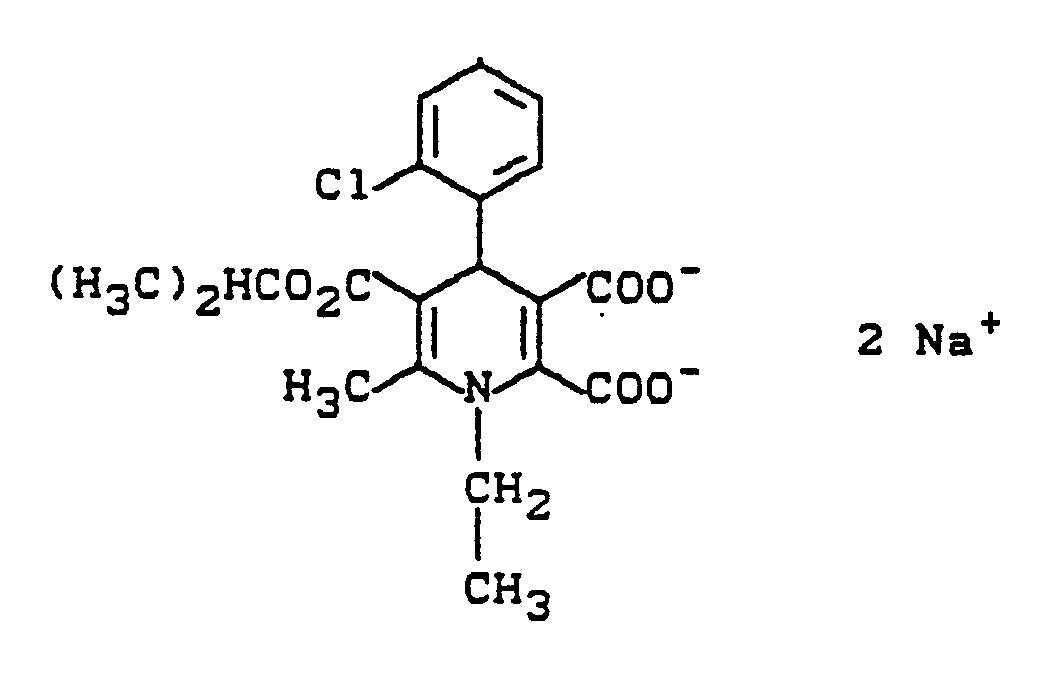
- 120 mg 4-(2-Chlorphenyl)-5,7-dioxo-1-ethyl-2-methyl-1,4,5,7-tetrahydrofuro[3,4-b]pyridin-3-carbonsäure-isopropylester werden in 20 ml tert-Butanol in der Wärme gelöst und sofort solange mit 2 Equivalenten 0,2 N wässriger Natronlauge versetzt. Es wird eingefroren und gefriergetrocknet.
Ausbeute: 120 mg
Schmp.: amorph.
Claims (11)

R¹ - für Phenyl, Naphthyl, Thienyl, Pyridyl, Chromenyl oder Thiochromenyl steht, wobei die genannten Reste jeweils bis zu 2 gleiche oder verschiedene Substituenten aus der Reihe Halogen, Alkyl, Alkoxy, Alkylthio mit jeweils bis zu 6 Kohlenstoffatomen, Fluoralkyl, Fluoralkoxy mit jeweils bis zu 3 Kohlenstoffatomen und 3 Fluoratomen, Nitro oder Cyano tragen können,
R² - für geradkettiges, verzweigtes oder cyclisches Alkyl mit bis zu 8 Kohlenstoffatomen steht, das in der Alkylkette durch ein Sauerstoff- oder ein Schwefelatom unterbrochen sein kann und das substituiert sein kann durch Halogen, Phenyl, Cyano, Hydroxy, Amino, Alkylamino, Dialkylamino mit jeweils bis zu 3 Kohlenstoffatomen je Alkylgruppe oder durch N-Benzyl-N-methylamino,
R³ - für geradkettiges, verzweigtes oder cyclisches Alkyl mit bis zu 6 Kohlenstoffatomen steht, das in der Alkylkette durch ein Sauerstoffatom unterbrochen sein kann und das substituiert sein kann durch Halogen, Hydroxy, Amino, Phenyl, Morpholino, Carboxy oder Alkoxycarbonyl mit bis zu 4 Kohlenstoffatomen
und
R⁴ und R⁵ - jeweils für Hydroxy stehen,
oder
R⁴ und R⁵ zusammen für -O- stehen, in Form ihrer Isomeren, Isomerengemische, optischen Antipoden oder Racemate sowie ihrer physiologisch unbedenklichen Salze.
R¹ - für Phenyl oder Thienyl steht, wobei die genannten Reste bis zu 2 gleiche oder verschiedene Substituenten der Reihe, Fluor, Chlor, Alkyl, Alkoxy mit jeweils bis zu 3 Kohlenstoffatomen, Trifluormethyl, Nitro oder Cyano tragen können,
R² - für geradkettiges oder verzweigtes Alkyl mit bis zu 6 Kohlenstoffatomen steht, das durch ein Sauerstoffatom in der Alkylkette unterbrochen sein kann und das substituiert sein kann durch Fluor, Chlor oder Phenyl,
R³ - für geradkettiges oder verzweigtes Alkyl mit bis zu 6 Kohlenstoffatomen steht, das durch Hydroxy oder Alkoxycarbonyl mit bis zu 2 Kohlenstoffatomen substituiert sein kann
und
R⁴ und R⁵ - jeweils für Hydroxy stehen,
oder
R⁴ und R⁵ zusammen für -O- stehen,
in Form ihrer Isomeren, Isomerengemische, optischen Antipoden oder Racemate sowie ihrer physiologisch unbedenklichen Salze.
R¹ - für Phenyl steht, das bis zu 2-fach gleich oder verschieden substituiert sein kann durch Chlor, Alkyl mit bis zu 3 Kohlenstoffatomen, Trifluormethyl oder Nitro,
R² - für geradkettiges oder verzweigtes Alkyl mit bis zu 4 Kohlenstoffatomen steht, das in der Alkylkette durch ein Sauerstoffatom unterbrochen sein kann,
R³ - für geradkettiges oder verzweigtes Alkyl mit bis zu 4 Kohlenstoffatomen steht
und
R⁴ und R⁵ - jeweils für Hydroxy stehen,
oder
R⁴ und R⁵ zusammen für -O- stehen,
in Form ihrer Isomeren, Isomerengemische, optischen Antipoden oder Racemate sowie ihrer physiologisch unbedenklichen Salze.

R¹ - für Phenyl, Naphthyl, Thienyl, Pyridyl, Chromenyl oder Thiochromenyl steht, wobei die genannten Reste jeweils bis zu 2 gleiche oder verschiedene Substituenten aus der Reihe Halogen, Alkyl, Alkoxy, Alkylthio mit jeweils bis zu 6 Kohlenstoffatomen, Fluoralkyl, Fluoralkoxy mit jeweils bis zu 3 Kohlenstoffatomen und 3 Fluoratomen, Nitro oder Cyano tragen können,
R² - für geradkettiges, verzweigtes oder cyclisches Alkyl mit bis zu 8 Kohlenstoffatomen steht, das in der Alkylkette durch ein Sauerstoff- oder ein Schwefelatom unterbrochen sein kann und das substituiert sein kann durch Halogen, Phenyl, Cyano, Hydroxy, Amino, Alkylamino, Dialkylamino mit jeweils bis zu 3 Kohlenstoffatomen je Alkylgruppe oder durch N-Benzyl-N-methylamino,
R³ - für geradkettiges, verzweigtes oder cyclisches Alkyl mit bis zu 6 Kohlenstoffatomen steht, das in der Alkylkette durch ein Sauerstoffatom unterbrochen sein kann und das substituiert sein kann durch Halogen, Hydroxy, Amino, Phenyl, Morpholino, Carboxy oder Alkoxycarbonyl mit bis zu 4 Kohlenstoffatomen
und
R⁴ und R⁵ - jeweils für Hydroxy stehen,
oder
R⁴ und R⁵ zusammen für -O- stehen,
dadurch gekennzeichnet, daß man zur Herstellung solcher Verbindungen der allgemeinen Formel (I), in welcher
R⁴ und R⁵ zusammen für -O- stehen,
Dihydropyridinlactole der allgemeinen Formel (II)

R¹, R² und R³ die oben angegebene Bedeutung haben,
in inerten Lösemitteln, in Gegenwart von Oxidationsmittel bei Temperaturen zwischen -30° C und +60° C oxidiert.
und die erhaltenen Anhydride gegebenenfalls in Gegenwart von Basen in inerten Lösemitteln bei Temperaturen zwischen 0 bis 100° C hydrolysiert zu Verbindungen der allgemeinen Formel (I), in welcher
R⁴ und R⁵ jeweils für Hydroxy stehen.
R¹ - für Phenyl oder Thienyl steht, wobei die genannten Reste bis zu 2 gleiche oder verschiedene Substituenten der Reihe, Fluor, Chlor, Alkyl, Alkoxy mit jeweils bis zu 3 Kohlenstoffatomen, Trifluormethyl, Nitro oder Cyano tragen können,
R² - für geradkettiges oder verzweigtes Alkyl mit bis zu 6 Kohlenstoffatomen steht, das durch ein Sauerstoffatom in der Alkylkette unterbrochen sein kann und das substituiert sein kann durch Fluor, Chlor oder Phenyl,
R³ - für geradkettiges oder verzweigtes Alkyl mit bis zu 6 Kohlenstoffatomen steht, das durch Hydroxy oder Alkoxycarbonyl mit bis zu 2 Kohlenstoffatomen substituiert sein kann
und
R⁴ und R⁵ - jeweils für Hydroxy stehen,
oder
R⁴ und R⁵ zusammen für -O- stehen.
R¹ - für Phenyl steht, das bis zu 2-fach gleich oder verschieden substituiert sein kann durch Chlor, Alkyl mit bis zu 3 Kohlenstoffatomen, Trifluormethyl oder Nitro,
R² - für geradkettiges oder verzweigtes Alkyl mit bis zu 4 Kohlenstoffatomen steht, das in der Alkylkette durch ein Sauerstoffatom unterbrochen sein kann,
R³ - für geradkettiges oder verzweigtes Alkyl mit bis zu 4 Kohlenstoffatomen steht
und
R⁴ und R⁵ - jeweils für Hydroxy stehen,
oder
R⁴ und R⁵ zusammen für -O- stehen.
Priority Applications (1)
| Application Number | Priority Date | Filing Date | Title |
|---|---|---|---|
| AT87111924T ATE52250T1 (de) | 1986-08-30 | 1987-08-18 | Dihydropyridinverbindungen, verfahren zu ihrer herstellung und ihre verwendung. |
Applications Claiming Priority (2)
| Application Number | Priority Date | Filing Date | Title |
|---|---|---|---|
| DE3629545 | 1986-08-30 | ||
| DE19863629545 DE3629545A1 (de) | 1986-08-30 | 1986-08-30 | Dihydropyridinverbindungen, verfahren zu ihrer herstellung und ihre verwendung |
Publications (3)
| Publication Number | Publication Date |
|---|---|
| EP0258729A2 true EP0258729A2 (de) | 1988-03-09 |
| EP0258729A3 EP0258729A3 (en) | 1988-06-15 |
| EP0258729B1 EP0258729B1 (de) | 1990-04-25 |
Family
ID=6308550
Family Applications (1)
| Application Number | Title | Priority Date | Filing Date |
|---|---|---|---|
| EP87111924A Expired - Lifetime EP0258729B1 (de) | 1986-08-30 | 1987-08-18 | Dihydropyridinverbindungen, Verfahren zu ihrer Herstellung und ihre Verwendung |
Country Status (18)
| Country | Link |
|---|---|
| US (1) | US4786641A (de) |
| EP (1) | EP0258729B1 (de) |
| JP (1) | JPH0832685B2 (de) |
| KR (1) | KR880002874A (de) |
| CN (1) | CN87105876A (de) |
| AT (1) | ATE52250T1 (de) |
| AU (1) | AU602529B2 (de) |
| CA (1) | CA1300626C (de) |
| DD (1) | DD263985A5 (de) |
| DE (2) | DE3629545A1 (de) |
| DK (1) | DK452687A (de) |
| ES (1) | ES2014456B3 (de) |
| FI (1) | FI873726A7 (de) |
| GR (1) | GR3000447T3 (de) |
| HU (1) | HU199120B (de) |
| IL (1) | IL83661A0 (de) |
| PT (1) | PT85622B (de) |
| ZA (1) | ZA876434B (de) |
Cited By (1)
| Publication number | Priority date | Publication date | Assignee | Title |
|---|---|---|---|---|
| EP0705830A1 (de) * | 1994-08-25 | 1996-04-10 | Bayer Ag | 2,3-Cyclisch kondensierte 1,4-Dihydropyridine, Verfahren zu ihrer Herstellung und ihre Verwendung als selektive Kaliumkanalmodulatoren |
Families Citing this family (16)
| Publication number | Priority date | Publication date | Assignee | Title |
|---|---|---|---|---|
| EP0657432B1 (de) * | 1993-12-10 | 2003-03-12 | Bayer Ag | Phenyl-substituierte 1,4-Dihydropyridine mit cerebraler Aktivität |
| JPH11106375A (ja) * | 1997-08-18 | 1999-04-20 | Pfizer Pharmaceut Inc | ブラジキニンアンタゴニストとしての光学的に活性な1,4−ジヒドロピリジン化合物 |
| US6711297B1 (en) * | 1998-07-03 | 2004-03-23 | University Of Pittsburgh - Of The Commonwealth System Of Higher Education | Methods and apparatus for dynamic transfer of image data |
| CO5271699A1 (es) | 2000-01-24 | 2003-04-30 | Pfizer Prod Inc | Procedimiento para el tratamiento de cardiomiopatia utilizando inhibidores de la glucogeno fosforilasa |
| GB0021831D0 (en) * | 2000-09-06 | 2000-10-18 | Astrazeneca Ab | Chemical compounds |
| GB0205176D0 (en) * | 2002-03-06 | 2002-04-17 | Astrazeneca Ab | Chemical compounds |
| GB0205175D0 (en) * | 2002-03-06 | 2002-04-17 | Astrazeneca Ab | Chemical compounds |
| GB0205162D0 (en) * | 2002-03-06 | 2002-04-17 | Astrazeneca Ab | Chemical compounds |
| GB0205170D0 (en) | 2002-03-06 | 2002-04-17 | Astrazeneca Ab | Chemical compounds |
| GB0205165D0 (en) * | 2002-03-06 | 2002-04-17 | Astrazeneca Ab | Chemical compounds |
| GB0205166D0 (en) | 2002-03-06 | 2002-04-17 | Astrazeneca Ab | Chemical compounds |
| GB0318464D0 (en) * | 2003-08-07 | 2003-09-10 | Astrazeneca Ab | Chemical compounds |
| GB0318463D0 (en) * | 2003-08-07 | 2003-09-10 | Astrazeneca Ab | Chemical compounds |
| GB0319690D0 (en) * | 2003-08-22 | 2003-09-24 | Astrazeneca Ab | Chemical compounds |
| GB0319759D0 (en) * | 2003-08-22 | 2003-09-24 | Astrazeneca Ab | Chemical compounds |
| AU2004272078A1 (en) * | 2003-09-10 | 2005-03-24 | Synta Pharmaceuticals Corp. | Dihydropyridine compounds for treating or preventing metabolic disorders |
Family Cites Families (9)
| Publication number | Priority date | Publication date | Assignee | Title |
|---|---|---|---|---|
| GB125803A (en) * | 1918-05-29 | 1919-05-01 | Joseph Ernest Barrows | Improvements in Sparking Plugs for use with Internal Combustion Engines. |
| GB161221A (en) * | 1919-11-21 | 1921-03-21 | Edwin William Nick | Improved method of feed-water regulation for marine boilers and means therefor |
| GB158138A (en) * | 1919-11-25 | 1921-02-03 | Herman Schoener | Improvements in weed cutters or hoes |
| DE2248150A1 (de) * | 1972-09-30 | 1974-04-04 | Bayer Ag | Dihydropyridinpolyester, verfahren zu ihrer herstellung sowie ihre verwendung als arzneimittel |
| US3970662A (en) * | 1975-06-19 | 1976-07-20 | Sterling Drug Inc. | 4-(3-Nitrophenyl)-2,3,5,6-pyridinetetracarboxylic acid and intermediates |
| EP0125803A3 (de) * | 1983-04-27 | 1987-01-21 | FISONS plc | Pharmazeutisch aktive Dihydropyridine |
| DE3445356A1 (de) * | 1983-12-15 | 1985-06-27 | Ciba-Geigy Ag, Basel | Halogenierte thiophen-verbindungen |
| DE3410645A1 (de) * | 1984-03-23 | 1985-09-26 | Bayer Ag, 5090 Leverkusen | L-alkylsubstituierte 1,4-dihydropyridinlactone, verfahren zu ihrer herstellung und ihre verwendung in arzneimitteln |
| US4748244A (en) * | 1984-05-11 | 1988-05-31 | Ciba-Geigy Corporation | Process for the preparation of pyridine-2-3-dicarboxylic acid derivatives, and novel 1-amino-1,4-dihydropyridine-2-3-diarboxylic acid derivatives |
-
1986
- 1986-08-30 DE DE19863629545 patent/DE3629545A1/de not_active Withdrawn
-
1987
- 1987-08-18 EP EP87111924A patent/EP0258729B1/de not_active Expired - Lifetime
- 1987-08-18 ES ES87111924T patent/ES2014456B3/es not_active Expired - Lifetime
- 1987-08-18 DE DE8787111924T patent/DE3762416D1/de not_active Expired - Lifetime
- 1987-08-18 AT AT87111924T patent/ATE52250T1/de not_active IP Right Cessation
- 1987-08-20 US US07/087,491 patent/US4786641A/en not_active Expired - Fee Related
- 1987-08-27 IL IL83661A patent/IL83661A0/xx not_active IP Right Cessation
- 1987-08-27 FI FI873726A patent/FI873726A7/fi not_active Application Discontinuation
- 1987-08-28 CA CA000545604A patent/CA1300626C/en not_active Expired - Lifetime
- 1987-08-28 PT PT85622A patent/PT85622B/pt not_active IP Right Cessation
- 1987-08-28 HU HU873794A patent/HU199120B/hu not_active IP Right Cessation
- 1987-08-28 AU AU77695/87A patent/AU602529B2/en not_active Ceased
- 1987-08-28 CN CN198787105876A patent/CN87105876A/zh active Pending
- 1987-08-28 ZA ZA876434A patent/ZA876434B/xx unknown
- 1987-08-28 DK DK452687A patent/DK452687A/da not_active Application Discontinuation
- 1987-08-28 DD DD87306465A patent/DD263985A5/de not_active IP Right Cessation
- 1987-08-28 JP JP62213163A patent/JPH0832685B2/ja not_active Expired - Lifetime
- 1987-08-29 KR KR1019870009512A patent/KR880002874A/ko not_active Withdrawn
-
1990
- 1990-04-26 GR GR90400152T patent/GR3000447T3/el unknown
Cited By (2)
| Publication number | Priority date | Publication date | Assignee | Title |
|---|---|---|---|---|
| EP0705830A1 (de) * | 1994-08-25 | 1996-04-10 | Bayer Ag | 2,3-Cyclisch kondensierte 1,4-Dihydropyridine, Verfahren zu ihrer Herstellung und ihre Verwendung als selektive Kaliumkanalmodulatoren |
| US6121284A (en) * | 1994-08-25 | 2000-09-19 | Bayer Aktiengesellschaft | 2,3-bridged 1,4-dihydropyridines, and their use as medicaments |
Also Published As
| Publication number | Publication date |
|---|---|
| CA1300626C (en) | 1992-05-12 |
| AU7769587A (en) | 1988-03-03 |
| HU199120B (en) | 1990-01-29 |
| PT85622A (en) | 1987-09-01 |
| DK452687D0 (da) | 1987-08-28 |
| ZA876434B (en) | 1988-05-25 |
| JPH0832685B2 (ja) | 1996-03-29 |
| ES2014456B3 (es) | 1990-07-16 |
| FI873726A0 (fi) | 1987-08-27 |
| GR3000447T3 (en) | 1991-06-28 |
| HUT45014A (en) | 1988-05-30 |
| IL83661A0 (en) | 1988-01-31 |
| KR880002874A (ko) | 1988-05-12 |
| CN87105876A (zh) | 1988-03-23 |
| US4786641A (en) | 1988-11-22 |
| DE3629545A1 (de) | 1988-03-10 |
| DE3762416D1 (de) | 1990-05-31 |
| AU602529B2 (en) | 1990-10-18 |
| ATE52250T1 (de) | 1990-05-15 |
| EP0258729A3 (en) | 1988-06-15 |
| DD263985A5 (de) | 1989-01-18 |
| EP0258729B1 (de) | 1990-04-25 |
| FI873726A7 (fi) | 1988-03-01 |
| JPS6372674A (ja) | 1988-04-02 |
| DK452687A (da) | 1988-03-01 |
| PT85622B (pt) | 1990-05-31 |
Similar Documents
| Publication | Publication Date | Title |
|---|---|---|
| DE2560549C2 (de) | ||
| EP0258729B1 (de) | Dihydropyridinverbindungen, Verfahren zu ihrer Herstellung und ihre Verwendung | |
| DE3525564A1 (de) | Tricyclische verbindungen mit indolstruktur, verfahren zu ihrer herstellung und deren verwendung als arzneimittel | |
| EP0148440A1 (de) | 1,3,4,5-Tetrahydrobenz[c,d]indole, ein Verfahren zu ihrer Herstellung und ihre Verwendung | |
| EP0189370A2 (de) | Spiro-dioxolane, -dithiolane und -oxothiolane | |
| EP0452712A1 (de) | Neue 4-Chinolyl-dihydropyridine, Verfahren zu ihrer Herstellung und ihre Verwendung in Arzneimitteln | |
| WO1985000171A1 (fr) | Spiroxuccinimides, leur fabrication et leur utilisation | |
| DE2351411C2 (de) | (1-Oxo-2,3-hydrocarbylen-6,7-dichlor-5- indanyloxy)-essigsäuren, Verfahren zu ihrer Herstellung und sie enthaltende pharmazeutische Mittel | |
| EP0519291B1 (de) | Aminomethyl-substituierte 2,3-Dihydropyrano(2,3-b)pyridine, Verfahren zu ihrer Herstellung und ihre Verwendung in Arzneimitteln | |
| EP0705830A1 (de) | 2,3-Cyclisch kondensierte 1,4-Dihydropyridine, Verfahren zu ihrer Herstellung und ihre Verwendung als selektive Kaliumkanalmodulatoren | |
| EP0087655A1 (de) | Verfahren zur Herstellung von Acemetacin | |
| EP0235347B1 (de) | Dihydropyridinlactole, Verfahren zur Herstellung und ihre Verwendung in Arzneimitteln | |
| EP0627427A1 (de) | 3-Chinolyl substituierte Dihydropyridine, Verfahren zu ihrer Herstellung und ihre Verwendung in Arzneimitteln | |
| EP0770082A1 (de) | Dioxo-thiopyrano-pyridin-carbonsäure-derivate und ihre verwendung als arzneimittel | |
| EP0313935B1 (de) | Enolether von 6-Chlor-4-hydroxy-2-methyl-N-(2-pyridyl)-2H-thieno(2,3-e)-1,2-thiazin-3-carbonsäureamid-1,1-dioxid, ein Verfahren zu ihrer Herstellung sowie ihre Verwendung | |
| EP0088323B1 (de) | Imidazothiadiazolalkencarbonsäureamide, neue Zwischenprodukte zu ihrer Herstellung, ihre Herstellung und ihre Verwendung in Arzneimitteln | |
| EP0229963B1 (de) | 4-Thienyl-dihydropyridine, Verfahren zur Herstellung und ihre Verwendung in Arzneimitteln | |
| DE3020421A1 (de) | Imidazoazolalkensaeureamide, neue zwischenprodukte zu ihrer herstellung, ihre herstellung und ihre verwendung in arzneimitteln | |
| DE3520104A1 (de) | Naphthoxazine, ihre herstellung und verwendung | |
| DE2818290A1 (de) | Neue naphthyridine | |
| EP0231511B1 (de) | A-Aminoaryldihydropyridinlactone, Verfahren zu ihrer Herstellung und ihre Verwendung in Arzneimitteln | |
| DE3700825A1 (de) | 8(alpha)-acylaminoergoline, ihre herstellung und verwendung | |
| DE2458146A1 (de) | Chinolinderivate | |
| DE2906253A1 (de) | Furonaphthyridinverbindungen und arzneimittel | |
| EP0334147A1 (de) | Disubstituierte Pyrrole |
Legal Events
| Date | Code | Title | Description |
|---|---|---|---|
| PUAI | Public reference made under article 153(3) epc to a published international application that has entered the european phase |
Free format text: ORIGINAL CODE: 0009012 |
|
| 17P | Request for examination filed |
Effective date: 19870818 |
|
| AK | Designated contracting states |
Kind code of ref document: A2 Designated state(s): AT BE CH DE ES FR GB GR IT LI NL SE |
|
| PUAL | Search report despatched |
Free format text: ORIGINAL CODE: 0009013 |
|
| AK | Designated contracting states |
Kind code of ref document: A3 Designated state(s): AT BE CH DE ES FR GB GR IT LI NL SE |
|
| 17Q | First examination report despatched |
Effective date: 19881026 |
|
| GRAA | (expected) grant |
Free format text: ORIGINAL CODE: 0009210 |
|
| AK | Designated contracting states |
Kind code of ref document: B1 Designated state(s): AT BE CH DE ES FR GB GR IT LI NL SE |
|
| REF | Corresponds to: |
Ref document number: 52250 Country of ref document: AT Date of ref document: 19900515 Kind code of ref document: T |
|
| REF | Corresponds to: |
Ref document number: 3762416 Country of ref document: DE Date of ref document: 19900531 |
|
| ET | Fr: translation filed | ||
| GBT | Gb: translation of ep patent filed (gb section 77(6)(a)/1977) | ||
| ITF | It: translation for a ep patent filed | ||
| PLBE | No opposition filed within time limit |
Free format text: ORIGINAL CODE: 0009261 |
|
| STAA | Information on the status of an ep patent application or granted ep patent |
Free format text: STATUS: NO OPPOSITION FILED WITHIN TIME LIMIT |
|
| 26N | No opposition filed | ||
| PGFP | Annual fee paid to national office [announced via postgrant information from national office to epo] |
Ref country code: AT Payment date: 19910729 Year of fee payment: 5 |
|
| PGFP | Annual fee paid to national office [announced via postgrant information from national office to epo] |
Ref country code: ES Payment date: 19910813 Year of fee payment: 5 |
|
| PGFP | Annual fee paid to national office [announced via postgrant information from national office to epo] |
Ref country code: GR Payment date: 19910816 Year of fee payment: 5 |
|
| PGFP | Annual fee paid to national office [announced via postgrant information from national office to epo] |
Ref country code: BE Payment date: 19910828 Year of fee payment: 5 |
|
| PGFP | Annual fee paid to national office [announced via postgrant information from national office to epo] |
Ref country code: NL Payment date: 19910831 Year of fee payment: 5 |
|
| PG25 | Lapsed in a contracting state [announced via postgrant information from national office to epo] |
Ref country code: AT Effective date: 19920818 |
|
| PG25 | Lapsed in a contracting state [announced via postgrant information from national office to epo] |
Ref country code: ES Free format text: LAPSE BECAUSE OF THE APPLICANT RENOUNCES Effective date: 19920819 |
|
| PG25 | Lapsed in a contracting state [announced via postgrant information from national office to epo] |
Ref country code: BE Effective date: 19920831 |
|
| BERE | Be: lapsed |
Owner name: BAYER A.G. Effective date: 19920831 |
|
| PG25 | Lapsed in a contracting state [announced via postgrant information from national office to epo] |
Ref country code: GR Free format text: THE PATENT HAS BEEN ANNULLED BY A DECISION OF A NATIONAL AUTHORITY Effective date: 19930228 |
|
| PG25 | Lapsed in a contracting state [announced via postgrant information from national office to epo] |
Ref country code: NL Effective date: 19930301 |
|
| NLV4 | Nl: lapsed or anulled due to non-payment of the annual fee | ||
| ITTA | It: last paid annual fee | ||
| EAL | Se: european patent in force in sweden |
Ref document number: 87111924.4 |
|
| REG | Reference to a national code |
Ref country code: GR Ref legal event code: MH4A Free format text: 3000447 |
|
| PGFP | Annual fee paid to national office [announced via postgrant information from national office to epo] |
Ref country code: DE Payment date: 19990716 Year of fee payment: 13 |
|
| PGFP | Annual fee paid to national office [announced via postgrant information from national office to epo] |
Ref country code: SE Payment date: 19990726 Year of fee payment: 13 Ref country code: CH Payment date: 19990726 Year of fee payment: 13 |
|
| PGFP | Annual fee paid to national office [announced via postgrant information from national office to epo] |
Ref country code: GB Payment date: 19990818 Year of fee payment: 13 Ref country code: FR Payment date: 19990818 Year of fee payment: 13 |
|
| REG | Reference to a national code |
Ref country code: ES Ref legal event code: FD2A Effective date: 19991007 |
|
| PG25 | Lapsed in a contracting state [announced via postgrant information from national office to epo] |
Ref country code: GB Free format text: LAPSE BECAUSE OF NON-PAYMENT OF DUE FEES Effective date: 20000818 |
|
| PG25 | Lapsed in a contracting state [announced via postgrant information from national office to epo] |
Ref country code: SE Free format text: LAPSE BECAUSE OF NON-PAYMENT OF DUE FEES Effective date: 20000819 |
|
| PG25 | Lapsed in a contracting state [announced via postgrant information from national office to epo] |
Ref country code: LI Free format text: LAPSE BECAUSE OF NON-PAYMENT OF DUE FEES Effective date: 20000831 Ref country code: CH Free format text: LAPSE BECAUSE OF NON-PAYMENT OF DUE FEES Effective date: 20000831 |
|
| GBPC | Gb: european patent ceased through non-payment of renewal fee |
Effective date: 20000818 |
|
| REG | Reference to a national code |
Ref country code: CH Ref legal event code: PL |
|
| EUG | Se: european patent has lapsed |
Ref document number: 87111924.4 |
|
| PG25 | Lapsed in a contracting state [announced via postgrant information from national office to epo] |
Ref country code: FR Free format text: LAPSE BECAUSE OF NON-PAYMENT OF DUE FEES Effective date: 20010430 |
|
| PG25 | Lapsed in a contracting state [announced via postgrant information from national office to epo] |
Ref country code: DE Free format text: LAPSE BECAUSE OF NON-PAYMENT OF DUE FEES Effective date: 20010501 |
|
| REG | Reference to a national code |
Ref country code: FR Ref legal event code: ST |
|
| PG25 | Lapsed in a contracting state [announced via postgrant information from national office to epo] |
Ref country code: IT Free format text: LAPSE BECAUSE OF NON-PAYMENT OF DUE FEES;WARNING: LAPSES OF ITALIAN PATENTS WITH EFFECTIVE DATE BEFORE 2007 MAY HAVE OCCURRED AT ANY TIME BEFORE 2007. THE CORRECT EFFECTIVE DATE MAY BE DIFFERENT FROM THE ONE RECORDED. Effective date: 20050818 |