EP0088323B1 - Imidazothiadiazolalkencarbonsäureamide, neue Zwischenprodukte zu ihrer Herstellung, ihre Herstellung und ihre Verwendung in Arzneimitteln - Google Patents
Imidazothiadiazolalkencarbonsäureamide, neue Zwischenprodukte zu ihrer Herstellung, ihre Herstellung und ihre Verwendung in Arzneimitteln Download PDFInfo
- Publication number
- EP0088323B1 EP0088323B1 EP83101929A EP83101929A EP0088323B1 EP 0088323 B1 EP0088323 B1 EP 0088323B1 EP 83101929 A EP83101929 A EP 83101929A EP 83101929 A EP83101929 A EP 83101929A EP 0088323 B1 EP0088323 B1 EP 0088323B1
- Authority
- EP
- European Patent Office
- Prior art keywords
- alkyl
- general formula
- optionally
- different
- substituted
- Prior art date
- Legal status (The legal status is an assumption and is not a legal conclusion. Google has not performed a legal analysis and makes no representation as to the accuracy of the status listed.)
- Expired
Links
- 238000002360 preparation method Methods 0.000 title claims description 16
- 239000003814 drug Substances 0.000 title claims description 9
- 229940079593 drug Drugs 0.000 title description 4
- 239000000543 intermediate Substances 0.000 title description 3
- 125000000217 alkyl group Chemical group 0.000 claims abstract description 30
- 229910052739 hydrogen Inorganic materials 0.000 claims abstract description 20
- 239000001257 hydrogen Substances 0.000 claims abstract description 20
- 229910052736 halogen Inorganic materials 0.000 claims abstract description 19
- 150000002367 halogens Chemical group 0.000 claims abstract description 19
- 229910052760 oxygen Inorganic materials 0.000 claims abstract description 18
- 125000001997 phenyl group Chemical group [H]C1=C([H])C([H])=C(*)C([H])=C1[H] 0.000 claims abstract description 18
- 239000002253 acid Substances 0.000 claims abstract description 17
- 239000001301 oxygen Substances 0.000 claims abstract description 15
- 125000002023 trifluoromethyl group Chemical group FC(F)(F)* 0.000 claims abstract description 14
- 125000003545 alkoxy group Chemical group 0.000 claims abstract description 13
- 229910052757 nitrogen Inorganic materials 0.000 claims abstract description 11
- QVGXLLKOCUKJST-UHFFFAOYSA-N atomic oxygen Chemical compound [O] QVGXLLKOCUKJST-UHFFFAOYSA-N 0.000 claims abstract description 8
- 125000003118 aryl group Chemical group 0.000 claims abstract description 7
- 125000004433 nitrogen atom Chemical group N* 0.000 claims abstract description 7
- 125000001424 substituent group Chemical group 0.000 claims abstract description 7
- 150000001412 amines Chemical class 0.000 claims abstract description 6
- 125000004663 dialkyl amino group Chemical group 0.000 claims abstract description 6
- 125000002541 furyl group Chemical group 0.000 claims abstract description 6
- 125000004076 pyridyl group Chemical group 0.000 claims abstract description 6
- 125000000714 pyrimidinyl group Chemical group 0.000 claims abstract description 6
- 125000001544 thienyl group Chemical group 0.000 claims abstract description 6
- 125000000449 nitro group Chemical group [O-][N+](*)=O 0.000 claims abstract description 5
- 125000003710 aryl alkyl group Chemical group 0.000 claims abstract description 4
- 125000004122 cyclic group Chemical group 0.000 claims abstract description 4
- 229920006395 saturated elastomer Polymers 0.000 claims abstract description 4
- 150000001408 amides Chemical class 0.000 claims abstract 5
- 125000004432 carbon atom Chemical group C* 0.000 claims description 25
- 150000001875 compounds Chemical class 0.000 claims description 21
- 238000000034 method Methods 0.000 claims description 19
- UFHFLCQGNIYNRP-UHFFFAOYSA-N Hydrogen Chemical compound [H][H] UFHFLCQGNIYNRP-UHFFFAOYSA-N 0.000 claims description 17
- 239000003960 organic solvent Substances 0.000 claims description 12
- 150000001728 carbonyl compounds Chemical class 0.000 claims description 11
- IJGRMHOSHXDMSA-UHFFFAOYSA-N Atomic nitrogen Chemical compound N#N IJGRMHOSHXDMSA-UHFFFAOYSA-N 0.000 claims description 10
- 125000001797 benzyl group Chemical group [H]C1=C([H])C([H])=C(C([H])=C1[H])C([H])([H])* 0.000 claims description 10
- 150000002431 hydrogen Chemical group 0.000 claims description 10
- 150000003839 salts Chemical class 0.000 claims description 10
- MYMOFIZGZYHOMD-UHFFFAOYSA-N Dioxygen Chemical compound O=O MYMOFIZGZYHOMD-UHFFFAOYSA-N 0.000 claims description 7
- 150000007513 acids Chemical class 0.000 claims description 7
- FYSNRJHAOHDILO-UHFFFAOYSA-N thionyl chloride Chemical compound ClS(Cl)=O FYSNRJHAOHDILO-UHFFFAOYSA-N 0.000 claims description 7
- 239000003795 chemical substances by application Substances 0.000 claims description 6
- HBAQYPYDRFILMT-UHFFFAOYSA-N 8-[3-(1-cyclopropylpyrazol-4-yl)-1H-pyrazolo[4,3-d]pyrimidin-5-yl]-3-methyl-3,8-diazabicyclo[3.2.1]octan-2-one Chemical class C1(CC1)N1N=CC(=C1)C1=NNC2=C1N=C(N=C2)N1C2C(N(CC1CC2)C)=O HBAQYPYDRFILMT-UHFFFAOYSA-N 0.000 claims description 5
- 125000003178 carboxy group Chemical group [H]OC(*)=O 0.000 claims description 5
- ABLZXFCXXLZCGV-UHFFFAOYSA-N Phosphorous acid Chemical class OP(O)=O ABLZXFCXXLZCGV-UHFFFAOYSA-N 0.000 claims description 4
- NGNBDVOYPDDBFK-UHFFFAOYSA-N 2-[2,4-di(pentan-2-yl)phenoxy]acetyl chloride Chemical compound CCCC(C)C1=CC=C(OCC(Cl)=O)C(C(C)CCC)=C1 NGNBDVOYPDDBFK-UHFFFAOYSA-N 0.000 claims description 3
- 150000003869 acetamides Chemical class 0.000 claims description 3
- 230000004913 activation Effects 0.000 claims description 3
- 239000003054 catalyst Substances 0.000 claims description 3
- 150000007530 organic bases Chemical class 0.000 claims description 3
- 229930195734 saturated hydrocarbon Natural products 0.000 claims description 3
- 229930195735 unsaturated hydrocarbon Natural products 0.000 claims description 3
- 239000012442 inert solvent Substances 0.000 claims description 2
- 239000000546 pharmaceutical excipient Substances 0.000 claims description 2
- 125000000547 substituted alkyl group Chemical group 0.000 claims description 2
- 201000010099 disease Diseases 0.000 claims 1
- 208000037265 diseases, disorders, signs and symptoms Diseases 0.000 claims 1
- -1 NH or N-alkyl Chemical compound 0.000 abstract description 15
- 239000002934 diuretic Substances 0.000 abstract description 6
- 229940030606 diuretics Drugs 0.000 abstract description 3
- 125000004435 hydrogen atom Chemical class [H]* 0.000 abstract 3
- 229910052717 sulfur Inorganic materials 0.000 abstract 3
- NINIDFKCEFEMDL-UHFFFAOYSA-N Sulfur Chemical compound [S] NINIDFKCEFEMDL-UHFFFAOYSA-N 0.000 abstract 2
- 239000005864 Sulphur Substances 0.000 abstract 2
- 125000005842 heteroatom Chemical group 0.000 abstract 2
- 229940116731 Uricosuric agent Drugs 0.000 abstract 1
- 125000004453 alkoxycarbonyl group Chemical group 0.000 abstract 1
- 125000004414 alkyl thio group Chemical group 0.000 abstract 1
- 125000004093 cyano group Chemical group *C#N 0.000 abstract 1
- 125000002887 hydroxy group Chemical group [H]O* 0.000 abstract 1
- 125000002183 isoquinolinyl group Chemical group C1(=NC=CC2=CC=CC=C12)* 0.000 abstract 1
- 125000003373 pyrazinyl group Chemical group 0.000 abstract 1
- 125000002943 quinolinyl group Chemical group N1=C(C=CC2=CC=CC=C12)* 0.000 abstract 1
- 125000003107 substituted aryl group Chemical group 0.000 abstract 1
- 239000003383 uricosuric agent Substances 0.000 abstract 1
- RTZKZFJDLAIYFH-UHFFFAOYSA-N ether Substances CCOCC RTZKZFJDLAIYFH-UHFFFAOYSA-N 0.000 description 18
- LFQSCWFLJHTTHZ-UHFFFAOYSA-N Ethanol Chemical compound CCO LFQSCWFLJHTTHZ-UHFFFAOYSA-N 0.000 description 12
- ZMXDDKWLCZADIW-UHFFFAOYSA-N N,N-Dimethylformamide Chemical compound CN(C)C=O ZMXDDKWLCZADIW-UHFFFAOYSA-N 0.000 description 12
- HEDRZPFGACZZDS-UHFFFAOYSA-N Chloroform Chemical compound ClC(Cl)Cl HEDRZPFGACZZDS-UHFFFAOYSA-N 0.000 description 10
- 239000000126 substance Substances 0.000 description 10
- HEMHJVSKTPXQMS-UHFFFAOYSA-M Sodium hydroxide Chemical compound [OH-].[Na+] HEMHJVSKTPXQMS-UHFFFAOYSA-M 0.000 description 9
- 239000000203 mixture Substances 0.000 description 9
- 150000003254 radicals Chemical class 0.000 description 9
- 241001465754 Metazoa Species 0.000 description 8
- NQRYJNQNLNOLGT-UHFFFAOYSA-N Piperidine Chemical compound C1CCNCC1 NQRYJNQNLNOLGT-UHFFFAOYSA-N 0.000 description 8
- 239000000725 suspension Substances 0.000 description 8
- 241000700159 Rattus Species 0.000 description 7
- YLGXILFCIXHCMC-JHGZEJCSSA-N methyl cellulose Chemical compound COC1C(OC)C(OC)C(COC)O[C@H]1O[C@H]1C(OC)C(OC)C(OC)OC1COC YLGXILFCIXHCMC-JHGZEJCSSA-N 0.000 description 7
- XLYOFNOQVPJJNP-UHFFFAOYSA-N water Substances O XLYOFNOQVPJJNP-UHFFFAOYSA-N 0.000 description 7
- BOXRDDIXJOUZLV-UHFFFAOYSA-N 2h-imidazo[4,5-d]thiadiazole Chemical class N1SC2=NC=NC2=N1 BOXRDDIXJOUZLV-UHFFFAOYSA-N 0.000 description 6
- WFDIJRYMOXRFFG-UHFFFAOYSA-N Acetic anhydride Chemical compound CC(=O)OC(C)=O WFDIJRYMOXRFFG-UHFFFAOYSA-N 0.000 description 6
- JUJWROOIHBZHMG-UHFFFAOYSA-N Pyridine Chemical compound C1=CC=NC=C1 JUJWROOIHBZHMG-UHFFFAOYSA-N 0.000 description 6
- YXFVVABEGXRONW-UHFFFAOYSA-N Toluene Chemical compound CC1=CC=CC=C1 YXFVVABEGXRONW-UHFFFAOYSA-N 0.000 description 6
- 239000002585 base Substances 0.000 description 6
- 238000001816 cooling Methods 0.000 description 6
- 230000001882 diuretic effect Effects 0.000 description 6
- 235000019441 ethanol Nutrition 0.000 description 6
- 238000012360 testing method Methods 0.000 description 6
- 238000006243 chemical reaction Methods 0.000 description 5
- 239000002244 precipitate Substances 0.000 description 5
- 239000000243 solution Substances 0.000 description 5
- 0 C*1C(C(N)=O)=C(*)*=C1NCC(*(CI)N)=C Chemical compound C*1C(C(N)=O)=C(*)*=C1NCC(*(CI)N)=C 0.000 description 4
- PEDCQBHIVMGVHV-UHFFFAOYSA-N Glycerine Chemical compound OCC(O)CO PEDCQBHIVMGVHV-UHFFFAOYSA-N 0.000 description 4
- MZRVEZGGRBJDDB-UHFFFAOYSA-N N-Butyllithium Chemical compound [Li]CCCC MZRVEZGGRBJDDB-UHFFFAOYSA-N 0.000 description 4
- BELBBZDIHDAJOR-UHFFFAOYSA-N Phenolsulfonephthalein Chemical compound C1=CC(O)=CC=C1C1(C=2C=CC(O)=CC=2)C2=CC=CC=C2S(=O)(=O)O1 BELBBZDIHDAJOR-UHFFFAOYSA-N 0.000 description 4
- KWYUFKZDYYNOTN-UHFFFAOYSA-M Potassium hydroxide Chemical compound [OH-].[K+] KWYUFKZDYYNOTN-UHFFFAOYSA-M 0.000 description 4
- SMWDFEZZVXVKRB-UHFFFAOYSA-N Quinoline Chemical compound N1=CC=CC2=CC=CC=C21 SMWDFEZZVXVKRB-UHFFFAOYSA-N 0.000 description 4
- 230000029142 excretion Effects 0.000 description 4
- HQKMJHAJHXVSDF-UHFFFAOYSA-L magnesium stearate Chemical compound [Mg+2].CCCCCCCCCCCCCCCCCC([O-])=O.CCCCCCCCCCCCCCCCCC([O-])=O HQKMJHAJHXVSDF-UHFFFAOYSA-L 0.000 description 4
- 229960003531 phenolsulfonphthalein Drugs 0.000 description 4
- XHXFXVLFKHQFAL-UHFFFAOYSA-N phosphoryl trichloride Chemical compound ClP(Cl)(Cl)=O XHXFXVLFKHQFAL-UHFFFAOYSA-N 0.000 description 4
- 239000002904 solvent Substances 0.000 description 4
- 230000003424 uricosuric effect Effects 0.000 description 4
- 210000002700 urine Anatomy 0.000 description 4
- UHOVQNZJYSORNB-UHFFFAOYSA-N Benzene Chemical compound C1=CC=CC=C1 UHOVQNZJYSORNB-UHFFFAOYSA-N 0.000 description 3
- WVDDGKGOMKODPV-UHFFFAOYSA-N Benzyl alcohol Chemical compound OCC1=CC=CC=C1 WVDDGKGOMKODPV-UHFFFAOYSA-N 0.000 description 3
- 241000282472 Canis lupus familiaris Species 0.000 description 3
- OKKJLVBELUTLKV-UHFFFAOYSA-N Methanol Chemical compound OC OKKJLVBELUTLKV-UHFFFAOYSA-N 0.000 description 3
- 241000699670 Mus sp. Species 0.000 description 3
- DNIAPMSPPWPWGF-UHFFFAOYSA-N Propylene glycol Chemical compound CC(O)CO DNIAPMSPPWPWGF-UHFFFAOYSA-N 0.000 description 3
- RWRDLPDLKQPQOW-UHFFFAOYSA-N Pyrrolidine Chemical compound C1CCNC1 RWRDLPDLKQPQOW-UHFFFAOYSA-N 0.000 description 3
- DBMJMQXJHONAFJ-UHFFFAOYSA-M Sodium laurylsulphate Chemical compound [Na+].CCCCCCCCCCCCOS([O-])(=O)=O DBMJMQXJHONAFJ-UHFFFAOYSA-M 0.000 description 3
- 150000001299 aldehydes Chemical class 0.000 description 3
- 230000037396 body weight Effects 0.000 description 3
- 239000003995 emulsifying agent Substances 0.000 description 3
- 238000009472 formulation Methods 0.000 description 3
- 231100000252 nontoxic Toxicity 0.000 description 3
- 230000003000 nontoxic effect Effects 0.000 description 3
- UMJSCPRVCHMLSP-UHFFFAOYSA-N pyridine Natural products COC1=CC=CN=C1 UMJSCPRVCHMLSP-UHFFFAOYSA-N 0.000 description 3
- 230000000894 saliuretic effect Effects 0.000 description 3
- 239000011734 sodium Substances 0.000 description 3
- 239000007858 starting material Substances 0.000 description 3
- 239000000454 talc Substances 0.000 description 3
- 235000012222 talc Nutrition 0.000 description 3
- 229910052623 talc Inorganic materials 0.000 description 3
- HZAXFHJVJLSVMW-UHFFFAOYSA-N 2-Aminoethan-1-ol Chemical compound NCCO HZAXFHJVJLSVMW-UHFFFAOYSA-N 0.000 description 2
- GLYQQFBHCFPEEU-UHFFFAOYSA-N 5-bromo-1,3,4-thiadiazol-2-amine Chemical compound NC1=NN=C(Br)S1 GLYQQFBHCFPEEU-UHFFFAOYSA-N 0.000 description 2
- VTYYLEPIZMXCLO-UHFFFAOYSA-L Calcium carbonate Chemical compound [Ca+2].[O-]C([O-])=O VTYYLEPIZMXCLO-UHFFFAOYSA-L 0.000 description 2
- ROSDSFDQCJNGOL-UHFFFAOYSA-N Dimethylamine Chemical compound CNC ROSDSFDQCJNGOL-UHFFFAOYSA-N 0.000 description 2
- IAZDPXIOMUYVGZ-UHFFFAOYSA-N Dimethylsulphoxide Chemical compound CS(C)=O IAZDPXIOMUYVGZ-UHFFFAOYSA-N 0.000 description 2
- WQZGKKKJIJFFOK-GASJEMHNSA-N Glucose Chemical compound OC[C@H]1OC(O)[C@H](O)[C@@H](O)[C@@H]1O WQZGKKKJIJFFOK-GASJEMHNSA-N 0.000 description 2
- VEXZGXHMUGYJMC-UHFFFAOYSA-N Hydrochloric acid Chemical compound Cl VEXZGXHMUGYJMC-UHFFFAOYSA-N 0.000 description 2
- BAVYZALUXZFZLV-UHFFFAOYSA-N Methylamine Chemical compound NC BAVYZALUXZFZLV-UHFFFAOYSA-N 0.000 description 2
- LRHPLDYGYMQRHN-UHFFFAOYSA-N N-Butanol Chemical compound CCCCO LRHPLDYGYMQRHN-UHFFFAOYSA-N 0.000 description 2
- JCXJVPUVTGWSNB-UHFFFAOYSA-N Nitrogen dioxide Chemical class O=[N]=O JCXJVPUVTGWSNB-UHFFFAOYSA-N 0.000 description 2
- 229920003171 Poly (ethylene oxide) Polymers 0.000 description 2
- 208000004880 Polyuria Diseases 0.000 description 2
- VYPSYNLAJGMNEJ-UHFFFAOYSA-N Silicium dioxide Chemical compound O=[Si]=O VYPSYNLAJGMNEJ-UHFFFAOYSA-N 0.000 description 2
- KEAYESYHFKHZAL-UHFFFAOYSA-N Sodium Chemical compound [Na] KEAYESYHFKHZAL-UHFFFAOYSA-N 0.000 description 2
- PMZURENOXWZQFD-UHFFFAOYSA-L Sodium Sulfate Chemical compound [Na+].[Na+].[O-]S([O-])(=O)=O PMZURENOXWZQFD-UHFFFAOYSA-L 0.000 description 2
- 229920002472 Starch Polymers 0.000 description 2
- WYURNTSHIVDZCO-UHFFFAOYSA-N Tetrahydrofuran Chemical compound C1CCOC1 WYURNTSHIVDZCO-UHFFFAOYSA-N 0.000 description 2
- FZNCGRZWXLXZSZ-CIQUZCHMSA-N Voglibose Chemical compound OCC(CO)N[C@H]1C[C@](O)(CO)[C@@H](O)[C@H](O)[C@H]1O FZNCGRZWXLXZSZ-CIQUZCHMSA-N 0.000 description 2
- 238000002835 absorbance Methods 0.000 description 2
- 230000002378 acidificating effect Effects 0.000 description 2
- 239000004480 active ingredient Substances 0.000 description 2
- 239000000654 additive Substances 0.000 description 2
- 150000001298 alcohols Chemical class 0.000 description 2
- 239000003513 alkali Substances 0.000 description 2
- 150000008052 alkyl sulfonates Chemical class 0.000 description 2
- 230000003276 anti-hypertensive effect Effects 0.000 description 2
- 239000002220 antihypertensive agent Substances 0.000 description 2
- 229940030600 antihypertensive agent Drugs 0.000 description 2
- 230000004071 biological effect Effects 0.000 description 2
- 230000036772 blood pressure Effects 0.000 description 2
- 239000000969 carrier Substances 0.000 description 2
- 125000005265 dialkylamine group Chemical group 0.000 description 2
- JQVDAXLFBXTEQA-UHFFFAOYSA-N dibutylamine Chemical compound CCCCNCCCC JQVDAXLFBXTEQA-UHFFFAOYSA-N 0.000 description 2
- 239000003085 diluting agent Substances 0.000 description 2
- 239000002270 dispersing agent Substances 0.000 description 2
- 238000001035 drying Methods 0.000 description 2
- 230000000694 effects Effects 0.000 description 2
- 239000003792 electrolyte Substances 0.000 description 2
- 235000013312 flour Nutrition 0.000 description 2
- 235000011187 glycerol Nutrition 0.000 description 2
- 150000004820 halides Chemical class 0.000 description 2
- 239000005457 ice water Substances 0.000 description 2
- AWJUIBRHMBBTKR-UHFFFAOYSA-N isoquinoline Chemical compound C1=NC=CC2=CC=CC=C21 AWJUIBRHMBBTKR-UHFFFAOYSA-N 0.000 description 2
- 229920005610 lignin Polymers 0.000 description 2
- 239000000314 lubricant Substances 0.000 description 2
- 235000019359 magnesium stearate Nutrition 0.000 description 2
- 150000002691 malonic acids Chemical class 0.000 description 2
- 230000002503 metabolic effect Effects 0.000 description 2
- 229920000609 methyl cellulose Polymers 0.000 description 2
- 239000001923 methylcellulose Substances 0.000 description 2
- 235000010981 methylcellulose Nutrition 0.000 description 2
- DVSDBMFJEQPWNO-UHFFFAOYSA-N methyllithium Chemical compound C[Li] DVSDBMFJEQPWNO-UHFFFAOYSA-N 0.000 description 2
- CBSSHWCJURWFFK-UHFFFAOYSA-N n-methyl-6-phenylimidazo[2,1-b][1,3,4]thiadiazol-2-amine Chemical compound N1=C2SC(NC)=NN2C=C1C1=CC=CC=C1 CBSSHWCJURWFFK-UHFFFAOYSA-N 0.000 description 2
- 239000012074 organic phase Substances 0.000 description 2
- 239000003208 petroleum Substances 0.000 description 2
- 229920000036 polyvinylpyrrolidone Polymers 0.000 description 2
- 238000010992 reflux Methods 0.000 description 2
- 239000011435 rock Substances 0.000 description 2
- 239000012312 sodium hydride Substances 0.000 description 2
- 229910000104 sodium hydride Inorganic materials 0.000 description 2
- 235000019333 sodium laurylsulphate Nutrition 0.000 description 2
- 229910052938 sodium sulfate Inorganic materials 0.000 description 2
- 235000011152 sodium sulphate Nutrition 0.000 description 2
- 239000008107 starch Substances 0.000 description 2
- 235000019698 starch Nutrition 0.000 description 2
- 239000003826 tablet Substances 0.000 description 2
- 125000005106 triarylsilyl group Chemical group 0.000 description 2
- 238000005303 weighing Methods 0.000 description 2
- LDDMACCNBZAMSG-BDVNFPICSA-N (2r,3r,4s,5r)-3,4,5,6-tetrahydroxy-2-(methylamino)hexanal Chemical compound CN[C@@H](C=O)[C@@H](O)[C@H](O)[C@H](O)CO LDDMACCNBZAMSG-BDVNFPICSA-N 0.000 description 1
- RYHBNJHYFVUHQT-UHFFFAOYSA-N 1,4-Dioxane Chemical compound C1COCCO1 RYHBNJHYFVUHQT-UHFFFAOYSA-N 0.000 description 1
- MSWZFWKMSRAUBD-IVMDWMLBSA-N 2-amino-2-deoxy-D-glucopyranose Chemical compound N[C@H]1C(O)O[C@H](CO)[C@@H](O)[C@@H]1O MSWZFWKMSRAUBD-IVMDWMLBSA-N 0.000 description 1
- MGNLPDIGVOLSBK-UHFFFAOYSA-N 2-bromo-6-phenylimidazo[2,1-b][1,3,4]thiadiazole Chemical compound N1=C2SC(Br)=NN2C=C1C1=CC=CC=C1 MGNLPDIGVOLSBK-UHFFFAOYSA-N 0.000 description 1
- ARQZZKPSVUIXFL-UHFFFAOYSA-N 2-diethoxyphosphoryl-1-piperidin-1-ylethanone Chemical compound CCOP(=O)(OCC)CC(=O)N1CCCCC1 ARQZZKPSVUIXFL-UHFFFAOYSA-N 0.000 description 1
- BSKHPKMHTQYZBB-UHFFFAOYSA-N 2-methylpyridine Chemical compound CC1=CC=CC=N1 BSKHPKMHTQYZBB-UHFFFAOYSA-N 0.000 description 1
- CZMRCDWAGMRECN-UHFFFAOYSA-N 2-{[3,4-dihydroxy-2,5-bis(hydroxymethyl)oxolan-2-yl]oxy}-6-(hydroxymethyl)oxane-3,4,5-triol Chemical compound OCC1OC(CO)(OC2OC(CO)C(O)C(O)C2O)C(O)C1O CZMRCDWAGMRECN-UHFFFAOYSA-N 0.000 description 1
- OVTYQHASJXYMLQ-UHFFFAOYSA-N 2h-imidazo[4,5-d][1,3]thiazole-2-sulfonamide Chemical class C1=NC2=NC(S(=O)(=O)N)SC2=N1 OVTYQHASJXYMLQ-UHFFFAOYSA-N 0.000 description 1
- 208000009304 Acute Kidney Injury Diseases 0.000 description 1
- BVKZGUZCCUSVTD-UHFFFAOYSA-M Bicarbonate Chemical compound OC([O-])=O BVKZGUZCCUSVTD-UHFFFAOYSA-M 0.000 description 1
- ZAMOUSCENKQFHK-UHFFFAOYSA-N Chlorine atom Chemical compound [Cl] ZAMOUSCENKQFHK-UHFFFAOYSA-N 0.000 description 1
- XTHFKEDIFFGKHM-UHFFFAOYSA-N Dimethoxyethane Chemical compound COCCOC XTHFKEDIFFGKHM-UHFFFAOYSA-N 0.000 description 1
- 239000004097 EU approved flavor enhancer Substances 0.000 description 1
- 108010010803 Gelatin Proteins 0.000 description 1
- 241000238631 Hexapoda Species 0.000 description 1
- 206010020772 Hypertension Diseases 0.000 description 1
- CTQNGGLPUBDAKN-UHFFFAOYSA-N O-Xylene Chemical compound CC1=CC=CC=C1C CTQNGGLPUBDAKN-UHFFFAOYSA-N 0.000 description 1
- 239000002202 Polyethylene glycol Substances 0.000 description 1
- 208000033626 Renal failure acute Diseases 0.000 description 1
- FAPWRFPIFSIZLT-UHFFFAOYSA-M Sodium chloride Chemical compound [Na+].[Cl-] FAPWRFPIFSIZLT-UHFFFAOYSA-M 0.000 description 1
- 235000021355 Stearic acid Nutrition 0.000 description 1
- GSEJCLTVZPLZKY-UHFFFAOYSA-N Triethanolamine Chemical compound OCCN(CCO)CCO GSEJCLTVZPLZKY-UHFFFAOYSA-N 0.000 description 1
- LEHOTFFKMJEONL-UHFFFAOYSA-N Uric Acid Chemical compound N1C(=O)NC(=O)C2=C1NC(=O)N2 LEHOTFFKMJEONL-UHFFFAOYSA-N 0.000 description 1
- TVWHNULVHGKJHS-UHFFFAOYSA-N Uric acid Natural products N1C(=O)NC(=O)C2NC(=O)NC21 TVWHNULVHGKJHS-UHFFFAOYSA-N 0.000 description 1
- GHVZOJONCUEWAV-UHFFFAOYSA-N [K].CCO Chemical compound [K].CCO GHVZOJONCUEWAV-UHFFFAOYSA-N 0.000 description 1
- 238000010521 absorption reaction Methods 0.000 description 1
- 201000011040 acute kidney failure Diseases 0.000 description 1
- 229910052783 alkali metal Inorganic materials 0.000 description 1
- 150000008044 alkali metal hydroxides Chemical class 0.000 description 1
- 229910001860 alkaline earth metal hydroxide Inorganic materials 0.000 description 1
- 150000008055 alkyl aryl sulfonates Chemical class 0.000 description 1
- 229940045714 alkyl sulfonate alkylating agent Drugs 0.000 description 1
- AZDRQVAHHNSJOQ-UHFFFAOYSA-N alumane Chemical class [AlH3] AZDRQVAHHNSJOQ-UHFFFAOYSA-N 0.000 description 1
- 235000012211 aluminium silicate Nutrition 0.000 description 1
- 125000000129 anionic group Chemical group 0.000 description 1
- 230000000845 anti-microbial effect Effects 0.000 description 1
- 230000002785 anti-thrombosis Effects 0.000 description 1
- 239000003146 anticoagulant agent Substances 0.000 description 1
- 239000008346 aqueous phase Substances 0.000 description 1
- 239000007900 aqueous suspension Substances 0.000 description 1
- 125000005228 aryl sulfonate group Chemical group 0.000 description 1
- RQPZNWPYLFFXCP-UHFFFAOYSA-L barium dihydroxide Chemical compound [OH-].[OH-].[Ba+2] RQPZNWPYLFFXCP-UHFFFAOYSA-L 0.000 description 1
- 229910001863 barium hydroxide Inorganic materials 0.000 description 1
- 235000019445 benzyl alcohol Nutrition 0.000 description 1
- MSWZFWKMSRAUBD-UHFFFAOYSA-N beta-D-galactosamine Natural products NC1C(O)OC(CO)C(O)C1O MSWZFWKMSRAUBD-UHFFFAOYSA-N 0.000 description 1
- 230000036765 blood level Effects 0.000 description 1
- 229910000019 calcium carbonate Inorganic materials 0.000 description 1
- AXCZMVOFGPJBDE-UHFFFAOYSA-L calcium dihydroxide Chemical compound [OH-].[OH-].[Ca+2] AXCZMVOFGPJBDE-UHFFFAOYSA-L 0.000 description 1
- 239000000920 calcium hydroxide Substances 0.000 description 1
- 229910001861 calcium hydroxide Inorganic materials 0.000 description 1
- 239000001506 calcium phosphate Substances 0.000 description 1
- 229910000389 calcium phosphate Inorganic materials 0.000 description 1
- 235000011010 calcium phosphates Nutrition 0.000 description 1
- 159000000007 calcium salts Chemical class 0.000 description 1
- 239000002775 capsule Substances 0.000 description 1
- 150000001722 carbon compounds Chemical class 0.000 description 1
- 150000001244 carboxylic acid anhydrides Chemical class 0.000 description 1
- 150000001735 carboxylic acids Chemical class 0.000 description 1
- 239000012876 carrier material Substances 0.000 description 1
- 230000002490 cerebral effect Effects 0.000 description 1
- 239000000460 chlorine Substances 0.000 description 1
- 229910052801 chlorine Inorganic materials 0.000 description 1
- 239000003086 colorant Substances 0.000 description 1
- 235000014113 dietary fatty acids Nutrition 0.000 description 1
- ZBCBWPMODOFKDW-UHFFFAOYSA-N diethanolamine Chemical compound OCCNCCO ZBCBWPMODOFKDW-UHFFFAOYSA-N 0.000 description 1
- 239000008298 dragée Substances 0.000 description 1
- 239000008151 electrolyte solution Substances 0.000 description 1
- 239000000839 emulsion Substances 0.000 description 1
- 150000002148 esters Chemical class 0.000 description 1
- 150000002170 ethers Chemical class 0.000 description 1
- LYCAIKOWRPUZTN-UHFFFAOYSA-N ethylene glycol Natural products OCCO LYCAIKOWRPUZTN-UHFFFAOYSA-N 0.000 description 1
- 238000002474 experimental method Methods 0.000 description 1
- 239000000194 fatty acid Substances 0.000 description 1
- 229930195729 fatty acid Natural products 0.000 description 1
- 235000019264 food flavour enhancer Nutrition 0.000 description 1
- 229920000159 gelatin Polymers 0.000 description 1
- 239000008273 gelatin Substances 0.000 description 1
- 235000019322 gelatine Nutrition 0.000 description 1
- 235000011852 gelatine desserts Nutrition 0.000 description 1
- 244000243234 giant cane Species 0.000 description 1
- 229960002442 glucosamine Drugs 0.000 description 1
- 239000008103 glucose Substances 0.000 description 1
- 150000002334 glycols Chemical class 0.000 description 1
- PCHJSUWPFVWCPO-UHFFFAOYSA-N gold Chemical compound [Au] PCHJSUWPFVWCPO-UHFFFAOYSA-N 0.000 description 1
- 239000008187 granular material Substances 0.000 description 1
- 150000004678 hydrides Chemical class 0.000 description 1
- 229930195733 hydrocarbon Natural products 0.000 description 1
- 150000002430 hydrocarbons Chemical class 0.000 description 1
- WGCNASOHLSPBMP-UHFFFAOYSA-N hydroxyacetaldehyde Natural products OCC=O WGCNASOHLSPBMP-UHFFFAOYSA-N 0.000 description 1
- 230000001631 hypertensive effect Effects 0.000 description 1
- 238000001802 infusion Methods 0.000 description 1
- 150000007529 inorganic bases Chemical class 0.000 description 1
- 159000000014 iron salts Chemical class 0.000 description 1
- 239000007788 liquid Substances 0.000 description 1
- SIAPCJWMELPYOE-UHFFFAOYSA-N lithium hydride Chemical compound [LiH] SIAPCJWMELPYOE-UHFFFAOYSA-N 0.000 description 1
- 229910000103 lithium hydride Inorganic materials 0.000 description 1
- 159000000003 magnesium salts Chemical class 0.000 description 1
- 230000014759 maintenance of location Effects 0.000 description 1
- 238000004519 manufacturing process Methods 0.000 description 1
- 238000005259 measurement Methods 0.000 description 1
- GXHFUVWIGNLZSC-UHFFFAOYSA-N meldrum's acid Chemical compound CC1(C)OC(=O)CC(=O)O1 GXHFUVWIGNLZSC-UHFFFAOYSA-N 0.000 description 1
- 235000013336 milk Nutrition 0.000 description 1
- 239000008267 milk Substances 0.000 description 1
- 210000004080 milk Anatomy 0.000 description 1
- 150000007522 mineralic acids Chemical class 0.000 description 1
- 125000001624 naphthyl group Chemical group 0.000 description 1
- QIQXTHQIDYTFRH-UHFFFAOYSA-N octadecanoic acid Chemical compound CCCCCCCCCCCCCCCCCC(O)=O QIQXTHQIDYTFRH-UHFFFAOYSA-N 0.000 description 1
- OQCDKBAXFALNLD-UHFFFAOYSA-N octadecanoic acid Natural products CCCCCCCC(C)CCCCCCCCC(O)=O OQCDKBAXFALNLD-UHFFFAOYSA-N 0.000 description 1
- 238000007911 parenteral administration Methods 0.000 description 1
- LIGACIXOYTUXAW-UHFFFAOYSA-N phenacyl bromide Chemical compound BrCC(=O)C1=CC=CC=C1 LIGACIXOYTUXAW-UHFFFAOYSA-N 0.000 description 1
- UHZYTMXLRWXGPK-UHFFFAOYSA-N phosphorus pentachloride Chemical compound ClP(Cl)(Cl)(Cl)Cl UHZYTMXLRWXGPK-UHFFFAOYSA-N 0.000 description 1
- FAIAAWCVCHQXDN-UHFFFAOYSA-N phosphorus trichloride Chemical compound ClP(Cl)Cl FAIAAWCVCHQXDN-UHFFFAOYSA-N 0.000 description 1
- 239000006187 pill Substances 0.000 description 1
- 231100000614 poison Toxicity 0.000 description 1
- 229920001223 polyethylene glycol Polymers 0.000 description 1
- 239000001267 polyvinylpyrrolidone Substances 0.000 description 1
- 235000013855 polyvinylpyrrolidone Nutrition 0.000 description 1
- NTTOTNSKUYCDAV-UHFFFAOYSA-N potassium hydride Chemical compound [KH] NTTOTNSKUYCDAV-UHFFFAOYSA-N 0.000 description 1
- 229910000105 potassium hydride Inorganic materials 0.000 description 1
- BDAWXSQJJCIFIK-UHFFFAOYSA-N potassium methoxide Chemical compound [K+].[O-]C BDAWXSQJJCIFIK-UHFFFAOYSA-N 0.000 description 1
- 229920001592 potato starch Polymers 0.000 description 1
- 239000000047 product Substances 0.000 description 1
- BDERNNFJNOPAEC-UHFFFAOYSA-N propan-1-ol Chemical compound CCCO BDERNNFJNOPAEC-UHFFFAOYSA-N 0.000 description 1
- 150000003222 pyridines Chemical class 0.000 description 1
- 238000011160 research Methods 0.000 description 1
- 238000007127 saponification reaction Methods 0.000 description 1
- 239000008159 sesame oil Substances 0.000 description 1
- 150000004760 silicates Chemical class 0.000 description 1
- 239000000377 silicon dioxide Substances 0.000 description 1
- 239000011780 sodium chloride Substances 0.000 description 1
- 239000001509 sodium citrate Substances 0.000 description 1
- NLJMYIDDQXHKNR-UHFFFAOYSA-K sodium citrate Chemical compound O.O.[Na+].[Na+].[Na+].[O-]C(=O)CC(O)(CC([O-])=O)C([O-])=O NLJMYIDDQXHKNR-UHFFFAOYSA-K 0.000 description 1
- QDRKDTQENPPHOJ-UHFFFAOYSA-N sodium ethoxide Chemical compound [Na+].CC[O-] QDRKDTQENPPHOJ-UHFFFAOYSA-N 0.000 description 1
- 239000007787 solid Substances 0.000 description 1
- 239000008117 stearic acid Substances 0.000 description 1
- 150000003462 sulfoxides Chemical class 0.000 description 1
- 239000006188 syrup Substances 0.000 description 1
- 235000020357 syrup Nutrition 0.000 description 1
- 238000010998 test method Methods 0.000 description 1
- YLQBMQCUIZJEEH-UHFFFAOYSA-N tetrahydrofuran Natural products C=1C=COC=1 YLQBMQCUIZJEEH-UHFFFAOYSA-N 0.000 description 1
- 230000001225 therapeutic effect Effects 0.000 description 1
- 239000003440 toxic substance Substances 0.000 description 1
- QORWJWZARLRLPR-UHFFFAOYSA-H tricalcium bis(phosphate) Chemical compound [Ca+2].[Ca+2].[Ca+2].[O-]P([O-])([O-])=O.[O-]P([O-])([O-])=O QORWJWZARLRLPR-UHFFFAOYSA-H 0.000 description 1
- LENZDBCJOHFCAS-UHFFFAOYSA-N tris Chemical compound OCC(N)(CO)CO LENZDBCJOHFCAS-UHFFFAOYSA-N 0.000 description 1
- 229940116269 uric acid Drugs 0.000 description 1
- 235000015112 vegetable and seed oil Nutrition 0.000 description 1
- 239000008158 vegetable oil Substances 0.000 description 1
- 239000008096 xylene Substances 0.000 description 1
Classifications
-
- C—CHEMISTRY; METALLURGY
- C07—ORGANIC CHEMISTRY
- C07D—HETEROCYCLIC COMPOUNDS
- C07D513/00—Heterocyclic compounds containing in the condensed system at least one hetero ring having nitrogen and sulfur atoms as the only ring hetero atoms, not provided for in groups C07D463/00, C07D477/00 or C07D499/00 - C07D507/00
- C07D513/02—Heterocyclic compounds containing in the condensed system at least one hetero ring having nitrogen and sulfur atoms as the only ring hetero atoms, not provided for in groups C07D463/00, C07D477/00 or C07D499/00 - C07D507/00 in which the condensed system contains two hetero rings
- C07D513/04—Ortho-condensed systems
-
- A—HUMAN NECESSITIES
- A61—MEDICAL OR VETERINARY SCIENCE; HYGIENE
- A61P—SPECIFIC THERAPEUTIC ACTIVITY OF CHEMICAL COMPOUNDS OR MEDICINAL PREPARATIONS
- A61P7/00—Drugs for disorders of the blood or the extracellular fluid
- A61P7/10—Antioedematous agents; Diuretics
-
- A—HUMAN NECESSITIES
- A61—MEDICAL OR VETERINARY SCIENCE; HYGIENE
- A61P—SPECIFIC THERAPEUTIC ACTIVITY OF CHEMICAL COMPOUNDS OR MEDICINAL PREPARATIONS
- A61P9/00—Drugs for disorders of the cardiovascular system
- A61P9/12—Antihypertensives
Definitions
- the present invention relates to new imidazothiadiazolalkenecarboxamides, these compounds for use in the therapeutic treatment of the human and animal body, various processes for their preparation and new intermediates which are used in their preparation; also drugs, especially in antihypertensives, diuretics and uricosurica, containing these new compounds.
- the compounds according to the invention can exist in stereoisomeric forms which either behave like images and mirror images (enantiomers) or do not behave like images and mirror images (diastereomers). Both the antipodes and the racemates and the diastereomer mixtures are the subject of the present invention.
- the racemates, like the diastereomers, can be separated into the pure stereoisomers in a known manner (cf. E.L. Eliel. Stereochemistry of Carbon Compounds, McGraw Hill 1962).
- the EiZ isomers which are possible as a result of the double bond in the side chain and which can be prepared by known processes or converted into one another by known processes are claimed.
- a known method for. B. called the irradiation with UV rays.
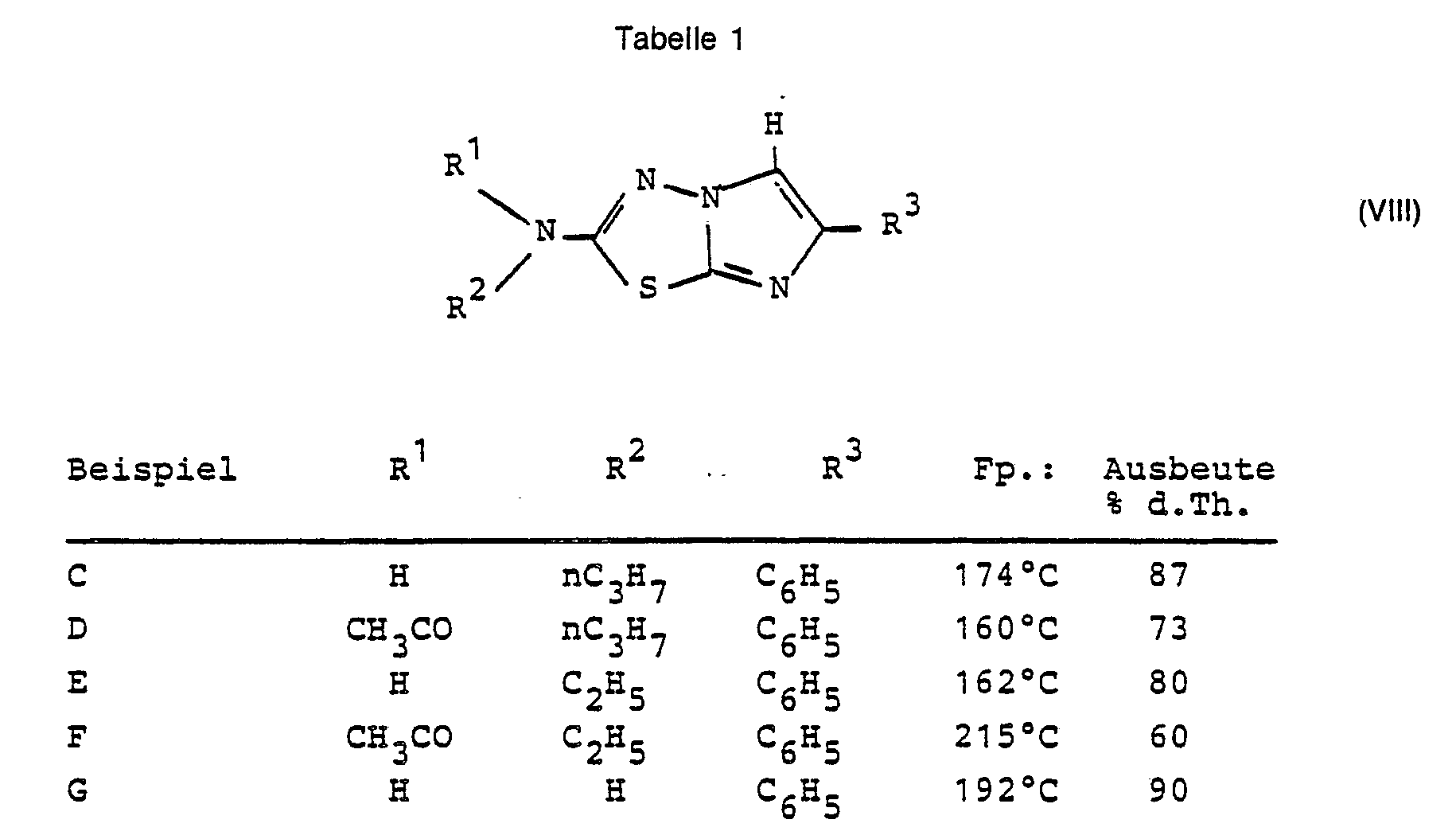
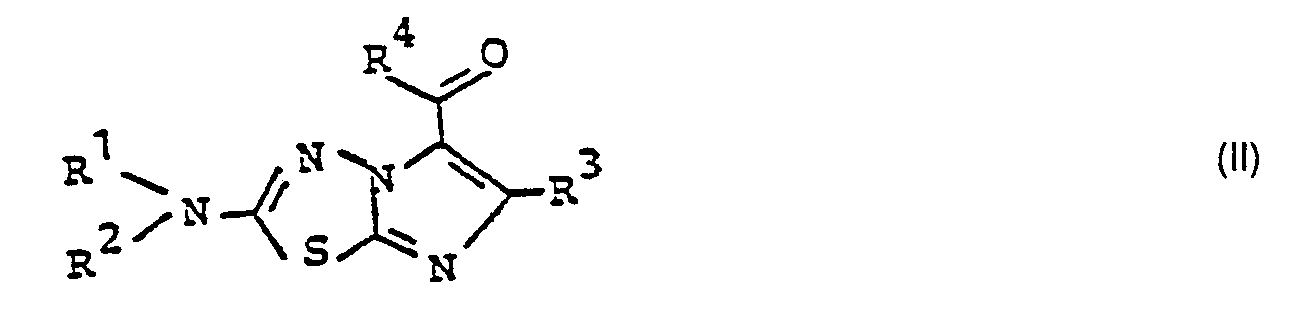
- the carbonyl compounds of the general formula (II) which can be used as starting compounds are Not yet known, but can be prepared in an analogous manner using known methods from imidazothiadiazoles of the general formula (VIII) in which R 1 to R 3 have the meaning given above, by reacting them with dimethylformamide in the presence of phosphorus oxychloride at temperatures of 20 ° C.-170 ° C., (see, for example, BL Pentimalli et al., Boll. Sci. Fac. Chim. Ind. Bologna 23,181 (1965); CA 63, 17848 e (1965), D. Bower et al., J. Chem. Soc. 1955, 2834, A. Hetzheim et al., Chem. Ber 103, 3533 (1970), H. Beyer et al., Z. Chem 2, 152 (1962) and S. Kano, Yagukagu Zasski 92, 935 (1972)).
- the imidazothiadiazoles of the general formula (VIII) which can be used as starting compounds are known or can, for. B. by reaction of 2-bromo-5-amino-1,3,4-thiadiazole with ⁇ -haloketones of the general formula Y ⁇ CH 2 ⁇ CO ⁇ R 3 , where R 3 has the meaning given above, and Y for CI , Br or J is in organic solvents and subsequent treatment with an excess of amines of the general formula H 2 NR 1 , followed by reaction with acylating agents of the general formula R 8 CXCl, where R 1 , R 8 and X have the meaning given above , can be obtained.
- aryl stands for an aromatic hydrocarbon radical with 6 to 14 carbon atoms, in particular for phenyl or naphthyl.
- the present invention also relates to the carbonyl compounds of the general formula (11) which can be used as intermediates and the alkenecarboxylic acids of the general formula (VI) and to processes for their preparation.
- the new compounds according to the invention are surprisingly distinguished by strong biological effects. In particular, they have pronounced diuretic and saluretic effects and can therefore be used as diuretics, saluretics and antihypertensives.
- diuretic and saluretic effects In animal insects on mice, rats or dogs, it has been found that the compounds according to the invention, when administered orally, have a pronounced diuretic and saluretic effect with simultaneous good tolerance even at doses below 10 mg / kg. Knowing the state of the art, these advantageous properties could not be expected.
- the blood pressure effect is determined on gold leaf high pressure rats according to Breuninger, H.: Methods for bloodless measurement of blood pressure in small animals, drug research. 6, 222-225 (1965).
- the bladder is catheterized and the urine and electrolyte excretion determined over 180 minutes (fractionated over 30 minutes each).
- the animals are given an electrolyte solution intravenously via a continuous infusion and, at the start of the experiment, the test substance in 1 ml / kg tylose suspension (0.5%) orally.
- the urine is analyzed for Na + , K + , chlorine, bicarbonate and pH.
- Fasted male SPF mice weighing 20 to 25 g (n 6 x 3 animals / cage) received 100 ml / kg tylose suspension (0.5%) as controls, or 100 mg / kg test substance in tylose suspension fed orally.
- the new compounds according to the invention are substances which can be used as medicaments. When administered orally or parenterally, they cause an increase in water and salt excretion and can therefore be used to treat cedematous and hypertensive conditions and to flush out toxic substances.
- the compounds can be used in acute kidney failure. In particular, they also show an advantageous uricosuric effect.
- the new compounds can be converted in a known manner into the customary formulations, such as tablets, capsules, dragées, pills, granules, syrups, emulsions, suspensions and solutions, using inert, non-toxic, pharmaceutically suitable excipients or solvents.
- the therapeutically active compound should be present in a concentration of about 0.5 to 90% by weight of the total mixture, i. H. in amounts sufficient to achieve the dosage range indicated.
- the formulations are prepared, for example, by stretching the active ingredients with solvents and / or carriers, optionally using emulsifiers and / or dispersants, z. B. in the case of the use of water as a diluent, organic solvents can optionally be used as auxiliary solvents.
- the application is carried out in the usual way, preferably orally or parenterally.
- tablets may of course also contain additives such as sodium citrate, calcium carbonate and calcium phosphate together with various additives such as starch, preferably potato starch, gelatin and the like, in addition to the carrier substances mentioned.
- Lubricants such as magnesium stearate, sodium lauryl sulfate and talc can also be used for tableting.
- the active compounds can be mixed with various flavor enhancers or colorants in addition to the abovementioned auxiliaries.
- solutions of the active ingredients can be used using suitable liquid carrier materials.
- suitable liquid carrier materials include: sodium hydroxide solution, potassium hydroxide solution, ethanolamine, diethanolamine, triethanolamine, amino-tris-hydroxymethyl-methane, glucosamine, N-methylglucosamine.
- Such salts can also be of greater importance for the oral use of the compounds according to the invention, in that they accelerate or delay the absorption, as desired.
- examples may be mentioned: magnesium salts, calcium salts, aluminum salts and iron salts.
- the dosage is oral administration about 0.1 to 500 mg / kg, preferably 0.5 to 100 mg / kg body weight per day.
- the phosphonate compounds of the general formula (111) used in carrying out the production process according to the invention are known or can be prepared by known methods (cf. I. Shahak et al. Isr. J. Chem. 7, 585 (1969)).
- acetamide derivatives of the general formula (V) used in carrying out process variant c) are known or can be prepared by known methods (cf. a) Brit. Pat. 715896 (1954); C.A. 49, 13290d (1955); b) DBP 1 142 859 (1960); C.A. 59, 7377c (1963)).
- the alkenoic acids of the general formula (VI) used according to process variant d) have hitherto not been disclosed, but can be prepared in a manner known per se by the processes indicated above.
- the activation of the free carboxyl group which is expedient for the reaction with amines, is preferably carried out via the corresponding acid halide, in particular via the corresponding acid chloride, using halide formers, such as, for. B. thionyl chloride, phosphorus trichloride and phosphorus pentachloride.
- the customary inert organic solvents can be used as diluents in all of the processes according to the invention.
- These preferably include ethers such as diethyl ether.
- Glycol ethers such as glycol dimethyl ether, dioxane, tetrahydrofuran or alcohols such as methanol, ethanol, propanol, butanol, benzyl alcohol or sulfoxides such as dimethyl sulfoxide, bases such as pyridine, quinoline, picoline or hydrocarbons such as benzene, toluene, xylene and dimethylformamide.
- alkali metal hydroxides such as sodium hydroxide, potassium hydroxide, alkaline earth metal hydroxide such as barium hydroxide or calcium hydroxide.
- pyridine substituted pyridine derivatives such as dialkylaminopyridines, quinoline, isoquinoline, dialkylamines such as dimethylamine , Dibutylamine, pyrrolidine, piperidine and similar nitrogenous organic bases.
- Examples A to G below illustrate the preparation of the imidazothiadiazoles of the general formula (VIII) used as starting substances according to the invention (Table 1).
- Examples H to L illustrate the preparation of the carbonyl compounds of the general formula (11) used in accordance with the invention (Table 2).
Landscapes
- Chemical & Material Sciences (AREA)
- Organic Chemistry (AREA)
- Health & Medical Sciences (AREA)
- Life Sciences & Earth Sciences (AREA)
- General Health & Medical Sciences (AREA)
- Veterinary Medicine (AREA)
- Chemical Kinetics & Catalysis (AREA)
- General Chemical & Material Sciences (AREA)
- Medicinal Chemistry (AREA)
- Nuclear Medicine, Radiotherapy & Molecular Imaging (AREA)
- Bioinformatics & Cheminformatics (AREA)
- Pharmacology & Pharmacy (AREA)
- Engineering & Computer Science (AREA)
- Animal Behavior & Ethology (AREA)
- Public Health (AREA)
- Hematology (AREA)
- Diabetes (AREA)
- Cardiology (AREA)
- Heart & Thoracic Surgery (AREA)
- Pharmaceuticals Containing Other Organic And Inorganic Compounds (AREA)
- Plural Heterocyclic Compounds (AREA)
- Nitrogen And Oxygen Or Sulfur-Condensed Heterocyclic Ring Systems (AREA)
- Lubricants (AREA)
- Organic Low-Molecular-Weight Compounds And Preparation Thereof (AREA)
- Macromonomer-Based Addition Polymer (AREA)
- Transition And Organic Metals Composition Catalysts For Addition Polymerization (AREA)
- Low-Molecular Organic Synthesis Reactions Using Catalysts (AREA)
Description
- Die vorliegende Erfindung betrifft neue Imidazothiadiazolalkencarbonsäureamide, diese Verbindungen zur Anwendung bei der therapeutischen Behandlung des menschlichen und tierischen Körpers, verschiedene Verfahren zu ihrer Herstellung und neue Zwischenprodukte, die bei ihrer Herstellung eingesetzt werden ; ferner Arzneimittel, insbesondere in Antihypertensiva, Diuretika und Uricosurica, die diese neuen Verbindungen enthalten.
- Es ist bereits bekannt geworden, daß bestimmte Imidazothiadiazole biologische Wirkungen, insbesondere antithrombotische und antimikrobielle Eigenschaften besitzen (vgl. DE-OS 3020421). Weiterhin ist bekannt, daß bestimmte Imidazothiadiazole und Imidazothiazolsulfonamide cerebrale Wirkungen besitzen (J. med. Chem., 1980, 117, IC. Barnisch et al.).
- Die antihypertensive, diuretische und uricosurische Wirkung von anderen Imidazoalkencarbonsäureamiden wurde ebenfalls bereits erwähnt (DE-OS 3043158).
- Die Erfindung betrifft neue Imidazolthiadiazolalkencarbonsäureamide der allgemeinen Formel (I)

- R1 für Wasserstoff, Phenyl oder einen geradkettigen verzweigten oder cyclischen gesättigten oder ungesättigten Kohlenwasserstoffrest mit bis zu 6 Kohlenstoffatomen steht, der gegebenenfalls einmal durch Sauerstoff, NH, N-Alkyl mit 1 bis 4 C-Atomen oder N-Benzyl unterbrochen ist und der gegebenenfalls substituiert ist durch Halogen,
- R2 entweder für den Rest CXR8 steht, wobei R8 die für R1 angegebene Bedeutung hat (gleich oder verschieden) und wobei X für Sauerstoff oder den Rest NR9R10 steht, wobei R9 und R10 gleich oder verschieden sind und jeweils die für R' angegebene Bedeutung besitzen oder
- R1 und R2 gemeinsam für eine Gruppe der allgemeinen Formel = C(R12)(Y-R13) stehen, wobei Y für den Rest N-Alkyl mit bis 4 C-Atomen steht und R'2 und R'3 gleich oder verschieden sind und jeweils die für R1 angegebene Bedeutung besitzen und mit R1 gleich oder verschieden sind,
- R3 die für R' angegebene Bedeutung besitzt und mit R1 gleich oder verschieden ist oder für Phenyl, Furyl, Thienyl, Pyrimidyl oder Pyridyl steht, wobei die Ringe gegebenenfalls substituiert sind durch ein oder zwei gleiche oder verschiedene Substituenten aus der Gruppe Halogen, Nitro, Trifluormethyl, Phenyl, Alkyl, Alkoxy, Dialkylamino oder SOn-Alkyl (n = 0 oder 2), wobei die genannten Alkyl- oder Alkoxy-Reste 1 bis 4 Kohlenstoffatome enthalten,
- R4 und R5 gleich oder verschieden sind und für Wasserstoff oder Alkyl mit 1 bis 4 Kohlenstoffatomen stehen und .
- R6 unf R7 die für R1 angegebene Bedeutung besitzen und mit R1 gleich oder verschieden sind oder gemeinsam mit dem Stickstoffatom einen 5- bis 7-gliedrigen Ring bilden, der gegebenenfalls durch ein Sauerstoff- oder Stickstoffatom unterbrochen ist, wobei der Stickstoff gegebenenfalls durch Wasserstoff, Alkyl mit 1 bis 4 Kohlenstoffatomen oder Benzyl substituiert ist und wobei dieser 5- bis 7-gliedrige Ring gegebenenfalls durch 1 oder 2 gleiche oder verschiedene Substituenten aus der Gruppe Halogen, Benzyl, Trifluormethyl, Alkyl oder Alkoxy mit jeweils 1 bis 4 Kohlenstoffatomen substituiert ist oder wobei dieser Ring gegebenenfalls in einem aromatischen Ring mit 6 oder 10 C-Atomen kondensiert sein kann, sowie ihre stereoisomeren Formen der verschiedenen Enantiomeren, Diastereomeren und E/Z-Isomeren sowie ihre pharmazeutisch unbedenklichen Säureadditionssalze.
- Die Herstellung der erfindungsgemäßen Imidazothiadiazolalkencarbonsäureamide der allgemeinen Formel (1) erfolgt, indem man
- a) Carbonylverbindungen der allgemeinen Formel (II)


- R5 bis R7 die oben angegebene Bedeutung haben, und
- R14 und R'5 für gegebenenfalls substituiertes Alkyl oder Aralkyl stehen,
in Gegenwart von starken Basen und in inerten organischen Lösungsmitteln bei Temperaturen zwischen -20 und 110 °C umsetzt, wobei, im Falle R8 = CH3 und X = 0, Alkencarbonsäureamide der allgemeinen Formel (I) mit R2 = H erhalten werden oder - b) Alkencarbonsäureamide der allgemeinen Formel (I), in der R1 bis R7 die oben angegebene Bedeutung haben und R2 = Wasserstoff ist, mit geeigneten Acylierungsmitteln der allgemeinen Formel (IV)

- c) Carbonylverbindungen der allgemeinen Formel (ll) mit Acetamidderivaten der allgemeinen Formel (V)

- d) Alkencarbonsäuren der allgemeinen Formel (VI)


- Je nach Wahl der Ausgangssubstanzen können die erfindungsgemäßen Verbindungen in stereoisomeren Formen existieren, die sich entweder wie Bild und Spiegelbild (Enantiomere) oder die sich nicht wie Bild und Spiegelbild (Diastereomere) verhalten. Sowohl die Antipoden als auch die Racemate und die Diastereomerengemische sind Gegenstand der vorliegenden Erfindung. Die Racemate lassen sich ebenso wie die Diastereomeren in bekannter Weise in die reinen Stereoisomeren trennen (vgl. E. L. Eliel. Stereochemistry of Carbon Compounds, McGraw Hill 1962).
- Darüber hinaus werden die durch die Doppelbindung der Seitenkette möglichen EiZ-Isomeren beansprucht, die nach bekannten Verfahren hergestellt oder nach bekannten Verfahren ineinander überführt werden können. Als bekanntes Verfahren sei z. B. die Bestrahlung mit UV-Strahlen genannt.
- Die als Ausgangsverbindungen einsetzbaren Carbonylverbindungen der allgemeinen Formel (II) sind bisher nicht bekannt, können aber in analoger Weise nach bekannten Methoden aus Imidazothiadiazolen der allgemeinen Formel (VIII)

- Die als Ausgangsverbindungen einsetzbaren Alkencarbonsäuren der allgemeinen Formel (VI) sind ebenfalls neu. Sie können nach bekannten Methoden hergestellt werden, indem man
- a) Carbonylverbindungen der allgemeinen Formel (II), in welcher R' bis R4 die oben angegebene Bedeutung haben, mit Phosphonatverbindungen der allgemeinen Formel (IX)

- R5, R14 und R15 die oben angegebene Bedeutung haben und
- R'6 für H, Trialkyl- oder Triarylsilyl oder für einen Rest der gleichen Bedeutung wie R14 steht,
in Gegenwart von starken Basen in inerten organischen Lösungsmitteln zu den Alkencarbonsäurederivaten umsetzt und diese dann mit Säuren oder Laugen zu den freien Carbonsäuren verseift (vgl. W.S. Wadsworth et al., JACS 83, 1733 (1961)), oder - b) Carbonylverbindungen der allgemeinen Formel (II), in welcher R1 bis R3 die oben angegebene Bedeutung haben, R4 gleich Wasserstoff ist (Aldehyde), mit Malonsäuren der allgemeinen Formel R5―CH(COOH)2 in welcher R5 die oben angegebene Bedeutung hat, oder mit Meldrumsäure in Gegenwart von inerten organischen Lösungsmitteln gegebenenfalls in Gegenwart von Kondensationsmitteln umsetzt (vgl. G. Jones, Org. Reactions, Vol. 15, S. 204 ff).
- Die als Ausgangsverbindungen einsetzbaren Imidazothiadiazole der allgemeinen Formel (VIII) sind bekannt oder können z. B. durch Umsetzung von 2-Brom-5-amino-1,3,4-thiadiazol mit α-Halogenketonen der allgemeinen Formel Y―CH2―CO―R3, wobei R3 die oben angegebene Bedeutung besitzt, und Y für CI, Br oder J steht in organischen Lösungsmitteln und anschließender Behandlung mit einem Überschuß von Aminen der allgemeinen Formel H2N-R1, gefolgt von einer Umsetzung mit Acylierungsmitteln der allgemeinen Formel R8CXCl, wobei R1, R8 und X die oben angegebene Bedeutung besitzen, erhalten werden.
- Falls nicht ausdrücklich anders angegeben steht in der vorliegenden Anmeldung Aryl für einen aromatischen Kohlenwasserstoffrest mit 6 bis 14 C-Atomen, insbesondere für Phenyl oder Naphthyl.
- Besonders hervorgehoben seien Verbindungen der allgemeinen Formel (I), in welcher
- R1 für Wasserstoff, Phenyl oder einen geradkettigen verzweigten oder cyclischen gesättigten oder ungesättigten Kohlenwasserstoffrest mit bis zu 6 Kohlenstoffatomen steht, der gegebenenfalls einmal durch Sauerstoff, NH, N-Alkyl mit 1-4 C-Atomen oder N-Benzyl unterbrochen ist und der gegebenenfalls substituiert ist durch Halogen,
- R2 für Wasserstoff oder den Rest CXR8 steht, wobei R8 die für R1 angegebene Bedeutung hat (gleich oder verschieden) und wobei X für Sauerstoff oder den Rest NR9R10 steht, wobei R9 und R10 gleich oder verschieden sind und jeweils die für R1 angegebene Bedeutung besitzen oder
- R1 und R2 gemeinsam für eine Gruppe der allgemeinen Formel = C(R12)(Y-R13) stehen, wobei Y für den Rest N-Alkyl mit 1 bis 4 C-Atomen steht und R12 und R13 gleich oder verschieden sind und jeweils die für R1 angegebene Bedeutung besitzen und mit R1 gleich oder verschieden sind.
- R3 die für R1 angegebene Bedeutung besitzt und mit R1 gleich oder verschieden ist oder für Phenyl, Furyl, Thienyl, Pyrimidyl oder Pyridyl steht, wobei die Ringe gegebenenfalls substituiert sind durch ein oder zwei gleiche oder verschiedene Substituenten aus der Gruppe Halogen, Nitro. Trifluormethyl, Phenyl, Alkyl. Alkoxy, Dialkylamino oder SOn-Alkyl (n = 0 oder 2), wobei die genannten Alkyl- und Alkoxyreste jeweils 1 bis 4 Kohlenstoffatomen enthalten.
- R4 und R5 gleich oder verschieden sind und für Wasserstoff oder Alkyl mit 1-4 Kohlenstoffatomen stehen und
- R6 und R7 die für R1 angegebene Bedeutung besitzen und mit R' gleich oder verschieden sind oder gemeinsam mit dem Stickstoffatom einen 5- bis 7-gliedrigen Ring bilden, der gegebenenfalls durch ein Sauerstoff- oder Stickstoffatom unterbrochen ist, wobei der Stickstoff gegebenenfalls durch Wasserstoff, Alkyl mit 1-4 Kohlenstoffatomen oder Benzyl substituiert ist und wobei dieser 5- bis 7-gliedrige Ring gegebenenfalls durch 1 oder 2 gleiche oder verschiedene Substituenten aus der Gruppe Halogen, Benzyl, Trifluormethyl, Alkyl oder Alkoxy mit jeweils 1-4 Kohlenstoffatomen substituiert ist oder wobei dieser Ring gegebenenfalls mit einem aromatischen Ring mit 6 oder 10 C-Atomen kondensiert sein kann. sowie ihre stereoisomeren Formen der verschiedenen Enantiomeren, Diastereomeren und Z/E-Isomeren sowie ihre pharmazeutisch unbedenklichen Säureadditionssalze.
- Gegenstand der vorliegenden Erfindung sind auch die als Zwischenprodukte verwendbaren Carbonylverbindungen der allgemeinen Formel (11) und die Alkencarbonsäuren der allgemeinen Formel (VI) sowie Verfahren zu ihrer Herstellung.
- Die neuen erfindungsgemäßen Verbindungen zeichnen sich überraschenderweise durch starke biologische Wirkungen aus. Insbesondere besitzen sie ausgeprägte diuretische und saluretische Wirkungen und können daher als Diuretika, Saluretika und Antihypertensiva verwendet werden. Bei Tierverscuhen an Mäusen, Ratten bzw. Hunden zeigt sich, daß die erfindungsgemäßen Verbindungen bei oraler Applikation bereits bei Dosierungen unter 10 mg/kg eine ausgeprägte diuretische und saluretische Wirkung bei gleichzeitiger guter Verträglichkeit besitzen. Bei Kenntnis des Standes der Technik konnten diese vorteilhaften Eigenschaften nicht erwartet werden.
- Die überraschenden und vorteilhaften Wirkungen der erfindungsgemäßen Verbindungen lassen sich nach den folgenden Testmethoden ermittein :
- Die Blutdruckwirkung wird ermittelt an Goldblatthochdruckratten nach Breuninger, H. : Methoden zur unblutigen Messung des Blutdruckes an Kleintieren, Arzneimittelforsch. 6, 222-225 (1965).
- Nüchterne männliche Ratten im Gewicht von 150 bis 250 g (SPF, Wistar, je n = 4 Paare) werden mit 10 ml/kg p. o. Tylose-Suspension (0,5 %) als Kontrollen bzw. mit 100 mg/kg p. o. Prüfsubstanz in 10 ml/kg p. o. Tylose-Suspension mittels Schlundsonde behandelt. Die Tiere werden in Stoffwechselkäfige verbracht und die Harn- und Elektrolytausscheidung über 6 Stunden bestimmt (Na+ und K+ Bestimmung : IL-Flammenphotometer).
- Bei nüchternen, wachen weiblichen Beagle-Hunden wird die Harnblase katheterisiert und die Harn-und Elektrolytausscheidung über 180 Minuten (fraktioniert über jeweils 30 Minuten) bestimmt. Die Tiere erhalten während dieser Zeit über eine Dauerinfusion eine Elektrolytlösung intravenös und am Beginn des Versuches die Prüfsubstanz in 1 ml/kg Tylose-Suspension (0,5 %) oral zugeführt. Der Harn wird auf Na+, K+, Chlor, Bicarbonat und pH analysiert.
- Nüchterne männliche SPF-Mäuse im Gewicht von 20 bis 25 g (n = 6 x 3 Tiere/Käfig) erhalten 100 ml/kg Tylose-Suspension (0,5 %) als Kontrollen, bzw. 100 mg/kg Prüfsubstanz in Tylose-Suspension oral zugeführt.
- Die Ausscheidung von Harn, Na+ und K+ bzw. Harnsäure wird über 2 und 4 Stunden in Stoffwechselkäfigen bestimmt.
- Zum Nachweis von uricosurischer Wirksamkeit wird an wachen, nüchternen männlichen Ratten (SPF-Wistar, Gewicht 180 bis 250 g) der Einfluß von erfindungsgemäßen Verbindungen auf den Phenolrot-Blutspiegel dargestellt. Nach der Methode von Kreppel, E. (Med. exp. 1 (1959). 285-289) erhalten je 8 Tiere 75 mg/kg Phenolrot in 5 ml/kg Kochsalzlösung intraperitoneal, nachdem ihnen 30 Minuten vorher entweder 10 mg/kg Tylose-Suspension (0,5 %) als Kontrollen oder 100 mg/kg Prüfsubstanz in Tylose-Suspension verabreicht worden war. Plasma wird durch Punktion des retroorbitalen Venenplexus 30. 60 und 120 Minuten nach Gabe von Phenolrot, bzw. 60, 90 und 150 Minuten nach Substanzgabe gewonnen, mit NaOH versetzt und die Extinktion bei 546 nm im Photometer (Eppendorf) bestimmt.
- Eine potentielle uricosurische Wirksamkeit liegt vor, wenn die Extinktionswerte signifikant höher als in der Kontrollgruppe sind.
- Die neuen erfindungsgemäßen Verbindungen sind als Arzneimittel verwendbare Substanzen. Sie bewirken bei oraler oder parenteraler Anwendung eine Steigerung der Wasser- und Salzausscheidung und können daher zur Behandlung cedematöser und hypertoner Zustände und zur Ausschwemmung toxischer Substanzen dienen.
- Darüber hinaus können die Verbindungen bei akutem Nierenversagen eingesetzt werden. Insbesondere zeigen sie auch eine vorteilhafte uricosurische Wirkung.
- Die neuen Verbindungen können in bekannter Weise in die üblichen Formulierungen übergeführt werden, wie Tabletten, Kapseln, Dragees, Pillen, Granulate, Sirupe, Emulsionen, Suspensionen und Lösungen, unter Verwendung inerter, nichttoxischer, pharmazeutisch geeigneter Trägersubstanzen oder Lösungsmittel. Hierbei soll die therapeutisch wirksame Verbindung jeweils in einer Konzentration von etwa 0,5 bis 90 Gew.-% der Gesamtmischung vorhanden sein, d. h. in Mengen, die ausreichend sind, um den angegebenen Dosierungsspielraum zu erreiche.
- Die Formulierungen werden beispielsweise hergestellt durch Verstrecken der Wirkstoffe mit Lösungsmitteln und/oder Trägerstoffen, gegebenenfalls unter Verwendung von Emulgiermitteln und/oder Dispergiermitteln, wobei z. B. im Fall der Benutzung von Wasser als Verdünnungsmittel gegebenenfalls organische Lösungsmittel als Hilfslösungsmittel verwendet werden können.
- Als Hilfsstoffe seien beispielhaft aufgeführt :
- Wasser, nichttoxische organische Lösungsmittel wie Paraffine (z. B. Erdölfraktionen), pflanzliche Öle (z. B. Erdnuß-Sesamöl), Alkohole (z. B. Ethylalkohol, Glycerin), Glykole (z. B. Propylenglykol, Polyethylenglykol), feste Trägerstoffe wie z. B. natürliche Gesteinsmehle (z. B. Kaoline, Tonerden, Talkum, Kreide), synthetische Gesteinsmehle (z. B. hochdisperse Kieselsäure, Silikate), Zucker (z. B. Rohr-, Milch- und Traubenzucker), Emulgiermittel wie nichtionogene und anionische Emulgatoren (z. B. Polyoxyethylen-Fettsäure-Ester, Polyoxyethylen-Fettalkohol-Ether, Alkylsulfonate und Arylsulfonate), Dispergiermittel (z. B. Lignin, Methylcellulose, Stärke und Polyvinylpyrrolidon) und Gleitmittel (z. B. Magnesiumstearat, Talkum, Stearinsäure und Natriumlaurylsulfat).
- Die Applikation erfolgt in üblicher Weise, vorzugsweise oral oder parenteral.
- Im Falle der oralen Anwendung können Tabletten selbstverständlich außer den genannten Trägerstoffen auch Zusätze wie Natriumcitrat, Calciumcarbonat und Calciumphosphat zusammen mit verschiedenen Zuschlagstoffen wie Stärke, vorzugsweise Kartoffelstärke, Gelatine und dergleichen enthalten. Weiterhin können Gleitmittel wie Magnesiumstearat, Natriumlaurylsulfat und Talkum zum Tablettieren mitverwendet werden. Im Falle wäßriger Suspensionen und/oder Elixieren, die für orale Anwendungen gedacht sind, können die Wirkstoffe außer mit den oben genannten Hilfsstoffen mit verschiedenen Geschmacksaufbessern oder Farbstoffen versetzt werden.
- Für den Fall der parenteralen Anwendung können Lösungen der Wirkstoffe unter Verwendung geeigneter flüssiger Trägermaterialien eingesetzt werden. Als besonders vorteilhaft für den Fall der parenteralen Anwendung hat sich die Tatsache herausgestellt, daß die erfindungsgemäßen Verbindungen in Wasser gut lösliche Salze zu bilden vermögen. Diese Salze werden erhalten, wenn man die erfindungsgemäßen Verbindungen in einem geeigneten Lösungsmittel mit der äquimolaren Menge einer nichttoxischen anorganischen oder organischen Base vereinigt. Als Beispiele seien genannt : Natronlauge, Kalilauge, Ethanolamin, Diethanolamin, Triethanolamin, Amino-tris-hydroxymethyl-methan, Glucosamin, N-Methylglucosamin. Derartige Salze können auch für die orale Anwendung der erfindungsgemäßen Verbindungen eine erhöhte Bedeutung besitzen, indem sie die Resorption je nach Wunsch beschleunigen' oder verzögern. Als Beispiele seien außer den oben bereits erwähnten Salzen genannt : Magnesiumsalze, Calciumsalze, Aluminiumsalze und Eisensalze.
- Im allgemeinen hat es sich als vorteilhaft erwiesen, bei parenteraler Applikation Mengen von etwa 0,05 bis 100 mg/kg, vorzugsweise etwa 0,1 bis 10 mg/kg Körpergewicht pro Tag zur Erzielung wirksamer Ergebnisse zu verabreichen und bei oraler Applikation beträgt die Dosierung etwa 0,1 bis 500 mg/kg, vorzugsweise 0,5 bis 100 mg/kg Körpergewicht pro Tag.
- Trotzdem kann es gegebenenfalls erforderlich sein, von den genannten Mengen abzuweichen, und zwar in Abhängigkeit vom Körpergewicht des Versuchstieres bzw. der Art des Applikationsweges, aber auch aufgrund der Tierart und deren individuellem Verhalten gegenüber dem Medikament bzw. der Art von dessen Formulierung und dem Zeitpunkt bzw. Intervall, zu welchem die Verabreichung erfolgt. So kann es in wenigen Fällen ausreichend sein, mit weniger als der vorgenannten Mindestmenge auszukommen, während in anderen Fällen die genannte obere Grenze überschritten werden muß. Im Falle der Applikation größerer Mengen kann es empfehlenswert sein, diese in mehrere Einzelgaben über den Tag zu verteilen.
- Diese Angaben gelten sowohl für die Anwendung der erfindungsgemäßen Verbindungen in der Veterinär- als auch in der Humanmedizin.
- Die bei der Durchführung des erfindungsgemäßen Herstellungsverfahrens eingesetzten Phosphonatverbindungen der allgemeinen Formel (111) sind bekannt oder können nach bekannten Methoden hergestellt werden (vgl. I. Shahak et al. Isr. J. Chem. 7, 585 (1969)).
- Als starke Basen zur Verwendung bei der Durchführung der Verfahrensvariante a) seien beispielhaft genannt :
- Alkalihydride, wie Natriumhydrid, Kaliumhydrid, Lithiumhydrid und Alkalialkoholate wie Natriumethylat, Kaliumethylat oder Kaliummethylat oder Alkalimetallalkyle wie Methyllithium oder Butyllithium.
- Die bei der Durchführung der Verfahrensvariante c) eingesetzten Acetamidderivate der allgemeinen Formel (V) sind bekannt oder können nach bekannten Methoden hergestellt werden (vgl. a) Brit. Pat. 715896 (1954) ; C.A. 49, 13290d (1955) ; b) DBP 1 142 859 (1960) ; C.A. 59. 7377c (1963)).
- Bei dieser Verfahrensvariante c) werden vorzugsweise saure oder basische Katalysatoren eingesetzt, von denen beispielhaft genannt seien ; basische Amine wie Dialkylamine, Piperidin oder Pyridin oder anorganische Säuren, insbesondere Salzsäure oder Kondensationsmittel wie Carbonsäureanhydride.
- Die gemäß Verfahrensvariante d) eingesetzten Alkensäuren der allgemeinen Formel (VI) sind bisher noch nicht bekannt geworden, lassen sich aber nach den oben angegebenen Verfahren in an sich bekannter Weise herstellen. Die für die Umsetzung mit Aminen zweckmäßige Aktivierung der freien Carboxylgruppe erfolgt vorzugsweise über das entsprechende Säurehalogenid, insbesondere über das entsprechende Säurechlorid unter Verwendung von Halogenidbildnern, wie z. B. Thionylchlorid, Phosphortrichlorid und Phosphorpentachlorid.
- Bei allen erfindungsgemäßen Verfahren können als Verdünnungsmittel die üblichen inerten organischen Lösungsmittel eingesetzt werden. Hierzu gehören vorzugsweise Ether wie Diethylether. Glykolether wie Glykoldimethylether, Dioxan, Tetrahydrofuran oder Alkohole wie Methanol, Ethanol, Propanol, Butanol, Benzylalkohol oder Sulfoxide wie Dimethylsulfoxid, Basen wie Pyridin, Chinolin, Picolin oder Kohlenwasserstoffe wie Benzol, Toluol, Xylol sowie Dimethylformamid.
- Bei der Herstellung der Alkensäuren der allgemeinen Formel (VI) werden für die Verseifung der korrespondierenden Ester als Basen vorzugsweise benutzt : Alkalimetallhydroxide wie Natriumhydroxid, Kaliumhydroxid, Erdalkalihydroxid wir Bariumhydroxid oder Calciumhydroxid.
- Bei der Herstellung über die Aldehyde der allgemeinen Formel (11) mit R4 gleich Wasserstoff mit Malonsäuren der allgemeinen Formel R5-CH(COOH)2 werden als Kondensationsmittel vorzugsweise verwendet : Pyridin, substituierte Pyridinderivate wie Dialkylaminopyridine, Chinolin, Isochinolin, Dialkylamine wie Dimethylamin, Dibutylamin, Pyrrolidin, Piperidin und ähnliche stickstoffhaltige organische Basen.
- Die nachfolgenden Beispiele A bis G erläutern die Herstellung der erfindungsgemäß als Ausgangssubstanzen verwendeten Imidazothiadiazole der allgemeinen Formel (VIII) (Tabelle 1).
- Die Beispiele H bis L erläutern die Herstellung der erfindungsgemäß verwendeten Carbonylverbindungen der allgemeinen Formel (11) (Tabelle 2).
- Die dann folgenden Beispiele erläutern die Herstellung der erfindungsgemäßen Imidazothiadiazolalkensäureamide der allgemeinen Formel (I) (Tabelle 3).
-

- 18,0 g 2-Brom-5-amino-1,3,4-thiadiazol (0,1 Mol) und 20,0 g w-Bromacetophenon (0.1 Mol) werden in 250 ml Dimethylformamid 4,5 Stunden auf 100 °C erwärmt. Nach dem Abkühlen auf Raumtemperatur wird mit 100 ml Eiswasser versetzt und der Niederschlag abgesaugt. Nach dem Trocknen wird in Chloroform aufgenommen und nach Zusatz von Ether umkristallisiert. Das rohe 2-Brom-6-phenylimida- zo[2,1-b]-1,3.4-thiadiazol wird anschließend in 250 ml Ethanol mit 25 ml 30 %iger Methylaminlösung zwei Stunden zum Rückfluß erwärmt. Nach dem Abkühlen fällt man durch Zusatz von 200 ml Wasser aus, saugt den Niederschlag ab und kristallisiert aus Chloroform/Ether um.
- Ausbeute : 12.6 g (55 %) Fp. : 177 °C.
-

- 23,0 g 2-Methylamino-6-phenyl-imidazo-[2,1-b]-1,3,4-thiadiazol (0,1 Mol) werden in 200 ml Acetanhydrid zum Rückfluß erhitzt. Nach dem Abkühlen fügt man 200 ml Ether zu, saugt den Niederschlag ab und trocknet.
- Ausbeute : 25,8 g (99 %) Fp. : 280 °C.
-

- 27,2 g N-Acetyl-N-methyl-2-amino-6-phenyl-imidazo-[2,1-b]-1,3,4-thiadiazol (0,1 Mol) werden bei Raumtemperatur zu einer kalt hergestellten Lösung von 18 ml Phosphoroxychlorid in 300 ml trockenem Dimethylformamid gegeben und 45 Minuten auf 80 °C erwärmt. Nach dem Abkühlen fügt man 250 ml Eiswasser zu, saugt ab und löst den Niederschlag in Chloroform. Nach dem Trocknen über Natriumsulfat wird eingeengt und nach Zusatz von Ether umkristallisiert.
- Ausbeute : 27.0 g (90 %) Fp. : 237 °C

-

- Zu 0,33 g Natriumhydrid 80 % (0,011 Mol) (mit Petrolether entölt) in 100 ml Toluol (wasserfrei) fügt man 2,9 g Diethylphosphonoessigsäurepiperidid (0,011 Mol) und erwärmt auf 60 °C, bis die Wasserstoffentwicklung beendet ist. Bei Raumtemperatur gibt man 2,6g.N-Acetyl-N-methyl-2-amino-6-phenyl- imidazo-[2,1-b]-1,3,4-thiadiazol-5-carbaldehyd hinzu und rührt eine Stunde bei 50 °C. Nach dem Abkühlen versetzt man mit 20 ml Ethanol und nach 30 Minuten mit 100 ml Wasser. Die organische Phase wird abgetrennt, die wäßrige Phase noch zweimal mit Chloroform extrahiert und die organischen Phasen über Natriumsulfat getrocknet. Nach dem Einengen kristallisiert man aus Chloroform/Ether um.
- Ausbeute : 2.49 g (68 %) Fp. : 264 °C.
-

- 3,67 g N-ß-(2-Methylamino-6-phenyl-imidazo-[2,1-b]-1,3,4-thiadiazol-5-yl)-E-propenoyl-piperidin (0,01 Mol) werden in 50 ml Acetanhydrid eine Stunde zum Rückfluß erwärmt. Nach dem Abkühlen versetzt man mit 50 ml Ether und saugt den Niederschlag ab.
- Ausbeute : 2,94 g (72 %) Fp. : 209 °C.


Claims (8)


in Gegenwart von starken Basen und in inerten organischen Lösungsmitteln bei Temperaturen zwischen -20 und 110 °C umsetzt, wobei, im Falle R8 = CH3 und X = 0, Alkencarbonsäureamide der allgemeinen Formel (I) mit R2 = H erhalten werden oder



Priority Applications (1)
| Application Number | Priority Date | Filing Date | Title |
|---|---|---|---|
| AT83101929T ATE26984T1 (de) | 1982-03-09 | 1983-02-28 | Imidazothiadiazolalkencarbonsaeureamide, neue zwischenprodukte zu ihrer herstellung, ihre herstellung und ihre verwendung in arzneimitteln. |
Applications Claiming Priority (2)
| Application Number | Priority Date | Filing Date | Title |
|---|---|---|---|
| DE19823208437 DE3208437A1 (de) | 1982-03-09 | 1982-03-09 | Imidazothiadiazolalkencarbonsaeureamide, neue zwischenprodukte zu ihrer herstellung, ihre herstellung und ihre verwendung in arzneimitteln |
| DE3208437 | 1982-03-09 |
Publications (3)
| Publication Number | Publication Date |
|---|---|
| EP0088323A2 EP0088323A2 (de) | 1983-09-14 |
| EP0088323A3 EP0088323A3 (en) | 1984-08-01 |
| EP0088323B1 true EP0088323B1 (de) | 1987-05-06 |
Family
ID=6157723
Family Applications (1)
| Application Number | Title | Priority Date | Filing Date |
|---|---|---|---|
| EP83101929A Expired EP0088323B1 (de) | 1982-03-09 | 1983-02-28 | Imidazothiadiazolalkencarbonsäureamide, neue Zwischenprodukte zu ihrer Herstellung, ihre Herstellung und ihre Verwendung in Arzneimitteln |
Country Status (12)
| Country | Link |
|---|---|
| US (4) | US4585873A (de) |
| EP (1) | EP0088323B1 (de) |
| JP (1) | JPS58162593A (de) |
| AT (1) | ATE26984T1 (de) |
| AU (1) | AU1193483A (de) |
| CA (1) | CA1215710A (de) |
| DE (2) | DE3208437A1 (de) |
| DK (1) | DK113283A (de) |
| ES (1) | ES520398A0 (de) |
| GR (1) | GR77427B (de) |
| NO (1) | NO830611L (de) |
| ZA (1) | ZA831574B (de) |
Families Citing this family (5)
| Publication number | Priority date | Publication date | Assignee | Title |
|---|---|---|---|---|
| DE102005010215A1 (de) * | 2005-03-05 | 2006-09-07 | Bayer Cropscience Ag | Heterobicyclische Acrylamide |
| SI2193133T1 (sl) | 2007-09-27 | 2015-12-31 | Fundacion Centro Nacional De Investigaciones Oncologicas Carlos Iii | Imidazolotiadiazoli za uporabo kot zaviralci protein-kinaze |
| SI2414369T1 (sl) | 2009-04-02 | 2015-12-31 | Fundacion Centro Nacional De Investigaciones Oncologicas Carlos Iii | Derivati imidazo(2,1-b)(1,3,4)tiadiazola |
| CN103649079B (zh) | 2010-12-22 | 2016-11-16 | Abbvie公司 | 丙型肝炎抑制剂及其用途 |
| BR112022007404A2 (pt) | 2019-10-21 | 2022-07-05 | Novartis Ag | Compostos e composições para o tratamento de doenças parasíticas |
Family Cites Families (3)
| Publication number | Priority date | Publication date | Assignee | Title |
|---|---|---|---|---|
| US3946031A (en) * | 1973-10-04 | 1976-03-23 | Syntex Inc. | 2-Substituted-1,2,4-thiadiazolo-[2,3-a]-benzimidazoles |
| DE2823686A1 (de) * | 1978-05-31 | 1979-12-06 | Bayer Ag | Imidazo eckige klammer auf 2.1-b eckige klammer zu eckige klammer auf 1.3.4 eckige klammer zu -thiadiazole |
| US4444770A (en) * | 1980-05-29 | 1984-04-24 | Bayer Aktiengesellschaft | New imidazoazole-alkenoic acid amide compounds, intermediate products for their production, their production, and their medicinal use |
-
1982
- 1982-03-09 DE DE19823208437 patent/DE3208437A1/de not_active Withdrawn
-
1983
- 1983-02-22 NO NO830611A patent/NO830611L/no unknown
- 1983-02-22 US US06/468,737 patent/US4585873A/en not_active Expired - Fee Related
- 1983-02-28 DE DE8383101929T patent/DE3371339D1/de not_active Expired
- 1983-02-28 AT AT83101929T patent/ATE26984T1/de active
- 1983-02-28 EP EP83101929A patent/EP0088323B1/de not_active Expired
- 1983-03-01 AU AU11934/83A patent/AU1193483A/en not_active Abandoned
- 1983-03-04 JP JP58034671A patent/JPS58162593A/ja active Pending
- 1983-03-07 GR GR70699A patent/GR77427B/el unknown
- 1983-03-07 CA CA000423009A patent/CA1215710A/en not_active Expired
- 1983-03-08 ES ES520398A patent/ES520398A0/es active Granted
- 1983-03-08 DK DK113283A patent/DK113283A/da not_active Application Discontinuation
- 1983-03-08 ZA ZA831574A patent/ZA831574B/xx unknown
-
1985
- 1985-10-21 US US06/789,689 patent/US4657905A/en not_active Expired - Fee Related
-
1986
- 1986-07-01 US US06/880,752 patent/US4703125A/en not_active Expired - Fee Related
- 1986-07-11 US US06/884,561 patent/US4709031A/en not_active Expired - Fee Related
Also Published As
| Publication number | Publication date |
|---|---|
| DK113283D0 (da) | 1983-03-08 |
| EP0088323A3 (en) | 1984-08-01 |
| NO830611L (no) | 1983-09-12 |
| DE3371339D1 (en) | 1987-06-11 |
| US4585873A (en) | 1986-04-29 |
| ATE26984T1 (de) | 1987-05-15 |
| US4657905A (en) | 1987-04-14 |
| JPS58162593A (ja) | 1983-09-27 |
| ZA831574B (en) | 1983-12-28 |
| EP0088323A2 (de) | 1983-09-14 |
| AU1193483A (en) | 1983-09-15 |
| CA1215710A (en) | 1986-12-23 |
| GR77427B (de) | 1984-09-14 |
| US4703125A (en) | 1987-10-27 |
| ES8401086A1 (es) | 1983-12-01 |
| DE3208437A1 (de) | 1983-09-15 |
| ES520398A0 (es) | 1983-12-01 |
| US4709031A (en) | 1987-11-24 |
| DK113283A (da) | 1983-09-10 |
Similar Documents
| Publication | Publication Date | Title |
|---|---|---|
| DE1695556C3 (de) | 3-Alkyl-1,2,3,4,4a,9-hexahydropyrazino[1,2-f]morphanthridinderivate | |
| EP0041215B1 (de) | Imidazoazolalkensäureamide, neue Zwischenprodukte zu ihrer Herstellung, ihre Herstellung und ihre Verwendung in Arzneimitteln | |
| DE3026201C2 (de) | ||
| EP0104423B1 (de) | 2-Nitro-1,1-ethendiamine, Verfahren zu ihrer Herstellung sowie ihre Verwendung als Arzneimittel | |
| DE3209276A1 (de) | Arzneimittel mit antihypoxischer und ischaemie-protektiver wirkung | |
| DE2523103A1 (de) | Neue propargyl-2-phenylamino-imidazoline-(2), deren saeureadditionssalze, diese enthaltende arzneimittel und verfahren zur herstellung derselben | |
| DE3542661A1 (de) | Imidazopyridazinalkensaeureamide, verfahren zu ihrer herstellung, zwischenprodukte zu ihrer herstellung | |
| EP0088323B1 (de) | Imidazothiadiazolalkencarbonsäureamide, neue Zwischenprodukte zu ihrer Herstellung, ihre Herstellung und ihre Verwendung in Arzneimitteln | |
| DE3532279A1 (de) | 1,4-benzoxathiin-derivate | |
| DE2658558A1 (de) | Diazabicyclo(3,3,1)nonane, verfahren zu ihrer herstellung sowie ihre verwendung als arzneimittel | |
| DE3020421A1 (de) | Imidazoazolalkensaeureamide, neue zwischenprodukte zu ihrer herstellung, ihre herstellung und ihre verwendung in arzneimitteln | |
| DE2427272C3 (de) | 1-(2-(β-Naphthyloxy)-äthyl)-3-methyl -pyrazolon-(5), Verfahren sowie Verwendung als Antithrombotikum | |
| DE3538063C2 (de) | ||
| EP0110219B1 (de) | Heterocyclisch substituierte Nitrile, ihre Herstellung und Verwendung als Arzneimittel | |
| EP0073997A1 (de) | Substituierte 2-Amino-3,4-dihydropyridinderivate, Verfahren zu ihrer Herstellung und ihre Verwendung in Arzneimitteln | |
| DE3329621A1 (de) | Aminoalkyl-imidazothiadiazol-alkencarbonsaeureamide, neue zwischenprodukte zu ihrer herstellung, ihre herstellung und ihre verwendung in arzneimitteln | |
| EP0011092A1 (de) | Alpha-Aminophenylessigsäurederivate zur Verwendung bei der Behandlung von Entzündungen sowie neue alpha-Aminophenylessigsäurederivate | |
| DD153549A5 (de) | Verfahren zur herstellung von pyridinderivaten | |
| DE2319281A1 (de) | Diuretisches und antihypertensives mittel | |
| EP0160256B1 (de) | Annellierte Furanone, Verfahren zu ihrer Herstellung und ihre Verwendung in Arzneimitteln | |
| DE1670539C3 (de) | Diacylthiamine und Verfahren zu deren Herstellung | |
| DE2230792A1 (de) | 3-amino-pyrazolone-(5), verfahren zu ihrer herstellung sowie ihre verwendung als arzneimittel | |
| DE3710254A1 (de) | Antiulcusmittel | |
| EP0001439A1 (de) | 1-N-substituierte 1.4-Dihydropyridazine, Verfahren zu ihrer Herstellung sowie ihre Verwendung für Arzneimittel | |
| AT253485B (de) | Verfahren zur Herstellung von neuen Acrylylnaphthyloxymonocarbonsäuren und deren Derivaten |
Legal Events
| Date | Code | Title | Description |
|---|---|---|---|
| PUAI | Public reference made under article 153(3) epc to a published international application that has entered the european phase |
Free format text: ORIGINAL CODE: 0009012 |
|
| 17P | Request for examination filed |
Effective date: 19830228 |
|
| AK | Designated contracting states |
Designated state(s): AT BE CH DE FR GB IT LI LU NL SE |
|
| PUAL | Search report despatched |
Free format text: ORIGINAL CODE: 0009013 |
|
| AK | Designated contracting states |
Designated state(s): AT BE CH DE FR GB IT LI LU NL SE |
|
| GRAA | (expected) grant |
Free format text: ORIGINAL CODE: 0009210 |
|
| AK | Designated contracting states |
Kind code of ref document: B1 Designated state(s): AT BE CH DE FR GB IT LI LU NL SE |
|
| REF | Corresponds to: |
Ref document number: 26984 Country of ref document: AT Date of ref document: 19870515 Kind code of ref document: T |
|
| ITF | It: translation for a ep patent filed | ||
| REF | Corresponds to: |
Ref document number: 3371339 Country of ref document: DE Date of ref document: 19870611 |
|
| ET | Fr: translation filed | ||
| PG25 | Lapsed in a contracting state [announced via postgrant information from national office to epo] |
Ref country code: LU Free format text: LAPSE BECAUSE OF NON-PAYMENT OF DUE FEES Effective date: 19880229 |
|
| PLBE | No opposition filed within time limit |
Free format text: ORIGINAL CODE: 0009261 |
|
| STAA | Information on the status of an ep patent application or granted ep patent |
Free format text: STATUS: NO OPPOSITION FILED WITHIN TIME LIMIT |
|
| 26N | No opposition filed | ||
| PG25 | Lapsed in a contracting state [announced via postgrant information from national office to epo] |
Ref country code: LI Effective date: 19890228 Ref country code: GB Effective date: 19890228 Ref country code: CH Effective date: 19890228 Ref country code: BE Effective date: 19890228 Ref country code: AT Effective date: 19890228 |
|
| PG25 | Lapsed in a contracting state [announced via postgrant information from national office to epo] |
Ref country code: SE Effective date: 19890301 |
|
| BERE | Be: lapsed |
Owner name: BAYER A.G. Effective date: 19890228 |
|
| PG25 | Lapsed in a contracting state [announced via postgrant information from national office to epo] |
Ref country code: NL Effective date: 19890901 |
|
| NLV4 | Nl: lapsed or anulled due to non-payment of the annual fee | ||
| GBPC | Gb: european patent ceased through non-payment of renewal fee | ||
| PG25 | Lapsed in a contracting state [announced via postgrant information from national office to epo] |
Ref country code: FR Free format text: LAPSE BECAUSE OF NON-PAYMENT OF DUE FEES Effective date: 19891027 |
|
| REG | Reference to a national code |
Ref country code: CH Ref legal event code: PL |
|
| PG25 | Lapsed in a contracting state [announced via postgrant information from national office to epo] |
Ref country code: DE Effective date: 19891101 |
|
| REG | Reference to a national code |
Ref country code: FR Ref legal event code: ST |
|
| EUG | Se: european patent has lapsed |
Ref document number: 83101929.4 Effective date: 19900124 |