EP0257667B1 - Brass-coated steel elements having improved rubber adhesion properties - Google Patents
Brass-coated steel elements having improved rubber adhesion properties Download PDFInfo
- Publication number
- EP0257667B1 EP0257667B1 EP87201197A EP87201197A EP0257667B1 EP 0257667 B1 EP0257667 B1 EP 0257667B1 EP 87201197 A EP87201197 A EP 87201197A EP 87201197 A EP87201197 A EP 87201197A EP 0257667 B1 EP0257667 B1 EP 0257667B1
- Authority
- EP
- European Patent Office
- Prior art keywords
- brass
- steel
- rubber
- coating
- wire
- Prior art date
- Legal status (The legal status is an assumption and is not a legal conclusion. Google has not performed a legal analysis and makes no representation as to the accuracy of the status listed.)
- Expired - Lifetime
Links
- 229910001369 Brass Inorganic materials 0.000 title claims abstract description 144
- 239000010951 brass Substances 0.000 title claims abstract description 144
- 229920001971 elastomer Polymers 0.000 title claims abstract description 87
- 239000005060 rubber Substances 0.000 title claims abstract description 86
- 229910000831 Steel Inorganic materials 0.000 title claims abstract description 76
- 239000010959 steel Substances 0.000 title claims abstract description 76
- 238000000576 coating method Methods 0.000 claims abstract description 81
- 239000011248 coating agent Substances 0.000 claims abstract description 71
- 229910019142 PO4 Inorganic materials 0.000 claims abstract description 55
- 229910045601 alloy Inorganic materials 0.000 claims abstract description 41
- 239000000956 alloy Substances 0.000 claims abstract description 41
- OAICVXFJPJFONN-UHFFFAOYSA-N Phosphorus Chemical compound [P] OAICVXFJPJFONN-UHFFFAOYSA-N 0.000 claims abstract description 19
- 229910052698 phosphorus Inorganic materials 0.000 claims abstract description 19
- 239000011574 phosphorus Substances 0.000 claims abstract description 19
- NBIIXXVUZAFLBC-UHFFFAOYSA-K phosphate Chemical compound [O-]P([O-])([O-])=O NBIIXXVUZAFLBC-UHFFFAOYSA-K 0.000 claims description 48
- 239000010452 phosphate Substances 0.000 claims description 42
- 239000000203 mixture Substances 0.000 claims description 34
- 238000000034 method Methods 0.000 claims description 32
- 239000010949 copper Substances 0.000 claims description 31
- 229910052802 copper Inorganic materials 0.000 claims description 28
- 238000012360 testing method Methods 0.000 claims description 26
- NBIIXXVUZAFLBC-UHFFFAOYSA-N Phosphoric acid Chemical compound OP(O)(O)=O NBIIXXVUZAFLBC-UHFFFAOYSA-N 0.000 claims description 16
- RYGMFSIKBFXOCR-UHFFFAOYSA-N Copper Chemical compound [Cu] RYGMFSIKBFXOCR-UHFFFAOYSA-N 0.000 claims description 15
- 239000004636 vulcanized rubber Substances 0.000 claims description 15
- 230000003014 reinforcing effect Effects 0.000 claims description 12
- 229910017518 Cu Zn Inorganic materials 0.000 claims description 11
- 229910017752 Cu-Zn Inorganic materials 0.000 claims description 11
- 229910017943 Cu—Zn Inorganic materials 0.000 claims description 11
- TVZPLCNGKSPOJA-UHFFFAOYSA-N copper zinc Chemical compound [Cu].[Zn] TVZPLCNGKSPOJA-UHFFFAOYSA-N 0.000 claims description 11
- 239000011701 zinc Substances 0.000 claims description 11
- 235000011007 phosphoric acid Nutrition 0.000 claims description 10
- 230000002787 reinforcement Effects 0.000 claims description 9
- 238000007747 plating Methods 0.000 claims description 8
- 229910052725 zinc Inorganic materials 0.000 claims description 8
- 229910001015 Alpha brass Inorganic materials 0.000 claims description 5
- HCHKCACWOHOZIP-UHFFFAOYSA-N Zinc Chemical compound [Zn] HCHKCACWOHOZIP-UHFFFAOYSA-N 0.000 claims description 5
- LRXTYHSAJDENHV-UHFFFAOYSA-H zinc phosphate Chemical compound [Zn+2].[Zn+2].[Zn+2].[O-]P([O-])([O-])=O.[O-]P([O-])([O-])=O LRXTYHSAJDENHV-UHFFFAOYSA-H 0.000 claims description 4
- 229910000165 zinc phosphate Inorganic materials 0.000 claims description 2
- 235000021317 phosphate Nutrition 0.000 abstract description 48
- 238000004519 manufacturing process Methods 0.000 abstract description 12
- 150000003013 phosphoric acid derivatives Chemical class 0.000 abstract description 7
- -1 phosphates Chemical compound 0.000 abstract description 4
- 230000032683 aging Effects 0.000 description 46
- 230000014759 maintenance of location Effects 0.000 description 21
- 239000010410 layer Substances 0.000 description 20
- 150000001875 compounds Chemical class 0.000 description 16
- 230000006872 improvement Effects 0.000 description 15
- 238000011282 treatment Methods 0.000 description 11
- 239000000314 lubricant Substances 0.000 description 10
- 239000000047 product Substances 0.000 description 10
- XEEYBQQBJWHFJM-UHFFFAOYSA-N Iron Chemical compound [Fe] XEEYBQQBJWHFJM-UHFFFAOYSA-N 0.000 description 8
- 229910052799 carbon Inorganic materials 0.000 description 8
- 239000000126 substance Substances 0.000 description 8
- 238000004458 analytical method Methods 0.000 description 7
- 230000004044 response Effects 0.000 description 7
- 238000005275 alloying Methods 0.000 description 6
- 229910000147 aluminium phosphate Inorganic materials 0.000 description 6
- 230000000694 effects Effects 0.000 description 6
- PXHVJJICTQNCMI-UHFFFAOYSA-N nickel Substances [Ni] PXHVJJICTQNCMI-UHFFFAOYSA-N 0.000 description 6
- 230000008569 process Effects 0.000 description 6
- 238000004073 vulcanization Methods 0.000 description 6
- 230000008901 benefit Effects 0.000 description 5
- 230000015556 catabolic process Effects 0.000 description 5
- 238000006731 degradation reaction Methods 0.000 description 5
- 229910052742 iron Inorganic materials 0.000 description 5
- 229910052759 nickel Inorganic materials 0.000 description 5
- 238000005491 wire drawing Methods 0.000 description 5
- 238000006243 chemical reaction Methods 0.000 description 4
- 239000002131 composite material Substances 0.000 description 4
- 230000007797 corrosion Effects 0.000 description 4
- 238000005260 corrosion Methods 0.000 description 4
- 238000001035 drying Methods 0.000 description 4
- 229910052748 manganese Inorganic materials 0.000 description 4
- 239000011572 manganese Substances 0.000 description 4
- 239000000463 material Substances 0.000 description 4
- 230000009467 reduction Effects 0.000 description 4
- OKTJSMMVPCPJKN-UHFFFAOYSA-N Carbon Chemical compound [C] OKTJSMMVPCPJKN-UHFFFAOYSA-N 0.000 description 3
- 239000000853 adhesive Substances 0.000 description 3
- 230000001070 adhesive effect Effects 0.000 description 3
- 239000012298 atmosphere Substances 0.000 description 3
- 238000010276 construction Methods 0.000 description 3
- 238000000151 deposition Methods 0.000 description 3
- 238000007598 dipping method Methods 0.000 description 3
- 230000002349 favourable effect Effects 0.000 description 3
- 229910052751 metal Inorganic materials 0.000 description 3
- 239000002184 metal Substances 0.000 description 3
- 230000035515 penetration Effects 0.000 description 3
- IJGRMHOSHXDMSA-UHFFFAOYSA-N Atomic nitrogen Chemical compound N#N IJGRMHOSHXDMSA-UHFFFAOYSA-N 0.000 description 2
- 229910000975 Carbon steel Inorganic materials 0.000 description 2
- 229910001294 Reinforcing steel Inorganic materials 0.000 description 2
- NINIDFKCEFEMDL-UHFFFAOYSA-N Sulfur Chemical compound [S] NINIDFKCEFEMDL-UHFFFAOYSA-N 0.000 description 2
- XLOMVQKBTHCTTD-UHFFFAOYSA-N Zinc monoxide Chemical compound [Zn]=O XLOMVQKBTHCTTD-UHFFFAOYSA-N 0.000 description 2
- 230000001464 adherent effect Effects 0.000 description 2
- 230000003679 aging effect Effects 0.000 description 2
- 239000006229 carbon black Substances 0.000 description 2
- 238000012512 characterization method Methods 0.000 description 2
- 230000000052 comparative effect Effects 0.000 description 2
- 230000008021 deposition Effects 0.000 description 2
- 230000006866 deterioration Effects 0.000 description 2
- 235000011180 diphosphates Nutrition 0.000 description 2
- 239000004744 fabric Substances 0.000 description 2
- 238000010438 heat treatment Methods 0.000 description 2
- 238000007654 immersion Methods 0.000 description 2
- 239000004615 ingredient Substances 0.000 description 2
- 238000011835 investigation Methods 0.000 description 2
- 230000005012 migration Effects 0.000 description 2
- 238000013508 migration Methods 0.000 description 2
- 238000012986 modification Methods 0.000 description 2
- 230000004048 modification Effects 0.000 description 2
- 229910052750 molybdenum Inorganic materials 0.000 description 2
- 229920001194 natural rubber Polymers 0.000 description 2
- 238000005457 optimization Methods 0.000 description 2
- 238000012545 processing Methods 0.000 description 2
- 230000002035 prolonged effect Effects 0.000 description 2
- 230000003068 static effect Effects 0.000 description 2
- 239000000758 substrate Substances 0.000 description 2
- BHPQYMZQTOCNFJ-UHFFFAOYSA-N Calcium cation Chemical compound [Ca+2] BHPQYMZQTOCNFJ-UHFFFAOYSA-N 0.000 description 1
- 244000043261 Hevea brasiliensis Species 0.000 description 1
- 229910000677 High-carbon steel Inorganic materials 0.000 description 1
- PWHULOQIROXLJO-UHFFFAOYSA-N Manganese Chemical compound [Mn] PWHULOQIROXLJO-UHFFFAOYSA-N 0.000 description 1
- 229920000459 Nitrile rubber Polymers 0.000 description 1
- 239000006057 Non-nutritive feed additive Substances 0.000 description 1
- 241001275902 Parabramis pekinensis Species 0.000 description 1
- 239000005062 Polybutadiene Substances 0.000 description 1
- 241000872198 Serjania polyphylla Species 0.000 description 1
- 235000021355 Stearic acid Nutrition 0.000 description 1
- UCKMPCXJQFINFW-UHFFFAOYSA-N Sulphide Chemical compound [S-2] UCKMPCXJQFINFW-UHFFFAOYSA-N 0.000 description 1
- 239000005864 Sulphur Substances 0.000 description 1
- PTFCDOFLOPIGGS-UHFFFAOYSA-N Zinc dication Chemical compound [Zn+2] PTFCDOFLOPIGGS-UHFFFAOYSA-N 0.000 description 1
- 230000002159 abnormal effect Effects 0.000 description 1
- 238000002835 absorbance Methods 0.000 description 1
- 230000009471 action Effects 0.000 description 1
- 230000006978 adaptation Effects 0.000 description 1
- 239000000654 additive Substances 0.000 description 1
- 239000002318 adhesion promoter Substances 0.000 description 1
- 229910052787 antimony Inorganic materials 0.000 description 1
- 239000003963 antioxidant agent Substances 0.000 description 1
- 235000006708 antioxidants Nutrition 0.000 description 1
- 238000001636 atomic emission spectroscopy Methods 0.000 description 1
- 230000009286 beneficial effect Effects 0.000 description 1
- QRUDEWIWKLJBPS-UHFFFAOYSA-N benzotriazole Chemical compound C1=CC=C2N[N][N]C2=C1 QRUDEWIWKLJBPS-UHFFFAOYSA-N 0.000 description 1
- 239000012964 benzotriazole Substances 0.000 description 1
- 230000015572 biosynthetic process Effects 0.000 description 1
- 150000001642 boronic acid derivatives Chemical class 0.000 description 1
- 229910001424 calcium ion Inorganic materials 0.000 description 1
- 150000001735 carboxylic acids Chemical class 0.000 description 1
- 238000002144 chemical decomposition reaction Methods 0.000 description 1
- 238000005234 chemical deposition Methods 0.000 description 1
- 239000007795 chemical reaction product Substances 0.000 description 1
- 239000003795 chemical substances by application Substances 0.000 description 1
- 229910052804 chromium Inorganic materials 0.000 description 1
- 239000008199 coating composition Substances 0.000 description 1
- GIPIUENNGCQCIT-UHFFFAOYSA-K cobalt(3+) phosphate Chemical class [Co+3].[O-]P([O-])([O-])=O GIPIUENNGCQCIT-UHFFFAOYSA-K 0.000 description 1
- 230000002301 combined effect Effects 0.000 description 1
- 230000000295 complement effect Effects 0.000 description 1
- 239000000356 contaminant Substances 0.000 description 1
- 229920001577 copolymer Polymers 0.000 description 1
- 230000001419 dependent effect Effects 0.000 description 1
- 235000014113 dietary fatty acids Nutrition 0.000 description 1
- 238000009792 diffusion process Methods 0.000 description 1
- 238000004070 electrodeposition Methods 0.000 description 1
- 238000002474 experimental method Methods 0.000 description 1
- 239000000194 fatty acid Substances 0.000 description 1
- 229930195729 fatty acid Natural products 0.000 description 1
- 150000004665 fatty acids Chemical class 0.000 description 1
- 239000012847 fine chemical Substances 0.000 description 1
- 229920006247 high-performance elastomer Polymers 0.000 description 1
- 238000007602 hot air drying Methods 0.000 description 1
- 238000002329 infrared spectrum Methods 0.000 description 1
- 239000003112 inhibitor Substances 0.000 description 1
- 230000003993 interaction Effects 0.000 description 1
- 238000002386 leaching Methods 0.000 description 1
- 230000001050 lubricating effect Effects 0.000 description 1
- 238000005461 lubrication Methods 0.000 description 1
- 239000002075 main ingredient Substances 0.000 description 1
- 238000005259 measurement Methods 0.000 description 1
- 230000007246 mechanism Effects 0.000 description 1
- 150000002739 metals Chemical class 0.000 description 1
- 239000002480 mineral oil Substances 0.000 description 1
- 235000010446 mineral oil Nutrition 0.000 description 1
- 238000002156 mixing Methods 0.000 description 1
- 229920003052 natural elastomer Polymers 0.000 description 1
- 229910052758 niobium Inorganic materials 0.000 description 1
- 229910052757 nitrogen Inorganic materials 0.000 description 1
- QIQXTHQIDYTFRH-UHFFFAOYSA-N octadecanoic acid Chemical compound CCCCCCCCCCCCCCCCCC(O)=O QIQXTHQIDYTFRH-UHFFFAOYSA-N 0.000 description 1
- OQCDKBAXFALNLD-UHFFFAOYSA-N octadecanoic acid Natural products CCCCCCCC(C)CCCCCCCCC(O)=O OQCDKBAXFALNLD-UHFFFAOYSA-N 0.000 description 1
- 230000002085 persistent effect Effects 0.000 description 1
- 125000002467 phosphate group Chemical group [H]OP(=O)(O[H])O[*] 0.000 description 1
- 229940085991 phosphate ion Drugs 0.000 description 1
- 150000003018 phosphorus compounds Chemical class 0.000 description 1
- 229920001084 poly(chloroprene) Polymers 0.000 description 1
- 229920002857 polybutadiene Polymers 0.000 description 1
- 230000002028 premature Effects 0.000 description 1
- 238000002360 preparation method Methods 0.000 description 1
- 238000003672 processing method Methods 0.000 description 1
- 230000001681 protective effect Effects 0.000 description 1
- 238000007586 pull-out test Methods 0.000 description 1
- 230000009257 reactivity Effects 0.000 description 1
- 230000001105 regulatory effect Effects 0.000 description 1
- 239000012779 reinforcing material Substances 0.000 description 1
- 238000009877 rendering Methods 0.000 description 1
- 230000000717 retained effect Effects 0.000 description 1
- 230000000630 rising effect Effects 0.000 description 1
- 238000013040 rubber vulcanization Methods 0.000 description 1
- 150000003839 salts Chemical class 0.000 description 1
- 238000005464 sample preparation method Methods 0.000 description 1
- 238000004904 shortening Methods 0.000 description 1
- 239000001488 sodium phosphate Substances 0.000 description 1
- 229910000162 sodium phosphate Inorganic materials 0.000 description 1
- 238000001228 spectrum Methods 0.000 description 1
- 238000010561 standard procedure Methods 0.000 description 1
- 239000008117 stearic acid Substances 0.000 description 1
- 238000005728 strengthening Methods 0.000 description 1
- 238000005486 sulfidation Methods 0.000 description 1
- 239000011593 sulfur Substances 0.000 description 1
- 229910052717 sulfur Inorganic materials 0.000 description 1
- 239000002344 surface layer Substances 0.000 description 1
- 229920001169 thermoplastic Polymers 0.000 description 1
- 239000004416 thermosoftening plastic Substances 0.000 description 1
- 150000003568 thioethers Chemical class 0.000 description 1
- 229910052718 tin Inorganic materials 0.000 description 1
- 239000011135 tin Substances 0.000 description 1
- RYFMWSXOAZQYPI-UHFFFAOYSA-K trisodium phosphate Chemical compound [Na+].[Na+].[Na+].[O-]P([O-])([O-])=O RYFMWSXOAZQYPI-UHFFFAOYSA-K 0.000 description 1
- 229910052720 vanadium Inorganic materials 0.000 description 1
- XLYOFNOQVPJJNP-UHFFFAOYSA-N water Substances O XLYOFNOQVPJJNP-UHFFFAOYSA-N 0.000 description 1
- 239000011787 zinc oxide Substances 0.000 description 1
Images
Classifications
-
- C—CHEMISTRY; METALLURGY
- C08—ORGANIC MACROMOLECULAR COMPOUNDS; THEIR PREPARATION OR CHEMICAL WORKING-UP; COMPOSITIONS BASED THEREON
- C08J—WORKING-UP; GENERAL PROCESSES OF COMPOUNDING; AFTER-TREATMENT NOT COVERED BY SUBCLASSES C08B, C08C, C08F, C08G or C08H
- C08J5/00—Manufacture of articles or shaped materials containing macromolecular substances
- C08J5/04—Reinforcing macromolecular compounds with loose or coherent fibrous material
- C08J5/06—Reinforcing macromolecular compounds with loose or coherent fibrous material using pretreated fibrous materials
-
- C—CHEMISTRY; METALLURGY
- C23—COATING METALLIC MATERIAL; COATING MATERIAL WITH METALLIC MATERIAL; CHEMICAL SURFACE TREATMENT; DIFFUSION TREATMENT OF METALLIC MATERIAL; COATING BY VACUUM EVAPORATION, BY SPUTTERING, BY ION IMPLANTATION OR BY CHEMICAL VAPOUR DEPOSITION, IN GENERAL; INHIBITING CORROSION OF METALLIC MATERIAL OR INCRUSTATION IN GENERAL
- C23C—COATING METALLIC MATERIAL; COATING MATERIAL WITH METALLIC MATERIAL; SURFACE TREATMENT OF METALLIC MATERIAL BY DIFFUSION INTO THE SURFACE, BY CHEMICAL CONVERSION OR SUBSTITUTION; COATING BY VACUUM EVAPORATION, BY SPUTTERING, BY ION IMPLANTATION OR BY CHEMICAL VAPOUR DEPOSITION, IN GENERAL
- C23C22/00—Chemical surface treatment of metallic material by reaction of the surface with a reactive liquid, leaving reaction products of surface material in the coating, e.g. conversion coatings, passivation of metals
- C23C22/05—Chemical surface treatment of metallic material by reaction of the surface with a reactive liquid, leaving reaction products of surface material in the coating, e.g. conversion coatings, passivation of metals using aqueous solutions
- C23C22/06—Chemical surface treatment of metallic material by reaction of the surface with a reactive liquid, leaving reaction products of surface material in the coating, e.g. conversion coatings, passivation of metals using aqueous solutions using aqueous acidic solutions with pH less than 6
- C23C22/07—Chemical surface treatment of metallic material by reaction of the surface with a reactive liquid, leaving reaction products of surface material in the coating, e.g. conversion coatings, passivation of metals using aqueous solutions using aqueous acidic solutions with pH less than 6 containing phosphates
- C23C22/08—Orthophosphates
-
- D—TEXTILES; PAPER
- D07—ROPES; CABLES OTHER THAN ELECTRIC
- D07B—ROPES OR CABLES IN GENERAL
- D07B1/00—Constructional features of ropes or cables
- D07B1/06—Ropes or cables built-up from metal wires, e.g. of section wires around a hemp core
- D07B1/0606—Reinforcing cords for rubber or plastic articles
- D07B1/0666—Reinforcing cords for rubber or plastic articles the wires being characterised by an anti-corrosive or adhesion promoting coating
-
- C—CHEMISTRY; METALLURGY
- C08—ORGANIC MACROMOLECULAR COMPOUNDS; THEIR PREPARATION OR CHEMICAL WORKING-UP; COMPOSITIONS BASED THEREON
- C08J—WORKING-UP; GENERAL PROCESSES OF COMPOUNDING; AFTER-TREATMENT NOT COVERED BY SUBCLASSES C08B, C08C, C08F, C08G or C08H
- C08J2321/00—Characterised by the use of unspecified rubbers
-
- D—TEXTILES; PAPER
- D07—ROPES; CABLES OTHER THAN ELECTRIC
- D07B—ROPES OR CABLES IN GENERAL
- D07B2205/00—Rope or cable materials
- D07B2205/30—Inorganic materials
- D07B2205/3021—Metals
- D07B2205/3085—Alloys, i.e. non ferrous
- D07B2205/3089—Brass, i.e. copper (Cu) and zinc (Zn) alloys
-
- Y—GENERAL TAGGING OF NEW TECHNOLOGICAL DEVELOPMENTS; GENERAL TAGGING OF CROSS-SECTIONAL TECHNOLOGIES SPANNING OVER SEVERAL SECTIONS OF THE IPC; TECHNICAL SUBJECTS COVERED BY FORMER USPC CROSS-REFERENCE ART COLLECTIONS [XRACs] AND DIGESTS
- Y10—TECHNICAL SUBJECTS COVERED BY FORMER USPC
- Y10T—TECHNICAL SUBJECTS COVERED BY FORMER US CLASSIFICATION
- Y10T428/00—Stock material or miscellaneous articles
- Y10T428/12—All metal or with adjacent metals
- Y10T428/12493—Composite; i.e., plural, adjacent, spatially distinct metal components [e.g., layers, joint, etc.]
- Y10T428/12535—Composite; i.e., plural, adjacent, spatially distinct metal components [e.g., layers, joint, etc.] with additional, spatially distinct nonmetal component
- Y10T428/12556—Organic component
- Y10T428/12562—Elastomer
-
- Y—GENERAL TAGGING OF NEW TECHNOLOGICAL DEVELOPMENTS; GENERAL TAGGING OF CROSS-SECTIONAL TECHNOLOGIES SPANNING OVER SEVERAL SECTIONS OF THE IPC; TECHNICAL SUBJECTS COVERED BY FORMER USPC CROSS-REFERENCE ART COLLECTIONS [XRACs] AND DIGESTS
- Y10—TECHNICAL SUBJECTS COVERED BY FORMER USPC
- Y10T—TECHNICAL SUBJECTS COVERED BY FORMER US CLASSIFICATION
- Y10T428/00—Stock material or miscellaneous articles
- Y10T428/12—All metal or with adjacent metals
- Y10T428/12493—Composite; i.e., plural, adjacent, spatially distinct metal components [e.g., layers, joint, etc.]
- Y10T428/12771—Transition metal-base component
- Y10T428/12861—Group VIII or IB metal-base component
- Y10T428/12903—Cu-base component
- Y10T428/12917—Next to Fe-base component
- Y10T428/12924—Fe-base has 0.01-1.7% carbon [i.e., steel]
Definitions
- the present invention relates to brass coated steel elements for use in the reinforcement of vulcanized rubber articles and in particular to brass-coated steel wire and cord elements having improved, durable adhesion properties for use high-performance rubber applications such as steel-belt reinforced pneumatic vehicle tires.
- Brass-coated steel reinforcements for use in vulcanized rubber articles include single filaments, steel cords, strands of twisted or parallel wires and other wire products (e.g. wire fabrics), strips, flattened or otherwise shaped wires, etc.
- the term "element" is intended to include all possible forms of such reinforcements.
- the steels used are generally carbon and high-carbon steels, i.e. alloys which owe their properties chiefly to the presence of carbon. The carbon content may vary from about 0.1 % to up to more than l %, a usual range for tire cord application being 0.6 to 0.8 %.
- brass includes rubber adherable Cu-Zn alloy compositions which contain at least 55% of copper, more usually alpha-brass ranging from about 60 to 75 % Cu, the remainder being essentially zinc (and optionally minor amounts of other alloying elements, such as Co, Ni, etc.).
- the present invention is particularly concerned with the problem of ensuring adequate adhesion retention, over extended periods of use, between brass-coated steel elements and the vulcanized rubber in which such reinforcing elements are incorporated, more especially between brass-coated steel tire cord and tire rubber wherein the embedded cord is frequently subjected to severe ageing under high humidity and/or high temperature conditions.
- Another object is to provide a novel brass composition for use as a rubber adherent coating on steel elements to be incorporated in rubber articles such as vehicle tires. ensuring a more durable brass-rubber adhesive bond during the lifetime of the steel/rubber composite.
- a further object is to provide a method of increasing the resistance of the brass-rubber bond in brass-coated steel/rubber vulcanizates to rapid degradation caused by heat and the presence of moisture.
- a still futher object is to provide brass-coated steel elements for use as tire reinforcements which retain a high adhesion level during tire operation when subjected to severe heat and humidity conditions such as simulated by steam ageing and overcure heat ageing.
- a yet still further object is to provide high-durable rubber products, in particular vehicle tires, containing improved steel element reinforcements.
- the US patent 4182639 relates to a method of treating brass coated steel tire cord to enhance its adhesion to rubber comprising forming a coating thereon of phosphate corrosion inhibitor and a sulfur containing rubber vulcanisation accelerator, the coating being formed in a contactor stage in close proximity to the final drawing die.
- phosphates such as sodium phosphate (table 8) can be applied on the surface of brass coated steel wire or cord in view of improving adhesion to rubber after ageing
- the present invention is based on the surprising finding that the normal relatively steep fall in rubber adhesion strength of conventional brass-coated steel reinforcing elements under severe humidity and heat ageing conditions (exemplified by steam ageing) can be retarded to a considerable degree when such reinforcing elements are coated with a rubber-adherent brass composition containing phosphorus, in particular when phosphorus is present as a phosphate in the brass coating.
- the invention is defined in the independent claims, especially in claim 1. Optional features are set out in the dependent claims.
- a rubber adherable steel reinforcing element having a brass alloy coating with a copper content of at least 55%, wherein the brass alloy contains phosphorus in an amount of 5 to 50 milligrams per square meter of coating surface, said P-content being expressed as a weight content of phosphate ions as measured by the Standard Test herein described and serving to provide an enhanced adhesion to vulcanized rubber products upon heat and/or humidity ageing.
- the steel elements according to the invention are advantageously in the form of steel wires (which preferably have a diameter of not more than 0.5 mm. a tensile strength of at least 2500 N/mm2 and a brass alloy coating having a thickness of from 0.10 to 0.40 micrometer) and steel cords for use as tire reinforcing elements comprising a plurality of such steel wires, preferably having a diameter of between 0.1 and 0.4 mm and a tensile strength of at least 2700 N/m2.
- vulcanized rubber articles containing as reinforcement steel elements according to the invention as hereinbefore defined or steel elements as produced by a method according to the invention as hereinbefore defined Rubber tires containing steel cords as hereinbefore defined constitute a particularly important embodiment of the present invention.
- the steel reinforcing elements produced according to the invention can be used in the production of vulcanized rubber articles containing steel reinforcing elements in which unvulcanized rubber is vulcanized in contact with steel reinforcing elements whereby bonding between the vulcanized rubber and the steel reinforcing elements is effected.
- an upper phosphate limit of about 50 mg/mm2 it has however been found that difficulties may sometimes arise. For example it may become harder to fulfil a requirement of sufficient initial adhesion with certain rubber compounds (owing to a too large reduction in adhesion build up rate in normal vulcanization conditions) and also the wet drawing operation frequently requires greater care. Thus it is preferred that the phosphate content be less than 50 mg/m2.
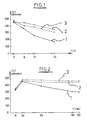
- FIG. 1 there is shown the evolution of cord/rubber adhesion strength with steam ageing time t, respectively for conventionally produced cords : solid line (l) and for two different cords according to the invention : broken lines (2) and (3).
- the adhesion strength in ordinate is expressed in terms of forces (N) necessary to pull out cords embedded in rubber blocks with a predetermined embedment length (ASTM test 2630).
- Steam ageing time t in hours is shown in abscis.
- Fig. 2 compares adhesion build up with curing time t (min.) and the effect of overcure on adhesion loss for the same conventional cords : solid line (l) and for the respective cords as in figure l and according to the invention : broken lines (2) and (3).
- cords according to the invention which are coated with a brass layer of the usual Cu-Zn compostion (here about 63-65 % Cu) except that the brass has a phosphate content of about 9 to 12 mg/m2.
- cords according to the invention are similar to conventional brassed cords in adhesion build up, but are clearly superior in overcure resistance (prolonged heat ageing at 155°C).
- the objects of the present invention are accomplished by providing a steel element (usually wire filaments and cords) for use in the reinforcement of vulcanized rubber products such as tires, hoses, straps, belts and the like, which element is covered with a phosphorized brass alloy coating having a copper content of at least 55 % by weight (more usually 60 to 75 % Cu), the said brass coating having generally a substantially homogeneous Cu-Zn alloy base composition and structure comprising an average phosphorus content of 5 to 50 milligrams per square meter of coating surface, the P-content being expressed as an amount by weight of phosphate ion (PO 3- 4 ) as measured by the Standard Test hereinafter described.
- a steel element usually wire filaments and cords
- a phosphorized brass alloy coating having a copper content of at least 55 % by weight (more usually 60 to 75 % Cu)
- the said brass coating having generally a substantially homogeneous Cu-Zn alloy base composition and structure comprising an average phosphorus content of 5 to 50 mill
- the phosphorus content of the improved brass coating is not less than 5 mg/per m2 and not more than 50 mg/m2, and preferably be comprised in the range of from 6 to 40 mg/m2 still more preferably from 8 to 30 mg/m2 and most preferably from 10 to 25 mg PO 3- 4 per m2.
- the phosphorus is preferably, but not necessarily, evenly distributed in the brass layer. It may be more concentrated in the upper part of the coating thickness, provided the average P-amount is not less than a specified lower limit as mentioned above.
- the P-amount in the brass coating is essentially present in the form of phosphate ions (PO 3- 4 ), conveniently but not necessarily of the constiuent metals (i.e.
- Suitable phosphates include for example pyrophosphates.
- phosphates of iron (stemming from the steel substrate or otherwise introduced to the brass alloy) and phosphates of optional brass alloying elements (e.g. Mn or Co or Ni) are not excluded.
- P-alloyed brass coatings wherein phosphorus is present as a solute, or as a suitable non-phosphate phosphorus compound are envisaged.
- P-containing rubber adherent brass coatings, applied on steel filaments and tire cords are all included within the scope of the present invention, provided their average P-content, expressed as PO4-ion amount, is not lower than 4 mg per m2 of brassed surface.
- the fundamental merit of the present invention consists both in the identification of the nature of the complex brass/rubber ageing problem and in the provision of an efficient and practical means for preventing otherwise excessive deterioration of adhesion strength under severe heat and/or humidity ageing circumstances.
- the present invention is applicable to a large variety of reinforcing steel elements covered by any suitable rubber adherable brass coating.
- the steel elements according to the invention are advantageously in the form of wires or cords for use in the reinforcement of tires and the following description is directed for the most part to brass-alloy coated steel wires and steel cords for this purpose, although not necessarily restricted thereto.
- the invention is generally, but not exclusively, applicable to the commonly used combinations of steel wire materials and brass (i.e. Cu-Zn) alloy surface coatings employed for strengthening vulcanized rubber composites.
- wire materials conveniently have a diameter of less than 2 mm and are produced from carbon steels (most often high-carbon steel containing between 0.6 and 1.0 % C, although alloyed versions thereof with higher than normal Si and Mn-contents and/or containing Cr, Ni, Mo, V, Co, Nb, etc, are not to be excluded).
- the wire surface will be covered with a thin brass alloy coating containing at least 55 % Cu (most often a binary Cu-Zn alpha-brass alloy with 60 to 75% Cu).
- the P-containing brass coatings according to this invention optionally may also comprise other elements, e.g one or more additional alloying elements (such as Co, Ni, Fe, Mn, Sn, Sb, Mo, etc.) added in varying minor amounts to the P-brass composition.
- additional alloying elements such as Co, Ni, Fe, Mn, Sn, Sb, Mo, etc.
- Particularly preferred embodiments of the present invention are concerned with brass alloy coated wires and cords for use in vehicle tires.
- wire materials are commonly made from brass-coated near-eutectoid steel up to about 1.0 % C (more often 0.7 - 0.85 % C), which following patenting, is brass plated and wet drawn to a final diameter of below 0.50 mm, commonly between 0.10 and 0.40 mm.
- hard drawn pearlitic wires have a tensile strength of about 2500 - 2800 N/mm2, sometimes increased to up to more than 3000 N/mm2.
- the wire surface is covered by a thin brass alloy coating containing from 58 to 75 % Cu, preferably from 60 to 72 % Cu.
- Coating thickness is generally less than 0.50 ⁇ m and is preferably between 0.10 and 0.35 ⁇ m.
- the brass alloy coating may be formed by alloy plating (e.g. from a cyanidic electrolytic Cu-Zn solution) or by sequential plating (in any order) from separate copper and zinc baths to form distinct Cu and Zn-layers in appropriate proportions followed by a thermodiffusion treatment so as to achieve a homogeneous (usually ⁇ -brass ⁇ alloy layer composition.
- any appropriate process can be used to achieve the desired P-containing brass composition of this invention and this can be realized at any suitable stage of the wire and cord manufacturing process.
- the alloying treatment with phosphorus and in particular the provision of a required phosphate amount in the brass composition, may be realized in different ways. It can thus be carried out prior or together with the deposition of the brass coating on the wire surface (alloy plating or sequential Cu and Zn plating),or between sequential plating and thermodiffusion, or following thermodiffusion and prior to wire drawing, or also during the wire drawing process. It could also be done on finished wire filaments (either before or after twisting the wires into a tire cord).
- the manner or order in which these P-containing or phosphatized brass surface coatings are realized into wires and cords is not important to the performance per se of the present invention, but only to the degree of performance and ease of manufacturing.
- a method of producing a brass coated steel wire or steel cord covered by a desired phosphatized brass composition comprises dipping a previously brass-coated steel wire in an appropriate phosphatizing solution so as to deposit a required amount of phosphate on the brassed wire surface, which phosphate upon subsequent wire drawing is evenly distributed into the brass layer by the combined effect of extreme thermoplastic surface straining, mechanical mixing and deformation enhanced migration or diffusion.
- a previously patented steel wire is first brass coated (either alloy plated or, more preferably sequentially plated with Cu + Zn and thermodiffused, and next treated in a phosphatizing H3PO4-solution of desired composition so as to fix a required phosphate-amount on the brass surface prior to drawing and finally subjected to a large deformation by drawing the same to a required final filament diameter.
- the phosphoric acid solution may also contain zinc phosphates, one suitable phosphoric acid/zinc phosphate solution being that sold under the commercial name Bonderite 9 (supplied by Barker Chemicals, USA).
- Bonderite 9 sold under the commercial name Bonderite 9 (supplied by Barker Chemicals, USA).
- the brassed wire is conveniently phosphatized by running through a bath of the desired solution and it is preferred to dry the wire between dipping and drawing, for instance by hot air drying or other convenient methods.
- the phosphatizing treatment of the Cu-Zn deposit can also be carried out before thermodiffusion (i.e. on the upper Zn-layer of the Cu + Zn plating) with subsequent thermodiffusion so as to form a phosphate-containing brass alloy.
- thermodiffusion i.e. on the upper Zn-layer of the Cu + Zn plating
- thermodiffusion so as to form a phosphate-containing brass alloy.
- the improved wire with P-alloyed brass coating is obtained by submerged drawing of a brass-coated wire in a wet lubricant solution of a composition effective to phosphatize the brass layer to a sufficient degree during the multiple die wire diameter reduction operation.
- This process effects phosphatization of the brass surface and may also provide penetration of part of the phosphate deeper into the brass layer by the action of heavy surface deformation under high die pressure while leaving most of the phosphate in the upper layer of the brass coating.
- Cords of 1 ⁇ 5, 1 ⁇ 4, 2+2, 3 + 9, 2 + 7 and 12 ⁇ 1 (compact cord) construction were twisted from said filaments (of normal strength and increased strength of up to more than 3000 N/mm2) covered in most cases with a Cu-Zn alloy thermodiffusion coating having a copper content in range of 60 to about 72% and further containing a preset amount of phosphate which was varied from a very small level (nil to less than 3 mg/m2 to increased levels of up to more than 30 mg/m2.
- the vulcanized rubber samples containing the embedded wires or cords were placed in a closed chamber containing a humid steam atmosphere at a temperature of 120°C. The samples were aged therein for a period of 12 to 24 hours. After this period of time, the samples were removed from the steam ageing chamber. Adhesion measurements for the unaged and steam aged samples were conducted at room temperature by using the above-described pull-out test.
- the rubbers to which the treated and untreated wire or cord is to be bonded are preferably standard tire rubbers based on natural rubber and/or polyisoprene. suitably compounded with carbon black, sulphur, zinc oxide, accelerators, anti-oxidants, stearic acid, etc. In most cases we used proprietary and/or commercially available tire rubber compounds. However, blends thereof with other rubbery polymers (like butadiene-styrene copolymers, polybutadiene, etc.) can also be used and for products other than tires there can be used nitrile rubber, polychloroprene and similar mixtures.
- This example illustrates the capacity of the phosphatizing-drawing method for producing steel filaments with a specified P-containing brass coating according to the invention.
- Steel wires were produced from patented and brass-coated halfproduct material of diameter 1,24 mm (0,72% C steel) by wet drawing the same to a diameter of 0,27 mm, the ultimate tensile strength of the wire attaining about 2700 - 2850 N/mm2.
- the thermodiffused brass layer on the wire surface had a Cu-Zn alloy composition with 63 to 71 % Cu and a coating weight of about 3,5 - 4,5 g of brass per kg of wire.
- the currently used wet lubricant solution was adapted with the aim of providing a desired degree of phosphatizing power varying from very poor (reference lubricant) to moderate and up to high.
- the phosphate concentration in the lubricant was raised stepwise from a normal level (low total phosphate amount of less than 0,5 g/l) to a medium level of l,2 - 2 g/l and was further increased to a high level ranging from 2 to 3 g/l.
- the concentration of soluble phosphates was set at a value of at least 0,5 g/l and adjusted in a range of about 0,6 to l g/l for moderate phosphatizing, respectively from about l to l,8 g/l for enhanced phosphatizing in combination with a control of pH (appropriate addition of H3PO4) and of the fatty acid (lubricating) compounds in the lubricant solution to compensate consumption of chemicals during operation.
- the vulcanized rubber/cord samples were then subjected to steam ageing (120°C - 24 hours) for adhesion comparison with unaged samples.
- Static adhesion tests were conducted (as described hereinabove) by pulling the filaments through and out the rubber blocks by means of an Instron testing machine and by measuring the pull-out force in Newton. The test data are summarized in table 2.
- adhesion response on phosphatization was evaluated for commercial tire cords (construction type 2 + 2 ⁇ 0.25 mm2 twisted from 0.25 mm diameter wires (tensile strength of about 2800 - 3000 N/mm2) provided with a brass surface layer containing about 63-64 % Cu with a coating weight of about 3.4 g/kg of wire.
- Phosphorus content of the brass coating was set at either a high level (at least 4 ⁇ 10 ⁇ 3 A.U. by IR-analysis), or alternatively at a normal low level (0,1 ⁇ 10 ⁇ 3 A.U.) by adapting the phosphatizing capacity of the wet drawing lubricant.
- Adhesion results of rubberised cord samples after vulcanization or steam ageing are given in Table 3 below.
- brass-coated cords of this invention are less sensitive to adhesion degradation by steam ageing. Adhesion retention after 24 hours is improved by 20-25 % over conventional cords. However, as will be demonstrated in the following examples, the reliability of the method and the level of improvement in aged adhesion retention can be increased to a still more significant extent by optimization of the practice of this invention in accordance with the underlying inventive concept.
- Brass-plated cords (2+2 ⁇ 0.25 mm) having an average brass coating thickness ranging between 0.12 and 0.30 ⁇ m with a copper content from about 60 % up to 70 % were twisted from 0.25 mm diameter wire.
- the wire had been drawn from brassed semiproduct (0.68 to 0.86 %C; diameter 1.20 to 1.40 mm) which was thermodiffused to produce a homogeneous ⁇ -brass structure as desired for adequate wet drawing and rubber adhesion purposes.
- thermodiffused brassed semiproducts prior to drawing, were first subjected to a controlled phosphatizing treatment by immersion in a phosphoric acid solution (0.5 to 10% H3PO4) followed by careful heating/drying so as to obtain a sufficiently phosphatized brass coating. Wet drawing to 0.25 mm was carried out in the same lubricant as used for current production of conventional wires (cfr. series I).
- Phosphorus content (expressed as PO 3- 4 ) of cord filaments has been determined by DCP-analysis (the Standard Test).
- Table 4 gives the results of coating characterization and adhesion behaviour in two unidentified standard tire compounds supplied to us by well known tire manufactures.
- specified phosphate levels are preferably at least 5 mg/m2 and more preferably in a range of from 7 up to more than 25 mg/m2.
- FIG. 1 A schematic representation of the improvement in adhesion retention after steam ageing is shown in Fig. 1, comparing actual levels of current tire cords with the results achieved by applying the cords and production method according to this invention.
- a first set-up phosphatization of the brassed semi-product was carried out by a predip bath (20 to 50 g/l of phosphoric acid) with rapid drying prior to and in line with the entering section of the wire drawing machine.
- the semi-product brass coating line was extended with an appropriate phosphatizing and phosphate fixing cell wherein the brass coated wire was treated in appropriate conditions (H3PO4-concentration from 5 to up to more than 250g/l, preferably from 25 to 125 g/l ; zinc orthophosphate concentration from zero up to the solubility limit; different immersion times) with the aim of systematically increasing the phosphate content of the brassed wire (firmly attached to brass layer by proper drying/heating).
- adhesion promotors and often optionally added to a given standard rubber mix
- Compound S was modified by replacement of part of the carbon black with the well known HRH or RFS system, and additionally small quantities of three well known adhesion promoters were added, to give modified compositions as follows :
- cords according to the invention systematically retain a significantly higher cord-to-rubber bond level than conventional tire cords under similar steam ageing conditions, and this for all the tested rubber modifications.
- vulcanized cord/rubber blocks were prepared from the same conventional cords and cords according to the invention of Example 5 and exposed in a humidity chamber for 8 days to a temperature of 80 - 85° C and an atmosphere of 95 % relative humidity.
- Table 11 gives a comparison of initial and cured humidity adhesion for both cord types embedded in rubbers S1 to S4.
- steel filaments and cords treated according to the invention and provided with a specified phosphate-containing brass surface coating for bonding to rubber ensure durable adhesion with rubber in service.
- adhesion retention in widely varying heat and/or humidity ageing conditions are markedly improved in different tire rubber compounds.
- any alloyed steel including non-ferrous metals and alloys, may be combined with rubber in any suitable form (such as filaments, cords, flat wire and other shaped elements and fabrics thereof) and provide improved adhesion properties if said elements are covered with a phosphate-containing brass layer.
- Modified phosphatizing methods may for example include depositing a metallic film (selected from Zn, Fe, Mn or a combination thereof) onto the brass surface and chemically converting said surface film into phosphate by treating the same in a phosphating bath.
- a chemical conversion treatment in a phosphoric acid solution containing metallic zinc ions, or optionally manganese or iron or iron and calcium ions to modify the metal composition of the phosphate film may if desired be made.
- Nickel and/or cobalt phosphates may similarly be incorporated into the brass coating if desired.
- electrochemical aids and the use of electrolytic deposition are not excluded.
Landscapes
- Chemical & Material Sciences (AREA)
- Engineering & Computer Science (AREA)
- Materials Engineering (AREA)
- Chemical Kinetics & Catalysis (AREA)
- Organic Chemistry (AREA)
- Health & Medical Sciences (AREA)
- Polymers & Plastics (AREA)
- Medicinal Chemistry (AREA)
- Manufacturing & Machinery (AREA)
- Mechanical Engineering (AREA)
- Metallurgy (AREA)
- General Chemical & Material Sciences (AREA)
- Ropes Or Cables (AREA)
- Laminated Bodies (AREA)
- Reinforced Plastic Materials (AREA)
- Tires In General (AREA)
- Wire Processing (AREA)
- Pharmaceuticals Containing Other Organic And Inorganic Compounds (AREA)
- Adhesives Or Adhesive Processes (AREA)
- Lining Or Joining Of Plastics Or The Like (AREA)
Priority Applications (1)
| Application Number | Priority Date | Filing Date | Title |
|---|---|---|---|
| AT87201197T ATE68531T1 (de) | 1986-06-27 | 1987-06-23 | Stahlgegenstaende mit messingueberzug, die verbesserte adhaesionseigenschaften gegenueber gummi aufweisen. |
Applications Claiming Priority (2)
| Application Number | Priority Date | Filing Date | Title |
|---|---|---|---|
| GB8615746 | 1986-06-27 | ||
| GB868615746A GB8615746D0 (en) | 1986-06-27 | 1986-06-27 | Brass-coated steel elements |
Publications (2)
| Publication Number | Publication Date |
|---|---|
| EP0257667A1 EP0257667A1 (en) | 1988-03-02 |
| EP0257667B1 true EP0257667B1 (en) | 1991-10-16 |
Family
ID=10600206
Family Applications (1)
| Application Number | Title | Priority Date | Filing Date |
|---|---|---|---|
| EP87201197A Expired - Lifetime EP0257667B1 (en) | 1986-06-27 | 1987-06-23 | Brass-coated steel elements having improved rubber adhesion properties |
Country Status (13)
| Country | Link |
|---|---|
| US (1) | US4883722A (Direct) |
| EP (1) | EP0257667B1 (Direct) |
| JP (1) | JPH078917B2 (Direct) |
| KR (1) | KR960000857B1 (Direct) |
| AT (1) | ATE68531T1 (Direct) |
| AU (1) | AU600283B2 (Direct) |
| BR (1) | BR8703254A (Direct) |
| CA (1) | CA1333141C (Direct) |
| DE (1) | DE3773801D1 (Direct) |
| ES (1) | ES2027278T3 (Direct) |
| GB (1) | GB8615746D0 (Direct) |
| IN (1) | IN168533B (Direct) |
| TR (1) | TR25014A (Direct) |
Cited By (1)
| Publication number | Priority date | Publication date | Assignee | Title |
|---|---|---|---|---|
| EP1963555A4 (en) * | 2005-11-14 | 2010-02-17 | Otis Elevator Co | LIFT CARRIER WITH CONVERTIVE COVER ON A VOLTAGE MEMBER |
Families Citing this family (21)
| Publication number | Priority date | Publication date | Assignee | Title |
|---|---|---|---|---|
| FR2633534B1 (fr) * | 1988-07-01 | 1992-03-13 | Roulements Soc Nouvelle | Procede de depot d'un revetement auto-lubrifiant a base de ptfe sur un element de roulement et roulements ainsi obtenus |
| US5173341A (en) * | 1989-02-10 | 1992-12-22 | Tokyo Rope Mfg. Co., Ltd. | Rubber-reinforcing steel wires and method of manufacturing the same |
| US5229215A (en) * | 1989-09-25 | 1993-07-20 | The Goodyear Tire & Rubber Company | Brass-plated steel wire |
| US5118367A (en) * | 1989-09-25 | 1992-06-02 | The Goodyear Tire & Rubber Company | Process for treating a brass-plated steel wire |
| DE69029389T2 (de) * | 1990-08-07 | 1997-05-22 | Tokyo Rope Mfg Co | Verfahren zu Herstellung von polymerbeschichteten Stahldrähten zur Gummiverstärkung |
| IT1273696B (it) * | 1994-07-28 | 1997-07-09 | Pirelli | Filo metallico trattato superficialmente per la realizzazione di strutture di rinforzo di manufatti in elastomerico e procedimento per la sua realizzazione |
| JP2772627B2 (ja) * | 1995-05-16 | 1998-07-02 | 東京製綱株式会社 | ゴム補強用超高強度スチールワイヤおよびスチールコード |
| US6203932B1 (en) * | 1995-12-21 | 2001-03-20 | Bridgestone Corporation | Steel wire for reinforcement of rubber articles, method of manufacturing the same, and steel cord using the same |
| US6410098B1 (en) * | 2000-07-05 | 2002-06-25 | Digital Plating Co., Ltd. | Process for preparing copper-film-plated steel cord for vehicle tire |
| EP1350049B1 (en) * | 2000-12-20 | 2004-09-01 | N.V. Bekaert S.A. | Flexible duct reinforced with high-tensile steel members |
| EP1365064B1 (en) * | 2001-02-21 | 2016-06-15 | Bridgestone Corporation | Steel wire and steel cord for reinforcing rubber article, and tire |
| EP1350865A3 (de) * | 2002-04-05 | 2004-12-29 | ThyssenKrupp Stahl AG | Verzinktes und phosphatiertes Blech sowie Verfahren zur Herstellung eines solchen Blechs |
| WO2007141973A1 (ja) * | 2006-06-02 | 2007-12-13 | Bridgestone Corporation | 空気入りタイヤ |
| US8883306B2 (en) * | 2008-03-04 | 2014-11-11 | Nv Bekaert Sa | Cold drawn low carbon steel filament and method of manufacturing said filament |
| US10358769B2 (en) * | 2012-02-06 | 2019-07-23 | Nv Bekaert Sa | Ternary or quaternary alloy coating for steam ageing and cured humidity adhesion elongated steel element comprising a ternary or quaternary brass alloy coating and corresponding method |
| ES2642918T3 (es) | 2012-02-06 | 2017-11-20 | Nv Bekaert Sa | Elemento de acero alargado que comprende un recubrimiento de aleación de latón ternaria o cuaternaria y método correspondiente |
| US9951469B2 (en) | 2012-07-24 | 2018-04-24 | Nv Bekaert Sa | Steel cord for rubber reinforcement |
| CN107709432B (zh) * | 2015-07-23 | 2020-10-27 | 横滨橡胶株式会社 | 橡胶组合物、橡胶组合物金属层叠体及硫化橡胶制品 |
| KR102125998B1 (ko) | 2018-03-12 | 2020-07-02 | 홍덕산업(주) | 내산화성이 우수한 전기 도금 비드와이어 |
| EP3918114A1 (en) * | 2019-01-31 | 2021-12-08 | NV Bekaert SA | Steel cord with a brass coating enriched with iron particles |
| CN116005212A (zh) * | 2023-01-19 | 2023-04-25 | 江苏兴达钢帘线股份有限公司 | 一种钢帘线、单丝及其生产方法和生产装置 |
Family Cites Families (14)
| Publication number | Priority date | Publication date | Assignee | Title |
|---|---|---|---|---|
| US2233422A (en) * | 1938-06-06 | 1941-03-04 | Herman J Lodeesen | Method of coating copper and its alloys |
| FR1007909A (fr) * | 1948-04-14 | 1952-05-12 | Tewa | Procédé pour le revêtement de surfaces métalliques avec du caoutchouc ou des produits de remplacement du caoutchouc |
| US4269877A (en) * | 1975-04-14 | 1981-05-26 | The Goodyear Tire & Rubber Company | Aromatic triazole, precipitation compound and oxidizing compound for increased surface protection and improved adhesion of brass coated steel to rubber |
| US3996074A (en) * | 1975-08-28 | 1976-12-07 | Monsanto Company | Method for improving hydrolytic stability of the bond between steel surfaces and organic adhesives |
| NL7702643A (nl) * | 1977-03-11 | 1978-09-13 | Akzo Nv | Voorwerp bekleed met een metaallegering, waaraan elastomeer materiaal is gehecht, alsmede werkwijze voor het vervaardigen van dat voorwerp. |
| GB1598388A (en) * | 1978-05-26 | 1981-09-16 | Bekaert Sa Nv | Steel wire reinforcing elements |
| US4182639A (en) * | 1978-11-06 | 1980-01-08 | United States Steel Corporation | Method for improving the adhesion of brass-coated steel cord to rubber |
| FR2445764A1 (fr) * | 1979-01-05 | 1980-08-01 | Bekaert Sa Nv | Nouveaux elements a base de fils d'acier pour le renforcement de compositions de caoutchouc |
| US4446198A (en) * | 1983-09-08 | 1984-05-01 | The Goodyear Tire & Rubber Company | Copper-zinc-iron ternary alloy coated steel wire reinforcers in tires |
| DE3561164D1 (en) * | 1984-07-09 | 1988-01-21 | Bekaert Sa Nv | Steel cord twisting structure |
| US4788086A (en) * | 1984-07-14 | 1988-11-29 | Nippondenso Co., Ltd. | Copper-based metallic member having a chemical conversion film and method for producing same |
| GB8424086D0 (en) * | 1984-09-24 | 1984-10-31 | Bekaert Sa Nv | Steel cord |
| GB8426746D0 (en) * | 1984-10-23 | 1984-11-28 | Bekaert Sa Nv | Ferrous substrate |
| GB8500322D0 (en) * | 1985-01-07 | 1985-02-13 | Bekaert Sa Nv | Steel elements |
-
1986
- 1986-06-27 GB GB868615746A patent/GB8615746D0/en active Pending
-
1987
- 1987-06-04 IN IN480/DEL/87A patent/IN168533B/en unknown
- 1987-06-09 CA CA000539221A patent/CA1333141C/en not_active Expired - Fee Related
- 1987-06-11 US US07/060,634 patent/US4883722A/en not_active Expired - Lifetime
- 1987-06-23 EP EP87201197A patent/EP0257667B1/en not_active Expired - Lifetime
- 1987-06-23 ES ES198787201197T patent/ES2027278T3/es not_active Expired - Lifetime
- 1987-06-23 AT AT87201197T patent/ATE68531T1/de not_active IP Right Cessation
- 1987-06-23 DE DE8787201197T patent/DE3773801D1/de not_active Expired - Fee Related
- 1987-06-24 TR TR87/0436A patent/TR25014A/xx unknown
- 1987-06-26 BR BR8703254A patent/BR8703254A/pt not_active IP Right Cessation
- 1987-06-26 AU AU74738/87A patent/AU600283B2/en not_active Ceased
- 1987-06-26 JP JP62159521A patent/JPH078917B2/ja not_active Expired - Fee Related
- 1987-06-27 KR KR1019870006559A patent/KR960000857B1/ko not_active Expired - Fee Related
Cited By (3)
| Publication number | Priority date | Publication date | Assignee | Title |
|---|---|---|---|---|
| EP1963555A4 (en) * | 2005-11-14 | 2010-02-17 | Otis Elevator Co | LIFT CARRIER WITH CONVERTIVE COVER ON A VOLTAGE MEMBER |
| CN101365835B (zh) * | 2005-11-14 | 2013-06-19 | 奥的斯电梯公司 | 在张紧构件上具有转化覆层的电梯承载构件 |
| US9051651B2 (en) | 2005-11-14 | 2015-06-09 | Otis Elevator Company | Elevator load bearing member having a conversion coating on tension member |
Also Published As
| Publication number | Publication date |
|---|---|
| ES2027278T3 (es) | 1992-06-01 |
| DE3773801D1 (de) | 1991-11-21 |
| AU7473887A (en) | 1988-01-07 |
| CA1333141C (en) | 1994-11-22 |
| IN168533B (Direct) | 1991-04-20 |
| JPS6333135A (ja) | 1988-02-12 |
| EP0257667A1 (en) | 1988-03-02 |
| JPH078917B2 (ja) | 1995-02-01 |
| GB8615746D0 (en) | 1986-08-06 |
| KR890000266A (ko) | 1989-03-13 |
| TR25014A (tr) | 1992-08-31 |
| US4883722A (en) | 1989-11-28 |
| ATE68531T1 (de) | 1991-11-15 |
| AU600283B2 (en) | 1990-08-09 |
| BR8703254A (pt) | 1988-03-15 |
| KR960000857B1 (ko) | 1996-01-13 |
Similar Documents
| Publication | Publication Date | Title |
|---|---|---|
| EP0257667B1 (en) | Brass-coated steel elements having improved rubber adhesion properties | |
| CA1144436A (en) | Steel wire reinforcing elements | |
| LU101209B1 (en) | Metal wires, manufacturing methods therefor, and tires | |
| EP0188036B1 (en) | Rubber adherable steel reinforcing elements with composite surface coating | |
| JPS6077989A (ja) | 三元合金被覆鋼線 | |
| AU597489B2 (en) | Intermediate coating of steel wire | |
| US5014760A (en) | Steel wire for reinforcing elastomer articles with improved adhesion promoting layer | |
| EP0343254A1 (en) | Metal and composite material made of the metal with rubber | |
| US6602614B2 (en) | Coated metal wire, wire-reinforced elastomeric article containing the same and method of manufacture | |
| US6203932B1 (en) | Steel wire for reinforcement of rubber articles, method of manufacturing the same, and steel cord using the same | |
| JPH07331480A (ja) | エラストマー物質の複合要素に用いられる表面処理ワイヤおよび該ワイヤの製造方法 | |
| GB2039580A (en) | Coated steel wire | |
| EP0188851A1 (en) | Ternary brass alloy coated steel elements for reinforcing rubber | |
| CA1258999A (en) | Quaternary brass alloy coated steel element and rubber reinforced therewith | |
| CA2018864C (en) | Process for treating a brass-plated steel wire | |
| EP0230071A1 (en) | Steel elements with brass alloy coatings for use in the reinforcement of vulcanised rubber articles | |
| EP1004689B1 (en) | Coated metal wire and method of manufacture | |
| US5389163A (en) | Method for producing a rubber-reinforced steel wire | |
| JP2018119242A (ja) | スチールコード及びゴム−スチールコード複合体 | |
| KR100317345B1 (ko) | 경시 접착력이 우수한 스틸 타이어 코드 및 그 제조 방법 | |
| JPH038880A (ja) | ブロンズ電気めっきビードワイヤ及びその製造方法 | |
| JPH08260368A (ja) | ゴム物品補強用ブラスメッキスチールワイヤ | |
| JP2018119243A (ja) | スチールコード及びゴム−スチールコード複合体 | |
| SU441698A1 (ru) | Способ получени покрыти на металлической поверхности | |
| KR0149451B1 (ko) | 스틸 코드의 제조방법 |
Legal Events
| Date | Code | Title | Description |
|---|---|---|---|
| PUAI | Public reference made under article 153(3) epc to a published international application that has entered the european phase |
Free format text: ORIGINAL CODE: 0009012 |
|
| AK | Designated contracting states |
Kind code of ref document: A1 Designated state(s): AT BE CH DE ES FR GB IT LI LU NL SE |
|
| 17P | Request for examination filed |
Effective date: 19880830 |
|
| 17Q | First examination report despatched |
Effective date: 19891108 |
|
| GRAA | (expected) grant |
Free format text: ORIGINAL CODE: 0009210 |
|
| AK | Designated contracting states |
Kind code of ref document: B1 Designated state(s): AT BE CH DE ES FR GB IT LI LU NL SE |
|
| REF | Corresponds to: |
Ref document number: 68531 Country of ref document: AT Date of ref document: 19911115 Kind code of ref document: T |
|
| ITF | It: translation for a ep patent filed | ||
| REF | Corresponds to: |
Ref document number: 3773801 Country of ref document: DE Date of ref document: 19911121 |
|
| ET | Fr: translation filed | ||
| REG | Reference to a national code |
Ref country code: ES Ref legal event code: FG2A Ref document number: 2027278 Country of ref document: ES Kind code of ref document: T3 |
|
| PLBE | No opposition filed within time limit |
Free format text: ORIGINAL CODE: 0009261 |
|
| STAA | Information on the status of an ep patent application or granted ep patent |
Free format text: STATUS: NO OPPOSITION FILED WITHIN TIME LIMIT |
|
| 26N | No opposition filed | ||
| EPTA | Lu: last paid annual fee | ||
| EAL | Se: european patent in force in sweden |
Ref document number: 87201197.8 |
|
| PGFP | Annual fee paid to national office [announced via postgrant information from national office to epo] |
Ref country code: SE Payment date: 19960222 Year of fee payment: 10 |
|
| PGFP | Annual fee paid to national office [announced via postgrant information from national office to epo] |
Ref country code: NL Payment date: 19960223 Year of fee payment: 10 |
|
| PGFP | Annual fee paid to national office [announced via postgrant information from national office to epo] |
Ref country code: AT Payment date: 19960416 Year of fee payment: 10 |
|
| PGFP | Annual fee paid to national office [announced via postgrant information from national office to epo] |
Ref country code: ES Payment date: 19960607 Year of fee payment: 10 |
|
| PGFP | Annual fee paid to national office [announced via postgrant information from national office to epo] |
Ref country code: CH Payment date: 19960723 Year of fee payment: 10 |
|
| PG25 | Lapsed in a contracting state [announced via postgrant information from national office to epo] |
Ref country code: AT Effective date: 19970623 |
|
| PG25 | Lapsed in a contracting state [announced via postgrant information from national office to epo] |
Ref country code: SE Effective date: 19970624 Ref country code: ES Free format text: LAPSE BECAUSE OF EXPIRATION OF PROTECTION Effective date: 19970624 |
|
| PG25 | Lapsed in a contracting state [announced via postgrant information from national office to epo] |
Ref country code: LI Free format text: LAPSE BECAUSE OF NON-PAYMENT OF DUE FEES Effective date: 19970630 Ref country code: CH Free format text: LAPSE BECAUSE OF NON-PAYMENT OF DUE FEES Effective date: 19970630 |
|
| PG25 | Lapsed in a contracting state [announced via postgrant information from national office to epo] |
Ref country code: NL Effective date: 19980101 |
|
| REG | Reference to a national code |
Ref country code: CH Ref legal event code: PL |
|
| EUG | Se: european patent has lapsed |
Ref document number: 87201197.8 |
|
| NLV4 | Nl: lapsed or anulled due to non-payment of the annual fee |
Effective date: 19980101 |
|
| REG | Reference to a national code |
Ref country code: ES Ref legal event code: FD2A Effective date: 20000301 |
|
| REG | Reference to a national code |
Ref country code: GB Ref legal event code: IF02 |
|
| PGFP | Annual fee paid to national office [announced via postgrant information from national office to epo] |
Ref country code: DE Payment date: 20030228 Year of fee payment: 17 |
|
| PGFP | Annual fee paid to national office [announced via postgrant information from national office to epo] |
Ref country code: BE Payment date: 20030303 Year of fee payment: 17 |
|
| PGFP | Annual fee paid to national office [announced via postgrant information from national office to epo] |
Ref country code: FR Payment date: 20030305 Year of fee payment: 17 |
|
| PGFP | Annual fee paid to national office [announced via postgrant information from national office to epo] |
Ref country code: LU Payment date: 20030320 Year of fee payment: 17 |
|
| PGFP | Annual fee paid to national office [announced via postgrant information from national office to epo] |
Ref country code: GB Payment date: 20030324 Year of fee payment: 17 |
|
| PG25 | Lapsed in a contracting state [announced via postgrant information from national office to epo] |
Ref country code: LU Free format text: LAPSE BECAUSE OF NON-PAYMENT OF DUE FEES Effective date: 20040623 Ref country code: GB Free format text: LAPSE BECAUSE OF NON-PAYMENT OF DUE FEES Effective date: 20040623 |
|
| PG25 | Lapsed in a contracting state [announced via postgrant information from national office to epo] |
Ref country code: BE Free format text: LAPSE BECAUSE OF NON-PAYMENT OF DUE FEES Effective date: 20040630 |
|
| BERE | Be: lapsed |
Owner name: S.A. *BEKAERT N.V. Effective date: 20040630 |
|
| PG25 | Lapsed in a contracting state [announced via postgrant information from national office to epo] |
Ref country code: DE Free format text: LAPSE BECAUSE OF NON-PAYMENT OF DUE FEES Effective date: 20050101 |
|
| GBPC | Gb: european patent ceased through non-payment of renewal fee |
Effective date: 20040623 |
|
| PG25 | Lapsed in a contracting state [announced via postgrant information from national office to epo] |
Ref country code: FR Free format text: LAPSE BECAUSE OF NON-PAYMENT OF DUE FEES Effective date: 20050228 |
|
| REG | Reference to a national code |
Ref country code: FR Ref legal event code: ST |
|
| PG25 | Lapsed in a contracting state [announced via postgrant information from national office to epo] |
Ref country code: IT Free format text: LAPSE BECAUSE OF NON-PAYMENT OF DUE FEES;WARNING: LAPSES OF ITALIAN PATENTS WITH EFFECTIVE DATE BEFORE 2007 MAY HAVE OCCURRED AT ANY TIME BEFORE 2007. THE CORRECT EFFECTIVE DATE MAY BE DIFFERENT FROM THE ONE RECORDED. Effective date: 20050623 |