EP0249961A2 - Datenverarbeitungseinrichtung zur Verwendung in statistischer Berechnung - Google Patents
Datenverarbeitungseinrichtung zur Verwendung in statistischer Berechnung Download PDFInfo
- Publication number
- EP0249961A2 EP0249961A2 EP87108696A EP87108696A EP0249961A2 EP 0249961 A2 EP0249961 A2 EP 0249961A2 EP 87108696 A EP87108696 A EP 87108696A EP 87108696 A EP87108696 A EP 87108696A EP 0249961 A2 EP0249961 A2 EP 0249961A2
- Authority
- EP
- European Patent Office
- Prior art keywords
- data
- key
- calculation
- item
- column
- Prior art date
- Legal status (The legal status is an assumption and is not a legal conclusion. Google has not performed a legal analysis and makes no representation as to the accuracy of the status listed.)
- Granted
Links
Images










Classifications
-
- G—PHYSICS
- G06—COMPUTING OR CALCULATING; COUNTING
- G06F—ELECTRIC DIGITAL DATA PROCESSING
- G06F17/00—Digital computing or data processing equipment or methods, specially adapted for specific functions
- G06F17/10—Complex mathematical operations
- G06F17/18—Complex mathematical operations for evaluating statistical data, e.g. average values, frequency distributions, probability functions, regression analysis
-
- G—PHYSICS
- G06—COMPUTING OR CALCULATING; COUNTING
- G06F—ELECTRIC DIGITAL DATA PROCESSING
- G06F15/00—Digital computers in general; Data processing equipment in general
- G06F15/02—Digital computers in general; Data processing equipment in general manually operated with input through keyboard and computation using a built-in program, e.g. pocket calculators
- G06F15/025—Digital computers in general; Data processing equipment in general manually operated with input through keyboard and computation using a built-in program, e.g. pocket calculators adapted to a specific application
Definitions
- the present invention relates to a data processing device of a mini-computer, so called a pocket computer, with statistic processing functions.
- the averaging process is executed on the condition of inputting the data (63, 49, 75) of the results of mathematics and also in case of calculating the average value of the results of the Japanese, the averaging process is executed on the condition of inputting the data (82, 35, 63) of the results of the Japanese.
- the calculation of the distribution function has been executed by using the approximate expression but since there is a portion.with bad calculation precision in the approximate expression, the distribution calculation has been executed by using the recurrence fomula in the above-mentioned bad precision portion.
- the distribution list is memorized in the memory of the mini-computer and the necessary corresponding values of the calculations are called out one by one, whereby the program calculation has been performed.
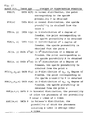
- the title and the names of the column items and the row items are inputted and sequentially the data of the table are inputted in turns so that the desired table is made and the data are stored in a memory element such as random access memory (RAM) in turns as shown in Table 1.
- RAM random access memory
- the essential object of the present invention is to provide a mini-computer with a statistic processing system comprising a memory for storing data in a table format formed with plural items of rows and columns, wherein various kinds of statistic calculations are executed by using the memory of table format, whereby inputting of the data is made easy and the operations of the confirmation, replacement and adding of the inputted data can be done easily.
- Another essential object of the present invention is to provide a statistic processing system which prevents the input miss of data by displaying an un-input data item or a missing data item clearly by means of specific symbols onto the display unit.
- Another essential object of the present invention is to provide a mini-computer with function faculty by operating keys and function faculty linking with the BASIC program, whereby the calculation of the distribution function can be performed in a short time in a large range keeping the precision of the calculation by covering the above-mentioned faults of the calculations by using the approximate expression or the recurrence fomula each other.
- Another essential object of the present invention is to provide a data processing device by which the sequential detection can be executed.
- the statistic processing system comprises a memory for storing each data in a table format formed of plural row and column (matrix) items, input means for inputting the data of the items by allocating the row, and (or) column of the table format data into said memory, indicating means for indicating any of the row or column of the item data stored in said memory, and calculation indicating keys for indicating plural kinds of the statistic calculations, wherein the statistic calculation indicated by said calculation indicating keys is executed with respect to the row or column indicated by said indicating means for indicating the row or column.
- the mini-computer comprises a distribution function calculation indicating keys, numerical keys for inputting variables such as provability values and degree of freedom, and a nonvolatile memory for memorizing a distribution function calculation routine on the basis of the distribution function calculation indicating keys.
- the data processing device comprises memory means for memorizing data groups with an arrangement aspect of matrix shape, input means for inputting various data, a first memory portion for storing the input data from the input means for comparison and a second memory portion for storing the data among the data group for comparison, so that the comparison between the contents of the first and second memory portions can be executed sequentially.
- each data is memorized into the memory in a table format made of plural row and column items by allocating the row and(or) column of the table format data into the memory by the input means and then the instructed calculation is executed with respect to the instructed row or column only by instructing any of the row or column of the item data stored in the memory and the kind of the statistic calculations. Therefore, various kinds of the statistic calculations,such as a statistic process with one variable or two variables can be easily executed only by instructing the row or column and the kind of the statistic calculation without inputting the item data many times, and the confirmation and correction etc. of the input item data can be also easily done by the operation of reading and writing into the memory.
- the calculation of the distribution function is performed depending on the distribution function calculation routine memorized in the memory on the basis of the distribution function calculation indicating keys and the input of the variables such as provability values and degree of freedom.
- the data groups with an arrangement aspect of matrix shape are stored in the memory means. And the data inputted for comparison by the input means are stored in the first memory portion. On the other hand, the data among said data group are stored in turns in the second memory portion for comparing with the inputted data. The comparison of the contents between the first and the second memory portions is sequentially executed so that the comparison between the data among the data group and the data inputted through the input means can be continuously executed.
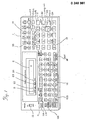
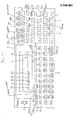
- Fig. 1 is a schematic perspective view showing a mini-computer of handy type of the first and second embodiments according to the present invention.
- a liquid crystal display unit (referred to as LCD hereinafter) 2 in the left upper portion of the mini-computer (body) 1 and a key board including character input keys and function keys in the peripheral portion of the mini-computer body 1.
- LCD liquid crystal display unit
- the LCD2 there are provided a dot segment type display capacity with 24 units in one line and indicators 21, 22, 23 and 24 for indicating the mode condition of the mini-computer in the lower portion of the LCD2.
- reference numeral 10 denotes a power switch and by turning the power switch 10 on, the mini-computer is powered up and initialized.
- the mode of the mini-computer is preset in the statistic processing mode (STAT).
- Reference numeral 11 denotes mode setting keys comprising STAT key 11A for setting a statistic processing mode (STAT) and a calculation mode (CAL) in turns at every operation, and BASIC key 11B for setting a program running (RUN) mode for executing the operation of the program processing mode by the BASIC language and programming mode (PRO) in turns at every operation.
- STAT statistic processing mode
- CAL calculation mode
- RUN program running
- the indicator STAT2l is turned on, in the CAL mode the indicator CAL22 is turned on, in the RUN mode the indicator RUN23 is turned on and in the PRO mode the indicator PR024 is turned on.
- Reference numeral 12 denotes a group of the character input keys which are made definable for various kinds of opening keys. Particularly in the group of the lower keys 12B there are disposed character keys which are defined as a group of distribution function keys used in a statistic processing by operating the distribution function indicating keys 12A.
- Reference numeral 13 denotes a group of numerical input keys and a group of calculation indicating keys and the subtraction key 34 is defined as an missing value key which indicates the absence of the item data in the statistic processing by switching the shift key.
- Reference numeral 14 denotes a group of function keys for executing various kinds of statistic processing such as the calculations of the amohg value, average value and deviation value of the row or column of a table data on the basis of the table data which is stored in the table data area after the item data is inputted as described below.
- the statistic calculation processing is executed by operating the above mentioned function keys and the results of the calculations are outputted and applied to the LCD2 and stored in a predetermined position of the table data area.
- Reference numeral 15 denotes cursor keys.
- Reference numeral 31 denotes a table key for forming and reading out each table data for the statistic processing
- reference numeral 32 denotes a row input input) down shift key for selecting each item in the row direction of the table
- reference numeral 33 denotes a column input ( ⁇ input) right shift key for selecting each item in the column direction of the table.
- Reference numeral 35 denotes a statistic processing key (+ X) with one variable or a statistic processing key (+ Y), with two variables which are switched by the shift key.
- Reference mark ( ⁇ X) or ( ⁇ Y) means that one or two column items are processed statistically.
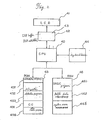
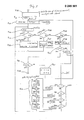
- Fig. 2 is a circuit block diagram showing a mini-computer of the first and second embodiments according to the present invention.
- Reference numeral 40 denotes a central processing unit (referred to as CPU) which executes the data processing depending on various kinds of control programs memorized in the read only memory ROM 45 connected to CPU 40 via a data bus line.
- CPU central processing unit
- Reference numeral 41 denotes the aforementioned LCD which is driven for displaying by the display control unit 42 connected to CPU 40 and the display control unit 42 accommodates a display buffer 43 for storing display data (dot data).
- Reference numeral 44 denotes the key board device shown in Fig. 1, which provides coded signals corresponding to the operated keys into CPU.
- ROM 45 comprises an initializing program area 451 for storing an initial program controlling the initialization processing at the time of applying power, an interpreter area 452 of BASIC language, a statistic program area for memorizing the statistic processing control program of a flow chart as mentioned below, a character pattern generator (CG) area 454 for developing the code information of the character and symbol generated in CPU in a dot pattern for the output (for the display in the present embodiment), other system program area 456 for memorizing other various kinds of system programs and a distribution table area 457 for memorizing the calculation value on the basis of the predetermined condition of the distribution functions such as normal distribution, t-distribution, X 2- distribution and F-distribution in a table format (each data in the distribution table is generally known as a distribution list). It is preferable that each of the above mentioned areas 451 to 457 is made by ROM chip individually.
- Reference numeral 46 denotes a random access memory RAM which is connected to CPU through a data bus line as well as ROM 45.
- RAM 46 comprises a,BASIC program area 461 for storing the BASIC user program which is made by a operator, a table data area 462 for storing plural table data which is obtained by the statistic processing system of the present invention, and a system area 463 for allocating various kinds of buffers and counters.
- the table data area 462 is allocated in the BASIC variable data area as shown in Fig. 8(A).
- Fig. 8(A) there are shown the memory contents such as variables T ⁇ $, D ⁇ $, D ⁇ (m,n) which are used for the input of the BASIC program and statistic data among the variable data.
- the head variable T ⁇ $ represents the name of the variable and the variable C represents the number of the column item.
- the variable D ⁇ $ for storing the name of the row item is stored.
- the data corresponding to each of the row and column is stored in the variable D ⁇ .
- the reference marks m and n represent the column and row of the table or the numbers in the lateral and vertical directions of the two dimensional arrangement.
- the variables T ⁇ $, D ⁇ $, D ⁇ (m, n J of the one dimensional and two dimensional arrangements which can be used in the BASIC program, and the table data inputted to be used in the statistic processing, are stored in common, whereby the link between the statistic processing data and the BASIC program becomes to be possible.
- the value to be stored in the BASIC variable area is within the range as follows; -9.999999999 X 10 99 ⁇ 9.999999999 X 10 99 wherein the value 9.999999999 X 10 99 is defined as a missing value, and the value -9.999999999 X 10 99 is defined as an un-input data.
- missing value and un-input data there has been adopted the way of memorizing special codes as a general data processing device in case the data is absent.
- it is necessary to discriminate whether the data is a missing value or an un-input data in the statistic process therefore, if a special code is allocated with respect to the missing value or un-input data, it is necessary to arrange the specific code in order not to be used together with the other character files at the time of BASIC processing since the statistic process and the BASIC process are performed in common in case of the present device.
- the maximum and minimum values which are hard to be generated are allocated to the missing and un-input data respectively.
- the maximum and minimum values are discriminated by a minus sign.
- the above-mentioned item data is set to a fixed length such as 16 bites and the data 50, 53, 55 of the variable name and item name are stored in the head of the item name.
- the address position 53 storing or to store the next variable name is obtained by the item number as described in Japanese Patent Laid Open No. 43246/1982.
- variable data on the BASIC is used together with the table data which is used in the statistic processing, the position of the variable data can be accessed by the command on the BASIC.
- the items 50, 51, 53 are allocated in the DiMT ⁇ $( ⁇ ), T ⁇ $(1), T ⁇ $(2) by the BASIC command, and the data of "mathematics" is stored by inputting T ⁇ $( ⁇ ) - mathematics.
- the variable name of T ⁇ $( ⁇ ) is indicated, the variable data area of RAM i.e. the table data storing area is searched in turns so as to access the corresponding address.
- Reference numeral 52 denotes a table title item.
- the table data shown in Fig. 8(A) represents the table data examples in Fig. 8(B).
- the statistic calculation processing is executed on the basis of the table data by operating any key of the function key group 14 and the calculation result as well as the variable name is allocated as a new item data in the table data area. Therefore, in the program process of ;the BASIC language, the variable name can be indicated to be used.
- table data formed by the statistic processing can be used on the BASIC program and the table data formed by the BASIC program can be used in the statistic processing.
- plural table data can be formed in series in the table data area.
- the table data is allocated on RAM at every time of indicating the row and the column as well as the BASIC program as shown in Fig. 8(A).
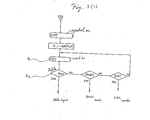
- the initial program is powered up by turning on the power switch 10 of the mini-computer body 1 and the process shown in Fig. 3(1) is executed (assuming that the table data is not formed under this condition).
- the statistic processing mode is automatically set and the STAT symbol 21 is turned on.
- the STAT symbol 21 is lighted by providing the STAT symbol lighting data from CPU 1 to the display buffer 43 and other symbols are turned on in similar way.
- the process goes to the step of forming or performing the BASIC program. Furthermore, when the STAT key 11A is operated, the calculation mode is set and the program goes to the step of the calculation process.
- step S3 the head position of the table data (the portion 50 in Fig. 8(A)) is indicated and it is judged whether the data of the variable name is present or not, and in case the data of the variable name is present, the last item area of the column item (obtained by the item number C) is accessed.
- this item area the table title of the first table is stored and the data of the first table title is taken out and provided to the display LCD 41 and the display is changed to "?” and then the table title such as "RECORD LIST" is displayed.
- the key data is read in the step S5 and the kind of the key is classified whether the key is an alphabet key or a kana key in the step S6.
- the row item name is displayed as well as the table title and the column item.
- variable area of Dh(m, n) is secured on the memory by the column item number and row item number and the un-input data is respectively stored in the step 30.
- step S40 it is judged whether or not the column item number n is over the value C, and in case the number n is not over the value C, the column counter value n is raised up by 1 so that the input of the data corresponding to the next column becomes possible.
- the program goes to the step S41 and it is judged whether or not the row item number m is over the value L.
- the column counter value is set in the step S42 and the row counter value is raised up by 1 and the program goes to the process ;-of the input of the data in the next row.
- the data 82, 73, 49,... , 74 are inputted by operating the column input key 33 and the contents as shown in Fig. 8(B) are stored in the variable data area of BASIC.
- the above mentioned missing value is stored as the data in the indicated variable area in the steps S36 and S37.
- step S43 in case each of the cursor movement keys 15 ⁇ , ⁇ , ⁇ , ⁇ is pushed, the cursor is moved to the indicated adjacent cell and the content of the cell indicated by the cursor is displayed in LCD 41 without rewriting the indicated variable data.
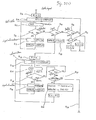
- the input by the key is read in the step S50 and in case it is judged in the step S51 that the ⁇ X key 35 has been pushed, the displayed column number is stored in the X counter in the step S54 and the display is performed in the step S55 as follows.
- the Y column (the second column) is indicated in the steps S52, S56 and S57 in the same way as the X column (the first column).
- step S53 the execution key is judged and in the step S58 it is judged whether both X and Y columns are indicated or not and in the step S59 it is judged whether the single X column is indicated or not.
- the statistic calculation with two variables is executed by using the column data indicated by X and Y in the step S60.
- the statistic calculation with one variable is executed by using the column data indicated by X in the step S61.
- the statistic amounts are obtained by the above mentioned statistic calculation with two variables.
- the statistic amounts are obtained by the statistic calculation with one variable as follows.
- a x assuming the parameter to be (n), the standard deviation which is used in case all of the population are used as sample data or in case the standard deviation is calculated considering the sample to be the population
- the indicated data is the missing value or the un-input data mentioned above
- the data is excluded from the sample data and then the statistic processing calculation is executed.
- the missing value is inputted in the table data, whereby the processing of the missing data becomes to be possible in the statistic processing calculation.
- the statistic processing system since the plural kinds of the table data are stored in the table data area and each item data is stored in the area by the above mentioned processing of forming the table as shown in Fig. 8, any processing of the various kinds of the statistic processing can be executed.
- the statistic processing with one variable is executed by selecting any of the column item group such as "mathematics" and operating any of the statistic processing keys group 14 shown in Fig. 1.
- the statistic processing with two variables is executed by selecting any two column items much as “mathematics", "language” shown in Fig. 8(B) and inputting the item data into the X, Y registers respectively and by operating any of the statistic processing keys group 14 shown in Fig. 1. Therefore, since each item data is erased at the end of each calculation in the conventional mini-computer with statistic functions, various kinds of the statistic processing can not be executed and the data should be inputted at every time of the statistic processing calculations. However, in the statistic processing system according to the present invention, in case the selected and read out data is a missing value or an un-input data, the data is excluded and processed, for example, is not included in the sample data and processed.
- the processing way of the sample amount zx is shown in Fig. 7 as an example.
- the count value 1 showing the row number and the amount register value ⁇ are cleared in the steps S70 and S71.
- the data of the variable name (for example D ⁇ $) 53 selected by the above mentioned way is selected so as to read out the row item number "L" which is kept in the L register in the step S72.
- the column item data is selected by operating the +X key 35 and it is judged whether the data is the missing data or the un-input data in the steps S73 to S75.
- the program goes to the step S78 and the next row item data is selected, in other words, excluded from the statistic processing calculation.
- the program goes to the step S76 and the item data is added to the value of the E register.
- the statistic processing system according to the present invention may best be understood by the explanation Of the embodiment described above. By the way the characteristics of the statistic processing system according to the present invention are referred as follows.
- each data is stored in the table format into the memory by the input means, subsequently any row or column of each of the item data stored in the memory and the kind of the statistic calculation are only indicated, whereby the indicated statistic calculation is executed for the indicated row and column.
- various kinds of the statistic processing calculation can be easily executed by indicating only the row or the column of the data and the kind of the statistic calculation such as a statistic processing with one variable or a statistic processing with two variables.
- the confirmation, partial correction and addition of the inputted item data can be easily performed by reading in and writing in to the memory, so that the statistic processing is facilitated.
- the table data corresponding to the N counter (which is reset at the time of initialization) is selected and moved into the table data area 462 in the step Sll, and subsequently the table item name is taken out and provided into the display buffer so as to be displayed on the LCD 2 in the step S12.
- the table key 31 is operated once more in the step S13, whereby the reference of the displayed data is executed on the basis of the counter N+l in the steps S14 to S 11 and the table item name of the counter N+l is displayed in the LCD 2 in the step S12. The above-mentioned operations are repeated till the desired table item is selected (S13 to S14 to Sll to S12).
- the ENTER key is operated in the,step S15.
- the ENTER key is operated, whereby a new table data can be made.
- the row and column items are inputted.
- the item names are displayed in the LCD 2.
- step S18 when the row/column input keys 32 and 33 are operated, it is judged in the step S19 whether or not the data is stored in the input buffer, subsequently the row/column item names are stored in the table data area in the step S20.
- the input of the row/column item names is completed by repeating the above-mentioned operations in turns.
- the table size is secured in the table data area on the basis of the number of the inputted row/column item name in the step S21, and the minimum value -9.999999999x10 99 showing the un-input data area written in the table data area in which the numerical data is not inputted in the step S22.
- the data area corresponding to the cursor counter is selected in the step S24, and it is judged in the step S25 whether or not the data stored in the data area is the maximum or minimum value 9.999999999x10 99 .
- the data stored in the data area is the maximum or the minimum value 9.999999999x10 99 . It is judged in the step S27 whether the sign of the value 9.999999999xl0 99 is plus(+) or minus(-) in order to judge whether the value 9.999999999x10 99 is the maximum or the minimum. In case the sign of the value 9.999999999x10 99 is plus(+), the data stored in the data area is judged to be the missing value and displayed as showing "_ _ _" for example on the LCD 2.
- the cursor keys 15 are operated so that the data area in which the data is going to be inputted is Selected.
- the input data is stored in the input buffer in the step S31.
- the row/column input keys 32 and/or 33 are operated in the step S32, whereby the data stored in the input buffer is stored in the data area in the step S33 and simultaneously the contents of the input buffer are cleared in the step S34.
- the missing value key 34 is operated in the step S35, whereby the maximum value 9.999999999x10 99 showing the missing value is stored in the input buffer in the step S36. Then, the row/column input keys 32 and/or 33 are operated in the step S32, whereby the data stored in the input buffer is stored in the data area in the step S33 and simultaneously the contents of the input buffer are cleared in the step S34.
- the condition of the data is displayed showing such as "_ _ _" in the LCD 2, therefore, the input condition of the data can be easily judged and also the data input miss can be easily found at the time of inputting or confirming the data.
- the data which can be displayed as a specific character is not limited to the data not stored in the data area and to the missing value, but a specific data can be set when necessary and the specific characters corresponding to the specific data can be displayed on the LCD 2.
- the statistic processing system of the second embodiment when the data stored in the item data area is read out, in case the data is a specific data, a specific character is displayed on the LCD 2 so that the condition of the data input can be easily judged at the time of data inputting or data confirmation, and still more the data input miss can be easily found.
- Fig. 11 is a schematic diagram showing an embodiment 3 of a mini-computer of handy type according to the present invention.
- Reference numeral 1 denotes a mini-computer, wherein there are provided a liquid crystal display unit (referred to as LCD hereinafter) 2 in the upper left portion and a key board comprising character input keys and function keys in the peripheral portion of .
- LCD 2 comprises a display capacity of 24 units in one line of dot segment type for example, and there are provided indicators 21, 22, 23 and 24 for displaying the mode condition of the mini-computer in the lower portion of LCD 2.
- Reference numeral 10 denotes a power switch and by turning the power switch 10 on, the mini- computer is powered up and an initialization processing is executed, whereby the mode of the computer is preset into a statistic processing mode (STAT).
- STAT statistic processing mode
- Reference numeral 11 denotes mode setting keys which comprise of a STAT key 11A for setting the statistic processing mode (STAT) and the calculation mode (CAL) alternately every time of operating the key 11A and a BASIC key 11B for setting the program processing mode by the BASIC language and setting alternately the program running mode (RUN) and the programming mode (PRO) every time of operating the key 11B.
- STAT statistic processing mode
- CAL calculation mode
- RUN program running mode
- PRO programming mode
- the indicator STAT 21 is turned on at the time of STAT mode
- the indicator CAL 22 is turned on at the time of CAL mode
- the indicator RUN 23 is turned on at the time of RUN mode
- the indicator PRO 24 is turned on at the time of PRO mode.
- Reference numeral 12 denotes a group of character input keys which can be defined also as various kinds of function keys.' Particularly in the lower part of the character keys 12, there are arranged a group of character keys which is defined as a group of distribution function keys to be used in the statistic processing by operating the distribution function indicating key 12A.
- N(P) key and N(X) key which are allocated to the character Z key 121 and the character X key 122 respectively are calculation indicating keys of a normal distribution function, wherein the N(P) key is a calculation indicating key for indicating the calculation of a provability variable X to the upper provability P and the N (X) key is a calculation indicating key for indicating the calculation of the upper provability P from the provability variable X.
- the t( P ) key and the t(X) key which are allocated to the character C key 123 and the character V key 124 respectively are calculation indicating keys of t-distribution function which is used in case of detection or presumption of an average value or detection or presumption of the disparity of two average values, wherein the t(P) key is a calculation indicating key for indicating the calculation of the degree of freedom n and the provability variable X to the upper provability P and the t(X) key is a calculation indicating key for indicating the calculation of the upper provability P from the degree of freedom n and the provability variable X.
- the X 2 ( P ) key and the X 2 (X) key which are allocated to the character B key 125 and the character N key 126 respectively are calculation indicating keys of X 2- distribution function which is used in case of detection or presumption of the divergence or in case of detection of the degree of suitability, wherein the x 2 (P) key is a calculation indicating key for indicating the calculation of the degree of freedom n and the provability variable X to the upside provability P and the X2(X) key is a calculation indicating key for indicating the calculation of the degree of freedom n of the upside provability P from the provability variable X.
- the F(P) key and the F(X) key which are allocated to the character M key 127 and the space (SPC) key 128 respectively are calculation indicating keys of F-distribution function which is used in case of dealing with the degree of similarity of the divergence, wherein the F(P) key is a calculation indicating key for indicating the calculation of the degrees of freedom n l and n 2 and the provability variable X to the upside provability P and the F(X) key is a calculation indicating key for indicating the calculation of the degrees of freedom n l , n 2 and the upside provability P from the provability variable X.
- the B key allocated to the character J key 129 is a calculation indicating key of the binomial distribution i.e.. the B distribution function, indicating the calculation of the provability of which the phenomena of provability P occur X times of n times
- the P key allocated to the character K key 130 is a calculation indicating key of the Poisson's distribution function i.e. P distribution, indicating the calculation of the provability of which the phenomena of average m occur X times.
- the calculations of the above-mentioned distribution function are generally known in statistics, the calculation processing routine on the basis of the above-mentioned calculations are non-volatilly memorized in the mini-computer according to the present invention.
- Reference numeral 13 denotes numerical input keys and the four rules of arithmetic calculation keys
- reference numeral 14 denotes a group of the calculation indicating keys for calculating the average 'value and the deviation in the statistic processing.
- Reference numeral 15 denotes cursor mark movement keys of the display unit 2
- reference numeral 16 denotes an entering key for indicating the execution of the calculation on the basis of the indication of the calculation.
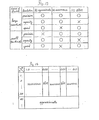
- Fig. 13 is a diagram showing the suitability or unsuitability of
- Fig. 13 the suitability (0 mark) and unsuitability (X mark) are shown in'case the degree of freedom h is large (n ⁇ 40) and small (n ⁇ 40) when the t-distribution function is adopted for example.
- the parameters are the degree of freedom n and the upside provability P, and in the upside provability P there are a few provabilities with very high frequency of use.
- the approximate expression is used in case of a large degree of freedom and the recurrence fomula is used in case of a small degree of freedom and moreover only the calculation values of the recurrence fomula.of the part of the upside provabilities P with high frequency of use is memorized in the memory, whereby the calculation speed can be made higher.
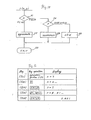
- Fig. 14 is a view showing an example of the division of the way of the t-distribution calculation in the mini-computer according to the present invention, wherein assuming that the upside provabilities P with high frequency of use are 5% and 1%, the calculation values of the recurrence fomula of the above- mentioned upside provabilities P 5% and 1% are stored in ROM 45.
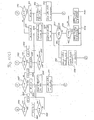
- Fig. 15 is a flow chart showing a dividing process by which way the calculation of the function t(n, p) is executed.
- step Sl First it is judged in the step Sl whether or not the degree of freedom is more than 40, and in case of more than 40 the calculation is executed by using the approximate expression in the step S2 and the calculation value is displayed in the display unit 2 in the display unit in the step S3.
- step S4 it is judged in the step S4 whether or not the upside provability P .is stored in the ROM 45, and in case of storing the upside provability P the calculation is executed by using the upside provability P stored in ROM 45 in the step S5 and the calculation value is displayed in the display unit 2 in the step S3.
- the calculation of the distribution function is executed by using the recurrence fomula in the step S6 and the calculation value is displayed in the display unit in the step S3.
- the calculation sequence of each of the distribution function keys is stored semi-fixedly in the statistic processing program in ROM 45.
- Each calculation sequence is processed corresponding to the flow chart shown in Fig. 15. That is, it is judged whether each calculation of the normal distribution function, t-distribution function, X 2- distribution function and F-distribution function is executed on the basis of the approximate expression, the recurrence fomula or the predetermined statistic values list depending on the condition of the degree of freedom n and the upside provability P.
- the calculation value is transferred to the display unit to be displayed.
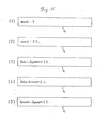
- the order of BASIC languages shown in Fig. 17 is provided corresponding to the calculation keys of the above-mentioned distribution functions, and the statistic calculation can be executed by making up a user program on the basis of the order of BASIC languages.
- the above-mentioned calculation sequence adopting the calculation routine on the basis of the keys, the calculation value can be displayed as mentioned above and also can be stored in other specific register.
- the t-distribution function PTD(n, p) is allocated to the character C key 123 and the calculation is executed by operating the allocated t(p) key.
- the mini-computer is set in the STAT mode for executing the statistic calculation function in a desk- computer.
- the distribution function key 12 and subsequently the t(p) key are inputted under the condition of STAT mode, the calculation process enters the sequence for obtaining the t-distribution function PTD(n, p).
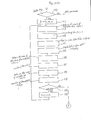
- the operation for obtaining the function PTD(9, 0.01) is shown in details with reference to the steps Sll to S15 in Fig. 16.
- the step Sll shows the condition of waiting for the input of the degree of freedom n in the t-distribution by inputting the distribution function t(p) key and the step S12 shows the condition of inputting 9 as the degree of freedom n.
- the step S13 shows the condition that the ENTER key is sequentially inputted after inputting 9 as the value n and the input of the upside provability P as the next variable is waited.
- the step S14 shows the condition of inputting 0.01.as the value of the upside provability P.
- the ENTER key is sequentially inputted after inputting 0.01, whereby the value 2.281 is obtained as the value of the t-distribution function PTD(9, 0.01) to be displayed.
- Fig. 18 is a flow chart showing a setting action of the mode condition of the mini-computer according to the present invention.
- the initializing program stored in the ROM 45 is performed in the step S22, and the initialization is executed and the STAT symbol 21 is turned on and a statistic processing mode is set in the step S23. (The display "0" is displayed. ) Under this condition reading-in the key is executed in order to judge whether the BASIC mode or the calculation mode (CAL mode) is set by operating the mode, setting key 11 in the step S24.
- step S27 the BASIC key is operated and in the step S28 the BASIC processing mode is set and the BASIC program-processing is executed.
- the BASIC mode the BASIC key is operated again, whereby the programmming mode (PRO) or the program running mode (RUN) is selected.
- the STAT key is operated in the step S29 so as to set the CAL mode and other mode setting keys are operated so as to set the corresponding mode.
- the mini-computer comprises the distribution function calculation indicating keys, the numerical keys for inputting the variables such as provability values and the degree of freedom and the non-volatile memory for memorizing the distribution function calculation routine on the basis of the distribution function calculation indicating keys, so that the calculation of a statistic examination and an estimation of a section can be executed without reference to the statistic numerical lists so as to be very convenient.
- the calculation of the distribution function is executed by selecting one of the distribution function calculation routines such as the approximate calculation routine, the recurrence fomula calculation routine, and the calculation routine for selecting the corresponding calculation value of the calculation values group predetermined stored fixedly, the calculation value can be obtained in a short time with high precision, high calculation ability and a little memory capacity.
- Fig. 21(B) when the SIFT key 28 is operated in the S100, SIFT flag provided in the system area 463 is turned on in the step S101 and the next operation of the cursor keys 15A, 15B, 15C or 15D is waited in the step S30.
- the next operation of the cursor keys 15A, 15B, 15C or 15D is waited in the step S30.
- the cursor left shift key 15B is operated in the step S105, it is judged in the step S120 whether or not the count value n is equal to 0, and in case the count value n is equal to 0, in other words, in case the column item is displayed, the value 1 is stored in the m counter (1 ; m) in the step S121 and then the above-mentioned operation in the steps S112 and S113 is executed so as to display the leftmost item (Mathematics in the present embodiment).
- the count value n is not equal to 0, in other words, in case the data item is displayed, it is judged in the step S122 whether or not the count value m is equal to 1 (i.e. representing the leftmost item), the operation of the cursor key 15B is ignored and the data item being displayed now is displayed as it is.
- the count value m is not equal to 1
- the desired item data can be displayed with less operation without moving the data item in turns up and down or in right and left directions, so that; the operating efficiency can be remarkably improved and the more the table data are, the shorter the operating time for displaying the table data can be made compared with the conventional mini-computer.
- the fifth embodiment is explained with reference to Figs. 22 to 27.
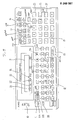
- Fig. 22 is a front view showing a data processing device, so called a pocket computer 1 of an embodiment 5 according to the present invention
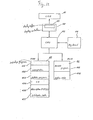
- Fig. 23 is a circuit block diagram of the computer 1 shown in Fig. 22. The constitution of the computer 1 will be explained with reference to Figs. 22 and 23.
- a power switch 3 on the left upper portion of the front plane 2 of the computer 1. When the power switch 3 is turned on, the power can be supplied to the computer 1 and the computer 1 is initialized and set in a statistic processing mode (STAT).
- STAT statistic processing mode
- the display unit 4 is for example a matrix operational type with a display capacity of one line 24 characters, and there are provided indicators 13 to 16 and 50 at the lower portion of the display unit for displaying various operation modes of the computer 1.
- LCD liquid crystal display element
- a group of character input keys 5 including function keys which are operated when characters such as item names are inputted at the time of making a table as mentioned below, numerical input keys group 6, so called ten keys, calculation symbols (such as +, -, x, ⁇ ) input keys group 7 and cursor keys group 3.
- a table key 9 is operated for making a table data as mentioned below, reference numeral 10 denotes a row input key which selects each of the rows to be inputted of the data matrix at the time of making a two dimensional table data as mentioned below.
- Reference numeral 11 denotes a column input key which selects each of the columns to be inputted of the data matrix as well as the row input key 10.
- mode setting keys 12 consisting of a STAT key 12a for alternately setting the computer 1 in the statistic processing mode (STAT) and a calculation mode (CAL) every operation of the STAT key 12a and a BASIC key 12b for setting the computer 1 in a program processing mode (RUN) using BASIC language in addition to an operation of switching between a RUN mode in which the computer 1 executes the program and a programming mode (PRO) alternately every operation of the BASIC key 12b.
- the minus sign key 17 is defined as a missing value key for indicating the absence of item data in the statistic processing by switching the shift key 18.
- Reference numeral 19 denotes a function key group for calculation each of the various kinds of statistic processing such as the sums, average values, deviation values of the row and column of the table data, on the basis of the table data inputted and stored in the table data area as mentioned below.
- the statistic calculation processing is executed by operating the above-mentioned function keys group 19 and the calculated results are displayed on the display unit 4 and stored in the predetermined position of the table data area 33.
- a variable indicating key 35 indicates a statistic processing key ( + X key) with one variable or a statistic processing key ( ⁇ Y key) with two variables, which is switched by operating the shift key 18.
- the above-mentioned + X key and + Y key execute the statistic processing of one or two column items respectively.
- a search key 39 for searching the data item in the table data and displaying them on the display unit 4.
- the computer 1 comprises a central processing unit (referred to CPU hereinafter) 21 for executing various kinds of data processing.
- the CPU 21 is connected to the key input portion 22 including such as the character input key group 5 through the key input buffer 49 and is also connected to the display unit 4 through the display control unit (DCU) 23.
- DCU display control unit
- the CPU 21 is connected to a fixing memory 25 made of ROM (read only memory) and to a memory 26 made of RAM(random access memory) and memory means consists of the fixing memory 25 and the memory 26.
- ROM 25 comprises an initial program area 27 for storing the initial program which controls the initializing processing, an interpreter area 28 for storing the interpreter program of the BASIC language used in the computer 1, a statistic processing program area 29 for storing a statistic processing program as mentioned below, a character generator (referred to as CG) program area 30 for storing the CG program which generates display character of dot pattern corresponding to the code information of the character code data to be inputted into CPU 21 depending on the operation of the key input portion 22, and a system program area 31 for storing various kinds of system programs.
- CG character generator
- RAM 26 comprises a user program area 32 for storing one or more user programs or various data written by a user of the computer 1 in BASIC language, a table data area 33 for storing table data prepared in the statistic processing and a system area 34 for allocating various buffers and counters'or registers.
- the system area 34 contains m, n, X registers 35, 36, 37 and a comparing buffer 38 and a counter 48.
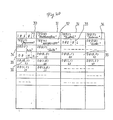
- Fig. 24 shows the aspects of allocating various data in the table data area 33.
- the table data area 33 is allocated to a part of the user program area 32 and each of the data in the table data area 33 are stored at very input processing or by the order of allocating variable data of a BASIC program so that the table data is made.
- An example of the data in the table data area 33 as shown in Fig. 24 corresponds to the Table 2 and each of the items of the table data is made in the length of 16 bites.
- a defining area 40 for defining and allocating a string function Th$(cl) to which the title of the table and the column item name of the table are allocated and the number of the column items ( in fact the number of the column items +1).
- column item name areas 41a to 41b for storing the column item name shown in Table 2 by using the count value cl of C register as a parameter as, follows.
- a defining area 42 so as to store the string function Dh$(L) to which the data of the row item name such as "Aoki” in Table 2.
- row item name areas 43a, 43b, 43c, ..., 43h as a parameter of the count value L so as to store the respective row item names as follows for example.
- a defining area 44 for defining a numerical function Dh(ml, nl) to which the input data corresponding to the record in case of Table 2 and then there are sequentially provided data areas 45a, 45b,..., 45h.so as to store each of the inputted data as follows for example.
- the above-mentioned data are automatically allocated to the table data area 33 every input processing of the data any.by variation order of the BASIC language.
- the address value of the data position is calculated by the variable names and the number of items stored in the defining areas 40, 42 and 44 in the access for reading out the data.
- the linking between the statistic processing data and the BASIC program can be done by including the one dimensional or two dimensional arrangement functions T0$, D0$ and DO(ml, nl) which can be used in the BASIC program, together with the table data inputted for use in the statistic processing.
- the value to be stored in the variable area in BASIC language is in the range of the value more than -9.999999999x10 99 less than 9.999999999 x10 99 .
- the data shown in the area 46 of the table data area 33 is a non-entered data which is allocated to the memory area estimated by the maximum column length M and the maximum row length N of the data matrix defined in the defining area 44 in case the input operation of the computer 1 is not executed and all of the data are stored in the corresponding area in the table data area 33.
- the data 9.999999999xl0 99 shown in the area 47 is a missing data representing the absence of the data.
- the numerical data in the areas 46 and 47 are the minimum and maximum data which can be used in the computer 1 and the reason why the minimum and maximum data for representing the non-input, the absence of the data are used is described as follows. That is, though in the computer 1 a specific code on the basis of the BASIC language can be used for the above-mentioned purpose, the computer 1 enables the program processing of the BASIC language so as to use various kinds of code systems. Accordingly, the maximum and minimum data are used in order to prevent such code systems from being limited effectively. By the way, there seldom occurs the maximum and minimum data of the data processing ability of the computer 1.
- the computer 1 includes the variable data in BASIC language together with the table data to be used in the statistic processing, therefore, the variable data position can be accessed by the command in BASIC language.
- the defining area 40 and the column item area 41 are allocated with DIMTO$(0), T0$(l)and T0$(2) by the BASIC command and the data "Mathematics" is stored by the input of T0$(0) - Mathematics.
- the variable name of T0$(0) is indicated, the variable data area in the memory 26, the table data area 33 is searched in turns and the corresponding address is accessed.
- the column item area 41d is a table title item.
- the table data shown in Fig. 24 represents the display data column in Table 2.
- the statistic calculation processing is executed on the basis of the table data by operating any key of the function keys group 19, and the calculated value as well as said variable name is allocated to the table data area 33 as a new item data. Therefore, the variable name can be indicated and used in the program processing of the BASIC language.
- the table data made by the statistic processing can be used on the BASIC program and the table data made by the BASIC program can be used in the statistic process.
- Plural table data can be sequentially made in the table data area 33.
- the table data is made in the statistic processing, though the explanation is omitted, the table data is allocated to the memory 26 every time each row and column are indicated as well as the BASIC program as shown in Fig. 24.
- Fig. 25 is a view showing a display example on the display unit 4 of the pocket computer 1.
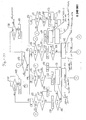
- Figs. 26 and 27 are flow charts showing a searching process of the present embodiment. The process of the embodiment according to the present invention will be explained with reference to Figs. 22 to 27.
- the table data shown in Table 2 are stored in the table data area 33 in the computer 1.
- the key to be operated is read in the key input portion 22.
- the read-in key is a cursor right shift key 8a
- the count value cl is added by 1 in the step n6 and the program goes back to the step n2. That is, the item name of the next column "Science" is displayed on the display unit 4.
- the program goes back to the step n2 without adding 1 to the count value cl. That is, the same display is repeated on the display unit 4.
- the read-in key is not the cursor right shift key 8a in the step n4
- the process goes to the step nl0 and it is judged whether or not the read-in key is the search key 39. In case the read-in key is not the search key 39, the process goes back to the step n2. In case the read-in key is the search key 39, "search: ?” is displayed on the display unit 4 ' as shown in Fig. 25(1) in the step nll, subsequently the process goes to the search process shown in Fig. 27. As mentioned above, it means that in the flow chart in Fig. 26 any of the column items with respect to the data column shown in Fig. 22 can be selected and searched.
- step Sl the count value ml of the m register 35, which is the parameter representing the column position of the table data in Table 2 is cleared so as to indicated the first row of the Table 2.
- the count value nl of the n register 36 is set to the count value cl which is the parameter showing the column item of the Table 1 set in the flow chart in Fig. 26 and the shift flag SF as mentioned below is set 0.
- step S3 the key inputted in the key input portion 22 is read in.
- step S4 it is judged whether or not the read-in key is one of the numerical keys group 6.
- the read-in key is a numerical key
- the inputted numerical data is stored in the key input buffer 49 in the step S5 and the contents stored in the key input buffer 49 are displayed on the display unit 4 in the step S6. That is, when the data "35” is inputted by operating the numerical key 6, the display "search: 35_” is displayed'on the display unit 4 as shown in Fig. 25(2).
- the process goes to the step S7 and it is judged whether or not the read-in key is the search key 39.
- the process goes to the step S8, and in case the read-in key is the search key 39, the process goes to the step S9 and it is judged whether or not the shift flag SF is set 1.Since the shift flag SF is set 0 in the step S2, the shift flag SF is set 1 in the step S10 and in the step Sll the content of the key input buffer 49 is transferred to the comparison data storing buffer 38 of the first memory portion for searching.
- the step S12 the table data D0(ml,nl) of Table 2 indicated by the count values ml and nl is taken out into the X register 37 of the second memory portion.
- the step S13 the content stored in the X register 37 is.compared with the content stored in the buffer 38 and it is judged whether or not these two contents are same. In case the two kinds of contents are not same, it is judged in the step S14 whether or not the count value ml reaches the maximum row number m of the Table 2, in other words, the searched row reaches the end row of the Table 2. In case the count value ml does not reach the end row number m (ml ⁇ m), in the step S15 the count value ml is added by 1 and the process goes back to the step S12. In case the count value ml reaches the maximum row number m in the step S14, the process goes back to the step S3 without increasing the count value ml and the key is read-in.
- the process goes to the step S23 and it is judged whether or not the shift key 18 is operated, in other words, whether the search operation is continued or other operation is started.
- the process goes to the step S8 and in case the shift key 18 is operated, the process goes to the step S24. It is judged in the step S24 whether or not the shift flag SF is set 1. In case the shift flag SF is set 0, the shift flag SF is set 1 in the step S25 and the process goes to the step S8. In case the shift flag SF is set 1, the shift flag SF is set 0 in the step S26 and the process goes to the step S8.
- step S8 it is judged whether or not the read-in key is,one of the cursor keys group 8.
- the process goes to the step S17, and in case the read-in key is a cursor key, the process goes to the step S18 and it is judged whether or not the read-in key is the cursor right shift key 8a of the cursor keys group 8.
- the read-in key is not the cursor right shift key 8a in the step S18, since it means that the cursor left shift key 8b was pressed, it is judged in the step S21 whether or not the count value cl reaches the left edge of Table 2. In case the count value cl reaches the left edge of Table 2, the process goes back to the step S3 as it is. In case the count value cl does not reach the left edge of Table 2, the count value cl is decreased by 1 in the step S22 and the process goes back to the step S3.
- the search operation of such a table data can be executed basically along the column direction of the table data. Even after the first search operation is finished by operating the search key 39, in case the search operation is executed on the basis of the same input data, it is not necessary to input such data again and the search operation can be sequentially executed only by operating the shift key 18.
- the data group with arrangement aspect of a matrix shape are stored in the memory means.
- the data for comparison is inputted by the input means and the inputted data is stored in the first memory portion.
- the data in the above-mentioned data group is stored in turns in the second memory portion so as to be compared with the inputted data, and then the contents in the second memory portion are sequentially compared, whereby the data of the data group and the data inputted through the input means can be continuously compared. Therefore, the operational ability of such a data processing device can be remarkably improved.
Landscapes
- Engineering & Computer Science (AREA)
- Physics & Mathematics (AREA)
- Theoretical Computer Science (AREA)
- General Physics & Mathematics (AREA)
- Data Mining & Analysis (AREA)
- General Engineering & Computer Science (AREA)
- Pure & Applied Mathematics (AREA)
- Mathematical Physics (AREA)
- Computational Mathematics (AREA)
- Mathematical Analysis (AREA)
- Mathematical Optimization (AREA)
- Algebra (AREA)
- Probability & Statistics with Applications (AREA)
- Operations Research (AREA)
- Bioinformatics & Computational Biology (AREA)
- Evolutionary Biology (AREA)
- Databases & Information Systems (AREA)
- Software Systems (AREA)
- Bioinformatics & Cheminformatics (AREA)
- Life Sciences & Earth Sciences (AREA)
- Computing Systems (AREA)
- Computer Hardware Design (AREA)
- Calculators And Similar Devices (AREA)
- Complex Calculations (AREA)
Applications Claiming Priority (10)
| Application Number | Priority Date | Filing Date | Title |
|---|---|---|---|
| JP142586/86 | 1986-06-17 | ||
| JP61142586A JPS62297958A (ja) | 1986-06-17 | 1986-06-17 | 統計処理システム |
| JP61142588A JPH0650497B2 (ja) | 1986-06-17 | 1986-06-17 | 小型電子計算機 |
| JP142588/86 | 1986-06-17 | ||
| JP61181792A JPS6337469A (ja) | 1986-07-31 | 1986-07-31 | 統計処理システム |
| JP181792/86 | 1986-07-31 | ||
| JP61197711A JPS6353676A (ja) | 1986-08-22 | 1986-08-22 | 小型電子計算機 |
| JP197711/86 | 1986-08-22 | ||
| JP61204959A JPS6361326A (ja) | 1986-08-30 | 1986-08-30 | デ−タ処理装置 |
| JP204959/86 | 1986-08-30 |
Publications (3)
| Publication Number | Publication Date |
|---|---|
| EP0249961A2 true EP0249961A2 (de) | 1987-12-23 |
| EP0249961A3 EP0249961A3 (de) | 1991-09-25 |
| EP0249961B1 EP0249961B1 (de) | 1994-09-14 |
Family
ID=27527647
Family Applications (1)
| Application Number | Title | Priority Date | Filing Date |
|---|---|---|---|
| EP87108696A Expired - Lifetime EP0249961B1 (de) | 1986-06-17 | 1987-06-16 | Datenverarbeitungseinrichtung zur Verwendung in statistischer Berechnung |
Country Status (3)
| Country | Link |
|---|---|
| US (1) | US5117379A (de) |
| EP (1) | EP0249961B1 (de) |
| DE (1) | DE3750525T2 (de) |
Cited By (4)
| Publication number | Priority date | Publication date | Assignee | Title |
|---|---|---|---|---|
| EP0325081A3 (de) * | 1987-12-23 | 1990-12-27 | International Business Machines Corporation | Graphischer Zugang zu einer statistischen Verarbeitung |
| EP0305043A3 (de) * | 1987-07-24 | 1991-04-10 | Sharp Kabushiki Kaisha | Verarbeitungsgerät von mit Relationen strukturierten Daten |
| WO1991012582A3 (en) * | 1990-02-08 | 1991-10-03 | Hewlett Packard Co | Method and apparatus for processing tabular responses to computer database queries |
| US5752016A (en) * | 1990-02-08 | 1998-05-12 | Hewlett-Packard Company | Method and apparatus for database interrogation using a user-defined table |
Families Citing this family (6)
| Publication number | Priority date | Publication date | Assignee | Title |
|---|---|---|---|---|
| JPH03260866A (ja) * | 1990-03-12 | 1991-11-20 | Ricoh Co Ltd | 統計演算装置 |
| US6920221B1 (en) | 1999-08-29 | 2005-07-19 | Intel Corporation | Method and apparatus for protected exchange of status and secret values between a video source application and a video hardware interface |
| US6434511B1 (en) | 1999-09-28 | 2002-08-13 | General Electric Company | Processor and method for determining the statistical equivalence of the respective mean values of two processes |
| RU2281548C1 (ru) * | 2004-12-14 | 2006-08-10 | Военный университет связи | Устройство для параметрической оценки закона распределения потоков сообщений |
| US20080045326A1 (en) * | 2006-08-09 | 2008-02-21 | Dandy Hunt | Methods, apparatus and computer program for generating and selecting number combination samples for use in a lottery from a pre-determined population of numbers |
| US7560961B1 (en) | 2006-08-11 | 2009-07-14 | Marvell International Ltd. | Voltage driver circuit |
Citations (1)
| Publication number | Priority date | Publication date | Assignee | Title |
|---|---|---|---|---|
| JPS5743246A (en) | 1980-08-27 | 1982-03-11 | Sharp Corp | Programmable electronic computer |
Family Cites Families (15)
| Publication number | Priority date | Publication date | Assignee | Title |
|---|---|---|---|---|
| US3610902A (en) * | 1968-10-07 | 1971-10-05 | Ibm | Electronic statistical calculator and display system |
| US4178633A (en) * | 1971-12-27 | 1979-12-11 | Hewlett-Packard Company | Programmable calculator including multifunction keys |
| US4012725A (en) * | 1972-07-07 | 1977-03-15 | Hewlett-Packard Company | Programmable calculator |
| US4037092A (en) * | 1973-11-26 | 1977-07-19 | Hewlett-Packard Company | Calculator having preprogrammed user-definable functions |
| US4298949A (en) * | 1976-08-16 | 1981-11-03 | Texas Instruments Incorporated | Electronic calculator system having high order math capability |
| JPS5340245A (en) * | 1976-09-27 | 1978-04-12 | Canon Inc | Electronic machinery with two variables statistical arithmetic function |
| US4476541A (en) * | 1977-12-02 | 1984-10-09 | Texas Instruments Incorporated | Variable function programmed system |
| USRE30671E (en) * | 1979-07-09 | 1981-07-07 | Texas Instruments Incorporated | Microprocessor system having high order capability |
| JPS56114047A (en) * | 1980-02-12 | 1981-09-08 | Sharp Corp | Execution system of electronic computer |
| US4521849A (en) * | 1981-10-01 | 1985-06-04 | Honeywell Information Systems Inc. | Programmable hit matrices used in a hardware monitoring interface unit |
| JPS58178642A (ja) * | 1982-04-13 | 1983-10-19 | Nec Corp | 表示付き個別選択呼出受信機 |
| JPS58189761A (ja) * | 1982-04-30 | 1983-11-05 | Casio Comput Co Ltd | 表デ−タ集計処理装置 |
| US4547860B1 (en) * | 1983-01-21 | 2000-11-21 | Laitram Corp | Computer keyboards with few keys designating hundreds of functions |
| US4608638A (en) * | 1983-10-21 | 1986-08-26 | Siemens Corporate Research & Support, Inc. | Apparatus for accumulating and permanently storing statistical information |
| JPS6174054A (ja) * | 1984-09-18 | 1986-04-16 | Sharp Corp | 電子式計算機 |
-
1987
- 1987-06-16 DE DE3750525T patent/DE3750525T2/de not_active Expired - Lifetime
- 1987-06-16 EP EP87108696A patent/EP0249961B1/de not_active Expired - Lifetime
-
1990
- 1990-07-19 US US07/555,673 patent/US5117379A/en not_active Expired - Lifetime
Patent Citations (1)
| Publication number | Priority date | Publication date | Assignee | Title |
|---|---|---|---|---|
| JPS5743246A (en) | 1980-08-27 | 1982-03-11 | Sharp Corp | Programmable electronic computer |
Non-Patent Citations (1)
| Title |
|---|
| "TOKEI-SUCHI-HYO (Statistic Values List)", NIPPON KIKAKU KYOKAI |
Cited By (4)
| Publication number | Priority date | Publication date | Assignee | Title |
|---|---|---|---|---|
| EP0305043A3 (de) * | 1987-07-24 | 1991-04-10 | Sharp Kabushiki Kaisha | Verarbeitungsgerät von mit Relationen strukturierten Daten |
| EP0325081A3 (de) * | 1987-12-23 | 1990-12-27 | International Business Machines Corporation | Graphischer Zugang zu einer statistischen Verarbeitung |
| WO1991012582A3 (en) * | 1990-02-08 | 1991-10-03 | Hewlett Packard Co | Method and apparatus for processing tabular responses to computer database queries |
| US5752016A (en) * | 1990-02-08 | 1998-05-12 | Hewlett-Packard Company | Method and apparatus for database interrogation using a user-defined table |
Also Published As
| Publication number | Publication date |
|---|---|
| US5117379A (en) | 1992-05-26 |
| EP0249961A3 (de) | 1991-09-25 |
| EP0249961B1 (de) | 1994-09-14 |
| DE3750525D1 (de) | 1994-10-20 |
| DE3750525T2 (de) | 1995-06-01 |
Similar Documents
| Publication | Publication Date | Title |
|---|---|---|
| KR100227012B1 (ko) | 스케줄 관리 장치 | |
| US4811257A (en) | Electronic calculator having means for directly inputting variables into a prestored and displayed equation | |
| EP0249961A2 (de) | Datenverarbeitungseinrichtung zur Verwendung in statistischer Berechnung | |
| EP0469581A2 (de) | Kleines elektronisches Gerät mit programmgesteuerten Funktionen eines austauschbaren Speichers | |
| GB2091009A (en) | Electronic dictionary | |
| EP0126286A2 (de) | Elektronische Registrierkasse | |
| EP3460416A1 (de) | Elektronische vorrichtung, messmoduseinstellverfahren und programm | |
| US5319581A (en) | Data processor with clocking for various world times | |
| US4636971A (en) | Data processing device with specifiable program order | |
| US4907173A (en) | Word processor | |
| US4913566A (en) | Spell check device with display | |
| EP0273764B1 (de) | Textverarbeitungssystem | |
| JPS61163461A (ja) | 文字処理装置 | |
| GB2162976A (en) | Programmable calculator | |
| US4334279A (en) | Display device for electronic calculators or the like | |
| JP2843854B2 (ja) | 画像データ記憶装置 | |
| US4864530A (en) | Display system for a compact electronic apparatus | |
| JP2575650B2 (ja) | かな漢字変換装置 | |
| JPS6337469A (ja) | 統計処理システム | |
| JPH0531780B2 (de) | ||
| JP4269357B2 (ja) | 手書き文字認識装置、手書き文字認識方法、及び手書き文字認識プログラムを記憶した記憶媒体 | |
| JPS6111765Y2 (de) | ||
| JPS61281320A (ja) | メモ機能付電子式卓上計算機 | |
| JP2858379B2 (ja) | 時間割表示装置 | |
| JPH02287487A (ja) | 電子学習機 |
Legal Events
| Date | Code | Title | Description |
|---|---|---|---|
| PUAI | Public reference made under article 153(3) epc to a published international application that has entered the european phase |
Free format text: ORIGINAL CODE: 0009012 |
|
| AK | Designated contracting states |
Kind code of ref document: A2 Designated state(s): DE FR GB |
|
| 17P | Request for examination filed |
Effective date: 19901207 |
|
| PUAL | Search report despatched |
Free format text: ORIGINAL CODE: 0009013 |
|
| AK | Designated contracting states |
Kind code of ref document: A3 Designated state(s): DE FR GB |
|
| 17Q | First examination report despatched |
Effective date: 19920923 |
|
| GRAA | (expected) grant |
Free format text: ORIGINAL CODE: 0009210 |
|
| AK | Designated contracting states |
Kind code of ref document: B1 Designated state(s): DE FR GB |
|
| REF | Corresponds to: |
Ref document number: 3750525 Country of ref document: DE Date of ref document: 19941020 |
|
| ET | Fr: translation filed | ||
| PLBE | No opposition filed within time limit |
Free format text: ORIGINAL CODE: 0009261 |
|
| STAA | Information on the status of an ep patent application or granted ep patent |
Free format text: STATUS: NO OPPOSITION FILED WITHIN TIME LIMIT |
|
| 26N | No opposition filed | ||
| REG | Reference to a national code |
Ref country code: GB Ref legal event code: IF02 |
|
| PGFP | Annual fee paid to national office [announced via postgrant information from national office to epo] |
Ref country code: FR Payment date: 20060608 Year of fee payment: 20 Ref country code: DE Payment date: 20060608 Year of fee payment: 20 |
|
| PGFP | Annual fee paid to national office [announced via postgrant information from national office to epo] |
Ref country code: GB Payment date: 20060614 Year of fee payment: 20 |
|
| REG | Reference to a national code |
Ref country code: GB Ref legal event code: PE20 |
|
| PG25 | Lapsed in a contracting state [announced via postgrant information from national office to epo] |
Ref country code: GB Free format text: LAPSE BECAUSE OF EXPIRATION OF PROTECTION Effective date: 20070615 |