EP0249514B1 - Procédé de caractérisation d'un catalyseur par la détermination de ses activités de conversion et de cokéfaction - Google Patents
Procédé de caractérisation d'un catalyseur par la détermination de ses activités de conversion et de cokéfaction Download PDFInfo
- Publication number
- EP0249514B1 EP0249514B1 EP87401063A EP87401063A EP0249514B1 EP 0249514 B1 EP0249514 B1 EP 0249514B1 EP 87401063 A EP87401063 A EP 87401063A EP 87401063 A EP87401063 A EP 87401063A EP 0249514 B1 EP0249514 B1 EP 0249514B1
- Authority
- EP
- European Patent Office
- Prior art keywords
- temperature
- conversion
- catalyst
- hydrocarbons
- process according
- Prior art date
- Legal status (The legal status is an assumption and is not a legal conclusion. Google has not performed a legal analysis and makes no representation as to the accuracy of the status listed.)
- Expired - Lifetime
Links
- 239000003054 catalyst Substances 0.000 title claims description 53
- 238000000034 method Methods 0.000 title claims description 30
- 238000006243 chemical reaction Methods 0.000 title claims description 14
- 238000004939 coking Methods 0.000 title claims description 13
- 229930195733 hydrocarbon Natural products 0.000 claims description 26
- 150000002430 hydrocarbons Chemical class 0.000 claims description 26
- CURLTUGMZLYLDI-UHFFFAOYSA-N Carbon dioxide Chemical compound O=C=O CURLTUGMZLYLDI-UHFFFAOYSA-N 0.000 claims description 24
- 238000000197 pyrolysis Methods 0.000 claims description 21
- 238000002485 combustion reaction Methods 0.000 claims description 20
- 230000008569 process Effects 0.000 claims description 16
- 238000001704 evaporation Methods 0.000 claims description 15
- 239000000203 mixture Substances 0.000 claims description 15
- 229910002092 carbon dioxide Inorganic materials 0.000 claims description 12
- 239000001569 carbon dioxide Substances 0.000 claims description 12
- 230000000694 effects Effects 0.000 claims description 12
- 238000010438 heat treatment Methods 0.000 claims description 12
- 239000011261 inert gas Substances 0.000 claims description 10
- 239000007789 gas Substances 0.000 claims description 8
- 238000005259 measurement Methods 0.000 claims description 8
- 238000009835 boiling Methods 0.000 claims description 7
- NINIDFKCEFEMDL-UHFFFAOYSA-N Sulfur Chemical compound [S] NINIDFKCEFEMDL-UHFFFAOYSA-N 0.000 claims description 5
- 239000002904 solvent Substances 0.000 claims description 4
- 230000008020 evaporation Effects 0.000 claims description 3
- 239000011159 matrix material Substances 0.000 claims description 3
- 230000001590 oxidative effect Effects 0.000 claims description 3
- 239000005864 Sulphur Substances 0.000 claims 1
- 229910017464 nitrogen compound Inorganic materials 0.000 claims 1
- 150000002830 nitrogen compounds Chemical class 0.000 claims 1
- YXFVVABEGXRONW-UHFFFAOYSA-N Toluene Chemical compound CC1=CC=CC=C1 YXFVVABEGXRONW-UHFFFAOYSA-N 0.000 description 18
- 229910052799 carbon Inorganic materials 0.000 description 11
- OKTJSMMVPCPJKN-UHFFFAOYSA-N Carbon Chemical compound [C] OKTJSMMVPCPJKN-UHFFFAOYSA-N 0.000 description 9
- MWUXSHHQAYIFBG-UHFFFAOYSA-N nitrogen oxide Inorganic materials O=[N] MWUXSHHQAYIFBG-UHFFFAOYSA-N 0.000 description 9
- IJGRMHOSHXDMSA-UHFFFAOYSA-N Atomic nitrogen Chemical compound N#N IJGRMHOSHXDMSA-UHFFFAOYSA-N 0.000 description 8
- 239000000571 coke Substances 0.000 description 7
- 239000004215 Carbon black (E152) Substances 0.000 description 5
- 238000004523 catalytic cracking Methods 0.000 description 5
- 239000001301 oxygen Substances 0.000 description 5
- 229910052760 oxygen Inorganic materials 0.000 description 5
- UGFAIRIUMAVXCW-UHFFFAOYSA-N Carbon monoxide Chemical compound [O+]#[C-] UGFAIRIUMAVXCW-UHFFFAOYSA-N 0.000 description 4
- QVGXLLKOCUKJST-UHFFFAOYSA-N atomic oxygen Chemical compound [O] QVGXLLKOCUKJST-UHFFFAOYSA-N 0.000 description 4
- 229910002091 carbon monoxide Inorganic materials 0.000 description 4
- 229910052757 nitrogen Inorganic materials 0.000 description 4
- 239000011593 sulfur Substances 0.000 description 4
- 230000003197 catalytic effect Effects 0.000 description 3
- 238000012512 characterization method Methods 0.000 description 3
- 150000001875 compounds Chemical class 0.000 description 3
- 238000009826 distribution Methods 0.000 description 3
- 239000001307 helium Substances 0.000 description 3
- 229910052734 helium Inorganic materials 0.000 description 3
- SWQJXJOGLNCZEY-UHFFFAOYSA-N helium atom Chemical compound [He] SWQJXJOGLNCZEY-UHFFFAOYSA-N 0.000 description 3
- 239000001257 hydrogen Substances 0.000 description 3
- 229910052739 hydrogen Inorganic materials 0.000 description 3
- 230000010354 integration Effects 0.000 description 3
- 239000007788 liquid Substances 0.000 description 3
- 238000007670 refining Methods 0.000 description 3
- QGZKDVFQNNGYKY-UHFFFAOYSA-N Ammonia Chemical compound N QGZKDVFQNNGYKY-UHFFFAOYSA-N 0.000 description 2
- XKRFYHLGVUSROY-UHFFFAOYSA-N Argon Chemical compound [Ar] XKRFYHLGVUSROY-UHFFFAOYSA-N 0.000 description 2
- QPLDLSVMHZLSFG-UHFFFAOYSA-N Copper oxide Chemical compound [Cu]=O QPLDLSVMHZLSFG-UHFFFAOYSA-N 0.000 description 2
- UFHFLCQGNIYNRP-UHFFFAOYSA-N Hydrogen Chemical compound [H][H] UFHFLCQGNIYNRP-UHFFFAOYSA-N 0.000 description 2
- PXHVJJICTQNCMI-UHFFFAOYSA-N Nickel Chemical compound [Ni] PXHVJJICTQNCMI-UHFFFAOYSA-N 0.000 description 2
- 238000004458 analytical method Methods 0.000 description 2
- 238000006555 catalytic reaction Methods 0.000 description 2
- 230000000052 comparative effect Effects 0.000 description 2
- 238000010586 diagram Methods 0.000 description 2
- 230000004907 flux Effects 0.000 description 2
- 230000007774 longterm Effects 0.000 description 2
- BASFCYQUMIYNBI-UHFFFAOYSA-N platinum Chemical compound [Pt] BASFCYQUMIYNBI-UHFFFAOYSA-N 0.000 description 2
- 239000007787 solid Substances 0.000 description 2
- 229910052717 sulfur Inorganic materials 0.000 description 2
- 229910052815 sulfur oxide Inorganic materials 0.000 description 2
- 239000005751 Copper oxide Substances 0.000 description 1
- TWRXJAOTZQYOKJ-UHFFFAOYSA-L Magnesium chloride Chemical compound [Mg+2].[Cl-].[Cl-] TWRXJAOTZQYOKJ-UHFFFAOYSA-L 0.000 description 1
- 239000008186 active pharmaceutical agent Substances 0.000 description 1
- 239000003463 adsorbent Substances 0.000 description 1
- 150000004996 alkyl benzenes Chemical class 0.000 description 1
- 229910000323 aluminium silicate Inorganic materials 0.000 description 1
- 229910021529 ammonia Inorganic materials 0.000 description 1
- 229910052786 argon Inorganic materials 0.000 description 1
- 239000003849 aromatic solvent Substances 0.000 description 1
- 230000006399 behavior Effects 0.000 description 1
- 150000001721 carbon Chemical class 0.000 description 1
- 229910000431 copper oxide Inorganic materials 0.000 description 1
- 238000005336 cracking Methods 0.000 description 1
- 230000009849 deactivation Effects 0.000 description 1
- 238000001514 detection method Methods 0.000 description 1
- HNPSIPDUKPIQMN-UHFFFAOYSA-N dioxosilane;oxo(oxoalumanyloxy)alumane Chemical compound O=[Si]=O.O=[Al]O[Al]=O HNPSIPDUKPIQMN-UHFFFAOYSA-N 0.000 description 1
- 238000004821 distillation Methods 0.000 description 1
- TXKMVPPZCYKFAC-UHFFFAOYSA-N disulfur monoxide Inorganic materials O=S=S TXKMVPPZCYKFAC-UHFFFAOYSA-N 0.000 description 1
- 238000011066 ex-situ storage Methods 0.000 description 1
- 238000002474 experimental method Methods 0.000 description 1
- 238000000605 extraction Methods 0.000 description 1
- 230000006870 function Effects 0.000 description 1
- 150000002431 hydrogen Chemical class 0.000 description 1
- 230000002045 lasting effect Effects 0.000 description 1
- 239000000463 material Substances 0.000 description 1
- 229910052751 metal Inorganic materials 0.000 description 1
- 239000002184 metal Substances 0.000 description 1
- 239000002808 molecular sieve Substances 0.000 description 1
- 229910052759 nickel Inorganic materials 0.000 description 1
- 230000003647 oxidation Effects 0.000 description 1
- 238000007254 oxidation reaction Methods 0.000 description 1
- 239000003208 petroleum Substances 0.000 description 1
- 238000005504 petroleum refining Methods 0.000 description 1
- 229910052697 platinum Inorganic materials 0.000 description 1
- 230000004044 response Effects 0.000 description 1
- 230000000717 retained effect Effects 0.000 description 1
- 235000012239 silicon dioxide Nutrition 0.000 description 1
- URGAHOPLAPQHLN-UHFFFAOYSA-N sodium aluminosilicate Chemical compound [Na+].[Al+3].[O-][Si]([O-])=O.[O-][Si]([O-])=O URGAHOPLAPQHLN-UHFFFAOYSA-N 0.000 description 1
- 229910001220 stainless steel Inorganic materials 0.000 description 1
- 239000010935 stainless steel Substances 0.000 description 1
- XTQHKBHJIVJGKJ-UHFFFAOYSA-N sulfur monoxide Chemical compound S=O XTQHKBHJIVJGKJ-UHFFFAOYSA-N 0.000 description 1
- 238000009834 vaporization Methods 0.000 description 1
- 230000008016 vaporization Effects 0.000 description 1
- XLYOFNOQVPJJNP-UHFFFAOYSA-N water Chemical compound O XLYOFNOQVPJJNP-UHFFFAOYSA-N 0.000 description 1
Images

Classifications
-
- G—PHYSICS
- G01—MEASURING; TESTING
- G01N—INVESTIGATING OR ANALYSING MATERIALS BY DETERMINING THEIR CHEMICAL OR PHYSICAL PROPERTIES
- G01N31/00—Investigating or analysing non-biological materials by the use of the chemical methods specified in the subgroup; Apparatus specially adapted for such methods
- G01N31/10—Investigating or analysing non-biological materials by the use of the chemical methods specified in the subgroup; Apparatus specially adapted for such methods using catalysis
-
- G—PHYSICS
- G01—MEASURING; TESTING
- G01N—INVESTIGATING OR ANALYSING MATERIALS BY DETERMINING THEIR CHEMICAL OR PHYSICAL PROPERTIES
- G01N33/00—Investigating or analysing materials by specific methods not covered by groups G01N1/00 - G01N31/00
- G01N33/26—Oils; Viscous liquids; Paints; Inks
- G01N33/28—Oils, i.e. hydrocarbon liquids
- G01N33/2805—Oils, i.e. hydrocarbon liquids investigating the resistance to heat or oxidation
Definitions
- the present invention relates to a catalyst characterization process by determining its conversion and coking activities. More particularly, the process allows the characterization of refining catalysts, of petroleum residues in particular, these catalysts being able to be new or used.
- the catalysts preferably exhibit a more or less converting activity which, during use, tends to diminish and become more and more coking.
- These catalysts can be classified into two groups, the first relating to the field of catalytic cracking and the second relating to the field of hydrotreatment.
- M.A.T. Micro Activity Test
- tests are carried out under high pressure in the presence of hydrogen followed by elementary analyzes involving a very high cost and a total duration of experiment commonly reaching a fortnight.
- Patent EP-A-0 026 012 describes a method for determining the API density of an oil by vaporization of volatile and pyrolyzable compounds and measurement of the quantity of hydrocarbons in a temperature range for example from 350 to 750 ° C. relative to the total amount sprayed.
- US-A-4,099,923 describes a unit for preselecting catalysts in the presence of hydrocarbons alone or in the presence of ammonia or air or both gases. An aliquot of the reaction gases is separated from the liquids and solids and is transferred to a gas chromatograph where it is analyzed.
- One of the objects of the invention is therefore to develop a process which makes it possible, from information which is not necessarily the same as that according to the prior art, to characterize catalysts in a rapid, simple, inexpensive manner, and in an integrated manner hence repeatable.
- Another object of the invention is to determine from a reference charge the converting activity of the catalysts by studying the distributions of the light products and of the pyrolysis products obtained as well as their coking activity, that is to say -display their deactivation potential by coking by the distribution of the pyrolysis and coking products of this charge. In other words, it is a question of rapidly classifying catalytic materials in relation to the level of conversion and coking of heavy products.
- Another object is to know how a given catalyst behaves with respect to different charges and therefore to predict the potential for economic volatility of these charges.
- Another object of the invention is also to have the possibility of quickly adjusting the properties of the catalyst to the properties of the feed.
- mixture of hydrocarbons is understood to mean, according to the invention, compounds comprising carbon and hydrogen but which can also comprise oxygen, sulfur and nitrogen.
- the mixture of hydrocarbons corresponds, for example, to cuts of initial boiling point, at normal atmospheric pressure, which is less than 350 ° C. A small proportion of hydrocarbons with a boiling point below 350 ° C can be tolerated in the mixture, although this is not preferable.
- the catalysts concerned are, for example, those used in the refining processes, in particular those used in the context of catalytic cracking or else those used in hydrotreatments.
- the catalyst Before the heating step, the catalyst is completely impregnated with the mixture of hydrocarbons.
- the operation is carried out as homogeneously as possible, preferably in solution in a solvent with a boiling point much lower than the initial boiling point of the mixture of hydrocarbons so that it can be removed without entraining all or part of the mixture.
- a light aromatic solvent preferably an alkyl benzene
- the concentration of mixture of hydrocarbons can be for example between 1 and 30% and preferably between 10 and 20%.
- the porosity of the catalytic matrix is filled with the solution thus produced and the solvent is then removed by known means.
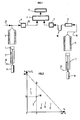
- the catalyst once impregnated with the hydrocarbon sample is ground, then introduced into a nacelle 1 taking place at the top of a piston 2 which is set in motion by a set of jacks 14.
- the basket 1 is placed in a first oven 3 in which a conversion-evaporation step is carried out by means of a supply 18 of inert gas by heating under a flow of inert gas, for example nitrogen, argon or helium and preferably helium to have a better response from the detector 4.
- inert gas for example nitrogen, argon or helium and preferably helium to have a better response from the detector 4.
- the specific flow rate of inert gas relative to the quantity of porous matrix impregnated is for example from 1 to 50 milliliters per milligram per minute, and preferably from 2 to 10 ml / mg / min.
- the effluents from the conversion-evaporation step are conveyed by a line 19 supplied with inert gas 12 and detected over time by a hydrocarbon detector, for example flame ionization (FID) 4 previously calibrated with a sample of reference. It is possible to carry out only one measurement of the signal Q or to make a series of measurements; in this case the results are integrated by section (for example an integration every 1 to 120 seconds, preferably every 40 to 120 seconds) and kept in memory by the microprocessor 5. A signal Q is thus obtained as a function of time and / or the temperature representative of the hydrocarbons generated during this step.
- a hydrocarbon detector for example flame ionization (FID) 4 previously calibrated with a sample of reference.
- Pyrolysis is then carried out, still under a flow of inert gas thanks to a temperature programming from ⁇ 2 to 8 3 , the temperature 8 3 being greater than 8 2 and comprised between 500 ° C and 1000 ° C, preferably between 600 ° C and 700 ° C and at a speed of between 2 ° C / min and 50 ° C / s and preferably 5 ° C / min at 35 ° C min.
- An insulated plateau lasting in time, for example, from 0.5 to 20 min is possibly applied when the temperature 6 3 is reached. This isotherm can advantageously be applied from 1 to 10 minutes.
- the pyrolysis effluents are detected by a hydrocarbon detector, for example a flame ionization detector, and the signal obtained P is integrated as before and stored in the memory of the microprocessor 5.
- a hydrocarbon detector for example a flame ionization detector
- the nacelle 1 containing the pyrolysis residue is then transferred by another piston 7 and another cylinder 15 in a second oven 6, advantageously separate from the first.
- Combustion is then carried out in an oxidizing atmosphere using a line 13 (air, oxygen or air-oxygen mixture where the percentage of oxygen usefully represents more than 20% of the total amount) and at a temperature 8 4 of between 500 ° C. and 1500 ° C, preferably between 600 and 700 ° C for a time of, for example, between 2 and 20 minutes and advantageously between 5 and 10 minutes.
- the organic carbon present in the residue is transformed into carbon dioxide and carbon monoxide and the gas mixture passes through a line 16 in a catalysis furnace 8 at a temperature making it possible to transform practically all of the carbon monoxide into carbon dioxide in conditions known per se, this furnace containing an oxidation catalyst (CuO for example).
- the carbon dioxide is retained on a trap 10 with liquid nitrogen or with solid adsorbent then after being released from the trap by known means, is detected by a specific detector 11, for example a catharometer which delivers a signal R representative of the quantity of the residue.
- This detector 11 can be followed in series by other detectors not shown in FIG. 1, specific for compounds such as sulfur and / or nitrogen oxides which will have been trapped during the combustion step and then released.
- the measurement of the signal R is stored in the memory of the microprocessor 5.
- the integration of the first signal Q resulting from the conversion-evaporation step makes it possible to obtain in milligrams per gram relative to a standard the amount of products A 1 , resulting from the evaporation and the conversion during the first step of heater.
- the integration of the second signal P resulting from the pyrolysis step makes it possible to obtain the quantity of heavy hydrocarbons pyrolyzed A 2 in milligrams per gram of sample.
- a platinum level not shown in FIG. 1 placed in the furnace 3 at the level of the sample makes it possible to measure the effective temperature Tmax from the top of this peak A 2 , which provides information on the pyrolysis process.
- the method according to the invention makes it possible to achieve the objectives defined above. It also makes it possible, from a reference charge, to explore the behavior of the refining catalysts by isolating the effects of a parameter (for example the influence of the metal content, or the influence of the support).
- a parameter for example the influence of the metal content, or the influence of the support.
- the method is reliable, easy to implement and the analysis time is short (for example 30 to 60 minutes).
- the toluene is evaporated under vacuum at 80 ° C for 2 hours.
- Each catalyst (30 mg) is then ground and introduced into a stainless steel basket.
- the basket is placed in a first oven maintained under a flow of helium at a flow rate of 100 ml / min, at a temperature of 300 ° C for 3 minutes.
- the effluents are detected by flame ionization detection, the integrated signal according to the invention every 120 seconds and the results stored in the microprocessor memory.
- a temperature rise is then carried out at 30 ° C / min to 600 ° C.
- the pyrolysis effluents are detected by the flame ionization detector and the integrated pyrolysis signal every 120 seconds is stored; then combustion is carried out by placing the basket containing the sample in a second oven under atmospheric air and oxygen at a flow rate of 350 ml / min, at a temperature of 600 ° C. for approximately 7 minutes.
- the oxides resulting from combustion, in particular carbon monoxide and carbon dioxide then pass through a catalysis furnace filled with copper oxide and heated to about 400 ° C to transform substantially all of the carbon monoxide into carbon dioxide.
- the entire carbon dioxide is then trapped on a 5 A molecular sieve (5x10 -10 m). At the end of the combustion stage, the trap is purged, and the carbon dioxide is detected by the catharometer.
- FIGS. 3 and 4 illustrate the correlations obtained for the hydrotreatment catalysts A, B and C, between the results according to the invention and the results of long-term tests.
- the ordinate represents the conversion into a fraction 500- measured at the end of the long-term test and on the abscissa the index F 1 according to the invention
- FIG. 4 is represented on the ordinate the percentage of coke after hydrotreatment determined according to the method known from the prior art and the coke index F, according to the invention.
- the good correlation shows the validity of the test according to the invention which can therefore be validly used to assess the conversion and coking activities of different catalysts.
- Example 1 is used, in which the Safaniya charge is replaced by an atmospheric residue RA Kuwait, the characteristics of which are presented in table 2.
- the parameters F 1 , F 2 , and F R according to the invention are presented in the table 4, for each catalyst A, B and C.
- a pure silica F with a specific surface area equal to 200 m 2 / g is compared with a commercial catalyst E previously subjected to a treatment for 2 hours at 800 ° C. under 1 atmosphere of water vapor (DA 250 by Grace Davison) .
- the so-called MAT test (Micro-Activity-Test) according to standard ASTM D 39-07 is used as a reference test.
- the charge for the MAT tests is a mixture comprising 30% of atmospheric residue RA Kirkouk + 70% of distillate under vacuum DSV Kirkouk, the characteristics of which are presented in Table 5.
- the same catalysts are subjected to a test according to the invention. They are impregnated with a solution of R. A. Kuwait at 10% by weight in toluene.
- the toluene is evaporated for 2 hours under primary vacuum at 80 ° C.
- FIGS. 5 and 6 Two examples of correlation are illustrated in FIGS. 5 and 6.
- Catalyst G is an alumino-silicate
- catalyst H is the DA 250 commercial catalyst from Grace Davison doped with 0.5% by weight of nickel.
- MAT prior art
- F 2 index obtained by the method according to the invention.
- FIG. 6 the percentage of coke according to the prior art is plotted on the ordinate and the coke index F R according to the invention on the abscissa.
Landscapes
- Chemical & Material Sciences (AREA)
- Health & Medical Sciences (AREA)
- Life Sciences & Earth Sciences (AREA)
- Pathology (AREA)
- Chemical Kinetics & Catalysis (AREA)
- Physics & Mathematics (AREA)
- Analytical Chemistry (AREA)
- Biochemistry (AREA)
- General Health & Medical Sciences (AREA)
- General Physics & Mathematics (AREA)
- Immunology (AREA)
- Engineering & Computer Science (AREA)
- Molecular Biology (AREA)
- General Chemical & Material Sciences (AREA)
- Oil, Petroleum & Natural Gas (AREA)
- Food Science & Technology (AREA)
- Medicinal Chemistry (AREA)
- Production Of Liquid Hydrocarbon Mixture For Refining Petroleum (AREA)
- Investigating Or Analyzing Non-Biological Materials By The Use Of Chemical Means (AREA)
Applications Claiming Priority (2)
| Application Number | Priority Date | Filing Date | Title |
|---|---|---|---|
| FR8607690A FR2599506B1 (fr) | 1986-05-27 | 1986-05-27 | Procede de caracterisation d'un catalyseur par la determination de ses activites de conversion et de cokefaction |
| FR8607690 | 1986-05-27 |
Publications (2)
| Publication Number | Publication Date |
|---|---|
| EP0249514A1 EP0249514A1 (fr) | 1987-12-16 |
| EP0249514B1 true EP0249514B1 (fr) | 1990-04-04 |
Family
ID=9335761
Family Applications (1)
| Application Number | Title | Priority Date | Filing Date |
|---|---|---|---|
| EP87401063A Expired - Lifetime EP0249514B1 (fr) | 1986-05-27 | 1987-05-11 | Procédé de caractérisation d'un catalyseur par la détermination de ses activités de conversion et de cokéfaction |
Country Status (11)
| Country | Link |
|---|---|
| US (1) | US4837158A (es) |
| EP (1) | EP0249514B1 (es) |
| JP (1) | JPH01124763A (es) |
| KR (1) | KR940002519B1 (es) |
| CN (1) | CN1012013B (es) |
| CA (1) | CA1284729C (es) |
| DE (1) | DE3762174D1 (es) |
| DK (1) | DK265787A (es) |
| ES (1) | ES2015308B3 (es) |
| FR (1) | FR2599506B1 (es) |
| ZA (1) | ZA873773B (es) |
Families Citing this family (15)
| Publication number | Priority date | Publication date | Assignee | Title |
|---|---|---|---|---|
| GB8819055D0 (en) * | 1988-08-11 | 1988-09-14 | Coal Industry Patents Ltd | Test for catalyst activity |
| FR2722296B1 (fr) * | 1994-07-05 | 1996-08-30 | Inst Francais Du Petrole | Methode amelioree permettant l'evaluation rapide d'au moins une caracteristique petroliere d'un echantillon de roche application a un gisement comportant des huiles lourdes |
| FR2739694B1 (fr) * | 1995-10-05 | 1997-11-14 | Inst Francais Du Petrole | Methode et dispositif pour determiner des caracteristiques petrolieres de sediments geologiques |
| FR2753271B1 (fr) * | 1996-09-12 | 1998-11-06 | Inst Francais Du Petrole | Methode et dispositif d'evaluation d'une caracteristique de pollution d'un echantillon de sol |
| JP2003107071A (ja) * | 2001-09-27 | 2003-04-09 | Sumika Chemical Analysis Service Ltd | 全窒素測定方法 |
| CN100403024C (zh) * | 2002-08-13 | 2008-07-16 | 中国科学院成都有机化学研究所 | 一种测定单壁碳纳米管纯度的方法 |
| US7435598B2 (en) * | 2003-11-10 | 2008-10-14 | Exxonmobil Chemical Patents Inc. | Catalyst testing apparatus and process |
| FR2869688B1 (fr) * | 2004-04-28 | 2006-07-14 | Inst Francais Du Petrole | Methode et dispositif pour determiner des caracteristiques petrolieres de sediments geologiques |
| FR2886019B1 (fr) * | 2005-05-20 | 2007-08-17 | Peugeot Citroen Automobiles Sa | Procede d'evaluation des emissions h2s en catalyse trois voies |
| FR2937737B1 (fr) * | 2008-10-29 | 2010-11-12 | Inst Francais Du Petrole | Methode et dispositif pour la caracterisation et la quantification rapides de soufre dans des roches sedimentaires et dans des produits petroliers |
| CN103336021B (zh) * | 2013-06-25 | 2015-03-11 | 公安部天津消防研究所 | 一种材料热分解实验装置及实验方法 |
| CN103575859B (zh) * | 2013-10-14 | 2015-04-29 | 青岛惠城石化科技有限公司 | 一种快速表征催化裂化催化剂活性的方法 |
| CN104865147B (zh) * | 2014-02-26 | 2017-08-25 | 江南大学 | 一种采用压降检测反应器内催化剂结焦量的方法 |
| CN106841295B (zh) * | 2017-01-27 | 2019-05-28 | 王宏铭 | 一种利用差式扫描量热法评价催化剂的方法 |
| CN116223713B (zh) * | 2022-11-30 | 2025-03-25 | 北京工业大学 | 用于水泥烧成系统的燃煤催化剂的效果评价方法和装置 |
Family Cites Families (5)
| Publication number | Priority date | Publication date | Assignee | Title |
|---|---|---|---|---|
| US4099923A (en) * | 1977-01-17 | 1978-07-11 | The Standard Oil Company | Automatic catalytic screening unit |
| US4248599A (en) * | 1979-09-19 | 1981-02-03 | Shell Oil Company | Process for determining the API gravity of oil by FID |
| US4419328A (en) * | 1981-07-30 | 1983-12-06 | Mobil Oil Corporation | Controlled fluidized bed reactor for testing catalysts |
| US4425259A (en) * | 1981-08-05 | 1984-01-10 | Ashland Oil, Inc. | Endothermic removal of coke deposited on catalytic materials during carbo-metallic oil conversion |
| US4568426A (en) * | 1983-02-09 | 1986-02-04 | Alcor, Inc. | Controlled atmosphere oven |
-
1986
- 1986-05-27 FR FR8607690A patent/FR2599506B1/fr not_active Expired
-
1987
- 1987-05-11 ES ES87401063T patent/ES2015308B3/es not_active Expired - Lifetime
- 1987-05-11 DE DE8787401063T patent/DE3762174D1/de not_active Expired - Lifetime
- 1987-05-11 EP EP87401063A patent/EP0249514B1/fr not_active Expired - Lifetime
- 1987-05-25 DK DK265787A patent/DK265787A/da not_active Application Discontinuation
- 1987-05-26 US US07/053,666 patent/US4837158A/en not_active Expired - Fee Related
- 1987-05-26 ZA ZA873773A patent/ZA873773B/xx unknown
- 1987-05-27 CA CA000538196A patent/CA1284729C/fr not_active Expired - Lifetime
- 1987-05-27 JP JP62131047A patent/JPH01124763A/ja active Pending
- 1987-05-27 CN CN87103819A patent/CN1012013B/zh not_active Expired
- 1987-05-27 KR KR1019870005250A patent/KR940002519B1/ko not_active Expired - Lifetime
Also Published As
| Publication number | Publication date |
|---|---|
| DK265787D0 (da) | 1987-05-25 |
| FR2599506B1 (fr) | 1989-07-21 |
| JPH01124763A (ja) | 1989-05-17 |
| US4837158A (en) | 1989-06-06 |
| ZA873773B (en) | 1989-01-25 |
| EP0249514A1 (fr) | 1987-12-16 |
| CN87103819A (zh) | 1988-01-13 |
| FR2599506A1 (fr) | 1987-12-04 |
| KR870011472A (ko) | 1987-12-23 |
| CN1012013B (zh) | 1991-03-13 |
| KR940002519B1 (ko) | 1994-03-25 |
| DK265787A (da) | 1987-11-28 |
| DE3762174D1 (de) | 1990-05-10 |
| ES2015308B3 (es) | 1990-08-16 |
| CA1284729C (fr) | 1991-06-11 |
Similar Documents
| Publication | Publication Date | Title |
|---|---|---|
| EP0249514B1 (fr) | Procédé de caractérisation d'un catalyseur par la détermination de ses activités de conversion et de cokéfaction | |
| EP2342557B1 (fr) | Méthode et dispositif pour la caractérisation et la quantification rapides du soufre dans des roches sédimentaires et dans des produits pétroliers | |
| EP0269511B1 (fr) | Procédé et dispositif de détermination des teneurs d'au moins deux éléments choisis parmi le carbone, l'hydrogène, le soufre et l'azote d'au moins deux fractions d'un échantillon de matière organique | |
| FR2774768A1 (fr) | Methode de determination d'au moins une propriete physicochimique d'une coupe petroliere | |
| EP2106548A1 (fr) | Dispositif et procede de mesure continue de la concentration en goudrons dans un flux gazeux | |
| EP0206905B1 (fr) | Procédé et appareillage de test et d'analyse en ligne permettant d'établir un bilan matière d'une réaction chimique | |
| FR3013456A1 (fr) | Procede d'estimation rapide de caracteristiques de residus de distillation et de coke | |
| EP0248694B1 (fr) | Procédé de détermination de la composition d'un mélange d'hydrocarbures en fonction de la température d'ébullition de ses constituants | |
| Islas et al. | The unusual properties of high mass materials from coal-derived liquids☆ | |
| US4783416A (en) | Analytical method to determine the unwashed gum content in a gasoline boiling hydrocarbon | |
| JP2008304316A (ja) | 土壌中に含まれる該成分の含有量を測定する方法 | |
| WO2007051941A2 (fr) | Procede de determination de la teneur en gazole dans une huile lubrifiante de moteur a combustion | |
| Skolniak et al. | Analysis of changes in the properties of selected chemical compounds and motor fuels taking place during oxidation processes | |
| EP1091210B1 (fr) | Méthode d'analyse par pyrolyse | |
| EP0536155A1 (fr) | Analyseur de soufre total | |
| WO2009010678A9 (fr) | Procede de determination de la teneur en carburant dans une huile lubrifiante de moteur a combustion | |
| EP2074631B1 (fr) | Procede de traitement de combustibles nucleaires comprenant du carbure de silicium et degainage de particules de combustible nucleaire | |
| EP3292405B1 (fr) | Procede de suivi en continu de l'etat d'avancement d'oxydation d'un carburant | |
| Fixari et al. | Fractions distribution and elemental composition of heavy oils by pyroanalysis | |
| JP2648375B2 (ja) | ディーゼル条件下の重油の自己着火能力の測定方法及び装置 | |
| EP1783480A1 (fr) | Méthode de détermination de la teneur en diolefines conjuguees d'un echantillon a partir de son spectre proche infrarouge et application au controle d'unités | |
| BE536540A (es) |
Legal Events
| Date | Code | Title | Description |
|---|---|---|---|
| PUAI | Public reference made under article 153(3) epc to a published international application that has entered the european phase |
Free format text: ORIGINAL CODE: 0009012 |
|
| AK | Designated contracting states |
Kind code of ref document: A1 Designated state(s): BE DE ES GB IT NL |
|
| 17P | Request for examination filed |
Effective date: 19880209 |
|
| 17Q | First examination report despatched |
Effective date: 19890622 |
|
| ITF | It: translation for a ep patent filed | ||
| GRAA | (expected) grant |
Free format text: ORIGINAL CODE: 0009210 |
|
| AK | Designated contracting states |
Kind code of ref document: B1 Designated state(s): BE DE ES GB IT NL |
|
| REF | Corresponds to: |
Ref document number: 3762174 Country of ref document: DE Date of ref document: 19900510 |
|
| PGFP | Annual fee paid to national office [announced via postgrant information from national office to epo] |
Ref country code: ES Payment date: 19900516 Year of fee payment: 4 |
|
| GBT | Gb: translation of ep patent filed (gb section 77(6)(a)/1977) | ||
| PLBE | No opposition filed within time limit |
Free format text: ORIGINAL CODE: 0009261 |
|
| STAA | Information on the status of an ep patent application or granted ep patent |
Free format text: STATUS: NO OPPOSITION FILED WITHIN TIME LIMIT |
|
| 26N | No opposition filed | ||
| PGFP | Annual fee paid to national office [announced via postgrant information from national office to epo] |
Ref country code: GB Payment date: 19910423 Year of fee payment: 5 |
|
| PGFP | Annual fee paid to national office [announced via postgrant information from national office to epo] |
Ref country code: BE Payment date: 19910515 Year of fee payment: 5 |
|
| ITTA | It: last paid annual fee | ||
| PGFP | Annual fee paid to national office [announced via postgrant information from national office to epo] |
Ref country code: NL Payment date: 19910531 Year of fee payment: 5 |
|
| PGFP | Annual fee paid to national office [announced via postgrant information from national office to epo] |
Ref country code: DE Payment date: 19910612 Year of fee payment: 5 |
|
| PG25 | Lapsed in a contracting state [announced via postgrant information from national office to epo] |
Ref country code: GB Effective date: 19920511 |
|
| PG25 | Lapsed in a contracting state [announced via postgrant information from national office to epo] |
Ref country code: ES Free format text: LAPSE BECAUSE OF NON-PAYMENT OF DUE FEES Effective date: 19920512 |
|
| PG25 | Lapsed in a contracting state [announced via postgrant information from national office to epo] |
Ref country code: BE Effective date: 19920531 |
|
| BERE | Be: lapsed |
Owner name: INSTITUT FRANCAIS DU PETROLE Effective date: 19920531 |
|
| PG25 | Lapsed in a contracting state [announced via postgrant information from national office to epo] |
Ref country code: NL Effective date: 19921201 |
|
| GBPC | Gb: european patent ceased through non-payment of renewal fee |
Effective date: 19920511 |
|
| NLV4 | Nl: lapsed or anulled due to non-payment of the annual fee | ||
| PG25 | Lapsed in a contracting state [announced via postgrant information from national office to epo] |
Ref country code: DE Effective date: 19930202 |
|
| REG | Reference to a national code |
Ref country code: ES Ref legal event code: FD2A Effective date: 19990201 |
|
| PG25 | Lapsed in a contracting state [announced via postgrant information from national office to epo] |
Ref country code: IT Free format text: LAPSE BECAUSE OF NON-PAYMENT OF DUE FEES;WARNING: LAPSES OF ITALIAN PATENTS WITH EFFECTIVE DATE BEFORE 2007 MAY HAVE OCCURRED AT ANY TIME BEFORE 2007. THE CORRECT EFFECTIVE DATE MAY BE DIFFERENT FROM THE ONE RECORDED. Effective date: 20050511 |