EP0248972A2 - Ammoniummonofluorphosphate, Verfahren zu ihrer Herstellung und ihre Verwendung - Google Patents
Ammoniummonofluorphosphate, Verfahren zu ihrer Herstellung und ihre Verwendung Download PDFInfo
- Publication number
- EP0248972A2 EP0248972A2 EP19870100505 EP87100505A EP0248972A2 EP 0248972 A2 EP0248972 A2 EP 0248972A2 EP 19870100505 EP19870100505 EP 19870100505 EP 87100505 A EP87100505 A EP 87100505A EP 0248972 A2 EP0248972 A2 EP 0248972A2
- Authority
- EP
- European Patent Office
- Prior art keywords
- ammonium
- general formula
- monofluorophosphates
- value
- radicals
- Prior art date
- Legal status (The legal status is an assumption and is not a legal conclusion. Google has not performed a legal analysis and makes no representation as to the accuracy of the status listed.)
- Withdrawn
Links
- 238000002360 preparation method Methods 0.000 title claims abstract description 5
- 238000000034 method Methods 0.000 title claims description 6
- SAEOCANGOMBQSP-UHFFFAOYSA-N diazanium;fluoro-dioxido-oxo-$l^{5}-phosphane Chemical class [NH4+].[NH4+].[O-]P([O-])(F)=O SAEOCANGOMBQSP-UHFFFAOYSA-N 0.000 claims abstract description 14
- 125000004432 carbon atom Chemical group C* 0.000 claims abstract description 8
- 125000000217 alkyl group Chemical group 0.000 claims abstract description 6
- 125000004435 hydrogen atom Chemical group [H]* 0.000 claims abstract description 5
- 229920006395 saturated elastomer Polymers 0.000 claims abstract description 5
- 125000003545 alkoxy group Chemical group 0.000 claims abstract description 4
- 125000004122 cyclic group Chemical group 0.000 claims abstract description 3
- 125000002887 hydroxy group Chemical group [H]O* 0.000 claims abstract description 3
- 150000001875 compounds Chemical class 0.000 claims description 17
- 239000002904 solvent Substances 0.000 claims description 15
- 239000000606 toothpaste Substances 0.000 claims description 14
- DWYMPOCYEZONEA-UHFFFAOYSA-N fluorophosphoric acid Chemical compound OP(O)(F)=O DWYMPOCYEZONEA-UHFFFAOYSA-N 0.000 claims description 13
- 239000000243 solution Substances 0.000 claims description 12
- 229940034610 toothpaste Drugs 0.000 claims description 12
- 239000000203 mixture Substances 0.000 claims description 10
- 239000000654 additive Substances 0.000 claims description 9
- 150000001412 amines Chemical class 0.000 claims description 9
- 150000003839 salts Chemical class 0.000 claims description 8
- 239000007864 aqueous solution Substances 0.000 claims description 6
- 230000000996 additive effect Effects 0.000 claims description 5
- -1 alkylammonium fluorides Chemical class 0.000 claims description 4
- 230000002378 acidificating effect Effects 0.000 claims description 3
- LDDQLRUQCUTJBB-UHFFFAOYSA-N ammonium fluoride Chemical class [NH4+].[F-] LDDQLRUQCUTJBB-UHFFFAOYSA-N 0.000 claims description 3
- 150000002500 ions Chemical class 0.000 claims description 2
- YZCKVEUIGOORGS-IGMARMGPSA-N Protium Chemical group [1H] YZCKVEUIGOORGS-IGMARMGPSA-N 0.000 claims 1
- 239000002253 acid Substances 0.000 claims 1
- 150000003863 ammonium salts Chemical class 0.000 claims 1
- 150000001450 anions Chemical class 0.000 claims 1
- 229910052500 inorganic mineral Inorganic materials 0.000 claims 1
- 239000011707 mineral Substances 0.000 claims 1
- 239000000126 substance Substances 0.000 abstract description 4
- 229910052731 fluorine Inorganic materials 0.000 abstract description 2
- 229910052739 hydrogen Inorganic materials 0.000 abstract description 2
- 239000001257 hydrogen Substances 0.000 abstract description 2
- PXGOKWXKJXAPGV-UHFFFAOYSA-N Fluorine Chemical compound FF PXGOKWXKJXAPGV-UHFFFAOYSA-N 0.000 abstract 1
- 239000011737 fluorine Substances 0.000 abstract 1
- LFQSCWFLJHTTHZ-UHFFFAOYSA-N Ethanol Chemical compound CCO LFQSCWFLJHTTHZ-UHFFFAOYSA-N 0.000 description 33
- 238000003756 stirring Methods 0.000 description 11
- CSCPPACGZOOCGX-UHFFFAOYSA-N Acetone Chemical compound CC(C)=O CSCPPACGZOOCGX-UHFFFAOYSA-N 0.000 description 10
- GAWIXWVDTYZWAW-UHFFFAOYSA-N C[CH]O Chemical group C[CH]O GAWIXWVDTYZWAW-UHFFFAOYSA-N 0.000 description 10
- 238000001035 drying Methods 0.000 description 8
- 229940074371 monofluorophosphate Drugs 0.000 description 8
- 229910052757 nitrogen Inorganic materials 0.000 description 8
- XLYOFNOQVPJJNP-UHFFFAOYSA-N water Substances O XLYOFNOQVPJJNP-UHFFFAOYSA-N 0.000 description 7
- KRHYYFGTRYWZRS-UHFFFAOYSA-M Fluoride anion Chemical compound [F-] KRHYYFGTRYWZRS-UHFFFAOYSA-M 0.000 description 6
- OKKJLVBELUTLKV-UHFFFAOYSA-N Methanol Chemical compound OC OKKJLVBELUTLKV-UHFFFAOYSA-N 0.000 description 6
- FAPWRFPIFSIZLT-UHFFFAOYSA-M Sodium chloride Chemical compound [Na+].[Cl-] FAPWRFPIFSIZLT-UHFFFAOYSA-M 0.000 description 6
- YXFVVABEGXRONW-UHFFFAOYSA-N Toluene Chemical compound CC1=CC=CC=C1 YXFVVABEGXRONW-UHFFFAOYSA-N 0.000 description 6
- 238000006243 chemical reaction Methods 0.000 description 6
- 239000007795 chemical reaction product Substances 0.000 description 6
- 229940091249 fluoride supplement Drugs 0.000 description 6
- 239000003960 organic solvent Substances 0.000 description 6
- 239000007858 starting material Substances 0.000 description 6
- 239000003760 tallow Substances 0.000 description 6
- 238000001816 cooling Methods 0.000 description 5
- ATUOYWHBWRKTHZ-UHFFFAOYSA-N Propane Chemical compound CCC ATUOYWHBWRKTHZ-UHFFFAOYSA-N 0.000 description 4
- 125000005210 alkyl ammonium group Chemical group 0.000 description 4
- 150000004985 diamines Chemical class 0.000 description 4
- 239000000047 product Substances 0.000 description 4
- 150000003254 radicals Chemical class 0.000 description 4
- XGRSAFKZAGGXJV-UHFFFAOYSA-N 3-azaniumyl-3-cyclohexylpropanoate Chemical compound OC(=O)CC(N)C1CCCCC1 XGRSAFKZAGGXJV-UHFFFAOYSA-N 0.000 description 3
- XEKOWRVHYACXOJ-UHFFFAOYSA-N Ethyl acetate Chemical compound CCOC(C)=O XEKOWRVHYACXOJ-UHFFFAOYSA-N 0.000 description 3
- KRHYYFGTRYWZRS-UHFFFAOYSA-N Fluorane Chemical compound F KRHYYFGTRYWZRS-UHFFFAOYSA-N 0.000 description 3
- PEDCQBHIVMGVHV-UHFFFAOYSA-N Glycerine Chemical compound OCC(O)CO PEDCQBHIVMGVHV-UHFFFAOYSA-N 0.000 description 3
- PMZURENOXWZQFD-UHFFFAOYSA-L Sodium Sulfate Chemical compound [Na+].[Na+].[O-]S([O-])(=O)=O PMZURENOXWZQFD-UHFFFAOYSA-L 0.000 description 3
- 239000007983 Tris buffer Substances 0.000 description 3
- 208000002925 dental caries Diseases 0.000 description 3
- 238000001914 filtration Methods 0.000 description 3
- 150000002222 fluorine compounds Chemical class 0.000 description 3
- 239000011780 sodium chloride Substances 0.000 description 3
- 229960004711 sodium monofluorophosphate Drugs 0.000 description 3
- 229910052938 sodium sulfate Inorganic materials 0.000 description 3
- 235000011152 sodium sulphate Nutrition 0.000 description 3
- 239000007787 solid Substances 0.000 description 3
- NLXLAEXVIDQMFP-UHFFFAOYSA-N Ammonia chloride Chemical compound [NH4+].[Cl-] NLXLAEXVIDQMFP-UHFFFAOYSA-N 0.000 description 2
- IJGRMHOSHXDMSA-UHFFFAOYSA-N Atomic nitrogen Chemical compound N#N IJGRMHOSHXDMSA-UHFFFAOYSA-N 0.000 description 2
- OYPRJOBELJOOCE-UHFFFAOYSA-N Calcium Chemical compound [Ca] OYPRJOBELJOOCE-UHFFFAOYSA-N 0.000 description 2
- NTIZESTWPVYFNL-UHFFFAOYSA-N Methyl isobutyl ketone Chemical compound CC(C)CC(C)=O NTIZESTWPVYFNL-UHFFFAOYSA-N 0.000 description 2
- UIHCLUNTQKBZGK-UHFFFAOYSA-N Methyl isobutyl ketone Natural products CCC(C)C(C)=O UIHCLUNTQKBZGK-UHFFFAOYSA-N 0.000 description 2
- LRHPLDYGYMQRHN-UHFFFAOYSA-N N-Butanol Chemical compound CCCCO LRHPLDYGYMQRHN-UHFFFAOYSA-N 0.000 description 2
- SCKMWTVJHVOKPI-UHFFFAOYSA-N P(=O)(O)(O)F.CCC Chemical compound P(=O)(O)(O)F.CCC SCKMWTVJHVOKPI-UHFFFAOYSA-N 0.000 description 2
- 150000001298 alcohols Chemical class 0.000 description 2
- 125000005263 alkylenediamine group Chemical group 0.000 description 2
- BFNBIHQBYMNNAN-UHFFFAOYSA-N ammonium sulfate Chemical compound N.N.OS(O)(=O)=O BFNBIHQBYMNNAN-UHFFFAOYSA-N 0.000 description 2
- 229910052921 ammonium sulfate Inorganic materials 0.000 description 2
- 235000011130 ammonium sulphate Nutrition 0.000 description 2
- TZCXTZWJZNENPQ-UHFFFAOYSA-L barium sulfate Chemical compound [Ba+2].[O-]S([O-])(=O)=O TZCXTZWJZNENPQ-UHFFFAOYSA-L 0.000 description 2
- QNHNZAMKMLIQRR-UHFFFAOYSA-L barium(2+);fluoro-dioxido-oxo-$l^{5}-phosphane Chemical compound [Ba+2].[O-]P([O-])(F)=O QNHNZAMKMLIQRR-UHFFFAOYSA-L 0.000 description 2
- 239000006227 byproduct Substances 0.000 description 2
- 239000011575 calcium Substances 0.000 description 2
- OSGAYBCDTDRGGQ-UHFFFAOYSA-L calcium sulfate Inorganic materials [Ca+2].[O-]S([O-])(=O)=O OSGAYBCDTDRGGQ-UHFFFAOYSA-L 0.000 description 2
- GFIKIVSYJDVOOZ-UHFFFAOYSA-L calcium;fluoro-dioxido-oxo-$l^{5}-phosphane Chemical compound [Ca+2].[O-]P([O-])(F)=O GFIKIVSYJDVOOZ-UHFFFAOYSA-L 0.000 description 2
- 150000001768 cations Chemical class 0.000 description 2
- 238000003776 cleavage reaction Methods 0.000 description 2
- NNBZCPXTIHJBJL-UHFFFAOYSA-N decalin Chemical compound C1CCCC2CCCCC21 NNBZCPXTIHJBJL-UHFFFAOYSA-N 0.000 description 2
- 125000001301 ethoxy group Chemical group [H]C([H])([H])C([H])([H])O* 0.000 description 2
- 238000009472 formulation Methods 0.000 description 2
- 230000007062 hydrolysis Effects 0.000 description 2
- 238000006460 hydrolysis reaction Methods 0.000 description 2
- 230000003301 hydrolyzing effect Effects 0.000 description 2
- 238000005342 ion exchange Methods 0.000 description 2
- 239000001294 propane Substances 0.000 description 2
- 238000001953 recrystallisation Methods 0.000 description 2
- 230000007017 scission Effects 0.000 description 2
- 239000011734 sodium Substances 0.000 description 2
- BFDWBSRJQZPEEB-UHFFFAOYSA-L sodium fluorophosphate Chemical compound [Na+].[Na+].[O-]P([O-])(F)=O BFDWBSRJQZPEEB-UHFFFAOYSA-L 0.000 description 2
- 125000001424 substituent group Chemical group 0.000 description 2
- XFNJVJPLKCPIBV-UHFFFAOYSA-N trimethylenediamine Chemical compound NCCCN XFNJVJPLKCPIBV-UHFFFAOYSA-N 0.000 description 2
- RTMPMACGUYQNRG-UHFFFAOYSA-N 2-[bis[2-[bis(2-hydroxyethyl)amino]ethyl]amino]ethanol Chemical compound OCCN(CCO)CCN(CCO)CCN(CCO)CCO RTMPMACGUYQNRG-UHFFFAOYSA-N 0.000 description 1
- QGZKDVFQNNGYKY-UHFFFAOYSA-O Ammonium Chemical compound [NH4+] QGZKDVFQNNGYKY-UHFFFAOYSA-O 0.000 description 1
- VEXZGXHMUGYJMC-UHFFFAOYSA-M Chloride anion Chemical compound [Cl-] VEXZGXHMUGYJMC-UHFFFAOYSA-M 0.000 description 1
- VEXZGXHMUGYJMC-UHFFFAOYSA-N Hydrochloric acid Chemical compound Cl VEXZGXHMUGYJMC-UHFFFAOYSA-N 0.000 description 1
- OAICVXFJPJFONN-UHFFFAOYSA-N Phosphorus Chemical compound [P] OAICVXFJPJFONN-UHFFFAOYSA-N 0.000 description 1
- 230000001070 adhesive effect Effects 0.000 description 1
- 125000003277 amino group Chemical group 0.000 description 1
- 235000019270 ammonium chloride Nutrition 0.000 description 1
- LTSAUCCKBTXBIR-UHFFFAOYSA-N azane ethene Chemical compound N.N.N.C=C.C=C LTSAUCCKBTXBIR-UHFFFAOYSA-N 0.000 description 1
- 230000015572 biosynthetic process Effects 0.000 description 1
- 238000009835 boiling Methods 0.000 description 1
- 229910052791 calcium Inorganic materials 0.000 description 1
- 238000005119 centrifugation Methods 0.000 description 1
- 238000004140 cleaning Methods 0.000 description 1
- 125000000753 cycloalkyl group Chemical group 0.000 description 1
- 125000000113 cyclohexyl group Chemical group [H]C1([H])C([H])([H])C([H])([H])C([H])(*)C([H])([H])C1([H])[H] 0.000 description 1
- 125000001511 cyclopentyl group Chemical group [H]C1([H])C([H])([H])C([H])([H])C([H])(*)C1([H])[H] 0.000 description 1
- 239000013530 defoamer Substances 0.000 description 1
- DGTVXEHQMSJRPE-UHFFFAOYSA-N difluorophosphinic acid Chemical class OP(F)(F)=O DGTVXEHQMSJRPE-UHFFFAOYSA-N 0.000 description 1
- 239000006185 dispersion Substances 0.000 description 1
- 239000000839 emulsion Substances 0.000 description 1
- 125000001495 ethyl group Chemical group [H]C([H])([H])C([H])([H])* 0.000 description 1
- 238000000605 extraction Methods 0.000 description 1
- 230000004720 fertilization Effects 0.000 description 1
- 239000000706 filtrate Substances 0.000 description 1
- 238000005187 foaming Methods 0.000 description 1
- 150000003840 hydrochlorides Chemical class 0.000 description 1
- 230000005764 inhibitory process Effects 0.000 description 1
- 230000007774 longterm Effects 0.000 description 1
- 239000003879 lubricant additive Substances 0.000 description 1
- 125000000956 methoxy group Chemical group [H]C([H])([H])O* 0.000 description 1
- 125000002496 methyl group Chemical group [H]C([H])([H])* 0.000 description 1
- 238000002156 mixing Methods 0.000 description 1
- 210000002200 mouth mucosa Anatomy 0.000 description 1
- TUFJPPAQOXUHRI-KTKRTIGZSA-N n'-[(z)-octadec-9-enyl]propane-1,3-diamine Chemical compound CCCCCCCC\C=C/CCCCCCCCNCCCN TUFJPPAQOXUHRI-KTKRTIGZSA-N 0.000 description 1
- XMMDVXFQGOEOKH-UHFFFAOYSA-N n'-dodecylpropane-1,3-diamine Chemical compound CCCCCCCCCCCCNCCCN XMMDVXFQGOEOKH-UHFFFAOYSA-N 0.000 description 1
- 238000006386 neutralization reaction Methods 0.000 description 1
- 238000013021 overheating Methods 0.000 description 1
- 229910052698 phosphorus Inorganic materials 0.000 description 1
- 239000011574 phosphorus Substances 0.000 description 1
- 239000003495 polar organic solvent Substances 0.000 description 1
- BDERNNFJNOPAEC-UHFFFAOYSA-N propan-1-ol Chemical compound CCCO BDERNNFJNOPAEC-UHFFFAOYSA-N 0.000 description 1
- 238000011321 prophylaxis Methods 0.000 description 1
- AOHJOMMDDJHIJH-UHFFFAOYSA-N propylenediamine Chemical compound CC(N)CN AOHJOMMDDJHIJH-UHFFFAOYSA-N 0.000 description 1
- 230000001681 protective effect Effects 0.000 description 1
- 230000035484 reaction time Effects 0.000 description 1
- 238000009938 salting Methods 0.000 description 1
- 238000005185 salting out Methods 0.000 description 1
- 150000003384 small molecules Chemical class 0.000 description 1
- 239000002689 soil Substances 0.000 description 1
- 238000001228 spectrum Methods 0.000 description 1
- 150000003467 sulfuric acid derivatives Chemical class 0.000 description 1
- 239000000725 suspension Substances 0.000 description 1
- CXWXQJXEFPUFDZ-UHFFFAOYSA-N tetralin Chemical compound C1=CC=C2CCCCC2=C1 CXWXQJXEFPUFDZ-UHFFFAOYSA-N 0.000 description 1
- 231100000331 toxic Toxicity 0.000 description 1
- 230000002588 toxic effect Effects 0.000 description 1
- PXXNTAGJWPJAGM-UHFFFAOYSA-N vertaline Natural products C1C2C=3C=C(OC)C(OC)=CC=3OC(C=C3)=CC=C3CCC(=O)OC1CC1N2CCCC1 PXXNTAGJWPJAGM-UHFFFAOYSA-N 0.000 description 1
Classifications
-
- A—HUMAN NECESSITIES
- A61—MEDICAL OR VETERINARY SCIENCE; HYGIENE
- A61Q—SPECIFIC USE OF COSMETICS OR SIMILAR TOILETRY PREPARATIONS
- A61Q11/00—Preparations for care of the teeth, of the oral cavity or of dentures; Dentifrices, e.g. toothpastes; Mouth rinses
-
- A—HUMAN NECESSITIES
- A61—MEDICAL OR VETERINARY SCIENCE; HYGIENE
- A61K—PREPARATIONS FOR MEDICAL, DENTAL OR TOILETRY PURPOSES
- A61K8/00—Cosmetics or similar toiletry preparations
- A61K8/18—Cosmetics or similar toiletry preparations characterised by the composition
- A61K8/19—Cosmetics or similar toiletry preparations characterised by the composition containing inorganic ingredients
- A61K8/20—Halogens; Compounds thereof
- A61K8/21—Fluorides; Derivatives thereof
-
- A—HUMAN NECESSITIES
- A61—MEDICAL OR VETERINARY SCIENCE; HYGIENE
- A61K—PREPARATIONS FOR MEDICAL, DENTAL OR TOILETRY PURPOSES
- A61K8/00—Cosmetics or similar toiletry preparations
- A61K8/18—Cosmetics or similar toiletry preparations characterised by the composition
- A61K8/19—Cosmetics or similar toiletry preparations characterised by the composition containing inorganic ingredients
- A61K8/26—Aluminium; Compounds thereof
Definitions
- the present invention relates to special alkylammonium monofluorophosphates, processes for their preparation and their use as toothpaste additives for caries inhibition.
- asymmetrical compounds are preferred in which the group NR 1 R 2 has a different meaning
- USP 4,011,310 describes new alkylammonium fluorophosphates for dental prophylaxis. These are mono- or difluorophosphates of primary, secondary or tertiary monoamines and primary alkylenediamines. Surprisingly, it has now been found that the alkylenediamines in which at least one of the amino groups is not described so far is secondary or tertiary, ie one or two carries additional alkyl groups. Form dimonofluorophosphates, which due to their polar character are particularly suitable for use as a toothpaste additive.
- the compounds of the general formula I are obtained in a simple manner by reacting the monofluorophosphoric acid or its salts, preferably the disodium monofluorophosphate, the calcium monofluorophosphate or the barium monofluorophosphate, with the corresponding amines or their salts, preferably the hydrochlorides or sulfates.
- the sodium monofluorophosphate is preferably reacted with the corresponding ammonium chloride or ammonium sulfate, surprisingly with almost quantitative salting-out to form the ammonium monofluorophosphate.
- the reaction is carried out by mixing the components together in a solvent at room temperature or at an elevated temperature up to the boiling point of the solvent.
- Suitable solvents are both water and polar organic solvents such as acetone, methyl isobutyl ketone, lower alcohols such as methanol, ethanol, propanol, butanol, but also mixtures of these solvents. If necessary, the solubility of the compounds of the formula I and / or of the by-products can be changed by adding nonpolar organic solvents, such as toluene, and the compound I sought can thus be obtained in higher purity and yield.
- the compounds according to the invention can also be obtained in solid form by stripping off the solvent after the reaction has taken place and extracting the ammonium monofluorophosphate from the residue with an anhydrous organic solvent, the sodium chloride or sodium sulfate being left behind, and removing the pure solvent by stripping off the organic solvent Ammonium monofluorophosphate according to formula I can be obtained. In order to avoid excessive foaming, it is advisable to add an appropriate defoamer when removing the solvent, which does not interfere when used as a toothpaste additive.
- the product can be additionally purified by recrystallization, for example from a lower alcohol.
- the amine or amine mixture is presented as a solution or suspension in water or a water-miscible organic solvent, such as ethanol, acetone, methyl isobutyl ketone, a lower alcohol or a mixture thereof.
- a water-miscible organic solvent such as ethanol, acetone, methyl isobutyl ketone, a lower alcohol or a mixture thereof.
- the ion exchange eluate must be added with vigorous stirring. After the stoichiometric amount of monofluorophosphoric acid-containing ion exchange eluate has been added, the mixture is stirred for a corresponding time to complete the reaction.
- the reaction time is between 15 minutes and 6 hours, preferably between 1 and 3 hours.
- ammonium monofluorophosphates according to the invention are obtained as a solution or, as a solid by stripping off the solvent in vacuo and recrystallizing the residue in a suitable solvent, for example in a lower alcohol or toluene.
- a suitable solvent for example in a lower alcohol or toluene.
- the products can then be freed from adhering last traces of the solvents by drying in vacuo.
- the compounds according to the invention can be formed directly from commercially available monofluorophosphoric acid and the corresponding amines. Additional cleaning, for example by recrystallization, may be necessary.
- ammonium non-fluorophosphates of the general formula I according to the invention are solid to wax-like substances which, depending on the nature of the substituents, have a noticeable to very good solubility in water.
- the pH of a 1% aqueous solution or dispersion of these compounds is p H 5-7.
- the monofluorophosphates according to the invention are generally readily soluble in heat in alcohols.
- the compounds according to the invention are used in an amount of 100 to 5000 ppm, preferably 500 to 2000 ppm fluoride equivalents, i.e. up to about 10% by weight.
- Alkyl groups in the sense of the invention are understood to mean groups with up to 30 C atoms, in particular 10-22 C atoms. These groups can optionally contain 1 or 2 double bonds.
- Cycloalkyl groups can be monocycles with 5-8 C atoms, in particular c-pentyl and c-hexyl, but also bicycles, such as tetrahydronaphthalene and decalin.
- alkyl or alkoxy groups occur as substituents of the above radicals, groups with 1-6 C atoms, in particular methyl and ethyl or methoxy and ethoxy, are preferred.
- the substances produced according to the invention can also be present as mixtures of all the compounds described under formula I.
- the aqueous solution is concentrated at 80-120 mbar and 40 ° C. and the bis- (hydroxyethyl) aminopropylene-N-hydroxyethyloctadecylammonium monofluorophosphate is precipitated with an organic solvent such as acetone.
- the precipitated calcium sulfate is then separated off by filtration and washed with a little H 0.
- the entire aqueous filtrate is evaporated to dryness in vacuo at 40 ° C., then the waxy residue is dissolved in methanol, filtered again and the bis (hydroxyethyl) aminopropylene-N-hydroxyethyl-octadecylammonium monofluorophosphate in an organic solvent such as acetone or ethyl acetate precipitated with vigorous stirring.
- N- oleyl-1,3-diaminopropane 64.9 g are mixed with 500 ml of H 2 O and neutralized within 15 minutes with vigorous stirring with 200 ml of 2N HCl. It is diluted with 1000 ml of H 2 O, warmed to 40 ° C. and then 28.8 g of Na 2 PO 3 F, dissolved in 100 ml of H 2 O, are added with continuous stirring.
- N-oleyl-1,3-diammoniumpropanmonofluorophos-0 phat at 20 C results in a stable emulsion, the solubility in glycerol is over 10%.
- N-lauryl-1,3-diaminopropane 29.8 g are mixed with 1000 ml of ethanol and a solution of 10 g of monofluorophosphoric acid in 500 ml of ethanol is added within 15 minutes with vigorous stirring and cooling to 30 ° C. The reaction product is filtered off and washed with a little ethanol.
Landscapes
- Health & Medical Sciences (AREA)
- Life Sciences & Earth Sciences (AREA)
- Veterinary Medicine (AREA)
- Animal Behavior & Ethology (AREA)
- General Health & Medical Sciences (AREA)
- Public Health (AREA)
- Birds (AREA)
- Inorganic Chemistry (AREA)
- Epidemiology (AREA)
- Chemical & Material Sciences (AREA)
- Oral & Maxillofacial Surgery (AREA)
- Cosmetics (AREA)
- Organic Low-Molecular-Weight Compounds And Preparation Thereof (AREA)
Abstract
Die vorliegende Erfindung betrifft Ammoniummonofluorophosphate der allgemeinen Formel

in der R1, R2, R3, R4 ein Wasserstoffatom, einen geradkettigen, verzweigten oder cyclischen, gesättigten oder ungesättigten Alkylrest mit 1 bis 30 C-Atomen bedeuten, wobei diese gegebenenfalls noch durch Alkyl-, Alkoxy- oder Hydroxylgruppen substituiert sein können und a den Wert 1 bis 6, b den Wert 0 oder 1, sowie c den Wert 1 (für b = 0 oder 1) oder 2 (für b = 0) annehmen kann, wobei mindestens einer der Reste R1-R4 nicht Wasserstoff ist, und einer der Reste R1-R4 auch eine Gruppe (H2PO3F)x R1R2N-(CH2)a- oder (HF)x R1R2N-(CH2)a darstellen kann, worin a, R1 und R2 die obige Bedeutung haben, sowie Verfahren zu deren Herstellung und deren Verwendung in Zahnpflegemitteln.
Die beanspruchten Substanzen zeichnen sich durch eine verbesserte Freisetzung von Fluor bei der Anwendung als Zahnpflegemittel aus.
Description
- Gegenstand der vorliegenden Erfindung sind spezielle Alkylammoniummonofluorophosphate, Verfahren zu ihrer Herstellung und ihre Verwendung als Zahnpastenadditive zur Kariesinhibierung.
- Es ist bekannt, daß Fluoride, die in geringen Mengen Zahnpasten zugesetzt werden, imstande sind die Zahnsubstanz zu härten und dadurch den Zahnverfall und Karies zu verringern. Da die meisten Fluoride, wie auch Flußsäure selbst, recht toxisch sind, ist es weiterhin bekannt, statt dessen Natriummonofluorophosphat (Na2PO3F) zu verwenden, aus dem Fluorid durch Hydrolyse freigesetzt wird.
- Obwohl dieses Salz und eine Reihe weiterer Monofluorophosphate seit langem in großem Umfang als Zahnpastenadditiv verwendet werden, besteht doch das Bedürfnis nach anderen Additiven, die bei der Anwendung als Zahnpasta in zeitlich unterschiedlichem Maße Fluorid freisetzen.
- Es stellte sich daher die Aufgabe neue, als Zahnpastenadditive besser geeignete, Fluorid abgebende Verbindungen zu finden.
- Überraschenderweise wurde nun gefunden, daß Ammoniummonofluorophosphate der allgemeinen Formel I

- Für die erfindungsgemäße Verwendung als Zahnpastaadditiv ist es wichtig, daß die hydrolytische Spaltung der Phosphor-Fluor-Bindung bei diesen Verbindungen im Mundbereich langsam aber kontinuierlich abläuft, so daß eine niedere, jedoch konstante Konzentration an freien Fluoriden erhalten wird. Durch die zusätzliche Kombination von Ammoniumfluoriden und Ammoniummonofluorophosphaten am selben Kation ist die Möglichkeit gegeben, gleichzeitig sowohl einen rasch wirkenden Schutz durch hydrolytische Spaltung der Ammoniumfluoridgruppe, als auch eine länger andauernde Schutzwirkung durch die deutlich langsamere Hydrolyse der Phosphor-Fluor-Bindung zu erzielen.
- Durch Variation der Reste R ergibt sich ein breites Spektrum an Anwendungsmöglichkeiten, wie beispielsweise die Kombination. von Resten mit guter Hafteigenschaft auf der Mundschleimhaut mit Resten variabler Hydrophobie und damit unterschiedlich schneller Fluorid-Freisetzung.
- Mit Hilfe der erfindungsgemäßen neuen Verbindungen können deshalb erstmals die verschiedenen Ansprüche an Zahnpasten mit beispielsweise großer Langzeitwirkung (für abends), sowie mit mäßig schneller Fluoridfreisetzung bei gleichzeitig guter Haftung (für morgens und mittags), für den Anwender in einfacher Art und Weise realisiert werden.
- Aus der USP 3,507,918 sind bereits gesättigte Amine enthaltende symmetrische Mono- und Di(alkylammonium)monofluorophosphate bekannt, die als Öl-lösliche Schmiermitteadditive verwendet werden. Niedermolekulare Verbindungen dieser A-rt werden weiterhin als Stickstoff- und Phosphorlieferanten zur Bodenkonservierung und Düngung verwendet. Entsprechende Salze von Diaminen werden in dieser Patentschrift nicht erwähnt.
- In der USP 4,105,759 und der DOS 28 12 117 werden neuartige symmetrische Bis(alkylammonium)monofluorophosphate der allgemeinen Formel (RNH ) PO F, in der R einen gesättigten oder ungesättigten Alkylrest mit 8 bis 18 C-Atomen bedeutet. Unsymmetrische Verbindungen oder Monofluorophosphate von Diaminen werden in dieser Anmeldung nicht erwähnt.
- In der USP 4,011,310 werden neue Alkylammoniumfluorophosphate zur Dentalprophylaxe beschrieben. Dabei handelt es sich um Mono- bzw. Difluorophosphate von primären, sekundären oder tertiären Monoaminen und primären Alkylendiaminen. Überraschenderweise wurde nun gefunden, daß die bisher nicht beschriebenen Alkylendiamine bei denen mindestens eine der Aminogruppen sekundär oder tertiär ist, d.h. einen oder zwei zusätzliche Alkylgruppen trägt. Dimonofluorophosphate bilden, welche aufgrund ihres polaren Charakters für die Verwendung als Zahnpastenadditiv besonders geeignet sind.
- Die Verbindungen der allgemeinen Formel I werden in einfacher Weise durch Umsetzung der Monofluorophosphorsäure oder ihrer Salze, vorzugsweise des Dinatriummonofluorophosphates, des Calciummonofluorophosphates oder des Bariummonofluorophosphates, mit den entsprechenden Aminen bzw. ihren Salzen, vorzugsweise den Hydrochloriden oder Sulfaten, erhalten.
- Falls das gegebenenfalls als Nebenprodukt entstehende Salz (z.B. NaCl oder Natriumsulfat) bei der jeweiligen Formulierung der Zahnpasta nicht stört, wird bevorzugt das Natriummonofluorophosphat mit dem entsprechenden Ammoniumchlorid bzw. Ammoniumsulfat umgesetzt, wobei überraschenderweise eine nahezu quantitative Umsalzung unter Bildung der Ammoniummonofluorophosphate stattfindet. Die Reaktion wird durch Zusammenmischen der Komponenten in einem Lösemittel bei Raumtemperatur oder bis zum Siedepunkt des Lösemittels erhöhter Temperatur durchgeführt. Als Lösemittel kommen sowohl Wasser als auch polare organische Lösemittel wie Aceton, Methylisobutylketon, niedere Alkohole wie Methanol, Ethanol, Propanol, Butanol, aber auch Gemische dieser Lösemittel in Frage. Gegebenenfalls kann durch Zusatz von unpolaren organischen Lösemitteln wie Toluol die Löslichkeit der Verbindungen der Formel I und/oder der Nebenprodukte verändert werden und damit die gesuchte Verbindung I in höherer Reinheit und Ausbeute entstehen.
- Aufgrund der guten physiologischen Verträglichkeit sowie dem Löslichkeitsverhalten der Edukte und Produkte wird als Lösemittel Wasser oder Ethanol, oder Gemische dieser beiden Lösemittel bevorzugt. Bei Verwendung dieser beiden Lösemittel ist eine weitere Aufarbeitung der Reaktionsprodukte überflüssig, da diese direkt als Lösung für die entsprechenden Formulierungen zur Anwendung gelangen können. Die erfindungsgemäßen Verbindungen können jedoch auch in fester Form erhalten werden, indem nach erfolgter Umsetzung das Lösemittel abgezogen und aus dem Rückstand das Ammoniummonofluorophosphat mit einem wasserfreien organischen Lösemittel extrahiert wird, wobei das Natriumchlorid bzw. Natriumsulfat zurück bleibt, und durch Abziehen des organischen Lösemittels das reine Ammoniummonofluorophosphat gemäß Formel I gewonnen werden kann. Um ein übermäßiges Schäumen zu vermeiden, empfiehlt es sich beim Abziehen des Lösemittels einen entsprechenden, bei der Verwendung als Zahnpastenadditiv nicht störenden Entschäumer, zuzusetzen.
- Zur leichten Gewinnung von in Wasser gut löslichen Ammoniummonofluorophosphaten gemäß Formel I, ist es ebenso möglich die entsprechende Umsalzung unter Bildung eines in Wasser schwer löslichen Salzes vorzunehmen. Vorzugsweise wird dabei Calcium- oder Bariummonofluorophosphat mit dem entsprechenden Ammoniumsulfat unter Bildung von Calcium- oder Bariumsulfat zur Reaktion gebracht. Letztere lassen sich aufgrund ihrer geringen Löslichkeit nach dem Fachmann an sich bekannten Methoden leicht von der wässrigen Lösung des erfindungsgemäßen Ammoniummonofluorophosphates abtrennen und dieses durch Abziehen des Lösemittels nach der oben beschriebenen Verfahrensweise gewinnen.
- In Wasser schwer lösliche Verbindungen gemäß Formel I können direkt nach Beendigung der Umsalzung durch Filtration, Zentrifugation oder andere dem Fachmann an sich bekannte Methoden von der wässrigen Lösung abgetrennt werden. Die weiteren Reaktionsprodukte, wie beispielsweise Natriumchlorid oder Natriumsulfat, verbleiben dabei in Lösung.
- Eine zusätzliche Reinigung des Produktes kann in vielen Fällen durch Umkristallisation, beispielsweise aus einem niederen Alkohol, erfolgen.
- Weiterhin wurde gefunden, daß man durch Umsetzen von Dinatriummonofluorophosphat mit sauren, vorzugsweise stark sauren Ionenaustauschern in wäßriger Lösung Monofluorophosphorsäure in hoher Reinheit erhalten kann, die bei sofortiger Umsetzung mit den entsprechenden Aminen reine Ammoniummonofluorophosphate ergibt. Da bei der Reaktion eine erhebliche Neutralisationswärme frei wird, muß die Lösung gekühlt o werden, wobei Reaktionstemperaturen von 0 bis 60 C, vorzugso - o weise 10 bis 30 C und insbesondere 15 bis 20 C, bevorzugt werden. Das Amin bzw. Amingemisch wird dabei als Lösung oder Suspension in Wasser oder einem mit Wasser mischbaren organischen Lösemittel, wie beispielsweise Ethanol, Aceton, Methylisobutylketon, einem niederen Alkohol oder einer Mischung derselben, vorgelegt. Zur Vermeidung lokaler Überhitzung muß die Zugabe des Ionenaustauschereluates unter kräftigem Rühren erfolgen. Nach erfolgter Zugabe des stöchiometrische Mengen Monofluorophosphorsäure enthaltenden Ionenaustauschereluates, wird die Mischung zur vollständigen Umsetzung noch eine entsprechende Zeit weitergerührt. Die Reaktionsdauer liegt zwischen 15 Minuten bis 6 Stunden, vorzugsweise zwischen 1 und 3 Stunden. Die erfindungsgemäßen Ammoniummonofluorophosphate werden als Lösung oder, durch Abziehen des Lösemittels im Vakuum und Umkristallisation des Rückstandes in einem geeigneten Lösemittel, wie beispielsweise in einem niederen Alkohol oder Toluol, als Feststoff gewonnen. Die Produkte können anschließend durch Trocknen im Vakuum von anhaftenden letzten Spuren der Lösemittel befreit werden.
- Ebenso kann die Bildung der erfindüngsgemäßen Verbindungen direkt aus käuflicher Monofluorophosphorsäure und den entsprechenden Aminen erfolgen. Dabei kann eine zusätzliche Reinigung, beispielsweise durch Umkristallisation, erforderlich werden.
- Die erfindungsgemäßen Ammoniumnonofluorophosphate der allgemeinen Formel I sind feste bis wachsartige Substanzen, die je nach Art der Substituenten eine merkliche bis sehr gute Löslichkeit in Wasser besitzen. Der pH-Wert einer 1%-igen wäßrigen Lösung oder Dispersion dieser Verbindungen liegt bei pH 5-7. In Alkoholen sind die erfindungsgemäßen Monofluorophosphate im allgemeinen in der Wärme gut löslich.
- Als Zahnpastenadditive werden die erfindungsgemäßen Verbindungen in einer Menge von 100 bis 5000 ppm, vorzugsweise 500 bis 2000 ppm Fluoridäquivalenten, d.h. bis etwa 10 Gew.% zugesetzt.
- Unter Alkylgruppen im Sinne der Erfindung werden Gruppen mit bis zu 30 C-Atomen, insbesondere 10-22 C-Atomen verstanden. Diese Gruppen können gegebenenfalls 1 oder 2 Doppelbindungen enthalten.
- Cycloalkylgruppen können Monocyclen mit 5-8 C-Atomen, insbesondere c-Pentyl und c-Hexyl sein, aber auch Bicyclen, wie Tetrahydronaphthalin und Decalin.
- Soweit Alkyl- oder Alkoxygruppen als Substituenten der vorstehenden Reste auftreten, sind Gruppen mit 1-6 C-Atomen, insbesondere Methyl und Ethyl bzw. Methoxy und Ethoxy bevorzugt.
- Die erfindungsgemäß hergestellten Substanzen können auch als Mischungen aller unter Formel I beschriebenen Verbindungen vorliegen.
- 36 g Natriummonofluorophosphat werden in 500 ml H2O gelöst und über eine Säule mit Kationenaustauscher (400 ml Lewatit S 100) gegeben. Die entstehende wäßrige Monofluorophosphorsäure wird bei 40° C unter kräftigem Rühren in 114,7 g Bis-(hydroxyethyl)aminopropylen-N-hydroxyethyl-octadecylamin eingetragen.
- Die Umsetzung zu Bis-(hydroxyethyl)aminopropylen-N-hydroxyethyl-octadecylammoniummonofluorophosphat erfolgt quantitativ.
- o Die wäßrige-Lösung wird bei 80 - 120 mbar und 40 C aufkonzenztriert und das Bis-(hydroxyethyl)aminopropylen-N-hydro- xyethyloctadecylammoniummonofluorophosphat mit einem organischen Lösemittel wie beispielsweise Aceton ausgefällt.
- o Die anschließende Trocknung im Vakuum bei 40 C ergibt 123,6 g Bis-(hydroxyethyl)aminopropylen-N-hydroxyethyl-octadecylam- moniummonofluorophosphat, das sind 88,5 % der Theorie bezogen auf eingesetztes Diamin.
- 45,9 g Bis-(hydroxyethyl)aminopropylen-N-hydroxyethyl-octadecylamin werden innerhalb von 15 Minuten unter starkem Rüh- ren und Kühlen auf 30 C,mit 40 ml 5N H SO versetzt. Unter 2 4 fortdauerndem Rühren werden 13,8 g Calciummonofluorophosphat zudosiert und 1 Stunde bei 40 C nachgerührt.
- Danach wird das ausgefallene Calciumsulfat mittels Filtration abgetrennt und mit wenig H 0 nachgewaschen. Das gesamte wäßrige Filtrat wird im Vakuum bei 40 C bis zur Trockene eingeengt, dann der wachsartige Rückstand in Methanol aufgelöst, nochmals filtriert und das Bis-(hydroxyethyl)amino- propylen-N-hydroxyethyl-octadecylammoniummonofluorophosphat in einem organischen Lösemittel wie beispielsweise Aceton oder Ethylacetat unter starkem Rühren ausgefällt.
- o Die anschließende Trocknung im Vakuum bei 40 C ergibt 50 g Bis-(hydroxyethyl)aminopropylen-N-hydroxyethyl-octadecylammo- niummonofluorophosphat, das sind 89,5 % der Theorie bezogen auf eingesetztes Diamin.
- 64,9 g N-Oleyl-1,3-diaminopropan werden mit 500 ml H2O versetzt und innerhalb von 15 Minuten unter starkem Rühren mit 200 ml 2n HCl neutralisiert. Es wird mit 1000 ml H2O ver- dünnt, auf 40 C erwärmt und dann unter fortdauerndem Rühren 28,8 g Na2PO3F, gelöst in ,100 ml H2O, zugesetzt.
- Die Lösung wird weitere 2 Stunden bei 40 C gerührt, danach mit 200 ml Aceton versetzt und das schaumartige Produkt mittels Filtration abgetrennt und kurz mit H 0 gewaschen.
- o Die anschließende Trocknung im Vakuum bei 40 C ergab 73,8 g N-Oleyl-1,3-diammoniumpropanmonofluorophosphat, d.s. 86,9 % der Theorie, bezogen auf eingesetzte Edukte.
- Mit Wasser ergibt N-Oleyl-1,3-diammoniumpropanmonofluorophos-0 phat bei 20 C eine stabile Emulsion, die Löslichkeit in Glycerin liegt über 10 %.
- 45,8 g N,N',N'-Tris(hydroxyethyl)-N-Talgfett-1,3-diaminopropan werden mit 1000 ml Ethanol versetzt und innerhalb von 15 Minuten unter starkem Rühren und Kühlen auf 30 °C mit einer Lösung von 10 g Monofluorophosphorsäure in 500 ml Ethanol versetzt. Das farblose Reaktionsprodukt wird abgesaugt und mit wenig Ethanol gewaschen.
- Die anschließende Trocknung im Vakuum bei 40°C ergab 43,7 g N,N',N'-Tris(hydroxyethyl)-N-Talgfett-1,3-diammoniumpropan- monofluorophosphat, d.s. 78,3 % der Theorie, bezogen auf eingesetzte Edukte.
- 29,8 g N-Lauryl-1,3-diaminopropan werden mit 1000 ml Ethanol versetzt und innerhalb von 15 Minuten unter starkem Rühren und Kühlen auf 30 °C mit einer Lösung von 10 g Monofluorophosphorsäure in 500 ml Ethanol versetzt. Das Reaktionsprodukt wird abgesaugt und mit wenig Ethanol gewaschen.
- o Die anschließende Trocknung im Vakuum bei 40 C ergab 45,4 g N-Lauryl-1,3-diammoniumpropan-bis(monofluorophosphat), d.s. 91,2 % der Theorie, bezogen auf eingesetzte Edukte.
- 33,7 g Pentakis(hydroxyethyl)-diethylentriamin werden mit 1000 ml Ethanol versetzt und innerhalb von 15 Minuten unter starkem Rühren und Kühlen auf 30 °C mit einer Lösung von 30 g Monofluorophosphorsäure in 1000 ml Ethanol versetzt. Das Reaktionsprodukt wird abgesaugt und mit wenig Ethanol gewaschen.
- Die anschließende Trocknung im Vakuum bei 40 C ergab 57,4 g Pentakis(hydroxyethyl)-diethylentriammonium-tris(monofluorop- hosphät), d.s. 90,1 % der Theorie, bezogen auf eingesetzte Edukte.
- 34,4 g N-Oleyl-1,3-diaminopropan-monohydrogenfluorid werden mit 1000 ml Ethanol versetzt und innerhalb von 15 Minuten unter starkem Rühren und Kühlen auf 30 C mit einer Lösung von 10 g Monofluorophosphorsäure in 500 ml Ethanol versetzt. Das Reaktionsprodukt wird abgesaugt und mit wenig Ethanol gewaschen. o
- Die anschließende Trocknung im Vakuum bei 40 C ergab 41,6 g N-Oleyl-1,3-diammoniumpropan-monofluorido-monofluorophosphat, d.s. 93,8 % der Theorie, bezogen auf eingesetzte Edukte.
- In analoger Weise wurden entsprechend den Beispielen 1-7 die folgenden Verbindungen bzw. ihre Monohydrogenfluoride zu den entsprechenden Monofluorophosphaten bzw. gemischten Fluoridomonofluorophosphaten umgesetzt;
- - N,N'-Pentamethyl-N-talgfett-1,3-propandiammoniumchlorid
- - N-Talgfett-1,3-diaminopropan
- - N-Talgfett-1,3-diaminopropandioleat
- - Talgfettpropylendiamin x 10 Ethoxygruppen
Claims (4)
1. Ammoniummonofluorophosphate der allgemeinen Formel I

in der R1, R2, R3, R4 ein Wasserstoffatom, einen gerad- kettigen, verzweigten oder cyclischen, gesättigten oder ungesättigten Alkylrest mit 1 bis 30 C-Atomen bedeuten, wobei diese gegebenenfalls noch durch Alkyl-, Alkoxy-oder Hydroxylgruppen substituiert sein können und a den Wert 1 bis 6, b den Wert 0 oder 1, sowie c den Wert 1 (für b = 0 oder 1) oder 2 (für b = 0) annehmen kann, wobei mindestens einer der Reste R -R nicht Wasserstoff 1 4 ist, und einer der Reste R1-R4 auch eine Gruppe (H2PO3F)x R1R2N-(CH2)a- oder (HF)x R1R2N-(CH2)a- darstellen kann, worin a, R1 und R2 die obige Bedeutung haben.
2. Verfahren zur Herstellung von Ammoniummonofluorophosphaten gemäß Formel I, dadurch gekennzeichnet, daß man !
und die entstehende Verbindung der allgemeinen Formel I isoliert.
i a) ein Salz der Monofluorophosphorsäure in einem Lösemittel mit einem oder mehreren Ammoniumsalzen der allgemeinen Formel II,

in der R1, R2, R3, R4 die oben genannten Bedeutungen haben und X das Anion einer Mineralsäure darstellt, umsetzt oder
b) ein Salz der Monofluorophosphorsäure mit einem sauren Ionenaustauscher in wäßriger Lösung in die freie Monofluorophosphorsäure überführt und diese sofort mit einer Lösung des oder der entsprechenden Amine der allgemeinen Formel II' neutralisiert, oder
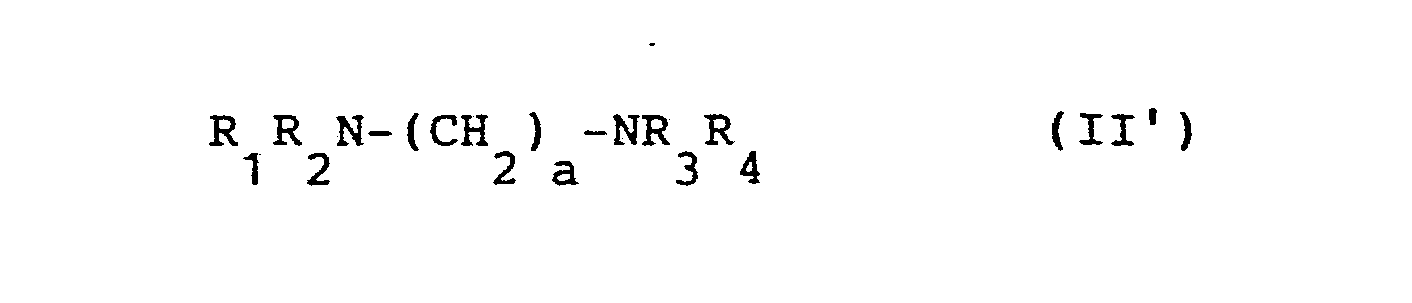
c) freie Monofluorophosphorsäure mit einer Lösung des oder der entsprechenden Amine der allgemeinen Formel II' neutralisiert
und die entstehende Verbindung der allgemeinen Formel I isoliert.
3. Zahnpasta enthaltend ein oder mehrere Ammoniummonofluorophosphate gemäß Anspruch 1 als Zahnpastenadditiv.
4. Zahnpasta enthaltend Verbindungen gemäß Anspruch I in Mischung mit für diesen Zweck geeigneten Ammoniummonofluorphosphaten und/oder Ammoniumfluoriden und/oder Alkylammoniumfluoriden.
Applications Claiming Priority (2)
| Application Number | Priority Date | Filing Date | Title |
|---|---|---|---|
| DE3605656 | 1986-02-21 | ||
| DE19863605656 DE3605656A1 (de) | 1986-02-21 | 1986-02-21 | Ammoniummonofluorophosphate, verfahren zu ihrer herstellung und ihre verwendung |
Publications (1)
| Publication Number | Publication Date |
|---|---|
| EP0248972A2 true EP0248972A2 (de) | 1987-12-16 |
Family
ID=6294665
Family Applications (1)
| Application Number | Title | Priority Date | Filing Date |
|---|---|---|---|
| EP19870100505 Withdrawn EP0248972A2 (de) | 1986-02-21 | 1987-01-16 | Ammoniummonofluorphosphate, Verfahren zu ihrer Herstellung und ihre Verwendung |
Country Status (4)
| Country | Link |
|---|---|
| EP (1) | EP0248972A2 (de) |
| JP (1) | JPS62258392A (de) |
| DE (1) | DE3605656A1 (de) |
| PT (1) | PT84329B (de) |
Family Cites Families (3)
| Publication number | Priority date | Publication date | Assignee | Title |
|---|---|---|---|---|
| US4011310A (en) * | 1975-10-20 | 1977-03-08 | Carter-Wallace, Inc. | Dental prophylaxis containing alkylamine fluorophosphates |
| ZA777063B (en) * | 1976-12-27 | 1979-07-25 | Colgate Palmolive Co | Antibacterial oral composition |
| US4105759A (en) * | 1977-03-28 | 1978-08-08 | Colgate-Palmolive Company | Amine monofluorophosphates in dentifrices |
-
1986
- 1986-02-21 DE DE19863605656 patent/DE3605656A1/de not_active Ceased
-
1987
- 1987-01-16 EP EP19870100505 patent/EP0248972A2/de not_active Withdrawn
- 1987-02-20 PT PT8432987A patent/PT84329B/pt not_active IP Right Cessation
- 1987-02-20 JP JP3600887A patent/JPS62258392A/ja active Pending
Also Published As
| Publication number | Publication date |
|---|---|
| JPS62258392A (ja) | 1987-11-10 |
| DE3605656A1 (de) | 1987-08-27 |
| PT84329A (en) | 1987-03-01 |
| PT84329B (pt) | 1989-09-14 |
Similar Documents
| Publication | Publication Date | Title |
|---|---|---|
| DE2943016A1 (de) | Verfahren zur reinigung von interferon | |
| DE2337289A1 (de) | Verfahren zur herstellung von n-phosphonomethylglycin | |
| DE3909198A1 (de) | Verfahren zur herstellung von ascorbinsaeure-2-phosphat sowie von 5,6-isorpropyliden-ascorbinsaeure als ausgangsprodukt | |
| EP0417604B1 (de) | Verfahren zur Herstellung von Riboflavin-5'-phosphat bzw. dessen Natriumsalz | |
| DE69206873T2 (de) | Zahnsteinbildungs-Kontrolle mit phosphorylierten Polyhydroxy-Verbindungen | |
| DE2914294C2 (de) | Verfahren zur Herstellung von Verbindungen mit Phosphor-Kohlenstoff-Stickstoff-Bindung | |
| EP0141200B1 (de) | Dihydroxyalkandiphosphonsäuren | |
| DE3609492A1 (de) | Verfahren zur herstellung von phosphorsaeureestern | |
| DE3542441A1 (de) | Bis-phosphorsaeuremonoester von alkylenoxyd-blockcopolymerisaten und deren salze | |
| DE3639084A1 (de) | Phosphorsaeureester und verfahren zu deren herstellung | |
| EP0523582A1 (de) | Verbessertes Verfahren zur Herstellung des Mononatriumsalzes von Riboflavin 5'-phosphat | |
| DE3605656A1 (de) | Ammoniummonofluorophosphate, verfahren zu ihrer herstellung und ihre verwendung | |
| EP0180043A2 (de) | Ammoniummonofluorophosphate, Verfahren zu ihrer Herstellung und ihre Verwendung | |
| DE19820974C2 (de) | Isolierung der Salze von 1-Hydroxy-1,1-diphosphonsäureverbindungen | |
| DE2335901A1 (de) | Mund- und zahnpflegemittel | |
| DE3628916A1 (de) | Phosphorsaeureester | |
| DD246527A5 (de) | Ammoniummonophosphate, verfahren zu ihrer herstellung und ihre verwendung | |
| EP0022546A2 (de) | Verfahren zur Herstellung von 1-Oxophospholan-chlorhydrinen sowie einige spezielle dieser Verbindungen | |
| DE2932951A1 (de) | Verfahren zur herstellung von hexamethylen-bis-dicyandiamid | |
| DE2407460C2 (de) | Verfahren zur Herstellung von Methylphosphinoxiden | |
| DE2405894B2 (de) | Phosphinylureido- und-thioureidopenicillansaeurederivate, verfahren zu ihrer herstellung und diese verbindungen enthaltende arzneimittel | |
| DE1228238B (de) | Verfahren zur Herstellung von als Schlafmittel verwendbaren halogenhaltigen primaeren Phosphorsaeureestern | |
| DE1793778C3 (de) | Neues sekundäres Phosphinoxyd | |
| DE955235C (de) | Verfahren zur Herstellung von Arylaethern des Glycerin-bis-chloralhemiacetals | |
| EP0301352B1 (de) | Olefinische Diphosphonsäuren, Verfahren zu ihrer Herstellung und ihre Verwendung als Thresholder sowie komplexierend wirkende olefinische Diphosphonsäuren enthaltende Zusammensetzungen |
Legal Events
| Date | Code | Title | Description |
|---|---|---|---|
| PUAI | Public reference made under article 153(3) epc to a published international application that has entered the european phase |
Free format text: ORIGINAL CODE: 0009012 |
|
| AK | Designated contracting states |
Kind code of ref document: A2 Designated state(s): AT BE CH DE ES FR GB IT LI LU NL SE |
|
| STAA | Information on the status of an ep patent application or granted ep patent |
Free format text: STATUS: THE APPLICATION HAS BEEN WITHDRAWN |
|
| 18W | Application withdrawn |
Withdrawal date: 19880706 |
|
| RIN1 | Information on inventor provided before grant (corrected) |
Inventor name: KLEEMANN, STEPHAN G., DR. DIPL.-CHEM. Inventor name: DANY, FRANZ-JOSEF, DR. DIPL.-CHEM. Inventor name: AUEL, THEODOR, DR. DIPL.-CHEM. |