EP0247966B1 - Schliesszylinder mit Schlüssel - Google Patents
Schliesszylinder mit Schlüssel Download PDFInfo
- Publication number
- EP0247966B1 EP0247966B1 EP87730061A EP87730061A EP0247966B1 EP 0247966 B1 EP0247966 B1 EP 0247966B1 EP 87730061 A EP87730061 A EP 87730061A EP 87730061 A EP87730061 A EP 87730061A EP 0247966 B1 EP0247966 B1 EP 0247966B1
- Authority
- EP
- European Patent Office
- Prior art keywords
- key
- cylinder
- energy application
- shape memory
- lock
- Prior art date
- Legal status (The legal status is an assumption and is not a legal conclusion. Google has not performed a legal analysis and makes no representation as to the accuracy of the status listed.)
- Expired
Links
- 230000015654 memory Effects 0.000 claims abstract description 13
- 229910052751 metal Inorganic materials 0.000 claims description 7
- 239000002184 metal Substances 0.000 claims description 7
- 229910001092 metal group alloy Inorganic materials 0.000 claims description 7
- 150000002739 metals Chemical class 0.000 claims description 4
- 230000037431 insertion Effects 0.000 claims 1
- 238000003780 insertion Methods 0.000 claims 1
- 239000000463 material Substances 0.000 abstract description 2
- 239000012781 shape memory material Substances 0.000 abstract 1
- 229910045601 alloy Inorganic materials 0.000 description 1
- 239000000956 alloy Substances 0.000 description 1
- 238000005452 bending Methods 0.000 description 1
- 238000011161 development Methods 0.000 description 1
- 230000018109 developmental process Effects 0.000 description 1
- 238000010438 heat treatment Methods 0.000 description 1
- 238000004519 manufacturing process Methods 0.000 description 1
- 229910001000 nickel titanium Inorganic materials 0.000 description 1
- 238000005192 partition Methods 0.000 description 1
- 230000004044 response Effects 0.000 description 1
Images
Classifications
-
- E—FIXED CONSTRUCTIONS
- E05—LOCKS; KEYS; WINDOW OR DOOR FITTINGS; SAFES
- E05B—LOCKS; ACCESSORIES THEREFOR; HANDCUFFS
- E05B19/00—Keys; Accessories therefor
- E05B19/18—Keys adjustable before use
-
- E—FIXED CONSTRUCTIONS
- E05—LOCKS; KEYS; WINDOW OR DOOR FITTINGS; SAFES
- E05B—LOCKS; ACCESSORIES THEREFOR; HANDCUFFS
- E05B51/00—Operating or controlling locks or other fastening devices by other non-mechanical means
- E05B51/005—Operating or controlling locks or other fastening devices by other non-mechanical means by a bimetallic or memory-shape element
-
- Y—GENERAL TAGGING OF NEW TECHNOLOGICAL DEVELOPMENTS; GENERAL TAGGING OF CROSS-SECTIONAL TECHNOLOGIES SPANNING OVER SEVERAL SECTIONS OF THE IPC; TECHNICAL SUBJECTS COVERED BY FORMER USPC CROSS-REFERENCE ART COLLECTIONS [XRACs] AND DIGESTS
- Y10—TECHNICAL SUBJECTS COVERED BY FORMER USPC
- Y10T—TECHNICAL SUBJECTS COVERED BY FORMER US CLASSIFICATION
- Y10T70/00—Locks
- Y10T70/70—Operating mechanism
- Y10T70/7441—Key
- Y10T70/7486—Single key
- Y10T70/7508—Tumbler type
- Y10T70/7559—Cylinder type
- Y10T70/7565—Plural tumbler sets
-
- Y—GENERAL TAGGING OF NEW TECHNOLOGICAL DEVELOPMENTS; GENERAL TAGGING OF CROSS-SECTIONAL TECHNOLOGIES SPANNING OVER SEVERAL SECTIONS OF THE IPC; TECHNICAL SUBJECTS COVERED BY FORMER USPC CROSS-REFERENCE ART COLLECTIONS [XRACs] AND DIGESTS
- Y10—TECHNICAL SUBJECTS COVERED BY FORMER USPC
- Y10T—TECHNICAL SUBJECTS COVERED BY FORMER US CLASSIFICATION
- Y10T70/00—Locks
- Y10T70/70—Operating mechanism
- Y10T70/7441—Key
- Y10T70/778—Operating elements
- Y10T70/7791—Keys
- Y10T70/7842—Single shank or stem
- Y10T70/787—Irregular nonplanar or undulated
-
- Y—GENERAL TAGGING OF NEW TECHNOLOGICAL DEVELOPMENTS; GENERAL TAGGING OF CROSS-SECTIONAL TECHNOLOGIES SPANNING OVER SEVERAL SECTIONS OF THE IPC; TECHNICAL SUBJECTS COVERED BY FORMER USPC CROSS-REFERENCE ART COLLECTIONS [XRACs] AND DIGESTS
- Y10—TECHNICAL SUBJECTS COVERED BY FORMER USPC
- Y10T—TECHNICAL SUBJECTS COVERED BY FORMER US CLASSIFICATION
- Y10T70/00—Locks
- Y10T70/70—Operating mechanism
- Y10T70/7441—Key
- Y10T70/778—Operating elements
- Y10T70/7791—Keys
- Y10T70/7881—Bitting
Definitions
- the invention relates to a lock cylinder with key according to the preamble of claim 1.
- a locking cylinder with a key in which on the side surface or on the side surfaces of the flat key, there are provided additional longitudinal ribs which cooperate with additional locking pins, i.e. can be scanned by them.
- a comparison in the joint between the cylinder core and the cylinder housing then enables the cylinder core to be turned further, that is to say that the lock is actuated.
- certain metals or metal alloys have a so-called shape memory, i.e. regardless of their current shape, they can take on a different shape when they are supplied with energy, for example in the form of heat.
- the shape memory in this case can consist in the fact that these metals or metal alloys assume a different shape compared to the shape in the cold state.
- a thermal switch operating on this principle is known from DE-GM 79 00 875.
- NiTi NiTi
- the invention is based on the object, using the shape memory of such metals or metal alloys, to increase the possible variations in a locking cylinder and key and thus also to increase the reliability of such an arrangement.
- the particular advantage of the invention can be seen in the fact that the key cannot be seen in any way as to what height is necessary for the longitudinal rib or the longitudinal rib sections which is outstanding over the side surface or side surfaces, in order to achieve a balance between the locking pins and the joint between the cylinder core and the cylinder housing to produce because the height that the corresponding rib or the rib sections have in the cold state is not identical to the height that is subsequently required.
- the necessary amount cannot be determined by trial and error, for example by heating the key, because the energy supply that is necessary to achieve a specific change or a specific response to the shape memory cannot be applied in a targeted manner in this way.
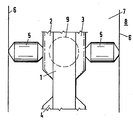
- the flat key itself or the part of the flat key is denoted by 1 and the key chalk is indicated by 4.
- Longitudinal ribs or rib sections 2 and 3 protrude beyond the side surfaces of the flat key, the rib height indicated here by dash-dotted lines which they have in the cold state of the key.
- the solid line of the rib indicates the state it is in when energized, whether from outside, i.e. For example, from the lock part or from the key itself, the shape memory of the metal or metal alloy from which the ribs are made is addressed.
- the locking pins are designated 5 and the parting line with the reference number 6.
- This parting line lies between the cylinder core 7 and the cylinder housing 8.
- a further rotation of the cylinder core which compares the locking pins 5 with the Partition 6 requires, only possible if the ribs 2 and 3 have a certain height, and this height corresponds to the change in shape memory.
- the locking pins would touch the dash-dotted line of the ribs, and thus it would be possible that after an initial rotation a tumbler pin, which is only indicated by 9, falls into the corresponding bore of the locking pins and thus prevents further rotation, which on the other hand only would be possible with a suitable key, i.e. when the rib has taken on its shape, which is outlined by the solid line.
Landscapes
- Lock And Its Accessories (AREA)
- Switches With Compound Operations (AREA)
Description
- Die Erfindung betrifft einen Schließzylinder mit Schlüssel gemäß dem Oberbegriff des Anspruches 1.
- Aus der DE-PS 24 11 362 ist bspw. ein Schließzylinder mit Schlüssel bekannt, bei dem an der Seitenfläche bzw. an den Seitenflächen des Flachschlüssels über diese herausragende Zusatzlängsrippen vorgesehen sind, die mit Zusatzsperrstiften zusammenwirken, d.h. von diesen abgetastet werden. Ein Abgleich in der Trennfuge zwischen Zylinderkern und Zylindergehäuse ermöglicht dann ein Weiterdrehen des Zylinderkemes, also ein Betätigen des Schlosses. Die Merkmale des Oberbegriffs des Anspruchs 1 sind aus diesem Dokument bekannt.
- Aus der EP-PS 00 29 498 ist es ferner bekannt, daß die Höhe eines der Abtastung unterliegenden Profiles oder Teilprofiles erst durch den eingeschobenen Schlüssel bestimmt wird, und zwar geschieht dies hierbei durch eine in einer Bohrung des Schlüsselschaftes radial verschiebbar gelagerte Kugel.
- Unabhängig ist es davon bekannt, daß bestimmte Metalle bzw. Metallegierungen über ein sogenanntes Formgedächtnis verfügen, d.h. unabhängig von ihrer augenblicklichen Form eine veränderte Form einnehmen können, wenn sie eine Energiezufuhr, bspw. in Form von Wärme, erhalten. Das Formgedächtnis kann in diesem Fall darin bestehen, daß diese Metalle oder Metallegierungen eine abweichende Form, verglichen mit der Form im kalten Zustand, einnehmen. So ist beispielsweise ein nach diesem Prinzip arbeitender Thermoschalter aus dem DE-GM 79 00 875 bekannt.
- Daß sog. Memory-Legierungen wie NiTi für Druck-, Zug-, Biege- oder Torsionselemente anwendbar sind, ist aus der Praxis bekannt.
- Der Erfindung liegt die Aufgabe zugrunde, unter Ausnutzung des Formgedächtnisses derartiger Metalle oder Metallegierungen die Variationsmöglichkeiten bei einem Schließzylinder und Schlüssel und damit auch die Abtastsicherheit einer derartigen Anordnung zu erhöhen.
- Gelöst wird diese Aufgabe erfindungsgemäß mit den Merkmalen im Kennzeichen des Anspruchs 1.
- Aus den Ansprüchen 2 bis 6 ergeben sich vorteilhafte Weiterbildungen.
- Der besondere Vorteil der Erfindung ist darin zu sehen, daß dem Schlüssel in keiner Weise anzusehen ist, welche Höhe für die über die Seitenfläche bzw. Seitenflächen hervorragende Längsrippe oder die Längsrippenabschnitte notwendig ist, um einen Abgleich zwischen den Sperrstiften und der Trennfuge zwischen Zylinderkern und Zylindergehäuse herzustellen, weil die Höhe, die die entsprechende Rippe oder die Rippenabschnitte im kalten Zustand aufweisen, nicht mit der Höhe identisch ist, die nachher benötigt wird. Andererseits kann man auch durch Probieren, also bspw. durch Erwärmen des Schlüssels, die notwendige Höhe nicht bestimmen, weil die Energiezufuhr, die zur Erreichung einer bestimmten Änderung bzw. eines bestimmten Ansprechens des Formgedächtnisses notwendig ist, auf diese Weise nicht gezielt aufgebracht werden kann.
- Auf diese Weise läßt sich die Sicherheit eines derartigen Schlosses weiter erhöhen, und darüber hinaus bietet sich die Möglichkeit, quasi eine weitere Dimension für die Profilformen bei der Herstellung der Schlüssel zu berücksichtigen.
- Die Erfindung soll nachfolgend schematisch erläutert werden, wobei die Figur eine skizzierte Aufsicht auf den Rücken eines Flachschlüssels zeigt mit angedeuteten Sperrstiften sowie der angedeuteten Trennfuge zwischen Zylinderkern und Zylindergehäuse.
- In dem dargestellten Beispiel ist der Flachschlüssel selbst bzw. der Teil des Flachschlüssels mit 1 bezeichnet und die Schlüsselreide mit 4 angedeutet. Über die Seitenflächen des Flachschlüssels hinaus ragen Längsrippen bzw. -rippenabschnitte 2 und 3, wobei hier strichpunktiert die Rippenhöhe angedeutet ist, die diese im kalten Zustand des Schlüssels aufweisen. Die durchgehende Linie der Rippe deutet den Zustand an, den diese einnimmt, wenn durch eine Energiezufuhr, sei es von außen, d.h. bspw. aus dem Schloßteil oder aber vom Schlüssel selbst, das Formgedächtnis des Metalls bzw. der Metallegierung, aus dem (der) die Rippen bestehen, angesprochen wird.
- In der Figur sind die Sperrstifte mit 5 bezeichnet und die Trennfuge mit dem Bezugszeichen 6. Diese Trennfuge liegt zwischen dem Zylinderkern 7 und dem Zylindergehäuse 8. Wie sich aus dieser Skizze ergibt, ist ein Weiterdrehen des Zylinderkernes, der einen Abgleich der Sperrstifte 5 mit der Trennfuge 6 voraussetzt, nur dann möglich, wenn die Rippen 2 und 3 eine bestimmte Höhe eingenommen haben, und diese Höhe entspricht der Änderung durch das Formgedächtnis. Im kalten Zustand würden die Sperrstifte die strichpunktierte Linie der Rippen berühren, und damit wäre es möglich, daß nach einer anfänglichen Drehung ein Zuhaltestift, der mit 9 lediglich angedeutet ist, in die entsprechende Bohrung der Sperrstifte einfällt und damit eine Weiterdrehung verhindert, die andererseits nur bei passendem Schlüssel möglich wäre, also dann, wenn die Rippe ihre Form angenommen hat, die durch die durchgehende Linie skizziert ist.
- Aus den Ansprüchen ergibt sich, daß die Energiezufuhr möglich ist durch eine Energiequelle im Schloßteil, wie aber auch im Schlüssel selbst, wobei sich hier die Schlüsselreide für die Aufnahme der Energiequelle eignen würde.
- Besonders vorteilhaft ist es auch, eine derartige Ausbildung in Verbindung mit elektronischen Schlössern zu benutzen, die ohnehin eine Energiezufuhr zur Sende- bzw. Empfangseinheit benötigen und damit noch über eine entsprechende Schaltung ergänzt werden können, die einerseits bei passender Kodierung erst die Energiezufuhr auslöst und andererseits durch diese Auslösung erst das Formgedächtnis des Materials der Rippe anspricht, so daß dann im Zusammenwirken mit der elektronischen Kodierung die "mechanische" Kodierung ausnutzbar ist und erst dann die Möglichkeit für eine Betätigung des Schlosses, d.h. ein Öffnen, liefert.
Claims (6)
Priority Applications (1)
| Application Number | Priority Date | Filing Date | Title |
|---|---|---|---|
| AT87730061T ATE47613T1 (de) | 1986-05-29 | 1987-05-27 | Schliesszylinder mit schluessel. |
Applications Claiming Priority (2)
| Application Number | Priority Date | Filing Date | Title |
|---|---|---|---|
| DE3618074A DE3618074C1 (de) | 1986-05-29 | 1986-05-29 | Schliesszylinder mit Schluessel |
| DE3618074 | 1986-05-29 |
Publications (3)
| Publication Number | Publication Date |
|---|---|
| EP0247966A2 EP0247966A2 (de) | 1987-12-02 |
| EP0247966A3 EP0247966A3 (en) | 1988-05-11 |
| EP0247966B1 true EP0247966B1 (de) | 1989-10-25 |
Family
ID=6301872
Family Applications (1)
| Application Number | Title | Priority Date | Filing Date |
|---|---|---|---|
| EP87730061A Expired EP0247966B1 (de) | 1986-05-29 | 1987-05-27 | Schliesszylinder mit Schlüssel |
Country Status (4)
| Country | Link |
|---|---|
| US (1) | US4869085A (de) |
| EP (1) | EP0247966B1 (de) |
| AT (1) | ATE47613T1 (de) |
| DE (1) | DE3618074C1 (de) |
Families Citing this family (11)
| Publication number | Priority date | Publication date | Assignee | Title |
|---|---|---|---|---|
| ES2138488B1 (es) * | 1996-04-18 | 2000-05-16 | Talleres Escoriaza Sa | Sistema de llave irreproducible y cilindro de combinacion para la misma. |
| US5819567A (en) * | 1996-07-19 | 1998-10-13 | International Security Products, Inc. | Lock system with key trapping |
| US5823030A (en) * | 1997-01-29 | 1998-10-20 | International Security Products, Inc. | Cylinder lock system |
| US7690231B1 (en) | 1997-02-14 | 2010-04-06 | Medeco Security Lock, Inc. | Electromechanical cylinder lock |
| US6119496A (en) * | 1998-10-07 | 2000-09-19 | International Security Products, Inc. | Keys for high security cylinder lock systems |
| DE102004052930B3 (de) * | 2004-10-29 | 2006-03-30 | Bks Gmbh | Sicherheitsschlüssel |
| US7469538B2 (en) * | 2005-10-28 | 2008-12-30 | Searete Llc | Self assembling/quick assembly structure using shape memory alloy materials |
| US20070119218A1 (en) * | 2005-10-28 | 2007-05-31 | Searete Llc | Adaptive engaging assembly |
| US8820129B2 (en) * | 2011-10-12 | 2014-09-02 | Moshe Dolev | Cylinder lock assembly with non-rotating elements |
| EP3272973A1 (de) * | 2016-07-18 | 2018-01-24 | BAE SYSTEMS plc | Schloss für manipulationssichere anordnung |
| WO2018015714A1 (en) * | 2016-07-18 | 2018-01-25 | Bae Systems Plc | A lock for a tamper resistant assembly |
Family Cites Families (20)
| Publication number | Priority date | Publication date | Assignee | Title |
|---|---|---|---|---|
| DE7900875U1 (de) * | 1981-10-22 | BBC AG Brown, Boveri & Cie., 5401 Baden, Aargau | Thermoschalter | |
| DE354058C (de) * | 1922-06-01 | Friedrich Weise | Schluessel mit einseitig federndem Doppelbart und dazugehoerigem Schloss | |
| US2116246A (en) * | 1934-06-20 | 1938-05-03 | Macdonald Robert | Lock and switch device |
| US2105304A (en) * | 1937-02-20 | 1938-01-11 | Clementine De Giuli | Electric lock |
| US2763027A (en) * | 1955-07-29 | 1956-09-18 | Melvin L Tampke | Impression type lock decoder |
| US2888817A (en) * | 1956-02-20 | 1959-06-02 | David B Buck | Pressure and magnetic key blank for locks |
| US3022408A (en) * | 1960-10-25 | 1962-02-20 | Robert W Wagner | Electrically heated key |
| US3541818A (en) * | 1968-07-05 | 1970-11-24 | Eugene Dana | Key |
| US3668909A (en) * | 1970-05-28 | 1972-06-13 | Locking Systems Inc | Settable key and coding mechanism therefor |
| DE2411362C3 (de) * | 1974-03-09 | 1979-06-28 | Zeiss Ikon Ag, 7000 Stuttgart | Verschlußvorrichtung, bestehend aus einem Drehzylinderschloß und dazugehörigem Flachschlüssel |
| US4325242A (en) * | 1977-08-25 | 1982-04-20 | Zeiss Ikon Ag Goerzwerk | Multi-level lock system and method |
| DE2947402A1 (de) * | 1979-11-24 | 1981-05-27 | DOM-Sicherheitstechnik GmbH & Co KG, 5040 Brühl | Flachschluessel fuer zylinderschloss |
| FR2492872B1 (fr) * | 1980-08-13 | 1985-10-11 | Vachette Sa | Cle a poussoir incorpore et barillet de surete utilisant ladite cle |
| US4400956A (en) * | 1981-08-05 | 1983-08-30 | Martin & Starchuk Limited | Skeleton key kit |
| US4433487A (en) * | 1982-02-26 | 1984-02-28 | All-Lock Electronics, Inc. | Key reading system |
| CA1238797A (en) * | 1982-03-23 | 1988-07-05 | Robert L. Steinbach | Key and method of manufacture |
| US4608842A (en) * | 1984-06-25 | 1986-09-02 | Zeiss Ikon Ag | Lock and key system |
| DE3509579A1 (de) * | 1985-03-16 | 1986-09-18 | Vdo Adolf Schindling Ag, 6000 Frankfurt | Zuendschluessel mit sender |
| DE3542008A1 (de) * | 1985-11-28 | 1987-06-04 | Dom Sicherheitstechnik | Schluessel fuer schliesszylinder |
| US4712398A (en) * | 1986-03-21 | 1987-12-15 | Emhart Industries, Inc. | Electronic locking system and key therefor |
-
1986
- 1986-05-29 DE DE3618074A patent/DE3618074C1/de not_active Expired
-
1987
- 1987-05-27 AT AT87730061T patent/ATE47613T1/de not_active IP Right Cessation
- 1987-05-27 EP EP87730061A patent/EP0247966B1/de not_active Expired
- 1987-05-29 US US07/055,724 patent/US4869085A/en not_active Expired - Fee Related
Also Published As
| Publication number | Publication date |
|---|---|
| EP0247966A3 (en) | 1988-05-11 |
| EP0247966A2 (de) | 1987-12-02 |
| ATE47613T1 (de) | 1989-11-15 |
| DE3618074C1 (de) | 1988-01-07 |
| US4869085A (en) | 1989-09-26 |
Similar Documents
| Publication | Publication Date | Title |
|---|---|---|
| DE69320683T2 (de) | Elektromechanische Schlossanordnung | |
| EP0247966B1 (de) | Schliesszylinder mit Schlüssel | |
| EP1072741B1 (de) | Schliesszylinder | |
| DE102020113121A1 (de) | Verriegelungseinrichtung zum Verriegeln einer Batterieeinheit sowie ein Fahrrad und ein Verfahren zum Entriegeln einer Batterieeinheit | |
| DE3517660C2 (de) | ||
| DE102004039531A1 (de) | Sperrmechanismus | |
| EP1079050A1 (de) | Schliesseinrichtung | |
| DE3505723A1 (de) | Getriebeverriegelungsanordnung | |
| DE3338713C2 (de) | Schließzylinder | |
| DE60101974T2 (de) | Schlüssel mit Metallschaft und Plastikkopf, versehen mit einer Blockierschachtel | |
| DE4437712B4 (de) | Schließeinrichtung mit einem Zylinderschloß und einem Wendeflachschlüssel | |
| EP1505229B1 (de) | Schliesszylinder | |
| DE2614645A1 (de) | Sicherheitsschloss | |
| EP0463133B1 (de) | Schlüssel für einen drehschliesszylinder | |
| DE2902578C2 (de) | Mittels Permanentmagnetschlüssel betätigbarer Schließzylinder | |
| EP0605820B1 (de) | Sicherheitsschalter | |
| DE69401213T2 (de) | Schlüssel mit zwei abschrägungen am ende für ein sicherheitzylinderschloss und zylinderschloss dafür | |
| EP0952282B1 (de) | Türverschluss mit Betätigung und zugehörigem Steckschlüssel | |
| DE3134471A1 (de) | "zylinderschloss" | |
| DE2754389C2 (de) | ||
| AT346202B (de) | Vorrichtung zum kuppeln fuer einbaudoppelzylinder | |
| EP1835095A1 (de) | Schlüssel für einen Schließzylinder | |
| EP0943762A2 (de) | Mechanisch und elektrisch codierte Verriegelungs- und Entriegelungsvorrichtung | |
| EP4255735B1 (de) | Stempel und achselement für den stempel | |
| EP0349738A2 (de) | Schliesszylinder |
Legal Events
| Date | Code | Title | Description |
|---|---|---|---|
| PUAI | Public reference made under article 153(3) epc to a published international application that has entered the european phase |
Free format text: ORIGINAL CODE: 0009012 |
|
| AK | Designated contracting states |
Kind code of ref document: A2 Designated state(s): AT CH FR GB LI NL SE |
|
| PUAL | Search report despatched |
Free format text: ORIGINAL CODE: 0009013 |
|
| AK | Designated contracting states |
Kind code of ref document: A3 Designated state(s): AT CH FR GB LI NL SE |
|
| 17P | Request for examination filed |
Effective date: 19880414 |
|
| 17Q | First examination report despatched |
Effective date: 19890314 |
|
| GRAA | (expected) grant |
Free format text: ORIGINAL CODE: 0009210 |
|
| AK | Designated contracting states |
Kind code of ref document: B1 Designated state(s): AT CH FR GB LI NL SE |
|
| REF | Corresponds to: |
Ref document number: 47613 Country of ref document: AT Date of ref document: 19891115 Kind code of ref document: T |
|
| ET | Fr: translation filed | ||
| GBT | Gb: translation of ep patent filed (gb section 77(6)(a)/1977) | ||
| PGFP | Annual fee paid to national office [announced via postgrant information from national office to epo] |
Ref country code: CH Payment date: 19900329 Year of fee payment: 4 |
|
| PGFP | Annual fee paid to national office [announced via postgrant information from national office to epo] |
Ref country code: FR Payment date: 19900330 Year of fee payment: 4 |
|
| PGFP | Annual fee paid to national office [announced via postgrant information from national office to epo] |
Ref country code: SE Payment date: 19900522 Year of fee payment: 4 |
|
| PGFP | Annual fee paid to national office [announced via postgrant information from national office to epo] |
Ref country code: AT Payment date: 19900529 Year of fee payment: 4 |
|
| PGFP | Annual fee paid to national office [announced via postgrant information from national office to epo] |
Ref country code: NL Payment date: 19900531 Year of fee payment: 4 |
|
| PLBE | No opposition filed within time limit |
Free format text: ORIGINAL CODE: 0009261 |
|
| STAA | Information on the status of an ep patent application or granted ep patent |
Free format text: STATUS: NO OPPOSITION FILED WITHIN TIME LIMIT |
|
| 26N | No opposition filed | ||
| PG25 | Lapsed in a contracting state [announced via postgrant information from national office to epo] |
Ref country code: GB Effective date: 19910527 Ref country code: AT Effective date: 19910527 |
|
| PG25 | Lapsed in a contracting state [announced via postgrant information from national office to epo] |
Ref country code: SE Effective date: 19910528 |
|
| PG25 | Lapsed in a contracting state [announced via postgrant information from national office to epo] |
Ref country code: LI Effective date: 19910531 Ref country code: CH Effective date: 19910531 |
|
| PG25 | Lapsed in a contracting state [announced via postgrant information from national office to epo] |
Ref country code: NL Effective date: 19911201 |
|
| NLV4 | Nl: lapsed or anulled due to non-payment of the annual fee | ||
| GBPC | Gb: european patent ceased through non-payment of renewal fee | ||
| PG25 | Lapsed in a contracting state [announced via postgrant information from national office to epo] |
Ref country code: FR Effective date: 19920131 |
|
| REG | Reference to a national code |
Ref country code: CH Ref legal event code: PL |
|
| REG | Reference to a national code |
Ref country code: FR Ref legal event code: ST |
|
| EUG | Se: european patent has lapsed |
Ref document number: 87730061.6 Effective date: 19911209 |