EP0245918B1 - 1,4-Dihydropyridinderivate - Google Patents
1,4-Dihydropyridinderivate Download PDFInfo
- Publication number
- EP0245918B1 EP0245918B1 EP87301432A EP87301432A EP0245918B1 EP 0245918 B1 EP0245918 B1 EP 0245918B1 EP 87301432 A EP87301432 A EP 87301432A EP 87301432 A EP87301432 A EP 87301432A EP 0245918 B1 EP0245918 B1 EP 0245918B1
- Authority
- EP
- European Patent Office
- Prior art keywords
- group
- formula
- cr6r7
- preparing compounds
- compounds
- Prior art date
- Legal status (The legal status is an assumption and is not a legal conclusion. Google has not performed a legal analysis and makes no representation as to the accuracy of the status listed.)
- Expired - Lifetime
Links
Classifications
-
- C—CHEMISTRY; METALLURGY
- C07—ORGANIC CHEMISTRY
- C07D—HETEROCYCLIC COMPOUNDS
- C07D401/00—Heterocyclic compounds containing two or more hetero rings, having nitrogen atoms as the only ring hetero atoms, at least one ring being a six-membered ring with only one nitrogen atom
- C07D401/02—Heterocyclic compounds containing two or more hetero rings, having nitrogen atoms as the only ring hetero atoms, at least one ring being a six-membered ring with only one nitrogen atom containing two hetero rings
- C07D401/10—Heterocyclic compounds containing two or more hetero rings, having nitrogen atoms as the only ring hetero atoms, at least one ring being a six-membered ring with only one nitrogen atom containing two hetero rings linked by a carbon chain containing aromatic rings
-
- A—HUMAN NECESSITIES
- A61—MEDICAL OR VETERINARY SCIENCE; HYGIENE
- A61P—SPECIFIC THERAPEUTIC ACTIVITY OF CHEMICAL COMPOUNDS OR MEDICINAL PREPARATIONS
- A61P9/00—Drugs for disorders of the cardiovascular system
-
- A—HUMAN NECESSITIES
- A61—MEDICAL OR VETERINARY SCIENCE; HYGIENE
- A61P—SPECIFIC THERAPEUTIC ACTIVITY OF CHEMICAL COMPOUNDS OR MEDICINAL PREPARATIONS
- A61P9/00—Drugs for disorders of the cardiovascular system
- A61P9/10—Drugs for disorders of the cardiovascular system for treating ischaemic or atherosclerotic diseases, e.g. antianginal drugs, coronary vasodilators, drugs for myocardial infarction, retinopathy, cerebrovascula insufficiency, renal arteriosclerosis
-
- C—CHEMISTRY; METALLURGY
- C07—ORGANIC CHEMISTRY
- C07D—HETEROCYCLIC COMPOUNDS
- C07D211/00—Heterocyclic compounds containing hydrogenated pyridine rings, not condensed with other rings
- C07D211/04—Heterocyclic compounds containing hydrogenated pyridine rings, not condensed with other rings with only hydrogen or carbon atoms directly attached to the ring nitrogen atom
- C07D211/80—Heterocyclic compounds containing hydrogenated pyridine rings, not condensed with other rings with only hydrogen or carbon atoms directly attached to the ring nitrogen atom having two double bonds between ring members or between ring members and non-ring members
- C07D211/84—Heterocyclic compounds containing hydrogenated pyridine rings, not condensed with other rings with only hydrogen or carbon atoms directly attached to the ring nitrogen atom having two double bonds between ring members or between ring members and non-ring members with hetero atoms or with carbon atoms having three bonds to hetero atoms, with at the most one bond to halogen directly attached to ring carbon atoms
- C07D211/90—Carbon atoms having three bonds to hetero atoms with at the most one bond to halogen
Definitions
- This invention relates to novel heterocyclic derivatives which have an effect on the transmembranal influx of calcium ions into the cells of cardiac and smooth muscle, to processes for the preparation thereof, to pharmaceutical compositions containing them and to their use in therapeutics.
- GB-A-1,409,865 and DE-A-2,462,086 disclose 4-phenyl-1,4-dihydropyridine derivatives in which the 4-phenyl group is either a pentahalo substituted phenyl group or an ortho substituted phenyl group in which the ortho substituent is a cyclopropyl radical, a lower alkenyl radical, a lower alkynyl radical or a radical of the formula OA in which A is selected from cyclopropyl, lower alkenyl, lower alkynyl, cyclopropyl lower alkyl, aryl lower alkenyl, halo lower alkenyl and lower alkyl amino lower alkyl radicals.
- the term lower alkenyl refers to a C2 ⁇ 6 unsaturated hydrocarbon radical containing 1 or 2 double bonds and includes vinyl and allyl.
- lower alkynyl includes ethynyl and propargyl.
- DE-A-3,207,982 describes a very wide range of 4-substituted 1,4-dihydropyridine derivatives which embraces 4-phenyl-1,4-dihydropyridine derivatives in which the phenyl group is substituted by an unsubstituted alkenyl or alkynyl group or an alkenyl group containing at least 6 carbon atoms which may be optionally substituted.
- Prog. Pharmacol. 5 , 25 (1982) is a paper relating to the structure/activity relationships of specific known calcium antagonists.
- this reference relates only to compounds in which the phenyl group is substituted by a nitro, cyano, methoxy, methylthio, methyl, chloro or trifluoromethyl group.
- R1 and R4 independently represent a C1 ⁇ 4 alkyl group
- R2 and R3 independently represent a C1 ⁇ 6 straight or branched chain alkyl or alkoxyalkyl group
- R5 represents the group C ⁇ CR8 where R8 is an aryl group.
- the compounds represented by formula (I) can exist in more than one isomeric and/or enantiomeric form and the invention includes all such isomers, enantiomers and mixtures thereof.
- aryl means a phenyl group optionally substituted by one or more halogen atoms e.g. fluorine, chlorine, bromine or iodine or C1 ⁇ 4 alkyl or C1 ⁇ 4 alkoxy groups.
- R1 and R4 examples include methyl or ethyl groups.
- R2 and R3 independently include C1 ⁇ 4 straight or branched alkyl such as methyl, ethyl, isopropyl, isobutyl, t-butyl or C1 ⁇ 4 alkyl (such as methyl, ethyl or n-propyl) substituted by a C1 ⁇ 3 alkoxy e.g. methoxy or propoxy group.
- a preferred group of compounds of formula (I) are those wherein R1 and R4 represent methyl.
- a further preferred group of compounds of formula (I) are those in which R2 and R3 independently represent a methyl or ethyl group, more especially ethyl.
- R5 represents the group C ⁇ CR8
- suitable groups for R8 include phenyl optionally substituted by one or two chlorine or bromine atoms or by a methyl group or a methoxy or ethoxy group. More preferably R8 represents an unsubstituted phenyl group.
- suitable groups for R6 include a hydrogen or a methyl, ethyl or propyl group or more particularly a hydrogen atom.
- R7 include cyano, pyridyl or a phenyl group optionally substituted by one or two chlorine or bromine atoms, a methyl group or a methoxy group. More preferably R7 represents a phenyl group optionally substituted by a chlorine atom or a methyl or methoxy group.
- a preferred class of compounds of the invention are those of formula (I) wherein R1 and R4 represent methyl, R2 and R3 represent ethyl, R6 represents hydrogen and R7 represents a phenyl group optionally substituted by a chlorine atom or by a methyl or methoxy group or R8 represents a phenyl group.
- the antihypertensive activity of compounds of the invention may be demonstrated by intravenous and/or oral administration of the compound to male spontaneously hypertensive rats.
- the compounds of the invention are thus of interest in the treatment of hypertension. They are also potentially useful for the treatment of other cardiovascular disorders including angina pectoris, myocardial ischaemia, congestive heart failure, cerebral vascular and peripheral disorders and diseases characterised by reversible airways obstruction such as asthma and chronic bronchitis.
- the compounds of the invention may be formulated in a conventional manner for use with one or more pharmaceutical carriers or excipients.
- compositions the compounds of formula (I) and/or physiologically acceptable addition salts thereof formulated for oral, sub lingual, transdermal, parenteral or rectal administration, or for administration by inhalation or insufflation.
- a proposed daily dosage of active compound of the invention for the treatment of man is in the range of 0.03mg to 100mg, which may conveniently be administered in one or more doses.
- the precise dose employed will depend on the age and condition of the patient as well as the route of administration.
- the compounds of the invention are conveniently administered to the human patient at a dose in the range 0.3 to 100mg per day.
- the compounds of the invention are conveniently administered at a dose in the range of 0.03-30mg per day.
- the compounds of the invention are conveniently administered to the human patient at a dose in the range of 0.1mg to 10mg per day.
- the compound is preferably administered twice or more particularly once a day.
- the reaction is conveniently carried out in a solvent such as an alkanol, e.g. ethanol or isopropanol and preferably with heating e.g. 40-150°C.
- the ⁇ , ⁇ -unsaturated ketone (II) may be prepared by reacting the aldehyde (IV) with the ketoester (V), in a solvent such as an alkanol e.g. ethanol or isopropanol, preferably with heating e.g. 40-150°C. Conveniently this reaction is carried out in the presence of a catalyst such as piperidine acetate.
- the aldehyde (IV) may be reacted with a mixture of the aminoester (III) and the ketoester (V) under the conditions previously described for the reaction of the ⁇ , ⁇ -unsaturated ketone (II) with the aminoester (III).
- Compounds of formula (I) in which R1 and R4 are the same and R2 and R3 are the same may be prepared by reacting the aldehyde (IV) with the aminoester (III) in the presence of a suitable acid catalyst.
- suitable acid catalysts include organic acids such as oxallc acid, alkanoic acids e.g. acetic acid or haloalkanoic acids such as trichloroacetic acid or trifluoroacetic acid or pyridinium salts thereof, or a sulphonic acid such as an alkanesulphonic acid e.g. methanesulphonic acid or an arylsulphonic acid e.g.
- benzenesulphonic acid or p-toluenesulphonic acid or a tetrahaloboric acid such as tetrafluoroboric acid is preferably carried out in the presence of a solvent and at a temperature within the range of -70° to 30°C preferably -30° to 10°C.
- Suitable solvents for the reaction include aprotic solvents such as hydrocarbons, e.g. hexane or cyclohexane, acetonitrile or ethers such as tertiary butyl methyl ether, dioxan or tetrahydrofuran, or protic solvents such as an alkanol e.g. methanol, ethanol, propanol, isopropanol or butanol.
- the reaction is carried out in the presence of a catalytic amount of a palladium salt such as palladium acetate, and a suitable organic base such as a trialkylamine e.g. triethylamine or tri-n-butylamine.
- the reaction is also preferably carried out in the presence of a triarylphosphine such as tri-o-tolyphosphine, or more preferably, triphenylphosphine.
- the reaction is conveniently carried out in a suitable solvent such as xylene or t-butyl acetate, or more conveniently in dimethylformamide or in a mixture of solvents e.g. xylene/dimethylformamide, preferably with heating.
- a suitable solvent such as xylene or t-butyl acetate
- dimethylformamide or in a mixture of solvents e.g. xylene/dimethylformamide, preferably with heating.
- the reaction mixture is preferably heated within the temperature range of 80°C to 150°C, more preferably at 100°C to 110°C.
- Compounds of formula (IV) may also be prepared by reacting a 2-halobenzaldehyde (X) (where Hal represents a bromine or iodine atom) with the ethylene derivative (VII). The reactions take place under the conditions previously described for the reaction between the compound of formula (VI) and the ethylene derivative (VII).
- the compounds of formula (VI) may be prepared by reacting the 2-halobenzaldehyde (XI) with the aminoester (III) and/or the ketoester (V) according to the conditions described above for the reaction between the compound of formula (IV) and the aminoester (III) and/or the ketoester (V).
- a suitable solvent such as dichloromethane, tetrahydrofuran or toluene.
- the reaction is carried out with heating for example 40-120°C, conveniently at reflux.
- the intermediate (XI) may be prepared by aqueous acid hydrolysis of the corresponding acetal (XII; in which R6 represents an alkyl group)
- the compound of formula (XII) may be prepared from the aldehyde (XIII) by reaction with a compound of formula (III) and/or (V) under the conditions described above for preparing compounds of formula (I) from the intermediate (IV).
- the intermediate (XIII) may be prepared from the bromobenzene derivative (XIV) by reaction with butyl lithium in solvent followed by addition of dimethylformamide.
- the compounds of formulae (III), (V), (VII) and (IX) are either known compounds or may be prepared by analogous methods to those described for known compounds.
- R5 represents the group -C ⁇ CR8
- R5 represents the group -C ⁇ CR8
- R9 and R10 independently represent a C1 ⁇ 4 alkyl group e.g. methyl group.
- the compounds of formula (I) wherein R5 represents the group C ⁇ CR8 and R8 is an optionally substituted phenyl group may be prepared from the reaction of the protected acetylene derivative (XV) with the appropriate halobenzene derivative (R8Hal) where Hal represents a chlorine, bromine or iodine group.
- the reaction is conveniently carried out in the presence of a strong base such as potassium hydroxide or sodium hydroxide, a triarylphosphine palladium salt such as bis(triphenylphosphine) palladium (II) dichloride, and a copper (I) halide e.g. cuprous iodide.
- the reaction is carried out in a solvent, for example piperidine and preferably with heating.
- Compounds of formula (XV) may be prepared from the aldehyde (XVI) by reaction with the ketoester (V) and/ or the aminoester (III) under conditions similar to those described above for the reaction of the aldehyde (IV) with compound (V) and/or (III).
- Compounds of formula (XVI) may be prepared from the reaction of the halobenzaldehyde (X) with the propargyl alcohol CH ⁇ CC(R9R10)OH (XVII) in the presence of a cuprous salt e.g. cuprous iodide, and a triarylphosphine palladium salt, e.g. bis(triphenylphosphine)palladium (II) dichloride.
- a cuprous salt e.g. cuprous iodide
- a triarylphosphine palladium salt e.g. bis(triphenylphosphine)palladium (II) dichloride.
- the reaction is carried out in a solvent such as piperidine and preferably with heating.
- the propargyl alcohols (XVII) are either known compounds of may be made by analogous methods to those described for the known compounds.
Landscapes
- Organic Chemistry (AREA)
- Chemical & Material Sciences (AREA)
- Health & Medical Sciences (AREA)
- Engineering & Computer Science (AREA)
- Bioinformatics & Cheminformatics (AREA)
- Heart & Thoracic Surgery (AREA)
- Life Sciences & Earth Sciences (AREA)
- Veterinary Medicine (AREA)
- Chemical Kinetics & Catalysis (AREA)
- General Chemical & Material Sciences (AREA)
- Medicinal Chemistry (AREA)
- Nuclear Medicine, Radiotherapy & Molecular Imaging (AREA)
- Public Health (AREA)
- Pharmacology & Pharmacy (AREA)
- Cardiology (AREA)
- Animal Behavior & Ethology (AREA)
- General Health & Medical Sciences (AREA)
- Urology & Nephrology (AREA)
- Vascular Medicine (AREA)
- Pharmaceuticals Containing Other Organic And Inorganic Compounds (AREA)
- Pyridine Compounds (AREA)
- Hydrogenated Pyridines (AREA)
- Catching Or Destruction (AREA)
- Plural Heterocyclic Compounds (AREA)
Claims (9)
- Verfahren zur Herstellung von Verbindungen der allgemeinen Formel (I)

R₁ und R₄ unabhängig eine C₁₋₄-Alkylgruppe bedeuten;
R₂ und R₃ unabhängig eine c₁₋₆ geradkettige oder verzweigtkettige Alkyl- oder Alkoxyalkylgruppe bedeuten;
R₅ eine Gruppe CH=CR₆R₇ bedeutet, worin R₆ ein Wasserstoffatom oder eine C₁₋₃-Alkylgruppe bedeutet und R₇ eine Aryl-, Pyridyl- oder Cyanogruppe bedeutet; oder
R₅ die Gruppe C=CR₈ bedeutet, worin R₈ eine Arylgruppe bedeutet;
dadurch gekennzeichnet, daß(a) zur Herstellung von Verbindungen, worin R₅ die Gruppe -CH=CR₆R₇ bedeutet, eine Verbindung der Formel (II): (b) zur Herstellung von Verbindungen, worin R₅ die Gruppe CH=CR₆R₇ bedeutet, ein Aldehyd der Formel (IV), worin R₅ die Gruppe -CH=CR₆R₇ bedeutet, mit einem Ketoester der Formel (V), worin R₁ und R₂ die oben gegebenen Bedeutungen besitzen und/oder einem Aminoester der Formel (III), wie oben definiert, umgesetzt wird;
 (c) zur Herstellung von Verbindungen, worin R₅ die Gruppe CH=CHR₆R₇ bedeutet, eine Verbindung der Formel (VI):
 (d) zur Herstellung einer Verbindung, worin R₅ die Gruppe CH=CR₆R₇ bedeutet, eine Verbindung der Formel (XI):
 (e) zur Herstellung von Verbindungen der Formel (I), worin R₅ die Gruppe -C=CR₈ bedeutet, eine Verbindung der Formel (XIV):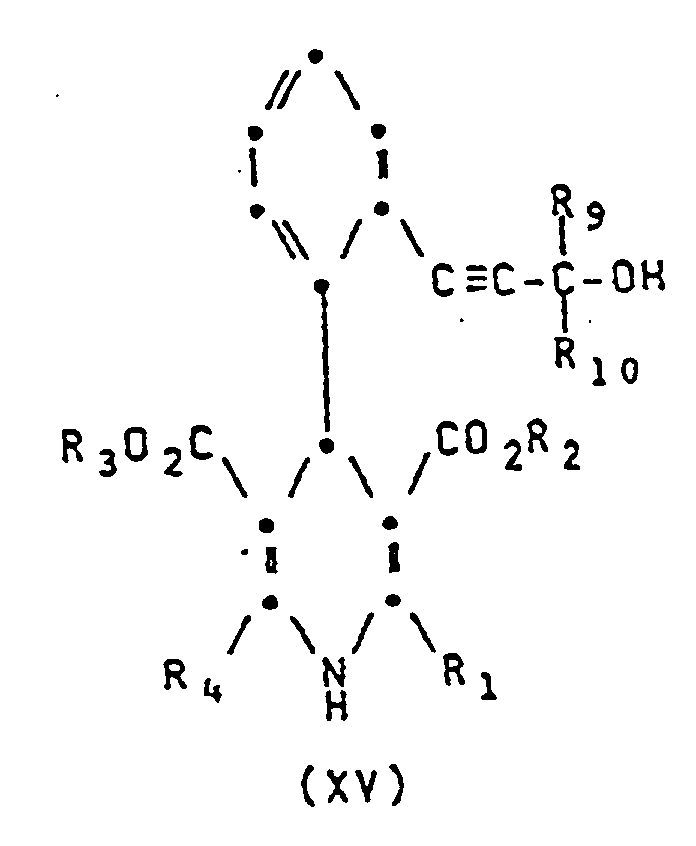
- Verfahren nach Anspruch 1, dadurch gekennzeichnet, daß Verbindungen hergestellt werden, worin R₁ und R₄ eine Methylgruppe bedeuten.
- Verfahren nach einem der Ansprüche 1 und 2, dadurch gekennzeichnet, daß Verbindungen hergestellt werden, worin R₃ und R₂ unabhängig eine Methyl- oder Ethylgruppe bedeuten.
- Verfahren nach einem der Ansprüche 1 bis 3, dadurch gekennzeichnet, daß Verbindungen hergestellt werden, worin R₆ Wasserstoff bedeutet.
- Verfahren nach einem der Anspruche 1 bis 4, dadurch gekennzeichnet, daß Verbindungen hergestellt werden, worin R₇ eine Cyano-, Pyridyl- oder eine Phenylgruppe (gegebenenfalls durch ein oder zwei Chlor- oder Bromatome, eine Methyl- oder Methoxygruppe substituiert), oder R₈ eine Phenylgruppe (gegebenenfalls durch eine oder zwei Chlor- oder Bromatome oder eine Methyl- oder Methoxygruppe substituiert) bedeutet.
- Verfahren nach einem der Ansprüche 1 bis 5, dadurch gekennzeichnet, daß Verbindungen, worin R₇ eine Phenylgruppe (gegebenenfalls substituiert durch ein Chloratom oder eine Methoxy- oder Methylgruppe) bedeutet, oder R₈ eine Phenylgruppe bedeutet, hergestellt werden.
Priority Applications (1)
| Application Number | Priority Date | Filing Date | Title |
|---|---|---|---|
| AT87301432T ATE88997T1 (de) | 1986-02-20 | 1987-02-19 | 1,4-dihydropyridinderivate. |
Applications Claiming Priority (2)
| Application Number | Priority Date | Filing Date | Title |
|---|---|---|---|
| IT1948186 | 1986-02-20 | ||
| IT19481/86A IT1204459B (it) | 1986-02-20 | 1986-02-20 | Derivati eterociclici |
Publications (2)
| Publication Number | Publication Date |
|---|---|
| EP0245918A1 EP0245918A1 (de) | 1987-11-19 |
| EP0245918B1 true EP0245918B1 (de) | 1993-05-05 |
Family
ID=11158396
Family Applications (1)
| Application Number | Title | Priority Date | Filing Date |
|---|---|---|---|
| EP87301432A Expired - Lifetime EP0245918B1 (de) | 1986-02-20 | 1987-02-19 | 1,4-Dihydropyridinderivate |
Country Status (7)
| Country | Link |
|---|---|
| US (1) | US4946851A (de) |
| EP (1) | EP0245918B1 (de) |
| JP (1) | JPS62252768A (de) |
| AT (1) | ATE88997T1 (de) |
| DE (1) | DE3785695T2 (de) |
| IT (1) | IT1204459B (de) |
| SU (1) | SU1731049A3 (de) |
Families Citing this family (7)
| Publication number | Priority date | Publication date | Assignee | Title |
|---|---|---|---|---|
| IL92646A0 (en) * | 1988-12-15 | 1990-08-31 | Erba Carlo Spa | Imidazolyl and pyridyl derivatives of phenyl substituted 1,4-dihydropyridines,their preparation and pharmaceutical compositions containing them |
| US5514693A (en) * | 1988-12-15 | 1996-05-07 | Farmitalia Carlo Erba S.R.L. | Imidazolyl and pyridyl derivatives of phenyl substituted 1,4-dihydropyridines and process for their preparation |
| US5158963A (en) * | 1989-08-02 | 1992-10-27 | Kaken Pharmaceutical Co., Ltd. | 1-4-dihydropyridine derivative, process for preparing the same and pharmaceutical composition containing the same |
| WO1991009847A1 (en) * | 1989-12-29 | 1991-07-11 | Kaken Pharmaceutical Co., Ltd. | Ethynylphenyl derivative, production thereof, and remedy for diseases of circulatory organs containing the same as active ingredient |
| GB9119983D0 (en) * | 1991-09-19 | 1991-11-06 | Erba Carlo Spa | Dihydropyridine derivatives useful in antitumor therapy |
| EP0657432B1 (de) * | 1993-12-10 | 2003-03-12 | Bayer Ag | Phenyl-substituierte 1,4-Dihydropyridine mit cerebraler Aktivität |
| US20080089947A1 (en) * | 2006-08-18 | 2008-04-17 | Knox Clayton D | Calcium Influx Inhibitors in the Treatment of Ischemia |
Citations (4)
| Publication number | Priority date | Publication date | Assignee | Title |
|---|---|---|---|---|
| DE2462086A1 (de) * | 1973-02-13 | 1975-10-23 | Science Union & Cie | 4-aryl-1,4-dihydropyridine, verfahren zu deren herstellung und diese verbindungen enthaltende arzneimittel |
| DE2756865A1 (de) * | 1976-12-22 | 1978-06-29 | Ciba Geigy Ag | Verfahren zur herstellung von 2-chlor-4,6-bis-alkylamino-s-triazinen |
| EP0071819A1 (de) * | 1981-07-30 | 1983-02-16 | Bayer Ag | Dihydropyridine mit positiv inotroper Wirkung, neue Verbindungen, ihre Verwendung in Arzneimitteln und Verfahren zu ihrer Herstellung |
| DE3207982A1 (de) * | 1982-03-05 | 1983-09-08 | Bayer Ag, 5090 Leverkusen | Neue 1,4-dihydropyridine, verfahren zu ihrer herstellung und ihrer verwendung in arzneimitteln |
-
1986
- 1986-02-20 IT IT19481/86A patent/IT1204459B/it active
-
1987
- 1987-02-19 DE DE8787301432T patent/DE3785695T2/de not_active Expired - Fee Related
- 1987-02-19 EP EP87301432A patent/EP0245918B1/de not_active Expired - Lifetime
- 1987-02-19 AT AT87301432T patent/ATE88997T1/de active
- 1987-02-20 JP JP62035942A patent/JPS62252768A/ja active Pending
-
1988
- 1988-10-28 US US07/266,233 patent/US4946851A/en not_active Expired - Fee Related
- 1988-12-05 SU SU884356934A patent/SU1731049A3/ru active
Patent Citations (4)
| Publication number | Priority date | Publication date | Assignee | Title |
|---|---|---|---|---|
| DE2462086A1 (de) * | 1973-02-13 | 1975-10-23 | Science Union & Cie | 4-aryl-1,4-dihydropyridine, verfahren zu deren herstellung und diese verbindungen enthaltende arzneimittel |
| DE2756865A1 (de) * | 1976-12-22 | 1978-06-29 | Ciba Geigy Ag | Verfahren zur herstellung von 2-chlor-4,6-bis-alkylamino-s-triazinen |
| EP0071819A1 (de) * | 1981-07-30 | 1983-02-16 | Bayer Ag | Dihydropyridine mit positiv inotroper Wirkung, neue Verbindungen, ihre Verwendung in Arzneimitteln und Verfahren zu ihrer Herstellung |
| DE3207982A1 (de) * | 1982-03-05 | 1983-09-08 | Bayer Ag, 5090 Leverkusen | Neue 1,4-dihydropyridine, verfahren zu ihrer herstellung und ihrer verwendung in arzneimitteln |
Non-Patent Citations (1)
| Title |
|---|
| Progr. Pharmacol. 5, 25 ( 1982) * |
Also Published As
| Publication number | Publication date |
|---|---|
| EP0245918A1 (de) | 1987-11-19 |
| JPS62252768A (ja) | 1987-11-04 |
| SU1731049A3 (ru) | 1992-04-30 |
| US4946851A (en) | 1990-08-07 |
| DE3785695D1 (en) | 1993-06-09 |
| IT8619481A0 (it) | 1986-02-20 |
| ATE88997T1 (de) | 1993-05-15 |
| IT1204459B (it) | 1989-03-01 |
| DE3785695T2 (de) | 1993-08-19 |
Similar Documents
| Publication | Publication Date | Title |
|---|---|---|
| US4801599A (en) | 1,4-dihydropyridines | |
| CA1212672A (en) | Dihydropyridines with a positive inotropic action, new compounds, their use in medicaments, and processes for their preparation | |
| IE872706L (en) | Dihydropyridine derivatives | |
| EP0097821B1 (de) | Dihydropyridine mit Calciumantagonistischer Wirkung, Verfahren zu ihrer Herstellung und diese enthaltende pharmazeutische Zusammensetzungen | |
| US4946851A (en) | 1.4-dihydropyridines | |
| DK158517B (da) | 1-alkylsubstituerede 1,4-dihydropyridinlactoner og deres anvendelse i laegemidler | |
| EP0245919B1 (de) | 1,4-Dihydropyridinderivate | |
| US4839348A (en) | 1,4-dihydropyridines | |
| KR940005016B1 (ko) | 1,4-디히드로피리딘 유도체 및 그의 제조방법 | |
| NL192385C (nl) | 6-alkyl-4-fenyl-1,4-dihydro-3,5-pyridinecarbonzuuresters, werkwijze voor de bereiding daarvan en farmaceutische preparaten die deze esters bevatten. | |
| EP0226271B1 (de) | 1,4-Dihydropyridinverbindungen und ihre Herstellung und pharmazeutische Formulierung | |
| EP0242950B1 (de) | Dihydropyridine, Verfahren zu ihrer Herstellung und ihre Verwendung als Arzneimittel | |
| EP0238211B1 (de) | Dihydropyridine, Verfahren zu ihrer Herstellung und ihre Verwendung als Arzneimittel | |
| JPS6352031B2 (de) | ||
| KR930001404B1 (ko) | 디아릴 화합물의 제조방법 | |
| KR950011410B1 (ko) | 헤테로사이클릭 화합물의 제조방법 | |
| HU198907B (en) | Process for producing dihydropyridine derivatives and pharmaceutical compositions containing them as active components | |
| FI87200B (fi) | Foerfarande foer framstaellning av terapeutiskt aktiva 6-alkyl-2-aminoalkyl-4-fenyl-1,4-dihydropyridin-3,5 -dikarboxylatderivat. | |
| NO174419B (no) | Analogifremgangsmaate for fremstilling av terapeutisk aktive heterocykliske forbindelser | |
| EP0295769A2 (de) | 1,4-Dihydropyridin-Derivate, Verfahren zur Herstellung und deren Anwendung in pharmazeutischen Zusammenstellungen | |
| LU86775A1 (fr) | Composes heterocycliques,leur preparation et composition pharmaceutique |
Legal Events
| Date | Code | Title | Description |
|---|---|---|---|
| PUAI | Public reference made under article 153(3) epc to a published international application that has entered the european phase |
Free format text: ORIGINAL CODE: 0009012 |
|
| AK | Designated contracting states |
Kind code of ref document: A1 Designated state(s): AT BE CH DE ES FR GB GR LI LU NL SE |
|
| 17P | Request for examination filed |
Effective date: 19880503 |
|
| 17Q | First examination report despatched |
Effective date: 19890927 |
|
| GRAA | (expected) grant |
Free format text: ORIGINAL CODE: 0009210 |
|
| AK | Designated contracting states |
Kind code of ref document: B1 Designated state(s): AT BE CH DE ES FR GB GR LI LU NL SE |
|
| PG25 | Lapsed in a contracting state [announced via postgrant information from national office to epo] |
Ref country code: SE Effective date: 19930505 Ref country code: NL Effective date: 19930505 Ref country code: GR Free format text: LAPSE BECAUSE OF FAILURE TO SUBMIT A TRANSLATION OF THE DESCRIPTION OR TO PAY THE FEE WITHIN THE PRESCRIBED TIME-LIMIT Effective date: 19930505 Ref country code: AT Effective date: 19930505 |
|
| REF | Corresponds to: |
Ref document number: 88997 Country of ref document: AT Date of ref document: 19930515 Kind code of ref document: T |
|
| REF | Corresponds to: |
Ref document number: 3785695 Country of ref document: DE Date of ref document: 19930609 |
|
| ET | Fr: translation filed | ||
| PG25 | Lapsed in a contracting state [announced via postgrant information from national office to epo] |
Ref country code: ES Free format text: LAPSE BECAUSE OF FAILURE TO SUBMIT A TRANSLATION OF THE DESCRIPTION OR TO PAY THE FEE WITHIN THE PRESCRIBED TIME-LIMIT Effective date: 19930816 |
|
| NLV1 | Nl: lapsed or annulled due to failure to fulfill the requirements of art. 29p and 29m of the patents act | ||
| PGFP | Annual fee paid to national office [announced via postgrant information from national office to epo] |
Ref country code: GB Payment date: 19940209 Year of fee payment: 8 |
|
| PGFP | Annual fee paid to national office [announced via postgrant information from national office to epo] |
Ref country code: FR Payment date: 19940210 Year of fee payment: 8 |
|
| PGFP | Annual fee paid to national office [announced via postgrant information from national office to epo] |
Ref country code: CH Payment date: 19940215 Year of fee payment: 8 |
|
| PGFP | Annual fee paid to national office [announced via postgrant information from national office to epo] |
Ref country code: DE Payment date: 19940224 Year of fee payment: 8 |
|
| PG25 | Lapsed in a contracting state [announced via postgrant information from national office to epo] |
Ref country code: LU Free format text: LAPSE BECAUSE OF NON-PAYMENT OF DUE FEES Effective date: 19940228 |
|
| PLBE | No opposition filed within time limit |
Free format text: ORIGINAL CODE: 0009261 |
|
| STAA | Information on the status of an ep patent application or granted ep patent |
Free format text: STATUS: NO OPPOSITION FILED WITHIN TIME LIMIT |
|
| PGFP | Annual fee paid to national office [announced via postgrant information from national office to epo] |
Ref country code: BE Payment date: 19940408 Year of fee payment: 8 |
|
| 26N | No opposition filed | ||
| PG25 | Lapsed in a contracting state [announced via postgrant information from national office to epo] |
Ref country code: GB Effective date: 19950219 |
|
| PG25 | Lapsed in a contracting state [announced via postgrant information from national office to epo] |
Ref country code: LI Effective date: 19950228 Ref country code: CH Effective date: 19950228 Ref country code: BE Effective date: 19950228 |
|
| BERE | Be: lapsed |
Owner name: GLAXO S.P.A. Effective date: 19950228 |
|
| GBPC | Gb: european patent ceased through non-payment of renewal fee |
Effective date: 19950219 |
|
| PG25 | Lapsed in a contracting state [announced via postgrant information from national office to epo] |
Ref country code: FR Effective date: 19951031 |
|
| PG25 | Lapsed in a contracting state [announced via postgrant information from national office to epo] |
Ref country code: DE Effective date: 19951101 |
|
| REG | Reference to a national code |
Ref country code: FR Ref legal event code: ST |