EP0243607A2 - Verfahren zur Herstellung von Biscarbamaten - Google Patents
Verfahren zur Herstellung von Biscarbamaten Download PDFInfo
- Publication number
- EP0243607A2 EP0243607A2 EP87102688A EP87102688A EP0243607A2 EP 0243607 A2 EP0243607 A2 EP 0243607A2 EP 87102688 A EP87102688 A EP 87102688A EP 87102688 A EP87102688 A EP 87102688A EP 0243607 A2 EP0243607 A2 EP 0243607A2
- Authority
- EP
- European Patent Office
- Prior art keywords
- atoms
- formula
- biscarbamates
- electrolysis
- distilled
- Prior art date
- Legal status (The legal status is an assumption and is not a legal conclusion. Google has not performed a legal analysis and makes no representation as to the accuracy of the status listed.)
- Granted
Links
Classifications
-
- C—CHEMISTRY; METALLURGY
- C07—ORGANIC CHEMISTRY
- C07C—ACYCLIC OR CARBOCYCLIC COMPOUNDS
- C07C271/00—Derivatives of carbamic acids, i.e. compounds containing any of the groups, the nitrogen atom not being part of nitro or nitroso groups
- C07C271/06—Esters of carbamic acids
- C07C271/08—Esters of carbamic acids having oxygen atoms of carbamate groups bound to acyclic carbon atoms
- C07C271/10—Esters of carbamic acids having oxygen atoms of carbamate groups bound to acyclic carbon atoms with the nitrogen atoms of the carbamate groups bound to hydrogen atoms or to acyclic carbon atoms
- C07C271/20—Esters of carbamic acids having oxygen atoms of carbamate groups bound to acyclic carbon atoms with the nitrogen atoms of the carbamate groups bound to hydrogen atoms or to acyclic carbon atoms to carbon atoms of hydrocarbon radicals substituted by nitrogen atoms not being part of nitro or nitroso groups
-
- C—CHEMISTRY; METALLURGY
- C25—ELECTROLYTIC OR ELECTROPHORETIC PROCESSES; APPARATUS THEREFOR
- C25B—ELECTROLYTIC OR ELECTROPHORETIC PROCESSES FOR THE PRODUCTION OF COMPOUNDS OR NON-METALS; APPARATUS THEREFOR
- C25B3/00—Electrolytic production of organic compounds
- C25B3/01—Products
- C25B3/07—Oxygen containing compounds
-
- C—CHEMISTRY; METALLURGY
- C25—ELECTROLYTIC OR ELECTROPHORETIC PROCESSES; APPARATUS THEREFOR
- C25B—ELECTROLYTIC OR ELECTROPHORETIC PROCESSES FOR THE PRODUCTION OF COMPOUNDS OR NON-METALS; APPARATUS THEREFOR
- C25B3/00—Electrolytic production of organic compounds
- C25B3/01—Products
- C25B3/09—Nitrogen containing compounds
-
- C—CHEMISTRY; METALLURGY
- C25—ELECTROLYTIC OR ELECTROPHORETIC PROCESSES; APPARATUS THEREFOR
- C25B—ELECTROLYTIC OR ELECTROPHORETIC PROCESSES FOR THE PRODUCTION OF COMPOUNDS OR NON-METALS; APPARATUS THEREFOR
- C25B3/00—Electrolytic production of organic compounds
- C25B3/20—Processes
- C25B3/23—Oxidation
Definitions
- the present invention relates to a new process for the production of biscarbamates and to new biscarbamates.
- carbamic acid esters are prepared by reacting alcohols with phosgene to form chloroformic acid esters and subsequent aminolysis. Dealing with the highly toxic and corrosive preliminary and intermediate products requires considerable technical effort. In addition, hydrochloric acid or halogen-containing waste salts are obtained in these processes, the separation of which is often technically very complex (Ullmann, Enzyklopadie der techn. Chemie, 4th edition, vol. 9, pp. 118-119).
- the invention was based on the object of finding a process which makes it possible to produce biscarbamic acid esters in a technically simpler and particularly environmentally friendly manner.
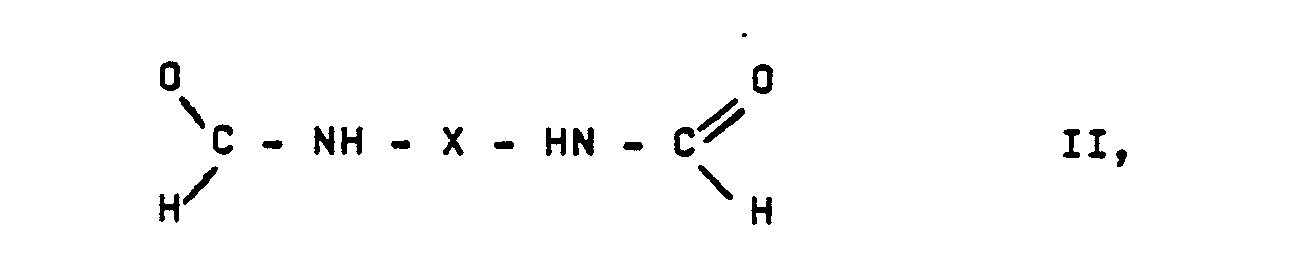
- Biscarbamates of the general formula are prepared by the process according to the invention by which this object is achieved in which R represents an alkyl radical with 1 to 8 C atoms and X represents a hydrocarbon radical with 2 to 6O C atoms, in which one or more C atoms can be replaced by heteroatoms and the halogen atoms, ester, carbonyl or May contain nitrile groups, in that formamides of the general formula in which X has the abovementioned meaning, in the presence of an alkanol of the formula ROH, in which R has the abovementioned meaning, and an ionogenic halide is electrochemically oxidized.
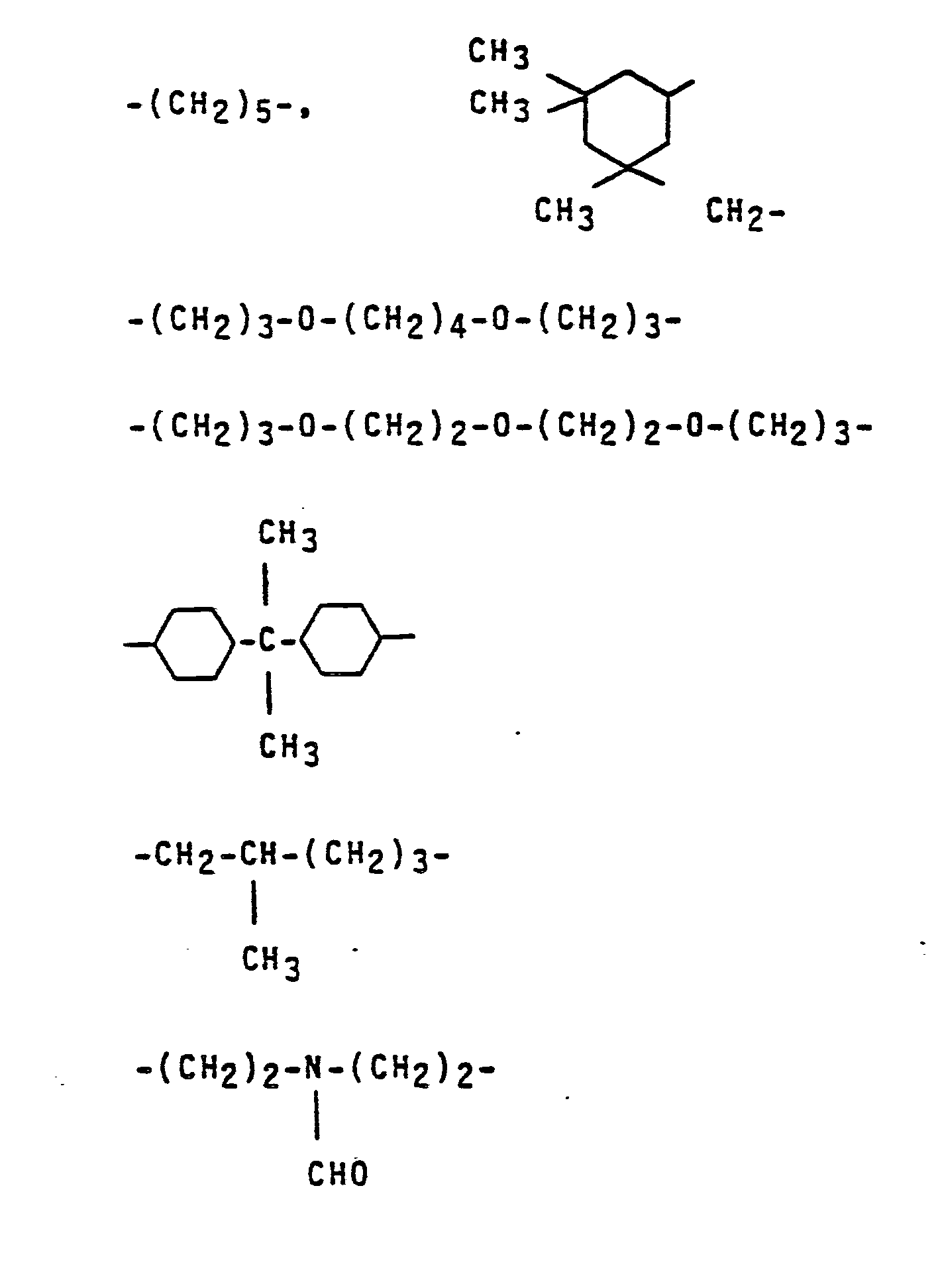
- This invention also relates to the new biscarbamates of the formula in which R1 represents an alkyl radical having 1 to 4 carbon atoms and Y represents one of the following radicals:
- the formamides of the formula II mentioned as starting materials for the preparation of the biscarbamates of the formula I contain, as the divalent radical X, a straight-chain, branched or ring-shaped hydrocarbon radical having 2 to 6O, preferably 3 to 3O, in particular 3 to 12 C atoms, such as an alkyl radical, a cycloalkyl radical or an alkylaryl radical.
- a straight-chain, branched or ring-shaped hydrocarbon radical having 2 to 6O, preferably 3 to 3O, in particular 3 to 12 C atoms, such as an alkyl radical, a cycloalkyl radical or an alkylaryl radical.
- one or more carbon atoms can be replaced by heteroatoms, such as N, O or S.
- the hydrocarbon radicals mentioned can also carry halogen atoms, ester, carbonyl or nitrile groups.
- R represents an alkyl radical having 1 to 8, preferably 1 to 5, in particular 1 to 4 carbon atoms.
- alkanols are n- or iso-propanol, n-butanol, but especially methanol and ethanol.
- Suitable ionogenic halides are salts, such as the alkali metal, alkaline earth metal or ammonium salts of hydrogen iodide, hydrobromic acid and hydrochloric acid. Salts of hydrobromic acid, such as alkali and alkaline earth bromides, and quaternary ammonium, especially tetraalkylammonium, bromides are particularly preferred.
- the cation does not play an essential role in the invention, therefore other ionogenic metal halides can also be used. Expediently, cheap halides will be chosen. Examples include sodium, potassium, calcium and ammonium bromide, and di-, tri- and tetramethyl- or tetraethylammonium bromide.
- the method according to the invention does not require a special electrolysis cell. It can advantageously be carried out in an undivided flow cell. All anode materials which are customary per se and are stable under the electrolysis conditions, such as noble metals, e.g. Gold or platinum.
- the preferred anode material is graphite.
- the cathode material is e.g. made of metals such as lead, iron, steel, nickel or precious metals such as platinum.
- the preferred cathode material is also graphite.
- composition of the electrolyte can be chosen within wide limits.
- the electrolyte contains the starting materials in the following weight ratios: 1 to 50% by weight of formamide of the formula II 40 to 90% by weight alkanol 0.1 to 10% by weight halide.
- a solvent can be added to the electrolyte, for example to improve the solubility of the formamide or the halide.
- Suitable solvents are nitriles such as acetonitrile, carbonates such as dimethyl carbonate, ethers such as tetrahydrofuran and dialkylformamides such as dimethylformamide.
- the current density is not a limited factor for the method according to the invention, it is e.g. 1 to 25 A / dm2, preferably electrolysis is carried out with a current density of 3 to 12 A / dm2.
- One electrolyzes e.g. at temperatures up to 120 ° C.
- a temperature range is selected whose upper value is expediently at least 5 to 10 ° C. below the boiling point of the electrolyte.
- electrolysis is preferably carried out at temperatures of 20 to 50 ° C.
- the electrolysis discharges can be worked up by methods known per se.
- the electrolysis discharge is expediently first worked up by distillation. Excess alkanol and any cosolvent used are distilled off.
- the halides are made in a known manner, e.g. separated by filtration or extraction.
- the biscarbamates are then often obtained in a very pure form, they can be used if necessary, e.g. can be further cleaned by reprecipitation or recrystallization. Alkanol, possibly unreacted formamide, cosolvents and halides can be returned to the electrolysis.
- the process according to the invention can be carried out batchwise or continuously.
- the biscarbamates are obtained in a particularly advantageous manner by the process according to the invention.
- the new process surprisingly offers the possibility of largely converting the formamides without any deterioration in yield.
- the current yields are also unusually high in the process according to the invention.
- the formamide in the electrolysis with 4 to 5 F / mol formamide is usually already fully implemented. These favorable results were not to be expected. It has long been known that the electrochemical conversion of formamides in alcohols in the presence of conducting salts such as tetraalkylammonium tetrafluoroborate leads to alkoxiform amides (see Tetrahedron 32 (1976), pp.
- the biscarbamates are versatile intermediates for the synthesis of isocyanates.
- the new biscarbamates are used in particular for the production of special polyurethanes.
- the electrolyte is cooled to 10 ° C. 38.4 g fall (Mp 195 to 2OO ° C, according to 1 HNMR and 13 C NMR spectra pure cis-trans mixture). Then methanol is distilled off at normal pressure, the residue taken up in CH2Cl2, NaBr (24.5 g) filtered off and CH2Cl2 distilled off. This gives a further 51 g of the biscarbamate (mp. 168 to 173 ° C). This corresponds to an overall yield of 84.8%.
Landscapes
- Chemical & Material Sciences (AREA)
- Organic Chemistry (AREA)
- Engineering & Computer Science (AREA)
- Chemical Kinetics & Catalysis (AREA)
- Electrochemistry (AREA)
- Materials Engineering (AREA)
- Metallurgy (AREA)
- Electrolytic Production Of Non-Metals, Compounds, Apparatuses Therefor (AREA)
- Organic Low-Molecular-Weight Compounds And Preparation Thereof (AREA)
Abstract

Description
- Die vorliegende Erfindung betrifft ein neues Verfahren zur Herstellung von Biscarbamaten sowie neue Biscarbamate.
- Bekanntlich stellt man Carbamidsäureester durch Umsetzung von Alkoholen mit Phosgen zu Chlorameisensäureestern und anschließende Aminolyse her. Der Umgang mit den hochtoxischen und korrosiven Vor- und Zwischenprodukten erfordert einen erheblichen technischen Aufwand. Weiterhin fallen bei diesen Verfahren Salzsäure oder halogenhaltige Abfallsalze an, deren Abtrennung häufig technisch sehr aufwendig ist (Ullmann, Enzyklopädie der techn. Chemie, 4. Auflage, Bd. 9, S. 118-119).
- Nach einer phosgenfreien Herstellungsmethode wird Harnstoff mit Alkanolen umgesetzt. Nachteilig sind hierbei die hohen Reaktionstemperaturen und langen Reaktionszeiten sowie der technisch umständliche Umgang mit Feststoffen (Houben-Weyl, Methoden der organischen Chemie, 1952, Bd. 8, S. 14O).
- Der Erfindung lag nun die Aufgabe zugrunde, ein Verfahren zu finden, das es ermöglicht, Biscarbamidsäureester technisch einfacher und auf besonders umweltfreundliche Art herzustellen.
- Nach dem erfindungsgemäßen Verfahren, durch das diese Aufgabe gelöst wurde, stellt man Biscarbamate der allgemeinen Formel


- Diese Erfindung betrifft außerdem die neuen Biscarbamate der Formel


- Die als Ausgangsstoffe für die Herstellung der Biscarbamate der Formel I genannten Formamide der Formel II enthalten als zweiwertigen Rest X einen geradkettigen, verzweigten oder ringförmigen Kohlenwasserstoffrest mit 2 bis 6O, vorzugsweise 3 bis 3O, insbesondere 3 bis 12 C-Atomen, wie einen Alkylrest, einen Cycloalkylrest oder einen Alkylarylrest. In diesen Kohlenwasserstoffresten können ein oder mehrere C-Atome durch Heteroatome, wie N, O oder S ersetzt sein. Die genannten Kohlenwasserstoffreste können auch Halogenatome, Ester-, Carbonyl- oder Nitrilgruppen tragen.
- Beispielsweise seien die folgenden Formamide genannt:


- In den Alkoholen der Formel ROH steht R für einen Alkylrest mit 1 bis 8, vorzugsweise 1 bis 5, insbesondere 1 bis 4 Kohlenstoffatomen. Als Alkanole seien beispielsweise n- oder iso-Propanol, n-Butanol, insbesondere aber Methanol und Ethanol genannt.
- Als ionogene Halogenide kommen Salze, wie die Alkali-, Erdalkali- oder Ammoniumsalze der Iodwasserstoff-, Bromwasserstoff- und Chlorwasserstoffsäure in Betracht. Besonders bevorzugt sind Salze der Bromwasserstoffsäure, wie Alkali- und Erdalkalibromide sowie quaternäre Ammonium-, insbesondere Tetraalkylammoniumbromide. Das Kation spielt keine erfindungswesentliche Rolle, es können daher auch andere ionogene Metallhalogenide verwendet werden. Zweckmäßigerweise wird man billige Halogenide wählen. Beispielsweise seien Natrium-, Kalium-, Calcium- und Ammoniumbromid sowie Di-, Tri- und Tetramethyl- oder Tetraethylammoniumbromid genannt.
- Das erfindungsgemäße Verfahren erfordert keine besondere Elektrolysezelle. Vorteilhaft kann man es in einer ungeteilten Durchflußzelle durchführen. Als Anoden können alle an sich üblichen Anodenmaterialien verwendet werden, die unter den Elektrolysebedingungen stabil sind, wie Edelmetalle, z.B. Gold oder Platin. Bevorzugtes Anodenmaterial ist Graphit. Das Kathodenmaterial besteht z.B. aus Metallen, wie Blei, Eisen, Stahl, Nickel oder Edelmetallen wie Platin. Bevorzugtes Kathodenmaterial ist ebenfalls Graphit.
- Die Zusammensetzung des Elektrolyten kann in weiten Grenzen gewählt werden. Beispielsweise enthält der Elektrolyt die Ausgangsstoffe in folgenden Gewichtsverhältnissen:
1 bis 5O Gew.% Formamid der Formel II
4O bis 9O Gew.% Alkanol
O,1 bis 1O Gew.% Halogenid. - Dem Elektrolyten kann, so gewünscht, ein Lösungsmittel, etwa zur Verbesserung der Löslichkeit des Formamids oder des Halogenids, zugesetzt werden. Geeignete Lösungsmittel sind Nitrile, wie Acetonitril, Carbonate, wie Dimethylcarbonat, Ether, wie Tetrahydrofuran und Dialkylformamide wie Dimethylformamid. Die Stromdichte ist kein begrenzter Faktor für das erfindungsgemäße Verfahren, sie beträgt z.B. 1 bis 25 A/dm², vorzugsweise wird mit einer Stromdichte von 3 bis 12 A/dm² elektrolysiert. Man elektrolysiert z.B. bei Temperaturen bis 12O°C. Bei druckloser Fahrweise der Elektrolyse wählt man einen Temperaturbereich, dessen oberer Wert zweckmäßigerweise zumindest 5 bis 1O°C unter dem Siedepunkt des Elektrolyten liegt. Bei Verwendung von Methanol oder Ethanol wird vorzugsweise bei Temperaturen von 2O bis 5O°C elektrolysiert.
- Die Aufarbeitung der Elektrolyseausträge kann man nach an sich bekannten Methoden vornehmen. Zweckmäßigerweise wird der Elektrolyseaustrag zunächst destillativ aufgearbeitet. Überschüssiges Alkanol und evtl. eingesetztes Kolösungsmittel werden abdestilliert. Die Halogenide werden in bekannter Weise, z.B. durch Filtration oder Extraktion abgetrennt. Die Biscarbamate fallen danach häufig in sehr reiner Form an, sie können bei Bedarf, z.B. durch Umfällen oder Umkristallisation weiter gereinigt werden. Alkanol, evtl. noch unumgesetztes Formamid, Kolösungsmittel sowie Halogenide können zur Elektrolyse zurückgeführt werden. Das erfindungsgemäße Verfahren kann sowohl diskontinuierlich als auch kontinuierlich durchgeführt werden.
- Nach dem erfindungsgemäßen Verfahren erhält man die Biscarbamate auf besonders vorteilhafte Weise. Das neue Verfahren bietet überraschenderweise die Möglichkeit, die Formamide weitgehend umzusetzen, ohne daß es zu Ausbeuteverschlechterungen kommt. Auch die Stromausbeuten sind bei dem erfindungsgemäßen Verfahren ungewöhnlich hoch. So ist das Formamid bei der Elektrolyse mit 4 bis 5 F/Mol Formamid meist bereits vollständig umgesetzt. Diese günstigen Resultate waren nicht zu erwarten. Es ist nämlich seit langem bekannt, daß die elektrochemische Umsetzung von Formamiden in Alkoholen in Gegenwart von Leitsalzen wie Tetraalkylammoniumtetrafluoroborat zu Alkoxiformamiden führt (s. Tetrahedron 32 (1976), S. 2185-22O6), und daß Biscarbamate unter Elektrolysebedingungen bei Verwendung von Leitsalzen wie Tetraethylammonium-p-toluolsulfonat elektrochemisch weiteroxidiert werden (s. J. Org. Chem. (1983), 48, S. 3338-3339).
- Die Biscarbamate sind vielfältig einsetzbare Zwischenprodukte für die Synthese von Isocyanaten. Die neuen Biscarbamate dienen insbesondere zur Herstellung spezieller Polyurethane.
-

- Nach Beendigung der Elektrolyse wird Methanol bei Normaldruck abdestilliert und der Rückstand in Methylethylketon heiß gelöst. Das Natriumbromid (36 g) wird heiß abfiltriert. Das Reaktionsprodukt wird aus dem Filtrat auskristallisiert. Dabei erhält man 385 g CH₃OOC-NH-(CH₂)₆-NHCOOCH₃ (Fp. 112°C, nach ¹HNMR-Spektrum rein, Analyse für C₁₀H₂₀N₂O₄ (%); ber.: C:51.7, H:8.6, O:27.6, N:12.1; gef.: C:51.7, H:8.5, O:27.6, N:12.O). Dies entspricht einer Ausbeute von 95.1 %.
-

- Man arbeitet analog Beispiel 1 auf erhält neben 27g Natriumbromid 356g CH₃OCONH-(CH₂)₄-NHCOOCH₃ (Fp. 126 bis 128°C, nach ¹HNMR-Spektrum rein). Dies entspricht einer Ausbeute von 83,8%.
-

- Man arbeitet analog Beispiel 1 auf und erhält neben 3O g Natriumbromid 175 g CH₃OCONH-(CH₂)₅-NHCOOCH₃ (Fp. 1O4 bis 112°C; nach ¹HNMR-Spektrum rein, Analyse ber. für C₉H₁₈N₂O₄ (%); ber.: C:49.5, H:8.3, O:29.4, N:12.8; gef.: C:49.5, H:8.1, O:29.4, N:12.8). Dies entspricht einer Ausbeute von 9O.6 %.

- Nach Beendigung der Elektrolyse wird Methanol bei Normaldruck abdestilliert. Der feste Rückstand wird in Methylethylketon aufgenommen und der zurückbleibende Feststoff (32 g, NaBr) abfiltriert. Aus dem Filtrat wird Methylethylketon abdestilliert. Der Rückstand wird aus wenig Methylethyl keton umkristallisiert. Hierbei erhält man 282 g des Biscarbamates (Fp. 1O3 bis 117°C; nach ¹HNMR- und ¹³C-NMR-Spektren rein, cis-trans-Gemisch). Dies entspricht einer Ausbeute von 79,8 %.

- Nach Beendigung der Elektrolyse wird Methanol bei Raumtemperatur abdestilliert. Der Rückstand wird in Methylenchlorid aufgenommen und Natriumbromid (28 g) abfiltriert. Aus dem Filtrat wird Methylenchlorid abdestilliert. Der verbleibende Rückstand (4O8 g) wird dann aus Methylethylketon umkristallisiert. Hierbei erhält man 248,2 g des Biscarbamates (Fp. 9O bis 92°C; nach ¹HNMR- und ¹³-Spekten rein, Analyse für C₉H₁₇N₃O₅ ber. (%): C:43.7, H:6.9, O:32.4, N:17.O; gef.: C:43.6, H:6.8, O:32.1, N:17.1). Aus der Mutterlauge können weitere 128,5 g des Biscarbamates isoliert werden. Dies entspricht einer Gesamtausbeute von 86,4 %.
-

- Nach Beendigung der Elektrolyse wird Methanol bei Normaldruck abdestilliert. Der Rückstand wird in Methylethylketon aufgenommen, dann wird Natriumbromid (32 g) abfiltriert und Methylethylketon abdestilliert. Hierbei erhält man 357 g CH₃OCONH-(CH₂)₃-O-(CH₂)₄-O-(CH₂)₃-NHCOOCH₃ (Fp. 45 bis 46°C; nach ¹HNMR- und ¹³CNMR-Spektren rein, Analyse ber. für C₁₄H₂₈N₂O₆ (%): C:52.5, H:8.8, O:3O.O, N:8.8; gef.: C:52.7, H:8.7, O:29.6, N:8.8). Dies entspricht einer Ausbeute von 87.9 %.
-

- Nach Beendigung der Elektrolyse wird Methanol bei Normaldruck abdestilliert. Der Rückstand wird in Toluol aufgenommen, dann wird Natriumbromid (22 g) abfiltriert und Toluol wieder abdestilliert. Hierbei erhält man 275 g CH₃OOCNH(CH₂)₃-O-(CH₂)₂-O-(CH₂)₂-O-(CH₂)₃NHCOOCH₃ (viskoses Öl, nach ¹HNMR- und ¹³CNMR-Spektren rein, Analyse für C₁₄H₂₈N₂O₇ berechnet (%): C:5O.O, H:8.3, O:33.4, N:8.3; gef.: C:5O.2, H:8.2, O:33.3, N:8.5). Dies entspricht einer Ausbeute von 86.9 %.

- Nach Beendigung der Elektrolyse wird Methanol bei Normaldruck abdestilliert. Der Rückstand wird mit Methyl-tert.-butylether aufgenommen und Natriumbromid (24 g) abfiltriert. Aus dem Filtrat wird Methyl-tert.-butylether abdestilliert. Hierbei erhält man 29O g CH₃OOC-NH-CH₂-CH(CH₃)-(CH₂)₃-NHCOOCH₃ (gelbe Flüssigkeit, nach ¹HNMR- und ¹³CNMR-Spektren rein, Analyse ber. für C₁₀H₂₀N₄O₂ (%): C:51.7, H:8.6, O:27.6, N:12.1; gef.: C:51.7, H:8.7, O:27.7, N:12.5). Dies entspricht einer Ausbeute von 82,7 %.

- Nach Beendigung der Elektrolyse wird der Elektrolyt auf 1O°C abgekühlt. Dabei fallen 38.4 g


- Nach Beendigung der Elektrolyse wird Methanol bei Normaldruck abdestilliert. Der Rückstand wird in Diethylketon gelöst und mit Wasser gewaschen. Die organische Phase wird mit Natriumsulfat getrocknet, dann wird Diethylketon abdestilliert. Hierbei erhält man 2O6,7 g des Biscarbamates der oben angegebenen Formel. (Fp. 137 bis 145°C, nach ¹HMR- und ¹³CNMR-Spektren reines cis-trans-Gemisch, Analyse ber. für C₁₉H₃₄O₄N₂ (%): C:64.4, H:9.6, O:18.1, N:7.9; gef.: C:64.3, H:9,8, O:18.O, N:7.9). Dies entspricht einer Ausbeute von 66 %.

- Nach Beendigung der Elektrolyse wird Methanol bei Normaldruck abdestilliert. Der Rückstand wird mit Methylenchlorid aufgenommen. Natriumbromid (25 g) wird abfiltriert und Methylenchlorid abdestilliert. Hierbei erhält man 29.9 g des Biscarbamates der oben angegebenen Formel (Schmelzbereich 144 bis 167°C, nach ¹HNMR- und ¹³CNMR-Spektren reines cis-trans-Gemisch, Analyse ber. für C₁₂H₂₂N₂O₄ (%): C:55.8, H:8.6, O:24.8, N:1O.8; gef.: C:55.7, H:8.5, O:24.8, N:1O.9). Dies entspricht einer Ausbeute von 72,6 %.

- Nach Beendigung der Elektrolyse wird zunächst Methanol bei Normaldruck, danach Dimethylformamid bei 15 mbar Kopfdruck bis 11O°C (Sumpftemperaturen) abdestilliert. Der Rückstand wird mit Wasser bei 8O°C digeriert, danach wird abfiltriert und getrocknet. Hierbei erhält man 81 g des Biscarbamates der oben angegebenen Formel (Fp. 186°C, nach ¹HNMR- und ¹³CNMR-Spektren rein, Analyse ber. für C₁₂H₁₆N₂O₄ (%): C:57.1, H:6.4, O:25.4, N:11.1; gef.: C:57.O, H:6.4, O:25.3, N:11.O). Dies entspricht einer Ausbeute von 77.1 %.
Claims (6)


Applications Claiming Priority (2)
| Application Number | Priority Date | Filing Date | Title |
|---|---|---|---|
| DE19863606478 DE3606478A1 (de) | 1986-02-28 | 1986-02-28 | Verfahren zur herstellung von biscarbamaten und neue biscarbamate |
| DE3606478 | 1986-02-28 |
Publications (3)
| Publication Number | Publication Date |
|---|---|
| EP0243607A2 true EP0243607A2 (de) | 1987-11-04 |
| EP0243607A3 EP0243607A3 (en) | 1987-12-09 |
| EP0243607B1 EP0243607B1 (de) | 1990-05-09 |
Family
ID=6295128
Family Applications (1)
| Application Number | Title | Priority Date | Filing Date |
|---|---|---|---|
| EP87102688A Expired - Lifetime EP0243607B1 (de) | 1986-02-28 | 1987-02-25 | Verfahren zur Herstellung von Biscarbamaten |
Country Status (7)
| Country | Link |
|---|---|
| US (1) | US4759832A (de) |
| EP (1) | EP0243607B1 (de) |
| JP (1) | JPS62207892A (de) |
| CA (1) | CA1292009C (de) |
| DE (2) | DE3606478A1 (de) |
| DK (1) | DK168795B1 (de) |
| NO (1) | NO171373C (de) |
Families Citing this family (5)
| Publication number | Priority date | Publication date | Assignee | Title |
|---|---|---|---|---|
| DE4010226A1 (de) * | 1990-03-30 | 1991-10-02 | Basf Ag | Neue 2,2-dialkylpentan-1,5-diisocyanate, -diurethane und -dicarbamidsaeurechloride, verfahren zu ihrer herstellung und ihre verwendung |
| GB9226772D0 (en) * | 1992-12-23 | 1993-02-17 | Coates Brothers Plc | Hot melt ink jet printing |
| US6414051B1 (en) * | 2000-02-01 | 2002-07-02 | Xerox Corporation | Acoustic printing inks containing bis(carbamates) |
| CN101939295B (zh) * | 2008-02-07 | 2013-04-24 | 拜尔农作物科学股份公司 | 杀虫的芳基吡咯啉 |
| CN114478300B (zh) * | 2021-07-16 | 2023-05-23 | 丰益表面活性材料(连云港)有限公司 | 新型酰氯催化剂及其制备方法与应用 |
Family Cites Families (8)
| Publication number | Priority date | Publication date | Assignee | Title |
|---|---|---|---|---|
| US3226428A (en) * | 1962-07-19 | 1965-12-28 | Sidney L Vail | Biscarbamate-formaldehyde adducts |
| US3341568A (en) * | 1963-09-05 | 1967-09-12 | Dow Chemical Co | Dicarbamates |
| US3391181A (en) * | 1965-03-18 | 1968-07-02 | Stevens & Co Inc J P | Preparation of methylolated carbamates |
| DE1965101A1 (de) * | 1969-12-27 | 1971-07-01 | Hoechst Ag | Pentadekapeptide mit adrenocorticotroper Wirkung und Verfahren zu ihrer Herstellung |
| US3950285A (en) * | 1974-04-04 | 1976-04-13 | Atlantic Richfield Company | Preparation of polymeric urethanes from dicarbamates |
| NL7609725A (nl) * | 1975-09-06 | 1977-03-08 | Hoechst Ag | Alkoxyderivaten van aan de n gesubstitueerde cyclische aminen en werkwijze voor hun be- reiding. |
| US4430262A (en) * | 1981-06-05 | 1984-02-07 | Shell Oil Company | Preparation of isocyanates and/or derivatives thereof |
| DE3529531A1 (de) * | 1985-08-17 | 1987-02-26 | Basf Ag | Verfahren zur herstellung von carbamidsaeureestern |
-
1986
- 1986-02-28 DE DE19863606478 patent/DE3606478A1/de not_active Withdrawn
-
1987
- 1987-02-13 US US07/014,635 patent/US4759832A/en not_active Expired - Lifetime
- 1987-02-17 CA CA000529931A patent/CA1292009C/en not_active Expired - Lifetime
- 1987-02-20 JP JP62035998A patent/JPS62207892A/ja active Granted
- 1987-02-25 EP EP87102688A patent/EP0243607B1/de not_active Expired - Lifetime
- 1987-02-25 DE DE8787102688T patent/DE3762633D1/de not_active Expired - Lifetime
- 1987-02-27 DK DK102387A patent/DK168795B1/da not_active IP Right Cessation
- 1987-02-27 NO NO870828A patent/NO171373C/no unknown
Also Published As
| Publication number | Publication date |
|---|---|
| JPS62207892A (ja) | 1987-09-12 |
| NO171373B (no) | 1992-11-23 |
| NO870828D0 (no) | 1987-02-27 |
| EP0243607B1 (de) | 1990-05-09 |
| US4759832A (en) | 1988-07-26 |
| DK102387D0 (da) | 1987-02-27 |
| DE3606478A1 (de) | 1987-09-03 |
| CA1292009C (en) | 1991-11-12 |
| NO171373C (no) | 1993-03-03 |
| DK102387A (da) | 1987-08-29 |
| NO870828L (no) | 1987-08-31 |
| JPH0338349B2 (de) | 1991-06-10 |
| EP0243607A3 (en) | 1987-12-09 |
| DE3762633D1 (de) | 1990-06-13 |
| DK168795B1 (da) | 1994-06-13 |
Similar Documents
| Publication | Publication Date | Title |
|---|---|---|
| EP0011712B1 (de) | Verfahren zur Herstellung von in 4-Stellung substituierten Benzaldehyddialkylacetalen | |
| EP0780371B1 (de) | 2-Alkylmerkapto-4-(trifluormethyl)-benzoesäureester sowie ein Verfahren zu ihrer Herstellung | |
| EP0012215A1 (de) | 2-Hydroxybutansulfonsaures Cholin und dessen Verwendung als Leitsalz | |
| EP0243607B1 (de) | Verfahren zur Herstellung von Biscarbamaten | |
| EP0902846B1 (de) | Verfahren zur herstellung von phthaliden | |
| EP0212512B1 (de) | Verfahren zur Herstellung von Carbamidsäureestern | |
| DE3814498A1 (de) | Verfahren zur herstellung von hydroxicarbonsaeureestern | |
| DE2855508A1 (de) | Verfahren zur herstellung von benzaldehyden | |
| EP0009697B1 (de) | Verfahren zur Herstellung von N-(Alpha-Methoxy-alkyl)-urethanen und neue N-(Alpha-methoxy-alkyl)-urethane | |
| EP0308744B1 (de) | Verfahren zur Herstellung von Imidazolidinonen und Oxazolidinonen | |
| EP0047950B1 (de) | Omega-Fluorsulfato-perfluorcarbonsäurederivate und Verfahren zu deren Herstellung | |
| EP0069918B1 (de) | Verfahren zur Herstellung von Cyclopentadecanolid | |
| EP0347690B1 (de) | Verfahren zur Herstellung von Benzolderivaten und neue Benzolderivate | |
| EP0179377B1 (de) | Verfahren zur Herstellung von 1-Alkoxyisochromanen und neue 1-Alkoxy-alkylisochromane | |
| EP0100498B1 (de) | Verfahren zur Herstellung von Dichlormilchsäure oder dem Nitril oder Amid der Dichlormilchsäure | |
| DE2331711A1 (de) | Verfahren zur selektiven elektrolytischen entbromierung | |
| EP0164705A2 (de) | Verfahren zur Herstellung von Phthalaldehydacetalen | |
| EP0513577B1 (de) | Verfahren zur Herstellung von 1-Alkoxyisochromanen | |
| EP0002477A1 (de) | Verfahren zur Herstellung von 1,1-Dihalogen-4-methyl-1,3-pentadienen | |
| DE3619656A1 (de) | Neue 2,6-dimethyl-p-benzochinontetraalkylketale sowie deren herstellung | |
| EP0621352A2 (de) | Verfahren zur Herstellung von Terephthalaldehydtetraalkylacetalen | |
| EP1913178A1 (de) | Verfahren zur herstellung von 1,1,4,4-tetraalkoxy-but-2-enderivaten | |
| DE1961364A1 (de) | Verfahren zur Herstellung von substituierten Hydrazinen | |
| DD218356A1 (de) | Einrichtung zur stabilisierung der laengsachse geschleppter unterwasser-schwimmkoerper | |
| DE2428878A1 (de) | Verfahren zur herstellung von p-hydroxymethyl-benzoesaeureestern |
Legal Events
| Date | Code | Title | Description |
|---|---|---|---|
| PUAI | Public reference made under article 153(3) epc to a published international application that has entered the european phase |
Free format text: ORIGINAL CODE: 0009012 |
|
| PUAL | Search report despatched |
Free format text: ORIGINAL CODE: 0009013 |
|
| 17P | Request for examination filed |
Effective date: 19870812 |
|
| AK | Designated contracting states |
Kind code of ref document: A2 Designated state(s): BE CH DE FR GB IT LI NL SE |
|
| AK | Designated contracting states |
Kind code of ref document: A3 Designated state(s): BE CH DE FR GB IT LI NL SE |
|
| 17Q | First examination report despatched |
Effective date: 19890206 |
|
| GRAA | (expected) grant |
Free format text: ORIGINAL CODE: 0009210 |
|
| AK | Designated contracting states |
Kind code of ref document: B1 Designated state(s): BE CH DE FR GB IT LI NL SE |
|
| ITF | It: translation for a ep patent filed | ||
| REF | Corresponds to: |
Ref document number: 3762633 Country of ref document: DE Date of ref document: 19900613 |
|
| GBT | Gb: translation of ep patent filed (gb section 77(6)(a)/1977) | ||
| ET | Fr: translation filed | ||
| ITTA | It: last paid annual fee | ||
| PLBE | No opposition filed within time limit |
Free format text: ORIGINAL CODE: 0009261 |
|
| STAA | Information on the status of an ep patent application or granted ep patent |
Free format text: STATUS: NO OPPOSITION FILED WITHIN TIME LIMIT |
|
| 26N | No opposition filed | ||
| EAL | Se: european patent in force in sweden |
Ref document number: 87102688.6 |
|
| PGFP | Annual fee paid to national office [announced via postgrant information from national office to epo] |
Ref country code: SE Payment date: 19970127 Year of fee payment: 11 |
|
| PG25 | Lapsed in a contracting state [announced via postgrant information from national office to epo] |
Ref country code: SE Free format text: LAPSE BECAUSE OF NON-PAYMENT OF DUE FEES Effective date: 19980226 |
|
| EUG | Se: european patent has lapsed |
Ref document number: 87102688.6 |
|
| PGFP | Annual fee paid to national office [announced via postgrant information from national office to epo] |
Ref country code: FR Payment date: 20010116 Year of fee payment: 15 |
|
| PGFP | Annual fee paid to national office [announced via postgrant information from national office to epo] |
Ref country code: CH Payment date: 20010117 Year of fee payment: 15 |
|
| PGFP | Annual fee paid to national office [announced via postgrant information from national office to epo] |
Ref country code: NL Payment date: 20010131 Year of fee payment: 15 |
|
| PGFP | Annual fee paid to national office [announced via postgrant information from national office to epo] |
Ref country code: GB Payment date: 20010219 Year of fee payment: 15 |
|
| PGFP | Annual fee paid to national office [announced via postgrant information from national office to epo] |
Ref country code: DE Payment date: 20010220 Year of fee payment: 15 |
|
| PGFP | Annual fee paid to national office [announced via postgrant information from national office to epo] |
Ref country code: BE Payment date: 20010313 Year of fee payment: 15 |
|
| REG | Reference to a national code |
Ref country code: GB Ref legal event code: IF02 |
|
| PG25 | Lapsed in a contracting state [announced via postgrant information from national office to epo] |
Ref country code: DE Free format text: LAPSE BECAUSE OF THE APPLICANT RENOUNCES Effective date: 20020215 |
|
| PG25 | Lapsed in a contracting state [announced via postgrant information from national office to epo] |
Ref country code: GB Free format text: LAPSE BECAUSE OF NON-PAYMENT OF DUE FEES Effective date: 20020225 |
|
| PG25 | Lapsed in a contracting state [announced via postgrant information from national office to epo] |
Ref country code: LI Free format text: LAPSE BECAUSE OF NON-PAYMENT OF DUE FEES Effective date: 20020228 Ref country code: CH Free format text: LAPSE BECAUSE OF NON-PAYMENT OF DUE FEES Effective date: 20020228 Ref country code: BE Free format text: LAPSE BECAUSE OF NON-PAYMENT OF DUE FEES Effective date: 20020228 |
|
| BERE | Be: lapsed |
Owner name: BASF A.G. Effective date: 20020228 |
|
| PG25 | Lapsed in a contracting state [announced via postgrant information from national office to epo] |
Ref country code: NL Free format text: LAPSE BECAUSE OF NON-PAYMENT OF DUE FEES Effective date: 20020901 |
|
| REG | Reference to a national code |
Ref country code: CH Ref legal event code: PL |
|
| GBPC | Gb: european patent ceased through non-payment of renewal fee |
Effective date: 20020225 |
|
| PG25 | Lapsed in a contracting state [announced via postgrant information from national office to epo] |
Ref country code: FR Free format text: LAPSE BECAUSE OF NON-PAYMENT OF DUE FEES Effective date: 20021031 |
|
| NLV4 | Nl: lapsed or anulled due to non-payment of the annual fee |
Effective date: 20020901 |
|
| REG | Reference to a national code |
Ref country code: FR Ref legal event code: ST |
|
| PG25 | Lapsed in a contracting state [announced via postgrant information from national office to epo] |
Ref country code: IT Free format text: LAPSE BECAUSE OF NON-PAYMENT OF DUE FEES;WARNING: LAPSES OF ITALIAN PATENTS WITH EFFECTIVE DATE BEFORE 2007 MAY HAVE OCCURRED AT ANY TIME BEFORE 2007. THE CORRECT EFFECTIVE DATE MAY BE DIFFERENT FROM THE ONE RECORDED. Effective date: 20050225 |