EP0241664A1 - Verfahren zur Herstellung substituierter Trihydroxybenzole - Google Patents
Verfahren zur Herstellung substituierter Trihydroxybenzole Download PDFInfo
- Publication number
- EP0241664A1 EP0241664A1 EP87101957A EP87101957A EP0241664A1 EP 0241664 A1 EP0241664 A1 EP 0241664A1 EP 87101957 A EP87101957 A EP 87101957A EP 87101957 A EP87101957 A EP 87101957A EP 0241664 A1 EP0241664 A1 EP 0241664A1
- Authority
- EP
- European Patent Office
- Prior art keywords
- hydrogen peroxide
- process according
- substituted
- reaction
- methylresorcinol
- Prior art date
- Legal status (The legal status is an assumption and is not a legal conclusion. Google has not performed a legal analysis and makes no representation as to the accuracy of the status listed.)
- Granted
Links
- 238000004519 manufacturing process Methods 0.000 title abstract description 3
- WQGWDDDVZFFDIG-UHFFFAOYSA-N pyrogallol Chemical class OC1=CC=CC(O)=C1O WQGWDDDVZFFDIG-UHFFFAOYSA-N 0.000 title description 3
- MHAJPDPJQMAIIY-UHFFFAOYSA-N Hydrogen peroxide Chemical compound OO MHAJPDPJQMAIIY-UHFFFAOYSA-N 0.000 claims abstract description 41
- 238000006243 chemical reaction Methods 0.000 claims abstract description 19
- 238000000034 method Methods 0.000 claims abstract description 17
- GHMLBKRAJCXXBS-UHFFFAOYSA-N Resorcinol Natural products OC1=CC=CC(O)=C1 GHMLBKRAJCXXBS-UHFFFAOYSA-N 0.000 claims abstract description 13
- 150000005207 1,3-dihydroxybenzenes Chemical class 0.000 claims abstract description 11
- GGNQRNBDZQJCCN-UHFFFAOYSA-N benzene-1,2,4-triol Chemical class OC1=CC=C(O)C(O)=C1 GGNQRNBDZQJCCN-UHFFFAOYSA-N 0.000 claims abstract description 11
- XLYOFNOQVPJJNP-UHFFFAOYSA-N water Substances O XLYOFNOQVPJJNP-UHFFFAOYSA-N 0.000 claims abstract description 9
- 239000000203 mixture Substances 0.000 claims description 10
- ZTMADXFOCUXMJE-UHFFFAOYSA-N 2-methylbenzene-1,3-diol Chemical compound CC1=C(O)C=CC=C1O ZTMADXFOCUXMJE-UHFFFAOYSA-N 0.000 claims description 6
- OIPPWFOQEKKFEE-UHFFFAOYSA-N orcinol Chemical compound CC1=CC(O)=CC(O)=C1 OIPPWFOQEKKFEE-UHFFFAOYSA-N 0.000 claims description 6
- WXTMDXOMEHJXQO-UHFFFAOYSA-N 2,5-dihydroxybenzoic acid Chemical compound OC(=O)C1=CC(O)=CC=C1O WXTMDXOMEHJXQO-UHFFFAOYSA-N 0.000 claims description 4
- GHVHDYYKJYXFGU-UHFFFAOYSA-N Beta-Orcinol Chemical compound CC1=CC(O)=C(C)C(O)=C1 GHVHDYYKJYXFGU-UHFFFAOYSA-N 0.000 claims description 4
- 239000004215 Carbon black (E152) Substances 0.000 claims description 4
- 125000001931 aliphatic group Chemical group 0.000 claims description 4
- 125000004432 carbon atom Chemical group C* 0.000 claims description 4
- 229930195733 hydrocarbon Natural products 0.000 claims description 4
- 229910052739 hydrogen Inorganic materials 0.000 claims description 4
- 239000001257 hydrogen Substances 0.000 claims description 4
- 125000004435 hydrogen atom Chemical class [H]* 0.000 claims description 4
- 229920006395 saturated elastomer Polymers 0.000 claims description 4
- GRLQBYQELUWBIO-UHFFFAOYSA-N 4,6-dichlorobenzene-1,3-diol Chemical compound OC1=CC(O)=C(Cl)C=C1Cl GRLQBYQELUWBIO-UHFFFAOYSA-N 0.000 claims description 2
- JQVAPEJNIZULEK-UHFFFAOYSA-N 4-chlorobenzene-1,3-diol Chemical compound OC1=CC=C(Cl)C(O)=C1 JQVAPEJNIZULEK-UHFFFAOYSA-N 0.000 claims description 2
- WFJIVOKAWHGMBH-UHFFFAOYSA-N 4-hexylbenzene-1,3-diol Chemical compound CCCCCCC1=CC=C(O)C=C1O WFJIVOKAWHGMBH-UHFFFAOYSA-N 0.000 claims description 2
- 229910006069 SO3H Inorganic materials 0.000 claims description 2
- 125000003178 carboxy group Chemical group [H]OC(*)=O 0.000 claims description 2
- 229910052801 chlorine Inorganic materials 0.000 claims description 2
- 238000002360 preparation method Methods 0.000 claims description 2
- 239000000243 solution Substances 0.000 description 7
- 150000001875 compounds Chemical class 0.000 description 6
- WFDIJRYMOXRFFG-UHFFFAOYSA-N Acetic anhydride Chemical compound CC(=O)OC(C)=O WFDIJRYMOXRFFG-UHFFFAOYSA-N 0.000 description 3
- UHOVQNZJYSORNB-UHFFFAOYSA-N Benzene Chemical compound C1=CC=CC=C1 UHOVQNZJYSORNB-UHFFFAOYSA-N 0.000 description 3
- YMWUJEATGCHHMB-UHFFFAOYSA-N Dichloromethane Chemical compound ClCCl YMWUJEATGCHHMB-UHFFFAOYSA-N 0.000 description 3
- XEKOWRVHYACXOJ-UHFFFAOYSA-N Ethyl acetate Chemical compound CCOC(C)=O XEKOWRVHYACXOJ-UHFFFAOYSA-N 0.000 description 3
- YXFVVABEGXRONW-UHFFFAOYSA-N Toluene Chemical compound CC1=CC=CC=C1 YXFVVABEGXRONW-UHFFFAOYSA-N 0.000 description 3
- 238000009835 boiling Methods 0.000 description 3
- 239000003960 organic solvent Substances 0.000 description 3
- 150000003232 pyrogallols Chemical class 0.000 description 3
- AZQWKYJCGOJGHM-UHFFFAOYSA-N 1,4-benzoquinone Chemical compound O=C1C=CC(=O)C=C1 AZQWKYJCGOJGHM-UHFFFAOYSA-N 0.000 description 2
- AKEUNCKRJATALU-UHFFFAOYSA-N 2,6-dihydroxybenzoic acid Chemical compound OC(=O)C1=C(O)C=CC=C1O AKEUNCKRJATALU-UHFFFAOYSA-N 0.000 description 2
- HEDRZPFGACZZDS-UHFFFAOYSA-N Chloroform Chemical compound ClC(Cl)Cl HEDRZPFGACZZDS-UHFFFAOYSA-N 0.000 description 2
- 238000007027 Dakin phenol oxidation reaction Methods 0.000 description 2
- QAOWNCQODCNURD-UHFFFAOYSA-N Sulfuric acid Chemical compound OS(O)(=O)=O QAOWNCQODCNURD-UHFFFAOYSA-N 0.000 description 2
- 230000015572 biosynthetic process Effects 0.000 description 2
- 230000002349 favourable effect Effects 0.000 description 2
- 238000002844 melting Methods 0.000 description 2
- 230000008018 melting Effects 0.000 description 2
- YKYONYBAUNKHLG-UHFFFAOYSA-N propyl acetate Chemical compound CCCOC(C)=O YKYONYBAUNKHLG-UHFFFAOYSA-N 0.000 description 2
- 239000011541 reaction mixture Substances 0.000 description 2
- VZGDMQKNWNREIO-UHFFFAOYSA-N tetrachloromethane Chemical compound ClC(Cl)(Cl)Cl VZGDMQKNWNREIO-UHFFFAOYSA-N 0.000 description 2
- ADUSGJRADQMJGN-UHFFFAOYSA-N 2,3,6-trihydroxybenzoic acid Chemical compound OC(=O)C1=C(O)C=CC(O)=C1O ADUSGJRADQMJGN-UHFFFAOYSA-N 0.000 description 1
- PCAXITAPTVOLGL-UHFFFAOYSA-N 2,3-diaminophenol Chemical class NC1=CC=CC(O)=C1N PCAXITAPTVOLGL-UHFFFAOYSA-N 0.000 description 1
- 125000000577 2,6-xylenyl group Chemical class [H]C1=C([H])C(=C(O*)C(=C1[H])C([H])([H])[H])C([H])([H])[H] 0.000 description 1
- WPFZLGOGWVNEID-UHFFFAOYSA-N 3-methylbenzene-1,2,4-triol Chemical compound CC1=C(O)C=CC(O)=C1O WPFZLGOGWVNEID-UHFFFAOYSA-N 0.000 description 1
- KZMGYPLQYOPHEL-UHFFFAOYSA-N Boron trifluoride etherate Chemical compound FB(F)F.CCOCC KZMGYPLQYOPHEL-UHFFFAOYSA-N 0.000 description 1
- 239000002253 acid Substances 0.000 description 1
- 125000003172 aldehyde group Chemical group 0.000 description 1
- 150000001299 aldehydes Chemical class 0.000 description 1
- 150000007933 aliphatic carboxylic acids Chemical class 0.000 description 1
- 150000004703 alkoxides Chemical class 0.000 description 1
- 239000007864 aqueous solution Substances 0.000 description 1
- 150000004945 aromatic hydrocarbons Chemical class 0.000 description 1
- 125000000484 butyl group Chemical group [H]C([*])([H])C([H])([H])C([H])([H])C([H])([H])[H] 0.000 description 1
- 239000003054 catalyst Substances 0.000 description 1
- 150000008280 chlorinated hydrocarbons Chemical class 0.000 description 1
- 238000005660 chlorination reaction Methods 0.000 description 1
- 239000000460 chlorine Substances 0.000 description 1
- 150000001805 chlorine compounds Chemical class 0.000 description 1
- 125000004218 chloromethyl group Chemical group [H]C([H])(Cl)* 0.000 description 1
- 239000002537 cosmetic Substances 0.000 description 1
- 239000000155 melt Substances 0.000 description 1
- 125000004108 n-butyl group Chemical group [H]C([H])([H])C([H])([H])C([H])([H])C([H])([H])* 0.000 description 1
- -1 n-hexyl ester Chemical class 0.000 description 1
- 150000004965 peroxy acids Chemical class 0.000 description 1
- 125000001436 propyl group Chemical group [H]C([*])([H])C([H])([H])C([H])([H])[H] 0.000 description 1
- 229940079877 pyrogallol Drugs 0.000 description 1
- 239000002994 raw material Substances 0.000 description 1
- 230000035484 reaction time Effects 0.000 description 1
- SMQUZDBALVYZAC-UHFFFAOYSA-N salicylaldehyde Chemical class OC1=CC=CC=C1C=O SMQUZDBALVYZAC-UHFFFAOYSA-N 0.000 description 1
- 150000003839 salts Chemical class 0.000 description 1
- 239000012047 saturated solution Substances 0.000 description 1
- 125000002914 sec-butyl group Chemical group [H]C([H])([H])C([H])([H])C([H])(*)C([H])([H])[H] 0.000 description 1
- 239000002904 solvent Substances 0.000 description 1
- 239000007858 starting material Substances 0.000 description 1
- 239000000126 substance Substances 0.000 description 1
- 238000003786 synthesis reaction Methods 0.000 description 1
- ILJSQTXMGCGYMG-UHFFFAOYSA-N triacetic acid Chemical compound CC(=O)CC(=O)CC(O)=O ILJSQTXMGCGYMG-UHFFFAOYSA-N 0.000 description 1
Classifications
-
- C—CHEMISTRY; METALLURGY
- C07—ORGANIC CHEMISTRY
- C07C—ACYCLIC OR CARBOCYCLIC COMPOUNDS
- C07C309/00—Sulfonic acids; Halides, esters, or anhydrides thereof
-
- C—CHEMISTRY; METALLURGY
- C07—ORGANIC CHEMISTRY
- C07C—ACYCLIC OR CARBOCYCLIC COMPOUNDS
- C07C37/00—Preparation of compounds having hydroxy or O-metal groups bound to a carbon atom of a six-membered aromatic ring
- C07C37/60—Preparation of compounds having hydroxy or O-metal groups bound to a carbon atom of a six-membered aromatic ring by oxidation reactions introducing directly hydroxy groups on a =CH-group belonging to a six-membered aromatic ring with the aid of other oxidants than molecular oxygen or their mixtures with molecular oxygen
-
- C—CHEMISTRY; METALLURGY
- C07—ORGANIC CHEMISTRY
- C07C—ACYCLIC OR CARBOCYCLIC COMPOUNDS
- C07C51/00—Preparation of carboxylic acids or their salts, halides or anhydrides
- C07C51/347—Preparation of carboxylic acids or their salts, halides or anhydrides by reactions not involving formation of carboxyl groups
- C07C51/367—Preparation of carboxylic acids or their salts, halides or anhydrides by reactions not involving formation of carboxyl groups by introduction of functional groups containing oxygen only in singly bound form
Definitions
- the invention relates to the preparation of mixtures of substituted 1,2,3- and 1,2,4-trihydroxybenzenes.
- substituted pyrogallol compounds were initially e.g. by chlorination of 2,6-dimethylphenol derivatives into corresponding chlorine compounds, the chloromethyl groups of which were then converted into aldehyde groups.
- the aldehydes were oxidized with per compounds, such as hydrogen peroxide or peracids or their salts, in basic medium to give the desired pyrogallol compounds. This multi-stage process only led to moderate yields despite the effort.
- a likewise cumbersome process with very fluctuating yields of pyrogallol or pyrogallol compounds is described in DE-OS 26 53 446.
- a 2,2,6,6-tetrahalocyclohexanone must first be prepared which is then hydrolyzed with water in the presence of a catalyst or in the form of an alkoxide with acid.
- the reaction consists in converting a corresponding quinone into a hydroxyhydroquinone by acetoxylating it with acetic anhydride in the presence of sulfuric acid or boron fluoride etherate to give the corresponding triacetate and then converting it to the desired hydroxyhydroquinone or to substituted polyhydroxy compounds (DE-OS 24 59 059).
- the object of the invention is therefore to obtain the corresponding 1,2,3- and 1,2,4-trihydroxybenzenes directly from substituted resorcinols.
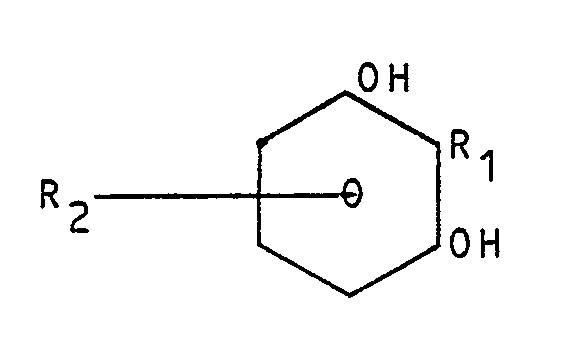
- mixtures of Substituted 1,2,3- and 1,2,4-trihydroxybenzenes can be prepared in one step if substituted resorcinols of the formula in which R1 and R2 are hydrogen, aliphatic, saturated straight-chain or branched hydrocarbon radicals with 1-6 C atoms, the group -COOH, -COOR3, -CH2OR3, -SO3H, -NO2, NH2 or F, Cl, Br, J, R3 represents an aliphatic, saturated, straight-chain or branched hydrocarbon radical with 1-6 C atoms and R1 and R2 - with the exception of hydrogen - can be the same or different, in contact with aqueous hydrogen peroxide at temperatures from 60 to 150 ° C, the initial amount of water in the mixture before the start of the reaction is between 0.1 to 36 percent by weight, based on the mixture.
- Resorcins that are suitable for the invention are 2-methylresorcinol; 5-methylresorcinol (orcin); 4n-hexylresorcinol; 2,5-dimethylresorcinol ( ⁇ -orcin); 4-chlororesorcinol; 4,6-dichlororesorcinol, dihydroxybenzoic acid.
- 2-Methylresorcinol, dihydroxybenzoic acid are preferred.
- Resorcinol itself is not used in the process according to the invention.
- the resorcinols to be used are generally commercially available. They are preferably used as a melt as long as their melting points are so low that they do not form any safety-critical mixtures with hydrogen peroxide.
- the resorcinols have melting points that are close to and above the boiling point of hydrogen peroxide, they should be used in the form of their solutions in water or in organic solvents.
- the organic solvents should be selected so that their boiling points are close to the desired working temperature.
- Common solvents such as aliphatic carboxylic acid esters, e.g. Ethyl acetate, propyl, n-butyl, sec-butyl, tert.butyl, n-hexyl ester, and chlorinated hydrocarbons, e.g. Chloroform, carbon tetrachloride, methylene chloride or aromatic hydrocarbons such as benzene or toluene.
- chlorinated hydrocarbons e.g. Chloroform, carbon tetrachloride, methylene chloride or aromatic hydrocarbons such as benzene or toluene.
- aqueous hydrogen peroxide solutions are commercially available solutions with concentrations of 20-85 percent by weight of hydrogen peroxide, preferably of 50-85 percent by weight.
- Preferred amounts of water before the start of the reaction are 0.5 to 15 percent by weight, particularly preferably 0.5 to 10 percent by weight, based on that Mixture present at the start of the reaction. Amounts of water of 0.5 to 6 percent by weight are very particularly preferred.
- the molar ratio of resorcinol to hydrogen peroxide is 2 to 20: 1, preferably 5 to 10: 1.
- the technical progress of the process according to the invention lies in the possibility, starting from commercially available starting materials, of obtaining the desired 1,2,3- and 1,2,4-trihydroxybenzenes in a single reaction step. Additional production of very special raw materials is no longer necessary.
Landscapes
- Chemical & Material Sciences (AREA)
- Organic Chemistry (AREA)
- Chemical Kinetics & Catalysis (AREA)
- Engineering & Computer Science (AREA)
- Oil, Petroleum & Natural Gas (AREA)
- Organic Low-Molecular-Weight Compounds And Preparation Thereof (AREA)
Abstract
Description
- Die Erfindung betrifft die Herstellung von Mischungen substituierter 1,2,3- und 1,2,4-Trihydroxybenzole.
- Die genannten Verbindungen sind wichtige Synthesebausteine für Produkte in der Pharmazie, für Kosmetik, Agro- und Fotochemikalien (Kirk Othmer, Encyclopedia Chem. Technol., 3. Auflage, Band 18, Seite 670 - 84, 1982).
Bisher konnten diese Verbindungen nur sehr aufwendig über mehrere Verfahrensstufen hergestellt werden. - Nach der EU-PS 25 659 wurden substituierte Pyrogallolverbindungen zunächst z.B. durch Chlorierung von 2,6-Dimethylphenolabkömmlingen in entsprechende Chlorverbindungen überführt, deren Chlormethylgruppen dann in Aldehydgruppen umgewandelt wurden. Die Aldehyde wurden entsprechend der Dakin-Reaktion mit Perverbindungen, wie Wasserstoffperoxid oder Persäuren bzw. deren Salzen, in basischem Medium oxydiert zu den gewünschten Pyrogallolverbindungen. Dieses mehrstufige Verfahren führte trotz des Aufwandes nur zu mäßigen Ausbeuten.
- Ein weiteres mehrstufiges Verfahren über eine modifizierte Dakin-Reaktion, die über Hydroxybenzaldehyde verläuft, führte nur dann zu zufriedenstellenden Ausbeuten, wenn der pH-Wert während der Reaktion kontinuierlich auf 6 durch Basenzugabe gehalten wurde. Hierdurch wurde auch die Aufarbeitung erschwert (EU-PS 44 260).
- Ein ebenfalls umständliches Verfahren mit sehr schwankenden Ausbeuten an Pyrogallol oder Pyrogallolverbindungen wird in der DE-OS 26 53 446 beschrieben. Ein 2,2,6,6-Tetrahalogencyclohexanon muß zunächst hergestellt werden, das dann mit Wasser in Gegenwart eines Katalysators oder in Form eines Alkoxyds mit Säure hydrolysiert wird.
- Auch Versuche, über Diaminophenole zu Polyhydroxyverbindungen zu gelangen, führten nicht zu guten Ergebnissen und waren recht aufwendig (DE-OS 24 43 336).
- Eine weitere Möglichkeit, über die Thiele-Winter-Reaktion zu Hydroxyhydrochinonen bzw. substituierten Polyhydroxyverbindungen zu kommen, war gleichzeitig sehr umständlich und technisch aufwendig. Die Reaktion besteht ja in der Umwandlung eines entsprechenden Chinons in ein Hydroxyhydrochinon durch dessen Acetoxylierung mit Essigsäureanhydrid in Gegenwart von Schwefelsäure oder Borfluoridätherat zu dem entsprechenden Triacetat und dann dessen Umwandlung in das gewünschte Hydroxyhydrochinon bzw. in substituierte Polyhydroxyverbindungen (DE-OS 24 59 059).
- Aufgabe der Erfindung ist es daher, ausgehend von substituierten Resorcinen, direkt die entsprechenden 1,2,3- und 1,2,4-Trihydroxybenzole zu erhalten.
- Es wurde nun gefunden, daß sich Mischungen aus substituierten 1,2,3- und 1,2,4-Trihydroxybenzolen einstufig herstellen lassen, wenn man substituierte Resorcine der Formel

- Resorcine, die für die Erfindung zum Beispiel in Frage kommen, sind 2-Methylresorcin; 5-Methylresorcin (Orcin); 4n-Hexylresorcin; 2,5-Dimethylresorcin (β-Orcin); 4-Chlorresorcin; 4,6-Dichlorresorcin, Dihydroxybenzoesäure. Bevorzugt sind 2-Methylresorcin, Dihydroxybenzoesäure. Resorcin selbst wird im erfindungsgemäßen Verfahren nicht verwendet.
- Die einzusetzenden Resorcine liegen im allgemeinen in käuflicher Reinheit vor. Sie werden bevorzugt als Schmelze eingesetzt, solange ihre Schmelzpunkte so niedrig sind, daß sie mit Wasserstoffperoxid keine sicherheitsbedenklichen Mischungen bilden.
- Haben die Resorcine Schmelzpunkte, die in der Nähe und oberhalb des Siedepunktes von Wasserstoffperoxid liegen, so sollten sie in Form ihrer Lösungen in Wasser oder in organischen Lösungsmitteln verwendet werden.
- Die Auswahl der organischen Lösungsmittel sollte so erfolgen, daß ihre Siedepunkte in der Nähe der gewünschten Arbeitstemperatur liegen.
- Gleichgültig, ob wäßrige Lösungen der Resorcine oder Lösungen in organischen Llsungsmitteln vorliegen, bevorzugt werden ihre gesättigten Lösungen verwendet, um die Reaktionsgeschwindigkeit nicht unnötig herabzusetzen.
- Als Lösungsmittel kommen übliche Lösungsmittel, wie aliphatische Carbonsäureester, z.B. Essigsäureäthyl-, propyl-, n-butyl-, sek-butyl-, tert.butyl-, n-hexylester in Frage, außerdem chlorierte Kohlenwasserstoffe, wie z.B. Chloroform, Tetrachlorkohlenstoff, Methylenchlorid oder aromatische Kohlenwasserstoffe, wie Benzol oder Toluol.
- Die wäßrigen Wasserstoffperoxidlösungen sind handelsübliche Lösungen mit Konzentrationen von 20 - 85 Gewichtsprozent Wasserstoffperoxid, bevorzugt von 50 - 85 Gewichtsprozent.
- Günstige Anfangstemperaturen bei Inkontaktbringen von dem betreffenden Resorcin und Wasserstoffperoxid sind 90 - 120 °C.
- Bevorzugte Wassermengen vor Beginn der Reaktion liegen bei 0,5 bis 15 Gewichtsprozent, besonders bevorzugt bei 0,5 bis 10 Gewichtsprozent, bezogen auf das vor Beginn der Reaktion vorliegende Gemisch. Ganz besonders bevorzugt sind Wassermengen von 0,5 bis 6 Gewichtsprozent.
- Das Molverhältnis von Resorcin zu Wasserstoffperoxid liegt bei 2 bis 20 : 1, bevorzugt bei 5 bis 10 : 1.
- Der technische Fortschritt des erfindungsgemäßen Verfahrens liegt in der Möglichkeit, ausgehend von handelsüblichen Ausgangsstoffen, in einer einzigen Reaktionsstufe zu den gewünschten 1,2,3- und 1,2,4-Trihydroxybenzolen zu kommen. Zusätzliche Herstellungen ganz spezieller Ausgangsstoffe fallen fort.
- Es kommt hinzu, daß die Reaktionsdauer bei der eigentlichen Umsetzung wesentlich verkürzt ist und trotzdem günstige Ausbeuten erhalten werden.
- Wurster erhielt im Gegensatz zum erfindungsgemäßen Verfahren aus Orcin mit wäßrigem Wasserstoffperoxid nur eine Farbstoffbildung (B, 10 [1887] Seite 2939).
- Die Erfindung wird an den folgenden Beispielen näher erläutert.
- 38,53 g (0,25 mol) 2,6-Dihydroxybenzoesäure werden in 30 g n-Propylacetat aufgelöst und bis zum Sieden auf 110 °C erwärmt. Zu dieser gerührten Lösung gibt man 2,76 g (0,055 mol) 70 %iges Wasserstoffperoxid.
Die Temperatur in der Reaktionslösung erhöht sich danach auf 120 °C. Nach Abklingen der Exotherme wird nach 10 Minuten ein Wasserstoffperoxid-Umsatz von 100 % bestimmt. Das Reaktionsgemisch enthält dann 6,9 g (0,040 mol) 2,3,6-Trihydroxybenzoesäure, was einer Gesamtausbeute von 74,7 %, bezogen auf eingesetztes Wasserstoffperoxid, entspricht. - 12,4 g (0,1 mol) 2-Methylresorcin werden auf 120 °C erwärmt. Zu dieser gerührten Schmelze gibt man 1,25 g (0,025 mol) 70 %iges Wasserstoffperoxid.
Die Temperatur in der Reaktionslösung erhöht sich danach auf 150 °C. Nach Abklingen der Exotherme wird nach 10 Minuten ein Wasserstoffperoxid-Umsatz von 100 % bestimmt. Das Reaktionsgemisch enthält dann 2,56 g (0,018 mol) 2,3,6-Trihydroxytoluol, was einer Gesamtausbeute von 73,2 %, bezogen auf eingesetztes Wasserstoffperoxid, entspricht.
Claims (8)
Priority Applications (1)
| Application Number | Priority Date | Filing Date | Title |
|---|---|---|---|
| AT87101957T ATE45138T1 (de) | 1986-03-11 | 1987-02-12 | Verfahren zur herstellung substituierter trihydroxybenzole. |
Applications Claiming Priority (2)
| Application Number | Priority Date | Filing Date | Title |
|---|---|---|---|
| DE19863607923 DE3607923A1 (de) | 1986-03-11 | 1986-03-11 | Verfahren zur herstellung substituierter trihydroxybenzole |
| DE3607923 | 1986-03-11 |
Publications (2)
| Publication Number | Publication Date |
|---|---|
| EP0241664A1 true EP0241664A1 (de) | 1987-10-21 |
| EP0241664B1 EP0241664B1 (de) | 1989-08-02 |
Family
ID=6295974
Family Applications (1)
| Application Number | Title | Priority Date | Filing Date |
|---|---|---|---|
| EP87101957A Expired EP0241664B1 (de) | 1986-03-11 | 1987-02-12 | Verfahren zur Herstellung substituierter Trihydroxybenzole |
Country Status (7)
| Country | Link |
|---|---|
| US (1) | US4762953A (de) |
| EP (1) | EP0241664B1 (de) |
| JP (1) | JPS62221643A (de) |
| AT (1) | ATE45138T1 (de) |
| BE (1) | BE1001740A3 (de) |
| DE (2) | DE3607923A1 (de) |
| GR (1) | GR3000119T3 (de) |
Cited By (1)
| Publication number | Priority date | Publication date | Assignee | Title |
|---|---|---|---|---|
| US7217840B2 (en) | 2002-06-11 | 2007-05-15 | Phv Analytic | Method for preparing 1,3,5-triaminobenzene and hydrolyzing it into high-purity phloroglucinal |
Citations (3)
| Publication number | Priority date | Publication date | Assignee | Title |
|---|---|---|---|---|
| DE1228258B (de) * | 1964-07-18 | 1966-11-10 | Kernforschung Gmbh Ges Fuer | Verfahren zur Ringhydroxylierung aromatischer Verbindungen |
| DE2064497A1 (de) * | 1969-12-30 | 1971-07-08 | Rhone-Poulenc S.A., Paris | Hydroxylierung von aromatischen Verbindungen |
| DE2410758A1 (de) * | 1974-03-06 | 1975-09-18 | Bayer Ag | Verfahren zur kernhydroxylierung von phenolen und phenolaethern |
Family Cites Families (4)
| Publication number | Priority date | Publication date | Assignee | Title |
|---|---|---|---|---|
| JPS5742050B2 (de) * | 1974-05-30 | 1982-09-07 | ||
| EP0025659B1 (de) * | 1979-09-14 | 1983-11-02 | Fbc Limited | Verfahren zur Herstellung von 1,2,3-Trihydroxyphenylverbindungen |
| DE3032743A1 (de) * | 1980-08-30 | 1982-04-29 | Bayer Ag, 5090 Leverkusen | Verfahren zur herstellung von brenzcatechin und hydrochinon |
| JPS5835135A (ja) * | 1981-08-27 | 1983-03-01 | Sumitomo Chem Co Ltd | フロログルシンの製造法 |
-
1986
- 1986-03-11 DE DE19863607923 patent/DE3607923A1/de not_active Withdrawn
-
1987
- 1987-02-12 EP EP87101957A patent/EP0241664B1/de not_active Expired
- 1987-02-12 AT AT87101957T patent/ATE45138T1/de not_active IP Right Cessation
- 1987-02-12 DE DE8787101957T patent/DE3760387D1/de not_active Expired
- 1987-02-26 US US07/019,093 patent/US4762953A/en not_active Expired - Fee Related
- 1987-03-11 BE BE8700237A patent/BE1001740A3/fr not_active IP Right Cessation
- 1987-03-11 JP JP62054286A patent/JPS62221643A/ja active Pending
-
1989
- 1989-08-03 GR GR89400124T patent/GR3000119T3/el unknown
Patent Citations (3)
| Publication number | Priority date | Publication date | Assignee | Title |
|---|---|---|---|---|
| DE1228258B (de) * | 1964-07-18 | 1966-11-10 | Kernforschung Gmbh Ges Fuer | Verfahren zur Ringhydroxylierung aromatischer Verbindungen |
| DE2064497A1 (de) * | 1969-12-30 | 1971-07-08 | Rhone-Poulenc S.A., Paris | Hydroxylierung von aromatischen Verbindungen |
| DE2410758A1 (de) * | 1974-03-06 | 1975-09-18 | Bayer Ag | Verfahren zur kernhydroxylierung von phenolen und phenolaethern |
Cited By (1)
| Publication number | Priority date | Publication date | Assignee | Title |
|---|---|---|---|---|
| US7217840B2 (en) | 2002-06-11 | 2007-05-15 | Phv Analytic | Method for preparing 1,3,5-triaminobenzene and hydrolyzing it into high-purity phloroglucinal |
Also Published As
| Publication number | Publication date |
|---|---|
| US4762953A (en) | 1988-08-09 |
| BE1001740A3 (fr) | 1990-02-20 |
| DE3760387D1 (en) | 1989-09-07 |
| ATE45138T1 (de) | 1989-08-15 |
| GR3000119T3 (en) | 1990-11-29 |
| DE3607923A1 (de) | 1987-09-17 |
| EP0241664B1 (de) | 1989-08-02 |
| JPS62221643A (ja) | 1987-09-29 |
Similar Documents
| Publication | Publication Date | Title |
|---|---|---|
| DE2600541C3 (de) | Verfahren zur Herstellung von Phenylbrenztraubensäure oder Arylbrenztraubensäuren | |
| DE1695753B2 (de) | Verfahren zur Herstellung von 6,6disubstituierten 2,2-Dimethyl-4-oxopiperidinen | |
| EP0402722A1 (de) | Verfahren zur Herstellung von Pyrazol und dessen Derivaten | |
| DE1418577B1 (de) | Verfahren zur Herstellung von kernsubstituierten o-(alpha-Alkylol)-phenolen | |
| DE1244151B (de) | Verfahren zur Herstellung von gesaettigten alpha-Di- oder Trimethylolfettsaeuren | |
| DE2944295A1 (de) | Verfahren zur herstellung von racemischer p-hydroxy-mandelsaeure | |
| Gilmore Jr | Cyclization of aryl-aliphatic esters with phosphorus pentoxide in phosphoric acid | |
| EP0241664B1 (de) | Verfahren zur Herstellung substituierter Trihydroxybenzole | |
| DE2505237C2 (de) | ||
| DE3308763A1 (de) | Verfahren zur selektiven herstellung von dihydroxybenzolen | |
| DE2922688C2 (de) | Verfahren zur Nitrosierung von Phenolen zu Benzochinonoximen | |
| EP0261327A1 (de) | Verfahren zur Herstellung von Trihydroxy- bzw. Alkoxyhydroxybenzolen | |
| DE2108237A1 (de) | Pyridoxin alpha ketoglutarat und dessen Derivate sowie Verfahren zum Herstellen dieser Verbindungen | |
| DE1618245A1 (de) | Verfahren zur gefahrlosen Herstellung von Derivaten des epsilon-Caprolactons | |
| DE2824558C3 (de) | Verfahren zur Herstellung von Quadratsäure | |
| DE1965384B2 (de) | ||
| WO2001096277A1 (de) | Verfahren zur herstellung von 2,3,4,6-tetramethylmandelsäure und 2,3,4,6-tetramethylmandelsäureacetat | |
| DE922166C (de) | Verfahren zur Umwandlung olefinischer Aldehyde in Oxyaldehyde | |
| DE960813C (de) | Verfahren zur Herstellung von ungesaettigten ª†- und ª€-Laktonen | |
| DE1203752B (de) | Verfahren zur Herstellung von reiner Terephthalsaeure | |
| DE1545672A1 (de) | Dikarbonsaeureimidderivate und Verfahren zu ihrer Herstellung | |
| AT258262B (de) | Verfahren zur Herstellung von Lactonen bzw. linearen Polyestern von ω-Hydroxysäuren | |
| AT256076B (de) | Verfahren zur Herstellung von Benzolcarbonsäuren | |
| DE2426863A1 (de) | Verfahren zur spaltung von cycloaliphatischen hdroperoxiden | |
| DE2263881A1 (de) | Verfahren zur herstellung von carvon |
Legal Events
| Date | Code | Title | Description |
|---|---|---|---|
| PUAI | Public reference made under article 153(3) epc to a published international application that has entered the european phase |
Free format text: ORIGINAL CODE: 0009012 |
|
| 17P | Request for examination filed |
Effective date: 19870212 |
|
| AK | Designated contracting states |
Kind code of ref document: A1 Designated state(s): AT CH DE FR GB GR IT LI NL SE |
|
| 17Q | First examination report despatched |
Effective date: 19880718 |
|
| GRAA | (expected) grant |
Free format text: ORIGINAL CODE: 0009210 |
|
| AK | Designated contracting states |
Kind code of ref document: B1 Designated state(s): AT CH DE FR GB GR IT LI NL SE |
|
| REF | Corresponds to: |
Ref document number: 45138 Country of ref document: AT Date of ref document: 19890815 Kind code of ref document: T |
|
| ITF | It: translation for a ep patent filed | ||
| REF | Corresponds to: |
Ref document number: 3760387 Country of ref document: DE Date of ref document: 19890907 |
|
| ET | Fr: translation filed | ||
| GBT | Gb: translation of ep patent filed (gb section 77(6)(a)/1977) | ||
| REG | Reference to a national code |
Ref country code: GR Ref legal event code: FG4A Free format text: 3000119 |
|
| PLBE | No opposition filed within time limit |
Free format text: ORIGINAL CODE: 0009261 |
|
| STAA | Information on the status of an ep patent application or granted ep patent |
Free format text: STATUS: NO OPPOSITION FILED WITHIN TIME LIMIT |
|
| 26N | No opposition filed | ||
| PGFP | Annual fee paid to national office [announced via postgrant information from national office to epo] |
Ref country code: SE Payment date: 19910111 Year of fee payment: 5 |
|
| PGFP | Annual fee paid to national office [announced via postgrant information from national office to epo] |
Ref country code: DE Payment date: 19910125 Year of fee payment: 5 |
|
| PGFP | Annual fee paid to national office [announced via postgrant information from national office to epo] |
Ref country code: GR Payment date: 19910129 Year of fee payment: 5 |
|
| PGFP | Annual fee paid to national office [announced via postgrant information from national office to epo] |
Ref country code: GB Payment date: 19910204 Year of fee payment: 5 |
|
| PGFP | Annual fee paid to national office [announced via postgrant information from national office to epo] |
Ref country code: CH Payment date: 19910208 Year of fee payment: 5 |
|
| PGFP | Annual fee paid to national office [announced via postgrant information from national office to epo] |
Ref country code: AT Payment date: 19910212 Year of fee payment: 5 |
|
| PGFP | Annual fee paid to national office [announced via postgrant information from national office to epo] |
Ref country code: FR Payment date: 19910227 Year of fee payment: 5 |
|
| ITTA | It: last paid annual fee | ||
| PGFP | Annual fee paid to national office [announced via postgrant information from national office to epo] |
Ref country code: NL Payment date: 19910228 Year of fee payment: 5 |
|
| PG25 | Lapsed in a contracting state [announced via postgrant information from national office to epo] |
Ref country code: GB Effective date: 19920212 Ref country code: AT Effective date: 19920212 |
|
| PG25 | Lapsed in a contracting state [announced via postgrant information from national office to epo] |
Ref country code: SE Effective date: 19920213 |
|
| PG25 | Lapsed in a contracting state [announced via postgrant information from national office to epo] |
Ref country code: LI Effective date: 19920229 Ref country code: CH Effective date: 19920229 |
|
| PG25 | Lapsed in a contracting state [announced via postgrant information from national office to epo] |
Ref country code: GR Free format text: THE PATENT HAS BEEN ANNULLED BY A DECISION OF A NATIONAL AUTHORITY Effective date: 19920831 |
|
| PG25 | Lapsed in a contracting state [announced via postgrant information from national office to epo] |
Ref country code: NL Effective date: 19920901 |
|
| GBPC | Gb: european patent ceased through non-payment of renewal fee | ||
| NLV4 | Nl: lapsed or anulled due to non-payment of the annual fee | ||
| PG25 | Lapsed in a contracting state [announced via postgrant information from national office to epo] |
Ref country code: FR Effective date: 19921030 |
|
| REG | Reference to a national code |
Ref country code: CH Ref legal event code: PL |
|
| PG25 | Lapsed in a contracting state [announced via postgrant information from national office to epo] |
Ref country code: DE Effective date: 19921103 |
|
| REG | Reference to a national code |
Ref country code: FR Ref legal event code: ST |
|
| REG | Reference to a national code |
Ref country code: GR Ref legal event code: MM2A Free format text: 3000119 |
|
| EUG | Se: european patent has lapsed |
Ref document number: 87101957.6 Effective date: 19920904 |
|
| PG25 | Lapsed in a contracting state [announced via postgrant information from national office to epo] |
Ref country code: IT Free format text: LAPSE BECAUSE OF NON-PAYMENT OF DUE FEES Effective date: 20050212 |