EP0241049B1 - Zweidruckturbine - Google Patents
Zweidruckturbine Download PDFInfo
- Publication number
- EP0241049B1 EP0241049B1 EP87107466A EP87107466A EP0241049B1 EP 0241049 B1 EP0241049 B1 EP 0241049B1 EP 87107466 A EP87107466 A EP 87107466A EP 87107466 A EP87107466 A EP 87107466A EP 0241049 B1 EP0241049 B1 EP 0241049B1
- Authority
- EP
- European Patent Office
- Prior art keywords
- nozzles
- gas
- stage
- blades
- rotor
- Prior art date
- Legal status (The legal status is an assumption and is not a legal conclusion. Google has not performed a legal analysis and makes no representation as to the accuracy of the status listed.)
- Expired
Links
- 230000009977 dual effect Effects 0.000 title claims description 15
- 238000006243 chemical reaction Methods 0.000 claims description 5
- 230000003247 decreasing effect Effects 0.000 claims description 5
- XLYOFNOQVPJJNP-UHFFFAOYSA-N water Substances O XLYOFNOQVPJJNP-UHFFFAOYSA-N 0.000 description 34
- 239000012530 fluid Substances 0.000 description 30
- 239000007789 gas Substances 0.000 description 12
- 239000003921 oil Substances 0.000 description 12
- 238000001816 cooling Methods 0.000 description 9
- 238000011084 recovery Methods 0.000 description 9
- 239000012809 cooling fluid Substances 0.000 description 4
- 230000007423 decrease Effects 0.000 description 2
- 239000007788 liquid Substances 0.000 description 2
- 238000004513 sizing Methods 0.000 description 2
- 235000008733 Citrus aurantifolia Nutrition 0.000 description 1
- 235000011941 Tilia x europaea Nutrition 0.000 description 1
- 230000015572 biosynthetic process Effects 0.000 description 1
- 238000005755 formation reaction Methods 0.000 description 1
- 239000012535 impurity Substances 0.000 description 1
- 229910052500 inorganic mineral Inorganic materials 0.000 description 1
- 239000004571 lime Substances 0.000 description 1
- 239000010687 lubricating oil Substances 0.000 description 1
- 238000005461 lubrication Methods 0.000 description 1
- 239000000463 material Substances 0.000 description 1
- 239000011707 mineral Substances 0.000 description 1
- 238000004904 shortening Methods 0.000 description 1
Images



Classifications
-
- F—MECHANICAL ENGINEERING; LIGHTING; HEATING; WEAPONS; BLASTING
- F02—COMBUSTION ENGINES; HOT-GAS OR COMBUSTION-PRODUCT ENGINE PLANTS
- F02G—HOT GAS OR COMBUSTION-PRODUCT POSITIVE-DISPLACEMENT ENGINE PLANTS; USE OF WASTE HEAT OF COMBUSTION ENGINES; NOT OTHERWISE PROVIDED FOR
- F02G5/00—Profiting from waste heat of combustion engines, not otherwise provided for
- F02G5/02—Profiting from waste heat of exhaust gases
- F02G5/04—Profiting from waste heat of exhaust gases in combination with other waste heat from combustion engines
-
- F—MECHANICAL ENGINEERING; LIGHTING; HEATING; WEAPONS; BLASTING
- F01—MACHINES OR ENGINES IN GENERAL; ENGINE PLANTS IN GENERAL; STEAM ENGINES
- F01D—NON-POSITIVE DISPLACEMENT MACHINES OR ENGINES, e.g. STEAM TURBINES
- F01D1/00—Non-positive-displacement machines or engines, e.g. steam turbines
- F01D1/02—Non-positive-displacement machines or engines, e.g. steam turbines with stationary working-fluid guiding means and bladed or like rotor, e.g. multi-bladed impulse steam turbines
- F01D1/023—Non-positive-displacement machines or engines, e.g. steam turbines with stationary working-fluid guiding means and bladed or like rotor, e.g. multi-bladed impulse steam turbines the working-fluid being divided into several separate flows ; several separate fluid flows being united in a single flow; the machine or engine having provision for two or more different possible fluid flow paths
-
- F—MECHANICAL ENGINEERING; LIGHTING; HEATING; WEAPONS; BLASTING
- F01—MACHINES OR ENGINES IN GENERAL; ENGINE PLANTS IN GENERAL; STEAM ENGINES
- F01K—STEAM ENGINE PLANTS; STEAM ACCUMULATORS; ENGINE PLANTS NOT OTHERWISE PROVIDED FOR; ENGINES USING SPECIAL WORKING FLUIDS OR CYCLES
- F01K23/00—Plants characterised by more than one engine delivering power external to the plant, the engines being driven by different fluids
- F01K23/02—Plants characterised by more than one engine delivering power external to the plant, the engines being driven by different fluids the engine cycles being thermally coupled
- F01K23/06—Plants characterised by more than one engine delivering power external to the plant, the engines being driven by different fluids the engine cycles being thermally coupled combustion heat from one cycle heating the fluid in another cycle
- F01K23/065—Plants characterised by more than one engine delivering power external to the plant, the engines being driven by different fluids the engine cycles being thermally coupled combustion heat from one cycle heating the fluid in another cycle the combustion taking place in an internal combustion piston engine, e.g. a diesel engine
-
- F—MECHANICAL ENGINEERING; LIGHTING; HEATING; WEAPONS; BLASTING
- F01—MACHINES OR ENGINES IN GENERAL; ENGINE PLANTS IN GENERAL; STEAM ENGINES
- F01K—STEAM ENGINE PLANTS; STEAM ACCUMULATORS; ENGINE PLANTS NOT OTHERWISE PROVIDED FOR; ENGINES USING SPECIAL WORKING FLUIDS OR CYCLES
- F01K23/00—Plants characterised by more than one engine delivering power external to the plant, the engines being driven by different fluids
- F01K23/02—Plants characterised by more than one engine delivering power external to the plant, the engines being driven by different fluids the engine cycles being thermally coupled
- F01K23/06—Plants characterised by more than one engine delivering power external to the plant, the engines being driven by different fluids the engine cycles being thermally coupled combustion heat from one cycle heating the fluid in another cycle
- F01K23/10—Plants characterised by more than one engine delivering power external to the plant, the engines being driven by different fluids the engine cycles being thermally coupled combustion heat from one cycle heating the fluid in another cycle with exhaust fluid of one cycle heating the fluid in another cycle
- F01K23/106—Plants characterised by more than one engine delivering power external to the plant, the engines being driven by different fluids the engine cycles being thermally coupled combustion heat from one cycle heating the fluid in another cycle with exhaust fluid of one cycle heating the fluid in another cycle with water evaporated or preheated at different pressures in exhaust boiler
-
- F—MECHANICAL ENGINEERING; LIGHTING; HEATING; WEAPONS; BLASTING
- F02—COMBUSTION ENGINES; HOT-GAS OR COMBUSTION-PRODUCT ENGINE PLANTS
- F02B—INTERNAL-COMBUSTION PISTON ENGINES; COMBUSTION ENGINES IN GENERAL
- F02B3/00—Engines characterised by air compression and subsequent fuel addition
- F02B3/06—Engines characterised by air compression and subsequent fuel addition with compression ignition
-
- F—MECHANICAL ENGINEERING; LIGHTING; HEATING; WEAPONS; BLASTING
- F02—COMBUSTION ENGINES; HOT-GAS OR COMBUSTION-PRODUCT ENGINE PLANTS
- F02G—HOT GAS OR COMBUSTION-PRODUCT POSITIVE-DISPLACEMENT ENGINE PLANTS; USE OF WASTE HEAT OF COMBUSTION ENGINES; NOT OTHERWISE PROVIDED FOR
- F02G2260/00—Recuperating heat from exhaust gases of combustion engines and heat from cooling circuits
-
- Y—GENERAL TAGGING OF NEW TECHNOLOGICAL DEVELOPMENTS; GENERAL TAGGING OF CROSS-SECTIONAL TECHNOLOGIES SPANNING OVER SEVERAL SECTIONS OF THE IPC; TECHNICAL SUBJECTS COVERED BY FORMER USPC CROSS-REFERENCE ART COLLECTIONS [XRACs] AND DIGESTS
- Y02—TECHNOLOGIES OR APPLICATIONS FOR MITIGATION OR ADAPTATION AGAINST CLIMATE CHANGE
- Y02T—CLIMATE CHANGE MITIGATION TECHNOLOGIES RELATED TO TRANSPORTATION
- Y02T10/00—Road transport of goods or passengers
- Y02T10/10—Internal combustion engine [ICE] based vehicles
- Y02T10/12—Improving ICE efficiencies
Definitions
- This invention relates generally to a heat recovery system in which gas is used to drive a dual pressure turbine for producing useful work.
- the exhaust steam from the high pressure stage or stages is directed to a mixing chamber where it mixes with a low pressure steam and is directed into the low pressure stages.
- the mixing chamber is primarily provided to ensure that the temperature, pressure, and velocity of the steam from the high pressure stage is respectively equalised with the temperature, pressure, and velocity of the low pressure steam prior to entering the low pressure stages.
- the mixing chamber that is normally used increases the size of the total package and further adds the possibility of unwanted turbulence in the chamber.
- DE-C 886 912 discloses a multistage turbine having a partial admission first stage and a full admission reaction second stage but the reaction degree in the second stage varies as fluids are admitted with different properties.
- GB-A 709 477 also discloses a multistage turbine in which a second stage receives working fluid from both a first stage and from a second source.
- a dual pressure turbine adapted to generate an output force in response to the flow of a gas therethrough, comprises a housing having a first inlet port arranged to be connected with a source of gas at a preselected high pressure level and superheated to a preselected high temperature; a first stage defined in the housing and including a first rotor chamber, a first rotor having a plurality of blades secured around the periphery and being rotatably positioned in the first rotor chamber, a first plurality of nozzles interconnecting the first inlet port and the first rotor chamber adjacent to a preselected number of blades of the first plurality of blades; a second, full admission, reaction stage defined in the housing and including a second rotor chamber, a second rotor having a second plurality of blades secured around the periphery and being rotatably positioned in the second rotor chamber and drivingly connected to the first rotor, a second plurality of nozzles opening into the
- the first and second passage means in the dual pressure turbine cooperate to ensure that the velocity, and preferably also the temperature and pressure of the respective gases from the outlet passage of the first stage and the second source are respectively substantially equal before entering the second stage.
- This arrangement eliminates a mixing chamber between the first and second stages thus also eliminating the possibility of turbulence that could exist in the mixing chamber.
- a heat recovery system 10 is provided for use on an engine 12 having a liquid cooling system 14 and an exhaust system 16.
- the liquid cooling system 14 includes a pump 18 for circulating cooling fluid through a known water jacket (not shown) in the engine, a thermostat 20 adapted to control the temperature of the cooling fluid, and the associated cooling lines 22.
- the exhaust system 16 includes an exhaust manifold pipe 24 connected to the engine 12.
- the engine 12 further includes an oil cooling system 26.
- the oil cooling system 26 includes an oil pump 28 for circulating the hot lubricating oil of the engine 12 to an oil cooler 30 and the connecting lines 32 and 34 to provide a path for the continuous circulation of the oil from the engine 12 to the oil cooler 30 and back to the engine 12.
- the system 10 includes a source of pressurized fluid, such as a pump 40.
- the pump 40 draws a fluid, such as water, from a reservoir 42 by way of a conduit 44.
- a fluid polisher 46 is provided in the line 44 and is adapted to remove minerals and other deposits from the water.
- a source 48 of make-up water is provided to replenish the water in the reservoir 42 if it becomes low.
- a means 50 is provided for preheating the water from the pump 40.
- the preheating means 50 includes the oil cooling system 26 and a housing 52 having a first fluid passageway 54 connected to the pump 40 by a conduit 56.
- a relief valve 57 is connected to the conduit 56 and controls the maximum pressure of the fluid in the conduit 56.
- the housing 52 is located in the conduit 32 of the oil cooling system 26 and defines a second fluid passageway 58 interconnecting the conduit 32 within the housing 52.
- the second fluid passageway is operatively associated in heat transferring relation with the first fluid passageway and is adapted to transfer the heat energy in the hot oil from the engine 12 to the water passing through the first fluid passageway 54.
- a first heat exchanger 60 is connected to the preheated means 50 by a conduit 62.
- the first heat exchanger includes an inlet port 64, an outlet port 66, and an evaporator 68.
- the evaporator has a first fluid passageway 70 connected between the inlet port 64 and the outlet port 66.
- a second fluid passageway 72 is located in the evaporator 68 and connected to the cooling lines 22 so that the pump 18 continuously circulates the engine cooling fluid.
- the second fluid passageway 72 is operatively associated in heat transferring relation with the first fluid passageway 70 so that the heat energy in the engine cooling fluid in the second fluid passageway 72 is transferred to the fluid or water in the first fluid passageway 70. This heat energy is sufficiently high to convert the water in the first fluid passageway 70 to a steam.
- a second heat exchanger 74 has an inlet port 76 and an outlet port 78 and is located in the exhaust manifold pipe 24.
- a conduit 80 connects the inlet port of the second heat exchanger 74 with the outlet port 66 of the first heat exchanger 60.
- a third heat exchanger 82 has an inlet port 84 and an outlet port 86 and is also located in the exhaust manifold pipe 24.
- a conduit 88 connects the inlet port 84 of the third heat exchanger 82 with the conduit 62.
- a first means 90 is provided for controllably directing a portion of the preheated water at a preselected pressure to the inlet port 64 of the first heat exchanger 60 so that the preheated fluid is converted to a steam or gas at substantially the preselected pressure and for subsequently directing the steam from the outlet port 66 of the first heat exchanger 60 to the inlet port 76 of the second heat exchanger 74 so that the steam at the preselected pressure is superheated to a preselected temperature.
- the first means 90 for controllably directing includes a flow control valve 92 operatively connected in the conduit 62 between the inlet port 64 of the first heat exchanger and the point of connection of the conduit 88 with the conduit 62.
- a second means 94 is provided for controllably directing the other portion of the preheated water, at a preselected pressure higher than the preselected pressure of the preheated water from the first means 90, to the inlet port 84 of the third heat exchanger 82 so that the other portion of the preheated fluid is converted to a steam at the higher preselected pressure and superheated to a preselected temperature higher than the temperature of the steam from the first means 90.
- the second means for controllably directing includes a second flow control valve 96 located in the conduit 88.
- a dual pressure turbine 100 is provided in the heat recovery system 10 and includes a housing 101 having a first inlet port 102 connected to the outlet port 86 of the third heat exchanger 82 by a conduit 104, a second inlet port 106 connected to the outlet port 78 of the second heat exchanger by a conduit 108, and an outlet port 110 connected to a condenser 112 by a conduit 114.
- the condensed fluid from the condenser 112 returns directly to the reservoir 42 for reuse in the heat recovery system 10.
- An output shaft 116 connects the dual pressure turbine 100 to a common load 118 that is also driven by the engine 12.
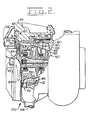
- a first stage 120 is located in the housing 101 and includes a first rotor chamber 112, a first rotor 124 rotatably positioned in the first rotor chamber 122, a first plurality of blades 126 evenly spaced and secured around the outer periphery of the rotor 124, a first plurality of nozzles 128 interconnecting the first inlet port 102 and the first rotor chamber 122, and an outlet passage 130.
- a nozzle 132 is shown in Fig. 2 rotated 90 ° out of location.
- the nozzle 132 as illustrated should be rotated 90 ° to be positioned in the top plane as properly illustrated in Fig. 4.
- Each nozzle 132 of the plurality of nozzles 128, as better illustrated in Fig. 4 has a bellmouth inlet 134 formed by a radius of curvature equal to 1/2 the diameter of a throat portion 136.
- the throat portion 136 has an axial straight length equal to 1/2 the diameter of the throat.
- An outlet portion 138 has a conical surface with an included angle of approximately 10 ° .
- the outlet portion 138 of each nozzle 132 opens into the first rotor chamber 122.
- the plurality of nozzles 128 cover an arc of approximately 136° and open into the first rotor chamber 122 adjacent the plurality of blades 126.
- Each blade 140 of the plurality of blades 126 are shaped such that a passage 142 between each pair of blades is of a constant width.
- the height and width of each blade 140 is substantially the same as the height of the minor diameter of each of the outlet portions 138 of the plurality of nozzles 128.
- a second stage 150 is located in the housing 101 and includes a second rotor chamber 152, a second rotor 154 rotatably positioned in the second rotor chamber 152, a second plurality of blades 156 evenly spaced and secured around the periphery of the second rotor 154, a second plurality of evenly spaced nozzles 158 opening into the second rotor chamber 152 adjacent the second plurality of blades, and an outlet passage 160.
- a first passage means 162 is provided for connecting the second inlet port 106 with the second plurality of nozzles 158 so that the steam from a source, such as the second heat exchanger 74, is substantially axially directed to a first portion of the nozzles of the second plurality of nozzles 158 at a predetermined velocity.
- the first passage means 162, as better illustrated in Figs. 5 and 6, includes an arcuate slot 164 connected to the second inlet port 106. At the area of connection with the second inlet port 106, the arcuate slot 164 has a predetermined cross-sectional area and defines an arc of approximately 200°. the cross-sectional area decreases as the arcuate slot 164 extends towards the second plurality of nozzles 158. The 200 ° angle of arc remains substantially constant and the arcuate slot opens to the second plurality of nozzles 158 in a substantially axial direction.
- a second passage means 170 is provided for connecting the outlet passage 130 of the first stage 120 with the other portion of nozzles of the second plurality of nozzles 158 so that the steam from the outlet passage 130 of the first stage 120 is substantially axially directed to the other portion of the plurality of nozzles 158 at substantially the same velocity as the predetermined velocity of the steam from the second inlet port 106.
- the second passage means 170 as better illustrated in Figs. 5 and 6, includes an arcuate slot 172 connected to the outlet passage 130 of the first stage 120. At the area of connection with the outlet passage 130, the arcuate slot 172 has a predetermined cross-sectional area and defines an arc of approximately 160 ° .
- the cross-sectional area increases as the arcuate slot 172 extends towards the second plurality of nozzles 158.
- the 160 ° angle of arc remains substantially constant and the arcuate slot 172 extends towards the second plurality of nozzles 158 in a substantially axial direction.
- a third stage 180 is located in the housing 101 and includes a third rotor chamber 182, a third rotor 184 rotatably positioned in the third rotor chamber 182, a third plurality of blades 186 evenly spaced and secured around the periphery of the third rotor, a third plurality of evenly spaced nozzles 188 connected to the outlet passage 160 of the second stage 150 and opening into the third rotor chamber 182 adjacent the third plurality of blades, and an outlet passage 190 connected to the outlet port 110.
- water from the reservoir 42 is drawn into the pump 40 and directed into the conduit 56 at a predetermined pressure level of for example 2140 kPa (310 psi) as established by the relief valve 57.
- the polisher 46 sufficiently cleans the water so that no impurities or other deposits are allowed to pass through. These deposits, if allowed to pass through would possibly cause lime or other deposits to form in the system thus reducing the overall efficiency of the heat recovery system.
- the pressurized water in conduit 56 flows through the first passageway 54 of the preheating means 50 and is preheated by the hot oil in the lubrication system. Due to the temperature of the oil, the water in the first passageway 54 is preheated to approximately 105°C (220 ° F). Because the water in the conduit 56 is under pressure, it does not convert to steam.
- the preheated water is directed to the evaporator 68 of the first heat exchanger 60 by the conduit 62.
- the flow control valve 92 in the conduit 62 controls the flow entering the first heat exchanger 60 and also controls the pressure of the fluid to approximately 130 kPa (19 psi).
- the heat in the second fluid passageway 72 from the jacket water of the engine 12 adds heat energy to the water and converts the water to steam. Since the temperature of the fluid in the water jacket is approximately 121°C (250 ° F) and the pressure of the fluid is approximately 130 kPa, the water is converted to steam and exits at 121°C and 130 kPa.
- the steam from the first heat exchanger 60 is directed to the second heat exchanger 74 where it is superheated to a temperature of approximately 182 ° C (360 ° F).
- the exhaust from the engine 12 is used to superheat the steam in the second heat exchanger 74.
- the temperature of the exhaust as it leaves the engine 12 is approximately 460°C (860°F).
- the steam is superheated to a predetermined temperature and maintained at the predetermined pressure level of 130 kPa.
- the other portion of the preheated water in conduit 62 is directed to the third heat exchanger 82 through the conduit 88.
- the flow control valve 96 in the conduit controls the flow entering the third heat exchanger 82 and also controls the pressure of the fluid to approximately 1724 kPa (250 psi).
- the preheated water entering the third heat exchanger 82 is converted to steam and superheated to approximately 415 ° C (780 ° F) and maintained at the 1724 kPa pressure level.
- the heat energy in the oil cooling system 26 By using the heat energy in the oil cooling system 26 to preheat the water from the pump 40 and by using the heat energy in the jacket water of the engine 72 to convert some of the preheated water to steam, then the heat energy in the exhaust system is sufficient to convert the remainder of the water to steam and to superheat both quantities of steam to their respective preselected temperatures.
- This arrangement provides the greatest effective use of the potential heat energy from the engine 12.
- a radiator normally will not be required in the system.
- the problems of sooting and oxide formations are greatly reduced. This helps both the efficiency of the system and the life of the elements of the second and third heat exchangers 74,82 located in the exhaust system 16.
- the dual pressure turbine 100 is used to convert the superheated steam into useful work.
- the superheated steam at 460 ° C and 1724 kPa is connected to the first inlet port 102 of the dual pressure turbine 100 and the superheated steam at 121 ° C and 130 kPa is connected to the second inlet port 106.
- the superheated steam in the first inlet port 102 is directed into the first rotor chamber 122 through the first plurality of nozzles 128. Based on the volume of superheated steam produced and the pressure thereof, nine nozzles 132 are used to direct the superheated steam to the blades 126 of the first stage rotor 124.
- each of the nine nozzles Due to the shape of each of the nine nozzles, the velocity of the steam is increased such that the steam impinges the blades at supersonic speed. It has been found that the highest efficiency of the first stage is attributed to the high velocity of the superheated system, the very close spacing of the nozzle exits, and the controlled constant spacing between the blades 126 on the rotor 124. Furthermore, the height and width of each of the blades 126 is substantially the same as the height of the minor diameter of each of the nozzle exits 138. These relationships provide a desired speed of 50,000 rpm.
- the superheated steam leaves the blades 126 first stage rotor 124 at a velocity of approximately 137m/sec (450 ft/sec), a temperature of approximately 182°C (360 ° F); and a pressure of approximately 130 kPa (19 psi).
- the pressure differential between the pressure of the steam entering the first stage 120 and the pressure of the steam leaving the first stage 120 results in a first stage turbine having a pressure ratio of approximately 13:1.
- the superheated steam enters the arcuate slot 172 and is directed towards the second plurality of nozzles 158.
- the velocity of the superheated steam is decreased to approximately 76m/sec (250 ft/sec) prior to entering the second plurality of nozzles 158. Because the arcuate angle of the arcuate slot 172 is approximately 160 ° , the superheated steam from the first stage is directed substantially only to a portion of the second plurality of nozzles 158 equal to the arcuate angle of the arcuate slot 172.
- the superheated steam at the second inlet port 106 is communicated with the second plurality of nozzles 158 through the arcuate slot 164.
- the velocity of the superheated steam at the second inlet port is approximately 30m/sec (100 ft/sec) and has a temperature of approximately 182 ° C. Since the cross-sectional area of the arcuate slot 164 decreases in size as it extends towards the second plurality of nozzles 158 the velocity of the steam is increased to approximately 76m/sec (250 ft/sec) prior to entering the second plurality of nozzles 158.
- the superheated steam from the second inlet port is directed substantially only to the other portion of the plurality of nozzles 158 equal to the arcuate angle of the arcuate slot 164.
- the superheated steam be directed into the second plurality of nozzles 158 in a substantially axial direction in order to generally eliminate turbulence in the steam flow. Furthermore, in order to maximize the efficiency of the turbine 100, the respective temperature, pressure, and velocity of the superheated steam from the second inlet port 106 and the outlet passage 130 of the first stage 120 should be substantially equal prior to entering the second plurality of nozzles 158.
- the second stage 150 is a full admission stage receiving the superheated steam from two different sources.
- the steam exiting the second stage 150 enters the third plurality of nozzles 188 of the third full admission stage 180.
- the steam exiting the third stage 180 is connected to the outlet port 110 and directed to the condenser 112 where it is condensed back to water and returned to the reservoir 42.
- the heat recovery system 10 as described above provides a system having an operating efficiency above 20% and the dual pressure turbine 100 in the system has an operating efficiency above 80% and most effectively utilizes the heat energy produced by the engine 12 while limiting total size and controlling the cost.
- the three stage dual pressure turbine 100 effectively utilizes the superheated steam produced from the heat energy in the engine 12 by using a first impulse stage having steam at supersonic velocity impinging the blades of the first stage rotor. Furthermore the velocity of the steam exiting the first stage and the steam entering the second inlet port is controlled so that when they enter the second stage their velocities are substantially the same.
- the second and third stages are full admission transonic reaction stages.
- the above three stage dual pressure turbine arrangement maintains the superheated steam in a superheated condition all the way through each stage. If any droplets of water form while in any of the three stages, they would erode away material thus causing damage and shortening the effective life of the dual pressure turbine.
Landscapes
- Engineering & Computer Science (AREA)
- Chemical & Material Sciences (AREA)
- Combustion & Propulsion (AREA)
- Mechanical Engineering (AREA)
- General Engineering & Computer Science (AREA)
- Physics & Mathematics (AREA)
- Fluid Mechanics (AREA)
- Engine Equipment That Uses Special Cycles (AREA)
Claims (6)
Applications Claiming Priority (2)
| Application Number | Priority Date | Filing Date | Title |
|---|---|---|---|
| US671262 | 1984-11-14 | ||
| US06/671,262 US4586338A (en) | 1984-11-14 | 1984-11-14 | Heat recovery system including a dual pressure turbine |
Related Parent Applications (1)
| Application Number | Title | Priority Date | Filing Date |
|---|---|---|---|
| EP85901663.6 Division | 1986-05-27 |
Publications (2)
| Publication Number | Publication Date |
|---|---|
| EP0241049A1 EP0241049A1 (de) | 1987-10-14 |
| EP0241049B1 true EP0241049B1 (de) | 1989-11-02 |
Family
ID=24693776
Family Applications (2)
| Application Number | Title | Priority Date | Filing Date |
|---|---|---|---|
| EP85901663A Expired EP0202234B1 (de) | 1984-11-14 | 1985-01-14 | Wärmewiedergewinnungssystem mit zweidruckturbine |
| EP87107466A Expired EP0241049B1 (de) | 1984-11-14 | 1985-01-14 | Zweidruckturbine |
Family Applications Before (1)
| Application Number | Title | Priority Date | Filing Date |
|---|---|---|---|
| EP85901663A Expired EP0202234B1 (de) | 1984-11-14 | 1985-01-14 | Wärmewiedergewinnungssystem mit zweidruckturbine |
Country Status (5)
| Country | Link |
|---|---|
| US (1) | US4586338A (de) |
| EP (2) | EP0202234B1 (de) |
| JP (2) | JPS62500948A (de) |
| DE (1) | DE3563642D1 (de) |
| WO (1) | WO1986002977A1 (de) |
Cited By (2)
| Publication number | Priority date | Publication date | Assignee | Title |
|---|---|---|---|---|
| EP3559433B1 (de) * | 2017-02-10 | 2021-12-22 | Cummins Inc. | System und verfahren zum expandieren des durchflusses in einem abwärmerückgewinnungssystem |
| EP3578771B1 (de) * | 2018-06-04 | 2022-02-23 | Audi AG | Kraftfahrzeug sowie ein verfahren zum betrieb eines kraftfahrzeugs |
Families Citing this family (48)
| Publication number | Priority date | Publication date | Assignee | Title |
|---|---|---|---|---|
| SE464716B (sv) * | 1987-02-25 | 1991-06-03 | Project Promotion Services | Kraftvaermeanlaeggning |
| CA1312292C (en) * | 1987-04-06 | 1993-01-05 | Daniel Dupuis | Filtering bag and filter |
| US5000003A (en) * | 1989-08-28 | 1991-03-19 | Wicks Frank E | Combined cycle engine |
| US5056315A (en) * | 1989-10-17 | 1991-10-15 | Jenkins Peter E | Compounded turbocharged rotary internal combustion engine fueled with natural gas |
| US5339632A (en) * | 1992-12-17 | 1994-08-23 | Mccrabb James | Method and apparatus for increasing the efficiency of internal combustion engines |
| IT1272684B (it) * | 1993-09-27 | 1997-06-26 | Gianluigi Reis | Sistema di ricupero energia dissipata, durante la sua marcia, da un veicolo a motore a combustione interna |
| US6095240A (en) * | 1998-07-01 | 2000-08-01 | Vita International, Inc. | Quadruple heat exchanger |
| US6047767A (en) * | 1998-04-21 | 2000-04-11 | Vita International, Inc. | Heat exchanger |
| US5875633A (en) * | 1998-04-24 | 1999-03-02 | Lawson, Jr.; Thomas Towles | Cooling system for internal combustion engines |
| JP2001271609A (ja) | 2000-01-18 | 2001-10-05 | Honda Motor Co Ltd | 内燃機関の廃熱回収装置 |
| JP2002115801A (ja) * | 2000-10-05 | 2002-04-19 | Honda Motor Co Ltd | 蒸発器の蒸気温度制御装置 |
| JP4647857B2 (ja) * | 2000-10-10 | 2011-03-09 | 本田技研工業株式会社 | 内燃機関のランキンサイクル装置 |
| WO2002031319A1 (en) * | 2000-10-10 | 2002-04-18 | Honda Giken Kogyo Kabushiki Kaisha | Rankine cycle device of internal combustion engine |
| JP2002115505A (ja) * | 2000-10-11 | 2002-04-19 | Honda Motor Co Ltd | 内燃機関のランキンサイクル装置 |
| WO2003029619A1 (en) * | 2001-09-28 | 2003-04-10 | Honda Giken Kogyo Kabushiki Kaisha | Temperature control device of evaporator |
| US8061139B2 (en) * | 2002-05-22 | 2011-11-22 | Ormat Technologies, Inc. | Integrated engine generator rankine cycle power system |
| WO2005088123A1 (de) * | 2004-03-15 | 2005-09-22 | Uestuen Orhan | Vorrichtung zur speicherung von wärmeenergie zur anschliessenden umwandlung in elektrische energie |
| WO2006138459A2 (en) * | 2005-06-16 | 2006-12-28 | Utc Power Corporation | Organic rankine cycle mechanically and thermally coupled to an engine driving a common load |
| US8141360B1 (en) | 2005-10-18 | 2012-03-27 | Florida Turbine Technologies, Inc. | Hybrid gas turbine and internal combustion engine |
| US7454911B2 (en) * | 2005-11-04 | 2008-11-25 | Tafas Triantafyllos P | Energy recovery system in an engine |
| US20100192574A1 (en) | 2006-01-19 | 2010-08-05 | Langson Richard K | Power compounder |
| DE102006010247B4 (de) | 2006-03-02 | 2019-12-19 | Man Truck & Bus Se | Antriebseinheit mit Wärmerückgewinnung |
| US20070271938A1 (en) * | 2006-05-26 | 2007-11-29 | Johnson Controls Technology Company | Automated inlet steam supply valve controls for a steam turbine powered chiller unit |
| DE102006043139B4 (de) * | 2006-09-14 | 2015-02-12 | Man Truck & Bus Ag | Vorrichtung zur Gewinnung von mechanischer oder elektrischer Energie aus der Abwärme eines Verbrennungsmotors eines Kraftfahrzeugs |
| DE102007003801A1 (de) * | 2007-01-25 | 2008-07-31 | Compact Dynamics Gmbh | Vorrichtung zur Gewinnung elektrischer Energie aus der Abgaswärme einer Verbrennungsmaschine eines Kraftfahrzeuges, und Verfahren zur Gewinnung elektrischer Energie aus der Abgaswärme einer Verbrennungsmaschine eines Kraftfahrzeuges |
| DE102007032437B3 (de) * | 2007-07-10 | 2008-10-16 | Voith Patent Gmbh | Verfahren und Vorrichtung zur Steuerung eines Dampfkreisprozesses |
| US20090205331A1 (en) * | 2008-02-19 | 2009-08-20 | Marsh J Kendall | Piston based double compounding engine |
| US8327654B2 (en) * | 2008-03-17 | 2012-12-11 | Denso International America, Inc. | Condenser, radiator, and fan module with Rankine cycle fan |
| US20090235664A1 (en) * | 2008-03-24 | 2009-09-24 | Total Separation Solutions, Llc | Cavitation evaporator system for oil well fluids integrated with a Rankine cycle |
| FR2929239B1 (fr) † | 2008-03-31 | 2010-04-16 | Aker Yards Sa | Navire pourvu de moyens de recuperation d'energie thermique et procede correspondant |
| US8353160B2 (en) * | 2008-06-01 | 2013-01-15 | John Pesce | Thermo-electric engine |
| US8046998B2 (en) | 2008-10-01 | 2011-11-01 | Toyota Motor Engineering & Manufacturing North America, Inc. | Waste heat auxiliary power unit |
| US20100146974A1 (en) * | 2008-12-16 | 2010-06-17 | General Electric Company | System for recovering waste heat |
| US8850814B2 (en) * | 2009-06-11 | 2014-10-07 | Ormat Technologies, Inc. | Waste heat recovery system |
| WO2011035073A2 (en) * | 2009-09-21 | 2011-03-24 | Clean Rolling Power, LLC | Waste heat recovery system |
| US20120096864A1 (en) * | 2010-10-26 | 2012-04-26 | General Electric Company | Air cooled condenser fogging control system |
| US8714288B2 (en) | 2011-02-17 | 2014-05-06 | Toyota Motor Engineering & Manufacturing North America, Inc. | Hybrid variant automobile drive |
| WO2013025341A1 (en) * | 2011-08-12 | 2013-02-21 | Dresser-Rand Company | Parallel cascaded cycle gas expander |
| ITTO20111184A1 (it) * | 2011-12-21 | 2013-06-22 | Soilmec Spa | Macchina per la costruzione dotata di un apparato per il recupero energetico. |
| WO2013160993A1 (ja) * | 2012-04-23 | 2013-10-31 | トヨタ自動車株式会社 | 熱輸送装置 |
| US9115603B2 (en) * | 2012-07-24 | 2015-08-25 | Electratherm, Inc. | Multiple organic Rankine cycle system and method |
| US9181866B2 (en) | 2013-06-21 | 2015-11-10 | Caterpillar Inc. | Energy recovery and cooling system for hybrid machine powertrain |
| CN103982259B (zh) * | 2014-04-22 | 2015-09-16 | 浙江银轮机械股份有限公司 | 一种基于orc系统的柴油发电机废热发电装置 |
| CN103982255B (zh) * | 2014-04-22 | 2015-08-19 | 浙江银轮机械股份有限公司 | 一种用于船舶主机废热发电orc系统 |
| CN104165102A (zh) * | 2014-04-22 | 2014-11-26 | 浙江银轮机械股份有限公司 | 一种基于有机郎肯循环的发动机废热回收系统 |
| US9874114B2 (en) * | 2014-07-17 | 2018-01-23 | Panasonic Intellectual Property Management Co., Ltd. | Cogenerating system |
| US20160123206A1 (en) * | 2014-11-03 | 2016-05-05 | The Boeing Company | Waste heat reclamation system, method for reclamation of waste heat, and system and method for using waste heat |
| IT202100009647A1 (it) * | 2021-04-16 | 2022-10-16 | Stacmol Ricerca E Sviluppo S R L | Sistema di conversione dell’energia termica in energia elettrica |
Family Cites Families (25)
| Publication number | Priority date | Publication date | Assignee | Title |
|---|---|---|---|---|
| DE301453C (de) * | ||||
| GB190916249A (en) * | 1908-07-24 | 1909-11-18 | App Rateau Soc D Expl Des | Improvements in Steam Turbines. |
| GB191301614A (en) * | 1912-02-19 | 1913-05-15 | Joseph Weishaeupl | Improvements in or relating to Steam or Gas Turbines. |
| GB171036A (en) * | 1920-11-02 | 1921-11-10 | John Picton Chittenden | Improvements in and connected with steam turbine installations |
| FR899051A (fr) * | 1942-11-09 | 1945-05-18 | Goetaverken Ab | Turbine |
| DE886912C (de) * | 1942-12-06 | 1953-08-17 | Wagner Hochdruck Dampfturbinen | Dampfturbinenbeschaufelung mit veraenderlicher Geschwindigkeits-abstufung |
| GB709477A (en) * | 1949-04-28 | 1954-05-26 | Karl Andreas Roeder | Improvements in and relating to multi-stage steam turbines |
| US3861150A (en) * | 1972-06-02 | 1975-01-21 | Lear Motors Corp | Low pollution vapor engine systems |
| US3830062A (en) * | 1973-10-09 | 1974-08-20 | Thermo Electron Corp | Rankine cycle bottoming plant |
| US4031705A (en) * | 1974-11-15 | 1977-06-28 | Berg John W | Auxiliary power system and apparatus |
| JPS609366B2 (ja) * | 1977-08-01 | 1985-03-09 | パイオニア株式会社 | Agc回路 |
| JPS5476988A (en) * | 1977-12-01 | 1979-06-20 | Hitachi Cable Ltd | Preparing parallel multicore cable |
| BE863558A (fr) * | 1978-02-02 | 1978-08-02 | Acec | Perfectionnements aux installations de production d'energie comprenant des moteurs a combustion interne associes a des turbines de detente a circuit ferme entrainant des generatrices de courant electrique |
| CH632051A5 (de) * | 1978-10-25 | 1982-09-15 | Sulzer Ag | Brennkraftmaschinenanlage. |
| US4276747A (en) * | 1978-11-30 | 1981-07-07 | Fiat Societa Per Azioni | Heat recovery system |
| US4421454A (en) * | 1979-09-27 | 1983-12-20 | Solar Turbines Incorporated | Turbines |
| US4435121A (en) * | 1979-09-27 | 1984-03-06 | Solar Turbines Incorporated | Turbines |
| US4366674A (en) * | 1980-06-06 | 1983-01-04 | Caterpillar Tractor Co. | Internal combustion engine with Rankine bottoming cycle |
| JPS57108402A (en) * | 1980-12-25 | 1982-07-06 | Mitsui Eng & Shipbuild Co Ltd | Equipment for recovering heat of exhaust gas of internal combustion engine |
| JPS57171003A (en) * | 1981-04-15 | 1982-10-21 | Toshiba Corp | Steam turbine |
| JPS5865917A (ja) * | 1981-10-15 | 1983-04-19 | Takuma Sogo Kenkyusho:Kk | デイゼル機関に於ける排熱回収動力発生装置 |
| JPS5922042A (ja) * | 1982-07-07 | 1984-02-04 | チバ・ガイギ−・ア−ゲ− | 固定焦点引伸機 |
| JPS5968504A (ja) * | 1982-10-13 | 1984-04-18 | Hitachi Ltd | ガスタ−ビン冷却媒体の熱回収システム |
| JPS59126007A (ja) * | 1983-01-08 | 1984-07-20 | Mitsui Eng & Shipbuild Co Ltd | デイ−ゼル機関の燃料ガス圧縮駆動装置 |
| JPS59131711A (ja) * | 1983-01-18 | 1984-07-28 | Toshiba Corp | 水力発電所の冷却装置 |
-
1984
- 1984-11-14 US US06/671,262 patent/US4586338A/en not_active Expired - Lifetime
-
1985
- 1985-01-14 JP JP60501507A patent/JPS62500948A/ja active Pending
- 1985-01-14 EP EP85901663A patent/EP0202234B1/de not_active Expired
- 1985-01-14 DE DE8585901663T patent/DE3563642D1/de not_active Expired
- 1985-01-14 WO PCT/US1985/000052 patent/WO1986002977A1/en not_active Ceased
- 1985-01-14 EP EP87107466A patent/EP0241049B1/de not_active Expired
-
1991
- 1991-12-27 JP JP3346133A patent/JPH0626400A/ja active Pending
Cited By (2)
| Publication number | Priority date | Publication date | Assignee | Title |
|---|---|---|---|---|
| EP3559433B1 (de) * | 2017-02-10 | 2021-12-22 | Cummins Inc. | System und verfahren zum expandieren des durchflusses in einem abwärmerückgewinnungssystem |
| EP3578771B1 (de) * | 2018-06-04 | 2022-02-23 | Audi AG | Kraftfahrzeug sowie ein verfahren zum betrieb eines kraftfahrzeugs |
Also Published As
| Publication number | Publication date |
|---|---|
| DE3563642D1 (en) | 1988-08-11 |
| WO1986002977A1 (en) | 1986-05-22 |
| EP0241049A1 (de) | 1987-10-14 |
| EP0202234B1 (de) | 1988-07-06 |
| JPH0626400A (ja) | 1994-02-01 |
| JPS62500948A (ja) | 1987-04-16 |
| US4586338A (en) | 1986-05-06 |
| EP0202234A1 (de) | 1986-11-26 |
Similar Documents
| Publication | Publication Date | Title |
|---|---|---|
| EP0241049B1 (de) | Zweidruckturbine | |
| EP0173774B1 (de) | Gasturbine | |
| EP1828550B1 (de) | Verfahren und vorrichtung zur energieerzeugung unter verwendung von abwärme | |
| US4684321A (en) | Heat recovery system including a dual pressure turbine | |
| US3991821A (en) | Heat exchange system | |
| EP0939200A1 (de) | Kühldampfsystem für dampfgekühlte Gasturbine | |
| CN1093214C (zh) | 汽轮机和冷却通风运行中的汽轮机的方法 | |
| US2851863A (en) | Air conditioning apparatus for aircraft | |
| US4055299A (en) | Energy source for large heating systems | |
| US4813228A (en) | Gas turbine | |
| CN113404556B (zh) | 一种汽轮机低压轴封减温系统 | |
| US4023367A (en) | Steam engine for a motor vehicle | |
| US3596888A (en) | Arrangement of mixing condensers for steam turbine powerplants | |
| US2663145A (en) | Power plant comprising the combination of gas and steam turbines with a superchargedfurnace steamgenerator | |
| US6305157B1 (en) | Gas turbine engine | |
| EP0098363B1 (de) | Gasturbine mit Kontrolle der Schaufeltemperatur | |
| CA1251052A (en) | Dual pressure turbine | |
| US1887717A (en) | Combustion turbine | |
| CA1251049A (en) | Heat recovery system including a dual pressure turbine | |
| US3400911A (en) | Structure of exhaust chamber in gas turbines | |
| US2654220A (en) | Apparatus for directing air to combustion products turbines | |
| US4396002A (en) | Tubular air heater | |
| US1637276A (en) | Heat-exchanging apparatus | |
| US2544941A (en) | Gas turbine plant | |
| RU2115004C1 (ru) | Способ работы газотурбинной установки и газотурбинная установка |
Legal Events
| Date | Code | Title | Description |
|---|---|---|---|
| PUAI | Public reference made under article 153(3) epc to a published international application that has entered the european phase |
Free format text: ORIGINAL CODE: 0009012 |
|
| AC | Divisional application: reference to earlier application |
Ref document number: 202234 Country of ref document: EP |
|
| AK | Designated contracting states |
Kind code of ref document: A1 Designated state(s): CH DE FR GB LI SE |
|
| 17P | Request for examination filed |
Effective date: 19880331 |
|
| 17Q | First examination report despatched |
Effective date: 19880908 |
|
| GRAA | (expected) grant |
Free format text: ORIGINAL CODE: 0009210 |
|
| AC | Divisional application: reference to earlier application |
Ref document number: 202234 Country of ref document: EP |
|
| AK | Designated contracting states |
Kind code of ref document: B1 Designated state(s): CH DE FR GB LI SE |
|
| REF | Corresponds to: |
Ref document number: 3574045 Country of ref document: DE Date of ref document: 19891207 |
|
| ET | Fr: translation filed | ||
| PLBE | No opposition filed within time limit |
Free format text: ORIGINAL CODE: 0009261 |
|
| STAA | Information on the status of an ep patent application or granted ep patent |
Free format text: STATUS: NO OPPOSITION FILED WITHIN TIME LIMIT |
|
| 26N | No opposition filed | ||
| EAL | Se: european patent in force in sweden |
Ref document number: 87107466.2 |
|
| PGFP | Annual fee paid to national office [announced via postgrant information from national office to epo] |
Ref country code: SE Payment date: 19951213 Year of fee payment: 12 |
|
| PG25 | Lapsed in a contracting state [announced via postgrant information from national office to epo] |
Ref country code: SE Effective date: 19970115 |
|
| EUG | Se: european patent has lapsed |
Ref document number: 87107466.2 |
|
| PGFP | Annual fee paid to national office [announced via postgrant information from national office to epo] |
Ref country code: FR Payment date: 19971202 Year of fee payment: 14 |
|
| PG25 | Lapsed in a contracting state [announced via postgrant information from national office to epo] |
Ref country code: FR Free format text: LAPSE BECAUSE OF NON-PAYMENT OF DUE FEES Effective date: 19990930 |
|
| REG | Reference to a national code |
Ref country code: FR Ref legal event code: ST |
|
| PGFP | Annual fee paid to national office [announced via postgrant information from national office to epo] |
Ref country code: CH Payment date: 20000330 Year of fee payment: 16 |
|
| PGFP | Annual fee paid to national office [announced via postgrant information from national office to epo] |
Ref country code: GB Payment date: 20001127 Year of fee payment: 17 Ref country code: DE Payment date: 20001127 Year of fee payment: 17 |
|
| PG25 | Lapsed in a contracting state [announced via postgrant information from national office to epo] |
Ref country code: LI Free format text: LAPSE BECAUSE OF NON-PAYMENT OF DUE FEES Effective date: 20010131 Ref country code: CH Free format text: LAPSE BECAUSE OF NON-PAYMENT OF DUE FEES Effective date: 20010131 |
|
| REG | Reference to a national code |
Ref country code: CH Ref legal event code: PL |
|
| REG | Reference to a national code |
Ref country code: GB Ref legal event code: IF02 |
|
| PG25 | Lapsed in a contracting state [announced via postgrant information from national office to epo] |
Ref country code: GB Free format text: LAPSE BECAUSE OF NON-PAYMENT OF DUE FEES Effective date: 20020114 |
|
| PG25 | Lapsed in a contracting state [announced via postgrant information from national office to epo] |
Ref country code: DE Free format text: LAPSE BECAUSE OF NON-PAYMENT OF DUE FEES Effective date: 20020801 |
|
| GBPC | Gb: european patent ceased through non-payment of renewal fee |
Effective date: 20020114 |