EP0240843B1 - Photoempfindliche Zusammensetzung, Herstellungs- und Anwendungsverfahren - Google Patents
Photoempfindliche Zusammensetzung, Herstellungs- und Anwendungsverfahren Download PDFInfo
- Publication number
- EP0240843B1 EP0240843B1 EP87104399A EP87104399A EP0240843B1 EP 0240843 B1 EP0240843 B1 EP 0240843B1 EP 87104399 A EP87104399 A EP 87104399A EP 87104399 A EP87104399 A EP 87104399A EP 0240843 B1 EP0240843 B1 EP 0240843B1
- Authority
- EP
- European Patent Office
- Prior art keywords
- radical
- photosensitive
- formula
- photosensitive composite
- resin
- Prior art date
- Legal status (The legal status is an assumption and is not a legal conclusion. Google has not performed a legal analysis and makes no representation as to the accuracy of the status listed.)
- Expired - Lifetime
Links
- 239000002131 composite material Substances 0.000 title claims description 55
- 238000000034 method Methods 0.000 title claims description 33
- 229920001577 copolymer Polymers 0.000 claims description 45
- 229920005989 resin Polymers 0.000 claims description 40
- 239000011347 resin Substances 0.000 claims description 40
- -1 alkyl radical Chemical class 0.000 claims description 36
- 150000001875 compounds Chemical class 0.000 claims description 29
- PPBRXRYQALVLMV-UHFFFAOYSA-N Styrene Chemical compound C=CC1=CC=CC=C1 PPBRXRYQALVLMV-UHFFFAOYSA-N 0.000 claims description 22
- 239000000203 mixture Substances 0.000 claims description 15
- 229920001665 Poly-4-vinylphenol Polymers 0.000 claims description 13
- 239000007864 aqueous solution Substances 0.000 claims description 13
- 238000002156 mixing Methods 0.000 claims description 13
- 239000000463 material Substances 0.000 claims description 12
- 125000004435 hydrogen atom Chemical group [H]* 0.000 claims description 11
- 239000000758 substrate Substances 0.000 claims description 11
- ISWSIDIOOBJBQZ-UHFFFAOYSA-N Phenol Chemical compound OC1=CC=CC=C1 ISWSIDIOOBJBQZ-UHFFFAOYSA-N 0.000 claims description 10
- 229920000642 polymer Polymers 0.000 claims description 9
- 238000006243 chemical reaction Methods 0.000 claims description 8
- JHIVVAPYMSGYDF-UHFFFAOYSA-N cyclohexanone Chemical compound O=C1CCCCC1 JHIVVAPYMSGYDF-UHFFFAOYSA-N 0.000 claims description 8
- TUJKJAMUKRIRHC-UHFFFAOYSA-N hydroxyl Chemical compound [OH] TUJKJAMUKRIRHC-UHFFFAOYSA-N 0.000 claims description 7
- ZWEHNKRNPOVVGH-UHFFFAOYSA-N 2-Butanone Chemical compound CCC(C)=O ZWEHNKRNPOVVGH-UHFFFAOYSA-N 0.000 claims description 6
- CSCPPACGZOOCGX-UHFFFAOYSA-N Acetone Chemical compound CC(C)=O CSCPPACGZOOCGX-UHFFFAOYSA-N 0.000 claims description 6
- 238000005530 etching Methods 0.000 claims description 6
- 239000003960 organic solvent Substances 0.000 claims description 6
- 239000000047 product Substances 0.000 claims description 6
- 239000002253 acid Substances 0.000 claims description 5
- 239000012954 diazonium Substances 0.000 claims description 5
- 150000003254 radicals Chemical class 0.000 claims description 5
- 125000000391 vinyl group Chemical group [H]C([*])=C([H])[H] 0.000 claims description 5
- XLLIQLLCWZCATF-UHFFFAOYSA-N 2-methoxyethyl acetate Chemical compound COCCOC(C)=O XLLIQLLCWZCATF-UHFFFAOYSA-N 0.000 claims description 4
- SLRMQYXOBQWXCR-UHFFFAOYSA-N 2154-56-5 Chemical compound [CH2]C1=CC=CC=C1 SLRMQYXOBQWXCR-UHFFFAOYSA-N 0.000 claims description 4
- XEKOWRVHYACXOJ-UHFFFAOYSA-N Ethyl acetate Chemical group CCOC(C)=O XEKOWRVHYACXOJ-UHFFFAOYSA-N 0.000 claims description 4
- RMRFFCXPLWYOOY-UHFFFAOYSA-N allyl radical Chemical compound [CH2]C=C RMRFFCXPLWYOOY-UHFFFAOYSA-N 0.000 claims description 4
- 125000003118 aryl group Chemical group 0.000 claims description 4
- 150000005840 aryl radicals Chemical class 0.000 claims description 4
- 230000032050 esterification Effects 0.000 claims description 4
- 238000005886 esterification reaction Methods 0.000 claims description 4
- 150000002148 esters Chemical group 0.000 claims description 4
- LEVJVKGPFAQPOI-UHFFFAOYSA-N phenylmethanone Chemical compound O=[C]C1=CC=CC=C1 LEVJVKGPFAQPOI-UHFFFAOYSA-N 0.000 claims description 4
- 239000002904 solvent Substances 0.000 claims description 4
- 239000003513 alkali Substances 0.000 claims description 3
- 125000002573 ethenylidene group Chemical group [*]=C=C([H])[H] 0.000 claims description 3
- 238000004519 manufacturing process Methods 0.000 claims description 3
- WSFSSNUMVMOOMR-NJFSPNSNSA-N methanone Chemical compound O=[14CH2] WSFSSNUMVMOOMR-NJFSPNSNSA-N 0.000 claims description 3
- WCYWZMWISLQXQU-UHFFFAOYSA-N methyl Chemical compound [CH3] WCYWZMWISLQXQU-UHFFFAOYSA-N 0.000 claims description 3
- HTQNYBBTZSBWKL-UHFFFAOYSA-N 2,3,4-trihydroxbenzophenone Chemical compound OC1=C(O)C(O)=CC=C1C(=O)C1=CC=CC=C1 HTQNYBBTZSBWKL-UHFFFAOYSA-N 0.000 claims description 2
- XNWFRZJHXBZDAG-UHFFFAOYSA-N 2-METHOXYETHANOL Chemical compound COCCO XNWFRZJHXBZDAG-UHFFFAOYSA-N 0.000 claims description 2
- ZNQVEEAIQZEUHB-UHFFFAOYSA-N 2-ethoxyethanol Chemical compound CCOCCO ZNQVEEAIQZEUHB-UHFFFAOYSA-N 0.000 claims description 2
- SVONRAPFKPVNKG-UHFFFAOYSA-N 2-ethoxyethyl acetate Chemical compound CCOCCOC(C)=O SVONRAPFKPVNKG-UHFFFAOYSA-N 0.000 claims description 2
- NTIZESTWPVYFNL-UHFFFAOYSA-N Methyl isobutyl ketone Chemical compound CC(C)CC(C)=O NTIZESTWPVYFNL-UHFFFAOYSA-N 0.000 claims description 2
- UIHCLUNTQKBZGK-UHFFFAOYSA-N Methyl isobutyl ketone Natural products CCC(C)C(C)=O UIHCLUNTQKBZGK-UHFFFAOYSA-N 0.000 claims description 2
- 239000012670 alkaline solution Substances 0.000 claims description 2
- 150000001408 amides Chemical class 0.000 claims description 2
- 239000007859 condensation product Substances 0.000 claims description 2
- 238000007334 copolymerization reaction Methods 0.000 claims description 2
- 150000001989 diazonium salts Chemical class 0.000 claims description 2
- 238000010894 electron beam technology Methods 0.000 claims description 2
- 239000003759 ester based solvent Substances 0.000 claims description 2
- 125000005843 halogen group Chemical group 0.000 claims description 2
- 230000001678 irradiating effect Effects 0.000 claims description 2
- 239000005453 ketone based solvent Substances 0.000 claims description 2
- 229940043265 methyl isobutyl ketone Drugs 0.000 claims description 2
- 150000002896 organic halogen compounds Chemical class 0.000 claims description 2
- ORTFAQDWJHRMNX-UHFFFAOYSA-M oxidooxomethyl Chemical compound [O-][C]=O ORTFAQDWJHRMNX-UHFFFAOYSA-M 0.000 claims description 2
- 238000003892 spreading Methods 0.000 claims description 2
- 125000005207 tetraalkylammonium group Chemical group 0.000 claims description 2
- XLYOFNOQVPJJNP-UHFFFAOYSA-N water Chemical compound O XLYOFNOQVPJJNP-UHFFFAOYSA-N 0.000 claims description 2
- QTBSBXVTEAMEQO-UHFFFAOYSA-N Acetic acid Natural products CC(O)=O QTBSBXVTEAMEQO-UHFFFAOYSA-N 0.000 claims 2
- WTQZSMDDRMKJRI-UHFFFAOYSA-N 4-diazoniophenolate Chemical compound [O-]C1=CC=C([N+]#N)C=C1 WTQZSMDDRMKJRI-UHFFFAOYSA-N 0.000 claims 1
- DKPFZGUDAPQIHT-UHFFFAOYSA-N butyl acetate Chemical group CCCCOC(C)=O DKPFZGUDAPQIHT-UHFFFAOYSA-N 0.000 claims 1
- HBGGXOJOCNVPFY-UHFFFAOYSA-N diisononyl phthalate Chemical compound CC(C)CCCCCCOC(=O)C1=CC=CC=C1C(=O)OCCCCCCC(C)C HBGGXOJOCNVPFY-UHFFFAOYSA-N 0.000 claims 1
- 230000018109 developmental process Effects 0.000 description 22
- 238000001020 plasma etching Methods 0.000 description 17
- WGTYBPLFGIVFAS-UHFFFAOYSA-M tetramethylammonium hydroxide Chemical compound [OH-].C[N+](C)(C)C WGTYBPLFGIVFAS-UHFFFAOYSA-M 0.000 description 16
- 229920002120 photoresistant polymer Polymers 0.000 description 7
- 239000000470 constituent Substances 0.000 description 6
- XUIMIQQOPSSXEZ-UHFFFAOYSA-N Silicon Chemical compound [Si] XUIMIQQOPSSXEZ-UHFFFAOYSA-N 0.000 description 5
- 238000002474 experimental method Methods 0.000 description 5
- 229910052710 silicon Inorganic materials 0.000 description 5
- 239000010703 silicon Substances 0.000 description 5
- 230000004304 visual acuity Effects 0.000 description 5
- SMZOUWXMTYCWNB-UHFFFAOYSA-N 2-(2-methoxy-5-methylphenyl)ethanamine Chemical compound COC1=CC=C(C)C=C1CCN SMZOUWXMTYCWNB-UHFFFAOYSA-N 0.000 description 4
- NIXOWILDQLNWCW-UHFFFAOYSA-N 2-Propenoic acid Natural products OC(=O)C=C NIXOWILDQLNWCW-UHFFFAOYSA-N 0.000 description 4
- 239000000243 solution Substances 0.000 description 4
- WSFSSNUMVMOOMR-UHFFFAOYSA-N Formaldehyde Chemical compound O=C WSFSSNUMVMOOMR-UHFFFAOYSA-N 0.000 description 3
- 229920000877 Melamine resin Polymers 0.000 description 3
- HEMHJVSKTPXQMS-UHFFFAOYSA-M Sodium hydroxide Chemical compound [OH-].[Na+] HEMHJVSKTPXQMS-UHFFFAOYSA-M 0.000 description 3
- 125000005396 acrylic acid ester group Chemical group 0.000 description 3
- 230000015572 biosynthetic process Effects 0.000 description 3
- 238000001312 dry etching Methods 0.000 description 3
- RTZKZFJDLAIYFH-UHFFFAOYSA-N ether Substances CCOCC RTZKZFJDLAIYFH-UHFFFAOYSA-N 0.000 description 3
- 229920001519 homopolymer Polymers 0.000 description 3
- JDSHMPZPIAZGSV-UHFFFAOYSA-N melamine Chemical compound NC1=NC(N)=NC(N)=N1 JDSHMPZPIAZGSV-UHFFFAOYSA-N 0.000 description 3
- 150000002735 metacrylic acids Chemical class 0.000 description 3
- XJRBAMWJDBPFIM-UHFFFAOYSA-N methyl vinyl ether Chemical compound COC=C XJRBAMWJDBPFIM-UHFFFAOYSA-N 0.000 description 3
- 230000035945 sensitivity Effects 0.000 description 3
- 239000000126 substance Substances 0.000 description 3
- XYLMUPLGERFSHI-UHFFFAOYSA-N alpha-Methylstyrene Chemical compound CC(=C)C1=CC=CC=C1 XYLMUPLGERFSHI-UHFFFAOYSA-N 0.000 description 2
- 238000004061 bleaching Methods 0.000 description 2
- DIKBFYAXUHHXCS-UHFFFAOYSA-N bromoform Chemical compound BrC(Br)Br DIKBFYAXUHHXCS-UHFFFAOYSA-N 0.000 description 2
- 230000000052 comparative effect Effects 0.000 description 2
- FFUAGWLWBBFQJT-UHFFFAOYSA-N hexamethyldisilazane Chemical compound C[Si](C)(C)N[Si](C)(C)C FFUAGWLWBBFQJT-UHFFFAOYSA-N 0.000 description 2
- 230000005855 radiation Effects 0.000 description 2
- 150000003440 styrenes Chemical class 0.000 description 2
- VZGDMQKNWNREIO-UHFFFAOYSA-N tetrachloromethane Chemical compound ClC(Cl)(Cl)Cl VZGDMQKNWNREIO-UHFFFAOYSA-N 0.000 description 2
- QEMXHQIAXOOASZ-UHFFFAOYSA-N tetramethylammonium Chemical compound C[N+](C)(C)C QEMXHQIAXOOASZ-UHFFFAOYSA-N 0.000 description 2
- BMWBYLGWPWDACF-UHFFFAOYSA-N 1-(methoxymethyl)-4-[4-(methoxymethyl)phenoxy]benzene Chemical compound C1=CC(COC)=CC=C1OC1=CC=C(COC)C=C1 BMWBYLGWPWDACF-UHFFFAOYSA-N 0.000 description 1
- KTZVZZJJVJQZHV-UHFFFAOYSA-N 1-chloro-4-ethenylbenzene Chemical compound ClC1=CC=C(C=C)C=C1 KTZVZZJJVJQZHV-UHFFFAOYSA-N 0.000 description 1
- OYXJYPFMYHHTPR-UHFFFAOYSA-N 2-(4-azidophenyl)-3-(4-methoxyphenyl)prop-2-enenitrile Chemical compound C1=CC(OC)=CC=C1C=C(C#N)C1=CC=C(N=[N+]=[N-])C=C1 OYXJYPFMYHHTPR-UHFFFAOYSA-N 0.000 description 1
- JESXATFQYMPTNL-UHFFFAOYSA-N 2-ethenylphenol Chemical group OC1=CC=CC=C1C=C JESXATFQYMPTNL-UHFFFAOYSA-N 0.000 description 1
- MYMOFIZGZYHOMD-UHFFFAOYSA-N Dioxygen Chemical compound O=O MYMOFIZGZYHOMD-UHFFFAOYSA-N 0.000 description 1
- 206010034972 Photosensitivity reaction Diseases 0.000 description 1
- 229920003171 Poly (ethylene oxide) Polymers 0.000 description 1
- CIUQDSCDWFSTQR-UHFFFAOYSA-N [C]1=CC=CC=C1 Chemical compound [C]1=CC=CC=C1 CIUQDSCDWFSTQR-UHFFFAOYSA-N 0.000 description 1
- 230000002378 acidificating effect Effects 0.000 description 1
- 150000001412 amines Chemical class 0.000 description 1
- 125000000852 azido group Chemical group *N=[N+]=[N-] 0.000 description 1
- CTDQFROYPMYVII-UHFFFAOYSA-N azido n-diazosulfamate;cyclohexa-2,5-diene-1,4-dione Chemical compound O=C1C=CC(=O)C=C1.[N-]=[N+]=NOS(=O)(=O)N=[N+]=[N-] CTDQFROYPMYVII-UHFFFAOYSA-N 0.000 description 1
- 239000002585 base Substances 0.000 description 1
- 125000003236 benzoyl group Chemical group [H]C1=C([H])C([H])=C(C([H])=C1[H])C(*)=O 0.000 description 1
- 229950005228 bromoform Drugs 0.000 description 1
- 125000000484 butyl group Chemical group [H]C([*])([H])C([H])([H])C([H])([H])C([H])([H])[H] 0.000 description 1
- 229910052799 carbon Inorganic materials 0.000 description 1
- 239000003054 catalyst Substances 0.000 description 1
- 238000001816 cooling Methods 0.000 description 1
- 239000013078 crystal Substances 0.000 description 1
- IJGRMHOSHXDMSA-UHFFFAOYSA-O diazynium Chemical compound [NH+]#N IJGRMHOSHXDMSA-UHFFFAOYSA-O 0.000 description 1
- 229910001882 dioxygen Inorganic materials 0.000 description 1
- 238000004090 dissolution Methods 0.000 description 1
- 235000019439 ethyl acetate Nutrition 0.000 description 1
- 239000011888 foil Substances 0.000 description 1
- 239000007789 gas Substances 0.000 description 1
- 238000010438 heat treatment Methods 0.000 description 1
- XLYOFNOQVPJJNP-UHFFFAOYSA-M hydroxide Chemical compound [OH-] XLYOFNOQVPJJNP-UHFFFAOYSA-M 0.000 description 1
- 125000001972 isopentyl group Chemical group [H]C([H])([H])C([H])(C([H])([H])[H])C([H])([H])C([H])([H])* 0.000 description 1
- QSHDDOUJBYECFT-UHFFFAOYSA-N mercury Chemical compound [Hg] QSHDDOUJBYECFT-UHFFFAOYSA-N 0.000 description 1
- 229910052753 mercury Inorganic materials 0.000 description 1
- 230000036211 photosensitivity Effects 0.000 description 1
- 229920003023 plastic Polymers 0.000 description 1
- 239000004033 plastic Substances 0.000 description 1
- 230000007261 regionalization Effects 0.000 description 1
- 150000003839 salts Chemical class 0.000 description 1
- 239000004065 semiconductor Substances 0.000 description 1
- 238000001039 wet etching Methods 0.000 description 1
Classifications
-
- G—PHYSICS
- G03—PHOTOGRAPHY; CINEMATOGRAPHY; ANALOGOUS TECHNIQUES USING WAVES OTHER THAN OPTICAL WAVES; ELECTROGRAPHY; HOLOGRAPHY
- G03C—PHOTOSENSITIVE MATERIALS FOR PHOTOGRAPHIC PURPOSES; PHOTOGRAPHIC PROCESSES, e.g. CINE, X-RAY, COLOUR, STEREO-PHOTOGRAPHIC PROCESSES; AUXILIARY PROCESSES IN PHOTOGRAPHY
- G03C1/00—Photosensitive materials
-
- G—PHYSICS
- G03—PHOTOGRAPHY; CINEMATOGRAPHY; ANALOGOUS TECHNIQUES USING WAVES OTHER THAN OPTICAL WAVES; ELECTROGRAPHY; HOLOGRAPHY
- G03F—PHOTOMECHANICAL PRODUCTION OF TEXTURED OR PATTERNED SURFACES, e.g. FOR PRINTING, FOR PROCESSING OF SEMICONDUCTOR DEVICES; MATERIALS THEREFOR; ORIGINALS THEREFOR; APPARATUS SPECIALLY ADAPTED THEREFOR
- G03F7/00—Photomechanical, e.g. photolithographic, production of textured or patterned surfaces, e.g. printing surfaces; Materials therefor, e.g. comprising photoresists; Apparatus specially adapted therefor
- G03F7/004—Photosensitive materials
- G03F7/038—Macromolecular compounds which are rendered insoluble or differentially wettable
- G03F7/0388—Macromolecular compounds which are rendered insoluble or differentially wettable with ethylenic or acetylenic bands in the side chains of the photopolymer
-
- G—PHYSICS
- G03—PHOTOGRAPHY; CINEMATOGRAPHY; ANALOGOUS TECHNIQUES USING WAVES OTHER THAN OPTICAL WAVES; ELECTROGRAPHY; HOLOGRAPHY
- G03F—PHOTOMECHANICAL PRODUCTION OF TEXTURED OR PATTERNED SURFACES, e.g. FOR PRINTING, FOR PROCESSING OF SEMICONDUCTOR DEVICES; MATERIALS THEREFOR; ORIGINALS THEREFOR; APPARATUS SPECIALLY ADAPTED THEREFOR
- G03F7/00—Photomechanical, e.g. photolithographic, production of textured or patterned surfaces, e.g. printing surfaces; Materials therefor, e.g. comprising photoresists; Apparatus specially adapted therefor
-
- G—PHYSICS
- G03—PHOTOGRAPHY; CINEMATOGRAPHY; ANALOGOUS TECHNIQUES USING WAVES OTHER THAN OPTICAL WAVES; ELECTROGRAPHY; HOLOGRAPHY
- G03F—PHOTOMECHANICAL PRODUCTION OF TEXTURED OR PATTERNED SURFACES, e.g. FOR PRINTING, FOR PROCESSING OF SEMICONDUCTOR DEVICES; MATERIALS THEREFOR; ORIGINALS THEREFOR; APPARATUS SPECIALLY ADAPTED THEREFOR
- G03F7/00—Photomechanical, e.g. photolithographic, production of textured or patterned surfaces, e.g. printing surfaces; Materials therefor, e.g. comprising photoresists; Apparatus specially adapted therefor
- G03F7/004—Photosensitive materials
- G03F7/008—Azides
- G03F7/012—Macromolecular azides; Macromolecular additives, e.g. binders
- G03F7/0125—Macromolecular azides; Macromolecular additives, e.g. binders characterised by the polymeric binder or the macromolecular additives other than the macromolecular azides
-
- G—PHYSICS
- G03—PHOTOGRAPHY; CINEMATOGRAPHY; ANALOGOUS TECHNIQUES USING WAVES OTHER THAN OPTICAL WAVES; ELECTROGRAPHY; HOLOGRAPHY
- G03F—PHOTOMECHANICAL PRODUCTION OF TEXTURED OR PATTERNED SURFACES, e.g. FOR PRINTING, FOR PROCESSING OF SEMICONDUCTOR DEVICES; MATERIALS THEREFOR; ORIGINALS THEREFOR; APPARATUS SPECIALLY ADAPTED THEREFOR
- G03F7/00—Photomechanical, e.g. photolithographic, production of textured or patterned surfaces, e.g. printing surfaces; Materials therefor, e.g. comprising photoresists; Apparatus specially adapted therefor
- G03F7/004—Photosensitive materials
- G03F7/016—Diazonium salts or compounds
- G03F7/021—Macromolecular diazonium compounds; Macromolecular additives, e.g. binders
-
- G—PHYSICS
- G03—PHOTOGRAPHY; CINEMATOGRAPHY; ANALOGOUS TECHNIQUES USING WAVES OTHER THAN OPTICAL WAVES; ELECTROGRAPHY; HOLOGRAPHY
- G03F—PHOTOMECHANICAL PRODUCTION OF TEXTURED OR PATTERNED SURFACES, e.g. FOR PRINTING, FOR PROCESSING OF SEMICONDUCTOR DEVICES; MATERIALS THEREFOR; ORIGINALS THEREFOR; APPARATUS SPECIALLY ADAPTED THEREFOR
- G03F7/00—Photomechanical, e.g. photolithographic, production of textured or patterned surfaces, e.g. printing surfaces; Materials therefor, e.g. comprising photoresists; Apparatus specially adapted therefor
- G03F7/004—Photosensitive materials
- G03F7/022—Quinonediazides
- G03F7/023—Macromolecular quinonediazides; Macromolecular additives, e.g. binders
- G03F7/0233—Macromolecular quinonediazides; Macromolecular additives, e.g. binders characterised by the polymeric binders or the macromolecular additives other than the macromolecular quinonediazides
-
- G—PHYSICS
- G03—PHOTOGRAPHY; CINEMATOGRAPHY; ANALOGOUS TECHNIQUES USING WAVES OTHER THAN OPTICAL WAVES; ELECTROGRAPHY; HOLOGRAPHY
- G03F—PHOTOMECHANICAL PRODUCTION OF TEXTURED OR PATTERNED SURFACES, e.g. FOR PRINTING, FOR PROCESSING OF SEMICONDUCTOR DEVICES; MATERIALS THEREFOR; ORIGINALS THEREFOR; APPARATUS SPECIALLY ADAPTED THEREFOR
- G03F7/00—Photomechanical, e.g. photolithographic, production of textured or patterned surfaces, e.g. printing surfaces; Materials therefor, e.g. comprising photoresists; Apparatus specially adapted therefor
- G03F7/004—Photosensitive materials
- G03F7/038—Macromolecular compounds which are rendered insoluble or differentially wettable
Definitions
- the present invention relates to photosensitive composites useful for the formation of fine resist patterns, and more particularly, to photosensitive composites of positive or negative-type which show a wide tolerance for alkaline development conditions when applied to lithographic technique or the like.
- Photosensitive resins are being used wideiy in many fields of planar processes including the manufacture of semiconductors.
- the resist patterns are becoming increasingly fine in their structure in order to increase the density of the electronic devices, accompanying diversification in functions and sophistication of these devices.
- resistance to heat and resistance to reactive ion etching (RIE) which is being employed widely in recent times as a method of etching, of resist patterns are being required.
- RIE reactive ion etching
- the object of the present invention is to provide photosensitive composites which have not only excellent heat resistivity, RIE resistivity, and resolving power, but also have an ample tolerance to alkaline development conditions of resist patterns, and hence, are useful to the formation of fine resist patterns.
- the applicants of the present invention were abie to obtain knowledge that by the introduction of a nonsubstitutional or substitutional benzyl radical to the phenol side chain of polyvinylphenol, the alkaline solubility of resist at the time of development after exposure can be reduced, and hence, widens the tolerance to the alkaline development conditions.
- the phenol side chain of polyvinylphenol and the phenyl radical in the nonsubstitutional or substitutional benzyl radical due to the presence of the phenol side chain of polyvinylphenol and the phenyl radical in the nonsubstitutional or substitutional benzyl radical, heat resistivity and RIE resistivity can be improved, which led to the completion of the present invention.
- a photosensitive composites of the present invention comprises a photosensitive compounds and a resin which contains polymers that include a structural unit as shown by the following formula: and a structural unit as shown by the following formula:
- the photosensitive composites of the present invention are used as the photoresist in the photographic techniques such as the printing method and the bleaching out color process.
- the photographic techniques consists ordinarily of the resist process in which after spreading an appropriate resist material over a silicon single crystal wafer or the like, a desired resist pattern is formed by irradiating the resist material with ultraviolet rays, electron beams, or the like, and the etching process in which the wafer which is the base film is fabricated by the use of the resist pattern formed.
- the photosensitive composites of the present invention are used as the resist material in this method.
- the resist process is a process in which a difference in the alkaline solubility is generated in the exposed portion and the unexposed portion to a beam irradiation, and a predetermined resist pattern is obtained by dissoling the exposed or unexposed portion with an alkaline developer.
- the resolving power, sensitivity, and the like of the resist pattern obtained are determined eventually by the quality of the development process. Therefore, the control of the duration of development, temperature of development, concentration of the developer, and the like during the development process become extremely important. It means then that discovery of resist materials which permits the formation of patterns with high accuracy desired under lax control conditions will be very welcome.
- the reactive ion etching (RIE) method which enables finer fabrication is in wide use in recent years, as mentioned earlier.
- the resist materials of the present invention will also be used in the RIE method. Accordingly, these photosensitive composites have to possess an excellent resistivity to RIE.
- the resist material is heated to an extremely high temperature in the RIE process so that it has to be a substance which will not generate deformation at high temperatures. Otherwise, the accuracy of the resist pattern will be deteriorated quickly by such a deformation.
- the photosensitive composites has to have in general a satisfactory adhesivity to a substrate or the like for which an eventual pattern formation is desired.
- the photosensitive composites of the present invention that satisfy these requirements consist of photosensitive compounds and resins that contain polymers that include a structural unit shown by the following formula: and a structural unit shown by the following formula:
- nonsubstitutional or substitutional benzyl radical is introduced to the phenol side chain, so that their acidity is lowered, alkaline solubility of the resist, at the time of development after exposure, is reduced, and hence, tolerance to the alkaline development conditions can be increased.
- the number average molecular weight of the resin is desirable to be of order of 103 to 105.
- the ideal content of a polymer that contains structural units shown by the formula (I) and (II) in the resin is 10 to 100% by weight.
- R1, R2, R3, ..., R4, and R5 in the formula (I) may be identical or may be different, and each represents hydrogen atom, halogen atom, alkyl radical, carboxyl radical, alkylcarbonyl radical, alkoxycarbonyl radical, alkoxy radical, acyloxy radical, allyl radical, aryl radical, hydroxy radical, halogenoalkyl radical, cyanoalkyl radical, or alkoxyalkyl radical.
- R6 represents hydrogen atom, alkyl radical, allyl radical, aryl radical, alkylcarbonyl radical, allylcarbonyl radical, or quinonediazidosulphonyl radical.
- a photosensitive composites of the present invention consists of a resin that contains a polymer that includes the formula (I) and (II) as the structural units, as a first indispensable constituent, and a photosensitive composites as a second indispensable constituent.
- the resin which is the first indispensable constituent necessarily contains a polymer which contains in the molecule as the components a structural unit shown by the formula (I) and a structural unit shown by the formula (II).
- the form in which these units are contained is under no special restrictions, and can take, for example, modes as will be enumerated in the following.
- the rate that the copolymers, which consists of a structural unit shown by formula (I) and a structural unit shown by formula (II), occupy in the resin has to be set at 10 to 100% by weight. This is because if the rate is less than 10% by weight, there will arise such problems as the RIE resistivity becomes poor and the control of the alkaline solubility becomes difficult (in other words, if an acidic group such as acrylic acid is introduced in excess, then resin obtained becomes excessively soluble, whereas if the amount of alkaline insoluble group such as styrene is increased, resin obtained becomes excessively insoluble).
- the number average molecular weight of the components of resin that contains these polymers in the range of 103 to 105. In particular, it is desirable to choose it in the range of 2,000 to 60,000 because of a more conspicuous tolerance to alkaline development, compared with the case of polyvinylphenol that was disclosed in the past. If the number average molecular weight is less than 103, adhesivity of the resist becomes poor and the tolerance to alkaline development is also deteriorated. On the other hand, if it exceeds 105, exposure sensitivity and the resolving power during development become poor and the tolerance to alkaline development is also deteriorated.
- the polymers in the photosensitive composite can be obtained by adding styrene to polyvinylphenol with parasulfonic acid as a catalyst.
- photosensitive compound which represents the second indispensable component of the photosensitive composite of the present invention
- a photosensitive compound of positive or negative type As examples of such photosensitive compound, one may mention, for instance, p-quinonediazides such as ⁇ -napththylamide of p-benzoquinone diazidosulfonic acid, p-iminoquinonediazides as disclosed in the specifications of British Patents No. 723382 and No.
- an organic halogen compound such as bromoform can be used if in the mixing withh polyvinylphenol, use is made of low molecular weight diazonium, diazosulfonates of aromatic and complex ring type amines, quinonediazides, diazo radical, azido radicals, high molecular weight products that contain other photosensitive groups, or polyethylene oxides.
- the photosensitive compound particularly useful is o-naphthoquinonediazidosulfonic acid, o-quinonediazides such as aromatic esters or amides of o-naphthoquinonediazidocarbonic acid.
- the mixing ratio of resin and photosensitive compound varies depending upon the kind of resin and photosensitive compound used, and their combination.
- a support member (substrate) on which is to be formed a resist layer by the use of a photosensitive composite one may choose it from general materials such as plastic, metallic foil, or metallic plate.
- organic solvent for this purpose, it is desirable to use such ketone-based solvents as cyclohexanone, acetone, methylethylketone, methylisobutylketone, cellosolve-based solvents such as methylcellosolve, methylcellosolve acetate, and ethylcellosolve acetate, or ester-based solvents such as acetic ester, acetic butyl, and acetic isoamyl, or a mixture of some of these solvents.
- ketone-based solvents as cyclohexanone, acetone, methylethylketone, methylisobutylketone
- cellosolve-based solvents such as methylcellosolve, methylcellosolve acetate, and ethylcellosolve acetate
- ester-based solvents such as acetic ester, acetic butyl, and acetic isoamyl, or a mixture
- a printing plate prepared in the above manner is exposed to a mercury lamp or the like, and then is developed with an aqueous solution of an alkali.
- the alkaline solution used for the development may be anything if it can dissolve the exposed portion in the case of positive type, and the unexposed portion in the case of negative type, and has an extremely low dissolution speed for the remaining portion.
- tetraalkylammonium aqueous solution like tetramethylammonium aqueous solution
- inorganic alkaline aqueous solution such as pottasium hydroxide, sodium hydroxide, and the like.
- the support material is etched.
- etching namely, wet etching and dry etching
- dry etching is preferred for the case of forming fine patterns with line width less than 3 ⁇ m.
- CF4, C2F6, CCl4, Bl3, Cl2, HCl, H2, or the like is used, as combined if needed.
- the unexposed portion that remains on the substrate after etching is removed from the top of the above material by means of a remover such as J-100 (manufactured by Nagase Chemical Industries, Inc.), oxygen gas plasma, or the like.
- the photosensitive composite of the present invention has not only excellent heat resistivity, RIE resistivity, and resolving power, but also has a wide tolerance width for alkaline development conditions, for instance, variations in concentration and temperature during development, so that it is possible to form a fine resist pattern with ease by using it.
- Styrene and polyvinylphenol (number average molecular weight: 7,000) were brought to reaction in a molar ratio of 2 : 10 to obtain a copolymer as shown by the following formula: Then, a resin was prepared by introducing benzoyl radical in place of hydrogen atom of the hydroxyl radical in phenol, by supplying benzoyl in a molar ratio of 1 : 10 for the copolymer.
- a photosensitive compound shown by the following formula is mixed for 80 parts by weight of the resin to obtain a photosensitive composite.
- HMDS hexamethyldisilazane
- the photoresist was exposed to a stepper that uses monochromatic radiation of 436 nm, developed for 20 seconds in a 3.0% aqueous solution of tetramethylammoniumhydroxide (TMAH) at 21°C, to form a resist pattern.
- TMAH tetramethylammoniumhydroxide
- L/S lines and spaces
- the resistivity to RIE was found to be improved by about 30% compared with the prior-art resist patterns.
- the resistivity to RIE is determined by measuring the film thickness before and after giving RIE.
- Example 2 An experiment was carried out similarly to Example 1, except for the use of 1,2-naphthoxydiazido-5-sulfonic acid ester (average esterification factor of 2.0) of 2,3,4-trihydroxybenzophenone as the photosensitive compound.
- a resist pattern was obtained by developing for 60 seconds at 21°C using a 2.2% aqueous solution of TMAH as the developer.
- TMAH aqueous solution of TMAH
- Example 2 Analogous to Example 1, there was obtained a resist pattern with a steep cross sectional profile even if the developer temperature is varied in the range of 25°C ⁇ 5°C and the concentration is varied in the range of 2.2% ⁇ 0.2%.
- heat resistivity and RIE resistivity obtained were similar to the results in Example 1.
- Example 1 Using the resin, a photosensitive composite was obtained in a manner similar to Example 1. Experiments similar to Example 1 confirmed that the composite has excellent properties similar to the composite of Example 1.
- a resin consisting of a copolymer shown by the following formula: was obtained by bringing styrene and polyvinylphenol (number average molecular weight : 6,000) into reaction in the molar ratio of 2 : 10.
- a photosensitive composite was obtained by mixing 30 parts by weight of the photosensitive compound shown by the following formula: for 100 parts by weight of the resin produced,where A in the avove formula represents On the other hand, a silicon wafer was heated in hot plate at 150°C for one hour, and after cooling it down to the room temperature, it was left standing for 3 minutes in an atmosphere of hexamethyldisilazane (HMDS) before it was taken out.
- HMDS hexamethyldisilazane
- a solution of the photosensitive composite was spread over the silicon wafer with spinner, dried in hot plate for 2 minutes at 90°C, and a photoresist of thickness 1.5 ⁇ m was formed.
- a resist pattern was formed by exposing the photoresist to monochromatic radiation of 436 nm by means of a stepper, and by developing for 45 seconds with a 2.38% aqueous solution of tetramethylammonium hyeroxide (TMAH) at 25°C.
- TMAH tetramethylammonium hyeroxide
- a solution of photosensitive composite was prepared by mixing, in 80 g of cyclohexanone 20 g of polyvinylphenol of number average molecular weight 10,000 and 4 g of a photosensitive compound, 4-azido-4′-methoxy- ⁇ -cyanostilbene.
Landscapes
- Physics & Mathematics (AREA)
- Spectroscopy & Molecular Physics (AREA)
- General Physics & Mathematics (AREA)
- Chemical & Material Sciences (AREA)
- Engineering & Computer Science (AREA)
- Materials Engineering (AREA)
- Addition Polymer Or Copolymer, Post-Treatments, Or Chemical Modifications (AREA)
- Exposure And Positioning Against Photoresist Photosensitive Materials (AREA)
- Photosensitive Polymer And Photoresist Processing (AREA)
- Compositions Of Macromolecular Compounds (AREA)
Claims (25)
- Lichtempfindlicher Verbund, umfassend:(a) ein Harz, das ein Polymer umfaßt, das(i) eine strukturelle Einheit der folgenden Formel:
 (ii) eine strukturelle Einheit der folgenden Formel:umfaßt, und
 (b) eine lichtempfindliche Verbindung.
 - Lichtempfindlicher Verbund nach Anspruch 1, wobei das Harz ein Copolymer umfaßt, das aus der strukturellen Einheit der Formel (I) und der strukturellen Einheit der Formel (II) besteht.
- Lichtempfindlicher Verbund nach Anspruch 1, wobei das Harz ein Copolymer umfaßt, das aus(a) einer Vielzahl von strukturellen Einheiten der Formel (I), bei denen mindestens ein Satz der Substituentengruppen R₁ bis R₅ unterschiedlich von dem Rest ist, und(b) einer strukturelle Einheit der Formel (II) besteht.
- Lichtempfindlicher Verbund nach Anspruch 1, wobei das Harz eine Mischung von einer Vielzahl von Arten an jeweils verschiedenen Copolymeren gemäß Anspruch 2 umfaßt, wobei mindestens ein Satz der Substituentengruppen R₁ bis R₅, die in den Copolymeren beinhaltet sind, sich von dem Rest unterscheidet.
- Lichtempfindlicher Verbund nach Anspruch 1, wobei das Harz eine Mischung eines Copolymers gemäß Anspruch 2 und eines Copolymers, das aus einer strukturellen Einheit der Formel (I), einer strukturellen Einheit der Formel (II) und einer strukturellen Einheit, ausgewählt aus einer Vinylkette, Vinylidenkette und Esterkette, besteht, umfaßt.
- Lichtempfindlicher Verbund nach Anspruch 1, wobei das Harz eine Mischung von einer Vielzahl von Arten jeweils unterschiedlicher Copolymere, die jeweils aus einer strukturellen Einheit der Formel (I), einer strukturellen Einheit der Formel (II) und einer strukturellen Einheit, ausgewählt aus einer Vinylkette, Vinylidenkette und Esterkette, bestehen, umfaßt.
- Lichtempfindlicher Verbund nach Anspruch 1, wobei das durchschnittliche Zahlenmolekulargewicht des Harzes 10³ bis 10⁵ ist.
- Lichtempfindlicher Verbund nach Anspruch 7, wobei das durchschnittliche Zahlenmolekulargewicht des Harzes 2.000 bis 60.000 ist.
- Lichtempfindlicher Verbund nach Anspruch 7, wobei der Gehalt eines Polymers, das strukturelle Einheiten der Formel (I) und der Formel (II) umfaßt, in dem Harz 10 bis 100 Gew.-% ist.
- Lichtempfindlicher Verbund nach Anspruch 9, wobei der Gehalt der lichtempfindlichen Verbindung in dem lichtempfindlichen Verbund 0,1 bis 50 Gew.-% ist.
- Lichtempfindlicher Verbund nach Anspruch 9, wobei, wenn die Zahl der strukturellen Einheiten der Formel (I) k ist, und die Zahl der strukturellen Einheiten der Formel (II) 1 ist, diese Zahlen der Bedingung

- Lichtempfindlicher Verbund nach Anspruch 9, wobei die lichtempfindliche Verbindung(a) ein Kondensationsprodukt zwischen einem p-Chinondiazid, p-Iminochinondiazid oder Diazoniumsalz und Formaldehyd, das in einem organischen Lösungsmittel löslich ist,(b) ein Copolymerisationsprodukt zwischen einem aromatischen Diazoniumsalz oder einem aromatischen Produkt und Formaldehyd,(c) ein aromatisches Azid, oder(d) eine organische Halogenverbindung ist.
- Lichtempfindlicher Verbund nach Anspruch 9, wobei die lichtempfindliche Verbindung(a) ein aromatischer Ester von o-Naphthochinondiazidosulfonsäure oder o-Naphthochinondiazidocarbonsäure oder(b) o-Chinondiazid, wie Amid, ist.
- Lichtempfindlicher Verbund nach Anspruch 9, wobei die lichtempfindliche Verbindung eine Verbindung der folgenden Formel


- Lichtempfindlicher Verbund nach Anspruch 14, wobei das Harz ein Copolymer der folgenden Formel

- Verfahren zur Herstellung des lichtempfindlichen Verbunds nach Anspruch 9, das die Schritte umfaßt:(a) Umsetzen von Styrol und Polyvinylphenol in einem molaren Verhältnis von 2 : 10, um ein Copolymer der Formel
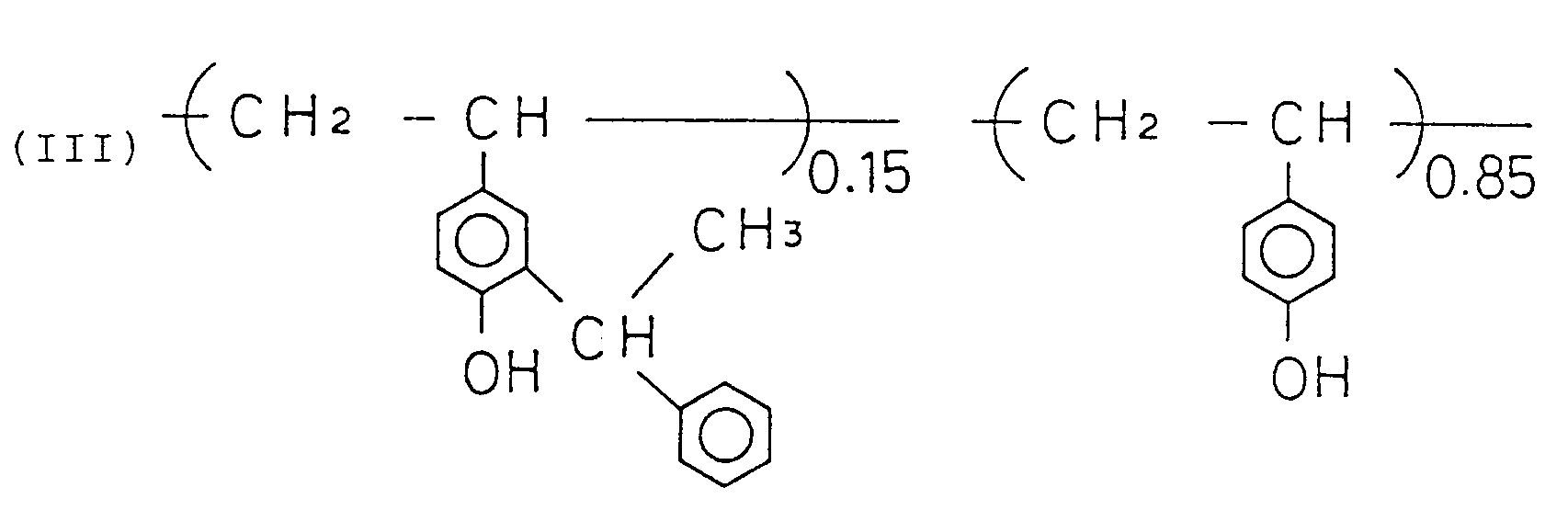 (b) Herstellen eines Harzes durch Einführen von Benzylradikalen in das Copolymer in einem molaren Verhältnis von 1 : 10, um das Benzoylradikal anstelle des Wasserstoffatoms in das Hydroxylradikal des Phenols einzuführen; und(c) Vermengen von 20 Gew.-Teilen einer lichtempfindlichen Verbindungen, dargestellt durch
- Verfahren zur Hestellung des lichtempfindlichen Verbunds nach Anspruch 9, umfassend die Schritte:(a) Umsetzen von Styrol und Polyvinylphenol in einem molaren Verhältnis von 2 : 10, um ein Copolymer der Formel
 (b) Herstellen eines Harzes durch Umsetzen von Benzoylradikalen mit dem Copolymer in einem molaren Verhältnis von 1 : 10, um das Benzoylradikal anstelle des Wasserstoffatoms in das Hydroxylradikal des Phenols einzuführen; und(c) Vermischen des Harzes mit 1,2-Naphthoxydiazido-5-sulfonsäureester (durchschnittlicher Veresterungsgrad 2,0) von 2,3,4-Trihydroxybenzophenon als lichtempfindliche Verbindung.
 - Verfahren zur Herstellung des lichtempfindlichen Verbunds nach Anspruch 9, umfassend die Schritte:(a) Umsetzen von Styrol und Polyvinylphenol in einem molaren Verhältnis von 2 : 10, um ein Copolymer der Formel
 (b) Einführen von
- Verfahren zur Herstellung des lichtempfindlichen Verbunds nach Anspruch 9, umfassend die Schritte:(a) Umsetzen von Styrol und Polyvinylphenol in einem molaren Verhältnis von 3 : 10, um ein Copolymer der Formel
 (b) Einführen des Methylradikals anstelle des Wasserstoffatoms in das Hydroxylradikal des Phenols, durch Umsetzen von dem Methylradikal mit dem Copolymer in einem molaren Verhältnis von 3 : 10; und(c) Mischen von 20 Gew.-Teilen einer lichtempfindlichen Verbindung, dargestellt durch
- Verfahren zur Herstellung eines Resistmusters auf der Oberfläche eines Substrats unter Verwendung des lichtempfindlichen Verbunds nach Anspruch 1, umfassend die Schritte:(a) Lösen des lichtempfindlichen Verbunds in einem organischen Lösungsmittel;(b) Verteilen des lichtempfindlichen Verbunds auf der Oberfläche des Substrats;(c) Schaffen eines Unterschieds in der Löslichkeit gegenüber einer alkalischen, wäßrigen Lösung zwischen dem belichteten Teil und dem unbelichteten Teil, indem man die Oberfläche des Substrats entweder mit einem Licht- oder Elektronenstrahl bestrahlt, um ein vorbestimmtes Muster zu schaffen; und(d) Lösen des belichteten Teils oder des unbelichteten Teils durch Entwickeln der Oberfläche des Substrats mit einem Alkali.
- Verfahren zur Bildung eines Resistmusters nach Anspruch 20, wobei die lichtempfindliche Verbindung, die in dem lichtempfindlichen Verbund eingeschlossen ist, vom positiven Typ ist, so daß der belichtete Teil bei der alkalischen Entwicklung gelöst wird.
- Verfahren zur Bildung eines Resistmusters nach Anspruch 20, wobei die lichtempfindliche Verbindung, die in dem lichtempfindlichen Verbund eingeschlossen ist, vom negativen Typ ist, so daß der unbelichtete Teil bei der alkalkischen Entwicklung gelöst wird.
- Verfahren zur Bildung eines Resistmusters nach Anspruch 20, wobei das organische Lösungsmittel(i) ein auf einem Keton basierendes Lösungmittel, wie Cyclohexanon, Aceton, Methylethylketon und Methylisobutylketon,(ii) ein auf Cellosolve basierendes Lösungsmittel, wie Methylcellosolve, Methylcellosolveacetat und Ethylcellosolveacetat, oder(iii) ein auf einem Ester basierendes Lösungsmittel, wie Essigsäureethyl, Essigsäurebutyl und Essigsäureisoamyl, oder(iv) eine Mischung dieser Lösungsmittel ist.
- Verfahren zur Herstellung eines Resistmusters nach Anspruch 20, wobei die alkalische Lösung für die alkalische Entwicklung eine wäßrige Lösung von Tetraalkylammonium oder eine wäßrige Lösung eines anorganischen Alkali umfaßt.
- Verfahren zur Bearbeitung eines Substrats unter Verwendung eines Resistmusters, das auf der Oberfläche des Substrats gemäß dem in Anspruch 20 beschriebenen Verfahren gebildet wurde, das die Schritte umfaßt:(a) Ätzen des Substrats unter Verwendung des Resistmusters als Maske; und(b) Entfernen des Resistmaterials, das auf dem Substrat zurückbleibt.
Applications Claiming Priority (2)
| Application Number | Priority Date | Filing Date | Title |
|---|---|---|---|
| JP68803/86 | 1986-03-28 | ||
| JP61068803A JPS62227143A (ja) | 1986-03-28 | 1986-03-28 | 感光性組成物 |
Publications (3)
| Publication Number | Publication Date |
|---|---|
| EP0240843A2 EP0240843A2 (de) | 1987-10-14 |
| EP0240843A3 EP0240843A3 (en) | 1990-06-20 |
| EP0240843B1 true EP0240843B1 (de) | 1994-03-02 |
Family
ID=13384239
Family Applications (1)
| Application Number | Title | Priority Date | Filing Date |
|---|---|---|---|
| EP87104399A Expired - Lifetime EP0240843B1 (de) | 1986-03-28 | 1987-03-25 | Photoempfindliche Zusammensetzung, Herstellungs- und Anwendungsverfahren |
Country Status (5)
| Country | Link |
|---|---|
| US (1) | US4828958A (de) |
| EP (1) | EP0240843B1 (de) |
| JP (1) | JPS62227143A (de) |
| KR (1) | KR900005417B1 (de) |
| DE (1) | DE3789154T2 (de) |
Families Citing this family (12)
| Publication number | Priority date | Publication date | Assignee | Title |
|---|---|---|---|---|
| EP0307752B1 (de) * | 1987-09-16 | 1995-02-22 | Hoechst Aktiengesellschaft | Poly(3-mono oder 3,5-disubstituierte acetoxystyrole) und deren Verwendung |
| JP2567282B2 (ja) * | 1989-10-02 | 1996-12-25 | 日本ゼオン株式会社 | ポジ型レジスト組成物 |
| EP0440374B1 (de) * | 1990-01-30 | 1997-04-16 | Wako Pure Chemical Industries Ltd | Chemisch verstärktes Photolack-Material |
| JP3030672B2 (ja) * | 1991-06-18 | 2000-04-10 | 和光純薬工業株式会社 | 新規なレジスト材料及びパタ−ン形成方法 |
| US5198517A (en) * | 1991-08-06 | 1993-03-30 | Eastman Kodak Company | Polymeric scavengers for oxidized developing agents and photographic elements containing the same |
| DE69218393T2 (de) * | 1991-12-16 | 1997-10-16 | Matsushita Electric Ind Co Ltd | Resistmaterial |
| US5550004A (en) * | 1992-05-06 | 1996-08-27 | Ocg Microelectronic Materials, Inc. | Chemically amplified radiation-sensitive composition |
| US5340687A (en) * | 1992-05-06 | 1994-08-23 | Ocg Microelectronic Materials, Inc. | Chemically modified hydroxy styrene polymer resins and their use in photoactive resist compositions wherein the modifying agent is monomethylol phenol |
| TW288112B (de) * | 1993-06-02 | 1996-10-11 | Sumitomo Chemical Co | |
| US5853953A (en) * | 1996-09-06 | 1998-12-29 | Shipley Company, L.L.C. | Polymers and photoresist compositions comprising same |
| KR20020092726A (ko) * | 2001-06-05 | 2002-12-12 | 주식회사 동진쎄미켐 | 포지티브 포토레지스트 조성물 |
| TWI751064B (zh) | 2021-03-29 | 2021-12-21 | 長春人造樹脂廠股份有限公司 | 多元酚樹脂、多元酚樹脂之縮水甘油醚及其應用 |
Family Cites Families (10)
| Publication number | Priority date | Publication date | Assignee | Title |
|---|---|---|---|---|
| GB1375461A (de) * | 1972-05-05 | 1974-11-27 | ||
| JPS5236043B2 (de) * | 1974-02-21 | 1977-09-13 | ||
| US4439516A (en) * | 1982-03-15 | 1984-03-27 | Shipley Company Inc. | High temperature positive diazo photoresist processing using polyvinyl phenol |
| JPS6017739A (ja) * | 1983-07-12 | 1985-01-29 | Cosmo Co Ltd | 微細加工用感光性レジスト |
| EP0135900A3 (de) * | 1983-09-16 | 1986-06-11 | Olin Hunt Specialty Products, Inc. | Wasserentwickelbare negative Schutzschichtzusammensetzung |
| DE3406927A1 (de) * | 1984-02-25 | 1985-08-29 | Hoechst Ag, 6230 Frankfurt | Strahlungsempfindliches gemisch auf basis von saeurespaltbaren verbindungen |
| US4603101A (en) * | 1985-09-27 | 1986-07-29 | General Electric Company | Photoresist compositions containing t-substituted organomethyl vinylaryl ether materials |
| US4737437A (en) * | 1986-03-27 | 1988-04-12 | East Shore Chemical Co. | Light sensitive diazo compound, composition and method of making the composition |
| US4732837A (en) * | 1986-05-02 | 1988-03-22 | Hoechst Celanese Corporation | Novel mixed ester O-quinone photosensitizers |
| US4732836A (en) * | 1986-05-02 | 1988-03-22 | Hoechst Celanese Corporation | Novel mixed ester O-quinone photosensitizers |
-
1986
- 1986-03-28 JP JP61068803A patent/JPS62227143A/ja active Pending
-
1987
- 1987-03-09 US US07/023,261 patent/US4828958A/en not_active Expired - Lifetime
- 1987-03-25 EP EP87104399A patent/EP0240843B1/de not_active Expired - Lifetime
- 1987-03-25 DE DE3789154T patent/DE3789154T2/de not_active Expired - Fee Related
- 1987-03-28 KR KR1019870002905A patent/KR900005417B1/ko not_active Expired
Also Published As
| Publication number | Publication date |
|---|---|
| JPS62227143A (ja) | 1987-10-06 |
| DE3789154T2 (de) | 1994-07-14 |
| KR870009255A (ko) | 1987-10-24 |
| EP0240843A3 (en) | 1990-06-20 |
| US4828958A (en) | 1989-05-09 |
| EP0240843A2 (de) | 1987-10-14 |
| KR900005417B1 (ko) | 1990-07-30 |
| DE3789154D1 (de) | 1994-04-07 |
Similar Documents
| Publication | Publication Date | Title |
|---|---|---|
| JP3660855B2 (ja) | 微細パターン形成方法 | |
| EP0919013B1 (de) | Antireflexbeschichtung für photoresistzusammensetzungen | |
| JP3258014B2 (ja) | ポジ型放射線感応性混合物およびそれを使用して製造した記録材料 | |
| EP1210651B1 (de) | Antireflexbeschichtung für photoresistzusammensetzungen | |
| EP0718316B1 (de) | Vernetzte Polymere | |
| EP0060585B1 (de) | Verfahren zur Herstellung eines Resistmusters auf ein Substrat und Resistmaterial | |
| US5019488A (en) | Method of producing an image reversal negative photoresist having a photo-labile blocked imide | |
| JPH06214387A (ja) | 放射感応性混合物 | |
| CN113214427B (zh) | 一种生物基ArF光刻胶成膜树脂、光刻胶组合物及其制备方法 | |
| US5234791A (en) | Radiation-curable composition and radiation-sensitive recording material prepared therefrom for use with high-energy radiation | |
| JP3495503B2 (ja) | 架橋されたポリマー | |
| US4828958A (en) | Photosensitive composition and method of forming a resist pattern with copolymer of polyvinyl phenol | |
| US4554237A (en) | Photosensitive resin composition and method for forming fine patterns with said composition | |
| US5688634A (en) | Energy sensitive resist material and process for device fabrication using the resist material | |
| EP0361906A2 (de) | Verfahren zur Herstellung negativer Bildumkehr-Fotolacke, die ein photolabiles blockiertes Imid enthalten | |
| EP1131675B1 (de) | Lösemittelsystem für positiv-arbeitende photoresiste | |
| CN113214429B (zh) | 一种ArF光刻胶成膜树脂及其制备方法和光刻胶组合物 | |
| US4701342A (en) | Negative resist with oxygen plasma resistance | |
| US5462840A (en) | Use of poly(35-disubstituted 4-hydroxystyrene/N-substituted maleimide for forming a negative image | |
| CA2020378A1 (en) | Maleimide containing, negative working deep uv photoresist | |
| EP0307752B1 (de) | Poly(3-mono oder 3,5-disubstituierte acetoxystyrole) und deren Verwendung | |
| CN1205783A (zh) | 用于正性光刻胶的混合溶剂系统 | |
| JPH11338151A (ja) | ポジ型感光性組成物 | |
| KR910005031B1 (ko) | 감광성 조성물 | |
| CN113219789A (zh) | 一种星型ArF光刻胶成膜树脂及其制备方法和光刻胶组合物 |
Legal Events
| Date | Code | Title | Description |
|---|---|---|---|
| PUAI | Public reference made under article 153(3) epc to a published international application that has entered the european phase |
Free format text: ORIGINAL CODE: 0009012 |
|
| AK | Designated contracting states |
Kind code of ref document: A2 Designated state(s): DE FR GB |
|
| 17P | Request for examination filed |
Effective date: 19880203 |
|
| PUAL | Search report despatched |
Free format text: ORIGINAL CODE: 0009013 |
|
| AK | Designated contracting states |
Kind code of ref document: A3 Designated state(s): DE FR GB |
|
| 17Q | First examination report despatched |
Effective date: 19920910 |
|
| GRAA | (expected) grant |
Free format text: ORIGINAL CODE: 0009210 |
|
| AK | Designated contracting states |
Kind code of ref document: B1 Designated state(s): DE FR GB |
|
| REF | Corresponds to: |
Ref document number: 3789154 Country of ref document: DE Date of ref document: 19940407 |
|
| ET | Fr: translation filed | ||
| PLBE | No opposition filed within time limit |
Free format text: ORIGINAL CODE: 0009261 |
|
| STAA | Information on the status of an ep patent application or granted ep patent |
Free format text: STATUS: NO OPPOSITION FILED WITHIN TIME LIMIT |
|
| 26N | No opposition filed | ||
| PGFP | Annual fee paid to national office [announced via postgrant information from national office to epo] |
Ref country code: DE Payment date: 19970401 Year of fee payment: 11 |
|
| PGFP | Annual fee paid to national office [announced via postgrant information from national office to epo] |
Ref country code: FR Payment date: 19980310 Year of fee payment: 12 |
|
| REG | Reference to a national code |
Ref country code: GB Ref legal event code: 746 Effective date: 19981008 |
|
| PG25 | Lapsed in a contracting state [announced via postgrant information from national office to epo] |
Ref country code: DE Free format text: LAPSE BECAUSE OF NON-PAYMENT OF DUE FEES Effective date: 19981201 |
|
| PG25 | Lapsed in a contracting state [announced via postgrant information from national office to epo] |
Ref country code: FR Free format text: LAPSE BECAUSE OF NON-PAYMENT OF DUE FEES Effective date: 19991130 |
|
| REG | Reference to a national code |
Ref country code: FR Ref legal event code: ST |
|
| REG | Reference to a national code |
Ref country code: GB Ref legal event code: IF02 |
|
| PGFP | Annual fee paid to national office [announced via postgrant information from national office to epo] |
Ref country code: GB Payment date: 20060322 Year of fee payment: 20 |
|
| PG25 | Lapsed in a contracting state [announced via postgrant information from national office to epo] |
Ref country code: GB Free format text: LAPSE BECAUSE OF EXPIRATION OF PROTECTION Effective date: 20070324 |