EP0237345B1 - Method and apparatus for granulation and granulated product - Google Patents
Method and apparatus for granulation and granulated product Download PDFInfo
- Publication number
- EP0237345B1 EP0237345B1 EP87302115A EP87302115A EP0237345B1 EP 0237345 B1 EP0237345 B1 EP 0237345B1 EP 87302115 A EP87302115 A EP 87302115A EP 87302115 A EP87302115 A EP 87302115A EP 0237345 B1 EP0237345 B1 EP 0237345B1
- Authority
- EP
- European Patent Office
- Prior art keywords
- spreader means
- feed material
- spreader
- feed
- granules
- Prior art date
- Legal status (The legal status is an assumption and is not a legal conclusion. Google has not performed a legal analysis and makes no representation as to the accuracy of the status listed.)
- Expired - Lifetime
Links
- 238000000034 method Methods 0.000 title claims abstract description 48
- 238000005469 granulation Methods 0.000 title claims description 21
- 230000003179 granulation Effects 0.000 title claims description 21
- 239000000463 material Substances 0.000 claims abstract description 164
- 239000008187 granular material Substances 0.000 claims abstract description 72
- 238000002844 melting Methods 0.000 claims abstract description 58
- 239000002245 particle Substances 0.000 claims abstract description 57
- 230000008018 melting Effects 0.000 claims abstract description 56
- 239000011230 binding agent Substances 0.000 claims abstract description 25
- 239000007788 liquid Substances 0.000 claims abstract description 16
- 239000011159 matrix material Substances 0.000 claims abstract description 10
- 230000007480 spreading Effects 0.000 claims abstract description 3
- 238000003892 spreading Methods 0.000 claims abstract description 3
- 230000008569 process Effects 0.000 claims description 25
- 238000010438 heat treatment Methods 0.000 claims description 21
- 230000002093 peripheral effect Effects 0.000 claims description 19
- RGHAZVBIOOEVQX-UHFFFAOYSA-N Metoprolol succinate Chemical compound OC(=O)CCC(O)=O.COCCC1=CC=C(OCC(O)CNC(C)C)C=C1.COCCC1=CC=C(OCC(O)CNC(C)C)C=C1 RGHAZVBIOOEVQX-UHFFFAOYSA-N 0.000 claims description 11
- 229960000939 metoprolol succinate Drugs 0.000 claims description 11
- 230000000694 effects Effects 0.000 claims description 7
- 239000011236 particulate material Substances 0.000 claims description 7
- 239000011149 active material Substances 0.000 claims description 6
- 239000001993 wax Substances 0.000 claims description 6
- 239000000203 mixture Substances 0.000 claims description 4
- URFIUJMADXJBKL-UHFFFAOYSA-N benzoic acid;1-(propan-2-ylamino)-3-(2-prop-2-enylphenoxy)propan-2-ol Chemical compound OC(=O)C1=CC=CC=C1.CC(C)NCC(O)COC1=CC=CC=C1CC=C URFIUJMADXJBKL-UHFFFAOYSA-N 0.000 claims description 3
- 230000002939 deleterious effect Effects 0.000 claims description 3
- 239000003925 fat Substances 0.000 claims description 3
- 230000006698 induction Effects 0.000 claims description 3
- 229920000642 polymer Polymers 0.000 claims description 3
- NINIDFKCEFEMDL-UHFFFAOYSA-N Sulfur Chemical compound [S] NINIDFKCEFEMDL-UHFFFAOYSA-N 0.000 claims description 2
- 230000002411 adverse Effects 0.000 claims description 2
- 229910021538 borax Inorganic materials 0.000 claims description 2
- 150000001720 carbohydrates Chemical class 0.000 claims description 2
- 235000014633 carbohydrates Nutrition 0.000 claims description 2
- 235000014113 dietary fatty acids Nutrition 0.000 claims description 2
- 239000000194 fatty acid Substances 0.000 claims description 2
- 229930195729 fatty acid Natural products 0.000 claims description 2
- 150000004665 fatty acids Chemical class 0.000 claims description 2
- 150000002191 fatty alcohols Chemical class 0.000 claims description 2
- 239000012768 molten material Substances 0.000 claims description 2
- 229920001223 polyethylene glycol Polymers 0.000 claims description 2
- 230000000717 retained effect Effects 0.000 claims description 2
- 235000010339 sodium tetraborate Nutrition 0.000 claims description 2
- 239000004328 sodium tetraborate Substances 0.000 claims description 2
- 239000011593 sulfur Substances 0.000 claims description 2
- 229910052717 sulfur Inorganic materials 0.000 claims description 2
- 150000003626 triacylglycerols Chemical class 0.000 claims description 2
- 239000011162 core material Substances 0.000 claims 5
- 238000000151 deposition Methods 0.000 claims 1
- 238000007599 discharging Methods 0.000 claims 1
- 230000036961 partial effect Effects 0.000 abstract description 5
- 230000015572 biosynthetic process Effects 0.000 abstract description 4
- 239000000843 powder Substances 0.000 description 30
- 239000007787 solid Substances 0.000 description 25
- 238000012545 processing Methods 0.000 description 10
- 239000000126 substance Substances 0.000 description 10
- 239000011324 bead Substances 0.000 description 9
- 238000001816 cooling Methods 0.000 description 9
- 238000009826 distribution Methods 0.000 description 9
- 239000013078 crystal Substances 0.000 description 8
- 230000015556 catabolic process Effects 0.000 description 6
- 238000006731 degradation reaction Methods 0.000 description 6
- 238000004519 manufacturing process Methods 0.000 description 6
- 239000012071 phase Substances 0.000 description 6
- 239000012254 powdered material Substances 0.000 description 6
- 238000007711 solidification Methods 0.000 description 6
- 230000008023 solidification Effects 0.000 description 6
- 230000008859 change Effects 0.000 description 5
- 238000000354 decomposition reaction Methods 0.000 description 5
- 229960002237 metoprolol Drugs 0.000 description 5
- IUBSYMUCCVWXPE-UHFFFAOYSA-N metoprolol Chemical compound COCCC1=CC=C(OCC(O)CNC(C)C)C=C1 IUBSYMUCCVWXPE-UHFFFAOYSA-N 0.000 description 5
- RZVAJINKPMORJF-UHFFFAOYSA-N Acetaminophen Chemical compound CC(=O)NC1=CC=C(O)C=C1 RZVAJINKPMORJF-UHFFFAOYSA-N 0.000 description 4
- PWKSKIMOESPYIA-BYPYZUCNSA-N L-N-acetyl-Cysteine Chemical compound CC(=O)N[C@@H](CS)C(O)=O PWKSKIMOESPYIA-BYPYZUCNSA-N 0.000 description 4
- 229960004308 acetylcysteine Drugs 0.000 description 4
- 230000008901 benefit Effects 0.000 description 4
- 239000010419 fine particle Substances 0.000 description 4
- 239000000155 melt Substances 0.000 description 4
- 239000007858 starting material Substances 0.000 description 4
- PVNIQBQSYATKKL-UHFFFAOYSA-N tripalmitin Chemical compound CCCCCCCCCCCCCCCC(=O)OCC(OC(=O)CCCCCCCCCCCCCCC)COC(=O)CCCCCCCCCCCCCCC PVNIQBQSYATKKL-UHFFFAOYSA-N 0.000 description 4
- 239000002775 capsule Substances 0.000 description 3
- 238000006243 chemical reaction Methods 0.000 description 3
- 230000007423 decrease Effects 0.000 description 3
- 230000003247 decreasing effect Effects 0.000 description 3
- 238000011049 filling Methods 0.000 description 3
- 239000007921 spray Substances 0.000 description 3
- UFWIBTONFRDIAS-UHFFFAOYSA-N Naphthalene Chemical compound C1=CC=CC2=CC=CC=C21 UFWIBTONFRDIAS-UHFFFAOYSA-N 0.000 description 2
- 238000005054 agglomeration Methods 0.000 description 2
- 230000002776 aggregation Effects 0.000 description 2
- XAGFODPZIPBFFR-UHFFFAOYSA-N aluminium Chemical compound [Al] XAGFODPZIPBFFR-UHFFFAOYSA-N 0.000 description 2
- 229910052782 aluminium Inorganic materials 0.000 description 2
- 239000011248 coating agent Substances 0.000 description 2
- 238000000576 coating method Methods 0.000 description 2
- DDRJAANPRJIHGJ-UHFFFAOYSA-N creatinine Chemical compound CN1CC(=O)NC1=N DDRJAANPRJIHGJ-UHFFFAOYSA-N 0.000 description 2
- 238000002425 crystallisation Methods 0.000 description 2
- 230000008025 crystallization Effects 0.000 description 2
- 239000000428 dust Substances 0.000 description 2
- 230000004927 fusion Effects 0.000 description 2
- 239000007789 gas Substances 0.000 description 2
- 239000011361 granulated particle Substances 0.000 description 2
- IPCSVZSSVZVIGE-UHFFFAOYSA-N hexadecanoic acid Chemical compound CCCCCCCCCCCCCCCC(O)=O IPCSVZSSVZVIGE-UHFFFAOYSA-N 0.000 description 2
- 239000007791 liquid phase Substances 0.000 description 2
- 238000001000 micrograph Methods 0.000 description 2
- 229960005489 paracetamol Drugs 0.000 description 2
- CVHZOJJKTDOEJC-UHFFFAOYSA-N saccharin Chemical compound C1=CC=C2C(=O)NS(=O)(=O)C2=C1 CVHZOJJKTDOEJC-UHFFFAOYSA-N 0.000 description 2
- 229940081974 saccharin Drugs 0.000 description 2
- 235000019204 saccharin Nutrition 0.000 description 2
- 239000000901 saccharin and its Na,K and Ca salt Substances 0.000 description 2
- 238000012546 transfer Methods 0.000 description 2
- DCXXMTOCNZCJGO-UHFFFAOYSA-N tristearoylglycerol Chemical compound CCCCCCCCCCCCCCCCCC(=O)OCC(OC(=O)CCCCCCCCCCCCCCCCC)COC(=O)CCCCCCCCCCCCCCCCC DCXXMTOCNZCJGO-UHFFFAOYSA-N 0.000 description 2
- QIVUCLWGARAQIO-OLIXTKCUSA-N (3s)-n-[(3s,5s,6r)-6-methyl-2-oxo-1-(2,2,2-trifluoroethyl)-5-(2,3,6-trifluorophenyl)piperidin-3-yl]-2-oxospiro[1h-pyrrolo[2,3-b]pyridine-3,6'-5,7-dihydrocyclopenta[b]pyridine]-3'-carboxamide Chemical compound C1([C@H]2[C@H](N(C(=O)[C@@H](NC(=O)C=3C=C4C[C@]5(CC4=NC=3)C3=CC=CN=C3NC5=O)C2)CC(F)(F)F)C)=C(F)C=CC(F)=C1F QIVUCLWGARAQIO-OLIXTKCUSA-N 0.000 description 1
- HFGHRUCCKVYFKL-UHFFFAOYSA-N 4-ethoxy-2-piperazin-1-yl-7-pyridin-4-yl-5h-pyrimido[5,4-b]indole Chemical compound C1=C2NC=3C(OCC)=NC(N4CCNCC4)=NC=3C2=CC=C1C1=CC=NC=C1 HFGHRUCCKVYFKL-UHFFFAOYSA-N 0.000 description 1
- CRDNMYFJWFXOCH-BUHFOSPRSA-N Couroupitine B Natural products N\1C2=CC=CC=C2C(=O)C/1=C1/C2=CC=CC=C2NC1=O CRDNMYFJWFXOCH-BUHFOSPRSA-N 0.000 description 1
- PMVSDNDAUGGCCE-TYYBGVCCSA-L Ferrous fumarate Chemical compound [Fe+2].[O-]C(=O)\C=C\C([O-])=O PMVSDNDAUGGCCE-TYYBGVCCSA-L 0.000 description 1
- 235000021314 Palmitic acid Nutrition 0.000 description 1
- 235000021355 Stearic acid Nutrition 0.000 description 1
- 230000009471 action Effects 0.000 description 1
- 239000000654 additive Substances 0.000 description 1
- 230000000996 additive effect Effects 0.000 description 1
- 238000013019 agitation Methods 0.000 description 1
- 230000002009 allergenic effect Effects 0.000 description 1
- PAZJSJFMUHDSTF-UHFFFAOYSA-N alprenolol Chemical compound CC(C)NCC(O)COC1=CC=CC=C1CC=C PAZJSJFMUHDSTF-UHFFFAOYSA-N 0.000 description 1
- 229960002213 alprenolol Drugs 0.000 description 1
- 150000001413 amino acids Chemical class 0.000 description 1
- 230000009286 beneficial effect Effects 0.000 description 1
- 230000005540 biological transmission Effects 0.000 description 1
- 238000007664 blowing Methods 0.000 description 1
- 239000001913 cellulose Substances 0.000 description 1
- 229920002678 cellulose Polymers 0.000 description 1
- 239000002131 composite material Substances 0.000 description 1
- 238000013270 controlled release Methods 0.000 description 1
- 239000007771 core particle Substances 0.000 description 1
- 229940109239 creatinine Drugs 0.000 description 1
- 239000006185 dispersion Substances 0.000 description 1
- 238000004090 dissolution Methods 0.000 description 1
- 239000003814 drug Substances 0.000 description 1
- 230000008030 elimination Effects 0.000 description 1
- 238000003379 elimination reaction Methods 0.000 description 1
- 238000005516 engineering process Methods 0.000 description 1
- 238000004880 explosion Methods 0.000 description 1
- 238000001125 extrusion Methods 0.000 description 1
- 238000009477 fluid bed granulation Methods 0.000 description 1
- 239000011521 glass Substances 0.000 description 1
- WPFVBOQKRVRMJB-UHFFFAOYSA-N hydroxycitronellal Chemical compound O=CCC(C)CCCC(C)(C)O WPFVBOQKRVRMJB-UHFFFAOYSA-N 0.000 description 1
- CRDNMYFJWFXOCH-UHFFFAOYSA-N indirubin Chemical compound N1C2=CC=CC=C2C(=O)C1=C1C2=CC=CC=C2NC1=O CRDNMYFJWFXOCH-UHFFFAOYSA-N 0.000 description 1
- 150000002484 inorganic compounds Chemical class 0.000 description 1
- 229910010272 inorganic material Inorganic materials 0.000 description 1
- 230000003993 interaction Effects 0.000 description 1
- 230000001788 irregular Effects 0.000 description 1
- 238000012423 maintenance Methods 0.000 description 1
- 230000014759 maintenance of location Effects 0.000 description 1
- 238000005259 measurement Methods 0.000 description 1
- 230000007246 mechanism Effects 0.000 description 1
- 238000007909 melt granulation Methods 0.000 description 1
- 238000002156 mixing Methods 0.000 description 1
- 238000012986 modification Methods 0.000 description 1
- 230000004048 modification Effects 0.000 description 1
- WQEPLUUGTLDZJY-UHFFFAOYSA-N n-Pentadecanoic acid Natural products CCCCCCCCCCCCCCC(O)=O WQEPLUUGTLDZJY-UHFFFAOYSA-N 0.000 description 1
- AYOOGWWGECJQPI-NSHDSACASA-N n-[(1s)-1-(5-fluoropyrimidin-2-yl)ethyl]-3-(3-propan-2-yloxy-1h-pyrazol-5-yl)imidazo[4,5-b]pyridin-5-amine Chemical compound N1C(OC(C)C)=CC(N2C3=NC(N[C@@H](C)C=4N=CC(F)=CN=4)=CC=C3N=C2)=N1 AYOOGWWGECJQPI-NSHDSACASA-N 0.000 description 1
- 231100000252 nontoxic Toxicity 0.000 description 1
- 230000003000 nontoxic effect Effects 0.000 description 1
- QIQXTHQIDYTFRH-UHFFFAOYSA-N octadecanoic acid Chemical compound CCCCCCCCCCCCCCCCCC(O)=O QIQXTHQIDYTFRH-UHFFFAOYSA-N 0.000 description 1
- OQCDKBAXFALNLD-UHFFFAOYSA-N octadecanoic acid Natural products CCCCCCCC(C)CCCCCCCCC(O)=O OQCDKBAXFALNLD-UHFFFAOYSA-N 0.000 description 1
- XULSCZPZVQIMFM-IPZQJPLYSA-N odevixibat Chemical compound C12=CC(SC)=C(OCC(=O)N[C@@H](C(=O)N[C@@H](CC)C(O)=O)C=3C=CC(O)=CC=3)C=C2S(=O)(=O)NC(CCCC)(CCCC)CN1C1=CC=CC=C1 XULSCZPZVQIMFM-IPZQJPLYSA-N 0.000 description 1
- 230000003287 optical effect Effects 0.000 description 1
- JTJMJGYZQZDUJJ-UHFFFAOYSA-N phencyclidine Chemical class C1CCCCN1C1(C=2C=CC=CC=2)CCCCC1 JTJMJGYZQZDUJJ-UHFFFAOYSA-N 0.000 description 1
- 238000003825 pressing Methods 0.000 description 1
- 230000002265 prevention Effects 0.000 description 1
- 230000003134 recirculating effect Effects 0.000 description 1
- 238000004064 recycling Methods 0.000 description 1
- 230000002829 reductive effect Effects 0.000 description 1
- 238000012552 review Methods 0.000 description 1
- 238000000518 rheometry Methods 0.000 description 1
- 230000035945 sensitivity Effects 0.000 description 1
- 238000000926 separation method Methods 0.000 description 1
- 238000005029 sieve analysis Methods 0.000 description 1
- 239000007790 solid phase Substances 0.000 description 1
- 239000002904 solvent Substances 0.000 description 1
- 239000012798 spherical particle Substances 0.000 description 1
- 238000001694 spray drying Methods 0.000 description 1
- 239000008117 stearic acid Substances 0.000 description 1
- 238000003860 storage Methods 0.000 description 1
- KDYFGRWQOYBRFD-UHFFFAOYSA-L succinate(2-) Chemical compound [O-]C(=O)CCC([O-])=O KDYFGRWQOYBRFD-UHFFFAOYSA-L 0.000 description 1
- 238000012360 testing method Methods 0.000 description 1
- 231100000331 toxic Toxicity 0.000 description 1
- 230000002588 toxic effect Effects 0.000 description 1
- 230000007704 transition Effects 0.000 description 1
- 229960001947 tripalmitin Drugs 0.000 description 1
- KMIOJWCYOHBUJS-HAKPAVFJSA-N vorolanib Chemical compound C1N(C(=O)N(C)C)CC[C@@H]1NC(=O)C1=C(C)NC(\C=C/2C3=CC(F)=CC=C3NC\2=O)=C1C KMIOJWCYOHBUJS-HAKPAVFJSA-N 0.000 description 1
Images




Classifications
-
- B—PERFORMING OPERATIONS; TRANSPORTING
- B29—WORKING OF PLASTICS; WORKING OF SUBSTANCES IN A PLASTIC STATE IN GENERAL
- B29C—SHAPING OR JOINING OF PLASTICS; SHAPING OF MATERIAL IN A PLASTIC STATE, NOT OTHERWISE PROVIDED FOR; AFTER-TREATMENT OF THE SHAPED PRODUCTS, e.g. REPAIRING
- B29C67/00—Shaping techniques not covered by groups B29C39/00 - B29C65/00, B29C70/00 or B29C73/00
- B29C67/02—Moulding by agglomerating
-
- A—HUMAN NECESSITIES
- A61—MEDICAL OR VETERINARY SCIENCE; HYGIENE
- A61K—PREPARATIONS FOR MEDICAL, DENTAL OR TOILETRY PURPOSES
- A61K9/00—Medicinal preparations characterised by special physical form
- A61K9/14—Particulate form, e.g. powders, Processes for size reducing of pure drugs or the resulting products, Pure drug nanoparticles
- A61K9/16—Agglomerates; Granulates; Microbeadlets ; Microspheres; Pellets; Solid products obtained by spray drying, spray freeze drying, spray congealing,(multiple) emulsion solvent evaporation or extraction
- A61K9/1682—Processes
- A61K9/1688—Processes resulting in pure drug agglomerate optionally containing up to 5% of excipient
-
- B—PERFORMING OPERATIONS; TRANSPORTING
- B01—PHYSICAL OR CHEMICAL PROCESSES OR APPARATUS IN GENERAL
- B01J—CHEMICAL OR PHYSICAL PROCESSES, e.g. CATALYSIS OR COLLOID CHEMISTRY; THEIR RELEVANT APPARATUS
- B01J2/00—Processes or devices for granulating materials, e.g. fertilisers in general; Rendering particulate materials free flowing in general, e.g. making them hydrophobic
-
- B—PERFORMING OPERATIONS; TRANSPORTING
- B01—PHYSICAL OR CHEMICAL PROCESSES OR APPARATUS IN GENERAL
- B01J—CHEMICAL OR PHYSICAL PROCESSES, e.g. CATALYSIS OR COLLOID CHEMISTRY; THEIR RELEVANT APPARATUS
- B01J2/00—Processes or devices for granulating materials, e.g. fertilisers in general; Rendering particulate materials free flowing in general, e.g. making them hydrophobic
- B01J2/14—Processes or devices for granulating materials, e.g. fertilisers in general; Rendering particulate materials free flowing in general, e.g. making them hydrophobic in rotating dishes or pans
-
- B—PERFORMING OPERATIONS; TRANSPORTING
- B01—PHYSICAL OR CHEMICAL PROCESSES OR APPARATUS IN GENERAL
- B01J—CHEMICAL OR PHYSICAL PROCESSES, e.g. CATALYSIS OR COLLOID CHEMISTRY; THEIR RELEVANT APPARATUS
- B01J2/00—Processes or devices for granulating materials, e.g. fertilisers in general; Rendering particulate materials free flowing in general, e.g. making them hydrophobic
- B01J2/28—Processes or devices for granulating materials, e.g. fertilisers in general; Rendering particulate materials free flowing in general, e.g. making them hydrophobic using special binding agents
Definitions
- the present invention is related to a method and apparatus for rapid granulation of particles, and to the resulting product. More particularly, the present invention is related to the formation of granules or particles of a larger size or mass of a desired range from a feed stock of smaller particles.
- US-A-4 256 677 describes rotating a toothed disc which is heated so that feed material melts on touching the disc and migrates to form beads on the teeth. Centrifugal force causes the beads to be thrown off the teeth and to solidify as particles as they fall.
- Agglomeration or granulation of smaller or finer particles into relatively larger or bigger sized masses is desirable for several reasons. For instance, when microencapsulation or coating of fine particles is necessary to control the release or interaction of these particles into or with the surrounding medium or environment, it may be advantageous to have these fine particles compacted or clustered into larger sized masses so as to reduce the total interacting surface area. In other situations, the material is available only in smaller particle size than could be tolerated or used in a particular application or could be readily handled for further processing, e.g., filling capsules with a pharmaceutically active material in difficult to handle fine powdered form as originally synthesized.
- granulation may be related to esthetics, rheology or safety, e.g., preventing dust explosions or inhalation of toxic or allergenic materials, ease of conveying, prevention of caking, increasing bulk density, facilitating removal of solids from liquids or gases, separation of one kind of solid from another by size differential after processing, etc.
- feed materials will be melted in their entirety and then fed as a liquid to a rotating disk or the like for centrifugal dispersion as in spray cooling.
- the resultant product from such techniques may be totally unacceptable in that it is "sticky" or otherwise difficult to handle for further processing, or important characteristics of the starting material may be effectively decreased or destroyed by such treatment.
- an object of the present invention to provide a method and apparatus for rapid granulation of finer particles, at a high production rate, and particularly to produce granules and particles from thermally sensitive materials.
- It is another object of this invention to provide a method and apparatus for granulating a fine powdered feed material to produce enlarged particles of generally uniform configuration which, if desired, can comprise a core including a major portion of the original powdered material in substantially unchanged form, with a matrix of partially or fully melted and solidified particles about the surface of each resultant granule to render the product reasonably self-sustaining.
- a feed material which can be in the nature of a meltable powder or a mixture of a non-meltable powder with a meltable binder material
- a further important object of this invention is to provide for granulation of fine powdery feed materials by heating such materials for extremely short periods of times, sufficient for at least some of the particles to melt or partially melt, but with the time during which such particles are at or above their melting point being less than required to cause decomposition, degradation or deleterious physical changes thereof.
- the invention provides a process for granulating of a powdery material, as defined in claim 1.
- the invention also provides an apparatus for performing this process, as defined in claim 12.
- Fig. 1 is a schematic view of a device for granulating powdery material, in which the spreader means is not in accordance with the invention
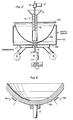
- Fig. 2 illustrates an embodiment of a device according to this invention
- Fig. 3 is a schematic plan view of the use of a device according to this invention showing the manner in which one particular type of feed material is affected as it is processed according to the techniques of this invention
- Fig. 4 is a schematic partial side elevational view showing the operation of the device in Fig. 3;
- Fig. 1 is a schematic view of a device for granulating powdery material, in which the spreader means is not in accordance with the invention
- Fig. 2 illustrates an embodiment of a device according to this invention
- Fig. 3 is a schematic plan view of the use of a device according to this invention showing the manner in which one particular type of feed material is affected as it is processed according to the techniques of this invention
- Fig. 4 is a schematic partial side elevational view showing the operation of the device in
- FIG. 5 and 6 are schematic views of further embodiments of devices according to this invention
- Figs. 7A and 7B are microphotographs of a starting or feed material (Fig. 7A) and the granulated product (Fig. 7B) resulting from processing the feed material in accordance with the present invention
- Fig. 8 is an enlarged microphotograph of a cross-section of one particular granule produced with a specific starting material and processed according to the techniques of this invention
- Fig. 9 graphically illustrates the surface temperature profiles of three different configurations of spreader means.
- the strategy to be applied in carrying out the process of the invention depends upon the stability and solidification characteristics of the substance being granulated. In order to achieve the process of this invention it is convenient to classify solids according to their chemical stability with respect to their melting points on the one hand and their rate of solidification upon cooling on the other. Granules thus produced may be polycrystalline, glassy, or a composite held together by a binder. The following classification will be helpful in devising the strategy to be applied in carrying out the objectives of this invention.
- the process is most easily applicable to Group lA materials.
- the temperature distribution on the spreader means is not critical as long as the temperature level is such that the droplets are solid when they arrive at the collection surface.
- the advantage of the invention is that the melting is carried out on the rotating bowl or disk, eliminating need for holding tanks, pumps, etc.
- the short residence time on the rotating bowl or disk permits them to be formed into solid particles or granules by fast partial melting or total melting and subsequent solidification. It is desirable to heat the material as little as is required for particle formation, to minimize degradation.
- the temperature and temperature distribution on the disk become important. At no position on the disk should the energy input be high enough to totally melt all the material passing that position.
- the film on the disc should remain as a two phase film with a liquid and solid phase.
- the energy input may be relatively high at the central and inner regions of the disk when heat transfer to the powder is difficult and most of the energy provides the heat of fusion for the melting material without significant change in its temperature. It is obvious that the disc temperature itself must be above the melting point in order to transfer the heat of fusion, but the temperature difference between the melting point and the disc temperature in the operation should decrease going from the center of the disc to the periphery for ease of control.
- a disk or bowl of high thermal mass e.g. at least 9.5mm (3/8-inch) thick and 15.2cm (6 inches) in diameter and of high thermal conductivity, e.g. of aluminum, or containing a substantial aluminum layer.
- the material should remain on the disk or bowl for the minimum amount of time required to form particles, and it is desirable that the minimum amount of material required to hold the granule together be melted.
- the binder is necessary. The material is then processed at temperatures below its melting point and below the temperature at which it decomposes in the time required for processing.
- the binder may be a solid which melts at a lower temperature and which is intimately mixed with it or the Group 4 solid may be coated previously with a meltable binder.
- Type C solids it may be necessary to catch the particles in a cooled medium.
- Type D materials may be processed into spheroidal particles by increasing the viscosity of the molten material by dissolving a polymer in it which is acceptable in the final use. The increased viscosity decreases the size of the crystals, permitting the droplet to cool into a polycrystalline or glassy spheroidal particle.
- a method and apparatus for producing enlarged agglomerates or granules from a powdered feed material comprising (a) feeding a meltable, powdery material to be granulated, or a non-meltable powdery material to be granulated admixed with a meltable binder material, to the surface of a rotating spreader means, at least a portion of which is heated to a temperature above the melting point of the feed material or binder therein, and preferably substantially below the temperature at which said material decomposes; (b) if necessary, controlling air currents above the spreader means to aid in maintaining the material in contact with the heated surface as it moves radially outwardly thereacross and to avoid undesirable temperature changes in the surface of the spreader means and, if necessary, controlling the hot-air currents below the spreader means with baffles, screens, etc.
- the spreader means in order to obtain the desired temperature profile in the spreader means; (c) adjusting the rate of feeding of said material, the temperature of the surface of the spreader means, the heat input to the spreader means and the rotational speed of the spreader means so that there is sufficient time for at least partial melting of the powdery material or the binder, generally without complete conversion of all the material into a liquid; (d) dispersing the particle mass from the edge of the spreader means into an atmosphere cooler than the melting temperature to form a granulated mass wherein, if desired, individual granules contain a core with a substantial portion of the original powdered material in essentially unchanged form maintained by a matrix of melted and resolidified particles bonded to each other at their surface, and (e) recirculating non-granulated powdery material, if any, to the feed stock.
- the spreader means has inclined side portions, and centrifugal force urges the powdery material into contact with these portions.
- an apparatus is shown as comprising a spreader (not in accordance with the invention), rotated about a central shaft 12 by any conventional motor means 14, such as a D.C. motor or the like, the speed of which is controllable by conventional variable drive means (not shown).
- the spreader means is heated, for example, directly by induction heating means (shown schematically at 18a in Figure 6), radiant heating means (not shown), or from below by heated air directed between the spreader means and a bottom shroud means 16 wherein the air has been heated by conventional heat guns or hot air blowers such as shown at 18.
- the fine powdery material or feed stock which is to be granulated is fed from a hopper 20 through a feeding means 22 which may be a screw feeder 24, controlled by a motor means 26 with a variable speed transmission 28, or other controllable feeding means such as a vibrating feeder or the like, onto the spreader means 10.
- a feeding means 22 which may be a screw feeder 24, controlled by a motor means 26 with a variable speed transmission 28, or other controllable feeding means such as a vibrating feeder or the like, onto the spreader means 10.
- the spreader means in accordance with the invention could be of various shapes or sizes as will be described in more detail hereafter.
- the spreader means can be generally bowl-shaped such as shown at 10a in the embodiment of Figure 2, 10b in the embodiment of Figure 5 or 10c in the embodiment of Figure 6.
- a bowl-shaped spreader means can have inclined sides which slope upwardly as steeply as 60 degrees or more, but less than about 80 degrees, preferably between about 10 and 50 degrees as exemplified in Figure 2.
- the bowl while shown as having a flattened center in Figure 2, could also be parabolic as shown in Figure 5 at 10b, hemispherical, divided into sections of different angles as shown in Figure 6 at l0c, or of any other workable shape.
- the surface area of the disk or bowl is determined by the rate at which the material needs to be granulated, the size of the granules, the viscosity of the melted material, the rotational speed of the spreader means, and the rate of heat input.
- baffle or cover means 30, 30a, 30b may be provided above the rotating spreader means to aid in controlling air currents above the spreader means to minimize adverse affects on the temperature of the surface of the spreader means and to decrease the amount of powdery material carried above the surface of the heated spreader means by air currents, by-passing the melt-granulation process occurring on the spreader means surface.
- the baffle means could also be heated (not shown) for efficiency in the case where a labile material must be melted rapidly after reaching the spreader means, but the primary heating of the feed material is preferably provided by direct contact with the heated surface of the spreader means.
- the distance of the baffle means from the spreader means when used, may be rendered adjustable in any conventional manner so that it can be varied to accomplish the optimal baffling effect as mentioned above.
- the baffle means may have a variety of shapes, for example, flat as shown, bowl-shaped to follow the contour of a bowl-shaped spreader means, or other variations which aid in granulation depending on the particle size, flow characteristics and ease of melting of the powdered feed stock.
- the baffle means if used, is preferably greater in size or diameter than that of the spreader means as exemplified in the drawings.
- Other techniques, such as rotating the baffle means and the like can also be adopted to achieve the most efficient baffling effect, with the rotational speed of the baffle means adjusted accordingly.
- the rotational speed of the spreader means, the feeding means, and the baffle means can be adjusted by employing conventional variable speed control means well known in the art.
- the heating means employed for heating the spreader means and/or the baffle means can be any conventional and controllable device, such as high frequency induction coils, electrical heating through variable resistor coils, radiant lamps or coils, heating guns, gas heaters and the like.
- the bottom shroud means l6 is an optional feature which is efficient when heat guns or gas-fired heating devices and the like are employed and which aids in keeping the heating devices clean of any build-up of powder or solidified material by enabling the temperature of the spreader means to be readily controlled and adjusted as necessary.
- Thermocouples, optical pyrometers or other temperature sensing devices can be utilized to assist in controlling the temperature of the various heated elements and the temperature variation of the spreader means along its radius.
- the powdery material which is to be granulated is in the form of substantially dry solid particles ranging in size from about 2 to 500 ⁇ m and having a melting point lower than the temperature at which it decomposes. If the material decomposes at its melting point or below the temperature of the spreader means, its residence time at or above the decomposition temperature is kept sufficiently short to prevent unacceptable degradation.
- the powdery material should be able to be melted at least partially without decomposing and without becoming "sticky" at least under the processing parameters of this invention, that is, when the material is heated to or above its melting point for the extremely short residence times utilized herein.
- a meltable additive or binder substance can be admixed with the powdery material in sufficient quantity to cause granulation as described.
- the particular binder selected can vary depending on the characteristics desired and the ultimate purpose of the granulated material. Obviously, if the granulated material is to be used as a pharmaceutical, the binder must be non-toxic and not affect the pharmaceutical activity of the feed stock.
- binders useful in many applications are di-and tri-glycerides, fats including hydrogenated fats, waxes, sulfur, polyethylene glycols, borax, fatty acids, carbohydrates, fatty alcohols, polymers compatible with the foregoing materials or any stable material remaining solid and relatively non-sticky under conventional use or storage conditions.
- the ratio of powdery feed material to binder can be from l00 percent feed material if no binder is necessary (i.e., "self-melting" material) to perhaps 99 per cent binder if only small quantities of the active material to be granulated are necessary in the ultimate granules for its desired activity. In general, however, from at least about l0 to about 80 percent of feed material is admixed with about 90 to about 20 percent binder in the feed stock, if a binder is necessary.
- the peripheral portions of the surface of the spreader means at or near the edge be at or slightly above the melting point of the material being melted so that the material does not solidify significantly before being dispersed from the spreader means.
- the entire surface can be of a uniform temperature or, if desired for certain applications can increase somewhat from the edge toward the center. According to well known scientific principles, the material is subjected to greater centrifugal force as it moves outwardly from the center and thus picks up speed. Further, once a film of melted material forms as the material moves away from the center and a portion of the material is heated by contact with the surface of the spreader means, movement is facilitated and speed increases.
- the feed material is fed in bulk to the central region of the spreader means, only a part of the material actually contacts the surface of the spreader means and melts, the remainder of the unchanged powder riding on the surface of those particles which have melted or partially melted, or moving outwardly in a film of partly melted material, reaching the edge of the spreader in partially melted or substantially unchanged form to be surrounded by a matrix of the melted material on contact with the cooler environment surrounding the edge of the spreader means and forming the enlarged granules as the melted material solidifies.
- the resultant granules can be produced within a desired mean particle size and having a range of physical characteristics. It is possible and, in certain instances, desirable to produce individual granules having a core of minimally changed feed particles which are surrounded by a glassy matrix of partially or completely melted and solidified material, the granule changing character gradually from the center to the surface. For some applications, for example, where there is no stickiness after melting and solidification the entire product granule can be formed of melted and resolidified starting material. In this case, the advantage of the process is the extremely short time in the molten state permitting the spray-cooling of materials having temperature sensitivity.
- the material as synthesized is finely powdered and thermally unstable. in its powdery state it is difficult to handle for further processing, e.g., for filling into capsules for ultimate use.
- Prior art attempts to granulate this material by spray-cooling produce "sticky" granules which are believed to result from the phase change attendant to retaining the material as a melt for the times necessary to process it by such techniques. Such stickiness is retained for extended periods of time, as much as an hour; too long to enable efficient handling.
- the meltable powder to be granulated, or a mixture thereof with an appropriate binder is preferably fed to the central region of the spreader means, the size of the granulated particles desired as well as the characteristics of the feed stock governing the surface area, shape, temperature, energy input and speed of rotation of the spreader means. It has been observed that by controlling various parameters, such as the energy input and the temperature, the temperature profile, surface area and rotational speed of the spreader means, the discharge rate from the feeding means and the like, there may be obtained a predominant, preselected size of the granulated mass product, and nearly monodisperse, frequently generally spherical, particles can be obtained.
- obtaining a predominant size of 370 ⁇ m agglomerates or granules requires a rotational speed of about l000 rpm.
- Such particles may vary about 25 micron on either side of the mean of 370 ⁇ m.
- the temperature of the disk depends upon the mechanism used for binding the particles together. Usually only a partial melting of the powder or the binder is sufficient to produce the desired granulation and the temperature is set, for example, at approximately l0 degrees Centigrade above the melting point of the feed powder and/or the binder.
- the spreader means can be heated in a number of different ways, two hot air blowers such as shown at l8 in Figure l, wired so that the voltage to the heating coil can be varied at will, function well for temperatures below 200°C.
- two hot air blowers such as shown at l8 in Figure l, wired so that the voltage to the heating coil can be varied at will, function well for temperatures below 200°C.
- the predominant size of the product granules is in a narrow range and, thus, the granules land in a rather narrow ring or zone when thrown from the edge of the spreader means, this zone being characteristic of the size and density of the granules and the peripheral velocity of the spreader means.
- the small amount of powder which is not agglomerated, and thus is of smaller particle size and mass, normally lands much closer to the edge of the spreader means or is carried farther by air currents.
- the granules can be readily separated from the non-granulated powder by any conventional means, for example, by cyclones or sieves.
- the non-granulated powder can, of course, be recycled.
- the production rate of the granules which can be obtained depends on the size and shape of the spreader means and the physical and thermal properties of the powder, among various other factors as mentioned herein.
- the processing of a material such as metoprolol succinate will be schematically seen.
- the feed material 50 in fine powdered form, drops onto the central region of the bowl-shaped spreader means l0a, as will be seen at 50a, is centrifugally spread outwardly across the spreader means surface as shown at 50b, begins to partially melt to produce a film of melted liquid 52 which contains some of the original unaffected crystalline powdered material 50 as seen schematically in the enlarged portion of Fig. 4.
- the enlarged granules 54 land in a ring or zone spaced from the edge of the spreader means l0a, with some of the non-granulated powder particles 50 dropping into a zone closer to the edge of the spreader means l0a because of their smaller mass or being carried away in the air currents.
- This two-phase technique is particularly useful for materials such as metoprolol succinate, the presence of the crystalline, minimally affected original powdery material in the liquid phase apparently causing a quick phase change back to a non-sticky solid granule upon contacting the cooler environment beyond the edge of the spreader means l0a to form the resultant granules 54.
- the tow-phase technique may not be necessary and the material can even be totally melted, still utilizing the basic concepts of the instant invention to subject such materials to the melting temperature for an extremely short period of time so as to avoid degradation.
- the present invention will be useful for granulation of powdery solids, even if they are thermally stable by eliminating the need for heating tanks, mixers, pumps, etc., since the melting will be accomplished on the rotating spreader means.
- FIGs. 7A and 7B photomicrographs of one type of starting material and the resultant granules will be seen.
- Fig. 8 an enlarged photomicrograph of a granule of "self-melting" material such as metoprolol succinate is shown wherein the core or center of the granule comprises particles resembling those in the original feed material, surrounded and held together by a glassy matrix of melted and resolidified material seen as primarily solid in Fig. 8, although it need not be a shell or total film, but can have limited areas of unmelted particles secured by the matrix.
- the transition from the melted surface materials to the center core particles is gradual, moving from substantially all melted and resolidified material at the surface to substantially all unchanged original feed material at the center or core.
- the temperature distribution of the surface for the treatment of metoprolol succinate has been measured for three spreader means, one which gives the desired non-sticky beads reproducibly, under steady-state conditions with a certain type of energy-input profile, and two which do not.
- the temperature was measured with an infra-red thermometer (Ircon Model 300) in the absence of metoprolol feed to avoid changes in emissivity of the surface.
- the emissivity was set by calibration against a thermocouple. Since no melting was occurring while the temperature was measured at various radial positions, the temperatures are indicative of the distribution of energy input at the various radial positions. When melting is actually occurring the actual temperature of the melting material is at or near its melting temperature.
- No. l bowl had a powdery appearance near the central feed but appeared at larger radii as a film which was uniform in appearance. It appeared to contain mostly liquid with some unmelted suspended solid crystals, except within l to 2 cm of the center close to the feed tube where the material was primarily solid with some liquid.
- the tip of a pencil was dipped in the film and withdrawn, it had a coating which immediately became hard and non-sticky. It is believed that, in this case, the entire film is at the melting temperature and the suspended solids act as crystallization nuclei.
- No. 2 bowl had a white inner circle mostly consisting of solids and a concentric zone of liquid at larger radius. Increasing the heat input decreased the diameter of the powder-rich circle and increased the area of the outer concentric liquid region. Liquid droplets were thrown from the outer region at the edge of the bowl. these droplets remained sticky for l5 minutes to l hour. When a pencil tip was dipped quickly into the outer region, the layer which deposited remained sticky for an extended period of time (many minutes), in contrast to the desired product wherein the "sticky" nature of the melted material disappeared almost instantaneously on cooling, making such material easy to handle for further processing as in filling of capsules with such granules. It is believed that the film in the outer region of bowl NO. 2 was above the melting point and contained an insufficient quantity of seed crystals (or none).
- No. 3 bowl showed a different behavior. Almost the entire outer region had a layer of solids with relatively narrow liquid streams crossing the powder, but essentially not mixing with it. It is not known if the solids layer came from the resolidification of the liquid due to a lower temperature of the bowl under this region or whether unmelted powder simply was caught by the relatively steep 50 degree wall wetted with molten metoprolol. This bowl also threw sticky beads at high heat input and loose powder at lower heat input.
- metaprolol succinate is difficult to granulate because it crystallizes slowly from the molten state and remains sticky for extended periods of time. It is also thermally unstable at its melting point and decomposes at a rate exceeding 1% per minute only a few degrees above the melting temperature. The process just described enabled the production of the non-sticky granules with degradation of less than 0.1%.
- Alprenolol benzoate was granulated using the same equipment as in Example 1. Approximately 200 gm was fed to the disc with the top shroud (baffle) temperature at about 85°C, the temperature at the bottom shroud plate being at about 119-120°C. The rotational speed of the disc was about 1000 RPM.
- the recovered product distribution was as follows: 0.6 gm, 590 to 860 ⁇ m; 6.7 gm, 500 to 590 ⁇ m; 5.1 gm, 420 to 500 ⁇ m; 3.6 gm, 297 to 420 ⁇ m; and the balance smaller than 297 ⁇ m. Most of the spherical granules were found in the 500 to 590 ⁇ m fraction which was entirely granulated.
- metoprolol succinate was fed to a flat disc rotating at about 1000 RPM.
- the equipment was the same as in Examples 1 and 2 except the heaters on the top baffle plate were eliminated, thus decreasing the amount of feed powder entrained in the air stream.
- the temperature on the bottom plate was about l44°C and at the top plate about 82°C. 238 gm of granules about 350 ⁇ m in diameter were recovered. This higher yield is due to the elimination of the hot air stream on top of the disc.
- the flat disc was replaced with a bowl shaped rotor also 20cm (8 inches)in diameter to permit centrifugal force to aid in keeping powder on the heated surface ( Figure 2).
- the bottom shroud plate was reduced from 30cm (12 inches) to 20cm (8 inches) so that there would be no hot surface on which powder could collect and undergo decomposition. Connector bolts between top and bottom shrouds were eliminated. To aid in maintaining the motor cool, it was moved away from the heat guns by the use of a 30cm (12 inch) shaft. 2.1 kg metoprolol succinate was fed at the rate of 1.2 kg/hr to the bowl rotating at about 1000 RPM heated from below with two hot air blowers.
- the temperature of the plate under the bowl, 1cm (3/8 inch) from the edge was about 150°C. 821 gm of granules approximately 350 ⁇ m in diameter was recovered. About 94 gm were grape-like agglomerates of spheres of about 500 to 1000 ⁇ m, and 120 gm of larger flat agglomerates were also produced. The balance was fine powder containing a few smaller granules passing through 250 ⁇ m sieves. Total weight recovered was about 1701 gm.
- the material less than 250 ⁇ m in diameter is recycled with similar conversion to granules per pass.
- the recycling of the undersize particles is repeated a second time with approximately the same conversion.
- Powdered saccharin particles about 100 ⁇ m in diameter, (Huels wax SP 1044, MP l05°C) in a ratio of 3 to 1 by weight.
- the bottom shroud temperature was set at about 115°C.
- the screw feeder was set at 8 RPM, the speed of the flat disc was set at 750 RPM.
- 100 gm of the mixture was fed.
- About 11.8 gm was larger than 500 ⁇ m, 3 gm was between 250 and 500 ⁇ m 3.5 gm between 150 and 250 ⁇ m, 1.5gm was between 125 to 150 ⁇ m, 3.7 gm between 75 and 125 ⁇ m, and 16.2 gm below 75 ⁇ m.
- the granulated particles in this case were irregular rather than round, but were sturdy granules.
- Powdered saccharin was mixed with tripalmitin (glyceryl tripalmitate) both having particle size less than about 25 ⁇ m.
- tripalmitin glyceryl tripalmitate
- the bottom shroud temperature was about 85°C.
- the apparatus was the same as in Example 5.
- Evidence of granulation of the fine particles was obtained both from sieve analysis and microscopic examination.
- NAC N-acetylcysteine
- Acetaminophen powder was fed to the bowl shown on Figure 2 under conditions similar to those used with metoprolol except the temperature on the bowl was about 185-190°C.
- 42 gm were spheres between 250 and 500 ⁇ m; about 90% of the spheres being white and about 10% having a slight brownish tinge. This material requires even faster processing than given under these conditions.
Landscapes
- Chemical & Material Sciences (AREA)
- Engineering & Computer Science (AREA)
- Organic Chemistry (AREA)
- Chemical Kinetics & Catalysis (AREA)
- Bioinformatics & Cheminformatics (AREA)
- Health & Medical Sciences (AREA)
- Public Health (AREA)
- Epidemiology (AREA)
- Life Sciences & Earth Sciences (AREA)
- Animal Behavior & Ethology (AREA)
- General Health & Medical Sciences (AREA)
- Medicinal Chemistry (AREA)
- Veterinary Medicine (AREA)
- Pharmacology & Pharmacy (AREA)
- Mechanical Engineering (AREA)
- Disintegrating Or Milling (AREA)
- Medicinal Preparation (AREA)
- Glanulating (AREA)
- Processing And Handling Of Plastics And Other Materials For Molding In General (AREA)
- Organic Low-Molecular-Weight Compounds And Preparation Thereof (AREA)
- Mechanical Treatment Of Semiconductor (AREA)
- Control And Other Processes For Unpacking Of Materials (AREA)
- Seasonings (AREA)
- Photoreceptors In Electrophotography (AREA)
- Saccharide Compounds (AREA)
- Breeding Of Plants And Reproduction By Means Of Culturing (AREA)
- Medical Preparation Storing Or Oral Administration Devices (AREA)
Applications Claiming Priority (2)
| Application Number | Priority Date | Filing Date | Title |
|---|---|---|---|
| US838828 | 1986-03-12 | ||
| US06/838,828 US5019302A (en) | 1986-03-12 | 1986-03-12 | Method for granulation |
Publications (3)
| Publication Number | Publication Date |
|---|---|
| EP0237345A2 EP0237345A2 (en) | 1987-09-16 |
| EP0237345A3 EP0237345A3 (en) | 1988-11-02 |
| EP0237345B1 true EP0237345B1 (en) | 1991-06-19 |
Family
ID=25278149
Family Applications (1)
| Application Number | Title | Priority Date | Filing Date |
|---|---|---|---|
| EP87302115A Expired - Lifetime EP0237345B1 (en) | 1986-03-12 | 1987-03-11 | Method and apparatus for granulation and granulated product |
Country Status (24)
| Country | Link |
|---|---|
| US (1) | US5019302A (cs) |
| EP (1) | EP0237345B1 (cs) |
| JP (1) | JPH01501768A (cs) |
| KR (1) | KR880701175A (cs) |
| CN (1) | CN1013479B (cs) |
| AT (1) | ATE64547T1 (cs) |
| AU (1) | AU591268B2 (cs) |
| BR (1) | BR8707635A (cs) |
| CA (1) | CA1321692C (cs) |
| CS (1) | CS150887A3 (cs) |
| DD (1) | DD265336A5 (cs) |
| DE (1) | DE3770843D1 (cs) |
| EG (1) | EG17922A (cs) |
| ES (1) | ES2023892B3 (cs) |
| FI (1) | FI884162A0 (cs) |
| GR (1) | GR3002725T3 (cs) |
| HU (1) | HUT48522A (cs) |
| IL (1) | IL81760A (cs) |
| IS (1) | IS1499B (cs) |
| NZ (1) | NZ219532A (cs) |
| PL (1) | PL264591A1 (cs) |
| PT (1) | PT84438B (cs) |
| WO (1) | WO1987005561A1 (cs) |
| ZA (1) | ZA871163B (cs) |
Families Citing this family (50)
| Publication number | Priority date | Publication date | Assignee | Title |
|---|---|---|---|---|
| US5100592A (en) * | 1986-03-12 | 1992-03-31 | Washington University Technology Associated, Inc. | Method and apparatus for granulation and granulated product |
| ATE75394T1 (de) * | 1986-11-14 | 1992-05-15 | Ciba Geigy Ag | Orales osmotisches system fuer metoprolol mit verbesserten formulierungseigenschaften. |
| US5137669A (en) * | 1988-03-02 | 1992-08-11 | Endocon, Inc. | Manufacture of partially fused peptide pellet |
| US5290569A (en) * | 1990-04-12 | 1994-03-01 | Shionogi & Co., Ltd. | Coated composition and its preparation process |
| DK0452145T3 (da) * | 1990-04-12 | 1996-12-02 | Shionogi & Co | Overtrukket præparat og fremstilling deraf |
| US5342557A (en) * | 1990-11-27 | 1994-08-30 | United States Surgical Corporation | Process for preparing polymer particles |
| US5143662A (en) * | 1991-02-12 | 1992-09-01 | United States Surgical Corporation | Process for preparing particles of bioabsorbable polymer |
| US5429825A (en) * | 1992-06-26 | 1995-07-04 | Mcneil-Ppc, Inc. | Rotomelt granulation |
| US5628945A (en) * | 1992-08-03 | 1997-05-13 | Riman; Richard E. | Multicomponent powder mixing process and compositions produced thereby |
| US5447565A (en) * | 1993-12-10 | 1995-09-05 | Wm. Wrigley Jr. Company | Apparatus and method for coating particles |
| US5508276A (en) | 1994-07-18 | 1996-04-16 | Eli Lilly And Company | Duloxetine enteric pellets |
| US5700497A (en) * | 1995-06-12 | 1997-12-23 | Kason Corporation | Vibratory agglomerator |
| WO1998022474A1 (fr) * | 1996-11-20 | 1998-05-28 | Otkrytoe Aktsionernoe Obschestvo 'aviabor' Dzerzhinsky Opytny Zavod Aviatsionnykh Materialov | Procede de fabrication de granules d'une substance thermolabile et installation requise |
| WO1998051748A1 (en) * | 1997-05-15 | 1998-11-19 | Kansai Paint Co., Ltd. | Granulated powdery paint and process for producing the same |
| DE19933289A1 (de) * | 1999-07-15 | 2001-01-18 | Basf Ag | Verfahren zur Herstellung eines Granulats aus einer Schmelze |
| US6273260B1 (en) | 2000-03-08 | 2001-08-14 | Eli Lilly And Company | Pharmaceutical packaging system |
| US6631808B2 (en) | 2001-08-07 | 2003-10-14 | Particle And Coating Technologies, Inc. | Air classifier system for the separation of particles |
| US6691765B2 (en) | 2001-08-07 | 2004-02-17 | Noram Technology, Ltd. | Products for the manufacture of molds and cores used in metal casting and a method for their manufacture and recycle from crushed rock |
| US6932286B2 (en) * | 2001-11-07 | 2005-08-23 | Fred P. Smith | Combination drop and broadcast spreader |
| EP1589957A1 (en) * | 2003-02-05 | 2005-11-02 | IPCA Laboratories Limited | Pharmaceutical compositions and process of production thereof |
| WO2005000237A2 (en) * | 2003-06-25 | 2005-01-06 | University Of Tennessee Research Foundation | Granules containing biologically active substances |
| EP1491253A1 (en) * | 2003-06-26 | 2004-12-29 | Urea Casale S.A. | Fluid bed granulation process and apparatus |
| US7314640B2 (en) * | 2003-07-11 | 2008-01-01 | Mongkol Sriwongjanya | Formulation and process for drug loaded cores |
| US6984403B2 (en) * | 2003-12-04 | 2006-01-10 | Pfizer Inc. | Azithromycin dosage forms with reduced side effects |
| KR100844628B1 (ko) * | 2003-12-04 | 2008-07-07 | 화이자 프로덕츠 인크. | 제약상 다입자의 제조 방법 |
| EP1701702A1 (en) * | 2003-12-04 | 2006-09-20 | Pfizer Products Inc. | Spray-congeal process using an extruder for preparing multiparticulate azithromycin compositions containing preferably a poloxamer and a glyceride |
| WO2005053652A1 (en) | 2003-12-04 | 2005-06-16 | Pfizer Products Inc. | Multiparticulate crystalline drug compositions containing a poloxamer and a glyceride |
| CA2547597A1 (en) * | 2003-12-04 | 2005-06-16 | Pfizer Products Inc. | Multiparticulate compositions with improved stability |
| ES2600577T3 (es) * | 2003-12-04 | 2017-02-09 | Bend Research, Inc. | Procedimiento de pulverización-solidificación que usa un extrusor para preparar composiciones en multipartículas de fármacos cristalinos |
| WO2005053639A2 (en) * | 2003-12-04 | 2005-06-16 | Pfizer Products Inc. | Controlled release multiparticulates formed with dissolution enhancers |
| PT1793187E (pt) * | 2004-09-21 | 2012-03-05 | Joan Vives Iglesias | Processo e máquina destinados à sinterização e/ou secagem de materiais em pó utilizando uma radiação infravermelha |
| US20070053983A1 (en) * | 2005-09-06 | 2007-03-08 | Girish Jain | Extended release compositions of metoprolol succinate |
| US7261529B2 (en) * | 2005-09-07 | 2007-08-28 | Southwest Research Institute | Apparatus for preparing biodegradable microparticle formulations containing pharmaceutically active agents |
| US9693967B2 (en) * | 2005-09-07 | 2017-07-04 | Southwest Research Institute | Biodegradable microparticle pharmaceutical formulations exhibiting improved released rates |
| US7758778B2 (en) * | 2005-09-07 | 2010-07-20 | Southwest Research Institute | Methods for preparing biodegradable microparticle formulations containing pharmaceutically active agents |
| US8563032B2 (en) * | 2005-12-05 | 2013-10-22 | Roxane Laboratories, Inc. | Formulation and manufacturing process for calcium acetate capsules |
| US20110217553A1 (en) * | 2007-12-20 | 2011-09-08 | Warner Isiah M | Frozen Ionic Liquid Microparticles and Nanoparticles, and Methods for their Synthesis and Use |
| JP2010099586A (ja) * | 2008-10-23 | 2010-05-06 | National Institute For Materials Science | 固形粒子の製造装置及び製造方法 |
| JP2012520176A (ja) * | 2009-03-16 | 2012-09-06 | ガバエ テクノロジーズ,エルエルシー | 回転毛細管を用いて粒子を生成する装置、システム及び方法 |
| WO2012047691A2 (en) * | 2010-10-04 | 2012-04-12 | 3M Innovative Properties Company | Method of modifying dissolution rate of particles by addition of hydrophobic nanoparticles |
| CN104062210B (zh) * | 2013-12-13 | 2018-04-27 | 郑州轻工业学院 | 颗粒采集及检测系统 |
| WO2016042372A1 (en) | 2014-09-17 | 2016-03-24 | Steer Engineering Private Limited | Effervescent composition and method of making it |
| CN104536492B (zh) * | 2014-12-23 | 2017-09-15 | 天津职业技术师范大学 | 一种喷油润滑下油温和环境温度的低温控制方法及装置 |
| CN105128165A (zh) * | 2015-07-13 | 2015-12-09 | 北京化工大学 | 一种离心法制备聚合物超细颗粒的装置 |
| CN105342857A (zh) * | 2015-12-07 | 2016-02-24 | 江苏知原药业有限公司 | 一种中药滴丸制备设备 |
| WO2017098481A1 (en) | 2015-12-12 | 2017-06-15 | Steerlife India Private Limited | Effervescent compositions of metformin and processes for preparation thereof |
| CN106994316A (zh) * | 2017-05-31 | 2017-08-01 | 安硕文教用品(上海)股份有限公司 | 一种铅笔料颗粒机 |
| CN107362047B (zh) * | 2017-08-25 | 2023-02-17 | 七次方家用电器(上海)有限公司 | 分料机构 |
| CN108889238A (zh) * | 2018-06-29 | 2018-11-27 | 东北大学 | 液态氯化镁粒化装置及余热回收系统与方法 |
| CN112371054A (zh) * | 2020-10-22 | 2021-02-19 | 武汉木兰山水生态农业发展有限公司 | 一种微生物肥料离心造粒方法 |
Citations (2)
| Publication number | Priority date | Publication date | Assignee | Title |
|---|---|---|---|---|
| US3208822A (en) * | 1961-08-16 | 1965-09-28 | Philadelphia Quartz Co | Spherical particles of anhydrous sodium metasilicate and method of manufacture thereof |
| EP0168372A1 (en) * | 1984-06-08 | 1986-01-15 | Monsanto Company | Pelletizing apparatus |
Family Cites Families (30)
| Publication number | Priority date | Publication date | Assignee | Title |
|---|---|---|---|---|
| US1671866A (en) * | 1924-12-18 | 1928-05-29 | Calco Chemical Company | Globular sodium bisulphate and method of making the same |
| BE491927A (cs) * | 1948-10-30 | |||
| US2818601A (en) * | 1955-10-27 | 1958-01-07 | United States Steel Corp | Disc-type balling device |
| DE1033640B (de) * | 1956-06-30 | 1958-07-10 | Metallgesellschaft Ag | Granulierteller |
| US2986772A (en) * | 1959-05-27 | 1961-06-06 | Jr George Patton | Eccentric rolling of powder and bonding agent into spherical pellets |
| BE636568A (cs) * | 1961-01-31 | |||
| DE1454743B2 (de) * | 1962-06-07 | 1970-05-14 | Beck, Erich, 6520 Worms | Verfahren und Vorrichtung zum Verdichten und Agglomerieren von pulverförmigen bis körnigen thermoplastischen Stoffen |
| BE640616A (cs) * | 1962-12-19 | |||
| GB1037792A (en) * | 1964-03-13 | 1966-08-03 | Konditerskaja Fabrika Im Marat | Enteric coated oral vaccines for intestinal infections |
| US3295838A (en) * | 1964-08-24 | 1967-01-03 | Mcdowell Wellman Eng Co | Conditioner for premoistening dry powders |
| DE1667178A1 (de) * | 1967-05-16 | 1971-06-09 | Metallgesellschaft Ag | Verfahren zur Herstellung von Agglomeraten aus feinteiligen festen Stoffen |
| USRE27214E (en) * | 1968-05-31 | 1971-11-02 | Method and apparatus for making spherical granules | |
| US3531562A (en) * | 1969-03-12 | 1970-09-29 | Monsanto Co | Increasing the density of thermoplastic foam scrap |
| GB1324116A (en) * | 1970-10-14 | 1973-07-18 | Koninklijke Gist Spiritus | Method and apparatus for preparing an enzyme composition in particulate form |
| US3966975A (en) * | 1970-12-21 | 1976-06-29 | Aktieselskabet Niro Atomizer | Method for producing agglomerated powders and apparatus for performing the method |
| US3743464A (en) * | 1971-08-24 | 1973-07-03 | Fmc Corp | Continuous sphering apparatus |
| FR2236483B1 (cs) * | 1973-07-12 | 1976-11-12 | Choay Sa | |
| NO133872C (cs) * | 1974-07-26 | 1976-07-14 | Norsk Hydro As | |
| US4174937A (en) * | 1975-03-19 | 1979-11-20 | The United States Of America As Represented By The Secretary Of The Interior | Powder agglomerator and its method of use |
| US4157371A (en) * | 1975-03-19 | 1979-06-05 | The United States Of America As Represented By The Secretary Of The Interior | Method of agglomerating fine powders |
| SE418247B (sv) * | 1975-11-17 | 1981-05-18 | Haessle Ab | Sett att framstella kroppar med reglerad frigoring av en aktiv komponent |
| US4256677A (en) * | 1976-04-12 | 1981-03-17 | Magnavox Government And Industrial Electronics Co. | Apparatus and method for making small spheres |
| JPS5446826A (en) * | 1977-08-24 | 1979-04-13 | Yamanouchi Pharmaceut Co Ltd | Slow-release rectal suppository |
| US4181708A (en) * | 1977-09-02 | 1980-01-01 | Eastman Kodak Company | Rumen-stable pellets |
| EP0008083A1 (de) * | 1978-08-15 | 1980-02-20 | Ciba-Geigy Ag | Verfahren zur Herstellung von Granulaten schwerschmelzbarer Zusatzstoffe für Kunststoffe, insbesondere von Pigmenten, durch thermische Rollgranulierung und die so erhaltenen Granulate |
| US4205060A (en) * | 1978-12-20 | 1980-05-27 | Pennwalt Corporation | Microcapsules containing medicament-polymer salt having a water-insoluble polymer sheath, their production and their use |
| US4399122A (en) * | 1980-02-07 | 1983-08-16 | E. I. Du Pont De Nemours And Company | Controlled release granules |
| US4331654A (en) * | 1980-06-13 | 1982-05-25 | Eli Lilly And Company | Magnetically-localizable, biodegradable lipid microspheres |
| JPS5839618A (ja) * | 1981-09-04 | 1983-03-08 | Chugai Pharmaceut Co Ltd | 持続性積層錠剤 |
| US4507276A (en) * | 1982-08-20 | 1985-03-26 | Bristol-Myers Company | Analgesic capsule |
-
1986
- 1986-03-12 US US06/838,828 patent/US5019302A/en not_active Expired - Lifetime
-
1987
- 1987-02-12 CA CA000529571A patent/CA1321692C/en not_active Expired - Fee Related
- 1987-02-18 ZA ZA871163A patent/ZA871163B/xx unknown
- 1987-02-26 IS IS3199A patent/IS1499B/is unknown
- 1987-03-03 IL IL81760A patent/IL81760A/xx unknown
- 1987-03-04 HU HU871809A patent/HUT48522A/hu unknown
- 1987-03-04 WO PCT/US1987/000434 patent/WO1987005561A1/en not_active Ceased
- 1987-03-04 BR BR8707635A patent/BR8707635A/pt not_active Application Discontinuation
- 1987-03-04 AU AU71626/87A patent/AU591268B2/en not_active Ceased
- 1987-03-04 JP JP62501926A patent/JPH01501768A/ja active Pending
- 1987-03-05 EG EG125/87A patent/EG17922A/xx active
- 1987-03-06 NZ NZ219532A patent/NZ219532A/en unknown
- 1987-03-06 CS CS871508A patent/CS150887A3/cs unknown
- 1987-03-10 PT PT84438A patent/PT84438B/pt not_active IP Right Cessation
- 1987-03-11 DD DD87300665A patent/DD265336A5/de not_active IP Right Cessation
- 1987-03-11 EP EP87302115A patent/EP0237345B1/en not_active Expired - Lifetime
- 1987-03-11 AT AT87302115T patent/ATE64547T1/de not_active IP Right Cessation
- 1987-03-11 DE DE8787302115T patent/DE3770843D1/de not_active Expired - Lifetime
- 1987-03-11 ES ES87302115T patent/ES2023892B3/es not_active Expired - Lifetime
- 1987-03-12 CN CN87101837A patent/CN1013479B/zh not_active Expired
- 1987-03-12 PL PL1987264591A patent/PL264591A1/xx unknown
- 1987-11-12 KR KR1019870701034A patent/KR880701175A/ko not_active Ceased
-
1988
- 1988-09-09 FI FI884162A patent/FI884162A0/fi not_active IP Right Cessation
-
1991
- 1991-09-16 GR GR91401340T patent/GR3002725T3/el unknown
Patent Citations (2)
| Publication number | Priority date | Publication date | Assignee | Title |
|---|---|---|---|---|
| US3208822A (en) * | 1961-08-16 | 1965-09-28 | Philadelphia Quartz Co | Spherical particles of anhydrous sodium metasilicate and method of manufacture thereof |
| EP0168372A1 (en) * | 1984-06-08 | 1986-01-15 | Monsanto Company | Pelletizing apparatus |
Also Published As
| Publication number | Publication date |
|---|---|
| EP0237345A3 (en) | 1988-11-02 |
| GR3002725T3 (en) | 1993-01-25 |
| NZ219532A (en) | 1990-01-29 |
| JPH01501768A (ja) | 1989-06-22 |
| EG17922A (en) | 1991-06-30 |
| PT84438A (en) | 1987-04-01 |
| BR8707635A (pt) | 1989-03-14 |
| CN1013479B (zh) | 1991-08-14 |
| HUT48522A (en) | 1989-06-28 |
| FI884162A7 (fi) | 1988-09-09 |
| CA1321692C (en) | 1993-08-31 |
| PT84438B (pt) | 1989-10-04 |
| ES2023892B3 (es) | 1992-02-16 |
| ATE64547T1 (de) | 1991-07-15 |
| IL81760A (en) | 1990-04-29 |
| DE3770843D1 (de) | 1991-07-25 |
| EP0237345A2 (en) | 1987-09-16 |
| IS3199A7 (is) | 1987-09-13 |
| AU591268B2 (en) | 1989-11-30 |
| IS1499B (is) | 1992-07-30 |
| FI884162A0 (fi) | 1988-09-09 |
| CS150887A3 (en) | 1992-11-18 |
| US5019302A (en) | 1991-05-28 |
| PL264591A1 (en) | 1988-04-28 |
| AU7162687A (en) | 1987-10-09 |
| CN87101837A (zh) | 1987-12-02 |
| ZA871163B (en) | 1987-09-30 |
| IL81760A0 (en) | 1987-10-20 |
| WO1987005561A1 (en) | 1987-09-24 |
| KR880701175A (ko) | 1988-07-26 |
| DD265336A5 (de) | 1989-03-01 |
Similar Documents
| Publication | Publication Date | Title |
|---|---|---|
| EP0237345B1 (en) | Method and apparatus for granulation and granulated product | |
| US5100592A (en) | Method and apparatus for granulation and granulated product | |
| FI81973C (fi) | Foerfarande och anordning foer oeverdragning av partiklar och vaetskedroppar. | |
| AU574187B2 (en) | Method and apparatus for coating particles or liquid droplets | |
| EP0305356B1 (en) | Granular product (i) | |
| JPH0827133B2 (ja) | 湿潤粉粒体の処理装置 | |
| Vervaet et al. | Melt granulation | |
| JPH09220460A (ja) | 冷却造粒方法およびその装置 | |
| JPS6323731A (ja) | 球状粒子の連続的製造方法 | |
| Appelgren | Recent advances in granulation technology and equipment | |
| JPS61245832A (ja) | 大径粒子用短円筒型容器を用いた冷却造粒方法および該方法を実施する装置 | |
| JPS61230730A (ja) | 粉粒体処理装置 | |
| JPH02149333A (ja) | 有機溶液を冷媒に用いて油性物質の球形粉粒体を製造する装置 | |
| JPS61230729A (ja) | 造粒並びにコ−テイング装置 | |
| Vervaet et al. | 20 Melt Granulation | |
| JPH0357838B2 (cs) |
Legal Events
| Date | Code | Title | Description |
|---|---|---|---|
| PUAI | Public reference made under article 153(3) epc to a published international application that has entered the european phase |
Free format text: ORIGINAL CODE: 0009012 |
|
| AK | Designated contracting states |
Kind code of ref document: A2 Designated state(s): AT BE CH DE ES FR GB GR IT LI LU NL SE |
|
| PUAL | Search report despatched |
Free format text: ORIGINAL CODE: 0009013 |
|
| AK | Designated contracting states |
Kind code of ref document: A3 Designated state(s): AT BE CH DE ES FR GB GR IT LI LU NL SE |
|
| 17P | Request for examination filed |
Effective date: 19890421 |
|
| 17Q | First examination report despatched |
Effective date: 19890913 |
|
| GRAA | (expected) grant |
Free format text: ORIGINAL CODE: 0009210 |
|
| ITF | It: translation for a ep patent filed | ||
| AK | Designated contracting states |
Kind code of ref document: B1 Designated state(s): AT BE CH DE ES FR GB GR IT LI LU NL SE |
|
| PG25 | Lapsed in a contracting state [announced via postgrant information from national office to epo] |
Ref country code: GR Free format text: LAPSE BECAUSE OF FAILURE TO SUBMIT A TRANSLATION OF THE DESCRIPTION OR TO PAY THE FEE WITHIN THE PRESCRIBED TIME-LIMIT Effective date: 19910619 |
|
| REF | Corresponds to: |
Ref document number: 64547 Country of ref document: AT Date of ref document: 19910715 Kind code of ref document: T |
|
| REF | Corresponds to: |
Ref document number: 3770843 Country of ref document: DE Date of ref document: 19910725 |
|
| ET | Fr: translation filed | ||
| REG | Reference to a national code |
Ref country code: ES Ref legal event code: FG2A Ref document number: 2023892 Country of ref document: ES Kind code of ref document: B3 |
|
| PG25 | Lapsed in a contracting state [announced via postgrant information from national office to epo] |
Ref country code: AT Effective date: 19920311 |
|
| PG25 | Lapsed in a contracting state [announced via postgrant information from national office to epo] |
Ref country code: ES Free format text: LAPSE BECAUSE OF NON-PAYMENT OF DUE FEES Effective date: 19920312 |
|
| PG25 | Lapsed in a contracting state [announced via postgrant information from national office to epo] |
Ref country code: LU Free format text: LAPSE BECAUSE OF NON-PAYMENT OF DUE FEES Effective date: 19920331 Ref country code: BE Effective date: 19920331 |
|
| PLBE | No opposition filed within time limit |
Free format text: ORIGINAL CODE: 0009261 |
|
| STAA | Information on the status of an ep patent application or granted ep patent |
Free format text: STATUS: NO OPPOSITION FILED WITHIN TIME LIMIT |
|
| 26N | No opposition filed | ||
| BERE | Be: lapsed |
Owner name: WASHINGTON UNIVERSITY TECHNOLOGY ASSOCIATES INC. Effective date: 19920331 |
|
| REG | Reference to a national code |
Ref country code: GR Ref legal event code: FG4A Free format text: 3002725 |
|
| PG25 | Lapsed in a contracting state [announced via postgrant information from national office to epo] |
Ref country code: NL Effective date: 19921001 |
|
| NLV4 | Nl: lapsed or anulled due to non-payment of the annual fee | ||
| REG | Reference to a national code |
Ref country code: GR Ref legal event code: MM2A Free format text: 3002725 |
|
| EAL | Se: european patent in force in sweden |
Ref document number: 87302115.8 |
|
| PGFP | Annual fee paid to national office [announced via postgrant information from national office to epo] |
Ref country code: GB Payment date: 19970303 Year of fee payment: 11 |
|
| PGFP | Annual fee paid to national office [announced via postgrant information from national office to epo] |
Ref country code: FR Payment date: 19970313 Year of fee payment: 11 |
|
| PGFP | Annual fee paid to national office [announced via postgrant information from national office to epo] |
Ref country code: DE Payment date: 19970314 Year of fee payment: 11 |
|
| PGFP | Annual fee paid to national office [announced via postgrant information from national office to epo] |
Ref country code: SE Payment date: 19970319 Year of fee payment: 11 |
|
| PGFP | Annual fee paid to national office [announced via postgrant information from national office to epo] |
Ref country code: CH Payment date: 19970320 Year of fee payment: 11 |
|
| PG25 | Lapsed in a contracting state [announced via postgrant information from national office to epo] |
Ref country code: GB Free format text: LAPSE BECAUSE OF NON-PAYMENT OF DUE FEES Effective date: 19980311 |
|
| PG25 | Lapsed in a contracting state [announced via postgrant information from national office to epo] |
Ref country code: SE Free format text: LAPSE BECAUSE OF NON-PAYMENT OF DUE FEES Effective date: 19980312 |
|
| PG25 | Lapsed in a contracting state [announced via postgrant information from national office to epo] |
Ref country code: LI Free format text: LAPSE BECAUSE OF NON-PAYMENT OF DUE FEES Effective date: 19980331 Ref country code: FR Free format text: THE PATENT HAS BEEN ANNULLED BY A DECISION OF A NATIONAL AUTHORITY Effective date: 19980331 Ref country code: CH Free format text: LAPSE BECAUSE OF NON-PAYMENT OF DUE FEES Effective date: 19980331 |
|
| GBPC | Gb: european patent ceased through non-payment of renewal fee |
Effective date: 19980311 |
|
| REG | Reference to a national code |
Ref country code: CH Ref legal event code: PL |
|
| PG25 | Lapsed in a contracting state [announced via postgrant information from national office to epo] |
Ref country code: DE Free format text: LAPSE BECAUSE OF NON-PAYMENT OF DUE FEES Effective date: 19981201 |
|
| EUG | Se: european patent has lapsed |
Ref document number: 87302115.8 |
|
| REG | Reference to a national code |
Ref country code: FR Ref legal event code: ST |
|
| REG | Reference to a national code |
Ref country code: ES Ref legal event code: FD2A Effective date: 19990503 |
|
| PG25 | Lapsed in a contracting state [announced via postgrant information from national office to epo] |
Ref country code: IT Free format text: LAPSE BECAUSE OF NON-PAYMENT OF DUE FEES Effective date: 20050311 |