EP0213518A2 - Antischaummittel für Polymerdispersionen - Google Patents
Antischaummittel für Polymerdispersionen Download PDFInfo
- Publication number
- EP0213518A2 EP0213518A2 EP86111348A EP86111348A EP0213518A2 EP 0213518 A2 EP0213518 A2 EP 0213518A2 EP 86111348 A EP86111348 A EP 86111348A EP 86111348 A EP86111348 A EP 86111348A EP 0213518 A2 EP0213518 A2 EP 0213518A2
- Authority
- EP
- European Patent Office
- Prior art keywords
- compounds
- weight
- general formula
- embodiment according
- carbon atoms
- Prior art date
- Legal status (The legal status is an assumption and is not a legal conclusion. Google has not performed a legal analysis and makes no representation as to the accuracy of the status listed.)
- Granted
Links
Classifications
-
- B—PERFORMING OPERATIONS; TRANSPORTING
- B01—PHYSICAL OR CHEMICAL PROCESSES OR APPARATUS IN GENERAL
- B01D—SEPARATION
- B01D19/00—Degasification of liquids
- B01D19/02—Foam dispersion or prevention
- B01D19/04—Foam dispersion or prevention by addition of chemical substances
-
- B—PERFORMING OPERATIONS; TRANSPORTING
- B01—PHYSICAL OR CHEMICAL PROCESSES OR APPARATUS IN GENERAL
- B01D—SEPARATION
- B01D19/00—Degasification of liquids
- B01D19/02—Foam dispersion or prevention
- B01D19/04—Foam dispersion or prevention by addition of chemical substances
- B01D19/0404—Foam dispersion or prevention by addition of chemical substances characterised by the nature of the chemical substance
Definitions
- the invention relates to the use of certain end-capped alkyl polyethylene glycol ethers in aqueous polymer dispersions and latices in order to give them certain properties which are desired and advantageous in several respects.
- DE-OS 33 15 951 relates to the use of polyethylene glycol ethers of the formula I below R1-O- (CH2CH2O) n -R2 (I), in which R1 is a straight-chain or branched alkyl or alkenyl radical having 8-18 C atoms, R2 is an alkyl radical having 4 to 8 C atoms and n is a number from 7 to 12, as foam-suppressing additives for low-foam cleaning agents.
- R1 is a straight-chain or branched alkyl or alkenyl radical having 8-18 C atoms
- R2 is an alkyl radical having 4 to 8 C atoms
- n is a number from 7 to 12
- foam-suppressing additives for low-foam cleaning agents as foam-suppressing additives for low-foam cleaning agents.
- the application is seen in particular in cleaning agents for trade and industry, which for example includes the cleaning of metal, glass, ceramic and plastic surfaces.
- DE-OS 33 15 951 also describes the use of the polyethylene glycol ethers of the general formula I in admixture with polyethylene glycol ethers, as obtained by adding 4 to 20 parts by weight of ethylene oxide to 1 part by weight of polyglycerol with a hydroxyl number of 900 to 1200 and subsequent etherification of the free hydroxyl groups can be obtained with alkyl halides having 4 to 8 carbon atoms.
- the preparation of such polyglycerol / ethylene oxide ethers and their use is the subject of DE-OS 33 15 952.
- Aqueous polymer dispersions and corresponding latices which are obtained by emulsion polymerization, are known to have a variety of uses in industry, for example they are used as binder dispersions which are exposed to a wide variety of stresses during transport, storage and use.
- Polymer dispersions of the type described are intrinsically highly sensitive, unstable 2-phase systems which are subject to numerous destabilizing influences under the application conditions described in practice. Their stabilization - in particular the prevention of undesired creaming or coagulation - represents a complex circle of problems for the polymer expert, for which the most varied solutions have been proposed.
- Polymer dispersions or emulsions of the type described must, for example, against Coagulation by the effects of freezing and thawing, the addition of electrolytes or the shear and other forces which occur in the formulation into dispersion paints, coating compositions, dispersion plasters, leather finishes, polishes, adhesives, textile auxiliaries or other fields of application known to the person skilled in the art are protected.
- Nonionic surfactants such as fatty alcohol, fatty acid, alkylphenol or fatty amine polyglycol ethers are mostly used for these stabilization tasks, but these generally promote the development of foams in the system and are often not satisfactorily biodegradable.
- the invention relates in a first embodiment to the use of compounds of the general formula I.
- R1-O- (CH2CH2O) n -R2 (I) in which R1 is a straight-chain or branched alkyl radical or alkenyl radical with 8 to 18 carbon atoms, R2 is an alkyl radical with 4 to 8 carbon atoms and n is a number from 7 to 30, in aqueous polymer dispersions and latices as emulsifying and / or emulsion-stabilizing agents, biodegradable component with foam damping ability. It is also possible to use products of the formula I with n greater than 30, for example with n up to 100.
- these compounds of the general formula I can already be present in the emulsion polymerization and can be used here as emulsifiers or coemulsifiers, if appropriate in combination with other emulsifiers, for example anionic emulsifiers.
- emulsifiers or coemulsifiers for example anionic emulsifiers.
- fatty alcohols are reacted with ethylene oxide in a molar ratio of 1: 7 to 1:30, then the hydroxyl groups present in the intermediate reaction product obtained are etherified.
- the reaction with ethylene oxide takes place under the known alkoxylation conditions, preferably in the presence of suitable alkaline catalysts.
- the etherification of the free hydroxyl groups is preferably carried out under the known conditions of Williamson's ether synthesis using straight-chain or branched C4-C8 alkyl halides, for example with n-butyl iodide, sec-butyl bromide, tert-butyl chloride, amyl chloride, tert-amyl bromide, n-hexyl chloride, n-heptyl bromide and n-octyl chloride. It may be expedient to use alkyl halide and alkali in a stoichiometric excess, for example from 100 to 200%, over the hydroxyl groups to be etherified.
- polyglycol ethers of the general formula I are used in combination with polyethylene glycol ethers, as are described in DE-OS 33 15 952 mentioned at the beginning.
- polyethylene glycol ether products which are formed by the addition of 4 to 20 parts by weight of ethylene oxide to 1 part by weight of polyglycerol with a hydroxyl number in the range from 900 to 1200 and subsequent etherification of the free hydroxyl groups with alkyl halides with 4 to 8 carbon atoms be preserved.
- Polyglycerols of the type described are obtained as distillation residues in the industrial production of the glycerol. These are mixtures of higher molecular weight condensation products of glycerol, preferably those with 2 to 10 glycerol residues in the molecule. These polyglycerols are characterized by their hydroxyl number, which is usually between 900 and 1200. Corresponding polyglycerols can of course also be obtained synthetically, for example by heating glycerol to 220 to 240 ° C. in the presence of caustic alkali, preferably in a protective gas atmosphere, and distilling off the water formed during the condensation.
- the polyglycerols described above are advantageously reacted with ethylene oxide in a weight ratio of 1: 4 to 1:20 ⁇ m and the etherification of the hydroxyl groups present in the reaction product obtained is then etherified.
- the reaction with ethylene oxide is carried out under the known alkoxylation conditions, preferably in the presence of suitable alkaline catalysts.
- the etherification of the free hydroxyl groups is also carried out here under the known conditions of Williamson's ether synthesis using straight-chain or branched C4-C8-alkyl halides.
- the etherification of the free hydroxyl groups can also be carried out in analogy to DE-PS 868 147 by reaction with isoolefins, for example isobutylene, in the presence of an acidic catalyst.
- polyglycol ethers of the general formula I with the end-capped polyglycerol polyglycol ethers are used, weight ratios of these components in the range from 1: 1 to 9: 1 and in particular those in the range from about 2.5: 1 to 9: 1 are preferred since they are characterized by strong foam-suppressing effects. These mixtures also meet the legal requirements for biodegradability.
- the polyglycol ethers or polyglycol ether mixtures used according to the invention are furthermore distinguished by alkali and acid stability.
- the polymer dispersions or latices usually contain the compounds of the general formula I or their mixtures with the polyglycerol ethers in amounts of about 0.05 to 5% by weight, based on the dry weight of the dispersion. Amounts in the range of about 0.5 to 3% by weight can be particularly preferred.
- a C 12-18 fatty alcohol + 9.1 EO-n-butyl mixed ether (product A) was tested as a defoaming additive on a 50 percent terpolymer dispersion of the VAc / VeoVa / AS type.
- the 50 percent polymer dispersion contains 33.0 parts by weight (pbw) of vinyl acetate, 14.4 pbw of vinyl versatic acid (VeoVa 10) and 4.8 pbw of acrylic acid and was mixed with a mixture of a lauryl ether sulfosuccinic acid di-Na salt and the condensation product of Nonylphenol + 30 EO manufactured.
- the mixed ether described was tested in comparison with a commercially available EO / PO block copolymer and the condensation product of nonylphenol + 10 EO according to the test method described below.
- the products described were used with an additional amount of 2%, based on the dry weight of polymer dispersion.
- the test of the polymer dispersion was carried out without additives as a standard (zero test).
- the results obtained can be found in the attached diagram I.
- EO / PO block copolymer a significant improvement in foam suppression is achieved.
- a nonylphenol + 10 EO used in practice to stabilize polymer dispersions even leads to increased foaming compared to the standard test.
- Example 2 (Table II) illustrates the effect of different amounts of product A used compared to the standard (zero test).
- the test is carried out on finished polymer dispersions.
- 50 g of the finished polymer dispersion are diluted with 450 g of deionized water and transferred to a 2 liter measuring cylinder with a heating jacket.
- the test is carried out at 25 ° C.
- a laboratory peristaltic pump type RG-L 85, Heidolph
- the test dispersion is continuously circulated at a flow rate of 3 1 ⁇ min ⁇ 1.
- the solution is sucked from the bottom of the measuring cylinder with a glass tube and returned in free fall via a second glass tube.
- the second glass tube is installed in the test facility so that the outlet is at the 2000 ml mark on the measuring cylinder.
- the maximum foam volume (total volume) is read and the circulation is ended.
- volumes of approx. 1600 to 2100 ml result.
- the total volume is read and the determined values are entered in a volume / time diagram.
- the values obtained in this way provide information about the foam properties of the polymer dispersion.
- the method described can be used to test the influence of defoaming substances or low-foam surfactants on their foam properties.
- a polymer dispersion the total volume after 10 min. Circulation and foam decay determined within the specified time intervals. The values found represent the standard for the further tests.
- a test is carried out with the substance to be tested. The test substance is metered into the polymer dispersion before the 10-minute cycle.
- the dosing amounts are between 0.1 and 20% test substance, based on the dry weight of the dispersion.
- anionic and nonionic emulsifiers were used.
- a 33.4% aqueous solution of a Na fatty acid methyl ester sulfonate was used as the anionic emulsifier X in solution 1, and a 70% nonylphenol + 30 EO and a further 0.8 g of active substance of the anionic emulsifier X were used as the nonionic emulsifier Y in solution 2.
- the total amount was adjusted to 1000 g by adding or leaving out water.
- the components of solution 1 are placed in the reaction vessel, flushed with nitrogen and heated to 80.degree.
- a pre-emulsion is prepared by vigorous stirring by adding the monomer solution 3 to the aqueous phase containing emulsifier.
- the pH of the pre-emulsion is adjusted to 3.8 to 4.0.
- the metering of the monomer pre-emulsion is started.
- the duration of the dosage is 2 to 2.5 hours.
- the temperature of the reaction mixture is kept at 80 ° C. for a further 2 hours.
- the dispersion is cooled and filtered and the pH is adjusted to 7.0 to 7.5 with 23.9 g of a 10% strength ammonium carbonate solution, for which the stated amounts of ammonium carbonate solution were used.
- Dispersions with less than about 0.4% coagulate (based on dry matter) were obtained.
- the dispersion according to 4.2 was low-foaming.
- the dispersion in the measuring arrangement described above showed 1700 ml foam height after 0.5 minutes, 800 ml after 5 minutes and only 480 ml after 10 minutes.
- the dispersion according to Comparative Example 4.1 showed 1900 ml foam height after 0.5 minutes, 1500 ml after 5 minutes and 900 ml foam height after 10 minutes.
- the result was a polymer dispersion stabilized purely by nonionic emulsifiers.
- the coagulum content resulting from the polymerization was less than 0.4% as in 4.1 and 4.2.
- the resulting polymer dispersion was coarse and very low in foam.
Landscapes
- Chemical & Material Sciences (AREA)
- Health & Medical Sciences (AREA)
- Toxicology (AREA)
- Dispersion Chemistry (AREA)
- Chemical Kinetics & Catalysis (AREA)
- Emulsifying, Dispersing, Foam-Producing Or Wetting Agents (AREA)
- Degasification And Air Bubble Elimination (AREA)
- Polymerisation Methods In General (AREA)
- Polyethers (AREA)
- Compositions Of Macromolecular Compounds (AREA)
- Addition Polymer Or Copolymer, Post-Treatments, Or Chemical Modifications (AREA)
- Manufacture Of Porous Articles, And Recovery And Treatment Of Waste Products (AREA)
Abstract
R₁-O-(CH₂CH₂O)n-R₂ (I) ,
in der R₁ einen geradkettigen oder verzweigten Alkylrest oder Alkenylrest mit 8 bis 18 C-Atomen, R₂ einen Alkylrest mit 4 bis 8 C-Atomen und n eine Zahl von 7 bis 30 bedeuten, in wäßrigen Polymerdispersionen und Latices als emulgierender und/oder emulsionsstabilisierender, biologisch abbaubarer Bestandteil mit Schaumdämpfungsvermögen.
Description
- Die Erfindung betrifft die Verwendung bestimmter endgruppenverschlossener Alkylpolyethylenglykolether in wäßrigen Polymerdispersionen und Latices, um diesen bestimmte Eigenschaften zu verleihen, die in mehrfacher Hinsicht gewünscht und vorteilhaft sind.
- Gegenstand der DE-OS 33 15 951 ist die Verwendung von Polyethylenglykolethern der nachfolgenden Formel I
R₁-O-(CH₂CH₂O)n-R₂ (I) ,
in der R₁ einen geradkettigen oder verzweigten Alkyl- oder Alkenylrest mit 8 - 18 C-Atomen, R₂ einen Alkylrest mit 4 bis 8 C-Atomen und n eine Zahl von 7 bis 12 bedeuten, als schaumdrückende Zusätze für schaumarme Reinigungsmittel. Der Einsatzzweck wird insbesondere in Reinigungsmitteln für Gewerbe und Industrie gesehen, die beispielsweise die Reinigung von Metall-, Glas-, Keramik- und Kunststoffoberflächen umfaßt. Gegenüber bekannten schaumdrückenden Zusätzen auf Basis von Anlagerungsprodukten von Alkylenoxiden anorganischer Verbindungen mit reaktiven Wasserstoffatomen im Molekül - wie sie beispielsweise aus den DE-PSn 1 280 455, 1 621 592, 1 289 597, 1 621 593 und 1 944 569 bekannt sind - zeichnen sich die Verbindungen der allgemeinen Formel I dadurch aus, daß sie zusätzlich biologisch abbaubar sind, nach den gesetzlichen Bestimmungsmethoden liegt ihre biologische Abbaubarkeit bei über 80 % BiAS-Abnahme. - Die DE-OS 33 15 951 beschreibt darüber hinaus den Einsatz der Polyethylenglykolether der allgemeinen Formel I in Abmischung mit Polyethylenglykolethern, wie sie durch Anlagerung von 4 bis 20 Gewichtsteilen Ethylenoxid an 1 Gewichtsteil Polyglycerin mit einer Hydroxylzahl von 900 bis 1200 und anschließende Veretherung der freien Hydroxylgruppen mit Alkylhalogeniden mit 4 bis 8 Kohlenstoffatomen erhalten werden. Die Herstellung solcher Polyglycerin/Ethylenoxidether und ihre Verwendung ist Gegenstand der DE-OS 33 15 952.
- Gegenüber diesem Stand der Technik, der sich mit Reinigungsmittelgemischen beschäftigt, geht die vorliegende Erfindung von der Aufgabe aus, bestimmte Verbesserungen in wäßrigen Polymerdispersionen bzw. Latices einzustellen. Wäßrige Polymerdispersionen und entsprechende Latices, die durch Emulsionspolymerisation gewonnen werden, haben bekanntlich in der Technik vielfaltige Einsatzzwecke, so finden sie beispielsweise als Bindemitteldispersionen Verwendung, die bei Transport, Lagerung und Einssatzzweck den unterschiedlichsten Beanspruchungen ausgesetzt werden. Polymerdispersionen der geschilderten Art sind an sich hochsensible instabile 2-Phasen-Systeme, die unter den geschilderten Anwendungsbedingungen der Praxis zahlreichen destabilisierenden Einflüssen unterworfen sind. Ihre Stabilisierung - d.h. insbesondere die Verhinderung eines unerwünschten Aufrahmens oder Koagulierens - stellt für den Polymerfachmann einen komplexen Kreis von Problemen dar, zu dem die vielgestaltigsten Lösungsvorschläge gemacht worden sind. Polymerdispersionen bzw. -emulsionen der geschilderten Art müssen beispielsweise gegen Koagulation durch Gefrier- und Auftaueinflüsse, Elektrolytzugaben oder die bei der Formulierung zu Dispersionsfarben, Beschichtungsmitteln, Dispersionsputzen, Lederzurichtungen, Polituren, Klebstoffen, Textilhilfsmitteln oder andere dem Fachmann bekannte Einsatzgebiete auftretenden Scher- und sonstige Kräfte geschützt werden. Für diese Stabilisierungsaufgaben werden meistens nichtionogene Tenside, wie Fettalkohol-, Fettsäure-, Alkylphenol- oder Fettaminpolyglykolether eingesetzt, die aber in der Regel die Schaumentwicklung im System fördern und vielfach biologisch auch nicht befriedigend abbaubar sind.
- Allgemein gilt, daß gerade für die Anwendung bei der Emulsionspolymerisation laufend neue oberflächenaktive Mittel gesucht werden, welche günstige Eigenschaften aufweisen und zwar sowohl bei Herstellung der Emulsion als auch während der Polymerisation und insbesondere hinsichtlich der Eigenschaften des entstehenden Polymerlatex. Dies gilt umso mehr, als es dem Fachmann nicht möglich ist, aus dem chemischen Aufbau eines oberflächenaktiven Mittels auch auf seine Eigenschaften als Polymerisationsemulgator bzw. -stabilisator zuverlässige Rückschlüsse zu ziehen.
- Gegenstand der Erfindung ist dementsprechend in einer ersten Ausführungsform die Verwendung von Verbindungen der allgemeinen Formel I
R₁-O-(CH₂CH₂O)n-R₂ (I)
in der R₁ einen geradkettigen oder verzweigten Alkylrest oder Alkenylrest mit 8 bis 18 C-Atomen, R₂ einen Alkylrest mit 4 bis 8 C-Atomen und n eine Zahl von 7 bis 30 bedeuten, in wäßrigen Polymerdispersionen und Latices als emulgierender und/oder emulsionsstabilisierender, biologisch abbaubarer Bestandteil mit Schaumdämpfungsvermögen. Es ist auch möglich, Produkte der Formel I mit n größer 30 etwa mit n bis zu 100 zu verwenden. - Diese Produkte wirken ebenfalls als Stabilisierungsmittel und als Emulgatoren für die Polymerisation, sind jedoch im allgemeinen nicht mehr schaumdämpfend.
- Erfindungsgemäß können diese Verbindungen der allgemeinen Formel I schon bei der Emulsionspolymerisation zugegen sein und hier als Emulgatoren oder Coemulgatoren gegebenenfalls im Kombination mit anderen Emulgatoren, beispielsweise anionischen Emulgatoren Verwendung finden. Ebenso ist es aber auch möglich, die Verbindung der allgemeinen Formel I nachträglich fertigen Polymerdispersionen bzw. Latices als zusätzliches Stabilisierungsmittel zuzugeben. Verständlicherweise können diese Maßnahmen auch miteinander verbunden werden.
- Zur Herstellung der erfindungsgemäß eingesetzten Verbindungen der allgemeinen Formel I wird auf die bereits zitierte DE-OS 33 15 951 verwiesen. Als Ausgangsmaterial für die Herstellung dieser Polyglykolether können die natürlichen Fettalkohole beispielsweise n-Octanol, n-Decanol, n-Dodecanol, n-Tetradecanol, n-Hexadecanol, n-Octadecanol, n-Octadecen-9, 10-ol (Oleylalkohol) und/oder synthetische lineare Alkohole der genannten Kohlenstoffzahl oder mit einer ungeraden Anzahl an C-Atomen zwischen 8 und 18 einzeln oder im Gemisch eingesetzt werden.
- Diese Fettalkohole werden mit Ethylenoxid im Molverhältnis von 1 : 7 bis 1 : 30 umgesetzt, anschließend werden die im erhaltenen Reaktionszwischenprodukt vorhandenen Hydroxylgruppen verethert. Die Umsetzung mit Ethylenoxid erfolgt dabei unter den bekannten Alkoxylierungsbedingungen, vorzugsweise in Gegenwart von geeigneten alkalischen Katalysatoren. Die Veretherung der freien Hydroxylgruppen wird bevorzugt unter den bekannten Bedingungen der Williamsonschen Ethersynthese mit geradkettigen oder verzweigten C₄-C₈-Alkylhalogeniden durchgeführt, beispielsweise mit n-Butyliodid, sec.-Butylbromid, tert.-Butylchlorid, Amylchlorid, tert.-Amylbromid, n-Hexylchlorid, n-Heptylbromid und n-Octylchlorid. Dabei kann es zweckmäßig sein, Alkylhalogenid und Alkali im stöchiometrischen Überschuß, beispielsweise von 100 bis 200%, über die zu verethernden Hydroxylgruppen einzusetzen.
- In einer besonders bevorzugten Ausführungsform der Erfindung werden Polyglykolether der Formel I eingesetzt, in der n eine Zahl von 8 bis 20 bedeutet. Besonders bevorzugt ist weiterhin die Verwendung von Verbindungen der Formel I, in der R₂ den n-Butylrest bedeutet und n = 8 - 16 ist.
- In einer weiteren Ausgestaltung der Erfindung werden die Polyglykolether der allgemeinen Formel I in Kombination mit Polyethylenglykolethern eingesetzt, wie sie in der eingangs genannten DE-OS 33 15 952 beschrieben sind. Hierbei handelt es sich um Polyethylenglykoletherprodukte, die durch Anlagerung von 4 bis 20 Gew.-Teilen Ethylenoxid an 1 Gew.-Teil Polyglycerin mit einer Hydroxylzahl im Bereich von 900 bis 1200 und anschließende Veretherung der freien Hydroxylgruppen mit Alkylhalogeniden mit 4 bis 8 C-Atomen erhalten werden.
- Polyglycerine der geschilderten Art fallen bei der großtechnischen Herstellung des Glycerins als Destillationsrückstände an. Es handelt sich dabei um Gemische aus höhermolekularen Kondensationsprodukten des Glycerins, bevorzugt aus solchen mit 2 bis 10 Glycerinresten im Molkül. Diese Polyglycerine sind durch ihre Hydroxylzahl charakterisiert, die in der Regel zwischen 900 und 1200 liegt. Entsprechende Polyglycerine können natürlich auch auf synthetischem Wege erhalten, beispielsweise durch längeres Erhitzen von Glycerin auf 220 bis 240°C in Gegenwart von Ätzalkali, vorzugsweise in Schutzgasatmosphäre und Abdestillieren des bei der Kondensation gebildeten Wassers.
- Zur Herstellung der erfindungsgemäß gewünschtenfalls mitzuverwendenden Polyglycerinpolyglykolether setzt man zweckmäßigerweise die vorstehend beschriebenen Polyglycerine mit Ethylenoxid im Gewichtsverhältnis von 1 : 4 bis 1 : 20 um und verethert anschließend die im erhaltenen Reaktionsprodukt vorhandenen Hydroxylgruppen. Auch hier wird die Umsetzung mit Ethylenoxid unter den bekannten Alkoxylierungsbedingungen, vorzugsweise in Gegenwart von geeigneten alkalischen Katalysatoren durchgeführt. Die Veretherung der freien Hydroxylgruppen schließlich wird auch hier unter den bekannten Bedingungen der Williamsonschen Ethersynthese mit geradkettigen oder verzweigten C₄-C₈-Alkylhalogeniden durchgeführt. Die Veretherung der freien Hydroxylgruppen kann aber auch in Analogie zur DE-PS 868 147 durch Umsetzung mit Isoolefinen, beispielsweise Isobutylen in Gegenwart eines sauren Katalysators erfolgen.
- Werden Gemische aus den Polyglykolethern der allgemeinen Formel I mit den endgruppenverschlossenen Polyglycerinpolyglykolethern verwendet, so sind Gewichtsverhältnisse dieser Komponenten im Bereich von 1 : 1 bis 9 : 1 und insbesondere solche im Bereich von etwa 2,5 : 1 bis 9 : 1 bevorzugt, da sie sich durch starke schaumdrückende Wirkung auszeichnen. Auch diese Gemische erfüllen die gesetzlichen Anforderungen an die biologische Abbaubarkeit. Die erfindungsgemäß eingesetzten Polyglykolether bzw. Polyglykolethergemische zeichnen sich weiterhin durch Alkali- und Säurestabilität aus.
- Im praktischen Einsatz enthalten die Polymerdispersionen bzw. Latices die Verbindungen der allgemeinen Formel I bzw. ihre Abmischungen mit den Polyglycerinethern üblicherweise in Mengen von etwa 0,05 bis 5 Gew.-%, bezogen auf die Trockenmasse der Dispersion. Mengen im Bereich von etwa 0,5 bis 3 Gew.-% können besonders bevorzugt sein.
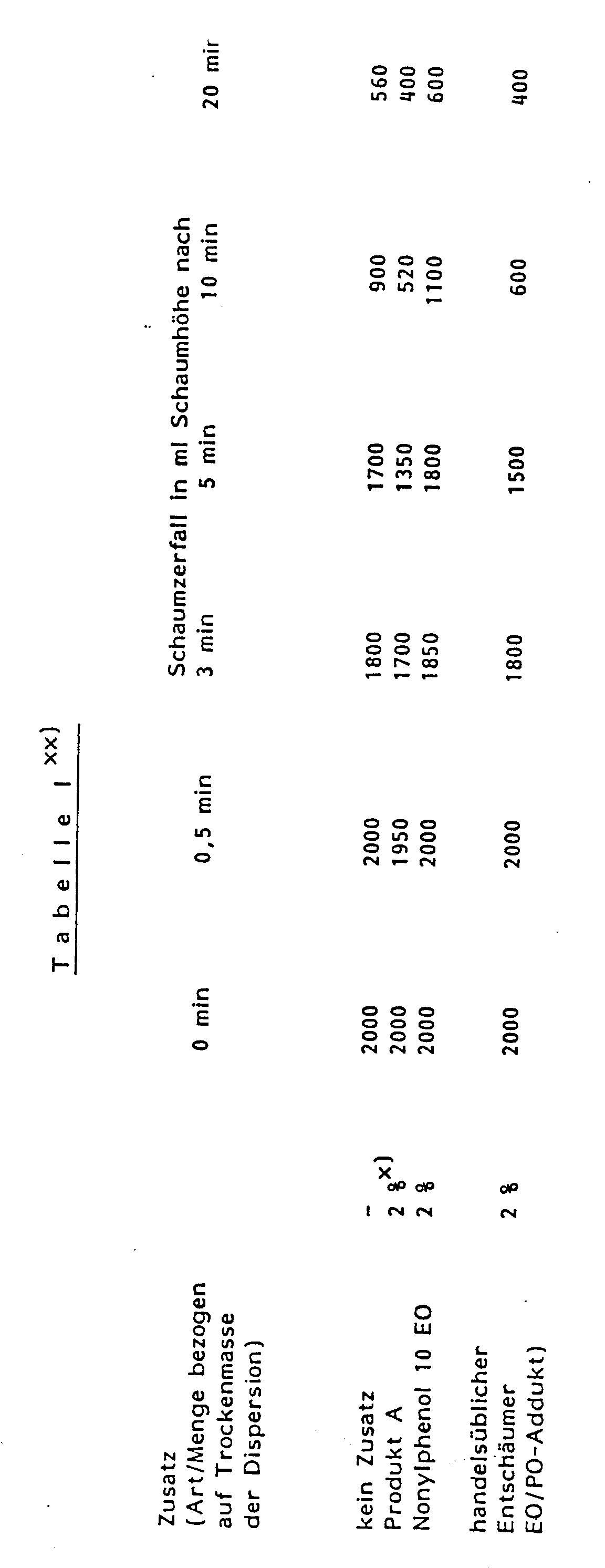
- Ein C12-18-Fettalkohol + 9,1 EO-n-Butylmischether (Produkt A) wurde als entschäumender Zusatz an einer 50-prozentigen Terpolymer-Dispersion vom Typ VAc/VeoVa/AS geprüft. Die 50-prozentige Polymerdispersion enthält 33,0 Gewichsteile (GT) Vinylacetat, 14,4 GT Versaticsäure-Vinylester (VeoVa 10) und 4,8 GT Acrylsäure und wurde mit einer Mischung aus einem Laurylethersulfobernsteinsäurehalbester-Di-Na-Salz und dem Kondensationsprodukt von Nonylphenol + 30 EO hergestellt.
- Der beschriebene Mischether wurde im Vergleich zu einem handelsüblichen EO/PO-Blockcopolymer und dem Kondensationsprodukt von Nonylphenol + 10 EO nach der nachfolgend beschriebenen Prüfmethode getestet. Die beschriebenen Produkte wurden mit einer Zusatzmenge von 2 %, bezogen auf Trockenmasse Polymerdispersion, eingesetzt. Vergleichsweise wurde die Prüfung der Polymerdispersion ohne Zusätze als Standard (Nullversuch) durchgeführt. Die ermittelten Ergebnisse sind dem beigefügten Diagramm I zu entnehmen. Die Ergebnisse zeigen deutlich, daß durch Zusatz des beschriebenen Mischethers sehr gute Schaumzerfallseigenschaften gegenüber dem Nullversuch erzielt werden. Gegenüber dem Stand der Technik (EO/PO-Blockcopolymer) wird eine deutliche Verbesserung in der Schaumunterdrückung erzielt. Ein in der Praxis zur Stabilisierung von Polymerdispersionen zum Einsatz kommendes Nonylphenol + 10 EO führt sogar zu erhöhter Schaumbildung im Vergleich zum Standardversuch.
- In Beispiel 2 (Tabelle II) wird die Wirkung unterschiedlicher Einsatzmengen von Produkt A gegenüber dem Standard (Nullversuch) verdeutlicht.
- Die Pröfung erfolgt an fertigen Polymerdispersionen.
- 50 g fertige Polymerdispersion werden mit 450 g volentsalztem Wasser verdünnt und in einen 2-I-Meßzylinder mit Heizmantel überführt. Im Regelfall wird die Prüfung bei 25°C durchgeführt. Mit Hilfe einer Laborschlauchpumpe (Typ RG-L 85, Fa. Heidolph) wird die Prüfdispersion bei einer Durchflußmenge von 3 1 · min ⁻¹ in einen ständigen Umlauf gebracht. Die Lösung wird mit einem Glasrohr vom Boden des Meßzylinders angesaugt und über ein zweites Glasrohr in freiem Fall zurückgeführt. Das zweite Glasrohr wird so in die Prüfeinrichtung eingebaut, daß sich der Auslauf in Höhe der 2000-ml-Markierung des Meßzylinders befindet. Nach 10 min. wird das maximale Schaumvolumen (Gesamtvolumen) abgelesen und der Umlauf beendet. In der Regel stellen sich Volumina von ca. 1600 bis 2100 ml ein.
- In Zeitabständen von 0,5, 1, 2, 3, 5, 10 und 20 min. wird das Gesamtvolumen abgelesen und die ermittelten Werte in ein Volumina/Zeit-Diagramm eingetragen. Die so erhaltenen Werte geben eine Aussage über die Schaumeigenschaften der Polymerdispersion.
- Die beschriebene Methode kann zur Prüfung des Einflusses entschäumender Substanzen bzw. schaumarmer Tenside auf deren Schaumeigenschaften angewandt werden. In diesem Fall wird von einer Polymerdispersion das Gesamtvolumen nach 10 min. Umlauf sowie der Schaumzerfall innerhalb der vorgegebenen Zeitintervalle ermittelt. Die gefundenen Werte stellen den Standard für die weiteren Prüfungen dar. Vergleichsweise wird ein Versuch mit der zu prüfenden Substanz durchgeführt. Die Dosierung der Prüfsubstanz zur Polymerdispersion erfolgt vor dem 10-minütigen Umlauf.
- Die Dosiermengen liegen je nach Produkttyp zwischen 0,1 und 20 % Prüfsubstanz, bezogen auf Trockenmasse der Dispersion.
- Die gefundenen Werte finden sich in Tabelle 1.

- B C12/18-Fettalkohol + 7,5 EO-C₄
C C12/18-Fettalkohol + 8,0 EO-C₄
D C12/18-Fettalkohol + 9,0 EO-C₄
A C12/14-Fettalkohol + 9,1 EO-C₄
E C12/18-Fettalkohol + 10,0 EO-C₄
F C12/14-Fettalkohol + 16,0 EO-C₄ - Alle Substanzen hatten etwa 100 % Aktivsubstanzgehalt. Die Ergebnisse finden sich in Tabelle II

- Verwendung eines C12-18-Fettalkohols + 9,1 EO-n-Butylmischether (Produkt A) als Polymerisationsemulgator.
- Zur Prüfung wurden pro Versuch 3 Lösungen hergestellt.
- 1,3 g Emulgator X (100 %ig)
0,5 g Kaliumperoxydisulfat
0,2 g Borax
191,7 g vollentsalztes Wasser - 0,8 g Emulgator X (100 %ig)
2,1 g Borax
1,9 g Kaliumperoxydisulfat
12,0 g Emulgator Y (100 %ig)
288,4 g vollentsalztes Wasser - 330,1 g Vinylacetat
143,5 g Versaticsäure-Vinylester
4,8 g Acrylsäure
23,9 g 10 %ige Ammoniumcarbonatlösung - Es wurde mit einer üblichen Kombination aus anionischen und nichtionischen Emulgatoren gearbeitet. Als anionischer Emulgator X wurde in Lösung 1 eine 33,4 %ige wäßrige Lösung eines Na-Fettsäuremethylestersulfonats, und in Lösung 2 als nichtionogener Emulgator Y eine 70 %iges Nonylphenol + 30 EO sowie weitere 0,8 g Aktivsubstanz des anionaktiven Emulgators X eingesetzt.
- In Lösung 2 wurde als nichtionogener Emulgator Y statt Nonylphenol + 30 EO das erfindungsgemäße Produkt A eingesetzt.
- Bei allen Versuchen wurde die Gesamtmenge durch Zufügen oder Weglassen von Wasser auf 1000 g eingestellt.
- Die Komponenten der Lösung 1 werden in das Reaktionsgefäß vorgelegt, mit Stickstoff gespült und auf 80°C geheizt. Während der Aufheizpause wird im Vorlagegefäß durch Zugabe der Monomerlösung 3 zur emulgatorhaltigen wäßrigen Phase Lösung 2 durch kräftiges Rühren eine Präemulsion hergestellt. Der pH-Wert der Präemulsion wird auf 3,8 bis 4,0 eingestellt. Bei Erreichen einer Reaktorinnentemperatur von 80°C wird mit der Dosierung der Monomerpräemulsion begonnen. Die Dauer der Dosierung beträgt 2 bis 2,5 Stunden. Nach beendeter Zugabe wird die Temperatur des Reaktionsgemisches weitere 2 Stunden bei 80°C gehalten. Die Dispersion wird abegekühlt und filtriert und der pH-Wert mit 23,9 g einer 10 %igen Ammoniumcarbonat-Lösung auf 7,0 bis 7,5 eingestellt, wozu die angegebenen Mengen an Ammoniumcarbonat-Lösung eingesetzt wurden.
- Es wurden Dispersionen mit weniger als etwa 0,4 % Koagulat (bezogen auf Trockenmasse) erhalten. Die Dispersion nach 4.2 waren schaumarm. So zeigte die Dispersion in der vorgeschilderten Meßanordnung nach 0,5 Minuten 1700 ml Schaumhöhe, nach 5 Minuten 800 ml und nach 10 Minuten nur mehr 480 ml.
- Die Dispersion nach Vergleichsbeispiel 4.1 zeigte demgegenüber nach 0,5 Minuten 1900 ml Schaumhöhe, nach 5 Minuten 1500 ml und nach 10 Minuten noch 900 ml Schaumhöhe.
- In Lösung 1 und 2 von Beispiel 4.1 wurde der anionaktive Emulgator X durch das erfindungsgemäße nichtionogene Produkt A ersetzt. Der nichtionogene Emulgator Y (Nonylphenol + 30 EO) wurde unverändert in Lösung 2 beibehalten.
- Es entstand eine rein durch nichtionogene Emulgatoren stabilisierte Polymerdispersion. Der bei der Polymerisation entstehende Koagulatgehalt war wie bei 4.1 und 4.2 kleiner 0,4 %. Die entstehende Polymerdispersion war grobteilig und sehr schaumarm.
Claims (6)
R₁-O-(CH₂CH₂O)n-R₂ (I) ,
in der R₁ einen geradkettigen oder verzweigten Alkylrest oder Alkenylrest mit 8 bis 18 C-Atomen, R₂ einen Alkylrest mit 4 bis 8 C-Atomen und n eine Zahl von 7 bis 30 bedeuten, in wäßrigen Polymerdispersionen und Latices als emulgierender und/oder emulsionsstabilisierender, biologisch abbaubarer Bestandteil mit Schaumdämpfungsvermögen.
Priority Applications (1)
| Application Number | Priority Date | Filing Date | Title |
|---|---|---|---|
| AT86111348T ATE54423T1 (de) | 1985-08-24 | 1986-08-16 | Antischaummittel fuer polymerdispersionen. |
Applications Claiming Priority (2)
| Application Number | Priority Date | Filing Date | Title |
|---|---|---|---|
| DE19853530301 DE3530301A1 (de) | 1985-08-24 | 1985-08-24 | Antischaummittel fuer polymerdispersionen (i) |
| DE3530301 | 1985-08-24 |
Publications (3)
| Publication Number | Publication Date |
|---|---|
| EP0213518A2 true EP0213518A2 (de) | 1987-03-11 |
| EP0213518A3 EP0213518A3 (en) | 1988-06-29 |
| EP0213518B1 EP0213518B1 (de) | 1990-07-11 |
Family
ID=6279280
Family Applications (1)
| Application Number | Title | Priority Date | Filing Date |
|---|---|---|---|
| EP86111348A Expired - Lifetime EP0213518B1 (de) | 1985-08-24 | 1986-08-16 | Antischaummittel für Polymerdispersionen |
Country Status (5)
| Country | Link |
|---|---|
| US (1) | US4792582A (de) |
| EP (1) | EP0213518B1 (de) |
| JP (1) | JPH06104190B2 (de) |
| AT (1) | ATE54423T1 (de) |
| DE (2) | DE3530301A1 (de) |
Cited By (3)
| Publication number | Priority date | Publication date | Assignee | Title |
|---|---|---|---|---|
| EP0275476A1 (de) * | 1986-12-22 | 1988-07-27 | Henkel Kommanditgesellschaft auf Aktien | Antischaummittel für Polymerdispersionen |
| EP0324340A3 (de) * | 1988-01-11 | 1990-01-17 | Henkel Kommanditgesellschaft auf Aktien | Schaumbekämpfungsmittel für die Herstellung und Verarbeitung von Nahrungsmitteln bzw. für Fermentationsprozesse |
| CN111948955A (zh) * | 2020-08-09 | 2020-11-17 | 哈尔滨新光光电科技股份有限公司 | 一种光电分布式孔径系统测试方法及仿真测试系统 |
Families Citing this family (16)
| Publication number | Priority date | Publication date | Assignee | Title |
|---|---|---|---|---|
| US5318841A (en) * | 1989-10-02 | 1994-06-07 | Arizona Chemical Company | Polyolefin adhesive |
| EP0494959A4 (en) * | 1989-10-02 | 1993-03-03 | Arizona Chemical Company | Polymeric composition having enhanced surface energy and method for obtaining same |
| US5271991A (en) * | 1989-10-02 | 1993-12-21 | Arizona Chemical Company | Additive for increasing the surface energy of molding and extrusion grade polyethylene |
| US5190816A (en) * | 1989-10-02 | 1993-03-02 | Arizona Chemical Company | Polyolefin adhesive tape |
| US5328951A (en) * | 1989-10-02 | 1994-07-12 | Arizona Chemical Company | Additive for increasing the surface energy of molding and extrusion grade polyethylene |
| US5272196A (en) * | 1989-10-02 | 1993-12-21 | Arizona Chemical Company | Additive for increasing the surface energy of molding and extrusion grade polymers |
| US5281438A (en) * | 1989-10-02 | 1994-01-25 | Arizona Chemical Company | Additive for increasing the surface energy of molding and extrusion grade polyethylene |
| US5240985A (en) * | 1989-10-02 | 1993-08-31 | Arizona Chemical Company | Additive for increasing the surface energy of molding and extrusion grade polyethylene |
| DE4006391A1 (de) * | 1990-03-01 | 1991-09-05 | Henkel Kgaa | Giessbares, fluessiges tensidkonzentrat |
| DE4111334A1 (de) * | 1990-11-14 | 1992-05-21 | Henkel Kgaa | Neue wasser-in-oel-emulsionen |
| US6274657B1 (en) | 1992-04-23 | 2001-08-14 | Arizona Chemical Company | Surfactant for forming stable dispersions of rosin esters |
| WO1993024577A1 (en) * | 1992-05-29 | 1993-12-09 | Henkel Corporation | Method of modifying the rheological properties of latex paint |
| DE19622221A1 (de) * | 1996-06-03 | 1997-12-04 | Henkel Kgaa | Verfahren zur Beschichtung elektrisch leitfähiger Substrate |
| US5840801A (en) * | 1996-06-24 | 1998-11-24 | Arizona Chemical Company | Method for improving dispersion and compatibility of zinc salts in elastomeric compounds during vulcanization |
| US20080176997A1 (en) * | 2006-10-20 | 2008-07-24 | Fernandez Ana Maria | Surfactants and methods for using in emulsion polymerization reactions and polymer dispersions, and for stabilizing emulsion polymers and polymer dispersions |
| WO2021211482A1 (en) * | 2020-04-14 | 2021-10-21 | Dow Global Technologies Llc | Foam control agent based on polyglycerol ether and use in bioethanol processing |
Family Cites Families (15)
| Publication number | Priority date | Publication date | Assignee | Title |
|---|---|---|---|---|
| CA748479A (en) * | 1966-12-13 | P. Grommers Einte | Process for preparing vinyl ester latices | |
| DE1280455B (de) * | 1964-10-24 | 1968-10-17 | Henkel & Cie Gmbh | Hochalkalische, lagerstabile und schaumarme Flaschenreinigungsmittel |
| ZA672169B (de) * | 1966-04-16 | |||
| DE1720603C3 (de) * | 1967-01-18 | 1975-06-12 | Hoechst Ag, 6000 Frankfurt | Verfahren zur Herstellung von wäßrigen Dispersionen lichtvernetzbarer Polymerisate |
| BE755617A (fr) * | 1969-09-03 | 1971-03-02 | Henkel & Cie Gmbh | Detergents contenant des additifs inhibiteurs de mousse |
| DE2004956C3 (de) * | 1970-02-04 | 1975-03-13 | Chemische Werke Huels Ag, 4370 Marl | Galvanisieren von Formkörpern aus Polyolefinen |
| DE2705555A1 (de) * | 1977-02-10 | 1978-08-17 | Bayer Ag | Stabile waermesensible latexmischungen |
| JPS5749636A (en) * | 1980-09-10 | 1982-03-23 | Asahi Chem Ind Co Ltd | Water-dispersed composition |
| JPS57105432A (en) * | 1980-12-22 | 1982-06-30 | Asahi Chem Ind Co Ltd | Aqueous dispersion |
| JPS57121070A (en) * | 1981-01-21 | 1982-07-28 | Showa Electric Wire & Cable Co Ltd | Electrical insulating coating compound |
| JPS57128740A (en) * | 1981-02-03 | 1982-08-10 | Mitsubishi Gas Chem Co Inc | Acetal resin composition |
| BR8206338A (pt) * | 1981-11-02 | 1983-09-20 | Kendall & Co | Composto estabilizador de emulsao monomerica,processo para a polimerizacao de emulsao,adesivo e elemento adesivo |
| JPS59109548A (ja) * | 1982-12-16 | 1984-06-25 | Sanyo Chem Ind Ltd | 重合体組成物 |
| DE3315952A1 (de) * | 1983-05-02 | 1984-11-08 | Henkel KGaA, 4000 Düsseldorf | Verwendung von polyglykolethern als schaumdrueckende zusaetze in schaumarmen reinigungsmitteln |
| DE3315951A1 (de) * | 1983-05-02 | 1984-11-08 | Henkel KGaA, 4000 Düsseldorf | Verwendung von polyglykolethern als schaumdrueckende zusaetze in schaumarmen reinigungsmitteln |
-
1985
- 1985-08-24 DE DE19853530301 patent/DE3530301A1/de not_active Withdrawn
-
1986
- 1986-08-11 US US06/895,077 patent/US4792582A/en not_active Expired - Lifetime
- 1986-08-16 DE DE8686111348T patent/DE3672540D1/de not_active Expired - Fee Related
- 1986-08-16 EP EP86111348A patent/EP0213518B1/de not_active Expired - Lifetime
- 1986-08-16 AT AT86111348T patent/ATE54423T1/de not_active IP Right Cessation
- 1986-08-25 JP JP61199884A patent/JPH06104190B2/ja not_active Expired - Lifetime
Cited By (5)
| Publication number | Priority date | Publication date | Assignee | Title |
|---|---|---|---|---|
| EP0275476A1 (de) * | 1986-12-22 | 1988-07-27 | Henkel Kommanditgesellschaft auf Aktien | Antischaummittel für Polymerdispersionen |
| US4981893A (en) * | 1986-12-22 | 1991-01-01 | Henkel Kommanditgesellschaft Auf Aktien | Foam inhibitors for polymer dispersions |
| EP0324340A3 (de) * | 1988-01-11 | 1990-01-17 | Henkel Kommanditgesellschaft auf Aktien | Schaumbekämpfungsmittel für die Herstellung und Verarbeitung von Nahrungsmitteln bzw. für Fermentationsprozesse |
| CN111948955A (zh) * | 2020-08-09 | 2020-11-17 | 哈尔滨新光光电科技股份有限公司 | 一种光电分布式孔径系统测试方法及仿真测试系统 |
| CN111948955B (zh) * | 2020-08-09 | 2022-12-09 | 哈尔滨新光光电科技股份有限公司 | 一种光电分布式孔径系统测试方法及仿真测试系统 |
Also Published As
| Publication number | Publication date |
|---|---|
| JPS6249939A (ja) | 1987-03-04 |
| DE3530301A1 (de) | 1987-02-26 |
| JPH06104190B2 (ja) | 1994-12-21 |
| EP0213518B1 (de) | 1990-07-11 |
| EP0213518A3 (en) | 1988-06-29 |
| DE3672540D1 (de) | 1990-08-16 |
| US4792582A (en) | 1988-12-20 |
| ATE54423T1 (de) | 1990-07-15 |
Similar Documents
| Publication | Publication Date | Title |
|---|---|---|
| EP0213518B1 (de) | Antischaummittel für Polymerdispersionen | |
| EP0182282B1 (de) | Polymerisationsemulgatoren | |
| DE1467848A1 (de) | Hauptpflegemittel | |
| EP1069139A2 (de) | Wässrige Polymerdispersion, ihre Herstellung und Verwendung | |
| DE69832382T2 (de) | Vernetzte reaktionsprodukte von alkoxylierten alkoholen und alkylenglycolen | |
| EP0766586B1 (de) | Wässrige fettalkoholdispersionen | |
| DE69706305T2 (de) | Polymere auf den basis von orthoestern und ihre herstellung und verwendung | |
| DE3327600A1 (de) | Copolymerisat- und tensidhaltige praeparate, deren herstellung und verwendung | |
| EP1512703B1 (de) | Verwendung copolymerisierbarer Tenside in der Emulsionspolymerisation | |
| DE69920510T2 (de) | Epoxidharze und deren stabile wässrige dispersionen | |
| DE903033C (de) | Verfahren zum Polymerisieren ungesaettigter Verbindungen in waesserigem Medium | |
| EP0195328B1 (de) | Aminobernsteinsäurederivate und ihre Verwendung als Emulgatoren für Polymerdispersionen | |
| EP0144614B1 (de) | Verfahren zur Herstellung von verpastbaren Vinylchloridpolymerisaten | |
| EP0275476B1 (de) | Antischaummittel für Polymerdispersionen | |
| DE2742234A1 (de) | Emulgator zur emulsionspolimerisation | |
| EP0121184A1 (de) | Verwendung von Bis-Halbestern der Sulfobernsteinsäure mit Polyetherdiolen aud Basis Ethylenoxid/Propylenoxid bzw. ihrer Salze als Polymerisationsemulgatoren | |
| DE3701579C2 (de) | ||
| EP0258551A2 (de) | Mittel zur Ausrüstung von Textilien | |
| EP0354344A2 (de) | Mercerisier- und/oder Laugiernetzmittel | |
| DE3442727C1 (de) | Verwendung von Polymerisaten von Alkylvinylethern zur Verhinderung oder Beseitigung von Schaum auf waessrigen Medien | |
| EP0209774B1 (de) | Verfahren zur Herstellung von verpastbaren Vinylchlorid-Polymerisaten | |
| EP0103696B1 (de) | Wässrige Tensidkonzentrate und Verfahren zur Verbesserung des Fliessverhaltens schwerbeweglicher wässriger Tensidkonzentrate | |
| EP0108884B1 (de) | Verfahren zur Herstellung von verpastbaren Polymeren des Vinylchlorids | |
| EP0223021A2 (de) | Antischaummittel für Polymerdispersionen (II) | |
| DE2742853A1 (de) | Verfahren zur unterdrueckung des schaeumens fluessiger medien |
Legal Events
| Date | Code | Title | Description |
|---|---|---|---|
| PUAI | Public reference made under article 153(3) epc to a published international application that has entered the european phase |
Free format text: ORIGINAL CODE: 0009012 |
|
| AK | Designated contracting states |
Kind code of ref document: A2 Designated state(s): AT BE CH DE FR GB IT LI LU NL SE |
|
| PUAL | Search report despatched |
Free format text: ORIGINAL CODE: 0009013 |
|
| AK | Designated contracting states |
Kind code of ref document: A3 Designated state(s): AT BE CH DE FR GB IT LI LU NL SE |
|
| 17P | Request for examination filed |
Effective date: 19880810 |
|
| 17Q | First examination report despatched |
Effective date: 19890810 |
|
| GRAA | (expected) grant |
Free format text: ORIGINAL CODE: 0009210 |
|
| AK | Designated contracting states |
Kind code of ref document: B1 Designated state(s): AT BE CH DE FR GB IT LI NL SE |
|
| REF | Corresponds to: |
Ref document number: 54423 Country of ref document: AT Date of ref document: 19900715 Kind code of ref document: T |
|
| REF | Corresponds to: |
Ref document number: 3672540 Country of ref document: DE Date of ref document: 19900816 |
|
| ET | Fr: translation filed | ||
| GBT | Gb: translation of ep patent filed (gb section 77(6)(a)/1977) | ||
| ITF | It: translation for a ep patent filed | ||
| PLBE | No opposition filed within time limit |
Free format text: ORIGINAL CODE: 0009261 |
|
| STAA | Information on the status of an ep patent application or granted ep patent |
Free format text: STATUS: NO OPPOSITION FILED WITHIN TIME LIMIT |
|
| 26N | No opposition filed | ||
| ITTA | It: last paid annual fee | ||
| PGFP | Annual fee paid to national office [announced via postgrant information from national office to epo] |
Ref country code: AT Payment date: 19930805 Year of fee payment: 8 |
|
| PG25 | Lapsed in a contracting state [announced via postgrant information from national office to epo] |
Ref country code: AT Effective date: 19940816 |
|
| EAL | Se: european patent in force in sweden |
Ref document number: 86111348.8 |
|
| PGFP | Annual fee paid to national office [announced via postgrant information from national office to epo] |
Ref country code: SE Payment date: 20000804 Year of fee payment: 15 |
|
| PGFP | Annual fee paid to national office [announced via postgrant information from national office to epo] |
Ref country code: DE Payment date: 20000807 Year of fee payment: 15 |
|
| PGFP | Annual fee paid to national office [announced via postgrant information from national office to epo] |
Ref country code: FR Payment date: 20000811 Year of fee payment: 15 |
|
| PGFP | Annual fee paid to national office [announced via postgrant information from national office to epo] |
Ref country code: CH Payment date: 20000814 Year of fee payment: 15 |
|
| PGFP | Annual fee paid to national office [announced via postgrant information from national office to epo] |
Ref country code: GB Payment date: 20000816 Year of fee payment: 15 |
|
| PGFP | Annual fee paid to national office [announced via postgrant information from national office to epo] |
Ref country code: NL Payment date: 20000831 Year of fee payment: 15 |
|
| PGFP | Annual fee paid to national office [announced via postgrant information from national office to epo] |
Ref country code: BE Payment date: 20001025 Year of fee payment: 15 |
|
| PG25 | Lapsed in a contracting state [announced via postgrant information from national office to epo] |
Ref country code: GB Free format text: LAPSE BECAUSE OF NON-PAYMENT OF DUE FEES Effective date: 20010816 |
|
| PG25 | Lapsed in a contracting state [announced via postgrant information from national office to epo] |
Ref country code: SE Free format text: LAPSE BECAUSE OF NON-PAYMENT OF DUE FEES Effective date: 20010817 |
|
| PG25 | Lapsed in a contracting state [announced via postgrant information from national office to epo] |
Ref country code: LI Free format text: LAPSE BECAUSE OF NON-PAYMENT OF DUE FEES Effective date: 20010831 Ref country code: CH Free format text: LAPSE BECAUSE OF NON-PAYMENT OF DUE FEES Effective date: 20010831 Ref country code: BE Free format text: LAPSE BECAUSE OF NON-PAYMENT OF DUE FEES Effective date: 20010831 |
|
| BERE | Be: lapsed |
Owner name: HENKEL K.G.A.A. Effective date: 20010831 |
|
| PG25 | Lapsed in a contracting state [announced via postgrant information from national office to epo] |
Ref country code: NL Free format text: LAPSE BECAUSE OF NON-PAYMENT OF DUE FEES Effective date: 20020301 |
|
| EUG | Se: european patent has lapsed |
Ref document number: 86111348.8 |
|
| GBPC | Gb: european patent ceased through non-payment of renewal fee |
Effective date: 20010816 |
|
| REG | Reference to a national code |
Ref country code: CH Ref legal event code: PL |
|
| PG25 | Lapsed in a contracting state [announced via postgrant information from national office to epo] |
Ref country code: FR Free format text: LAPSE BECAUSE OF NON-PAYMENT OF DUE FEES Effective date: 20020430 |
|
| NLV4 | Nl: lapsed or anulled due to non-payment of the annual fee |
Effective date: 20020301 |
|
| PG25 | Lapsed in a contracting state [announced via postgrant information from national office to epo] |
Ref country code: DE Free format text: LAPSE BECAUSE OF NON-PAYMENT OF DUE FEES Effective date: 20020501 |
|
| REG | Reference to a national code |
Ref country code: FR Ref legal event code: ST |
|
| PG25 | Lapsed in a contracting state [announced via postgrant information from national office to epo] |
Ref country code: IT Free format text: LAPSE BECAUSE OF NON-PAYMENT OF DUE FEES;WARNING: LAPSES OF ITALIAN PATENTS WITH EFFECTIVE DATE BEFORE 2007 MAY HAVE OCCURRED AT ANY TIME BEFORE 2007. THE CORRECT EFFECTIVE DATE MAY BE DIFFERENT FROM THE ONE RECORDED. Effective date: 20050816 |