EP0211397B1 - Silberkatalysator, seine Herstellung und Verwendung - Google Patents
Silberkatalysator, seine Herstellung und Verwendung Download PDFInfo
- Publication number
- EP0211397B1 EP0211397B1 EP86110546A EP86110546A EP0211397B1 EP 0211397 B1 EP0211397 B1 EP 0211397B1 EP 86110546 A EP86110546 A EP 86110546A EP 86110546 A EP86110546 A EP 86110546A EP 0211397 B1 EP0211397 B1 EP 0211397B1
- Authority
- EP
- European Patent Office
- Prior art keywords
- silver
- carrier
- less
- reactor
- catalyst
- Prior art date
- Legal status (The legal status is an assumption and is not a legal conclusion. Google has not performed a legal analysis and makes no representation as to the accuracy of the status listed.)
- Expired
Links
- 239000003054 catalyst Substances 0.000 title claims abstract description 29
- BQCADISMDOOEFD-UHFFFAOYSA-N Silver Chemical compound [Ag] BQCADISMDOOEFD-UHFFFAOYSA-N 0.000 title claims abstract description 25
- 229910052709 silver Inorganic materials 0.000 title claims abstract description 25
- 239000004332 silver Substances 0.000 title claims abstract description 25
- 238000002360 preparation method Methods 0.000 title claims description 4
- 239000011148 porous material Substances 0.000 claims abstract description 19
- QVGXLLKOCUKJST-UHFFFAOYSA-N atomic oxygen Chemical compound [O] QVGXLLKOCUKJST-UHFFFAOYSA-N 0.000 claims abstract description 11
- 239000001301 oxygen Substances 0.000 claims abstract description 11
- 229910052760 oxygen Inorganic materials 0.000 claims abstract description 11
- VGGSQFUCUMXWEO-UHFFFAOYSA-N Ethene Chemical compound C=C VGGSQFUCUMXWEO-UHFFFAOYSA-N 0.000 claims abstract description 8
- 239000005977 Ethylene Substances 0.000 claims abstract description 8
- IAYPIBMASNFSPL-UHFFFAOYSA-N Ethylene oxide Chemical compound C1CO1 IAYPIBMASNFSPL-UHFFFAOYSA-N 0.000 claims abstract description 7
- XLYOFNOQVPJJNP-UHFFFAOYSA-N water Substances O XLYOFNOQVPJJNP-UHFFFAOYSA-N 0.000 claims abstract description 6
- OYPRJOBELJOOCE-UHFFFAOYSA-N Calcium Chemical compound [Ca] OYPRJOBELJOOCE-UHFFFAOYSA-N 0.000 claims abstract description 5
- ZLMJMSJWJFRBEC-UHFFFAOYSA-N Potassium Chemical compound [K] ZLMJMSJWJFRBEC-UHFFFAOYSA-N 0.000 claims abstract description 5
- 239000011575 calcium Substances 0.000 claims abstract description 5
- 229910052791 calcium Inorganic materials 0.000 claims abstract description 5
- 229910052700 potassium Inorganic materials 0.000 claims abstract description 5
- 239000011591 potassium Substances 0.000 claims abstract description 5
- 229910052782 aluminium Inorganic materials 0.000 claims abstract description 4
- 230000003647 oxidation Effects 0.000 claims abstract description 4
- 238000007254 oxidation reaction Methods 0.000 claims abstract description 4
- PNEYBMLMFCGWSK-UHFFFAOYSA-N Alumina Chemical compound [O-2].[O-2].[O-2].[Al+3].[Al+3] PNEYBMLMFCGWSK-UHFFFAOYSA-N 0.000 claims abstract description 3
- XAGFODPZIPBFFR-UHFFFAOYSA-N aluminium Chemical compound [Al] XAGFODPZIPBFFR-UHFFFAOYSA-N 0.000 claims abstract description 3
- 159000000000 sodium salts Chemical class 0.000 claims abstract description 3
- 239000007789 gas Substances 0.000 claims description 6
- 238000000034 method Methods 0.000 claims description 6
- GRYLNZFGIOXLOG-UHFFFAOYSA-N Nitric acid Chemical compound O[N+]([O-])=O GRYLNZFGIOXLOG-UHFFFAOYSA-N 0.000 claims description 2
- -1 alkali metal salts Chemical class 0.000 claims description 2
- 230000002902 bimodal effect Effects 0.000 claims description 2
- 238000009826 distribution Methods 0.000 claims description 2
- 229910017604 nitric acid Inorganic materials 0.000 claims description 2
- 239000011149 active material Substances 0.000 claims 1
- 239000000654 additive Substances 0.000 claims 1
- 229910052783 alkali metal Inorganic materials 0.000 claims 1
- 239000004411 aluminium Substances 0.000 claims 1
- 150000001399 aluminium compounds Chemical class 0.000 claims 1
- 229940077746 antacid containing aluminium compound Drugs 0.000 claims 1
- 229940043430 calcium compound Drugs 0.000 claims 1
- 150000001875 compounds Chemical class 0.000 claims 1
- 239000012266 salt solution Substances 0.000 claims 1
- GGCZERPQGJTIQP-UHFFFAOYSA-N sodium;9,10-dioxoanthracene-2-sulfonic acid Chemical compound [Na+].C1=CC=C2C(=O)C3=CC(S(=O)(=O)O)=CC=C3C(=O)C2=C1 GGCZERPQGJTIQP-UHFFFAOYSA-N 0.000 claims 1
- IJGRMHOSHXDMSA-UHFFFAOYSA-N Atomic nitrogen Chemical compound N#N IJGRMHOSHXDMSA-UHFFFAOYSA-N 0.000 description 6
- 239000012876 carrier material Substances 0.000 description 5
- 238000006243 chemical reaction Methods 0.000 description 4
- 238000005470 impregnation Methods 0.000 description 4
- 238000004519 manufacturing process Methods 0.000 description 4
- OKKJLVBELUTLKV-UHFFFAOYSA-N Methanol Chemical compound OC OKKJLVBELUTLKV-UHFFFAOYSA-N 0.000 description 3
- HUCVOHYBFXVBRW-UHFFFAOYSA-M caesium hydroxide Inorganic materials [OH-].[Cs+] HUCVOHYBFXVBRW-UHFFFAOYSA-M 0.000 description 3
- 239000007788 liquid Substances 0.000 description 3
- 239000000203 mixture Substances 0.000 description 3
- 229910052757 nitrogen Inorganic materials 0.000 description 3
- XKRFYHLGVUSROY-UHFFFAOYSA-N Argon Chemical compound [Ar] XKRFYHLGVUSROY-UHFFFAOYSA-N 0.000 description 2
- 238000010521 absorption reaction Methods 0.000 description 2
- 230000000694 effects Effects 0.000 description 2
- 239000003112 inhibitor Substances 0.000 description 2
- IIPYXGDZVMZOAP-UHFFFAOYSA-N lithium nitrate Chemical compound [Li+].[O-][N+]([O-])=O IIPYXGDZVMZOAP-UHFFFAOYSA-N 0.000 description 2
- VNWKTOKETHGBQD-UHFFFAOYSA-N methane Chemical compound C VNWKTOKETHGBQD-UHFFFAOYSA-N 0.000 description 2
- BHRZNVHARXXAHW-UHFFFAOYSA-N sec-butylamine Chemical compound CCC(C)N BHRZNVHARXXAHW-UHFFFAOYSA-N 0.000 description 2
- SQGYOTSLMSWVJD-UHFFFAOYSA-N silver(1+) nitrate Chemical compound [Ag+].[O-]N(=O)=O SQGYOTSLMSWVJD-UHFFFAOYSA-N 0.000 description 2
- MFGOFGRYDNHJTA-UHFFFAOYSA-N 2-amino-1-(2-fluorophenyl)ethanol Chemical compound NCC(O)C1=CC=CC=C1F MFGOFGRYDNHJTA-UHFFFAOYSA-N 0.000 description 1
- 229910013553 LiNO Inorganic materials 0.000 description 1
- 229910000831 Steel Inorganic materials 0.000 description 1
- 229910052786 argon Inorganic materials 0.000 description 1
- 230000009286 beneficial effect Effects 0.000 description 1
- 229910002091 carbon monoxide Inorganic materials 0.000 description 1
- 239000000969 carrier Substances 0.000 description 1
- 239000002826 coolant Substances 0.000 description 1
- 238000001035 drying Methods 0.000 description 1
- 238000002474 experimental method Methods 0.000 description 1
- 230000002349 favourable effect Effects 0.000 description 1
- 239000000463 material Substances 0.000 description 1
- 238000005259 measurement Methods 0.000 description 1
- QSHDDOUJBYECFT-UHFFFAOYSA-N mercury Chemical compound [Hg] QSHDDOUJBYECFT-UHFFFAOYSA-N 0.000 description 1
- 229910052753 mercury Inorganic materials 0.000 description 1
- 229910052751 metal Inorganic materials 0.000 description 1
- 239000002184 metal Substances 0.000 description 1
- TWNQGVIAIRXVLR-UHFFFAOYSA-N oxo(oxoalumanyloxy)alumane Chemical compound O=[Al]O[Al]=O TWNQGVIAIRXVLR-UHFFFAOYSA-N 0.000 description 1
- 239000002245 particle Substances 0.000 description 1
- 230000000704 physical effect Effects 0.000 description 1
- 238000002459 porosimetry Methods 0.000 description 1
- 229910001961 silver nitrate Inorganic materials 0.000 description 1
- 150000003388 sodium compounds Chemical class 0.000 description 1
- 229910001220 stainless steel Inorganic materials 0.000 description 1
- 239000010935 stainless steel Substances 0.000 description 1
- 239000010959 steel Substances 0.000 description 1
- 239000000126 substance Substances 0.000 description 1
- 238000005496 tempering Methods 0.000 description 1
Classifications
-
- B—PERFORMING OPERATIONS; TRANSPORTING
- B01—PHYSICAL OR CHEMICAL PROCESSES OR APPARATUS IN GENERAL
- B01J—CHEMICAL OR PHYSICAL PROCESSES, e.g. CATALYSIS OR COLLOID CHEMISTRY; THEIR RELEVANT APPARATUS
- B01J23/00—Catalysts comprising metals or metal oxides or hydroxides, not provided for in group B01J21/00
- B01J23/38—Catalysts comprising metals or metal oxides or hydroxides, not provided for in group B01J21/00 of noble metals
- B01J23/54—Catalysts comprising metals or metal oxides or hydroxides, not provided for in group B01J21/00 of noble metals combined with metals, oxides or hydroxides provided for in groups B01J23/02 - B01J23/36
- B01J23/66—Silver or gold
-
- C—CHEMISTRY; METALLURGY
- C07—ORGANIC CHEMISTRY
- C07D—HETEROCYCLIC COMPOUNDS
- C07D301/00—Preparation of oxiranes
- C07D301/02—Synthesis of the oxirane ring
- C07D301/03—Synthesis of the oxirane ring by oxidation of unsaturated compounds, or of mixtures of unsaturated and saturated compounds
- C07D301/04—Synthesis of the oxirane ring by oxidation of unsaturated compounds, or of mixtures of unsaturated and saturated compounds with air or molecular oxygen
- C07D301/08—Synthesis of the oxirane ring by oxidation of unsaturated compounds, or of mixtures of unsaturated and saturated compounds with air or molecular oxygen in the gaseous phase
- C07D301/10—Synthesis of the oxirane ring by oxidation of unsaturated compounds, or of mixtures of unsaturated and saturated compounds with air or molecular oxygen in the gaseous phase with catalysts containing silver or gold
Definitions
- DE-A 3 010 533 specifies surfaces of less than 1 m 2 / g and pore volumes of 0.2 to 0.6 cm 3 / g with a pore diameter between 500 and 50,000 nm.
- the chemical composition of the carrier is said to be not critical. Values of 700 kg / m 3 are given as possible bulk density.
- the carrier that is important for the effectiveness of the catalysts is made from aluminum oxide. Its a-Al 2 0 3 content should be at least 99% by weight.
- the contents of calcium and / or aluminum ion compounds soluble in nitric acid can be between 200 and 2000 ppm and the contents of soluble potassium and / or sodium compounds should not be less than 50 ppm.
- the carrier material made of high-purity ⁇ -Al z 0 3 should expediently have a BET surface area of not less than 0.3 m 2 / g and not more than 0.7 m Z / g.
- the pore volume of the carrier material is expediently determined by the generally known method of water absorption or mercury porosimetry. The pore volume determined by exposure to water at room temperature for only five minutes should differ only insignificantly, for example a maximum of 10%, from the volume determined by the methods mentioned.
- the pore distribution is bimodal, the larger pores preferably accounting for at least 50% of the total pore volume and having an average diameter of approximately 10,000 to 40,000 nm, and the smaller pore diameters of approximately 500 to 2000 nm.
- suitable geometric shapes for the carrier particles adjust the bulk density of the support material so that it does not exceed 650 kg / m 3 and the outer geometric surface area of the catalyst per reactor volume does not fall below 600 m l / m l .
- the catalytically active metal components are applied by an impregnation process which can consist of one or more impregnation stages and which comprises one or more tempering stages. At least 13% by weight of silver should be applied to the catalyst support and a silver amount of at least 110 kg of silver per m 3 of reactor should be achieved.
- the silver catalysts according to the invention are used for the production of ethylene oxide from ethylene and oxygen in the gas phase.
- the advantage is that, when used for the production of ethylene oxide, they show a drop in selectivity which is only half as great as that of the known catalysts, and the service lives are consequently significantly longer. At the same time, the load flexibility of the catalysts increases.
- Silver nitrate is dissolved in twice as much mole of sec-butylamine. 2 ml of an aqueous lithium nitrate solution (22.75 g of LiNO 3 per 100 ml of solution) are added to this solution per batch for 100 g of carrier. The solution volume is then increased 1.1 times by adding demineralized water.
- the carrier Depending on the expected liquid absorption of the carrier, it is impregnated with the solution and stored for one day at room temperature. The impregnated support is then transferred to a forced air oven and annealed at 240 ° C. in a stream of nitrogen until the reaction has subsided.
- the catalyst is treated with an amount of a methanolic solution sufficient for complete impregnation, the 1% by volume sec-butylamine and 0.3 ml of a cesium hydroxide solution (5.46 g CsOH per 100 ml solution with methanol ) contains. This is followed by a drying step in a stream of nitrogen.
- the above-mentioned catalysts are comminuted and 10 g of the sieve fraction 0.6 to 0.75 mm are filled into a stainless steel reactor with an inner diameter of 5 mm.
- the reactor has a jacket through which a thermostatic liquid is sent.
- a gas of the composition 30% ethylene, 8% oxygen, 2 ppm inhibitor, the rest nitrogen is passed through the reactor.
- the pressure is 16 bar and the catalyst load 3300 NI Gas / I contact x h.
- the temperature is adjusted so that the oxygen conversion is 50%. After 2 days, samples are taken and activity and selectivity are determined.
- the catalysts A, B, C, F and I are uncrushed in a quantity of 13 dm 3 each in a steel pressure-resistant tube reactor which corresponds to the single tube customary in technical systems.
- the reactor has a jacket through which a thermostatic liquid is sent.
- a gas of the approximate composition: 30% ethylene, 8% oxygen, 6.5% CO 2 , 4% argon, 3 ppm inhibitor and 50% methane is passed through the reactor.
- the pressure is 16 bar.
- the temperature in the cooling medium of the reactor is set such that an oxygen conversion of 35% is achieved at a space velocity of 2000 Nm 3 gas / m 3 contact xh.
- 50% of the oxygen is converted at a space velocity of 4000 Nm 3 gas / m 3 contact xh. Samples are taken after one month and after 12 months.
- Table 4 shows the service life behavior and load flexibility of the catalysts used.
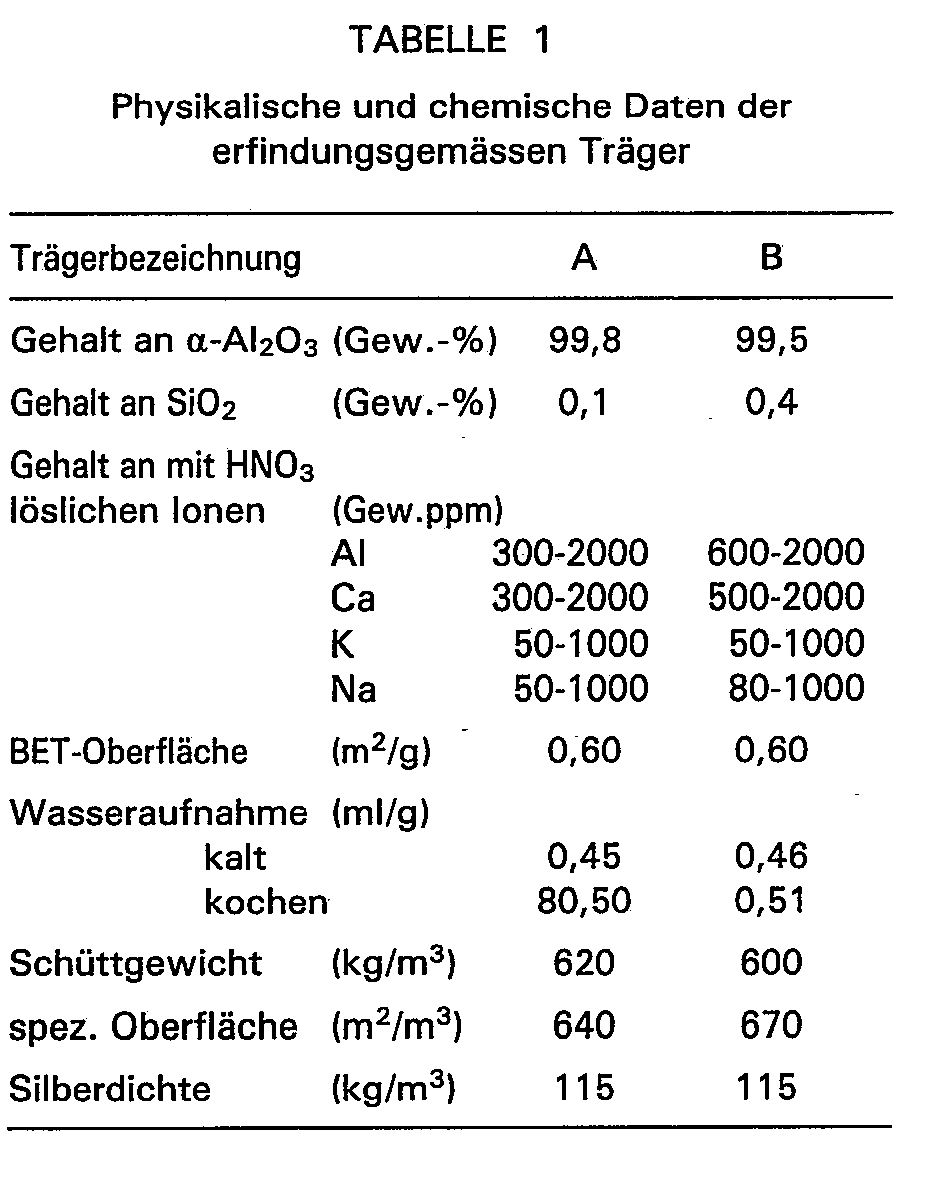
- the supports according to the invention have the properties listed in Table 1 below. Comparable known supports with different properties in various respects are shown in Table 2. These carriers do not have the desired beneficial properties as shown in the following examples.
Landscapes
- Chemical & Material Sciences (AREA)
- Organic Chemistry (AREA)
- Chemical Kinetics & Catalysis (AREA)
- Engineering & Computer Science (AREA)
- Materials Engineering (AREA)
- Catalysts (AREA)
- Organic Low-Molecular-Weight Compounds And Preparation Thereof (AREA)
Description
- Es ist bekannt, Silber enthaltende Katalysatoren für die Direktoxidation von Ethylen mit Sauerstoff zu Ethylenoxid zu verwenden. Zumeist dient a-Aluminiumoxid als Träger für die Herstellung der Silberkatalysatoren. Es sind verschiedene Verfahren für die Aufbringung der katalytisch aktiven Komponente Silber auf den Träger bekannt (US-A 2 294 383, 3 423 328, 3 172 893).
- Die Angaben über die wünschenswerten Eigenschaften, die das Trägermaterial aufweisen soll, gehen in der Literatur auseinander. In aller Regel werden deshalb in Patentschriften recht weite Bereiche für die physikalischen Eigenschaften des Trägers beansprucht.
- So werden in DE-A 3 010 533 Oberflächen von weniger als 1 m2/g und Porenvolumina von 0,2 bis 0,6 cm3/g bei einem Porendurchmesser zwischen 500 und 50 000 nm angegeben. Die chemische Zusammensetzung des Trägers wird als nicht entscheidend bezeichnet. Als mögliches Schüttgewicht werden Werte von 700 kg/m3 angegeben.
- In DE-A 2 712 785 werden Träger mit BET-Oberflächen von 0,03 bis 2 m2/g beschrieben. Zu ähnlichen Aussagen kommt die US-A 3 962 136.
- Im Gegensatz dazu zeigen die jüngsten technischen Erfahrungen, dass nur kleine Ausschnitte aus den bekannten Bereichen wirklich vorteilhafte Eigenschaften bei den gefertigten Katalysatoren ergeben. Überraschend gute Ergebnisse bei Aktivität, Selektivität und vor allem Standzeit erzielt man bei der Direktoxidation von Ethylen mit Sauerstoff zu Ethylenoxid mit einem Silberkatalysator auf porösem Träger aus a-Aluminiumoxid, der bestimmte Mengen an löslichen Calcium-, Aluminium-, Kalium- und Natriumsalzen enthält, mit einer BET-Oberfläche zwischen 0,2 und 0,8 m2/g, einem Porenvolumen von wenigstens 0,5 ml/g, wobei die Poren gleichermassen für kaltes und warmes Wasser zugänglich sind, einem Schüttgewicht unter 650 kg/m3, und der eine Form hat, die im Reaktor eine geometrische Oberfläche von mindestens 600 m2/m3 realisiert, auf welcher mehr als 13 Gew.-% Silber als aktive Komponente aufgebracht werden und je m3 Reaktor mehr als 110 kg Silber zur Verfügung stehen.
- Der für die Wirksamkeit der Katalysatoren wichtige Träger wird aus Aluminiumoxid gefertigt. Sein Gehalt an a-AI203 soll mindestens 99 Gew.-% betragen. Die Gehalte an salpetersäurelöslichen Calcium-und/oder Aluminiumionenverbindungen können zwischen 200 und 2000 ppm liegen und die Gehalte an löslichen Kalium- und/oder Natriumverbindungen sollen 50 ppm nicht unterschreiten. Das Trägermaterial aus hochreinem α-AIz03 soll zweckmässig eine BET-Oberfläche von nicht weniger als 0,3 m2/g und nicht mehr als 0,7 mZ/g aufweisen. Das Porenvolumen des Trägermaterials wird zweckmässig durch die allgemein bekannte Methode der Wasseraufnahme bzw. der Quecksilberporosimetrie bestimmt. Das durch nur fünfminütiges Einwirken von Wasser bei Raumtemperatur festgestellte Porenvolumen soll sich nur unwesentlich, z.B. maximal 10%, von dem nach den genannten Methoden bestimmten Volumen unterscheiden.
- Die Porenverteilung ist bimodal, wobei die grösseren Poren vorzugsweise zumindest 50% des Gesamtporenvolumens ergeben und einen mittleren Durchmesser von etwa 10 000 bis 40 000 nm haben, die kleineren Poren Durchmesser von etwa 500 bis 2000 nm. Man kann durch Auswahl geeigneter geometrischer Formen der Trägerpartikel das Schüttgewicht des Trägermaterials so einstellen, dass es 650 kg/m3 nicht überschreitet und die äussere geometrische Oberfläche des Katalysators pro Reaktorvolumen dabei 600 ml/ml nicht unterschreitet.
- Die katalytisch aktiven Metallkomponenten werden durch ein Tränkverfahren aufgebracht, das aus einer oder mehreren Tränkstufen bestehen kann und das eine oder mehrere Temperungsstufen umfasst. Dabei soll der Katalysatorträger mit mindestens 13 Gew.-% Silber beaufschlagt werden und eine Silbermenge von mindestens 110 kg Silber pro m3 Reaktor erreicht werden.
- Die erfindungsgemässen Silberkatalysatoren werden für die Herstellung von Ethylenoxid aus Ethylen und Sauerstoff in der Gasphase eingesetzt. Der Vorteil besteht darin, dass diese beim Einsatz für die Herstellung von Ethylenoxid einen nur halb so grossen Selektivitätsabfall zeigen wie die bekannten Katalysatoren, die Standzeiten demzufolge deutlich höher sind. Gleichzeitig erhöht sich die Belastungsflexibilität der Katalysatoren.
- Die Herstellung der erfindungsgemässen und der nicht erfindungsgemässen Katalysatoren auf den verschiedenen Trägern wurde nach folgender allgemeiner Vorgehensweise durchgeführt:
- Silbernitrat wird in zweimal soviel Molen sec.-Butylamin gelöst. Dieser Lösung werden je Ansatz für 100 g Träger 2 ml einer wässrigen Lithiumnitrat-Lösung (22,75 g LiN03 auf 100 ml Lösung) zugesetzt. Danach wird durch Zugabe von VE-Wasser das Lösungsvolumen auf das 1,1 fache erhöht.
- Entsprechend der zu erwartenden Flüssigkeitsaufnahme des Trägers wird dieser mit der Lösung imprägniert und einen Tag bei Raumtemperatur gelagert. Dann wird der imprägnierte Träger in einen Umluftofen überführt und bei 240°C im Stickstoffstrom getempert, bis die Reaktion abgeklungen ist.
- In einem zweiten Tränkschritt wird der Katalysator mit einer zur vollständigen Tränkung ausreichenden Menge einer methanolischen Lösung behandelt, die 1 Vol.-% sec.-Butylamin und 0,3 ml einer Caesiumhydroxid-Lösung (5,46 g CsOH auf 100 ml Lösung mit Methanol) enthält. Es schliesst sich ein Trocknungsschritt im Stickstoffstrom an.
- Die obengenannten Katalysatoren werden zerkleinert und jeweils 10 g der Siebfraktion 0,6 bis 0,75 mm werden in einen Reaktor aus rostfreiem Stahl von 5 mm Innendurchmesser gefüllt. Der Reaktor besitzt einen Mantel, durch den eine thermostatisierende Flüssigkeit geschickt wird. Durch den Reaktor wird ein Gas der Zusammensetzung: 30% Ethylen, 8% Sauerstoff, 2 ppm Inhibitor, Rest Stickstoff geleitet. Der Druck beträgt 16 bar und die Katalysatorbelastung 3300 NI Gas/I Kontakt x h. Die Temperatur wird so eingeregelt, dass der Sauerstoffumsatz 50% beträgt. Nach 2 Tagen werden Proben gezogen und Aktivität und Selektivität bestimmt.
- Die vorteilhaften reaktionstechnischen Ergebnisse, wie sie sich mit den auf den Trägern A und B hergestellten Katalysatoren erzielen lassen, sind in Tabelle 3 aus Mittelwerten verschiedener Messungen zusammengestellt. Die weniger günstigen Ergebnisse mit allen anderen Trägermaterialien (C-I) zeigt der zweite Teil der Tabelle.
- Die Katalysatoren A, B, C, F und I werden unzerkleinert in einer Menge von je 13 dm3 in einen stählernen druckfesten Rohrreaktor gefüllt, der dem in technischen Anlagen üblichen Einzelrohr entspricht. Der Reaktor besitzt einen Mantel, durch den eine thermostatisierende Flüssigkeit geschickt wird. Durch den Reaktor wird ein Gas der ungefähren Zusammensetzung: 30% Ethylen, 8% Sauerstoff, 6,5% C02, 4% Argon, 3 ppm Inhibitor und 50% Methan geschickt. Der Druck beträgt 16 bar. Die Temperatur im Kühlmedium des Reaktors wird in einer ersten Versuchsreihe a so eingestellt, dass bei einer Raumgeschwindigkeit von 2000 Nm3 Gas/m3 Kontakt x h ein Sauerstoffumsatz von 35% erreicht wird. In einer zweiten Versuchsreihe wird bei einer Raumgeschwindigkeit von 4000 Nm3 Gas/m3 Kontakt x h 50% des Sauerstoffs umgesetzt. Proben werden jeweils nach einem Monat und nach 12 Monaten gezogen.
- Tabelle 4 zeigt Standzeitverhalten und Belastungsflexibilität der eingesetzten Katalysatoren.
- Die erfindungsgemässen Träger haben die in der nachfolgenden Tabelle 1 zusammengestellten Eigenschaften. Vergleichbare bekannte Träger mit in verschiedener Hinsicht abweichenden Eigenschaften sind in Tabelle 2 enthalten. Diese Träger haben nicht die gewünschten vorteilhaften Eigenschaften, wie in den folgenden Beispielen gezeigt wird.


Claims (7)
Priority Applications (1)
| Application Number | Priority Date | Filing Date | Title |
|---|---|---|---|
| AT86110546T ATE38166T1 (de) | 1985-08-07 | 1986-07-30 | Silberkatalysator, seine herstellung und verwendung. |
Applications Claiming Priority (2)
| Application Number | Priority Date | Filing Date | Title |
|---|---|---|---|
| DE3528313 | 1985-08-07 | ||
| DE19853528313 DE3528313A1 (de) | 1985-08-07 | 1985-08-07 | Silberkatalysator, seine herstellung und verwendung |
Publications (2)
| Publication Number | Publication Date |
|---|---|
| EP0211397A1 EP0211397A1 (de) | 1987-02-25 |
| EP0211397B1 true EP0211397B1 (de) | 1988-10-26 |
Family
ID=6277916
Family Applications (1)
| Application Number | Title | Priority Date | Filing Date |
|---|---|---|---|
| EP86110546A Expired EP0211397B1 (de) | 1985-08-07 | 1986-07-30 | Silberkatalysator, seine Herstellung und Verwendung |
Country Status (5)
| Country | Link |
|---|---|
| US (1) | US4740493A (de) |
| EP (1) | EP0211397B1 (de) |
| AT (1) | ATE38166T1 (de) |
| CA (1) | CA1276620C (de) |
| DE (2) | DE3528313A1 (de) |
Families Citing this family (20)
| Publication number | Priority date | Publication date | Assignee | Title |
|---|---|---|---|---|
| DE3643248A1 (de) * | 1986-12-18 | 1988-06-30 | Basf Ag | Silberkatalysator, seine herstellung und verwendung |
| JP2561678B2 (ja) * | 1987-11-06 | 1996-12-11 | 三菱化学株式会社 | エチレンオキシド製造用銀触媒 |
| DE3905578A1 (de) * | 1989-02-23 | 1990-08-30 | Basf Ag | Verfahren zur herstellung eines silberkatalysators |
| DE4106508A1 (de) * | 1991-03-01 | 1992-09-03 | Basf Ag | Silberkatalysator |
| US5407888A (en) * | 1992-05-12 | 1995-04-18 | Basf Aktiengesellschaft | Silver catalyst |
| NL9420033A (nl) * | 1994-08-09 | 1996-06-03 | Scient Design Co | Werkwijze voor de bereiding van een zilver-katalysator. |
| DE69924453T2 (de) * | 1998-11-17 | 2006-02-16 | Nippon Shokubai Co., Ltd. | Katalysatorträger zur Verwendung in der Herstellung von Ethylenoxid |
| US6750173B2 (en) | 2002-04-08 | 2004-06-15 | Scientific Design Company, Inc. | Ethylene oxide catalyst |
| US6846774B2 (en) * | 2003-04-23 | 2005-01-25 | Scientific Design Co., Inc. | Ethylene oxide catalyst |
| US7932408B2 (en) * | 2006-09-29 | 2011-04-26 | Scientific Design Company, Inc. | Catalyst with bimodal pore size distribution and the use thereof |
| US7977274B2 (en) * | 2006-09-29 | 2011-07-12 | Sd Lizenzverwertungsgesellschaft Mbh & Co. Kg | Catalyst with bimodal pore size distribution and the use thereof |
| US7507845B1 (en) | 2007-08-27 | 2009-03-24 | Sd Lizenzverwertungsgesellschaft Mbh & Co Kg | Process for production of an olefin oxide |
| US8349765B2 (en) * | 2008-07-18 | 2013-01-08 | Scientific Design Company, Inc. | Mullite-containing carrier for ethylene oxide catalysts |
| US9115104B2 (en) | 2009-01-27 | 2015-08-25 | Scientific Design Company, Inc. | Ethylene oxide catalyst with optimized cesium content |
| EP2542340A4 (de) | 2010-03-01 | 2014-03-19 | Shell Oil Co | Epoxidierungskatalysator, verfahren zur herstellung des katalysators und verfahren zur herstellung eines olefinoxids |
| US9018126B2 (en) | 2010-07-13 | 2015-04-28 | Shell Oil Company | Epoxidation catalyst, a process for preparing the catalyst, and a process for the production of an olefin oxide |
| CN103270001B (zh) | 2010-12-29 | 2015-11-25 | 圣戈本陶瓷及塑料股份有限公司 | 多波瓣的多孔陶瓷本体及其制造方法 |
| TWI632954B (zh) | 2013-05-16 | 2018-08-21 | 科學設計股份有限公司 | 改善環氧乙烷觸媒的催化效能之載體處理 |
| TWI632138B (zh) | 2013-05-16 | 2018-08-11 | 科學設計股份有限公司 | 具有降低鈉含量之建基於銀之環氧乙烷觸媒 |
| CN115382386B (zh) * | 2021-05-24 | 2024-05-07 | 中国石油化工股份有限公司 | 一种工业装置含氧尾气的处理方法 |
Family Cites Families (10)
| Publication number | Priority date | Publication date | Assignee | Title |
|---|---|---|---|---|
| US2294383A (en) * | 1942-09-01 | Process for the preparation of | ||
| US3172893A (en) * | 1964-08-27 | 1965-03-09 | Ethylene oxtoationximproved s silver catalyst | |
| US3423328A (en) * | 1965-11-22 | 1969-01-21 | Engelhard Ind Inc | Silver-barium catalyst |
| BE775697A (de) * | 1970-12-02 | 1972-05-23 | Shell Int Research | |
| US4010115A (en) * | 1972-01-07 | 1977-03-01 | Shell Oil Company | Catalyst for the oxidation of ethylene to ethylene oxide |
| US4012425A (en) * | 1972-01-07 | 1977-03-15 | Shell Oil Company | Ethylene oxide process |
| GB1491447A (en) * | 1973-12-05 | 1977-11-09 | Ici Ltd | Alkylene oxide production and catalysts therefor |
| US4455392A (en) * | 1981-10-05 | 1984-06-19 | Union Carbide Corporation | Process for preparing a supported silver catalyst |
| BG37835A3 (en) * | 1982-06-30 | 1985-08-15 | Hoechst Aktiengesellschaft | Method for preparing silver catalyst |
| US4555501A (en) * | 1984-05-14 | 1985-11-26 | The Halcon Sd Group, Inc. | Process for preparing silver catalysts |
-
1985
- 1985-08-07 DE DE19853528313 patent/DE3528313A1/de not_active Withdrawn
-
1986
- 1986-07-24 CA CA000514628A patent/CA1276620C/en not_active Expired - Lifetime
- 1986-07-25 US US06/889,499 patent/US4740493A/en not_active Expired - Fee Related
- 1986-07-30 DE DE8686110546T patent/DE3660986D1/de not_active Expired
- 1986-07-30 EP EP86110546A patent/EP0211397B1/de not_active Expired
- 1986-07-30 AT AT86110546T patent/ATE38166T1/de not_active IP Right Cessation
Also Published As
| Publication number | Publication date |
|---|---|
| US4740493A (en) | 1988-04-26 |
| EP0211397A1 (de) | 1987-02-25 |
| ATE38166T1 (de) | 1988-11-15 |
| DE3528313A1 (de) | 1987-02-12 |
| DE3660986D1 (en) | 1988-12-01 |
| CA1276620C (en) | 1990-11-20 |
Similar Documents
| Publication | Publication Date | Title |
|---|---|---|
| DE3528313A1 (de) | Silberkatalysator, seine herstellung und verwendung | |
| DE69007639T2 (de) | Silberkatalysator zur Produktion von Ethylenoxid und Verfahren zur Herstellung davon. | |
| DE2521906C2 (de) | ||
| DE69520409T3 (de) | Verfahren zur Herstellung von Äthylenoxid-Katalysatoren | |
| DE69200450T2 (de) | Ethylenoxidkatalysator und Verfahren zu seiner Herstellung und seiner Anwendung. | |
| DE69404748T2 (de) | Ethylenoxidkatalysator und Verfahren zu seiner Herstellung und seiner Anwendung | |
| DE69205845T3 (de) | Katalysatorträger, zusammensetzung und Verfahren zu seiner Herstellung. | |
| DE69409536T2 (de) | Epoxydierungskatalysator und verfahren | |
| DE68921777T2 (de) | Hochwirksame Silberkatalysatoren zur Herstellung von Ethylenoxid durch Ethylenoxidation. | |
| DE69032957T4 (de) | Alkylenoxidkatalysatoren mit einem hohen Silbergehalt | |
| DE2712785C2 (de) | ||
| DE2716154C2 (de) | ||
| DE69730848T2 (de) | Verfahren zur herstellung von propylenoxid unter anwendung eines auf erdalkalikarbonaten aufgetragenen edelmetallkatalysators | |
| EP0208180B1 (de) | Verfahren zur Herstellung von 1,2-Dichlorethan durch Oxichlorierung von Ethylen an Kupfer enthaltenden Trägerkatalysatoren | |
| DE3310752C2 (de) | ||
| EP0271814B1 (de) | Silberkatalysator, seine Herstellung und Verwendung | |
| DD247388A5 (de) | Verfahren zur herstellung von silberhaltigen katalysatoren | |
| EP0038446B1 (de) | Silberhaltige Trägerkatalysatoren und Katalysator-Zwischenprodukte, Verfahren zu ihrer Herstellung und ihre Verwendung | |
| EP0384312A1 (de) | Verfahren zur Herstellung eines Silberkatalysators | |
| DD203827A5 (de) | Verfahren zur herstellung eines silberkatalysators | |
| EP0501317A1 (de) | Silberkatalysator | |
| DE68918349T2 (de) | Katalysator für die Oxidation von Ethylen zu Ethylenoxid. | |
| DE4292694C2 (de) | Katalysator, dessen Herstellung und dessen Verwendung zur Hydrierung von gasförmigem CO¶2¶ | |
| DE2312429A1 (de) | Verfahren zur synthese von propylenoxid | |
| DE2945755C2 (de) | Verfahren zur Herstellung kugeliger Tonerdeteilchen mit großer Dichte |
Legal Events
| Date | Code | Title | Description |
|---|---|---|---|
| PUAI | Public reference made under article 153(3) epc to a published international application that has entered the european phase |
Free format text: ORIGINAL CODE: 0009012 |
|
| AK | Designated contracting states |
Kind code of ref document: A1 Designated state(s): AT BE CH DE FR GB LI NL |
|
| 17P | Request for examination filed |
Effective date: 19870116 |
|
| 17Q | First examination report despatched |
Effective date: 19880125 |
|
| GRAA | (expected) grant |
Free format text: ORIGINAL CODE: 0009210 |
|
| AK | Designated contracting states |
Kind code of ref document: B1 Designated state(s): AT BE CH DE FR GB LI NL |
|
| REF | Corresponds to: |
Ref document number: 38166 Country of ref document: AT Date of ref document: 19881115 Kind code of ref document: T |
|
| GBT | Gb: translation of ep patent filed (gb section 77(6)(a)/1977) | ||
| REF | Corresponds to: |
Ref document number: 3660986 Country of ref document: DE Date of ref document: 19881201 |
|
| ET | Fr: translation filed | ||
| PG25 | Lapsed in a contracting state [announced via postgrant information from national office to epo] |
Ref country code: AT Effective date: 19890730 |
|
| PG25 | Lapsed in a contracting state [announced via postgrant information from national office to epo] |
Ref country code: LI Free format text: LAPSE BECAUSE OF NON-PAYMENT OF DUE FEES Effective date: 19890731 Ref country code: CH Free format text: LAPSE BECAUSE OF NON-PAYMENT OF DUE FEES Effective date: 19890731 |
|
| PLBE | No opposition filed within time limit |
Free format text: ORIGINAL CODE: 0009261 |
|
| R20 | Corrections of a patent specification |
Effective date: 19890203 |
|
| PLBI | Opposition filed |
Free format text: ORIGINAL CODE: 0009260 |
|
| 26 | Opposition filed |
Opponent name: HUELS AKTIENGESELLSCHAFT Effective date: 19890720 |
|
| 26N | No opposition filed | ||
| NLR1 | Nl: opposition has been filed with the epo |
Opponent name: HUELS AG |
|
| REG | Reference to a national code |
Ref country code: CH Ref legal event code: PL |
|
| PGFP | Annual fee paid to national office [announced via postgrant information from national office to epo] |
Ref country code: FR Payment date: 19900615 Year of fee payment: 5 |
|
| PGFP | Annual fee paid to national office [announced via postgrant information from national office to epo] |
Ref country code: BE Payment date: 19900629 Year of fee payment: 5 |
|
| PGFP | Annual fee paid to national office [announced via postgrant information from national office to epo] |
Ref country code: DE Payment date: 19900712 Year of fee payment: 5 |
|
| PGFP | Annual fee paid to national office [announced via postgrant information from national office to epo] |
Ref country code: GB Payment date: 19900716 Year of fee payment: 5 |
|
| PGFP | Annual fee paid to national office [announced via postgrant information from national office to epo] |
Ref country code: NL Payment date: 19900731 Year of fee payment: 5 |
|
| RDAG | Patent revoked |
Free format text: ORIGINAL CODE: 0009271 |
|
| STAA | Information on the status of an ep patent application or granted ep patent |
Free format text: STATUS: PATENT REVOKED |
|
| 27W | Patent revoked |
Effective date: 19910204 |
|
| GBPR | Gb: patent revoked under art. 102 of the ep convention designating the uk as contracting state | ||
| NLR2 | Nl: decision of opposition | ||
| BERE | Be: lapsed |
Owner name: BASF A.G. Effective date: 19910731 |