EP0205009B1 - System zur Codierung einer Datengruppe in einer Sequenz von lauflängenbegrenzten Symbolen - Google Patents
System zur Codierung einer Datengruppe in einer Sequenz von lauflängenbegrenzten Symbolen Download PDFInfo
- Publication number
- EP0205009B1 EP0205009B1 EP86107017A EP86107017A EP0205009B1 EP 0205009 B1 EP0205009 B1 EP 0205009B1 EP 86107017 A EP86107017 A EP 86107017A EP 86107017 A EP86107017 A EP 86107017A EP 0205009 B1 EP0205009 B1 EP 0205009B1
- Authority
- EP
- European Patent Office
- Prior art keywords
- rll
- byte
- symbol
- parallel
- sequence
- Prior art date
- Legal status (The legal status is an assumption and is not a legal conclusion. Google has not performed a legal analysis and makes no representation as to the accuracy of the status listed.)
- Expired
Links
Images



Classifications
-
- G—PHYSICS
- G06—COMPUTING OR CALCULATING; COUNTING
- G06T—IMAGE DATA PROCESSING OR GENERATION, IN GENERAL
- G06T9/00—Image coding
- G06T9/005—Statistical coding, e.g. Huffman, run length coding
-
- H—ELECTRICITY
- H03—ELECTRONIC CIRCUITRY
- H03M—CODING; DECODING; CODE CONVERSION IN GENERAL
- H03M5/00—Conversion of the form of the representation of individual digits
- H03M5/02—Conversion to or from representation by pulses
- H03M5/04—Conversion to or from representation by pulses the pulses having two levels
- H03M5/14—Code representation, e.g. transition, for a given bit cell depending on the information in one or more adjacent bit cells, e.g. delay modulation code, double density code
- H03M5/145—Conversion to or from block codes or representations thereof
Definitions
- This invention relates to a system for encoding an input byte-wide data stream into an output run-lenth-limited (RLL) symbol string or for decoding an output byte-wide data stream from an input RLL symbol string.
- RLL run-lenth-limited
- RLL run-length-limited
- the (1,7) format is gaining increasing acceptance in the industry as the preferred RLL coding format for present magnetic disk technology.
- the RLL (1,7) coding format a sequence of unencoded binary data is converted into an encoded bit string in which each one in a coded bit sequence must be separated from the nearest adjacent one by at least one, but no more than seven zeros.
- the most efficient coding rate results when every two unencoded data bits are converted into three coded bits.
- three coded data bits are converted into two decoded data bits.
- FIG. 1 A typical prior art architecture employing RLL (1,7) coding in a magnetic disk storage system is illustrated in Figure 1.
- unencoded data from a data processing system is provided to the encoder section of an encoder/decoder (ENC/DEC) through a serializer/deserializer (S/D).
- S/D serializer/deserializer
- the data is normally in parallel byte form, which must be serialized into a sequence of 2-bit groups.
- Each 2-bit group provided to the encoder results in the provision of three encoded bits that go to a buffer (B) for serialization into an encoded, bit-wide data string that is processed by drive circuitry for writing onto a magnetic disk. In the industry, this is referred to as bit-by-bit encoding.
- bit-wide encoded data string is provided through the buffer B in the form of successive groups of three encoded bits to the decoder section of the encoder/decoder. Each successive group of three encoded bits is decoded to a group of two data bits (bit-by-bit decoding).
- the succession of bit pairs from the decoder are converted by the serializer/deserializer into a succession of bytes that are forwarded to the data processing system.
- An artifact of the bit-by-bit coding system of Figure 1 is the requirement for at least two conversion clocks: an f C clock for the encoded bit channel and a 2/3 f C clock for the transfer of data between the serializer/deserializer S/D and the buffer B.
- the f C clock can be derived conventionally from a disk servo clock while writing information to a disk or from encoded read data obtained from a disk while reading information from the disk. Normally, f C is obtained under either circumstance through a voltage-frequency oscillator (VFO).
- VFO voltage-frequency oscillator
- the 2/3 f C clock is usually derived by use of a second VFO synchronized to the f C clock. This imposes an added hardware requirement and requires the settling times of two VFO's to be accounted for when the timing source to the f C VFO is switched.
- Figure 1 architecture requires an extra format conversion for unencoded and decoded data passing between the serializer/deserializer and encoder/decoder, further adding complexity to the system.
- the typical prior art RLL (1,7) encoder consists of a finite-state machine whose internal state is described by three state bits. Plural state bits increase the logic and storage hardware requirements of the encoder, which make it awkward for being cascaded in parallel to provide byte-wide encoding.
- the technical problem that is solved by the system of the invention is the elimination of the need for an odd 2/3 f C clock to shift unencoded or decoded data relative to the bit rate of the encoded channel.
- the invention is based upon the simultaneous coding conversion of an entire byte of data, which permits the system to transfer decoded or unencoded data at the byte rate and eliminates the requirement for the odd 2/3 rate clock.
- the system is one for encoding an input byte-wide data sequence into an output run-length-limited (RLL) symbol string and for decoding an output byte-wide data sequence from an input RLL symbol string.
- RLL run-length-limited
- the system includes an RLL encoder that responds to consecutive parallel unencoded bytes occurring at a byte rate in an input byte-wide data sequence by producing an output RLL symbol sequence including consecutive groups of parallel RLL symbols.
- a format converter is connected to the RLL encoder for converting the output RLL symbol sequence into an output RLL-encoded symbol string having a symbol string rate which is a whole multiple of the byte rate.
- the format converter further responds to an input RLL symbol string having an input symbol string rate, by providing an input RLL symbol sequence including consecutive groups of parallel RLL symbols.
- An RLL decoder responds to the input RLL symbol sequence constructed by the format converter by producing, at the byte rate, an output byte-wide data sequence including consecutive parallel bytes of decoded data.
- the primary objective of the system is to provide a bi-directional code conversion interface between a channel conducting a sequence of consecutive parallel bytes of data at a byte rate and a data channel conducting strings of RLL (1,7) symbols at a symbol string rate.
- An advantage of the present invention is the elimination of the need for an odd clock signal having 2/3 the frequency of the symbol channel.
- FIG. 1 is a block diagram of code conversion architecture in the prior art.
- FIG. 2 is a block diagram illustrating the general architecture of the system of the invention.
- FIG. 3 is a more detailed illustration of the functional blocks included in the system of the invention.
- Figure 4 is a waveform diagram illustrating read and write modes of operation of the system of the invention.
- Figure 5 is a schematic diagram illustrating a format converter used in the system of the invention.
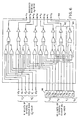
- Figure 6 is a schematic diagram illustrating a decoder for converting twelve bits of RLL (1,7)-encoded data simultaneously into a parallel byte of decoded data.
- Figure 7 is a circuit diagram of the encoder used to simultaneously encode a byte of unencoded data into twelve bits of RLL (1,7)-encoded data.
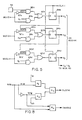
- Figure 8 is a gating circuit used to steer byte clock signals during read and write operations of the invention.
- a byte of data is taken, as in the usual sense, to denote a sequence of eight adjacent binary digits (bits) that are operated upon as a unit.
- a parallel byte refers to the eight bits transferred simultaneously on a data channel including 8 parallel transmission paths.
- a string refers to a linear sequence of bits.
- a coded symbol consists of a group of three consecutive bits resulting from an encoding operation performed on two bits of unencoded data.
- a symbol string is a string of encoded bits in which successive groups of three bits form successive symbols.
- weight is assigned a bit in a data string according to its place in the string.
- the first bit is accorded the most significance (MSB) and is assigned the lowest-numerical subscript, e.g., x0. Bits occurring after the MSB have correspondingly less significance, but subscripts of higher magnitude.
- MSB most significance
- bit x0 the first bit
- bit x7 the last bit
- this significance convention is observed for unencoded bits (x), encoded bits (y), and symbols(Y).
- the system of the invention accepts an input byte sequence constituting a succession of parallel bytes on a data channel that is eight bits wide. Each byte consists of eight simultaneously-transferred bits.
- the byte sequence is fed to the system 10 for being encoded into an output consisting of a string of RLL (1,7)-encoded symbols.
- An input byte sequence can be provided from a conventional data processing system (not shown) for being entered (written) onto a magnetic disk (also not shown) for storage and later retrieval.
- the input byte sequence is converted by the system of the invention to an output symbol string, in which form it is stored on the disk.
- an input symbol string is obtained from the disk and provided to the system 10 for conversion into a decoded output byte sequence that is forwarded to the data processing system.
- the system 10 operates in conjunction with conventional disk control logic 12 that provides a read/write (R/W) gate signal for defining the mode of operation for the system 10.
- R/W read/write
- the control logic includes a VFO (not shown) to generate a symbol channel clock f C and a multi-phase byte clock f B that is constrained to be an integer sub-multiple of f C .
- the control logic 12 also provides conventional signals MUX 1 and MUX 2 for controlling conventional multiplexing and format conversion circuitry in the system 10.
- the system 10 is a byte-wide encoder and decoder for RLL (1,7) code and includes an RLL encoder 16 that accepts consecutive bytes of an input byte sequence at a byte rate f B and encodes them according to RLL (1,7) coding rules into a write symbol group sequence (WSGS).
- the write symbol group sequence consists of a sequence of groups of parallel encoded symbol bits.
- the 2/3 conversion rate constrains each group of the write symbol group sequence to twelve bits, which form 4 symbols.
- the write symbol group sequence is provided to a serializer/deserializer circuit 18 that, during a write mode of operation, performs parallel-to-serial format conversion to convert the 12-bit wide write symbol group sequence into a bit-wide output symbol string having a string rate f C that is equal to 12 f B .
- the serializer/deserializer circuit 18 receives a bit-wide input symbol string at the string rate f C and performs serial-to-parallel format conversion on the input string to produce a read symbol group sequence (RSGS) consisting of the succession of groups of twelve parallel encoded data bits.
- the read symbol group sequence is provided to an RLL decoder 20 which converts the sequence to a corresponding parallel byte sequence of decoded bits that is forwarded at the byte rate f B to the data processing system as read data.
- the system 10 preferably operates in a conventional magnetic disk storage unit for encoding a parallel byte sequence of data to be written to a magnetic disk.
- the parallel byte stream is provided as write data from a data processing system (not shown) and is delivered unencoded to the system 10.
- the write data is converted by the system of the invention to an RLL (1,7)-encoded bit string comprising symbol channel write data which is submitted to disk drive electronics (not shown) for being entered on a magnetic disk (also not shown).
- This mode of operation is referred to hereinbelow as the WRITE mode and is signified by a WRITE state of the R/W signal produced by the control logic 12.
- an RLL (1,7)-encoded bit string comprising symbol channel read data obtained from the disk drive electronics for delivery to the data processing system is delivered to the system 10 for conversion to a decoded parallel byte sequence which is transferred by conventional means to the data processing system.
- the byte-wide encoder and decoder system for RLL (1,7) code pictured in Figure 3 a sequence of parallel bytes that are to be encoded for being written onto a magnetic disk are staged, byte-by-byte into the system through a first input latch 30, which is enabled by the WRITE state of the R/W signal. Once entered into the latch 30, a byte of unencoded data is available from the output of the latch 30 to a second latch 32 and to the RLL (1,7) byte-wide encoder 16.
- WSG write symbol group
- each group of twelve encoded bits comprises 4 symbols, Y0 - Y3 (where Y0 is the most significant symbol), with each symbol defined by a respective set of three encoded bits.
- symbol Y1 is defined by encoded bits Y3 - Y5.
- the sequence of parallel bytes staged into the encoder 16 from the input latch 30 results in the provision by the encoder of a corresponding sequence of write symbol groups termed a write symbol group sequence (WSGS) that is fed simultaneously to a pair of conventional serializer/deserializers (S/D) 36 and 38 that constitute the S/D circuit 18.
- WSGS write symbol group sequence
- S/D serializer/deserializers
- Each of the S/D's 36 and 38 has a P i (parallel input) port and a S i (serial input) port.
- alternating levels of the MUX 2 signal on the C (control) ports of the S/D's permit the entry of alternate write symbol groups provided by the encoder 16 through the P i ports of the S/D's.
- the other is converting the parallel format of the previous write symbol group by shifting the bits of the previous group serially through one of the 12 signal leads connected to the O (output) port of the S/D.
- the serialized symbol group is provided to a conventional 2-to-1 multiplexer 40, which is operated by the control logic 12 to interleave serialized symbol groups provided alternately from the S/D's 36 and 38 into a continuous symbol string of encoded bits.
- the encoded symbol string output by the multiplexer 40 is fed to conventional circuitry 42 which performs precompensation on the bits of the output symbol string to prepare them for being written as symbol channel write data onto the magnetic disk.
- write symbol group (N) is provided in parallel to another conventional 2-to-1 multiplexer 44 while the other S/D is serially shifting the previous write symbol group, WSG (N-1), serially to the multiplexer 40.
- the multiplexer 44 interleaves the symbol groups to reform the write symbol group sequence, which is provided, during write operations, through the output of the multiplexer 44 to a pair of conventional, serially-connected latches 46 and 48.
- the decoder 20 receives the six encoded symbol bits of WSG (N) and uses them, together with the least significant ten bits of WSG (N-1) stored in the latch 48, to decode the byte (byte N-1) from which WSG (N-1) was encoded.
- the decoded byte (N-1) is provided by the decoder 20 to a conventional digital comparator 52 where it is compared with the unencoded form of byte (N-1) stored in the latch 32.
- the output of the comparator 52 comprises a WRITE CHECK signal which, in one state, indicates correspondence between the decoded byte available from the decoder 20 and the stored byte available from the latch 32.
- the other state of the WRITE CHECK signal indicates noncorrespondence and can be used to institute standard error-correcting procedures in other components of the disk interface with which the system of the invention is used.
- the control logic 12 changes the R/W signal to its READ state and the disk drive circuitry provides symbol channel read data obtained from the magnetic disk in the form of an input encoded symbol string.
- the input symbol string is fed through a shift register 54 to the S i ports of the S/D's 36 and 38.
- the S/D's are controlled to receive alternate groups of twelve encoded bits from the input string and to provide them, alternately in parallel form, through the multiplexer 44 to the decoder 20 in the manner described hereinabove.
- the alternate groups of parallel encoded bits are formed by the multiplexer 44 into a read symbol group sequence that is fed to the decoder 20 in the manner described hereinabove.
- the read symbol group sequence is decoded by the decoder 20 into an output sequence of parallel bytes that are returned to the data processing system through an output register 56 as read data.
- the symbol string clock is labelled f C .
- the BYTE CLKS signal represents a series of phased byte clock signals (f B1 - f B4 ) that is cycled once for each byte of data encoded or decoded by the system 10. Since there is a 2/3 ratio of unencoded to encoded bits, one byte clock cycle is completed for every twelve pulses of f C , and each byte clock has the frequency f C /12. Every twelve pulses of f C coincides with the completion of one encoding or decoding operation for each byte of data received or provided by the system 10.
- the write mode begins with the provision of the WRITE state of the R/W signal to the system 10.
- the WRITE state of the R/W signal enables the operations of the latches 30 and 32, the multiplexer 40, the pre-compensation circuit 42, and the comparator 52.
- the signal is provided in inverted form to the shift register 54 and the output register 56 to prevent their operating during write mode operation.
- the R/W signal gates f B3 to the latch 46 and f B4 to the latch 48.
- a write mode sequence of operation includes the provision of a parallel byte of data (byte (N)) to the latch 30, with the byte being latched on the negative level of f B1 while present at the input of the latch.
- the symbol group WSG (N) of 12 parallel encoded bits resulting from the encoding of byte (N) is loaded into S/D 36 by a gated write group load pulse 57 that occurs in CLK 1 during the write mode.
- the pulse 57 occurs during the second phase (B2) of the byte clock.
- twelve shift pulses are provided in CLK 1 to serially shift out the ISG entered by the pulse 57.
- the positive state of the MUX 2 signal couples the parallel output of the S/D 36 to the output of the multiplexer 44 where, as explained above, the most significant six bits of write symbol group (N) are made available to the decoder 20.
- the decoder then decodes WSG (N-1).
- the least significant ten bits of write symbol group (N) are entered into the latch 46.
- the previous symbol group, group (N-1) will have previously been shifted to the latch 48 from the latch 46.
- the byte clock f B3 sets the comparator 52 so that the decoded byte corresponding to symbol group (N-1) (that is, byte (N-1)) is compared against the unencoded version of byte (N-1) stored in the latch 32. Assuming that the unencoded and decoded bytes correspond, the control logic will, during the fourth phase B4 of the byte clock, produce f B4 .
- the fourth phase of the byte clock f B4 enters byte (N) into the latch 32, and the ten least significant bits of symbol group (N) into the latch 48.
- the CLK 1 and CLK 2 signals are in phase with the MUX 1 and MUX 2 signals, which permits the multiplexer 40 to seamlessly interleave the serialized symbol groups. Further, the twelve shifting pulses of CLK 1 and CLK 2 when active have the frequency of f C , and therefore ensure that the encoded bit string has the frequency f C .
- Figure 5 illustrates the S/D 36 and includes an array of AND gates 60 a -60 l that feed through OR gates 62 a - 62 l to the respective input D ports of clocked storage devices 64 a -64 l .
- AND gates 66 a - 66 l are fed through the respective OR gates 62 a - 62 l to the respective inputs of the storage devices 64 a - 64 l .
- Parallel entry of twelve bits of a write symbol group into the S/D 36 is permitted by the positive state of the MUX 2 signal which enables the gates 66 a - 66 l : when the CLK 1 load pulse 57 is fed simultaneously to the clock inputs of the storage devices 64 a - 64 l , the current write symbol group is entered into the S/D 36.
- the MUX 2 signal changes state by going low. As illustrated, the low state of MUX 2 is inverted by the inverters 67 a - 67 l to produce a conventional inverse logic signal MUX2 which enables AND gates 60 a - 60 l .
- MUX2 With MUX2 high, the symbol group bits are fed sequentially through the S/D 36 from the storage device 64 a through the storage device 64 l , with the serial output being available at the Q output port of device 64 l .
- the S/D 38 can be implemented in exactly the fashion illustrated for the S/D 36 in Figure 5 simply by exchanging the MUX 2 and MUX2 signals, with the positive state of the MUX 2 signal provided to enable the gates 60 a - 60 l and the inverted state, MUX2 , enabling the gates 66 a - 66 l . Further, the clock signal input would be changed to CLK 2 .
- Read mode operations comprise a sequence of decoding cycles, each defined by one succession of the four phase byte clocks B1-B4.
- the READ state of the R/W signal disables latches 30 and 32, multiplexer 40, and comparator 52; it enables the registers 54 and 56.
- the WRITE state of the R/W signal gates f B1 to the latch 46 and f B3 to the latch 48.
- the control logic 12 will have been alerted by the provision of a read request or command from the data processor to search for a standard pattern of encoded bits comprising a preamble in the data field to be read.
- the read data is shifted serially into the shift register 54 from the disk drive electronics.
- the contents of the shift register 54 are continuously read in parallel by the control logic 12 so that when the preamble denoting the beginning of the addressed storage sector is recognized, the control logic 12 can synchronize the provision of the gated clocks CLK 1 and CLK 2 to the S/D's 36 and 38.
- the first pulse of the twelve shift pulses of one of the gated clocks will be made available to one of the S/D's 36 or 38 in phase with the availability, at the serial output of the shift register 54, of the first encoded bit of the input bit string.
- the S/D's are driven out of phase to capture alternate groups of twelve serial bits from the input symbol string. While one S/D is receiving twelve encoded bits, the other is loading the previous twelve bits in parallel as an input symbol group (ISG) through the multiplexer 44 to the decoder 20.
- ISG input symbol group
- MUX 2 negative and CLK 1 is gated on
- symbol bits are shifted serially from the register 54 into the devices 60 a - 60 l .
- twelve shift pulses of CLK 1 twelve symbol bits will be held in S/D 36.
- S/D 38 acquires the next twelve bits in the input symbol string.
- a byte decode cycle will commence just after the rising edge of the first pulse of gated clock CLK 2 .
- the twelve shift pulses of the gated clock and the positive state of the MUX 2 signal will shift the twelve encoded bits of input symbol group (N+1) into S/D 38.
- the positive state of the MUX 2 signal permits input symbol group (N) to be available on the output of the multiplexer 44. This provides 6 most significant bits of symbol group (N) to be available to the decoder, thereby enabling the decoding of symbol group (N-1).
- the READ state of the R/W signal gates f B1 to the latch 46, which enters the ten least significant bits of symbol group (N) into the latch 46.
- f B2 is provided to the output register 56 which clocks the decoded byte (N-1) into the register, thereby providing it in parallel-byte format as read data to the data processing system.
- the R/W signal gates f B3 to the latch 48, transferring thereto the ten least significant bits of the input symbol group (N).
- input symbol group (N+1) is transferred in parallel from S/D 38 to be available through the multiplexer 44. This enables the decoder 20 to convert input symbol group (N) into output byte (N) with the sequence of operations described above for the previous decode cycle implemented for input symbol groups (N+1) and (N).
- R/W The use of the R/W signal to gate byte clocks to the registers 46 and 48 can be understood by reference to Figure 9.
- one state of R/W permits f B1 to pass through two gates (G1 and G3) to the clock input of, for example, register 46.
- the opposite state R/W permits f B3 to pass to the clock input through gates G2 and G3.
- the gate G4 passes either R/W or R/W to the enable port of the register.
- the NOR expressions (1) and (2) are implemented by the decoder NOR gate sections 60 and 62, respectively, in Figure 6. It should be evident that the pair of NOR sections 60 and 62 can be replicated four times to provide simultaneous decoding of a byte (eight decoded bits) from sixteen encoded bits spanning 6 adjacent symbols, Y0 - Y1, thus providing a look ahead to the two future channel symbols Y'0 and Y'1.
- the sixteen encoded bits are provided from the ten least significant bits of symbol group (N) stored in the latch 48 and the six most significant bits of symbol group (N+1) that are available to the decoder from the output of the multiplexer 44.
- the byte-wide encoder might also be implemented by replicating the encoder taught in the incorporated Adler et al. patent four times to produce twelve encoded bits (4 symbols) at a time.
- the encoder in the incorporated patent relies upon the generation and storage of an intermediate 3-bit state for producing each coded symbol. Replication of circuitry for generating and storing the intermediate 3-bit states would result in a complicated and relatively slow-operating encoder.
- the encoder of Figure 7 avoids concatenation of 3-bit state circuitry by enlarging the dependence of each encoded bit from two to four bits of unencoded data. This permits the realization of an RLL (1,7) encoder that provides simultaneous encoding of a parallel byte of data in which each resulting symbol is dependent upon only one state bit (in addition to four unencoded bits) for each encoding operation.
- any current symbol Y that comprises three encoded symbol bits (Y0, Y1, Y2) and that is encoded according to the algorithm of the Adler et al. patent from unencoded bits x0 and x1 contained in the bit string fragment ...x0 x1 x2 x3....
- the current symbol Y has the functional dependence given in equation (3): where z1, z2, and z3 are current state bits resulting from the encoding of the symbol immediately preceding Y, and x0 and x1 are the two unencoded bits to be used in encoding Y.
- the set of equations (14) - (17) define an encoding operation that produces an RLL (1,7) symbol Y' based upon four unconstrained, unencoded bits x3 - x0 and a single state variable w.
- the portion of the encoder 16 that is enclosed by the dotted line indicated by the reference numeral 70 implements, in a modular logic circuit, the encoding equations (14) - (16).
- a conventional 1-bit data storage device 72 provides the current state variable w to the modular circuit 70.
- the unencoded bits x'0 - x'7 constitute a byte (N-1) stored in latch 32.
- the unencoded bits x0 - x7 constitute the byte (N) following the byte (N-1) and are stored in latch 30.
- the bits x0 - x2 are provided both to the encoder 16 and to the input of the latch 32.
- the adjacent bits x'6x'7x0x1 are provided, together with w, to the modular circuit 70, which performs the encoding operation resulting in encoded bits Y0, Y1, and Y2 that form the (most significant) symbol Y0 of the write symbol group WSG (N).
- state variables w', w'', and w''' are produced by NAND gates 74-78, each of which implements the state variable equation (17).
- Each of the state variables produced by the NAND gates 74-78 are combined in a respective modular circuit equivalent to the modular circuit 70 with the proper bits in byte (N) to produce the remaining symbols, Y1, Y2, and Y3 of WSG (N).
- a next state variable w'''' is produced by the NAND gate 80 and provided as an input to the storage device 72 into which it is entered during a write mode encoding cycle by the occurrence of f B4 .
- the state variable w'''' will comprise the current state variable w that enables the encoding operation producing WSG (N+1).
Landscapes
- Engineering & Computer Science (AREA)
- Theoretical Computer Science (AREA)
- Multimedia (AREA)
- Physics & Mathematics (AREA)
- General Physics & Mathematics (AREA)
- Signal Processing For Digital Recording And Reproducing (AREA)
- Compression, Expansion, Code Conversion, And Decoders (AREA)
- Dc Digital Transmission (AREA)
Claims (7)
- System zum Codieren eines Byte-breiten Eingangsdatenstromes in eine Lauflänge-begrenzte (RLL) Ausgangssymbolkette und zum Decodieren eines Byte-breiten Ausgangsdatenstromes von einer RLL-Eingangssymbolkette, gekennzeichnet durch:
ein RLL-Codierungsmittel (16, 30-34), das auf aufeinanderfolgende, nicht-codierte parallele Bytes anspricht, die mit einer Byte-Rate (fB) in einem Byte-breiten Eingangsdatenstrom zum Erzeugen einer ersten RLL (1,7)-Symbolfolge mit aufeinanderfolgenden Gruppen paralleler RLL-Symbole auftreten, wobei der RLL (1,7)-Lauflängecode als eine Bitkette definiert ist, in der jede in der Bitfolge von der am nächsten benachbarten durch zumindest eine, jedoch nicht mehr als sieben Nullen getrennt ist,
ein Formatmittel (36, 38), das mit dem RLL-Codierungsmittel zum Empfangen der ersten RLL-Symbolfolge bei der Byte-Rate und zum Umwandeln der ersten RLL (1,7)-Symbolfolge in eine RLL-Ausgangssymbolkette verbunden ist, die eine SymbolketteRate (fc) aufweist, die ein ganzzähliges Vielfaches der Byte-Rate ist und die auf eine RLL-Eingangssymbolkette anspricht, welche die Symbolkette-Rate zum Liefern einer zweiten RLL (1,7)-Symbolfolge mit aufeinanderfolgenden Gruppen paralleler RLL-Symbole bei der Byte-Rate aufweist und
ein RLL-Decodierungsmittel (20), das auf die zweite RLL(1,7)-Symbolfolge zum Liefern eines Byte-breiten Ausgangsdatenstromes mit aufeinanderfolgenden decodierten, parallelen Datenbytes anspricht, die bei der Byte-Rate auftreten. - System nach Anspruch 1, bei welchem das RLL-Codierungsmittel ein pralleles Byte bei einer 2/3-Codierungsrate in eine entsprechende Gruppe paralleler RLL (1,7)-Symbole codiert.
- System nach Anspruch 2, bei welchem das RLL-Codierungsmittel aufweist:
Latch-Mittel (30, 32) zum Empfangen eines der aufeinanderfolgenden Bytes und von zwei Bits aus dem Byte, welches dem empfangenen Byte vorangeht in einem Parallelformat,
Registermittel (72) zum Empfangen eines Einzelzustands-Bits, das aus dem Codieren des vorangehenden Bytes abgeleitet ist und
ein Logikmittel (34), das mit den Latch- und Registermitteln zum Erzeugen der zwei Bits und des Zustandsbits, einer RLL (1,7)-codierten Symbol gruppe mit zwölf Symbol bits und einem nächsten Zustandsbit für die Verwendung beim Codieren des nächsten folgenden Bytes entsprechend dem empfangenen Byte verbunden ist. - System nach Anspruch 3, bei welchem das Logikmittel ein Codierungsmodul (70) aufweist, das ein RLL (1,7)-Symbol auf der Grundlage vier aufeinanderfolgender, nicht-codierter Bits in den aufeinanderfolgenden Bytes und eines Zustandsbits erzeugt.
- System nach Anspruch 4, mit vier der Codierungsmodule.
- System nach Anspruch 1, bei welchem das Formatmittel aufweist:
ein erstes Speichermittel (36) zum Empfangen jeder eines ersten Satzes abwechselnder Gruppen paralleler RLL-Symbole in der ersten RLL-Symbol gruppenfolge und zum daraus Erzeugen einer ersten seriellen Folge von Gruppen serialisierter RLL-Symbole, wenn das RLL-Codierungsmittel die aufeinanderfolgenden Bytes empfängt,
ein zweites Speichermittel (38) zum Empfangen jeder einer zweiten Gruppe abwechselnder Gruppen paralleler RLL-Symbole in der ersten RLL-Symbolgruppenfolge und zum daraus Erzeugen einer zweiten seriellen Folge von Gruppen serialisierter RLLSymbole, wenn das RLL-Codierungsmittel die aufeinanderfolgenden Bytes empfangen hat, und
ein erstes Multiplex-Mittel (40), das mit dem ersten und zweiten Speichermittel zum Überlappen der ersten und zweiten seriellen Folgen verbunden ist, um die RLL-Ausgangssymbolkette zu erzeugen. - System nach Anspruch 6, bei welchem das erste Speichermittel (36) aus der Symbolkette abwechselnde Gruppen serieller Symbole extrahiert und daraus eine erste parallele Folge von Gruppen paralleler RLL-Symbole erzeugt und das zweite Speichermittel (38) aus der Eingangssymbolkette andere abwechselnde Gruppen serieller Symbole extrahiert und daraus eine zweite parallele Folge von Gruppen paralleler Symbole erzeugt, wenn das Formatmittel eine Eingangssymbolkette empfängt und das Formatmittel ein zweites Multiplex-Mittel (44) aufweist, das mit dem ersten und zweiten Speichermittel zum Überlappen der ersten und zweiten parallelen Folgen verbunden ist, um eine zweite RLL-Symbolfolge zu erzeugen.
Applications Claiming Priority (2)
| Application Number | Priority Date | Filing Date | Title |
|---|---|---|---|
| US06/745,242 US4688016A (en) | 1985-06-13 | 1985-06-13 | Byte-wide encoder and decoder system for RLL (1,7) code |
| US745242 | 1985-06-13 |
Publications (3)
| Publication Number | Publication Date |
|---|---|
| EP0205009A2 EP0205009A2 (de) | 1986-12-17 |
| EP0205009A3 EP0205009A3 (en) | 1989-05-03 |
| EP0205009B1 true EP0205009B1 (de) | 1991-03-20 |
Family
ID=24995854
Family Applications (1)
| Application Number | Title | Priority Date | Filing Date |
|---|---|---|---|
| EP86107017A Expired EP0205009B1 (de) | 1985-06-13 | 1986-05-23 | System zur Codierung einer Datengruppe in einer Sequenz von lauflängenbegrenzten Symbolen |
Country Status (5)
| Country | Link |
|---|---|
| US (1) | US4688016A (de) |
| EP (1) | EP0205009B1 (de) |
| JP (1) | JPS61288624A (de) |
| CA (1) | CA1252895A (de) |
| DE (1) | DE3678206D1 (de) |
Families Citing this family (25)
| Publication number | Priority date | Publication date | Assignee | Title |
|---|---|---|---|---|
| US4833470A (en) * | 1986-07-15 | 1989-05-23 | Matsushita Electric Industrial Co., Ltd. | Code conversion apparatus |
| JPH061608B2 (ja) * | 1986-12-08 | 1994-01-05 | 富士通株式会社 | デ−タの変復調装置 |
| US4914438A (en) * | 1987-09-01 | 1990-04-03 | Hitachi, Ltd. | Digital information coding system |
| US4868690A (en) * | 1987-11-05 | 1989-09-19 | Magnetic Peripherals Inc. | Self-initializing 1,7 code decoder with low sensitivity to errors in preamble |
| JPH01286626A (ja) * | 1988-01-18 | 1989-11-17 | Hitachi Ltd | データ符号化方式 |
| US4870414A (en) * | 1988-03-18 | 1989-09-26 | International Business Machines Corporation | Even mark modulation coding method |
| US5737632A (en) * | 1989-12-19 | 1998-04-07 | Hitachi, Ltd. | Magnetic disc control apparatus with parallel data transfer between disc control unit and encoder/decoder circuit |
| US5047767A (en) * | 1990-05-21 | 1991-09-10 | Eastman Kodak Company | Apparatus utilizing a four state encoder for encoding and decoding A sliding block (1,7) code |
| DE69024045T2 (de) * | 1990-08-16 | 1996-06-20 | Ibm | Kodierungsverfahren und Vorrichtung zur Pipeline- und Parallelverarbeitung. |
| US5392168A (en) * | 1990-08-31 | 1995-02-21 | Matsushita Electric Industrial Co., Ltd. | Method of recording digital video and audio data |
| US5231545A (en) * | 1991-06-04 | 1993-07-27 | Quantum Corporation | Fault tolerant rll data sector address mark decoder |
| JP2987206B2 (ja) * | 1991-12-13 | 1999-12-06 | アヴィッド・テクノロジー・インコーポレーテッド | バッファ及びフレーム索引作成 |
| US6058236A (en) * | 1992-04-10 | 2000-05-02 | Avid Technology, Inc. | System and method for digitally capturing video segments from a video assist of a film camera |
| US6678461B1 (en) | 1992-04-10 | 2004-01-13 | Avid Technology, Inc. | Media recorder for capture and playback of live and prerecorded audio and/or video information |
| US5424881A (en) * | 1993-02-01 | 1995-06-13 | Cirrus Logic, Inc. | Synchronous read channel |
| US6977673B1 (en) | 1995-02-23 | 2005-12-20 | Avid Technology, Inc. | Portable moving picture recording device including switching control for multiple data flow configurations |
| US7623754B1 (en) | 1995-02-23 | 2009-11-24 | Avid Technology, Inc. | Motion picture recording device using digital, computer-readable non-linear media |
| US5999406A (en) * | 1995-02-23 | 1999-12-07 | Avid Technology, Inc. | Dockable electronic equipment container |
| US7532807B2 (en) * | 1995-04-07 | 2009-05-12 | Avid Technology, Inc. | Combined editing system and digital moving picture recording system |
| US6775217B1 (en) * | 2000-05-18 | 2004-08-10 | Cirrus Logic, Inc. | Multi-stage ring oscillator for providing stable delays on EFM data pulses for recording CD-R and CD-RW medium |
| US6763477B1 (en) | 2000-07-31 | 2004-07-13 | Hewlett-Packard Development Company, L.P. | Method and apparatus for transmitting and receiving data using a self clocking link protocol |
| US6504493B1 (en) | 2000-10-31 | 2003-01-07 | Marvell International, Ltd. | Method and apparatus for encoding/decoding data |
| US7091890B1 (en) * | 2004-08-17 | 2006-08-15 | Xilinx, Inc. | Multi-purpose source synchronous interface circuitry |
| US7502433B1 (en) | 2004-08-17 | 2009-03-10 | Xilinx, Inc. | Bimodal source synchronous interface |
| US7787526B2 (en) * | 2005-07-12 | 2010-08-31 | Mcgee James Ridenour | Circuits and methods for a multi-differential embedded-clock channel |
Family Cites Families (7)
| Publication number | Priority date | Publication date | Assignee | Title |
|---|---|---|---|---|
| US3685033A (en) * | 1970-08-24 | 1972-08-15 | Honeywell Inc | Block encoding for magnetic recording systems |
| US3852687A (en) * | 1973-07-02 | 1974-12-03 | Ibm | High rate digital modulation/demodulation method |
| DE2508706C2 (de) * | 1974-05-02 | 1984-10-11 | International Business Machines Corp., Armonk, N.Y. | Schaltungsanordnung zur Codierung von Datenbitfolgen |
| JPS5634266A (en) * | 1979-08-29 | 1981-04-06 | Hitachi Ltd | Double run length encoding system |
| US4337458A (en) * | 1980-02-19 | 1982-06-29 | Sperry Corporation | Data encoding method and system employing two-thirds code rate with full word look-ahead |
| US4413251A (en) * | 1981-07-16 | 1983-11-01 | International Business Machines Corporation | Method and apparatus for generating a noiseless sliding block code for a (1,7) channel with rate 2/3 |
| US4488142A (en) * | 1981-12-31 | 1984-12-11 | International Business Machines Corporation | Apparatus for encoding unconstrained data onto a (1,7) format with rate 2/3 |
-
1985
- 1985-06-13 US US06/745,242 patent/US4688016A/en not_active Expired - Fee Related
-
1986
- 1986-04-11 CA CA000506442A patent/CA1252895A/en not_active Expired
- 1986-05-23 EP EP86107017A patent/EP0205009B1/de not_active Expired
- 1986-05-23 DE DE8686107017T patent/DE3678206D1/de not_active Expired - Lifetime
- 1986-06-12 JP JP61135085A patent/JPS61288624A/ja active Granted
Also Published As
| Publication number | Publication date |
|---|---|
| CA1252895A (en) | 1989-04-18 |
| JPH0214816B2 (de) | 1990-04-10 |
| JPS61288624A (ja) | 1986-12-18 |
| DE3678206D1 (de) | 1991-04-25 |
| EP0205009A2 (de) | 1986-12-17 |
| EP0205009A3 (en) | 1989-05-03 |
| US4688016A (en) | 1987-08-18 |
Similar Documents
| Publication | Publication Date | Title |
|---|---|---|
| EP0205009B1 (de) | System zur Codierung einer Datengruppe in einer Sequenz von lauflängenbegrenzten Symbolen | |
| US4115768A (en) | Sequential encoding and decoding of variable word length, fixed rate data codes | |
| US5436626A (en) | Variable-length codeword encoder | |
| US4146909A (en) | Sync pattern encoding system for run-length limited codes | |
| US5663724A (en) | 16B/20B encoder | |
| US5781133A (en) | Method and apparatus for implementing run length limited codes | |
| EP0083407A1 (de) | Verfahren und Anordnung zum Erzeugen eines rauschlosen Blockkodes für einen (2,7)-Kanal mit 1/2 Verhältnis | |
| US5428627A (en) | Method and apparatus for initializing an ECC circuit | |
| US3811108A (en) | Reverse cyclic code error correction | |
| US4684921A (en) | RLL (1,7) encoder with single state bit | |
| US4882583A (en) | Modified sliding block code for limiting error propagation | |
| EP0413076A1 (de) | Daten-Kodierung für den Sofortstart von PRML-Empfängern | |
| US3594560A (en) | Digital expandor circuit | |
| FI78802B (fi) | Kopplingsarrangemang foer kodning och avkodning av informationssignaler. | |
| US3906485A (en) | Data coding circuits for encoded waveform with constrained charge accumulation | |
| JP3935217B2 (ja) | mビット情報ワードのシーケンスから変調信号への変換 | |
| US4398225A (en) | Combined serializer encoder and decoder for data storage system | |
| EP0209671B1 (de) | Lauflängenbegrenztes Kodiergerät und dessen Betriebsverfahren | |
| EP0503863A2 (de) | Lexikographisches Kodieren und Dekodieren von Zustandsabhängigen Kodes | |
| US4261019A (en) | Compatible digital magnetic recording system | |
| JP2006209953A (ja) | ショート・ブロック・エンコーダを用いたデータ変調方式 | |
| JP2593662B2 (ja) | パンクチャド符号化回路 | |
| GB2109200A (en) | Digital data encoding | |
| JPS60128722A (ja) | 可変長符号化復号化方式 | |
| JPS60128720A (ja) | 逐次復号化回路 |
Legal Events
| Date | Code | Title | Description |
|---|---|---|---|
| PUAI | Public reference made under article 153(3) epc to a published international application that has entered the european phase |
Free format text: ORIGINAL CODE: 0009012 |
|
| AK | Designated contracting states |
Kind code of ref document: A2 Designated state(s): DE FR GB IT |
|
| 17P | Request for examination filed |
Effective date: 19870422 |
|
| PUAL | Search report despatched |
Free format text: ORIGINAL CODE: 0009013 |
|
| RHK1 | Main classification (correction) |
Ipc: H03M 5/14 |
|
| AK | Designated contracting states |
Kind code of ref document: A3 Designated state(s): DE FR GB IT |
|
| 17Q | First examination report despatched |
Effective date: 19900618 |
|
| GRAA | (expected) grant |
Free format text: ORIGINAL CODE: 0009210 |
|
| AK | Designated contracting states |
Kind code of ref document: B1 Designated state(s): DE FR GB IT |
|
| REF | Corresponds to: |
Ref document number: 3678206 Country of ref document: DE Date of ref document: 19910425 |
|
| ET | Fr: translation filed | ||
| ITF | It: translation for a ep patent filed | ||
| PLBE | No opposition filed within time limit |
Free format text: ORIGINAL CODE: 0009261 |
|
| STAA | Information on the status of an ep patent application or granted ep patent |
Free format text: STATUS: NO OPPOSITION FILED WITHIN TIME LIMIT |
|
| 26N | No opposition filed | ||
| REG | Reference to a national code |
Ref country code: GB Ref legal event code: IF02 |
|
| PGFP | Annual fee paid to national office [announced via postgrant information from national office to epo] |
Ref country code: GB Payment date: 20030502 Year of fee payment: 18 |
|
| PGFP | Annual fee paid to national office [announced via postgrant information from national office to epo] |
Ref country code: FR Payment date: 20030522 Year of fee payment: 18 |
|
| PGFP | Annual fee paid to national office [announced via postgrant information from national office to epo] |
Ref country code: DE Payment date: 20030528 Year of fee payment: 18 |
|
| PG25 | Lapsed in a contracting state [announced via postgrant information from national office to epo] |
Ref country code: GB Free format text: LAPSE BECAUSE OF NON-PAYMENT OF DUE FEES Effective date: 20040523 |
|
| PG25 | Lapsed in a contracting state [announced via postgrant information from national office to epo] |
Ref country code: DE Free format text: LAPSE BECAUSE OF NON-PAYMENT OF DUE FEES Effective date: 20041201 |
|
| GBPC | Gb: european patent ceased through non-payment of renewal fee |
Effective date: 20040523 |
|
| PG25 | Lapsed in a contracting state [announced via postgrant information from national office to epo] |
Ref country code: FR Free format text: LAPSE BECAUSE OF NON-PAYMENT OF DUE FEES Effective date: 20050131 |
|
| REG | Reference to a national code |
Ref country code: FR Ref legal event code: ST |
|
| PG25 | Lapsed in a contracting state [announced via postgrant information from national office to epo] |
Ref country code: IT Free format text: LAPSE BECAUSE OF NON-PAYMENT OF DUE FEES;WARNING: LAPSES OF ITALIAN PATENTS WITH EFFECTIVE DATE BEFORE 2007 MAY HAVE OCCURRED AT ANY TIME BEFORE 2007. THE CORRECT EFFECTIVE DATE MAY BE DIFFERENT FROM THE ONE RECORDED. Effective date: 20050523 |