EP0199331B1 - Pharmakologisch aktive Peptide - Google Patents
Pharmakologisch aktive Peptide Download PDFInfo
- Publication number
- EP0199331B1 EP0199331B1 EP86105507A EP86105507A EP0199331B1 EP 0199331 B1 EP0199331 B1 EP 0199331B1 EP 86105507 A EP86105507 A EP 86105507A EP 86105507 A EP86105507 A EP 86105507A EP 0199331 B1 EP0199331 B1 EP 0199331B1
- Authority
- EP
- European Patent Office
- Prior art keywords
- pharmacologically active
- active peptides
- atoms
- amino acid
- alkyl
- Prior art date
- Legal status (The legal status is an assumption and is not a legal conclusion. Google has not performed a legal analysis and makes no representation as to the accuracy of the status listed.)
- Expired
Links
Classifications
-
- C—CHEMISTRY; METALLURGY
- C07—ORGANIC CHEMISTRY
- C07K—PEPTIDES
- C07K7/00—Peptides having 5 to 20 amino acids in a fully defined sequence; Derivatives thereof
- C07K7/04—Linear peptides containing only normal peptide links
- C07K7/06—Linear peptides containing only normal peptide links having 5 to 11 amino acids
-
- C—CHEMISTRY; METALLURGY
- C07—ORGANIC CHEMISTRY
- C07K—PEPTIDES
- C07K14/00—Peptides having more than 20 amino acids; Gastrins; Somatostatins; Melanotropins; Derivatives thereof
- C07K14/795—Porphyrin- or corrin-ring-containing peptides
- C07K14/80—Cytochromes
-
- C—CHEMISTRY; METALLURGY
- C07—ORGANIC CHEMISTRY
- C07K—PEPTIDES
- C07K5/00—Peptides containing up to four amino acids in a fully defined sequence; Derivatives thereof
- C07K5/04—Peptides containing up to four amino acids in a fully defined sequence; Derivatives thereof containing only normal peptide links
- C07K5/10—Tetrapeptides
- C07K5/1002—Tetrapeptides with the first amino acid being neutral
- C07K5/1016—Tetrapeptides with the first amino acid being neutral and aromatic or cycloaliphatic
-
- A—HUMAN NECESSITIES
- A61—MEDICAL OR VETERINARY SCIENCE; HYGIENE
- A61K—PREPARATIONS FOR MEDICAL, DENTAL OR TOILETRY PURPOSES
- A61K38/00—Medicinal preparations containing peptides
Definitions
- the invention relates to pharmacologically active peptides, in particular having an opiate-like effect.
- the object of the invention is to create new, not yet described peptides which in particular have an opiate-like effect.
- the peptides have the following structure: where Tyr is equal to the amino acid tyrosine and the N-terminal L-tyrosine of the general formula is present, with the details
- R 3 represents hydrogen or an alkyl group with 1 to 4 carbon atoms
- R 4 for hydrogen or together with R 3 for an ethylene bridge
- R s is hydrogen, an alkyl group with 1 to 4 carbon atoms or an R 6 CO group,
- R 6 is a saturated or unsaturated, straight-chain or branched alkyl radical having 1 to 17 carbon atoms, a phenyl radical or a phenylalkyl radical having 7 to 12 carbon atoms, the phenyl radicals having 1 or 2 substituents from the series halogen, alkyl having 1 to 4 C atoms or alkoxy can be substituted with 1 to 4 C atoms, the R s O group being in the meta or para position to
- A, B, C, D, and E can be any amino acid of the D or L form.
- T stands for OH, OR, NH 2 , NHR, NR 2 or NHNHR ', where R may have the following meaning: Substit. linear or branched C 1-10 alkyl, adamantyl, C 1-10 cycloalkyl or C 6-8 aralkyl, expediently phenyl, benzyl or phenylethyl and R 'is hydrogen, linear or branched C 1-10 alkyl, cycloalkyl or C 6-8 aralkyl, linear, branched or cyclic aliphatic.
- C 1-16 acyl optionally substituted by OH, NH 2 , C 1-14 alkoxy or halogen, aromatic acyl, optionally substituted by OH, NH 2 , halogen or C 1-4 alkoxy; represents linear branched or cyclic C 3-11 aliphatic urethane and their pharmaceutically acceptable salts.
- the amino acids proline and phenylalanine are present as dehydroamino acids.
- the phenylalanine is in the 3rd amino acid position of the peptide (calculated from the left, N-terminal end of the peptide) in the D form.
- the same as above The peptides have a stabilizing effect when the threonine in the 4th amino acid position is in the D form.
- amino acid L-threonine in the 4th amino acid position can be replaced by glutamine, glycine or aspartic acid.
- the peptides according to the invention can have effects on the central nervous system.
- this can be an analgesic effect; all or part of the analgesic effect can be mediated via opioid receptors.
- the peptides according to the invention can trigger endocrine effects, e.g. an increase in growth hormone levels.
- the peptides according to the invention can be used as immunomodulators.
- the administration of such peptides leads e.g. B. in a weakened organism to stimulate the body's immune system.
- the substances can also be supplied to the mammalian organism to activate the cell metabolism system; This increases the oxygen uptake of the tissue cells, which can be particularly important in the case of age-related diseases.
- the peptides according to the invention can be used as antigens to generate antibodies in the mammalian organism.
- the peptide is coupled to the macromolecule in the usual way with carbodiimide and injected intracutaneously into the back and abdominal skin of rabbits.
- the antibodies against the peptides according to the invention can be used to determine the same in body tissues and fluids. This can be used for the determination of exogenously supplied as well as endogenously generated peptides (diagnostics).
- the peptides according to the invention and / or their derivatives and / or their salts can be contained in human and veterinary medicinal products. These can be used in particular as antitussives, antidiarrheals, modulators of the immune system, analgesics, antipsychotics, tranquilizers, blood circulation promoters and to promote wound healing.
- the synthetic method used uses benzyloxycarbonyl-protected amino acids as mixed anhydrides (Lottsspeich et al., Hoppe-Seyler's Z. Physiol. Chem., 1835-1839, 1980).
- the amino component at -15 ° C or lower in dimethylformamide (DMF) with a 0.5 molar excess of mixed anhydride of a Z-amino acid isobutyl carboxylic acid (where Z- serves as a protective group and represents an N-benzyloxycarbonyl radical) for 2-4 hours implemented. After the 2-4 hour coupling, the excess anhydride is destroyed.
- the pH of the reaction product is then adjusted to 8 with aqueous, saturated KHCO a solution and stirred at 0 ° C for 30 minutes.
- the peptides are extracted with ethyl acetate.
- the ethyl acetate / peptide mixture is washed 3 times with NaCl / water, 3 times with water and evaporated.
- the peptide thus obtained, which still bears the protective group Z, is then hydrogenated in methanol.
- 100-500 mg Pd / activated carbon are added as catalyst per mmol peptide.
- the C0 27 cleavage is controlled with Ba (OH) 2 solution.
- the catalyst is then filtered off (paper filter), washed extensively with water and the filtrate is evaporated on a rotary evaporator.
- the desired deblocked peptide is contained in the residue.
- the 50% excess of mixed anhydride is destroyed.
- the pH of the reaction product is adjusted to pH 8 with aqueous, saturated KHCO 3 solution and stirred at 0 ° C for 30 minutes.
- the peptide is then extracted with 50-100 ml of ethyl acetate (EtAc); the EtAc / peptide mixture is ge saturated, aqueous NaCl solution. After a further final wash with water, the EtAc phase is evaporated.
- the peptide is dissolved in 30 ml of methanol and 100 mg of palladium on activated carbon (Merck) are added. After the air has been displaced by nitrogen, hydrogen is introduced into the reaction vessel. The hydrogenation is carried out at 25 ° -30 ° C. The hydrogenation is complete when no more CO 2 is released, ie when no more precipitate is formed after checking in aqueous Ba (OH) 2 solution. The solution is filtered, washed with water and evaporated on a rotary evaporator. The permanent product Pro-Phe-Thr-OMet (1) is later used as an amino component.
- Stage II / Stage 2 Implementation of the Stage II / 1a anhydrides with the stage 11 / 1b amino component.
- stage II / 2 The dipeptide obtained in stage II / 2 is dissolved in 20 ml of DMF with the addition of 170 ⁇ l (1.5 mmol) of N-methylmorpholine.
- stage 4 reaction of the mixed anhydride of stage 11 / 3a) with the amino component of stage II / 3b
- stage III / 1b The respective reaction products of stage III / 1b are worked up as described under 1/2 and 1/3.
- the other peptides according to the invention were prepared in the same manner as described above, with other Z-amino acid derivatives being used in accordance with the desired sequence, e.g. instead of Z-L-threonine, Z-D-threonine; instead of Z-Pro-Phe, Z-Pro-D-Phe; or other amino acid methyl esters e.g. Threonine methyl ester or serine methyl ester can be used.
- the synthesis of the other peptides according to the invention is likewise carried out analogously to the synthesis methods such as Lott8:00 et al. (1980) (see above).
- the peptide esters were subjected to ammonolysis in the usual way for the purpose of C-terminal amidation.
- the two substances show specific opiate-like effects on the electrically stimulated plexus myentericus / longitudinal muscle preparation of the guinea pig ileum (GPI), method according to Schulz and Goldstein, J. Pharmacol. Exptl. Ther. 183, 400, 1972.
- GPI guinea pig ileum
- the numbers indicate the concentration ( ⁇ M) which is necessary to inhibit the electrically induced contraction of the guinea pig and intestinal preparation (GPI) by 50% (IC 50 value).
- the numbers are averages from 4-5 determinations; the standard deviation from the mean values is less than 13%.
- the inhibitions of GPI can be removed with the specific opioid antagonist naloxone or blocked with pretreatment.
- the corresponding D-Ala 2 compounds show even stronger opiate-like effects on the GPI preparation.
- Opiate-like effects can also be observed in rats after intracerebroventricular injection.
- the procedure is as described by Brantl et al., Life Sciences, 28, 1903-1909, 1981.
- An effective analgesic dose proved to be 400 to 800 ⁇ g of the above.
- Peptides; the analgesic effect can be eliminated with naloxone 10 mg per kg body weight (intraperitoneally) or blocked with pretreatment with naloxone.
Landscapes
- Chemical & Material Sciences (AREA)
- Organic Chemistry (AREA)
- Health & Medical Sciences (AREA)
- General Health & Medical Sciences (AREA)
- Biochemistry (AREA)
- Biophysics (AREA)
- Life Sciences & Earth Sciences (AREA)
- Genetics & Genomics (AREA)
- Medicinal Chemistry (AREA)
- Molecular Biology (AREA)
- Proteomics, Peptides & Aminoacids (AREA)
- Gastroenterology & Hepatology (AREA)
- Medicines That Contain Protein Lipid Enzymes And Other Medicines (AREA)
- Peptides Or Proteins (AREA)
Description
- Die Erfindung betrifft pharmakologisch aktive Peptide, insbesondere opiatartig wirkend.
- Aufgabe der Erfindung ist es, neue, bisher noch nicht beschriebene Peptide zu schaffen, die insbesondere opiatartig wirken.
- Die Aufgabe ist gemäß der Erfindung dadurch gelöst, daß die Peptide folgende Struktur aufweisen:wobei Tyr gleich der Aminosäure Tyrosin ist und das N-terminale L-Tyrosin der allgemeinen Formel


- R3 für Wasserstoff oder eine Alkylgruppe mit 1 bis 4 C-Atomen,
- R4 für Wasserstoff oder zusammen mit R3 für eine Äthylenbrücke,
- Rs für Wasserstoff, eine Alkylgruppe mit 1 bis 4 C-Atomen oder eine R6CO-Gruppe,
- R6 für einen gesättigten oder ungesättigten, geradkettigen oder verzweigten Alkylrest mit 1 bis 17 C-Atomen, einen Phenylrest oder einen Phenylalkylrest mit 7 bis 12 C-Atomen, wobei die Phenylreste durch 1 oder 2 Substituenten aus der Reihe Halogen, Alkyl mit 1 bis 4 C-Atomen oder Alkoxy mit 1 bis 4 C-Atomen substituiert sein können, wobei die RsO-Gruppe sich in meta- oder paraStellung zum
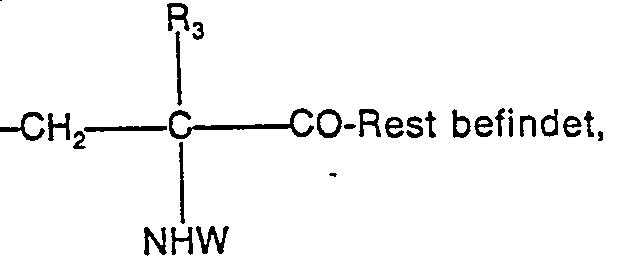
- W für Wasserstoff, Alkyl mit 1 bis 5 C-Atomen Alkenyl mit 3 bis 5 C-Atomen, Cyclopropylmethyl, Cyclobutylmethyl, R6CO-, H-Val, H-Ser, H-Arg, H-Lys, H-Ile, H-Tyr oder H-Phe;
- Phe gleich der Aminosäure Phenylalanin ist, das auch in der allgemeinen Formel vorliegt

- R7 für Wasserstoff oder Alkyl mit 1 bis 4 C-Atomen,
- Ra für Wasserstoff, Fluor, Chlor, Brom, Nitro,
- Alkyl mit 1 bis 4 C-Atomen, z für 1 oder 2 steht.
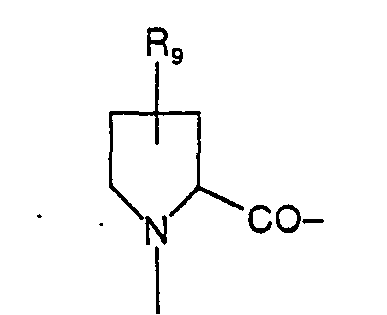
- Pro gleich der Aminosäure Prolin ist, das auch in der allgemeinen Formel vorliegt

- Rg für Wasserstoff, eine Hydroxygruppe, eine Alkyl- oder Alkoxygruppe mit 1 oder 4 C-Atomen
- - am Stickstoff eine Alkyl- oder Alkoxygruppe mit 1 bis 4 C-Atomen gebunden ist
- - eine oder mehrere Ketogruppen in den Ring eingeführt sind;
- Rg für Wasserstoff, eine Hydroxygruppe, eine Alkyl- oder Alkoxygruppe mit 1 oder 4 C-Atomen
- und Thr gleich der Aminosäure Threonin ist. A, B, C, D, und E können jede beliebige Aminosäure der D- oder L-Form sein. T steht für OH, OR, NH2, NHR, NR2 oder NHNHR', wobei R gegebenenfalls die folgende Bedeutung hat: Substit. lineares oder verzweigtes C1-10-Alkyl, Adamantyl, C1-10-Cycloalkyl oder C6-8-Aralkyl, zweckmäßigerweise Phenyl, Benzyl oder Phenyläthyl bedeutet und R' Wasserstoff, lineares oder verzweigtes C1-10-Alkyl, Cycloalkyl oder C6-8-Aralkyl, lineares, verzweigtes oder cyclisches aliphat. C1-16-Acyl, gegebenenfalls durch OH, NH2, C1-14-Alkoxy oder Halogen substituiert, aromatisches Acyl, gegebenenfalls durch OH, NH2, Halogen oder C1-4-Alkoxy substituiert; lineares verzweigtes oder cyclisches C3-11-aliphatisches Urethan darstellt und deren pharmazeutische annehmbare Salze.
- Nach einer weiteren Ausbildung sind die Peptide dadurch gekennzeichnet, daß A = Isoleucin, Leucin, Serin oder Threonin, B = Isoleucin, Glycin, Serin oder Valin, C = Glycin, Leucin, Threonin, Asparagin oder Arginin, D = Glutamin, Lysin oder Arginin und E = Valin, Asparaginsäure, Leucin oder Arginin ist.
- Nach einer anderen Weiterbildung der Erfindung liegen die Aminosäuren Prolin, Phenylalanin als Dehydroaminosäuren vor.
- Nach einer besonders vorteilhaften Weiterbildung der Erfindung liegt das Phenylalanin in der 3. Aminosäureposition des Peptids (vom linken, N-terminalen Ende des Peptids her gerechnet) in der D-Form vor.
- Dies hat insbesondere den Vorteil, daß die opiatartige Wirkung erhalten bleibt (zum Teil gesteigert wird) und eine besonders hohe Stabilität gegenüber peptidspaltenden Enzymen resultiert.
- Den gleichen, o.g. stabilisierenden Effekt weisen die Peptide auf, wenn das Threonin der 4. Aminosäureposition in der D-Form vorliegt.
- Die Aminosäure L-Threonin in der 4. Aminosäureposition kann nach einer Weiterbildung der Erfindung durch Glutamin, Glycin oder Asparaginsäure ersetzt sein.
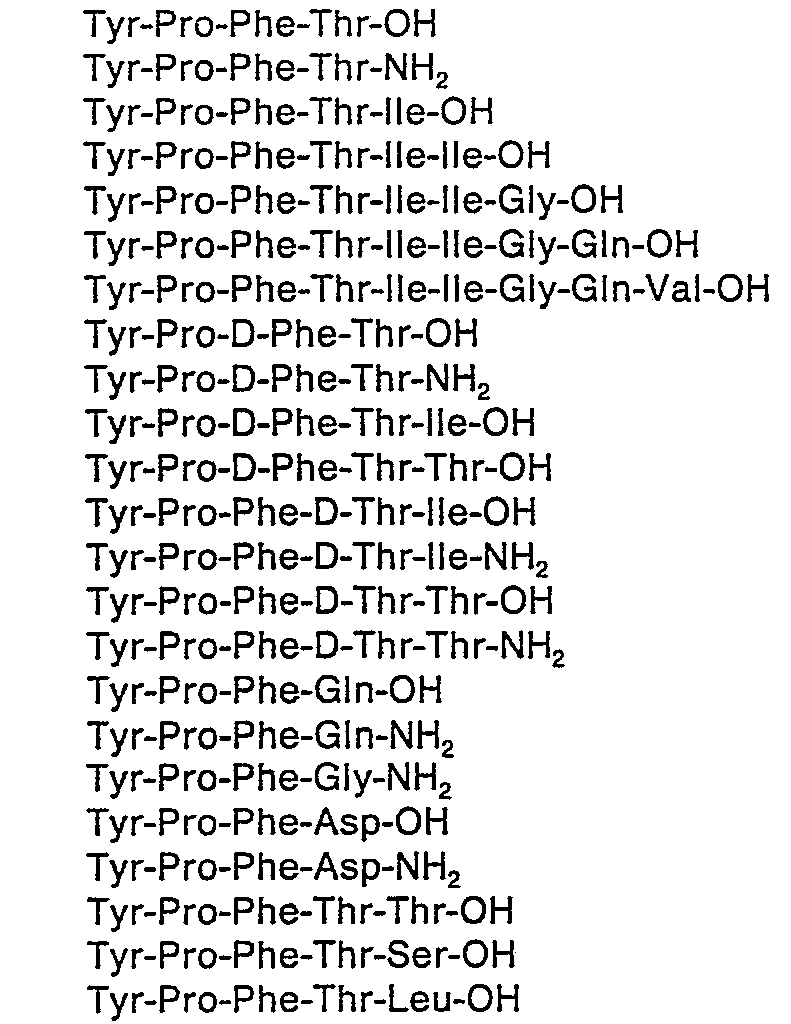
- Besonders vorteilhaft sind insbesondere Peptide folgender Struktur:

- Die erfindungsgemäßen Peptide können Wirkungen auf das zentrale Nervensystem ausüben. Das kann zum Beispiel eine schmerzstillende (analgetische) Wirkung sein; die analgetische Wirkung kann ganz oder teilweise über opioide Rezeptoren vermittelt werden.
- Weiterhin können die erfindungsgemäßen Peptide endokrine Wirkungen auslösen, z.B. eine Erhöhung des Wachstumhormonspiegels.
- Die erfindungsgemäßen Peptide können als Immunomodulatoren Anwendung finden. Die Verabreichung solcher Peptide führt z. B. bei einem geschwächten Organismus zu einer Stimulation des körpereigenen Immunsystems.
- Die Substanzen können auch zur Aktivierung des Zellstoffwechselsystems dem Säugetierorganismus zugeführt werden; hierbei wird die Sauerstoffaufnahme der Gewebszellen erhöht, dies kann insbesondere bei altersbedingten Krankheiten von Bedeutung sein.
- Die erfindungsgemäßen Peptide können nach Kopplung an Thyreoglobulin oder andere makromolekulare Eiweißkörper als Antigene zur Erzeugung von Antikörpern im Säugetierorganismus verwendet werden. Hierbei wird das Peptid in üblicher Weise mit Carbodiimid an das Makromolekül gekoppelt und intracutan in die Rücken- und Bauchhaut von Kaninchen injiziert.
- Die Antikörper gegen die erfindungsgemäßen Peptide können zur Bestimmung derselben in Körpergeweben und -Flüssigkeiten verwendet werden. Dies kann sowohl zur Bestimmung exogen zugeführter, wie auch endogen entstandener Peptide verwendet werden (Diagnostik).
- Die erfindungsgemäßen Peptide und/oder deren Derivate und/oder deren Salze können in Human- und Tierarzneimitteln enthalten sein. Diese können insbesondere als Antitussiva, Antidiarrhoika, Modulatoren des Immunsystems, Analgetika, Antipsychotika, Tranquilizer, Durchblutungsförderer und zur Förderung der Wundheilung Verwendung finden.
- Beispiel:
- 1) Synthese zweier erfindungsgemäßer Peptide folgender Sequenz:

- Die verwendete Synthesemethode benützt Benzyloxycarbonyl-geschützte Aminosäuren als gemischte Anhydride (Lottspeich et al., Hoppe-Seyler's Z. Physiol. Chem., 1835-1839, 1980).
- Hierbei wird die Aminokomponente bei -15°C oder niedriger in Dimethylformamid (DMF) mit einem 0,5 molaren Überschuß an gemischtem Anhydrid einer Z-AminosäureisobutyJcarbonsäure (wobei Z- als Schutzgruppe dient und einen N-Benzyloxycarbonyl-Rest darstellt) 2-4 Stunden umgesetzt. Nach der 2-4 stündigen Kupplung wird der Überschuß an Anhydrid zerstört. Bei 0 °C wird dann der pH-Wert des Reaktionsproduktes mit wässriger, gesättigter KHCOa-Lösung auf 8 eingestellt und 30 Minuten bei 0°C gerührt. Die Peptide werden mit Äthylacetat extrahiert. Das Äthylacetat/Peptidgemisch wird, um das Z-Aminosäure-Kaliumsalz zu entfernen, 3 mal mit NaCL/Wasser, 3 mal mit Wasser gewaschen und abgedampft. Das so erhaltene Peptid, welches noch die Schutzgruppe Z trägt, wird dann in Methanol hydriert. Hierbei werden 100-500 mg Pd/Aktivkohle als Katalysator pro mmol Peptid zugesetzt. Die C027 Abspaltung wird mit Ba(OH)2-Lösung kontrolliert. Der Katalysator wird dann abfiltriert (Papierfilter), mit Wasser ausgiebig gewaschen und das Filtrat auf einem Rotationsverdampfer eingedampft. Das gewünschte deblockierte Peptid ist im Rückstand enthalten.
- I. Herstellung des Zwischenproduktes
- L-Pro-L-Phe-L-Thr-OMet (I)
- I/Stufe 1a) Herstellung des gemischten Anhydrids: Z-Pro-Phe-gem. Anhydrid
- 592,5 mg (1,5 mmol, = 40%iger Überschuß) des Dipeptids Z-Pro-Phe (Bachem, Schweiz) werden in 20 ml DMF mit 200 µl (1,5 mmol) Chlorameisensäureisobutylester bei -15°C nach Zusatz von 170 µl (1,5 mmol) N-Methylmorpholin 15 Minuten umgesetzt.
- I/Stufe 1b) Vorbereitung der Aminokomponente. 170 mg (1,0 mmol) Threoninmethylesterhydrochlorid (Novabiochem, Schweiz) werden in 20 ml DMF unter Zusatz von 110 µl (1,0 mmol) N-Methylmorphin bei -15°C aufgelöst.
- I/Stufe 2) Umsetzung des gemischten Anhydrids der Stufe 1/la mit der Aminokomponente der Stufe 1/1 b.
- Das Z-Pro-Phe-gem. Anhydrid wird mit dem Thr-OMet in insgesamt 40 ml DMF bei -15°C 4 Stunden zum Z-Pro-Phe-Thr-OMet umgesetzt.
- Vor der Aufarbeitung wird der 50%ige Überschuß an gemischtem Anhydrid zerstört. Bei 0°C wird der pH-Wert des Reaktionsproduktes mit wässriger, gesättigter KHCO3-Lösung auf pH 8 eingestellt und 30 Minuten bei 0°C gerührt. Danach wird das Peptid mit 50-100 ml Äthylacetat (EtAc) extrahiert; das EtAc/Peptidgemisch wird mit gesättigter, wässriger NaCI-Lösung gewaschen. Nach einem weiteren abschließenden Waschen mit Wasser wird die EtAc-Phase eingedampft.
- I/Stufe 3) Abspalten der Schutzgruppe durch Hydrierung.
- Das Peptid wird in 30 ml Methanol gelöst und 100 mg Palladium auf Aktivkohle (Merck) zugegeben. Nach dem Verdrängen der Luft durch Stickstoff wird in das Reaktionsgefäß Wasserstoff eingeleitet. Die Hydrierung wird bei 25°-30°C durchgeführt. Die Hydrierung ist beendet, wenn kein CO2 mehr freigesetzt wird, d.h. wenn nach Kontrolle in wässriger Ba(OH)2-Lösung kein Niederschlag mehr gebildet wird. Die Lösung wird filtriert, mit Wasser gewaschen und am Rotationsverdampfer einrotiert. Das bleibende Produkt Pro-Phe-Thr-OMet (1) wird dann später als Aminokomponente eingesetzt.
- II. Herstellung des Zwischenproduktes
- L-Pro-L-Phe-L-Thr-L-Ile-OMet (II) II/Stufe 1a) Herstellung des gemisches Anhydrids:
- Z-Thr-gem. Anhydrid.
- 379,5 mg (1,5 mmol) Z-L-Thr (Novabiochem, Schweiz) werden in 20 ml DMF unter Zusatz von 170 µl (1,5 mmol) N-Methylmorpholin gelöst und mit 180 µl Chlorameisensäureisobutylester bei -15°C 15 Minuten umgesetzt.
- II/Stufe 1b) Vorbereitung der Aminokomponente.
- 185 mg (1,0 mmol) L-Isoleucin-Methylesterhydrochlorid (Bachem, Schweiz) werden in 20 ml DMF unter Zusatz von 170 µl (1,5 mmol) N-Methylmorpholin gelöst.
- II/Stufe 2) Umsetzung des gem. Anhydrids der Stufe II/1a mit der Aminokomponente der Stufe 11/1b.
- Das Z-Thr-gem. Anhydrid wird mit dem Ile-OMet in insgesamt 40 ml DMF bei -15°C 4 Stunden zum Z-Thr-Ile-OMet umgesetzt.
- Die weitere Aufarbeitung erfolgt analog wie bereits unter 1/2 und 1/3 beschrieben. Schließlich erhält man den Dipeptidmethylester Thr-Ile-OMet, der nachfolgend als Aminokomponente weiter umgesetzt wird.
- II/Stufe 3a) Herstellung des gemischten Anhydrids: Z-Pro-Phe-gem. Anhydrid
- Der gleiche Ansatz wird wie unter Stufe 1/1a) beschrieben hergestellt.
- li/Stufe 3b) Vorbereitung der Aminokomponente. Das in Stufe II/2 erhaltene Dipeptid wird in 20 ml DMF unter Zusatz von 170 µl (1,5 mmol) N-Methylmorpholin gelöst.
- II/Stufe 4) Umsetzung des gemischten Anhydrids der Stufe 11/3a) mit der Aminokomponente der Stufe II/3b
- Das Z-Pro-Phe-gem. Anhydrid wird mit dem Thr-lle-OMet in 40 ml DMF bei -15°C 4 Stunden zum Z-Pro-Phe-Thr-Ile-OMet umgesetzt.
- Die weitere Aufarbeitung erfolgt analog wie bereits unter 1/2 und 1/3 beschrieben. Das erhaltene Tetrapeptid Pro-Phe-Thr-Ile-OMet (II) wird dann später als Aminokomponente eingesetzt.
- III. Weiterverarbeitung der Zwischenprodukte Pro-Phe-Thr-OMet (I)
- Pro-Phe-Thr-Ile-OMet (II)
- III/Stufe 1a) Herstellung des gem. Anhydrids: Z-Tyr-gem. Anh.
- 674 mg (1,5 mmol) N,O-di-Z-Tyrosin (Novabiochem, Schweiz) werden in 20 ml DMF unter Zusatz von 170 µl (1,5 mmol) N-Methylmorpholin gelöst und mit 200 µl (1,5 mmol) Chlorameisensäureisobutylester bei -15°C 15 Minuten umgesetzt.
- Die Zwischenprodukte I und II werden in 20 ml DMF gelöst und mit je einem Ansatz der Stufe III/1a bei -15°C 4 Stunden umgesetzt.
- Die Aufarbeitung der jeweiligen Reaktionsprodukte der Stufe III/1b erfolgt wie unter 1/2 und 1/3 beschrieben. Die Syntheseendprodukte
- Tyr-Pro-Phe-Thr-OMet
- Tyr-Pro-Phe-Thr-Ile-OMet
- werden dann entweder direkt über Säulenchromatographie (Biogel P 2) gereinigt (bzw. nach einer in üblicher Weise durchgeführten sauren Esterhydrolyse) und nachfolgend analysiert, so wie von Lottspeich et al. (Hoppe-Seyler's Z. Physiol. Chem., 361, 1835-1839, 1980) beschrieben. Die gereinigten und mittels Aminosäureanalyse analysierten Peptide
- Tyr-Pro-Phe-Thr-OH
- Tyr-Pro-Phe-Thr-Ile-OH
- wurden dann auf pharmakologische Wirkungen hin untersucht. (Vgl. Beispiel, 2)
- Die Herstellung der anderen erfindungsgemäßen Peptide erfolgte auf die gleiche Weise, wie dies oben bereits beschrieben wurde, wobei entsprechend der gewünschten Sequenz andere Z-Aminosäurederivate eingesetzt werden, so z.B. statt Z-L-Threonin, Z-D-Threonin; statt Z-Pro-Phe, Z-Pro-D-Phe; bzw. andere Aminosäuremethylester z.B. Threoninmethylester oder Serinmethylester verwendet werden. Die Synthese der anderen erfindungsgemässen Peptide erfolgt ebenfalls analog den Syntheseverfahren wie Lottspeich et al. (1980) beschrieben (siehe oben).
- Die Peptidester wurden zum Zwecke der C-terminalen Amidierung in üblicher Weise einer Ammonolyse unterworfen.
- 2) Pharmakologische Wirkungen zweier erfindungsgemäßer Peptide (Tyr-Pro-Phe-Thr-OH und Tyr-Pro-Phe-Thr-Ile-OH)
- Die beiden Substanzen zeigen spezifische opiatartige Wirkungen am elektrisch stimulierten plexus myentericus/Längsmuskel-Präparat des Meerschweinchenileums (GPI), Methode nach Schulz und Goldstein, J. Pharmacol. Exptl. Ther. 183, 400, 1972.
- Die Ergebnisse sind in Tabelle 1 aufgeführt.
- Opiatartige Wirkungen zweier erfindungsgemässer Peptide; die Zahlen geben diejenige Konzentration (µM) an, die notwendig ist, die elektrisch induzierte Kontraktion des Meerschweinchen-Darm-Präparates (GPI) um 50% zu hemmen (IC50-Wert). Die Zahlen sind Mittelwerte aus 4-5 Bestimmungen; die Standardabweichung von den Mittelwerten ist kleiner als 13%. Die Hemmungen des GPI sind mit dem spezifischen Opioid-Antagonisten Naloxon aufhebbar bzw. bei Vorbehandlung blockierbar.
-

- Die entsprechenden D-Ala2-Verbindungen zeigen noch stärkere opiatartige Wirkungen am GPI-Präparat.
- Opiatartige Wirkungen können auch nach intracerebroventrikulärer Injektion bei Ratten beobachtet werden. Hierbei wird so vorgegangen, wie von Brantl et al., Life Sciences, 28, 1903-1909, 1981 beschrieben wurde. Als wirksame analgetische Dosis erwiesen sich 400 bis 800 µg der o.g. Peptide; die analgetische Wirkung ist mit Naloxon 10 mg pro kg Körpergewicht (intraperitoneal) aufhebbar bzw. bei Vorbehandlung mit Naloxon blokkierbar.
Claims (14)


Priority Applications (1)
| Application Number | Priority Date | Filing Date | Title |
|---|---|---|---|
| AT86105507T ATE46173T1 (de) | 1985-04-23 | 1986-04-21 | Pharmakologisch aktive peptide. |
Applications Claiming Priority (2)
| Application Number | Priority Date | Filing Date | Title |
|---|---|---|---|
| DE3514587 | 1985-04-23 | ||
| DE19853514587 DE3514587A1 (de) | 1985-04-23 | 1985-04-23 | Pharmakologisch aktive peptide |
Publications (2)
| Publication Number | Publication Date |
|---|---|
| EP0199331A1 EP0199331A1 (de) | 1986-10-29 |
| EP0199331B1 true EP0199331B1 (de) | 1989-09-06 |
Family
ID=6268863
Family Applications (2)
| Application Number | Title | Priority Date | Filing Date |
|---|---|---|---|
| EP86902336A Pending EP0218650A1 (de) | 1985-04-23 | 1986-04-21 | Pharmakologisch aktive peptide |
| EP86105507A Expired EP0199331B1 (de) | 1985-04-23 | 1986-04-21 | Pharmakologisch aktive Peptide |
Family Applications Before (1)
| Application Number | Title | Priority Date | Filing Date |
|---|---|---|---|
| EP86902336A Pending EP0218650A1 (de) | 1985-04-23 | 1986-04-21 | Pharmakologisch aktive peptide |
Country Status (5)
| Country | Link |
|---|---|
| EP (2) | EP0218650A1 (de) |
| JP (1) | JPS62501422A (de) |
| AT (1) | ATE46173T1 (de) |
| DE (2) | DE3514587A1 (de) |
| WO (1) | WO1986006381A1 (de) |
Families Citing this family (4)
| Publication number | Priority date | Publication date | Assignee | Title |
|---|---|---|---|---|
| US5066783A (en) * | 1986-05-20 | 1991-11-19 | Cohen Eric A | Antiviral peptides and means for treating herpes infections |
| US4795740A (en) * | 1986-05-20 | 1989-01-03 | Cohen Eric A | Antiviral peptides and means for treating herpes infections |
| GB8800600D0 (en) * | 1988-01-12 | 1988-02-10 | Univ Manchester | Increasing efficiency of animal performance |
| WO1992002543A1 (en) * | 1990-08-01 | 1992-02-20 | Cytel Corporation | Novel immunosuppressant peptides |
Family Cites Families (4)
| Publication number | Priority date | Publication date | Assignee | Title |
|---|---|---|---|---|
| JPS5668651A (en) * | 1979-09-20 | 1981-06-09 | Erba Carlo Spa | Novel biologically active peptide |
| EP0053029A1 (de) * | 1980-11-24 | 1982-06-02 | Peninsula Laboratories Incorporated | Nicht-enkephalinartige Peptide, ihre Herstellung, sie enthaltende Zusammensetzungen und ihre medizinische und tierärztliche Verwendung |
| DE3333752A1 (de) * | 1983-09-19 | 1985-04-11 | Victor Dipl.- Chem. 8000 München Brantl | Pharmakologisch aktive peptide |
| DE3435727A1 (de) * | 1984-09-28 | 1986-04-10 | Victor Dipl.-Chem. Dr.med. 6200 Wiesbaden Brantl | Pharmakologisch aktive peptide |
-
1985
- 1985-04-23 DE DE19853514587 patent/DE3514587A1/de not_active Withdrawn
-
1986
- 1986-04-21 WO PCT/DE1986/000169 patent/WO1986006381A1/de not_active Ceased
- 1986-04-21 EP EP86902336A patent/EP0218650A1/de active Pending
- 1986-04-21 DE DE8686105507T patent/DE3665462D1/de not_active Expired
- 1986-04-21 JP JP61502293A patent/JPS62501422A/ja active Pending
- 1986-04-21 AT AT86105507T patent/ATE46173T1/de active
- 1986-04-21 EP EP86105507A patent/EP0199331B1/de not_active Expired
Also Published As
| Publication number | Publication date |
|---|---|
| ATE46173T1 (de) | 1989-09-15 |
| DE3665462D1 (en) | 1989-10-12 |
| JPS62501422A (ja) | 1987-06-11 |
| WO1986006381A1 (fr) | 1986-11-06 |
| DE3514587A1 (de) | 1986-10-30 |
| EP0199331A1 (de) | 1986-10-29 |
| EP0218650A1 (de) | 1987-04-22 |
Similar Documents
| Publication | Publication Date | Title |
|---|---|---|
| DD156968A5 (de) | Verfahren zur herstellung von neuen angiotensin-ii antagonisierenden oktapeptidestern | |
| DE2616399A1 (de) | Polypeptid und verfahren zu seiner herstellung | |
| JPH0811746B2 (ja) | 新規ペプチド化合物 | |
| EP0176070B1 (de) | Pharmakologisch aktive peptide | |
| EP0019829B1 (de) | Pharmakologisch aktive Peptide und deren Zusammensetzungen | |
| WO1991008223A1 (de) | Neue vom neuropeptid y abgeleitete peptide | |
| CH676425A5 (de) | ||
| CH615904A5 (en) | Process for the preparation of L-leucine-13-motilin | |
| DE69630583T2 (de) | Peptide, bronchodilator und den blutstrom verbesserndes mittel | |
| DE2936099A1 (de) | Pharmakologisch aktive peptide | |
| EP0248231B1 (de) | Pharmakologisch aktive Peptide | |
| DE2112553C3 (de) | 1 -alpha-Aminolsobuttersäurecorticotropinpeptide, deren Derivate, Säureadditionssalze und Komplexe sowie Arzneipräparate | |
| EP0199331A1 (de) | Pharmakologisch aktive Peptide | |
| EP0137339B1 (de) | Pharmakologisch aktive Peptide | |
| DE68923572T2 (de) | Peptide. | |
| EP0080194B1 (de) | Neue Peptide und Verfahren zu ihrer Herstellung | |
| DE3850015T2 (de) | Zyklische GRF-Analoga. | |
| CH637915A5 (de) | Angiotensin-2-antagonistisch wirkende peptide und verfahren zur herstellung dieser verbindungen. | |
| EP0320785A2 (de) | Peptide mit beeinflussender Wirkung auf die Hypophyse von Säugern | |
| WO1995015765A1 (en) | Peptides to overcome inhibition of nerve growth | |
| DE2901478A1 (de) | Beta tief h -endorphin-analoge und deren herstellung | |
| DE3047596A1 (de) | Pharmakologisch aktive dipeptide | |
| DE69813232T2 (de) | Wespe pompilid neuropeptide | |
| EP0491361A2 (de) | Kurze Peptide mit Insulinwirkung | |
| DE3876240T2 (de) | Sorbin und abgeleitete peptide, die die absorption durch die mucosa erhoehen. |
Legal Events
| Date | Code | Title | Description |
|---|---|---|---|
| PUAI | Public reference made under article 153(3) epc to a published international application that has entered the european phase |
Free format text: ORIGINAL CODE: 0009012 |
|
| AK | Designated contracting states |
Kind code of ref document: A1 Designated state(s): AT BE CH DE FR GB IT LI LU NL SE |
|
| 17P | Request for examination filed |
Effective date: 19861126 |
|
| 17Q | First examination report despatched |
Effective date: 19871125 |
|
| RAP3 | Party data changed (applicant data changed or rights of an application transferred) |
Owner name: BRANTL, VICTOR, DR. MED., DIPL.-CHEM. |
|
| RAP1 | Party data changed (applicant data changed or rights of an application transferred) |
Owner name: BRANTL, VICTOR, DR. MED., DIPL.-CHEM. |
|
| GRAA | (expected) grant |
Free format text: ORIGINAL CODE: 0009210 |
|
| AK | Designated contracting states |
Kind code of ref document: B1 Designated state(s): AT BE CH DE FR GB IT LI LU NL SE |
|
| REF | Corresponds to: |
Ref document number: 46173 Country of ref document: AT Date of ref document: 19890915 Kind code of ref document: T |
|
| REF | Corresponds to: |
Ref document number: 3665462 Country of ref document: DE Date of ref document: 19891012 |
|
| GBT | Gb: translation of ep patent filed (gb section 77(6)(a)/1977) | ||
| ET | Fr: translation filed | ||
| ITF | It: translation for a ep patent filed | ||
| PLBE | No opposition filed within time limit |
Free format text: ORIGINAL CODE: 0009261 |
|
| STAA | Information on the status of an ep patent application or granted ep patent |
Free format text: STATUS: NO OPPOSITION FILED WITHIN TIME LIMIT |
|
| 26N | No opposition filed | ||
| PGFP | Annual fee paid to national office [announced via postgrant information from national office to epo] |
Ref country code: SE Payment date: 19930129 Year of fee payment: 8 |
|
| PGFP | Annual fee paid to national office [announced via postgrant information from national office to epo] |
Ref country code: BE Payment date: 19930210 Year of fee payment: 8 |
|
| PGFP | Annual fee paid to national office [announced via postgrant information from national office to epo] |
Ref country code: LU Payment date: 19930303 Year of fee payment: 8 |
|
| PGFP | Annual fee paid to national office [announced via postgrant information from national office to epo] |
Ref country code: DE Payment date: 19930407 Year of fee payment: 8 |
|
| PGFP | Annual fee paid to national office [announced via postgrant information from national office to epo] |
Ref country code: GB Payment date: 19930414 Year of fee payment: 8 |
|
| PGFP | Annual fee paid to national office [announced via postgrant information from national office to epo] |
Ref country code: FR Payment date: 19930420 Year of fee payment: 8 |
|
| PGFP | Annual fee paid to national office [announced via postgrant information from national office to epo] |
Ref country code: CH Payment date: 19930426 Year of fee payment: 8 |
|
| PGFP | Annual fee paid to national office [announced via postgrant information from national office to epo] |
Ref country code: AT Payment date: 19930428 Year of fee payment: 8 |
|
| ITTA | It: last paid annual fee | ||
| PGFP | Annual fee paid to national office [announced via postgrant information from national office to epo] |
Ref country code: NL Payment date: 19930430 Year of fee payment: 8 |
|
| EPTA | Lu: last paid annual fee | ||
| PG25 | Lapsed in a contracting state [announced via postgrant information from national office to epo] |
Ref country code: LU Free format text: LAPSE BECAUSE OF NON-PAYMENT OF DUE FEES Effective date: 19940421 Ref country code: GB Effective date: 19940421 Ref country code: AT Effective date: 19940421 |
|
| PG25 | Lapsed in a contracting state [announced via postgrant information from national office to epo] |
Ref country code: SE Effective date: 19940422 |
|
| PG25 | Lapsed in a contracting state [announced via postgrant information from national office to epo] |
Ref country code: LI Effective date: 19940430 Ref country code: CH Effective date: 19940430 Ref country code: BE Effective date: 19940430 |
|
| BERE | Be: lapsed |
Owner name: BRANTL VICTOR Effective date: 19940430 |
|
| PG25 | Lapsed in a contracting state [announced via postgrant information from national office to epo] |
Ref country code: NL Effective date: 19941101 |
|
| NLV4 | Nl: lapsed or anulled due to non-payment of the annual fee | ||
| GBPC | Gb: european patent ceased through non-payment of renewal fee |
Effective date: 19940421 |
|
| PG25 | Lapsed in a contracting state [announced via postgrant information from national office to epo] |
Ref country code: FR Effective date: 19941229 |
|
| REG | Reference to a national code |
Ref country code: CH Ref legal event code: PL |
|
| PG25 | Lapsed in a contracting state [announced via postgrant information from national office to epo] |
Ref country code: DE Effective date: 19950103 |
|
| EUG | Se: european patent has lapsed |
Ref document number: 86105507.7 Effective date: 19941110 |
|
| REG | Reference to a national code |
Ref country code: FR Ref legal event code: ST |
|
| PG25 | Lapsed in a contracting state [announced via postgrant information from national office to epo] |
Ref country code: IT Free format text: LAPSE BECAUSE OF NON-PAYMENT OF DUE FEES;WARNING: LAPSES OF ITALIAN PATENTS WITH EFFECTIVE DATE BEFORE 2007 MAY HAVE OCCURRED AT ANY TIME BEFORE 2007. THE CORRECT EFFECTIVE DATE MAY BE DIFFERENT FROM THE ONE RECORDED. Effective date: 20050421 |