EP0197271B1 - Verfahren zur Herstellung hochreiner Molybdän- oder Wolframpulver in Form ihrer Metalle oder Oxide - Google Patents
Verfahren zur Herstellung hochreiner Molybdän- oder Wolframpulver in Form ihrer Metalle oder Oxide Download PDFInfo
- Publication number
- EP0197271B1 EP0197271B1 EP86102251A EP86102251A EP0197271B1 EP 0197271 B1 EP0197271 B1 EP 0197271B1 EP 86102251 A EP86102251 A EP 86102251A EP 86102251 A EP86102251 A EP 86102251A EP 0197271 B1 EP0197271 B1 EP 0197271B1
- Authority
- EP
- European Patent Office
- Prior art keywords
- tungsten
- preparing
- powder
- molybdenum
- oxide
- Prior art date
- Legal status (The legal status is an assumption and is not a legal conclusion. Google has not performed a legal analysis and makes no representation as to the accuracy of the status listed.)
- Expired
Links
- 239000000843 powder Substances 0.000 title claims description 88
- 229910052750 molybdenum Inorganic materials 0.000 title claims description 62
- 238000000034 method Methods 0.000 title claims description 47
- ZOKXTWBITQBERF-UHFFFAOYSA-N Molybdenum Chemical compound [Mo] ZOKXTWBITQBERF-UHFFFAOYSA-N 0.000 title claims description 28
- 239000011733 molybdenum Substances 0.000 title claims description 28
- WFKWXMTUELFFGS-UHFFFAOYSA-N tungsten Chemical compound [W] WFKWXMTUELFFGS-UHFFFAOYSA-N 0.000 title claims description 28
- 229910052721 tungsten Inorganic materials 0.000 claims description 50
- NWUYHJFMYQTDRP-UHFFFAOYSA-N 1,2-bis(ethenyl)benzene;1-ethenyl-2-ethylbenzene;styrene Chemical compound C=CC1=CC=CC=C1.CCC1=CC=CC=C1C=C.C=CC1=CC=CC=C1C=C NWUYHJFMYQTDRP-UHFFFAOYSA-N 0.000 claims description 24
- 239000003729 cation exchange resin Substances 0.000 claims description 24
- 238000000354 decomposition reaction Methods 0.000 claims description 22
- QGLKJKCYBOYXKC-UHFFFAOYSA-N nonaoxidotritungsten Chemical compound O=[W]1(=O)O[W](=O)(=O)O[W](=O)(=O)O1 QGLKJKCYBOYXKC-UHFFFAOYSA-N 0.000 claims description 20
- 239000007864 aqueous solution Substances 0.000 claims description 17
- QOSATHPSBFQAML-UHFFFAOYSA-N hydrogen peroxide;hydrate Chemical compound O.OO QOSATHPSBFQAML-UHFFFAOYSA-N 0.000 claims description 17
- 229910000476 molybdenum oxide Inorganic materials 0.000 claims description 17
- 239000010937 tungsten Substances 0.000 claims description 17
- 229910001930 tungsten oxide Inorganic materials 0.000 claims description 17
- PQQKPALAQIIWST-UHFFFAOYSA-N oxomolybdenum Chemical compound [Mo]=O PQQKPALAQIIWST-UHFFFAOYSA-N 0.000 claims description 16
- 238000011282 treatment Methods 0.000 claims description 13
- 239000002253 acid Substances 0.000 claims description 12
- 238000001816 cooling Methods 0.000 claims description 12
- 239000011343 solid material Substances 0.000 claims description 10
- VEXZGXHMUGYJMC-UHFFFAOYSA-N Hydrochloric acid Chemical compound Cl VEXZGXHMUGYJMC-UHFFFAOYSA-N 0.000 claims description 8
- GRYLNZFGIOXLOG-UHFFFAOYSA-N Nitric acid Chemical compound O[N+]([O-])=O GRYLNZFGIOXLOG-UHFFFAOYSA-N 0.000 claims description 8
- 229910017604 nitric acid Inorganic materials 0.000 claims description 8
- 238000001035 drying Methods 0.000 claims description 4
- 239000012535 impurity Substances 0.000 description 33
- 239000000243 solution Substances 0.000 description 32
- MHAJPDPJQMAIIY-UHFFFAOYSA-N Hydrogen peroxide Chemical compound OO MHAJPDPJQMAIIY-UHFFFAOYSA-N 0.000 description 25
- XLYOFNOQVPJJNP-UHFFFAOYSA-N water Substances O XLYOFNOQVPJJNP-UHFFFAOYSA-N 0.000 description 24
- 238000010438 heat treatment Methods 0.000 description 23
- 238000006243 chemical reaction Methods 0.000 description 19
- 238000005342 ion exchange Methods 0.000 description 10
- UFHFLCQGNIYNRP-UHFFFAOYSA-N Hydrogen Chemical compound [H][H] UFHFLCQGNIYNRP-UHFFFAOYSA-N 0.000 description 9
- 229910052739 hydrogen Inorganic materials 0.000 description 9
- 239000001257 hydrogen Substances 0.000 description 9
- VLAPMBHFAWRUQP-UHFFFAOYSA-L molybdic acid Chemical compound O[Mo](O)(=O)=O VLAPMBHFAWRUQP-UHFFFAOYSA-L 0.000 description 8
- 238000000746 purification Methods 0.000 description 8
- 238000004445 quantitative analysis Methods 0.000 description 8
- CMPGARWFYBADJI-UHFFFAOYSA-L tungstic acid Chemical compound O[W](O)(=O)=O CMPGARWFYBADJI-UHFFFAOYSA-L 0.000 description 8
- 239000004809 Teflon Substances 0.000 description 7
- 229920006362 Teflon® Polymers 0.000 description 7
- -1 polyethylene Polymers 0.000 description 7
- 239000012488 sample solution Substances 0.000 description 7
- 239000000463 material Substances 0.000 description 6
- 239000002244 precipitate Substances 0.000 description 6
- BFKJFAAPBSQJPD-UHFFFAOYSA-N tetrafluoroethene Chemical group FC(F)=C(F)F BFKJFAAPBSQJPD-UHFFFAOYSA-N 0.000 description 6
- DZKDPOPGYFUOGI-UHFFFAOYSA-N tungsten dioxide Inorganic materials O=[W]=O DZKDPOPGYFUOGI-UHFFFAOYSA-N 0.000 description 6
- 229910052776 Thorium Inorganic materials 0.000 description 5
- 229910052770 Uranium Inorganic materials 0.000 description 5
- 150000001768 cations Chemical class 0.000 description 5
- 238000001704 evaporation Methods 0.000 description 5
- 230000008020 evaporation Effects 0.000 description 5
- 229920000642 polymer Polymers 0.000 description 5
- 238000001953 recrystallisation Methods 0.000 description 5
- 238000003756 stirring Methods 0.000 description 5
- ZSLUVFAKFWKJRC-IGMARMGPSA-N 232Th Chemical compound [232Th] ZSLUVFAKFWKJRC-IGMARMGPSA-N 0.000 description 4
- XEEYBQQBJWHFJM-UHFFFAOYSA-N Iron Chemical compound [Fe] XEEYBQQBJWHFJM-UHFFFAOYSA-N 0.000 description 4
- PXHVJJICTQNCMI-UHFFFAOYSA-N Nickel Chemical compound [Ni] PXHVJJICTQNCMI-UHFFFAOYSA-N 0.000 description 4
- 239000004743 Polypropylene Substances 0.000 description 4
- 230000002378 acidificating effect Effects 0.000 description 4
- 229910052783 alkali metal Inorganic materials 0.000 description 4
- 150000001340 alkali metals Chemical class 0.000 description 4
- 229910001385 heavy metal Inorganic materials 0.000 description 4
- 229920001155 polypropylene Polymers 0.000 description 4
- 239000000047 product Substances 0.000 description 4
- 230000002285 radioactive effect Effects 0.000 description 4
- DNYWZCXLKNTFFI-UHFFFAOYSA-N uranium Chemical compound [U][U][U][U][U][U][U][U][U][U][U][U][U][U][U][U][U][U][U][U][U][U][U][U][U][U][U][U][U][U][U][U][U][U][U][U][U][U][U][U][U][U][U][U][U][U][U][U][U][U][U][U][U][U][U][U][U][U][U][U][U][U][U][U][U][U][U][U][U][U][U][U][U][U][U][U][U][U][U][U][U][U][U][U][U][U][U][U][U][U][U][U][U][U][U][U][U][U][U][U][U][U][U][U][U][U][U][U][U][U][U][U][U][U] DNYWZCXLKNTFFI-UHFFFAOYSA-N 0.000 description 4
- 208000005156 Dehydration Diseases 0.000 description 3
- 239000004698 Polyethylene Substances 0.000 description 3
- HEMHJVSKTPXQMS-UHFFFAOYSA-M Sodium hydroxide Chemical compound [OH-].[Na+] HEMHJVSKTPXQMS-UHFFFAOYSA-M 0.000 description 3
- 238000011109 contamination Methods 0.000 description 3
- 239000013078 crystal Substances 0.000 description 3
- 230000018044 dehydration Effects 0.000 description 3
- 238000006297 dehydration reaction Methods 0.000 description 3
- 238000004519 manufacturing process Methods 0.000 description 3
- 229910052751 metal Inorganic materials 0.000 description 3
- 229920000573 polyethylene Polymers 0.000 description 3
- 229910052700 potassium Inorganic materials 0.000 description 3
- 229910052708 sodium Inorganic materials 0.000 description 3
- 239000011734 sodium Substances 0.000 description 3
- 239000000126 substance Substances 0.000 description 3
- 239000013077 target material Substances 0.000 description 3
- VHUUQVKOLVNVRT-UHFFFAOYSA-N Ammonium hydroxide Chemical compound [NH4+].[OH-] VHUUQVKOLVNVRT-UHFFFAOYSA-N 0.000 description 2
- 229910003893 H2WO4 Inorganic materials 0.000 description 2
- DGAQECJNVWCQMB-PUAWFVPOSA-M Ilexoside XXIX Chemical compound C[C@@H]1CC[C@@]2(CC[C@@]3(C(=CC[C@H]4[C@]3(CC[C@@H]5[C@@]4(CC[C@@H](C5(C)C)OS(=O)(=O)[O-])C)C)[C@@H]2[C@]1(C)O)C)C(=O)O[C@H]6[C@@H]([C@H]([C@@H]([C@H](O6)CO)O)O)O.[Na+] DGAQECJNVWCQMB-PUAWFVPOSA-M 0.000 description 2
- ZLMJMSJWJFRBEC-UHFFFAOYSA-N Potassium Chemical compound [K] ZLMJMSJWJFRBEC-UHFFFAOYSA-N 0.000 description 2
- QGZKDVFQNNGYKY-UHFFFAOYSA-N ammonia Natural products N QGZKDVFQNNGYKY-UHFFFAOYSA-N 0.000 description 2
- 238000007796 conventional method Methods 0.000 description 2
- 239000000498 cooling water Substances 0.000 description 2
- XAYGUHUYDMLJJV-UHFFFAOYSA-Z decaazanium;dioxido(dioxo)tungsten;hydron;trioxotungsten Chemical compound [H+].[H+].[NH4+].[NH4+].[NH4+].[NH4+].[NH4+].[NH4+].[NH4+].[NH4+].[NH4+].[NH4+].O=[W](=O)=O.O=[W](=O)=O.O=[W](=O)=O.O=[W](=O)=O.O=[W](=O)=O.O=[W](=O)=O.[O-][W]([O-])(=O)=O.[O-][W]([O-])(=O)=O.[O-][W]([O-])(=O)=O.[O-][W]([O-])(=O)=O.[O-][W]([O-])(=O)=O.[O-][W]([O-])(=O)=O XAYGUHUYDMLJJV-UHFFFAOYSA-Z 0.000 description 2
- 229910052742 iron Inorganic materials 0.000 description 2
- 238000010309 melting process Methods 0.000 description 2
- 239000002184 metal Substances 0.000 description 2
- 229910052759 nickel Inorganic materials 0.000 description 2
- 229920000172 poly(styrenesulfonic acid) Polymers 0.000 description 2
- 229940005642 polystyrene sulfonic acid Drugs 0.000 description 2
- 239000011591 potassium Substances 0.000 description 2
- 239000002994 raw material Substances 0.000 description 2
- 239000011347 resin Substances 0.000 description 2
- 229920005989 resin Polymers 0.000 description 2
- 239000000523 sample Substances 0.000 description 2
- 238000000926 separation method Methods 0.000 description 2
- MYRTYDVEIRVNKP-UHFFFAOYSA-N 1,2-Divinylbenzene Chemical compound C=CC1=CC=CC=C1C=C MYRTYDVEIRVNKP-UHFFFAOYSA-N 0.000 description 1
- YCKRFDGAMUMZLT-UHFFFAOYSA-N Fluorine atom Chemical compound [F] YCKRFDGAMUMZLT-UHFFFAOYSA-N 0.000 description 1
- 239000004793 Polystyrene Substances 0.000 description 1
- 150000007513 acids Chemical class 0.000 description 1
- 239000003513 alkali Substances 0.000 description 1
- 239000011609 ammonium molybdate Substances 0.000 description 1
- APUPEJJSWDHEBO-UHFFFAOYSA-P ammonium molybdate Chemical compound [NH4+].[NH4+].[O-][Mo]([O-])(=O)=O APUPEJJSWDHEBO-UHFFFAOYSA-P 0.000 description 1
- 235000018660 ammonium molybdate Nutrition 0.000 description 1
- 229940010552 ammonium molybdate Drugs 0.000 description 1
- 229940023913 cation exchange resins Drugs 0.000 description 1
- 239000003795 chemical substances by application Substances 0.000 description 1
- 230000000052 comparative effect Effects 0.000 description 1
- 150000001875 compounds Chemical class 0.000 description 1
- 229920001577 copolymer Polymers 0.000 description 1
- 230000007423 decrease Effects 0.000 description 1
- 230000003247 decreasing effect Effects 0.000 description 1
- 238000010894 electron beam technology Methods 0.000 description 1
- 230000008030 elimination Effects 0.000 description 1
- 238000003379 elimination reaction Methods 0.000 description 1
- 230000005284 excitation Effects 0.000 description 1
- 238000011049 filling Methods 0.000 description 1
- 239000011737 fluorine Substances 0.000 description 1
- 229910052731 fluorine Inorganic materials 0.000 description 1
- 238000000227 grinding Methods 0.000 description 1
- JEGUKCSWCFPDGT-UHFFFAOYSA-N h2o hydrate Chemical compound O.O JEGUKCSWCFPDGT-UHFFFAOYSA-N 0.000 description 1
- 125000002887 hydroxy group Chemical group [H]O* 0.000 description 1
- 230000001771 impaired effect Effects 0.000 description 1
- 239000003456 ion exchange resin Substances 0.000 description 1
- 229920003303 ion-exchange polymer Polymers 0.000 description 1
- 150000002500 ions Chemical class 0.000 description 1
- 229910052749 magnesium Inorganic materials 0.000 description 1
- 239000012528 membrane Substances 0.000 description 1
- 150000002736 metal compounds Chemical class 0.000 description 1
- MEFBJEMVZONFCJ-UHFFFAOYSA-N molybdate Chemical compound [O-][Mo]([O-])(=O)=O MEFBJEMVZONFCJ-UHFFFAOYSA-N 0.000 description 1
- 239000004033 plastic Substances 0.000 description 1
- 229920003023 plastic Polymers 0.000 description 1
- 229920001467 poly(styrenesulfonates) Polymers 0.000 description 1
- 229920002223 polystyrene Polymers 0.000 description 1
- 230000002265 prevention Effects 0.000 description 1
- 230000009257 reactivity Effects 0.000 description 1
- 238000011084 recovery Methods 0.000 description 1
- 230000001105 regulatory effect Effects 0.000 description 1
- 238000005245 sintering Methods 0.000 description 1
- 235000011121 sodium hydroxide Nutrition 0.000 description 1
- 235000015393 sodium molybdate Nutrition 0.000 description 1
- 239000011684 sodium molybdate Substances 0.000 description 1
- TVXXNOYZHKPKGW-UHFFFAOYSA-N sodium molybdate (anhydrous) Chemical compound [Na+].[Na+].[O-][Mo]([O-])(=O)=O TVXXNOYZHKPKGW-UHFFFAOYSA-N 0.000 description 1
- 239000007787 solid Substances 0.000 description 1
- 238000001179 sorption measurement Methods 0.000 description 1
- 238000004544 sputter deposition Methods 0.000 description 1
- 229910001220 stainless steel Inorganic materials 0.000 description 1
- 239000010935 stainless steel Substances 0.000 description 1
- 239000007858 starting material Substances 0.000 description 1
- 125000001174 sulfone group Chemical group 0.000 description 1
- 238000001291 vacuum drying Methods 0.000 description 1
- 238000005406 washing Methods 0.000 description 1
- 229910009112 xH2O Inorganic materials 0.000 description 1
Images

Classifications
-
- C—CHEMISTRY; METALLURGY
- C22—METALLURGY; FERROUS OR NON-FERROUS ALLOYS; TREATMENT OF ALLOYS OR NON-FERROUS METALS
- C22B—PRODUCTION AND REFINING OF METALS; PRETREATMENT OF RAW MATERIALS
- C22B34/00—Obtaining refractory metals
- C22B34/30—Obtaining chromium, molybdenum or tungsten
- C22B34/36—Obtaining tungsten
-
- B—PERFORMING OPERATIONS; TRANSPORTING
- B22—CASTING; POWDER METALLURGY
- B22F—WORKING METALLIC POWDER; MANUFACTURE OF ARTICLES FROM METALLIC POWDER; MAKING METALLIC POWDER; APPARATUS OR DEVICES SPECIALLY ADAPTED FOR METALLIC POWDER
- B22F9/00—Making metallic powder or suspensions thereof
- B22F9/16—Making metallic powder or suspensions thereof using chemical processes
- B22F9/18—Making metallic powder or suspensions thereof using chemical processes with reduction of metal compounds
- B22F9/20—Making metallic powder or suspensions thereof using chemical processes with reduction of metal compounds starting from solid metal compounds
- B22F9/22—Making metallic powder or suspensions thereof using chemical processes with reduction of metal compounds starting from solid metal compounds using gaseous reductors
-
- C—CHEMISTRY; METALLURGY
- C01—INORGANIC CHEMISTRY
- C01G—COMPOUNDS CONTAINING METALS NOT COVERED BY SUBCLASSES C01D OR C01F
- C01G39/00—Compounds of molybdenum
- C01G39/003—Preparation involving a liquid-liquid extraction, an adsorption or an ion-exchange
-
- C—CHEMISTRY; METALLURGY
- C01—INORGANIC CHEMISTRY
- C01G—COMPOUNDS CONTAINING METALS NOT COVERED BY SUBCLASSES C01D OR C01F
- C01G41/00—Compounds of tungsten
- C01G41/003—Preparation involving a liquid-liquid extraction, an adsorption or an ion-exchange
-
- C—CHEMISTRY; METALLURGY
- C22—METALLURGY; FERROUS OR NON-FERROUS ALLOYS; TREATMENT OF ALLOYS OR NON-FERROUS METALS
- C22B—PRODUCTION AND REFINING OF METALS; PRETREATMENT OF RAW MATERIALS
- C22B3/00—Extraction of metal compounds from ores or concentrates by wet processes
- C22B3/20—Treatment or purification of solutions, e.g. obtained by leaching
- C22B3/42—Treatment or purification of solutions, e.g. obtained by leaching by ion-exchange extraction
-
- C—CHEMISTRY; METALLURGY
- C22—METALLURGY; FERROUS OR NON-FERROUS ALLOYS; TREATMENT OF ALLOYS OR NON-FERROUS METALS
- C22B—PRODUCTION AND REFINING OF METALS; PRETREATMENT OF RAW MATERIALS
- C22B34/00—Obtaining refractory metals
- C22B34/30—Obtaining chromium, molybdenum or tungsten
- C22B34/34—Obtaining molybdenum
-
- Y—GENERAL TAGGING OF NEW TECHNOLOGICAL DEVELOPMENTS; GENERAL TAGGING OF CROSS-SECTIONAL TECHNOLOGIES SPANNING OVER SEVERAL SECTIONS OF THE IPC; TECHNICAL SUBJECTS COVERED BY FORMER USPC CROSS-REFERENCE ART COLLECTIONS [XRACs] AND DIGESTS
- Y02—TECHNOLOGIES OR APPLICATIONS FOR MITIGATION OR ADAPTATION AGAINST CLIMATE CHANGE
- Y02P—CLIMATE CHANGE MITIGATION TECHNOLOGIES IN THE PRODUCTION OR PROCESSING OF GOODS
- Y02P10/00—Technologies related to metal processing
- Y02P10/20—Recycling
-
- Y—GENERAL TAGGING OF NEW TECHNOLOGICAL DEVELOPMENTS; GENERAL TAGGING OF CROSS-SECTIONAL TECHNOLOGIES SPANNING OVER SEVERAL SECTIONS OF THE IPC; TECHNICAL SUBJECTS COVERED BY FORMER USPC CROSS-REFERENCE ART COLLECTIONS [XRACs] AND DIGESTS
- Y10—TECHNICAL SUBJECTS COVERED BY FORMER USPC
- Y10S—TECHNICAL SUBJECTS COVERED BY FORMER USPC CROSS-REFERENCE ART COLLECTIONS [XRACs] AND DIGESTS
- Y10S423/00—Chemistry of inorganic compounds
- Y10S423/09—Reaction techniques
- Y10S423/14—Ion exchange; chelation or liquid/liquid ion extraction
Definitions
- This invention relates to methods for preparing a high-purity molybdenum (Mo) or tungsten (W) powder, and a high-purity molybdenum oxide or tungsten oxide powder, and more specifically to methods for preparing an Mo powder or W powder or oxides powder thereof having an extremely high purity in wich an amount of impurities are lowered to an order of ppb, with ease and at a less cost, the impurities being represented by radioactive elements such as uranium and thorium; alkali metals such as sodium and potassium; and heavy metals such as iron and nickel.
- radioactive elements such as uranium and thorium
- alkali metals such as sodium and potassium
- heavy metals such as iron and nickel.
- Circuit lead wires of MOS-LSI elements above all, 256 K bits or more VLSI elements are usually formed by applying a sputtering process in which targets comprising Mo or W are employed. At this time, it is an essential requirement that the targets are high in purity.
- the formed VLSI elements will deteriorate in the reliability of operation owing to a bad influence of a rays. For this reason, it is necessary that a tolerance of the radioactive element is on the order of ppb. Further, since an alkali metal such as sodium or potassium easily migrates in gate insulating membranes of the elements in order to decline interfacial properties of MOS, its tolerance must be on the order of several tens of ppb. Furthermore, since a heavy metal such as iron or nickel will cause a leak phenomenon at an interfacial junction, and its tolerance is also required to be on the order of several tens of ppb.
- the above-mentioned targets are usually manufactured by sintering Mo or W. Accordingly, in order to obtain the high-purity Mo or W targets containing less impurities, an Mo powder or a W powder which will be used as a raw material, needless to say, must not contain such impurities as mentioned above, and in short it must be of an extremely high purity.
- the Mo powder may be generally prepared by first dissolving an Mo ore in a solution of an alkali such as caustic soda or aqueous ammonia; adding nitric acid to the resulting sodium molybdate solution or ammonium molybdate solution to form molybdic acid; dissolving this molybdic aicd in aqueous ammonia; concentrating the solution under a reduced pressure by heating in order to precipitate the crystal of a molybdic acid; and reducing the precipitated crystal with hydrogen.
- the W powder can be preared by preparing a tungstic acid and then reducing it with hydrogen.
- a purification method (an EB melting process) has been developed in which an electron beam is applied to the sintered bodies manufactured by the Mo or W powder.
- alkali metals and heavy metals can be relatively easily eliminated, but uranium and thorium are difficult to remove, because vapor pressures of uranium and thorium are close to those of Mo and W.
- the EB melting process is not considered to be a satisfactory means for the high purification.
- An object of the present invention is to provide a method for preparing an Mo or W powder or powder of oxides thereof having an extremely high purity at which a content of such impurities as mentioned above is on the order of ppb, and according to the present invention, the problems just described can be solved and overcome.
- the method for preparing the high-purity Mo or W powder comprises a first step of decomposing a powder or an oxide powder of Mo or W with hydrogen peroxide water; a second step of contacting the resulting aqueous solution with a cation exchange resin; a third step of concentrating the aqueous solution obtained in the second step; and a fourth step of subjecting a concentrated solid material obtained in the third step to a hydrogen reduction treatment.
- the method for preparing the high-purity molybdenum oxide or tungsten oxide powder comprises a first step of decomposing a powder or an oxide powder of Mo or W with hydrogen peroxide water; a second step of contacting the resulting aqueous solution with a cation exchange resin; and a third step of concentrating the aqueous solution obtained in the second step.
- an Mo powder, a W powder or its oxide powder which has been manufactured in a conventional manner and which thus contains much amounts of impurities is dissolved in hydrogen peroxide water in order to decompose it.
- the Mo oxides and the W oxides used in this invention are not particularly limited, but lower oxides are preferable in particular in view of a reactivity with hydrogen peroxide water.
- Concrete examples of the lower oxides include W0 2 , W 4 0 11 and Mo 4 O 11 These oxide powders may be manufactured using the conventional method, and thus contain great amounts of the impurities.
- a consumption percent of used hydrogen peroxide i.e., molar ratios (H 2 0 2/ HWO 4 or H 2 0 2/ HMo0 4 ) of the used hydrogen peroxide per mole of HW0 4 and HMo0 4 are 1.5 and 0.75, respectively.
- the reaction would make progress in accordance with the formula (1) or (2), respectively, and thus the consumption ratio of hydrogen peroxide is 3.5.
- the grain diameter of the Mo or W powder is within the range of 1 to 100 11m, preferably 1 to 30 11m, more preferably 1 to 10 11m.
- a hydrogen peroxide concentration of used hydrogen peroxide water is preferably within the range of 5 to 35 % by weight, more preferably 20 to 35 % by weight.
- this concentration is in excess of the level of 35 % by weight, its handling will be extremely difficult; when it is less than the level of 5 % by weight, a larger amount of heat energy will be necessary to vaporize water in heating and concentrating an aqueous solution (a part of a third step) obtained in a second step of this invention, which will lead to the increase in the whole cost, though the abovementioned problems of the conventional technique will be solved.
- H 2 0 2 is a weak acid and thus is partially taken in a molybdate or a molecule (a compound) combinining with an OH group and the like. Therefore, a part of the impurities will not be adsorbed by an ion exchange resin and will be eluted together with Mo or W, so that purity of Mo or W will be lowered. For this reason, the impurities may be ionized by adding a strong acid. In this case, however, if the concentration of the acid is 0.5 N or more, a separation efficiency of Na, K, Mg and the like will remarkably deteriorate. In view of this fact, the concentration of the acid is preferably 0.4 N or less, more preferably within the range of 0.05 to 0.2 N. Usable examples of the strong acids include hydrochloric acid and nitric acid.
- This first step makes progress in the state of an exothermic reaction. If a temperature in the reaction system is too high, precipitates of molybdic acid or tungstic acid will begin to be produced, which will render a purification in the subsequent steps difficult. Further, if too high, hydrogen peroxide itself will be thermally decomposed, so that the reactions of formulae (1) and (2) will not advance smoothly, which fact will brake a mass production. Accordingly, the reaction in the first step should preferably be performed while cooling.
- the cooling operation can be carried out so that the temperature in the reaction system may be preferably at a level of 60°C or less, more preferably within the range of 10 to 40°C.
- a manufacturing device used in the first step is preferably provided with a cooling means for cooling the above-mentioned reaction system.
- a such cooling constitution can be given so that an H 2 0 2 - resistant decomposition vessel made of, for example, a fluorine resin such as tetrafluoroethylene or a polyethylene may be water-cooled on its periphery. Needless to say, any cooling means is acceptable, so long as it can cool the reaction system. Further, since it is preferred to gradually add H 2 0 2 thereto as mentioned above, an equipment for continuously adding hydrogen peroxide is preferably provided to the manufacturing device.
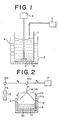
- FIG. 1 One embodiment of such a decomposition device is shown by a schematic view in Fig. 1.
- Reference numeral 1 in this drawing is a decomposition vessel made of a material excellent in a resistance to H 2 0 2 such as a tetrafluoroethylene polymer, and in the vessel 1, sample 6 of hydrogen peroxide water containing a W or Mo powder material is placed. Further, this decomposition vessel 1 is received in a cooling tank 2.
- numerals 3 and 4 are a cooling water inlet and a cooling water outlet, respectively.
- the sample 6 in the decomposition vessel is stirred by a stirrer 5 to accelerate and uniformize the reaction therein.
- a continuously H 2 0 2 feeding device 7 is additionally provided thereto. As the device 7, any member such as a pump may be employed, so long as it can feed H 2 0 2 thereto at a constant flow rate.
- the decomposition vessel is provided with the streaming water cooling device and is constituted so as to continuously add hydrogen peroxide thereinto, and thus the generation of a reaction heat can be controlled, with the result that the much Mo or W powder can always be decomposed at a low temperature of 60° C or less.
- the decomposition and the evaporation of hydrogen peroxide and the precipitate of a molybdic acid or tungstic acid can be inhibited, by which facts the decomposition device just described can be simply constituted and the used agent (H 2 0 2 ) can be saved. Therefore, the total costs of the first step can be remarkably decreased and the safety of its operation can also be improved advantageously.
- the first step makes progress in the state of the exothermic reaction, a calorific value can be restrained to a lower level in the case that the oxide powder of Mo or W is used, because the amount of hydrogen peroxide water in the decomposition reaction is small. Therefore, the reaction will progress moderately and rapidly on the whole, which fact means that any intricate temperature control is not necessary in the reaction system.
- aqueous solution prepared in the above-mentioned first step is brought into contact with a cation exchange resin, so that impurities which are present as cations therein will be adsorbed by the exchange resin, thereby removing the impurities from the aqueous solution.
- Mo or W in this step is present in the form of M 0 0 4 - or W0 4- , as shown in the formula 11 to (4), and thus it will be eluted from the cation exchange resin without being adsorbed thereby. In this way, the impurities alone will be removed substantially perfectly from the Mo or W powder material by the adsorption function of the cation exchange resin in this step.
- the used cation exchange resin is preferably an H type which is excellent in an elimination efficiancy of cations, and a grain diameter of the cation exchange resin depents upon factors such as an amount of the aqueous solution to be treated, a purification efficiency and a flow rate of the solution, but it is usually within the range of 100 to 30 meshes. More specifically, the preferred cation exchange resin is composed of a basic component of a copolymer of polystyrene and about 8 % of divinylbenzene (DVB) and a strongly acidic sulfone group which is an exchanger.
- DVD divinylbenzene
- cation exchange resins are now commercially sold under trade names of Diaion SK, Amber Light (IR-120) and DOWEX 50W-8X (each trade name, produced by Mitusbishi Kasei Co., Ltd., Rohm & Haas Co., Ltd. and Dow Chemical Co., Ltd., respectively).
- the contact of the cation exchange resin with the aqueous solution may be accomplished by filling columns with the cation exchange resin in a suitable density, as shown in Fig. 3, and causing the aqueous solution prepared in the first step to flow through the cation exchange resin.
- a multi-stage system in which a plurality of ion exchange columns are connected to each other is a preferable way from the viewpoints of a high purification and a high separation efficiency.
- aqueous solution which has been ion-exchanged in the second step is heated to vaporize water therein and to thereby carry out its concentration.
- aqueous solution prepared in the second step i.e., the aqueous solution containing Mo or W alone is heated for the evaporation of water therein, a concentrated solid of H 2 Mo0 4 . xH 2 0 or H 2 W0 4 . xH 2 0 will be obtained.
- This concentration treatment may be carried out usually at a temperature of 50 to 300 C, more preferably 50 to 100°C, and it is also preferred to accomplish the treatment under a reduced pressure.
- the heating and drying may be carried out at 100 to 300°C.
- a high-frequency heating and concentration treatment bv the use of microwave is nreferred.
- the concentration process of using the microwave may be carried out concretely by using an apparatus in which the high-frequency heating system based on the microwave is utilized, for example, a microwave oven.
- a microwave oven According to this heating system, water molecules in the Mo or W solution to be concentrated are excited so that heat is generated and a temperature of the solution is inhibited to a level of about 100°C.
- a vessel for receiving the solution to be concentrated may not have a so high heat resistance.
- the vessel made from a polyethylene, a polypropylene, Teflon (trade name, produced by E.I. du pont de Nemours & Co. Inc.) can be utilized, and any contamination does not occur from the vessel.
- a heating time can be suitably regulated in accordance with an amount of the solution to be concentrated and the like, but the heating operation is preferably stopped just before H 2 Mo0 4 - xH 2 0 or H 2 WO 4' xH 2 0 precipitated on the bottom of the vessel has been evaporated to dryness, because if the water in the solution is lost absolutely, the excitation of the metal compound will be increased in order for its temperature to abruptly rise.
- H2Mo04' xH 2 0 or H 2 WO 4 .-xH 2 O is stirred immediately before evaporated to dryness, it will be dried by thermal inertia and will easily be granulated. That is, the concentration and the drying can be carried out in one step, and in a subsequent grinding process, a lot of drive power can be saved.
- a lid made from, e.g., Teflon is preferably employed for the vessel.
- spatulas for stirring and the like which will be used after drying are preferably made from Teflon.
- a concentration device used in the third step may be one which is provided with, for example, a sealed vessel for receiving the molybdenum or tungsten solution to be concentrated; a heating means disposed around the outer periphery of the sealed vessel; and a pressure-reducing means, connected with the sealed vessel, for reducing a pressure in the latter.
- numeral 11 is a sealed vessel which is composed basically of a lower box 11 a and an upper lid 11b. These members 11 a and 11 b are joined detachably at their flange potions 11 c by means of bolts and nuts.
- the upper lid 11b is provided with an exhaust portion 11d connecting to the pressure-reducing means which will be described hereinafter.
- a container 12a filled with the Mo or W solution 12 to be concentrated is received.
- a heating means 13 is arranged around the outer periphery of the sealed container 11, and a preferable example of the heating means 13 is a mantle heater disposed so as to wrap the whole container 11, because the mantle heater can restrain a heat loss at the time of heating and thus can reduce an energy cost.
- Reference numeral 14 is a pressure-reducing means to reduce a pressure in the sealed vessel 11, which is connected with the upper lid 11b via a conduit P 1 , a flow path switch cock 14a and a conduit P 2 .
- a pressure-reducing means 14 a usual vacuum pump may be employed, but since water vapor and water always occur in the heating and concentration step for the solution 12 as described below, the pressure-reducing means 14 preferably has such a structure that its function is not impaired by water vapor and the like.
- a trap may be disposed in the middle of the conduit P 2 , or as the simplest means, an aspirator in which running water is utilized may be employed.
- An air filter 15 is connected with the exhaust portion 11 via a conduit P 3 , a cock 15a, a conduit P 4 , a cock 14a and the conduit P t .
- the series of members just mentioned constitutes an additional system for recovering the pressure in the vessel 11 into ordinary pressure prior to taking out the produced concentrated solid material from the sealed vessel 11, after the heating and concentration treatment under the reduced pressure has been over.
- the vessel 11 surrounds the solution 12a and a space section thereover as shown in the drawing, and in the vessel 11, an umbrella lie connecting to the exhaust portion 11d is provided so as to prevent the contamination of the solution 12a, in other words, the concentrated solid material by foreign substances.
- the apparatus just described can be operated as follows:
- Operating conditions such as a vacuum degree and a temperature in the vessel 11 can be decided on the basis of a kind, a concentration, an amount and the like of the solution 12a, but for example, it is preferred that the pressure and the temperature in the vessel 11 are from about 10 to 50 mmHg and from about 60 to 100 C, more preferably 70 to 100°C, respectively. If the aforementioned conditions are selected for the heating and concentration treatment, (1) the Mo or W solution which is being concentrated in the sealed vessel will not be contaminated by anything, (2) since the evaporation treatment is done under the reduced pressure, the concentration can be accomplished in a shorter period of time than under ordinary pressure, and (3) the temperature in the vessel at heating can be set lower than under ordinary pressure.
- the present invention comprises a fourth step in which the concentrated solid material which has been prepared in the third step is reduced with hydrogen in order to obtain the high-purity Mo or W powder.
- the prepared solid material When heated at a temperature of 400 to 700°C, preferably 400 to 650°C, in a hydrogen atmosphere to obtain Mo0 2 and then further heated at a temperature of 800 to 1,100°C in an ordinary manner, the prepared solid material will be chemically reduced to the Mo or W powder.
- the present invention can be carried out, for example, as follows: A crude tungsten (or molybdenum) powder (or its oxide powder) and water are placed in a vessel equipped with a running water cooler and a stirrer. Hydrogen peroxide water is added thereto dropwise successively for decomposition, and an aqueous tungsten (or molybdenum) solution is then brought into contact with an H-type strongly acidic cation exchange resin.
- the impurities-free aqueous tungsten or molybdenum solution is heated and evaporated under a reduced pressure in a polypropylene sealed vessel for concentration, and is further heated and dehydrated, thereby obtaining highpurity tungsten oxide (W0 3 ) [(or high-purity molybdenum oxide (Mo0 3 )].
- W0 3 high-purity tungsten oxide
- Mo0 3 molybdenum oxide
- the thus obtained W0 3 (or M 0 0 3 ) can be used as it were.
- the high-purity W0 3 (or M 0 0 3 ) is available for a target material or the like.
- a heating temperature is 50 to 795° C, preferably 100 to 795° C.
- the thus obtained W0 3 (or Mo03) is then reduced with hydrogen at a temperature of 800 to 1,100°C, preferably 800 to 1,000°C.
- reducing procedure is required and the dehydration temperature is sufficient at 100 to 300°C.
- the tungsten (or molybdenum) powder which has been prepared by such an operation has a high purity, and an amount of the used hydrogen peroxide is one-half or less of its amount in the case that cooling is not made, and it is in the vicinity of a theoretical amount.
- a yield of tungsten (or molybdenum) can also be improved remarkably.
- H-type cation exchange resin (trade name, Diaion SK 1; grain diameter: 50 to 100 meshes; produced by Mitsubishi Chemical Industries Co., Ltd.) of strongly acidic polystyrene sulfonic acid was prepared.
- this cation exchange resin was swelled sufficiently with water, polypropylene columns each having an inner diameter of 35 mm and a length of 400 mm were filled with the swelled cation exchange resin, thereby forming three ion exchange columns. By the use of these three columns, such an apparatus as shown in Fig. 3 was constructed.
- reference numeral 21 is a sample solution prepared in the first step
- numeral 22 is a pump for forwarding the solution 21.
- Numerals 23, 24 and 25 all are the above-mentioned ion exchange columns
- numerals 26, 27, 28, 29, 30, 31 and 32 all are three-way cocks for switching flow paths of the sample solution.
- Numeral 33 is an Mo eluate coming through the ion exchange columns
- 35 and 36 are a hydrochloric acid solution and a washing solution for reproducing the cation exchange resin
- 34 is a three-way cock.
- the three-way cocks 26, 27, 28, 29 and 30 were opened to form such a flow path as the sample solution 21 would flow through the ion exchange columns 23 and 24 in turn by the solution-forwarding pump 22 but would not flow through the ion exchange column 25, and afterward, the solution-forwarding pump 22 was operated to run the sample solution 21.
- the three-way cock 30 was switched and the three-way cocks 31 and 32 were opened to form a flow path comprising the ion exchange columns 23, 24 and 25 through which the sample solution 21 would flow.
- the sample solution 21 was caused to flow through the given flow path, thereby obtaining the Mo eluate 33.
- the Mo eluate obtained in the second step was placed in a vessel an inner wall of which is made of a tetrafluoroethylene polymer, and was heated to 150°C to carry out an evaporation dehydration treatment.
- the resulting concentrated solid material was heated to 900°C or higher for reduction in a hydrogen furnace, and 980 g of a powder was obtained, a yield being 97 %.
- the powder obtained in the fourth step was quantitatively analyzed to measure contents of elements other than Mo, i.e., impurities.
- the results are shown in Table 1.
- the results of the quantitative analysis of an Mo powder which was purified in the conventional manner (recrystallization process) are also shown together therein.
- the unit for the respective values in the table is ppm except for U and Th.
- Example 2 According to the procedure of Example 1 with the exeption that a W powder containing impurities shows in Table 2 and 2.3 liters of hydrogen peroxide solution were employed, a purified W powder was prepared. The results of a quantitative analysis are shown in Table 2.
- Diaion SK 1 (trade name, average grain diameter: 50 to 100 meshes; produced by Mitsubishi Chemical Industries Co., Ltd.) of strongly acidic polystyrene sulfonic acid was employed. After 400 g of this cation exchange resin was sufficiently swelled with water, and polypropylene columns having an inner diameter of 35 mm and a length of 400 mm were filled with the swelled cation exchange resin, thereby forming ion exchange columns. The previously prepared solution was caused to flow through the thus formed ion exchange columns.
- tungsten oxide or molybdenum oxide
- the resulting tungsten oxide (or molybdenum oxide) was reduced with hydrogen at a temperature of 900' C by the use of a hydrogen reduction furnace to prepare a tungsten (or molybdenum) powder.
- Example 2 The same treatments as the third and fourth steps in Example 1 were carried out to obtain 900 g of a desired powder.
- the concentrated solid material which had been obtained in the third step was quantitatively analyzed (in terms of a metallic powder) to measure quantitative values of elements other than the W content, i.e , impurities.
- the results are shown in Table 1.
- Table 1 For comeparison, the results of the quantitative analysis of ammonium paratungstate which was purified in the conventional manner (a recrystallization process) are also shown together therein.
- the unit of the respective values in the table is ppb.
- an aqueous hydrogen peroxide solution of molybdic acid (H Z Mo0 4 ) prepared by the passage through a cation exchange resin was employed as a solution to be treated. That is, 3 liters of the aqueous hydrogen peroxide solution was placed in a polyethylene vessel which had been heated and washed in nitric acid, and a Teflon (trade name) lid which had likewise been heated and washed in nitric acid was mounted on the vessel. The latter was then received in a domestic microwave oven (output 0.5 kW), and was then heated therein for about 3 hours.
- a domestic microwave oven output 0.5 kW
- H 2 Mo0 4 powder was quantitatively determined for impurities shown in the table, and determined values (ppb) are shown in Table 7.
- ppb determined values of impurities in an H 2 Mo0 4 solution which is a starting material are also shown together therein.
- the contents of the impurities in the product prepared by this invention can be reduced to about 1/100 of their contents in products prepared by the conventional process.
- the apparatus used for the purification is extremely simple, and its method is also simple. Incidentally, when a small amount of a strong acid is added to the reaction system at the decomposition with H 2 0 2 and when cooling is carried out, a recovery rate of Mo or W will be heightened, a less amount of H 2 0 2 will be consumed, and the product having a higher purity will be obtained.
- an amount of radioactive elements is less than 0.1 ppb, and an amount of alkali metals and heavy metals are less 0.05 ppm.
- the Mo and W powders prepared by this invention are of an extremely high purity, and it thus is fair to say that they are useful as materials for targets of VLSI elements.
Landscapes
- Chemical & Material Sciences (AREA)
- Organic Chemistry (AREA)
- Engineering & Computer Science (AREA)
- Materials Engineering (AREA)
- Metallurgy (AREA)
- Mechanical Engineering (AREA)
- Manufacturing & Machinery (AREA)
- Inorganic Chemistry (AREA)
- Geology (AREA)
- Life Sciences & Earth Sciences (AREA)
- Geochemistry & Mineralogy (AREA)
- General Life Sciences & Earth Sciences (AREA)
- Chemical Kinetics & Catalysis (AREA)
- General Chemical & Material Sciences (AREA)
- Environmental & Geological Engineering (AREA)
- Inorganic Compounds Of Heavy Metals (AREA)
- Manufacture And Refinement Of Metals (AREA)
- Manufacture Of Metal Powder And Suspensions Thereof (AREA)
Claims (20)
Applications Claiming Priority (8)
| Application Number | Priority Date | Filing Date | Title |
|---|---|---|---|
| JP60041238A JPH0615681B2 (ja) | 1985-03-04 | 1985-03-04 | 高純度のモリブデン又はタングステン粉末の製造方法 |
| JP41238/85 | 1985-03-04 | ||
| JP13608785A JPH06937B2 (ja) | 1985-06-24 | 1985-06-24 | 高純度のモリブデン又はタングステンの製造方法 |
| JP136087/85 | 1985-06-24 | ||
| JP19381485 | 1985-09-04 | ||
| JP193814/85 | 1985-09-04 | ||
| JP21260985 | 1985-09-27 | ||
| JP212609/85 | 1985-09-27 |
Publications (2)
| Publication Number | Publication Date |
|---|---|
| EP0197271A1 EP0197271A1 (de) | 1986-10-15 |
| EP0197271B1 true EP0197271B1 (de) | 1989-04-19 |
Family
ID=27461019
Family Applications (1)
| Application Number | Title | Priority Date | Filing Date |
|---|---|---|---|
| EP86102251A Expired EP0197271B1 (de) | 1985-03-04 | 1986-02-21 | Verfahren zur Herstellung hochreiner Molybdän- oder Wolframpulver in Form ihrer Metalle oder Oxide |
Country Status (3)
| Country | Link |
|---|---|
| US (1) | US4762695A (de) |
| EP (1) | EP0197271B1 (de) |
| DE (1) | DE3662916D1 (de) |
Families Citing this family (33)
| Publication number | Priority date | Publication date | Assignee | Title |
|---|---|---|---|---|
| US5879918A (en) * | 1989-05-12 | 1999-03-09 | Pioneer Hi-Bred International, Inc. | Pretreatment of microprojectiles prior to using in a particle gun |
| FR2687170B1 (fr) * | 1992-02-07 | 1994-09-30 | Eurecat Europ Retrait Catalys | Recuperation de molybdene et de vanadium a partir de catalyseurs uses. |
| DE4231955C1 (de) * | 1992-09-24 | 1994-01-13 | Kernforschungsz Karlsruhe | Verfahren zur Behandlung von Auflöserückständen |
| EP0644945A4 (de) * | 1993-01-29 | 1997-01-15 | Pioneer Hi Bred Int | Die vorbehandlung von mikroprojektilen von ihrer verwendung in einer partikelpistole. |
| DE4404747C2 (de) * | 1994-02-15 | 1995-12-14 | Starck H C Gmbh Co Kg | Herstellung von Reinstmetallpulver aus Metallalkoxiden |
| CN1036978C (zh) * | 1995-01-26 | 1998-01-14 | 北京科技大学 | 基因枪用转移外源基因微型生物钨弹的制备方法 |
| AT403775B (de) * | 1995-10-31 | 1998-05-25 | Plansee Ag | Verfahren zur reduktion von metallverbindungen |
| AT404912B (de) * | 1996-11-04 | 1999-03-25 | Plansee Ag | Verfahren zur herstellung von pulver-pressansätzen für feinkörniges hartmetall |
| RU2176677C2 (ru) * | 1998-10-06 | 2001-12-10 | Воропанова Лидия Алексеевна | Способ извлечения вольфрама (vi) из водного раствора |
| US7245018B1 (en) * | 1999-06-22 | 2007-07-17 | Semiconductor Energy Laboratory Co., Ltd. | Wiring material, semiconductor device provided with a wiring using the wiring material and method of manufacturing thereof |
| US6661096B1 (en) * | 1999-06-29 | 2003-12-09 | Semiconductor Energy Laboratory Co., Ltd. | Wiring material semiconductor device provided with a wiring using the wiring material and method of manufacturing thereof |
| US7571814B2 (en) * | 2002-02-22 | 2009-08-11 | Wave Separation Technologies Llc | Method for separating metal values by exposing to microwave/millimeter wave energy |
| RU2225891C2 (ru) * | 2002-05-30 | 2004-03-20 | Воропанова Лидия Алексеевна | Способ сорбции вольфрама (vi) из водных растворов |
| DE10231777A1 (de) * | 2002-07-13 | 2004-02-05 | Diehl Munitionssysteme Gmbh & Co. Kg | Verfahren zur Herstellung eines Wolfram-Basismaterials und Verwendung desselben |
| RU2253687C1 (ru) * | 2003-09-02 | 2005-06-10 | Воропанова Лидия Алексеевна | Селективное извлечение вольфрама (vi) |
| US7534282B2 (en) * | 2003-09-16 | 2009-05-19 | Japan New Metals Co., Ltd. | High purity metal Mo coarse powder and sintered sputtering target produced by thereof |
| CN100391854C (zh) * | 2005-09-01 | 2008-06-04 | 武汉理工大学 | 三氧化钼层叠纳米棒及制备方法 |
| CN100348778C (zh) * | 2005-09-22 | 2007-11-14 | 上海交通大学 | SiC陶瓷颗粒表面化学镀铜方法 |
| RU2341461C1 (ru) * | 2007-10-24 | 2008-12-20 | Институт химии высокочистых веществ Российской академии наук (ИХВВ РАН) | Способ получения высокочистого оксида вольфрама (vi) |
| RU2427657C1 (ru) * | 2010-03-11 | 2011-08-27 | Лидия Алексеевна Воропанова | Селективное извлечение вольфрама ( vi ) из растворов катионов тяжелых металлов |
| CA2815708C (en) * | 2010-12-24 | 2016-12-13 | Central South University | Method for extracting tungsten from scheelite |
| CA2948541C (en) * | 2012-04-27 | 2018-02-20 | Triumf | Processes, systems, and apparatus for cyclotron production of technetium-99m |
| RU2506331C1 (ru) * | 2012-11-19 | 2014-02-10 | Федеральное государственное бюджетное образовательное учреждение высшего профессионального образования "Национальный исследовательский Томский политехнический университет" | Способ получения вольфрамата аммония |
| CN104722768A (zh) * | 2015-04-16 | 2015-06-24 | 柳州豪祥特科技有限公司 | 一种铁钼粉体的制备工艺 |
| RU2600045C1 (ru) * | 2015-06-09 | 2016-10-20 | Федеральное государственное автономное образовательное учреждение высшего образования "Национальный исследовательский Томский политехнический университет" | Способ получения паравольфрамата аммония |
| RU2608117C1 (ru) * | 2015-07-06 | 2017-01-13 | Федеральное государственное автономное образовательное учреждение высшего образования "Национальный исследовательский Томский политехнический университет" | Способ переработки растворов после карбонатного вскрытия вольфрамовых руд |
| RU2633677C1 (ru) * | 2016-10-11 | 2017-10-16 | Акционерное общество "Закаменск" | Способ переработки растворов после карбонатной переработки вольфрамовых руд |
| CN111014723B (zh) * | 2019-11-27 | 2022-09-20 | 有研亿金新材料有限公司 | 一种半导体存储器用高纯纳米钨粉的制备方法 |
| CN111893442B (zh) * | 2020-07-17 | 2022-04-19 | 厦门虹鹭钨钼工业有限公司 | 一种钼钨溅射靶材及其制备方法 |
| CN115178749B (zh) * | 2022-07-26 | 2024-07-09 | 金堆城钼业股份有限公司 | 一种利用还原法制备高纯钼粉的方法 |
| CN116790913A (zh) * | 2022-12-30 | 2023-09-22 | 西安蓝晓科技新材料股份有限公司 | 一种从高浓度钨矿浸提液中提钨的离子交换系统和方法 |
| CN117604276A (zh) * | 2023-10-30 | 2024-02-27 | 洛阳汇晶新材料科技有限公司 | 一种基于液相冶金的高纯钼提纯方法 |
| CN117401714B (zh) * | 2023-11-01 | 2026-02-03 | 中南大学 | 一种从辉钼矿制备三氧化钼的方法 |
Family Cites Families (10)
| Publication number | Priority date | Publication date | Assignee | Title |
|---|---|---|---|---|
| CA561559A (en) * | 1958-08-05 | John C. R. Kelley, Jr. | Preparation of molybdenum | |
| FR1306120A (fr) * | 1961-09-01 | 1962-10-13 | Electrochimie Soc | Procédé de récupération de catalyseur tungstique |
| US3519385A (en) * | 1968-03-12 | 1970-07-07 | Atomic Energy Commission | Method for separating molybdenum from technetium |
| BE794636A (fr) * | 1972-01-27 | 1973-05-16 | American Metal Climax Inc | Procede pour produite de l'oxyde de molybdene et du molybdate d'ammonium de haute purete |
| US3957946A (en) * | 1974-12-23 | 1976-05-18 | Amax Inc. | Molybdenum oxide purification process |
| US3969478A (en) * | 1975-01-30 | 1976-07-13 | Abram Naumovich Zelikman | Process for separation of tungsten and molybdenum by extraction |
| US4046852A (en) * | 1976-05-19 | 1977-09-06 | Amax Inc. | Purification process for technical grade molybdenum oxide |
| US4101309A (en) * | 1976-10-13 | 1978-07-18 | Tokyo Shibaura Electric Co., Ltd. | Method for preparing tungsten materials |
| US4328191A (en) * | 1980-05-12 | 1982-05-04 | Gte Laboratories Incorporated | Process for the recovery of molybdenum from spent catalysts |
| US4533527A (en) * | 1982-09-04 | 1985-08-06 | Interox Chemicals Limited | Tungsten recovery from carbides |
-
1986
- 1986-02-21 EP EP86102251A patent/EP0197271B1/de not_active Expired
- 1986-02-21 DE DE8686102251T patent/DE3662916D1/de not_active Expired
-
1987
- 1987-09-04 US US07/094,074 patent/US4762695A/en not_active Expired - Lifetime
Also Published As
| Publication number | Publication date |
|---|---|
| DE3662916D1 (en) | 1989-05-24 |
| EP0197271A1 (de) | 1986-10-15 |
| US4762695A (en) | 1988-08-09 |
Similar Documents
| Publication | Publication Date | Title |
|---|---|---|
| US4762695A (en) | Methods for preparing high-purity molybdenum or tungsten powder and high-purity oxides powder of the same | |
| US20230304128A1 (en) | Processes and systems for purifying and recycling lithium-ion battery waste streams | |
| JP4764338B2 (ja) | モリブデンの回収方法及び触媒の製造方法 | |
| US8435483B2 (en) | Method for making ammonium metatungstate | |
| US3969478A (en) | Process for separation of tungsten and molybdenum by extraction | |
| US5348723A (en) | Synthesis of semiconductor grade tungsten hexafluoride | |
| Mitchell | Purification of analytical reagents | |
| KR900004453B1 (ko) | 고순도의 몰리브덴 또는 텅스텐 분말의 제조방법 | |
| Shiokawa et al. | Preparation of high purity uranium metal from aqueous solutions | |
| CN1015618B (zh) | 离子交换法制备纯仲钨酸铵方法 | |
| JPH0610317B2 (ja) | 高純度のモリブデン又はタングステンの製造方法 | |
| JPH06937B2 (ja) | 高純度のモリブデン又はタングステンの製造方法 | |
| CN117401715B (zh) | 一种从粗钨酸钠溶液制备偏钨酸铵与仲钨酸铵的方法 | |
| JP3206432B2 (ja) | 低α低酸素金属スカンジウムとその製造方法 | |
| Singh et al. | Studies on sorption of radiocesium on copper-hexacyanoferrate-loaded resins | |
| JPS61295338A (ja) | 高純度のモリブデン又はタングステンの製造方法 | |
| JPS63182218A (ja) | Ecd用高純度タングステン酸化物又はモリブデン酸化物 | |
| Qu et al. | Enhanced recovery of dithionate from desulfurization with pyrolusite system by manganese dioxide anode of spent batteries | |
| JPS61209918A (ja) | モリブデン又はタングステン溶液の濃縮装置 | |
| EP1930296B1 (de) | Verfahren zur herstellung von hochreinem ätzkali | |
| JP3589708B2 (ja) | 高純度の銅の製造方法 | |
| EP1746074B1 (de) | Verfahren zur Herstellung von Eisensulfat | |
| JPH0128920B2 (de) | ||
| US3114608A (en) | Methods of producing iodine-131 | |
| KR20050026885A (ko) | 암모늄 메탈레이트 용액의 정제 |
Legal Events
| Date | Code | Title | Description |
|---|---|---|---|
| PUAI | Public reference made under article 153(3) epc to a published international application that has entered the european phase |
Free format text: ORIGINAL CODE: 0009012 |
|
| AK | Designated contracting states |
Kind code of ref document: A1 Designated state(s): DE FR GB NL |
|
| 17P | Request for examination filed |
Effective date: 19870318 |
|
| 17Q | First examination report despatched |
Effective date: 19880526 |
|
| GRAA | (expected) grant |
Free format text: ORIGINAL CODE: 0009210 |
|
| AK | Designated contracting states |
Kind code of ref document: B1 Designated state(s): DE FR GB NL |
|
| REF | Corresponds to: |
Ref document number: 3662916 Country of ref document: DE Date of ref document: 19890524 |
|
| ET | Fr: translation filed | ||
| PLBE | No opposition filed within time limit |
Free format text: ORIGINAL CODE: 0009261 |
|
| STAA | Information on the status of an ep patent application or granted ep patent |
Free format text: STATUS: NO OPPOSITION FILED WITHIN TIME LIMIT |
|
| 26N | No opposition filed | ||
| REG | Reference to a national code |
Ref country code: GB Ref legal event code: 746 Effective date: 19981007 |
|
| REG | Reference to a national code |
Ref country code: FR Ref legal event code: D6 |
|
| PGFP | Annual fee paid to national office [announced via postgrant information from national office to epo] |
Ref country code: FR Payment date: 20010213 Year of fee payment: 16 |
|
| PGFP | Annual fee paid to national office [announced via postgrant information from national office to epo] |
Ref country code: NL Payment date: 20010228 Year of fee payment: 16 |
|
| REG | Reference to a national code |
Ref country code: GB Ref legal event code: IF02 |
|
| PG25 | Lapsed in a contracting state [announced via postgrant information from national office to epo] |
Ref country code: NL Free format text: LAPSE BECAUSE OF NON-PAYMENT OF DUE FEES Effective date: 20020901 |
|
| PG25 | Lapsed in a contracting state [announced via postgrant information from national office to epo] |
Ref country code: FR Free format text: LAPSE BECAUSE OF NON-PAYMENT OF DUE FEES Effective date: 20021031 |
|
| NLV4 | Nl: lapsed or anulled due to non-payment of the annual fee |
Effective date: 20020901 |
|
| REG | Reference to a national code |
Ref country code: FR Ref legal event code: ST |
|
| PGFP | Annual fee paid to national office [announced via postgrant information from national office to epo] |
Ref country code: GB Payment date: 20030219 Year of fee payment: 18 |
|
| PGFP | Annual fee paid to national office [announced via postgrant information from national office to epo] |
Ref country code: DE Payment date: 20030306 Year of fee payment: 18 |
|
| PG25 | Lapsed in a contracting state [announced via postgrant information from national office to epo] |
Ref country code: GB Free format text: LAPSE BECAUSE OF NON-PAYMENT OF DUE FEES Effective date: 20040221 |
|
| PG25 | Lapsed in a contracting state [announced via postgrant information from national office to epo] |
Ref country code: DE Free format text: LAPSE BECAUSE OF NON-PAYMENT OF DUE FEES Effective date: 20040901 |
|
| GBPC | Gb: european patent ceased through non-payment of renewal fee |
Effective date: 20040221 |