EP0196624A2 - Kleinstation - Google Patents
Kleinstation Download PDFInfo
- Publication number
- EP0196624A2 EP0196624A2 EP86104196A EP86104196A EP0196624A2 EP 0196624 A2 EP0196624 A2 EP 0196624A2 EP 86104196 A EP86104196 A EP 86104196A EP 86104196 A EP86104196 A EP 86104196A EP 0196624 A2 EP0196624 A2 EP 0196624A2
- Authority
- EP
- European Patent Office
- Prior art keywords
- framework
- small station
- station according
- concrete
- rails
- Prior art date
- Legal status (The legal status is an assumption and is not a legal conclusion. Google has not performed a legal analysis and makes no representation as to the accuracy of the status listed.)
- Granted
Links
Images


Classifications
-
- H—ELECTRICITY
- H02—GENERATION; CONVERSION OR DISTRIBUTION OF ELECTRIC POWER
- H02B—BOARDS, SUBSTATIONS OR SWITCHING ARRANGEMENTS FOR THE SUPPLY OR DISTRIBUTION OF ELECTRIC POWER
- H02B13/00—Arrangement of switchgear in which switches are enclosed in, or structurally associated with, a casing, e.g. cubicle
- H02B13/02—Arrangement of switchgear in which switches are enclosed in, or structurally associated with, a casing, e.g. cubicle with metal casing
- H02B13/025—Safety arrangements, e.g. in case of excessive pressure or fire due to electrical defect
-
- H—ELECTRICITY
- H02—GENERATION; CONVERSION OR DISTRIBUTION OF ELECTRIC POWER
- H02B—BOARDS, SUBSTATIONS OR SWITCHING ARRANGEMENTS FOR THE SUPPLY OR DISTRIBUTION OF ELECTRIC POWER
- H02B7/00—Enclosed substations, e.g. compact substations
- H02B7/06—Distribution substations, e.g. for urban network
Definitions
- The. The invention relates to a small station according to the preamble of claim 1.
- Smaller electrical network stations which are particularly suitable for installation at consumer centers, have long been designed as non-accessible compact stations, so-called small stations.
- Known small stations have a housing made of lightweight concrete, which is combined with weatherproof sheet steel parts for the ventilation walls, the roof and the doors. They are relatively expensive to manufacture, have a high weight and require special precautions for the safe derivation of Explo pressure waves from inside the building to the outside environment.
- the concrete housing of these small stations is increasingly rejected because it is aesthetically disturbing in many places. Recent experience has shown that concrete is not an indestructible material, as has long been assumed.
- Station buildings in metal or plastic construction are already known, which have a frame made of C or L profiles. However, these buildings have too little stability, so that they have not proven themselves as potentially explosive network station buildings.
- the present invention is therefore based on the object to develop a new design principle for such small stations, which takes into account the above-mentioned new requirements for small stations and leads to more stable, cheaper, versatile stations, the exterior of which can be adapted to the respective installation site without additional expenditure.
- the body of the building from the framework has many advantages over conventional concrete buildings: it has a much lighter weight and a high inherent quality rigidity, the cladding and infill of the framework can be adapted to the respective purpose and location quickly and inexpensively. Likewise, the outside dimensions of the station and the division of its interior can be varied without difficulty, the attachment of the partition walls, devices and other installations does not require any additional precautions, the ratio of inside dimensions to outside dimensions is extremely favorable.
- the building body of the small station according to the invention has a considerably increased stability due to the square tubes provided, which are used simultaneously for ventilation and pressure relief of the interior of the building, so that the facilities provided for this in the known station buildings can be saved .
- the base frame as well as the frame above are as all around and. -Exhaust air trained.
- the outer cladding of the framework preferably consists of aluminum profiles, profiled aluminum sheet, sheets, plastic concrete, glass fiber concrete. or wooden panels.
- plastering as external cladding on the framework clad with sheet metal or with light concrete, concrete or synthetic resin concrete. In the latter case, reinforcements of structural steel mesh are appropriate.
- Doors for TransfDrmatoren and 'ventilation on the two longitudinal walls can be omitted in this small station, since the roof is designed to be foldable, so that access to the transformer is possible from above.
- the roof can be constructed in one or more parts in accordance with the detailed functions of the network stations. The hinged If necessary, the roof over the transformer must be fitted with a lower apron. By eliminating the side ventilation doors, a more economical, visually clearer solution with less need for retention areas around the station is possible.
- the framework of the small station according to the invention therefore fulfills several functions at the same time: it has a static task to ensure the inherent rigidity of the station, it serves as a support for the installed devices, it guarantees safe earthing at every location of the station, it ensures safe ventilation and pressure relief , it serves as a cladding support for any external cladding and it allows cross-connections within the station for fastening partitions, units and MV and LV cables.
- the invention is based on. several embodiments shown in the drawing described and explained.
- the framework according to FIG. 1 of a small station consists of vertically extending square tubes 10 and horizontally extending C-profile rails 11, which in turn are connected by transverse C-profile rails 12 for the transverse stiffening of the framework.
- the top and bottom horizontal rails 13 and 14, which belong to the outer frame of the framework, are also square tubes, which have punched or cutouts or at least partially consist of perforated sheet or steel mesh, so that through them the ventilation of the interior of the small station can be performed.
- the upper transverse square tubes 10, which are shown in the drawing in the removed state and can be plugged onto the rest of the framework, are part of the roof closing the small station upwards, which is shown in the exemplary embodiments described later.
- the framework is fastened on a base frame 15, which in this exemplary embodiment is in the form of a floor pan, which is divided into three segments: a front segment 16, over which the low-voltage space of the small station extends, a middle segment 17 for the Transformer room with a closed trough for collecting the transformer oil and a rear segment 18, above which the high-voltage or medium-voltage room is arranged.
- the latching of the square tubes 10 depends on the width of these three segments 16 to 18, so that the roof of the small station can also correspond to these segment widths.
- the base frame 15 is advantageously cast from concrete; However, it can also be made of plastic or sheet metal if it is important to reduce the weight of the small station to a minimum.
- the C-profile rails 11 and 12 of the framework expediently serve at the same time as fastening rails for partition walls, MV and LV switchgear and other installations of the small station and offer the possibility of secure earthing in all areas of the small station.
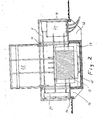
- the small station is shown in the installed state with the Dabh unfolded above the transformer room in a longitudinal section.
- the transformer With 19 the transformer, with 20 the medium voltage switchgear and with 21 the low voltage switchgear.
- the latter are installed in the upper framework and can be transported with the framework as a chassis.
- the roof 22 above the transformer room 17 is pivotally mounted on the vertical or horizontal square tubes 10.
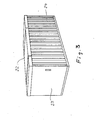
- FIG. 3 shows an overall perspective view of the part of the small station protruding from the earth, the outer walls of the small station being clad by aluminum doors 23 or aluminum sheets, aluminum profiles or sheet trapezoidal profiles 24.
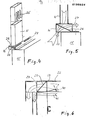
- FIG. 4 shows a square tube 10 which runs vertically in the framework and which, together with the lowest horizontally extending square tube 14, forms the ventilation system for the small station.
- the vertical square tube 10 has openings 25 in its upper region which point into the interior of the small station.
- the lower end of the square tube 10 is welded to the horizontally extending square tube 14 in such a way that an unimpeded air flow through the interior of the two tubes is ensured, as indicated by the dashed arrow in FIG. 5.
- the horizontally extending square tube 14 projects with its lower surface beyond the base frame 15 of the small station to the outside, so that the supply and exhaust air can enter or exit all around through the openings 26 provided in this partial area of the base of the square tube 14.
- openings 27 are also provided in the side surface of the square tube pointing into the station interior, through which primarily the fresh air can flow into the small station, as indicated by the arrow in FIG. 5.
- Optimal ventilation and cooling of the small station is achieved by supplying the fresh air in the lower area of the station interior and removing the heated air in the upper area of the station interior.
- FIGS. 6 and 9 An equivalent venting device in the upper area of the small station is shown in FIGS. 6 and 9 poses.
- the pipe running horizontally directly under the roof 22 consists of a perforated square pipe 13 into which a diagonally running perforated plate 29 is also inserted.
- the exhaust air from the small station, as indicated by the arrow in FIG. 6, is directed to the floor through the roof 22 which projects beyond the side walls of the station and is angled downwards.
- swiveling fins 40 automatically close the round vent and thus only allow the pressure wave to travel through the aluminum hollow profiles or channels between the sheets and the profile sheet, so that the hot gases cool down greatly on the extended path marked with an arrow 41 and can only exit in the lower area of the station close to the ground.
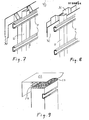
- FIGS. 7 and 8 show two exemplary embodiments of the outer cladding of the framework with flat metal sheets 32 and trapezoidal sheets 31 or with aluminum hollow profiles 30 with integrated supply and exhaust air or pressure relief channels which are protected against arcing.
- a flat .Table 32 made of aluminum, sheet steel or a plastic is first attached.
- the outer cladding panels 31 are then fastened to this panel 32, so that ventilation ducts or pressure relief ducts are formed as in the case of the aluminum hollow profiles 30.
- the inflow or outflow takes place in that the interior trim parts are designed to be lower in height than the exterior ones.
- the ventilation ducts between the plates 32 and 31 ensure that and exhaust air for the interior of the small station, depending on the arrangement of the outer cladding panels 30 and 31 so that the supply air enters the ventilation duct at the bottom and is fed to the inside of the station at the top (FIG. 10) or vice versa (FIG. 11).
- the pressure wave escapes after the all-round ventilation is closed either through the supply air slots in the lower area of the station or, to a greater extent because of the buoyancy of hot gases, through the upper inlet openings of the ventilation ducts.
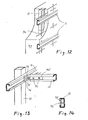
- the framework part according to FIG. 12 is filled with concrete 33, the strength of which is increased by a reinforcement 34.
- the vertical square tubes 10 and the horizontal C-profile rails 11 are also in the concrete wall 33.
- the outside of the small station has a plastering, not shown in the drawing.
- This infill of the framework with concrete represents an alternative to the cladding solutions of the small station with sheet metal plates according to Figures 7 and 8.
- both solutions can also be combined, for example in such a way that the rear wall placed in an embankment and the side walls with concrete infill. while the exposed front wall is clad with profile panels.
- Figure 13 shows an expedient way of connecting two mutually perpendicular C-profile rails 11 and 12 in the framework.
- the connection is made by a tie rod which has two sheet metal strips 35 and 36 arranged at right angles to one another, which are non-positively connected to one another by a hammer or hook-head screw 37 with a lock nut 38.
- the sheet metal strip 35 is inserted into the C profile rail 12 and fixed there with pressure screws 39, the head of which does not protrude beyond the C profile of the rail 12.
- the hammer or hook head screw 37 is inserted into the C-profile of the other rail 11 and fixed there by means of the lock nut.
Landscapes
- Engineering & Computer Science (AREA)
- Power Engineering (AREA)
- Building Environments (AREA)
- Vehicle Body Suspensions (AREA)
- Input Circuits Of Receivers And Coupling Of Receivers And Audio Equipment (AREA)
- Magnetic Resonance Imaging Apparatus (AREA)
- Transplanting Machines (AREA)
- Foundations (AREA)
Abstract
Description
- . Die. Erfindung betrifft eine Kleinstation nach dem Oberbegriff des Patentanspruches 1.
- Kleinere elektrische Netzstationen, die sich besonders für die Aufstellung an Verbraucherschwerpunkten eignen, werden seit längerer Zeit als nicht begehbare Kompaktstationen, sogenannte Kleinstationen, ausgeführt. Die . bekannten Kleinstationen weisen .bevorzugt.ein Gehäuse aus Leichtbeton auf, das mit wetterfesten Stahlblechteilen für die Belüftungswände, das Dach und die Türen kombiniert ist. Sie sind relativ teuer in der Herstellung, weisen ein hohes Eigengewicht auf und erfordern besondere Vorkehrungen für die gefahrlose Ableitung von Explosionsdruckwellen aus dem Gebäudeinneren an die Außenumgebung. Hinzu kommt, daß das Betongehäuse dieser Kleinstationen zunehmend auf Ablehnung stößt, weil es vielerorts ästhetisch stört. Daß Beton kein unverwüstlicher Werkstoff ist, wie lange Zeit angenommen wurde, haben neuere Erfahrungen gezeigt.
- Es sind auch bereits Stationsgebäude in Metall- oder Kunststoffbauweise bekannt, die ein Rahmengestell aus C-oder L-Profilen aufweisen. Diese Gebäude haben jedoch eine zu geringe Stabilität, so daß sie sich als explosionsgefährdete Netzstation-Gebäude nicht bewährt haben.
- Durch die moderne Schalttechnik - SF6- und Vakuumtechnik - sind die Sicherheitsanforderungen an derartige Stationsgebäude wesentlich geringer geworden. Die SF6-Schalter erfordern nur hoch 10% der Wartung der derzeit verwendeten Schalter. Die Außenabmessungen der Gebäude, können aufgrund der geringeren Abmessungen der modernen Schaltgeräte weiter reduziert werden.
- Der vorliegenden Erfindung liegt deshalb die Aufgabe zugrunde, ein neues Konstruktionsprinzip für derartige Kleinstationen zu entwickeln, das die obengenannten neuen Forderungen an Kleinstationen berücksichtigt und -zu stabileren, preiswerteren, vielseitig abwandelbaren Stationen führt, deren Äußeres ohne zusätzliche Aufwendungen dem jeweiligen Aufstellungsort angepaßt werden kann.
- Diese Aufgabe wird erfindungsgemäß durch die kennzeichnenden Merkmale des Patentanspruches 1 gelöst. Der Ge- Däudekorpus aus dem Rahmenwerk hat gegenüber den konventionellen Betongebäuden vielerlei Vorteile: er hat ein wesentlich leichteres Gewicht, weist eine hohe Eigensteifigkeit auf, die Verkleidung und Ausfachung des Rahmenwerkes kann dem jeweiligen Verwendungszweck und Einsatzort schnell und preiswert angepaßt werden. Ebenso sind die Außenabmessungen der Station und die Aufteilung ihres Innenraumes ohne Schwierigkeiten zu variieren, die Befestigung der Zwischenwände, Gerät'e und sonstigen Installationen erfordert keine zusätzlichen Vorkehrungen, das Verhältnis von Innenabmessungen zu Außenabmessungen ist extrem günstig. Gegenüber den vorbekannten Rahmengestellen aus Schienen besitzt der Gebäudekorpus der erfindungsgemäßen Kleinstation eine erheblich gesteigerte Stabilität aufgrund der vorgesehenen Vierkantrohre, die gleichzeitig für die Be- und Entlüftung und die Druckentlastung des Gebäudeinneren benutzt werden, so daß die hierfür bei den bekannten Stationsgebäuden vorgesehenen Einrichtungen eingespart werden könne. Der Grundrahmen sowie der oben liegende Rahmen sind als Rundumzu- und. -abluft ausgebildet.
- Die Außenverkleidung des Rahmenwerkes besteht vorzugsweise aus Aluminiumprofilen, profiliertem Aluminiumblech, Blechen, Kunststoff-Beton, Glasfaser-Beton . oder Holzplatten. Es ist jedoch auch möglich, als Außenverkleidung einen Verputz an das mit Blech verkleidete oder mit Leichtbeton, Beton oder Kunstharzbeton ausgefachte Rahmenwerk anzubringen. Im letzteren Fall sind Einlagen von Baustahlgewebe zweckmäßig.
- Türen für TransfDrmatoren und 'Lüftungen an den beiden Längswänden können bei dieser Kleinstation entfallen, da das Dach klappbar ausgeführt ist, so daß ein Zugang zu dem Transformator von oben möglich ist. Das Dach kann ein- und mehrteilig entsprechend den Detailfunktionen der Netzstationen ausgebildet sein. Das aufklappbare Dach über dem Transformator ist gegebenenfalls mit einer tiefer gezogenen Schürze zu versehen. Durch den Wegfall der seitlichen Lüftungstüren ist eine wirtschaftlichere, optisch freizügigere Lösung mit geringerem Bedarf an Vorhalteflächen um die Station möglich.
- Das Rahmenwerk der erfindungsgemäßen Kleinstation erfüllt also mehrere Funktionen gleichzeitig: es hat eine statische Aufgabe zur Sicherung der Eigensteifigkeit der Station, es dient als Träger für die installierten Geräte, es garantiert eine sichere Erdung an jedem Ort der Station, es sichert eine gefahrlose Entlüftung und Druckentlastung, es dient als Verkleidungsträger für beliebige Außenverkleidungen und es läßt Querverbindungen innerhalb der Station zur Befestigung von Zwischenwänden, Aggregaten und MS- und NS-Kabeln zu.
- Die Erfindung wird nachfolgend anhand von. mehreren in der Zeichnung dargestellten Ausführungsbeispielen näher beschrieben und erläutert.
- Es zeigen:
- Figur 1: das Rahmenwerk einer Kleinstation, mit Grundrahmen bzw. Betonfundamentwanne und abgenommenen oberen Querstreben als Bestandteil eines Daches in perspektivischer Darstellung;
- Figur 2: einen Längsschnitt durch die Kleinstation gemäß Figur 1 mit Außenverkleidung und geöffnetem Dach über dem Transformator und im Rahmenwerk einmontierten MS- und NS-Geräten;
- Figur 3: den aus dem Erdreich ragenden Teil der Kleinstation gemäß Figur 2 in perspektivischer Darstellung mit dreigeteilten Dach- und Längswänden ohne Lüftungstüren oder Lüfter-Elemente;
- Figur 4 bis 6: Detaildarstellungen der Rundum- Be- und Entlüftung durch Vierkantrohre des Rahmenwerkes gemäß Figur 1;
- Figur 7 und 8: vergrößerte Ausschnittdarstellungen der Außenwandverkleidungen der Kleinstation in perspektivischer Darstellung mit integrierter Druckentlastung und Lüftung;
- Figur 9: ein Beispiel für die unter dem Dach liegende Entlüftung einer Kleinstation mit Betonausfachung;
- Figur 10 und 11: Querschnitte durch die Kleinstation gemäß Figur 2 und 3 mit unterschiedlichen Lösungen für die Be- und Entlüftung sowie Druckentlastung entsprechend Figur 7 und 8 des Gebäudeinneren;
- Figur 12: einen Ausschnitt aus dem Rahmenwerk gemäß Figur 1. mit Bewehrung, Betonausfachung und außenseitigem Verputz;
- Figur 13: die Verbindung zweier senkrecht zueinander verlaufender C-Profilschienen im 'Rahmenwerk gemäß Figur 1 in perspektivischer Darstellung und
- Figur 14: einen Querschnitt durch eine der beiden C-Profilschienen gemäß Figur 13.
- Das Rahmenwerk gemäß Figur 1 einer Kleinstation besteht aus senkrecht verlaufenden Vierkantrohren 10 und waagerecht verlaufenden C-Profilschienen 11, die ihrerseits durch querverlaufende C-Profilschienen 12 zur Queraussteifung des Rahmenwerkes verbunden sind. Die obersten und untersten waagerecht verlaufenden Schienen 13 und 14, die zum äußeren Rahmen des Rahmenwerkes gehören, sind ebenfalls Vierkantrohre, die Ausstanzungen oder Ausschnitte aufweisen beziehungsweise mindestens teilweise aus Lochblech oder Baustahlgewebe bestehen, so daß durch sie die Be- und Entlüftung des Inneren der Kleinstation geführt werden kann. Die oberen querverlaufenden Vierkantrohre 10, die in der Zeichnung im abgenommenen Zustand dargestellt sind und auf das restliche Rahmenwerk aufsteckbar sind, sind Bestandteil des die Kleinstation nach oben abschließenden Daches, das bei den später beschriebenen Ausführungsbeispielen dargestellt ist.
- Das Rahmenwerk ist auf einem Grundrahmen-15, der in diesem Ausführungsbeispiel in Form-einer Bodenwanne ausgebildet ist, befestigt, die in drei Segmente unterteilt ist: ein vorderes Segment 16, über dem sich der Niederspannungsraum der Kleinstation erstreckt, ein mittleres Segment 17 für den Transformatorenraum mit einer geschlossenen Wanne zum Auffangen des Transformatorenöls und ein hinteres Segment 18, über dem der Hochspannungs-oder Mittelspannungsraum angeordnet ist. Die Rastung der Vierkantrohre 10 richtet sich nach der Breite dieser drei Segmente 16 bis 18, so daß auch das Dach der Kleinstation diesen Segmentbreiten entsprechen kann.
- Der Grundrahmen 15 ist zweckmäßigerweise aus Beton gegossen; er kann aber auch aus Kunststoff oder Blech hergestellt sein, wenn es darauf ankommt, das Gewicht der Kleinstation auf ein Minimum zu reduzieren.
- Die C-Profilschienen 11 und 12 des Rahmenwerkes dienen zweckmäßigerweise gleichzeitig als Befestigungsschienen für Zwischenwände, MS- und NS-Schältgeräte und sonstige Installationen der Kleinstation und bieten die Möglichkeit einer gesicherten Erdung in allen Bereichen der Kleinstation.
- In Figur 2 ist die Kleinstation in.installiertem Zustand mit aufgeklappten Dabh über dem.. Traforaum im.Längsschnitt dargestellt. Mit 19 ist der Transformator, mit 20 die Mittelspannungsschaltanlage und mit 21 die Niederspannungsschaltanlage bezeichnet. Letztere sind im oberen Rahmenwerk einmontiert und können mit dem Rahmenwerk als Chassis transportiert werden. Das-Dach 22 über dem Transformatorenraum 17 ist schwenkbar an den senkrecht oder waagerecht verlaufenden Vierkantrohren 10 gelagert.
- Figur 3 zeigt eine perspektivische Gesamtansicht des aus dem Erdreich ragenden Teiles der Kleinstation, wobei die Außenwände der Kleinstation durch Aluminiumtüren 23 bzw. Aluminiumbleche, Aluminiumprofile oder.Blechtrapezprofi- le 24 verkleidet sind. Durch den Wegfall von Lüftungstüren in den Längswänden .24 der Kleinstation infolge der Verlagerung des Zuganges zum Traforaum in die Dachebene wird eine größere Freizügigkeit hinsichtlich der Gestaltung und Installation der Netzstation im Bereich der Längswände erreicht.
- Figur 4 zeigt ein senkrecht im Rahmenwerk verlaufendes Vierkantrohr 10, das zusammen mit dem untersten waagerecht verlaufenden Vierkantrohr 14 das Be- und Entlüftungssystem für die Kleinstation bildet. Das senkrecht verlaufende Vierkantrohr 10 weist in seinem oberen Bereich Durchbrüche 25 auf, die in das Innere der Kleinstation weisen. Das untere Ende des Vierkantrohres 10 ist so mit dem waagerecht verlaufenden Vierkantrohr 14 verschweißt, daß ein ungehinderter Luftstrom durch das Innere der beiden Rohre gewährleistet ist, wie mit dem gestrichelten Pfeil in Figur 5 angedeutet ist. Das waagerecht verlaufende Vierkantrohr 14 ragt mit seiner unteren Fläche über den Grundrahmen 15 der Kleinstation nach außen vor, so daß durch die in diesem Teilbereich der Grundfläche des Vierkantrohres 14 vorgesehenen Öffnungen 26 die Zu- und Abluft rundum ein- bzw. austreten kann. Schließlich sind auch in der in das Stationsinnere weisenden Seitenfläche des Vierkantrohres 14 Durchbrüche 27 vorgesehen, durch die vornehmlich die Frischluft in die Kleinstation strömen kann, wie mit dem Pfeil in Figur 5 angedeutet ist. Durch die Zuführung der Frischluft im unteren Bereich des Stationsinneren und die Abfuhr der erwärmten Luft im oberen Bereich des Stationsinneren wird eine optimale Lüftung und Kühlung der Kleinstation erreicht.
- Um ein -Eindringen von Kleintieren und grobem Schmutz durch die Lüftungsöffnungen 26 und 27 in das Stationsinnere zu. verhindern, ist in das Vierkantrohr 14 ein diagonal liegendes Lochblech 28 eingeschoben.
- Eine gleichwirkende Entlüftungsvorrichtung im oberen Bereich der Kleinstation ist in den Figuren 6 und 9 dargestellt. Hier besteht das unmittelbar unter dem Dach 22 waagerecht verlaufende Rohr aus einem perforierten Vierkantrohr 13, in das ebenfalls ein diagonal verlaufendes Lochblech 29 eingeschoben ist. Die Abluft der Kleinstation wird, wie in Figur 6.mit dem Pfeil angedeutet, durch das die Seitenwände der Station überragende und nach unten abgewinkelte Dach 22 zum Boden geleitet.
- 'Im Störlichtbogenfall verschließen selbsttätig schwenkbare Lamellen 40 die Ründumentlüftung und erlauben der Druckwelle somit nur noch den Weg über die AluminiumHohlprofile bzw. Kanäle zwischen den Blechen und dem Profilblech, so daß die heißen Gase auf dem verlängerten, mit einem Pfeil.41 gekennzeichneten Weg stark abgekühlt werden und nur im unteren Bereich der Station nahe am Erdboden austreten können.
- Figur 7 und 8 zeigen zwei Ausführungsbeispiele der Außenverkleidung des Rahmenwerkes mit ebenen Blechtafeln 32 und Trapezblechen 31 bzw. mit Aluminiumhohlprofilen 30 mit integrierter störiichtbogensicherer Zu- und Abluft bzw. Druckentlastungskanälen. An den vertikal verlaufenden Vierkantrohren 10 des Rahmenwerkes ist zunächst eine ebene .Tafel 32 aus Aluminium, Stahlblech oder einem Kunststoff befestigt. An dieser Tafel 32 sind dann die äußeren Verkleidungsplatten 31 befestigt, so daß Lüftungskanäle bzw. Druckentlastungskanäle wie im Fall der Aluminiumhohlprofile 30 entstehen. Die.Ein- bzw. Ausströmung erfolgt dadurch, daß die innenliegende Verkleidungsteile in der Höhe niedriger ausgebildet sind als die außenliegenden.
- Wie aus den Figuren 10 und 11 hervorgeht, wird durch die Lüftungskanäle zwischen den Platten 32 und 31 die Zu-und Abluft für das Innere der Kleinstation geführt, und zwar je nach Anordnung der äußeren Verkleidungsplatten 30 bzw. 31 so, daß die Zuluft unten in den Lüftungskanal eintritt und oben dem Stationsinneren zugeführt wird (Figur 10) oder umgekehrt (Figur 11). Im Störlichtbogenfall entweicht die Druckwelle nach Verschließen der Rundumentlüftung entweder über die Zuluftschlitze im unteren Bereich der Station oder, und zwar der größere Teil wegen des Auftriebes von heißen Gasen, durch die oberen Einlaßöffnungen der Lüftungskanäle.
- Das Rahmenwerkteilstück gemäß Figur 12 ist mit Beton 33 ausgefacht, dessen Festigkeit durch eine Bewehrung 34 erhöht wird. Die vertikal verlaufenden Vierkantrohre 10 und die waagerecht verlaufenden C-Profilschienen 11 liegen ebenfalls in der Betonwand 33. Die Außenseite der Kleinstation weist einen in der Zeichnung nicht dargestellten Verputz auf. Diese Ausfachung des Rahmenwerkes mit Beton stellt eine Alternative zu den Verkleidungslösungen der Kleinstation mit Blechplatten gemäß Figur 7 und 8 dar. Selbstverständlich lassen sich beide Lösungen auch kombinieren, beispielsweise in der Art, daß die in eine Böschung gestellte Hinterwand und die Seitenwände mit Betonausfachung ausgeführt-sind, während die frei liegende Vorderwand mit Profilplatten verkleidet ist.
- Figur 13 zeigt eine zweckmäßige Art der Verbindung zweier senkrecht- zueinander verlaufender C-Profilschienen 11 und 12 im Rahmenwerk. Die -Verbindung erfolgt durch einen Zuganker, der zwei im rechten Winkel zueinander angeordnet Blechstreifen 35 und 36 aufweist, die durch eine Hammer- bzw. Hakenkopfschraube 37 mit Kontermutter 38 kraftschlüssig miteinander verbunden sind. Der Blechstreifen 35 wird in die C-Profilschiene 12 eingeschoben und dort mit Druckschrauben 39 festgelegt, deren Kopf nicht über das C- Profil der Schiene 12 hinausragt. Die Hammer- oder Hakenkopfschraube 37 wird in das C- Profil der anderen Schiene 11 eingeführt und mittels der Kontermutter.38 dort festgelegt. Auf diese einfache Weise ist es möglich, querverlaufende C-Profilschienen 11 und 12 an jeder beliebigen Stelle der zum Rahmenwerk gehörenden C-Profilschienen zur Befestigung von Zwischenwänden, Aggregaten oder Installationen in der Kleinstation anzubringen ohne Behinderung oder Platzinanspruchnahme durch vorstehende Verbindungsteile. Dadurch wird eine hohe Flexibilität in der Unterteilung und Einrichtung des Stationsinneren erreicht.
Claims (11)
Priority Applications (1)
| Application Number | Priority Date | Filing Date | Title |
|---|---|---|---|
| AT86104196T ATE53460T1 (de) | 1985-04-02 | 1986-03-26 | Kleinstation. |
Applications Claiming Priority (2)
| Application Number | Priority Date | Filing Date | Title |
|---|---|---|---|
| DE3511962 | 1985-04-02 | ||
| DE19853511962 DE3511962A1 (de) | 1985-04-02 | 1985-04-02 | Kleinstation |
Publications (3)
| Publication Number | Publication Date |
|---|---|
| EP0196624A2 true EP0196624A2 (de) | 1986-10-08 |
| EP0196624A3 EP0196624A3 (en) | 1988-07-20 |
| EP0196624B1 EP0196624B1 (de) | 1990-06-06 |
Family
ID=6267058
Family Applications (1)
| Application Number | Title | Priority Date | Filing Date |
|---|---|---|---|
| EP86104196A Expired - Lifetime EP0196624B1 (de) | 1985-04-02 | 1986-03-26 | Kleinstation |
Country Status (3)
| Country | Link |
|---|---|
| EP (1) | EP0196624B1 (de) |
| AT (1) | ATE53460T1 (de) |
| DE (2) | DE3511962A1 (de) |
Cited By (5)
| Publication number | Priority date | Publication date | Assignee | Title |
|---|---|---|---|---|
| EP0563436A1 (de) * | 1992-03-31 | 1993-10-06 | Betonbau GmbH | Transportable Raumzelle und Verfahren zum herstellen einer Raumzelle |
| CN105909005A (zh) * | 2016-04-14 | 2016-08-31 | 国家电网公司 | 一种用于高寒地区特(超)高压变压器安装的保温棚及其搭建方法 |
| CN113251246A (zh) * | 2021-06-21 | 2021-08-13 | 西安西热锅炉环保工程有限公司 | 一种燃煤耦合污泥发电联合设备组支撑装置 |
| US20240291247A1 (en) * | 2021-07-05 | 2024-08-29 | Unareti S.P.A | Electrical transformation substation |
| US12633729B2 (en) * | 2021-07-05 | 2026-05-19 | Unareti S.P.A. | Electrical transformation substation |
Families Citing this family (1)
| Publication number | Priority date | Publication date | Assignee | Title |
|---|---|---|---|---|
| DE102024118463A1 (de) | 2024-06-28 | 2025-12-31 | Holzbau Dawen GmbH | Funktionsgebäude für Stromschaltanlagen |
Family Cites Families (3)
| Publication number | Priority date | Publication date | Assignee | Title |
|---|---|---|---|---|
| FR593668A (fr) * | 1925-02-19 | 1925-08-28 | Cabine pour transformateurs électriques et autres usages | |
| FR1428544A (fr) * | 1964-12-31 | 1966-02-18 | Entpr Generale D Installations | Nouveau poste de transformation |
| AT336227B (de) * | 1974-06-24 | 1977-04-25 | Vmw Ranshofen Berndorf Ag | Trafostation, insbesondere turmtrafostation in leichtbauweise aus metall |
-
1985
- 1985-04-02 DE DE19853511962 patent/DE3511962A1/de not_active Withdrawn
-
1986
- 1986-03-26 EP EP86104196A patent/EP0196624B1/de not_active Expired - Lifetime
- 1986-03-26 AT AT86104196T patent/ATE53460T1/de not_active IP Right Cessation
- 1986-03-26 DE DE8686104196T patent/DE3671814D1/de not_active Expired - Lifetime
Cited By (5)
| Publication number | Priority date | Publication date | Assignee | Title |
|---|---|---|---|---|
| EP0563436A1 (de) * | 1992-03-31 | 1993-10-06 | Betonbau GmbH | Transportable Raumzelle und Verfahren zum herstellen einer Raumzelle |
| CN105909005A (zh) * | 2016-04-14 | 2016-08-31 | 国家电网公司 | 一种用于高寒地区特(超)高压变压器安装的保温棚及其搭建方法 |
| CN113251246A (zh) * | 2021-06-21 | 2021-08-13 | 西安西热锅炉环保工程有限公司 | 一种燃煤耦合污泥发电联合设备组支撑装置 |
| US20240291247A1 (en) * | 2021-07-05 | 2024-08-29 | Unareti S.P.A | Electrical transformation substation |
| US12633729B2 (en) * | 2021-07-05 | 2026-05-19 | Unareti S.P.A. | Electrical transformation substation |
Also Published As
| Publication number | Publication date |
|---|---|
| EP0196624B1 (de) | 1990-06-06 |
| ATE53460T1 (de) | 1990-06-15 |
| DE3671814D1 (de) | 1990-07-12 |
| EP0196624A3 (en) | 1988-07-20 |
| DE3511962A1 (de) | 1986-10-09 |
Similar Documents
| Publication | Publication Date | Title |
|---|---|---|
| DE212019000503U1 (de) | Vorgefertigtes Stahlkonstruktionsgebäude | |
| EP0563436B1 (de) | Transportable Raumzelle und Verfahren zum herstellen einer Raumzelle | |
| DE3408390A1 (de) | Raumzelle | |
| EP0639677B1 (de) | Gebäude, bestehend aus Modulen vorgefertigter Bauzellen | |
| DE2654002A1 (de) | Vorgefertigte gebaeudeeinheit fuer mehrfachverwendung | |
| DE4020962A1 (de) | Raumzelle | |
| EP0196624B1 (de) | Kleinstation | |
| DE3103581A1 (de) | Einheitsfundament fuer auf schiffsdecks anzuordnende geraete | |
| DE102019121346B4 (de) | Deckenmodul zum Aufbau eines Reinraums | |
| EP0209027B1 (de) | Transportable Umspannstation | |
| DE8509797U1 (de) | Kleinstation | |
| DE3024437A1 (de) | Fertigbausystem fuer schutzraeume | |
| EP0566860A2 (de) | Explosionsgeschützte Stahlbetonraumzelle, insbesondere Stahlbetonraumzellentrafostation | |
| EP0106297A2 (de) | Bauelement zur Herstellung von Gebäudewänden aus Beton und mit Hilfe des Bauelementes hergestellte Gebäudewand | |
| DE2657614A1 (de) | Raumkonstruktion zur bildung von bauwerken mit einer oder mehreren etagen | |
| DE7924725U1 (de) | Stuetz- und traggeruest fuer eine aus einzelnen rasterelementen zusammensetzbare schallschutzverkleidung fuer maschinen, insbesondere schallschutzkapselung und -kabine | |
| DE2540915C3 (de) | Außenwandkonstruktion für Bauwerke | |
| DE10019262C2 (de) | Zerlegbare, wiederaufbaubare Raumzelle | |
| DE20215395U1 (de) | Transportable Raumzelle zum Schutz einer Senderanlage oder anderer elektronischer Geräte | |
| DE1931427C3 (de) | Wandkonstruktion für Bauwerke | |
| DE3621893A1 (de) | Gittertraeger aus metall fuer den geruestbau und die errichtung weitgespannter temporaerer ueberdachungen mit mind. drei gurten in einer ebene | |
| DE19639471A1 (de) | Verfahren zum Sanieren von Wohngebäuden, die in Plattenbauweise hergestellt sind | |
| DE3145647A1 (de) | Vorgehaengte fassade | |
| DE20212484U1 (de) | Transformatorenstation | |
| DE3119585A1 (de) | Vorgefertigtes bauwerk |
Legal Events
| Date | Code | Title | Description |
|---|---|---|---|
| PUAI | Public reference made under article 153(3) epc to a published international application that has entered the european phase |
Free format text: ORIGINAL CODE: 0009012 |
|
| AK | Designated contracting states |
Kind code of ref document: A2 Designated state(s): AT BE CH DE FR LI |
|
| PUAL | Search report despatched |
Free format text: ORIGINAL CODE: 0009013 |
|
| AK | Designated contracting states |
Kind code of ref document: A3 Designated state(s): AT BE CH DE FR LI |
|
| 17P | Request for examination filed |
Effective date: 19880611 |
|
| 17Q | First examination report despatched |
Effective date: 19891103 |
|
| GRAA | (expected) grant |
Free format text: ORIGINAL CODE: 0009210 |
|
| AK | Designated contracting states |
Kind code of ref document: B1 Designated state(s): AT BE CH DE FR LI |
|
| REF | Corresponds to: |
Ref document number: 53460 Country of ref document: AT Date of ref document: 19900615 Kind code of ref document: T |
|
| REF | Corresponds to: |
Ref document number: 3671814 Country of ref document: DE Date of ref document: 19900712 |
|
| ET | Fr: translation filed | ||
| PLBE | No opposition filed within time limit |
Free format text: ORIGINAL CODE: 0009261 |
|
| STAA | Information on the status of an ep patent application or granted ep patent |
Free format text: STATUS: NO OPPOSITION FILED WITHIN TIME LIMIT |
|
| 26N | No opposition filed | ||
| PGFP | Annual fee paid to national office [announced via postgrant information from national office to epo] |
Ref country code: FR Payment date: 19950302 Year of fee payment: 10 |
|
| PGFP | Annual fee paid to national office [announced via postgrant information from national office to epo] |
Ref country code: BE Payment date: 19950309 Year of fee payment: 10 Ref country code: AT Payment date: 19950309 Year of fee payment: 10 |
|
| PGFP | Annual fee paid to national office [announced via postgrant information from national office to epo] |
Ref country code: DE Payment date: 19950411 Year of fee payment: 10 |
|
| PGFP | Annual fee paid to national office [announced via postgrant information from national office to epo] |
Ref country code: CH Payment date: 19950509 Year of fee payment: 10 |
|
| PG25 | Lapsed in a contracting state [announced via postgrant information from national office to epo] |
Ref country code: AT Effective date: 19960326 |
|
| PG25 | Lapsed in a contracting state [announced via postgrant information from national office to epo] |
Ref country code: LI Effective date: 19960331 Ref country code: CH Effective date: 19960331 Ref country code: BE Effective date: 19960331 |
|
| BERE | Be: lapsed |
Owner name: BETONBAU G.M.B.H. Effective date: 19960331 |
|
| REG | Reference to a national code |
Ref country code: CH Ref legal event code: PL |
|
| PG25 | Lapsed in a contracting state [announced via postgrant information from national office to epo] |
Ref country code: FR Effective date: 19961129 |
|
| PG25 | Lapsed in a contracting state [announced via postgrant information from national office to epo] |
Ref country code: DE Effective date: 19961203 |
|
| REG | Reference to a national code |
Ref country code: FR Ref legal event code: ST |