EP0196522B1 - 2-Amino-4-trichlormethyl-pyridin, Verfahren zur seiner Herstellung und seine Verwendung als Nitrifikationshemmer - Google Patents
2-Amino-4-trichlormethyl-pyridin, Verfahren zur seiner Herstellung und seine Verwendung als Nitrifikationshemmer Download PDFInfo
- Publication number
- EP0196522B1 EP0196522B1 EP86103458A EP86103458A EP0196522B1 EP 0196522 B1 EP0196522 B1 EP 0196522B1 EP 86103458 A EP86103458 A EP 86103458A EP 86103458 A EP86103458 A EP 86103458A EP 0196522 B1 EP0196522 B1 EP 0196522B1
- Authority
- EP
- European Patent Office
- Prior art keywords
- amino
- trichloromethylpyridine
- free radical
- preparation
- nitrification inhibitor
- Prior art date
- Legal status (The legal status is an assumption and is not a legal conclusion. Google has not performed a legal analysis and makes no representation as to the accuracy of the status listed.)
- Expired
Links
- PMPFKKHAWYLYNU-UHFFFAOYSA-N 4-(trichloromethyl)pyridin-2-amine Chemical compound NC1=CC(C(Cl)(Cl)Cl)=CC=N1 PMPFKKHAWYLYNU-UHFFFAOYSA-N 0.000 title claims description 8
- 238000000034 method Methods 0.000 title claims description 6
- 239000003112 inhibitor Substances 0.000 title claims description 4
- LQNUZADURLCDLV-UHFFFAOYSA-N nitrobenzene Chemical compound [O-][N+](=O)C1=CC=CC=C1 LQNUZADURLCDLV-UHFFFAOYSA-N 0.000 claims description 6
- 239000002904 solvent Substances 0.000 claims description 6
- 238000005660 chlorination reaction Methods 0.000 claims description 4
- MVPPADPHJFYWMZ-UHFFFAOYSA-N chlorobenzene Chemical compound ClC1=CC=CC=C1 MVPPADPHJFYWMZ-UHFFFAOYSA-N 0.000 claims description 4
- 150000001875 compounds Chemical class 0.000 claims description 4
- 230000026030 halogenation Effects 0.000 claims description 4
- 238000005658 halogenation reaction Methods 0.000 claims description 4
- OCJBOOLMMGQPQU-UHFFFAOYSA-N 1,4-dichlorobenzene Chemical compound ClC1=CC=C(Cl)C=C1 OCJBOOLMMGQPQU-UHFFFAOYSA-N 0.000 claims description 3
- OTBXSHMBMCKWDD-UHFFFAOYSA-N 2-[4-(trichloromethyl)pyridin-2-yl]isoindole-1,3-dione Chemical compound ClC(Cl)(Cl)C1=CC=NC(N2C(C3=CC=CC=C3C2=O)=O)=C1 OTBXSHMBMCKWDD-UHFFFAOYSA-N 0.000 claims description 3
- LGRFSURHDFAFJT-UHFFFAOYSA-N Phthalic anhydride Natural products C1=CC=C2C(=O)OC(=O)C2=C1 LGRFSURHDFAFJT-UHFFFAOYSA-N 0.000 claims description 3
- JHIWVOJDXOSYLW-UHFFFAOYSA-N butyl 2,2-difluorocyclopropane-1-carboxylate Chemical compound CCCCOC(=O)C1CC1(F)F JHIWVOJDXOSYLW-UHFFFAOYSA-N 0.000 claims description 3
- 229940117389 dichlorobenzene Drugs 0.000 claims description 3
- DNJNBNSEZWBVOR-UHFFFAOYSA-N 2-(4-methylpyridin-2-yl)isoindole-1,3-dione Chemical compound CC1=CC=NC(N2C(C3=CC=CC=C3C2=O)=O)=C1 DNJNBNSEZWBVOR-UHFFFAOYSA-N 0.000 claims description 2
- 150000003254 radicals Chemical class 0.000 claims 5
- 239000003999 initiator Substances 0.000 claims 2
- 230000007062 hydrolysis Effects 0.000 claims 1
- 238000006460 hydrolysis reaction Methods 0.000 claims 1
- RTZKZFJDLAIYFH-UHFFFAOYSA-N Diethyl ether Chemical compound CCOCC RTZKZFJDLAIYFH-UHFFFAOYSA-N 0.000 description 9
- 239000002689 soil Substances 0.000 description 9
- HZAXFHJVJLSVMW-UHFFFAOYSA-N 2-Aminoethan-1-ol Chemical compound NCCO HZAXFHJVJLSVMW-UHFFFAOYSA-N 0.000 description 8
- XLYOFNOQVPJJNP-UHFFFAOYSA-N water Substances O XLYOFNOQVPJJNP-UHFFFAOYSA-N 0.000 description 7
- CSCPPACGZOOCGX-UHFFFAOYSA-N Acetone Chemical compound CC(C)=O CSCPPACGZOOCGX-UHFFFAOYSA-N 0.000 description 6
- BFNBIHQBYMNNAN-UHFFFAOYSA-N ammonium sulfate Chemical compound N.N.OS(O)(=O)=O BFNBIHQBYMNNAN-UHFFFAOYSA-N 0.000 description 6
- 229910052921 ammonium sulfate Inorganic materials 0.000 description 6
- 235000011130 ammonium sulphate Nutrition 0.000 description 6
- LFQSCWFLJHTTHZ-UHFFFAOYSA-N Ethanol Chemical compound CCO LFQSCWFLJHTTHZ-UHFFFAOYSA-N 0.000 description 5
- 238000007127 saponification reaction Methods 0.000 description 4
- RFFLAFLAYFXFSW-UHFFFAOYSA-N 1,2-dichlorobenzene Chemical compound ClC1=CC=CC=C1Cl RFFLAFLAYFXFSW-UHFFFAOYSA-N 0.000 description 3
- UHOVQNZJYSORNB-UHFFFAOYSA-N Benzene Chemical compound C1=CC=CC=C1 UHOVQNZJYSORNB-UHFFFAOYSA-N 0.000 description 3
- YXFVVABEGXRONW-UHFFFAOYSA-N Toluene Chemical compound CC1=CC=CC=C1 YXFVVABEGXRONW-UHFFFAOYSA-N 0.000 description 3
- 230000000844 anti-bacterial effect Effects 0.000 description 3
- 239000000203 mixture Substances 0.000 description 3
- 239000000126 substance Substances 0.000 description 3
- QPFMBZIOSGYJDE-UHFFFAOYSA-N 1,1,2,2-tetrachloroethane Chemical compound ClC(Cl)C(Cl)Cl QPFMBZIOSGYJDE-UHFFFAOYSA-N 0.000 description 2
- OZAIFHULBGXAKX-UHFFFAOYSA-N 2-(2-cyanopropan-2-yldiazenyl)-2-methylpropanenitrile Chemical compound N#CC(C)(C)N=NC(C)(C)C#N OZAIFHULBGXAKX-UHFFFAOYSA-N 0.000 description 2
- ORLGLBZRQYOWNA-UHFFFAOYSA-N 4-methylpyridin-2-amine Chemical compound CC1=CC=NC(N)=C1 ORLGLBZRQYOWNA-UHFFFAOYSA-N 0.000 description 2
- ZAMOUSCENKQFHK-UHFFFAOYSA-N Chlorine atom Chemical compound [Cl] ZAMOUSCENKQFHK-UHFFFAOYSA-N 0.000 description 2
- HEDRZPFGACZZDS-UHFFFAOYSA-N Chloroform Chemical compound ClC(Cl)Cl HEDRZPFGACZZDS-UHFFFAOYSA-N 0.000 description 2
- -1 acetone Chemical class 0.000 description 2
- 239000013543 active substance Substances 0.000 description 2
- 125000003277 amino group Chemical group 0.000 description 2
- 238000006243 chemical reaction Methods 0.000 description 2
- 239000000460 chlorine Substances 0.000 description 2
- 229910052801 chlorine Inorganic materials 0.000 description 2
- 239000000284 extract Substances 0.000 description 2
- 230000000855 fungicidal effect Effects 0.000 description 2
- DCUJJWWUNKIJPH-UHFFFAOYSA-N nitrapyrin Chemical compound ClC1=CC=CC(C(Cl)(Cl)Cl)=N1 DCUJJWWUNKIJPH-UHFFFAOYSA-N 0.000 description 2
- 239000003208 petroleum Substances 0.000 description 2
- 239000002244 precipitate Substances 0.000 description 2
- BDERNNFJNOPAEC-UHFFFAOYSA-N propan-1-ol Chemical compound CCCO BDERNNFJNOPAEC-UHFFFAOYSA-N 0.000 description 2
- 125000006239 protecting group Chemical group 0.000 description 2
- ATRQECRSCHYSNP-UHFFFAOYSA-N 2-(trifluoromethyl)pyridine Chemical class FC(F)(F)C1=CC=CC=N1 ATRQECRSCHYSNP-UHFFFAOYSA-N 0.000 description 1
- XNWFRZJHXBZDAG-UHFFFAOYSA-N 2-METHOXYETHANOL Chemical compound COCCO XNWFRZJHXBZDAG-UHFFFAOYSA-N 0.000 description 1
- 241000238876 Acari Species 0.000 description 1
- CTQNGGLPUBDAKN-UHFFFAOYSA-N O-Xylene Chemical compound CC1=CC=CC=C1C CTQNGGLPUBDAKN-UHFFFAOYSA-N 0.000 description 1
- CDBYLPFSWZWCQE-UHFFFAOYSA-L Sodium Carbonate Chemical compound [Na+].[Na+].[O-]C([O-])=O CDBYLPFSWZWCQE-UHFFFAOYSA-L 0.000 description 1
- 239000004480 active ingredient Substances 0.000 description 1
- 239000000654 additive Substances 0.000 description 1
- 230000000996 additive effect Effects 0.000 description 1
- 150000001338 aliphatic hydrocarbons Chemical class 0.000 description 1
- XAGFODPZIPBFFR-UHFFFAOYSA-N aluminium Chemical compound [Al] XAGFODPZIPBFFR-UHFFFAOYSA-N 0.000 description 1
- 229910052782 aluminium Inorganic materials 0.000 description 1
- XKMRRTOUMJRJIA-UHFFFAOYSA-N ammonia nh3 Chemical compound N.N XKMRRTOUMJRJIA-UHFFFAOYSA-N 0.000 description 1
- 239000003153 chemical reaction reagent Substances 0.000 description 1
- 239000003795 chemical substances by application Substances 0.000 description 1
- 150000008280 chlorinated hydrocarbons Chemical class 0.000 description 1
- 238000010411 cooking Methods 0.000 description 1
- 239000012153 distilled water Substances 0.000 description 1
- 230000000694 effects Effects 0.000 description 1
- 238000001704 evaporation Methods 0.000 description 1
- 230000008020 evaporation Effects 0.000 description 1
- 239000011888 foil Substances 0.000 description 1
- 239000011521 glass Substances 0.000 description 1
- 150000008282 halocarbons Chemical class 0.000 description 1
- 244000000013 helminth Species 0.000 description 1
- 230000002363 herbicidal effect Effects 0.000 description 1
- 239000005457 ice water Substances 0.000 description 1
- 230000005764 inhibitory process Effects 0.000 description 1
- 230000000749 insecticidal effect Effects 0.000 description 1
- 239000013067 intermediate product Substances 0.000 description 1
- 238000002955 isolation Methods 0.000 description 1
- 150000002576 ketones Chemical class 0.000 description 1
- 238000004519 manufacturing process Methods 0.000 description 1
- 230000000704 physical effect Effects 0.000 description 1
- OTYBMLCTZGSZBG-UHFFFAOYSA-L potassium sulfate Chemical compound [K+].[K+].[O-]S([O-])(=O)=O OTYBMLCTZGSZBG-UHFFFAOYSA-L 0.000 description 1
- 229910052939 potassium sulfate Inorganic materials 0.000 description 1
- 235000011151 potassium sulphates Nutrition 0.000 description 1
- 239000000047 product Substances 0.000 description 1
- 239000011541 reaction mixture Substances 0.000 description 1
- 238000010992 reflux Methods 0.000 description 1
- 239000008096 xylene Substances 0.000 description 1
Classifications
-
- C—CHEMISTRY; METALLURGY
- C07—ORGANIC CHEMISTRY
- C07D—HETEROCYCLIC COMPOUNDS
- C07D213/00—Heterocyclic compounds containing six-membered rings, not condensed with other rings, with one nitrogen atom as the only ring hetero atom and three or more double bonds between ring members or between ring members and non-ring members
- C07D213/02—Heterocyclic compounds containing six-membered rings, not condensed with other rings, with one nitrogen atom as the only ring hetero atom and three or more double bonds between ring members or between ring members and non-ring members having three double bonds between ring members or between ring members and non-ring members
- C07D213/04—Heterocyclic compounds containing six-membered rings, not condensed with other rings, with one nitrogen atom as the only ring hetero atom and three or more double bonds between ring members or between ring members and non-ring members having three double bonds between ring members or between ring members and non-ring members having no bond between the ring nitrogen atom and a non-ring member or having only hydrogen or carbon atoms directly attached to the ring nitrogen atom
- C07D213/60—Heterocyclic compounds containing six-membered rings, not condensed with other rings, with one nitrogen atom as the only ring hetero atom and three or more double bonds between ring members or between ring members and non-ring members having three double bonds between ring members or between ring members and non-ring members having no bond between the ring nitrogen atom and a non-ring member or having only hydrogen or carbon atoms directly attached to the ring nitrogen atom with hetero atoms or with carbon atoms having three bonds to hetero atoms with at the most one bond to halogen, e.g. ester or nitrile radicals, directly attached to ring carbon atoms
- C07D213/72—Nitrogen atoms
- C07D213/73—Unsubstituted amino or imino radicals
-
- C—CHEMISTRY; METALLURGY
- C05—FERTILISERS; MANUFACTURE THEREOF
- C05G—MIXTURES OF FERTILISERS COVERED INDIVIDUALLY BY DIFFERENT SUBCLASSES OF CLASS C05; MIXTURES OF ONE OR MORE FERTILISERS WITH MATERIALS NOT HAVING A SPECIFIC FERTILISING ACTIVITY, e.g. PESTICIDES, SOIL-CONDITIONERS, WETTING AGENTS; FERTILISERS CHARACTERISED BY THEIR FORM
- C05G3/00—Mixtures of one or more fertilisers with additives not having a specially fertilising activity
- C05G3/90—Mixtures of one or more fertilisers with additives not having a specially fertilising activity for affecting the nitrification of ammonium compounds or urea in the soil
-
- C—CHEMISTRY; METALLURGY
- C07—ORGANIC CHEMISTRY
- C07D—HETEROCYCLIC COMPOUNDS
- C07D401/00—Heterocyclic compounds containing two or more hetero rings, having nitrogen atoms as the only ring hetero atoms, at least one ring being a six-membered ring with only one nitrogen atom
- C07D401/02—Heterocyclic compounds containing two or more hetero rings, having nitrogen atoms as the only ring hetero atoms, at least one ring being a six-membered ring with only one nitrogen atom containing two hetero rings
- C07D401/04—Heterocyclic compounds containing two or more hetero rings, having nitrogen atoms as the only ring hetero atoms, at least one ring being a six-membered ring with only one nitrogen atom containing two hetero rings directly linked by a ring-member-to-ring-member bond
-
- Y—GENERAL TAGGING OF NEW TECHNOLOGICAL DEVELOPMENTS; GENERAL TAGGING OF CROSS-SECTIONAL TECHNOLOGIES SPANNING OVER SEVERAL SECTIONS OF THE IPC; TECHNICAL SUBJECTS COVERED BY FORMER USPC CROSS-REFERENCE ART COLLECTIONS [XRACs] AND DIGESTS
- Y02—TECHNOLOGIES OR APPLICATIONS FOR MITIGATION OR ADAPTATION AGAINST CLIMATE CHANGE
- Y02P—CLIMATE CHANGE MITIGATION TECHNOLOGIES IN THE PRODUCTION OR PROCESSING OF GOODS
- Y02P60/00—Technologies relating to agriculture, livestock or agroalimentary industries
- Y02P60/20—Reduction of greenhouse gas [GHG] emissions in agriculture, e.g. CO2
- Y02P60/21—Dinitrogen oxide [N2O], e.g. using aquaponics, hydroponics or efficiency measures
Definitions
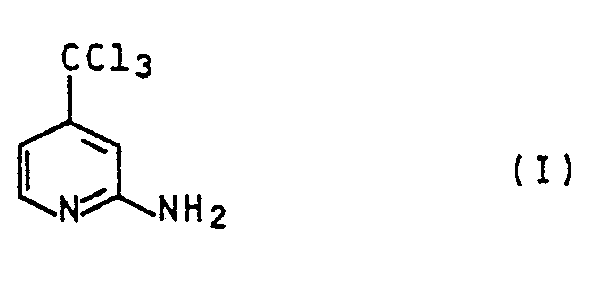
- 2-chloro-6-trichloromethylpyridine is known as a nitrification inhibitor; the general name of the active substance is nitrapyrin. Its manufacture and effect is e.g. Described in U.S. Patent No. 3,135,594.
- this compound is limited by its physical and chemical properties; it is namely volatile due to the low vapor pressure, which makes it difficult to use as an anti-nitrification agent.
- Aminohalopyridines are also known as substances. You are attributed fungicidal, bactericidal and insecticidal activity, but is not a substance in this group that z. B. is described in US Pat. No. 3,799,935, has practical importance. Trifluoromethylpyridine derivatives with herbicidal, fungicidal, bactericidal properties and activity against mites and parasitic worms are known from US Pat. No. 3,787,420.
- 2-Amino-4-trichloromethyl-pyridine can be obtained from 2-amino-4-picolin after appropriate protection of the amino group. Protection of the amino group can e.g. B. by reaction with phthalic anhydride. The halogenation of 4-methyl-2-phthalimido-pyridine with chlorine to 2-phthalimido-4-trichloromethyl-pyridine can be carried out in the reaction mixture without isolation of this compound; the protective group is then split off again by saponification, ethanolamine having proven itself.
- a solvent is expediently used to introduce the protective group; z. B. aromatics such as benzene, toluene, xylene; Aliphatic hydrocarbons and substituted aromatics such as nitrobenzene, dichlorobenzene or other halogenated hydrocarbons such as tetrachloroethane in question.
- the water formed is expediently removed azeotropically. The reaction takes place between 50 and 250 ° C, preferably between 100 and 180 ° C. If the halogenation is to be carried out without isolating the intermediate product, it is expedient to use a solvent suitable for the halogenation from the outset.
- a radical generator such as azodiisobutyronitrile, is expediently added in an amount of 0.1% to 10%, preferably 0.5% to 1%, based on the compound to be chlorinated.
- the implementation can also be accelerated with the help of a UV light source.
- the temperature range for the chlorination is 50 to 250 ° C, preferably 120 to 160 ° C.
- the saponification is expediently carried out according to the method described in DE-OS-3 319 650.
- an excess of ethanolamine, water, an alcohol such as ethanol, propanol, methyl glycol, a ketone such as acetone, a chlorinated hydrocarbon such as chloroform or an ether such as diethyl ether is recommended as the solvent.
- An excess of ethanolamine, ethanol and propanol are preferred.
- the preferred temperature range for the saponification is -10 ° C to 30 ° C.
Landscapes
- Chemical & Material Sciences (AREA)
- Organic Chemistry (AREA)
- Life Sciences & Earth Sciences (AREA)
- Soil Sciences (AREA)
- Pest Control & Pesticides (AREA)
- Pyridine Compounds (AREA)
- Agricultural Chemicals And Associated Chemicals (AREA)
- Plural Heterocyclic Compounds (AREA)
Description
- 2-Chlor-6-trichlormethylpyridin ist als Nitrifikationshemmer bekannt; die allgemeine Bezeichnung des Wirkstoffes ist Nitrapyrin. Seine Herstellung und Wirkung ist z. B. in der US-PS-3 135 594 beschrieben.
- Die Anwendbarkeit dieser Verbindung ist durch ihre physikalischen und chemischen Eigenschaften eingeschränkt; sie ist nämlich, bedingt durch den niedrigen Dampfdruck leicht flüchtig, was den Einsatz als nitrifikationshemmendes Mittel erschwert.
- Aminohalogenpyridine sind ebenfalls als Stoffe bekannt. Ihnen wird fungizide, bakterizide und insektizide Wirkung zugeschrieben, jedoch ist kein Stoff dieser Gruppe, die z. B. in der US-PS-3 799 935 beschrieben ist, zu praktischer Bedeutung gelangt. Trifluormethylpyridinderivate mit herbiziden, fungiziden, bakteriziden Eigenschaften sowie Wirkung gegenüber Milben und parasitären Würmern sind aus US-PS-3 787 420 bekannt.
- Es wurde nun gefunden, daß 2-Amino-4-trich- lormethylpyridin der Formel I

- Man kann 2-Amino-4-trichlormethyl-pyridin nach entsprechendem Schutz der Aminogruppe aus 2-Amino-4-picolin gewinnen. Der Schutz der Aminogruppe kann z. B. durch Umsetzung mit Phthalsäureanhydrid bewirkt werden. Die Halogenierung des 4-Methyl-2-phthalimido-pyridins mit Chlor zu 2-Phthalimido-4-trichlormethyl-pyridin kann ohne Isolierung dieser Verbindung in dem Reaktionsgemisch vorgenommen werden; man spaltet anschließend die Schutzgruppe durch Verseifen wieder ab, wobei sich Ethanolamin bewährt hat.
- Für das Einführen der Schutzgruppe verwendet man zweckmäßig ein Lösungsmittel; es kommen z. B. Aromaten wie Benzol, Toluol, Xylol; aliphatische Kohlenwasserstoffe sowie substituierte Aromaten wie Nitrobenzol, Dichlorbenzol oder sonstige halogenierte Kohlenwasserstoffe wie Tetrachlorethan in Frage. Das entstehende Wasser wird zweckmäßigerweise azeotrop entfernt. Die Umsetzung verläuft zwischen 50 und 250°C, bevorzugt zwischen 100 bis 180°C. Soll die Halogenierung ohne Isolierung des Zwischenproduktes durchgeführt werden, so setzt man zweckmäßigerweise von vornherein ein für die Halogenierung geeignetes Lösungsmittel ein.
- Bevorzugt sind Chlorbenzol, Dichlorbenzol, aber auch z. B. Nitrobenzol. Zweckmäßig wird ein Radikalbildner, wie Azodiisobuttersäurenitril in einer Menge von 0,1 % bis 10 %, vorzugsweise 0,5 % bis 1 %, bezogen auf die zu chlorierende Verbindung zugegeben. Wie üblich kann die Umsetzung auch mit Hilfe einer UV-Lichtquelle beschleunigt werden. Der Temperaturbereich für die Chlorierung liegt bei 50 bis 250°C, vorzugsweise bei 120 bis 160°C.
- Die Verseifung wird zweckmäßig nach der in der DE-OS-3 319 650 beschriebenen Methode vorgenommen.
- Für die Verseifung empfiehlt sich als Lösungsmittel ein Überschuß an Ethanolamin, Wasser, ein Alkohol wie Ethanol, Propanol, Methylglykol, ein Keton wie Aceton, ein chlorierter Kohlenwasserstoff wie Chloroform oder ein Ether wie Diethylether. Bevorzugt sind ein Überschuß an Ethanolamin, Ethanol und Propanol. Der bevorzugte Temperaturbereich für die Verseifung liegt bei -10° C bis 30° C.
- 108,1 g 2-Amino-4-picolin wurden in 1 kg 1,2-Dichlorbenzol mit 148 g Phthalsäureanhydrid 2 Stunden unter Rückfluß an einem auf über 100° C gehaltenen Kühler auf 170° C erwärmt und das gebildete Wasser abdestilliert. Die Mischung wurde auf 140°C abgekühlt und mit 1 g Azodiisobuttersäurenitril versetzt. Bei 140° C wurden 400 g Chlor eingeleitet, danach wurde abgekühlt, ein Teil des Lösungsmittels i.V. entfernt und der Rückstand mit Petrolether versetzt. Der Niederschlag wurde abgetrennt, mit Petrolether gewaschen und getrocknet. Es wurden 320 g 2-Phtha- limido-4-trichlormethylpyridin (entsprechend 94 % der berechneten Menge; Schmp.: 143°C) erhalten.
- Von dem Vorprodukt wurden 105 g bei 20 bis 30°C in 600 g Ethanolamin eingetragen. Nach 30 Minuten wurde in 2 I Eiswasser gegeben, der Niederschlag abgetrennt mit Wasser gewaschen und getrocknet. Es wurden 122 g 2-Amino-4-trichlormethylpyridin (entsprechend 96 %; Schmp.: 114°C) erhalten.
- Zu 200 g eines nicht sterilisierten, dem Freiland entnommenen lehmigen Sandbodens, dessen Feuchtigkeitsgehalt auf 50 % der maximalen Wasserkapazität eingestellt war, wurden 220 mg Ammoniumsulfat gegeben und mit dem Boden gründlich vermischt. Danach wurden die Wirkstoffe, in 0,2 ml Aceton gelöst, in Mengen von jeweils 2, 1, 0,5 und 0,25 ppm, bezogen auf feuchten Sandboden, zugesetzt. Nach sorgfältiger Durchmischung wurden die Bodenproben nach Verdunsten des Acetons in mit Aluminiumfolie zur Vermeidung von Wasserverlusten bedeckten 1-Liter-Gläsern zusammen mit den Kontrollen ohne Wirkstoffzusatz über einen Zeitraum von 28 Tagen bei 21°C bebrütet (Nach diesem Zeitraum enthält eine Bodenprobe mit normaler Sodengare im allgemeinen keine nachweisbaren Mengen von Ammoniumstickstoff mehr).
- Danach wurden jeweils 2,5 g der Bodenproben in 100-ml-Erlenmeyerkolben eingefüllt und 22,5 ml einer 0,1n Kaliumsulfat-Lösung zugesetzt. Nach 30minütigem Schütteln wurde abfiltriert und jeweils 2,5 ml der Bodenauszüge wurden mit 1625 ml destilliertem Wasser vermischt. Anschließend wurden zum Nachweis der im Bodenauszug noch vorhandenen Ammoniumionen 1,25 ml Neßler-Reagenz hinzugefügt und gründlich geschüttelt. Die Farbveränderungen wurden dann photometrisch bei einer Wellenlänge von 420 ηm gemessen. Anhand von Standardkurven, die durch Messung von Lösungen mit bekannten Ammoniumsulfat-Gehalten ermitteln worden waren, wurden die noch in den Bodenproben vorhandenen Ammoniumsulfat-Mengen bestimmt. Die prozentuale Hemmung der Nitrifikation in den behandelten Bodenproben wurde im Vergleich mit den unbehandelten Bodenproben (nur Ammoniumsulfatzusatz) nach folgender Formel berechnet:

- a = Nitrifikationsrate von Ammoniumsulfat (mit 100 % bzw. 1.0 angenommen)
- b = Nitrifikationsrate von Ammoniumsulfat + Nitrifikationshemmer

Claims (7)
Applications Claiming Priority (2)
| Application Number | Priority Date | Filing Date | Title |
|---|---|---|---|
| DE19853509860 DE3509860A1 (de) | 1985-03-19 | 1985-03-19 | 2-amino-4-trichlormethyl-pyridin, verfahren zu seiner herstellung und seine verwendung als nitrifikationshemmer |
| DE3509860 | 1985-03-19 |
Publications (2)
| Publication Number | Publication Date |
|---|---|
| EP0196522A1 EP0196522A1 (de) | 1986-10-08 |
| EP0196522B1 true EP0196522B1 (de) | 1989-07-12 |
Family
ID=6265674
Family Applications (1)
| Application Number | Title | Priority Date | Filing Date |
|---|---|---|---|
| EP86103458A Expired EP0196522B1 (de) | 1985-03-19 | 1986-03-14 | 2-Amino-4-trichlormethyl-pyridin, Verfahren zur seiner Herstellung und seine Verwendung als Nitrifikationshemmer |
Country Status (6)
| Country | Link |
|---|---|
| US (1) | US4699983A (de) |
| EP (1) | EP0196522B1 (de) |
| JP (1) | JPS61233671A (de) |
| CA (1) | CA1254572A (de) |
| DE (2) | DE3509860A1 (de) |
| DK (1) | DK163504C (de) |
Families Citing this family (1)
| Publication number | Priority date | Publication date | Assignee | Title |
|---|---|---|---|---|
| DE4012831A1 (de) * | 1990-04-23 | 1991-10-24 | Basf Ag | 2-amino-4-trichlorpyridinderivate |
Citations (1)
| Publication number | Priority date | Publication date | Assignee | Title |
|---|---|---|---|---|
| US3787420A (en) * | 1969-03-17 | 1974-01-22 | Dow Chemical Co | Cyanoalkoxy(trifluoromethyl)pyridines |
Family Cites Families (4)
| Publication number | Priority date | Publication date | Assignee | Title |
|---|---|---|---|---|
| US3135594A (en) * | 1961-09-01 | 1964-06-02 | Dow Chemical Co | Method and product for treating soil to suppress the nitrification of ammonium nitrogen therein |
| US3682936A (en) * | 1970-10-02 | 1972-08-08 | Dow Chemical Co | Certain 6-(trifluoromethyl)-pyridinols |
| US3799935A (en) * | 1972-10-10 | 1974-03-26 | Dow Chemical Co | Substituted aminohalo-pyridines |
| US4154835A (en) * | 1977-10-12 | 1979-05-15 | Merck & Co., Inc. | Anthelmintic imidazo [1,2-a] pyridines |
-
1985
- 1985-03-19 DE DE19853509860 patent/DE3509860A1/de not_active Withdrawn
-
1986
- 1986-03-07 JP JP61048771A patent/JPS61233671A/ja active Pending
- 1986-03-12 US US06/838,780 patent/US4699983A/en not_active Expired - Fee Related
- 1986-03-13 CA CA000504024A patent/CA1254572A/en not_active Expired
- 1986-03-14 DE DE8686103458T patent/DE3664324D1/de not_active Expired
- 1986-03-14 EP EP86103458A patent/EP0196522B1/de not_active Expired
- 1986-03-18 DK DK123886A patent/DK163504C/da not_active IP Right Cessation
Patent Citations (1)
| Publication number | Priority date | Publication date | Assignee | Title |
|---|---|---|---|---|
| US3787420A (en) * | 1969-03-17 | 1974-01-22 | Dow Chemical Co | Cyanoalkoxy(trifluoromethyl)pyridines |
Also Published As
| Publication number | Publication date |
|---|---|
| DK123886A (da) | 1986-09-20 |
| DK163504B (da) | 1992-03-09 |
| DE3664324D1 (en) | 1989-08-17 |
| DK123886D0 (da) | 1986-03-18 |
| CA1254572A (en) | 1989-05-23 |
| DK163504C (da) | 1992-07-27 |
| US4699983A (en) | 1987-10-13 |
| JPS61233671A (ja) | 1986-10-17 |
| EP0196522A1 (de) | 1986-10-08 |
| DE3509860A1 (de) | 1986-09-25 |
Similar Documents
| Publication | Publication Date | Title |
|---|---|---|
| DE2529689C2 (de) | Pyrazolinverbindungen | |
| DD246245A5 (de) | Herbizide zusammensetzung | |
| DE877760C (de) | Verfahren zur Herstellung von ª-(o-Chlorphenyl)-succinimid und ª-(o-Chlorphenyl-ª-methyl-succinimid | |
| CH380734A (de) | Verfahren zur Herstellung von neuen s-Triazinderivaten | |
| DE1166790B (de) | Verfahren zur Herstellung von insektizid wirksamem O, O-Dimethyl-O-(3-methyl-4-nitrophenyl)-thionophosphorsaeureester | |
| DE1518333A1 (de) | N,N-substituierte 4-Methylsulfonyl-2,6-dinitroaniline und Verfahren zu ihrer Herstellung | |
| DE1667979B2 (de) | 1,3-benzodioxolcarbamate sowie verfahren zu deren herstellung und schaedlingsbekaempfungsmittel mit einem gehalt dieser verbindungen | |
| EP0196522A1 (de) | 2-Amino-4-trichlormethyl-pyridin, Verfahren zur seiner Herstellung und seine Verwendung als Nitrifikationshemmer | |
| DE870561C (de) | Verfahren zur Herstellung von AEthern des p-Nitrophenols | |
| DE1567114A1 (de) | Pestizide Zubereitungen | |
| DE2457599A1 (de) | Pyran-derivate und ihre verwendung als herbicide | |
| DE2910205A1 (de) | Verfahren zur herstellung stabiler waessriger loesungen von polyvinylpyrrolidonund halogen-komplexen | |
| DE2356158C3 (de) | Herbicide Mittel mit einem Gehalt an Thiophosphorsäureamiden | |
| EP0139135A1 (de) | 4-Alkylimidazol-Derivate, ihre Herstellung und Verwendung | |
| DE922500C (de) | Mittel mit insektizider, fungizider und bakterizider Wirkung | |
| EP0114626B1 (de) | Ditriazolylvinyl-phenyl-ketone, Verfahren zu ihrer Herstellung und ihre Verwendung als Nitrifikationshemmer | |
| EP0005227B1 (de) | Akarizide und insektizide Mittel sowie deren Verwendung zur Schädlingsbekämpfung | |
| DE1568060C3 (de) | 4,4' Dibrom benzilsäure isopropyl ester, Verfahren zu seiner Herstellung und Verwendung dieses Esters zur Be kampfung von Spinnentieren und Insekten | |
| DE1545755C (de) | ||
| DE495717C (de) | Verfahren zur Herstellung von C-Alkylderivaten im Kern halogensubstituierter Kresole | |
| DE1925112A1 (de) | Neue Phenolverbindungen und Verfahren zu ihrer Herstellung | |
| AT222941B (de) | Parasitentötende Präparate | |
| DE1567006C3 (de) | Unkrautbekämpfungsmittel | |
| AT362619B (de) | Insektizides und fungizides mittel | |
| AT330162B (de) | Verfahren zur herstellung von substituierten 1,1-diphenyl-2-nitropropanen und -butanen |
Legal Events
| Date | Code | Title | Description |
|---|---|---|---|
| PUAI | Public reference made under article 153(3) epc to a published international application that has entered the european phase |
Free format text: ORIGINAL CODE: 0009012 |
|
| AK | Designated contracting states |
Kind code of ref document: A1 Designated state(s): BE CH DE FR GB IT LI NL SE |
|
| 17P | Request for examination filed |
Effective date: 19860820 |
|
| 17Q | First examination report despatched |
Effective date: 19880113 |
|
| GRAA | (expected) grant |
Free format text: ORIGINAL CODE: 0009210 |
|
| AK | Designated contracting states |
Kind code of ref document: B1 Designated state(s): BE CH DE FR GB IT LI NL SE |
|
| ITF | It: translation for a ep patent filed | ||
| GBT | Gb: translation of ep patent filed (gb section 77(6)(a)/1977) | ||
| REF | Corresponds to: |
Ref document number: 3664324 Country of ref document: DE Date of ref document: 19890817 |
|
| ET | Fr: translation filed | ||
| PLBE | No opposition filed within time limit |
Free format text: ORIGINAL CODE: 0009261 |
|
| STAA | Information on the status of an ep patent application or granted ep patent |
Free format text: STATUS: NO OPPOSITION FILED WITHIN TIME LIMIT |
|
| 26N | No opposition filed | ||
| ITTA | It: last paid annual fee | ||
| PGFP | Annual fee paid to national office [announced via postgrant information from national office to epo] |
Ref country code: FR Payment date: 19930217 Year of fee payment: 8 |
|
| PGFP | Annual fee paid to national office [announced via postgrant information from national office to epo] |
Ref country code: SE Payment date: 19930218 Year of fee payment: 8 |
|
| PGFP | Annual fee paid to national office [announced via postgrant information from national office to epo] |
Ref country code: CH Payment date: 19930222 Year of fee payment: 8 |
|
| PGFP | Annual fee paid to national office [announced via postgrant information from national office to epo] |
Ref country code: GB Payment date: 19930301 Year of fee payment: 8 |
|
| PGFP | Annual fee paid to national office [announced via postgrant information from national office to epo] |
Ref country code: DE Payment date: 19930313 Year of fee payment: 8 |
|
| PGFP | Annual fee paid to national office [announced via postgrant information from national office to epo] |
Ref country code: BE Payment date: 19930318 Year of fee payment: 8 |
|
| PGFP | Annual fee paid to national office [announced via postgrant information from national office to epo] |
Ref country code: NL Payment date: 19930331 Year of fee payment: 8 |
|
| PG25 | Lapsed in a contracting state [announced via postgrant information from national office to epo] |
Ref country code: GB Effective date: 19940314 |
|
| PG25 | Lapsed in a contracting state [announced via postgrant information from national office to epo] |
Ref country code: SE Free format text: LAPSE BECAUSE OF NON-PAYMENT OF DUE FEES Effective date: 19940315 |
|
| PG25 | Lapsed in a contracting state [announced via postgrant information from national office to epo] |
Ref country code: LI Effective date: 19940331 Ref country code: CH Effective date: 19940331 Ref country code: BE Effective date: 19940331 |
|
| BERE | Be: lapsed |
Owner name: BASF A.G. Effective date: 19940331 |
|
| PG25 | Lapsed in a contracting state [announced via postgrant information from national office to epo] |
Ref country code: NL Effective date: 19941001 |
|
| GBPC | Gb: european patent ceased through non-payment of renewal fee |
Effective date: 19940314 |
|
| NLV4 | Nl: lapsed or anulled due to non-payment of the annual fee | ||
| PG25 | Lapsed in a contracting state [announced via postgrant information from national office to epo] |
Ref country code: FR Effective date: 19941130 |
|
| REG | Reference to a national code |
Ref country code: CH Ref legal event code: PL |
|
| PG25 | Lapsed in a contracting state [announced via postgrant information from national office to epo] |
Ref country code: DE Effective date: 19941201 |
|
| REG | Reference to a national code |
Ref country code: FR Ref legal event code: ST |
|
| EUG | Se: european patent has lapsed |
Ref document number: 86103458.5 Effective date: 19941010 |
|
| PG25 | Lapsed in a contracting state [announced via postgrant information from national office to epo] |
Ref country code: IT Free format text: LAPSE BECAUSE OF NON-PAYMENT OF DUE FEES;WARNING: LAPSES OF ITALIAN PATENTS WITH EFFECTIVE DATE BEFORE 2007 MAY HAVE OCCURRED AT ANY TIME BEFORE 2007. THE CORRECT EFFECTIVE DATE MAY BE DIFFERENT FROM THE ONE RECORDED. Effective date: 20050314 |