EP0192829B1 - Amino-propanol-Derivate, Verfahren zu ihrer Herstellung und diese Verbindungen enthaltende Arzneimittel sowie Zwischenprodukte - Google Patents
Amino-propanol-Derivate, Verfahren zu ihrer Herstellung und diese Verbindungen enthaltende Arzneimittel sowie Zwischenprodukte Download PDFInfo
- Publication number
- EP0192829B1 EP0192829B1 EP85115037A EP85115037A EP0192829B1 EP 0192829 B1 EP0192829 B1 EP 0192829B1 EP 85115037 A EP85115037 A EP 85115037A EP 85115037 A EP85115037 A EP 85115037A EP 0192829 B1 EP0192829 B1 EP 0192829B1
- Authority
- EP
- European Patent Office
- Prior art keywords
- phenoxy
- propanol
- tert
- butylamino
- group
- Prior art date
- Legal status (The legal status is an assumption and is not a legal conclusion. Google has not performed a legal analysis and makes no representation as to the accuracy of the status listed.)
- Expired - Lifetime
Links
- 0 CB*N(*)*C(C=C1)=C*(*)C=C1O Chemical compound CB*N(*)*C(C=C1)=C*(*)C=C1O 0.000 description 6
Classifications
-
- C—CHEMISTRY; METALLURGY
- C07—ORGANIC CHEMISTRY
- C07D—HETEROCYCLIC COMPOUNDS
- C07D303/00—Compounds containing three-membered rings having one oxygen atom as the only ring hetero atom
- C07D303/02—Compounds containing oxirane rings
- C07D303/12—Compounds containing oxirane rings with hydrocarbon radicals, substituted by singly or doubly bound oxygen atoms
- C07D303/18—Compounds containing oxirane rings with hydrocarbon radicals, substituted by singly or doubly bound oxygen atoms by etherified hydroxyl radicals
- C07D303/20—Ethers with hydroxy compounds containing no oxirane rings
- C07D303/22—Ethers with hydroxy compounds containing no oxirane rings with monohydroxy compounds
-
- A—HUMAN NECESSITIES
- A61—MEDICAL OR VETERINARY SCIENCE; HYGIENE
- A61P—SPECIFIC THERAPEUTIC ACTIVITY OF CHEMICAL COMPOUNDS OR MEDICINAL PREPARATIONS
- A61P25/00—Drugs for disorders of the nervous system
- A61P25/02—Drugs for disorders of the nervous system for peripheral neuropathies
-
- A—HUMAN NECESSITIES
- A61—MEDICAL OR VETERINARY SCIENCE; HYGIENE
- A61P—SPECIFIC THERAPEUTIC ACTIVITY OF CHEMICAL COMPOUNDS OR MEDICINAL PREPARATIONS
- A61P9/00—Drugs for disorders of the cardiovascular system
- A61P9/08—Vasodilators for multiple indications
-
- A—HUMAN NECESSITIES
- A61—MEDICAL OR VETERINARY SCIENCE; HYGIENE
- A61P—SPECIFIC THERAPEUTIC ACTIVITY OF CHEMICAL COMPOUNDS OR MEDICINAL PREPARATIONS
- A61P9/00—Drugs for disorders of the cardiovascular system
- A61P9/10—Drugs for disorders of the cardiovascular system for treating ischaemic or atherosclerotic diseases, e.g. antianginal drugs, coronary vasodilators, drugs for myocardial infarction, retinopathy, cerebrovascula insufficiency, renal arteriosclerosis
-
- A—HUMAN NECESSITIES
- A61—MEDICAL OR VETERINARY SCIENCE; HYGIENE
- A61P—SPECIFIC THERAPEUTIC ACTIVITY OF CHEMICAL COMPOUNDS OR MEDICINAL PREPARATIONS
- A61P9/00—Drugs for disorders of the cardiovascular system
- A61P9/12—Antihypertensives
-
- C—CHEMISTRY; METALLURGY
- C07—ORGANIC CHEMISTRY
- C07C—ACYCLIC OR CARBOCYCLIC COMPOUNDS
- C07C255/00—Carboxylic acid nitriles
-
- C—CHEMISTRY; METALLURGY
- C07—ORGANIC CHEMISTRY
- C07D—HETEROCYCLIC COMPOUNDS
- C07D211/00—Heterocyclic compounds containing hydrogenated pyridine rings, not condensed with other rings
- C07D211/04—Heterocyclic compounds containing hydrogenated pyridine rings, not condensed with other rings with only hydrogen or carbon atoms directly attached to the ring nitrogen atom
- C07D211/06—Heterocyclic compounds containing hydrogenated pyridine rings, not condensed with other rings with only hydrogen or carbon atoms directly attached to the ring nitrogen atom having no double bonds between ring members or between ring members and non-ring members
- C07D211/08—Heterocyclic compounds containing hydrogenated pyridine rings, not condensed with other rings with only hydrogen or carbon atoms directly attached to the ring nitrogen atom having no double bonds between ring members or between ring members and non-ring members with hydrocarbon or substituted hydrocarbon radicals directly attached to ring carbon atoms
- C07D211/18—Heterocyclic compounds containing hydrogenated pyridine rings, not condensed with other rings with only hydrogen or carbon atoms directly attached to the ring nitrogen atom having no double bonds between ring members or between ring members and non-ring members with hydrocarbon or substituted hydrocarbon radicals directly attached to ring carbon atoms with substituted hydrocarbon radicals attached to ring carbon atoms
- C07D211/20—Heterocyclic compounds containing hydrogenated pyridine rings, not condensed with other rings with only hydrogen or carbon atoms directly attached to the ring nitrogen atom having no double bonds between ring members or between ring members and non-ring members with hydrocarbon or substituted hydrocarbon radicals directly attached to ring carbon atoms with substituted hydrocarbon radicals attached to ring carbon atoms with hydrocarbon radicals, substituted by singly bound oxygen or sulphur atoms
- C07D211/22—Heterocyclic compounds containing hydrogenated pyridine rings, not condensed with other rings with only hydrogen or carbon atoms directly attached to the ring nitrogen atom having no double bonds between ring members or between ring members and non-ring members with hydrocarbon or substituted hydrocarbon radicals directly attached to ring carbon atoms with substituted hydrocarbon radicals attached to ring carbon atoms with hydrocarbon radicals, substituted by singly bound oxygen or sulphur atoms by oxygen atoms
-
- C—CHEMISTRY; METALLURGY
- C07—ORGANIC CHEMISTRY
- C07D—HETEROCYCLIC COMPOUNDS
- C07D211/00—Heterocyclic compounds containing hydrogenated pyridine rings, not condensed with other rings
- C07D211/04—Heterocyclic compounds containing hydrogenated pyridine rings, not condensed with other rings with only hydrogen or carbon atoms directly attached to the ring nitrogen atom
- C07D211/06—Heterocyclic compounds containing hydrogenated pyridine rings, not condensed with other rings with only hydrogen or carbon atoms directly attached to the ring nitrogen atom having no double bonds between ring members or between ring members and non-ring members
- C07D211/36—Heterocyclic compounds containing hydrogenated pyridine rings, not condensed with other rings with only hydrogen or carbon atoms directly attached to the ring nitrogen atom having no double bonds between ring members or between ring members and non-ring members with hetero atoms or with carbon atoms having three bonds to hetero atoms with at the most one bond to halogen, e.g. ester or nitrile radicals, directly attached to ring carbon atoms
- C07D211/40—Oxygen atoms
- C07D211/44—Oxygen atoms attached in position 4
- C07D211/46—Oxygen atoms attached in position 4 having a hydrogen atom as the second substituent in position 4
-
- C—CHEMISTRY; METALLURGY
- C07—ORGANIC CHEMISTRY
- C07D—HETEROCYCLIC COMPOUNDS
- C07D405/00—Heterocyclic compounds containing both one or more hetero rings having oxygen atoms as the only ring hetero atoms, and one or more rings having nitrogen as the only ring hetero atom
- C07D405/02—Heterocyclic compounds containing both one or more hetero rings having oxygen atoms as the only ring hetero atoms, and one or more rings having nitrogen as the only ring hetero atom containing two hetero rings
- C07D405/12—Heterocyclic compounds containing both one or more hetero rings having oxygen atoms as the only ring hetero atoms, and one or more rings having nitrogen as the only ring hetero atom containing two hetero rings linked by a chain containing hetero atoms as chain links
Definitions
- alkylene chains straight-chain or branched alkylene radicals of 2-6 carbon atoms can be used.
- the ethylene, trimethylene, tetramethylene, pentamethylene or hexamethylene group or the 1-methyltrimethylene, 1,1-dimethyltrimethylene or 2,2-dimethyltrimethylene group are suitable.
- a “hydrocarbon group” in the definition of R 3 is understood to mean straight-chain or branched, saturated or unsaturated hydrocarbon radicals having 3-8, preferably 3-5, carbon atoms.
- the isopropyl, tert-butyl and the 2-methyl-3-butyn-2-yl radical are particularly preferred.
- nitroxy hydrocarbon groups one H atom of the corresponding groups is replaced by a nitroxy radical.
- the 1-nitroxy-but-3-yl radical is particularly preferred.
- the compounds of the formula I according to the invention generally carry one or two nitroxy groups, but mono-nitroxy compounds are preferred.
- EP-A-34 461 i.a. describe a 1-phenoxy-2-hydroxypropylamino compound which bears a 1-nitroxyalkylamino group in the 4-position on the phenyl ring.
- the compounds of general formula I according to the invention have valuable properties. Not only do they have ⁇ -blocking activity, they also reduce the need for oxygen in the heart, increase blood flow and lower blood pressure. They are therefore suitable for the prophylaxis and / or treatment of cardiovascular diseases, e.g. High pressure and angina pectoris.
- the nitrate ester formation reaction of the compounds of the general formulas II, XII, XIII, XV and XVIII can be carried out by the compounds of the general formulas II, XII, XIII, XV and XVIII with a nitrate ester-forming reagent, such as fuming nitric acid, a mixture of fuming nitric acid and acetic anhydride or a mixture of fuming nitric acid and conc. Sulfuric acid at low temperatures in the presence or absence of an inert solvent.
- a nitrate ester-forming reagent such as fuming nitric acid, a mixture of fuming nitric acid and acetic anhydride or a mixture of fuming nitric acid and conc.
- the reaction temperatures are between room temperature and -60 ° C, preferably between -10 ° C and -30 ° C.
- the molar ratio of the reactants is between 1 and 10.
- the nitrate ester formation reaction can be carried out by selectively halogenating an aliphatic hydroxyl group in a compound of general formulas II, XII, XIII or XVIII and then reacting the reaction product with silver nitrate in the presence or absence of a solvent at temperatures between room temperature and 100 ° C .
- the molar ratio of the reaction between the halogen compound and silver nitrate can be between 1 and 10.
- the halogenation reaction can be carried out according to methods known from the literature, by reacting a compound of the general formulas 11, XII, XIII or XVIII with mesyl chloride or tosyl chloride in the presence of an acid-binding agent and then the reaction product obtained with an alkali halide in an organic solvent, e.g. Dimethylformamide, brings about the reaction.
- an organic solvent e.g. Dimethylformamide
- the compounds of the general formulas 111, XIII and XVI are prepared in a manner known per se by adding epihalohydrins in an organic solvent and / or water in the presence of an acid-binding agent, such as alkali metal hydroxides and hydrides or organic nitrogen bases, with compounds of the general Formulas V, XII and XXI wherein in formula XXI A has the meaning given above and W 1 represents a N0 2 group or an alkylcarbonylamino group, is reacted at temperatures between room temperature and 100 ° C. and optionally the group W 1 in the group transferred.
- the molar ratios of the compounds of the general formulas V, XII and XXI to the epihalohydrins can be between 1 and 100.
- reaction of the compounds with the general formulas V, XII and XXI with a compound of the general formula VI or VII takes place in an organic solvent such as methanol, ethanol, propanol, benzene, toluene or dimethylformamide at temperatures between room temperature and 100 ° C.
- organic solvent such as methanol, ethanol, propanol, benzene, toluene or dimethylformamide at temperatures between room temperature and 100 ° C.
- the molar ratio can be between 1 and 10.
- the reactions of the compounds of the general formulas 111, XIII and XVI with an amine of the general formula IV take place in the presence or absence of a solvent between 0 ° C. and 90 ° C., preferably between 20 ° C. and 50 ° C.
- a solvent e.g. Methanol, ethanol, propanol, iso-propanol, benzene, toluene or dimethylformamide can be used.
- the molar ratio of the reactants is not critical. Ratios between 2 and 100 can be selected.
- the reactions of amines VIII, XVI and XIX with activated compounds of general formulas IX and XIV are carried out in an organic solvent such as hexane, diethyl ether, tetrahydrofuran, methylene chloride, benzene, toluene or dimethylformamide or in an aqueous solution at temperatures between -50 ° C and + 70 ° C, preferably between -30 ° C and room temperature.
- an organic solvent such as hexane, diethyl ether, tetrahydrofuran, methylene chloride, benzene, toluene or dimethylformamide
- the activated compounds of general formulas IX and XIV can e.g. are in the form of carboxylic acid halides, anhydrides or esters, or the carboxylic acids are activated by activating reagents such as N, N'-carbonyldiimidazole, N, N'-dicyclohexylcarbodiimide, 1-ethyl-3- (3-dimethylaminopropyl) carbodiimide, 1 -Alkyl-2-halogenopyridinium salts or the like
- the activation and the reaction with the amines VIII, XVI and XIX can be carried out in one synthesis step. Molar ratios between 1 and 10 can be selected.
- the reactions of the amines XI and XV with activated compounds of the general formulas X, XVII and XX are carried out in an organic solvent such as ether, tetrahydrofuran, dioxane, methylene chloride, benzene, tuluene or dimethylformamide or in water at temperatures between -50 ° C and +100 ° C, preferably between -30 ° C and room temperature.
- an organic solvent such as ether, tetrahydrofuran, dioxane, methylene chloride, benzene, tuluene or dimethylformamide
- the activated compounds of the general formulas X, XVII and XX can be present, for example, in the form of carboxylic acid halides, anhydrides and esters, or the activation takes place in the reaction mixture with activating reagents such as N, N'-carbonyldiimidazole, N, N'-dicyclohexylcarbodiimide, or 1-ethyl-3- (3-dimethyl aminopropyl) carbondiimide.
- activation and the reaction with the amines XI and XV can be carried out in one step.
- the molar ratio of the reactants is not critical. Ratios between 1 and 10 can be selected.
- the compounds according to the invention have asymmetric carbon atoms.
- an inorganic or organic acid e.g. Hydrochloric acid, hydrobromic acid, nitric acid, phosphoric acid, sulfuric acid, formic acid, acetic acid, propionic acid, oxalic acid, fumaric acid, maleic acid, succinic acid, adipic acid, benzoic acid, salicylic acid, o-acetoxybenzoic acid, acidic acid, acidic acid acid Methanesulfonic acid or p-toluenesulfonic acid.
- an inorganic or organic acid e.g. Hydrochloric acid, hydrobromic acid, nitric acid, phosphoric acid, sulfuric acid, formic acid, acetic acid, propionic acid, oxalic acid, fumaric acid, maleic acid, succinic acid, adipic acid, benzoic acid, salicylic acid, o-acetoxybenzoic acid, acidic acid, acidic acid acid Methanesulfonic acid or p-to
- the new substances I and II according to the invention and their salts can be administered enterally or parenterally in liquid or solid form.
- Water is preferably used as the injection medium, which contains the additives which are customary in injection solutions, such as stabilizing agents, solubilizers or buffers.
- additives which are customary in injection solutions, such as stabilizing agents, solubilizers or buffers.
- Such additions are e.g. Tartrate and citrate buffers, ethanol, complexing agents (such as ethylenediaminetetraacetic acid and its non-toxic salts), high molecular weight polymers (such as liquid polyethylene oxide) for viscosity regulation.
- Solid carrier materials are e.g.
- the 4-nitroxybutyric acid required as starting material was prepared in a manner known per se from sodium (4-hydroxy) butanoate and a mixture of 100 percent. Nitric acid / 96 percent Sulfuric acid produced. The remaining nitroxyalkylcarboxylic acids were prepared analogously from the corresponding hydroxyalkylcarboxylic acids.
- the residue is dissolved in ethyl acetate / diethyl ether and extracted with aqueous lactic acid solution, and the aqueous phase is then extracted 3 times with ethyl acetate.
- the combined organic phases are dried over sodium sulfate.
- the residue which remains after evaporation (3.5 g) is dissolved in ethyl acetate and mixed with 0.8 g of benzoic acid.
- the precipitate obtained is suction filtered and dried.
- the compound 1- (4-amino-2-methylcarbonyl) phenoxy-3-tert-butylamino-2-propanol required as the starting material is prepared by methods known per se and in accordance with the regulations in EP 29 992.
- the aqueous phases are saturated with sodium chloride and extracted 3 times with 150 ml of ethyl acetate.
- the ethyl acetate phases are dried and evaporated.
- the residue (3.9 g) is dissolved in 30 ml of ethyl acetate and 1.59 g of cyclamic acid in 60 ml of ethyl acetate are added.
- the deposited crystals are suctioned off and dried.
- the compound 1- (4-amino-2-ethoxycarbonyl) phenoxy-3-tert-butyl- amino-2-propanol is produced by processes known per se and according to the regulations in EP 29 992.
- nitroxyalkylammonium nitrates required as starting materials are prepared from the corresponding hydroxyalkylamines in accordance with known regulations (e.g. Houben-Weyl-Mueller, Methods of Organic Chemistry, Vol. VI / 2, Georg Thieme Verlag, Stuttgart 1963, p. 325 ff.).
Landscapes
- Chemical & Material Sciences (AREA)
- Organic Chemistry (AREA)
- Health & Medical Sciences (AREA)
- Engineering & Computer Science (AREA)
- Bioinformatics & Cheminformatics (AREA)
- Veterinary Medicine (AREA)
- Public Health (AREA)
- Chemical Kinetics & Catalysis (AREA)
- General Chemical & Material Sciences (AREA)
- Medicinal Chemistry (AREA)
- Nuclear Medicine, Radiotherapy & Molecular Imaging (AREA)
- Pharmacology & Pharmacy (AREA)
- Life Sciences & Earth Sciences (AREA)
- Animal Behavior & Ethology (AREA)
- General Health & Medical Sciences (AREA)
- Heart & Thoracic Surgery (AREA)
- Cardiology (AREA)
- Urology & Nephrology (AREA)
- Vascular Medicine (AREA)
- Biomedical Technology (AREA)
- Neurology (AREA)
- Neurosurgery (AREA)
- Organic Low-Molecular-Weight Compounds And Preparation Thereof (AREA)
- Pharmaceuticals Containing Other Organic And Inorganic Compounds (AREA)
- Acyclic And Carbocyclic Compounds In Medicinal Compositions (AREA)
- Plural Heterocyclic Compounds (AREA)
- Hydrogenated Pyridines (AREA)
Description
- Gegenstand der vorliegenden Erfindung sind neue Aminopropanol-Derivate der allgemeinen Formel 1

- der Rest -B-X-NR,- eine (C2-C6-Alkylen)carbonylamino-, (C5-C6 Cycloalkylen)carbonylamino-, Cyclohexylenmethylcarbonylamino-, Ethylenoxymethylcarbonylamino-, Piperidindiyl- oder Methylenpiperidinyl-Gruppe darstellt, oder für den Fall, daß A eine -CO-CH2-Gruppe bedeutet, -B-X-NR,- auch eine C2-C6-Alkylenaminogruppe bedeuten kann,
- A eine direkte Bindung, eine Ethylenkette oder eine -CO-CH2-Gruppe bedeutet,
- n die Zahlen 1 bis 3 bedeutet,
- R2 Wasserstoff, Cyano, Acetyl oder Ethoxycarbonyl bedeutet und
- R3 eine Kohlenwasserstoff- oder Nitroxy-Kohlenwasserstoff-Gruppe mit 3-8 Kohlenstoffatomen bedeutet,
sowie deren physiologisch verträgliche Salze. - Als "Alkylenketten" in der Definition von B koennen, geradkettige oder verzweigte Alkylenreste von 2-6 Kohlenstoffatomen eingesetzt werden. Insbesondere kommen in Frage die Ethylen-, Trimethylen-, Tetramethylen-, Pentamethylen- oder Hexamethylen-Gruppierung bzw. die 1-Methyltrimethylen-, 1,1-Dimethyltrimethylen- oder 2,2-Dimethyltrimethylen-Gruppierung.
- Unter einer "Kohlenwasserstoff-Gruppe" bei der Definition von R3 werden geradkettige oder verzweigte, gesaettigte oder ungesaettigte Kohlenwasserstoffreste mit 3-8, vorzugsweise 3-5, Kohlenstoffatomen verstanden. Besonders bevorzugt sind der Isopropyl-, tert.-Butyl-sowie der 2-Methyl-3-butin-2-yl-Rest. Bei "Nitroxy-Kohlenwasserstoff-Gruppen" ist jeweils ein H-Atom der entsprechenden Gruppen durch einen Nitroxy-Rest ersetzt. Besonders bevorzugt ist der 1-Nitroxy-but-3-yl-Rest.
- Die erfindungsgemaeßen Verbindungen der Formel I tragen in der Regel eine oder zwei Nitroxy-Gruppen, bevorzugt sind jedoch Mono-Nitroxy-Verbindungen.
- Die Verbindungen aehnlicher Art ohne die Gruppierung -O-NO2 sind bereits beschrieben in DE-OS-1 667 883, DE-OS-1 793 511, DE-OS-2 007 751, DE-OS-2 106 209, DE-OS-2 106 816, DE-OS-2 253 776, DE-OS-2 503 222, AT-334 385, S. African 6 803 130 oder S. African 6 808 345.
- In der EP-A-34 461 ist u.a. eine 1-Phenoxy-2-hydroxypropylamino-Verbindung beschreiben, die in 4-Stellung am Phenyl-Ring eine 1-Nitroxyalkylamino-Gruppe trägt.
- Diese Verbindung zeigt im Vergleich zu den vorliegenden Verbindungen praktisch keine β-blockierenden Eigenschaften und weist eine hohe Denitrierungsgeschwindigkeit auf (Vrel), d.h. sie besitzt nur eine kurze Wirkdauer.
- Die erfindungsgemaeßen Verbindungen der allgemeinen Formel I besitzen wertvolle Eigenschaften. Sie besitzen nicht nur β-Rezeptoren blockierende Aktivitaet, sondern sie bewirken auch eine Verminderung des Sauerstoffbedarfs des Herzens, eine Erhoehung des Blutflusses und eine Erniedrigung des Blutdruckes. Sie eignen sich daher zur Prophylaxe und/oder Behandlung von Herz- und Kreislauferkrankungen, wie z.B. Hochdruck und Angina Pectoris.
- Die erfindungsgemaeßen Verbindungen der allgemeinen Formel koennen in an sich bekannter Weise dadurch hergestellt werden, daß man
- a) eine Verbindung der allgemeinen Formel II

- A, B, X, R1-R3 und n die oben genannten Bedeutungen haben und R, zusaetzlich noch die Gruppierung -B-(OH)n darstellen kann,
einer Nitratester-Bildungsreaktion unterwirft, oder
- A, B, X, R1-R3 und n die oben genannten Bedeutungen haben und R, zusaetzlich noch die Gruppierung -B-(OH)n darstellen kann,
- b) eine Verbindung der allgemeinen Formel III
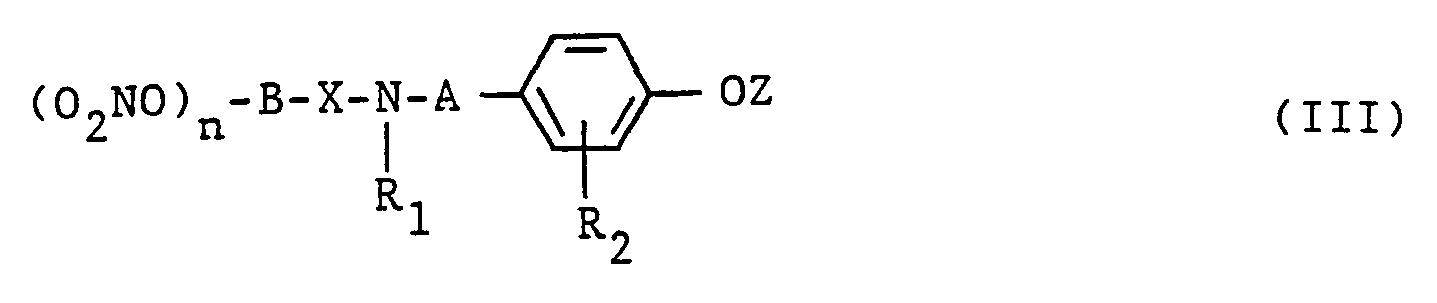


- c) eine Verbindung der allgemeinen Formel V

- c1) mit einer Verbindung der allgemeinen Formel VI

- c2) mit einer Verbindung der allgemeinen Formel VII

- c1) mit einer Verbindung der allgemeinen Formel VI
- d) eine Verbindung der allgemeinen Formel VIII


- e) eine Verbindung der allgemeinen Formel X


- Die Verbindungen der allgemeinen Formel II (Zwischenprodukte fuer die Herstellung von Verbindungen der allgemeinen formel 1) sind ebenfalls neu und Gegenstand dieser Anmeldung. Sie koennen hergestellt werden, indem man in an sich bekannter Weise eine Verbindung der allgemeinen Formel XII

- a) in einer Veretherungsreaktion zu einer Verbindung der allgemeinen Formel XIII

- b1) mit einer Verbindung der allgemeinen Formel VI oder
- b2) mit einer Verbindung der allgemeinen Formel VII umsetzt, oder
- c) eine Verbindung der allgemeinen Formel VIII mit einer Verbindung der allgemeinen Formel XIV

- d) eine Verbindung der allgemeinen Formel X mit einer Verbindung der allgemeinen Formel XV

- Die Verbindungen der allgemeinen Formel III (Zwischenprodukte zur Herstellung von Verbindungen der allgemeinen formel 1) sind ebenfalls neu und Gegenstand dieser Anmeldung.
- Sie koennen hergestellt werden, indem man in an sich bekannter Weise
- a) eine Verbindung der allgemeinen Formel XIII einer Nitratester-Bildungsreaktion unterwirft, oder
- b) eine Verbindung der allgemeinen Formel V einer Glycidether- oder Halogenhydrin-Bildungsreaktion unterwirft, oder
- c1) eine Verbindung der allgemeinen Formel XVI
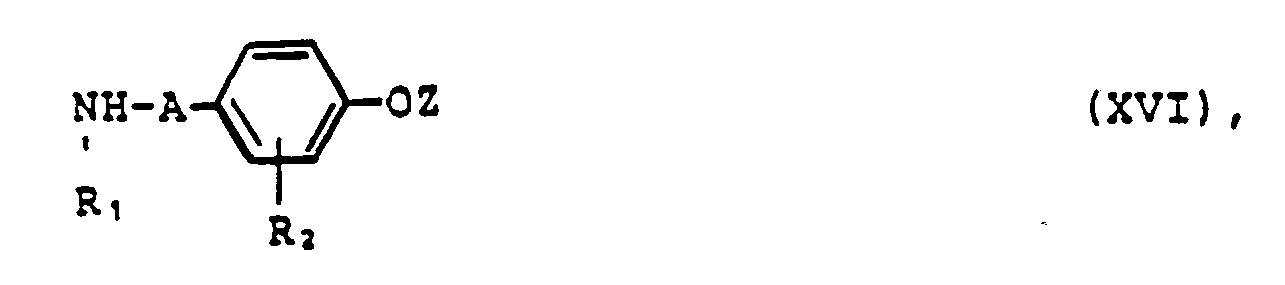
- c2) eine Verbindung der allgemeinen Formel XVII

- d) Verbindungen der allgemeinen Formel XVIII

- Die Verbindungen der allgemeinen Formel V (Zwischenprodukte fuer die Herstellung von Verbindungen der allgemeinen Formel I) koennen hergestellt werden, in dem man in an sich bekannter Weise
- a) eine Verbindung der allgemeinen Formel XII einer Nitratester-Bildungsreaktion unterwirft, oder
- b) eine Verbindung der allgemeinen Formel XIX

- c) eine Verbindung der allgemeinen Formel XX

- Die Nitratester-Bildungsreaktion der Verbindungen der allgemeinen Formeln II, XII, XIII, XV und XVIII kann durchgefuehrt werden, indem man die Verbindungen der allgemeinen Formeln II, XII, XIII, XV und XVIII mit einem nitratesterbildenden Reagenz, wie rauchender Salpetersaeure, einer Mischung aus rauchender Salpetersaeure und Acetanhydrid oder einer Mischung aus rauchender Salpetersaeure und konz. Schwefelsaeure bei niedrigen Temperaturen in Gegenwart oder Abwesenheit eines inerten Loesungsmittels umsetzt.
- Die Reaktionstemperaturen liegen zwischen Raumtemperatur und -60°C, bevorzugt zwischen -10°C und -30°C. Das Molverhaeltnis der Reaktionspartner liegt zwischen 1 und 10.
- Alternativ kann die Nitratester-Bildungsreaktion durchgefuehrt werden, indem man in einer Verbindung der allgemeinen Formeln II, XII, XIII oder XVIII selektiv eine aliphatische Hydroxylgruppe halogeniert und anschließend das Reaktionsprodukt mit Silbernitrat in Gegenwart oder Abwesenheit eines Loesungsmittels bei Temperaturen zwischen Raumtemperatur und 100°C umsetzt. Das Molverhaeltnis der Umsetzungsreaktion zwischen der Halogenverbindung und Silbernitrat kann zwischen 1 und 10 liegen.
- Die Halogenierungsreaktion kann nach literaturbekannten Verfahren durchgefuehrt werden, indem man eine Verbindung der allgemeinen Formeln 11, XII, XIII oder XVIII mit Mesylchlorid oder Tosylchlorid in Gegenwart eines saeurebindenden Mittels umsetzt und das erhaltene Reaktionsprodukt anschließend mit einem Alkalihalogenid in einem organischen Loesungsmittel, z.B. Dimethylformamid, zur Reaktion bringt.
- Die Herstellung der Verbindungen der allgemeinen Formeln 111, XIII und XVI erfolgt in an sich bekannter Weise dadurch, daß man Epihalogenhydrine in einem organischen Loesungsmittel und/oder Wasser in Gegenwart eines saeurebindenden Mittels, wie Alkalihydroxide und -hydride oder organische Stickstoffbasen, mit Verbindungen der allgemeinen Formeln V, XII bzw. XXI
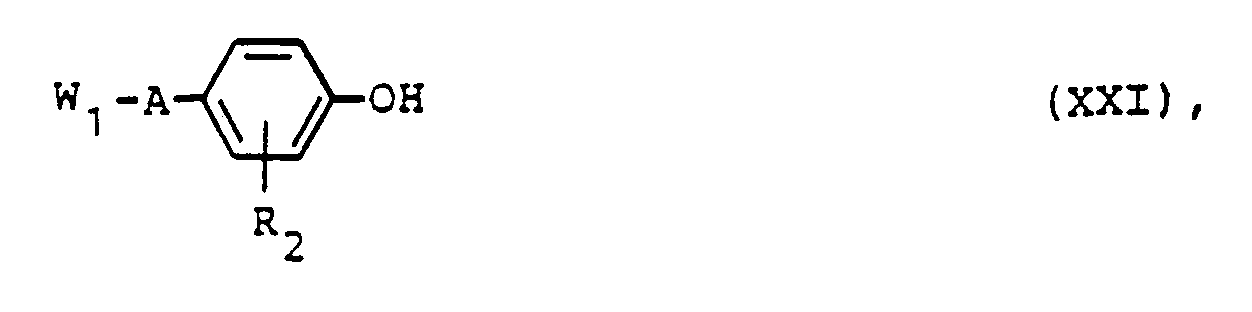

- Die Umsetzung der Verbindungen mit den allgemeinen Formeln V, XII und XXI mit einer Verbindung der allgemeinen Formel VI oder VII erfolgt in einem organischen Loesungsmittel wie Methanol, Ethanol, Propanol, Benzol, Toluol oder Dimethylformamid bei Temperaturen zwischen Raumtemperatur und 100°C. Das Molverhaeltnis kann zwischen 1 und 10 betragen.
- Die Umsetzungen der Verbindungen der allgemeinen Formeln 111, XIII und XVI mit einem Amin der allgemeinen Formel IV erfolgen in Gegenwart oder Abwesenheit eines Loesungsmittels zwischen 0°C und 90°C, bevorzugt zwischen 20°C und 50°C. Als Loesungsmittel koennen z.B. Methanol, Ethanol, Propanol, iso-Propanol, Benzol, Toluol oder Dimethylformamid verwendet werden. Das molare Verhaeltnis der Reaktionspartner ist nicht kritisch. Es koennen Verhaeltnisse zwischen 2 und 100 gewaehlt werden.
- Die Umsetzungen der Amine VIII, XVI und XIX mit aktivierten Verbindungen der allgemeinen Formeln IX und XIV werden in einem organischen Loesungsmittel wie Hexan, Diethylether, Tetrahydrofuran, Methylenchlorid, Benzol, Toluol oder Dimethylformamid oder in waessriger Loesung bei Temperaturen zwischen -50°C und +70°C, bevorzugt zwischen -30°C und Raumtemperatur, durchgefuehrt.
- Die aktivierten Verbindungen der allgemeinen Formeln IX und XIV koennen dabei z.B. in Form von Carbonsaeurehalogeniden, -anhydriden oder -estern vorliegen, oder die Aktivierung der Carbonsaeuren erfolgt durch aktivierende Reagenzien wie N,N'-Carbonyldiimidazol, N,N'-Dicyclohexylcarbodiimide, 1-Ethyl-3-(3-dimethylaminopropyl)carbodiimid, 1-Alkyl-2-halogen-pyridiniumsalze o.ä. Die Aktivierung und die Umsetzung mit den Aminen VIII, XVI und XIX kann dabei in einem Syntheseschritt durchgefuehrt werden. Es koennen molare Verhaeltnisse zwischen 1 und 10 gewaehlt werden.
- Die Umsetzungen der Amine XI und XV mit aktivierten Verbindungen der allgemeinen Formeln X, XVII und XX werden in einem organischen Loesungsmittel wie Ether, Tetrahydrofuran, Dioxan, Methylenchlorid, Benzol, Tuluol oder Dimethylformamid oder in Wasser bei Temperaturen zwischen -50°C und +100°C, bevorzugt zwischen -30°C und Raumtemperatur, durchgefuehrt. Die aktivierten Verbindungen der allgemeinen Formeln X, XVII und XX koennen dabei z.B. in Form von Carbonsaeurehalogeniden, -anhydriden und -estern vorliegen, oder die Aktivierung erfolgt im Reaktionsgemisch mit aktivierenden Reagenzien wie N,N'-Carbonyldiimidazol, N,N'-Dicyclohexylcarbodiimid, oder 1-Ethyl-3-(3-dimethylaminopropyl)carbondiimid. Die Aktivierung und die Umsetzung mit den Aminen XI und XV kann dabei in einem Schritt erfolgen. Das molare Verhaeltnis der Reaktionspartner ist nicht kritisch. Es koennen Verhaeltnisse zwischen 1 und 10 gewaehlt werden.
- Die erfindungsgemaeßen Verbindungen besitzen asymmetrische Kohlenstoffatome.
- Gegenstand der Erfindung sind daher auch saemtliche moeglichen Diastereomerengemische, Racemate und saemtliche optisch aktiven Formen der erfindungsgemaeßen verbindungen der allgemeinen Formeln I, II, III und gegebenenfalls V.
- Zur Ueberfuehrung der Verbindungen der allgemeinen Formeln 1 und II in ihre pharmakologisch unbedenklichen Salze setzt man diese, vorzugsweise in einem organischen Loesungsmittel, mit der aequivalenten Menge einer anorganischen oder organischen Saeure, z.B. Salzsaeure, Bromwasserstoffsaeure, Salpetersaeure, Phosphorsaeure, Schwefelsaeure, Ameisensaeure, Essigsaeure, Propionsaeure, Oxalsaeure, Fumarsaeure, Maleinsaeure, Bernsteinsaeure, Adipinsaeure, Benzoesaeure, Salicylsaeure, o-Acetoxybenzoesaeure, Zimtsaeure, Naphthoesaeure, Mandelsaeure, Citronensaeure, Aepfelsaeure, Weinsaeure, Asparaginsaeure, Glutaminsaeure, Methansulfonsaeure oder p-Toluolsulfonsaeure um.
- Die erfindungsgemaeßen neuen Substanzen I und II und ihre Salze koennen in fluessiger oder fester Form enteral oder parenteral appliziert werden. Als Injektionsmedium kommt vorzugsweise Wasser zur Anwendung, welches die bei Injektionsloesungen ueblichen Zusaetze wie Stabilisierungsmittel, Loesungsvermittler oder Puffer enthaelt. Derartige Zusaetze sind z.B. Tartrat- und Citratpuffer, Ethanol, Komplexbildner (wie Ethylendiamintetraessigsaeure und deren nicht toxische Salze), hochmolekulare Polymere (wie fluessiges Polyethylenoxid) zur Viskositaetsregulierung. Fest Traegerstoffe sind z.B. Staerke, Lactose, Mannit, Methylcellulose, Talkum, hochdisperse Kieselgelsaeuren, hoehermolekulare Fettsaeuren (wie Stearinsaeure), Gelatine, Agar-Agar, Calciumphosphat, Magnesiumstearat, tierische und pflanzliche Fette und feste hochmolekulare Polymere (wie z.B. Polyethylenglykole), fuer orale Applikation geeignete Zubereitungen koennen gewuenschtenfalls Geschmacks- und Sueßstoffe enthalten.
- Die erfindungsgemaeßen Verbindungen werden ueblicherweise in Mengen von 20-500 mg pro Tag bezogen auf 75 kg Koerpergewicht appliziert. Bevorzugt ist es, 2-3 mal pro Tag 1-2 Tabletten mit einem Wirkstoffgehalt von 10-200 mg zu verabreichen. Die Tabletten koennen auch retardiert sein, wodurch nur noch 1 mal pro Tag 1-2 Tabletten mit 20-500 mg Wirkstoff gegeben werden muß. Der Wirkstoff kann auch durch Injektion 1-8 mal pro Tag bzw. durch Dauerinfusion gegeben werden, wobei Mengen von 5--200 mg/Tag normalerweise ausreichen.
- Neben den nachfolgend aufgefuehrten Beispiel sind insbesondere die folgenden Verbindungen im Sinne der Anmeldung bevorzugt:
- 1-[4-(2-Methyl-1-nitroxy-2-propyl)carbonylamino]phenoxy-3-isopropylamino-2-propanol
- 3-(2-Methyl-3-butin-2-yl)amino-1-[4-(2-methyl-1-nitroxy-2-propyl)carbonylamino]phenoxy-2-propanol
- 3-Isopropylamino-1-[4-[[(t-4-nitroxy)cyclohexyl]-r-1-carbonylamino]]phenoxy-2-propanol
- 3-(2-Methyl-3-butin-2-yl)amino-1-[4-[[(t-4-nitroxy)cyclohexyl]-r-1-carbonylamino]]phenoxy-2-propanol
- 3-Isopropylamino-1-[4-[[(t-2-nitroxy)cyclohexyl]-r-1-methylcarbonylamino]]phenoxy-2-propanol
- 3-(2-Methyl-3-butin-2-yl)amino-1-[4-[[(t-2-nitroxy)cyclohexyl]-r-1-methylcarbonylamino]]phenoxy-2-propanol
- 1-[2-Cyano-4-(3-nitroxypropyl)carbonylamino]phenoxy-3-isopropylamino-2-propanol
- 1-[2-Cyano-4-(3-nitroxypropyl)carbonylamino]phenoxy-3-(2-methyl-3-butin-2-yl)amino-2-propanol
- 1-[2-Cyano-4-[[(t-4-nitroxy-)cyclohexyl]-r-1-carbonylamino]]phenoxy-3-isopropylamino-2-propanol
- 1-[2-Cyano-4-[[(t-4-nitroxy)cyclohexyl]-r-1-carbonylamino]]phenoxy-3-(2-methyl-3-butin-2-yl)amino-2-propanol
- 3-lsopropylamino-1-[2-methylcarbonyl-4-(3-nitroxypropyl)carbonylamino]phenoxy-2-propanol
- 3-(2-Methyl-3-butin-2-yl)amino-1-[2-methylcarbonyl-4-(3-nitroxypropyl)carbonylamino]phenoxy-2-propanol
- 3-Isopropylamino-1-[2-methylcarbonyl-4-[[(t-4-nitroxy)cyclohexyl]-r-1-carbonylamino]phenoxy-2-propanol
- 3-(2-Methyl-3-butin-2-yl)amino-1-(2-methylcarbonyl-4-[[(t-nitroxy)cyclohexyl]-r-1-carbonylamino]]phenoxy-2-propanol
- 1-[2-Ethoxycarbonyl-4-(4-nitroxybutyl)carbonylamino]phenoxy-3-tert.-butylamino-2-propanol
- 1-[2-Ethoxycarbonyl-4-(2-methyl-1-nitroxy-2-propyl)carbonylamino]phenoxy-3-tert.-butylamino-2-propanol
- 1-[2-Ethoxycarbonyl-4-[[(t-4-nitroxy)cyclohexyl-r-1-carbonylamino]]phenoxy-3-tert.-butylamino-2-propanol
- 1-[2-Ethoxycarbonyl-4-[[[(t-2-nitroxy)cyclohexyl]-r-1-methyl]carbonyl]amino]phenoxy-3-tert.-butylamino-2-propanol
- 1-[2-Ethoxycarbonyl-4-(3-nitroxypropyl)carbonylamino]phenoxy-3-isopropylamino-2-propanol
- 1-[2-Ethoxycarbonyl-4-(3-nitroxypropyl)carbonylamino]phenoxy-3-(2-methyl-3-butin-2-yl)amino-2-propanol
- 1-[4-[(2-Nitroxyethyl)amino]carbonylmethyl]phenoxy-3-tert.-butylamino-2-propanol
- 1-[4-[(1-Nitroxy-but-3-yl)amino]carbonylmethyl]phenoxy-3-tert.-butylamino-2-propanol
- 1-[4-[(2iMethyl-4-nitroxy-2-butyl)amino]carbonylmethyl]phenoxy-3-tert.-butylamino-2-propanol
- 1-[4-[(2,3-Dinitroxy-propyl)amino]carbonylmethyl]phenoxy-3-tert.-butylamino-2-propanol
- 1-[4-[N,N-Bis(2-nitroxyethyl)amino]carbonylmethyl]phenoxy-3-tert.-butylamino-2-propanol
- 1-[4-[N,N-Bis(2-nitroxypropyl)amino]carbonylmethyl]phenoxy-3-tert.-butylamino-2-propanof
- trans-1-[4-[(4-Nitroxycyclohexyl)amino]carbonylmethyl]phenoxy-3-tert.-butylamino-2-propanol
- 3-Isopropylamino-1-[4-[(3-nitroxypropyl)amino]carbonylmethyl]phenoxy-2-propanol
- 3-Isopropylamino-1-[4-[(2-nitroxypropyl)amino]carbonylmethyl]phenoxy-2-propanol
- 3-Isopropylamino-1-[4-[(1-nitroxy-but-3-yl)amino]carbonylmethyl]phenoxy-2-propanol
- 3-Isopropylamino-1-[4-[(2-methyl-4-nitroxy-2-butyl)amino]carbonylmethyl]phenoxy-2-propanol
- 3-Isopropylamino-1-[4-[(2,2-dimethyl-3-nitroxypropyl)amino]carbonylmethyl]phenoxy-2-propanol
- 3-Isopropylamino-1-[4-[(2,3-dinitroxy-propyl)amino]carbonylmethyl]phenoxy-2-propanol
- 3-Isopropylamino-1-[4-[[N-methyl-N-(3-nitroxypropyl)]amino]carbonylmethyl]phenoxy-2-propanol
- 3-Isopropylamino-1-[4-[[N-methyl-N-(2-nitroxypropyl)]amino]carbonylmethyl]phenoxy-2-propanol
- 3-Isopropy(amino-1-[4-[[N-methyl-N-(4-nitroxybutyl)]amino]carbonylmethyl]phenoxy-2-propanol
- 3-Isopropylamino-1-[4-[[N-methyl-N-(1-nitroxy-but-3-yl)lamino]carbonylmethyl]phenoxy-2-propanol
- 3-Isopropylamino-1-[4-[[N-methyl-N-(2,2-dimethyl-3-nitroxypropyl)]amino]carbonylmethyl]phenoxy-2-propanol
- trans-3-Isopropylamino-1-[4-((2-nitroxycyclohexyl)amino]carbonylmethyl]phenoxy-2-propanol
- trans-3-Isopropylamino-1-[4-[(4-nitroxycyclohexyl)amino]carbonylmethyl]phenoxy-2-propanol
- cis-3-Isopropylamino-amino-1-[4-[(4-nitroxycyclohexyl)amino]carbonylmethyl]phenoxy-2-propanol
- trans-3-Isopropylamino-1-[4-[[(4-nitroxycyclohexyl)methyl]amino]carbonylmethyl]phenoxy-2-propanol
- trans-3-Isopropylamino-[4-[[(2-nitroxycyclohexyl)methyl]amino]carbonylmethyl]phenoxy-2-propanol
- 3-Isopropylamino-1-[4-(4-nitroxy-1-piperidino)carbonylmethyl]phenoxy-2-propanol
- 3-lsopropylamino-1-[4-(2-nitroxymethyl-1-piperidino)carbonylmethyl]phenoxy-2-propanol
- 3-Isopropylamino-1-[4-(3-nitroxymethyl-1-piperidino)carbonylmethyl]phenoxy-2-propanol
- 3-(2-Methyl-3-butin-2-yl)amino-1-[4-[(3-nitroxypropyl)amino]carbonylmethyl]phenoxy-2-propanol
- 3-(2-Methyl-3-butin-2-yl)amino-1-[4-[(2-nitroxypropyl)amino]carbonylmethyl]phenoxy-2-propanol
- 3-(2-Methyl-3-butin-2-yl)amino-7-[4-(4-nitroxy-1-piperidino)carbonylmethyl]phenoxy-2-propanol
- 1-[4-(3-Nitroxypropyl)carbonylamino]phenoxy-3-isopropylamino-2-propanol
- 1-[4-(3-Nitroxypropyl)carbonylamino]phenoxy-3-(2-methyl-3-butin-2-yl)amino-2-propanol
- 1-[4-[2-(3-Nitroxypropyl)carbonylamino]ethyl]phenoxy-3-tert.-butylamino-2-propanol
- 1-[4-[2-(2-Methyl-1-nitroxy-2-propyl)carbonylamino]ethyl]phenoxy-3-tert.-butylamino-2-propanol
- 1-[4-[[N-Methyl-N-(3-nitroxypropyl)]amino]carbonylmethyl]phenoxy-3-tert.-butylamino-2-propanol
- 1-[4-[[N-Methyl-N-(2-nitroxypropyl)]amino]carbonylmethyl]phenoxy-3-tert.-butylamino-2-propanol
- 1-[4-[[N-Methyl-N-(4-nitroxybutyl)]amino]carbonylmethyl]phenoxy-3-tert.-butylamino-2-propanol
- 1-[4-[[N-Methyl-N-(1-nitroxy-but-3-yl)]amino]carbonylmethyl]phenoxy-3-tert.-butylamino-2-propanol
- cis-1-[4-[(4-Nitroxycyclohexyl)amino]carbonylmethyl]phenoxy-3-tert.-butylamino-2-propanol
- 1-[4-(2-Nitroxymethyl-1-piperidino)-carbonylmethyl]phenoxy-3-tert.-butylamino-2-propanol
- 1-[4-[(2-Nitroxyethylmercapto)methylcarbonylamino]phenoxy]-3-tert.-butylamino-2-propanol
- 1-[4-[(2-Nitroxyethylsulfinyl)methylcarbonylamino]phenoxy]-3-tert.-butylamino-2-propanol
- 1-[4-[(2-Nitroxyethylsulfonyl)methylcarbonylamino]phenoxy-3-tert.-butylamino-2-propanol.
- Zu einer Loesung von 5.0 g 1-(4-Amino)phenoxy-3-tert.-butylamino-2-propanol in 100 ml trockenem THF wird bei Raumtemperatur eine Loesung von 3.6 g 4-Nitroxybutanoylchlorid getropft. Man ruehrt noch 1 h bei Raumtemperatur und dampft im Vakuum zur Trockne ein. Der verbleibende Rueckstand wird mit wenig Diethylether verrieben. Der erhaltene Niederschlag wird abgesaugt und getrocknet.
- Man erhaelt 7.1 g (83% d.Th.) Kristalle vom Schmp. 137-140°C.
- Das als Ausgangsmaterial benoetigte 4-Nitroxybutanoylchlorid wird wie folgt hergestellt:
- Zu einer Loesung von 1.49 g 4-Nitroxybuttersaeure in 150 ml trockenem Methylenchlorid werden bei Raumtemperatur 2.08 g Phosphorpentachlorid gegeben. Man ruehrt noch 1 h und zieht dann das Loesungsmittel im Vakuum ab. Der verbliebende Rueckstand (1.7 g Oel) wird direkt weiter umgesetzt.
- Die als Ausgangsmaterialien benoetigten Verbindungen 1-(4-Amino)phenoxy-3-tert.-butylamino-2-propanol, 1-(4-Amino)phenoxy-3-isopropylamino-2-propanol bzw. 1-(4-Amino)phenoxy-3-(2-methyl-3- butin-2-yl)amino-2-propanol werden nach en sich bekannten Verfahren und gemaeß den Vorschriften in EP 29 992 hergestellt.
- Die als Ausgangsmaterial benoetigte 4-Nitroxybuttersaeure wurde nach an sich bekannter Weise aus Natrium-(4-hydroxy)butanoat und einem Gemisch aus 100 proz. Salpetersaeure/96 proz. Schwefelsaeure hergestellt. Die uebrigen Nitroxyalkylcarbonsaeuren wurden analog aus den entsprechenden Hydroxyalkylcarbonsaeuren hergestellt.
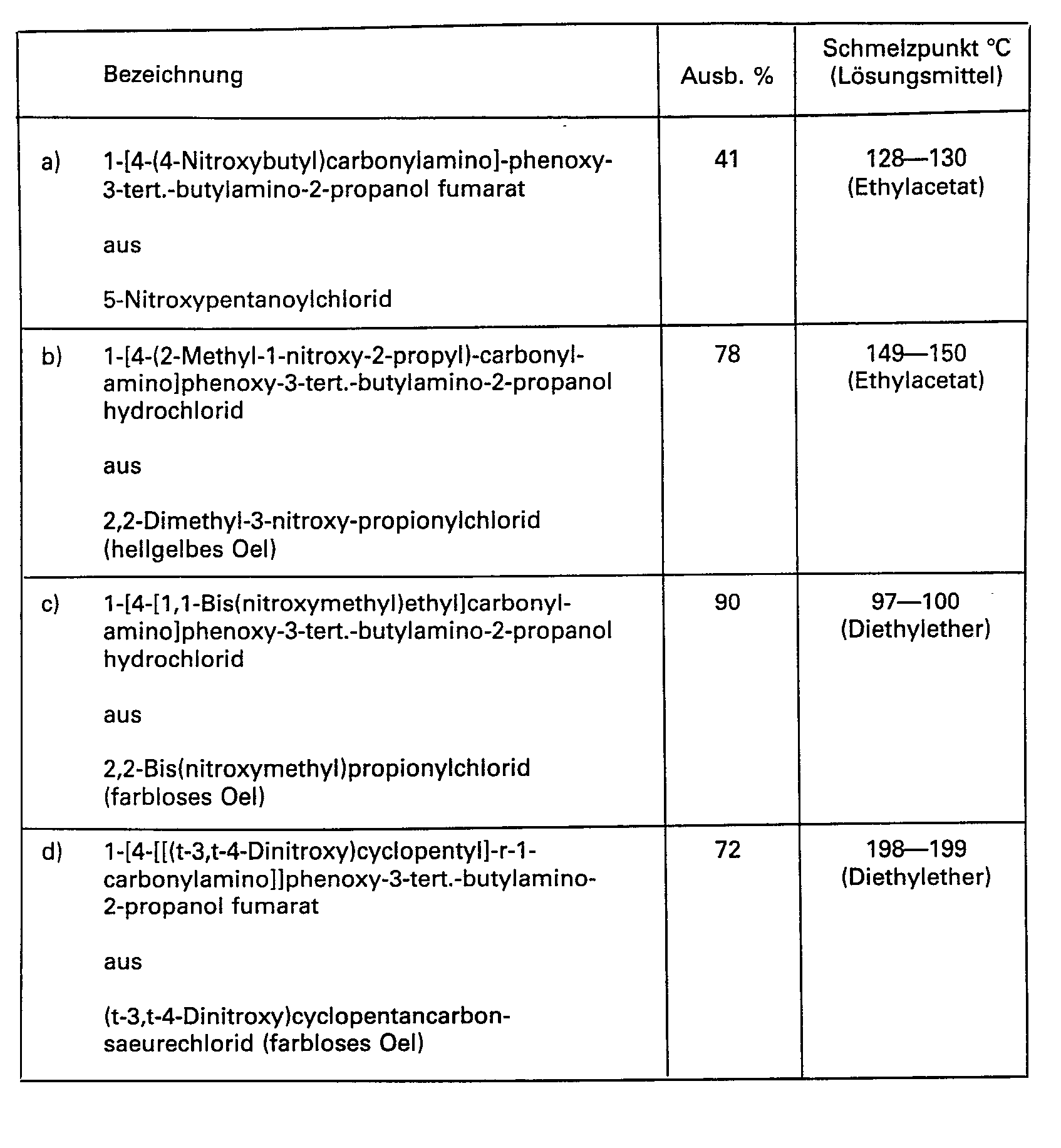
- In analoger Weise, wie in Beispiel 7 beschrieben, erhaelt man aus 1-(4-Amino)phenoxy-3-tert.-butylamino-2-propanol, 1-(4-Amino)phenoxy-3-isopropylamino-2-propanol bzw. 1-(4-Amino)phenoxy-3-(2-methyl-3-butin-2-yl)amino-2-propanol und den entsprechenden Nitroxyalkylcarbonsaeurechloriden folgende Verbindungen:
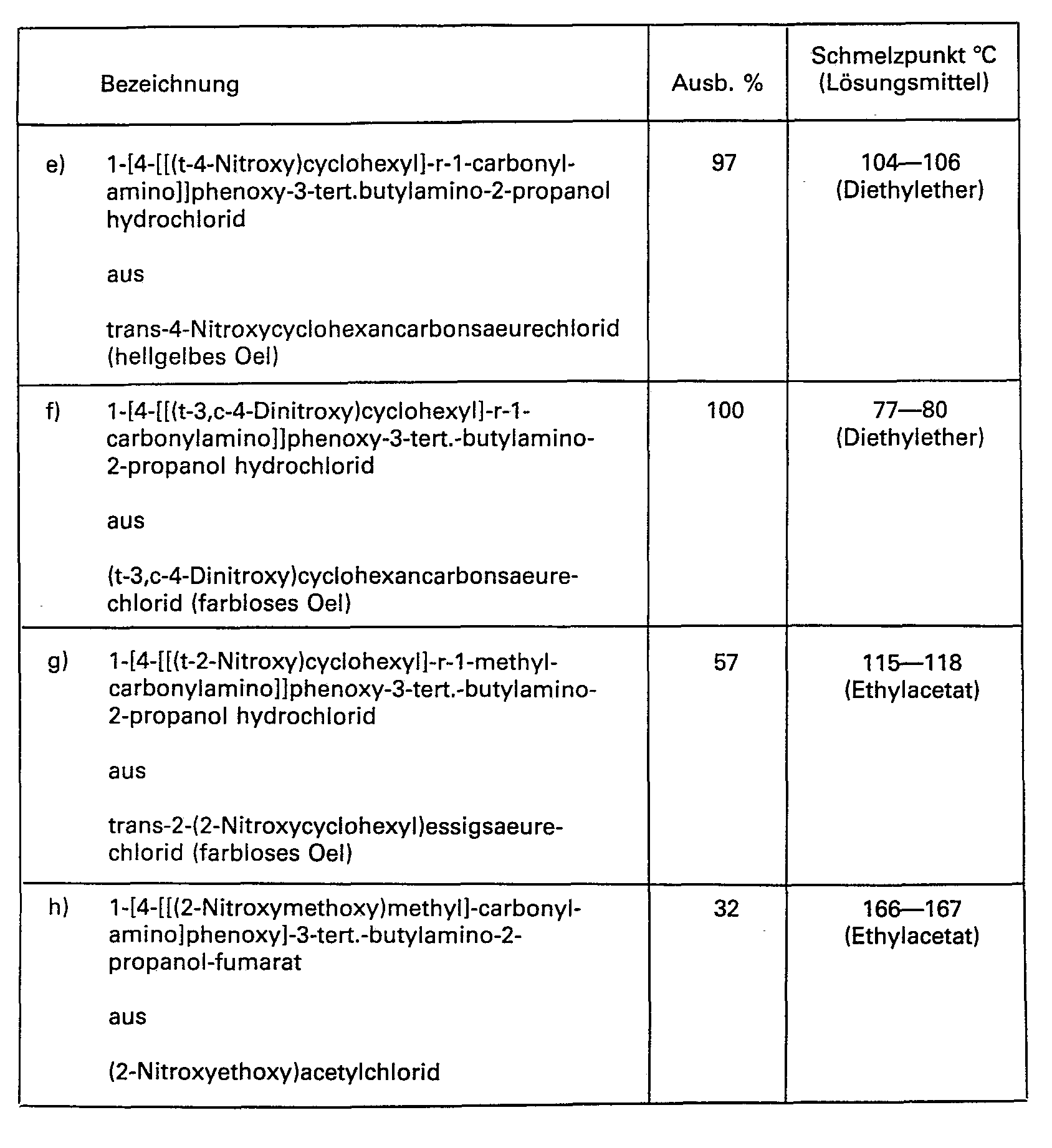
- Zu einer Suspension von 2.6 g 1-(4-Amino-2-cyano)phenoxy-3-tert.-butylamino-2-propanol in 50 ml trockenem Methylenchlorid tropft man bei 5°C eine Loesung von 2.0 g 2,2-Dimethyl-3-nitroxy- propionylchlorid in 50 ml trockenem Methylenchlorid, reuhrt weitere 2 h bei 5°C und laeßt ueber Nacht auf Raumtemperatur kommen. Man versetzt mit 100 ml waeßriger Kaliumcarbonatloesung und extrahiert 5 mal mit je 100 ml Methylenchlorid. Die Extrakte werden ueber Natriumsulfat getrocknet. Der Rueckstand wird in Ethylacetat/Diethylether geloest und mit waeßriger Milchsaeureloesung extrahiert, die waeßrige Phase dann 3 mal mit Ethylacetat extrahiert. Die vereinigten organischen Phasen werden ueber Natriumsulfat getrocknet. Der nach dem Eindampfen verbleibende Rueckstand (3.5 g) wird in Ethylacetat geloest und mit 0.8 g Benzoesaeure versetzt. Der erhaltene Niederschlag wird abgesaugt und getrocknet.
- Man erhaelt 3.2 g (61 % d.Th.) Kristalle vom Schmelzpunkt 131-133°C.
- Die als Ausgangsmaterial benoetigte Verbindung 1-(4-Amino-2-cyano)phenoxy-3-tert.-butylamino-2-propanol wird nach an sich bekannten Verfahren und gemaeß den Vorschriften in EP 29 992 hergestellt.
- In analoger Weise, wie in Beispiel 3 beschrieben, erhaelt man aus 1-(4-Amino-2-cyano)phenoxy-3-tert.-butylamino-2-propanol und Nitroxyalkylcarbonsaeurechloriden folgende Verbindungen:

- Zu einer Loesung von 3.4 g 1-(4-Amino-2-methylcarbonyl)phenoxy-3-tert.-butylamino-2-propanol in 70 ml trockenem Tetrahydrofuran tropft man bei Raumtemperatur eine Loesung von 2.7 g 2,2-Dimethyl-3-nitroxy-propionylchlorid in 70 ml trockenem Tetrahydrofuran. Man laeßt ueber Nacht ruehren, saugt das kristallisierte Salz ab und trocknet.
- Man erhaelt 4.9 g (88% d.Th.) Kristalle vom Schmelzpunkt 175-177°C.
- Die als Ausgangsmaterial benoetigte Verbindung 1-(4-Amino-2-methylcarbonyl)phenoxy-3-tert.-butyl- amino-2-propanol wird nach an sich bekannten Verfahren und gemaeß den Vorschriften in EP 29 992 hergestellt.
- In analoger Weist, wie in Beispiel 5 beschrieben, erhaelt man aus 1-(4-Amino-2-methylcarbonyl)phenoxy-3-tert.-butylamino-2-propanoi und Nitroxyalkylcarbonsäurechloriden folgende Verbindungen:
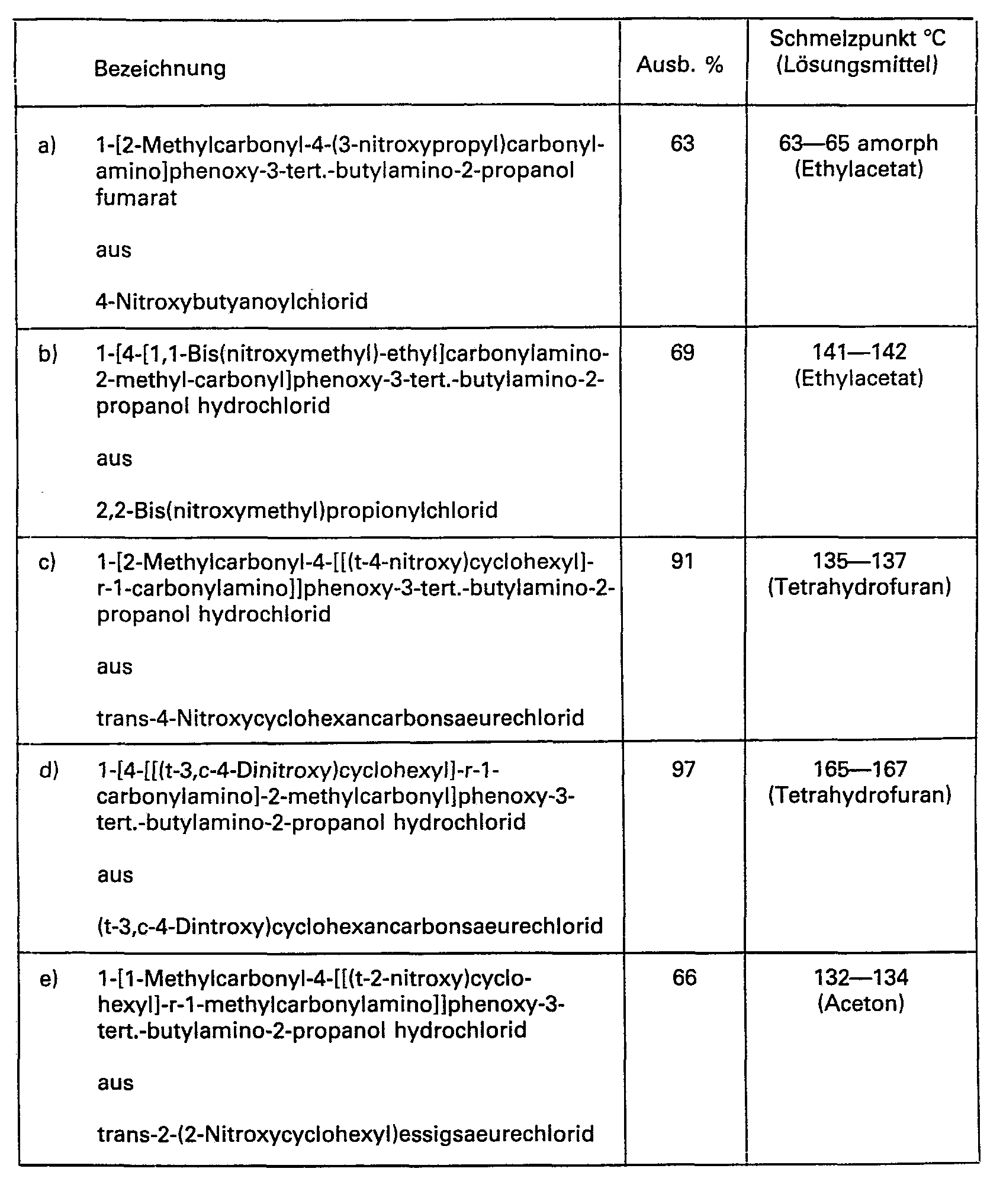
- Zu einer Lösung von 6.85 g 1-(4-Amino-2-ethoxycarbonyl)phenoxy-3-tert.-butylamino-2-propanol in 250 mltrockenem Tetrahydrofuran gibt man 3 ml Triethylamin und tropft bei 10°C eine Lösung von 3.6 g 4-Nitroxy-butanoylchlorid in 30 ml trockenem Tetrahydrofuran zu. Man läßt 10 h bei dieser Temperatur rühren, saugt vom Niederschlag ab und dampft zur Trockne ein. Der Rückstand (8.4 g) wird in 150 ml Methylenchlorid gelöst und 3 mal mit je 150 ml Wasser extrahiert. Die wäßrigen Phasen werden mit Natriumchlorid gesättigt und 3 mal mit je 150 ml Ethylacetat extrahiert. Die Ethylacetat-Phasen werden getrocknet und eingedampft. Der Rückstand (3.9 g) wird in 30 ml Ethylacetat gelöst und mit 1.59 g Cyclaminsäure in 60 ml Ethylacetat versetzt. Die abgeschiedenen Kristalle werden abgesaugt und getrocknet.
- Man erhält 1.8 g (13% d.Th.) Kristalle vom Schmelzpunkt 118/120°C.
- Die als Ausgangsmaterial benoetigte Verbindung 1-(4-Amino-2-ethoxycarbonyl)phenoxy-3-tert.-butyl- amino-2-propanol wird nach an sich bekannten Verfahren und gemaeß den Vorschriften in EP 29 992 hergestellt.
- Zu 13.4 g 2,3-Epoxy-1-[4-[(3-nitroxypropyl)amino]carbonylmethyl]phenoxy-propan gibt man 26.5 ml tert.-Butylamin und ruehrt 15 h bei Raumtemperatur. Das ueberschuessige Amin wird in Vakuum abgezogen, der Rueckstand in 150 ml Methylenchlorid geloest, 2 mal mit je 30 ml gesaettigter Natriumchlorid-Loesung, dann 2 mal mit je 50 ml 0.01 N-Salzsaeure und nochmals mit 30 ml gesaettigter Natriumchlorid-Loesung gewaschen, mit Aktivkohle gereinigt, getrocknet und eingeengt. Der verbliebende Rueckstand (12.8 g) wird in 150 ml Ethylacetat geloest und mit einer Loesung von 3.9 g Fumarsaeure in 200 ml Aceton versetzt. Das sich abscheidende Oel wird dekantiert, mit 200 ml Diethylether versetzt und 12 h bei Raumtemperatur geruehrt. Das kristallisierte Salz wird abgesaugt und getrocknet.
- Man erhaelt 13.2 g (61 % d.Th.) Kristalle vom Schmelzpunkt 98-100°C.
- In analoger Weise, wie in Beispiel 8 beschrieben, erhaelt man aus 2,3-Epoxy-1-[4-[(Nitroxyalkyl)amino]carbonylmethyl]phenoxy-propanen und primaeren Aminen folgende Verbindungen:


- Die als Ausgangsmaterial benoetigte Verbindung 2,3-Epoxy-1-[4-[(3-nitroxypropyl)aminolcarbonyl- methyl]phenoxy-propan wird wie folgt hergestellt:
- Zu einer Loesung von 11.0 g 4-[(3-Nitroxypropyl)amino]carbonylmethyl-phenol in 50 ml Dimethylformamid gibt man 16.9 ml Epichlorhydrin und tropft dann bei 20-25°C 43.3 ml 1 N-Natronlauge zu. Man ruehrt noch 4 h bei Raumtemperatur und dampft dann bei 30°C Badtemperatur im Vakuum zur Trockne ein. Der Rueckstand wird mit Methylenchlorid und Wasser versetzt. Nach der Phasentrennung wird die organische Phase noch 2 mal mit Wasser gewaschen, getrocknet und eingeengt. Es verbleiben 13.4 g (100% d.Th.) eines oeligen Produktes. Dieses wird direkt weiter verarbeitet.
- In analoger Weise, wie in Beispiel 10 beschrieben, wurden aus Epichlorhydrin und 4-(Nitroxyalkylamino)carbonylmethylphenolen folgende Verbindungen hergestellt:
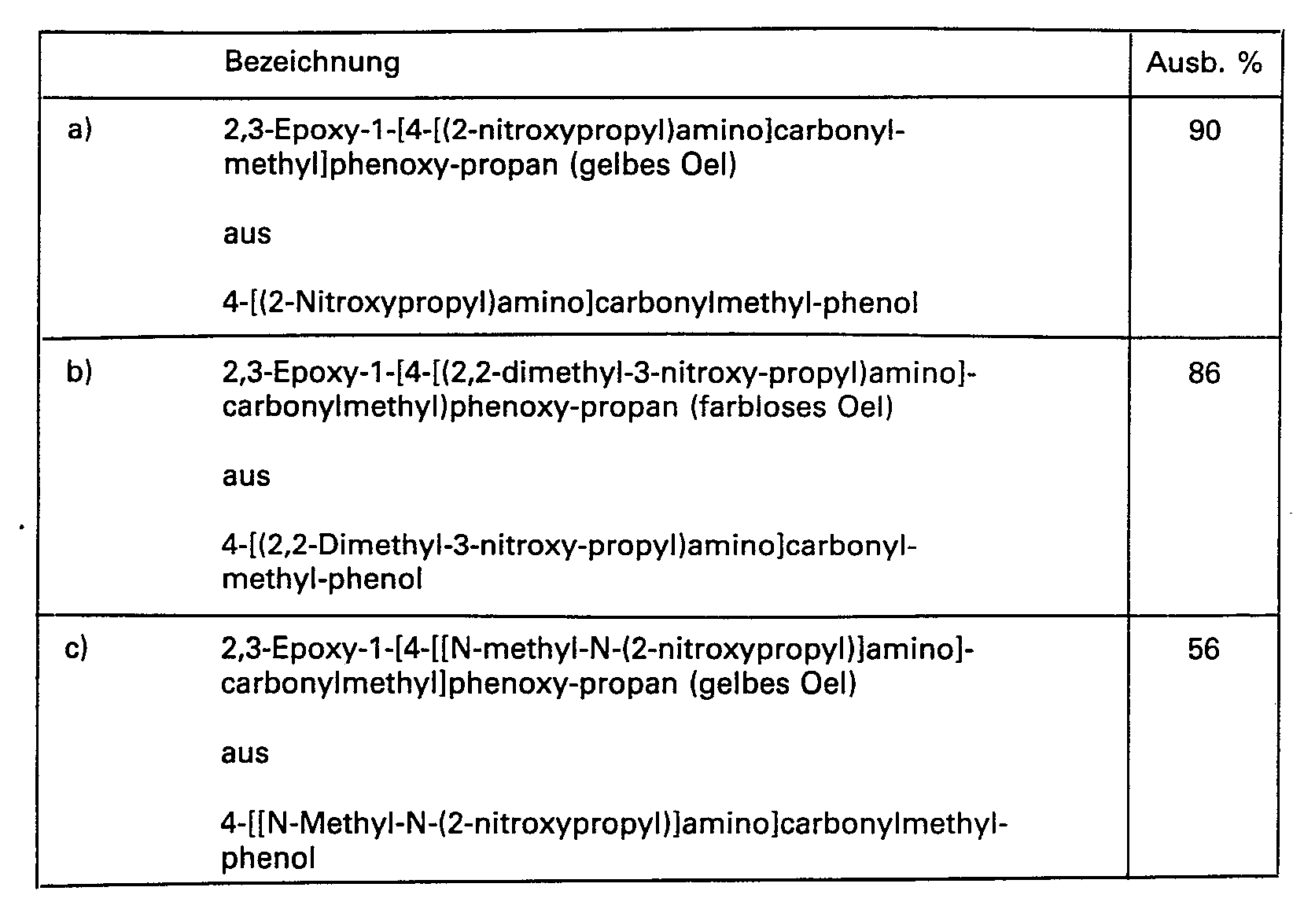

- Dia als Ausgangsmaterial benoetigte Verbindung 4-[(3-Nitroxypropyl)amino]carbonylmethyl-phenol wird wie folgt hergestellt:
- Eine Loesung von 7.6 g (4-Hydroxyphenyl)essigsaeure in 5 ml trockenem Dimethylformamid und 200 ml trockenem Methylenchlorid wird mit 5.5 ml 4-Methylmorpholin versetzt und auf -20 bis -15°C abgekuehlt. Man tropft bei dieser Temperatur innerhalb 45 Minuten eine Loesung von 6.6 ml Chlorameisensaeure-isobutylester in 200 ml trockenem Methylenchlorid zu und ruehrt noch 1.5 h weiter. Dann gibt man bei -20 bis -15°C 9.15 g 3-Nitroxypropyl-ammonium-nitrat zu und tropft eine Loesung von 5.5 ml 4-Methyl-morpholin in 20 ml trockenem Methylenchlorid zu und ruehrt 1 h weiter. Man laeßt auf Raumtemperatur kommen und waescht nacheinander mit 55 ml 0.2 N Salzsaeure, 50 ml 5 proz. Natriumhydrogencarbonat-Loesung und 50 ml Wasser, trocknet ueber Natriumsulfat und engt ein.
- Es verbleiben 11 g des oeligen Produktes (87% d.Th.).
- In analoger Weise, wie in Beispiel 12 beschrieben, erhaelt man aus (4-Hydroxyphenyl) essigsaeure und Nitroxyalkyl-ammonium-nitraten folgende Verbindungen:


- Die als Ausgangsmaterialien benoetigten Nitroxyalkylammonium nitrate werden nach bekannten Vorschriften (z.B. Houben-Weyl-Mueller, Methoden der organischen Chemie, Bd. VI/2, Georg Thieme Verlag, Stuttgart 1963, S. 325 ff.) aus den entsprechenden Hydroxyalkylaminen hergestellt.
Claims (9)








Priority Applications (1)
| Application Number | Priority Date | Filing Date | Title |
|---|---|---|---|
| AT85115037T ATE56946T1 (de) | 1984-12-01 | 1985-11-27 | Amino-propanol-derivate, verfahren zu ihrer herstellung und diese verbindungen enthaltende arzneimittel sowie zwischenprodukte. |
Applications Claiming Priority (2)
| Application Number | Priority Date | Filing Date | Title |
|---|---|---|---|
| DE19843443998 DE3443998A1 (de) | 1984-12-01 | 1984-12-01 | Amino-propanol-derivate, verfahren zu ihrer herstellung und diese verbindungen enthaltende arzneimittel sowie zwischenprodukte |
| DE3443998 | 1984-12-01 |
Publications (2)
| Publication Number | Publication Date |
|---|---|
| EP0192829A1 EP0192829A1 (de) | 1986-09-03 |
| EP0192829B1 true EP0192829B1 (de) | 1990-09-26 |
Family
ID=6251741
Family Applications (1)
| Application Number | Title | Priority Date | Filing Date |
|---|---|---|---|
| EP85115037A Expired - Lifetime EP0192829B1 (de) | 1984-12-01 | 1985-11-27 | Amino-propanol-Derivate, Verfahren zu ihrer Herstellung und diese Verbindungen enthaltende Arzneimittel sowie Zwischenprodukte |
Country Status (5)
| Country | Link |
|---|---|
| US (1) | US4801596A (de) |
| EP (1) | EP0192829B1 (de) |
| JP (1) | JPS61148151A (de) |
| AT (1) | ATE56946T1 (de) |
| DE (2) | DE3443998A1 (de) |
Families Citing this family (19)
| Publication number | Priority date | Publication date | Assignee | Title |
|---|---|---|---|---|
| NL8802276A (nl) * | 1988-09-15 | 1990-04-02 | Cedona Pharm Bv | Geneesmiddel met relaxerende werking, dat als aktieve stof een nitraatester bevat. |
| DE3836084A1 (de) * | 1988-10-22 | 1990-04-26 | Boehringer Mannheim Gmbh | Cyclische azaaliphaten mit nitroxyfunktion, verfahren zu ihrer herstellung und diese verbindungen enthaltende arzneimittel |
| DE3836021A1 (de) * | 1988-10-22 | 1990-05-03 | Boehringer Mannheim Gmbh | Arzneimittel enthaltend nitroxyalkylamine mit amidfunktion und verfahren zur herstellung dieser verbindungen |
| FR2645893B1 (fr) * | 1989-04-12 | 1995-09-22 | Fort Christian | Construction modulaire antisismique |
| DE4011505C2 (de) * | 1990-04-10 | 1995-01-12 | Sanol Arznei Schwarz Gmbh | Nitratoalkancarbonsäure-Derivate, Verfahren zu deren Herstellung und diese enthaltende Arzneimittel |
| DE4004841A1 (de) * | 1990-02-16 | 1991-08-22 | Boehringer Mannheim Gmbh | Salpetersaeureester von cyclohexanol-derivaten |
| JP3454531B2 (ja) * | 1991-11-07 | 2003-10-06 | 三共株式会社 | ニトロキシアルキルアミド誘導体 |
| ES2065291B1 (es) * | 1993-07-30 | 1995-10-01 | Prodesfarma Sa | "nitrato esteres de 1-ariloxi-3-alquilamino-2-propanoles, utilizacion y composicion farmaceutica correspondiente" |
| US5925658A (en) * | 1995-03-02 | 1999-07-20 | Sankyo Company, Limited | Optically active thiazolidinone derivative |
| US7115661B1 (en) | 1999-12-29 | 2006-10-03 | Queen's University At Kingston | Methods and compositions for mitigating pain |
| US5807847A (en) * | 1996-06-04 | 1998-09-15 | Queen's University At Kingston | Nitrate esters |
| US6310052B1 (en) | 1996-06-04 | 2001-10-30 | Queen's University At Kingston | Nitrate esters and their use for neurological conditions |
| US20050137191A1 (en) * | 1996-06-04 | 2005-06-23 | Thatcher Gregory R. | Nitrate esters and their use for mitigating cellular damage |
| JP2007502831A (ja) * | 2003-08-20 | 2007-02-15 | ニトロメッド インコーポレーティッド | ニトロソ化およびニトロシル化心血管化合物、組成物、ならびに使用方法 |
| JP2007518697A (ja) * | 2003-09-26 | 2007-07-12 | ニトロメッド インコーポレーティッド | ニトロソ化グルタミン酸化合物、組成物、および使用方法 |
| ATE399757T1 (de) * | 2003-11-20 | 2008-07-15 | Nicox Sa | Neues verfahren zur herstellung von nitrooxyderivaten von paracetamol |
| JP2007513113A (ja) * | 2003-12-02 | 2007-05-24 | ニコックス エス エイ | 抗高血圧薬剤のニトロオキシ誘導体 |
| DK1691804T3 (da) * | 2003-12-02 | 2007-07-16 | Nicox Sa | Nitrooxydderivater af carvedilol og andre beta-blokkere som antihypertensive lægemidler |
| AU2011320595A1 (en) * | 2010-10-29 | 2013-06-06 | Merck Sharp & Dohme Corp. | Diazeniumdiolate heterocyclic derivatives |
Family Cites Families (5)
| Publication number | Priority date | Publication date | Assignee | Title |
|---|---|---|---|---|
| CH504408A (de) * | 1966-11-03 | 1971-03-15 | Ici Ltd | Verfahren zur Herstellung von Alkanolaminderivaten |
| JPS56113748A (en) * | 1980-02-13 | 1981-09-07 | Kowa Co | Aminoethanol derivative and its preparation |
| DE3015991A1 (de) * | 1980-04-25 | 1981-11-05 | C.H. Boehringer Sohn, 6507 Ingelheim | Neue 1-aryloxy-3-alkylamino-2-propanole und verfahren zur ihrer herstellung |
| JPS58109461A (ja) * | 1981-12-24 | 1983-06-29 | Kowa Co | 新規ベンズアミド誘導体 |
| CH661501A5 (fr) * | 1982-01-26 | 1987-07-31 | Oreal | Composes derivant du amino-3 propanol-2 utilisables pour la teinture des cheveux, leur procede de preparation, composition de teinture les contenant et procede de teinture de cheveux correspondant. |
-
1984
- 1984-12-01 DE DE19843443998 patent/DE3443998A1/de not_active Withdrawn
-
1985
- 1985-11-27 EP EP85115037A patent/EP0192829B1/de not_active Expired - Lifetime
- 1985-11-27 DE DE8585115037T patent/DE3579913D1/de not_active Expired - Lifetime
- 1985-11-27 AT AT85115037T patent/ATE56946T1/de not_active IP Right Cessation
- 1985-12-02 US US06/803,497 patent/US4801596A/en not_active Expired - Fee Related
- 1985-12-02 JP JP60269565A patent/JPS61148151A/ja active Pending
Also Published As
| Publication number | Publication date |
|---|---|
| ATE56946T1 (de) | 1990-10-15 |
| DE3443998A1 (de) | 1986-06-05 |
| DE3579913D1 (de) | 1990-10-31 |
| EP0192829A1 (de) | 1986-09-03 |
| JPS61148151A (ja) | 1986-07-05 |
| US4801596A (en) | 1989-01-31 |
Similar Documents
| Publication | Publication Date | Title |
|---|---|---|
| EP0192829A1 (de) | Amino-propanol-Derivate, Verfahren zu ihrer Herstellung und diese Verbindungen enthaltende Arzneimittel sowie Zwischenprodukte | |
| EP0004920B1 (de) | Carbazolyl-(4)-oxy-propanolamin-Derivate, Verfahren zu ihrer Herstellung und diese Verbindungen enthaltende Arzneimittel | |
| DE2508045C2 (de) | Substituierte n-(1-benzylpyrrolidinyl-2-alkyl)-benzamide, verfahren zu deren herstellung und diese enthaltende arzneimittel | |
| EP0201735A1 (de) | N-Indolylethyl-sulfonsäureamide, Verfahren zu ihrer Herstellung und ihre Verwendung | |
| DD143074A5 (de) | Verfahren zur herstellung neuer n-aryl bzw.benzimidazolinone | |
| EP0200915B1 (de) | Amino-propanol-Derivate, Verfahren zu deren Herstellung, Verwendung derselben und diese enthaltende Arzneimittel | |
| EP0157267B1 (de) | Substituierte Benzopyrane, Verfahren zu ihrer Herstellung sowie ihre Verwendung in Arzneimitteln | |
| EP0131221A2 (de) | Thioether, Verfahren zu deren Herstellung sowie diese Verbindungen enthaltende Arzneimittel | |
| DE3305569A1 (de) | Biscarboxamide zur bekaempfung von erkrankungen sowie verfahren zu ihrer herstellung | |
| EP0127826B1 (de) | 1,4-Dihydropyridine, Verfahren zu ihrer Herstellung sowie ihre Verwendung in Arzneimitteln | |
| EP0367019B1 (de) | Arzneimittel enthaltend Nitroxyalkylamine mit Amidfunktion und Verfahren zur Herstellung dieser Verbindungen | |
| EP0255126B1 (de) | 2-Acyloxypropylamin-Derivate, Verfahren zur Herstellung und diese enthaltende Arzneimittel | |
| CH626351A5 (de) | ||
| EP0366004B1 (de) | Cyclische Azaaliphaten mit Nitroxyfunktion, Verfahren zu ihrer Herstellung und diese Verbindungen enthaltende Arzneimittel | |
| US4450172A (en) | Antihypertensive polyhalohydroxyisopropyl phenylalka(e)noic acid esters of alkylaminohydroxypropyloxyphenylalkyl alcohols | |
| AT390952B (de) | Verfahren zur herstellung von neuen furan- oder thiophenderivaten | |
| DE69713128T2 (de) | 4-(1-piperazinyl)benzosäurederivate, verfahren zu ihrer herstellung und ihre therapeutischen verwendungen | |
| FR2525221A1 (fr) | Derives du furanne et sels d'addition de ces derives, leurs procedes de preparation et leurs applications en therapeutique | |
| DE3242204A1 (de) | Verfahren zur herstellung von aminoalkylfuranen oder -thiophenen | |
| DE2706179C2 (de) | N-(2-Morpholinoäthyl)-Benzamidderivate, deren Säureadditionssalze, Verfahren zu deren Herstellung und pharmazeutisches Präparat | |
| EP1748994B1 (de) | Nitrooxyderivate von blutdrucksenkenden arzneimitteln | |
| EP0003298B1 (de) | 4-Hydroxy-2-benzimidazolin-thion-Derivate, Verfahren zu deren Herstellung sowie diese Verbindungen enthaltende Arzneimittel | |
| EP0104445A2 (de) | Piperidinochinoxalin-Derivate, ihre Herstellung und Verwendung | |
| EP0096006A2 (de) | 3-(Ureidocyclohexylamino)-propan-1,2-diolderivate, Verfahren zu ihrer Herstellung, pharmazeutische Präparate enthaltend diese Verbindungen, sowie ihre therapeutische Verwendung | |
| AT235845B (de) | Verfahren zur Herstellung von neuen Benzolsulfonylsemicarbaziden |
Legal Events
| Date | Code | Title | Description |
|---|---|---|---|
| PUAI | Public reference made under article 153(3) epc to a published international application that has entered the european phase |
Free format text: ORIGINAL CODE: 0009012 |
|
| 17P | Request for examination filed |
Effective date: 19851127 |
|
| AK | Designated contracting states |
Kind code of ref document: A1 Designated state(s): AT BE CH DE FR GB IT LI LU NL SE |
|
| 17Q | First examination report despatched |
Effective date: 19870730 |
|
| GRAA | (expected) grant |
Free format text: ORIGINAL CODE: 0009210 |
|
| AK | Designated contracting states |
Kind code of ref document: B1 Designated state(s): AT BE CH DE FR GB IT LI LU NL SE |
|
| PG25 | Lapsed in a contracting state [announced via postgrant information from national office to epo] |
Ref country code: SE Effective date: 19900926 Ref country code: NL Effective date: 19900926 |
|
| REF | Corresponds to: |
Ref document number: 56946 Country of ref document: AT Date of ref document: 19901015 Kind code of ref document: T |
|
| ITF | It: translation for a ep patent filed | ||
| REF | Corresponds to: |
Ref document number: 3579913 Country of ref document: DE Date of ref document: 19901031 |
|
| PG25 | Lapsed in a contracting state [announced via postgrant information from national office to epo] |
Ref country code: LU Free format text: LAPSE BECAUSE OF NON-PAYMENT OF DUE FEES Effective date: 19901130 |
|
| ET | Fr: translation filed | ||
| GBT | Gb: translation of ep patent filed (gb section 77(6)(a)/1977) | ||
| NLV1 | Nl: lapsed or annulled due to failure to fulfill the requirements of art. 29p and 29m of the patents act | ||
| PLBE | No opposition filed within time limit |
Free format text: ORIGINAL CODE: 0009261 |
|
| STAA | Information on the status of an ep patent application or granted ep patent |
Free format text: STATUS: NO OPPOSITION FILED WITHIN TIME LIMIT |
|
| 26N | No opposition filed | ||
| ITTA | It: last paid annual fee | ||
| PGFP | Annual fee paid to national office [announced via postgrant information from national office to epo] |
Ref country code: FR Payment date: 19931110 Year of fee payment: 9 |
|
| PGFP | Annual fee paid to national office [announced via postgrant information from national office to epo] |
Ref country code: AT Payment date: 19931112 Year of fee payment: 9 |
|
| PGFP | Annual fee paid to national office [announced via postgrant information from national office to epo] |
Ref country code: GB Payment date: 19931117 Year of fee payment: 9 |
|
| PGFP | Annual fee paid to national office [announced via postgrant information from national office to epo] |
Ref country code: CH Payment date: 19931129 Year of fee payment: 9 |
|
| PGFP | Annual fee paid to national office [announced via postgrant information from national office to epo] |
Ref country code: DE Payment date: 19931201 Year of fee payment: 9 |
|
| PGFP | Annual fee paid to national office [announced via postgrant information from national office to epo] |
Ref country code: BE Payment date: 19940105 Year of fee payment: 9 |
|
| PG25 | Lapsed in a contracting state [announced via postgrant information from national office to epo] |
Ref country code: GB Effective date: 19941127 Ref country code: AT Effective date: 19941127 |
|
| PG25 | Lapsed in a contracting state [announced via postgrant information from national office to epo] |
Ref country code: LI Effective date: 19941130 Ref country code: CH Effective date: 19941130 Ref country code: BE Effective date: 19941130 |
|
| BERE | Be: lapsed |
Owner name: BOEHRINGER MANNHEIM G.M.B.H. Effective date: 19941130 |
|
| GBPC | Gb: european patent ceased through non-payment of renewal fee |
Effective date: 19941127 |
|
| PG25 | Lapsed in a contracting state [announced via postgrant information from national office to epo] |
Ref country code: FR Effective date: 19950731 |
|
| REG | Reference to a national code |
Ref country code: CH Ref legal event code: PL |
|
| PG25 | Lapsed in a contracting state [announced via postgrant information from national office to epo] |
Ref country code: DE Effective date: 19950801 |
|
| REG | Reference to a national code |
Ref country code: FR Ref legal event code: ST |