EP0180754A2 - 3,4-Diazolderivate, Verfahren zu ihrer Herstellung und diese Verbindungen enthaltende Arzneimittel - Google Patents
3,4-Diazolderivate, Verfahren zu ihrer Herstellung und diese Verbindungen enthaltende Arzneimittel Download PDFInfo
- Publication number
- EP0180754A2 EP0180754A2 EP85112139A EP85112139A EP0180754A2 EP 0180754 A2 EP0180754 A2 EP 0180754A2 EP 85112139 A EP85112139 A EP 85112139A EP 85112139 A EP85112139 A EP 85112139A EP 0180754 A2 EP0180754 A2 EP 0180754A2
- Authority
- EP
- European Patent Office
- Prior art keywords
- general formula
- compound
- preparation
- atom
- alkyl
- Prior art date
- Legal status (The legal status is an assumption and is not a legal conclusion. Google has not performed a legal analysis and makes no representation as to the accuracy of the status listed.)
- Withdrawn
Links
- 150000001875 compounds Chemical class 0.000 title claims abstract description 93
- 238000002360 preparation method Methods 0.000 title claims abstract description 81
- 238000000034 method Methods 0.000 title claims abstract description 11
- WTKZEGDFNFYCGP-UHFFFAOYSA-N Pyrazole Chemical class C=1C=NNC=1 WTKZEGDFNFYCGP-UHFFFAOYSA-N 0.000 title claims abstract description 10
- 239000003814 drug Substances 0.000 title claims abstract description 10
- 229940079593 drug Drugs 0.000 title description 4
- 229910052717 sulfur Chemical group 0.000 claims description 40
- 125000004434 sulfur atom Chemical group 0.000 claims description 37
- XHXFXVLFKHQFAL-UHFFFAOYSA-N phosphoryl trichloride Chemical compound ClP(Cl)(Cl)=O XHXFXVLFKHQFAL-UHFFFAOYSA-N 0.000 claims description 34
- 229910052757 nitrogen Inorganic materials 0.000 claims description 28
- 230000009021 linear effect Effects 0.000 claims description 26
- 125000000623 heterocyclic group Chemical group 0.000 claims description 25
- 125000006273 (C1-C3) alkyl group Chemical group 0.000 claims description 24
- 125000004433 nitrogen atom Chemical group N* 0.000 claims description 23
- 125000003236 benzoyl group Chemical group [H]C1=C([H])C([H])=C(C([H])=C1[H])C(*)=O 0.000 claims description 17
- 125000001797 benzyl group Chemical group [H]C1=C([H])C([H])=C(C([H])=C1[H])C([H])([H])* 0.000 claims description 17
- 229910052739 hydrogen Inorganic materials 0.000 claims description 17
- 229910052760 oxygen Inorganic materials 0.000 claims description 17
- 239000001301 oxygen Substances 0.000 claims description 17
- 125000001997 phenyl group Chemical group [H]C1=C([H])C([H])=C(*)C([H])=C1[H] 0.000 claims description 17
- 229910052736 halogen Inorganic materials 0.000 claims description 15
- 150000002367 halogens Chemical class 0.000 claims description 15
- 239000001257 hydrogen Substances 0.000 claims description 15
- 125000000449 nitro group Chemical group [O-][N+](*)=O 0.000 claims description 15
- 125000004430 oxygen atom Chemical group O* 0.000 claims description 14
- RWRDLPDLKQPQOW-UHFFFAOYSA-N Pyrrolidine Chemical compound C1CCNC1 RWRDLPDLKQPQOW-UHFFFAOYSA-N 0.000 claims description 12
- NQRYJNQNLNOLGT-UHFFFAOYSA-N Piperidine Chemical compound C1CCNCC1 NQRYJNQNLNOLGT-UHFFFAOYSA-N 0.000 claims description 8
- 125000005843 halogen group Chemical group 0.000 claims description 8
- 125000004435 hydrogen atom Chemical group [H]* 0.000 claims description 8
- 150000003839 salts Chemical class 0.000 claims description 8
- MYMOFIZGZYHOMD-UHFFFAOYSA-N Dioxygen Chemical compound O=O MYMOFIZGZYHOMD-UHFFFAOYSA-N 0.000 claims description 7
- UFHFLCQGNIYNRP-UHFFFAOYSA-N Hydrogen Chemical compound [H][H] UFHFLCQGNIYNRP-UHFFFAOYSA-N 0.000 claims description 7
- 150000001412 amines Chemical class 0.000 claims description 7
- 125000002924 primary amino group Chemical group [H]N([H])* 0.000 claims description 7
- 125000002723 alicyclic group Chemical group 0.000 claims description 6
- QJGQUHMNIGDVPM-UHFFFAOYSA-N nitrogen group Chemical group [N] QJGQUHMNIGDVPM-UHFFFAOYSA-N 0.000 claims description 6
- 125000006559 (C1-C3) alkylamino group Chemical group 0.000 claims description 4
- QUKGLNCXGVWCJX-UHFFFAOYSA-N 1,3,4-thiadiazol-2-amine Chemical compound NC1=NN=CS1 QUKGLNCXGVWCJX-UHFFFAOYSA-N 0.000 claims description 4
- ZSIQJIWKELUFRJ-UHFFFAOYSA-N azepane Chemical group C1CCCNCC1 ZSIQJIWKELUFRJ-UHFFFAOYSA-N 0.000 claims description 4
- 239000007800 oxidant agent Substances 0.000 claims description 4
- RLAROPIDCNCRNR-UHFFFAOYSA-N Cl.Cl.[C-]#N Chemical compound Cl.Cl.[C-]#N RLAROPIDCNCRNR-UHFFFAOYSA-N 0.000 claims description 3
- 125000000217 alkyl group Chemical group 0.000 claims description 3
- QVGXLLKOCUKJST-UHFFFAOYSA-N atomic oxygen Chemical compound [O] QVGXLLKOCUKJST-UHFFFAOYSA-N 0.000 claims description 3
- 239000003085 diluting agent Substances 0.000 claims description 3
- 239000003937 drug carrier Substances 0.000 claims description 3
- 230000007062 hydrolysis Effects 0.000 claims description 3
- 238000006460 hydrolysis reaction Methods 0.000 claims description 3
- 150000002431 hydrogen Chemical class 0.000 claims 6
- JCXJVPUVTGWSNB-UHFFFAOYSA-N Nitrogen dioxide Chemical class O=[N]=O JCXJVPUVTGWSNB-UHFFFAOYSA-N 0.000 claims 1
- 230000000694 effects Effects 0.000 abstract description 5
- LFQSCWFLJHTTHZ-UHFFFAOYSA-N Ethanol Chemical compound CCO LFQSCWFLJHTTHZ-UHFFFAOYSA-N 0.000 description 69
- -1 Benzyl- Chemical group 0.000 description 42
- RTZKZFJDLAIYFH-UHFFFAOYSA-N Diethyl ether Chemical compound CCOCC RTZKZFJDLAIYFH-UHFFFAOYSA-N 0.000 description 40
- WYURNTSHIVDZCO-UHFFFAOYSA-N Tetrahydrofuran Chemical compound C1CCOC1 WYURNTSHIVDZCO-UHFFFAOYSA-N 0.000 description 22
- 125000000951 phenoxy group Chemical group [H]C1=C([H])C([H])=C(O*)C([H])=C1[H] 0.000 description 20
- ZMANZCXQSJIPKH-UHFFFAOYSA-N Triethylamine Chemical compound CCN(CC)CC ZMANZCXQSJIPKH-UHFFFAOYSA-N 0.000 description 18
- 239000000203 mixture Substances 0.000 description 18
- GLYQQFBHCFPEEU-UHFFFAOYSA-N 5-bromo-1,3,4-thiadiazol-2-amine Chemical compound NC1=NN=C(Br)S1 GLYQQFBHCFPEEU-UHFFFAOYSA-N 0.000 description 17
- WEVYAHXRMPXWCK-UHFFFAOYSA-N Acetonitrile Chemical compound CC#N WEVYAHXRMPXWCK-UHFFFAOYSA-N 0.000 description 15
- GFAINJZOIVMPPR-UHFFFAOYSA-N 1-amino-3-[3-[3-(piperidin-1-ylmethyl)phenoxy]propyl]urea Chemical compound NNC(=O)NCCCOC1=CC=CC(CN2CCCCC2)=C1 GFAINJZOIVMPPR-UHFFFAOYSA-N 0.000 description 13
- 238000005160 1H NMR spectroscopy Methods 0.000 description 13
- 238000004458 analytical method Methods 0.000 description 13
- IAZDPXIOMUYVGZ-UHFFFAOYSA-N DMSO Substances CS(C)=O IAZDPXIOMUYVGZ-UHFFFAOYSA-N 0.000 description 12
- HEMHJVSKTPXQMS-UHFFFAOYSA-M Sodium hydroxide Chemical compound [OH-].[Na+] HEMHJVSKTPXQMS-UHFFFAOYSA-M 0.000 description 12
- ULUMORRUZNYLRM-UHFFFAOYSA-N 1-amino-3-[3-[3-(piperidin-1-ylmethyl)phenoxy]propyl]thiourea Chemical compound NNC(=S)NCCCOC1=CC=CC(CN2CCCCC2)=C1 ULUMORRUZNYLRM-UHFFFAOYSA-N 0.000 description 11
- 238000005481 NMR spectroscopy Methods 0.000 description 11
- 125000001436 propyl group Chemical group [H]C([*])([H])C([H])([H])C([H])([H])[H] 0.000 description 11
- 125000002496 methyl group Chemical group [H]C([H])([H])* 0.000 description 10
- 239000007787 solid Substances 0.000 description 10
- XLYOFNOQVPJJNP-UHFFFAOYSA-N water Substances O XLYOFNOQVPJJNP-UHFFFAOYSA-N 0.000 description 10
- 239000000243 solution Substances 0.000 description 9
- NTYJJOPFIAHURM-UHFFFAOYSA-N Histamine Chemical compound NCCC1=CN=CN1 NTYJJOPFIAHURM-UHFFFAOYSA-N 0.000 description 8
- MHAJPDPJQMAIIY-UHFFFAOYSA-N Hydrogen peroxide Chemical compound OO MHAJPDPJQMAIIY-UHFFFAOYSA-N 0.000 description 7
- 238000006243 chemical reaction Methods 0.000 description 7
- 239000000047 product Substances 0.000 description 7
- 238000010992 reflux Methods 0.000 description 7
- 239000000725 suspension Substances 0.000 description 7
- QGJOPFRUJISHPQ-UHFFFAOYSA-N Carbon disulfide Chemical compound S=C=S QGJOPFRUJISHPQ-UHFFFAOYSA-N 0.000 description 6
- VEXZGXHMUGYJMC-UHFFFAOYSA-N Hydrochloric acid Chemical compound Cl VEXZGXHMUGYJMC-UHFFFAOYSA-N 0.000 description 6
- OKKJLVBELUTLKV-UHFFFAOYSA-N Methanol Chemical compound OC OKKJLVBELUTLKV-UHFFFAOYSA-N 0.000 description 6
- 239000000706 filtrate Substances 0.000 description 6
- 239000003921 oil Substances 0.000 description 6
- 125000004169 (C1-C6) alkyl group Chemical group 0.000 description 5
- 238000004587 chromatography analysis Methods 0.000 description 5
- 239000002244 precipitate Substances 0.000 description 5
- 239000002904 solvent Substances 0.000 description 5
- NWZSZGALRFJKBT-KNIFDHDWSA-N (2s)-2,6-diaminohexanoic acid;(2s)-2-hydroxybutanedioic acid Chemical compound OC(=O)[C@@H](O)CC(O)=O.NCCCC[C@H](N)C(O)=O NWZSZGALRFJKBT-KNIFDHDWSA-N 0.000 description 4
- NLXLAEXVIDQMFP-UHFFFAOYSA-N Ammonium chloride Substances [NH4+].[Cl-] NLXLAEXVIDQMFP-UHFFFAOYSA-N 0.000 description 4
- VHUUQVKOLVNVRT-UHFFFAOYSA-N Ammonium hydroxide Chemical compound [NH4+].[OH-] VHUUQVKOLVNVRT-UHFFFAOYSA-N 0.000 description 4
- IAZDPXIOMUYVGZ-WFGJKAKNSA-N Dimethyl sulfoxide Chemical compound [2H]C([2H])([2H])S(=O)C([2H])([2H])[2H] IAZDPXIOMUYVGZ-WFGJKAKNSA-N 0.000 description 4
- LGDSHSYDSCRFAB-UHFFFAOYSA-N Methyl isothiocyanate Chemical compound CN=C=S LGDSHSYDSCRFAB-UHFFFAOYSA-N 0.000 description 4
- GLUUGHFHXGJENI-UHFFFAOYSA-N Piperazine Chemical compound C1CNCCN1 GLUUGHFHXGJENI-UHFFFAOYSA-N 0.000 description 4
- 235000011114 ammonium hydroxide Nutrition 0.000 description 4
- HBNYJWAFDZLWRS-UHFFFAOYSA-N ethyl isothiocyanate Chemical compound CCN=C=S HBNYJWAFDZLWRS-UHFFFAOYSA-N 0.000 description 4
- 230000027119 gastric acid secretion Effects 0.000 description 4
- 229960001340 histamine Drugs 0.000 description 4
- IKDUDTNKRLTJSI-UHFFFAOYSA-N hydrazine monohydrate Substances O.NN IKDUDTNKRLTJSI-UHFFFAOYSA-N 0.000 description 4
- 239000005457 ice water Substances 0.000 description 4
- 238000004519 manufacturing process Methods 0.000 description 4
- BDAGIHXWWSANSR-UHFFFAOYSA-N methanoic acid Natural products OC=O BDAGIHXWWSANSR-UHFFFAOYSA-N 0.000 description 4
- 125000001424 substituent group Chemical group 0.000 description 4
- JZXIZUODUVNBNM-UHFFFAOYSA-N 1-amino-3-[2-hydroxy-3-[3-(piperidin-1-ylmethyl)phenoxy]propyl]thiourea Chemical compound NNC(=S)NCC(O)COC1=CC=CC(CN2CCCCC2)=C1 JZXIZUODUVNBNM-UHFFFAOYSA-N 0.000 description 3
- KHMPYRXDRBTNHP-UHFFFAOYSA-N 3-[(2-methylpiperidin-1-yl)methyl]phenol Chemical compound CC1CCCCN1CC1=CC=CC(O)=C1 KHMPYRXDRBTNHP-UHFFFAOYSA-N 0.000 description 3
- JEGMWWXJUXDNJN-UHFFFAOYSA-N 3-methylpiperidine Chemical compound CC1CCCNC1 JEGMWWXJUXDNJN-UHFFFAOYSA-N 0.000 description 3
- KYINPWAJIVTFBW-UHFFFAOYSA-N 3-methylpyrrolidine Chemical compound CC1CCNC1 KYINPWAJIVTFBW-UHFFFAOYSA-N 0.000 description 3
- QTBSBXVTEAMEQO-UHFFFAOYSA-N Acetic acid Chemical compound CC(O)=O QTBSBXVTEAMEQO-UHFFFAOYSA-N 0.000 description 3
- YNAVUWVOSKDBBP-UHFFFAOYSA-N Morpholine Chemical group C1COCCN1 YNAVUWVOSKDBBP-UHFFFAOYSA-N 0.000 description 3
- NINIDFKCEFEMDL-UHFFFAOYSA-N Sulfur Chemical compound [S] NINIDFKCEFEMDL-UHFFFAOYSA-N 0.000 description 3
- 239000004480 active ingredient Substances 0.000 description 3
- 230000015572 biosynthetic process Effects 0.000 description 3
- CCGSUNCLSOWKJO-UHFFFAOYSA-N cimetidine Chemical compound N#CNC(=N/C)\NCCSCC1=NC=N[C]1C CCGSUNCLSOWKJO-UHFFFAOYSA-N 0.000 description 3
- 229960001380 cimetidine Drugs 0.000 description 3
- KRKNYBCHXYNGOX-UHFFFAOYSA-N citric acid Chemical compound OC(=O)CC(O)(C(O)=O)CC(O)=O KRKNYBCHXYNGOX-UHFFFAOYSA-N 0.000 description 3
- 238000001704 evaporation Methods 0.000 description 3
- 239000006260 foam Substances 0.000 description 3
- 238000009472 formulation Methods 0.000 description 3
- 125000005842 heteroatom Chemical group 0.000 description 3
- 238000002955 isolation Methods 0.000 description 3
- 239000000843 powder Substances 0.000 description 3
- VMXUWOKSQNHOCA-LCYFTJDESA-N ranitidine Chemical compound [O-][N+](=O)/C=C(/NC)NCCSCC1=CC=C(CN(C)C)O1 VMXUWOKSQNHOCA-LCYFTJDESA-N 0.000 description 3
- 229960000620 ranitidine Drugs 0.000 description 3
- 239000000126 substance Substances 0.000 description 3
- 239000011593 sulfur Substances 0.000 description 3
- 238000003786 synthesis reaction Methods 0.000 description 3
- 239000003826 tablet Substances 0.000 description 3
- 238000002560 therapeutic procedure Methods 0.000 description 3
- ILWRPSCZWQJDMK-UHFFFAOYSA-N triethylazanium;chloride Chemical compound Cl.CCN(CC)CC ILWRPSCZWQJDMK-UHFFFAOYSA-N 0.000 description 3
- TTWWZVGVBRPHLE-UHFFFAOYSA-N 1,1-dichloro-n-phenylmethanimine Chemical compound ClC(Cl)=NC1=CC=CC=C1 TTWWZVGVBRPHLE-UHFFFAOYSA-N 0.000 description 2
- DAEKYCRWIPWMOR-UHFFFAOYSA-N 1-(4-chlorophenyl)-3-[3-[3-(piperidin-1-ylmethyl)phenoxy]propylcarbamoylamino]urea Chemical compound C1=CC(Cl)=CC=C1NC(=O)NNC(=O)NCCCOC1=CC=CC(CN2CCCCC2)=C1 DAEKYCRWIPWMOR-UHFFFAOYSA-N 0.000 description 2
- OVWMDVKRFRIMNU-UHFFFAOYSA-N 1-[3-[3-(piperidin-1-ylmethyl)phenoxy]propyl]-3-(propan-2-ylcarbamoylamino)urea Chemical compound CC(C)NC(=O)NNC(=O)NCCCOC1=CC=CC(CN2CCCCC2)=C1 OVWMDVKRFRIMNU-UHFFFAOYSA-N 0.000 description 2
- OTSZMWCSGBDNQQ-UHFFFAOYSA-N 1-amino-3-[3-(piperidin-1-ylmethyl)phenoxy]propan-2-ol Chemical compound NCC(O)COC1=CC=CC(CN2CCCCC2)=C1 OTSZMWCSGBDNQQ-UHFFFAOYSA-N 0.000 description 2
- ADAKRBAJFHTIEW-UHFFFAOYSA-N 1-chloro-4-isocyanatobenzene Chemical compound ClC1=CC=C(N=C=O)C=C1 ADAKRBAJFHTIEW-UHFFFAOYSA-N 0.000 description 2
- SLIFAGSDRFKGEE-UHFFFAOYSA-N 1-cyclohexyl-3-[3-[3-(piperidin-1-ylmethyl)phenoxy]propylcarbamothioylamino]thiourea Chemical compound C1CCCCC1NC(=S)NNC(=S)NCCCOC(C=1)=CC=CC=1CN1CCCCC1 SLIFAGSDRFKGEE-UHFFFAOYSA-N 0.000 description 2
- HEALDGPDWRZVCL-UHFFFAOYSA-N 1-cyclohexyl-3-[3-[3-(piperidin-1-ylmethyl)phenoxy]propylcarbamothioylamino]urea Chemical compound C1CCCCC1NC(=O)NNC(=S)NCCCOC(C=1)=CC=CC=1CN1CCCCC1 HEALDGPDWRZVCL-UHFFFAOYSA-N 0.000 description 2
- GSLTVFIVJMCNBH-UHFFFAOYSA-N 2-isocyanatopropane Chemical compound CC(C)N=C=O GSLTVFIVJMCNBH-UHFFFAOYSA-N 0.000 description 2
- NXYZIYYNFQHSKQ-UHFFFAOYSA-N 2-n-[3-[3-(piperidin-1-ylmethyl)phenoxy]propyl]-1,3,4-thiadiazole-2,5-diamine Chemical compound S1C(N)=NN=C1NCCCOC1=CC=CC(CN2CCCCC2)=C1 NXYZIYYNFQHSKQ-UHFFFAOYSA-N 0.000 description 2
- USDUMNVQVGKLTI-UHFFFAOYSA-N 2-n-[3-[3-[(3-methylpiperidin-1-yl)methyl]phenoxy]propyl]-1,3,4-thiadiazole-2,5-diamine Chemical compound C1C(C)CCCN1CC1=CC=CC(OCCCNC=2SC(N)=NN=2)=C1 USDUMNVQVGKLTI-UHFFFAOYSA-N 0.000 description 2
- XKHJXGWXPIUNNG-UHFFFAOYSA-N 2-n-[3-[3-[(3-methylpyrrolidin-1-yl)methyl]phenoxy]propyl]-1,3,4-thiadiazole-2,5-diamine Chemical compound C1C(C)CCN1CC1=CC=CC(OCCCNC=2SC(N)=NN=2)=C1 XKHJXGWXPIUNNG-UHFFFAOYSA-N 0.000 description 2
- GXAVYBMFGGFLIG-UHFFFAOYSA-N 2-n-[4-[3-[(3-methylpiperidin-1-yl)methyl]phenoxy]butyl]-1,3,4-thiadiazole-2,5-diamine Chemical compound C1C(C)CCCN1CC1=CC=CC(OCCCCNC=2SC(N)=NN=2)=C1 GXAVYBMFGGFLIG-UHFFFAOYSA-N 0.000 description 2
- BBKLPFMWHBVBAP-UHFFFAOYSA-N 3-[(3-methylpyrrolidin-1-yl)methyl]phenol Chemical compound C1C(C)CCN1CC1=CC=CC(O)=C1 BBKLPFMWHBVBAP-UHFFFAOYSA-N 0.000 description 2
- VQSXCZMVUMSITD-UHFFFAOYSA-N 3-[3-(piperidin-1-ylmethyl)phenoxy]propan-1-amine Chemical compound NCCCOC1=CC=CC(CN2CCCCC2)=C1 VQSXCZMVUMSITD-UHFFFAOYSA-N 0.000 description 2
- IAVREABSGIHHMO-UHFFFAOYSA-N 3-hydroxybenzaldehyde Chemical compound OC1=CC=CC(C=O)=C1 IAVREABSGIHHMO-UHFFFAOYSA-N 0.000 description 2
- OSWFIVFLDKOXQC-UHFFFAOYSA-N 4-(3-methoxyphenyl)aniline Chemical compound COC1=CC=CC(C=2C=CC(N)=CC=2)=C1 OSWFIVFLDKOXQC-UHFFFAOYSA-N 0.000 description 2
- NLHHRLWOUZZQLW-UHFFFAOYSA-N Acrylonitrile Chemical compound C=CC#N NLHHRLWOUZZQLW-UHFFFAOYSA-N 0.000 description 2
- QGZKDVFQNNGYKY-UHFFFAOYSA-N Ammonia Chemical compound N QGZKDVFQNNGYKY-UHFFFAOYSA-N 0.000 description 2
- OKTJSMMVPCPJKN-UHFFFAOYSA-N Carbon Chemical compound [C] OKTJSMMVPCPJKN-UHFFFAOYSA-N 0.000 description 2
- 241000700199 Cavia porcellus Species 0.000 description 2
- VEXZGXHMUGYJMC-UHFFFAOYSA-M Chloride anion Chemical compound [Cl-] VEXZGXHMUGYJMC-UHFFFAOYSA-M 0.000 description 2
- VZCYOOQTPOCHFL-OWOJBTEDSA-N Fumaric acid Chemical compound OC(=O)\C=C\C(O)=O VZCYOOQTPOCHFL-OWOJBTEDSA-N 0.000 description 2
- 229910010082 LiAlH Inorganic materials 0.000 description 2
- AFVFQIVMOAPDHO-UHFFFAOYSA-N Methanesulfonic acid Chemical compound CS(O)(=O)=O AFVFQIVMOAPDHO-UHFFFAOYSA-N 0.000 description 2
- ISWSIDIOOBJBQZ-UHFFFAOYSA-N Phenol Chemical compound OC1=CC=CC=C1 ISWSIDIOOBJBQZ-UHFFFAOYSA-N 0.000 description 2
- NBIIXXVUZAFLBC-UHFFFAOYSA-N Phosphoric acid Chemical compound OP(O)(O)=O NBIIXXVUZAFLBC-UHFFFAOYSA-N 0.000 description 2
- VYPSYNLAJGMNEJ-UHFFFAOYSA-N Silicium dioxide Chemical compound O=[Si]=O VYPSYNLAJGMNEJ-UHFFFAOYSA-N 0.000 description 2
- KEAYESYHFKHZAL-UHFFFAOYSA-N Sodium Chemical compound [Na] KEAYESYHFKHZAL-UHFFFAOYSA-N 0.000 description 2
- QAOWNCQODCNURD-UHFFFAOYSA-N Sulfuric acid Chemical compound OS(O)(=O)=O QAOWNCQODCNURD-UHFFFAOYSA-N 0.000 description 2
- 239000003699 antiulcer agent Substances 0.000 description 2
- 239000000010 aprotic solvent Substances 0.000 description 2
- CPEKAXYCDKETEN-UHFFFAOYSA-N benzoyl isothiocyanate Chemical compound S=C=NC(=O)C1=CC=CC=C1 CPEKAXYCDKETEN-UHFFFAOYSA-N 0.000 description 2
- HQABUPZFAYXKJW-UHFFFAOYSA-N butan-1-amine Chemical compound CCCCN HQABUPZFAYXKJW-UHFFFAOYSA-N 0.000 description 2
- 150000003857 carboxamides Chemical class 0.000 description 2
- 239000012230 colorless oil Substances 0.000 description 2
- 238000004440 column chromatography Methods 0.000 description 2
- 230000008602 contraction Effects 0.000 description 2
- 125000000113 cyclohexyl group Chemical group [H]C1([H])C([H])([H])C([H])([H])C([H])(*)C([H])([H])C1([H])[H] 0.000 description 2
- KQWGXHWJMSMDJJ-UHFFFAOYSA-N cyclohexyl isocyanate Chemical compound O=C=NC1CCCCC1 KQWGXHWJMSMDJJ-UHFFFAOYSA-N 0.000 description 2
- 125000001511 cyclopentyl group Chemical group [H]C1([H])C([H])([H])C([H])([H])C([H])(*)C1([H])[H] 0.000 description 2
- XBDQKXXYIPTUBI-UHFFFAOYSA-N dimethylselenoniopropionate Natural products CCC(O)=O XBDQKXXYIPTUBI-UHFFFAOYSA-N 0.000 description 2
- 238000001035 drying Methods 0.000 description 2
- 150000002148 esters Chemical class 0.000 description 2
- WUDNUHPRLBTKOJ-UHFFFAOYSA-N ethyl isocyanate Chemical compound CCN=C=O WUDNUHPRLBTKOJ-UHFFFAOYSA-N 0.000 description 2
- 230000008020 evaporation Effects 0.000 description 2
- 238000001914 filtration Methods 0.000 description 2
- 235000019253 formic acid Nutrition 0.000 description 2
- 230000002496 gastric effect Effects 0.000 description 2
- 150000004677 hydrates Chemical class 0.000 description 2
- IXCSERBJSXMMFS-UHFFFAOYSA-N hydrogen chloride Substances Cl.Cl IXCSERBJSXMMFS-UHFFFAOYSA-N 0.000 description 2
- 229910000041 hydrogen chloride Inorganic materials 0.000 description 2
- 239000003112 inhibitor Substances 0.000 description 2
- 238000002347 injection Methods 0.000 description 2
- 239000007924 injection Substances 0.000 description 2
- YDNLNVZZTACNJX-UHFFFAOYSA-N isocyanatomethylbenzene Chemical compound O=C=NCC1=CC=CC=C1 YDNLNVZZTACNJX-UHFFFAOYSA-N 0.000 description 2
- RIWNFZUWWRVGEU-UHFFFAOYSA-N isocyanomethylbenzene Chemical compound [C-]#[N+]CC1=CC=CC=C1 RIWNFZUWWRVGEU-UHFFFAOYSA-N 0.000 description 2
- 125000001449 isopropyl group Chemical group [H]C([H])([H])C([H])(*)C([H])([H])[H] 0.000 description 2
- MZSJGCPBOVTKHR-UHFFFAOYSA-N isothiocyanatocyclohexane Chemical compound S=C=NC1CCCCC1 MZSJGCPBOVTKHR-UHFFFAOYSA-N 0.000 description 2
- HAMGRBXTJNITHG-UHFFFAOYSA-N methyl isocyanate Chemical compound CN=C=O HAMGRBXTJNITHG-UHFFFAOYSA-N 0.000 description 2
- 125000000250 methylamino group Chemical group [H]N(*)C([H])([H])[H] 0.000 description 2
- QGGVBGZKAIKNPH-UHFFFAOYSA-N n-[5-[3-[3-(piperidin-1-ylmethyl)phenoxy]propylamino]-1,3,4-thiadiazol-2-yl]benzamide Chemical compound C=1C=CC=CC=1C(=O)NC(S1)=NN=C1NCCCOC(C=1)=CC=CC=1CN1CCCCC1 QGGVBGZKAIKNPH-UHFFFAOYSA-N 0.000 description 2
- 239000012074 organic phase Substances 0.000 description 2
- 239000012071 phase Substances 0.000 description 2
- DGTNSSLYPYDJGL-UHFFFAOYSA-N phenyl isocyanate Chemical compound O=C=NC1=CC=CC=C1 DGTNSSLYPYDJGL-UHFFFAOYSA-N 0.000 description 2
- 238000001556 precipitation Methods 0.000 description 2
- DUIOPKIIICUYRZ-UHFFFAOYSA-N semicarbazide Chemical compound NNC(N)=O DUIOPKIIICUYRZ-UHFFFAOYSA-N 0.000 description 2
- 239000000741 silica gel Substances 0.000 description 2
- 229910002027 silica gel Inorganic materials 0.000 description 2
- 239000011734 sodium Substances 0.000 description 2
- 239000012312 sodium hydride Substances 0.000 description 2
- 229910000104 sodium hydride Inorganic materials 0.000 description 2
- 239000007858 starting material Substances 0.000 description 2
- 238000006467 substitution reaction Methods 0.000 description 2
- 230000000699 topical effect Effects 0.000 description 2
- 125000000008 (C1-C10) alkyl group Chemical group 0.000 description 1
- VNFNWOOBGZNKEI-UHFFFAOYSA-N 1,1-dimethyl-3-[3-[3-(piperidin-1-ylmethyl)phenoxy]propylcarbamoylamino]urea Chemical compound CN(C)C(=O)NNC(=O)NCCCOC1=CC=CC(CN2CCCCC2)=C1 VNFNWOOBGZNKEI-UHFFFAOYSA-N 0.000 description 1
- 150000004869 1,3,4-thiadiazoles Chemical class 0.000 description 1
- RYHBNJHYFVUHQT-UHFFFAOYSA-N 1,4-Dioxane Chemical compound C1COCCO1 RYHBNJHYFVUHQT-UHFFFAOYSA-N 0.000 description 1
- IKLIMRDMSMSARN-UHFFFAOYSA-N 1-(4-chloroanilino)-3-[3-[3-(piperidin-1-ylmethyl)phenoxy]propyl]thiourea Chemical compound C1=CC(Cl)=CC=C1NNC(=S)NCCCOC1=CC=CC(CN2CCCCC2)=C1 IKLIMRDMSMSARN-UHFFFAOYSA-N 0.000 description 1
- DBDDLDZZYACUFQ-UHFFFAOYSA-N 1-(carbamoylamino)-3-[2-methyl-3-[3-(piperidin-1-ylmethyl)phenoxy]propyl]urea Chemical compound NC(=O)NNC(=O)NCC(C)COC1=CC=CC(CN2CCCCC2)=C1 DBDDLDZZYACUFQ-UHFFFAOYSA-N 0.000 description 1
- MZRJUKACRVLVED-UHFFFAOYSA-N 1-(cyclohexylcarbamothioylamino)-3-[3-[3-(piperidin-1-ylmethyl)phenoxy]propyl]urea Chemical compound C1CCCCC1NC(=S)NNC(=O)NCCCOC(C=1)=CC=CC=1CN1CCCCC1 MZRJUKACRVLVED-UHFFFAOYSA-N 0.000 description 1
- ADMKFPUFEVBBQX-UHFFFAOYSA-N 1-[(5-anilino-1,3,4-thiadiazol-2-yl)amino]-3-[3-(piperidin-1-ylmethyl)phenoxy]propan-2-ol Chemical compound C=1C=CC(CN2CCCCC2)=CC=1OCC(O)CNC(S1)=NN=C1NC1=CC=CC=C1 ADMKFPUFEVBBQX-UHFFFAOYSA-N 0.000 description 1
- QQXOHXKGAUJDAF-UHFFFAOYSA-N 1-amino-3-[2-methyl-3-[3-(piperidin-1-ylmethyl)phenoxy]propyl]urea Chemical compound NNC(=O)NCC(C)COC1=CC=CC(CN2CCCCC2)=C1 QQXOHXKGAUJDAF-UHFFFAOYSA-N 0.000 description 1
- CUEJXUCKCVFREN-UHFFFAOYSA-N 1-butyl-3-[3-[3-(piperidin-1-ylmethyl)phenoxy]propylcarbamothioylamino]urea Chemical compound CCCCNC(=O)NNC(=S)NCCCOC1=CC=CC(CN2CCCCC2)=C1 CUEJXUCKCVFREN-UHFFFAOYSA-N 0.000 description 1
- YYWHNIVAAHYZBR-UHFFFAOYSA-N 1-ethyl-3-[3-[3-(piperidin-1-ylmethyl)phenoxy]propylcarbamothioylamino]thiourea Chemical compound CCNC(=S)NNC(=S)NCCCOC1=CC=CC(CN2CCCCC2)=C1 YYWHNIVAAHYZBR-UHFFFAOYSA-N 0.000 description 1
- ASPMWFXWLBVJGM-UHFFFAOYSA-N 1-ethyl-3-[3-[3-(piperidin-1-ylmethyl)phenoxy]propylcarbamoylamino]urea Chemical compound CCNC(=O)NNC(=O)NCCCOC1=CC=CC(CN2CCCCC2)=C1 ASPMWFXWLBVJGM-UHFFFAOYSA-N 0.000 description 1
- QKHAODFBYFCISV-UHFFFAOYSA-N 1-methyl-3-[3-[3-(piperidin-1-ylmethyl)phenoxy]propylcarbamothioylamino]thiourea Chemical compound CNC(=S)NNC(=S)NCCCOC1=CC=CC(CN2CCCCC2)=C1 QKHAODFBYFCISV-UHFFFAOYSA-N 0.000 description 1
- WWFHOGLMRFRZHF-UHFFFAOYSA-N 1-methyl-3-[3-[3-(piperidin-1-ylmethyl)phenoxy]propylcarbamoylamino]urea Chemical compound CNC(=O)NNC(=O)NCCCOC1=CC=CC(CN2CCCCC2)=C1 WWFHOGLMRFRZHF-UHFFFAOYSA-N 0.000 description 1
- UNWQBYMXCYTGRU-UHFFFAOYSA-N 1-phenoxybutan-1-amine Chemical compound CCCC(N)OC1=CC=CC=C1 UNWQBYMXCYTGRU-UHFFFAOYSA-N 0.000 description 1
- CECBYVFDQKDSFY-UHFFFAOYSA-N 1-phenyl-3-[3-[3-(piperidin-1-ylmethyl)phenoxy]propylcarbamothioylamino]urea Chemical compound C=1C=CC=CC=1NC(=O)NNC(=S)NCCCOC(C=1)=CC=CC=1CN1CCCCC1 CECBYVFDQKDSFY-UHFFFAOYSA-N 0.000 description 1
- OVSKIKFHRZPJSS-UHFFFAOYSA-N 2,4-D Chemical compound OC(=O)COC1=CC=C(Cl)C=C1Cl OVSKIKFHRZPJSS-UHFFFAOYSA-N 0.000 description 1
- VZSRBBMJRBPUNF-UHFFFAOYSA-N 2-(2,3-dihydro-1H-inden-2-ylamino)-N-[3-oxo-3-(2,4,6,7-tetrahydrotriazolo[4,5-c]pyridin-5-yl)propyl]pyrimidine-5-carboxamide Chemical compound C1C(CC2=CC=CC=C12)NC1=NC=C(C=N1)C(=O)NCCC(N1CC2=C(CC1)NN=N2)=O VZSRBBMJRBPUNF-UHFFFAOYSA-N 0.000 description 1
- VLOQYQDBXQKLFJ-UHFFFAOYSA-N 2-methyl-3-[3-(piperidin-1-ylmethyl)phenoxy]propan-1-amine Chemical compound NCC(C)COC1=CC=CC(CN2CCCCC2)=C1 VLOQYQDBXQKLFJ-UHFFFAOYSA-N 0.000 description 1
- QTWJRLJHJPIABL-UHFFFAOYSA-N 2-methylphenol;3-methylphenol;4-methylphenol Chemical compound CC1=CC=C(O)C=C1.CC1=CC=CC(O)=C1.CC1=CC=CC=C1O QTWJRLJHJPIABL-UHFFFAOYSA-N 0.000 description 1
- VOQZHUXGRMMVTI-UHFFFAOYSA-N 2-n,2-n-dimethyl-5-n-[3-[3-(piperidin-1-ylmethyl)phenoxy]propyl]-1,3,4-oxadiazole-2,5-diamine Chemical compound O1C(N(C)C)=NN=C1NCCCOC1=CC=CC(CN2CCCCC2)=C1 VOQZHUXGRMMVTI-UHFFFAOYSA-N 0.000 description 1
- GPSSKGYMZFHVAA-UHFFFAOYSA-N 2-n,2-n-dimethyl-5-n-[3-[3-(piperidin-1-ylmethyl)phenoxy]propyl]-1,3,4-thiadiazole-2,5-diamine Chemical compound S1C(N(C)C)=NN=C1NCCCOC1=CC=CC(CN2CCCCC2)=C1 GPSSKGYMZFHVAA-UHFFFAOYSA-N 0.000 description 1
- AQPIKBFZQZWBFF-UHFFFAOYSA-N 2-n-(4-chlorophenyl)-5-n-[3-[3-(piperidin-1-ylmethyl)phenoxy]propyl]-1,3,4-oxadiazole-2,5-diamine Chemical compound C1=CC(Cl)=CC=C1NC(O1)=NN=C1NCCCOC1=CC=CC(CN2CCCCC2)=C1 AQPIKBFZQZWBFF-UHFFFAOYSA-N 0.000 description 1
- XJZDLNDVRIZFKH-UHFFFAOYSA-N 2-n-[3-[3-(piperidin-1-ylmethyl)phenoxy]propyl]-1,3,4-oxadiazole-2,5-diamine Chemical compound O1C(N)=NN=C1NCCCOC1=CC=CC(CN2CCCCC2)=C1 XJZDLNDVRIZFKH-UHFFFAOYSA-N 0.000 description 1
- QVTWNYSFISMATP-UHFFFAOYSA-N 2-n-[3-[3-(pyrrolidin-1-ylmethyl)phenoxy]propyl]-1,3,4-thiadiazole-2,5-diamine Chemical compound S1C(N)=NN=C1NCCCOC1=CC=CC(CN2CCCC2)=C1 QVTWNYSFISMATP-UHFFFAOYSA-N 0.000 description 1
- GIGXIWUGOMHQKZ-UHFFFAOYSA-N 2-n-[3-[3-[(2,6-dimethylpiperidin-1-yl)methyl]phenoxy]propyl]-1,3,4-thiadiazole-2,5-diamine Chemical compound CC1CCCC(C)N1CC1=CC=CC(OCCCNC=2SC(N)=NN=2)=C1 GIGXIWUGOMHQKZ-UHFFFAOYSA-N 0.000 description 1
- MZXKQYLSCQEWOG-UHFFFAOYSA-N 2-n-[3-[3-[(3,5-dimethylpiperidin-1-yl)methyl]phenoxy]propyl]-1,3,4-thiadiazole-2,5-diamine Chemical compound C1C(C)CC(C)CN1CC1=CC=CC(OCCCNC=2SC(N)=NN=2)=C1 MZXKQYLSCQEWOG-UHFFFAOYSA-N 0.000 description 1
- NSOKIIOJFPQAPG-UHFFFAOYSA-N 2-n-[3-[3-[(4-methylpiperazin-1-yl)methyl]phenoxy]propyl]-1,3,4-thiadiazole-2,5-diamine Chemical compound C1CN(C)CCN1CC1=CC=CC(OCCCNC=2SC(N)=NN=2)=C1 NSOKIIOJFPQAPG-UHFFFAOYSA-N 0.000 description 1
- VQIJIDCSGLMMMC-UHFFFAOYSA-N 2-n-[3-[3-[(4-methylpiperidin-1-yl)methyl]phenoxy]propyl]-1,3,4-thiadiazole-2,5-diamine Chemical compound C1CC(C)CCN1CC1=CC=CC(OCCCNC=2SC(N)=NN=2)=C1 VQIJIDCSGLMMMC-UHFFFAOYSA-N 0.000 description 1
- NPARGTADNHPEAQ-UHFFFAOYSA-N 2-n-[4-[3-(piperidin-1-ylmethyl)phenoxy]but-2-enyl]-1,3,4-thiadiazole-2,5-diamine Chemical compound S1C(N)=NN=C1NCC=CCOC1=CC=CC(CN2CCCCC2)=C1 NPARGTADNHPEAQ-UHFFFAOYSA-N 0.000 description 1
- BCKIMRWLBSPHPS-UHFFFAOYSA-N 2-n-[4-[3-[(3-methylpyrrolidin-1-yl)methyl]phenoxy]butyl]-1,3,4-thiadiazole-2,5-diamine Chemical compound C1C(C)CCN1CC1=CC=CC(OCCCCNC=2SC(N)=NN=2)=C1 BCKIMRWLBSPHPS-UHFFFAOYSA-N 0.000 description 1
- QRGMQBNUEIVBSO-UHFFFAOYSA-N 2-n-benzyl-5-n-[3-[3-(piperidin-1-ylmethyl)phenoxy]propyl]-1,3,4-thiadiazole-2,5-diamine Chemical compound C=1C=CC(CN2CCCCC2)=CC=1OCCCNC(S1)=NN=C1NCC1=CC=CC=C1 QRGMQBNUEIVBSO-UHFFFAOYSA-N 0.000 description 1
- ITPPJCDQWKFRLC-UHFFFAOYSA-N 2-n-cyclohexyl-5-n-[3-[3-(piperidin-1-ylmethyl)phenoxy]propyl]-1,3,4-oxadiazole-2,5-diamine Chemical compound C=1C=CC(CN2CCCCC2)=CC=1OCCCNC(O1)=NN=C1NC1CCCCC1 ITPPJCDQWKFRLC-UHFFFAOYSA-N 0.000 description 1
- IOTIEJDQXNJCFH-UHFFFAOYSA-N 2-n-cyclohexyl-5-n-[3-[3-(piperidin-1-ylmethyl)phenoxy]propyl]-1,3,4-thiadiazole-2,5-diamine Chemical compound C=1C=CC(CN2CCCCC2)=CC=1OCCCNC(S1)=NN=C1NC1CCCCC1 IOTIEJDQXNJCFH-UHFFFAOYSA-N 0.000 description 1
- OYTXVNMJJYZVGU-UHFFFAOYSA-N 2-n-phenyl-5-n-[3-[3-(piperidin-1-ylmethyl)phenoxy]propyl]-1,3,4-thiadiazole-2,5-diamine Chemical compound C=1C=CC(CN2CCCCC2)=CC=1OCCCNC(S1)=NN=C1NC1=CC=CC=C1 OYTXVNMJJYZVGU-UHFFFAOYSA-N 0.000 description 1
- WLJVXDMOQOGPHL-PPJXEINESA-N 2-phenylacetic acid Chemical compound O[14C](=O)CC1=CC=CC=C1 WLJVXDMOQOGPHL-PPJXEINESA-N 0.000 description 1
- KFZMGEQAYNKOFK-UHFFFAOYSA-N 2-propanol Substances CC(C)O KFZMGEQAYNKOFK-UHFFFAOYSA-N 0.000 description 1
- IDWRJRPUIXRFRX-UHFFFAOYSA-N 3,5-dimethylpiperidine Chemical group CC1CNCC(C)C1 IDWRJRPUIXRFRX-UHFFFAOYSA-N 0.000 description 1
- QVDQDDRCNWEBIU-UHFFFAOYSA-N 3-[(3-methylpiperidin-1-yl)methyl]phenol Chemical compound C1C(C)CCCN1CC1=CC=CC(O)=C1 QVDQDDRCNWEBIU-UHFFFAOYSA-N 0.000 description 1
- DXFZTDREQLPNEI-UHFFFAOYSA-N 3-[3-(azepan-1-ylmethyl)phenoxy]propan-1-amine Chemical compound NCCCOC1=CC=CC(CN2CCCCCC2)=C1 DXFZTDREQLPNEI-UHFFFAOYSA-N 0.000 description 1
- BPUOHUMZZKDGLM-UHFFFAOYSA-N 3-[3-(morpholin-4-ylmethyl)phenoxy]propan-1-amine Chemical compound NCCCOC1=CC=CC(CN2CCOCC2)=C1 BPUOHUMZZKDGLM-UHFFFAOYSA-N 0.000 description 1
- QXKZJYVGGKDGHX-UHFFFAOYSA-N 3-[3-(pyrrolidin-1-ylmethyl)phenoxy]propan-1-amine Chemical compound NCCCOC1=CC=CC(CN2CCCC2)=C1 QXKZJYVGGKDGHX-UHFFFAOYSA-N 0.000 description 1
- RZBNOKIWNTUHDK-UHFFFAOYSA-N 3-[3-[(2,6-dimethylpiperidin-1-yl)methyl]phenoxy]propan-1-amine Chemical compound CC1CCCC(C)N1CC1=CC=CC(OCCCN)=C1 RZBNOKIWNTUHDK-UHFFFAOYSA-N 0.000 description 1
- TVWVYAZWNFFFNV-UHFFFAOYSA-N 3-[3-[(3-methylpiperidin-1-yl)methyl]phenoxy]propan-1-amine Chemical compound C1C(C)CCCN1CC1=CC=CC(OCCCN)=C1 TVWVYAZWNFFFNV-UHFFFAOYSA-N 0.000 description 1
- IYMUZPSDPZFFAU-UHFFFAOYSA-N 3-[3-[(3-methylpyrrolidin-1-yl)methyl]phenoxy]propan-1-amine Chemical compound C1C(C)CCN1CC1=CC=CC(OCCCN)=C1 IYMUZPSDPZFFAU-UHFFFAOYSA-N 0.000 description 1
- QUHOGPYKODZMKL-UHFFFAOYSA-N 3-[3-[(4-methylpiperazin-1-yl)methyl]phenoxy]propan-1-amine Chemical compound C1CN(C)CCN1CC1=CC=CC(OCCCN)=C1 QUHOGPYKODZMKL-UHFFFAOYSA-N 0.000 description 1
- ZEQMMXMSZSMEND-UHFFFAOYSA-N 3-[3-[(dimethylamino)methyl]phenoxy]propan-1-amine Chemical compound CN(C)CC1=CC=CC(OCCCN)=C1 ZEQMMXMSZSMEND-UHFFFAOYSA-N 0.000 description 1
- GNHMRTZZNHZDDM-UHFFFAOYSA-N 3-chloropropionitrile Chemical compound ClCCC#N GNHMRTZZNHZDDM-UHFFFAOYSA-N 0.000 description 1
- WIHNPBIUQFAFGJ-UHFFFAOYSA-N 4-[3-(piperidin-1-ylmethyl)phenoxy]but-2-en-1-amine Chemical compound NCC=CCOC1=CC=CC(CN2CCCCC2)=C1 WIHNPBIUQFAFGJ-UHFFFAOYSA-N 0.000 description 1
- QPUILFICZGPHKK-UHFFFAOYSA-N 4-[3-[(3-methylpyrrolidin-1-yl)methyl]phenoxy]butan-1-amine Chemical compound C1C(C)CCN1CC1=CC=CC(OCCCCN)=C1 QPUILFICZGPHKK-UHFFFAOYSA-N 0.000 description 1
- ZFCFBWSVQWGOJJ-UHFFFAOYSA-N 4-chlorobutanenitrile Chemical compound ClCCCC#N ZFCFBWSVQWGOJJ-UHFFFAOYSA-N 0.000 description 1
- UZOFELREXGAFOI-UHFFFAOYSA-N 4-methylpiperidine Chemical compound CC1CCNCC1 UZOFELREXGAFOI-UHFFFAOYSA-N 0.000 description 1
- NYUQTKIFVPAWDZ-UHFFFAOYSA-N 5-N-[3-[3-(piperidin-1-ylmethyl)phenoxy]propyl]-2-N-propan-2-yl-1,3,4-thiadiazole-2,5-diamine Chemical compound S1C(NC(C)C)=NN=C1NCCCOC1=CC=CC(CN2CCCCC2)=C1 NYUQTKIFVPAWDZ-UHFFFAOYSA-N 0.000 description 1
- HWNXKFIXAFKBAV-UHFFFAOYSA-N 5-n-[2-methyl-3-[3-(piperidin-1-ylmethyl)phenoxy]propyl]-2-n-phenyl-1,3,4-oxadiazole-2,5-diamine Chemical compound C=1C=CC(CN2CCCCC2)=CC=1OCC(C)CNC(O1)=NN=C1NC1=CC=CC=C1 HWNXKFIXAFKBAV-UHFFFAOYSA-N 0.000 description 1
- VINJMVBPFONAIO-UHFFFAOYSA-N 5-n-[3-[3-(piperidin-1-ylmethyl)phenoxy]propyl]-2-n-propan-2-yl-1,3,4-oxadiazole-2,5-diamine Chemical compound O1C(NC(C)C)=NN=C1NCCCOC1=CC=CC(CN2CCCCC2)=C1 VINJMVBPFONAIO-UHFFFAOYSA-N 0.000 description 1
- ZHHSNCODWGFVIP-UHFFFAOYSA-N 5-n-butyl-2-n-[3-[3-(piperidin-1-ylmethyl)phenoxy]propyl]-1,3,4-thiadiazole-2,5-diamine Chemical compound S1C(NCCCC)=NN=C1NCCCOC1=CC=CC(CN2CCCCC2)=C1 ZHHSNCODWGFVIP-UHFFFAOYSA-N 0.000 description 1
- IFSVONSRWLZHAD-UHFFFAOYSA-N 5-n-ethyl-2-n-[3-[3-(piperidin-1-ylmethyl)phenoxy]propyl]-1,3,4-oxadiazole-2,5-diamine Chemical compound O1C(NCC)=NN=C1NCCCOC1=CC=CC(CN2CCCCC2)=C1 IFSVONSRWLZHAD-UHFFFAOYSA-N 0.000 description 1
- FYGBLMPUAMHMQY-UHFFFAOYSA-N 5-n-methyl-2-n-[3-[3-(piperidin-1-ylmethyl)phenoxy]propyl]-1,3,4-oxadiazole-2,5-diamine Chemical compound O1C(NC)=NN=C1NCCCOC1=CC=CC(CN2CCCCC2)=C1 FYGBLMPUAMHMQY-UHFFFAOYSA-N 0.000 description 1
- IDYXVEARHLAQCY-UHFFFAOYSA-N 5-n-methyl-2-n-[3-[3-(piperidin-1-ylmethyl)phenoxy]propyl]-1,3,4-thiadiazole-2,5-diamine Chemical compound S1C(NC)=NN=C1NCCCOC1=CC=CC(CN2CCCCC2)=C1 IDYXVEARHLAQCY-UHFFFAOYSA-N 0.000 description 1
- 0 CC(CCC1)CC1ON*#C Chemical compound CC(CCC1)CC1ON*#C 0.000 description 1
- ADNJZSRTXNHTPC-UHFFFAOYSA-N CNC(NNCCCOC1=CC(CN2CCCCC2)=CC=C1)=S Chemical compound CNC(NNCCCOC1=CC(CN2CCCCC2)=CC=C1)=S ADNJZSRTXNHTPC-UHFFFAOYSA-N 0.000 description 1
- 241000282472 Canis lupus familiaris Species 0.000 description 1
- FEWJPZIEWOKRBE-JCYAYHJZSA-N Dextrotartaric acid Chemical compound OC(=O)[C@H](O)[C@@H](O)C(O)=O FEWJPZIEWOKRBE-JCYAYHJZSA-N 0.000 description 1
- YMWUJEATGCHHMB-UHFFFAOYSA-N Dichloromethane Chemical class ClCCl YMWUJEATGCHHMB-UHFFFAOYSA-N 0.000 description 1
- 241000792859 Enema Species 0.000 description 1
- 241000282326 Felis catus Species 0.000 description 1
- 206010016717 Fistula Diseases 0.000 description 1
- 208000007882 Gastritis Diseases 0.000 description 1
- 208000018522 Gastrointestinal disease Diseases 0.000 description 1
- UEZVMMHDMIWARA-UHFFFAOYSA-N Metaphosphoric acid Chemical compound OP(=O)=O UEZVMMHDMIWARA-UHFFFAOYSA-N 0.000 description 1
- MKYBYDHXWVHEJW-UHFFFAOYSA-N N-[1-oxo-1-(2,4,6,7-tetrahydrotriazolo[4,5-c]pyridin-5-yl)propan-2-yl]-2-[[3-(trifluoromethoxy)phenyl]methylamino]pyrimidine-5-carboxamide Chemical compound O=C(C(C)NC(=O)C=1C=NC(=NC=1)NCC1=CC(=CC=C1)OC(F)(F)F)N1CC2=C(CC1)NN=N2 MKYBYDHXWVHEJW-UHFFFAOYSA-N 0.000 description 1
- VMXUWOKSQNHOCA-UHFFFAOYSA-N N1'-[2-[[5-[(dimethylamino)methyl]-2-furanyl]methylthio]ethyl]-N1-methyl-2-nitroethene-1,1-diamine Chemical compound [O-][N+](=O)C=C(NC)NCCSCC1=CC=C(CN(C)C)O1 VMXUWOKSQNHOCA-UHFFFAOYSA-N 0.000 description 1
- GRYLNZFGIOXLOG-UHFFFAOYSA-N Nitric acid Chemical compound O[N+]([O-])=O GRYLNZFGIOXLOG-UHFFFAOYSA-N 0.000 description 1
- 208000008469 Peptic Ulcer Diseases 0.000 description 1
- PMZURENOXWZQFD-UHFFFAOYSA-L Sodium Sulfate Chemical compound [Na+].[Na+].[O-]S([O-])(=O)=O PMZURENOXWZQFD-UHFFFAOYSA-L 0.000 description 1
- FEWJPZIEWOKRBE-UHFFFAOYSA-N Tartaric acid Natural products [H+].[H+].[O-]C(=O)C(O)C(O)C([O-])=O FEWJPZIEWOKRBE-UHFFFAOYSA-N 0.000 description 1
- 241000534944 Thia Species 0.000 description 1
- 235000011054 acetic acid Nutrition 0.000 description 1
- 239000002253 acid Substances 0.000 description 1
- 150000007513 acids Chemical class 0.000 description 1
- 239000000556 agonist Substances 0.000 description 1
- 229910000147 aluminium phosphate Inorganic materials 0.000 description 1
- 125000003277 amino group Chemical group 0.000 description 1
- 229910021529 ammonia Inorganic materials 0.000 description 1
- 239000005557 antagonist Substances 0.000 description 1
- 239000008135 aqueous vehicle Substances 0.000 description 1
- 125000004429 atom Chemical group 0.000 description 1
- NDKBVBUGCNGSJJ-UHFFFAOYSA-M benzyltrimethylammonium hydroxide Chemical compound [OH-].C[N+](C)(C)CC1=CC=CC=C1 NDKBVBUGCNGSJJ-UHFFFAOYSA-M 0.000 description 1
- 238000009835 boiling Methods 0.000 description 1
- 125000000484 butyl group Chemical group [H]C([*])([H])C([H])([H])C([H])([H])C([H])([H])[H] 0.000 description 1
- 239000002775 capsule Substances 0.000 description 1
- WORJEOGGNQDSOE-UHFFFAOYSA-N chloroform;methanol Chemical compound OC.ClC(Cl)Cl WORJEOGGNQDSOE-UHFFFAOYSA-N 0.000 description 1
- 238000004140 cleaning Methods 0.000 description 1
- 229940110456 cocoa butter Drugs 0.000 description 1
- 235000019868 cocoa butter Nutrition 0.000 description 1
- 238000001816 cooling Methods 0.000 description 1
- 239000006071 cream Substances 0.000 description 1
- 239000013078 crystal Substances 0.000 description 1
- 238000002425 crystallisation Methods 0.000 description 1
- 230000008025 crystallization Effects 0.000 description 1
- XYZMOVWWVXBHDP-UHFFFAOYSA-N cyclohexyl isocyanide Chemical compound [C-]#[N+]C1CCCCC1 XYZMOVWWVXBHDP-UHFFFAOYSA-N 0.000 description 1
- 125000004177 diethyl group Chemical group [H]C([H])([H])C([H])([H])* 0.000 description 1
- RBNPZEHAODHBPZ-UHFFFAOYSA-M dihydroxyaluminium Chemical compound O.O.NCC(=O)O[Al] RBNPZEHAODHBPZ-UHFFFAOYSA-M 0.000 description 1
- ROORDVPLFPIABK-UHFFFAOYSA-N diphenyl carbonate Chemical compound C=1C=CC=CC=1OC(=O)OC1=CC=CC=C1 ROORDVPLFPIABK-UHFFFAOYSA-N 0.000 description 1
- 239000002270 dispersing agent Substances 0.000 description 1
- 230000000138 effect on histamine Effects 0.000 description 1
- 239000000839 emulsion Substances 0.000 description 1
- 239000007920 enema Substances 0.000 description 1
- 229940079360 enema for constipation Drugs 0.000 description 1
- 239000012259 ether extract Substances 0.000 description 1
- 125000001495 ethyl group Chemical group [H]C([H])([H])C([H])([H])* 0.000 description 1
- 125000000031 ethylamino group Chemical group [H]C([H])([H])C([H])([H])N([H])[*] 0.000 description 1
- 230000003890 fistula Effects 0.000 description 1
- 235000013305 food Nutrition 0.000 description 1
- 239000001530 fumaric acid Substances 0.000 description 1
- 239000000499 gel Substances 0.000 description 1
- 125000005456 glyceride group Chemical group 0.000 description 1
- 210000002837 heart atrium Anatomy 0.000 description 1
- 238000010438 heat treatment Methods 0.000 description 1
- 150000002391 heterocyclic compounds Chemical class 0.000 description 1
- 239000003453 histamine agonist Substances 0.000 description 1
- BRWIZMBXBAOCCF-UHFFFAOYSA-N hydrazinecarbothioamide Chemical compound NNC(N)=S BRWIZMBXBAOCCF-UHFFFAOYSA-N 0.000 description 1
- XMBWDFGMSWQBCA-UHFFFAOYSA-N hydrogen iodide Chemical compound I XMBWDFGMSWQBCA-UHFFFAOYSA-N 0.000 description 1
- 229940071870 hydroiodic acid Drugs 0.000 description 1
- 238000000338 in vitro Methods 0.000 description 1
- 238000001802 infusion Methods 0.000 description 1
- 230000002401 inhibitory effect Effects 0.000 description 1
- 230000005764 inhibitory process Effects 0.000 description 1
- 229910052500 inorganic mineral Inorganic materials 0.000 description 1
- INQOMBQAUSQDDS-UHFFFAOYSA-N iodomethane Chemical compound IC INQOMBQAUSQDDS-UHFFFAOYSA-N 0.000 description 1
- 239000006210 lotion Substances 0.000 description 1
- 230000014759 maintenance of location Effects 0.000 description 1
- 229940098779 methanesulfonic acid Drugs 0.000 description 1
- 239000011707 mineral Substances 0.000 description 1
- 210000003205 muscle Anatomy 0.000 description 1
- SFMJNHNUOVADRW-UHFFFAOYSA-N n-[5-[9-[4-(methanesulfonamido)phenyl]-2-oxobenzo[h][1,6]naphthyridin-1-yl]-2-methylphenyl]prop-2-enamide Chemical compound C1=C(NC(=O)C=C)C(C)=CC=C1N1C(=O)C=CC2=C1C1=CC(C=3C=CC(NS(C)(=O)=O)=CC=3)=CC=C1N=C2 SFMJNHNUOVADRW-UHFFFAOYSA-N 0.000 description 1
- UXORJXZZYCPIDZ-UHFFFAOYSA-N n-[5-[[2-hydroxy-3-[3-(piperidin-1-ylmethyl)phenoxy]propyl]amino]-1,3,4-thiadiazol-2-yl]benzamide Chemical compound C=1C=CC(CN2CCCCC2)=CC=1OCC(O)CNC(S1)=NN=C1NC(=O)C1=CC=CC=C1 UXORJXZZYCPIDZ-UHFFFAOYSA-N 0.000 description 1
- VBMWENDAKUKPNV-UHFFFAOYSA-N n-[[3-[3-(piperidin-1-ylmethyl)phenoxy]propylcarbamothioylamino]carbamothioyl]benzamide;hydrochloride Chemical compound Cl.C=1C=CC=CC=1C(=O)NC(=S)NNC(=S)NCCCOC(C=1)=CC=CC=1CN1CCCCC1 VBMWENDAKUKPNV-UHFFFAOYSA-N 0.000 description 1
- HNHVTXYLRVGMHD-UHFFFAOYSA-N n-butyl isocyanate Chemical compound CCCCN=C=O HNHVTXYLRVGMHD-UHFFFAOYSA-N 0.000 description 1
- 125000004123 n-propyl group Chemical group [H]C([H])([H])C([H])([H])C([H])([H])* 0.000 description 1
- 229910017604 nitric acid Inorganic materials 0.000 description 1
- 239000002674 ointment Substances 0.000 description 1
- 150000007524 organic acids Chemical class 0.000 description 1
- 235000005985 organic acids Nutrition 0.000 description 1
- 238000007911 parenteral administration Methods 0.000 description 1
- 239000008194 pharmaceutical composition Substances 0.000 description 1
- 239000008024 pharmaceutical diluent Substances 0.000 description 1
- 230000000144 pharmacologic effect Effects 0.000 description 1
- AHWALFGBDFAJAI-UHFFFAOYSA-N phenyl carbonochloridate Chemical compound ClC(=O)OC1=CC=CC=C1 AHWALFGBDFAJAI-UHFFFAOYSA-N 0.000 description 1
- GQWBGKIFDSDPDJ-UHFFFAOYSA-N phenyl n-[3-[3-(piperidin-1-ylmethyl)phenoxy]propyl]carbamate;hydrochloride Chemical compound Cl.C=1C=CC=CC=1OC(=O)NCCCOC(C=1)=CC=CC=1CN1CCCCC1 GQWBGKIFDSDPDJ-UHFFFAOYSA-N 0.000 description 1
- 125000004193 piperazinyl group Chemical group 0.000 description 1
- 125000003386 piperidinyl group Chemical group 0.000 description 1
- 239000003755 preservative agent Substances 0.000 description 1
- 235000019260 propionic acid Nutrition 0.000 description 1
- QYPXCXAKFZEADZ-UHFFFAOYSA-N pyrazole-1,3-diamine Chemical class NC=1C=CN(N)N=1 QYPXCXAKFZEADZ-UHFFFAOYSA-N 0.000 description 1
- IUVKMZGDUIUOCP-BTNSXGMBSA-N quinbolone Chemical compound O([C@H]1CC[C@H]2[C@H]3[C@@H]([C@]4(C=CC(=O)C=C4CC3)C)CC[C@@]21C)C1=CCCC1 IUVKMZGDUIUOCP-BTNSXGMBSA-N 0.000 description 1
- 239000011541 reaction mixture Substances 0.000 description 1
- 229910052938 sodium sulfate Inorganic materials 0.000 description 1
- 235000011152 sodium sulphate Nutrition 0.000 description 1
- 239000007921 spray Substances 0.000 description 1
- 239000003381 stabilizer Substances 0.000 description 1
- 230000000087 stabilizing effect Effects 0.000 description 1
- 238000003756 stirring Methods 0.000 description 1
- 210000002784 stomach Anatomy 0.000 description 1
- 239000000829 suppository Substances 0.000 description 1
- 239000002511 suppository base Substances 0.000 description 1
- 239000000375 suspending agent Substances 0.000 description 1
- 239000006188 syrup Substances 0.000 description 1
- 235000020357 syrup Nutrition 0.000 description 1
- 239000011975 tartaric acid Substances 0.000 description 1
- 235000002906 tartaric acid Nutrition 0.000 description 1
- YLQBMQCUIZJEEH-UHFFFAOYSA-N tetrahydrofuran Natural products C=1C=COC=1 YLQBMQCUIZJEEH-UHFFFAOYSA-N 0.000 description 1
- 230000001225 therapeutic effect Effects 0.000 description 1
- VZCYOOQTPOCHFL-UHFFFAOYSA-N trans-butenedioic acid Natural products OC(=O)C=CC(O)=O VZCYOOQTPOCHFL-UHFFFAOYSA-N 0.000 description 1
- NRTLTGGGUQIRRT-UHFFFAOYSA-N triethylazanium;bromide Chemical compound [Br-].CC[NH+](CC)CC NRTLTGGGUQIRRT-UHFFFAOYSA-N 0.000 description 1
- 238000010626 work up procedure Methods 0.000 description 1
Classifications
-
- C—CHEMISTRY; METALLURGY
- C07—ORGANIC CHEMISTRY
- C07D—HETEROCYCLIC COMPOUNDS
- C07D285/00—Heterocyclic compounds containing rings having nitrogen and sulfur atoms as the only ring hetero atoms, not provided for by groups C07D275/00 - C07D283/00
- C07D285/01—Five-membered rings
- C07D285/02—Thiadiazoles; Hydrogenated thiadiazoles
- C07D285/04—Thiadiazoles; Hydrogenated thiadiazoles not condensed with other rings
- C07D285/12—1,3,4-Thiadiazoles; Hydrogenated 1,3,4-thiadiazoles
-
- C—CHEMISTRY; METALLURGY
- C07—ORGANIC CHEMISTRY
- C07D—HETEROCYCLIC COMPOUNDS
- C07D271/00—Heterocyclic compounds containing five-membered rings having two nitrogen atoms and one oxygen atom as the only ring hetero atoms
- C07D271/02—Heterocyclic compounds containing five-membered rings having two nitrogen atoms and one oxygen atom as the only ring hetero atoms not condensed with other rings
- C07D271/10—1,3,4-Oxadiazoles; Hydrogenated 1,3,4-oxadiazoles
- C07D271/113—1,3,4-Oxadiazoles; Hydrogenated 1,3,4-oxadiazoles with oxygen, sulfur or nitrogen atoms, directly attached to ring carbon atoms, the nitrogen atoms not forming part of a nitro radical
-
- A—HUMAN NECESSITIES
- A61—MEDICAL OR VETERINARY SCIENCE; HYGIENE
- A61P—SPECIFIC THERAPEUTIC ACTIVITY OF CHEMICAL COMPOUNDS OR MEDICINAL PREPARATIONS
- A61P1/00—Drugs for disorders of the alimentary tract or the digestive system
- A61P1/04—Drugs for disorders of the alimentary tract or the digestive system for ulcers, gastritis or reflux esophagitis, e.g. antacids, inhibitors of acid secretion, mucosal protectants
-
- A—HUMAN NECESSITIES
- A61—MEDICAL OR VETERINARY SCIENCE; HYGIENE
- A61P—SPECIFIC THERAPEUTIC ACTIVITY OF CHEMICAL COMPOUNDS OR MEDICINAL PREPARATIONS
- A61P43/00—Drugs for specific purposes, not provided for in groups A61P1/00-A61P41/00
-
- C—CHEMISTRY; METALLURGY
- C07—ORGANIC CHEMISTRY
- C07D—HETEROCYCLIC COMPOUNDS
- C07D285/00—Heterocyclic compounds containing rings having nitrogen and sulfur atoms as the only ring hetero atoms, not provided for by groups C07D275/00 - C07D283/00
- C07D285/01—Five-membered rings
- C07D285/02—Thiadiazoles; Hydrogenated thiadiazoles
- C07D285/04—Thiadiazoles; Hydrogenated thiadiazoles not condensed with other rings
- C07D285/12—1,3,4-Thiadiazoles; Hydrogenated 1,3,4-thiadiazoles
- C07D285/125—1,3,4-Thiadiazoles; Hydrogenated 1,3,4-thiadiazoles with oxygen, sulfur or nitrogen atoms, directly attached to ring carbon atoms, the nitrogen atoms not forming part of a nitro radical
- C07D285/135—Nitrogen atoms
-
- C—CHEMISTRY; METALLURGY
- C07—ORGANIC CHEMISTRY
- C07D—HETEROCYCLIC COMPOUNDS
- C07D295/00—Heterocyclic compounds containing polymethylene-imine rings with at least five ring members, 3-azabicyclo [3.2.2] nonane, piperazine, morpholine or thiomorpholine rings, having only hydrogen atoms directly attached to the ring carbon atoms
- C07D295/04—Heterocyclic compounds containing polymethylene-imine rings with at least five ring members, 3-azabicyclo [3.2.2] nonane, piperazine, morpholine or thiomorpholine rings, having only hydrogen atoms directly attached to the ring carbon atoms with substituted hydrocarbon radicals attached to ring nitrogen atoms
- C07D295/08—Heterocyclic compounds containing polymethylene-imine rings with at least five ring members, 3-azabicyclo [3.2.2] nonane, piperazine, morpholine or thiomorpholine rings, having only hydrogen atoms directly attached to the ring carbon atoms with substituted hydrocarbon radicals attached to ring nitrogen atoms substituted by singly bound oxygen or sulfur atoms
- C07D295/096—Heterocyclic compounds containing polymethylene-imine rings with at least five ring members, 3-azabicyclo [3.2.2] nonane, piperazine, morpholine or thiomorpholine rings, having only hydrogen atoms directly attached to the ring carbon atoms with substituted hydrocarbon radicals attached to ring nitrogen atoms substituted by singly bound oxygen or sulfur atoms with the ring nitrogen atoms and the oxygen or sulfur atoms separated by carbocyclic rings or by carbon chains interrupted by carbocyclic rings
-
- C—CHEMISTRY; METALLURGY
- C07—ORGANIC CHEMISTRY
- C07D—HETEROCYCLIC COMPOUNDS
- C07D417/00—Heterocyclic compounds containing two or more hetero rings, at least one ring having nitrogen and sulfur atoms as the only ring hetero atoms, not provided for by group C07D415/00
- C07D417/02—Heterocyclic compounds containing two or more hetero rings, at least one ring having nitrogen and sulfur atoms as the only ring hetero atoms, not provided for by group C07D415/00 containing two hetero rings
- C07D417/12—Heterocyclic compounds containing two or more hetero rings, at least one ring having nitrogen and sulfur atoms as the only ring hetero atoms, not provided for by group C07D415/00 containing two hetero rings linked by a chain containing hetero atoms as chain links
Definitions
- the invention relates to new 3,4-diazole derivatives with a high selective effect on histamine H 2 receptors, processes for their preparation and medicaments which contain these compounds, and finally the use of these compounds in therapy.
- cimetidine and ranitidine have already found their way into therapy.
- the half-lives of cimetidine and ranitidine are relatively short. This makes it necessary to administer tablets with dosage units of 160-300 mg several times a day in a therapeutically determined form.
- anti-ulcer agents that last longer and / or are more effective than cimetidine and ranitidine.
- the compounds according to the invention show an inhibition of gastric acid secretion when this is stimulated by histamine agonists. Ash and Shild, "Brit. J. Pharmacol. Chemother.”, 27, 427 (1966) and Black et al., "Nature", 236, 385 (1972).
- the pharmacological activity of these compounds can be shown by a modified method according to DE OS 2734070 in the perfused rat stomach or by determining the pA 2 values in vitro in the guinea pig auricle (see Ariens, Molec. Pharmac., Volume 1, Academic Press, New York , 1964) can be detected.
- H 2 -antagonistic effect on awake Heidenhain-Pouch dogs can be shown by the method of Black et al., "Nature” 236, 385 (1972) and on awake fistula cats.
- the new compounds continue to antagonize histamine activity to the contraction frequency of the isolated right guinea pig atrium, but they do not affect histamine-induced contractions of the isolated smooth gastrointestinal muscle when caused by H 2 agonists.
- histamine-HZ receptors After inhibitors of histamine-HZ receptors have inhibitory effects on both basal gastric acid secretion and gastric, histamine, metacholine or food-induced gastric acid secretion, they can be used for the treatment of peptic ulcers caused by excessive gastric acid secretion and in the Therapy of hyperacid gastritis can be used.
- the invention is based on the task of providing new inhibitors for histamine H 2 receptors with improved and / or longer-lasting effectiveness. This task is solved by the invention.
- the substituents R and R 2 which may be the same or different, each represent a hydrogen atom, a linear C 1 -C 10 alkyl group, preferably a linear C 1 -C 6 alkyl group, very particularly preferably a linear one C 1 -C 3 alkyl group, a C 5 -C 6 cycloalkyl group, ie a cyclopentyl or cyclohexyl group, an amino group, a C 1 -C 3 alkylamino group, for example an n- or i-propylamino group, an ethylamino group or one Methylamino group, with the methylamino group being preferred, or a di- (C 1 -C 3 -alyl) ami2o group, preferably a diethyl or dimethyiamino group.
- R and R can also, together with the nitrogen atom to which they are attached, form a 5- to 10-membered nitrogen-containing alicyclic, heterocyclic ring which is optionally mono- or disubstituted by a C 1 -C 3 -alkyl group.
- This ring can optionally contain one or more further heteroatoms, for example another nitrogen atom, an oxygen atom or a sulfur atom.
- Preferred examples of the 5- to 10-membered heterocyclic ring thus defined are the pyrrolidine, piperidine and homopiperidine ring.
- Preferred examples of heterocyclic rings which contain further heteroatoms are the piperazine and the morpholine ring.
- the substituents each denote a C 1 -C 3 -alkyl group, preferably a methyl group.
- the pyrrolidine, piperidine or homopiperidine ring can in each case be substituted in the 2-, 3- or 4-position or in the case of a double substitution in the 2,5- or 2,6-position with a methyl group.
- Preferred substituted nitrogen-containing 5- to 10-membered alicyclic, heterocyclic rings are, for example, the 3-methylpyrrolidine, 3-methylpiperidine, 4-methylpiperidine or 3,5-dimethylpiperidine ring, very particularly preferred are the 3-methylpyrrolidine and 3-methylpiperidine ring.
- X is an oxygen or sulfur atom, with the sulfur atom being preferred.
- the substituents R 3 and R 4 can also be the same or different.
- R 3 and R 4 each represent hydrogen, a linear or branched chain C, -C6 alkyl group, preferably a C, -C 3 alkyl group, such as an i- or n-propyl group, an ethyl or methyl group, in particular a methyl group , a C 5 -C 6 cycloalkyl group, ie a cyclopentyl or cyclohexyl group, or a benzyl, benzoyl or phenyl group.
- a linear or branched chain C, -C6 alkyl group preferably a C, -C 3 alkyl group, such as an i- or n-propyl group, an ethyl or methyl group, in particular a methyl group , a C 5 -C 6 cycloalkyl group, ie a cyclopentyl or cyclohexyl group, or a benzyl, benzoyl or
- the benzyl, benzoyl or phenyl group can be unsubstituted or optionally by a nitro group, a Ha logen atom or a C 1 -C 3 alkyl group, in particular a methyl group.
- R and R together with the nitrogen atom to which they are attached can also form a 5- to 7-membered nitrogen-containing alicyclic, heterocyclic ring, the piperidine ring being preferred.
- the ring thus formed can contain a further heteroatom, for example a nitrogen atom, an oxygen or sulfur atom.
- a preferred example of such a ring is the morpholine or the piperazine ring.
- a preferred group of compounds according to the invention is characterized in that one of the substituents R 1 and R 2 is a hydrogen atom and the other is a C 1 -C 3 -alkyl group, preferably a methyl group, where A, X, R 3 and R 4 are as defined above.
- a further preferred group of compounds according to the invention is characterized in that R and R 2 are each a C 1 -C 3 alkyl group, particularly a methyl group, wherein A, X, R 3 and R 4 as above d e fi - ned are.
- the invention also encompasses all stereoisomeric forms and hydrates of the compounds of the general formula I described above.
- the synthesis according to variant (a) is carried out in a manner known per se.
- the reaction is advantageously carried out in a solvent, preferably in an aprotic solvent, for example dioxane or tetrahydrofuran.
- the reaction is preferably carried out at elevated temperature, for example at the reflux temperature of the solvent used, and generally takes from 1 to 3 hours.
- the isolation and workup, as well as the cleaning, are also carried out in a manner known per se, for example by preparative layer chromatography.
- the synthesis according to variant (b) is also carried out in a manner known per se.
- a solvent for example an aprotic solvent, as defined above, is preferably used.
- Hydroperoxide is preferably used as the oxidizing agent.
- Working up and isolation is carried out in a manner known per se, for example by preparative thick-layer chromatography.
- the invention also encompasses the physiologically acceptable salts of these compounds.
- These salts can be formed, for example, with mineral acids, such as chloric, bromic, hydroiodic acid, phosphoric acid, metaphosphoric acid, nitric acid or sulfuric acid, or with organic acids, such as formic acid, acetic acid, propionic acid, phenylacetic acid, tartaric acid, citric acid, fumaric acid, methanesulfonic acid, etc. will.
- the compounds according to the invention are effective H 2 antagonists which are recognized to be superior to compounds having the same direction of action, such as, for example, CIMETIDIN and RANITIDIN.
- the invention therefore furthermore relates to a medicament, in particular for the treatment of gastrointestinal diseases, which is characterized in that it contains at least one of the compounds described above as active ingredient together with an inert pharmaceutically acceptable carrier or diluent.
- the compounds of the invention can be formulated for administration in any manner.
- the invention therefore also includes pharmaceutical compositions containing at least one compound according to the invention included in human or veterinary medicine.
- Such drugs can conventionally be made using one or more pharmaceutical carriers or diluents.
- the compounds according to the invention can therefore be formulated for oral, buccal, topical, parenteral or rectal administration, with oral administration being preferred.
- the drug may be in the form of, for example, tablets, capsules, powders, solutions, syrups or suspensions, which have been prepared in a conventional manner using acceptable diluents.
- the drug can take the form of tablets or sachets that have been formulated in a conventional manner.
- the compounds of the invention can be formulated for parenteral administration by bolus injection or continuous infusion.
- Formulations for injection can be in unit dose form as ampoules or in multi-dose containers with added preservatives.
- the medicaments can take such forms as suspensions, solutions or emulsions in oily or aqueous vehicles and they can contain formulation auxiliaries such as suspending, stabilizing and / or dispersing agents.
- the active ingredient can also be in powder form for reconstitution with a suitable carrier, for example sterile, pyrogen-free water, before use.
- a suitable carrier for example sterile, pyrogen-free water
- the compounds according to the invention can also be formulated for rectal preparations, for example suppositories or retention enemas, which contain, for example, conventional suppository bases, such as cocoa butter or other glycerides.
- the compounds according to the invention can be formulated in a conventional manner as ointments, creams, gels, lotions, powders or sprays.
- a suitable daily dose of compounds according to the invention is 1 to 4 doses up to a total of 5 mg to 1 g / day, preferably 5 to 250 mg / day, depending on the patient's condition.
- Examples 1 to 4 describe the preparation of starting compounds of the general formula II.
- Examples 5 to 28 describe the preparation of starting compounds of the general formula IV.
- Examples 29 to 70 describe the preparation of the compounds of the general formula I according to the invention.
- Example 40 The preparation is carried out analogously to Example 40 from N-cyclohexyl-2 - [[3- [ 3- (1-piperidinylmethyl) phenoxy] propyl] aminothioxomethyl] hydrazinecarboxamide and phosphorus oxychloride.
- the analysis values are compiled in Table III.
- Example 40 The preparation is carried out analogously to Example 40 from N-4-chlorophenyl-N'- [[ 3- [ 3- (1-piperidinylmethyl) phenoxy] propyl] aminothioxomethyl] hydrazinecarboxamide and phosphorus oxychloride.
- the analysis values are compiled in Table III.
- Example 40 The preparation is carried out analogously to Example 40 from N-methyl-N'- [ 3- [3- (1-piperidinylmethyl) phenoxy ] propyl] -1,2-hydrazine dicarboxamide and phosphorus oxychloride.
- the analysis values are compiled in Table III.
- Example 40 The preparation is carried out analogously to Example 40 from N-ethyl-N '- [3- [3- (1-piperidinylmethyl) phenoxy] propyl] -1,2-hydrazinedicarboxamide and phosphorus oxychloride.
- the analysis values are compiled in Table III.
- Example 40 The preparation is carried out analogously to Example 40 from N-isopropyl-N'- [ 3- [3- (1-piperidinylmethyl) phenoxy] propyl] -1,2-hydrazinedicarboxamide and phosphorus oxychloride.
- the analysis values are compiled in Table III.
- Example 40 The preparation is carried out analogously to Example 40 from N-4-chlorophenyl-N '- [3- [3- (1-piperidinylmethyl) phenoxy] propyl] -1,2-hydrazinedicarboxamide and phosphorus oxychloride.
- the analysis values are compiled in Table III.
- Example 51 The preparation is carried out analogously to Example 51 from 2-methyl-3- [3- (1-piperidinylmethyl) phenoxy] -1-propanamine and 5-bromo-1,3,4-thiadiazol-2-amine.
- Example 51 The preparation is carried out analogously to Example 51 from 3- [3 - [(dimethylamino) methyl] phenoxy] -1-propanamine and 5-bromo-1,3,4-thiadiazol-2-amine.
- Example 51 The preparation is carried out analogously to Example 51 from 3- [3- (1-pyrrolidinylmethyl) phenoxy] -1-propanamine and 5-bromo-1,3,4-thiadiazol-2-amine.
- Example 51 The preparation is carried out analogously to Example 51 from 3- [3- (1-piperidinylmethyl) phenoxy] -1-propanamine and 5-bromo-1,3,4-thiadiazol-2-amine.
- the product obtained is identical to the substance described in Example 50.
- Example 51 The preparation is carried out analogously to Example 51 from 3- [3 - [(hexahydro-1H-azepin-1-yl) methyl] phenoxy] -1-propanamine and 5-bromo-1,3,4-thiadiazol-2-amine.
- Example 51 The preparation is carried out analogously to Example 51 from 3- [3- (4-morpholinylmethyl) phenoxy] -1-propanamine and 5-bromo-1,3,4-thiadiazol-2-amine.
- Example 51 The preparation is carried out analogously to Example 51 from 3- [3 - [(4-methyl-1-piperazinyl) methyl] phenoxy] -1-propanamine and 5-bromo-1,3,4-thiadiazol-2-amine.
- Example 40 The preparation is carried out analogously to Example 40 from N- [3- [3- (1-piperidinylmethyl) phenoxy] propy] -1,2-hydrazinedicarboxamide and phosphorus oxychloride.
- Example 51 The preparation is carried out analogously to Example 51 from 3- [3- (4-thiomorpholinyl-methyl) phenoxy-1-propanamine and 5-bromo-1,3,4-thiadiazol-2-amine.
- Example 51 The preparation is carried out analogously to Example 51 from 4- [3- (1-piperidinylmethylphenoxy] -1-butanamine and 5-bromo-1,3,4-thiadiazol-2-amine.
- Example 51 The preparation is carried out analogously to Example 51 from 3- [3 - [(3-methylpiperidin-1-yl) methyl] phenoxy] propanamine and 5-bromo-1,3,4-thiadiazol-2-amine.
- Example 51 The preparation is carried out analogously to Example 51 from 4- [3- [3-methylpiperidin-1-yl) methyl] phenoxy] butanamine and 5-bromo-1,3,4-thiadiazol-2-amine.
- Example 51 The preparation is carried out analogously to Example 51 from 3- [3 - [(3-methylpyrrolidin-1-yl) methyl] phenoxy] propanamine and 5-bromo-1,3,4-thiadiazoi-2-amine.
- Example 51 The preparation is carried out analogously to Example 51 from 4- [3 - [(3-methylpyrrolidin-1-yl) methy] phenoxy] butanamine and 5-bromo-1,3,4-thiadiazol-2-amine.
- Example 51 The preparation is carried out analogously to Example 51 from 3- [3 - [(2,6-dimethyl-1-piperidinyl) methyl] phenoxy] -1-propanamine and 5-bromo-1,3,4-thiadiazol-2-amine.
- Example 51 The preparation is carried out analogously to Example 51 from 3- [3- [3,5-dimethyl-1-piperidinyl) methyl] phenoxy] -1-propanamine and 5-bromo-1,3,4-thiadiazol-2-amine.
- Example 51 The preparation is carried out analogously to Example 51 from 3- [3 - [(4-methyl-1-piperidinyl) methylphenoxy] -1-propanamine and 5-bromo-1,3,4-thiadiazol-2-amine.
Landscapes
- Chemical & Material Sciences (AREA)
- Organic Chemistry (AREA)
- Health & Medical Sciences (AREA)
- Life Sciences & Earth Sciences (AREA)
- General Health & Medical Sciences (AREA)
- General Chemical & Material Sciences (AREA)
- Medicinal Chemistry (AREA)
- Nuclear Medicine, Radiotherapy & Molecular Imaging (AREA)
- Bioinformatics & Cheminformatics (AREA)
- Pharmacology & Pharmacy (AREA)
- Engineering & Computer Science (AREA)
- Animal Behavior & Ethology (AREA)
- Chemical Kinetics & Catalysis (AREA)
- Public Health (AREA)
- Veterinary Medicine (AREA)
- Pharmaceuticals Containing Other Organic And Inorganic Compounds (AREA)
- Plural Heterocyclic Compounds (AREA)
- Nitrogen- Or Sulfur-Containing Heterocyclic Ring Compounds With Rings Of Six Or More Members (AREA)
- Hydrogenated Pyridines (AREA)
- Thiazole And Isothizaole Compounds (AREA)
- Organic Low-Molecular-Weight Compounds And Preparation Thereof (AREA)
- Heterocyclic Carbon Compounds Containing A Hetero Ring Having Nitrogen And Oxygen As The Only Ring Hetero Atoms (AREA)
Abstract
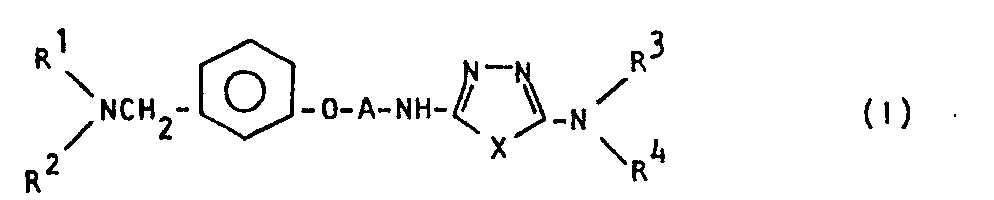
beschrieben, welche eine hohe selektive Wirkung auf Hista- min-H2-Rezeptoren ausüben. Weiterhin werden Verfahren zur Herstellung dieser Verbindungen und diese Verbindungen enthaltende Arzneimittel beschrieben.
Description
- Die Erfindung betrifft neue 3,4-Diazolderivate mit einer hohen selektiven Wirkung auf Histamin-H2-Rezeptoren, Verfahren zu ihrer Herstellung und Arzneimittel, die diese Verbindungen enthalten, sowie schließlich die Verwendung dieser Verbindungen in der Therapie.
- Als Anti-Ulcusmittel haben Cimetidin und Ranitidin bereits Eingang in die Therapie gefunden. Die Halbwertszeiten von Cimetidin und Ranitidin sind jedoch verhältnismäßig kurz. Dadurch wird es nötig, mehrfach täglich Tabletten mit Dosiseinheiten von 160 - 300 mg in einer therapeutisch festgelegten Form zu verabreichen. Es besteht somit ein Bedarf an Anti-Ulcusmitteln, die länger wirken und/oder wirksamer sind als Cimetidin und Ranitidin. Die erfindungsgemäßen Verbindungen zeigen aufgrund ihrer spezifischen Hz-antagonistischen Aktivität eine Hemmung der Magensäuresekretion, wenn diese durch Histaminagonisten stimuliert wird. Ash und Shild, "Brit. J. Pharmacol. Chemother.", 27, 427 (1966) und Black et al., "Nature", 236, 385 (1972).
- Die pharmakologische Aktivität dieser Verbindungen kann nach einer modifizierten Methode gemäß der DE OS 2734070 beim perfundierten Rattenmagen gezeigt werden oder durch die Ermittlung der pA2-Werte in vitro am Meerschweinchenvorhof (vergleiche Ariens, Molec. Pharmac., Band 1, Academic Press,New York, 1964) nachgewiesen werden.
- Weiterhin kann die H2-antagonistische Wirkung an wachen Heidenhain-Pouch-Hunden nach der Methode von Black et al., "Nature" 236, 385 (1972) und an wachen Fistelkatzen gezeigt werden.
- Die neuen Verbindungen antagonisieren weiterhin die Histaminwirkung auf die Kontraktionsfrequenz des isolierten rechten Atriums des Meerschweinchens, aber sie beeinflussen nicht histamininduzierte Kontraktionen des isolierten, glatten gastrointestinalen Muskels, wenn diese durch H2-Agonisten hervorgerufen werden. Nachdem Hemmstoffe für Histamin-HZ-Rezeptoren sowohl bezüglich der basalen Magensäuresekretion als auch der durch Gastrin, Histamin,Metacholin oder Nahrung induzierten Magensäuresekretion Hemmwirkung besitzen, können sie für die Behandlung von peptischen Ulcera, die durch übermäßige Sekretion von Magensäure verursacht sind, und bei der Therapie hyperacider Gastritis verwendet werden.
- Der Erfimdung liegt die Aufgabe zugrunde, neue Hemmstoffe für Histamin- H2-Rezeptroren mit verbesserter und/oder länger anhaltender Wirksamkeit zur Verfüigung zu stellen. Diese Aufgabe wird durch die Erfindunq qelöst.
- Gegenstanid der Erfindung sind daher neue 3,4-Diazolderivate der allgemeinen Formel I

in der R und R2, die gleich oder verschieden sein können, jeweils für Wasserstoff, lineares C1-C10-Alkyl, C5-C6-Cycloalkyl, Amino, C1-C3-Al- kylamino oder Di(C1-C3-alkyl)amino stehen oder R1 und R2 zusammen mit dem Stickstoffatom, an das sie gebunden sind, einen gegebenenfalls ein-oder zweifach mit einer C1-C3-Alkylgruppe substituierten 5- bis 10- gliedrigen stickstoffhaltigen alicyclischen, heterocyclischen Ring bilden, A die Gruppierung -(CH2)n-,

3 oder 4 steht, X ein Sauerstoff- oder Schwefelatom bedeutet, Rund R4, die gleich oder verschieden sein können, jeweils Wasserstoff, lineares oder verzweigtkettiges C1-C6-Alkyl, C5-C6-Cycloalkyl oder eine Benzyl-, Benzoyl- oder Phenylgruppe, die gegebenenfalls durch eine Nitro-, Halogen- oder C1-C3-Alkylgruppe substituiert ist, bedeuten oder R3 und R4 zusammen mit dem Stickstoffatom, an das sie gebunden sind, einen 5- bis 7gliedrigen stickstoffhaltigen alicyclischen, heterocyclischen Ring bilden, sowie ihre physiologisch annehmbaren Salze. In der allgemeinen Formel I bedeuten die Substituenten R und R2, die gleich oder verschieden sein können, jeweils ein Wasserstoffatom, eine lineare C1-C10-Alkylgruppe, vorzugsweise eine lineare C1-C6-Alkylgruppe, ganz besonders bevorzugt eine lineare C1-C3-Alkylgruppe, eine C5-C6-Cycloalkylgruppe, d.h. eine Cyclopentyl- oder Cyclohexylgruppe, eine Aminogruppe, eine C1-C3-Alkylaminogruppe, zum Beispiel eine n- oder i-Propylaminogruppe, eine Ethylaminogruppe oder eine Methylaminogruppe, wobei die Methylaminogruppe bevorzugt wird, oder eine Di-(C1-C3-aliyl)ami2ogruppe, vorzugsweise eine Diethyl- oder Dimethyiamino gruppe. R und R können aber auch zusammen mit dem Stickstoffatom, an das sie gebunden sind, einen gegebenenfalls ein- oder zweifach mit einer CI-C3-Alkylgruppe substituierten 5- bis 10gliedrigen stickstoffhaltigen alicyclischen, heterocyclischen Ring bilden. Dieser Ring kann gegebenenfalls ein oder mehrere weitere Heteroatome, zum Beispiel ein weiteres Stickstoffatom, ein Sauerstoffatom oder ein Schwefelatom, enthalten. Bevorzugte Beispiele für den so definierten 5- bis 10gliedrigen heterocyclischen Ring sind der Pyrrolidin-, Piperidin- und Homopiperidinring. Bevorzugte Beispiele für heterocyclische Ringe, die weitere Heteroatome enthalten, sind der Piperazin- und der Morpholinring. Im Falle einer Ein- oder Zweifachsubstitution am 5- bis lOgliedrigen stickstoffhaltigen alicyclischen, heterocyclischen Ring bedeuten die Substituenten jeweils eine C1-C3-Alkylgruppe, vorzugsweise eine Methylgruppe. So kann zum Beispiel der Pyrrolidin-, Piperidin- oder Homopiperidinring jeweils in 2-, 3- oder 4-Stellung oder bei einer Zweifachsubstitution in 2,5- oder 2,6-Stellung mit einer Methylgruppe substituiert sein. Bevorzugte substituierte stickstoffhaltige 5- bis lOgliedrige alicyclische, heterocyclische Ringe sind zum Beispiel der 3-Methylpyrrolidin-, 3-Methylpiperidin-, 4-Methylpiperidin- oder 3,5-Dimethylpiperidinring, ganz besonders bevorzugt sind der 3-Methylpyrrolidin- und 3-Methylpiperidinring. - A bedeutet eine der folgenden Gruppierungen: -(CH2)n-,


- Eine bevorzugte Gruppe von erfindungsgemäßen Verbindungen ist dadurch gekennzeichnet, daß einer der Substituenten R1 und R2 ein Wasserstoffatom und der andere eine C1-C3-Alkylgruppe, vorzugsweise eine Methylgruppe, ist, wobei A, X, R3 und R4 wie oben definiert sind. Eine weitere bevorzugte Gruppe von erfindungsgemäßen Verbindungen ist dadurch gekennzeichnet, daß R und R2 jeweils für eine C1-C3-Alkylgruppe, insbesondere eine Methylgruppe, stehen, wobei A, X, R3 und R4 wie oben defi- niert sind.
- Die Erfindung umfaßt auch alle stereoisomeren Formen und Hydrate der oben beschriebenen Verbindungen der allgemeinen Formel I.
- Die erfindungsgemäßen Verbindungen können durch ein Verfahren hergestellt werden, das dadurch gekennzeichnet ist, daß man
- (a) zur Herstellung von Verbindungen, bei denen R1, R und A die oben angegebenen Bedeutungen haben, R3 für Wasserstoff steht, R4 lineares oder verzweigtkettiges C1-C6-Alkyl, C5-C6-Cycloalkyl oder eine Benzyl-, Benzoyl- oder Phenylgruppe, die gegebenenfalls durch eine Nitro-, Halogen- oder C1-C3-Alkylgruppe substituiert ist, bedeutet und X für ein Sauerstoff- oder Schwefelatom steht, eine Verbindung der allgemeinen Formel II

in der R1, R2 und A wie oben definiert sind und Y für ein Sauerstoff- oder Schwefelatom steht, mit einem Isocyaniddichlorid der allgemeinen Formel III
in der R4 wie oben definiert ist, zu einer Verbindung der allgemeinen Formel I umsetzt oder daß man - (b) zur Herstellung von Verbindungen, bei denen R , R2 und A die oben angegebenen Bedeutungen haben, R3 und R4, die gleich oder verschieden sein können, jeweils lineares oder verzweigtkettiges C1-C6-Alkyl, C5-C6-Cycloalkyl oder eine Benzyl-, Benzoyl-oder Phenylgruppe, die gegebenenfalls durch eine Nitro-, Halogen- oder C1-C3-Alkylgruppe substituiert ist, bedeuten oder R3 und R4 zusammen mit dem Stickstoffatom, an das sie gebunden sind, einen 5- bis 7gliedrigen stickstoffhaltigen alicyclischen, heterocyclischen Ring bilden und X für ein Schwefelatom steht, eine Verbindung der allgemeinen Formel IV

in der R1, R2, R3, R4 und A wie oben definiert sind und Y und Z jeweils für ein Schwefelatom stehen, mit Hilfe eines Oxidationsmittels zu einer Verbindung der allgemeinen Formel I cyclisiert oder daß man - (c) zur Herstellung von Verbindungen, bei denen R1, R2 und A die oben angegebenen Bedeutungen haben, R3 und R4, die gleich oder verschieden sein können, jeweils lineares oder verzweigtkettiges C1-C6-Alkyl, C5-C6-Cycloalkyl oder eine Benzyl-, Benzoyl-oder Phenylgruppe, die gegebenenfalls durch eine Nitro-, Halogen- oder C1-C3-Alkylgruppe substituiert ist, bedeuten oder R3 und R4 zusammen mit dem Stickstoffatom, an das sie gebunden sind, einen 5- bis 7gliedrigen stickstoffhaltigen alicyclischen, heterocyclischen Ring bilden und X für ein Schwefelatom steht, eine Verbindung der allgemeinen Formel IV

in der R1, R2, R3, R4 und A wie oben definiert sind und entweder Y und Z gleich sind und jeweils für ein Schwefelatom stehen oder Y und Z voneinander verschieden sind und entweder für ein Sauerstoff- oder ein Schwefelatom stehen, mit Phosphoroxychlorid zu einer Verbindung der allgemeinen Formel I cyclisiert oder daß man - -(d) zur Herstellung von Verbindungen, bei denen R1, R2 und A die oben angegebenen Bedeutungen haben, R3 und R4, die gleich oder verschieden sein können, jeweils lineares oder verzweigtkettiges C1-C6-Alkyl, C5-C6-Cycloalkyl oder eine Benzyl-, Benzoyl-oder Phenylgruppe, die gegebenenfalls durch eine Nitro-, Halogen- oder C1-C3-Alkylgruppe substituiert ist, bedeuten oder R3 und R4 zusammen mit dem Stickstoffatom, an das sie gebunden sind, einen 5- bis 7gliedrigen stickstoffhaltigen, alicyclischen, heterocyclischen Ring bilden und X für ein Sauerstoffatom steht, eine Verbindung der allgemeinen Formel IV

in der R1, R 2, R 3, R4 und A wie oben definiert sind und Y und Z jeweils für ein Sauerstoffatom stehen, mit Phosphoroxychlorid zu einer Verbindung der allgemeinen Formel I cyclodehydratisiert oder daß man - (e) zur Herstellung von Verbindungen, bei denen R1, R2 und A die oben angegebenen Bedeutungen haben, R3 und R4 jeweils Wasserstoff bedeuten und X für ein Sauerstoff- oder Schwefelatom steht, eine Verbindung der allgemeinen Formel V

in der R1, R2 und A wie oben definiert sind, durch Hydrolyse zu einer Verbindung der allgemeinen Formel I umsetzt oder daß man - (f) zur Herstellung von Verbindungen, bei denen R1, R2, R3, R 4 und A die oben angegebenen Bedeutungen haben und X für ein Schwefelatom steht, ein Amin der allgemeinen Formel VI

in der R1, R2 und A wie oben definiert sind, mit einem 1,3,4-Thiadiazol-2-amin der allgemeinen Formel VII
in der Hal für ein Halogenatom steht und R3 und R4 wie oben definiert sind, zu einer Verbindung der allgemeinen Formel I umsetzt oder daß man - (g) zur Herstellung von Verbindungen, bei denen R1, R2, R 3, R 4 und A die oben angegebenen Bedeutungen haben und X für ein Schwefelatom steht, eine Verbindung der allgemeinen Formel VIII

in der R1, R2 und A wie oben definiert sind und Hal für ein Halogenatom steht, mit einem Amin der allgemeinen Formel IX
in der R3 und R wie oben definiert sind, zu einer Verbindung der allgemeinen Formel I umsetzt - Die Synthese gemäß der Variante (a) erfolgt in an sich bekannter Weise. Vorteilhafterweise wird die Umsetzung in einem Lösungsmittel, bevorzugt in einem aprotischen Lösungsmittel, zum Beispiel Dioxan oder Tetrahydrofuran, durchgeführt. Die Umsetzung erfolgt vorzugsweise bei erhöhter Temperatur, beispielsweise bei Rückflußtemperatur des verwendeten Lösungsmittels, und nimmt im allgemeinen einen Zeitraum von 1 bis 3 Stunden in Anspruch. Die Isolierung und Aufarbeitung sowie die Reinigung erfolgen ebenfalls in an sich bekannter Weise, beispielsweise durch präparative Schichtchromatographie.
- Die Synthese gemäß der Variante (b) erfolgt ebenfalls in an sich bekannter Weise. Auch hier wird vorzugsweise ein Lösungsmittel, beispielsweise ein aprotisches Lösungsmittel, wie oben definiert, verwendet. Als Oxidationsmittel wird vorzugsweise Hydroperoxid eingesetzt. Die Aufarbeitung und Isolierung erfolgt in an sich bekannter Weise, beispielsweise durch präparative Dickschichtchromatographie.
- Das gleiche gilt für die Varianten (c) bis (g), die ebenfalls in an sich bekannter Weise durchgeführt werden.
- Die Herstellung der unter (a) bis (g) beschriebenen Ausgangsprodukte kann prinzipiell nach bekannten Synthesevorschriften für 1,3,4-Oxa-(thia)diazol-2,5-diamine durchgeführt werden (siehe
- 1. W.R. Sherman in "HeterocyclicCompounds", Bd. 7, 541 - 626 (Hrsg.: R.C. Elderfield, Wiley, New York, 1961)
- 2. J. Sandström in "Advances in Heterocyclic Chemistry", Bd. 9, 165 - 209 (Hrsg.: A.R. Katritzky und A.J. Boulton, Academic Press, New York (1968), Recent advances in the chemistry of 1,3,4-thiadiazoles
- 3. A. Hetzheim und K. Möckel in "Advances in Heterocyclic Chemistry", Bd. 7 (Hrsg.: A.R. Katritzky und A.J. Boulton, Academic Press, New York, 1968)
- 4. G. Werber u.a., J. Heterocycl. Chem. 14, 823 (1977)).
- Es hat sich gezeigt, daß diese Ausgangsprodukte ebenfalls eine gewisse H2-antagonistische Aktivität zeigen, so daß gegebenenfalls deren therapeutische Verwendbarkeit in Betracht gezogen werden könnte.
- Die Erfindung umfaßt neben den stereoisomeren Verbindungen und Hydraten der Substanzen der allgemeinen Formel I auch die physiologisch annehmbaren Salze dieser Verbindungen. Diese Salze können zum Beispiel mit Mineralsäuren, wie Chlor-, Brom-, Jodwasserstoffsäure, Phosphorsäure, Metaphosphorsäure, Salpetersäure oder Schwefelsäure, oder mit organischen Säuren, wie Ameisensäure, Essigsäure, Propionsäure, Phenylessigsäure, Weinsäure, Zitronensäure, Fumarsäure, Methansulfonsäure etc., gebildet werden.
- Wie oben bereits ausgeführt, stellen die erfindungsgemäßen Verbindungen wirksame H2-Antagonisten dar, die anerkannt guten Verbindungen gleicher Wirkungsrichtung, wie beispielsweise dem CIMETIDIN und dem RANITIDIN, überlegen sind.
- Ein weiterer Gegenstand der Erfindung ist daher ein Arzneimittel, insbesondere zur Behandlung von gastrointestinalen Erkrankungen, das dadurch gekennzeichnet ist, daß es als Wirkstoff mindestens eine der oben beschriebenen Verbindungen zusammen mit einem inerten pharmazeutisch annehmbaren Träger oder Verdünnungsmittel enthält.
- Die erfindungsgemäßen Verbindungen können zur Verabreichung in jeder beliebigen Weise formuliert werden. Die Erfindung umfaßt daher auch Arzneimittel, die mindestens eine erfindungsgemäße Verbindung zur Verwendung in der Human- oder Veterinärmedizin enthalten. Solche Arzneimittel können herkömmlicherweise unter Verwendung von einem oder mehreren pharmazeutischen Trägern oder Verdünnungsmitteln hergestellt werden.
- Die erfindungsgemäßen Verbindungen können daher für die orale, bukkale, topische, parenterale oder rektale Verabreichung formuliert werden, wobei die orale Verabreichung bevorzugt wird.
- Für die orale Verabreichung kann das Arzneimittel in Form von beispielsweise Tabletten, Kapseln, Pulvern, Lösungen, Sirups oder Suspensionen vorliegen, die unter Verwendung von annehmbaren Verdünnungsmitteln auf herkömmliche Weise hergestellt worden sind.
- Für die bukkale Verabreichung kann das Arzneimittel die Form von Tabletten oder Briefchen einnehmen, die in herkömmlicher Weise formuliert worden sind.
- Die erfindungsgemäßen Verbindungen können für die parenterale Verabreichung durch Bolusinjektion oder kontinuierliche Infusion formuliert werden. Formulierungen zur Injektion können in Dosiseinheitsform als Ampullen oder in Mehrfachdosenbehältern mit zugesetztem Konservierungsmittel vorliegen.
- Die Arzneimittel können solche Formen, wie Suspensionen, Lösungen oder Emulsionen in öligen oder wäßrigen Trägern, einnehmen, und sie können Formulierungshilfsmittel, wie Suspendierungs-, Stabilisierungs- und/ oder Dispergierungsmittel, enthalten.
- Alternativ kann der Wirkstoff auch in Pulverform zur Rekonstitution mit einem geeigneten Träger, zum Beispiel sterilem, pyrogenfreiem Wasser, vor dem Gebrauch vorliegen.
- Die erfindungsgemäßen Verbindungen können auch für rektale Zubereitungen, zum Beispiel Suppositorien oder Retentionseinläufe, formuliert werden, die zum Beispiel herkömmliche Suppositoriengrundlagen, wie Kakaobutter oder andere Glyceride, enthalten.
- Zur topischen Anwendung können die erfindungsgemäßen Verbindungen als Salben, Cremes, Gels, Lotionen, Pulver oder Sprays in herkömmlicher Weise formuliert werden.
- Für die orale Verabreichung ist eine geeignete Tagesdosis an erfindungsgemäßen Verbindungen 1 bis 4 Dosen bis insgesamt 5 mg bis 1 g/Tag, vorzugsweise 5 bis 250 mg/Tag,.je nach Zustand des Patienten. Im Einzelfall kann es gegebenenfalls erforderlich sein, von den genannten Mengen abzuweichen, und zwar in Abhängigkeit vom individuellen Verhalten gegenüber dem Wirkstoff bzw. der Art seiner Formulierung und dem Zeitpunkt bzw. Intervall, zu welchem die Verabreichung erfolgt. So gibt es zum Beispiel Fälle, wo mit weniger als der oben genannten Mindestmenge ausgekommen werden kann, während in anderen Fällen die genannte obere Grenze überschritten werden muß.
- Die Erfindung wird in den Beispielen erläutert. Die Beispiele 1 bis 4 beschreiben die Herstellung von Ausgangsverbindungen der allgemeinen Formel II. Die Beispiele 5 bis 28 beschreiben die Herstellung von Ausgangsverbindungen der allgemeinen Formel IV. Die Beispiele 29 bis 70 beschreiben die Herstellung der erfindungsgemäßen Verbindungen der allgemeinen Formel I.
- Zu einer Lösung von 10,0 g (40 mmol) 3-[3-(1-Piperidinylmethyl)phenoxy]-1-propanamin in 200 ml absolutem Ether werden bei Raumtemperatur langsam 6,3 g (40 mmol) Chlorameisensäurephenylester getropft. Gleichzeitig mit der zweiten Hälfte des Esters wird eine Lösung von 1,6 g (40 mmol) Natriumhydroxid in 16 ml Wasser zugetropft. Es wird eine Stunde gerührt, anschließend werden die Phasen getrennt. Die Etherphase wird gewaschen, über Natriumsulfat getrocknet und eingeengt. Der ölige Rückstand wird in 250 ml einer Ethanol/Ether-Mischung (1:1) aufgenommen und bei 0°C bis zur vollständigen Fällung des Produkts mit trockenem Chlorwasserstoff begast. Ausbeute: 13 g N-[3-[3-(1-Piperidinylmethyl)phenoxy]propyl]carbamidsäu- rephenylesterhydrochlorid; Schmp.: 144°C C22H28N2O3·HCI (404,9) Berechnet: C 65,3 H 7,22 N 6,92 Gefunden: C 65,2 H 6,97 N 7,09
- 13 g (32 mmol) des so hergestellten Esters werden unter Zugabe von 4,5 ml (32 mmol) Triethylamin in 100 ml Ethanol gelöst, mit 15 g (0,3 mol) Hydrazinhydrat versetzt und 3 Stunden unter Rückfluß erhitzt. Der Ansatz wird im Vakuum eingeengt, überschüssiges Hydrazinhydrat weitgehend abdestilliert. Der ölige Rückstand wird durch Säulenchromatographie gereinigt (Kieselgel; ammoniakgesättigtes Methylenchlorid).
- Ausbeute: 7 g farbloses Öl (72% d.Th.) C16H26N4O2 (306,4) 1H-NMR (CDC13; TMS): δ = 1,3-1,7 (m) (-(CH2)3-) 6H; 1,97 (m) (CH2) 2H; 2,2-2,5 (m) (-(CH2)2-) 4H; 3,1-3,7 (m) (N-CH2, NH2 (austauschbar mit D20)) 4H; 3,37 (s) (CH2) 2H; 4,00 (t) (0-CH2) 2H; 6,34 (t) (NH (austauschbar mit D20)) 1H; 6,6-7,3 (m) (Aromaten-H, NH (austauschbar mit D20)) 5H.
- 2,2 g (8 mmol) 2-Methyl-3-[3-(1-piperidinylmethyl)phenoxyl-1-propanamin in 20 ml Ethanol werden mit 1,9 g (8 mmol) Diphenylcarbonat 12 Stunden bei Raumtemperatur gerührt. Anschließend wird die Lösung mit 4 g Hydrazinhydrat versetzt und eine Stunde unter Rückfluß erhitzt. Die Isolierung erfolgt wie in Beispiel 1 beschrieben.
- Ausbeute: 1,1 g farbloses Öl (43% d.Th.) C17H27N4O2 (319,4)
- 1H-NMR (CDC13; TMS): 6 = 1,33 (d) (CH3) 3H; 1,3-1,7 (m) (-(CH2)3-) 6H; 1 , 9-2 , 5 (m) (-(CH2)2-, CH) 5H; 3,1-3,7 (m) (N-CH 2, NH2 (austauschbar mit D20)) 4H; 3,40 (s) (CH2) 2H; 3,86 (d) (0-CH2) 2H; 6,40 (t) (NH (austauschbar mit D20)) 1H; 6,6-7,3 (m) (Aromaten-H, NH (austauschbar mit D20)) 5H.
- 49,7 g (0,2 mol) 3-[3-(1-Piperidinylmethyl)phenoxYl-1-propanamin in 200 ml Ethanol werden unter heftigem Rühren in eine Mischung aus je 200 ml Ethanol und Schwefelkohlenstoff getropft und über Nacht weitergerührt. Nach Verdampfen des Schwefelkohlenstoffs wird die ethanolische Suspension mit 30 g (0,21 mol) Methyljodid versetzt und bis zur vollständigen Auflösung gerührt. Man engt dann auf ca. 200 ml ein, gibt 50 ml Hydrazinhydrat hinzu und läßt bei Raumtemperatur 48 Stunden stehen. Das entstandene Kristallisat wird abgesaugt und mit kaltem Ethanol gewaschen.
- Ausbeute: 51 g (79% d.Th.) C 16 H 26 N 4 0S (322,5); Schmp.: 116°C (Ethanol)
- Berechnet: C 59,6 H 8,13 N 17,4 Gefunden: C 59,4 H 8,04 N 17,3
- 3,97 g (15 mmol) 1-Amino-3-[3-(1-piperidinylmethyl)phenoxy]-2-propanol werden analog Beispiel 3 umgesetzt. Nach Eindampfen der Reaktionslösung wird der ölige Rückstand mehrmals mit Wasser digeriert, zentrifugiert, getrocknet und mit Ether zur Kristallisation gebracht.
- Ausbeute: 2,5 g (67% d.Th.) C 16 H 26 N 4 0 2S (338,5); Schmp.: 91-93°C (Acetonitril/Ether) Berechnet: C 56,8 H 7,74 N 16,6 Gefunden: C 56,6 H 7,65 N 16,6
- 1,62 g (5 mmol) N-[3-[3-(1-Piperidinylmethyl)phenoxylpropyl]hydrazin- carbothioamid werden in 30 ml THF gelöst, mit 0,44 g (6 mmol) Methylisothiocyanat versetzt und bei Raumtemperatur über Nacht stehen gelassen. Zur Vervollständigung der Fällung wird mit Ether versetzt, der Niederschlag abgesaugt, mit Ether gewaschen und aus Ethanol umkristallisiert. Die Analysenwerte sind in Tabelle I zusammengestellt.
- Die Herstellung erfolgt analog Beispiel 5 aus N-[3-[3-(1-Piperidinyl- methyl)phenoxy]propyl]hydrazincarbothioamid und Ethylisothiocyanat. Die Analysenwerte sind in Tabelle I zusammengestellt.
- Die Herstellung erfolgt analog Beispiel 5 aus N-[3-[3-(1-Piperidinyl- methyl)phenoxylpropyllhydrazincarbothioamid und Cyclohexylisothiocyanat. Die Analysenwerte sind in Tabelle I zusammengestellt.
- Die Herstellung erfolgt analog Beispiel 5 aus N-[3-[3-(1-piperidinyl- methyl)phenoxy]propyl]hydrazincarbothioamid und Benzoylisothiocyanat. Die Analysenwerte sind in Tabelle I zusammengestellt.
- 1,62 g (5 mmol) N-[3-[3-(1-Piperidinylmethyl)phenoxy]propyl]hydrazin- carbothioamid werden in 30 ml THF gelöst, mit 0,40 g (6 mmol) Methylisocyanat versetzt und bei Raumtemperatur über Nacht stehen gelassen. Zur Vervollständigung der Fällung wird mit Ether versetzt, der Niederschlag abgesaugt, mit Ether gewaschen und aus Ethanol umkristallisiert. Die Analysenwerte sind in Tabelle I zusammengestellt.
- Die Herstellung erfolgt analog Beispiel 9 aus N-[3-[3-(1-Piperidinyl- methyl)phenoxylpropyllhydrazincarbothioamid und Ethylisocyanat. Die Analysenwerte sind in Tabelle I zusammengestellt.
- Die Herstellung erfolgt analog Beispiel 9 aus N-[3-[3-(1-Piperidinyl- methyl)phenoxylpropyllhydrazincarbothioamid und Isopropylisocyanat. Die Analysenwerte sind in Tabelle I zusammengestellt.
- Die Herstellung erfolgt analog Beispiel 9 aus N-[3-[3-(1-Piperdinyl- methyl)phenoxy]propyl]hydrazincarbothioamid und n-Butylisocyanat. Die Analysenwerte sind in Tabelle I zusammengestellt.
- Die Herstellung erfolgt analog Beispiel 9 aus N-[3-[3-(1-Piperidinyl- methyl)phenoxy]propyl]hydrazincarbothioamid und Cyclohexylisocyanat. Die Analysenwerte sind in Tabelle I zusammengestellt.
- Die Herstellung erfolgt analog Beispiel 9 aus N-[3-[3-(1-Piperidinyl- methyl)phenoxy]propyl]hydrazincarbothioamid und Benzylisocyanat. Die Analsenwerte sind in Tabelle I zusammengestellt.
- Die Herstellung erfolgt analog Beispiel 9 aus N-[3-[3-(1-Piperidinyl- methyl)phenoxy]propyl]hydrazincarbothioamid und Phenylisocyanat. Die Analysenwerte sind in Tabelle I zusammengestellt.
- Die Herstellung erfolgt analog Beispiel 9 aus N-[3-[3-(1-Piperidinyl- methyl)phenoxy]propyl]hydrazincarbothioamid und 4-Chlorphenylisocyanat. Die Analysenwerte sind in Tabelle I zusammengestellt.
- Zu 1,0 g (3,3 mmol) N-[3-[3-(1-Piperidinylmethyl)phenoxy]propyl]hydra- zincarboxamid in 20 ml THF werden 0,5 g (6,6 mmol) Methylisothiocyanat gegeben und 12 Stunden bei Raumtemperatur gerührt. Der Niederschlag wird abfiltriert und aus Ethanol umkristallisiert. Die Analysenwerte sind in Tabelle I zusammengestellt.
- Die Herstellung erfolgt analog Beispiel 17 aus N-[3-[3-(1-Piperidinyl- methyl)phenoxy]propyl]hydrazincarboxamid und Ethylisothiocyanat. Die Analysenwerte sind in Tabelle I zusammengestellt.
- Die Herstellung erfolgt analog Beispiel 17 aus N-[3-[3-(1-Piperidinyl- methyl)phenoxy]propyl]hydrazincarboxamid und Cyclohexylisothiocyanat. Die Analysenwerte sind in Tabelle I zusammengestellt.
- Zu 2,0 g (6,6 mmol) N-[3-[3-(1-Piperidinylmethyl)phenoxy]propyl]hydra- zincarboxamid in 20 ml THF werden 0,8 ml (13 mmol) Methylisocyanat gegeben und 1 Stunde bei Raumtemperatur gerührt. Der Niederschlag wird abfiltriert und aus Methanol umkristallisiert. Die Analysenwerte sind in Tabelle I zusammengestellt.
- Die Herstellung erfolgt analog Beispiel 20 aus N-[3-[3-(1-Piperidinyl- methyl)phenoxy]propyl]hydrazincarboxamid und Ethylisocyanat. Die Analysenwerte sind in Tabelle I zusammengestellt.
- Die Herstellung erfolgt analog Beispiel 20 aus N-[3-[3-(1-Piperidinyl- methyl)phenoxy]propyl]hydrazincarboxamid und Isopropylisocyanat. Die Analysenwerte sind in Tabelle I zusammengestellt.
- Die Herstellung erfolgt analog Beispiel 20 aus N-[3-(3-(1-Piperidinyl- methyl)phenoxy]propyl]hydrazincarboxamid und Cyclohexylisocyanat. Die Analysenwerte sind in Tabelle I zusammengestellt.
- Die Herstellung erfolgt analog Beispiel 20 aus N-[3-[3-(1-Piperidinyl- methyl)phenoxy]propyl]hydrazincarboxamid und Benzylisocyanat. Die Analysenwerte sind in Tabelle I zusammengestellt.
- Die Herstellung erfolgt analog Beispiel 20 aus N-[3-[3-(1-Piperidinyl- methyl)phenoxy]propyl]hydrazincarboxamid und Phenylisocyanat. Die Analysenwerte sind in Tabelle I zusammengestellt.
- Die Herstellung erfolgt analog Beispiel 20 aus N-[3-[3-(1-Piperidinyl- methyl)phenoxy]propyl]hydrazincarboxamid und 4-Chlorphenylisocyanat. Die Analysenwerte sind in Tabelle I zusammengestellt.


- 1,2 g (4 mmol) N-[3-[3-(1-piperidinylmethyl)phenoxy]propyl]hydrazincar- boxamid in 20 ml Ether werden mit 0,6 ml (4 mmol) Triethylamin und 0,4 ml (4 mmol) N,N-Dimethylcarbamidchlorid versetzt und 12 Stunden gerührt. Festes Triethylammoniumchlorid wird abfiltriert und das Filtrat im Vakuum eingeengt.
- Ausbeute: 1,2 g amorpher Feststoff (80% d.Th.) C19H31N5O3 (377,5)
- 1H-NMR (CDC13; TMS): δ = 1,3-1,7 (m) (-(CH2)3-) 6H; 1,90 (m) (CH2) 2H; 2,2-2,5 (m) (-(CHZ)2-) 4H; 2,87 (s) ((CH3)2) 6H; 3,1-3,7 (m) (N-CH2, NH (austauschbar mit D20)) 3H; 3,57 (s) (CH2) 2H; 3,97 (t) (0-CH2) 2H; 6,27 (t) (NH (austauschbar mit D20)) 1H; 6,6-7,3 (m) (Aromaten-H) 4H; 7,57 (s) (NH (austauschbar mit D20)) 1H.
- 1,62 g (5 mmol) N-[3-[3-(1-Piperidinylmethyl)phenoxy]propyl]hydrazin- carbothioamid in 30 ml THF werden mit 1 ml Triethylamin und 0,6 g (6 mmol) N,N-Dimethylcarbamidchlorid versetzt und 3 Stunden unter Rückfluß erhitzt. Festes Triethylammoniumchlorid wird abfiltriert, das Filtrat eingedampft und der ölige Rückstand mit Ether zur Kristallisation gebracht.
- Ausbeute: 1,5 g (76% d.Th.); Schmp.: 91-94°C (Ethanol/Wasser) C19H31N5O2S (393,6)
- Berechnet: C 58,0 H 7,94 N 17,8 Gefunden: C 58,1 H 7,82 N 17,6
- 1,5 g (5 mmol) N-[3-(3-(1-Piperidinylmethyl)phenoxy]propyl]hydrazin- carboxamid in 30 ml THF werden mit 1,4 ml (10 mmol) Triethylamin und 0,7 ml (5 mmol) Phenylisocyaniddichlorid versetzt und bis zur quantitativen Umsetzung bei Raumtemperatur gerührt. Festes Triethylammoniumchlorid wird abfiltriert, das Filtrat im Vakuum eingedampft und der feste Rückstand aus Ethanol umkristallisiert. Die Analysenwerte sind in Tabelle II zusammengestellt.
- Die Herstellung erfolgt analog Beispiel 29 aus N-[3-[3-(1-Piperidinyl- methyl)phenoxylpropyllhydrazincarboxamid und Benzylisocyaniddichlorid. Die Analysenwerte sind in Tabelle II zusammengestellt.
- Die Herstellung erfolgt analog Beispiel 29 aus N-[3-[3-(1-Piperidinyl- methyl)phenoxylpropyllhydrazincarboxamid und Cyclöhexylisocyaniddichlorid. Die Analysenwerte sind in Tabelle II zusammengestellt.
- Die Herstellung erfolgt analog Beispiel 29 aus N-[3-[3-(1-Piperidinyl- methyl)phenoxy]propyl]hydrazincarbothioamid und Phenylisocyaniddichlorid. Die Analysenwerte sind in Tabelle II zusammengestellt.
- Die Herstellung erfolgt analog Beispiel 29 aus N-[3-[3-(1-Piperidinyl- methyl)phenoxy]propyl]hydrazincarbothioamid und Benzylisocyaniddichlorid. Die Analysenwerte sind in Tabelle II zusammengestellt.

- 0,96 g (3 mmol) N-[2-Methyl-3-[3-(1-piperidinylmethyl)phenoxy]propyll- hydrazincarboxamid werden analog Beispiel. 29 umgesetzt und isoliert.
- Ausbeute: 0,61 g (48% d.Th.); Schmp.: 116°C (Acetonitril) C 24 H 31 N 5 0 2 (421,5) Berechnet: C 68,4 H 7,41 N 16,6 Gefunden: C 68,0 H 7,22 N 16,6
- 0,68 g (2 mmol) N-[2-Hydroxy-3-[3-(1-piperidinylmethyl)phenoxy]propyl]-hydrazincarbothioamid werden analog Beispiel 29 umgesetzt und isoliert.
- Ausbeute: 0,48 g (55% d.Th.); Schmp.: 150-152°C (Acetonitril) C23H29N5O2S (439,6)
- Berechnet: C 62,8 H 6,65 N 15,9 Gefunden: C 62,7 H 6,57 N 16,1
- 1,58 g (4 mmol) N-Methyl-N'-[3-[3-(1-piperidinylmethyl)phenoxy]propyl]-1,2-hydrazindicarbothioamid in 30 ml Ethanol werden mit 2 ml 30%igem Wasserstoffperoxid versetzt und kurz aufgekocht. Der sich abscheidende Schwefel wird unter Verwendung von Aktivkohle heiß abfiltriert, das Filtrat eingedampft und durch präparative Schichtchromatographie gereinigt.
- Ausbeute: 0,8 g farbloser Schaum (55% d.Th.) C18H27N5OS (361,5)
- 1H-NMR (DMSO-d6, TMS): 6 = 1,1-1,7 (m) (-(CH2)3-) 6H; 1,98 (m) (-CH2-) 2H; 2,1-2,4 (m) (-(CH2)2-) 4H; 2,74 (d) (N-CH3) 3H; 3,1-3,6 (m) (N-CH2-) 2H; 3,35 (s) (N-CH2-) 2H; 3,98 (t) (0-CH2-) 2H; 6,5-7,4 (m) (Aromaten-H, (NH)2 (austauschbar mit D20)) 6H.
- 1,64 g (4 mmol) N-Ethyl-N'-[3-[3-(1-piperidinylmethyl)phenoxy]propyl]-1,2-hydrazindicarbothioamid in 30 ml Ethanol werden analog Beispiel 36 umgesetzt und isoliert. Ausbeute: 1,1 g farbloser Schaum (73% d.Th.); Schmp. 102 - 104°C C19H29N5OS (375,5) Berechnet: C 60,8 H 7,78 N 18,6 Gefunden: C 60,6 H 7,87 N 18,4
- 1H-NMR (DMSO-d6, TMS): 6 = 1,13 (t) (C-CH3) 3H; 1,1-1,7 (m)(-(CH2)3-) 6H; 1,98 (m) (-CH2-) 2H; 2,1-2,4 (m) (-(CH2)2-) 4H; 2,9-3,6 (m) ((N-CH2-)2) 4H; 3,35 (s) (N-CH2-) 2H; 3,98 (t) (0-CH2-) 2H; 6,5-7,4 (m) (Aromaten-H, (NH)2 (austauschbar mit D20)) 6H.
- Bei analoger Umsetzung von N-Cyclohexyl-N'-[3-[3-(1-piperidinylmethyl)-phenoxy]propyl]-1,2-hydrazindicarbothioamid erhält man eine Verbindung, die mit dem weiter unten beschriebenen Beispiel 42 identisch ist.
- 2,61 g (5 mmol) N-Benzoyl-N'-[3-[3-(1-piperidinylmethyl)phenoxy]propyl]-1,2-hydrazindicarbothioamidhydrochlorid werden in 50 ml Ethanol unter Erwärmen gelöst und mit 2 ml 30%igem Wasserstoffperoxid versetzt. Nach kurzem Aufkochen der Lösung wird der ausgeschiedene Schwefel abfiltriert, mit Ammoniaklösung das Produkt gefällt und aus Ethanol/Wasser umkristallisiert.
- Ausbeute: 1,65 g (73% d.Th.); Schmp.: 184-186°C (Ethanol) C 24 H 29 N 5 0 2S (451,6)
- Berechnet: C 63,8 H 6,47 N 15,5 Gefunden: C 63,8 H 6,45 N 15,4
- 0,68 g (2 mmol) N-[2-Hydroxy-3-[3-(1-piperidinylmethyl]phenoxy]propyl]-hydrazincarbothioamid in 20 ml THF werden mit 0,33 g (2 mmol) Benzoylisothiocyanat versetzt und bei Raumtemperatur über Nacht gerührt. Nach Verdampfen des THF wird der feste Rückstand mit Ether gewaschen, in 30 ml Ethanol unter Erhitzen gelöst und mit 1 ml 30%igem Wasserstoffperoxid versetzt. Der ausgeschiedene Schwefel wird abfiltriert, das Filtrat eingedampft und der ölige Rückstand durch präparative Schichtchromatographie gereinigt.
- Ausbeute: 0,18 g farbloser Schaum (19% d.Th.) C24H29N5O3S (467,6)
- 1,63 g (4 mmol) N-(1-Methylethyl)-2-[[3-[3-(1-piperidinylmethyl)phenoxy]- propyll-aminothioxomethyl]hydrazincarboxamid werden in 10 ml Phosphoroxychlorid unter schwachem Rückfluß 1 Stunde gerührt. Der Reaktionsansatz wird dann auf 300 ml Eiswasser gegossen und mit konzentrierter Ammoniaklösung auf ca. pH 9 gebracht. Der entstehende Niederschlag wird abgetrennt, mit Wasser gewaschen und aus Acetonitril umkristallisiert. Die Analysenwerte sind in Tabelle III zusammengestellt.
- Die Herstellung erfolgt analog Beispiel 40 aus N-Butyl-2-[[3-[3-(1-pi- peridinylmethyl)phenoxylpropyl]aminothioxomethyllhydrazincarboxamid und Phosphoroxychlorid. Die Analysenwerte sind in Tabelle III zusammengestellt.
- Die Herstellung erfolgt analog Beispiel 40 aus N-Cyclohexyl-2-[[3-[3-(1-piperidinylmethyl)phenoxy]propyl]aminothioxomethyl]hydrazincarboxamid und Phosphoroxychlorid. Die Analysenwerte sind in Tabelle III zusammengestellt.
- Die Herstellung erfolgt analog Beispiel 40 aus N-4-Chlorphenyl-N'-[[3- [3-(1-piperidinylmethyl)phenoxy]propyl]aminothioxomethyl]hydrazincar- boxamid und Phosphoroxychlorid. Die Analysenwerte sind in Tabelle III zusammengestellt.
- Die Herstellung erfolgt analog Beispiel 40 aus N-Methyl-N'-[3-[3-(1-pi- peridinylmethyl)phenoxy]propyl]-1,2-hydrazindicarboxamid und Phosphoroxychlorid. Die Analysenwerte sind in Tabelle III zusammengestellt.
- Die Herstellung erfolgt analog Beispiel 40 aus N-Ethyl-N'-[3-[3-(1-pi- peridinylmethyl)phenoxy]propyl]-1,2-hydrazindicarboxamid und Phosphoroxychlorid. Die Analysenwerte sind in Tabelle III zusammengestellt.
- Die Herstellung erfolgt analog Beispiel 40 aus N-Isopropyl-N'-[3-[3-(1-piperidinylmethyl)phenoxy]propyl]-1,2-hydrazindicarboxamid und Phosphoroxychlorid. Die Analysenwerte sind in Tabelle III zusammengestellt.
- Die Herstellung erfolgt analog Beispiel 40 aus N-4-Chlorphenyl-N'-[3-[3-(1-piperidinylmethyl)phenoxy]propyl]-1,2-hydrazindicarboxamid und Phosphoroxychlorid. Die Analysenwerte sind in Tabelle III zusammengestellt.


- 1,18 g (3 mmol) N,N-Dimethyl-2-[[3-[3-(1-piperidinylmethyl)phenoxy]-propyll-aminothioxomethyllhydrazincarboxamid werden analog Beispiel 40 umgesetzt und isoliert.
- Ausbeute: 0,8 g (71% d.Th.); Schmp.: 128-129°C (Ethanol/Wasser) C19H29N5OS (375,5)
- Berechnet: C 60,8 H 7,78 N 18,6 Gefunden: C 60,5 H 7,76 N 18,8
- 1,13 g (3 mmol) N,N-Dimethyl-N'-[3-[3-(1-piperidinylmethyl)phenoxy]pro- pyll-1,2-hydrazindicarboxamid werden analog Beispiel 40 umgesetzt und isoliert.
- Ausbeute: 0,65 g (60% d.Th.); Schmp.: 132°C zers. (Acetonitril) C19H29N5O2 (359,5)
- Berechnet: C 63,5 H 8,13 N 19,5 Gefunden: C 63,3 H 8,10 N 19,4
- 0,9 g (2 mmol) N-Benzoyl-N'-[3-[3-(1-piperidinylmethyl)phenoxy]propyl]-1,3,4-thiadiazol-2,5-diamin werden in 20 ml konzentrierter Salzsäure 2 Stunden unter Rückfluß erhitzt. Nach Verdampfen der Salzsäure bis zur Trockene wird der feste Rückstand zunächst mit Ether digeriert, dann in wenig Ethanol gelöst, mit konzentrierter Ammoniaklösung das Produkt gefällt und aus Ethanol/Wasser umkristallisiert.
- Ausbeute: 0,5 g (70% d.Th.); Schmp.: 158-159°C (Ethanol/Wasser) C17H25N5OS (347,5)
- Berechnet: C 58,8 H 7,25 N 20,2 Gefunden: C 58,8 H 7,28 N 20,0
- 0,6 g (2,3 mmol) 4-[3-(1-Piperidinylmethyl)phenoxy]-2-buten-1-amin, 0,35 ml Triethylamin und 0,42 g (2,3 mmol) 5-Brom-1,3,4-thiadiazol-2-amin werden in 20 ml THF 3 Stunden unter Rückfluß erhitzt. Festes Triethylammoniumbromid wird abfiltriert, das Filtrat eingedampft und der ölige Rückstand durch präparative Schichtchromatographie gereinigt.
- Ausbeute: 0,25 g (30% d.Th.); Schmp. 131 - 134°C C18H25N5OS (359,4)
- Berechnet: C 60,1 H 7,01 N 19,5 Gefunden: C 60,2 H 7,13 N 19,6
- 1H-NMR (CDC13TMS): δ = 1,2-1,7 (m) (-(CH2)3-) 6H; 2,1-2,6 (m) (-(CH2)2-) 4H; 3,49 (s) (N-CH2-) 2H; 3,6-4,0 (m) (N-CH2-) 2H; 4,15-4,55 (m) (0-CH2-) 2H; 5,83 (m) (CH=CH) 2H; 6,15 (br. s) (NH2 (austauschbar mit D20)); 6,6-7,2 (m) (Aromaten-H, (NH) (austauschbar mit D20)) 5H.
- 0,8 g (3 mmol) 1-Amino-3-[3-(1-piperidinylmethyl)phenoxy]-2-propanol in 20 ml THF werden mit 0,54 g (3 mmol) 5-Brom-1,3,4-thiadiazol-2-amin und 0,45 ml Triethylamin versetzt und analog Beispiel 23 umgesetzt. Das erhaltene Öl wird durch Säulenchromatographie gereinigt (Kieselgel; ammoniakal. Methanol-Chloroform-Lösung (5+95)).
- Ausbeute: 0,3 g (28% d.Th.); Schmp.: 130 - 132° C C17H25N5O2S (363,5)
- Berechnet: C 56,2 H 6,93 N 19,3 Gefunden: C 55,7 H 6,96 N 19,5
- 1H-NMR (d6-DMSO,TMS)δ= 1.25-1.55 (m) (C-(CH2)3-C) 6 H; 2.30 (m) (N(CH2)2) 4 H; 3.32 (m) (CH2-NH) 2 H; 3.37 (s) (N-CH2) 2 H; 3.85-4.10 (m) (0-CH2-CHOH) 3 H; 5.27 (d) 1 H; 6.24 (s) 2 H; 6.78-6.90 (m) 4 H; 7.21 (t) 1 H ppm.
- Die Herstellun erfolgt analog Beispiel 51 aus 2-Methyl-3-[3-(1-piperidinyl- methyl)phenoxy]-1-propanamin und 5-Brom-1,3,4-thiadiazol-2-amin.
- Ausbeute: 74 % d.Th.; Schmp. 133 - 135° C C18H27N5OS (361.5)
- Berechnet: C 59.8 H 7.53 N 19.4 Gefunden: . C 59.8 H 7.49 N 19.4
- 1H-NMR (d6-DMSO, TMS): δ = 1.01 (d) (CH3) 3 H; 1.25-1.55 (m) (C-(CH2)3-C) 6 H; 2.15-2.40 (m) (N(CH2)2, CH-CH3) 5 H; 3.20 (m) (CH2-NH) 2 H; 3.37 (s) (N-CH2) 2 H; 3.85 (m) (0-CH2) 2 H; 6.23 (s) 2 H; 6.78-6.90 (m) 4 H; 7.20 (t) 1 H, ppm.
- Die Herstellun erfolgt analog Beispiel 51 aus 3-[3-[(Dimethylamino) methyl]phenoxy]-1-propanamin und 5-Brom-1,3,4-thiadiazol-2-amin.
- Ausbeute: 38% d.Th.; Schmp. 130 - 131° C C14H21N5OS (307.4)
- Berechnet: C 54.7 H 6.89 N 22.8 Gefunden: C 54.7 H 6.80 N 22.9
- 1H-NMR (d6-DMSO, TMS): δ = 1.97 (quin.) (0-CH2-CH2) 2 H; 2.13 (s) (N(CH3)2) 6 H; 3.29 (q) (CH2-NH) 2 H; 3.34 (s) (N-CH2) 2 H; 4.01 (t) (0-CH2) 2 H; 6.24 (s) 2 H; 6.80-6.90 (m) 4 H; 7.22 (t) 1 H ppm.
- Die Herstellung erfolgt analog Beispiel 51 aus 3-[3-(1-Pyrrolidinylmethyl) phenoxy]-1-propanamin und 5-Brom-1,3,4-thiadiazol-2-amin.
- Ausbeute: 66 % d.Th.; Schmp. 138 - 140° C C16H23N5OS (333.5)
- Berechnet: C 57.6 H 6.95 N 21.0 Gefunden: C 57.6 H 6.75 N 21.0
- 1H-NMR (d6-DMSO, TMS): δ = 1.69 (m) (C-(CH2)2-C) 4 H; 1.97 (quin) (0-CH2-CH2) 2 H; 2.41 (m) (N(CH2)2) 4 H; 3.29 (q) (CH2-NH) 2 H; 3.52 (s) (N-CH2) 2 H; 4.01 (t) (O-CH2) 2 H; 6.24 (s) 2 H; 6.75-6.90 (m) 4 H; 7.21 (t) 1 H ppm.
- Die Herstellung erfolgt analog Beispiel 51 aus 3-[3-(1-Piperidinylmethyl) phenoxy]-1-propanamin und 5-Brom-1,3,4-thiadiazol-2-amin. Das erhaltene Produkt ist identisch mit der in Beispiel 50 beschriebenen Substanz.
- Ausbeute: 55 % d.Th.; Schmp. 158 - 159° C
- Die Herstellung erfolgt analog Beispiel 51 aus 3-[3-[(Hexahydro-1H-azepin-1-yl)methy]phenoxy]-1-propanamin und 5-Brom-1,3,4-thiadiazol-2-amin.
- Ausbeute: 69 % d.Th.; Schmp. 140 - 142° C C18H27N5OS (361.5)
- Berechnet: C 59.8 H 7.53 N 19.4 Gefunden: C 59.7 H 7.46 N 19.6
- 1H-NMR (d6-DMSO, TMS): δ= 1.56 (m) (C-(CH2)4-C) 8 H; 1.97 (quin) (0-CH2-CH2) 2 H; 2.55 (m) (N(CH2)2) 4 H; 3.29 (q) (CH2-NH) 2 H; 3.55 (s) (N-CH2) 2 H; 4.01 (t) (0-CH2) 2 H; 6.24 (s) 2 H; 6.75-6.90 (m) 4 H; 7.21 (t) 1 H ppm.
- Die Herstellung erfolgt analog Beispiel 51 aus 3-[3-(4-Morpholinylmethyl) phenoxy]-1-propanamin und 5-Brom-1,3,4-thiadiazol-2-amin.
- Ausbeute: 60 % d.Th.; Schmp. 170 - 172° C C16H23N5O2S (349.5)
- Berechnet: C 55.0 H 6.63 N 20.0 Gefunden: C 54.9 H 6.57 N 19.8
- 1H-NMR (d6-DMSO, TMS): δ = 1.96 (quin) (O-CH2-CH2) 2 H; 2.33 (m) (N(CH2)2) 4 H; 3.29 (q) (CH2-NH) 2 H; 3.41 (s) (N-CH2) 2 H; 3.57 (m) (O(CH2)2) 4 H; 4.01 (t) (O-CH2) 2 H; 6.25 (s) 2 H; 6.79-6.88 (m) 4 H; 7.22 (t) 1 H ppm.
- Die Herstellung erfolgt analog Beispiel 51 aus 3-[3-[(4-Methyl-1-piperazinyl)methyl]phenoxy]-1-propanamin und 5-Brom-1,3,4-thiadiazol-2-amin.
- Ausbeute: 63 % d.Th.; Schmp. 146 - 148° C C17H26N6OS (362.5)
- Berechnet: C 56.3 H 7.22 N 23.2 Gefunden: C 56.4 H 7.03 N 23.4
- 1H-NMR (d6-DMSO, TMS): δ = 1.97 (quin) (0-CH2-CH2) 2 H; 2.14 (s) (N-CH3) 3 H; 2.20-2.40 (m) (Piperazin) 8 H; 3.29 (q) (CH2-NH) 2 H; 3.40 (s) (N-CH2) 2 H; 4.01 (t) (O-CH2) 2 H; 6.24 (s) 2 H; 6.78-6.87 (m) 4 H; 7.21 (t) 1 H ppm.
- Die Herstellung erfolgt analog Beispiel 40 aus N-[3-[3-(1-Piperidinyl- methyl)phenoxy]propy]-1,2-hydrazindicarboxamid und Phosphoroxychlorid.
- Ausbeute: 25 % d.Th.; Schmp. 114°C C17H25N5O2 (331.4)
- Berechnet: C 61.6 H 7.60 N 21.1 Gefunden: C 61.4 H 7.87 N 20.9
- 1H-NMR (d6-DMSO, TMS): δ= 1.25-1.55 (m) (C-(CH2)3-C) 6 H; 1.96 (quin) (O-CH2CH2) 2 H; 2.30 (m) (N(CH2)2) 4 H; 3.21 (q) (CH2-NH) 2 H; 3.37 (s) (N-CH2) 2 H; 4.00 (t) (0-CH2) 2 H; 6.29 (s) 2 H; 6.75-6.90 (m) 4 H; 7.21 (t) 1 H ppm.
- 7 mmol N-[2-Methyl-3-[3-(1-piperidinylmethyl)phenoxy]propyl]-1,2-hydrazin- dicarboxamid werden in 30 ml Phosphoroxychlorid 6 h bei 50 - 60° C gerührt. Der abgekühlte Ansatz wird auf 300 ml Eiswasser gegossen und unter Kühlung mit konz. Ammoniaklösung neutralisiert. Das Produkt wird mit Ether extrahiert, die vereinigten Etherextrakte gewaschen, getrocknet und eingedampft. Der feste Rückstand wird aus Ether umkristallisiert.
- Ausbeute: 20% d.Th.; Schmp. 92° C C18H27N5O2 (345.5)
- Berechnet: C 62.6 H 7.88 N 20.3 Gefunden: C 62.5 H 7.72 N 20.2
- 1H-NMR (CDC13, TMS): δ = 1.08 (d) (CH3) 3 H; 1.25-1.55 (m) (C-(CH2)3-C) 6 H; 2.10-2.50 (m) (N(CH2)2,CH-CH3) 5 H; 3.15-3.50 (m) (CH2-NH, N-CH2) 4 H; 3.65-4.00 (m) (0-CH2) 2 H; 4.50-5.20 (3H); 6.60-7.30 (m) 4 H ppm.
- Die Herstellung erfolgt analog Beispiel 51 aus 3-[3-(4-Thiomorpholinyl- methyl)phenoxy -1-propanamin und 5-Brom-1,3,4-thiadiazol-2-amin.
- Ausbeute: 58 % d.Th.; Schmp. 158 - 160° C C16H23N5OS2 (365.5)
- Berechnet: C 52.6 H 6.34 N 19.2 Gefunden: C 52.5 H 6.32 N 19.4
- 1H-NMR (d6-DMSO, TMS): δ= 1.97 (quin) (CH2) 2 H; 2.60 (s) (-(CH2)4-) 8 H; 3.29 (q) (CH2) 2 H; 3.45 (s) (CH2) 2 H; 4.01 (t) (CH2) 2 H; 6.25 (s) 2 H; 6.80-6.89 (m) 4 H; 7.22 (t) 1 H ppm.
- Die Herstellung erfolgt analog Beispiel 51 aus 4-[3-(1-Piperidinylmethyl phenoxy]-1-butanamin und 5-Brom-1,3,4-thiadiazol-2-amin.
- Ausbeute: 61 % d.Th.; Schmp. 139° C C18H27N5OS (361.5)
- Berechnet: C 59.8 H 7.53 N 19.4 Gefunden: C 59.9 H 7.45 N 19.5
- 1H-NMR (d6-DMSO, TMS): δ = 1.20-1.67 (m) (-(CH2)3-) 6 H; 1.73 (m) (-(CH2)2-) 4 H; 2.33 (m) (-(CH2)2-) 4 H; 3.20 (m) (-CH2-, N-H) 3 H; 3.40 (s) (-CH2-) 2 H; 4.00 (t) (-0-CH2-) 2 H; 6.17 (s) (-NH2) 2 H; 6.67-7.40 (m) 4 H ppm.
- 24.4 g (0.2 mol) 3-Hydroxybenzaldehyd werden mit 40 ml (ca. 0,4 mol) 3-Methylpiperidin und 20 ml (ca. 0,52 mol) 100 proz. Ameisensäure unter Kühlung gemischt und anschließend 2 h bei 120° C gerührt. Der auf Raumtemperatur abgekühlte Reaktionsansatz wird in Wasser gegossen, mit Ammoniak alkalisiert, der ausgefallene Feststoff abfiltriert und aus Ethanol umkristallisiert.
- Ausbeute: 37 g (90 % d.Th.); Schmp. 155 - 157° C
- Zu einer Suspension von 1.0 g (0.025 mol) Natriumhydrid (60 %) in abs. DMF werden 5.13 g (0.025 mol) 3-[(3-Methylpiperidin-1-yl) methyl phenol eingetragen und über Nacht bei Raumtemperatur gerührt. Nach Zusatz von 2.23 g (0.025 mol) 3-Chlorpropionsäurenitril wird 7 h bei 60° C gerührt, anschließend in Eiswasser gegossen, mit Ether extrahiert und die organische Phase mit 5-proz. NaOH gewaschen. Die Etherphase wird nach Trocknen über Na2SO4 in eine Suspension von 1.14 g (0.03 mol) LiAlH4 in abs. Ether getropft und anschließend mit 2.2 ml H20 hydrolysiert. Nach Abfiltrieren und Einengen des Lösungsmittels i. Vak. verbleiben 2.96 g eines hellgelben Öls.
- Die Herstellung erfolgt analog Beispiel 51 aus 3-[3-[(3-Methylpiperidin-1-yl)methyl]phenoxy]propanamin und 5-Brom-1,3,4-thiadiazol-2-amin.
- Ausbeute: 45 % d.Th.; Schmp. 138,5 - 140,0° C C18H27N5OS (361.5)
- Berechnet: C 59.8 H 7.48 N 19.39 Gefunden: C 59.7 H 7.45 N 19.11
- 1H-NMR (d6-DMSO, TMS): δ= 0.8 (d) 3 H; 1.28-2.16 (m) 10 H; 2.58-2.8 (m) 2 H; 3.27 (t) 2 H; 3.4 (s) 2 H; 4.03 (t) 2 H; 6.27 (s) 2 H; 6.7-7.37 (m) 4 H ppm.
- Herstellung der Vorstufe
- Zu einer Suspension von 1,0 g (0,025 mol) Natriumhydrid (60 %) in abs. DMF werden 5,13 g (0,025 mol) 3-((-Methylpiperidin-1-yl)methyl)phenol (Beispiel 64 a) eingetragen und über Nacht bei Raumtemperatur gerührt. Nach Zusatz von 2,58 g (0,025 mol) 4-Chlorbutyronitril wird 7 h bei 60°C gerührt, anschließend in Eiswasser gegossen, mit Ether extrahiert und die organische Phase mit 5-proz. NaOH gewaschen. Die Etherphase wird nach Trocknen über Na2S04 in eine Suspension von 1,14 g (0,03 mol) LiA1H4 in abs. Ether getropft und anschließend mit 2,2 ml H20 hydrolysiert. Nach Abfiltrieren der Anorganika und Abziehen des Lösungsmittels i. Vak. verbleiben 3,66 g eines hellgelben öls. N-[4-[3-((3-Methylpiperidin-1-yl)methyl)phenoxy]butyl]-1,3,4-thiadiazol-2,5-diamin
- Die Herstellung erfolgt analog Beispiel 51 aus 4-[3-[3-Methylpiperidin-1-yl)methyl]phenoxy]-butanamin und 5-Brom-1,3,4-thiadiazol-2-amin.
- Ausbeute: 54 % d.Th.; Schmp. 123 - 124° C C19H29N5OS (375,5)
- Berechnet: C 60,8 H 7,78 N 18,6 Gefunden: C 60,8 H 7,78 N 18,7
- 1N-NMR (CDC13; TMS) δ = 0.82-0.96 (m) 4 H; 1.52-1.76 (m) 5 H; 1.82-1.94 (m) 5 H; 2.52 (m) 2 H; 3.36 (dt) 2 H'; 3.46 (s) 2 H; 4.0 (t) 2 H; 5.02 (s) 2 H; 5.42 (s) 1 H; 6,8 (m) 1 H; 6,92 (m) 2 H; 7.22 (m) 1 H ppm.
- Herstellung der Vorstufen
- Die Herstellung erfolgt analog Beispiel 64 a aus 3-Methyl-pyrrolidin.
- Ausbeute: 85 % d.Th. (gelbes öl)
- 28,7 g (0,15 mol) 3-[(3-Methylpyrrolidin-1-yl)methy]phenol werden mit 100 ml Acrylnitril und 1,5 ml 40proz. methanol. Benzyltrimethylammoniumhydroxid-Lösung 18 h unter Rückfluß erhitzt. Das überschüssige Acrylnitril wird i. Vak. entfernt, der Rückstand in Ether aufgenommen, mit 5-proz. NaOH gewaschen und mit 7,6 g (0,2 mol) LiAlH4 analog Beispiel 64 b zum Amin reduziert. Man erhält 14,9 g (40 % d.Th.) eines hellgelben öls, das für weitere Umsetzungen rein genug ist.
- N-[3-[3-((3-Methylpyrrolidin-1-yl)methyl)phenoxy]propyl]-1,3,4-thiadiazol-2,5-diamin
- Die Herstellung erfolgt analog Beispiel 51 aus 3-[3-[(3-Methylpyrrolidin-1-yl)methyl]phenoxy]propanamin und 5-Brom-1,3,4-thiadiazoi-2-amin.
- Ausbeute: 48 % d.Th.; Schmp. 116 - 1190 C C17H25N5OS (347,5)
- Berechnet: C 58,8 H 7,25 N 20,2 Gefunden: C 58,7 H 7,24 N 20,1
- 1H-NMR (CDCl3, TMS): δ= 1.0 (d) 3 H; 1.24 (m) 1 H; 1.96-2.34 (m) 5 H; 2.46 (m) 1 H; 2.74 (m) 1 H; 2.84'(m) 1 H; 3,5 (dt) 2 H; 3.56 (s) 2 H; 4.08 (t) 2 H; 4,8 (s) 2 H; 5.36 (s) 1 H; 6.79 (m) 1 H; 6.91 (m) 2 H; 7.21 (m) 1 H ppm.
- Die Darstellung erfolgt analog Beispiel 65 a aus 3-[(3-Methylpyrrolidin-1-yl)methyl]phenol. Man erhält ein hellgelbes öl, das für weitere Umsetzungen rein genug ist. Ausbeute: 60% d.Th.
- N-[4-[3-((3-Methylpyrrolidin-1-yl)methyl)phenoxy]butyl]-1,3,4-thiadiazol-2,5-diamin
- Die Herstellung erfolgt analog Beispiel 51 aus 4-[3-[(3-Methylpyrrolidin-1-yl)methy]phenoxy]-butanamin und 5-Brom-1,3,4-thiadiazol-2-amin.
- Ausbeute: 50 % d.Th.; Schmp. 118 - 119°C
- C18H27N5OS (361,5) Berechnet: C 59,8 H 7,52 N 19,4 Gefunden: C 59,8 H 7,66 N 19,3
- 1H-NMR (CDCl3, TMS): δ = 1.0 (d) 3H; 1.26-1.4 (m) 1 H; 1.78-1.92 (m) 4 H; 1.94-2.1 (m) 2 H; 2.18-2.34 (m) 1 H; 2.38-2.5 (m) 1 H; 2.68-2.78 (m) 1 H; 2.8-2.88 (m) 1 H; 3.36 (dt) 2 H; 3.58 (s) 2 H; 4.0 (t) 2 H; 4.9 (s) 2 H; 5.28 (s) 1 H; 6.78 (m) 1 H; 6.9 (m) 2 H; 7.22 (m) 1 H ppm.
- Die Herstellung erfolgt analog Beispiel 51 aus 3-[3-[(2,6-Dimethyl-1-piperidinyl)methyl]phenoxy]-1-propanamin und 5-Brom-1,3,4-thiadiazol-2-amin.
- Ausbeute: 43 % d.Th.; Schmp. 149 - 151° C C19H29N5OS (375.5)
- Berechnet: C 60.8 H 7.78 N 18.6 Gefunden: C 60.7 H 7.64 N 18.7
- 1H-NMR(d6-DMSO, TMS): δ = 0.94 (d) (CH3) 6 H; 1.15-1.65 (m) ((CH2)3) 6 H; 1.97 (quin) (CH2) 2 H; 2.43 (m) (N(CH2)2 2 H; 3.29 (q) (CH2) 2 H; 3.66 (s) (N-CH2) 2 H; 4.00 (t) (CH2) 2 H; 6.24 (s) 2 H; 6.73-6.95 (m) 4 H; 7.18 (t) 1 H ppm.
- Die Herstellung erfolgt analog Beispiel 51 aus 3-[3-[3,5-Dimethyl-1-piperidinyl)methyl]phenoxy]-1-propanamin und 5-Brom-1,3,4-thiadiazol-2-amin.
- Ausbeute: 46 % d. Th.; Schmp. 112 - 1160 C C19H29N5OS (375.5)
- Berechnet: C 60.8 H 7.78 N 18.6 Gefunden: C 60.7 H 7.77 N 18.6
- 1H-NMR (CDOCl3, TMS): δ= 0.50-2.90 (m) 16 H; 3.45 (s) (N-CH2) 2 H; 3.51 (t) (CH2-NH) 2 H; 4.08 (t) (0-CH2) 2 H; 4.60-4.90 2 H; 5.10-5.40 1 H; 6.74-6.93 (m) 3 H; 7.22 (t) 1 H ppm.
- Die Herstellung erfolgt analog Beispiel 51 aus 3-[3-[(4-Methyl-1-piperidinyl) methyl phenoxy]-1-propanamin und 5-Brom-1,3,4-thiadiazol-2-amin.
- Ausbeute: 64 % d.Th.; Schmp. 141 - 143°C C18H27N5OS (361.5)
- Berechnet: C 59.8 H 7.53 N 19.4 Gefunden: C 59.8 H 7.29 N 19.3
- 1H-NMR (CDCl3, TMS): δ = 0.91 (d) (CH3) 3 H; 1.15-2.00 (m) 7 H; 2.12 (quin) (0-CH2-CH2) 2 H; 2.84 (m) 2 H; 3.45 (s) (N-CH2) 2 H; 3.51 (t) (CH2-NH) 2 H; 4.08 (t) (0-CH2) 2 H; 4.60-4.80 2 H; 5.10-5.40 1 H; 6.75-6.92 (m) 3 H; 7.21 (t) 1 H ppm.
und daß man die in den Stufen (a) bis (g) erhaltene Verbindung gegebenenfalls in ihr physiologisch unbedenkliches Salz umwandelt.
Claims (11)

in der R1 und R2, die gleich oder verschieden sein können, jeweils für Wasserstoff, lineares C1-C10-Alkyl, C5-C6-Cycloalkyl, Amino, C1-C3-Al- kylamino oder Di(C1-C3-alkyl)amino stehen oder R1 und R2 zusammen mit dem Stickstoffatom, an das sie gebunden sind, einen gegebenenfalls ein-oder zweifach mit einer C1-C3-Alkylgruppe substituierten 5- bis 10- gliedrigen stickstoffhaltigen alicyclischen, heterocyclischen Ring bilden, A die Gruppierung -(CH2)n-,


in der R4 wie oben definiert ist, zu einer Verbindung der allgemeinen Formel I umsetzt oder daß man

in der R1, R2, R3, R4 und A wie oben definiert sind und Y und Z jeweils für ein Schwefelatom stehen, mit Hilfe eines Oxidationsmittels zu einer Verbindung der allgemeinen Formel I cyclisiert oder daß man

in der R 1, R2, R3, R und A wie oben definiert sind und entweder Y und Z gleich sind und jeweils für ein Schwefelatom stehen oder Y und Z voneinander verschieden sind und entweder für ein Sauerstoff- oder ein Schwefelatom stehen, mit Phosphoroxychlorid zu einer Verbindung der allgemeinen Formel I cyclisiert oder daß man

in der R 1, R 2, R3, R4 und A wie oben definiert sind und Y und Z jeweils für ein Sauerstoffatom stehen, mit Phosphoroxychlorid zu einer Verbindung der allgemeinen Formel I cyclodehydratisiert oder daß man

1 2 in der R1, R2 und A wie oben definiert sind, durch Hydrolyse zu einer Verbindung der allgemeinen Formel I umsetzt oder daß man

in der R1, R2 und A wie oben definiert sind, mit einem 1,3,4-Thiadiazol-2-amin der allgemeinen Formel VII

in der Hal für ein Halogenatom steht und R3 und R4 wie oben definiert sind, zu einer Verbindung der allgemeinen Formel I umsetzt oder daß man

in der R1, R2 und A wie oben definiert sind und Hal für ein Halogenatom steht, mit einem Amin der allgemeinen Formel IX

in der R3 und R4 wie oben definiert sind, zu einer Verbindung der allgemeinen Formel I umsetzt
und daß man die in den Stufen (a) bis (g) erhaltene Verbindung gegebenenfalls in ihr physiologisch unbedenkliches Salz umwandelt.

in der R1 und R2, die gleich oder verschieden sein können, jeweils für Wasserstoff, lineares C1-C10-Alkyl, C5-C6-Cycloalkyl, Amino, C1-C3-Al- kylamino oder Di(C1-C3-alkyl)amino stehen oder R1 und R2 zusammen mit dem Stickstoffatom, an das sie gebunden sind, einen gegebenenfalls ein-oder zweifach mit einer C1-C3-Alkylgruppe substituierten 5- bis 10- gliedrigen stickstoffhaltigen alicyclischen, heterocyclischen Ring bilden, A die Gruppierung -(CH2)n-,


3 oder 4 steht, X ein Sauerstoff- oder Schwefelatom bedeutet, R3 und R4, die gleich oder verschieden sein können, jeweils Wasserstoff, lineares oder verzweigtkettiges C1-C6-Alkyl, C5-C6-Cycloalkyl oder eine Benzyl-, Benzoyl- oder Phenylgruppe, die gegebenenfalls durch eine Nitro-, Halogen- oder C1-C3-Alkylgruppe substituiert ist, bedeuten oder R3 und R4 zusammen mit dem Stickstoffatom, an das sie gebunden sind, einen 5- bis 7gliedrigen stickstoffhaltigen alicyclischen, heterocyclischen Ring bilden, sowie ihrer physiologisch annehmbaren Salze, dadurch gekennzeichnet , daß man

in der Rl, R2 und A wie oben definiert sind und Y für ein Sauerstoff- oder Schwefelatom steht, mit einem Isocyaniddichlorid der allgemeinen Formel III

in der R4 wie oben definiert ist, zu einer Verbindung der allgemeinen Formel I umsetzt oder daß man

in der R 1, R2, R 3, R 4 und A wie oben definiert sind und Y und Z jeweils für ein Schwefelatom stehen, mit Hilfe eines Oxidationsmittels zu einer Verbindung der allgemeinen Formel I cyclisiert oder daß man

in der R 1, R 2, R 3, R4 und A wie oben definiert sind und entweder Y und Z gleich sind und jeweils für ein Schwefelatom stehen oder Y und Z voneinander verschieden sind und entweder für ein Sauerstoff-oder ein Schwefelatom stehen, mit Phosphoroxychlorid zu einer Verbindung der allgemeinen Formel I cyclisiert oder daß man

in der R1, R 2, R 3, R4 und A wie oben definiert sind und Y und Z jeweils für ein Sauerstoffatom stehen, mit Phosphoroxychlorid zu einer Verbindung der allgemeinen Formel I cyclodehydratisiert oder daß man

in der R1, R2 und A wie oben definiert sind, durch Hydrolyse zu einer Verbindung der allgemeinen Formel I umsetzt oder daß man

in der R1, R2 und A wie oben definiert sind, mit einem 1,3,4-Thiadiazol-2-amin der allgemeinen Formel VII

in der Hal für ein Halogenatom steht und R3 und R4 wie oben definiert sind, zu einer Verbindung der allgemeinen Formel I umsetzt oder daß man

in der R1, R und A wie oben definiert sind und Hal für ein Halogenatom steht, mit einem Amin der allgemeinen Formel IX

in der R3 und R4 wie oben definiert sind, zu einer Verbindung der allgemeinen Formel I umsetzt
und daß man die in den Stufen (a) bis (g) erhaltene Verbindung gegebenenfalls in ihr physiologisch unbedenkliches Salz umwandelt.


Applications Claiming Priority (2)
| Application Number | Priority Date | Filing Date | Title |
|---|---|---|---|
| DE19843441086 DE3441086A1 (de) | 1984-11-09 | 1984-11-09 | 3,4-diazolderivate, verfahren zu ihrer herstellung und diese verbindungen enthaltende arzneimittel |
| DE3441086 | 1984-11-09 |
Publications (2)
| Publication Number | Publication Date |
|---|---|
| EP0180754A2 true EP0180754A2 (de) | 1986-05-14 |
| EP0180754A3 EP0180754A3 (de) | 1987-02-25 |
Family
ID=6249961
Family Applications (1)
| Application Number | Title | Priority Date | Filing Date |
|---|---|---|---|
| EP85112139A Withdrawn EP0180754A3 (de) | 1984-11-09 | 1985-09-25 | 3,4-Diazolderivate, Verfahren zu ihrer Herstellung und diese Verbindungen enthaltende Arzneimittel |
Country Status (15)
| Country | Link |
|---|---|
| US (1) | US4727081A (de) |
| EP (1) | EP0180754A3 (de) |
| JP (1) | JPS61115074A (de) |
| KR (1) | KR860004040A (de) |
| AU (1) | AU575441B2 (de) |
| DE (1) | DE3441086A1 (de) |
| DK (1) | DK512185A (de) |
| ES (4) | ES8609315A1 (de) |
| GR (1) | GR852687B (de) |
| HU (1) | HU194197B (de) |
| IL (1) | IL76818A (de) |
| NZ (1) | NZ214097A (de) |
| PT (1) | PT81427B (de) |
| YU (1) | YU173585A (de) |
| ZA (1) | ZA858194B (de) |
Cited By (1)
| Publication number | Priority date | Publication date | Assignee | Title |
|---|---|---|---|---|
| CN101863852A (zh) * | 2010-06-29 | 2010-10-20 | 沈阳航空航天大学 | 含1,3,4-噁二唑杂环结构芳香二元胺及其制备方法 |
Families Citing this family (2)
| Publication number | Priority date | Publication date | Assignee | Title |
|---|---|---|---|---|
| DE3513184A1 (de) * | 1985-04-12 | 1986-10-16 | Ludwig Heumann & Co GmbH, 8500 Nürnberg | 1,3,4-thiadiazolderivate, verfahren zu ihrer herstellung und diese verbindungen enthaltende arzneimittel |
| WO2022034121A1 (en) | 2020-08-11 | 2022-02-17 | Université De Strasbourg | H2 blockers targeting liver macrophages for the prevention and treatment of liver disease and cancer |
Family Cites Families (4)
| Publication number | Priority date | Publication date | Assignee | Title |
|---|---|---|---|---|
| EP0048555B1 (de) * | 1980-08-27 | 1985-12-04 | Glaxo Group Limited | Amino-1,2,4-triazol-Derivate, Verfahren zu ihrer Herstellung und diese enthaltende pharmazeutische Zusammensetzungen |
| JPS59196879A (ja) * | 1983-04-08 | 1984-11-08 | Wakamoto Pharmaceut Co Ltd | 新規な1,3,4−チアジアゾ−ル誘導体 |
| JPS6067474A (ja) * | 1983-09-24 | 1985-04-17 | Wakamoto Pharmaceut Co Ltd | 新規な1,3,4−チアジアゾ−ル誘導体及びそれを有効成分とする抗潰瘍剤 |
| JPS60255756A (ja) * | 1984-06-01 | 1985-12-17 | Ikeda Mohandou:Kk | アミノアルキルフエノキシ誘導体 |
-
1984
- 1984-11-09 DE DE19843441086 patent/DE3441086A1/de not_active Withdrawn
-
1985
- 1985-09-25 EP EP85112139A patent/EP0180754A3/de not_active Withdrawn
- 1985-10-25 ZA ZA858194A patent/ZA858194B/xx unknown
- 1985-10-25 IL IL76818A patent/IL76818A/xx unknown
- 1985-10-28 ES ES548289A patent/ES8609315A1/es not_active Expired
- 1985-11-04 PT PT81427A patent/PT81427B/de unknown
- 1985-11-04 AU AU49333/85A patent/AU575441B2/en not_active Ceased
- 1985-11-05 JP JP60248682A patent/JPS61115074A/ja active Pending
- 1985-11-06 NZ NZ214097A patent/NZ214097A/xx unknown
- 1985-11-06 YU YU01735/85A patent/YU173585A/xx unknown
- 1985-11-06 DK DK512185A patent/DK512185A/da not_active Application Discontinuation
- 1985-11-06 HU HU854271A patent/HU194197B/hu not_active IP Right Cessation
- 1985-11-06 GR GR852687A patent/GR852687B/el unknown
- 1985-11-07 US US06/795,992 patent/US4727081A/en not_active Expired - Fee Related
- 1985-11-07 KR KR1019850008306A patent/KR860004040A/ko not_active Withdrawn
-
1986
- 1986-04-30 ES ES554601A patent/ES8704487A1/es not_active Expired
- 1986-04-30 ES ES554603A patent/ES8704489A1/es not_active Expired
- 1986-04-30 ES ES554602A patent/ES8704488A1/es not_active Expired
Cited By (2)
| Publication number | Priority date | Publication date | Assignee | Title |
|---|---|---|---|---|
| CN101863852A (zh) * | 2010-06-29 | 2010-10-20 | 沈阳航空航天大学 | 含1,3,4-噁二唑杂环结构芳香二元胺及其制备方法 |
| CN101863852B (zh) * | 2010-06-29 | 2011-09-21 | 沈阳航空航天大学 | 含1,3,4-噁二唑杂环结构芳香二元胺及其制备方法 |
Also Published As
| Publication number | Publication date |
|---|---|
| IL76818A (en) | 1990-06-10 |
| HUT40427A (en) | 1986-12-28 |
| ES554603A0 (es) | 1987-04-16 |
| US4727081A (en) | 1988-02-23 |
| AU4933385A (en) | 1986-05-15 |
| JPS61115074A (ja) | 1986-06-02 |
| PT81427A (de) | 1985-12-01 |
| ES8704489A1 (es) | 1987-04-16 |
| ES8704488A1 (es) | 1987-04-16 |
| NZ214097A (en) | 1988-08-30 |
| DE3441086A1 (de) | 1986-05-15 |
| ES554602A0 (es) | 1987-04-16 |
| KR860004040A (ko) | 1986-06-16 |
| ZA858194B (en) | 1986-06-25 |
| ES8704487A1 (es) | 1987-04-16 |
| DK512185D0 (da) | 1985-11-06 |
| YU173585A (en) | 1988-04-30 |
| HU194197B (en) | 1988-01-28 |
| ES548289A0 (es) | 1986-09-01 |
| GR852687B (de) | 1986-03-11 |
| ES554601A0 (es) | 1987-04-16 |
| AU575441B2 (en) | 1988-07-28 |
| IL76818A0 (en) | 1986-02-28 |
| ES8609315A1 (es) | 1986-09-01 |
| EP0180754A3 (de) | 1987-02-25 |
| DK512185A (da) | 1986-05-10 |
| PT81427B (de) | 1987-04-09 |
Similar Documents
| Publication | Publication Date | Title |
|---|---|---|
| DE2951675C2 (de) | Guanidinothiazolverbindungen, Verfahren zu deren Herstellung und Arzneimittelzubereitungen | |
| DE2734070A1 (de) | Aminoalkylfuranderivate, verfahren zu ihrer herstellung und diese verbindungen enthaltende arzneimittel | |
| EP1261593B1 (de) | 8,8a-dihydro-indeno 1,2-d]thiazol-derivate, die in 2-stellung einen substituenten mit einer sulfonamidstruktur oder sulfonstruktur tragen; verfahren zu ihrer herstellung und ihre verwendung als arzneimittel | |
| EP0262448A1 (de) | Imidazolylguanidinderivate, Verfahren zu ihrer Herstellung und diese Verbindungen enthaltende Arzneimittel | |
| DE2847792C2 (de) | ||
| DE2344833A1 (de) | Guanidine, ihre salze, verfahren zu ihrer herstellung und diese verbindungen enthaltende arzneimittel | |
| EP0526395A1 (de) | Arylalkylaminderivate, Verfahren zu ihrer Herstellung und diese Verbindungen enthaltende Arzneimittel | |
| DE3336409A1 (de) | Chinazolinderivate, verfahren zu ihrer herstellung und diese verbindungen enthaltende arzneimittel | |
| EP0158789A1 (de) | Diaminderivate, Verfahren zu ihrer Herstellung und diese Verbindungen enthaltende Arzneimittel | |
| EP0154721A1 (de) | Neue Alkanolderivate, Verfahren zu ihrer Herstellung und diese Verbindungen enthaltendes Arzneimittel | |
| DE2514334A1 (de) | Neue pyridinderivate, verfahren zu deren herstellung und ihre verwendung in pharmazeutischen zusammensetzungen | |
| EP0302164B1 (de) | Guanidincarbonsäureester, Verfahren zu ihrer Herstellung und diese Verbindungen enthaltende Arzneimittel | |
| DE3441086A1 (de) | 3,4-diazolderivate, verfahren zu ihrer herstellung und diese verbindungen enthaltende arzneimittel | |
| DE68924416T2 (de) | Carboximidamid-Derivate. | |
| EP0197189A2 (de) | 1,3,4-Thiadiazolderivate, Verfahren zu ihrer Herstellung und diese Verbindungen enthaltende Arzneimittel | |
| EP0073931B1 (de) | Neue Anilino-1,2,3-triazol-Derivate, diese enthaltende Arzneimittel sowie Verfahren zu deren Herstellung und deren Verwendung | |
| DE2331721A1 (de) | Verfahren zur herstellung neuer heterocyclischer verbindungen | |
| EP0141119A2 (de) | Sulfenamidderivate, Verfahren zu ihrer Herstellung und diese Verbindungen enthaltende Arzneimittel | |
| EP0132541A2 (de) | Propan-2-ol-Derivate, Verfahren zu ihrer Herstellung und diese Verbindungen enthaltende Arzneimittel | |
| EP0434982B1 (de) | 5-(Amino)-triazolylcarbothioamidderivate, Verfahren zu ihrer Herstellung und diese enthaltende Arzneimittel sowie Verwendung der ersteren | |
| DE3341750A1 (de) | 1,2,4-triazolderivate, verfahren zu ihrer herstellung und diese verbindungen enthaltende arzneimittel | |
| EP0158083A2 (de) | Arzneimittel | |
| DE3438073A1 (de) | Butenylderivate, verfahren zu ihrer herstellung und diese verbindungen enthaltende arzneimittel | |
| DE3421386A1 (de) | Neue n-pyrazolyl-1,2-benzothiazin-3-carboxamide und diese enthaltende pharmazeutische praeparate | |
| DE4119755A1 (de) | Aminoalkylsubstituierte 2-amino-1,3,4-thiadiazole, ihre herstellung und verwendung |
Legal Events
| Date | Code | Title | Description |
|---|---|---|---|
| PUAI | Public reference made under article 153(3) epc to a published international application that has entered the european phase |
Free format text: ORIGINAL CODE: 0009012 |
|
| AK | Designated contracting states |
Kind code of ref document: A2 Designated state(s): AT BE CH DE FR GB IT LI LU NL SE |
|
| PUAL | Search report despatched |
Free format text: ORIGINAL CODE: 0009013 |
|
| AK | Designated contracting states |
Kind code of ref document: A3 Designated state(s): AT BE CH DE FR GB IT LI LU NL SE |
|
| 17P | Request for examination filed |
Effective date: 19870626 |
|
| 17Q | First examination report despatched |
Effective date: 19890410 |
|
| STAA | Information on the status of an ep patent application or granted ep patent |
Free format text: STATUS: THE APPLICATION IS DEEMED TO BE WITHDRAWN |
|
| 18D | Application deemed to be withdrawn |
Effective date: 19890821 |
|
| RIN1 | Information on inventor provided before grant (corrected) |
Inventor name: SCHICKANEDER, HELMUT, DR. DIPL.-CHEM. Inventor name: SZELENYI, ISTVAN, DR. Inventor name: WEGNER, KURT, DR. Inventor name: KRAEMER, IRENE Inventor name: AHRENS, KURT HENNING, DR. Inventor name: SCHUNACK, HELMUT, PROF. DR. |