EP0173984A2 - System zur Steuerung der ISDN-Aktivierungsablauffolge - Google Patents
System zur Steuerung der ISDN-Aktivierungsablauffolge Download PDFInfo
- Publication number
- EP0173984A2 EP0173984A2 EP85110979A EP85110979A EP0173984A2 EP 0173984 A2 EP0173984 A2 EP 0173984A2 EP 85110979 A EP85110979 A EP 85110979A EP 85110979 A EP85110979 A EP 85110979A EP 0173984 A2 EP0173984 A2 EP 0173984A2
- Authority
- EP
- European Patent Office
- Prior art keywords
- terminal
- network
- signal
- exchange
- network terminal
- Prior art date
- Legal status (The legal status is an assumption and is not a legal conclusion. Google has not performed a legal analysis and makes no representation as to the accuracy of the status listed.)
- Withdrawn
Links
Images






Classifications
-
- H—ELECTRICITY
- H04—ELECTRIC COMMUNICATION TECHNIQUE
- H04L—TRANSMISSION OF DIGITAL INFORMATION, e.g. TELEGRAPHIC COMMUNICATION
- H04L12/00—Data switching networks
-
- H—ELECTRICITY
- H04—ELECTRIC COMMUNICATION TECHNIQUE
- H04Q—SELECTING
- H04Q11/00—Selecting arrangements for multiplex systems
- H04Q11/04—Selecting arrangements for multiplex systems for time-division multiplexing
- H04Q11/0428—Integrated services digital network, i.e. systems for transmission of different types of digitised signals, e.g. speech, data, telecentral, television signals
-
- H—ELECTRICITY
- H04—ELECTRIC COMMUNICATION TECHNIQUE
- H04L—TRANSMISSION OF DIGITAL INFORMATION, e.g. TELEGRAPHIC COMMUNICATION
- H04L12/00—Data switching networks
- H04L12/02—Details
- H04L12/12—Arrangements for remote connection or disconnection of substations or of equipment thereof
-
- Y—GENERAL TAGGING OF NEW TECHNOLOGICAL DEVELOPMENTS; GENERAL TAGGING OF CROSS-SECTIONAL TECHNOLOGIES SPANNING OVER SEVERAL SECTIONS OF THE IPC; TECHNICAL SUBJECTS COVERED BY FORMER USPC CROSS-REFERENCE ART COLLECTIONS [XRACs] AND DIGESTS
- Y10—TECHNICAL SUBJECTS COVERED BY FORMER USPC
- Y10S—TECHNICAL SUBJECTS COVERED BY FORMER USPC CROSS-REFERENCE ART COLLECTIONS [XRACs] AND DIGESTS
- Y10S379/00—Telephonic communications
- Y10S379/902—Auto-switch for an incoming voice data, or fax telephone call, e.g. comp/fax/tel
Definitions
- the present invention relates to a system for controlling a network activation sequence in an integrated service digital network (ISDN), more particularly to the system for controlling the network activation sequence between a network terminal and an exchange terminal.
- ISDN integrated service digital network
- terminal equipment such as a telephone or a data terminal is connected via a network terminal to an exchange terminal.
- the transmission line between the terminal equipment and network termination and the transmission line between the network termination and exchange terminal known as the "physical layer" provide the physical transmission lines between the network side and the user side.
- the transmission lines are placed in a deactivated state when idle, i.e., when awaiting use. This is basically to decrease power consumption as much as possible. Therefore, to enable actual communication between the network side and the user side, the transmission lines must be switched from the deactivated state to the activated state.
- the International Consultative Committee for Telephone and Telephone (CCITT) is conducting studies with the eventual aim of prescribing the S/T point in this standard construction, that is, the signal sequences of only private subscriber lines between the terminal equipment and network terminal. It does not intend to prescribe the U point, that is, between the network terminal and the exchange equipment. With respect to the activation sequences at the S/T point, the CCITT is moving in the direction of issuing some specific recommendations, as mentioned later.
- a two-wire time-division transmission system (so called as "ping-pong" transmission system) is used for the digital subscriber transmission system.
- two wires are used to connect the network terminal and the exchange terminal, enabling alternate transmission and reception of digital signals in a burst manner.
- Network terminal apparatuses are provided in the exchange terminal and in the network terminal respectively.
- the receiving level of a signal receiving equalizer provided in the network terminal apparatus is set before the transmission of information, so that the exchange terminal side and the network terminal side are set to the most suitable receiving level state. This is done by a training pattern sent between the network terminal side and the exchange terminal side.
- a training pattern is usually sent from the exchange terminal side when it is not in the communication state.
- the network terminal side network terminal apparatus receives this training pattern to set the receiving level of the equalizer.
- the network terminal side is thus continuously held in the synchronized state.
- the network terminal side network terminal apparatus does not send out any signal at all to the transmission line.
- the network terminal side network terminal apparatus when the network terminal side network terminal apparatus is activated from the exchange terminal side or it is activated from the network terminal side, it sends out the training pattern, by which the receiving equalizer in the exchange terminal side network terminal apparatus sets the receiving level.
- the receiving level of each equalizer is set in the exchange terminal side and the network terminal side, the exchange terminal side and the network terminal side become synchronized and communication is carried out.
- the receiving level of the equalizer is set in the network terminal side network terminal apparatus by the training pattern from the exchange terminal side, so setting of the receiving level is not carried out.
- an input signal is supplied to the receiving equalizer of the exchange terminal side network apparatus due to various causes. That is, in the ping-pong transmission system, the transmission line is used by time division, and transmission and the reception are switched with burst periods. At this time, noise generates at the time of switching between transmission and reception. Further, the training pattern leaks via a transformer, which connects the sending side and the receiving side in the network terminal apparatus to the line. Thus, the receiving level of the exchange terminal side receiving equalizer is undesirably set.
- the levels of these signals are usually high, so, if the receiving level of the equalizer in the exchange terminal side is set by these signals, when synchronization is established in the exchange terminal side by the start signal from the network terminal and the training pattern, the problem arises that the exchange terminal side cannot receive the signal attenuated by the transmission line from the terminal side.
- the network terminal side network terminal apparatus is powered from the exchange terminal side, and the network terminal side forms a direct current loop before the start for the exchange terminal side.
- the exchange terminal side sets the receiving equalizer in the initial state by detecting this loop and receives the training pattern next sent from the network terminal, so that the receiving level of the receiving equalizer in the exchange terminal side network terminal apparatus is set.
- An object of the present invention is to provide a system for controlling the network activation sequence in an ISDN subscriber line in which the network activation sequence between the terminal equipment and the network terminal of CCITT recommendations is extended to an entire network between the terminal equipment and the exchange terminal.
- An essential object of the present invention is to provide a system for controlling the network activation sequence in an ISDN subscriber line which can decrease the power consumption.
- a further object of the present invention is to provide a system in which even if the power of the network terminal side is supplied between apparatuses, the exchange terminal side can be initially set, then the receiving level of the exchange terminal can be correctly set.
- a control system for a network activation sequence in a digital subscriber line which is formed by terminal equipment, a network control device including a plurality of terminal equipment, and an exchange terminal.
- the network control device In a waiting state of the digital subscriber line, the network control device is placed in a state which can receive only a signal.
- a sending portion of the network control device is driven when, at a calling time from the terminal equipment, the terminal control device receives a line activation signal from the exchange equipment, and when, at an incoming state from the state from the exchange terminal, the terminal control device receives a line activation from the exchange equipment. Then, the synchronization pattern signal is sent from the sending portion to the exchange terminal so that the synchronization of the exchange terminal is established.
- Figure 1 illustrates the basic configuration of subscriber terminals.
- 1 denotes an exchange terminal, 2 network terminal equipment, 3a a facsimile, 3b a data terminal, 3c a telex terminal, 3d a teletex terminal, 3e a packet mode terminal, 3f a picture phone, 4a to 4d terminal adapters, and 5a digital phone (terminal control eqipment).
- the network terminal equipment 2 which provides termination for one digital subscriber line, enables the connection of several terminals, but with not more than two terminals active at any one time.
- Figure 2 shows the subscriber line in ISDN.
- the terminal equipment and network terminal are provided in a private home.
- the CCITT is working in the direction of issuing recommendations to carry out the activation and deactivation sequences by a specific method. It designates the activation sequence shown in Figs. 3A and 3B and the deactivation sequences shown in Figs. 3C and 3D. That is, in activation, there are cases where the activation is requested from the terminal equipment, shown in Fig. 3A, and where the activation is requested from the host device, that is, the exchange device, shown in Fig. 3B. In deactivation, there are cases where the deactivation is requested from the terminal equipment, shown in Fig. 3C, and where the deactivation is requested from the host device, shown in Fig. 3D.
- the terminal equipment When a physical activation request is in the terminal equipment, as shown in Fig. 3A, the terminal equipment outputs signal info 1 to the network terminal.
- the network terminal receives this signal and outputs info 2.
- the trminal equipment outputs info 5 by this, and the network terminal returns info 4.
- the terminal equipment receives this info 4 and instructs the activation. By this, the necessary terminal equipment is activated before the calling request is carried out.
- network terminal When the activation request is in the exchange terminal side, an shown in Fig. 3B, network terminal outputs a signal info 2.
- the terminal equipment receives this signal and outputs info 5.
- the network terminal outputs info 4 by this and, similar to (a) above, instructs the activation. By this, the necessary terminal equipment is activated before the incoming request is carried out.
- the terminal equipment When a physical deactivation request is made from the terminal equipment side, as shown in Fig. 3C, the terminal equipment outputs signal info 0 to the network terminal.
- the network terminal receives this signal and returns info 0.
- the terminal equipment receives this info 0 and instructs the physical deactivation. By this, the necessary terminal equipment is returned from the activate state to the deactivate state.
- the network terminal When the deactivation request is requested from the exchange terminal side, as shown in Fig. 3D, the network terminal outputs info 0. By this, the terminal equipment instructs the physical deactivation and returns info 0 to the network terminal side at the same time.
- maintenance signals as shown in Table 1 are output to the U point between the network terminal and the exchange terminal.
- the present invention provides a control system in the activation and the deactivation sequences at the U point shown in Fig. 2, which is not covered by the CCITT recommendation and can be dealt with on the authority of manufactures or a policies of the government office of the country.
- Figure 4 is a diagram of a conventional system.
- an idle state having flags is communicated between the network terminal 2 and the exchange terminal 1.
- the synchronization of the network terminal 2 and the exchange terminal 1 is established by the flag. Therefore, in the conventional system, the idle state having flags must exist between the exchange terminal 1 and the network terminal 2.
- Fig. 5 only a clock signal is received from the exchange terminal 1 at the network terminal 2.
- the exchange terminal 1 sends a training pattern having a flag to the network terminal 2 as shown in Fig. 6A.
- the network terminal 2 receives the training pattern, the network terminal 2 sends a pattern to the exchange terminal 1 as shown in Fig. 6B.
- the driver in the network terminal is normally in the off state when the activation is not required. This is the characteristic feature of the invention.
- a training pattern is output from the exchange terminal to the network terminal at the U point, however, no pulse is sent from the network terminal to the exchange terminal. Further, no pulse is sent from the network terminal or terminal equipment to the S/T point.
- Figure 8A shows an activation sequence from the terminal equipment.
- the terminal equipment sends info 1 to the network terminal as the physical activation request.
- the network terminal receives this info 1 from the terminal equipment, it sends a training pattern PON to the exchange terminal.
- This signal is informed from the network terminal to the terminal equipment as info 2.
- FIG 8B shows the activation sequence from the exchange terminal.
- Fig. 9A when deactivation is requested from the terminal equipment, it sends info 0 to the network terminal.
- the network terminal receives this, it sends info 0 to the terminal equipment and also sends to the exchange terminal POFF, which stops the sending of the pulse. Both the S/T paint and U point thus enter the deactive state.
- the deactivation start from the terminal equipment is not applied, but if it were, it would be carried out by the sequence shown in Fig. 9A.
- info 0 no pulse
- POFF which stops the sending of the pulse to the exchange terminal.
- the signal PH-ERROR-INDICATION Primitive indicating the cause of the physical error is sent to a layer 2.
- the training pattern PON is sent from the network terminal.
- info 5 is sent from the terminal equipment to the network terminal.
- the times supervision is performed from the PH-ACTIVATE-REQUEST to PH-ACTIVATE-INDICATION of the physical layer by the layer 2.
- the physical layer of the exchange terminal waits for different states.
- the transmission states at the U point in these state are given in Table 2.
- the sequence for supervising the synchronization mentioned here is applied to the following states, that is, "Wait TER" and "Activate”. This is a state where synchronization should be established.
- Table 2 the terms enclosed by parentheses are irrelevant for receiving side, but, at the sending side, send out the value enclosed by parentheses.
- Fig. 7A is a diagram of the construction on the subscriber line side, and 7B on the construction on the exchange terminal side.
- 1 is an exchange terminal
- 2 a network terminal, which includes a control portion 2-1, an exchange terminal side interface portion 2-2 for communicating a signal with the exchange terminal side and judging the received signal, and a terminal equipment side interface portion 2-3 for communicating a signal with a terminal equipment side 3 and judging the received signal
- 3 is a terminal equipment, which includes a control portion 3-1, a receiving portion 3-2 for receiving the signal from the network terminal 2 side and decoding the same at the same time and a sending portion 3-3 for outputing the signal to be sent to the network terminal 2.
- the exchange terminal 1 is provided with, as shown in Fig. 7B, a transformer 10, a microprocessor 11, a sending buffer 12, a receiving buffer 13, a network terminal 14, a descrambler 17, which carries out a scramble conversion for obtaining data from a scrambled send data, a maintenance bit detecting circuit 18 (11 bit-DET) which discriminates and detects the maintenance signal sent from the
- a maintenance bit output portion 21 which outputs the maintenance signal mentioned above to be sent to the network terminal
- a scrambler 22 which carries out a scramble conversion to the received signal (data) received from the host device
- a flag circuit 23 for outputting the flag to be added to a head of sending packet
- a combining circuit 24 which combines the flag, the maintenance signal, and the scrambled data into a sending packet
- a unipolar bipolar converting circuit 25 which converts the unipolar signal into the bipolar signal
- the microprocessor 11 includes a timer (not shown in the drawing) therein.
- this microprocessor 11 recognizes PH-ACTIVATE-REQUEST and PH-DEACTIVATE-REQUEST) and outputs PH-ERROR-INDICATION or recognizes the synchronization establish signal transmitted from the M bit-DETECT 18.
- the control portion 3-1 controls the sending portion 3-3 so as to send info 1 to the network terminal and then the sending portion 3-3 sends info 1.
- the terminal equipment side interface portion 2-3 of the network terminal 2 receives and decodes this info 1 and informes this to the control portion 2-1.
- the control portion 2-1 works so that the training pattern PON is sent via the host interface portion 2-2 to the exchange terminal.
- the host interface portion 2-2 sends the training pattern PON.
- the exchange terminal 3 receives this training pattern PON via the transformer 10, this signal is sent via the network terminal 14 to the M bit-DET 18.
- M bit-DET 18 informs the detection of PON, which is a kind of maintenance signal, to the microprocessor 11.
- the combined output is output via the unipolar bipolar conversion circuit 25, the driver 26, and the transformer 10.
- the receiving portion 3-2 receives and decodes this info 2 and informs it to the control portion 3-1.
- the receiving portion 3-2 controls the sending portion 3-3 so as to send info 5.
- the sending portion 3-3 sends out info 5.
- the exchange terminal 1 is placed in activate state.
- the control portion 2-1 receives this and controls the lower interface portion 2-3 so as to output info 4.
- Info 4 is sent to the terminal equipment 3.
- the receiving portion 3-2 of the terminal equipment 3 receives and decodes this and informs the same to the control portion 3-1. Then, the control portion 3-1 places the terminal equipment 3 in the activate state.
- the control portion 2-1 controls the terminal equipment side interface portion 2-3 so as to output info 0. Info 0 is sent to the exchange terminal 3.
- the receiving portion 3-2 of the exchange terminal 3 receives this, it is placed in the activate state and the control portion 3-1 controls the sending portion 3-2 so as to output info 0.
- the M bit-DET 18 detects the reception of this POFF and informs the same to the microprocessor 11.
- the combining circuit 24 adds the flag from the flag circuit 23.
- each portion is operated as similar as the cases (1) and (2) mentioned above, and the predetermined sequence is carried out.
- Figure 12 explains the ping-pong transmission system.
- "A" designates an office side network terminal apparatus
- "B” designates a terminal side network terminal apparatus.
- Hatched frames designate a sending signal from the office side to the terminal side
- nonhatched frames designate a receiving signal from the terminal side to the office side.
- the signal from the office side terminal apparatus and the signal from the terminal side terminal apparatus are alternately transmitted in a burst manner on the two-wire subscriber line C.
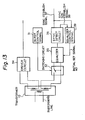
- Fig. 13 shows the construction of the office side network terminal apparatus of embodiment of the system according to the present invention.
- Fig. 13 corresponds to the network terminal 14 in Fig. 7B.
- 31 is a burst control circuit
- 32 is a switching circuit
- 33 is a transformer
- 34 is a driver circuit
- 35 is an equalizer
- 36 is a synchronization detecting circuit
- 37 is a synchronization establish signal
- 38 is a synchronization non-establish signal
- 39 is an equalizer control circuit
- 40 is an initial setting signal.
- the switching between the transmission and the reception is carried out under control of the burst control circuit 31.
- the switching circuit 32 carries out the switching of the switches, so that the sending mode and the receiving mode are switched.
- a sending signal sent from the driver circuit 34 is sent via the transformer 10 to the subscriber line.
- the receiving mode the receiving signal transmitted from the subscriber line is input via a transformer 10 and the siwtching circuit 32 to the equalizer 35.
- the equalizer 35 equalizes the amplitude and the frequency of the received input signal.
- the siwtch in the switching circuit 32 is held at the opened state, so that the sending signal from the driver circuit 34 does not enter the equalizer 35.
- the receiving mode in which the switch 32 is closed, the noise caused when the switching circuit 32 itself is switched, or the residual component (leak) of the sending signal in the sending mode before the switch is closed enters the equalizer 35, although at few times.
- the level of the equalizer 35 is set by these signals, and the output of the equalizer 35 is input to the synchronization detecting ciecuit 36.
- the synchronization detecting circuit 36 detects the frame synchronization state in the office side, outputs the synchronization establish signal 37 when the frame synchronization is established, and outputs the synchronization non-establish signal 38 when the frame synchronization is not established. While the synchronization non-establish signal 38 is output, the equalizer control circuit 39 outputs periodically the initial setting signal 40 to the equalizer 35. By this, the equalizer 35 is periodically set in the initial state.
- the initial state of the equalizer 35 is the state which corresponds to the minimum receiving level, that is, the maximum gain state. If the training pattern from the terminal attenuates in the transmission line, this can be received.
- the frame synchronization establish and the synchronization establish signal 37 is output, the output of the initial setting signal 40 is stopped and the receiving level is set in the equalizer 35.
- the equalizer in the office side network terminal apparatus is set at an error level by noise, etc., as it is set periodically at an initial state as mentioned above, the trouble that a normal signal cannot be received from the terminal can be prevented, so that the setting of the receiving level in the office side receiving equalizer can be correctly carried out.
- Figures 14A and 14B show the relationships between the initial setting signal and the synchronization establish signal in the office side.
- Figure 14A shows the state before the synchronization is established. Only the office side signal, shown by hatching, is sent out as the transmission signal in the subscriber line. The synchronization establish signal SYNC is not sent from the synchronization detecting circuit. In this state, the initial setting signal RST is output periodically.
- Figure 14B shows the state in which the synchronization establishes in the terminal and the signal is sent from the terminal side. The office side signal, shown by hatching, and the terminal side signal, having no hatching, are sent alternately as the transmission signal in the subscriber line.
- the synchronization establish signal "SYNC" from the synchronization detecting circuit becomes "1".
- the initial setting signal RST is not output, and the equalizer in the office side network terminal apparatus sets the receiving level by the training pattern from the terminal.
- the initial setting signal RST is generated immediately after the signal from the office side finishes, and following this, the signal of the termianl input.
- the equalizer iij the office side does not set the receiving level by noise or intra-office residual signals, so the level setting is correctly carried out by the signal from the terminal.
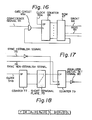
- Figure 15 shows an example of a concrete construction of the synchronization detecting circuit 36, Fig. 16 the burst control circuit 31 and Fig. 17 the equalizer control circuit 39.
- Figure 15 shows an example of a concrete construction of the synchronization detecting circuit 36, Fig. 16 the burst control circuit 31 and Fig. 17 the equalizer control circuit 39.
- Figs. 16 shows an example of a concrete construction of the synchronization detecting circuit 36
- Fig. 16 the burst control circuit 31
- Fig. 17 the equalizer control circuit 39.
- 51 designates receiving data, 52 an equalize finish signal, 53 a gate circuit, 54A, 54B clock signals, 55 a flip-flop (FF), 56 a shift register (SR), 57 a coincidence circuit, 58 a flag detection signal, 29A a JK type flip-flog (JKFF), 59B, 60, 61 gate circuits, 62 a counter, 63 the output of the counter, 64 a gate circuit, 65 a coincidence signal, 65A a gate circuit, 66 a counter, 77 a read-only memory (ROM), 68 a receiving burst signal (SRCNT), 69 a reset signal (RSTS), 70 a flip-flop (FF), 71 a shift register (SR), 72, 73 gate circuits, 74 a flip-flop (FF), 75 a synchronization establish signal, 76 a synchronization non establish signal, 77 a counter, 78 a short terminal plate, 79 a counter, and 80 an initial setting signal (RST) of the equalizer.
- Figure 18 shows one example of a data format in the present invention.
- F is a flag which alternates "10000000” and "10000001”
- M is a maintenance bit
- D is D channel data
- L is a direct current balance bit.
- the receiving data 51 from the equalizer (not shown) is received via the gate circuit 53 by the equalization finish signal 52 from the same equalizer and the timing is extracted from the receiving data.
- the receiving data is latched once in FF55 by the clock 54A thus formed.
- SR56 is formed by 8 bits and converts a serial receiving data input from FF55 to an 8 bit parallel signal. This parallel signal is checked by the coincidence detect circuit 57 for whether it coincides with the flag pattern ("10000000" or "10000001"). When it coincides with the flag pattern, the flag detect signal 58 is output from the coincidence detect circuit.
- JKFF 59A and the gate circuit 59B are provided because the 8th bit of the coincidence detect circuit 58 must be alternated.
- the flag detect signal 58 is input via the gate circuits 60, 61 to a load terminal L of the counter 62 formed by 10 bits.
- the synchronization establish signal 75 in FF74 becomes “1”, then the flag detect signal 58 is blocked by the gate circuit 60.
- the counter 62 is operated by a burst period, and the output 63 appears at the next burst period.
- the gate circuit 64 detects the coincidence between the output 63 and the flag detect signal 58. When bath coincide, the gate circuit 64 outputs the coincidence signal 65, and this signal is supplied to the load terminal L of the counter 66 formed by 10 bits.
- the output of the counter 66 is supplied to the ROM67, then the ROM67 forms various kinds of timing signals, such as the receiving burst signal (SRCNT) 68 and the reset signal (RSTS) 69, and outputs the same.
- the output of the FF70 is set to "1" by the coincidence signal 65 and is reset by the reset signal (RSTS) 69.
- the output of FF70 is supplied to SR71 formed by 8 bits. SR71 is reset by the falling of the receiving burst signal (STCNT) 68.
- the output of the coincidence signal 65 means that the flag position of the N'th receiving burst signal and that of the N+lth receiving burst signal are the same. That is, the frame synchronization establishes. Therefore, the setting of FF70 shows that the frame synchronization is established between N'th N+l'th burst receiving signals. The fact that FF70 does not set means that the frame synchronization is not establihsed between N'th and N+l'th receiving burst signals. FF70 is reset at every burst period by the reset signal (RSTS) 69 of the timing signal forming ROM67.
- RSTS reset signal
- the gate circuit 72 outputs "1" when the output of SR71 is continuously “1” three times.
- the gate circuit 73 outputs "0" when the output of SR71 is continuously “0” six times.
- the outputs of the gates circuit 72, 73 are supplied to FF74 so as to set or reset FF74.
- the set output of FF74 is the synchronization establish signal 75 and the reset output is the synchronization non- established signal 76.
- the gate circuits 72, 73 detect the three and six continuous outputs and six respectively so as to generate an output and thus form the synchronization protect circuit.
- the counter 77 is formed by n bits and forms timing signals having each period by counting down the clock 54B supplied from the office side.
- the short terminal plate 78 arbitrarily selects and outputs a desired timing signal among the various timing signals formed by the counter 77 by connecting between terminal plates.
- the synchronization establish signal 75 of the FF74 is inverted and supplied to a reset terminal of the counter 79, and the synchronization non-establish signal 76 is supplied to an enable terminal of the counter 79. Therefore, the counter 79 is held at a reset state in the synchronization establish state, and the reset signal (RST) of the equalizer does not output.
- the counter In the synchronization non-establish state (desynchronization state), the counter can be in an operable state and the initial setting signal (RST) 80 of the equalizer is periodically output.
- Figure 19 is a time chart explaining the operation when the synchronization is established in the system according to the present invention.
- each signal is shown by the same reference numeral used in Fig. 15 to Fig. 17.
- Figure 20 is a time chart explaining the operation when the synchronization is not estalbish (desynchronization) in the system according to the present invention.
- Each reference numeral in Figure 20 corresponds to the case in Fig. 19.
- the embodiment shows an example of a construction using hardware.
- the same construction can be formed by software carrying out the function shown in Fig. 17. That is, during the time when the synchronization establish signal 75 is not "1", the periodic pulse is formed by the timer formed by the software, so that it is supplied to the equalizer as the initla setting signal.
- an activation sequence between the network termination and the exchange equipment which matches the activation sequence between the terminal equipment and network terminals is provided.
- a very useful system for controlling the line activation sequence used in an ISDN subscriber line can be provided.
- an intra-office signal receiving equalizer in an office side network terminal apparatus in a digital subscriber line transmission system, in establishing synchronization for the terminal side by using the signal from the terminal, an intra-office signal receiving equalizer is periodically initially set until the synchronization is established.
- the initialy setting is stopped so that the receiving level of the intra-office signal reciever is set. Therefore, even if the source of the terminal side network terminal apparatus is supplied intra apparatus, the office side receiving equalizer can be reset, so that the receiving level of the receiving equalizer can be correctly carried out in the office side.
Landscapes
- Engineering & Computer Science (AREA)
- Computer Networks & Wireless Communication (AREA)
- Signal Processing (AREA)
- Data Exchanges In Wide-Area Networks (AREA)
- Telephonic Communication Services (AREA)
- Synchronisation In Digital Transmission Systems (AREA)
Applications Claiming Priority (4)
| Application Number | Priority Date | Filing Date | Title |
|---|---|---|---|
| JP59182233A JPS6182549A (ja) | 1984-08-31 | 1984-08-31 | 回線立上手順制御方式 |
| JP182233/84 | 1984-08-31 | ||
| JP187400/84 | 1984-09-07 | ||
| JP59187400A JPS6187443A (ja) | 1984-09-07 | 1984-09-07 | 等化器誤受信防止方式 |
Publications (2)
| Publication Number | Publication Date |
|---|---|
| EP0173984A2 true EP0173984A2 (de) | 1986-03-12 |
| EP0173984A3 EP0173984A3 (de) | 1989-06-07 |
Family
ID=26501106
Family Applications (1)
| Application Number | Title | Priority Date | Filing Date |
|---|---|---|---|
| EP85110979A Withdrawn EP0173984A3 (de) | 1984-08-31 | 1985-08-30 | System zur Steuerung der ISDN-Aktivierungsablauffolge |
Country Status (3)
| Country | Link |
|---|---|
| US (2) | US4754273A (de) |
| EP (1) | EP0173984A3 (de) |
| KR (1) | KR900006321B1 (de) |
Cited By (3)
| Publication number | Priority date | Publication date | Assignee | Title |
|---|---|---|---|---|
| EP0484330A4 (en) * | 1989-07-25 | 1992-07-29 | Raychem Corporation | Digital added main line system |
| US5978390A (en) * | 1995-03-20 | 1999-11-02 | Raychem Corporation | Dual DDS data multiplexer |
| US6282204B1 (en) | 1997-12-19 | 2001-08-28 | Terayon Communication Systems, Inc. | ISDN plus voice multiplexer system |
Families Citing this family (16)
| Publication number | Priority date | Publication date | Assignee | Title |
|---|---|---|---|---|
| JPH0652896B2 (ja) * | 1986-03-20 | 1994-07-06 | 沖電気工業株式会社 | 起動制御方式 |
| US4989202A (en) * | 1988-10-14 | 1991-01-29 | Harris Corporation | ISDN testing device and method |
| JP2816164B2 (ja) * | 1988-11-11 | 1998-10-27 | 株式会社日立製作所 | 通信システム |
| JP2766381B2 (ja) * | 1990-06-19 | 1998-06-18 | 株式会社東芝 | ターミナルアダプタプーリングシステム |
| US5317630A (en) * | 1990-09-10 | 1994-05-31 | At&T Bell Laboratories | Interface for a data telephone and data terminal in a digital telephone system |
| US5297169A (en) * | 1991-06-28 | 1994-03-22 | Telefonaktiebolaget L M Ericsson | Equalizer training in a radiotelephone system |
| US5359594A (en) * | 1992-05-15 | 1994-10-25 | International Business Machines Corporation | Power-saving full duplex nodal communications systems |
| JP3148003B2 (ja) * | 1992-07-02 | 2001-03-19 | 富士通株式会社 | 受信データ再生装置 |
| JP2636758B2 (ja) * | 1994-12-01 | 1997-07-30 | 日本電気株式会社 | バーストモードディジタル受信器 |
| US5671251A (en) * | 1995-02-28 | 1997-09-23 | Motorola, Inc. | Apparatus and method for a data communications device to selectively operate as an analog modem, as a digital modem, and as a terminal adapter |
| US5983353A (en) * | 1997-01-21 | 1999-11-09 | Dell Usa, L.P. | System and method for activating a deactivated device by standardized messaging in a network |
| US5991806A (en) * | 1997-06-09 | 1999-11-23 | Dell Usa, L.P. | Dynamic system control via messaging in a network management system |
| US6782096B1 (en) * | 1998-11-12 | 2004-08-24 | Paradyne Corporation | Subscriber line driver and termination |
| US6738474B1 (en) | 2000-02-23 | 2004-05-18 | Eci Telecom, Ltd. | System for providing pots splitters externally with respect to digital subscriber loop access multiplexers and remote terminal and central office equipment racks |
| DE10139777C2 (de) | 2001-08-03 | 2003-12-18 | Infineon Technologies Ag | Verfahren zum Deaktivieren von Sendeempfangseinrichtungen in einen Bereitschaftszustand und Warmstartmöglichkeit |
| US20040200896A1 (en) * | 2003-04-14 | 2004-10-14 | Marcus Eckerl | Apparatus for storing and transferring personal data |
Family Cites Families (15)
| Publication number | Priority date | Publication date | Assignee | Title |
|---|---|---|---|---|
| US3644896A (en) * | 1970-03-30 | 1972-02-22 | Ashwani K Chaddha | Modem controller |
| US3946315A (en) * | 1975-06-27 | 1976-03-23 | Hughes Aircraft Company | Single frequency signalling in a radiotelephone communication system with idle condition signal generator at one terminal activated by another terminal |
| US4044307A (en) * | 1975-08-01 | 1977-08-23 | Milgo Electronic Corporation | Data modems with automatic equalization, drop-out detection and data echo protection |
| IT1047329B (it) * | 1975-09-30 | 1980-09-10 | C Olivetto E C S P A Ing | Dispositivo di teleaccensione e di inizzializzazione di un terminale |
| US4232197A (en) * | 1978-08-25 | 1980-11-04 | Bell Telephone Laboratories, Incorporated | Processor for a TDMA burst modem |
| EP0024617A1 (de) * | 1979-08-24 | 1981-03-11 | Siemens Aktiengesellschaft | Digital-Fernmeldesystem |
| US4387440A (en) * | 1980-03-03 | 1983-06-07 | Eaton Michael D | Modem control device code multiplexing |
| DE3010702C2 (de) * | 1980-03-20 | 1982-11-04 | Standard Elektrik Lorenz Ag, 7000 Stuttgart | Digitales Nachrichtenübermittlungssystem |
| US4392225A (en) * | 1981-02-17 | 1983-07-05 | Tii Corporation | Telephone carrier system repeater and power supply |
| SE430732B (sv) * | 1982-05-07 | 1983-12-05 | Ellemtel Utvecklings Ab | Anordning for att ansluta digitala terminaler till en digital vexel |
| JPS5954347A (ja) * | 1982-09-22 | 1984-03-29 | Fujitsu Ltd | チヤネル插入タイミング調整方式 |
| GB2128446B (en) * | 1982-10-02 | 1985-09-04 | Standard Telephones Cables Ltd | Telecommunication exchange |
| SE435010B (sv) * | 1982-12-30 | 1984-08-27 | Ellemtel Utvecklings Ab | Sett och anordning i ett telekommunikationssystem for aktivering av organ fran vilolege till aktivt lege |
| SE435011B (sv) * | 1982-12-30 | 1984-08-27 | Ellemtel Utvecklings Ab | Sett och anordning i ett telekommunikationssystem vid aktivering av abonnentterminaler |
| DE3316470A1 (de) * | 1983-05-05 | 1984-11-08 | Siemens AG, 1000 Berlin und 8000 München | Schaltungsanordnung fuer ein teilnehmeranschluss in einem diensteintegrierenden digitalnetz (isdn) |
-
1985
- 1985-08-30 EP EP85110979A patent/EP0173984A3/de not_active Withdrawn
- 1985-08-31 KR KR1019850006370A patent/KR900006321B1/ko not_active Expired
-
1987
- 1987-08-14 US US07/087,960 patent/US4754273A/en not_active Expired - Fee Related
-
1988
- 1988-03-15 US US07/170,120 patent/US4812839A/en not_active Expired - Fee Related
Cited By (8)
| Publication number | Priority date | Publication date | Assignee | Title |
|---|---|---|---|---|
| EP0484330A4 (en) * | 1989-07-25 | 1992-07-29 | Raychem Corporation | Digital added main line system |
| US5459730A (en) * | 1989-07-25 | 1995-10-17 | Raychem Corporation | Digital added main line system |
| US5459729A (en) * | 1989-07-25 | 1995-10-17 | Raychem Corporation | Digital added main line system |
| US5473613A (en) * | 1989-07-25 | 1995-12-05 | Raychem Corporation | Digital added main line system |
| US5627833A (en) * | 1989-07-25 | 1997-05-06 | Raychem Corporation | Digital added main line system with power-up and power-down features |
| EP0849971A3 (de) * | 1989-07-25 | 1999-10-20 | Raychem Corporation | System für eine digitale addierte Hauptleitung |
| US5978390A (en) * | 1995-03-20 | 1999-11-02 | Raychem Corporation | Dual DDS data multiplexer |
| US6282204B1 (en) | 1997-12-19 | 2001-08-28 | Terayon Communication Systems, Inc. | ISDN plus voice multiplexer system |
Also Published As
| Publication number | Publication date |
|---|---|
| US4754273A (en) | 1988-06-28 |
| KR900006321B1 (ko) | 1990-08-28 |
| US4812839A (en) | 1989-03-14 |
| KR870002707A (ko) | 1987-04-06 |
| EP0173984A3 (de) | 1989-06-07 |
Similar Documents
| Publication | Publication Date | Title |
|---|---|---|
| US4754273A (en) | System for controlling network activation sequence | |
| EP0120718B1 (de) | Funktelefonsystem mit Vielkanalzugriff | |
| US4766594A (en) | Digital network system having arrangement for testing digital subscriber line | |
| US5778319A (en) | Mobile station and radio communication system employing multi-channel access | |
| US4220821A (en) | Off-hook initiated demand assignment communications | |
| CA1219663A (en) | Data call transfer | |
| US5333182A (en) | Arbitrary selecting of a terminal to be called in key telephone systems | |
| JPS6376648A (ja) | モデムプ−ル起動方式 | |
| US5341418A (en) | ISDN terminal adapter for access from analog signal equipment of four-wire full duplex type to ISDN | |
| CA2045019C (en) | Terminal adapter pooling system | |
| CA1220843A (en) | Digital terminal keyboard dialing | |
| CA1250066A (en) | Integrated service digital network subscriber line | |
| CA1250065A (en) | System for controlling network activation sequence | |
| JPS6059841A (ja) | 通信速度可変端末 | |
| US6625210B1 (en) | Method for making a call in a multiple bit-rate channel corresponding bit-rate switching procedure and transmission network | |
| KR100206304B1 (ko) | 내부 호 처리가 가능한 원격가입자 수용장치 및 그 제어방법 | |
| JP3149262B2 (ja) | Isdn端末装置の通信方法 | |
| EP1011287B1 (de) | Verfahren zum Verbindungsaufbau in einem Übertragungskanal mit mehreren Bit-Raten, entsprechende Bit-Ratenschaltungsprozedur und Übertragungsnetz | |
| JPS62234454A (ja) | 複数端末収容型回線インタフェイス装置 | |
| KR970000393B1 (ko) | 디지탈 전화 시스템의 선로 정합 회로 | |
| RU2185038C2 (ru) | Способ установления связи по коммутируемой сети для абонентских приборов одного абонентского номера с избираемым прибором другого абонентского номера и устройство для его осуществления | |
| JP3149258B2 (ja) | Isdn端末装置 | |
| JP2970719B2 (ja) | 4線全二重式アナログ装置からisdnへアクセスするための端末アダプター | |
| JPH11285037A (ja) | 端末アダプタ装置 | |
| JPS61127242A (ja) | デイジタル加入者線起動方式 |
Legal Events
| Date | Code | Title | Description |
|---|---|---|---|
| PUAI | Public reference made under article 153(3) epc to a published international application that has entered the european phase |
Free format text: ORIGINAL CODE: 0009012 |
|
| AK | Designated contracting states |
Kind code of ref document: A2 Designated state(s): DE FR GB |
|
| PUAL | Search report despatched |
Free format text: ORIGINAL CODE: 0009013 |
|
| AK | Designated contracting states |
Kind code of ref document: A3 Designated state(s): DE FR GB |
|
| 17P | Request for examination filed |
Effective date: 19891130 |
|
| 17Q | First examination report despatched |
Effective date: 19910212 |
|
| STAA | Information on the status of an ep patent application or granted ep patent |
Free format text: STATUS: THE APPLICATION IS DEEMED TO BE WITHDRAWN |
|
| 18D | Application deemed to be withdrawn |
Effective date: 19910623 |
|
| RIN1 | Information on inventor provided before grant (corrected) |
Inventor name: SHIMOZONO, RYOJI Inventor name: KAWATO, YUTAKA Inventor name: OKADA, SUMIEFUJITSU DAI-NANA FUJIGAOKA-RYO Inventor name: HATANO, TAKASHI Inventor name: TSUTSUMI, KENJI Inventor name: TANAKA, YASUO Inventor name: OGAWA, YASUNORIOKURAYAMA HAIMU 4-907 Inventor name: NARA, TAKASHIHOSHIKAWA SHUROSU 701 |