EP0171602B1 - Wässrige Kohledispersionen - Google Patents
Wässrige Kohledispersionen Download PDFInfo
- Publication number
- EP0171602B1 EP0171602B1 EP85108549A EP85108549A EP0171602B1 EP 0171602 B1 EP0171602 B1 EP 0171602B1 EP 85108549 A EP85108549 A EP 85108549A EP 85108549 A EP85108549 A EP 85108549A EP 0171602 B1 EP0171602 B1 EP 0171602B1
- Authority
- EP
- European Patent Office
- Prior art keywords
- weight
- coal
- aqueous
- formula
- dispersions
- Prior art date
- Legal status (The legal status is an assumption and is not a legal conclusion. Google has not performed a legal analysis and makes no representation as to the accuracy of the status listed.)
- Expired
Links
Classifications
-
- C—CHEMISTRY; METALLURGY
- C10—PETROLEUM, GAS OR COKE INDUSTRIES; TECHNICAL GASES CONTAINING CARBON MONOXIDE; FUELS; LUBRICANTS; PEAT
- C10L—FUELS NOT OTHERWISE PROVIDED FOR; NATURAL GAS; SYNTHETIC NATURAL GAS OBTAINED BY PROCESSES NOT COVERED BY SUBCLASSES C10G OR C10K; LIQUIFIED PETROLEUM GAS; USE OF ADDITIVES TO FUELS OR FIRES; FIRE-LIGHTERS
- C10L1/00—Liquid carbonaceous fuels
- C10L1/32—Liquid carbonaceous fuels consisting of coal-oil suspensions or aqueous emulsions or oil emulsions
- C10L1/326—Coal-water suspensions
-
- Y—GENERAL TAGGING OF NEW TECHNOLOGICAL DEVELOPMENTS; GENERAL TAGGING OF CROSS-SECTIONAL TECHNOLOGIES SPANNING OVER SEVERAL SECTIONS OF THE IPC; TECHNICAL SUBJECTS COVERED BY FORMER USPC CROSS-REFERENCE ART COLLECTIONS [XRACs] AND DIGESTS
- Y10—TECHNICAL SUBJECTS COVERED BY FORMER USPC
- Y10S—TECHNICAL SUBJECTS COVERED BY FORMER USPC CROSS-REFERENCE ART COLLECTIONS [XRACs] AND DIGESTS
- Y10S516/00—Colloid systems and wetting agents; subcombinations thereof; processes of
- Y10S516/01—Wetting, emulsifying, dispersing, or stabilizing agents
-
- Y—GENERAL TAGGING OF NEW TECHNOLOGICAL DEVELOPMENTS; GENERAL TAGGING OF CROSS-SECTIONAL TECHNOLOGIES SPANNING OVER SEVERAL SECTIONS OF THE IPC; TECHNICAL SUBJECTS COVERED BY FORMER USPC CROSS-REFERENCE ART COLLECTIONS [XRACs] AND DIGESTS
- Y10—TECHNICAL SUBJECTS COVERED BY FORMER USPC
- Y10S—TECHNICAL SUBJECTS COVERED BY FORMER USPC CROSS-REFERENCE ART COLLECTIONS [XRACs] AND DIGESTS
- Y10S516/00—Colloid systems and wetting agents; subcombinations thereof; processes of
- Y10S516/01—Wetting, emulsifying, dispersing, or stabilizing agents
- Y10S516/03—Organic sulfoxy compound containing
Definitions
- the invention relates to aqueous, optionally methanol-containing pumpable and flowable coal dispersions with a special nonionic dispersant and the use of a special nonionic dispersant in coal-water dispersions.
- Aqueous coal dispersions have become increasingly important in recent times, particularly with regard to their cheap transportation options, e.g. in pipelines.
- aqueous carbon dispersions which contain higher molecular weight polyalkylene oxides as nonionic surface-active dispersants.
- polyalkylene oxides of alkylphenols such as nonylphenoxypolyethylene oxide with more than a hundred ethylene oxide units.
- the various surfactants do not prove to be particularly suitable in all cases, i.e. they are not applicable to all types of coal. Furthermore, the dispersants used to date are sometimes difficult to handle because they may have a very slow dissolution rate in water and partially concentrated aqueous solutions cannot be prepared.
- DE-OS-2 745 449 and 2 751 519 give polyalkylene oxide derivatives of bisphenol A derivatives, in particular in sulfated form, as dispersants for disperse dyes and for optical brighteners which are difficult or insoluble in water. 10 to 200% by weight of the dispersants mentioned are used, based on the amount of the dispersed substances. Such an amount is completely out of the question, for example, for aqueous coal dispersions.
- the object of the present invention is to provide new dispersants for coal dispersions from different types of coal.
- non-sulfated polyalkylene oxide bisphenol A derivatives are outstandingly suitable as dispersants for aqueous coal dispersions.
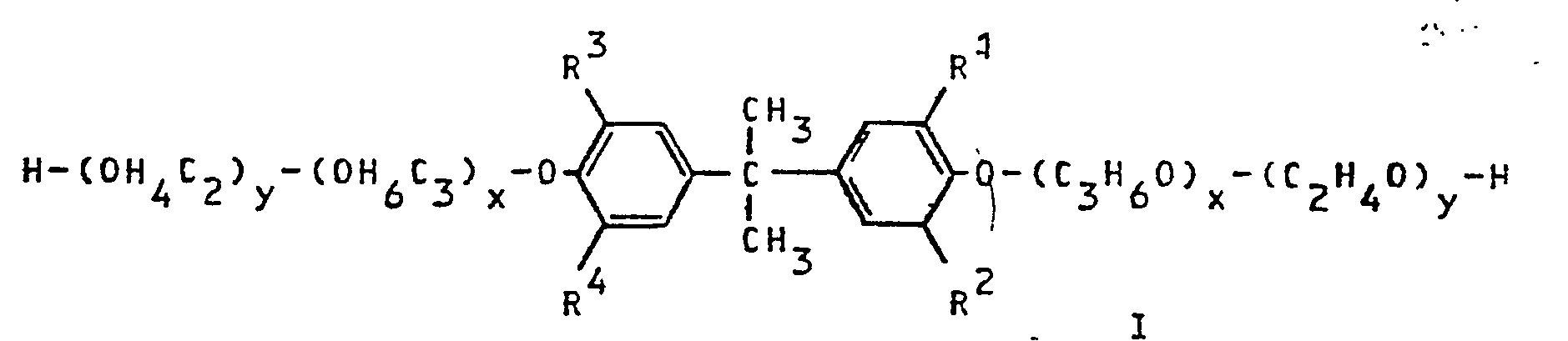
- the invention relates to aqueous, pumpable and flowable coal dispersions containing, in each case based on the total weight, 65 to 80, preferably 70 to 75% by weight of ground coal, 35 to 20, preferably 30 to 25% by weight of water, of which optionally 1 to 60 wt .-% are replaced by methanol, and conventional additives, characterized in that the dispersion 0.1 to 1.5, preferably 0.2 to 1.0 wt .-%, based on the total weight of the mixture , a nonionic dispersant of the formula in R 1 the rest and R 2 to R 4 represent a hydrogen atom or the radical R 1 and x is 0 or a number from 5 to 400, preferably 50 to 200, and y is a number from 80 to 800, preferably 100 to 400, the propylene oxide Ethylene oxide blocks interchanged or propylene oxide and ethylene oxide can be present in a statistical distribution, as well as the use of compounds of the formula I as dispersants in aqueous coal dispersers
- the coal dispersions according to the invention preferably contain a floated, ground coal with a suitable grain size distribution of less than 300 ⁇ .
- coal with a high ash content is generally more difficult to disperse than coal with a low ash content.
- High ash content means approx. 8 to 12%, lower ash content less than 4% ash.
- the sulfur content of the preferably used floated coal is generally less than 1%.
- the pumpable and flowable properties relate to the viscosity of the coal dispersion.
- a dispersion with 2000 mPa.s is just barely flowable.
- the desired values are 1000 mPa.s and below.
- the optimally desired range can be specified with ⁇ 800 mPas. As shown in the examples, it is easily achieved in the coal dispersions according to the invention.
- methanol As already mentioned, 1 to 60% by weight of the water can be replaced by methanol.
- the addition of methanol serves for the purpose of lowering the viscosity, i.e. better pumpability, the coal dispersions
- coal dispersions according to the invention contain the usual additives known per se to the person skilled in the art:
- Foam damper conventional foam damper such as fatty acid polyalkoxylates, e.g. B. stearyl alcohol propoxylate with 10 to 50 propylene oxide units or silicone oils etc .; as a viscosity regulator soluble inorganic salts, e.g. B.
- pH regulators since a pH value of 8 to 10 is particularly expedient for practical use, such as alkali and alkaline earth metal hydroxides, ammoni
- the dispersants of the formula are known per se or can be prepared in a conventional manner by the processes described in DE-OS-2 745 449 and 2 751 519.
- Particularly preferred dispersants of the formula are those in which x 0 and y are 80 to 400 and in which x is 50 to 150 and y is 200 to 400.
- aqueous coal dispersions are prepared in the customary manner.
- a concentrated aqueous solution which contains 40 to 70% by weight of dispersant according to the invention and which, in contrast to some dispersants of the prior art, can be easily prepared, is added to the required amount of water which, with vigorous rotation, the ground coal and optionally further additives are added.
- the dispersant is dissolved in water and the coal is added with stirring with the aid of a pilot dissolver at about 1000 to 2000 rpm in the course of 3 minutes and then dispersed at 6500 rpm for 20 minutes.
- the alkoxylated ethylenediamines are difficult to handle, and only 17% aqueous solutions can be prepared.
- the dispersants according to the invention give 50 to 60% aqueous solutions without difficulty, which is a significant advantage for industrial handling.
Landscapes
- Chemical & Material Sciences (AREA)
- Oil, Petroleum & Natural Gas (AREA)
- Engineering & Computer Science (AREA)
- Chemical Kinetics & Catalysis (AREA)
- General Chemical & Material Sciences (AREA)
- Organic Chemistry (AREA)
- Emulsifying, Dispersing, Foam-Producing Or Wetting Agents (AREA)
- Air Transport Of Granular Materials (AREA)
- Liquid Carbonaceous Fuels (AREA)
Description
- Die Erfindung betrifft wäßrige, gegebenenfalls methanolhaltige pumpbare und fließfähige Kohledispersionen mit einem speziellen nichtionischen Dispergiermittel sowie die Verwendung eines speziellen nichtionischen Dispergiermittels in Kohle-Wasser-Dispersionen.
- Wäßrige Kohledispersionen haben in neuerer Zeit zunehmend an Bedeutung gewonnen, insbesondere im Hinblick auf ihre günstigen Transportmöglichkeiten, z.B. in Pipelines.
- Aus der US-PS-4 358 293 sind wäßrige Kohledispersionen bekannt, die als nichtionische oberflächenaktive Dispergiermittel höhermolekulare Polyalkylenoxide enthalten. U.a. werden Polyalkylenoxide von Alkylphenolen, wie Nonylphenoxypolyethylenoxid mit mehr als hundert Ethylenoxideinheiten, beschrieben.
- Die verschiedenen Tenside erweisen sich bei der Anwendung nicht in allen Fällen als besonders gut geeignet, d.h. sie sind nicht für alle Kohlearten anwendbar. Weiterhin sind die bisher verwendeten Dispergiermittel teilweise schwierig zu handhaben, da sie u.U. in Wasser eine sehr langsame Lösungsgeschwindigkeit aufweisen und teilweise konzentrierte wäßrige Lösungen nicht herstellbar sind.
- Aus den DE-OS-2 745 449 und 2 751 519 gehen Polyalkylenoxidderivate von Bisphenol A-Derivaten, insbesondere in sulfatierter Form, als Dispergiermittel für Dispersionsfarbstoffe und für in Wasser schwer oder unlösliche optischen Aufhellern hervor. Dabei werden, bezogen auf die Menge der dispergierten Stoffe, 10 bis 200 Gew.-% der genannten Dispergiermittel verwendet. Eine solche Menge ist beispielsweise für wäßrige Kohledispersionen völlig indiskutabel.
- Aufgabe der vorliegenden Erfindung ist es, neue Dispergiermittel für Kohledispersionen aus unterschiedlichen Kohletypen zur Verfügung zu stellen.
- Es wurde nun gefunden, daß nichtsulfatierte Polyalkylenoxid-Bisphenol A-Derivate hervorragend als Dispergiermittel für wäßrige Kohledispersionen geeignet sind.
- Demnach sind Gegenstand der Erfindung wäßrige, pumpbare und fließfähige Kohledispersionen enthaltend, jeweils bezogen auf das Gesamtgewicht, 65 bis 80, bevorzugt 70 bis 75 Gew.-% gemahlene Kohle, 35 bis 20, bevorzugt 30 bis 25 Gew.-% Wasser, von dem gegebenenfalls 1 bis 60 Gew.-% durch Methanol ersetzt sind, und übliche Zusätze, dadurch gekennzeichnet, daß die Dispersion 0,1 bis 1,5, bevorzugt 0,2 bis 1,0 Gew.-%, bezogen auf das Gesamtgewicht der Mischung, eines nichtionischen Dispergiermittels der Formel


- Die erfindungsgemäßen Kohledispersionen enthalten bevorzugt eine flotierte, gemahlene Kohle mit einer zweckmäßigen Korngrößenverteilung von kleiner 300 µ.
- Eine beispielhafte und besonders zweckmäßige Verteilung bedeutet 100 % kleiner 300 µ, 80 % kleiner 200 µ und 50 % kleiner 50 µ.
- Es ist selbstverständlich, daß Kohle mit einem hohen Aschegehalt in der Regel schwerer dispergiert werden kann als Kohle mit einem niederen Aschegehalt. Hoher Aschegehalt bedeutet ca. 8 bis 12 %, niederer Aschegehalt weniger als 4 % Asche. Der Schwefelgehalt der bevorzugt eingesetzten flotierten Kohle beträgt in der Regel weniger als 1 %.
- Die Eigenschaften pumpbar und fließfähig betreffen die Viskosität der Kohledispersion. In der Regel ist eine Dispersion mit 2000 mPa.s gerade noch fließfähig. Für die Praxis, damit mit möglichst geringem Energieaufwand transportiert werden kann, liegen die gewünschten Werte bei 1000 mPa.s und darunter. Der optimal gewünschte Bereich kann mit < 800 mPas angegeben werden. Er wird, wie in den Beispielen gezeigt, in den erfindungsgemäßen Kohledispersionen ohne weiteres erreicht.
- Wie bereits erwähnt, können 1 bis 60 Gew.-% des Wassers durch Methanol ersetzt werden. Der Zusatz von Methanol dient zum Zwecke der Viskositätserniedrigung, d.h. bessere Pumpbarkeit, der Kohledispersionen bei
- Darüberhinaus enthalten die erfindungsgemäßen Kohledispersionen die dem Fachmann an sich bekannten üblichen Zusätze:
- Schaumdämpfer, an sich übliche Schaumdämpfer wie Fettsäurepolyalkoxylate, z. B. Stearylalkoholpropoxylat mit 10 bis 50 Propylenoxideinheiten oder Silikonöle etc.; als Viskositätsregler lösliche anorganische Salze, z. B. Ammoniumchlorid und -carbonat, Alkali und Erdalkali-chloride und -carbonate, insbesondere des Natriums sowie Calciums und Magnesiums, wasserlösliche Phosphate und Silicate, wie Natrium-hexametaphosphat oder Natrium-metasilikat-9-hydrat; pH-Wert-Regulatoren, da für die praktische Anwendung ein pH-Wert von 8 bis 10 besonders zweckmäßig ist, wie Alkali- und Erdalkalihydroxide, Ammoniak sowie primäre und sekundäre Amine, Stabilisierhilfsmittel mit Schutzkolloid- und/oder Verdickerwirkung, hierfür kommen in Betracht Polyether (z. B. Polyethylenoxid, Copolymere von Polyethylenoxid und Polypropylenoxid), Carboxymethylcellulose, Hydroxyethylcellulose, Polysaccharide (z. B. Alginate), Polyalkohole, Polyacrylate und Copolymere davon; als übliche Zusätze seien auch Biocide genannt.
- Die Dispergiermittel der Formel sind an sich bekannt oder können nach den in den DE-OS-2 745 449 und 2 751 519 beschriebenen Verfahren in an sich üblicher Weise hergestellt werden.
- Besonders bevorzugte Dispergiermittel der Formel sind solche, in denen x 0 und y 80 bis 400 und in denen x 50 bis 150 und y 200 bis 400 bedeuten.
- Die Herstellung der wäßrigen Kohledispersionen erfolgt in üblicher Weise. In der Regel wird eine konzentrierte wäßrige Lösung, die 40 bis 70 Gew.-% erfindungsgemäßes Dispergiermittel enthält und die sich im Gegensatz zu manchen Dispergiermitteln des Standes der Technik leicht herstellen läßt, der erforderlichen Wassermenge zugegeben, der unter starker Rotation die gemahlene Kohle und gegebenenfalls weitere Zusätze zugeführt werden.
- I Herstellung von Dispergiermitteln der Formel
- a) 228 g (1 Mol) 4,4'-Dihydroxy-diphenyl-dimethyl-methan, 104 g (1 Mol) Styrol und 1,66 g p-Toluolsulfonsäure als Katalysator werden bei Raumtemperatur vermischt und anschließend erwärmt. Bei ca. 60°C erfolgt die exotherme Reaktion und Temperaturanstieg auf 120 bis 130°C. Bei dieser Temperatur können gegebenenfalls weitere 1 bis 3 Mol Styrol innerhalb von ca. 2 Stunden zugetropft werden. Es wird noch 1 Stunde zur Vervollständigung der Reaktion bei 130°C nachgerührt. Es wird ein rotbraunes, viskoses Öl erhalten, die Ausbeute ist quantitativ.
- b) Das aus der Stufe a) erhaltene Produkt wird mit 1 Gew.-% Kaliumhydroxid versetzt und unter Rühren werden bei 120 bis 130°C portionsweise Propylenoxid und Ethylenoxid, gegebenenfalls in umgekehrter Reihenfolge, so aufgepreßt, daß der Druck 8 bar nicht übersteigt.
- Zusammensetzung der Kohle-Wasser-Dispersionen:
- 70 Gew.-% polnische Importkohle (Steinkohle, flotiert, gemahlen)
- 0,5 Gew.-% Dispergiermittel der Formel gemäß Tabelle 1
- 29,5 Gew.-% Wasser
- Das Dispergiermittel wird im Wasser gelöst und die Kohle unter Rühren unter Zuhilfenahme eines Technikumdissolvers bei ca. 1000 bis 2000 U/min innerhalb von 3 min zugegeben und anschließend bei 6500 U/min 20 min lang dispergiert.
- Die Viskosität [mPa.s] wird mit einem Rotationsviskosimeter bestimmt bei 20°C und einer Schergeschwindigkeit D von 220 s-1.


- 1. Ethylendiamin mit 30 % Propylenoxid und 70 % Ethylenoxid MG 15 500 (Tetronic 1307) 460
- 2. Blockpolymerisat aus 20 % Propylenoxid und 80 % Ethylenoxid, MG 8500 (Pluronic 6800) 960
- 3. i-Nonylphenol mit 200 Ethylenoxid 710
- Aus der Tabelle geht hervor, daß ein Vergleich mit Dispergiermitteln aus der US-PS-4 358 293 durchgeführt wurde:
- Der Vergleich zeigt, daß mit alkoxyliertem Ethylendiamin und Nonylphenol brauchbare Werte erreicht werden, die Dispergiermittel der Formel I jedoch stets günstiger liegen.
- Die alkoxylierten Ethylendiamine lassen sich bekanntermaßen schlecht handhaben, nur 17 %-ige wäßrige Lösungen sind herstellbar.
- Die erfindungsgemäßen Dispergiermittel ergeben ohne Schwierigkeiten 50 bis 60 %-ige wäßrige Lösungen, was für die technische Handhabung einen wesentlichen Vorteil darstellt.
Claims (4)

Applications Claiming Priority (2)
| Application Number | Priority Date | Filing Date | Title |
|---|---|---|---|
| DE3426395A DE3426395A1 (de) | 1984-07-18 | 1984-07-18 | Waessrige kohledispersionen |
| DE3426395 | 1984-07-18 |
Publications (3)
| Publication Number | Publication Date |
|---|---|
| EP0171602A2 EP0171602A2 (de) | 1986-02-19 |
| EP0171602A3 EP0171602A3 (en) | 1988-01-20 |
| EP0171602B1 true EP0171602B1 (de) | 1989-10-25 |
Family
ID=6240907
Family Applications (1)
| Application Number | Title | Priority Date | Filing Date |
|---|---|---|---|
| EP85108549A Expired EP0171602B1 (de) | 1984-07-18 | 1985-07-10 | Wässrige Kohledispersionen |
Country Status (7)
| Country | Link |
|---|---|
| US (1) | US4675025A (de) |
| EP (1) | EP0171602B1 (de) |
| JP (1) | JPS6143698A (de) |
| AU (1) | AU573364B2 (de) |
| CA (1) | CA1260709A (de) |
| DE (2) | DE3426395A1 (de) |
| ZA (1) | ZA855380B (de) |
Families Citing this family (6)
| Publication number | Priority date | Publication date | Assignee | Title |
|---|---|---|---|---|
| DE3707941A1 (de) * | 1987-03-12 | 1988-09-22 | Henkel Kgaa | Dispergiermittel und ihre verwendung in waessrigen kohlesuspensionen |
| US5266989A (en) * | 1988-10-06 | 1993-11-30 | Nikon Corporation | Camera which can be used for trimming shots |
| JP2753531B2 (ja) * | 1988-11-04 | 1998-05-20 | 株式会社ニコン | 自動焦点調節カメラ |
| US5270755A (en) * | 1990-05-01 | 1993-12-14 | Ricoh Company, Ltd. | Trimming information recordable camera |
| JPH07175119A (ja) * | 1990-05-01 | 1995-07-14 | Ricoh Co Ltd | トリミング撮影可能なカメラ |
| JPH06337469A (ja) * | 1993-05-31 | 1994-12-06 | Canon Inc | 擬似望遠機能付きカメラ |
Family Cites Families (12)
| Publication number | Priority date | Publication date | Assignee | Title |
|---|---|---|---|---|
| US2564191A (en) * | 1949-01-03 | 1951-08-14 | Petrolite Corp | Certain oxyalkylated derivatives of difunctional bis-phenol aldehyde resins |
| US4218218A (en) * | 1977-10-08 | 1980-08-19 | Basf Aktiengesellschaft | Stable finely dispersed aqueous formulations of disperse dyes and optical brighteners, and their use |
| DE2745449C2 (de) * | 1977-10-08 | 1979-10-25 | Basf Ag, 6700 Ludwigshafen | Stabile feindisperse wäßrige Zubereitungen von Dispersionsfarbstoffen und optischen Aufhellern und deren Verwendung |
| AU551441B2 (en) * | 1981-01-29 | 1986-05-01 | Standard Oil Company, The | Coal-aqueous (oil) mixtures |
| US4441889A (en) * | 1981-01-29 | 1984-04-10 | Gulf & Western Industries, Inc. | Coal-aqueous mixtures |
| US4358293A (en) * | 1981-01-29 | 1982-11-09 | Gulf & Western Manufacturing Co. | Coal-aqueous mixtures |
| DE3130609A1 (de) * | 1981-08-01 | 1983-03-24 | Hoechst Ag, 6000 Frankfurt | Dispergiermittel, verfahren zu deren herstellung und deren verwendung |
| JPS58122991A (ja) * | 1982-01-19 | 1983-07-21 | Kao Corp | 石炭・水スラリ−組成物 |
| JPS5920390A (ja) * | 1982-07-24 | 1984-02-02 | Nippon Oil & Fats Co Ltd | 石炭−水スラリ−の製造法 |
| DE3240309A1 (de) * | 1982-10-30 | 1984-05-03 | Bayer Ag, 5090 Leverkusen | Verwendung von aralkyl-polyalkylen-glykolethern zur herstellung von waessrigen kohle-aufschlaemmungen |
| US4457762A (en) * | 1983-01-07 | 1984-07-03 | Diamond Shamrock Chemicals Company | Stabilized water slurries of carbonaceous materials |
| US4501594A (en) * | 1983-10-21 | 1985-02-26 | Diamond Shamrock Chemicals Company | Anionic polyhydroxy polyphenyl compounds as dispersants for aqueous slurries of carbonaceous materials |
-
1984
- 1984-07-18 DE DE3426395A patent/DE3426395A1/de not_active Withdrawn
-
1985
- 1985-07-10 EP EP85108549A patent/EP0171602B1/de not_active Expired
- 1985-07-10 DE DE8585108549T patent/DE3573928D1/de not_active Expired
- 1985-07-16 CA CA000486841A patent/CA1260709A/en not_active Expired
- 1985-07-17 ZA ZA855380A patent/ZA855380B/xx unknown
- 1985-07-17 AU AU45113/85A patent/AU573364B2/en not_active Ceased
- 1985-07-17 JP JP60156184A patent/JPS6143698A/ja active Pending
- 1985-07-18 US US06/756,317 patent/US4675025A/en not_active Expired - Fee Related
Also Published As
| Publication number | Publication date |
|---|---|
| ZA855380B (en) | 1986-03-26 |
| AU573364B2 (en) | 1988-06-02 |
| AU4511385A (en) | 1986-01-23 |
| JPS6143698A (ja) | 1986-03-03 |
| CA1260709A (en) | 1989-09-26 |
| US4675025A (en) | 1987-06-23 |
| DE3426395A1 (de) | 1986-01-23 |
| EP0171602A3 (en) | 1988-01-20 |
| DE3573928D1 (en) | 1989-11-30 |
| EP0171602A2 (de) | 1986-02-19 |
Similar Documents
| Publication | Publication Date | Title |
|---|---|---|
| DE3140637C2 (de) | ||
| EP0260538A2 (de) | Verwendung von quellfähigen, synthetischen Schichtsilikaten in wässrigen Bohrspül- und Bohrlochbehandlungsmitteln | |
| DE60123666T2 (de) | Wässrige suspension eines celluloseethers, verfahren zu ihrer herstellung und trockenmischung | |
| DE3004161A1 (de) | Cellulosederivate | |
| EP0108302B1 (de) | Verwendung von Aralkyl-polyalkylen-glykolethern zur Herstellung von wässrigen Kohle-Aufschlämmungen | |
| EP0319868B1 (de) | Verwendung von Carboxymethylsulfoethylcellulose in Bohrspülungen | |
| EP0171602B1 (de) | Wässrige Kohledispersionen | |
| DE69528194T2 (de) | Verfahren zur herstellung einer wässrigen celluloseethersuspension und trockenmischung geeignet zur verwendung bei der herstellung der suspension | |
| DE2921306C2 (de) | ||
| DE3735092A1 (de) | Eisenoxidpigmentsuspensionen und -slurries | |
| DE3446921A1 (de) | Neue alkoxylierte aminopolyether, verfahren zu ihrer herstellung und sie enthaltende kohle-wasser-aufschlaemmungen | |
| EP0062304A1 (de) | Verfahren zur Herstellung von Azopigmentpräparationen und ihre Verwendung | |
| DE1033655B (de) | Verfahren zur Herstellung von Bisbiguaniden | |
| DE69220707T2 (de) | Konzentrierte flüssige Zusammensetzung Salzbildender Farbstoffe und Tinten | |
| DE69508933T2 (de) | Wässrige suspension einer cellulose-ether, verfahren zu deren herstellung und zusammensetzung | |
| EP0153671B1 (de) | Stabilisierte, Wasser enthaltende, alkalisch eingestellte Natriumdithionitzubereitungen | |
| EP0176920B1 (de) | Wässrige Kohledispersionen | |
| EP0290899A2 (de) | Zusatzmittel für Bohrflüssigkeiten, Herstellung und Verwendung | |
| EP1180326B1 (de) | ortho-Phenylphenolat-Konzentrate | |
| DE2514866A1 (de) | Verbesserte waessrige bohrspuelung | |
| DE1493668C3 (de) | Verfahren zur Herstellung cyanäthylgruppenhaltiger Arylsulfonate | |
| DE1592453A1 (de) | Verfahren zum Herstellen eines alkalischen Zinnoxyd-Sols | |
| CH356438A (de) | Stabilisierte Farbstoffpräparate | |
| DE3517107A1 (de) | Waessrige kohledispersionen | |
| CH633846A5 (en) | Process for preparing viscosity-stable aqueous pigment dispersions for paper coating compositions |
Legal Events
| Date | Code | Title | Description |
|---|---|---|---|
| PUAI | Public reference made under article 153(3) epc to a published international application that has entered the european phase |
Free format text: ORIGINAL CODE: 0009012 |
|
| AK | Designated contracting states |
Designated state(s): DE FR GB IT NL SE |
|
| PUAL | Search report despatched |
Free format text: ORIGINAL CODE: 0009013 |
|
| AK | Designated contracting states |
Kind code of ref document: A3 Designated state(s): DE FR GB IT NL SE |
|
| 17P | Request for examination filed |
Effective date: 19871204 |
|
| 17Q | First examination report despatched |
Effective date: 19890302 |
|
| GRAA | (expected) grant |
Free format text: ORIGINAL CODE: 0009210 |
|
| AK | Designated contracting states |
Kind code of ref document: B1 Designated state(s): DE FR GB IT NL SE |
|
| ITF | It: translation for a ep patent filed | ||
| GBT | Gb: translation of ep patent filed (gb section 77(6)(a)/1977) | ||
| REF | Corresponds to: |
Ref document number: 3573928 Country of ref document: DE Date of ref document: 19891130 |
|
| ET | Fr: translation filed | ||
| R20 | Corrections of a patent specification |
Effective date: 19900115 |
|
| NLXE | Nl: other communications concerning ep-patents (part 3 heading xe) |
Free format text: ON 900531 NEW PAGES 2 AND 7 OF THE TRANSLATION OF THE PATENT SPECIFICATION HAVE BEEN RECEIVED IN CONNECTION WITH CORRECTIONS ISSUED BY THE EUROPEAN PATENT OFFICE |
|
| PLBE | No opposition filed within time limit |
Free format text: ORIGINAL CODE: 0009261 |
|
| STAA | Information on the status of an ep patent application or granted ep patent |
Free format text: STATUS: NO OPPOSITION FILED WITHIN TIME LIMIT |
|
| 26N | No opposition filed | ||
| PGFP | Annual fee paid to national office [announced via postgrant information from national office to epo] |
Ref country code: FR Payment date: 19910617 Year of fee payment: 7 |
|
| PGFP | Annual fee paid to national office [announced via postgrant information from national office to epo] |
Ref country code: SE Payment date: 19910618 Year of fee payment: 7 |
|
| PGFP | Annual fee paid to national office [announced via postgrant information from national office to epo] |
Ref country code: GB Payment date: 19910701 Year of fee payment: 7 |
|
| PGFP | Annual fee paid to national office [announced via postgrant information from national office to epo] |
Ref country code: DE Payment date: 19910718 Year of fee payment: 7 |
|
| ITTA | It: last paid annual fee | ||
| PGFP | Annual fee paid to national office [announced via postgrant information from national office to epo] |
Ref country code: NL Payment date: 19910731 Year of fee payment: 7 |
|
| PG25 | Lapsed in a contracting state [announced via postgrant information from national office to epo] |
Ref country code: GB Effective date: 19920710 |
|
| PG25 | Lapsed in a contracting state [announced via postgrant information from national office to epo] |
Ref country code: SE Effective date: 19920711 |
|
| PG25 | Lapsed in a contracting state [announced via postgrant information from national office to epo] |
Ref country code: DE Effective date: 19920716 |
|
| PG25 | Lapsed in a contracting state [announced via postgrant information from national office to epo] |
Ref country code: NL Effective date: 19930201 |
|
| GBPC | Gb: european patent ceased through non-payment of renewal fee |
Effective date: 19920710 |
|
| NLV4 | Nl: lapsed or anulled due to non-payment of the annual fee | ||
| PG25 | Lapsed in a contracting state [announced via postgrant information from national office to epo] |
Ref country code: FR Effective date: 19930331 |
|
| REG | Reference to a national code |
Ref country code: FR Ref legal event code: ST |
|
| EUG | Se: european patent has lapsed |
Ref document number: 85108549.8 Effective date: 19930204 |