EP0170141B1 - Verfahren zur Herstellung eines Kontaktlinsen-Halbfertigzeugs - Google Patents
Verfahren zur Herstellung eines Kontaktlinsen-Halbfertigzeugs Download PDFInfo
- Publication number
- EP0170141B1 EP0170141B1 EP85108783A EP85108783A EP0170141B1 EP 0170141 B1 EP0170141 B1 EP 0170141B1 EP 85108783 A EP85108783 A EP 85108783A EP 85108783 A EP85108783 A EP 85108783A EP 0170141 B1 EP0170141 B1 EP 0170141B1
- Authority
- EP
- European Patent Office
- Prior art keywords
- blank
- produced
- semi
- contact lens
- process according
- Prior art date
- Legal status (The legal status is an assumption and is not a legal conclusion. Google has not performed a legal analysis and makes no representation as to the accuracy of the status listed.)
- Expired
Links
Images
Classifications
-
- G—PHYSICS
- G02—OPTICS
- G02C—SPECTACLES; SUNGLASSES OR GOGGLES INSOFAR AS THEY HAVE THE SAME FEATURES AS SPECTACLES; CONTACT LENSES
- G02C7/00—Optical parts
- G02C7/02—Lenses; Lens systems ; Methods of designing lenses
- G02C7/04—Contact lenses for the eyes
-
- B—PERFORMING OPERATIONS; TRANSPORTING
- B29—WORKING OF PLASTICS; WORKING OF SUBSTANCES IN A PLASTIC STATE IN GENERAL
- B29C—SHAPING OR JOINING OF PLASTICS; SHAPING OF MATERIAL IN A PLASTIC STATE, NOT OTHERWISE PROVIDED FOR; AFTER-TREATMENT OF THE SHAPED PRODUCTS, e.g. REPAIRING
- B29C43/00—Compression moulding, i.e. applying external pressure to flow the moulding material; Apparatus therefor
- B29C43/02—Compression moulding, i.e. applying external pressure to flow the moulding material; Apparatus therefor of articles of definite length, i.e. discrete articles
- B29C43/021—Compression moulding, i.e. applying external pressure to flow the moulding material; Apparatus therefor of articles of definite length, i.e. discrete articles characterised by the shape of the surface
-
- B—PERFORMING OPERATIONS; TRANSPORTING
- B29—WORKING OF PLASTICS; WORKING OF SUBSTANCES IN A PLASTIC STATE IN GENERAL
- B29D—PRODUCING PARTICULAR ARTICLES FROM PLASTICS OR FROM SUBSTANCES IN A PLASTIC STATE
- B29D11/00—Producing optical elements, e.g. lenses or prisms
- B29D11/00009—Production of simple or compound lenses
- B29D11/00038—Production of contact lenses
-
- B—PERFORMING OPERATIONS; TRANSPORTING
- B29—WORKING OF PLASTICS; WORKING OF SUBSTANCES IN A PLASTIC STATE IN GENERAL
- B29C—SHAPING OR JOINING OF PLASTICS; SHAPING OF MATERIAL IN A PLASTIC STATE, NOT OTHERWISE PROVIDED FOR; AFTER-TREATMENT OF THE SHAPED PRODUCTS, e.g. REPAIRING
- B29C43/00—Compression moulding, i.e. applying external pressure to flow the moulding material; Apparatus therefor
-
- B—PERFORMING OPERATIONS; TRANSPORTING
- B29—WORKING OF PLASTICS; WORKING OF SUBSTANCES IN A PLASTIC STATE IN GENERAL
- B29L—INDEXING SCHEME ASSOCIATED WITH SUBCLASS B29C, RELATING TO PARTICULAR ARTICLES
- B29L2011/00—Optical elements, e.g. lenses, prisms
- B29L2011/0016—Lenses
Definitions
- the present invention is based on a method for producing a semi-finished contact lens product by thermally deforming thermoplastic materials.
- a process for the production of lens blanks by thermal deformation of thermoplastics is described in DE-A-27 29 385.
- superfluous thermoplastic material is pressed into the molded parts, so that mold attachments are created which have to be removed later. This process cannot easily be applied to the manufacture of semi-finished contact lens products.
- a method for producing contact lenses is known, in which a spherical contact lens is produced in a first step by thermoplastic deformation and is then annealed in a second step becomes. In the annealing process, the originally spherical surfaces are converted into aspherical surfaces due to mechanical relaxation effects.
- contact lenses are preferred which have aspherical inner surfaces with defined flats towards the edge. It is thus achieved that the contact lens floats on a tear fluid film that flows during eyelid and eye movements and thus ensures an exchange of nutrients and a removal of metabolites.
- the collective term "contact lenses” should be understood to mean lenses and shells.
- Thermoplastic materials for the production of contact lenses are therefore not only expected to have excellent biocompatibility, but also high dimensional stability over longer periods of wear.
- a manufacturing process for contact-optical objects that is frequently used in practice is embossing, turning and polishing from buttons (so-called blanks), which already have approximately the diameter of the desired contact lens.
- Optical contact objects are required by ophthalmology to have a surface roughness of less than 0.1 pm, preferably less than 0.05 j.lm.
- the radii of curvature of the spherical basic curve of the usual inner surface geometries, which are of the order of 8 mm should change by less than ⁇ 0.02 mm over the course of the wearing time of a contact lens. If you consider that a modern contact lens only has a thickness of about 0.12 mm at its edge zones, it is understandable that the required tolerances for the inner surfaces can only be observed using technically very complex and time-consuming turning and polishing processes.
- the aim of the invention was to find a new way of manufacturing semi-finished contact lenses made of thermoplastic polymers, from which largely tension-free contact lenses with high stability and even complicated internal geometries can be produced with little effort.
- the cylindrical button can be made according to conventional methods of plastics processing such.
- All that is required to produce finished contact lenses is by turning and polishing the end face geometries corresponding to the apex refractive indices.
- Such contact lenses are characterized by a high degree of freedom from tension as well as by a particularly high mechanical stability of the radii and geometries of the base curves.
- thermoplastic materials all semi-hard to hard organic polymers known per se for contact lenses, e.g. B. on the basis of cellulose esters, polycarbonates, polyamides, polyesters, homo- and copolymers of vinyl pyrrolidone, methacrylic and acrylic acid esters or polymer blends based on these polymers.
- buttons with preferably flat or preformed concave rear surface are z. B. by conventional methods of injection molding in molds.
- the buttons have z. B. a diameter of 11 to 30 mm, preferably 12 to 28 mm, the upper values of these areas being primarily suitable for contact shells and the diameter for lenses being particularly preferably 12.7 mm ⁇ 0.05.
- the thickness of the buttons is z. B. in the manufacture of scaler shells between 10 and 14 mm, z. B. between 4.5 and 5.5 mm and the radius of the concave inner curve of the buttons at 7 to 9 mm.
- the first step requires relatively simple molds; about 2 to 3 different molding tools are sufficient, since according to the method according to the invention, the precision shaping takes place in a further work process separate from the manufacture of the buttons.
- the advantage is that the buttons can be produced in a short cycle time with high machine utilization, without having to make too high demands on freedom from tension and shape precision, as is otherwise necessary in the injection molding of optical lenses. You can therefore do without expensive and sensitive molds.
- buttons Another possibility for the production of prefabricated buttons is the pressing of thermoplastic materials or the cutting of round bars.
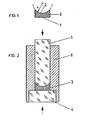
- Fig. 1 shows a button 3 with the flat end face 1 and the concave rear face 2 with the radius r of the base curve.
- the end face 1 is not necessarily flat, it can also have a curved surface. Since it will later have to be machined anyway, a flat surface is advisable, since it can be produced with less work.
- the button 3 is placed in a press tool, shown in Fig. 2. _
- the press tool has a preferably flat stamp 4 and a convex stamp 5, both guided in a sleeve 6.
- the stamp 4 can sit on a base, the stamp 5 is pressed with the necessary force, the z. B. generates a pressure of 1 to 100 bar, preferably 5 to 20 bar, on the button 3.
- the press tool and its contents for. B. heated in an air bath or in an oil bath.
- the chemically indifferent silicone oils have proven to be particularly advantageous for this.
- the forming temperature in step b) of the process according to the invention should preferably be 20 to 80 ° C. above the glass transition temperature of the thermoplastic material, but still below the melt flow temperature.
- the forming time is generally between 5 and 120 minutes, preferably 10 to 60 minutes under thermal stress.
- the tool is cooled under pressure and only then is the semi-finished product removed.
- the glass transition temperature can best be determined by means of the thermomechanical analysis, in which a test specimen is slowly warmed up and the penetration of a needle loaded with weights into the test specimen is followed.
- the glass transition temperature is determined by applying a tangent to the penetration curve.
- the forming temperature in step b) of the production process according to the invention is preferably 133 to 193 ° C.
- the melt flow temperature of a thermoplastic material depends not only on its polymer chemical composition, but also on the average molecular weight and its distribution. You will z. B. determined by placing a button on a flat surface and determining the temperature at which the button begins to melt or melt under its own weight.
- the process according to the invention can be compared with hot forming without the state of the melt flow being reached, as in the case of injection injection molding, for example.
- a major advantage of the method according to the invention is that the surface of the stamp 5 can be transferred to the semi-finished product with high precision without shrinkage.
- the stamp 5 has the counter geometry of the desired semi-finished product. It is applied with conventional manufacturing methods of the precision mechanical and optical industry by grinding and polishing, by bright turning or galvanic polishing, depending on the punch material.
- the stamp 5 consists of a non-porous, polishable material, preferably of optical glass types, of quartz glass or also of stainless steels or mold steels.
- the geometry of the back surface, which later faces the eye, is predetermined by the stamp 5. All currently available knowledge and future advances regarding the inner contour of the contact lens and the design of the zones near the edge (flattening, favoring the tear fluid exchange, etc.) can be incorporated into the geometry of the stamp 5 surface. Of course, the processing of such aspherical surfaces is a significant manufacturing problem that can only be solved with a high level of mechanical engineering effort and special care during production (see, for example, Heynacher: Aspherical optics - why it is required and how it is manufactured. Zeiss information 24 , 19-25 (1978/79) Issue 88 and E.
- Contact blanks can be produced from the blanks produced according to the invention in a manner known per se, as in the case of conventional blanks. This happens e.g. B. by milling, turning, grinding and polishing the end face, whereby the desired peak powers are achieved.
- the contact lenses made from the semi-finished products produced by the process according to the invention are distinguished by a particularly good stability of the radii and the back surface geometries and a low roughness depth of less than 0.1 J.1m, preferably less than 0.05 pm, specified by the stamp 5 .
- the contact lenses produced according to the invention have only very weak - and moreover symmetrical - tensions, which is probably decisive for the improved dimensional stability.
- contact lenses obtained in a conventional manner e.g. injection molding
- thermoplastic materials are all transparent polymers which are compatible with the eye, such as cellulose esters, aliphatic carboxylic acids, polymethyl methacrylate, copolymers of (meth) acrylic or alkyl cycloalkyl esters with, for.
- polymer blends such as z. B. in DE-OS 2 807 663, DE-OS 3 314188 and US-PS 4 263183 are suitable for the inventive method.
Landscapes
- Ophthalmology & Optometry (AREA)
- Engineering & Computer Science (AREA)
- Health & Medical Sciences (AREA)
- Physics & Mathematics (AREA)
- Mechanical Engineering (AREA)
- General Health & Medical Sciences (AREA)
- Manufacturing & Machinery (AREA)
- General Physics & Mathematics (AREA)
- Optics & Photonics (AREA)
- Eyeglasses (AREA)
- Casting Or Compression Moulding Of Plastics Or The Like (AREA)
- Moulds For Moulding Plastics Or The Like (AREA)
- Solid State Image Pick-Up Elements (AREA)
- Coloring (AREA)
- Processing And Handling Of Plastics And Other Materials For Molding In General (AREA)
Description
- Die vorliegende Erfindung geht aus von einem Verfahren zur Herstellung eines Kontaktlinsen-Halbfertigzeugs durch thermische Verformung von thermoplastischen Materialien.
- Ein Verfahren zur Herstellung von Linsenrohlingen durch thermische Verformung von thermoplastischen Kunststoffen ist in DE-A-27 29 385 beschrieben. Bei der Verformung wird hierbei überflüssiger thermoplastischer Kunststoff in die Formteile gedrückt, so daß Formansätze entstehen, die später entfernt werden müssen. Dieses Verfahren läßt sich nicht ohne weiteres auf die Herstellung von Kontaktlinsen-Halbfertigzeugen übertragen. Ferner ist aus GB-A-11 74 682, auf welcher der Oberbegriff des Anspruchs 1 basiert, ein Verfahren zur Herstellung von Kontaktlinsen bekannt, bei dem in einem ersten Schritt durch thermoplastische Verformung eine sphärische Kontaktlinse hergestellt wird, die dann in einem zweiten Schritt getempert wird. Bei dem Temperprozeß werden die ursprünglich sphärischen Flächen aufgrund mechanischer Relaxationseffekte in asphärische Flächen umgewandelt.
- Die ophthalmologische Forschung der letzten Jahre hat gezeigt, daß die Verträglichkeit einer Kontaktlinse oder -schale nicht nur von der Natur des polymeren Materials, aus dem sie hergestellt wurde, sondern ganz entscheidend von der Innengeometrie der dem Auge zugewandten Seite und deren Stabilität abhängig ist. Man bevorzugt heute Kontaktlinsen, welche asphärische Innenflächen mit definierten Abflachungen zum Rand hin aufweisen. So wird erreicht, daß die Kontaktlinse auf einem Tränenflüssigkeitsfilm schwimmt, der bei Lid-und Augenbewegungen fließt und somit einen Austausch von Nährstoffen und einen Abtransport von Metaboliten gewährleistet. Im folgenden sollen unter dem Sammelbegriff "Kontaktlinsen" jeweils Linsen und Schalen verstanden werden.
- Von thermoplastischen Materialien zur Herstellung von Kontaktlinsen wird daher nicht nur eine ausgezeichnete Biokompatibilität, sondern auch eine hohe Formstabilität über längere Tragezeitdauern hinweg erwartet. Ein in der Praxis häufig verwendeter Herstellprozeß für kontaktoptische Gegenstände ist das Prägen, Drehen und Polieren aus Knöpfen (sogenannten Blanks), die in etwa schon den Durchmesser der gewünschten Kontaktlinse besitzen. Von kontaktoptischen Gegenständen wird von der Augenmedizin gefordert, daß sie eine Oberflächenrauhtiefe von unter 0,1 pm, bevorzugt unter 0,05 j.lm besitzen. Darüber hinaus sollen die Krümmungsradien der sphärischen Grundkurve der üblichen Innenflächen-Geometrien, die in der Größenordnung um 8 mm liegen, sich im Laufe der Tragezeit einer Kontaktlinse um weniger als ± 0,02 mm ändern. Bedenkt man, daß eine moderne Kontaktlinse an ihren Randzonen nur noch eine Dicke von etwa 0,12 mm aufweist, so wird verständlich, daß die geforderten Toleranzen für die Innenflächen nur unter Anwendung technisch sehr aufwendiger und zeitraubender Dreh- und Polierverfahren einzuhalten sind.
- Ziel der Erfindung war es nun, einen neuen Herstellweg über Kontaktlinsen-Halbfertigzeuge aus thermoplastischen Polymeren zu finden, aus denen sich mit geringem Aufwand weitgehend verspannungsfreie Kontaktlinsen mit hoher Stabilität auch komplizierter Innengeometrien herstellen lassen.
- Die Aufgabe wird erfindungsgemäß dadurch gelöst, .
- a) daß man zunächst aus dem thermoplastischen Material einen zylindrischen Knopf herstellt, dessen Gewicht weitgehend jenem des herzustellenden Halbfertigzeugs entspricht.
- b) daß man den Knopf anschließend in ein abgeschlossenes, mit zwei einander gegenüberstehenden, in einer Hülse geführten Stempeln versehenes Preßwerkzeug einbringt, wobei der eine Stempel eine konvex gekrümmte, asphärische Oberfläche entsprechend der Innenfläche der herzustellenden Kontaktlinse aufweist und
- c) daß man den Knopf im Preßwerkzeug unter Druck oberhalb der Glasübergangstemperatur des thermoplastischen Materials zu dem Kontaktlinsen-Halbfertigzeug mit vollständig ausgebildeter asphärischer Rückfläche umformt.
- Der zylindrische Knopf kann nach herkömmlichen Methoden der Kunststoffverarbeitung wie z. B. Spritzgießen, Prägen, Stanzen, Pressen oder Schneiden hergestellt werden. Ausgehend von den so hergestellten Halbfertigzeugen müssen zur Herstellung von fertigen Kontaktlinsen nur noch die den Scheitelbrechwerten entsprechenden Stirnflächengeometrien durch Drehen und Polieren aufgebracht werden. Solche Kontaktlinsen zeichnen sich durch eine hohe Verspannungsfreiheit sowie durch eine besonders hohe mechanische Stabilität der Radien und Geometrien der Basiskurven aus.
- Bevorzugte Ausführungsformen des erfindungsgemäßen Verfahrens sind in den Unteransprüchen beschrieben.
- Als thermoplastische Materialien können alle an sich für Kontaktlinsen bekannten halbharten bis harten organischen Polymeren z. B. auf der Basis von Celluloseestern, Polycarbonaten, Polyamiden, Polyestern, Homo- und Copolymerisaten von Vinylpyrrolidon, Methacryl-und Acrylsäureestern bzw. Polymerblends auf Basis dieser Polymeren eingesetzt werden.
- Die Knöpfe mit vorzugsweise planer oder vorgebildeter konkaver Rückfläche werden in Schritt a) des erfindungsgemäßen Verfahrens z. B. nach herkömmlichen Methoden des Injektionsspritzgusses in Formwerkzeugen hergestellt. Die Knöpfe haben z. B. einen Durchmesser von 11 bis 30 mm, bevorzugt 12 bis 28 mm, wobei die oberen Werte dieser Bereiche in erster Linie für Kontaktschalen in Frage kommen und für Linsen der Durchmesser besonders bevorzugt 12,7 mm ± 0,05, beträgt. Die Dicke der Knöpfe liegt z. B. bei der Herstellung von Skeralschalen zwischen 10 und 14 mm, bei Linsen z. B. zwischen 4,5 und 5,5 mm und der Radius der konkaven Innenkurve der Knöpfe bei 7 bis 9 mm. Bei dem ersten Arbeitsschritt kommt man mit verhältnismäßig einfachen Formwerkzeugen aus; es genügen etwa 2 bis 3 verschiedene Formwerkzeuge, da nach dem erfindungsgemäßen Verfahren die Präzisionsformgebung in einem von der Knopf-Herstellung getrennten weiteren Arbeitsprozeß erfolgt. Der Vorteil ist, daß die Knöpfe in kurzer Zykluszeit unter hoher Maschinenauslastung hergestellt werden können, ohne daß auf Spannungsfreiheit und Formpräzision allzu hohe Anforderungen gestellt werden müssen, wie es sonst bei der Spritzguß-Herstellung von optischen Linsen notwendig ist. Man kann daher auf teure und empfindliche Formwerkzeuge verzichten.
- Eine weitere Möglichkeit zur Herstellung von vorgefertigten Knöpfen besteht im Pressen von thermoplastischen Materialien oder im Schneiden von Rundstäben.
- Die Abb. 1 zeigt einen Knopf 3 mit der planen Stirnfläche 1 und der konkaven Rückfläche 2 mit dem Radius r der Basiskurve. Die Stirnfläche 1 ist nicht zwingend plan, sie kann auch eine gekrümmte Fläche aufweisen. Da sie später ohnehin spanabhebend bearbeitet werden muß, bietet sich jedoch eine plane Fläche an, denn sie ist mit geringerem arbeitstechnischen Aufwand herstellbar. Der Knopf 3 wird in ein Preßwerkzeug, dargestellt in Abb. 2, eingelegt. _ Das Preßwerkzeug besitzt einen vorzugsweise planen Stempel 4 und einen konvexen Stempel 5, beide geführt in einer Hülse 6. Der Stempel 4 kann auf einer Unterlage aufsitzen, der Stempel 5 wird mit der notwendigen Kraft aufgedrückt, die z. B. einen Druck von 1 bis 100 bar, bevorzugt 5 bis 20 bar, auf dem Knopf 3 erzeugt. Während des Preßvorganges wird das Preßwerkzeug samt Inhalt z. B. im Luftbad oder in einem Ölbad erwärmt. Hierfür erweisen sich besonders die chemisch indifferenten Silikonöle als vorteilhaft. Die Umformtemperatur in Schritt b) des erfindungsgemäßen Verfahrens sollte bevorzugt 20 bis 80° C oberhalb der Glasübergangstemperatur des thermoplastischen Materials, jedoch noch unterhalb der Schmelzflußtemperatur liegen. Die Umformzeit beträgt in allgemeinen zwischen 5 und 120 Minuten, bevorzugt 10 bis 60 Minuten unter Temperaturbelastung. Das Werkzeug wird unter Druck abgekühlt und erst dann das Halbfertigzeug entnommen.
- Die Glasübergangstemperatur läßt sich am zweckmäßigsten mittels der thermomechanischen Analyse ermitteln, bei der ein Probekörper langsam erwärmt und das Eindringen einer mit Gewichten belasteten Nadel in den Probekörper verfolgt wird. Die Glasübergangstemperatur wird durch Anlegen einer Tangente an die Eindringkurve bestimmt. Bei bestimmten optischen Polymethylmethacrylat-Gläsern liegt sie beispielsweise bei 113°C. Die Umformtemperatur im Schritt b) des erfindungsgemäßen Herstellverfahrens beträgt in diesem Fall bevorzugt 133 bis 193° C.
- Die Schmelzflußtemperatur eines thermoplastischen Materials hängt nicht nur von seiner polymerchemischen Zusammensetzung, sondern auch von der mittleren Molmasse und deren Verteilung ab. Sie wird z. B. bestimmt, indem man einen Knopf auf eine ebene Unterlage legt und die Temperatur ermittelt, bei der der Knopf unter seinem eigenen Gewicht anfängt zu schmelzen bzw. zu zerlaufen.
- Den erfindungsgemäßen Vorgang kann man mit einer Warmverformung vergleichen, ohne daß wie etwa bei einem Injektionsspritzguß der Zustand des Schmelzflusses erreicht wird. Ein wesentlicher Vorteil des erfindungsgemäßen Verfahrens ist, daß die Oberfläche des Stempels 5 mit hoher Präzision ohne Schwund auf das Halbfertigzeug übertragen werden kann. Der Stempel 5 besitzt die Gegengeometrie des gewünschten Halbfertigzeuges. Sie wird mit herkömmlichen Fertigungsmethoden der präzisionsmechanischen und optischen Industrie durch Schleifen und Polieren, durch Blankdrehen oder galvanisches Polieren, je nach Preßstempel-Material, aufgebracht. Der Stempel 5 besteht aus einem porenfreien, polierbaren Material, bevorzugt aus optischen Glassorten, aus Quarzglas oder auch aus Edelstählen oder Formenbaustählen.
- Durch den Stempel 5 wird die Geometrie der Rückfläche, die später dem Auge zugewandt ist, vorgegeben. In die Geometrie der Stempel 5 -Oberfläche können alle derzeit verfügbaren Erkenntnisse und zukünftigen Fortschritte hinsichtlich der Kontaktlinsen-Innenkontur und der Gestaltung der randnahen Zonen (Abflachungen, Begünstigung des Tränenflüssigkeits-Austauschs usw.) eingearbeitet werden. Natürlich ist die Bearbeitung derartiger asphärischer Flächen ein erhebliches fertigungstechnisches Problem, das nur mit hohem maschinenbautechnischen Aufwand und besonderer Sorgfalt bei der Fertigung gelöst werden kann (siehe z. B. E. Heynacher: Asphärische Optik - Warum sie gefordert und wie sie gefertigt wird. Zeiss-Informationen 24, 19-25 (1978/79) Heft 88 und E. Heynacher: Fertigung und Prüfung asphärischer Flächen - Stand der Technik in der Bundesrepublik Deutschland, Feinwerktechnik und Meßtechnik 92, Heft 1 (Jan./Febr. 1984), pp. 1-5). Bei Anwendung des erfindungsgemäßen Verfahrens muß der hohe Fertigungsaufwand jedoch nicht mehr an den einzelnen Kontaktlinsen-Individuen betrieben werden, vielmehr wird es vorteilhafterweise möglich, die mit hohem Aufwand auf dem Preßstempel erzeugte (negative) Idealgeometrie der Kontaktlinsen-Innenfläche in hoher Präzision mit geringem Fertigungsaufwand und somit sehr kostengünstig auf Kontaktlinsen-Rohlinge zu übertragen.
- Die von der Augenmedizin gewünschten äußerst kompliziert gekrümmten Innenflächen-Geometrien brauchen also nicht mehr in aufwendigen Verfahren gefräst, geschliffen und poliert zu werden.
- Aus den erfindungsgemäß hergestellten Rohlingen lassen sich in an sich bekannter Weise wie bei konventionellen Blanks Kontaktlinsen fertigen. Dies geschieht z. B. durch Fräsen, Drehen, Schleifen und Polieren der Stirnfläche, wodurch die gewünschten Scheitelbrechwerte erzielt werden.
- Die aus den nach dem erfindungsgemäßen Verfahren hergestellten Halbfertigzeugen gefertigten Kontaktlinsen zeichnen sich durch eine besonders gute Stabilität der Radien und der Rückflächen-Geometrien und einer vom Stempel 5 vorgegebenen geringen Rauhtiefe von unter 0,1 J.1m, bevorzugt unter 0,05 pm, aus. Wie die Untersuchung in polarisiertem Licht zeigt, weisen die erfindungsgemäß hergestellten Kontaktlinsen nur sehr schwache - und überdies symmetrische - Verspannungen auf, was wahrscheinlich für die verbesserte Formstabilität ausschlaggebend ist. Im Vergleich dazu zeigen auf konventionelle Weise (z. B. Spritzguß) erhaltene Kontaktlinsen häufig sehr deutliche und asymmetrische Verspannungen auf, deren Muster vor allem von der Fließrichtung des Spritzgutes während des Verspritzungsprozesses bestimmt wird, und die daher zu Änderungen der Geometrie während des Tragens neigen.
- Als thermoplastische Materialien kommen alle mit dem Auge verträglichen transparenten Polymere in Frage, wie Celluloseester, aliphatische Carbonsäuren, Polymethylmethacrylat, Copolymere von (Meth)Acrylsäurealkyl- oder -cycloalkylestern mit z. B. Vinylpyrrolidon, aromatische Polycarbonate, transparente amorphe aromatisch/aliphatische Polyamide und aromatisch/aliphatische Polyester, Polyolefine wie z. B. Poly-1-methylpenten-4 sowie Copolymerisate von Ethylen mit Vinylacetat bzw. deren teilverseifte Produkte. Auch Polymerblends, wie sie z. B. in DE-OS 2 807 663, DE-OS 3 314188 und US-PS 4 263183 beschrieben sind, sind für das erfindungsgemäße Verfahren geeignet.
Claims (7)
Priority Applications (1)
| Application Number | Priority Date | Filing Date | Title |
|---|---|---|---|
| AT85108783T ATE34335T1 (de) | 1984-07-28 | 1985-07-13 | Verfahren zur herstellung eines kontaktlinsenhalbfertigzeugs. |
Applications Claiming Priority (2)
| Application Number | Priority Date | Filing Date | Title |
|---|---|---|---|
| DE3427887 | 1984-07-28 | ||
| DE3427887 | 1984-07-28 |
Publications (3)
| Publication Number | Publication Date |
|---|---|
| EP0170141A2 EP0170141A2 (de) | 1986-02-05 |
| EP0170141A3 EP0170141A3 (en) | 1986-07-09 |
| EP0170141B1 true EP0170141B1 (de) | 1988-05-18 |
Family
ID=6241811
Family Applications (1)
| Application Number | Title | Priority Date | Filing Date |
|---|---|---|---|
| EP85108783A Expired EP0170141B1 (de) | 1984-07-28 | 1985-07-13 | Verfahren zur Herstellung eines Kontaktlinsen-Halbfertigzeugs |
Country Status (7)
| Country | Link |
|---|---|
| EP (1) | EP0170141B1 (de) |
| JP (1) | JPS6141118A (de) |
| KR (1) | KR860001357A (de) |
| AT (1) | ATE34335T1 (de) |
| DE (1) | DE3562730D1 (de) |
| ES (1) | ES8608399A1 (de) |
| HK (1) | HK86488A (de) |
Cited By (2)
| Publication number | Priority date | Publication date | Assignee | Title |
|---|---|---|---|---|
| US6951894B1 (en) | 1994-09-06 | 2005-10-04 | Ciba Vision Corporation | Extended wear ophthalmic lens |
| US7468398B2 (en) | 1994-09-06 | 2008-12-23 | Ciba Vision Corporation | Extended wear ophthalmic lens |
Families Citing this family (6)
| Publication number | Priority date | Publication date | Assignee | Title |
|---|---|---|---|---|
| US4761436A (en) * | 1985-10-21 | 1988-08-02 | Shin-Etsu Chemical Co., Ltd. | Contact lens comprising triorganovinylsilane polymers |
| DE3543357A1 (de) * | 1985-12-07 | 1987-06-11 | Bayer Ag | Verfahren und vorrichtung zur herstellung von kontaktlinsen-rohlingen mit fertig ausgebildeten rueckflaechen-geometrien |
| US5141677A (en) * | 1991-01-22 | 1992-08-25 | Minnesota Mining And Manufacturing Company | Method of hot stamping intraocular lens bodies |
| JP4087947B2 (ja) * | 1998-05-08 | 2008-05-21 | Hoyaヘルスケア株式会社 | ガス透過型ハードコンタクトレンズの製造方法 |
| US6162376A (en) | 1999-02-24 | 2000-12-19 | Mead Opthalmics | Compression molding of optical lenses |
| KR100368014B1 (ko) * | 2000-10-18 | 2003-01-24 | (주)보성기연 | 에프.알.피 플랜지관 제조방법 |
Family Cites Families (5)
| Publication number | Priority date | Publication date | Assignee | Title |
|---|---|---|---|---|
| CH280552A (de) * | 1950-03-23 | 1952-01-31 | Diplom Optiker Albert Braun Fa | Verfahren und Vorrichtung zur Herstellung von Augenhaftschalen. |
| GB819474A (en) * | 1955-05-13 | 1959-09-02 | Frederick Thomas Ridley | Contact lenses |
| DE1704527C3 (de) * | 1966-02-15 | 1978-07-27 | Ceskoslovenska Akademie Ved, Prag | Verfahren zum Herstellen von nichtspärischen Linsen aus einem Polymer |
| DE2729385A1 (de) * | 1976-07-12 | 1978-01-19 | American Optical Corp | Verfahren zum herstellen einer thermoplastischen linse vermittels verformen in fester phase |
| DE3325055A1 (de) * | 1983-07-12 | 1985-01-24 | Bayer Ag, 5090 Leverkusen | Verfahren zur herstellung von kontaktoptischen gegenstaenden |
-
1985
- 1985-07-13 EP EP85108783A patent/EP0170141B1/de not_active Expired
- 1985-07-13 AT AT85108783T patent/ATE34335T1/de not_active IP Right Cessation
- 1985-07-13 DE DE8585108783T patent/DE3562730D1/de not_active Expired
- 1985-07-26 JP JP16417885A patent/JPS6141118A/ja active Pending
- 1985-07-26 ES ES545600A patent/ES8608399A1/es not_active Expired
- 1985-07-27 KR KR1019850005398A patent/KR860001357A/ko not_active Ceased
-
1988
- 1988-10-27 HK HK864/88A patent/HK86488A/xx unknown
Cited By (6)
| Publication number | Priority date | Publication date | Assignee | Title |
|---|---|---|---|---|
| US6951894B1 (en) | 1994-09-06 | 2005-10-04 | Ciba Vision Corporation | Extended wear ophthalmic lens |
| US7468398B2 (en) | 1994-09-06 | 2008-12-23 | Ciba Vision Corporation | Extended wear ophthalmic lens |
| US7538146B2 (en) | 1994-09-06 | 2009-05-26 | Ciba Vision Corporation | Extended wear ophthalmic lens |
| US7553880B2 (en) | 1994-09-06 | 2009-06-30 | Ciba Vision Corporation | Extended wear ophthalmic lens |
| US8415404B2 (en) | 1994-09-06 | 2013-04-09 | Ciba Vision Corporation | Extended wear ophthalmic lens |
| US8568626B2 (en) | 1994-09-06 | 2013-10-29 | Ciba Vision Corporation | Extended wear ophthalmic lens |
Also Published As
| Publication number | Publication date |
|---|---|
| HK86488A (en) | 1988-11-04 |
| ES8608399A1 (es) | 1986-06-16 |
| JPS6141118A (ja) | 1986-02-27 |
| DE3562730D1 (en) | 1988-06-23 |
| KR860001357A (ko) | 1986-02-26 |
| EP0170141A2 (de) | 1986-02-05 |
| ATE34335T1 (de) | 1988-06-15 |
| EP0170141A3 (en) | 1986-07-09 |
| ES545600A0 (es) | 1986-06-16 |
Similar Documents
| Publication | Publication Date | Title |
|---|---|---|
| DE3443607C2 (de) | ||
| EP0458734B1 (de) | Verfahren zur Herstellung von Kontaklinsen | |
| DE69333398T2 (de) | Verfahren zur herstellung von torischen, sphärischen oder asphärischen, multifokalen oder progressiven kontaktlinsen | |
| DE69317293T2 (de) | Verfahren zum herstellen von plastikformen und verfahren zum giessen von kontaktlinsen | |
| DE69914031T2 (de) | Giessform für opthalmische Linsen, Verfahren zur Herstellung dergleichen, und Verfahren zur Herstellung von opthalmischen Linsen mit der Giessform | |
| DE69905787T2 (de) | Kontaktlinsen mit Identifiziermarkierungen | |
| DE69116658T2 (de) | Giessform zur Herstellung eines Dorns für eine torische Linse | |
| DE60011447T2 (de) | Giessform zur herstellung von kontaktlinsen | |
| DE60206739T2 (de) | Giessform für ophthalmischen linsen enthaltend formgedächtnispolmer oder formgedächtnislegierung und verfahren zur herstellung ophthalmischer produkten | |
| DE2820809A1 (de) | Verfahren und vorrichtung zum giessen einer linse aus fluessigem kunststoff | |
| DE69213486T2 (de) | Intraolukare Linse und Heissprägeherstellungsverfahren | |
| DE102004021215C5 (de) | Verfahren zum Ausbilden eines optischen Elements | |
| EP0170141B1 (de) | Verfahren zur Herstellung eines Kontaktlinsen-Halbfertigzeugs | |
| DE69520544T2 (de) | Verfahren und Vorrichtung zur Herstellung eines optischen Gegenstands | |
| DE3734656A1 (de) | Herstellung von augenlinsen mittels schneidlaser | |
| DE1479601A1 (de) | Verfahren zur Herstellung von optischen und ophtalmischen Linsen aus waermegehaerteten Kunstharzen | |
| DE2711384C3 (de) | Vorrichtung zur Herstellung von Rohlingen für afokale Linsen | |
| DE69328530T2 (de) | Verfahren zur Herstellung von einer Intraokular-Linse aus Polyimidpulver | |
| DE2729385A1 (de) | Verfahren zum herstellen einer thermoplastischen linse vermittels verformen in fester phase | |
| EP0226848A2 (de) | Verfahren und Vorrichtung zur Herstellung von Kontaktlinsen-Rohlingen mit fertig ausgebildeten Rückflächen-Geometrien | |
| DE69420864T2 (de) | Verfahren zum Pressformen eines optischen Elementes | |
| EP0131227A2 (de) | Verfahren zur Herstellung von kontaktoptischen Gegenständen | |
| DE19858849A1 (de) | Verfahren und Vorrichtung zum Herstellen von Brillengläsern aus Kunststoff | |
| DE3114881C2 (de) | Nachverformungsverfahren zur Herstellung von Präzisionsglaskörpern mit hoher Oberflächenqualität | |
| DE69413284T2 (de) | Verfahren zum Herstellen von optischen Gegenständen |
Legal Events
| Date | Code | Title | Description |
|---|---|---|---|
| PUAI | Public reference made under article 153(3) epc to a published international application that has entered the european phase |
Free format text: ORIGINAL CODE: 0009012 |
|
| 17P | Request for examination filed |
Effective date: 19850713 |
|
| AK | Designated contracting states |
Designated state(s): AT BE CH DE FR GB IT LI LU NL SE |
|
| PUAL | Search report despatched |
Free format text: ORIGINAL CODE: 0009013 |
|
| AK | Designated contracting states |
Kind code of ref document: A3 Designated state(s): AT BE CH DE FR GB IT LI LU NL SE |
|
| 17Q | First examination report despatched |
Effective date: 19870202 |
|
| GRAA | (expected) grant |
Free format text: ORIGINAL CODE: 0009210 |
|
| ITF | It: translation for a ep patent filed | ||
| AK | Designated contracting states |
Kind code of ref document: B1 Designated state(s): AT BE CH DE FR GB IT LI LU NL SE |
|
| REF | Corresponds to: |
Ref document number: 34335 Country of ref document: AT Date of ref document: 19880615 Kind code of ref document: T |
|
| REF | Corresponds to: |
Ref document number: 3562730 Country of ref document: DE Date of ref document: 19880623 |
|
| ET | Fr: translation filed | ||
| GBT | Gb: translation of ep patent filed (gb section 77(6)(a)/1977) | ||
| PLBE | No opposition filed within time limit |
Free format text: ORIGINAL CODE: 0009261 |
|
| STAA | Information on the status of an ep patent application or granted ep patent |
Free format text: STATUS: NO OPPOSITION FILED WITHIN TIME LIMIT |
|
| 26N | No opposition filed | ||
| ITTA | It: last paid annual fee | ||
| REG | Reference to a national code |
Ref country code: CH Ref legal event code: PUE Owner name: DR. FRANK WINGLER |
|
| REG | Reference to a national code |
Ref country code: CH Ref legal event code: PUE Owner name: DR. OTTO-CHRISTIAN GEYER TRANSFER- CIBA-GEIGY AG |
|
| BECA | Be: change of holder's address |
Free format text: 931124 *CIBA-GEIGY A.G.:KLYBECKSTRASSE 141, CH-4002 BASEL |
|
| BECH | Be: change of holder |
Free format text: 931124 *CIBA-GEIGY A.G.:KLYBECKSTRASSE 141, CH-4002 BASEL |
|
| REG | Reference to a national code |
Ref country code: GB Ref legal event code: 732E |
|
| NLS | Nl: assignments of ep-patents |
Owner name: DR. FRANK WINGLER TE LEVERKUSEN, BONDSREPUBLIEK DU |
|
| NLS | Nl: assignments of ep-patents |
Owner name: DR. MED. OTTO CHRISTIAN GEYER TE BRAUNFELS, BONDSR |
|
| REG | Reference to a national code |
Ref country code: FR Ref legal event code: TP |
|
| NLS | Nl: assignments of ep-patents |
Owner name: CIBA-GEIGY A.G. TE BAZEL, ZWITSERLAND. |
|
| EPTA | Lu: last paid annual fee | ||
| PGFP | Annual fee paid to national office [announced via postgrant information from national office to epo] |
Ref country code: CH Payment date: 19941028 Year of fee payment: 10 |
|
| EAL | Se: european patent in force in sweden |
Ref document number: 85108783.3 |
|
| PGFP | Annual fee paid to national office [announced via postgrant information from national office to epo] |
Ref country code: FR Payment date: 19950606 Year of fee payment: 11 |
|
| PGFP | Annual fee paid to national office [announced via postgrant information from national office to epo] |
Ref country code: AT Payment date: 19950613 Year of fee payment: 11 |
|
| PGFP | Annual fee paid to national office [announced via postgrant information from national office to epo] |
Ref country code: GB Payment date: 19950615 Year of fee payment: 11 |
|
| PGFP | Annual fee paid to national office [announced via postgrant information from national office to epo] |
Ref country code: DE Payment date: 19950619 Year of fee payment: 11 |
|
| PGFP | Annual fee paid to national office [announced via postgrant information from national office to epo] |
Ref country code: NL Payment date: 19950628 Year of fee payment: 11 |
|
| PGFP | Annual fee paid to national office [announced via postgrant information from national office to epo] |
Ref country code: SE Payment date: 19950630 Year of fee payment: 11 |
|
| PGFP | Annual fee paid to national office [announced via postgrant information from national office to epo] |
Ref country code: LU Payment date: 19950701 Year of fee payment: 11 |
|
| PG25 | Lapsed in a contracting state [announced via postgrant information from national office to epo] |
Ref country code: LI Effective date: 19950731 Ref country code: CH Effective date: 19950731 |
|
| PGFP | Annual fee paid to national office [announced via postgrant information from national office to epo] |
Ref country code: BE Payment date: 19950825 Year of fee payment: 11 |
|
| REG | Reference to a national code |
Ref country code: CH Ref legal event code: PL |
|
| PG25 | Lapsed in a contracting state [announced via postgrant information from national office to epo] |
Ref country code: LU Free format text: LAPSE BECAUSE OF NON-PAYMENT OF DUE FEES Effective date: 19960713 Ref country code: GB Effective date: 19960713 Ref country code: AT Effective date: 19960713 |
|
| PG25 | Lapsed in a contracting state [announced via postgrant information from national office to epo] |
Ref country code: SE Effective date: 19960714 |
|
| PG25 | Lapsed in a contracting state [announced via postgrant information from national office to epo] |
Ref country code: BE Effective date: 19960731 |
|
| BERE | Be: lapsed |
Owner name: CIBA-GEIGY A.G. Effective date: 19960731 |
|
| PG25 | Lapsed in a contracting state [announced via postgrant information from national office to epo] |
Ref country code: NL Effective date: 19970201 |
|
| GBPC | Gb: european patent ceased through non-payment of renewal fee |
Effective date: 19960713 |
|
| PG25 | Lapsed in a contracting state [announced via postgrant information from national office to epo] |
Ref country code: FR Effective date: 19970328 |
|
| NLV4 | Nl: lapsed or anulled due to non-payment of the annual fee |
Effective date: 19970201 |
|
| PG25 | Lapsed in a contracting state [announced via postgrant information from national office to epo] |
Ref country code: DE Effective date: 19970402 |
|
| EUG | Se: european patent has lapsed |
Ref document number: 85108783.3 |
|
| REG | Reference to a national code |
Ref country code: FR Ref legal event code: ST |