EP0156976B1 - Optisch einheitliche Imine - Google Patents
Optisch einheitliche Imine Download PDFInfo
- Publication number
- EP0156976B1 EP0156976B1 EP84115022A EP84115022A EP0156976B1 EP 0156976 B1 EP0156976 B1 EP 0156976B1 EP 84115022 A EP84115022 A EP 84115022A EP 84115022 A EP84115022 A EP 84115022A EP 0156976 B1 EP0156976 B1 EP 0156976B1
- Authority
- EP
- European Patent Office
- Prior art keywords
- lower alkoxy
- phenyl
- lower alkyl
- signifies
- glyceraldehyde
- Prior art date
- Legal status (The legal status is an assumption and is not a legal conclusion. Google has not performed a legal analysis and makes no representation as to the accuracy of the status listed.)
- Expired
Links
- 0 CCN=C(*)[C@@](C)* Chemical compound CCN=C(*)[C@@](C)* 0.000 description 1
Classifications
-
- C—CHEMISTRY; METALLURGY
- C07—ORGANIC CHEMISTRY
- C07D—HETEROCYCLIC COMPOUNDS
- C07D205/00—Heterocyclic compounds containing four-membered rings with one nitrogen atom as the only ring hetero atom
- C07D205/02—Heterocyclic compounds containing four-membered rings with one nitrogen atom as the only ring hetero atom not condensed with other rings
- C07D205/06—Heterocyclic compounds containing four-membered rings with one nitrogen atom as the only ring hetero atom not condensed with other rings having one double bond between ring members or between a ring member and a non-ring member
- C07D205/08—Heterocyclic compounds containing four-membered rings with one nitrogen atom as the only ring hetero atom not condensed with other rings having one double bond between ring members or between a ring member and a non-ring member with one oxygen atom directly attached in position 2, e.g. beta-lactams
-
- C—CHEMISTRY; METALLURGY
- C07—ORGANIC CHEMISTRY
- C07D—HETEROCYCLIC COMPOUNDS
- C07D317/00—Heterocyclic compounds containing five-membered rings having two oxygen atoms as the only ring hetero atoms
- C07D317/08—Heterocyclic compounds containing five-membered rings having two oxygen atoms as the only ring hetero atoms having the hetero atoms in positions 1 and 3
- C07D317/72—Heterocyclic compounds containing five-membered rings having two oxygen atoms as the only ring hetero atoms having the hetero atoms in positions 1 and 3 spiro-condensed with carbocyclic rings
-
- C—CHEMISTRY; METALLURGY
- C07—ORGANIC CHEMISTRY
- C07D—HETEROCYCLIC COMPOUNDS
- C07D205/00—Heterocyclic compounds containing four-membered rings with one nitrogen atom as the only ring hetero atom
- C07D205/02—Heterocyclic compounds containing four-membered rings with one nitrogen atom as the only ring hetero atom not condensed with other rings
- C07D205/06—Heterocyclic compounds containing four-membered rings with one nitrogen atom as the only ring hetero atom not condensed with other rings having one double bond between ring members or between a ring member and a non-ring member
- C07D205/08—Heterocyclic compounds containing four-membered rings with one nitrogen atom as the only ring hetero atom not condensed with other rings having one double bond between ring members or between a ring member and a non-ring member with one oxygen atom directly attached in position 2, e.g. beta-lactams
- C07D205/085—Heterocyclic compounds containing four-membered rings with one nitrogen atom as the only ring hetero atom not condensed with other rings having one double bond between ring members or between a ring member and a non-ring member with one oxygen atom directly attached in position 2, e.g. beta-lactams with a nitrogen atom directly attached in position 3
-
- C—CHEMISTRY; METALLURGY
- C07—ORGANIC CHEMISTRY
- C07D—HETEROCYCLIC COMPOUNDS
- C07D277/00—Heterocyclic compounds containing 1,3-thiazole or hydrogenated 1,3-thiazole rings
- C07D277/02—Heterocyclic compounds containing 1,3-thiazole or hydrogenated 1,3-thiazole rings not condensed with other rings
- C07D277/20—Heterocyclic compounds containing 1,3-thiazole or hydrogenated 1,3-thiazole rings not condensed with other rings having two or three double bonds between ring members or between ring members and non-ring members
- C07D277/32—Heterocyclic compounds containing 1,3-thiazole or hydrogenated 1,3-thiazole rings not condensed with other rings having two or three double bonds between ring members or between ring members and non-ring members with hetero atoms or with carbon atoms having three bonds to hetero atoms with at the most one bond to halogen, e.g. ester or nitrile radicals, directly attached to ring carbon atoms
- C07D277/38—Nitrogen atoms
- C07D277/40—Unsubstituted amino or imino radicals
-
- C—CHEMISTRY; METALLURGY
- C07—ORGANIC CHEMISTRY
- C07D—HETEROCYCLIC COMPOUNDS
- C07D317/00—Heterocyclic compounds containing five-membered rings having two oxygen atoms as the only ring hetero atoms
- C07D317/08—Heterocyclic compounds containing five-membered rings having two oxygen atoms as the only ring hetero atoms having the hetero atoms in positions 1 and 3
- C07D317/10—Heterocyclic compounds containing five-membered rings having two oxygen atoms as the only ring hetero atoms having the hetero atoms in positions 1 and 3 not condensed with other rings
- C07D317/14—Heterocyclic compounds containing five-membered rings having two oxygen atoms as the only ring hetero atoms having the hetero atoms in positions 1 and 3 not condensed with other rings with substituted hydrocarbon radicals attached to ring carbon atoms
- C07D317/28—Radicals substituted by nitrogen atoms
-
- C—CHEMISTRY; METALLURGY
- C07—ORGANIC CHEMISTRY
- C07D—HETEROCYCLIC COMPOUNDS
- C07D403/00—Heterocyclic compounds containing two or more hetero rings, having nitrogen atoms as the only ring hetero atoms, not provided for by group C07D401/00
- C07D403/02—Heterocyclic compounds containing two or more hetero rings, having nitrogen atoms as the only ring hetero atoms, not provided for by group C07D401/00 containing two hetero rings
- C07D403/04—Heterocyclic compounds containing two or more hetero rings, having nitrogen atoms as the only ring hetero atoms, not provided for by group C07D401/00 containing two hetero rings directly linked by a ring-member-to-ring-member bond
-
- C—CHEMISTRY; METALLURGY
- C07—ORGANIC CHEMISTRY
- C07D—HETEROCYCLIC COMPOUNDS
- C07D405/00—Heterocyclic compounds containing both one or more hetero rings having oxygen atoms as the only ring hetero atoms, and one or more rings having nitrogen as the only ring hetero atom
- C07D405/14—Heterocyclic compounds containing both one or more hetero rings having oxygen atoms as the only ring hetero atoms, and one or more rings having nitrogen as the only ring hetero atom containing three or more hetero rings
-
- C—CHEMISTRY; METALLURGY
- C07—ORGANIC CHEMISTRY
- C07D—HETEROCYCLIC COMPOUNDS
- C07D493/00—Heterocyclic compounds containing oxygen atoms as the only ring hetero atoms in the condensed system
- C07D493/12—Heterocyclic compounds containing oxygen atoms as the only ring hetero atoms in the condensed system in which the condensed system contains three hetero rings
- C07D493/14—Ortho-condensed systems
-
- Y—GENERAL TAGGING OF NEW TECHNOLOGICAL DEVELOPMENTS; GENERAL TAGGING OF CROSS-SECTIONAL TECHNOLOGIES SPANNING OVER SEVERAL SECTIONS OF THE IPC; TECHNICAL SUBJECTS COVERED BY FORMER USPC CROSS-REFERENCE ART COLLECTIONS [XRACs] AND DIGESTS
- Y02—TECHNOLOGIES OR APPLICATIONS FOR MITIGATION OR ADAPTATION AGAINST CLIMATE CHANGE
- Y02P—CLIMATE CHANGE MITIGATION TECHNOLOGIES IN THE PRODUCTION OR PROCESSING OF GOODS
- Y02P20/00—Technologies relating to chemical industry
- Y02P20/50—Improvements relating to the production of bulk chemicals
- Y02P20/55—Design of synthesis routes, e.g. reducing the use of auxiliary or protecting groups
Definitions
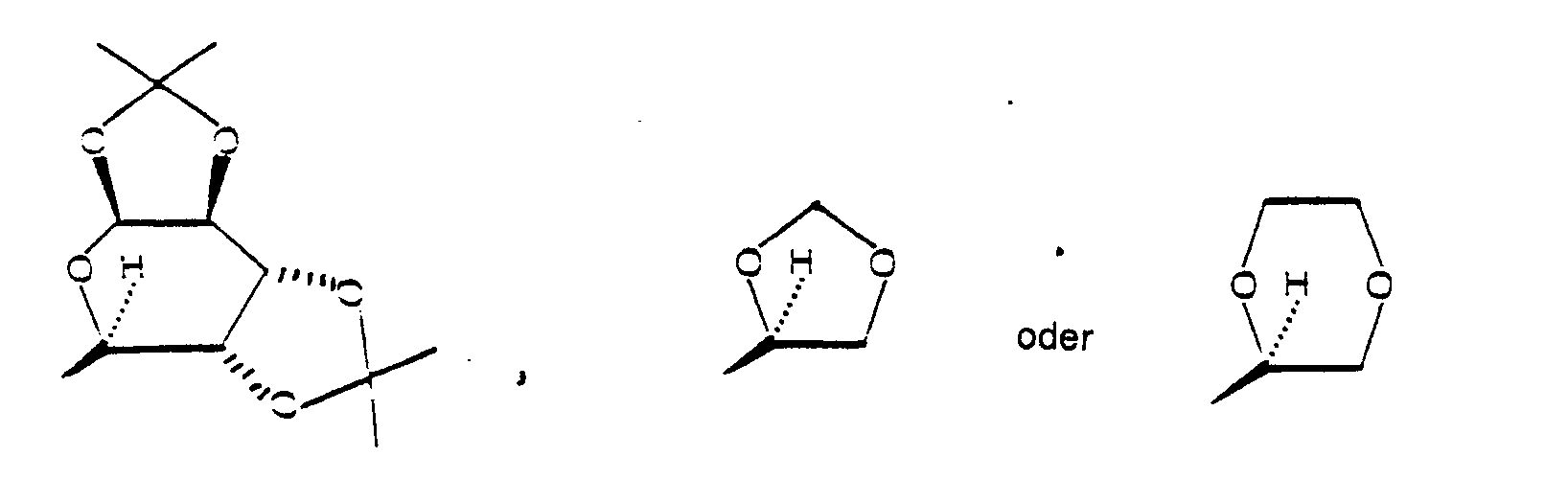
- the present invention relates to new optically uniform imines of the general formula wherein R 3 is lower alkyl, phenyl-lower alkyl, lower alkoxy-lower alkyl, especially lower alkoxymethyl, and R 4 is lower alkyl or phenyl-lower alkyl or R 3 and R 4 together with the chiral center is a 5- or 6-membered, if necessary a further 0-heterocycle which is not directly connected to the chiral center and which may optionally be substituted by lower alkyl, lower alkoxy, oxo or spirocyclo-lower alkyl, where adjacent lower alkoxy groups can together form a ring, such as, for. B.
- the present invention relates to optically uniform compounds of the above formula III and the corresponding antipodes thereof and the preparation of these compounds.
- the substances according to the invention can be used for the production of optically uniform ⁇ -lactams of the formula la defined below.
- lower alkyl taken alone, or in combinations such as” lower alkoxy and the like denotes straight-chain or branched saturated hydrocarbon radicals having at most 7, preferably at most 4, carbon atoms, such as methyl, ethyl, isopropyl and the like.
- Examples of 2,4- and 3,4-di (lower alkoxy) benzyl are in particular 2,4- and 3,4-dimethoxybenzyl.
- Examples of 2,4- and 3,4-di (lower alkoxy) phenyl are in particular 2,4- and 3,4-dimethoxyphenyl.
- An example of di [4- (lower alkoxy) phenyl] methyl is especially di (4-methoxyphenyl) methyl.
- An example of 4- (lower alkoxyl) phenyl is especially 4-methoxyphenyl.
- R 3 and R 4 together with the chiral center represent a group of the formula:
- the present invention comprises compounds of the general formula in which Z "denotes 2,4- or 3,4-di (lower alkoxy) benzyl, di [4- (lower alkoxy) phenyl] methyl or 4- (lower alkoxy) phenyl, and the corresponding optical antipodes thereof.
- Z ' is preferably 2,4-dimethoxybenzyl.
- the compounds of formula III and their optical antipodes can be prepared according to the invention by using an aldehyde of the general formula wherein R 3 and R 4 have the above meaning, or the optical antipode thereof with an amine of the general formula where Z 'has the above meaning.
- the process is preferably carried out in an inert organic solvent, for example in a halogenated hydrocarbon such as methylene chloride, chloroform, 1,2-dichloroethane and the like, or in a hydrocarbon such as benzene, toluene and the like.
- the water of reaction formed during the reaction is preferably removed continuously, for example by azeotropic distillation or by working in the presence of a dehydrating agent, for example in the presence of a suitable molecular sieve, or by other conventional drying agents, such as potassium carbonate, magnesium sulfate and the like. If the water of reaction formed is removed azeotropically, the reaction is carried out at the boiling point of the solvent selected; when using a dehydrating agent, it is preferable to work at room temperature.
- Suitable reactive carboxylic acid derivatives are, for example, the corresponding carboxylic acid halides, in particular the carboxylic acid chlorides, corresponding carboxylic acid anhydrides and mixed anhydrides (e.g. with trifluoroacetic acid, mesitylenesulfonic acid and the like), corresponding carboxylic acid imidazolides and the like.
- the procedure is expediently carried out in the presence of a tertiary amine, such as triethylamine, and in an inert organic solvent, in particular ethers such as tetrahydrofuran, diethyl ether, t-butyl methyl ether, dioxane, ethylene glycol dimethyl ether or the like, halogenated hydrocarbons such as methylene chloride, chloroform, 1,2 -Dichloroethane or the like, acetonitrile, dimethylformamide or the like come into question.
- a tertiary amine such as triethylamine
- an inert organic solvent in particular ethers such as tetrahydrofuran, diethyl ether, t-butyl methyl ether, dioxane, ethylene glycol dimethyl ether or the like, halogenated hydrocarbons such as methylene chloride, chloroform, 1,2 -Dichloroethane or
- the solution is stirred at room temperature for 30 minutes, then cooled to ⁇ 20 ° and treated with 0.65 ml (0.47 g, 4.6 mmol) of triethylamine and after a few minutes with a solution of 0.8 g (0.40 mmol) phthaloylglycyl chloride in 20 ml methylene chloride.
- the reaction mixture is warmed to room temperature and then stirred for 1.5 hours. After filtration, the organic solution obtained is washed with water (2 ⁇ 150 ml) and aqueous sodium chloride solution (1 ⁇ 100 ml) and dried over magnesium sulfate.
- reaction mixture is stirred for 12 hours at room temperature, then diluted with 100 ml of methylene chloride and washed successively with 30 ml of water, 30 ml of 0.1 N aqueous hydrochloric acid, 30 ml of water and 30 ml of aqueous sodium chloride solution and dried over sodium sulfate.
- the solvent is evaporated and the residue is purified by chromatography on silica gel (230-400 mesh; ethyl acetate: n-hexane 1: 1 as solvent).
Landscapes
- Organic Chemistry (AREA)
- Chemical & Material Sciences (AREA)
- Plural Heterocyclic Compounds (AREA)
- Pharmaceuticals Containing Other Organic And Inorganic Compounds (AREA)
- Organic Low-Molecular-Weight Compounds And Preparation Thereof (AREA)
- Pyrrole Compounds (AREA)
- Cephalosporin Compounds (AREA)
- Hydrogenated Pyridines (AREA)
- Nitrogen Condensed Heterocyclic Rings (AREA)
- Heterocyclic Carbon Compounds Containing A Hetero Ring Having Oxygen Or Sulfur (AREA)
- Polymers With Sulfur, Phosphorus Or Metals In The Main Chain (AREA)
- Optical Fibers, Optical Fiber Cores, And Optical Fiber Bundles (AREA)
- Fats And Perfumes (AREA)
Description
- Die vorliegende Erfindung betrifft neue optisch einheitliche Imine der allgemeinen Formel

- Gegenstand der vorliegenden Erfindung sind optisch einheitliche Verbindungen der obigen Formel III und die entsprechenden Antipoden davon und die Herstellung dieser Verbindungen. Die erfindungsgemässen Stoffe können zur Herstellung von optisch einheitlichen ß-Lactamen der weiter unten definierten Formel la verwendet werden.
- Der Ausdruck « niederes Alkyl für sich allein genommen, oder in Kombinationen, wie « niederes Alkoxy und dergleichen, bezeichnet geradkettige oder verzweigte gesättigte Kohlenwasserstoffreste mit höchstens 7, vorzugsweise höchstens 4 Kohlenstoffatomen, wie Methyl, Aethyl, Isopropyl und dergleichen.
- Beispiele für 2,4- und 3,4-Di(niederes Alkoxy) benzyl sind insbesondere 2,4- und 3,4-Dimethoxybenzyl. Beispiele für 2,4- und 3,4-Di(niederes Alkoxy) phenyl sind insbesondere 2,4- und 3,4-Dimethoxyphenyl. Ein Beispiel für Di [4-(niederes Alkoxy) phenyl] methyl ist insbesondere Di(4-methoxyphenyl) methyl. Ein Beispiel für 4-(niederes Alkoxyl) phenyl ist insbesondere 4-Methoxyphenyl.
- In einer besonders bevorzugten Ausführungsform bedeuten R3 und R4 zusammen mit dem Chiralitätszentrum eine Gruppe der Formel :


- In einer speziellen Ausführungsform umfasst die vorliegende Erfindung Verbindungen der allgemeinen Formel

und die entsprechenden optischen Antipoden davon. - Z' bedeutet vorzugsweise 2,4-Dimethoxybenzyl.
- Die nachfolgend aufgeführten Verbindungen sind Vertreter der durch die obige Formel III definierten Verbindungsklasse :
- Isopropyliden-L-glyceraldehyd-(2,4-dimethoxybenzyl) imin und
- Isopropyliden-L-glyceraldehyd-(3,4-dimethoxybenzyl) imin.
- Die Verbindungen der Formel III und deren optische Antipoden können erfindungsgemäss hergestellt werden, indem man einen Aldehyd der allgemeinen Formel


- Die Verbindungen der Formel III und ihre optischen Antipoden können in Gegenwart einer Base mit einem reaktiven Derivat einer Carbonsäure der allgemeinen Formel


- Bei der Reaktion eines reaktiven Derivates einer Carbonsäure der Formel II mit einer Verbindung der Formel III bzw. dem optischen Antipoden davon handelt es sich um eine dem Fachmann geläufige Cycloaddition. Geeignete reaktive Carbonsäurederivate sind beispielsweise die entsprechenden Carbonsäurehalogenide, insbesondere die Carbonsäurechloride, entsprechende Carbonsäureanhydride und gemischte Anhydride (z. B. mit Trifluoressigsäure, Mesitylensulfonsäure und dergleichen), entsprechende Carbonsäureimidazolide und dergleichen. Zweckmässigerweise arbeitet man dabei in Gegenwart eines tertiären Amins, wie Triäthylamin, und in einem inerten organischen Lösungsmittel, wobei insbesondere Aether, wie Tetrahydrofuran, Diäthyläther, t-Butylmethyläther, Dioxan, Aethylenglykoldimethyläther oder dergleichen, halogenierte Kohlenwasserstoffe, wie Methylenchlorid, Chloroform, 1,2-Dichloräthan oder dergleichen, Acetonitril, Dimethylformamid oder dergleichen in Frage kommen. Die obige Cycloaddition wird dabei in einem Temperaturbereich von etwa - 30 °C bis etwa 50 °C durchgeführt.
- Die obige Reaktion einer Verbindung der Formel II mit einer optisch einheitlichen Verbindung der Formel III oder dem optischen Antipoden davon liefert eine Verbindung der obigen Formel la bzw. den entsprechenden optischen Antipoden davon, wobei die Substituenten in 3- und 4-Stellung des Azetidinringes zueinander wie erwartet cis-ständig sind. Ueberraschenderweise hat es sich jedoch gezeigt, dass die Verwendung einer optisch aktiven Verbindung der Formel III bzw. des optischen Antipoden davon in der obigen Cycloaddition in hoher optischer Ausbeute zwei neue optische Zentren induziert, d. h. mit hoher Diastereoselektivität zur Bildung von nur einem von zwei möglichen diastereomeren Produkten führt. Im erhaltenen Produkt konnte das zweite mögliche cis-Cycloadditionsprodukt, das zum tatsächlich erhaltenen Produkt diastereoisomer wäre, nicht nachgewiesen werden.
- Die Verbindungen der Formel III und ihre entsprechenden optischen Antipoden, welche in der oben beschriebenen Cycloaddition überraschenderweise nur das eine von zwei diastereomeren Produkten liefern, müssen niche isoliert werden, sondern können direkt der erfindungsgemässen Cycloaddition unterworfen werden.
- Die optisch einheitlichen β-Lactame der Formel la und deren Herstellung durch Umsetzen einer Verbindung der Formel III mit einem reaktiven Derivat einer Carbonsäure der Formel II werden in der Europäischen Patentanmeldung Nr. 82.107790.6 (Veröffentlichungsnummer : 73.061) beansprucht.
- Zu einer bei Raumtemperatur gerührten Lösung von 4,9 g (37,65 mMol) Isopropyliden-D-glyceraldehyd in 100 ml trockenem Methylenchlorid (frei von Methanol) gibt man 10 g Molekularsieb 4 Ä und anschliessend tropfenweise eine Lösung von 6,29 g (37,65 mMol) 2,4-Dimethoxybenzylamin in 20 ml trockenem Methylenchlorid. Man rührt die Reaktionsmischung während 2 Stunden bei Raumtemperatur, versetzt anschliessend mit 5 wasserfreiem Magnesiumsulfat, rührt noch während 30 Minuten und filtriert anschliessend, wobei der Filterkuchen noch mit 20 ml Methylenchlorid gewaschen wird.
- Die erhaltene organische Lösung von Isopropyliden-D-glyceraldehyd-(2,4-dimethoxybenzyl) imin wird unter Argon auf -18° gekühlt und unter Rühren mit 5,5 ml (39,5 mMol) Triäthylamin versetzt. Nach wenigen Minuten gibt man über einen Zeitraum von 1 Stunde eine Lösung von 8,8 g (39,3 mMol) . Phthaloylglycylchlorid in 100 ml trockenem Methylenchlorid dazu, rührt die Reaktionsmischung während 2 Stunden bei ―15° und lässt anschliessend auf Raumtemperatur erwärmen. Man rührt noch über Nacht bei Raumtemperatur, wäscht die Reaktionsmischung dreimal mit je 100 ml Wasser und mit 100 ml Kochsalzlösung und trocknet die erhaltene Lösung über Natriumsulfat. Man dampft ein und chromatographiert den erhaltenen Rückstand an einer Kieselgelsäule (Korngrösse : 230-400 mesh) unter Eluieren mit Hexan/Essigester (1 : 1). Man erhält 15,8 g (90 %) N-[(3R,4R)-cis-1-(2,4-Dimethoxybenzyl)-4-[(S)-2,2-dimethyl-1,3-dioxolan-4-yl]-2-oxo-3-azetidinyl] phthalimid als Schaum ; [α]D=―37° (c = 1 in Chloroform) ; MS : 466 (M+). Nach der Umkristallisation aus Aethylacetat erhält man farblose Kristalle vom Schmelzpunkt 155° ; [α]D = ―49,2 (c = 0,8 in Chloroform).
- Zu einer bei Raumtemperatur gerührten Lösung von 0,9 g (5,4 mMol) 2,4-Dimethoxybenzylamin in 100 ml Methyllenchlorid gibt man 3 g Molekularsieb 4 A und nach 20 Minuten 0,7 g (5,4 mMol) Isopropyliden-L-glyceraldehyd und 5 g wasserfreies Magnesiumsulfat. Anschliessend rührt man noch während 1 Stunde bei Raumtemperatur. Die erhaltene organische Lösung von Isopropyliden-L-glyceraldehyd-(2,4-dimethoxybenzyl) imin wird unter Argon auf -20° gekühlt und unter Rühren mit 0,88 ml (5,4 mMol) Triäthylamin versetzt. Dann wird innerhalb 1 Stunde eine Lösung von 1,25 g (5,6 mMol) Phthaloylglycylchlorid in 20 ml trockenem Methylenchlorid zugetropft und anschliessend über Nacht bei Raumtemperatur weiter gerührt. Man arbeitet auf wie in Beispiel 1 beschrieben und erhält nach der Chromatographie 1,77 g (70 %) N-[(3S,4S)-cis-1-(2,4-Dimethoxybenzyl)-4-[(R)-2,2-dimethyl-1,3-dioxolan-4-yl]-2-oxo-3-azetidinyl]-phthalimid als Schaum ; [α]D = + 41° (c = 0,8 in Chloroform); MS : 466 (M+). Nach dem Umkristallisieren aus Aethylacetat erhält man ein kristallines Produkt mit [α]D = + 48° (c = 0,6 in Chloroform).
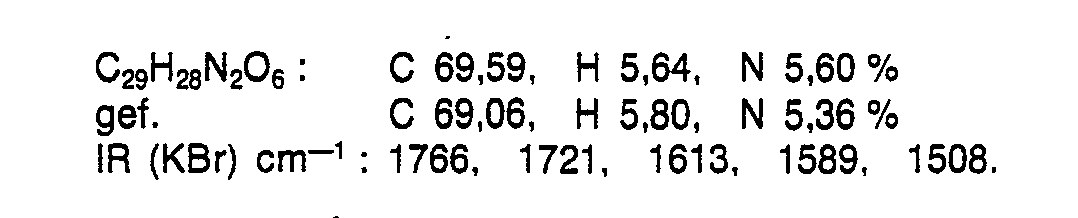
- 1 g (1,2: 3,4)-di-O-lsopropyliden-α-D-galacto-hexodialdo-1 ,5-pyranose (3,87 mMol) werden in 60 ml absolutem Methylenchlorid, enthaltend 5 g Molekularsieb 4 A, unter Rühren in einer Argonatmosphäre gelöst. Die Lösung wird bei Zimmertemperatur mit einer Lösung von 0,68 g 2,4-Dimethoxybenzylamin (4 mMol) in 10 ml Methylenchlorid tropfenweise behandelt. Die Lösung wird bei Zimmertemperatur 30 Minuten gerührt, anschliessend auf ―20° abgekühlt und mit 0,65 ml (0,47 g, 4,6 mMol) Triäthylamin behandelt und nach einigen Minuten mit einer Lösung von 0,8 g (0,40 mMol) Phthaloylglycylchlorid in 20 ml Methylenchlorid. Das Reaktionsgemisch wird auf Zimmertemperatur erwärmt und anschliessend 1,5 Stunden gerührt. Nach Filtration wird die erhaltene organische Lösung mit Wasser (2 mal 150 ml) und wässriger Kochsalzlösung (1 mal 100 ml) gewaschen und über Magnesiumsulfat getrocknet. Nach Eindampfen des Lösungsmittels und chromatographischer Reinigung an Kieselgel (230-400 mesh ; n-Hexan : Aethylacetat 1 : 1 als Lösungsmittel) erhält man 1,8 g (75 %) N-[cis-1-(2,4-Dimethoxybenzyl)-2-oxo-4-[(3aaH,8baH)-tetrahydro-2,2,7,7-tetramethyl-5H-bis [1,3] dioxolo [4,5-b : 4', 5'-d] pyran-5-yl]-3- azetidinyl]-phthalimid als Schaum. [α]D=―27° (c = 1 % in Methanol) MS: 594 (M+). IR 1767, 1722 cm-1 (KBr).
- 2,0 g (11,76 mMol) Cyclohexyliden-D-glyceraldehyd werden in 8 ml absolutem Methylenchlorid gelöst und bei Zimmertemperatur mit 2,06 g (12,35 mMol) 2,4-Dimethoxybenzylamin behandelt. Nach 30- minütigem Rühren wird das Reaktionsgemisch auf 0° abgekühlt und mit 1,96 ml (14,11 mMol) Triäthylamin und tropfenweise mit einer Lösung von 2,76 g (12,35 mMol) Phthaloylglycylchlorid in 4 ml Methylenchlorid behandelt. Das Reaktionsgemisch wird 12 Stunden bei Zimmertemperatur gerührt, anschliessend mit 100 ml Methylenchlorid verdünnt und nacheinander mit 30 ml Wasser, 30 ml 0,1 N wässriger Salzsäure, 30 ml Wasser und 30 ml wässriger Kochsalzlösung gewaschen und über Natriumsulfat getrocknet. Das Lösungsmittel wird abgedampft und der Rückstand an Kieselgel chromatographisch gereinigt (230-400 mesh ; Aethylacetat : n-Hexan 1 : 1 als Lösungsmittel). Man erhält 4,3 g (72%) N-[(3R,4R)-1-(2,4-Dimethoxybenzyl)-4-[(S)-1,4-dioxaspiro [4.5] dec-2-yl]-2-oxo-3-azetidinyl]-phthalimid, [a]D = -18° (c = 0,5 in Methanol).
-

- NMR (CDCI3)8 (ppm) : 1,2-1,6 (10H, m, (CH2)5), 3,35 (1H, dd, 6 und 9 Hz, H-4), 3,5-3,8 (2H, m, O―CH2) 3,81 und 3,82 (6H, 2s, 2 x OCH3), 4,20 (1 H, m, O-CH), 4,15 und 4,90 (2H, 2d, 14 Hz, N―CH2-Ar). 5,25 (1 H, d, 6 Hz, H3), 6,50 (2H, m, 2H Ar), 7,27 (1H. d, Ar), 7,85 (4H, m, Ar).
- MS : M+ : 506.
- Zu einer bei Raumtemperatur gerührten Lösung von 0,9 g (5,4 mMol) 3,4-Dimethoxybenzylamin in 100 ml Methylenchlorid gibt man 3 g Molekularsieb 4 Ä und nach 20 Minuten 0,7 (5,4 mMol) Isopropyliden-L-glyceraldehyd und 5 wasserfreies Magnesiumsulfat. Anschliessend rührt man noch während 1 Stunde bei Raumtemperatur. Die erhaltene organische Lösung von Isopropyliden-L-glyceraldehyd-(3,4-dimethoxybenzyl) imin wird unter Argon auf -20° gekühlt und unter Rühren mit 0,88 ml (5,4 mMol) Triäthylamin versetzt. Dann wird innerhalb 1 Stunde eine Lösung von 1,25 g (5,6 mMol) Phthaloylglycylchlorid in 20 ml trockenem Methylenchlorid zugetropft und anschliessend über Nacht bei Raumtemperatur weiter gerührt. Man arbeitet auf wie in Beispiel 1 beschrieben und erhält nach der Chromatographie 1,56 g (62 %) N-(3S,4S)-cis-1-(3,4-Dimethoxybenzyl)-4-[(R)-2,2-dimethyl-1,3-dioxolan-4-yl]-2-oxo-3-azetidinyl] phthalimid als Schaum ; [α]D = + 16,2° (c = 1,0 in Methanol) ;
- MS : 466 (M+).
-

- Zu einer bei Raumtemperatur gerührten Lösung von 670 mg (4 mMol) 2,4-Dimethoxybenzylamin in 70 ml Methylenchlorid gibt man 2,5 g Molekularsieb 4 A und nach 20 Minuten 660 mg (4 mMol) (S)-2-Benzyloxypropionaldehyd und 3,7 g wasserfreies Magnesiumsulfat. Anschliessend rührt man 1 Stunde bei Raumtemperatur. Die erhaltene Lösung wird in einer Argonatmosphäre auf -20° gekühlt und unter Rühren mit 0,65 ml (4 mMol) Triäthylamin versetzt. Dann wird innerhalb 1 Stunde eine Lösung von 930 mg (4,15 mMol) Phthaloylglycylchlorid in 15 ml trockenem Methylenchlorid zugetropft und anschliessend 12 Stunden bei Raumtemperatur weiter gerührt. Man arbeitet auf wie in Beispiel 1 beschrieben und erhält nach der Chromatographie 990 mg (50 %) N-[(3S,4S)-4-[(S)-1-(Benzyloxy) äthyl]-1-(2,4-dimethylbenzyl)-2-oxo-3-azetidinyl] phthalimid als Schaum. [a]D = + 44.6 (c = 1 in Chloroform).
- MS : = 500 (M+).
-
Claims (10)

und die entsprechenden optischen Antipoden davon.


und die entsprechenden optischen Antipoden davon.

und der entsprechenden optischen Antipoden, dadurch gekennzeichnet, dass man einen Aldehyd der allgemeinen Formel

oder den optischen Antipoden davon mit einem Amin der allgemeinen Formel


Applications Claiming Priority (4)
| Application Number | Priority Date | Filing Date | Title |
|---|---|---|---|
| CH552481 | 1981-08-27 | ||
| CH5524/81 | 1981-08-27 | ||
| CH392582 | 1982-06-25 | ||
| CH3925/82 | 1982-06-25 |
Related Parent Applications (1)
| Application Number | Title | Priority Date | Filing Date |
|---|---|---|---|
| EP82107790.6 Division | 1982-08-25 |
Publications (3)
| Publication Number | Publication Date |
|---|---|
| EP0156976A2 EP0156976A2 (de) | 1985-10-09 |
| EP0156976A3 EP0156976A3 (en) | 1986-06-04 |
| EP0156976B1 true EP0156976B1 (de) | 1987-09-30 |
Family
ID=25694185
Family Applications (2)
| Application Number | Title | Priority Date | Filing Date |
|---|---|---|---|
| EP84115022A Expired EP0156976B1 (de) | 1981-08-27 | 1982-08-25 | Optisch einheitliche Imine |
| EP82107790A Expired EP0073061B1 (de) | 1981-08-27 | 1982-08-25 | Optisch einheitliche Beta-Lactame, deren Herstellung und Verwendung bei der Herstellung von antimikrobiell wirksamen Beta-Lactamen sowie Vorprodukte verwendbar zu deren Herstellung |
Family Applications After (1)
| Application Number | Title | Priority Date | Filing Date |
|---|---|---|---|
| EP82107790A Expired EP0073061B1 (de) | 1981-08-27 | 1982-08-25 | Optisch einheitliche Beta-Lactame, deren Herstellung und Verwendung bei der Herstellung von antimikrobiell wirksamen Beta-Lactamen sowie Vorprodukte verwendbar zu deren Herstellung |
Country Status (15)
| Country | Link |
|---|---|
| US (3) | US4576751A (de) |
| EP (2) | EP0156976B1 (de) |
| KR (1) | KR880000432B1 (de) |
| AT (2) | ATE30017T1 (de) |
| AU (2) | AU555097B2 (de) |
| CA (1) | CA1262128A (de) |
| DE (2) | DE3275543D1 (de) |
| DK (1) | DK168433B1 (de) |
| ES (1) | ES515255A0 (de) |
| HU (1) | HU190697B (de) |
| IE (1) | IE53791B1 (de) |
| IL (1) | IL66619A0 (de) |
| NO (1) | NO159931C (de) |
| NZ (1) | NZ201660A (de) |
| PH (1) | PH21581A (de) |
Families Citing this family (21)
| Publication number | Priority date | Publication date | Assignee | Title |
|---|---|---|---|---|
| US4782147A (en) * | 1980-12-05 | 1988-11-01 | Takeda Chemical Industries, Ltd. | 1-sulfo-2-oxoazetidine derivatives and their production |
| US4572801A (en) * | 1981-04-30 | 1986-02-25 | Takeda Chemical Industries, Ltd. | 4-Carbamoyloxymethyl-1-sulfo-2-oxoazetidine derivatives and their production |
| AU564150B2 (en) * | 1982-04-30 | 1987-08-06 | Takeda Chemical Industries Ltd. | 1-sulfo-2-azetidinone derivatives |
| DE3372768D1 (de) * | 1982-06-03 | 1987-09-03 | Hoffmann La Roche | 1-sulfo-2-oxoazetidine derivatives |
| CA1204746A (en) * | 1982-08-19 | 1986-05-20 | Hoffmann-La Roche Limited | .beta. LACTAMS |
| US4663469A (en) * | 1982-12-09 | 1987-05-05 | Hoffman-La Roche Inc. | 4-hydroxy-l-threoninamides |
| US4502994A (en) * | 1982-12-09 | 1985-03-05 | Hoffmann-La Roche Inc. | Enantiomeric synthesis of 3-amino-4-carbamoyloxymethyl-2-azetidonone-1-sulfate |
| CA1251454A (en) * | 1983-01-20 | 1989-03-21 | Gerard Schmid | PROCESS FOR THE MANUFACTURE OF .beta.-LACTAMES |
| DK36784A (da) * | 1983-02-25 | 1984-08-26 | Hoffmann La Roche | Fremgangsmaade til fremstilling af chirale aldehyder |
| US4501697A (en) * | 1983-06-17 | 1985-02-26 | E. R. Squibb & Sons, Inc. | 4-[[(Amidomethyl)oxy]methyl]-2-oxo-1-azetidinesulfonic acid salts |
| DK411384A (da) * | 1983-10-03 | 1985-04-04 | Hoffmann La Roche | Fremgangsmaade til fremstilling af azetidinonderivater |
| EP0146735A1 (de) * | 1983-11-23 | 1985-07-03 | F. HOFFMANN-LA ROCHE & CO. Aktiengesellschaft | Optisch einheitliche beta-Lactame |
| JPS60139667A (ja) * | 1983-12-27 | 1985-07-24 | Takeda Chem Ind Ltd | アゼチジノンの製造法 |
| GB8717446D0 (en) * | 1987-07-23 | 1987-08-26 | Merck Sharp & Dohme | Chemical compounds |
| US4937331A (en) * | 1988-03-25 | 1990-06-26 | President And Fellows Of Harvard College | Chiral azetidinone epoxides |
| EP2197881B1 (de) * | 2007-09-17 | 2013-04-17 | Basilea Pharmaceutica AG | Verfahren zur herstellung verbrückter monobactamzwischenprodukte |
| UY34585A (es) | 2012-01-24 | 2013-09-02 | Aicuris Gmbh & Co Kg | Compuestos b-lactámicos sustituidos con amidina, su preparación y uso |
| CN103044416A (zh) * | 2012-12-17 | 2013-04-17 | 浙江华方药业有限责任公司 | 一种卡芦莫南钠的合成方法 |
| CN106164072B (zh) | 2014-03-24 | 2019-10-01 | 诺华股份有限公司 | 用于治疗细菌感染的单环内酰胺有机化合物 |
| ES2817537T3 (es) | 2015-09-23 | 2021-04-07 | Novartis Ag | Sales y formas sólidas de un antibiótico monobactámico |
| ES2912656T3 (es) | 2017-08-02 | 2022-05-26 | Novartis Ag | Proceso para preparar ácido 1-(((Z)-(1-(2-aminotiazol-4-il)-2-oxo-2-(((3S,4R)-2-oxo-4-((2-oxooxazolidin-3-il)metil)-1-sulfoacetidin-3-il)amino)etiliden)amino)oxi)ciclopropano carboxílico |
Family Cites Families (5)
| Publication number | Priority date | Publication date | Assignee | Title |
|---|---|---|---|---|
| DK194776A (da) * | 1975-05-05 | 1976-11-06 | Smithkline Corp | Antibakterielle midler og mellemprodukter dertil |
| GB1570278A (en) * | 1975-10-06 | 1980-06-25 | Fujisawa Pharmaceutical Co | O-substituted-2-azetidinone derivatives and the preparation thereof |
| JPS609514B2 (ja) * | 1976-08-05 | 1985-03-11 | 塩野義製薬株式会社 | 7−アミノ−3′−ノルセファロスポラン酸類 |
| US4202978A (en) * | 1978-02-08 | 1980-05-13 | Hoffmann-La Roche Inc. | (S)-1-[2-(4-(2-Hydroxy-s-(1-alkylaminopropoxy)phenylalkyl]-4-phenylpiperazines |
| US4473502A (en) * | 1981-04-08 | 1984-09-25 | Merck & Co., Inc. | Synthesis of thienamycin via (3SR, 4RS)-3-[1 (SR)-hydroxyethyl]-2-oxo-4-azetidineacetic acid |
-
1982
- 1982-07-29 CA CA000408343A patent/CA1262128A/en not_active Expired
- 1982-08-11 US US06/407,027 patent/US4576751A/en not_active Expired - Fee Related
- 1982-08-19 DK DK373082A patent/DK168433B1/da not_active IP Right Cessation
- 1982-08-20 NZ NZ201660A patent/NZ201660A/en unknown
- 1982-08-23 IL IL66619A patent/IL66619A0/xx not_active IP Right Cessation
- 1982-08-23 AU AU87523/82A patent/AU555097B2/en not_active Ceased
- 1982-08-24 HU HU822715A patent/HU190697B/hu not_active IP Right Cessation
- 1982-08-25 AT AT84115022T patent/ATE30017T1/de not_active IP Right Cessation
- 1982-08-25 EP EP84115022A patent/EP0156976B1/de not_active Expired
- 1982-08-25 AT AT82107790T patent/ATE25676T1/de active
- 1982-08-25 DE DE8282107790T patent/DE3275543D1/de not_active Expired
- 1982-08-25 EP EP82107790A patent/EP0073061B1/de not_active Expired
- 1982-08-25 DE DE8484115022T patent/DE3277410D1/de not_active Expired
- 1982-08-26 ES ES515255A patent/ES515255A0/es active Granted
- 1982-08-26 PH PH27783A patent/PH21581A/en unknown
- 1982-08-26 NO NO822902A patent/NO159931C/no unknown
- 1982-08-26 IE IE2067/82A patent/IE53791B1/en not_active IP Right Cessation
- 1982-08-27 KR KR8203877A patent/KR880000432B1/ko not_active Expired
-
1985
- 1985-08-26 US US06/769,634 patent/US4699986A/en not_active Expired - Lifetime
- 1985-08-26 US US06/769,536 patent/US4617150A/en not_active Expired - Fee Related
-
1986
- 1986-03-12 AU AU54671/86A patent/AU576951B2/en not_active Ceased
Also Published As
| Publication number | Publication date |
|---|---|
| AU576951B2 (en) | 1988-09-08 |
| NO822902L (no) | 1983-02-28 |
| IE822067L (en) | 1983-02-27 |
| ES8401935A1 (es) | 1984-01-16 |
| ES515255A0 (es) | 1984-01-16 |
| EP0156976A3 (en) | 1986-06-04 |
| IL66619A0 (en) | 1982-12-31 |
| EP0073061A2 (de) | 1983-03-02 |
| HU190697B (en) | 1986-10-28 |
| IE53791B1 (en) | 1989-02-15 |
| AU8752382A (en) | 1983-03-03 |
| KR880000432B1 (ko) | 1988-03-24 |
| PH21581A (en) | 1987-12-11 |
| NZ201660A (en) | 1986-01-24 |
| AU555097B2 (en) | 1986-09-11 |
| KR840001135A (ko) | 1984-03-28 |
| ATE25676T1 (de) | 1987-03-15 |
| NO159931B (no) | 1988-11-14 |
| US4699986A (en) | 1987-10-13 |
| DE3277410D1 (en) | 1987-11-05 |
| AU5467186A (en) | 1986-07-31 |
| EP0156976A2 (de) | 1985-10-09 |
| EP0073061A3 (en) | 1983-06-15 |
| ATE30017T1 (de) | 1987-10-15 |
| NO159931C (no) | 1989-02-22 |
| DE3275543D1 (en) | 1987-04-09 |
| US4617150A (en) | 1986-10-14 |
| DK168433B1 (da) | 1994-03-28 |
| DK373082A (da) | 1983-02-28 |
| US4576751A (en) | 1986-03-18 |
| EP0073061B1 (de) | 1987-03-04 |
| CA1262128A (en) | 1989-10-03 |
Similar Documents
| Publication | Publication Date | Title |
|---|---|---|
| EP0156976A2 (de) | Optisch einheitliche Imine | |
| DE69428280T2 (de) | Verfahren zur herstellung von azetidinonen | |
| DE69201058T2 (de) | Perhydroisoindol derivate und ihre herstellung. | |
| DE3788463T2 (de) | 3-Beta-(3,4-disubstituiertes succinimido)azetidinone. | |
| DE60204334T2 (de) | Verfahren zur Herstellung von Repaglinid | |
| DE69731005T2 (de) | Verfahren zu Herstellung von Taxol | |
| DE2740280A1 (de) | 7-acylamino-8-oxo-3-oxa-1-azabicyclo eckige klammer auf 4.2.0 eckige klammer zu octan-2-carbonsaeure-derivate | |
| JPS6226258A (ja) | 光学的に均一な化合物及びその製造方法 | |
| DE69502772T2 (de) | Baccatinderivate und Verfahren zu ihrer Herstellung | |
| DE69839056T2 (de) | Stereoisomere indolderivate, verfahren zu ihrer herstellung und ihre verwendung | |
| JPS6058920B2 (ja) | セフアロスポリン類縁体 | |
| EP0116854B1 (de) | Verfahren zur Herstellung von optisch einheitlichen 2-Azetidinon-Derivaten | |
| CH617205A5 (de) | ||
| EP0120289B1 (de) | Verfahren zur Herstellung von chiralen B-Lactamen | |
| DE3850977T2 (de) | Verfahren zur Herstellung von Azetidinonen. | |
| EP0146735A1 (de) | Optisch einheitliche beta-Lactame | |
| US5142066A (en) | Stereoselective process for the preparation of 2-amino-ethanol derivatives having a central analgesic activity and intermidiates thereof | |
| DE69911274T2 (de) | Verfahren zur Herstellung von 2-Aryl-5-(perflouralkyl)pyrrolderivaten aus N-(Arylmethylen)-1-chlor-1-(perfluoroalkyl)methylaminderivaten | |
| CH641448A5 (de) | Verfahren zur herstellung von beta-lactamen. | |
| IE53792B1 (en) | Optically uniform imines | |
| EP0539330B1 (de) | Verfahren zur Herstellung substituierter Indole | |
| US5559237A (en) | Process for preparation of 2-oxo-1-piperidinyl derivatives | |
| DE3844978B4 (de) | Verfahren zur Herstellung von (cis)-4-Hydroxy-4-phenyl-L-prolin-Derivaten | |
| DE69327092T2 (de) | Optisch aktives 1-phenylpyrrolidonderivat und dessen herstellung | |
| HU193730B (en) | New process for preparing azetidinones |
Legal Events
| Date | Code | Title | Description |
|---|---|---|---|
| PUAI | Public reference made under article 153(3) epc to a published international application that has entered the european phase |
Free format text: ORIGINAL CODE: 0009012 |
|
| 17P | Request for examination filed |
Effective date: 19841211 |
|
| AC | Divisional application: reference to earlier application |
Ref document number: 73061 Country of ref document: EP |
|
| AK | Designated contracting states |
Designated state(s): AT BE CH DE FR GB IT LI LU NL SE |
|
| PUAL | Search report despatched |
Free format text: ORIGINAL CODE: 0009013 |
|
| AK | Designated contracting states |
Kind code of ref document: A3 Designated state(s): AT BE CH DE FR GB IT LI LU NL SE |
|
| 17Q | First examination report despatched |
Effective date: 19861218 |
|
| GRAA | (expected) grant |
Free format text: ORIGINAL CODE: 0009210 |
|
| AC | Divisional application: reference to earlier application |
Ref document number: 73061 Country of ref document: EP |
|
| AK | Designated contracting states |
Kind code of ref document: B1 Designated state(s): AT BE CH DE FR GB IT LI LU NL SE |
|
| REF | Corresponds to: |
Ref document number: 30017 Country of ref document: AT Date of ref document: 19871015 Kind code of ref document: T |
|
| ITF | It: translation for a ep patent filed | ||
| REF | Corresponds to: |
Ref document number: 3277410 Country of ref document: DE Date of ref document: 19871105 |
|
| GBT | Gb: translation of ep patent filed (gb section 77(6)(a)/1977) | ||
| ET | Fr: translation filed | ||
| PLBE | No opposition filed within time limit |
Free format text: ORIGINAL CODE: 0009261 |
|
| STAA | Information on the status of an ep patent application or granted ep patent |
Free format text: STATUS: NO OPPOSITION FILED WITHIN TIME LIMIT |
|
| 26N | No opposition filed | ||
| ITPR | It: changes in ownership of a european patent |
Owner name: CESSIONE;F. HOFFMANN - LA ROCHE AG |
|
| NLS | Nl: assignments of ep-patents |
Owner name: F. HOFFMANN-LA ROCHE AG TE BAZEL, ZWITSERLAND. |
|
| REG | Reference to a national code |
Ref country code: FR Ref legal event code: TP |
|
| REG | Reference to a national code |
Ref country code: CH Ref legal event code: PUE Owner name: F. HOFFMANN-LA ROCHE AG |
|
| REG | Reference to a national code |
Ref country code: GB Ref legal event code: 732 |
|
| ITTA | It: last paid annual fee | ||
| EPTA | Lu: last paid annual fee | ||
| PGFP | Annual fee paid to national office [announced via postgrant information from national office to epo] |
Ref country code: GB Payment date: 19940719 Year of fee payment: 13 |
|
| PGFP | Annual fee paid to national office [announced via postgrant information from national office to epo] |
Ref country code: BE Payment date: 19940722 Year of fee payment: 13 |
|
| PGFP | Annual fee paid to national office [announced via postgrant information from national office to epo] |
Ref country code: LU Payment date: 19940801 Year of fee payment: 13 |
|
| PGFP | Annual fee paid to national office [announced via postgrant information from national office to epo] |
Ref country code: FR Payment date: 19940810 Year of fee payment: 13 |
|
| PGFP | Annual fee paid to national office [announced via postgrant information from national office to epo] |
Ref country code: CH Payment date: 19940815 Year of fee payment: 13 |
|
| PGFP | Annual fee paid to national office [announced via postgrant information from national office to epo] |
Ref country code: SE Payment date: 19940817 Year of fee payment: 13 |
|
| PGFP | Annual fee paid to national office [announced via postgrant information from national office to epo] |
Ref country code: DE Payment date: 19940819 Year of fee payment: 13 |
|
| PGFP | Annual fee paid to national office [announced via postgrant information from national office to epo] |
Ref country code: NL Payment date: 19940831 Year of fee payment: 13 Ref country code: AT Payment date: 19940831 Year of fee payment: 13 |
|
| EAL | Se: european patent in force in sweden |
Ref document number: 84115022.0 |
|
| PG25 | Lapsed in a contracting state [announced via postgrant information from national office to epo] |
Ref country code: LU Free format text: LAPSE BECAUSE OF NON-PAYMENT OF DUE FEES Effective date: 19950825 Ref country code: GB Effective date: 19950825 Ref country code: AT Effective date: 19950825 |
|
| PG25 | Lapsed in a contracting state [announced via postgrant information from national office to epo] |
Ref country code: SE Effective date: 19950826 |
|
| PG25 | Lapsed in a contracting state [announced via postgrant information from national office to epo] |
Ref country code: LI Effective date: 19950831 Ref country code: CH Effective date: 19950831 Ref country code: BE Effective date: 19950831 |
|
| BERE | Be: lapsed |
Owner name: F. HOFFMANN-LA ROCHE A.G. Effective date: 19950831 |
|
| PG25 | Lapsed in a contracting state [announced via postgrant information from national office to epo] |
Ref country code: NL Effective date: 19960301 |
|
| REG | Reference to a national code |
Ref country code: CH Ref legal event code: PL |
|
| GBPC | Gb: european patent ceased through non-payment of renewal fee |
Effective date: 19950825 |
|
| PG25 | Lapsed in a contracting state [announced via postgrant information from national office to epo] |
Ref country code: FR Effective date: 19960430 |
|
| NLV4 | Nl: lapsed or anulled due to non-payment of the annual fee |
Effective date: 19960301 |
|
| PG25 | Lapsed in a contracting state [announced via postgrant information from national office to epo] |
Ref country code: DE Effective date: 19960501 |
|
| EUG | Se: european patent has lapsed |
Ref document number: 84115022.0 |
|
| REG | Reference to a national code |
Ref country code: FR Ref legal event code: ST |